South Dakota Department of Revenue Tax Guides & Bulletins
South Dakota Sales/Use Tax Guide — Restaurants and Bars
Bars and Restaurants https://dor.sd.gov/ 1-800-829-9188
The purpose of this tax fact is to explain how South Dakota use tax applies to restaurants February 2026 and bars. It is not intended to answer all questions that may arise. The information contained in this fact sheet is current as of the date of publication.
# Sales of Food and Beverage
Text version of this table
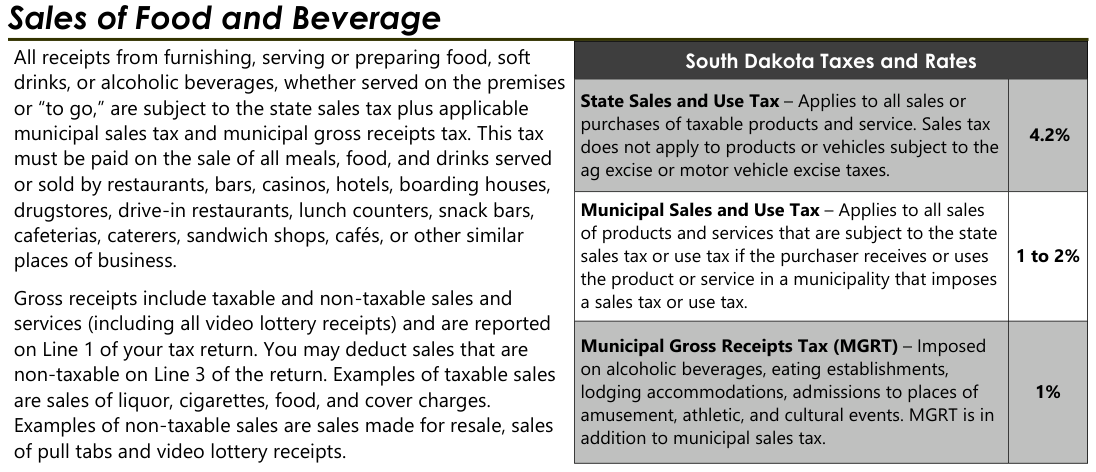
All receipts from furnishing, serving or preparing food, soft drinks, or alcoholic beverages, whether served on the premises or “to go,” are subject to the state sales tax plus applicable municipal sales tax and municipal gross receipts tax. This tax must be paid on the sale of all meals, food, and drinks served or sold by restaurants, bars, casinos, hotels, boarding houses, drugstores, drive-in restaurants, lunch counters, snack bars, cafeterias, caterers, sandwich shops, cafés, or other similar places of business. Gross receipts include taxable and non-taxable sales and services (including all video lottery receipts) and are reported on Line 1 of your tax return. You may deduct sales that are non-taxable on Line 3 of the return. Examples of taxable sales are sales of liquor, cigarettes, food, and cover charges. Examples of non-taxable sales are sales made for resale, sales of pull tabs and video lottery receipts. South Dakota Taxes and Rates State Sales and Use Tax – Applies to all sales or purchases of taxable products and service. Sales tax does not apply to products or vehicles subject to the ag excise or motor vehicle excise taxes. 4.2% Municipal Sales and Use Tax – Applies to all sales of products and services that are subject to the state sales tax or use tax if the purchaser receives or uses the product or service in a municipality that imposes a sales tax or use tax. 1 to 2% Municipal Gross Receipts Tax (MGRT) – Imposed on alcoholic beverages, eating establishments, lodging accommodations, admissions to places of amusement, athletic, and cultural events. MGRT is in addition to municipal sales tax. 1%
Bars are allowed to back tax out of their gross receipts. For example, a drink is sold for $3.00 which includes tax. At a 4.2% rate, the gross receipts subject to tax are $2.88 ($3.00/1.042). All other businesses must clearly state to the customer that tax is included in the price to be able to include taxes in the posted price.
On two-for-one drink promotions, no use tax is due on the cost of the "free drink" as gross receipts have been reported on the sale. For events such as "Ladies Night" where, for example, the customer pays $2.00 at the door and drinks all night, the bar's gross receipts would be $2.00 no matter how much the customer consumes. Bars are not allowed to sell alcohol below their cost.
# Employee Meals
The receipts from the sale of meals to employees are subject to state sales tax, the municipal sales tax and municipal gross receipts tax. The cost of meals furnished to employees or others at no charge are subject to state use tax, plus the municipal sales tax.
# Tips
Tips received as discretionary gifts to waiters, waitresses, or bartenders are not subject to sales tax.
Some businesses collect the tips for their employees. If the tip is added to the bill and is a mandatory charge for services, it is subject to the sales tax. For example, if a restaurant serves a dinner to an organization and adds a 15% tip when the organization is billed, the entire charge, including the tip, is subject to the sales tax. If the tips collected by the business are voluntary tips paid by the customer, the tip is not subject to sales tax. A restaurant may retain a fee for the credit card processing from the voluntary tips given to the staff. The fee retained for credit card processing is included in the restaurant's taxable receipts.
# Sales for Resale
Food and other similar items that are sold to a customer may be purchased by the restaurant or bar from its supplier as a "sale for resale." The business does not pay sales tax to the supplier at the time of the purchase, but must furnish the supplier with a valid exemption certificate.
Tour guides and promoters are required to pay sales tax on meals purchased for tourists and clients.
Exemption certificates should be reviewed annually. Exemption certificates may be obtained from our website at https:// dor.sd.gov or by calling 1-800-829-9188.
# Sales to Governments and Exempt Entities
Sales made directly to and for use by the U.S. Government or the State of
South Dakota and its counties, cities, townships, or school districts are not subject to the sales tax.
The purchase must be made with government funds. An exemption certificate or proof that payment was made with government funds must be kept by the seller as documentation of the exemption.
Sales made to other exempt organizations are not subject to the sales tax.
However, the organization must provide the seller restaurant with an exemption certificate and number. The purchase must be paid by an authorized representative with a voucher that states that the purchase is for the organization's own use.
# Coupons
The purchase must be paid directly from the funds of the organization.
NOTE: Purchases made by individuals are not exempt from the sales tax, even if the individual is reimbursed later. This includes high school ball players, cheerleaders, state and federal employees, city council representatives, or teachers who purchase their own meals.
Retailer or store coupons are discounts or reductions given by a retailer at the time
Retailer/Coupon Example: of sale. Because the retailer is not reimbursed by a third party for this amount, this discount is not subject to sales tax. To calculate tax on this sale, deduct the value of the coupon from the sales price of the item then calculate the tax.
Manufacturer Example:
Widget $200.00
Tax $8.40
Manufacturer's coupons
Manufacturer's - $20.00
Discount
Widget $200.00
Store Discount - $20.00
Sub Total $180.00
Tax $7.56
Total Due $187.56
$180.00 is reported as gross receipts on this transaction.
The manufacturer reimburses the seller for the value of the coupon. Because the retailer
Total Due $188.40 receives reimbursement, the value of the coupon is part of the selling price and is subject to sales tax if the item sold is taxable. To calculate tax on this sale, calculate tax $200.00 is reported as gross receipts on this transaction. on the sales price of the item then deduct the coupon value.
# Cigarettes
Receipts from the sale of cigarettes are subject to state sales tax plus applicable municipal sales tax.
Taxable Receipts include:
Amounts received from customers from the retail sale of cigarettes are subject to sales tax.
•
Amounts received from the manufacturer if the payment is directly related to a discount the retailer must
- provide to the purchaser when the purchaser is the end consumer and one of the following criteria is met:
The retailer shows the discount on the invoice as a discount from a manufacturer or third party; a. b. The purchaser presents a coupon issued by a third party that indicates the third party will reimburse any retailer for the discount.
# Cigarettes (cont.)
Examples:
- ABC Quick Stop sells a carton of cigarettes for $32.00. The manufacturer reimburses the store $2.00 for each carton of cigarettes sold. The store is required to pass this discount to the customer.
A. If the discount is listed as a manufacturer's discount, the store will include the $2.00 in their taxable receipts.
Invoice A
Cigarettes $32.00
Sub Total $32.00
Tax $1.34
Manufacturer Discount -$2.00
Total $31.34
B. If the store does not list this as a manufacturer's discount, the store does not owe tax on the $2.00 received from the manufacturer.
Invoice B
Cigarettes $32.00
Manufacturer Discount -$2.00
Sub Total $30.00
Tax $1.26
Total $31.26
- ABC Quick Stop sells a carton of cigarettes for $30.00. ABC owes sales tax on the $30.00. ABC has signed a contract with the manufacturer stating they will put their cigarettes on the shelf nearest the cash register (most visible site) in return for $2.00 for each carton of cigarettes sold.
Because the $2.00 is for placement of a product pursuant to a written contract, ABC does not owe sales tax
- on the $2.00.
# Displays and Signage
Payments received by a retailer from a manufacturer, wholesaler, or distributor pursuant to a written contract between the retailer and manufacturer, wholesaler, or distributor that requires the retailer to display the manufacturer, wholesaler, or distributor's product or signage in a specified manner or location are exempt from sales tax.
# Vending Machines
Examples:
- ABC Supply receives a cash payment for placing XYZ Softdrinks' products on the third shelf in the soft drink aisle.
- XYZ Softdrinks offers retailers cash payments if the retailer sells soft drinks supplied only by
XYZ Softdrinks.
The gross receipts from vending machines are subject to the state sales tax, plus applicable municipal sales tax. Gross receipts from vending machines that serve prepared food, such as hot soup, coffee, or hot chocolate, are also subject to the municipal gross receipts tax. If a vending machine sells prepared food and other items, the municipal gross receipts tax will apply to all receipts unless documentation is kept to show the products sold. Gross receipts from vending machines located outside municipal limits are subject to state sales tax only.
The purchase of vending machines is subject to state sales tax, plus the municipal sales tax. Machines brought into South Dakota from other states are subject to use tax, however credit will be allowed for sales or use tax paid in the state the machine was originally used in.
Owners of these machines who place them in another person's business are considered retailers. They must have a sales tax license, and report and pay sales tax on the gross receipts from these machines. Businesses do not owe sales or use tax on commissions they receive from receipts of vending machines owned and operated by others.
See the Amusement Devices Tax Fact for information on how taxes apply to amusement devices.
# Jukebox License
Businesses that play music generally are required to be licensed by national performing rights organizations. Contact BMI (1-800-669-4264) and ASCAP (1-800-910-7347, extension 36) regarding licensing fees for playing copyrighted music, or for an explanation of this system.
# Franchise Operations
Most services provided by a franchisor to a franchisee are subject to sales tax. For more information, view the Franchise Tax Fact Sheet on our website at https:// dor.sd.gov or request a copy by calling the department at 1-800-829-9188.
# Use Tax
Equipment and supplies used by restaurants are subject to sales tax when purchased. If the supplier does not charge sales tax, use tax is due. In addition, items purchased with the intent to resell which are removed from inventory for use by the restaurant or bar are also subject to use tax.
Use tax is the same rate as sales tax and both state and any applicable municipal taxes apply.
Examples of Use Taxable Items:
Air filter systems Microwave pizza ovens
- •
Appliances Newspaper subscriptions
- •
Ashtrays Office supplies
- •
Bands Online service fees
- •
Banners Paper towels/napkins
- •
Barstools Pitchers
- •
Bookkeeping fees Placemats
- •
Can liners Poker chips
- •
Cards Popcorn (if furnished
- • free)
Cash registers
•
Popcorn machines
•
Chairs
•
Posters
•
Cleaning service
•
Pourers
•
Cleaning supplies
•
Serving trays
•
Coin counters
•
Signs
•
Computer system
•
Sink brushes
•
Cooking utensils
•
CO used to dispense soda pop is NOT subject to use tax at the time the business purchases it since it becomes part of the pop, which is taxed. CO2 used for dispensing beer is subject to sales or use tax since it is a catalyst that transports the beer out of the keg and does not become part of the beer.
# Municipal Tax
Many municipalities in South Dakota have a sales and use tax in addition to the state sales tax. If the customer Software • Coolers • Sound system • Dance wax • Stir sticks/straws/sword • Dice and cups
- picks
Disposable eating
•
Tables
- utensils
Tableware
•
Glassware
•
Toilet paper
•
Glass washers
•
Uniforms
•
Keg taps
•
Vending machines
•
Magazine subscriptions
•
Menus
- receives a product or service in one of these municipalities, the product or service is subject to that municipality's sales tax.
Municipalities may also have a gross receipts tax The municipal gross receipts tax (also referred to as the bed, board, and booze tax) is in addition to the municipal sales tax. The gross receipts tax can be imposed on alcoholic beverages, eating establishments, lodging accommodations, ticket sales, and admissions to places of amusement, or athletic and cultural events.
A list of municipal tax rates is available on our website at https://dor.sd.gov or by calling 1-800-829-9188.
Restaurants and bars must remit the municipal gross receipts tax (if applicable for that municipality) for all sales of food and beverages, admissions, and cover charges.
The municipal use tax applies to snacks, meals, or beverages that are given away free of charge. The municipal sales tax also applies to purchases of supplies and equipment.
# Advertising
which is prepared by an advertising agency and placed by that agency in the media is exempt from sales tax.
In addition, charges by a newspaper, radio or television station for placement of an ad are exempt.
All other advertising charges are subject to sales tax. Examples of taxable advertising are brochures, signs, posters, and promotional items given free of charge to customers.
# Promotional and Donated Items
Items purchased for promotional purposes are use taxable if sales tax was not paid at the time of purchase. These may include t-shirts, Frisbees, caps, liquor samples, etc., which are given away. Use tax is also due on items an employee or owner withdraws from inventory for personal use.
Merchandise (such as food or beverages) taken out of inventory and donated to a sales tax exempt agency is not subject to sales or use tax. A group is not exempt just because it is described as "nonprofit", the group must hold a valid South Dakota exemption number. To find out if a group is sales tax exempt, contact the department at 1-800-829-9188.
Use tax plus the municipal use tax is due on the cost of meals and drinks given free of charge to customers.
# Containers
Examples:
- Steve's Family Restaurant donates food for the
Washington Elementary School PTA meeting.
Since the PTA is not a sales tax exempt organization,
- the restaurant owes use tax on the cost of the donated food.
- The VFW offers pull tabs to customers with the purchase of a drink. The pull tabs give the customer either a free drink or $.25 off the next drink.
The free drink is use taxable to the bar at their cost.
•
The $.25 would just lower the gross receipts by $.25, therefore no use tax is due. If the supplier doesn't charge the VFW sales tax on the pull tabs, they would owe use tax on the purchase price of the pull tabs. Drinks given away by the owner or employees to customers are use taxable on the cost of the drink.
Examples of Containers:
Containers used for food or beverages are exempt from sales tax if they are used to hold items which are
Examples of Items that
ARE Subject to Sales
Paper cups and lids
- sold by the restaurant or bar and which are subject to
Tax:
Wrapping paper
- the sales tax, such as coffee, sandwiches, french fries, or Styrofoam containers
- soft drinks. The container must be given free of charge
Napkins
•
Paper or plastic bags
- and as a convenience to the customer. This is also true
Straws
•
Tape
- for an off-sale business purchasing bags. Paper or
Utensils
•
Doggie bags
- plastic bags are not subject to sales or use tax.
Reusable plates, trays,
•
Pizza boxes and liners
- or baskets
Disposable food trays
•
Delivery Services
Companies that sell and deliver prepared food can buy the food for resale by providing an exemption certificate to the restaurant. The sale of food, plus delivery charge is subject to state sales tax, the municipal sales and municipal gross receipts tax.
The delivery company hired by a restaurant to deliver meals sold by the restaurant is providing a transportation service that is exempt from sales tax.
Catering
Catering services are subject to state sales tax, the municipal sales, and municipal gross receipts tax rate based on the location of the catered event. A South Dakota restaurant that caters an event in North Dakota does not need to report South Dakota sales tax on the receipts from the event.
Catering services may purchase food and disposable plates, glasses, cups, and trays for resale. Napkins and utensils are subject to sales or use tax when purchased.
Keg/Tapper Deposits
Tax is due on deposits according to the accounting method used by the business when reporting and paying state sales or use taxes. Cash reporters include the deposit amount in their gross sales during the period the deposit is received. Accrual reporters include the deposit amount in their gross sales during the period when billed or when recorded in the business's books and records.
Live Entertainment
Entertainment services are subject to sales tax. If you hire a band, comedian, dancer, or any other type of performer that is not an employee on your payroll, the entertainer should charge sales tax on the entire receipts for entertainment services. If an entertainer does not have a sales tax license or does not charge sales tax, the purchaser of the entertainer's services is subject to use tax. If admission or a cover is charged, the admission or cover charge is subject to tax and the entertainer(s) may be given an exemption certificate.
Hors D'oeuvre
Food that is given away is subject to state use tax, plus the municipal use tax on the cost of the food. If a charge is made for the food, the receipts are subject to state sales tax, the municipal sales and municipal gross receipts tax.
# Bad Checks/Bad Debts
Gift Certificates
No sales tax should be charged on gift certificates at the time the gift certificate is sold. Tax should be charged on items purchased with a gift certificate. If an individual has a gift certificate valued at $50, and purchases $55 worth of goods, sales tax is owed on the $55. If the customer uses the $50 gift certificate to purchase $25 worth of goods and receives change, sales tax is owed on the $25 purchase.
Sales of gift certificates are included in gross sales on line one of the sales tax return and deducted on line 3, Non-Taxable Sales.
Most restaurants and bars report tax on a cash basis, that is the amount of money collected during the month is the amount reported as gross receipts. If a customer's check is returned from the bank unpaid, and the restaurant or bar reports on a cash basis, the amount of the customer's check is not included in the gross receipts reported by the restaurant or bar for the month. The collection of the nonsufficient funds check must be included on the sales tax return when payment is received.
Bars and restaurants reporting on the accrual basis may take checks, which are returned unpaid because of nonsufficient funds or no account that are not collected by them, as a reduction in gross receipts. If the nonsufficient funds check is deducted then later collected, the collection of the nonsufficient funds check must be included on the next sales tax return.
Amounts written off as bad debts with the IRS may be deducted from the sales tax return during the twelve months following the IRS write-off if those amounts were previously reported as taxable transactions.
Bad check fees or penalties charged by a restaurant, bar, or any other retailer are not subject to sales tax.
# Alcohol Licenses
You must have the proper alcoholic beverage license and a sales tax license to legally sell alcoholic beverages or purchase alcoholic beverages for resale. The sales tax license and the alcoholic beverage license must be in the same owner's name.
To apply for a new alcoholic beverage license contact your county auditor or city finance officer for availability of licenses, the cost and the process for obtaining a license.
If an alcoholic beverage license is being transferred to new ownership, the seller and buyer must fill out the necessary forms from the city finance office or county auditor in which the property is located. The license will not be transferred until:
The seller has filed a final sales tax return and paid all taxes due; and
The new owner has obtained a sales tax license in the same owner's name as the alcoholic beverage license will be held.
The city or county will conduct public hearings to act on license applications and license transfers. If approved, the application is sent to the Department of Revenue to issue or transfer the license.
For additional information on types of alcoholic beverage licenses and age restrictions, visit our website at https:// dor.sd.gov.
# Legal Age to Sell and Serve
No person under 21 years old may sell, serve, or dispense alcoholic beverages. However, a person 18 years or older may sell or serve alcoholic beverages if:
- less than 50% of the gross business transacted by the establishment is from the sale of alcohol;
OR
- the licensee or an employee that is at least 21 years old is on the premises when the alcohol is sold or served.
The exception allowing a person 18 years or older to sell or serve alcoholic beverages includes tending bar or drawing, pouring, or mixing alcoholic beverages, only if the person has been certified by a nationally recognized alcohol management program (SDCL 35-4-79.4). Under no circumstances may any person under 18 years old sell, serve, or dispense alcoholic beverages.
# Legal Age to Purchase and Consume
The legal age to purchase and consume alcohol in South Dakota is 21 years old.
- It is legal to sell alcohol to 18 to 20 year olds if they are in the immediate presence of a parent, guardian, or spouse who is over 21 years old. It is legal to refuse to serve anyone under 21 years old.
- It is illegal to serve alcohol to anyone under 18 years old, even if accompanied by a parent, guardian, or spouse who is over 21 years old.
- It is illegal for a person less than 21 years old to loiter on the licensed premises of an alcoholic beverage licensee.
# Recordkeeping Requirements
Restaurant and bar owners must have a South Dakota sales tax license for each place of business in the state. Even outlets located in the same county or the same town must have separate licenses.
Contact Us
If you have any questions, please contact the South Dakota Department of Revenue.
Call toll-free: 1-800-829-9188
Business Tax Division Email: bustax@state.sd.us
Website: https://dor.sd.gov/
Mailing address and office location: South Dakota Department of Revenue
445 East Capitol Ave
Pierre, SD 57501
Source: view the official PDF
Nearby sections (19 sections)
- hotels-motels-campgrounds · South Dakota Sales/Use + Tourism Tax Guide…
- internet-services · South Dakota Sales/Use Tax Guide — Internet /…
- landscaping · South Dakota Sales/Use Tax Guide — Landscaping
- license-requirements · South Dakota License Requirements — Sales/Use…
- manufacturing · South Dakota Sales/Use Tax Guide — Manufacturing
- marketplace-provider-bulletin · South Dakota Marketplace Provider Sales…
- metal-mining · South Dakota Sales/Use Tax Guide — Metal Mining
- motor-vehicle-sales-purchases · South Dakota Motor Vehicle Sales and…
- prepared-food · South Dakota Sales/Use Tax — Prepared Food Guide
- property-tax-101 · South Dakota Property Tax 101 — Overview
- real-estate · South Dakota Sales/Use Tax Guide — Real Estate
- remote-seller-bulletin · South Dakota Remote Seller (Wayfair) Sales Tax…
- restaurants-and-bars · South Dakota Sales/Use Tax Guide — Restaurants…
- sales-use-tax-guide · South Dakota Sales and Use Tax Guide — master…
- self-contractors · South Dakota Sales/Use + Contractors' Excise Tax…
- taxpayer-bill-of-rights · South Dakota Taxpayer Bill of Rights
- tourism-tax · South Dakota Tourism Tax Guide
- use-tax-business · South Dakota Use Tax Guide — Business
- use-tax-individual · South Dakota Use Tax Guide — Individual