Michigan Department of Treasury Form Instructions
Form 6074 — Michigan Schedule of Tiered Entities (Flow-Through Entity) & Instructions
6074 (06-25)
Reset Form
Attachment 37
# MICHIGAN Schedule of Tiered Entities
This form must be completed if an indirect credit is claimed on Form 6072, Michigan Schedule FTE, Part 2. Complete a separate table for each indirect credit. Each chain of ownership to a credit-generating entity (CGE) should be reported as a separate credit. If more rows are needed to report an indirect credit, continue on additional tables and leave the CGE row blank. If more than three tables are needed, complete additional forms.
Filer's Name Shown on Tax Return Identifying Number
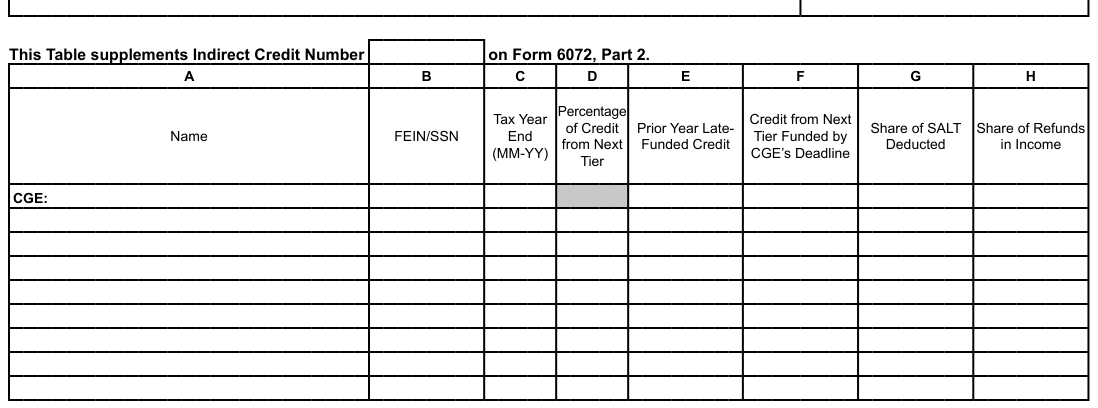
Text version of this table
| This Table supplements Indirect Credit Number | CGE: on Form 6072, Part 2. | ||||||
| A | B | C | D | E | F | G | H |
| Name | FEIN/SSN | Tax Year End (MM-YY) | Percentage of Credit from Next Tier | Prior Year Late- Funded Credit | Credit from Next Tier Funded by CGE’s Deadline | Share of SALT Deducted | Share of Refunds in Income |
| CGE: |
- 0000 2025 45 01 27 4 on Form 6072, Part 2.
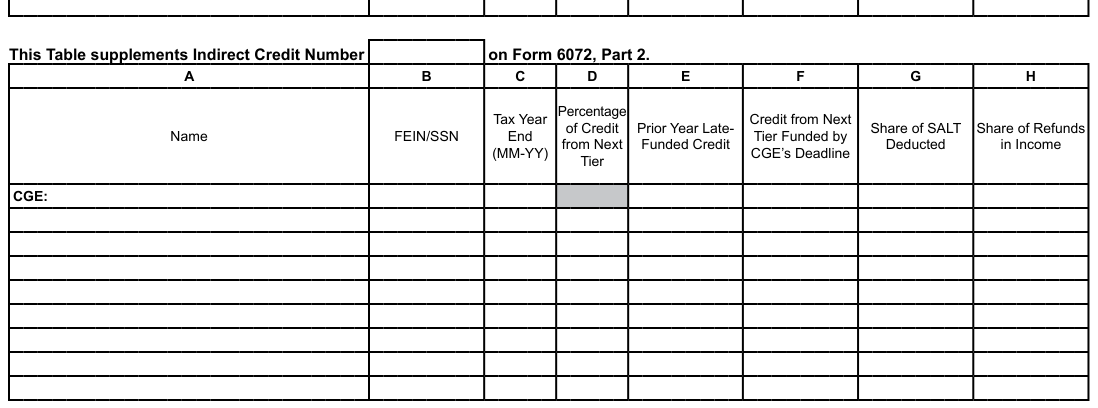
Text version of this table
| This Table supplements Indirect Credit Number | on Form 6072, Part 2. | ||||||
| A | B | C | D | E | F | G | H |
| Name | FEIN/SSN | Tax Year End (MM-YY) | Percentage of Credit from Next Tier | Prior Year Late- Funded Credit | Credit from Next Tier Funded by CGE’s Deadline | Share of SALT Deducted | Share of Refunds in Income |
| CGE: |
# Instructions for Form 6074, MICHIGAN Schedule of Tiered Entities
Purpose
For 2025 and future tax years this form allows an eligible taxpayer to report an indirect credit for their allocated share of tax paid by an electing flow-through entity. By electing to file annual returns and pay the Michigan Flow-Through Entity (FTE) tax, the electing flowthrough entity's indirect members become eligible to claim a credit for the member's allocated share of that FTE tax. Taxpayers are also required to report on this form an addition and a subtraction of their allocated share of: (1) Michigan FTE taxes paid by an electing flowthrough entity, to the extent they reduced the filer's adjusted gross income (AGI), and (2) a refund of Michigan FTE tax received by an electing flow-through entity to the extent it increased the filer's AGI.
This Form reports FTE tax credits and adjustments that were generated by the filer's indirect ownership in a credit-generating entity (CGE) through one or more other flow-through entities and regardless of whether any of those other entities also elected into the FTE tax. For this purpose, "other flow-through entity" includes a fiduciary (trust or estate), which is not permitted to elect into the FTE tax.
Complete this Form before completing Form 6072. Information reported on this form must be carried to Form 6072, Part 2, as directed in these instructions. If Form 6074 does not accompany Form 6072, Part 2, any indirect credits claimed by the filer may be ⚠ denied.
This form cannot be filed, nor can an FTE credit be claimed on an annual return, until the CGE has filed its annual return that generates the allocated share of tax (credit) reported on this form. If that FTE tax return has not been filed and ideally, processed without error, you will not be eligible for your credit.
Terminology
For common terms used in these instructions, refer to Form 6072 general instructions, where numerous terms are defined. See especially CGE, tiered or indirect credits, report, and Michigan
Flow-through Entity Tax Information: Indirect Share for Direct
Members Report.
# Timing of Credit Claims
If the filer has credits from any CGE's current tax year that were not funded by that CGE's credit funding deadline, do not report those credits on this form; those credits will be reportable in a later tax year, once the CGE pays that tax. To report prior tax year late-funded credits on this year's Form 6074 and Form 6072, see Example 1:
Prior Year Late-Funded Credits for Tiered Entities.
Where does a taxpayer get the information to complete this form?
Whether or not an election was made into the FTE tax, all flowthrough entities are required under Michigan law to report to their direct members specific information about the members' allocated share of an FTE tax credit, addition or subtraction, and business income apportioned to Michigan. You may have received this information in the notes to your federal Schedule K-1, on a Michigan Flow-Through Entity Tax Information Report, or in any other format the flow-through entity prefers (collectively, "report"). This report is the source of the information the filer must have to complete this form. For indirect credits, this report should include information about the CGE and the filer's indirect share of tax paid on the CGE's return, addition, and subtraction. Also, information about each flowthrough entity in the chain of ownership from the CGE to the filer should be included in that report. On the Michigan Flow-Through Entity Tax Information Report, this information is provided in the Flow-Through's Schedule of Tiered Entities.
In a tiered structure, each flow-through entity that is a direct or indirect member of a CGE must take the information reported to it by the flow-through entity it directly owns, and pass that information through to its direct members, allocated appropriately to each. Each entity (tier) in a chain of ownership must break down the allocated share of tax, addition, and subtraction at each tier.
If the filer did not receive enough detail on that report to complete this form, the filer should contact the flow-through entity and request the necessary information. Otherwise, significant delays in the processing of the return or a denial of the claimed FTE credit may result.
# Line-by-Line Instructions
Each indirect credit and its respective information are reported separately on a single table. Generally, each table correlates to a single row / indirect credit on Form 6072, Part 2. However, if more rows are needed, an indirect credit may need to be continued on additional table(s). Complete additional Form 6074s as needed.
For each table used, complete the number field at the top of the table, using sequential numbers. If multiple tables are needed to report the tiered structure of one indirect credit, use the same number in the field. If the filer has indirect credits attributable to more than one tax year of the same CGE, a separate table should be used for each. If a filer receives an indirect credit from a CGE, but through different chains of ownership, a separate table should be used for each of those indirect credits. Spouses that file a joint return and receive FTE tax credits from the same CGE should complete separate tables to accurately report their individually-allocated credit. See Example 2:
Joint Filers with Direct and Indirect Credits for more information.
Column A: Report the name of the credit-generating entity (CGE) in the first row, unless the table is continued in another table, in which case, leave the CGE row blank. The next row should be the name of the flow-through entity or fiduciary that directly owns the CGE. Each entity or person named in Column A should be the direct owner of the entity reported immediately above that row. The last row should be the filer, unless the table is a continuation of another table.
Remaining rows may be left blank.
If the filer has indirect credits attributable to more than one tax year of the same CGE, a separate table should be used for each.
Column B: Report the FEIN or SSN of the entity or person reported in the same row in Column A.
Column C: Report the tax year end, in MM-YY format, of the entity or person in the same row in Column A.
Column D: Report as a percentage the share of the CGE's FTE tax attributable to the entity or person in the same row in Column A.
Report the percentage as XXX.XXXX. For example, enter 76.5432 if the filer from column A has a 76.5432% share of the CGE's FTE tax. This column should not be completed for the CGE. Each entry in Column D should represent the entity or person's share of the amount reported in column E or F in the immediately preceding row.
Many times, this will be the entity or person's ownership percentage.
If the person or entity has income or gain specially allocated from the partnership listed immediately above it, the person's or entity's credit should also be allocated in that manner. In that case, derive the person or entity's credit percentage based on a ratio, the numerator of which is the person's known dollar amount of allocated tax reported in column E or F, and the denominator of which is the dollar amount of allocated tax reported in column E or F of the immediately preceding row.
Column E: Report the amount of prior year late-funded credits attributable to the person or entity in the same row in Column A.
Members must delay their credit claims in some cases, depending on when the CGE paid its tax. Credits reported here should be from a CGE's prior tax year (a tax year that did not end with or within your current tax year) and should represent the person or entity's share of the tax paid after that CGE's credit funding deadline. See definition of that term in the Form 6072 instructions. If the filer has timely funded credits from the same CGE from the CGE's current tax year, report that credit in a separate table and in Column F.
If the filer has credits from any CGE's current tax year that were not funded by that CGE's credit funding deadline, do not report those credits on this form; those credits will be reportable in a later tax year, once the CGE has paid that tax.
Note: It is possible to claim late funded credits in a future tax year even if the filer is no longer a member of the CGE when the FTE tax is actually paid.
Column F: Report the amount of allocated share of FTE tax that was paid by the CGE's credit funding deadline, that is attributable to the person or entity in the same row in Column A. Any portion of the entity's current tax year FTE tax that was paid after its credit funding deadline is not allowed to be claimed this year, but can be claimed on the filer's return for a subsequent tax year, depending on when the CGEpaid that tax.
Column G: For each entry in Column A, report their share of the CGE's Michigan FTE tax paid, to the extent the FTE tax was deducted in arriving at the entity's business income (as defined under Part 4 of the Michigan Income Tax Act) or the person's AGI, for the current tax year. When a flow-through entity deducts state and local taxes (SALT) on its federal return, that deduction reduces the entity's net income and in turn, generally reduces each member's distributive shares of income included in their flow-through income (FTI) or AGI. Part 1 of the Michigan Income Tax Act requires that a taxpayer's share of these income taxes be added to AGI and therefore, the filer is required to report their share in this column.
Column H: For each person or entity in Column A, report their share of Michigan FTE taxes refunded to a CGE in the CGE's tax year that ends with or within their direct member's tax year, to the extent that refund was included in the entity's business income (as defined under Part 4 of the Michigan Income Tax Act) or the person's AGI, for the current tax year. When a flow-through entity receives a refund of state and local taxes (SALT) that it deducted on a previous federal return, that refund increases the entity's net income and in turn, generally increases each member's distributive shares of income included in
AGI. The Michigan Income Tax Act allows a taxpayer to subtract their allocated share of such refund to be added to AGI and therefore, the filer should report their share in this column.
How to Carry Information to Form 6072, Part 2
For these instructions, see Form 6072, Part 2 instructions.
# Other Supporting Forms and Schedules
Include with this form for each flow-through entity and credit (or adjustment) claimed a copy of the Schedule K-1 with any of the following received from the flow-through entity: Schedule K-1 notes, Michigan Flow-through Entity Tax Information Report, or the same information in any other format.
Examples
# Example 1: Prior Year Late-Funded Credit for Tiered Entities
Company A timely filed a 2024 Michigan Flow-through Entity Tax return. However, Company A failed to pay all tax on or before their credit funding deadline and instead paid the tax on November 1, 2025. Therefore, Company A's members will experience a delay related to when they are able to claim the credit reported on Company A's 2024 Michigan Flow-through Entity Tax return. Company A filed their 2025 Michigan Flowthrough Entity Tax return timely and the full credit was funded by Company A's credit funding deadline for the tax year. Company A deducted 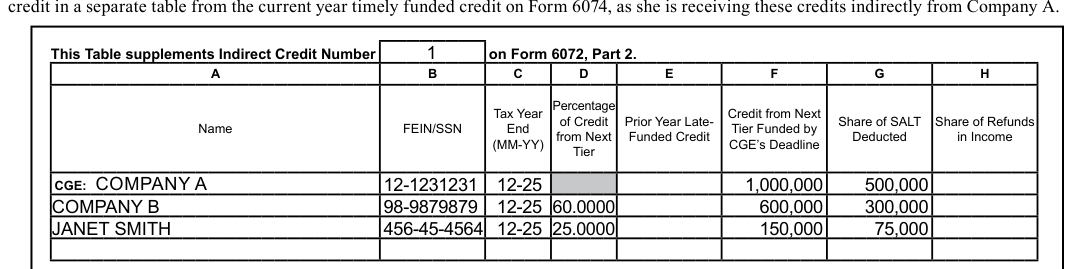
Text version of this table
1 A B C D E F G H Name FEIN/SSN Tax Year End (MM-YY) Percentage of Credit from Next Tier Prior Year Late- Funded Credit Credit from Next Tier Funded by CGE’s Deadline Share of SALT Deducted Share of Refunds in Income CGE: COMPANY A 12-1231231 12-25 1,000,000 500,000 COMPANY B 98-9879879 12-25 60.0000 600,000 300,000 JANET SMITH 456-45-4564 12-25 25.0000 150,000 75,000
# JANET SMITH
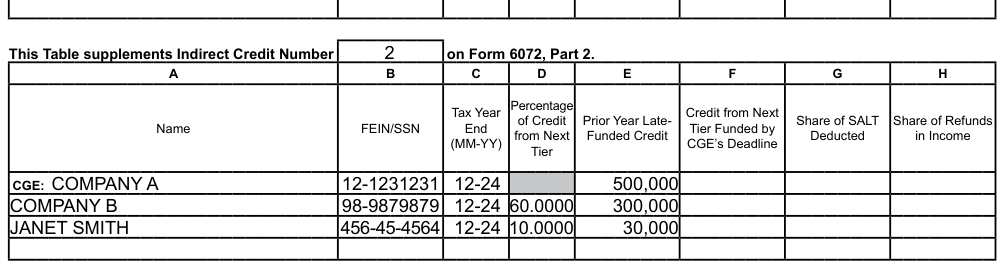
Text version of this table
| 2 | |||||||
| A | B | C | D | E | F | G | H |
| Name | FEIN/SSN | Tax Year End (MM-YY) | Percentage of Credit from Next Tier | Prior Year Late- Funded Credit | Credit from Next Tier Funded by CGE’s Deadline | Share of SALT Deducted | Share of Refunds in Income |
| CGE: COMPANY A | 12-1231231 | 12-24 | 500,000 | ||||
| COMPANY B | 98-9879879 | 12-24 | 60.0000 | 300,000 | |||
| JANET SMITH | 456-45-4564 | 12-24 | 10.0000 | 30,000 |
Once Form 6074 is completed, Janet carries the applicable information to Form 6072, Part 2.
PART 2: INDIRECT FTE CREDITS AND ADJUSTMENTS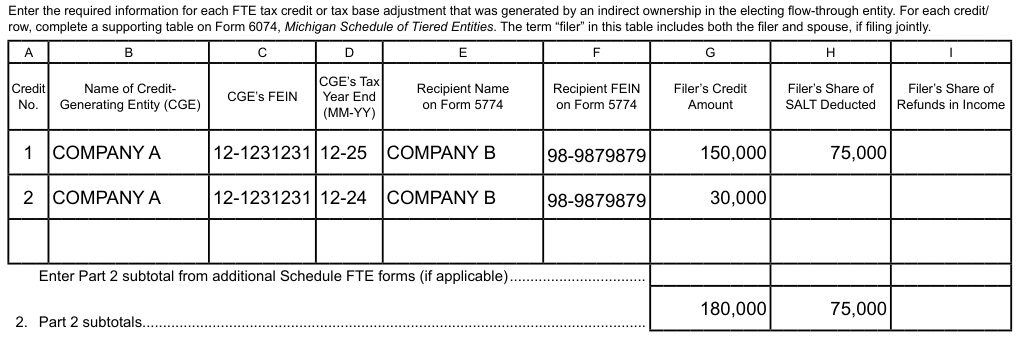
Text version of this table
A B C D E F G H I Credit No. Name of Credit- Generating Entity (CGE) CGE's FEIN CGE’s Tax Year End (MM-YY) Recipient FEIN on Form 5774 Recipient FEIN on Form 5774 Filer's Credit Filer’s Share of SALT Deducted Filer’s Share of Refunds in Income 1 COMPANY A 12-1231231 12-25 COMPANY B 98-9879879 150,000 75,000 2 COMPANY A 12-1231231 12-24 COMPANY B 98-9879879 30,000 180,000 75,000
- Total Addition of State and Local Taxes Deducted. Add line 1 column F and line 2 column H. Carry this amount to Schedule 1, line 2 or MI-1041, line 30 …
- Total Subtraction of Refunds. Add line 1 column G and line 2 column I. Carry this amount to Schedule 1, line 16 or MI-1041, line 38 …
- Total FTE Credits. Add line 1 column D, line 1 column E, and line 2 column G. Carry this amount to MI-1040, line 30 or MI-1041, line 19...
75,000
180,000
Example 2: Joint Filers with Direct and Indirect Credits
Entity XYZ generated a credit of $75,000 for the tax year and deducted $67,500 of SALT on their federal tax return. Entity XYZ paid all tax on or before their credit funding deadline.
Entity A generated a credit of $1,000,000 for the tax year and deducted $750,000 of SALT on their federal tax return. Entity A paid all tax on or before their credit funding deadline.
Couple's Direct Credits Couple's Indirect Credits Joe owns 25% share of Company XYZ Joe owns 40% share of Entity F Jane owns 75% share of Company XYZ Joe owns 80% share of Entity E Entity F owns 20% share of Entity E Entity F owns 25% share of Entity D Entity E owns 50% share of Entity D Entity D owns 50% share of Entity C Entity C owns 50% share of Entity B Entity B owns 50% share of Entity A Joe Taxpayer F D C E B A XYZ Jane Taxpayer 40% 80% 25% 50% 50% 50% 50% 25% 75% Diagram 1: Joe and Jane's FTE Credits 20%
Diagram 2: Joe and Jane's Completed Form 6072
6072 (09-25)
12-25
Attachment 36
MICHIGAN Schedule FTE
The Michigan Schedule FTE (Schedule FTE) is required to be filed with any Form MI-1040 or MI-1041 that claims a credit, addition, or subtraction related to the Flow-Through Entity Tax (FTE tax) under Part 4 of the Michigan Income Tax Act. The information you report should typically come from the statement issued by the flow-through entity (FTE) you directly own. For each credit identified on this schedule, include the Michigan Flow-Through Entity Tax Information Reports (or same information in another format) that you received from a flow-through entity you directly own.
Filer's Name Shown on Tax Return Identifying Number JOE TAXPAYER 123-00-3123
PART 1: DIRECT FTE CREDITS AND ADJUSTMENTS
Enter the required information for each FTE tax credit or tax base adjustment you are claiming on your return that was generated by direct ownership in the electing flowthrough entity. The term "filer" in this table includes both the filer and spouse, if filing jointly.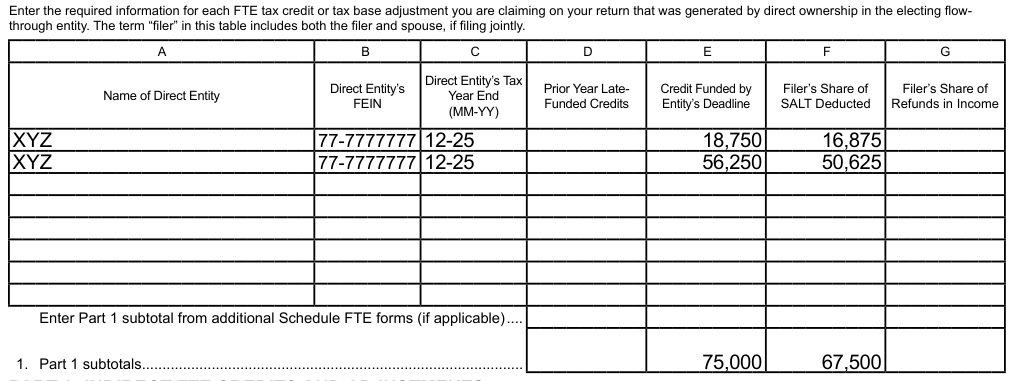
Text version of this table
A B C D E F G Name of Direct Entity Direct Entity's Tax Direct Entity’s Tax Year End (MM-YY) Prior Year Late- Funded Credits Credit Funded by Entity’s Deadline Filer’s Share of SALT Deducted Filer’s Share of Refunds in Income XYZ 77-7777777 12-25 18,750 16,875 XYZ 77-7777777 12-25 56,250 50,625 75,000 67,500
PART 2: INDIRECT FTE CREDITS AND ADJUSTMENTS
Enter the required information for each FTE tax credit or tax base adjustment that was generated by an indirect ownership in the electing flow-through entity. For each credit/ row, complete a supporting table on Form 6074, Michigan Schedule of Tiered Entities. The term "filer" in this table includes both the filer and spouse, if filing jointly.
A B C D E F G H I
CGE's Tax
Credit Name of Credit- Recipient Name Recipient FEIN Filer's Credit Filer's Share of Filer's Share of CGE's FEIN Year End
No. Generating Entity (CGE) on Form 5774 on Form 5774 Amount SALT Deducted Refunds in Income 1 A 11-1111111 12-25 B 22-2222222 12,500 9,375 2 A 11-1111111 12-25 B 22-2222222 5,000 3,750 3 A 11-1111111 12-25 B 22-2222222 5,000 3,750 Enter Part 2 subtotal from additional Schedule FTE forms (if applicable) …
- Part 2 subtotals …
67,500 50,625
- Total Addition of State and Local Taxes Deducted. Add line 1 column F and line 2 column H. Carry this amount to Schedule 1, line 2 or MI-1041, line 30 … 118, 125
- Total Subtraction of Refunds. Add line 1 column G and line 2 column I. Carry this amount to Schedule 1, line 16 or MI-1041, line 38 …
- Total FTE Credits. Add line 1 column D, line 1 column E, and line 2 column G. Carry this amount to MI-1040, line 30 or MI-1041, line 19...
142,500
Diagram 3: Joe and Jane's Completed Form 6074
6074 (09-25)
12-25
MICHIGAN Schedule of Tiered Entities
Attachment 37
This form must be completed if an indirect credit is claimed on Form 6072, Michigan Schedule FTE, Part 2. Complete a separate table for each indirect credit. Each chain of ownership to a credit-generating entity (CGE) should be reported as a separate credit. If more rows are needed to report an indirect credit, continue on additional tables and leave the CGE row blank. If more than three tables are needed, complete additional forms.
Filer's Name Shown on Tax Return
# JOE TAXPAYER
Identifying Number
123-00-3123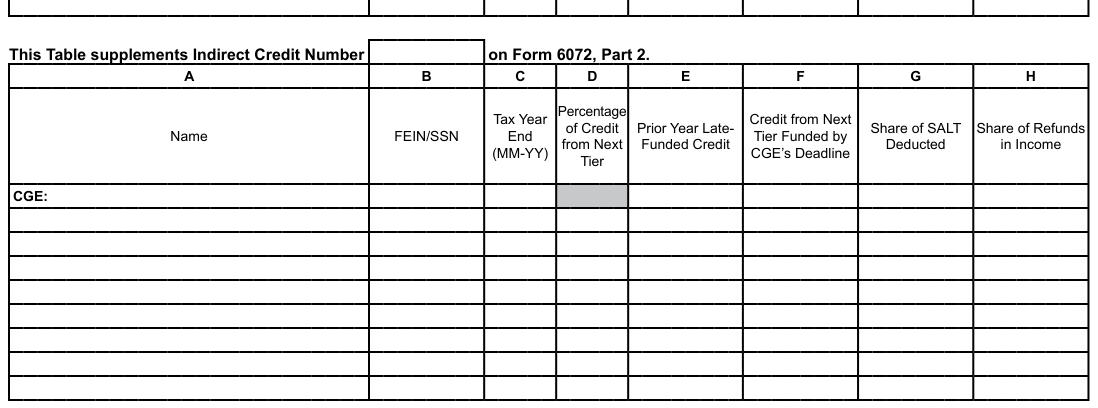
Text version of this table
This Table supplements Indirect Credit Number on Form 6072, Part 2. A B C D E F G H Name Name FEIN/SSN Tax Year End (MM-YY) Percentage of Credit from Next Tier Prior Year Late- Funded Credit Credit from Next Tier Funded by CGE’s Deadline Share of SALT Deducted Share of Refunds in Income CGE:
Share of SALT
Deducted
Share of Refunds in Income
CGE: A 11-1111111 12-25 1,000,000 750,000 B 22-2222222 12-25 50.0000 500,000 375,000 C 33-3333333 12-25 50.0000 250,000 187,500 D 44-4444444 12-25 50.0000 125,000 93,750 E 66-6666666 12-25 50.0000 62,500 46,875 F 55-5555555 12-25 20.0000 12,500 9,375 JOE TAXPAYER 123-00-3123 12-25 40.0000 5,000 3,750 This Table supplements Indirect Credit Number 3 on Form 6072, Part 2.
A B C D E F G H
Name FEIN/SSN
End of Credit from Next
Prior Year Late-
Funded Credit
Share of SALT
Deducted
Share of Refunds in Income
CGE: A 11-1111111 12-25 1,000,000 750,000 B 22-2222222 12-25 50.0000 500,000 375,000 C 33-3333333 12-25 50.0000 250,000 187,500 D 44-4444444 12-25 50.0000 125,000 93,750 E 66-6666666 12-25 50.0000 62,500 46,875 JOE TAXPAYER 123-00-3123 12-25 80.0000 50,000 37,500
Source: view the official PDF
Nearby sections (12 sections)
- form-4890-cit-booklet · Form 4890 — Michigan CIT Forms and Instructions…
- form-4891-cit · Form 4891 — Michigan Corporate Income Tax Annual Return…
- form-5772-fte-instructions · Form 5772 Instructions — Michigan…
- form-5774-instructions · Form 5774 Instructions — Schedule for…
- form-807-composite · Form 807 — Michigan Composite Individual Income…
- mi-1040-book · MI-1040 Book — Michigan Individual Income Tax Return &…
- mi-1040cr · MI-1040CR — Michigan Homestead Property Tax Credit Claim…
- mi-1041-book · MI-1041 Book — Michigan Fiduciary Income Tax Return &…
- schedule-fte · Form 6072 — Michigan Schedule FTE (Flow-Through Entity)…
- schedule-tiered-entities · Form 6074 — Michigan Schedule of Tiered…
- suw-5080 · Form 5080 — Michigan Sales, Use & Withholding Taxes…
- suw-5081-annual · Form 5081 — Michigan Sales, Use & Withholding Taxes…