Michigan Department of Treasury Form Instructions
Form 807 — Michigan Composite Individual Income Tax Return & Instructions (2025, Rev. 05-25)
Michigan Department of Treasury, 807 (Rev. 05-25), Page 1 of 5 Issued under authority of Public Act 281 of 1967 as amended.
2025 MICHIGAN Composite Individual Income Tax Return
This return is due April 15, 2026. Type or print clearly in blue or black ink.
(MM-DD-YYYY) (MM-DD-2025)
Return is for calendar year 2025 or for tax year beginning: and ending: - 2025
# 4. City or Town State ZIP/Postal Code Country Code
NOTE: Individual members subject to a federal excess business loss limitation may not participate in a composite filing.
- Ordinary income or (loss) from U.S. Form 1065 or U.S. Form 1120S … 5. 00
- Additions from line 37 … 6. 00
- Subtotal. Add lines 5 and 6 … 7. 00
- Subtractions from line 40 … 8. 00
- Total income subject to apportionment. Subtract line 8 from line 7 … 9. 00
- Apportionment percentage from MI-1040H (see instructions) … 10. %
- Total Michigan apportioned income. Multiply line 9 by the percentage on line 10 … 11. 00
- Michigan allocated income or (loss) from line 45 … 12. 00
- Flow-through entity tax non-electing entity income or (loss) adjustment (see instructions) … 13. 00
- Total Michigan income. Add lines 11, 12 and 13 … 14. 00
- Michigan income attributable to Michigan residents (see instructions for Schedule C) … 15. 00
- Michigan income attributable to nonparticipating members (see instructions for Schedule B) … 16. 00
- Michigan income attributable to participants (see instructions for Schedule A) … 17. 00
- Exemption allowance from line 51 … 18. 00
- SEP, SIMPLE or qualified plan deductions from line 54 … 19. 00
- Add lines 18 and 19 … 20. 00
- Taxable income. Subtract line 20 from line 17 … 21. 00
- Tax. Multiply line 21 by 4.25% (0.0425) … 422. 00
- Credit for participants' allocated share of flow-through entity tax reported by filer from Schedule A (see instructions) … 423. 00
- Michigan extension payments and estimated tax payments … 424. 00
- 2025 AMENDED RETURNS ONLY. See instructions … 425. 00
- If the total of lines 23, 24 and 25 is less than line 22, enter TAX DUE.
Include interest _ and penalty _ , if applicable … PAY 426. 00
- Overpayment. If the total of lines 23, 24 and 25 is more than line 22, enter overpayment … 27. 00
# Filer's Signature Date Preparer's PTIN, FEIN or SSN
By checking this box, I authorize Treasury to discuss my return with my preparer.
Preparer's Name (print or type) Mailing: Make check payable to "State of Michigan."
Write the entity's FEIN, "Composite Return" and tax year on the check.
Mail completed returns to:
P.O. Box 30058
Lansing, MI 48909
Preparer's Signature
Preparer's Business Name, Address and Telephone Number Continued on Page 2.
# ADDITIONS
- Net income or (loss) from rental real estate activities … 30.
- Net income or (loss) from other rental activities … 31.
- Portfolio Income or (loss): a. Interest income … 32a. b. Dividend income … 32b. c. Royalty income … 32c. d. Net short-term capital gain or (loss) (from U.S. Schedule K) … 32d. e. Net long-term capital gain or (loss) (from U.S. Schedule K) … 32e. f. Other portfolio income … 32f.
- Net gain or (loss) under Section 1231 … 33.
- Other income from U.S. Schedule K … 34.
- State or local taxes measured by income, including any allocated share of tax paid by an electing flow-through entity (see instructions) … 35.
- Other miscellaneous additions (include a supporting statement) … 36.
- Total additions. Add lines 30 through 36. Enter here and on line 6 … 37.
# SUBTRACTIONS
- Income or (loss) from other partnerships, S corporations and fiduciaries … 38.
- Other miscellaneous subtractions (include a supporting statement). Describe: __ 39.
- Total subtractions. Add lines 38 and 39. Enter here and on line 8 … 40.
MICHIGAN ALLOCATED INCOME OR (LOSS)
- Guaranteed payments to all members allocated to Michigan: a. Participating nonresidents - for services performed in Michigan … 41a. b. Nonparticipating nonresidents - for services performed in Michigan … 41b. c. Michigan residents - total payments … 41c.
- Income attributable to other Michigan partnerships, S corporations or fiduciaries … 42.
- Net Michigan capital gains or (losses) not subject to apportionment (from U.S. Schedule D) … 43.
- Other Michigan allocated income or (loss) (see instructions) … 44.
- Total Michigan allocated income or (loss).
Add lines 41a through 44. Enter here and on line 12 … 45.
EXEMPTION ALLOWANCE. See instructions for completing this section.
- Michigan income to participants from line 17 … 46.
- Total income from Participants' Total Income Worksheet, page 9 … 47.
- Percent of income attributable to Michigan.
Divide line 46 by line 47 (must be between 0 and 100%) … 48.
- Prorated exemption allowance per participant.
Multiply line 48 by $5,800 (exemption allowance) … 49.
- Number of participants included in this return … 50.
- Total prorated exemption … 51.
SEP, SIMPLE OR QUALIFIED PLAN DEDUCTIONS (PARTNERS ONLY)
- SEP, SIMPLE or qualified plan deductions for participants (include a schedule) … 52.
- Percent of income attributable to Michigan from line 48 … 53.
- SEP, SIMPLE or qualified plan deductions attributable to Michigan.
Multiply line 52 by the percentage on line 53. Enter here and on line 19 … 54.
%
%
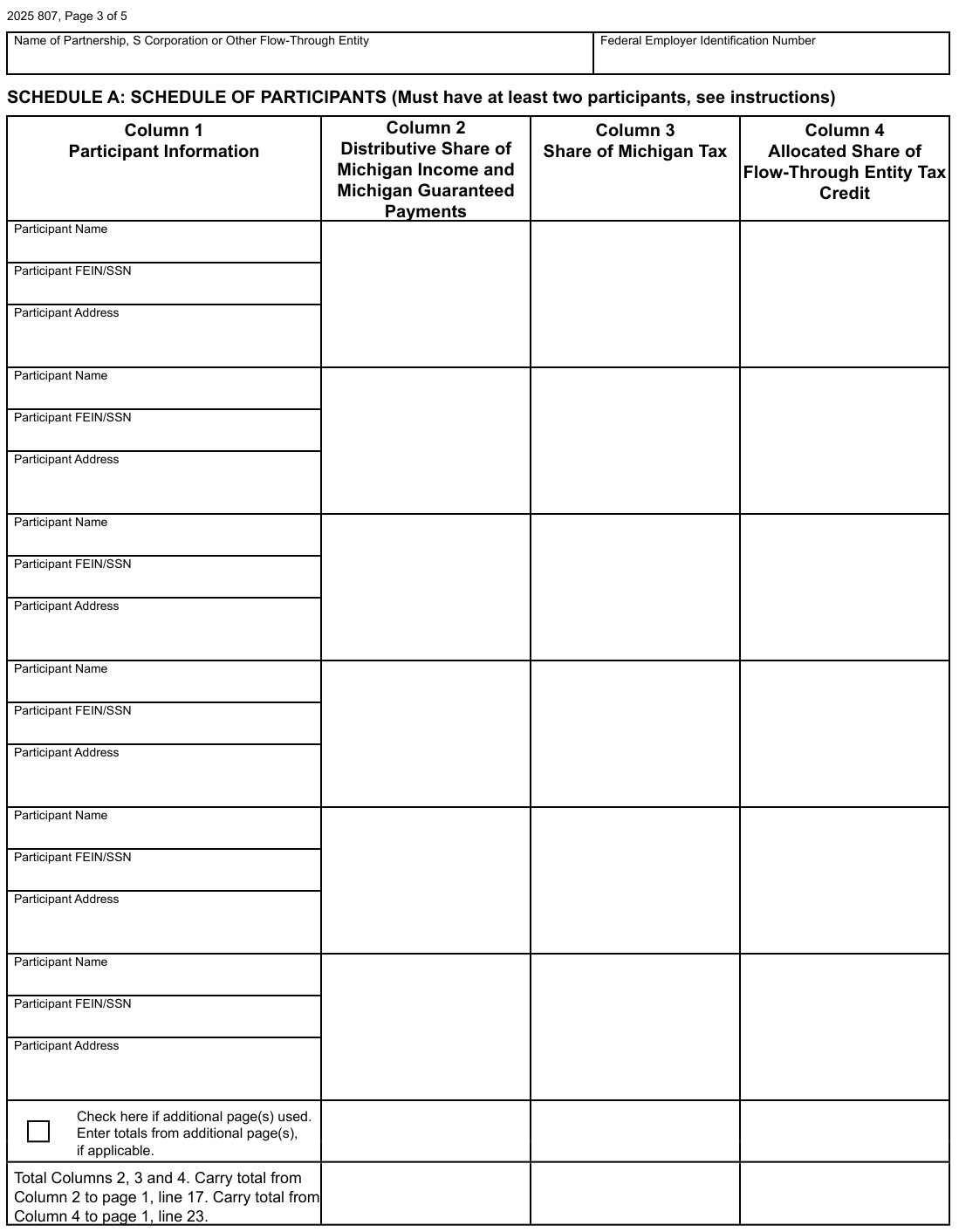
Text version of this table
| Name of P | artnership, S | Corporation or Other Flow-Through | Entity |
|---|---|---|---|
| CHEDU | LE A: S | CHEDULE OF PARTICIP | ANTS (M |
| Co | lumn 1 | Col | |
| P | articipa | nt Information | Distribut |
| Michigan | |||
| Michigan | |||
| Pay | |||
| Participant | Name | ||
| Participant | FEIN/SSN | ||
| Participant | Address | ||
| Participant | Name | ||
| Participant | FEIN/SSN | ||
| Participant | Address | ||
| Participant | Name | ||
| Participant | FEIN/SSN | ||
| Participant | Address | ||
| Participant | Name | ||
| Participant | FEIN/SSN | ||
| Participant | Address | ||
| Participant | Name | ||
| Participant | FEIN/SSN | ||
| Participant | Address | ||
| Participant | Name | ||
| Participant | FEIN/SSN | ||
| Participant | Address | ||
| Check here | if additional page(s) used. | ||
| Enter totals | from additional page(s), | ||
| if applicabl | e. | ||
| Total Col | umns 2, 3 | and 4. Carry total from | |
| Column | 2 to page | 1, line 17. Carry total from | |
| Column | 4 to page | 1, line 23. |
# Michigan Guaranteed
# Michigan Guaranteed Payments
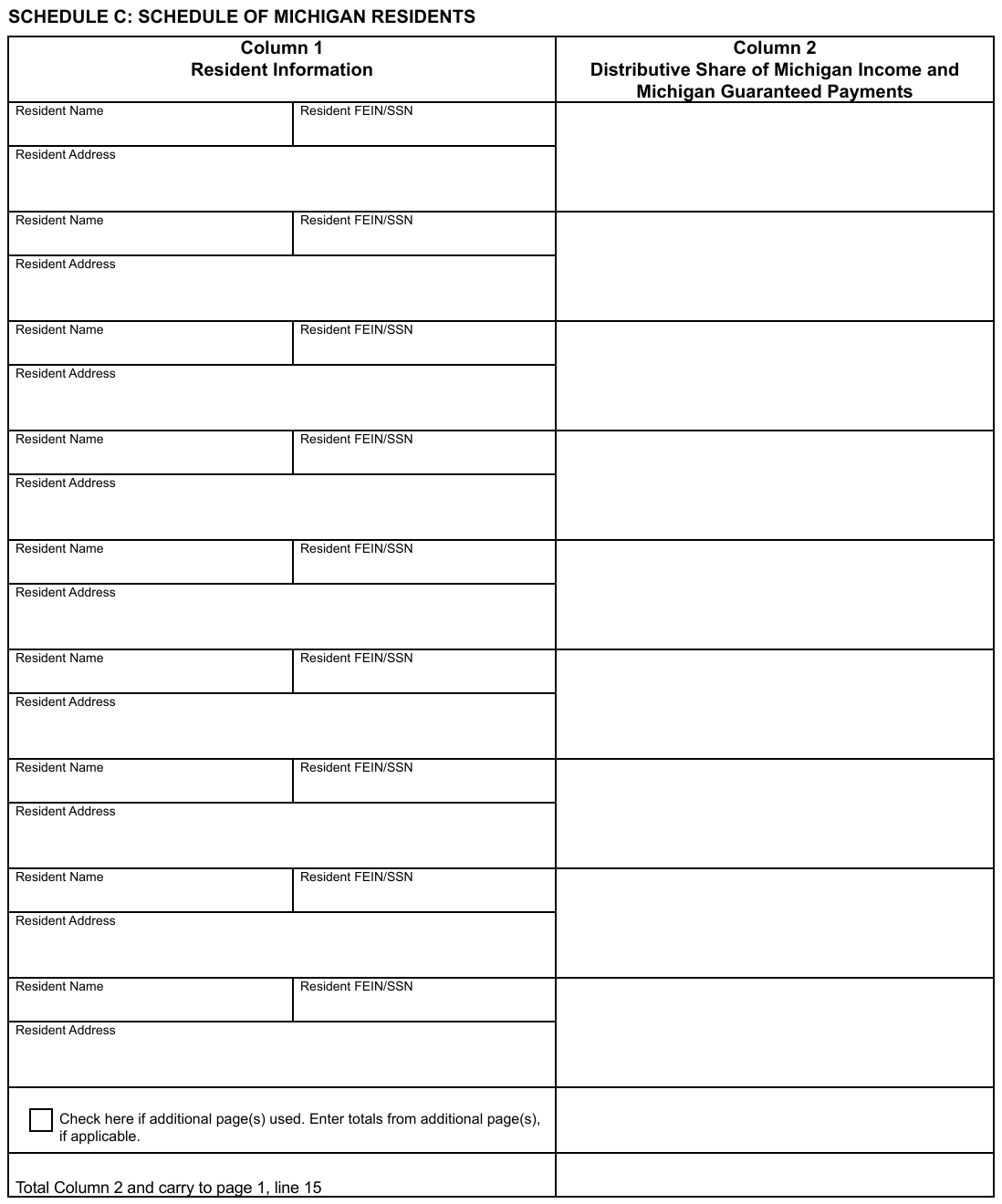
Text version of this table
| Column 1 Resident Information | Column 2 Distributive Share of Michigan Income and Michigan Guaranteed Payments | |
| Resident Name | Resident FEIN/SSN | |
| Resident Address | ||
| Resident Name | Resident FEIN/SSN | |
| Resident Address | ||
| Resident Name | Resident FEIN/SSN | |
| Resident Address | ||
| Resident Name | Resident FEIN/SSN | |
| Resident Address | ||
| Resident Name | Resident FEIN/SSN | |
| Resident Address | ||
| Resident Name | Resident FEIN/SSN | |
| Resident Address | ||
| Resident Name | Resident FEIN/SSN | |
| Resident Address | ||
| Resident Name | Resident FEIN/SSN | |
| Resident Address | ||
| Resident Name | Resident FEIN/SSN | |
| Resident Address | ||
| Check here if additional page(s) used. Enter totals from additional page(s), if applicable. | ||
| Total Column 2 and carry to page 1, line 15 |
Instructions for Form 807, Michigan Composite Individual Income Tax Return
Tax Assistance
Treasury offers a variety of services designed to assist you and most are available 24 hours a day, seven days a week.
# Internet Options
Find the following information on this website:
- Current year forms and instructions
- Answers to many tax preparation questions
- Most commonly used tax forms Select the Michigan Treasury eServices where you can:
- File your return (no fee)
- View the status and summary of your return or correspondence
- Ask questions to a non-AI generative Chat Bot
- Change your address
- Submit a response to letters received from Treasury
- Submit questions and receive responses on your account
- Make payments
- Submit an Authorized Representative Declaration (Power of Attorney), Form 151
- Request an installment agreement
- Submit an Offer in Compromise
- Request and manage third party access.
# Telephone Options
517-636-4486
Through Treasury's phone system you can:
- Request the status of your refund
- Check the status of letters you have sent to Treasury
- Request information on estimated payments
- Order current tax year forms.
The Automated Information Service is not available for Composite Individual Income Tax returns. Customer service representatives are available from 8 a.m. to 4:30 p.m., Monday through Friday.
Assistance is available using TTY through the Michigan Relay Service by calling 711.
IMPORTANT: To obtain information about your account using the Internet and Telephone Options you will need the following information from your return:
- Federal Employer Identification Number (FEIN)
- Tax year of the return
- Ordinary income or (loss)
- Refund amount
Definitions
The following are definitions for the purposes of this form.
Flow-through entity (FTE): An S corporation; partnership; limited partnership; limited liability partnership; or limited liability company that is not taxed as a C corporation for federal income tax purposes. FTE does not include a publicly traded partnership.
Intermediate FTE: An FTE in a tiered structure, that has an interest in another FTE.
Member of an FTE: An individual; estate; trust; or intermediate FTE.
Nonresident member: An individual who is not domiciled in this state; nonresident estate or trust; or intermediate FTE with a nonresident ultimate owner.
Participant: A nonresident member who has elected to participate in a composite return.
Ultimate owner: An individual, estate or trust that has an interest in an FTE or intermediate FTE.
# Filing a Return
A Composite Individual Income Tax Return (Form 807) is a collective individual income tax filing for two or more nonresident members filed by the FTE. This form is used to report and pay individual income tax under Part 1 of Public Act 281 of 1967, as amended. This return is not an entity-level filing for tax imposed on the FTE.
An FTE is not required to file Form 807. The filing FTE and participants must agree to comply with the provisions described in the sections "Filing and Participation Requirements" and "Reporting to Participants." An FTE may choose to file Form 807 on behalf of its nonresident members who elect to participate. An intermediate FTE may also be eligible to file a composite return (see "Tiered Entities").
Participation on a composite return will eliminate the need for an individual ultimate owner to file a Michigan Individual Income Tax Return (Form MI-1040) when the ultimate owner has no other Michigan-sourced income. If the composite return does not eliminate the ultimate owner's requirement to file an MI-1040, the individual ultimate owner would claim their share of tax paid on the composite return as withholding on the MI-1040. See "Composite Filer Participants" in the MI-1040 instruction book for more information.
# Flow-through Entity Tax
The flow-through entity tax is levied and imposed on certain electing entities with business activity in Michigan. Generally, the flow-through entity tax allows the entity to elect to pay tax on certain income at the individual income tax rate. The members of that entity are eligible to receive a refundable income tax credit equal to the tax previously paid on that income by the flow-through entity.
The filing of a flow-through entity tax return will not satisfy the respective filing obligations of members, as it neither reports the income of members nor claims the refundable tax credit that may be applicable for that income. The filing of a composite return is a separate and distinct obligation from the filing of a flow-through entity tax return.
Electing flow-through entities must file the Michigan flow-through entity tax annual return and pay any tax due before filing the composite return.
A member of flow-through entity that elected to pay the Michigan flow-through entity tax may claim a refundable credit, and will report an addition. See instructions for lines 23 and 35 on pages 8 and 9, respectively.
# Tiered Entities
An FTE is part of a tiered structure if it has one or more members that are also FTEs. A tiered structure consists of a source FTE and one or more intermediate FTEs. The intermediate FTE receives income from the source FTE and the income is passed through to the ultimate owner(s).
The intermediate FTE may not participate in the composite return if:
- The composite filer cannot identify the intermediate FTE's participating ultimate owner(s)
- The intermediate FTE has elected to pay the flow-through entity tax and paid tax on a non-electing entity's income A C corporation or an entity that files federally as a C corporation is not eligible to participate in the composite return.
An intermediate FTE that generated its own income or loss and has two or more nonresident members may file its own composite return even if it participated on another composite return. If an intermediate FTE participated on another FTE's composite return, it should not include any income or tax paid on its behalf with the other FTE's composite return.
For each participating intermediate FTE include a Tiered Structure Schedule from the source FTE to the ultimate owner, with the following:
- Details for each tier of the tiered structure:
- FTE name, FEIN and ownership percentage for each tier
- Details for each participating ultimate owner:
- Name, address, account number, distributive share of Michigan income, tax and ownership percentage
# Filing and Participation Requirements
Two or more participating nonresident members are required for an FTE to file a composite return. An intermediate FTE may participate in a composite return unless it has elected to pay the flow-through entity tax and paid tax on a non-electing entity's income. Further, the intermediate FTE may only participate in a composite return if the filing FTE is able to include with the composite return the Tiered Structure Schedule, which provides the details for each tier from the source FTE to the ultimate owner, including the intermediate FTE's participating ultimate owner's name, address, account number, distributive share of Michigan income and tax (see "Tiered Entities").
All of the following conditions must apply to the nonresident ultimate owner for participation in a composite return. The nonresident ultimate owner:
- Is subject to Michigan individual income tax
- Was not a Michigan resident (full-year or part-year)
- Agrees to claim only one Michigan exemption
- Does not have a federal excess business loss limitation
- Is not a C corporation or has not elected to file federally as a C corporation.
# Due Date of Return
The 2025 composite return is for filers whose tax year ends in
- If the FTE's tax year does not end in 2025, do not use this form. Use the appropriate year that corresponds to the year the ultimate owner will include the income in their federal individual income tax filing.
The composite return for any tax period ending in 2025 is due April 15, 2026. The return for any period ending in 2026 will be due April 15, 2026.
If the FTE cannot file by the due date, a request for an extension can be filed before the original due date. See "Requesting an Extension".
# Requesting an Extension
The filer may request an extension of time to file by filing an Application for Extension of Time to File Michigan Tax Returns (Form 4) on or before the original due date of the composite return. The remaining estimated annual tax liability that has not been satisfied by estimated payments must be remitted with Form 4. A Michigan extension, Form 4, must be filed even if the FTE files a federal extension. An extension of time to file is NOT an extension of time to pay.
When completing Form 4, line 1, check "Fiduciary Tax (includes Composite Filers)" and use the filing FTE's name and FEIN to ensure the payment is properly credited to the filing FTE's account. When the composite return is filed, include a copy of Form 4.
# Required Documentation
Include only the following items, as applicable, with the composite return:
- Copy of U.S. Form 1065 (5 pages) or U.S. Form 1120S (5 pages)
- Michigan Schedule of Apportionment (Form MI-1040H)
- Completed Schedule A, Schedule of Participants
- Tiered Structure Schedule (see "Tiered Entities")
- Completed Schedule B, Schedule of Nonparticipants
- Completed Schedule C, Schedule of Michigan Residents
- Statement signed by an authorized officer or general partner certifying that each participant has been informed of the terms and conditions of this program of participation
- Include supporting documentation to support the flow-through entity tax credit, if applicable.
- A copy of Form 4.
# Reporting to Participants
An FTE filing Form 807 must report the following information to each participant on the composite return:
- FEIN of the FTE
- Tax year of the FTE
- The participant's distributive share of income allocated or apportioned to Michigan from Schedule A, Schedule of Participants, Column 2
- The participant's share of tax liability on the composite return filed by the FTE from Schedule A, Schedule of Participants, Column 3
- The participant's allocated share of flow-through entity tax credit from Schedule A, Schedule of Participants, Column 4.
Specify that this credit should not be claimed on any other income tax return.
- The FTE's Michigan sales and the FTE's total sales everywhere
- The participant's prorated exemption allowance as computed on line 49 of the composite return.
The FTE may use any method to report the necessary information to the participants so long as it conveys the information listed above. Treasury recommends that the FTE provides the information to the participants as a supplemental attachment to their federal Schedule K-1, which provides the participant with the information necessary to file an MI-1040 if the ultimate owner has other Michigan-sourced income.
# 2026 Estimated Tax Payments
Estimated income tax payments must be remitted with an Estimated Income Tax Voucher for Fiduciary and Composite Filers (Form MI-1041ES). For each quarter, file one Form MI-1041ES with the quarterly estimated payment for all participants whose share of annual income tax liability is expected to exceed $500 after credits. Form MI-1041ES must be exemptions and completed with the name and FEIN of the FTE that will claim the estimated payments on their composite return. Do not submit estimated payments with Form MI-1041ES for members who are not participating in the composite return.
FTEs using a calendar tax year must remit quarterly estimated payments with Form MI-1041ES by April 15, 2026; June 15, 2026; September 15, 2026; and January 15, 2027. FTEs with a fiscal tax year must remit quarterly estimated payments with Form MI-1041ES using the due date that corresponds with its fiscal tax year end. The first estimated payment is due on the 15th day of the fourth month after the prior fiscal tax year ends.
Quarterly estimated payment due dates for a fiscal tax year filer apply regardless of the participants' filing tax year.
# Amended Returns
To amend, file Form 807 and check the Amended Return box at the top of page 1 of the form. Provide a statement to explain the reason(s) for amending. Include all applicable schedules and supporting documentation. It is not necessary to include a copy of the original return.
Schedules
Schedule A, Schedule of Participants:
Complete this schedule for all participants. See "Filing and Participation Requirements" for additional information.
If an intermediate FTE is participating on the composite return, the filer must only report the income attributable to the participating ultimate owner(s) of that intermediate FTE on Schedule A. See "Tiered Entities" for information about the required Tiered Structure Schedule.
If the filer elected to pay FTE tax, enter in Column 4 each participant's credit that is reported on the filer's Schedule for Reporting Member Information for a Flow-Through Entity that is accompanied with the Michigan flow-through entity tax annual return. However, participants' credits for this tax year are limited to only credits generated by the flow-through entity filing this composite return based on the filer's FTE annual tax return. Do not include credits generated by any other electing flow-through entity. The credits should include the following:
- For FTE tax levied on the filer's current tax year, report each participant's share of FTE tax paid by the filer through the fifteenth day of the third month after the filer's tax year end.
- For FTE tax levied on the filer for any previous tax year, report each participant's share of that tax paid during the current tax year excluding any amount reported in item number 1.
Example: FTE is a calendar year taxpayer and timely paid $1,000 in quarterly estimated tax payments for Year 1. FTE also requested and received an extension of time to file the Year 1 FTE tax annual return. When filing the Year 1 FTE tax annual return on September 30, Year 2, FTE determined that tax was owed and paid an additional $600 in tax, plus $200 in combined penalty and interest. Members X and Y each own 50% of FTE and participate on a composite return for Year 1.
Their credits are based on each member's share of the $1,000 in taxes levied for Year 1 and paid as of March 15, Year 2, $500 each. Even though the additional $600 tax payment was paid toward FTE's Year 1 liability and by the extended due date of that return, that payment is not eligible for a Year 1 credit. Instead, that payment may be claimed as a credit by members on their Year 2 annual return. The $200 payment attributable to penalty and interest is not eligible to be claimed for the credit in any tax year.
Complete additional copies of Schedule A as needed. Subtotal each schedule and include the grand totals of Columns 2, 3 and 4 on the first page of the schedule. Carry the grand total of Column 2 to line 17. The grand total of Column 3 should reconcile to line 22. Carry the grand total of Column 4 to line 23.
Schedule B, Schedule of Nonparticipants:
Complete this schedule for all nonparticipants that are not Michigan residents. If intermediate FTEs are participating on the composite return, the filer must only report the income attributable to nonparticipants on Schedule B. If a C corporation or an entity that files federally as a C corporation has an interest in the filing FTE, report the income here. Reporting this income is for reconciliation purposes only and is not used to compute a Corporate Income Tax (CIT) liability. Complete additional copies of Schedule B as needed. Subtotal each schedule and include the grand total of Column 2 on the first page of the schedule. Carry the grand total of Column 2 to line 16.
Schedule C, Schedule of Michigan Residents:
Complete this schedule for Michigan residents. A Michigan resident may not participate on a composite return. If intermediate FTEs are participating on the composite return, the filer must only report the income attributable to Michigan residents on Schedule C. Reporting this income is for reconciliation purposes only. Complete additional copies of Schedule C as needed. Subtotal each schedule and include the grand total of Column 2 on the first page of the schedule.
Carry the grand total of Column 2 to line 15.
# Line-by-Line Instructions
Lines not listed are explained on the form.
Line 5: Enter ordinary income or (loss) from U.S. Form 1065, line 23 or U.S. Form 1120S, line 22.
Line 10: Enter the apportionment percentage from Form MI-1040H. See MI-1040H instructions on determining the apportionment percentage and for information regarding income tax nexus standards.
Line 13: Enter the Michigan-sourced income from non-electing flow-through entities, if any, that was reported on the filer's Michigan flow-through entity tax annual return.
Line 14: The amount on this line should equal the total of lines 15, 16 and 17.
Complete Schedule A, Schedule of Participants and if applicable, B, Nonparticipants Schedule Schedule of and Schedule C, Schedule of Michigan Residents before continuing to line 15.
Line 15: Carry the total from Column 2 of the Schedule C, Schedule of Michigan Residents to this line.
Line 16: Carry the total from Column 2 of the Schedule B, Schedule of Nonparticipants to this line.
# Line 17: Carry the total from Column 2 of the Schedule A,
Schedule of Participants to this line.
Line 22: Multiply line 21 by the tax rate on line 22. The tax should reconcile to the grand total from Column 3 of the Schedule A, Schedule of Participants.
Line 23: Enter the total of participants' allocated share of flow-through entity tax reported on Schedule A, Schedule of Participants, Column 4.
Line 25: This line is for amended returns only. Enter the refund and/or credit forward amount received on the original return as a negative number. Enter the amount paid with the original return as a positive number. Do not include any interest or penalty paid with the original return.
Line 26: Pay. If the total of lines 23, 24 and 25 is less than line 22, enter the balance of the tax due. This is the tax owed with the return. Enter any applicable penalties and interest in the spaces provided. Add tax, penalty and interest together and enter the total on this line. Make the check payable to "State of Michigan."
Write the filing company's FEIN, "Composite Return" and the tax year on the front of the check. To ensure accurate processing of the return, remit payment for this return only. If payment was not submitted with the return, make a payment using Form MI-1041-V. If the balance due is less than $1, no payment is required. To compute applicable penalty and interest visit Line 29: Refund. If the total of lines 23, 24 and 25 is more than line 22, the overpayment will be refunded. Treasury will not refund amounts less than $1.
Mail completed returns to:
P.O. Box 30058
Lansing, MI 48909
Additions
Lines 30 through 34: Enter income from lines 2, 3, 5, 6a, 7, 8, 9a, 10 and 11 of U.S. Form 1065 Schedule K or from lines 2, 3, 4, 5a, 6, 7, 8a, 9 and 10 of U.S. Form 1120S Schedule K. Guaranteed payments, income attributable to other Michigan fiduciaries or FTEs should be allocated to Michigan on lines 41 through 44.
Line 35: Enter the amounts of state and local income tax used to determine ordinary income on U.S. Form 1065, line 23 or U.S. Form 1120S, line 22. Add the participants' share of Michigan flow-through entity taxes paid and deducted from income on the filer's federal tax return for this tax year.
Line 36: Enter other additions to income, such as gross interest and dividends from obligations or securities of states and their political subdivisions other than Michigan. Include gross expenses from the production of Michigan oil and gas and nonferrous metallic minerals extraction subject to Michigan severance tax. If line 38 results in a net loss, enter here as a positive number.
P.A. 24 of 2025 requires filers to complete the following calculation if there are adjustments due to separating from the Internal Revenue Code. See Treasury Notice, Decoupling Michigan's Income Taxes from Certain Internal Revenue Code
(IRC) Provisions. If the total of all adjustments is negative, report it as positive on line 36. If the total is positive, report it on line 39.
ADJUSTMENTS FOR SEPARATING FROM
INTERNAL REVENUE CODE
- Net Bonus depreciation adjustment using IRC 168(k) in effect as of 12/31/2024 … Gain/Loss adjustment on disposition of
- IRC 168(k) depreciable property using the IRC in effect as of 12/32/2024 …
- Net adjustment for IRC 168(n) qualified production property depreciation …
- Gain/loss adjustment on disposition of IRC 168(n) qualified production property …
- Net depreciation adjustment using IRC 179 as of 12/31/2024 …
- Gain/loss adjustment for disposition of property, due to Michigan Individual Income Tax's use of IRC 179 as of 12/31/2024 … Net expense adjustment using IRC 163(j)
- as of 12/31/2024 …
- Net expense adjustment using IRC 174 as of 12/31/2024 …
- TOTAL. Add lines 1 through 8. If sum is negative, report as positive on Schedule 1, line 36. If sum is positive, report on Schedule 1, line 39 …
Subtractions
Note: Charitable contributions and other amounts reported as itemized deductions on U.S. Schedule A are not allowed as subtractions when determining Michigan taxable income.
Line 38: Enter the net income or (loss) from other fiduciaries or other FTEs included in income. If line 38 results in a net loss, do not enter here but on line 36 as a positive number instead.
Line 39: Enter amounts:
- Interest from U.S. obligations that are included in line 32a.
- Other deductions used to compute AGI, that were not included in determining ordinary income.
- P.A. 24 of 2025 requires certain adjustments to business income or loss due to separation from the Internal Revenue
Code. See Schedule 1, line 36 for more information.
- Pension benefits paid to nonresident partners that are included in ordinary income but are excluded from Michigan tax under section 114 of Title 4 of the U.S. Code.
- Gross income and related expenses from producing Michigan oil and gas and nonferrous metallic minerals extraction to the extent subject to Michigan severance tax and included in federal taxable income.
- The participants' share of Michigan flow-through entity taxes refunded and included in income on the filer's federal tax return for this tax year. Include a schedule of all subtractions.
Michigan Allocated Income or
Participants' Total Income Worksheet Column A refers to Distributive Income categories from Schedule K form(s). Columns B and C refer to lines Loss on the U.S. Form 1065 Schedule K and U.S. Form 1120S Schedule K. Column D is the list of amounts that Line 41: Enter all guaranteed payments are added to arrive at participants' total income that is reported on Form 807, line 47. attributable to Michigan. This includes all payments to Michigan residents and D A B C Participants' U.S. Form 1065 U.S. Form 1120S Distribute Income Distributive Income Categories payments to nonresidents for services performed in Michigan.
# Schedule K
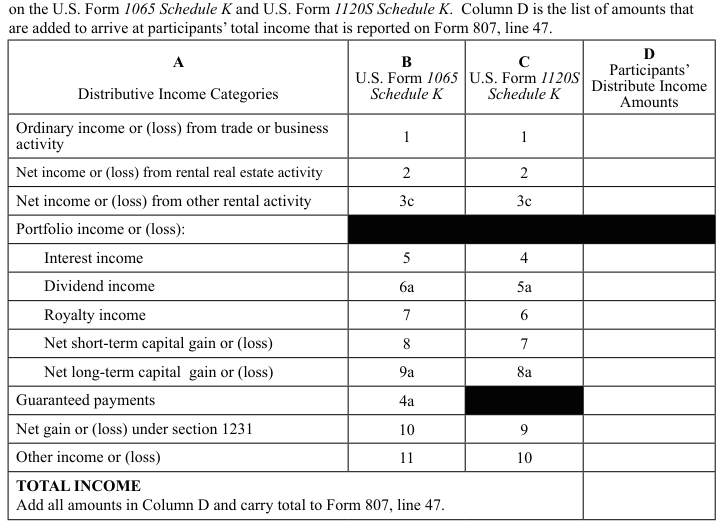
Text version of this table
A Distributive Income Categories B U.S. Form 1065 Schedule K C U.S. Form 1120S Schedule K D Participants’ Distribute Income Amounts Ordinary income or (loss) from trade or business activity 1 1 Net income or (loss) from rental real estate activity 2 2 Net income or (loss) from other rental activity 3c 3c Portfolio income or (loss): Interest income 5 4 Dividend income 6a 5a Royalty income 7 6 Net short-term capital gain or (loss) 8 7 Net long-term capital gain or (loss) 9a 8a Guaranteed payments 4a Net gain or (loss) under section 1231 10 9 Line 43: Enter gains or (losses) from the 11 10 TOTAL INCOME Add all amounts in Column D and carry total to Form 807, line 47.
Include any Michigan standard deduction as a negative number. The standard deduction cannot exceed the qualified participant's share of Michigan tax. The standard deduction of $20,000 against taxable income before personal exemptions is available to a participant who was born during the period January 1, 1946 through December 31, 1952 (Tier 2) and reached age 67. A participant that is in Tier 2 and eligible for the Michigan standard deduction may increase the $20,000 deduction to $35,000 if the participant received retirement or pension benefits from employment with a governmental agency that was not covered by the federal Social Security Act.
A participant born during the period January 1, 1953 through January 1, 1959 (Tier 3), and reached the age of 67 on or before December 31, 2025, would be entitled to the standard deduction but would not be entitled to a personal exemption.
Although participants may be eligible for a standard deduction, nonresidents are not subject to tax on retirement and pension benefits and therefore participants may not deduct such benefits.
For more information on retirement tiers, refer to the MI-1040 booklet.
Exemption Allowance
Michigan's personal exemption allowance is prorated for all nonresident participants based on Michigan income to total income.
If the entity claims a Tier 3 standard deduction for a participant, remove all income related to that participant from the computations in lines 46 and 47 and do not include those participants in line 50.
Line 47: Enter the participants' total income as determined using the Participants' Total Income Worksheet.
Line 48: Compute the percentage of participants' income that is attributable to Michigan by dividing Michigan income (line 46) by total income (line 47). This figure may not exceed 100 percent.
Line 49: Multiply the percent of Michigan income to total income as determined on line 48 by $5,800 in 2025. The result is the maximum exemption allowance a participant may be eligible to claim on this form.
Line 51: For each participant listed on Schedule A, Schedule of Participants determine the lesser of:
- The amount on line 49, or
- That participant's Distributed Share of Michigan Income from Column 2 of the Schedule A, Schedule of Participants.
Enter on line 51 the sum of the result above for all participants.
The amount entered on line 51 may not exceed the product of lines 49 and 50.
SEP, SIMPLE or Qualified Plan Subtractions
(PARTNERS ONLY)
# Line 52: Figure the portions of Simplified Employee Pensions
(SEP), Savings Incentive Match Plan for Employees (SIMPLE), or qualified plan deductions which are attributable to the participants. Include a schedule showing calculations.
Signing Return/Correspondence
By signing Form 807, the signing partner or officer declares that the filer has power of attorney from each participant to file a composite return on the participant's behalf. Treasury will mail refund checks, assessments and all correspondence to the filer at the address indicated on the return. The filer must agree to be responsible for the payment of any additional tax, interest and penalties as finally determined. Any issues that arise as a result of the filed composite return will be resolved with the filer. However, Treasury may find it necessary to contact the participants.
When You Have Finished
Sign the return
A tax preparer must include the name, address, telephone number of the firm he or she represents, and preparer tax identification number or federal employer identification number.
Check the box to indicate if Treasury may discuss your return with your preparer.
The Taxpayer Protection Act requires paid preparers to sign the return and provide his or her preparer tax identification number. Additional information on the Taxpayer Protection Act is available at www.michigan.gov/taxes.
A paid preparer must not engage in any fraudulent tax activity.
Any concerns related to fraudulent activity of a paid preparer may be reported to the Michigan Department of Treasury, Fraud Unit, P.O. Box 30140, Lansing, MI 48909.
Forms
Michigan tax forms are available at www.michigan.gov/taxes.
Source: view the official PDF
Nearby sections (12 sections)
- form-4890-cit-booklet · Form 4890 — Michigan CIT Forms and Instructions…
- form-4891-cit · Form 4891 — Michigan Corporate Income Tax Annual Return…
- form-5772-fte-instructions · Form 5772 Instructions — Michigan…
- form-5774-instructions · Form 5774 Instructions — Schedule for…
- form-807-composite · Form 807 — Michigan Composite Individual Income…
- mi-1040-book · MI-1040 Book — Michigan Individual Income Tax Return &…
- mi-1040cr · MI-1040CR — Michigan Homestead Property Tax Credit Claim…
- mi-1041-book · MI-1041 Book — Michigan Fiduciary Income Tax Return &…
- schedule-fte · Form 6072 — Michigan Schedule FTE (Flow-Through Entity)…
- schedule-tiered-entities · Form 6074 — Michigan Schedule of Tiered…
- suw-5080 · Form 5080 — Michigan Sales, Use & Withholding Taxes…
- suw-5081-annual · Form 5081 — Michigan Sales, Use & Withholding Taxes…