Michigan Department of Treasury Form Instructions
Form 4890 — Michigan CIT Forms and Instructions for Standard Taxpayers (General Information, 2025)
2025 General Information for Standard Taxpayers
Insurance Companies and Financial Institutions: See the Corporate Income Tax (CIT) Instruction Booklet for Insurance Companies (Form 4904) or the CIT Instruction Booklet for Financial Institutions (Form 4907) at www.michigan.gov/taxes.
This booklet is intended as a guide to help complete the Corporate Income Tax (CIT) return. It does not take the place of the law.
Who Files a Standard Return?
Under the CIT, taxpayer means a C Corporation, insurance company, financial institution, or a Unitary Business Group
(UBG) liable for tax, interest, or penalty. All taxpayers (described here as standard taxpayers) other than financial institutions and insurance companies with apportioned or allocated gross receipts equal to $350,000 or more and whose CIT liability is greater than $100 must file a CIT Annual Return (Form 4891). (See "Filing if Tax Year Is Less Than 12 Months" in this "General Information" section.) The law does not require the filing of the CIT return by a taxpayer whose gross receipts apportioned or allocated to Michigan are less than $350,000 or whose CIT liability is less than or equal to $100. There is not a separate form for reporting that a taxpayer has no filing requirement. However, taxpayers without a filing requirement may choose to file a return to claim a refund of the estimated payments made or create and carryforward an available business loss.
Public Law 86-272: If a taxpayer's activity is protected under Public Law (PL) 86-272, but the taxpayer wishes to claim a refund, the taxpayer must file a Form 4891. When filing this form, leave lines 12 through 41 and lines 50 through 54 blank, and include an attachment explaining the circumstances of the PL 86-272 protection. Line 42 and line 43 must be completed to report any recapture of credits.
UBGs: If all members of the UBG are claiming PL 86-272 protection, then the UBG will leave lines 12 through 41 and lines 50 through 54 blank and include a statement explaining the circumstances of the PL 86-272 protection for each member. Lines 42 and 43 of form 4891 must be completed to report any recapture of credits by the group. (Each member will leave lines 21 through 34 blank on the CIT Data on Unitary Business Group Members, Form 4897.) However, as long as one member of a UBG has nexus with Michigan and exceeds the protections of PL 86-272, all members of the UBG
- including members protected under PL 86-272 - must be included when calculating the UBG's CIT tax base and apportionment formula. PL 86-272 will only remove income from the apportionable CIT tax base when all members of the UBG are protected under PL 86-272.
EXCEPTION: A person that would be a standard taxpayer if viewed separately is defined and taxed as a financial institution if it is owned, directly or indirectly, by a financial institution and is in a UBG with its owner. A person in this situation will report on the CIT UBG Combined Filing Schedule for Financial Institutions (Form 4910), which supports the CIT Annual Return for Financial Institutions (Form 4908).
UBGs: For a UBG (discussed in greater detail below), the $350,000 filing threshold is calculated by adding gross receipts of every member and after elimination of intercompany transactions. The tax liability threshold of $100 is determined on a group basis.
Insurance companies and financial institutions will calculate tax liability using specialized tax bases and rules, which are covered in separate booklets (see the Insurance Company Annual Return for Corporate Income and Retaliatory Taxes, Form 4905, and CIT Annual Return for Financial Institutions, Form 4908, respectively).
Using This Booklet
This CIT booklet includes forms and instructions for all standard taxpayers (all filers except insurance companies and financial institutions). These forms are designed for calendar year 2025 and for a fiscal filer with a tax year ending in 2026.
Read the "General Information" section first. The Michigan Department of Treasury (Treasury) recommends taxpayers and tax preparers also review the instructions for all forms.
# Overview of CIT for Standard Taxpayers
The CIT imposes a tax on all standard taxpayers with apportioned or allocated gross receipts (annualized, if applicable) equal to $350,000 or more and whose CIT liability is more than $100. The CIT tax rate is 6 percent.
The statute offers one non-refundable credit that is available for standard taxpayers. The Small Business Alternative Credit is available for qualifying standard taxpayers by calculating the credit on the CIT Small Business Alternative Credit (Form 4893).
For standard taxpayers, the CIT tax base is the taxpayer's federal taxable income (as defined for CIT purposes), with certain additions and subtractions.
# Filing CIT Quarterly Tax Estimates
If estimated liability for the year is reasonably expected to exceed $800, a taxpayer must file estimated returns. A taxpayer may remit quarterly estimated payments by check with a Corporate Income Tax Quarterly Return (Form 4913) or may remit monthly or quarterly estimated payments electronically by Electronic Funds Transfer (EFT). When payments are made by EFT, Form 4913 is not required. When payments are made by EFT, Form 4913 is not required. A taxpayer also may remit monthly or quarterly estimated payments online.
When payments are made online, Form 4913 is not required.
Visit Michigan Treasury Online (MTO) at mto.treasury. michigan.gov, log in or create a user profile, and follow fast pay instructions to make your payment.
Estimated returns and payments for calendar year taxpayers are due to Treasury by April 15, July 15, October 15, and January 15 of the following year. Fiscal year taxpayers should make returns and payments by the appropriate due date which is fifteen days after the end of each fiscal quarter. The sum of estimated payments for each quarter must always reasonably approximate the liability for the quarter.
NOTE: Your debit transaction will be ineligible for EFT if the bank account used for the electronic debit is funded or otherwise associated with a foreign account to the extent that the payment transaction would qualify as an International ACH Transaction (IAT) under NACHA Rules. Contact your financial institution for questions about the status of your account.
Contact Treasury's Corporate Income Tax Division at 517-636-6925 for alternate payment methods.
The estimated payment made with each quarterly return must be computed on the actual CIT for the quarter, or 25 percent of the estimated total liability if paying a CIT liability.
To avoid interest and penalty charges, estimated payments must equal at least 85 percent of the total liability for the tax year and the amount of each estimated payment must reasonably approximate the tax liability for that quarter. If the prior year's tax under the Income Tax Act is $20,000 or less, estimated tax may be based on the prior year's total tax liability paid in four equal installments. ("Four equal installments" describes the minimum pace of payments that will satisfy this safe harbor.) If the prior year's tax liability was reported for a period less than 12 months, this amount must be annualized for purposes of both the $20,000 ceiling and calculating the quarterly payments due under this method. Payments at a more accelerated pace also will qualify. If the year's tax liability is $800 or less, estimates are not required.
NOTE: Reliance on the tax liability of the prior year as a means to avoid interest and penalty charges is only allowed if you had business activity in Michigan in that prior year and filed a CIT return for that prior year. A return must be filed to establish the tax liability for that prior year, even if gross receipts in the prior year were less than $350,000. In addition, if your business was not in existence in the preceding year, no safe harbor exists. In such a case, estimates must be based on the CIT liability for the current year. There is no prior-year safe harbor for a taxpayer's first CIT tax period. For a taxpayer's first CIT tax period the estimates must equal at least 85 percent of the total CIT liability, as explained above.
# Amending Estimates
If, after making payments, the estimated tax is substantially different than originally estimated, recompute the tax and adjust the payment in the next quarter.
# Electronic Filing of CIT Returns
Michigan has an enforced CIT e-file mandate. Software developers producing CIT preparation software and computergenerated forms must support e-file for all eligible Michigan forms that are included in their software package. All eligible CIT returns prepared using tax preparation software or computer-generated forms must be e-filed.
Treasury will be enforcing the CIT e-file mandate. The enforcement includes not processing computer-generated paper returns that are eligible to be e-filed. A notice will be mailed to the taxpayer, indicating that the taxpayer's return was not filed in the proper form and content and must be e-filed. Payment received with a paper return will be processed and credited to the taxpayer's account even when the return is not processed.
Treasury will continue to accept certain PDF attachments with CIT e-filed returns. A current list of defined attachments is available in the CIT "Michigan Tax Preparer Handbook for Electronic Filing Programs," available at www.michigan.gov/ taxes/efile by clicking on "Corporate Income Tax-Michigan Business Tax," then "Corporate Income Tax Handbook" for the applicable tax year. Follow your software instructions for submitting attachments with an e-filed return.
If the CIT return includes supporting documentation or attachments that are not on the predefined list of attachments, the return can still be e-filed. Follow your software instructions for including additional attachments. The tax preparer or taxpayer should retain file copies of all documentation or attachments.
For more information and program updates, including exclusions from e-file, visit the e-file website at www.
MIfastfile.org.
The taxpayer may be required to e-file its federal return. Visit the Internal Revenue Service (IRS) website at www.irs.gov for more information on federal e-file requirements and the IRS Federal/State Modernized e-File (MeF) program.
# Complete Federal Tax Forms First
Before preparing CIT returns, complete all federal tax forms.
These forms may include:
- C Corporations - U.S. Form 1120 and Schedules D, K, 851, 940, 4562, 4797, and 8825.
- Limited Liability Companies (LLCs) - Federal forms listed above if LLC files as a C Corporation for federal return purposes.
Reference these federal forms to complete Form 4891.
Copies of certain pages from these federal forms must also be attached to the annual return filed. See the instructions for the annual return for further details.
# Completing Michigan Forms
Treasury captures the information from paper CIT returns using an Intelligent Character Recognition process. If completing a paper return, avoid unnecessary delays caused by manual processing by following the guidelines below so the return is processed quickly and accurately.
- Use black or blue ink. Do not use pencil, red ink, or felt tip pens. Do not highlight information.
- Print using capital letters (UPPER CASE). Capital letters are easier to recognize.
- Print numbers like this: 0123456789. Do not put a slash through the zero ( ) or seven ( 7 ).
- Fill check boxes with an [X]. Do not use a check mark [a].
- Leave lines/boxes blank if they do not apply or if the amount is zero, unless otherwise instructed.
- Do not enter data in boxes filled with Xs.
- Do not write extra numbers, symbols, or notes on the return, such as cents, dashes, decimal points (excluding percentages), or dollar signs, unless otherwise instructed.
Enclose any explanations on a separate sheet unless instructed to write explanations on the return.
- Date format, unless otherwise specified, should be in the following format: MM-DD-YYYY. Use dashes (-) rather than slashes (/).
- Enter phone numbers using dashes (e.g., 517-555-5555); do not use parentheses.
- Stay within the lines when entering information in boxes.
- Report losses and negative amounts with a negative sign in front of the number (do not use parentheses). For example, a loss in the amount of $22,459 should be reported as -22,459.
- Percentages should be carried out four digits to the right of the decimal point. Do not round percentages.
For example, 24.154266 percent becomes 24.1542 percent.
When converting a percentage to a decimal number, carry numbers out six digits to the right of the decimal point. For example, 24.154266 percent becomes 0.241542.
- Report all amounts in whole dollars. Round down amounts of 49 cents or less. Round up amounts of 50 cents or more. If cents are entered on the form, they will be treated as whole dollar amounts.
Suggested Order of Analysis and Preparation of a CIT Annual Return First, determine whether the taxpayer has nexus with Michigan. Nexus is a legal term that expresses whether a taxpayer has sufficient connection to Michigan to justify subjecting the taxpayer to Michigan tax. See Revenue Administrative Bulletins (RAB) 2013-9 and 2014-5 on Treasury's website at www.michigan.gov/treasury.
Next, determine whether the taxpayer has $350,000 or more of gross receipts that are apportioned or allocated to Michigan.
(See "Filing if Tax Year Is Less Than 12 Months" in this "General Information" section, if applicable.) Gross receipts means the entire amount received by the taxpayer from any activity, whether in intrastate, interstate, or foreign commerce, carried out for direct or indirect gain, benefit, or advantage to the taxpayer or to others, with certain exceptions. Gross receipts also include the imputed gross receipts from any (unitary or non-unitary) flow-through entity that is not electing to be taxed under MBT and from which the taxpayer receives a distributive share of income or loss.
The statutory definition of gross receipts is found in Michigan Compiled Laws (MCL) 206.607(4). Guidance on gross receipts can be found in the instructions for the CIT Annual Return (Form 4891).
Gross receipts is a worldwide figure. For a taxpayer that has nexus only with Michigan, all gross receipts are allocated to Michigan. A taxpayer that has nexus with Michigan and at least one other state or foreign country must calculate its apportionment percentage and multiply its total gross receipts by that apportionment percentage. See Form 4891, lines 9a through 9g, and accompanying instructions for this calculation.
The resulting figure is the taxpayer's gross receipts apportioned to Michigan.
Gross receipts include the imputed gross receipts from any (unitary or non-unitary) flow-through entity not electing to be taxed under MBT and from which the taxpayer receives a distributive share of income or loss. The imputed gross receipts attributed to the taxpayer are the apportioned or allocated gross receipts based on the flow-through entity's apportionment percentage multiplied by the percentage of the taxpayer's share of distributive income as compared to the total distributive income of that flow-through entity.
If all of the foregoing considerations determine that a taxpayer must file a CIT return, standard taxpayers will use Form 4891 to file for CIT. It is available to all standard taxpayers, and allows for the calculation of the Small Business Alternative Credit.
For a taxpayer using Form 4891, first complete lines 1 through 38 to calculate Corporate Income Tax Before Credit. At that point, if the Small Business Alternative Credit will be claimed, complete the CIT Small Business Alternative Credit (Form 4893). In addition, a taxpayer that is claiming the Small Business Alternative Credit will need to complete the Schedule of Shareholders and Officers (Form 4894) to determine if they qualify for the credit.
After the Small Business Alternative Credit has been determined on Form 4893, line 14 or line 18, carry the figure to Form 4891, line 39. Follow the Form 4891 instructions for the remaining lines.
If preparing a UBG return for a standard taxpayer, complete the CIT Data on Unitary Business Group Members (Form
- for each member first, as this form provides the data that is required on Form 4891.
# Further General Guidance
A UBG must file a combined CIT return. (For a definition of UBG, and details on filing a combined CIT return, see "UBGs and Combined Filing" in this "General Information" section.) Producers of oil and gas must add back expenses and subtract income that was included in federal taxable income and resulted from the production of oil and gas if that production of oil and gas is subject to the Severance Tax on Oil or Gas, 1929 PA 48., and from the production of minerals if that production is subject to severance tax in PA 410 of 2012. Expenses should be added back on line 23, and income should be reported on line 30.
Businesses reporting less than 12 months must annualize gross receipts to determine whether they are required to file. (See "Filing if Tax Year Is Less Than 12 Months" in this "General Information" section for more guidance on annualization.)
LLC. An LLC is classified for CIT purposes according to its federal tax classification. The following terms, whenever used in CIT forms, instructions, and statute, include LLCs as indicated:
- S Corporation includes an LLC federally taxed as an S Corporation, and a member of this LLC is a shareholder.
- C Corporation includes an LLC federally taxed as a C Corporation, and a member of this LLC is a shareholder. A member or other person performing duties similar to those of an officer in an incorporated entity is an "officer" in this LLC.
NOTE: In this booklet, the term "corporation," used without a C refers to a C Corporation.
NOTE: A person that is a disregarded entity for federal income tax purposes, including a single member LLC or qualified subchapter S subsidiary (Q-Sub), is disregarded for purposes of
CIT. If the owner of the disregarded entity files CIT, the activity of the disregarded entity must be included on that return.
UBGs and Combined Filing
NOTE: UBGs are addressed here, in general. In the instructions for each form, "Special Instructions for Unitary Business Groups" are located directly before "Line-by-Line Instructions." The information in the "Line-by-Line Instructions" that apply only to UBGs are labeled "UBGs."
Additional direction is found in the "Supplemental Instructions for Standard Members in UBGs" section of this instruction booklet.
# General Overview of Unitary Taxation
More than 20 states have adopted unitary taxation. Unitary taxation is a method of taxing related persons that, if it applies, generally treats those related persons as if they were one. There are specific tests, discussed below, to determine whether two or more business entities are sufficiently connected by ownership and business relationships to be treated as a group.
If those tests are satisfied and a UBG is found to exist, in most cases the members of that UBG will file a single CIT return.
One member will be designated as the group's representative for filing the return and corresponding with Treasury. This member is referred to throughout these instructions as the designated member (DM). Included in that return will be separate forms that report income, deductions, and activities separately by member, and then the combined amounts are entered on the Form 4891. References in the instructions to "the taxpayer" generally will refer to the group rather than any one of its members.
This is a simplification for introductory purposes, and there are many details and exceptions described throughout the CIT forms and instructions. In particular, tax credits, transactions between members, and the presence of financial institutions or insurance companies in the group require careful attention.
One key issue in dealing properly with unitary taxation is to recognize that it is not limited to large, multi-state companies.
Businesses of any size and any geographic extent may find that they are members of a UBG.
Determining the Existence and Membership of a UBG
Unitary Business Group means a group of United States persons that are corporations, insurance companies, or financial institutions, other than a foreign operating entity, that satisfies the control test and relationship test.
United States person is defined in Internal Revenue Code (IRC) § 7701(a)(30). A foreign operating entity is defined by statute in MCL 206.607(3).
Control Test and Relationship Tests. For more information regarding the UBG Control Test and Relationship Tests see RAB 2018-12 available at www.michigan.gov/treasury.
Role of the Designated Member: The DM speaks, acts, and files the CIT return on behalf of the UBG for CIT purposes.
Only the DM may file a valid extension request for the UBG.
Treasury maintains the UBG's CIT tax data (e.g., prior CIT returns, overpayment credit forward) under the DM's name and Federal Employer Identification Number (FEIN).
# Exemption Guidelines for CIT
The following may be exempt from CIT:
- Most persons who are exempt from federal income tax under the IRC.
- Nonprofit cooperative housing corporations.
- Foreign person that is domiciled in a member country of the North American free trade agreement if the foreign person is domiciled in a subnational jurisdiction that does not impose an income tax on a similarly situated person domiciled in Michigan. For purposes of this provision, foreign person is defined in MCL 206.625(5)(c).
- Domestic International Sales Corporations (DISCs) as defined in IRC 992.
- A person that is a self-insurer group operating under an agreement entered pursuant to section 611(2) of the worker's disability compensation act of 1969, 1969 PA 317, MCL 418.611.
If a taxpayer is exempt under the first bullet above, but has unrelated business taxable income as defined in the IRC; that business activity is subject to the CIT and a return will be required if the apportioned or allocated gross receipts are $350,000 or more from the unrelated business activity.
Foreign persons that are not exempt from the CIT must calculate business income, gross receipts, CIT tax base, and the sales factor differently than domestic taxpayers. Refer to MCL 206.625(2)-(4) for details.
For a complete list of exemptions, consult the CIT (PA 38 of 2011, as amended) at www.legislature.mi.gov.
If a taxpayer is exempt and has no unrelated business taxable income, filing a CIT return is not required.
What Lead Form to File
File Form 4891 if:
- Apportioned or allocated gross receipts (annualized, if applicable) are $350,000 or more and the standard taxpayer's CIT tax liability is greater than $100.
- Apportioned or allocated gross receipts (annualized, if applicable) are less than $350,000, and:
○ A refund is claimed, or
○ A loss was generated during the filing period and will create a carryforward to the next year, or ○ A CIT business loss carryforward from a prior year is reported (filing in this case is necessary to move the carryforward to the following year).
This list does not cover all situations. See instructions for each form for more information.
Different primary returns and instruction booklets are available for insurance companies (Form 4905) and financial institutions (Form 4908). The tax base for each of these special taxpayer categories is fundamentally different than for standard taxpayers.
# Filing if Tax Year Is Less Than 12 Months
In most cases, annual returns must be filed for the same period as federal income tax returns. If the filing period is less than 12 months, annualize to determine if there is a filing requirement, which forms to file, and eligibility for a Small Business Alternative Credit. Do not use annualized numbers on a return unless specified; use them only to determine annual return and estimated payment filing requirements, and qualifications for the Small Business Alternative Credit.
Tax year means the calendar year, or the fiscal year ending during the calendar year, upon the basis of which the tax base of a taxpayer is computed. If a return is made for a fractional part of a year, tax year means the period for which the return is made.
A taxpayer that has a 52- or 53-week tax year beginning not more than seven days before or after December 31 of any year is considered to have a tax year beginning after December of that tax year. (NOTE: While the examples below are for a prior tax year, the concepts apply to the current tax year.) Example 1: A taxpayer with a federal tax year beginning on Saturday, December 26, 2023, will be treated as follows:
- 2023 tax year end of December 31, 2023.
- Due date of April 30, 2024.
- 2024 tax year beginning January 1, 2024.
Example 2: A taxpayer with a federal tax year ending on Sunday, January 6, 2024, will be treated as follows:
- 2023 tax year end of December 31, 2023.
- Due date of April 30, 2024.
- 2024 tax year beginning on January 1, 2024.
Example 3: A 52- or 53-week year closing near the end of January is common in the retail industry. Such a taxpayer will be treated as follows:
- 2023-24 fiscal year end will be January 31, 2024.
- Due date will be May 31, 2024.
- 2024-25 fiscal year will begin on February 1, 2024.
# Annualizing
Multiply each amount required, including gross receipts, business income, and prior year's tax liability, by 12 and divide the result by the number of months the business operated.
Generally, a business is considered in business for one month if the business operated for more than half the days of the month.
A business whose entire tax year is 15 days or less, however, is considered in business for one month.
- If annualized apportioned or allocated gross receipts are $350,000 or more and the CIT tax liability is greater than $100, file an annual return.
- Annualize prior year's CIT tax liability to determine whether estimates may be based on that liability. If the prior year's annualized liability is $20,000 or less, estimates may be based on the annualized amount if paid in four equal installments.
○ Example: A fiscal year taxpayer with a tax year ending in June files a six-month return ending June 2014 reporting a tax liability of $9,000. Estimates for the tax year ending June 2015 may be based on the annualized liability of $18,000. Estimates must be paid in four equal installments of $4,500.
See appropriate forms (CIT Small Business Alternative Credit (Form 4983), and CIT Schedule of Shareholders and Officers (Form 4894)) for annualization instructions pertaining to the Small Business Alternative Credit.
# Due Dates of Annual Returns
For the 2025 calendar year, all annual returns are due April 30,
- All fiscal filers with a federal tax year ending in 2026, will be required to file the 2025-2026 fiscal year return by the last day of the fourth month after the end of the tax year. An extension of time to file is not an extension of time to pay.
# Additional Filing Time
If additional time is needed to file an annual tax return, request a Michigan extension by filing an Application for Extension of Time to File Michigan Tax Returns (Form 4).
Filing a federal extension request with the IRS does not automatically grant a CIT extension. The IRS does not notify state governments of extensions.
Extension applications must be postmarked on or before the due date of an annual return.
Although Treasury may grant extensions for filing CIT returns, it will not extend the time to pay. Extension applications received without proper payment will not be processed. Penalty and interest will accrue on the unpaid tax from the original due date of the return.
Properly filed and paid estimates along with the amount included on the extension application will be accepted as payment on a tentative return, and an extension may be granted.
It is important that the application is completed correctly.
Once a properly prepared and timely filed application along with appropriate estimated tax payments are received, Treasury will grant an extension of eight months to file the tax return.
A written response will be sent to the legal address on file when a valid extension application is received.
If a CIT extension is filed on time but the total payments received by the original due date are less than 90 percent of the tax liability, a 10 percent negligence penalty may apply.
An extension of time to file will also extend the statute of limitations.
# Amending a Return
To amend a current or prior year annual return, complete the Michigan CIT Amended Return (Form 4892) that is applicable for that year and include an explanation for the changes.
Include all schedules filed with the original return, even if not amending that schedule. Do not include a copy of the original return with your amended return.
Current and past year forms are available at www.michigan. gov/treasuryforms.
To amend a return to claim a refund, file within four years of the due date of the original return (including valid extensions).
Interest will be paid beginning 45 days after the claim is filed or the due date, whichever is later.
If amending a return to report a deficiency, penalty and interest may apply from the due date of the original return.
If any changes are made to a federal income tax return that affect the CIT tax base, filing an amended return is required. To avoid penalty, file the amended return within 180 days after the final determination by the IRS.
# Computing Penalty and Interest
Annual and estimated returns filed late or without sufficient payment of the tax due are subject to a penalty of 5 percent of the tax due, for the first two months. Penalty increases by an additional 5 percent per month, or fraction thereof, after the second month, to a maximum of 25 percent.
Compute penalty and interest for underpaid estimates using the
CIT Penalty and Interest Computation for Underpaid Estimated
Tax (Form 4899). If a taxpayer prefers not to file this form, Treasury will compute the penalty and interest.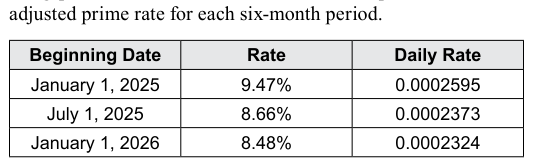
Text version of this table
Beginning Date Rate Daily Rate January 1, 2025 9.47% 0.0002595 July 1, 2025 8.66% 0.0002373 January 1, 2026 8.48% 0.0002324
For a list of interest rates, click on "Reports and Legal" on the Treasury website at www.michigan.gov/treasury/. Interest rates are updated in RABs.
# Signing the Return
All returns must be signed and dated by the taxpayer or the taxpayer's authorized agent. This may be the owner, corporate officer, or association member. The corporate officer may be the president, vice president, treasurer, assistant treasurer, chief accounting officer, or any other corporate officer (such as tax officer) authorized to sign the corporation's tax return.
If someone other than the above prepared the return, the preparer must give his or her business address and telephone number.
Print the name of the authorized signer and preparer in the appropriate area on the return.
Assemble the returns and attachments (in sequence order) and use a clip in the upper-left corner or rubber band the pages together. (Do not staple a check to the return.) In an e-filed return, the preparation software will assemble the forms and PDF attachments in the proper order automatically.
IMPORTANT REMINDER: Failure to include all the required forms and attachments will delay processing and may result in reduced or denied refund or credit forward or a bill for tax due.
SIGNING AN E-FILED RETURN: An electronic tax return must be signed by an authorized tax return signer, the Electronic Return Originator (ERO), if applicable, and the paid tax preparer, if applicable.
NOTE: If the return meets one of the exceptions to the e-file mandate and is being filed on paper, it must be manually signed and dated by the taxpayer or the taxpayer's authorized agent.
The CIT Fed/State e-file signature process is as follows:
Fed/State Returns: Michigan will accept the federal signature method. Michigan does not require any additional signature documentation.
State Stand Alone Returns: State Stand Alone returns must be signed using Form MI-8879 (also called the Michigan e-file Authorization for Business Taxes MI-8879, Form 4763), provided in the e-file software. Returns are signed by entering the taxpayer PIN in the software after reading the perjury statement displayed in the software. The taxpayer PIN will be selected by the taxpayer, or the taxpayer may authorize his or her tax preparer to select the taxpayer PIN.
The MI-8879 (Form 4763) will be printed and contain the taxpayer PIN. The tax preparer will retain Form MI-8879 in their records as part of the taxpayer's printed return. CIT State Stand Alone e-filings submitted without a taxpayer PIN will be rejected by Treasury. Do not mail Form MI-8879 to Treasury and do not include Form MI-8879 as an attachment with the e-file return.
# Mailing Addresses
Mail the annual return and all necessary schedules to:
With payment:
PO Box 30804
Lansing MI 48909
Make check payable to "State of Michigan." Print taxpayer's FEIN, the tax year, and "CIT" on the front of the check. Do not staple the check to the return.
Without payment:
PO Box 30803
Lansing MI 48909
Mail an extension application (Form 4) to:
PO Box 30774
Lansing MI 48909-8274
Mail CIT quarterly estimate payments (Form 4913) to:
PO Box 30774
Lansing MI 48909-8274
Courier delivery service mail should be sent to:
7285 Parsons Dr.
Dimondale MI 48821
Make all checks payable to "State of Michigan." Print taxpayer's FEIN or Michigan Treasury (TR) assigned number, the tax year, and "CIT" on the front of the check. Do not staple the check to the return.
# Correspondence
An address change or business discontinuance can be reported online by using Michigan Treasury Online (MTO), Business Tax Services. See www.michigan.gov/mtobusiness for information. In the alternative, Notice of Change or Discontinuance (Form 163), can be found online at www.
Mail correspondence to:
Business Taxes Division, CIT Unit
PO Box 30059
Lansing MI 48909
To Request Forms
Internet
Current and past year forms are available at
Alternate Format
Printed material in an alternate format may be obtained by calling 517-636-6925.
TTY
Assistance is available using TTY through the Michigan Relay Service by calling 711.
# Revenue Administrative Bulletins (RABs)
Treasury provides updates via RABs under "Reports and Legal" at www.michigan.gov/treasury/. Currently relevant RABs for the CIT are:
- 2013-9, CIT Definition of "Actively Solicits"
- 2014-5, Michigan CIT Nexus Standards
- 2015-20, Where Benefit of Services is Received
- 2018-12, CIT Unitary Business Group Control Test and Relationship Tests
- 2020-26, Corporate Income Tax Small Business Alternative Credit
- 2022-23, Computing Pro-forma Federal Taxable Income for Unitary Business Group Members that File a Federal Consolidated Return
- 2022-26, Treatment of Ordinary and Necessary Expenses for Certain Marihuana Establishments
- 2024-10, Corporate Income Tax (CIT) Penalty and Interest for Underpaid Estimated Tax
- 2024-23, Federal Taxable Income, Net Operating Loss and Business Loss Under Part 2 of the Michigan Income Tax Act
- 2024-24, Alternative Apportionment for the Michigan Business Tax, Corporate Income Tax, and Income Tax
- Interest Rates: For a list of interest rates updated and published in April and October, go to www.michigan.gov/ treasury/ and click on "Reports and Legal."
Sourcing of Sales to Michigan under the Corporate Income Tax (CIT)
TANGIBLE AND REAL PROPERTY
Sale of tangible personal property
Property is shipped or delivered, or, in the case of electricity and gas, the contract requires the property to be shipped or delivered, to any purchaser within this State based on the ultimate destination at the point that the property comes to rest regardless of the free on board point or other conditions of the sales. Property stored in transit for 60 days or more prior to receipt by the purchaser or the purchaser's designee, or in the case of a dock sale not picked up for 60 days or more, shall be deemed to have come to rest at this ultimate destination.
Property stored in transit for fewer than 60 days prior to receipt by the purchaser or the purchaser's designee, or in the case of a dock sale picked up before 60 days, is not deemed to have come to rest at this ultimate destination.
NOTE: Tangible personal property means that term as defined in Section 2 of the Use Tax Act, Public Act (PA) 94 of 1937, MCL 205.92.
Sale, lease, rental or licensing of real property
Property is located in this State.
Lease or rental of tangible personal property
To the extent the property is used in this State. Extent of use is determined by multiplying the receipts by a fraction, the numerator is the number of days of physical location of the property in this State during the lease or rental period in the tax year and the denominator is the number of days of physical location of the property everywhere during all lease or rental periods in the tax year.
If the physical location of the property during the lease or rental period is unknown or cannot be determined, the tangible personal property is used in the state in which the property was located at the time the lease or rental payer obtained possession.
Lease or rental of mobile transportation property owned by the taxpayer To the extent property is used in this State. For example, the extent an aircraft will be deemed to be used is determined by multiplying all the receipts from the lease or rental of the aircraft during the tax year by a fraction, the numerator of the fraction is the number of landings of the aircraft in this State in the tax year and the denominator of the fraction is the total number of landings of the aircraft in the tax year.
If the extent of use of any transportation property within this State cannot be determined, the receipts are in this State if the property has its principal base of operations in this State.
INTANGIBLE PROPERTY (IN GENERAL)
Royalties and other income received for use of or for the privilege of using intangible property including patents, knowhow, formulas, designs, processes, patterns, copyrights, trade names, service names, franchises, licenses, contracts, customer lists, custom computer software, or similar items Property is used by the purchaser in this State. If property is used in more than one state, royalties or other income will be apportioned to this State pro rata according to the portion of use in this State.
If the portion of use in this State cannot be determined, the royalties or other income will be excluded from both the numerator and the denominator.
If the purchaser of intangible property uses it or the rights to the intangible property, in the regular course of its business operations in this State, regardless of the location of the purchaser's customers.
SALES FROM PERFORMANCE OF SERVICES (IN
GENERAL)
Receipts from performance of services, in general
Recipient of services receives all of the benefit of the services in this State.
If the recipient of the services receives some of the benefit of the services in this State, receipts are included in the numerator of the apportionment factor in proportion to the extent that the recipient receives benefit of the services in this State.
For more information regarding how a taxpayer determines where the recipient of services performed receives the benefit of those services and on other CIT topics, see the Michigan Department of Treasury (Treasury) Website at www. michigan.gov/treasury/. Review "Corporate Income Tax" under "Taxes." Treasury also posts updates via Revenue Administrative Bulletin (RAB). Also see RAB 2015-20, Where Benefit of Services is Received,
# FINANCIAL SERVICES
Sales derived from securities brokerage services including commissions on transactions, the spread earned on principal transactions in which broker buys or sells from its account, total margin interest paid on behalf of brokerage accounts owned by broker's customers, and fees and receipts of all kinds from underwriting of securities Multiply the total dollar amount of receipts from securities brokerage services by a fraction, the numerator of which is the sales of securities brokerage services to customers within this State, and the denominator of which is the sales of securities brokerage services to all customers.
If receipts from brokerage services can be associated with a particular customer, but it is impractical to associate the receipts with the address of the customer, then the address of the customer will be presumed to be the address of the branch office that generates the transactions for the customer.
Sales of services derived directly or indirectly from sale of management, distribution, administration, or securities brokerage services to, or on behalf of, a regulated investment company or its beneficial owners, including receipts derived directly or indirectly from trustees, sponsors, or participants of employee benefit plans that have accounts in a regulated investment company To the extent the shareholders of the regulated investment company are domiciled within this State. For this purpose, domicile means the shareholder's mailing address on the records of the regulated investment company.
If the regulated investment company or the person providing management services to the regulated investment company has actual knowledge that the shareholder's primary residence or principal place of business is different than the shareholder's mailing address, then the shareholder's primary residence or principal place of business is the shareholder's domicile.
A separate computation must be made with respect to receipts derived from each regulated investment company. Total amount of sales attributable to this State must be equal to total receipts received by each regulated investment company multiplied by a fraction determined as follows:
- The numerator of the fraction is the average of the sum of the beginning-of-year and end-of-year number of shares owned by the regulated investment company shareholders who have their domicile in this State.
- The denominator of the fraction is the average of the sum of the beginning-of-year and end-of-year number of shares owned by all shareholders.
- For purposes of the fraction, the year will be the tax year of the regulated investment company that ends with or within the tax year of the taxpayer.
Receipts from the origination of a loan or gains from sale of a loan secured by residential real property Only if one or more of the following apply:
- Real property is located in this State.
- Real property is located both within this State and one or more other states and more than 50 percent of the fair market value of the real property is located within this State.
- More than 50 percent of the real property is not located in any one state and the borrower is located in this State.*
Interest from loans secured by real property
Property is located in this State.
If property is located both in this State and one or more other states, and more than 50 percent of the fair market value of the real property is located within this State.
If more than 50 percent of the fair market value of the real property is not located within any one state, if the borrower is located in this State.* The determination of whether the real property securing a loan is located in this State will be made at the time the original agreement was made and any and all subsequent substitutions of collateral will be disregarded.
Interest from a loan not secured by real property
Borrower is located in this State.*
Gains from sale of a loan not secured by real property, including income recorded under coupon stripping rules of IRC 1286 Borrower is located in this State.* Credit card receivables, including interest, fees, and penalties from credit card receivables and receipts from fees charged to cardholders, such as annual fees Billing address of the cardholder is located in this State.
Sale of credit card or other receivables
Billing address of the customer is located in this State.
Credit card issuer's reimbursements fees
Billing address of the cardholder is located in this State.
Merchant discounts, computed net of any cardholder chargebacks, but not reduced by any interchange transaction fees or by any issuer's reimbursement fees paid to another for charges made by its cardholders Commercial domicile of the merchant is located in this State.
Loan servicing fees derived from loans of another secured by real property Real property is located in this State.
Real property is located both in and out of this State and one or more states if more than 50 percent of the fair market value of the real property is located in this State.
More than 50 percent of the fair market value of the real property is not located in any one state, and the borrower is located in this State.* If the location of the security cannot be determined, then loan servicing fees for servicing either the secured or the unsecured loans of another are in this State if the lender to whom the loan servicing service is provided is located in this State.
Loan servicing fees derived from loans of another not secured by real property Borrower is located in this State.* If location of the security cannot be determined, then loan servicing fees for servicing either the secured or the unsecured loans of another are in this State if the lender to whom the loan servicing service is provided is located in this State.
Sale of securities and other assets from investment and trading activities, including, but not limited to, interest, dividends, and gains Attributable to the State if the person's customer is in this State, or if the location of the person's customer cannot be determined, both of the following:
- Interest, dividends, and other income from investment assets and activities and from trading assets and activities, including, but not limited to, investment securities; trading *A borrower is considered located in this State if the borrower's billing address is in this State.
account assets; federal funds; securities purchased and sold under agreements to resell or repurchase; options; futures contracts; forward contracts; notional principal contracts such as swaps; equities; and foreign currency transactions are in this State if the average value of the assets is assigned to a regular place of business of the taxpayer within this State.
○ Interest from federal funds sold and purchased and from securities purchased under resale agreements and securities sold under repurchase agreements are in this State if the average value of the assets is assigned to a regular place of business of the taxpayer within this State.
○ Amount of receipts and other income from investment assets and activities is in this State if assets are assigned to a regular place of business of the taxpayer within this State.
- Amount of receipts from trading assets and activities, including, but not limited to, assets and activities in the matched book, in the arbitrage book, and foreign currency transactions, but excluding amounts otherwise sourced in this section, are in this State if the assets are assigned to a regular place of business of the taxpayer within this State.
# TRANSPORTATION SERVICES
Receipts from transportation services
Generally, receipts will be proportioned based on the ratio that revenue miles of the person in this State bear to the revenue miles of the person everywhere. Revenue mile means the transportation for consideration of 1 net ton in weight or 1 passenger the distance of 1 mile.
For transportation services that source sales based on revenue miles, enter a sales amount on Form 4891, Line 9a, by multiplying total sales of the transportation service by the ratio of Michigan revenue miles over revenue miles everywhere for that type of transportation service. Revenue mile means the transportation for a consideration of one net ton in weight or one passenger the distance of one mile.
Receipts from maritime transportation services will be attributable to this State as follows:
- 50 percent of those receipts that either originate or terminate in this State.
- 100 percent of those receipts that both originate and terminate in this State.
Receipts attributable to this State of a person whose business activity consists of the transportation of:
- Property and individuals - Proportioned based on the total receipts for passenger miles and ton mile fractions, separately computed and individually weighted by the ratio of receipts from passenger transportation to total receipts from all transportation, and by the ratio of receipts from freight transportation to total receipts from all transportation, respectively.
Michigan Ton Miles Receipts from x
Transportation of Property
Total Ton Miles
+
# Michigan Passenger Miles Receipts from x Transportation of Passengers
Total Passenger Miles
= Michigan Sales from Transportation Services
- Oil by pipeline - Proportioned based on the ratio that the receipts for the barrel miles transported in this State bear to the receipts for the barrel miles transported by the person everywhere.
- Gas by pipeline - Proportioned based on the ratio that the receipts for the 1,000 cubic feet miles transported in this State bear to the receipts for the 1,000 cubic feet miles transported by the person everywhere.
NOTE: If a taxpayer can show that revenue mile information is not available or cannot be obtained without unreasonable expense to the taxpayer, receipts attributable to this State will be that portion of the revenue derived from transportation services performed everywhere that the miles of transportation services performed in this State bears to the miles of transportation services performed everywhere. If Treasury determines that the information required for the calculations above are not available or cannot be obtained without unreasonable expense to the taxpayer, Treasury may use other available information that in the opinion of Treasury will result in an equitable allocation of the taxpayer's receipts to this State.
NOTE: Only transportation services are sourced using revenue miles. To the extent the taxpayer has business activities or revenue streams not from transportation services, those receipts should be sourced accordingly.
# TELECOMMUNICATIONS SERVICES
NOTE: Terms used to describe the sale of telecommunications service or mobile telecommunications service have the same meaning as those terms defined in the Streamlined Sales and Use Tax Agreement administered under the Streamlined Sales and Use Tax Administration Act, PA 174 of 2004, MCL 205.801 to 205.833.
Sale of telecommunications service or mobile telecommunications service, in general Customer's place of primary use of the service is in this State.
As used here, place of primary use means the customer's residential street address or primary business street address where the customer's use of the telecommunications service primarily occurs.
For mobile telecommunications service, the customer's residential street address or primary business street address is the place of primary use only if it is within the licensed service area of the customer's home service provider.
Sale of telecommunications service sold on an individual call-by-call basis Call both originates and terminates in this State.
Call either originates or terminates in this State and the service address is located in this State.
Sale of postpaid telecommunications service
Origination point of the telecommunication signal (as first identified by the service provider's telecommunication system or as identified by information received by the seller from its service provider if the system used to transport telecommunication signals is not the seller's) is located in this State.
Sale of prepaid telecommunications service or prepaid mobile telecommunications service Purchaser obtains the prepaid card or similar means of conveyance at a location in this State.
Recharging a prepaid telecommunications service or mobile telecommunications service Purchaser's billing information indicates a location in this State.
Sale of private communication services
100 percent of the receipts from the sale of each channel termination point within this State.
100 percent of the receipts from the sale of the total channel mileage between each termination point within this State.
50 percent of the receipts from the sale of service segments for a channel between two customer channel termination points, one of which is located in this State and the other is located outside of this State, which segments are separately charged.
Receipts from the sale of service for segments with a channel termination point located in this State and in two or more other states or equivalent jurisdictions, and which segments are not separately billed, are in this State based on a percentage determined by dividing the number of customer channel termination points in this State by the total number of customer channel termination points.
Sale of billing services and ancillary services for telecommunications service Based on the location of the purchaser's customers.
If the location of the purchaser's customers is not known or cannot be determined, the sale of billing services and ancillary services for telecommunications service are in this State based on the location of the purchaser.
To access a carrier's network or from the sale of telecommunications services for resale 100 percent of the receipts from access fees attributable to intrastate telecommunications service that both originates and terminates in this State.
50 percent of the receipts from access fees attributable to interstate telecommunications service if the interstate call either originates or terminates in this State.
100 percent of receipts from interstate end user access line charges, if customer's service address is in this State. As used here, "interstate end user access line charges" includes, but is not limited to, the surcharge approved by the federal communications commission and levied pursuant to 47 CFR 69.
Gross receipts from sales of telecommunications services to other telecommunication service providers for resale will be sourced to this State using the apportionment concepts used for non-resale receipts of telecommunications services if the information is readily available to make that determination. If the information is not readily available, then the taxpayer may use any other reasonable and consistent method.
Taxpayer whose business activities include live radio or television programming as described in Subsector
Code 7922 of Industry Group 792 or are included in
Industry Groups 483, 484, 781, or 782, under the SIC
Code as compiled by the U.S. Department of Labor, or any combination of the business activities included in those groups Media receipts are attributable to this State only if the commercial domicile of the customer is in this State and the customer has a direct connection or relationship with the taxpayer pursuant to a contract under which the media receipts are derived.
Media receipts from the sale of advertising are attributable to this State if the customer of that advertising is commercially domiciled in this State and receives some of the benefit of the sale of that advertising in this State. Sales are included in proportion to the extent that the customer receives the benefit of the advertising in this State.
If the taxpayer is a broadcaster and if the customer receives some of the benefit of the advertising in this State, the media receipts for that sale of advertising from that customer will be proportioned based on the ratio that the broadcaster's viewing or listening audience in this State bears to its total viewing or listening audience everywhere.
Media property means motion pictures, television programs, Internet programs and Web sites, other audiovisual works, and any other similar property embodying words, ideas, concepts, images, or sound without regard to the means or methods of distribution or the medium in which the property is embodied.
Media receipts means receipts from the sale, license, broadcast, transmission, distribution, exhibition, or other use of media property and receipts from the sale of media services. Media receipts do not include receipts from the sale of media property that is a consumer product that is ultimately sold at retail.
Media services means services in which the use of the media property is integral to the performance of those services.
OTHER
Default for all other receipts not otherwise sourced here Sourced based on where the benefit to the customer is received, or if where the benefit to the customer is received cannot be determined, sourced to the customer's location.
2025 Supplemental Instructions for Standard Members in Unitary Business Groups (UBGs)
# NOTE: These instructions for Unitary Business Groups
(UBGs) are meant to supplement general instructions and form-specific instructions for standard taxpayers of the Corporate Income Tax (CIT), not to replace them.
Standard taxpayers and standard members refer to all taxpayers or UBG members, respectively, other than financial institutions or insurance companies. Financial institutions that are members of a UBG should see "Supplemental Instructions for
Financial Institution Members in UBGs" in the CIT Forms and Instructions for Financial Institutions (Form 4907).
There is not a corresponding supplement for insurance companies because, although they can be members of a UBG, they do not file combined returns.
Introductory pages of this CIT instruction booklet contain general information designed to assist in identifying the existence and membership of a UBG. The following instructions address:
- Filing combined returns by different member types within a UBG.
- Understanding the role of the Designated Member (DM).
- For each type of UBG member that is reported on a combined return (standard and financial institution), there are required forms that collect data necessary for preparation of a combined return:
○ The CIT Unitary Business Group Affiliates Excluded from the Return of a Standard Taxpayer (Form 4896) and
CIT Data on Unitary Business Group Members (Form
- support a combined return of standard members to be filed on the CIT Annual Return (Form 4891).
# ○ The CIT Unitary Business Group Combined Filing
Schedule for Financial Institutions (Form 4910) supports a combined return of financial institution members to be filed on the CIT Annual Return for Financial Institutions (Form 4908).
Guidance that is specific to only one form is contained in the instructions for that form, in sections titled either "Special Instructions for Unitary Business Groups" or simply "UBGs."
With the exception of a section providing supplemental instructions for the Corporate Income Tax Loss Adjustment for the Small Business Alternative Credit (Form 4895), the following are instructions that apply to more than one form.
Special Instructions and the Designated Member
# Special Instructions for the Annual Return
By definition, a UBG can include standard members, insurance companies, and financial institutions. However, in some cases not all members of the UBG will be included on the same return. All standard members in a UBG (except those owned by and unitary with a financial institution) file a single combined return on Form 4891. Financial institution members of a UBG (and any standard member owned by and unitary with a financial institution in the group) file a combined return on Form 4908. Insurance company members of a UBG each file separately on Form 4905.
Before completing a combined return, UBGs should first complete Forms 4896 and 4897 or Form 4910. These forms are used to gather data from each member included in the combined filing schedule and eliminate intercompany transactions where applicable, to support the primary return.
Insurance companies that are part of a UBG will each file a separate Form 4905, but should be listed as an excluded affiliate with an incompatible tax base on Form 4896 or Form 4910, as applicable, if they are unitary with a standard taxpayer or a financial institution.
# The Designated Member (DM)
A UBG combined return of standard members is filed under the name and Federal Employer Identification Number (FEIN) or Michigan Treasury (TR) assigned number of the DM of the standard member group. Designated Member means a UBG member that has nexus with Michigan and will file the combined CIT return on behalf of the standard members of the group. In a brother-sister controlled group, any member with nexus may be designated to serve as DM. In a parentsubsidiary controlled group or a combined controlled group (an interlocking combination of a parent-subsidiary group and a brother-sister group), the controlling member must serve as DM if it has nexus with Michigan. If it does not have nexus, the controlling member may appoint any member with nexus with Michigan to serve as DM. That DM must continue to serve as such every year, unless it ceases to be a group member or the controlling member attains Michigan nexus. The filing period of a combined return is based on the tax year of the DM.
If a UBG is comprised of both standard members and financial institutions, the UBG will have two DMs (one for the standard members completing Form 4891 and related forms, and one for the financial institution members completing Form 4908 and related forms). If the standard members are owned by a financial institution, they will file on the financial UBG return, Form 4910.
Role of the DM: The DM speaks, acts, and files the CIT return on behalf of the group for CIT purposes. Only the DM may file a valid extension request for the group. Treasury maintains the group's CIT data (e.g., prior CIT returns, business loss carryforward, overpayment credit forward) under the DM's name and account number. The designated member must be of the same taxpayer type (standard or financial institution) as the members for which it files a combined return.
# Special Instructions for Supporting Forms
Most forms are completed by UBGs on a group basis. However, the following three forms must be completed with entityspecific data, rather than groupwide data:
- CIT Schedule of Shareholders and Officers (Form 4894)
• CIT Loss Adjustment for the Small Business Alternative
Credit (Form 4895). (In some circumstances, a separate copy of Form 4895 also is completed with groupwide data.)
- CIT Data on UBG Members (Form 4897).
If more than one member completes one of these forms, multiple copies of that form must be included in the group's combined return.
CIT Small Business Alternative Credit (Form 4893):
For the Small Business Alternative Credit, the criteria to qualify for the credit should be applied on a group basis. The adjusted business income disqualifier is calculated at the group level after intercompany eliminations. The allocated income disqualifier is based on all items paid or allocable to a shareholder or officer by all members of the UBG. All items paid or allocable to a single individual from members of the UBG must be combined when calculating this disqualifier.
This is a change from the comparable calculation under MBT.
In addition, a disqualifier applies to a UBG at the group level if such disqualifier applies to any member of the UBG. The reduction percentages for the credit also apply to the entire group if they apply to any one member of the group. If the qualification is satisfied, the calculation of the available credit amount should also be on a group basis. The calculation of the credit should also be done after eliminations of intercompany transactions. The available amount of the Small Business Alternative Tax Credit is taken against the entire group's tax liability. Additional UBG instructions are provided on forms where the Small Business Alternative Credit is calculated.
If the UBG is comprised of both standard members and financial institutions, two copies of supporting forms will be completed (one group of supporting forms for the standard members' annual return and one group of supporting forms for the financial institutions' annual return).
# Effects of Members Joining a Group
When an entity becomes a member of a UBG part way through the member's tax year, for CIT purposes the new member will experience a short tax year beginning on the date the member joins the group, even if it does not have a short period for federal purposes.
For both the UBG return and the new member's separate short period return, tax bases will be calculated using actual numbers from the applicable short period of the new member.
If a member that is new to the group brings with it a carryforward of a business loss, combine that amount with any carryforward of business loss that was generated by the group or brought to the group by another member. The group must then use the oldest available business loss carryforward first, regardless of source. If two members each created (or brought) a business loss carryforward of the same age, and together those exceed the amount allowable in this filing period after use of older carryforwards, those members' respective business loss carryforwards are used in proportion to the amount they created for, or brought to, the group.
# Effects of Members Leaving a Group
When a member of a UBG ceases to be a member part way through the member's tax year, for CIT purposes the departing member will experience a short tax year ending on the departure date, even if it does not have a short period for federal purposes.
For both the UBG return and the departing member's separate short period return, tax bases will be calculated using actual numbers from the applicable short period of the departing member.
In most cases, when a member leaves the group, any business loss carryforward of the unitary business group is divided among the unitary business group and the departing members in proportion to the losses the members would have generated had each member filed separately. Specifically, the portion of the business loss carryforward of a taxpayer that is a unitary business group attributable to a departing member is an amount equal to the business loss carryforward of the unitary business group multiplied by a fraction, the numerator of which is what would have been the business loss of that member had that member filed a separate return, and the denominator of which is the sum of what would have been the separate business losses of all members of the group in that year having business losses if those members filed separate returns.
Other UBG-Related Issues
An affiliated person that is excluded from membership in a UBG because it is a foreign person, which has nexus and meets the applicable filing threshold, must file a separate CIT return.
# Further Guidance on UBGs
For information on CIT issues, see the Treasury Website at www.michigan.gov/treasury/. Treasury posts updates to the Corporate Income Tax page and via Revenue Administrative Bulletin (RAB).
Source: view the official PDF
Nearby sections (12 sections)
- form-4890-cit-booklet · Form 4890 — Michigan CIT Forms and Instructions…
- form-4891-cit · Form 4891 — Michigan Corporate Income Tax Annual Return…
- form-5772-fte-instructions · Form 5772 Instructions — Michigan…
- form-5774-instructions · Form 5774 Instructions — Schedule for…
- form-807-composite · Form 807 — Michigan Composite Individual Income…
- mi-1040-book · MI-1040 Book — Michigan Individual Income Tax Return &…
- mi-1040cr · MI-1040CR — Michigan Homestead Property Tax Credit Claim…
- mi-1041-book · MI-1041 Book — Michigan Fiduciary Income Tax Return &…
- schedule-fte · Form 6072 — Michigan Schedule FTE (Flow-Through Entity)…
- schedule-tiered-entities · Form 6074 — Michigan Schedule of Tiered…
- suw-5080 · Form 5080 — Michigan Sales, Use & Withholding Taxes…
- suw-5081-annual · Form 5081 — Michigan Sales, Use & Withholding Taxes…