Michigan Department of Treasury Form Instructions
Form 6072 — Michigan Schedule FTE (Flow-Through Entity) & Instructions
6072 (09-25)
Attachment 36
# MICHIGAN Schedule FTE
The Michigan Schedule FTE (Schedule FTE) is required to be filed with any Form MI-1040 or MI-1041 that claims a credit, addition, or subtraction related to the Flow-Through Entity Tax (FTE tax) under Part 4 of the Michigan Income Tax Act. The information you report should typically come from the statement issued by the flow-through entity (FTE) you directly own. For each credit identified on this schedule, include the Michigan Flow-Through Entity Tax Information Reports (or same information in another format) that you received from a flow-through entity you directly own.
Filer's Name Shown on Tax Return Identifying Number
# PART 1: DIRECT FTE CREDITS AND ADJUSTMENTS
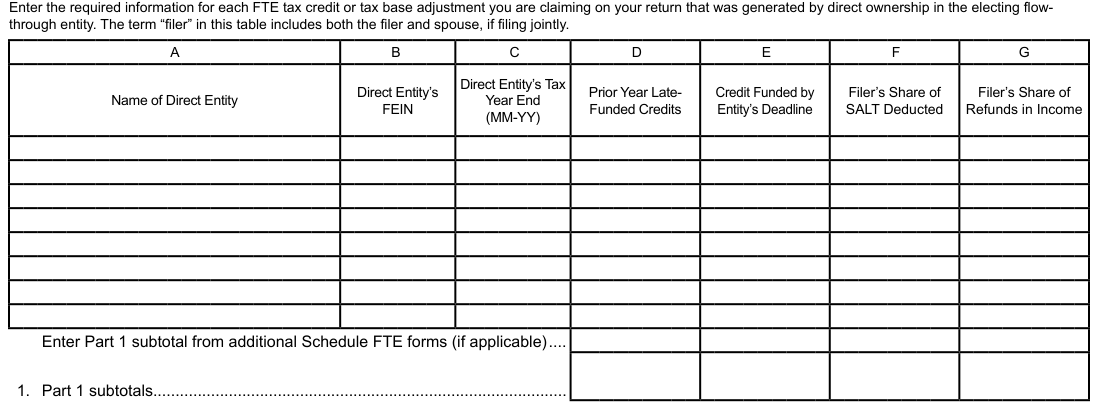
Enter the required information for each FTE tax credit or tax base adjustment you are claiming on your return that was generated by direct ownership in the electing flowthrough entity. The term "filer" in this table includes both the filer and spouse, if filing jointly.
Text version of this table
| A | B | C | D | E | F | G |
|---|---|---|---|---|---|---|
| Direct Entity's Tax | Direct Entity’s FEIN | Direct Entity’s Tax Year End (MM-YY) | Prior Year Late- Funded Credits | Credit Funded by Entity’s Deadline | Filer’s Share of SALT Deducted | Filer’s Share of Refunds in Income |
| Enter Part 1 subtotal from additional Schedule FTE forms (if applicable).... 1. Part 1 subtotals............................................................................................. |
# PART 2: INDIRECT FTE CREDITS AND ADJUSTMENTS
Text version of this table
| A | B | C | D | E | F | G | H | I |
|---|---|---|---|---|---|---|---|---|
| Credit No. | Name of Credit- Generating Entity (CGE) | CGE's FEIN | CGE’s Tax Year End (MM-YY) | Recipient FEIN on Form 5774 | Recipient FEIN on Form 5774 | Filer's Credit | Filer’s Share of SALT Deducted | Filer’s Share of Refunds in Income |
| Enter Part 2 subtotal from additional Schedule FTE forms (if applicable)................................. 2. Part 2 subtotals.......................................................................................................................... |
Filer's Share of
# Refunds in Income
- Part 2 subtotals …
- Total Addition of State and Local Taxes Deducted. Add line 1 column F and line 2 column H. Carry this amount to
- Total Subtraction of Refunds. Add line 1 column G and line 2 column I. Carry this amount to Schedule 1, line 16 or MI-1041, line 38 …
- Total FTE Credits. Add line 1 column D, line 1 column E, and line 2 column G. Carry this amount to MI-1040, line 30 or MI-1041, line 19...
- 0000 2025 33 01 27 9
Reset Form
# Instructions for Form 6072, MICHIGAN Schedule FTE
Purpose
For 2025 and future tax years this form allows an eligible taxpayer to claim a credit for their allocated share of tax paid by an electing flow-through entity. By electing to file annual returns and pay the Michigan Flow-Through Entity (FTE) tax, the electing flow-through entity's direct or indirect members become eligible to claim a credit for the member's allocated share of that FTE tax. Taxpayers are also required to report on this form an addition and a subtraction of their allocated share of: (1) Michigan FTE taxes paid by an electing flowthrough entity, to the extent they reduced the filer's adjusted gross income (AGI), and (2) a refund of Michigan FTE tax received by an electing flow-through entity to the extent it increased the filer's AGI .
FTE credits are reported here, totaled, and then carried to the appropriate form according to the type of taxpayer. Individual and fiduciary filers carry the figures to the Michigan Individual Income
# Tax Return (Form MI-1040), and the Fiduciary Income Tax Return
(Form MI-1041), respectively. This form is not required to be filed with a Composite Return (Form 807).
The allocated share of Michigan FTE tax paid, or "addition", and allocated share of Michigan FTE tax refund, or "subtraction" are reported here and then carried to the appropriate form, according to the type of taxpayer. Individual filers carry the figures to the Schedule 1, and Fiduciary filers carry the figures to the MI-1041 ⚠ Schedule 1 or MI-1041 Schedule NR, depending on residency.
This form cannot be filed, nor can an FTE credit be claimed on an annual return, until the creditgenerating entity (CGE) has filed its annual return that generates the allocated share of tax (credit) reported on this form. If that FTE tax return has not been filed and ideally, processed without error, you will not be eligible for your credit.
Terminology
Adjustments are the filer's FTE addition and/or FTE subtraction.
Filer for this form's purpose includes a fiduciary filer or both a filer and spouse, if filing jointly. However, for a joint return, a primary filer's credits and adjustments should be reported on separate rows from the spouse's credits and adjustments.
Flow-through entity or entity means an entity that for the applicable tax year is treated as an S corporation or a partnership under the internal revenue code for federal income tax purposes. Flowthrough entity does not include a publicly traded partnership, any entity disregarded or treated as a corporation under section 845, or an insurance company subject to the premiums tax under Michigan's corporate income tax.
Electing flow-through entity means a "flow-through entity" that validly made an election to pay the FTE tax under Part 4 of the Income Tax Act. An election into the FTE tax lasts for 3 tax years.
Credit-generating entity (CGE) is an electing flow-through entity that filed the return and paid the tax for which the filer is claiming a credit. Because tiered entities may include more than one electing flow-through entity and credits and adjustments from each of those entities must be separately reported by the filer, this term is to distinguish between the two types of flow-through entities.
Credit funding deadline is determined in reference to a CGE's tax year and determines the tax year against which the filer may claim its credit (or portion of credit) based on their share of tax levied on that CGE's return. For each annual tax return a CGE files, it must pay its tax by its credit funding deadline for its members to claim those credits against the same tax year; otherwise, the credits (or portions of credit) must be claimed in a member's subsequent tax year, based on when the CGE ultimately pays that tax. For example, if a CGE files an amended return to report additional tax for tax year 1 (TY1) and pays that additional tax after TY1's credit funding deadline, but during its TY2, credits attributable to that additional tax may only be claimed by the members on their returns for their tax year with or within the CGE's TY2 falls.
For CGEs' tax years beginning before 2024, the credit funding deadline was the 15th day of the 3rd month after the CGE's tax year end. For CGE's tax year beginning on or after January 1, 2024, the credit funding deadline is the due date of the CGE's annual return, including extensions.
Member when used in reference to a flow-through entity, means a shareholder of an S corporation or a partner or member in a partnership. A member can be an individual, trust, or estate, regardless of residency in Michigan, or another flow-through entity.
Indirectly owns means that the person owns a flow-through entity indirectly through another flow-through entity. For example, Sam is a partner in partnership A and partnership A is a partner in partnership
B. Sam indirectly owns partnership B.
Indirect credit and tiered credit describe a credit generated by a CGE that is not owned by the filer of the form, but instead owned by another flow-through entity, trust, or estate that is listed as a direct member on Form 5774, Part 2. An indirect or tiered credit is passed from a CGE through flow-through entities that are direct owners, until each respective share is ultimately claimed by taxpayers subject to Michigan individual income tax (IIT), who are the filers of this form. There may be multiple tiers of flow-through entity ownership between the CGE and the filer. These IIT taxpayers own the CGE indirectly, which is why their credits may be referred to as indirect credits. In addition, this ownership structure is often referred to as a tiered structure and therefore, creates what may be referred to as tiered credits.
Same tax year as used in these instructions means the flow-through entity's tax year that ends with or within the filer's tax year. This term is necessary because flow-through entities, trusts, and estates can have fiscal, rather than calendar, tax years.
Example: Entity X has two individual members, Y and Z. Entity X's tax year ends June 30, 2025. Member Y and Member Z's tax years end December 31, 2025. If Entity X elects into the FTE tax, its tax year ending in 2025 is reported on 2024 FTE tax forms, because it is a fiscal filer. Members Y and Z file their individual income tax returns on 2025 forms. However, these instructions would refer to both Y and Z's 2025 tax year and Company X's tax year ending June 30, 2025 as the same tax year.
Report refers to a document or documents provided by a flowthrough entity to each of its direct members to report information about the member's allocated share of an FTE tax credit, addition, or subtraction, and the CGE associated with those items. This report may be provided to you on a Michigan Flow-through Entity Tax Information for Direct Members Report, as Schedule K-1 notes or in any other format preferred by a flow-through entity. For indirect or tiered credits, information about each of those entities and their shares of FTE credits, additions, and subtractions should also be included in the report. See Michigan Flow-through Entity Tax Information: Indirect Share for Direct Members Report.
Michigan Flow-through Entity Tax Information: Indirect Share for Direct Members Report is a report specifically used to provide information to members about tiered credits and adjustments.
Reports are completed and provided to direct members in succession throughout a chain of ownership. Specifically, a CGE completes a separate report including the "Cumulative Tiered Information" part of the report, for each of its direct members that are other flowthrough entities, and provides the reports to those respective entities.
Those recipient flow-through entities complete new reports using the information they received and provide the new, individualized reports to their direct members. On each of those reports, the reporting entity (that was a recipient entity) adds its information to the "Cumulative Tiered Information" part of the report. Each tiered entity in the chain of ownership does the same until reporting to its direct owner that is subject to Michigan IIT.
Form 5774 is the form an electing flow-through entity files with its annual return (Form 5772) to report and allocate each of its members' respective shares of the FTE tax levied on that annual return.
Specifically, an FTE taxpayer reports this information in Part 2 of Form 5774, but on this form and in these instructions, the applicable portion of Form 5774 is referred to simply as Form 5774. Part 1 of Form 5774 is not applicable to taxpayers eligible to claim FTE credits.
It is not expected that the filer obtains a copy of the CGE's Form 5774; rather, flow-through entities in a tiered structure should reference Form 5774 in their reports to members and specify which entity in a tiered structure was reported on the CGE's Form 5774.
Tiered structure refers to a situation where a flow-through entity has at least one other flow-through entity as a member. Within a tiered structure, each flow-through entity that has business activity in Michigan may or may not elect to pay the Michigan FTE Tax.
# Timing of Credit Claims
If the filer has credits from any CGE's current tax year that were not funded by that CGE's credit funding deadline, do not report those credits on this form; those credits will be reportable in a later tax year, once the CGE pays that tax. To report prior tax year late-funded credits on this year's Form 6072, see Example 1: Prior Year Late-Funded
# Credits or Example 2: Prior Year Late-Funded Credits for Tiered
Entities.
Where does a taxpayer get the information to complete this form?
Whether or not an election was made into the FTE tax, all flowthrough entities within a tiered structure are required under Michigan law to report to their direct members specific information about the members' allocated share of an FTE tax credit, addition or subtraction, and business income apportioned to Michigan. You may have received this information in the notes to your federal Schedule K-1, on a Michigan Flow-Through Entity Tax Information Report, or in any other format the flow-through entity prefers (collectively, "report" - see Terminology). This report is the source of the information the filer must have to complete this form.
If the filer did not receive enough detail on that report to complete this form, the filer should contact the flow-through entity and request the necessary information. Otherwise, significant delays in the processing of the return or a denial of the claimed FTE tax credit may result.
In a tiered structure, even if a member flow-through entity does not elect into the FTE tax, that entity must take the information reported to it by the flow-through entity it owns, and pass that information through to its own members, allocated appropriately to each. Ideally, you should have received a Flow-Through Entity's Schedule of Tiered Entities from the entity you directly own, breaking down the allocated share of tax, addition, and subtraction at each tier.
Line-by-Line Instructions
Lines not listed are explained on the form.
# Part 1: Direct FTE Credits and Adjustments
This section reports FTE tax credits and adjustments the filer is claiming for this tax year and that were generated by the filer's direct ownership in a CGE. Each entity and its respective information (and the filer's share of that tax information) are reported separately on a single row. If the filer has credits attributable to more than one tax year of the same CGE, a separate row should be used for each. See Example 1:
Prior Year Late-Funded Credits for more information.
Column C: Report the tax year end of the electing flow-through entity in MM-YY format (disregard the day of the month). This will generally be the CGE's tax year that ends with or within the current tax year of the filer. However, if prior year late-funded credits are reported (see Column D), the CGE's tax year end should be the tax year of that CGE's annual return from which the credit was generated.
Column D: Report prior year late-funded credits in this column and on a separate row from current year, timely funded credits (see column E).
Members must delay their credit claims in some cases, depending on when the CGE paid its tax. It is possible to report these credits even if you are no longer a member of the CGE in your current tax year.
Column E: Report credits based on the filer's allocated share of tax from a directly owned CGE's same tax year. Only the portion of the filer's share of tax that was paid by that entity's credit funding deadline may be reported here. Any portion of the entity's current tax year FTE tax that was paid after its credit funding deadline must not be claimed this year but can be claimed on the filer's return for a subsequent tax year, depending on which year the CGE paid that tax.
Column F: Report here the filer's share of a CGE's Michigan FTE tax paid for the same CGE tax year that the filer reports on this form, to the extent that tax was deducted in arriving at the filer's adjusted gross income (AGI). When a flow-through entity deducts state and local taxes (SALT) on its federal return, that deduction reduces the entity's net income and in turn, generally reduces each member's distributive shares of income included in AGI. The Michigan Income Tax Act requires that a taxpayer's share of such income taxes to be added to AGI and therefore, the filer is required to report their share in this column.
Column G: Report here the filer's share of Michigan FTE taxes refunded to a CGE in the CGE's tax year that ends with or within the filer's tax year reported on this form, to the extent that refund was included in the filer's AGI. When a flow-through entity receives a refund of state and local taxes (SALT) that it deducted on a previous federal return, that refund increases the entity's net income and in turn, generally increases each member's distributive shares of income included in AGI. The Michigan Income Tax Act allows a taxpayer to subtract their allocated share of such refund to be added to AGI and therefore, the filer should report their share in this column.
# Part 2: Indirect FTE Credits and Adjustments
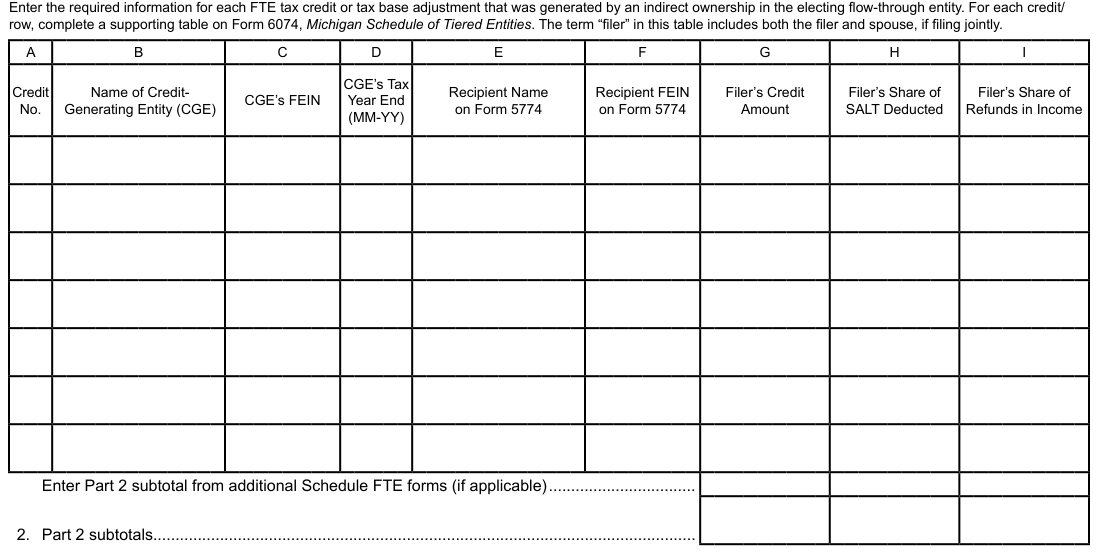
This section reports FTE tax credits and adjustments that were generated by the filer's indirect ownership in a CGE through one or more other flow-through entities and regardless of whether any of those other entities also elected into the FTE tax. For this purpose, "other flow-through entity" includes a fiduciary (trust or estate), which is not permitted to elect into the FTE tax.
Each indirect credit and its respective information are reported separately on a single row. Assign a unique and sequential numeric value to each credit. An indirect credit must be attributable to only one CGE and through only one chain of ownership. For example, Filer owns a share of Entity Y, which owns a share of Entity X. Filer also owns a share of Entity Z, which owns a share of Entity X. Entity X is a CGE.
Filer has two, distinct, indirect credits from Entity X and must report them separately. Spouses that file a joint return and receive an FTE tax credit from the same CGE should complete separate tables to accurately report their individually allocated credit.
If the filer has credits attributable to more than one tax year of the same CGE, a separate row should be used for each. See Example 1:
# Prior Year Late-Funded Credits or Example 2: Prior Year Late-Funded
Credits for Tiered Entities, and apply the concepts to reporting on Form 6074.
Before completing this Part, complete Form 6074. All information reported in this Part is carried over from Form 6074. Complete a supporting table for each distinct indirect credit that will be reported on Form 6072, Part 2. Complete one row of this Part at a time.
Column A: Assign a unique numeric value to each indirect credit. It is recommended that the credits be numbered sequentially, beginning with the number 1. Ensure that each populated row is completed and corresponds to at least one completed table on Form 6074.
Column B: For each indirect credit (row used) in this Part, carry from the corresponding Form 6074 table the name of the credit-generating entity (CGE).
Column C: Report the FEIN of the CGE reported in column B.
Column D: Report the tax year end, in MM-YY format, of the CGE reported in column B.
Column E: Report here the name of the entity from the second row of the credit's corresponding table on Form 6074, which is the entity reported immediately below the CGE.
Column F: Report the FEIN of the entity reported in Column E.
Column G: Report the amount from Column E or F, whichever is applicable, of the last row from the corresponding table on Form 6074.
The last row on the corresponding table should be the filer of these forms. See Example 3: Two Taxpayers Filing Jointly with Direct and Indirect Credits. If the filer has indirect credits attributable to more than one tax year of the same CGE, a separate line should be created for each.
Column H: Report the amount in Column G of the last row from the corresponding table on Form 6074. The last row should be the filer of these forms.
Column I: Report the amount in Column H of the last row from the corresponding table on Form 6074. The last row should be the filer of these forms.
# Other Supporting Forms and Schedules
Include with this form for each flow-through entity and credit (or adjustment) claimed a copy of the Schedule K-1 with any of the following received from the flow-through entity: Schedule K-1 notes, Michigan Flow-through Entity Tax Information Report, or the same information in any other format.
Examples
These examples illustrate how the Michigan flow-through entity direct and indirect credits are computed.
# Example 1: Prior Year Late-Funded Credit
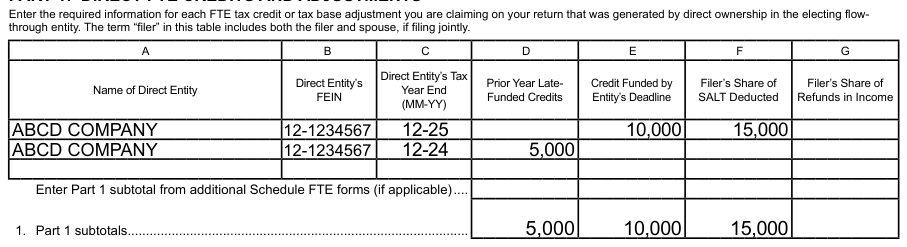
Benjamin Johnson has a $10,000 FTE credit generated by ABCD Company, which was funded by the entity deadline for tax year 2025. He also has a prior year late-funded credit of $5,000 from tax year 2024 from the same credit generating entity. ABCD Company deducted $15,000 of SALT on their 2025 federal tax return. Benjamin is allowed to claim a total FTE credit of $15,000 on his Individual Income Tax Return for tax year 2025.
6072 (09-25)
12-25
Attachment 36
MICHIGAN Schedule FTE
Filer's Name Shown on Tax Return Identifying Number
BENJAMIN JOHNSON 123-45-6789
# PART 1: DIRECT FTE CREDITS AND ADJUSTMENTS
Enter the required information for each FTE tax credit or tax base adjustment you are claiming on your return that was generated by direct ownership in the electing flowthrough entity. The term "filer" in this table includes both the filer and spouse, if filing jointly.
Text version of this table
| A | B | C | D | E | F | G |
|---|---|---|---|---|---|---|
| Name of Direct Entity | Direct Entity’s FEIN | Direct Entity’s Tax Year End (MM-YY) | Prior Year Late- Funded Credits | Credit Funded by Entity’s Deadline | Filer’s Share of SALT Deducted | Filer’s Share of Refunds in Income |
| XYZ | 77-7777777 | 12-25 | 18,750 | 16,875 | ||
| XYZ | 77-7777777 | 12-25 | 56,250 | 50,625 | ||
| 75,000 | 67,500 |
Direct Entity's Tax
Direct Entity's Prior Year Late- Credit Funded by Filer's Share of Filer's Share of
# FEIN Funded Credits Entity's Deadline SALT Deducted Refunds in Income
Text version of this table
| A | B | C | D | E | F | G |
|---|---|---|---|---|---|---|
| Name of Direct Entity | Direct Entity’s FEIN | Direct Entity’s Tax Year End (MM-YY) | Prior Year Late- Funded Credits | Credit Funded by Entity’s Deadline | Filer’s Share of SALT Deducted | Filer’s Share of Refunds in Income |
| ABCD COMPANY | 12-1234567 | 12-25 | 10,000 | 15,000 | ||
| ABCD COMPANY | 12-1234567 | 12-24 | 5,000 | |||
| 5,000 | 10,000 | 15,000 |
- Total Addition of State and Local Taxes Deducted. Add line 1 column F and line 2 column H. Carry this amount to 15,000
- Total Subtraction of Refunds. Add line 1 column G and line 2 column I. Carry this amount to Schedule 1, line 16 or MI-1041, line 38 …
- Total FTE Credits. Add line 1 column D, line 1 column E, and line 2 column G. Carry this amount to MI-1040, line 30 or MI-1041, line 19...
15,000
# Example 2: Prior Year Late-Funded Credit for Tiered Entities
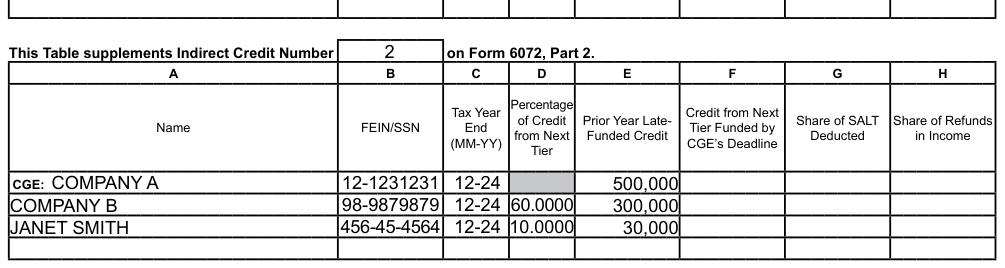
Company A timely filed a 2024 Michigan Flow-through Entity Tax return. However, Company A failed to pay all tax on or before their credit funding deadline and instead paid the tax on November 1, 2025. Therefore, Company A's members will experience a delay related to when they are able to claim the credit reported on Company A's 2024 Michigan Flow-through Entity Tax return. Company A filed their 2025 Michigan Flowthrough Entity Tax return timely and the full credit was funded by Company A's credit funding deadline for the tax year. Company A deducted 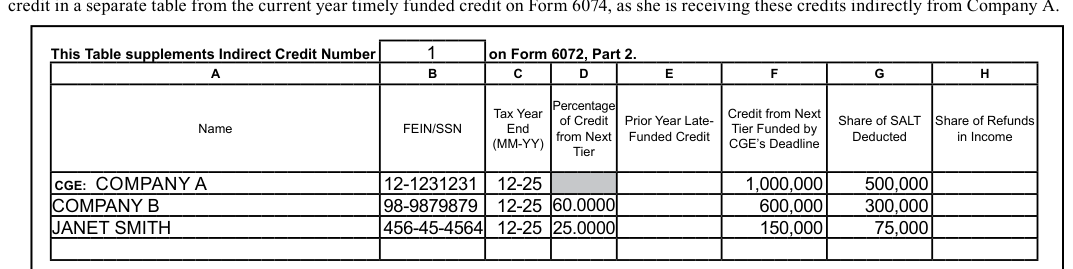
Text version of this table
1 A B C D E F G H Name Name FEIN/SSN Tax Year End (MM-YY) Percentage of Credit from Next Prior Year Late- Funded Credit Credit from Next Tier Funded by CGE’s Deadline Share of SALT Deducted Share of Refunds in Income CGE: COMPANY A 12-1231231 12-25 1,000,000 500,000 COMPANY B 98-9879879 12-25 60.0000 600,000 300,000 JANET SMITH 456-45-4564 12-25 25.0000 150,000 75,000
Once Form 6074 is completed, Janet carries the applicable information to Form 6072, Part 2.
# PART 2: INDIRECT FTE CREDITS AND ADJUSTMENTS
Enter the required information for each FTE tax credit or tax base adjustment that was generated by an indirect ownership in the electing flow-through entity. For each credit/ row, complete a supporting table on Form 6074, Michigan Schedule of Tiered Entities. The term "filer" in this table includes both the filer and spouse, if filing jointly.
CGE's FEIN
CGE's Tax
Filer's Credit
Amount
Filer's Share of
Filer's Share of
# Refunds in Income
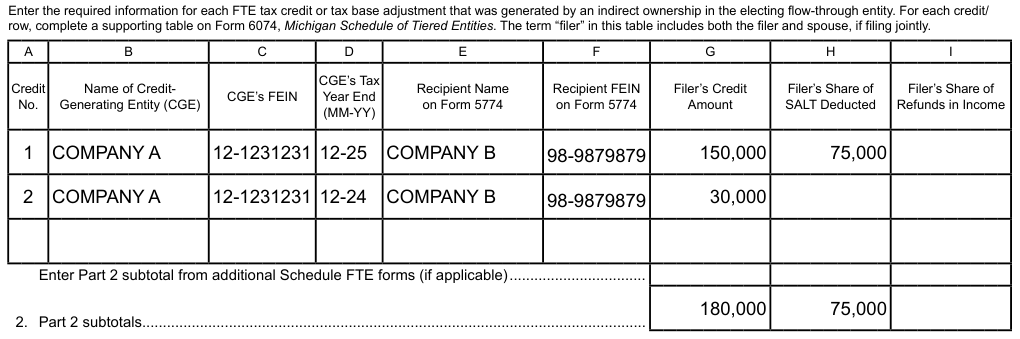
Text version of this table
| A | B | C | D | E | F | G | H | I |
|---|---|---|---|---|---|---|---|---|
| Credit No. | Name of Credit- Generating Entity (CGE) | CGE’s FEIN | CGE’s Tax Year End (MM-YY) | Recipient Name on Form 5774 | Recipient FEIN on Form 5774 | Filer’s Credit Amount | Filer’s Share of SALT Deducted | Filer’s Share of Refunds in Income |
| 1 | COMPANY A | 12-1231231 | 12-25 | COMPANY B | 98-9879879 | 150,000 | 75,000 | |
| 2 | COMPANY A | 12-1231231 | 12-24 | COMPANY B | 98-9879879 | 30,000 | ||
| 180,000 | 75,000 |
- Total Addition of State and Local Taxes Deducted. Add line 1 column F and line 2 column H. Carry this amount to
- Total Subtraction of Refunds. Add line 1 column G and line 2 column I. Carry this amount to Schedule 1, line 16 or MI-1041, line 38 …
- Total FTE Credits. Add line 1 column D, line 1 column E, and line 2 column G. Carry this amount to MI-1040, line 30 or MI-1041, line 19...
75,000
180,000
# Example 3: Joint Filers with Direct and Indirect Credits
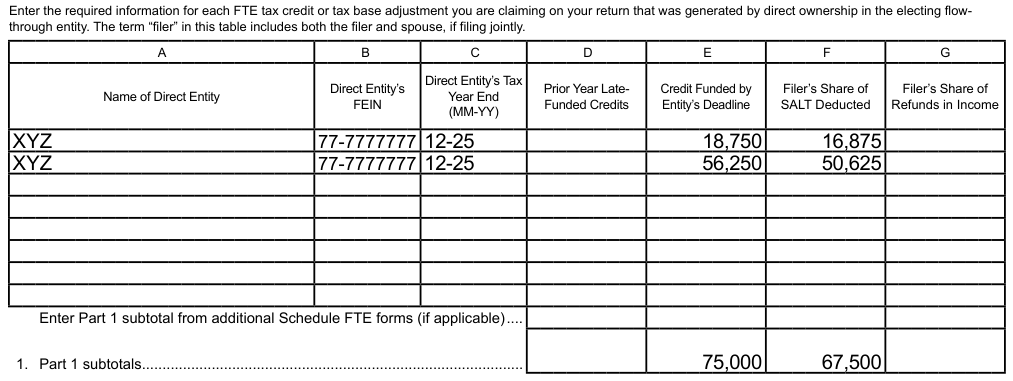
Entity XYZ generated a credit of $75,000 for the tax year and deducted $67,500 of SALT on their federal tax return. Entity XYZ paid all tax on or before their credit funding deadline.
Entity A generated a credit of $1,000,000 for the tax year and deducted $750,000 of SALT on their federal tax return. Entity A paid all tax on or before their credit funding deadline.
# Couple's Direct Credits Couple's Indirect Credits
Joe owns 25% share of Company XYZ Joe owns 40% share of Entity F Jane owns 75% share of Company XYZ Joe owns 80% share of Entity E Entity F owns 20% share of Entity E Entity F owns 25% share of Entity D Entity E owns 50% share of Entity D Entity D owns 50% share of Entity C Entity C owns 50% share of Entity B Entity B owns 50% share of Entity A
Joe Taxpayer
F
D C
E
B A
XYZ
Jane Taxpayer
40%
80%
25%
50%
50% 50% 50%
25%
75%
Diagram 1: Joe and Jane's FTE Credits 20%
Diagram 2: Joe and Jane's Completed Form 6072
6072 (09-25)
12-25
Attachment 36
# MICHIGAN Schedule FTE
The Michigan Schedule FTE (Schedule FTE) is required to be filed with any Form MI-1040 or MI-1041 that claims a credit, addition, or subtraction related to the Flow-Through Entity Tax (FTE tax) under Part 4 of the Michigan Income Tax Act. The information you report should typically come from the statement issued by the flow-through entity (FTE) you directly own. For each credit identified on this schedule, include the Michigan Flow-Through Entity Tax Information Reports (or same information in another format) that you received from a flow-through entity you directly own.
Filer's Name Shown on Tax Return Identifying Number
JOE TAXPAYER 123-00-3123
# PART 1: DIRECT FTE CREDITS AND ADJUSTMENTS
Enter the required information for each FTE tax credit or tax base adjustment you are claiming on your return that was generated by direct ownership in the electing flowthrough entity. The term "filer" in this table includes both the filer and spouse, if filing jointly.
Direct Entity's Tax
Direct Entity's Prior Year Late- Credit Funded by Filer's Share of Filer's Share of
- Part 1 subtotals …
# PART 2: INDIRECT FTE CREDITS AND ADJUSTMENTS
Enter the required information for each FTE tax credit or tax base adjustment that was generated by an indirect ownership in the electing flow-through entity. For each credit/ row, complete a supporting table on Form 6074, Michigan Schedule of Tiered Entities. The term "filer" in this table includes both the filer and spouse, if filing jointly.
Text version of this table
| 2 | |||||||
| A | B | C | D | E | F | G | H |
| Name | FEIN/SSN | Tax Year End (MM-YY) | Percentage of Credit from Next Tier | Prior Year Late- Funded Credit | Credit from Next Tier Funded by CGE’s Deadline | Share of SALT Deducted | Share of Refunds in Income |
| CGE: COMPANY A | 12-1231231 | 12-24 | 500,000 | ||||
| COMPANY B | 98-9879879 | 12-24 | 60.0000 | 300,000 | |||
| JANET SMITH | 456-45-4564 | 12-24 | 10.0000 | 30,000 |
CGE's Tax
Credit Name of Credit- Recipient Name Recipient FEIN Filer's Credit Filer's Share of Filer's Share of
# CGE's FEIN Year End
No. Generating Entity (CGE) on Form 5774 on Form 5774 Amount SALT Deducted Refunds in Income 1 A 11-1111111 12-25 B 22-2222222 12,500 9,375 2 A 11-1111111 12-25 B 22-2222222 5,000 3,750 3 A 11-1111111 12-25 B 22-2222222 5,000 3,750 Enter Part 2 subtotal from additional Schedule FTE forms (if applicable) …
- Part 2 subtotals …
67,500 50,625
- Total Addition of State and Local Taxes Deducted. Add line 1 column F and line 2 column H. Carry this amount to 118, 125
- Total Subtraction of Refunds. Add line 1 column G and line 2 column I. Carry this amount to Schedule 1, line 16 or MI-1041, line 38 …
- Total FTE Credits. Add line 1 column D, line 1 column E, and line 2 column G. Carry this amount to MI-1040, line 30 or MI-1041, line 19...
142,500
Diagram 3: Joe and Jane's Completed Form 6074
6074 (09-25)
12-25
Attachment 37
# MICHIGAN Schedule of Tiered Entities
This form must be completed if an indirect credit is claimed on Form 6072, Michigan Schedule FTE, Part 2. Complete a separate table for each indirect credit. Each chain of ownership to a credit-generating entity (CGE) should be reported as a separate credit. If more rows are needed to report an indirect credit, continue on additional tables and leave the CGE row blank. If more than three tables are needed, complete additional forms.
Filer's Name Shown on Tax Return
# JOE TAXPAYER
This Table supplements Indirect Credit Number 1 A B Name FEIN/SSN CGE: A 11-1111111 Identifying Number 123-00-3123 on Form 6072, Part 2.
C D E F G H
Percentage
Credit from Next
Tax Year
Share of SALT Share of Refunds
Prior Year Lateof Credit
Tier Funded by
End
Deducted in Income
Funded Credit from Next
CGE's Deadline
Tier
12-25 1,000,000 750,000
500,000 375,000
22-2222222 12-25
B 50.0000
33-3333333 12-25
C 250,000 187,500
50.0000
125,000 93,750
44-4444444 12-25
D 50.0000
31,250 23,438
55-5555555 12-25
F 25.0000
12,500 9,375
123-00-3123 12-25
# JOE TAXPAYER
This Table supplements Indirect Credit Number 2 A B Name FEIN/SSN 11-1111111
CGE: A
40.0000 on Form 6072, Part 2.
C D E F G H
Percentage
Credit from Next
Tax Year of Credit Prior Year Late- Share of SALT Share of Refunds Tier Funded by End from Next Funded Credit Deducted in Income CGE's Deadline Tier 12-25 1,000,000 750,000 22-2222222 12-25 B 500,000 375,000 50.0000 33-3333333 12-25 C 250,000 187,500 50.0000 44-4444444 12-25 D 125,000 93,750 50.0000 66-6666666 12-25 E 62,500 46,875 50.0000 55-5555555 12-25 F 12,500 9,375 20.0000 123-00-3123 12-25
# JOE TAXPAYER
This Table supplements Indirect Credit Number 3 A B Name FEIN/SSN 11-1111111
CGE: A
5,000 3,750
40.0000 on Form 6072, Part 2.
C D E F G H
Percentage
Credit from Next
Tax Year of Credit Prior Year Late- Share of SALT Share of Refunds Tier Funded by End from Next Funded Credit Deducted in Income CGE's Deadline Tier 12-25 1,000,000 750,000 22-2222222 12-25 B 500,000 375,000 50.0000 33-3333333 12-25 C 250,000 187,500 50.0000 44-4444444 12-25 D 125,000 93,750 50.0000 66-6666666 12-25 E 62,500 46,875 50.0000 123-00-3123 12-25 JOE TAXPAYER 50,000 37,500 80.0000
Source: view the official PDF
Nearby sections (12 sections)
- form-4890-cit-booklet · Form 4890 — Michigan CIT Forms and Instructions…
- form-4891-cit · Form 4891 — Michigan Corporate Income Tax Annual Return…
- form-5772-fte-instructions · Form 5772 Instructions — Michigan…
- form-5774-instructions · Form 5774 Instructions — Schedule for…
- form-807-composite · Form 807 — Michigan Composite Individual Income…
- mi-1040-book · MI-1040 Book — Michigan Individual Income Tax Return &…
- mi-1040cr · MI-1040CR — Michigan Homestead Property Tax Credit Claim…
- mi-1041-book · MI-1041 Book — Michigan Fiduciary Income Tax Return &…
- schedule-fte · Form 6072 — Michigan Schedule FTE (Flow-Through Entity)…
- schedule-tiered-entities · Form 6074 — Michigan Schedule of Tiered…
- suw-5080 · Form 5080 — Michigan Sales, Use & Withholding Taxes…
- suw-5081-annual · Form 5081 — Michigan Sales, Use & Withholding Taxes…