Wisconsin Department of Revenue Form Instructions
Form 4T — Exempt Organization Business Franchise/Income
Tax-exempt organizations and certain individual retirement arrangements (IRAs) or Medical Savings Accounts
(MSAs) use Form 4T to report their unrelated business taxable income and credits and to compute their franchise or income tax and economic development surcharge liability.
Table of Contents
General Franchise or Income Tax Return Instructions … 2 Who Must File … 2 When and Where to File … 3 Period Covered by Return … 3 Accounting Methods and Elections … 4 Payment of Estimated Tax … 4 Disclosure of Related Entity Expenses and Reportable Transactions … 5 Internal Revenue Service Adjustments, Amended Returns, and Claims for Refund … 6 Economic Development Surcharge … 6 Information Returns … 7 Wisconsin Use Tax … 7 Penalties for Not Filing or Filing Incorrect Returns … 7 Conformity With Internal Revenue Code and Exceptions … 7 Provisions of the Internal Revenue Code Not Adopted by Wisconsin: … 8 Other Exceptions to Internal Revenue Code … 13 Depreciation and Bonus Depreciation … 13 Accounting for Differences … 13 Items A Through J … 13 Lines 1 Through 13 - Organizations Taxable as Corporations … 15 Lines 14 Through 23 - Organizations Taxable as Trusts … 19 Lines 25 Through 41 … 22 Additional Information, Signatures, and Supplemental Schedules … 24 Wisconsin Income of Multistate Organizations … 25 Who Must Use Apportionment … 25 What Is the Apportionment Percentage … 25 Corporate Partners or LLC Members … 26 Obtaining Forms and Assistance … 27
Appendix: Tax Table for Trusts
General Franchise or Income Tax Return Instructions
# Who Must File
Organizations Required to File. The following exempt organizations are required to file a Wisconsin corporation franchise or income tax return:
- Organizations exempt from Wisconsin income taxation under sec. 71.26(1)(a) or 71.45(1), Wis. Stats., which satisfy, or which are the sole owner of limited liability companies (LLCs) that satisfy, all the following:
Do business in Wisconsin,
Have at least $1,000 of gross income from an unrelated trade or business for federal income tax purposes, and Must file federal Form 990-T or 4720 to report such unrelated trade or business income.
- Trusts exempt from federal income tax under Internal Revenue Code (IRC) section 501(a), which satisfy all the following:
Have income from Wisconsin sources, such as business transacted or property located in Wisconsin, Have at least $1,000 of gross income from an unrelated trade or business for federal income tax purposes, and Must file federal Form 990-T, 4720, or 5227.
- IRAs and MSAs described in IRC sections 408(a) and 220(d) which satisfy all the following:
Have income from Wisconsin sources, such as business transacted or property located in Wisconsin, Have at least $1,000 of gross income from an unrelated trade or business for federal income tax purposes, and Must file federal Form 990-T or 4720.
- Exempt organizations engaged in buying or selling lottery prizes if the winning tickets were originally bought in Wisconsin.
"Gross income" of a manufacturing, merchandising, or mining business is the total receipts or sales, less the cost of goods sold, plus the gross income from other sources that is includable in unrelated business taxable income.
"Doing business in this state." The definition of "Doing business in this state," sec. 71.22(1r), Wis. Stats, includes regularly selling products or services of any kind or nature to customers in Wisconsin that receive the product or service in Wisconsin; regularly soliciting business from potential customers in Wisconsin; regularly performing services outside Wisconsin for which the benefits are received in Wisconsin; regularly engaging in transactions with customers in Wisconsin that involve intangible property and result in receipts flowing to the taxpayer from within Wisconsin; and holding loans secured by real or tangible personal property located in Wisconsin. "Regular" and "regularly" mean 15 or more days of activity. Fifteen days of activity means one person for 15 days or 15 persons for one day, or any combination of persons and days that results in at least 15 person-days of activity. "Days of activity" include any day, or portion thereof, upon which business activity took place. "Days of activity" do not include travel days, holidays, or weekends, unless business activities were conducted on those days.
Organizations Not Required to File. The following organizations are not required to file a Wisconsin corporation franchise or income tax return:
- Exempt organizations that aren't subject to tax on unrelated business taxable income under IRC section 511 and aren't required to file federal Form 990-T, except those with income realized from the sale of or purchase and subsequent sale or redemption of lottery prizes if the winning tickets were originally bought in Wisconsin.
- Employee benefit plans established by an employer engaged in or affecting interstate commerce or by an employee organization that represents employees engaged in or affecting interstate commerce. This exception doesn't apply to government plans, church plans not electing under the vesting, etc., provisions, worker's compensation plans, non-U.S. plans primarily for nonresident aliens, and "excess benefit plans."
- The State of Wisconsin, including the University of Wisconsin System, or any county, village, school district, or other political unit of the State of Wisconsin.
- Credit unions.
# When and Where to File
Generally, an exempt organization must file Form 4T by the 15th day of the 5th month following the close of its taxable year. However, an employees' trust defined in IRC section 401(a), an IRA, and an MSA must file Form 4T by the 15th day of the 4th month following the close of the taxable year. If a return is filed late, without an extension, the exempt organization may be subject to penalties and interest.
Extensions. If you are requesting an extension of time to file your federal income tax return, the following treatment applies:
- For exempt organizations taxable as corporations, any extension allowed by the Internal Revenue Service (IRS) for filing the federal return automatically extends the Wisconsin due date to 30 days after the federal extended due date. You don't need to submit either a copy of the federal extension or an application for a Wisconsin extension to the department by the original due date of your return. However, you must file a copy of the federal extension with the Wisconsin return that you file.
- For exempt organizations taxable as trusts, any extension allowed by the IRS for filing the federal return automatically extends the Wisconsin due date to the federal due date. You must file a copy of the federal extension with the Wisconsin return that you file.
- Disaster Relief Extension. If you are filing under extension because of a federal or state disaster, include a statement indicating which disaster extension you are using and attach it to your return. Additional information on disaster areas can be found here: revenue.wi.gov/Pages/FAQS/pcs-extensn.aspx#ext5
# Filing Return
If you file your return on paper, follow these mailing instructions carefully:
- Do not fasten, staple, or bind the pages of your return. Use paper clips instead.
- If you are submitting multiple returns, separate them with colored separator sheets.
- Use the mailing address shown on the form.
# Period Covered by Return
The return must cover the same period as the exempt organization's federal business income tax return, Form 990-T.
A 2025 Wisconsin return must be filed by an exempt organization for calendar year 2025 or a fiscal year that begins in 2025. A fiscal year may end only on the last day of a month. The period covered by the return can't exceed 12 months.
Example: Corporation A has a fiscal year beginning March 1, 2025, and ending February 29, 2026. Corporation A files a 2025 Form 4T for the period of March 1, 2025, through February 29, 2026.
However, exempt organizations reporting on a 52-53 week period for federal tax purposes must file on the same reporting period for Wisconsin. A 52-53 week taxable year is deemed to begin on the first day of the calendar month beginning nearest to the first day of the 52-53 week taxable year. The taxable year is deemed to end on the last day of the calendar month closest to the last day of the 52-53 week taxable year for purposes of due dates, extensions, and assessments of interest and penalties.
Any change in accounting period made for federal purposes must also be made for Wisconsin purposes. For the first taxable year for which the change applies, file with the Wisconsin return a copy of the IRS's notice of approval of accounting period change if such approval is required or an explanation of the change if the IRS's approval isn't required.
# Accounting Methods and Elections
In computing unrelated business taxable income, the method of accounting must be the same method used in computing federal unrelated business taxable income. However, if the method used for federal purposes isn't authorized under the IRC in effect for Wisconsin, use a method authorized under the IRC in effect for Wisconsin.
Change in Accounting Method. A change in accounting method made for federal purposes must also be made for Wisconsin purposes, unless the change isn't authorized under the IRC in effect for Wisconsin. Adjustments required federally as a result of a change made while the exempt organization is subject to Wisconsin taxation must also be made for Wisconsin purposes, except in the last year that an exempt organization is subject to taxation by Wisconsin it must take into account all remaining adjustments required.
For the first taxable year for which the change applies, file with the Wisconsin return either a copy of the application for change in accounting method filed with the IRS and copy of the IRS's consent, if applicable, or an explanation of the change if the IRS's approval isn't required.
Elections. As explained above, an exempt organization can't make different elections for federal and Wisconsin purposes with respect to accounting periods and accounting methods, unless the federal method isn't permitted under the IRC in effect for Wisconsin. In situations where an exempt organization has an option under the IRC and the IRS doesn't consider that option to be a method of accounting, a different election may be made for Wisconsin than that made for federal purposes. If federal law specifies the manner or time period in which an election must be made, those requirements also apply for Wisconsin purposes. For more information, see Wisconsin Tax Bulletin 214 (July 2021, page 8).
If different elections are made, adjustments are required on the Wisconsin return to account for any differences.
Exempt organizations enter such adjustments on Part 1 or Part 2.
# Payment of Estimated Tax
The franchise or income tax and economic development surcharge must be paid by the 15th day of the 5th month (15th day of the 4th month for employees' trusts, IRAs, and MSAs) following the close of the taxable period, regardless of the due date of the return. Exempt organizations may be required to make quarterly estimated payments to prepay their franchise or income tax and economic development surcharge.
If the total of an exempt organization's franchise or income tax and economic development surcharge due is $500 or more, it generally must make quarterly estimated tax payments. Corporations should use Wisconsin Form Corp-ES or make payment by electronic funds transfer, and trusts should use Form 1-ES or make payment by electronic funds transfer. Failure to make required estimated tax payments may result in an interest charge.
CAUTION: An extension for filing the return doesn't extend the time to pay the franchise or income tax. Interest will be charged on the tax and surcharge not paid by the original due date. You can avoid interest charges during the extension period by paying the tax and surcharge due by the original due date. Submit your payment with Wisconsin Form Corp-ES, Corporation Estimated Tax Voucher.
Quick Refund. An exempt corporation that overpaid its estimated tax may apply for a refund before filing its tax return if its overpayment is (1) at least 10% of the expected Wisconsin tax liability and (2) at least $500. To apply, file Wisconsin Form 4466W, Corporation or Pass-Through Entity Application for Quick Refund of Overpayment of Estimated Tax, after the end of the taxable year and before the exempt corporation files its tax return. Do not file Form 4466W at the same time as your tax return.
An exempt corporation that has a tax due when filing its tax return as a result of receiving a "quick refund" will be charged 12% annual interest on the amount of unpaid tax from the date the refund is issued to the earlier of the 15th day of the 5th month (15th day of the 4th month for employees' trusts, IRAs, and MSAs) after the close of the taxable year or the date the tax liability is paid. Any tax that remains unpaid after the unextended due date of the tax return continues to be subject to 18% or 12% annual interest, as appropriate.
# Economic Development Surcharge
The economic development surcharge applies to corporations having gross receipts from all unrelated trade or business activities of $4 million or more during the taxable year. Corporations that must file Wisconsin franchise or income tax returns must pay the economic development surcharge, with certain exceptions. The surcharge doesn't apply to:
- Exempt corporations that have less than $4 million of gross receipts from all unrelated trade or business activities for federal income tax purposes.
- "Gross receipts from all unrelated trade or business activities" includes gross receipts, gross sales, the gross sales price from the disposition of capital assets and business assets, gross rents, gross income from unrelated debtfinanced property, gross interest, annuities, royalties, and rents from controlled organizations, gross investment income, gross exploited exempt activity income, gross advertising income, gross receipts passed through from other entities, and all other receipts that are included in unrelated business taxable income for Wisconsin income tax purposes.
For more information, refer to Publication 400, Wisconsin's Economic Development Surcharge.
# Information Returns
If an exempt organization pays $600 or more in rents, royalties, or certain nonwage compensation to one or more individuals, the exempt organization must file an information return to report those payments. You may use Wisconsin Form 9b, Miscellaneous Income, or you may use federal Forms 1099 or 1099-NEC instead of Form 9b. For more information, see the Form 9b instructions.
# Wisconsin Use Tax
Exempt organizations that don't hold a Wisconsin Certificate of Exempt Status (CES#) and purchase taxable tangible personal property, certain coins and stamps, certain leased properties affixed to real estate, certain digital goods, or taxable services for storage, use, or consumption in Wisconsin without payment of a sales or use tax may owe Wisconsin state, county, or stadium use tax and be required to file a Wisconsin sales and use tax return.
For more information or forms, visit the department's web site at revenue.wi.gov/Pages/FAQS/home.aspx, e-mail DORSalesandUse@wisconsin.gov, fax your question to (608) 267-1030, call (608) 266-2776, or write to the Wisconsin Department of Revenue, PO Box 8946, Madison, WI 53708-8946.
# Penalties for Not Filing or Filing Incorrect Returns
If you don't file a Form 4T that you are required to file, or if you file an incorrect Form 4T due to negligence or fraud, interest and penalties may be assessed against you. The interest rate on delinquent taxes is 18% per year. Civil penalties may be as much as 100% of the amount of tax not reported on the return. Criminal penalties for filing a false return include a fine of up to $10,000 and imprisonment. Further, if you fail to disclose reportable transactions, you may be subject to the penalties described in sec. 71.81, Wis. Stats., including a $30,000 penalty for failure to disclose a listed transaction.
# Conformity With Internal Revenue Code and Exceptions
The Wisconsin income and franchise tax law applicable is based on the federal Internal Revenue Code ("IRC"). The IRC generally applies for Wisconsin purposes at the same time as for federal purposes. For taxable years beginning on or after January 1, 2025, Wisconsin's definition of the IRC is the IRC as of December 31, 2024 with exceptions.
Below is a listing of the exceptions.
Note: The exceptions and provisions adopted by Wisconsin listed below are those in effect as of the publication date of these instructions. It is possible that subsequent changes in Wisconsin law may add or eliminate some exceptions applicable to taxable years beginning in 2025.
Provisions of the Internal Revenue Code Adopted by Wisconsin:
Changes made by the following public laws apply for Wisconsin purposes for taxable years beginning after December 31, 2024:
- Sections 70306, 70352, 70413, 70414, 70431, and 71306 of P.L. 119-21 o Section 70306, relating to increased dollar limitations for expensing of depreciable business assets under Section 179, IRC. o Section 70352, relating to the repeal of the election for a 1-month deferral in the determination of the taxable year of specified foreign corporations o Section 70413, relating to adding certain educational materials for elementary and secondary school students to the definition of "qualified higher education expenses" for the purposes of accounts under Section 529, IRC.
o Section 70414, relating to adding certain postsecondary credentialing expenses to the definition of "qualified higher education expenses" for the purposes of accounts under Section 529, IRC. o Section 70431, increasing the percentage of gains on qualifying small business stock that can be excluded from income, increasing the maximum gain per issuer that can be excluded from income, and increasing the maximum amount of assets a qualifying small business can have. o Section 71306, relating to a permanent safe harbor for high-deductible health plans offering telehealth services without a deductible.
Provisions of the Internal Revenue Code Not Adopted by Wisconsin:
•
Sections 1, 3, 4, and 5 of P.L. 106-519, which repealed foreign sales corporation provisions and replaced with extraterritorial income provisions.
- Sections 101, 102, and 422 of P.L. 108-357, which repealed the exclusion for extraterritorial income, domestic production activities deduction, and the creation of sec. 965 - incentives to reinvest foreign earnings in the U.S.
- Sections 1310 and 1351 of P.L. 109-58, which provides for the modification to special rules for nuclear decommissioning costs, repeal of the limitation on contract research expenses paid so small businesses, universities, and federal laboratories.
- Section 11146 of P.L. 109-59, the tax treatment of state ownership of railroad real estate investment trust.
- Section 403(q) of P.L. 109-135, which provides incentives to reinvest foreign earnings from controlled foreign corporations in the U.S.
- Section 513 of P.L.109-222, which repeals foreign sales corporation/extraterritorial income exclusion binding contract relief.
- Section 104 of P.L. 109-432, which increases the rates of the alternative incremental credit and provides a new alternative simplified credit • Sections 8233 and 8235 of P.L. 110-28, which created a special rule for banks required to change from the reserve method of accounting in becoming tax-option (S) corporations and the elimination of all earnings and profits attributable to pre-1983 years.
- Section 11(e) and (g) of P.L. 110-172, which provides clerical amendments to research credits for controlled corporations and common control, and clerical amendments to the FSC Repeal and Extraterritorial Income Exclusion Act of 2000.
- Section 301 of P.L. 110-245, which provides for tax responsibilities of expatriation.
- Section 15351 of P.L. 110-246, limits the amount of farm losses that may offset non-farming business income to $300,000.
- Section 302 of division A, section 401 of division B, and sections 312, 322, 502(c), 707, and 801 of division C of P.L. 110-343, which limits executive compensation for employers participating in troubled assets relief program for the taxable year in which the troubled assets exceed $300,000,000. Caps the domestic production activities deduction at 6% for oil-related activities. The deduction for income attributable to domestic production activities in Puerto Rico applies to the first 8 taxable years beginning before January 1, 2010. Tax incentives for investment in the District of Columbia includes exclusion for gain on sale of an asset held from more than 5 years. Defines wages for purposes of the domestic production activities deduction. Creates sec. 198A to provide for expensing of disaster expenses for control of hazardous substances. Specifies treatment of nonqualified deferred compensation plans maintained by foreign corporations.
- Sections 1232, 1251, 1501, and 1502 of division B of P.L. 111-5, which suspends the special rules for original issue discount on high yield obligations issued during the period 9/1/2008 and 12/31/2009. Provides that no builtin-gain tax is imposed on a tax-option (S) Corporation for a taxable year beginning in 2009 and 2010 if the seventh taxable year in the corporation's recognition period preceded such taxable year. Tax-exempt obligations held by financial institutions, in an amount not to exceed 2 percent of the adjusted basis of the financial institution's assets, are not taken into account for determining the portion of the financial institutions interest expense subject to the pro rata interest disallowance rule of sec. 265(b). Modification of the small insurer exception to tax-exempt interest expense allocation rules for financial institutions.
- Sections 211, 212, 213, 214, and 216 of P.L. 111-226, which adopts a matching rule to prevent the separation of foreign taxes from the associated foreign income, denies a foreign tax credit for the disqualified portion of any foreign income tax paid in connection with a covered asset acquisition, provides a separate application of foreign tax credit limitation to items resourced under treaties, limits the amount of foreign taxes deemed paid with respect to sec. 956 inclusions, treats a foreign corporation as a member of an affiliated group for interest allocation and apportionment purposes in more than 50% of gross income is effectively connected income and at least 80% of either the vote or value of all outstanding stock is owned directly or indirectly by members of the affiliated group.
- Section 2122 of P.L. 111-240, which clarifies the income sourcing rules for guarantee fees.
- Sections 754 and 760 of P.L. 111-312, which specifies certain tax incentives for investments in the District of Columbia and specifies that gross income does not include gain on certain small business stock.
- Sections 104, 318, 322, 323, 326, 327, and 411 of P.L. 112-240, which makes the alternative minimum tax exemption permanent and indexed for inflation, extends through 2013 the deduction with respect to income attributable to domestic production activities in Puerto Rico, extends the subpart F exception for active financing income, extends the look-thru treatment of payments between related controlled foreign corporations under foreign personal holding company, extends through 2013 the reduction in tax-option (S) Corporation built-in gains tax and clarifies treatment of installment sales, provides a 60% exclusion for gain on small business stock acquired before 2019, and extends through 2013 the rules that allow gain certain sales of electric transmission property to be recognized ratably over 8 taxable years.
- Public Law. 114-7, relating to contributions for relief of slain New York Police Detectives.
- Section 1101 of P.L. 114-74 relating to partnership rules.
- Section 305 of division P of P.L. 114-113, relating to the transportation costs of independent refiners.
- Sections 123, 125-128, 143, 144, 151-153, 165-167, 169-171, 189, 191, 326, and 411 of division Q of P.L. 114-
- o Section 123, relating to extension of 15-year straight-line cost recovery for qualified leasehold improvements, qualified restaurant buildings and improvements, and qualified retail improvements. o Section 125, relating to the extension of treatment of certain dividends of regulated investment companies. o Section 126, relating to the extension of exclusion of 100 percent of gain on certain small business stock. o Section 127, relating to the extension of reduction in S-corporation recognition period for built-in gains tax. o Section 128, relating to the extension of subpart F exception for active financing income. o Section 143, relating to the extension and modification of bonus depreciation. o Section 144, relating to the extension of look-thru treatment of payments between related controlled foreign corporations under foreign personal holding company rules. o Section 151, relating to the extension and modification of exclusion from gross income of discharge of qualified principal residence indebtedness. o Section 152, relating to the extension of mortgage insurance premiums treated as qualified residence interest. o Section 153, relating to the extension of above-the-line deduction for qualified tuition and related expenses. o Section 165, relating to the extension of classification of certain race horses as 3-year property. o Section 166, relating to the extension of 7-year recovery period for motorsports entertainment complexes. o Section 167, relating to the extension and modification of accelerated depreciation for business property on an Indian reservation. o Section 169, relating to the extension of special expensing rules for certain film and television productions; special expensing for live theatrical productions. o Section 170, relating to the extension of deduction allowable with respect to income attributable to domestic production activities in Puerto Rico. o Section 171, relating to the extension and modification of empowerment zone tax incentives. o Section 189, relating to the extension of special allowance for second generation biofuel plant property. o Section 191, relating to the extension of special rule for sales or dispositions to implement FERC or State electric restructuring policy for qualified electric utilities. o Section 326, relating to the dividends derived from RICs and REITs ineligible for deduction for United States source portion of dividends from certain foreign corporations. o Section 411, relating to the partnership audit rules.
- Sections 11011, 11012, 13201 (a) to (e) and (g), 13206, 13221, 13301, 13304 (a), (b), and (d), 13531, 13601, 13801, 14101, 14102, 14103, 14201, 14202, 14211, 14212, 14213, 14214, 14215, 14221, 14222, 14301, 14302, 14304, and 14401 of P.L. 115−97: o Section 11011, relating to the 20% deduction for domestic qualified business income. o Section 11012, relating to the limitation on losses for taxpayers other than corporations. o Section 13201 (a) to (e) and (g), relating to the temporary 100% expensing for certain business assets (bonus depreciation). o Section 13206, relating to the amortization of research and experimental expenditures beginning in 2022. o Section 13221, relating to special rules for the taxable year of inclusion. o Section 13301, relating to the 30% taxable income limitation for the deduction of interest. o Section 13304(a), (b), and (d) relating to the limit on the deduction by employers of fringe benefits (meals, entertainment, and transportation). o Section 13531, relating to the limitation on deductions for FDIC premiums. o Section 13601, relating to the modification of the limitation on excessive employee remuneration. o Section 13801, relating to the production period for beer, wine, and distilled spirits. o Section 14101, relating to the deduction for the foreign-source portion of dividends received by domestic corporations from specified 10% owned foreign corporations. o Section 14102, relating to the special rules for sale or transfers involving specified 10% owned foreign corporations. o Section 14103, relating to the treatment of deferred foreign income upon transition to a participation exemption system of taxation. o Section 14201, relating to the current year global intangible low-taxed income by U.S. shareholders. o Section 14202, relating to the deduction for foreign derived intangible income and global intangible low-taxed income. o Section 14211, relating to the elimination of the inclusion of foreign base company oil related income. o Section 14212, relating to the repeal of the inclusion based on withdrawal of previously excluded subpart F income from qualified investment. o Section 14213, relating to the modification of stock attribution rules for determining the status as a controlled foreign corporation. o Section 14214, relating to the modification of the definition of a U.S. shareholder. o Section 14215, relating to the elimination of the requirement that a corporation must be controlled for 30 days before the subpart F inclusions apply. o Section 14221, relating to the limitations on income shifting through intangible property transfers. o Section 14222, relating to certain related party amounts paid or accrued in hybrid transactions or with hybrid entities. o Section 14301, relating to the repeal of section 902 - indirect foreign tax credits, and determination of the deemed paid credit for subpart F inclusions under sec. 960 on a current year basis. o Section 14302, relating to the separate foreign tax credit limitation basket for foreign branch income. o Section 14304, relating to the election to increase the percentage of domestic taxable income offset by the overall domestic loss treated as foreign source. o Section 14401, relating to the base erosion anti-abuse tax.
- Sections 40304, 40305, 40306, and 40412 of P.L. 115-123: o Section 40304, relating to the extension of classification of certain race horses as 3-year property. o Section 40305, relating to the extension of 7-year recovery period for motor-sports entertainment complexes. o Section 40306, relating to the extension of accelerated depreciation for business property on an Indian reservation. o Section 40412, relating to the extension of special allowance for second generation biofuel plant property.
- Section 101 (c) of division T of P.L. 115-141, relating to the application of section 199 to certain qualified payments paid after 2017 for payments received by a patron from a specified agricultural or horticultural cooperative for qualified production activities income
- Sections 101 (d) and (e), 102, 201 to 207, 301, 302, and 401 (a) (47) and (195), (b) (13), (17), (22) and (30), and
(d) (1) (D) (v), (vi), and (xiii) and (xvii) (II) of division U of P.L. 115-141: o Sections 101 (d) and (e) and 102, relating to technical corrections to bonus depreciation, alternative minimum tax requirements for qualified Indian reservation property, and qualified production activities income made by the Protecting Americans from Tax Hikes Act of 2015 and the Consolidated Appropriations Act, 2016. o Sections 201 to 207 relating to partnership audit rules. o Sections 301 and 302, relating to amendments to regulatory requirements for partnership returns and the definition of qualified small power production facilities made by the Bipartisan Budget Act of 2015 and the Energy Policy Act of 2005. o Section 401 (a) (47) and (195), (b) (13), (17), (22) and (30), and (d) (1) (D) (v), (vi), and (xiii) and (xvii) (II), relating to clerical corrections and deadwood-related provisions to the following: exempt facility bonds, taxexempt enterprise zone facility bonds, the special allowance for qualified disaster assistance property, reducing the dividends received deduction where portfolio stock is debt financed, exemption from tax on corporations, certain trusts, etc., requirements of domestic international sales corporations, dividends received by corporations, rules applied to deductions for dividends received, the foreign tax credit, and dividends received by corporations.
- Sections 104, 114, 115, 116, 130, and 145 of division Q of P.L. 116-94: o Section 104, relating to the deduction of qualified tuition and related expenses. o Section 114, relating to the classification of certain race horses as 3-year property. o Section 115, relating to the 7-year recovery period for motorsports entertainment complexes. o Section 116, relating to the accelerated depreciation for business property on Indian reservations. o Section 130, relating to special allowance for second generation biofuel plant property. o Section 145, relating to look-thru rule for related controlled foreign corporations.
- Sections 2304 and 2306 of P.L. 116-136: o Section 2304, relating to the modification of limitations on losses for taxpayers other than corporations. o Section 2306, relating to the modifications of limitation on business interest.
- Sections 111, 114, 115, 116, 118 (a) and (d), 133, 137, 138, and 210 of division EE of P.L. 116-260: o Section 111, relating to the look-thru rule for related controlled foreign corporations. o Section 114, relating to the exclusion from gross income of discharge of qualified principal residence indebtedness. o Section 115, relating to the 7-year recovery period for motorsports entertainment complexes. o Section 116, relating to the expensing rules for certain productions. o Section 118 (a) and (d), relating to empowerment zone tax incentives. o Section 133, relating to the treatment of mortgage insurance premiums as qualified residence interest. o Section 137, relating to the classification of certain racehorses as 3-year property. o Section 138, relating to the accelerated depreciation for business property on Indian reservations.
•
Section 210, relating to temporary allowance of full deduction for business meals. Sections 5003, 9041, 9673, 9675, and 9708 of P.L. 117-2.
o Section 5003, relating to additional restaurant revitalization grant funds. o Section 9041, relating to the excess business loss limitation extension for noncorporate taxpayers to December 31, 2026. o Section 9673, relating to restaurant revitalization grants not being included in gross income and deductions allowed. o Section 9675, relating to the exclusion from income for most student loans discharged after December 31, 2020, and before January 1, 2026. o Section 9708, relating to the expanded definition of "covered employee" for publicly held corporations deducting excessive employee remuneration.
•
Section 13903(b) of P.L. 117-169, relating to the extension of the excess business loss limitation for noncorporate taxpayers through December 31, 2028.
- Section 2 of P.L. 118-146, relating to charitable contributions to a post or organization of past or present members of the Armed Forces of the United States (veteran service organizations).
- Sections 3 and 4 of P.L. 118-148, relating to the exclusion from income of disaster relief payments related to the train derailment in East Palestine, Ohio.
- Sections 70301, 70302, 70303, 70307, 70309, 70322 (a), 70421, 70430, 70434, 70435, 70438, 70509, and 70602 of P.L. 119-21. o Section 70301, relating to 100% bonus depreciation for property acquired after January 19, 2025. o Section 70302, relating to full expensing for domestic research or experimental expenditures. o Section 70303, relating to excluding depreciation, amortization, and depletion deductions from the definition of adjusted taxable income for the purposes of the business interest expense limitation, and adding trailers and campers to the definition of a motor vehicle for the purposes of the floor plan financing rules. o Section 70307, relating to 100% depreciation allowance for certain real property used in manufacturing, production, or refining of tangible personal property. o Section 70309, relating to treating spaceports like airports under the exempt facility bond rules. o Section 70322 (a), relating to adding gains from the sale of intangible property and any other property subject to depreciation, amortization, or depletion to the list of income eligible for the foreign-derived deduction under Section 250, IRC. o Section 70421, relating to permanent renewal and enhancement of opportunity zones. o Section 70430, relating to exempting additional residential construction contracts from the percentage of completion method. o Section 70434, relating to adding sound recording productions to the definition of qualifying productions for the purpose of section 181, IRC. o Section 70435, relating to a 25% exclusion for interest income received by eligible lenders on loans secured by rural or agricultural real property. o Section 70438, relating to allowing an increased federal standard deduction for certain individuals with personal casualty losses from qualified disasters. o Section 70509, relating to removing certain solar and wind energy property from 5-year property if construction began after December 31, 2024. o Section 70602, relating to treatment of certain payments from partnerships to partners for property or services.
- Section 2 of P.L. 119-29, relating to allowing filing extensions for state declared disasters.
Other Exceptions to Internal Revenue Code
The following federal provisions in effect as of December 31, 2024, are specifically excluded for Wisconsin franchise and income tax purposes:
# Depreciation and Bonus Depreciation
For taxable years beginning on or after January 1, 2014, for purposes of computing depreciation, depletion, and amortization, the Internal Revenue Code means the federal Internal Revenue Code in effect on January 1, 2014.
The provision that property required to be depreciated for taxable year 1986 under the Internal Revenue Code as amended to December 31, 1980, to continue to be depreciated under the Internal Revenue Code as amended to December 31, 1980, is limited to taxable years beginning before January 1, 2014.
Wisconsin has not adopted federal bonus depreciation provisions. For Wisconsin purposes, depreciation, depletion, and amortization is computed based on the Internal Revenue Code in effect on January 1, 2014.
# Section 179 Expense
Wisconsin has adopted federal section 179 expense provisions. For taxable years beginning on or after January 1, 2014, sections 179, 179A, 179B, 179C, 179D, and 179E of the Internal Revenue Code, related to expensing of depreciable business assets, apply for Wisconsin tax purposes. "Internal Revenue Code" means the federal Internal Revenue Code in effect for the year in which the property is placed in service.
Accounting for Differences
Adjustments may be necessary to account for differences between federal and Wisconsin taxable income because of the items described above. Exempt organizations show these adjustments on Part 1 and Part 2. See the instructions for line 1 for details.
# Line-by-Line Instructions for Form 4T
You must complete pages 1 and 2 of Form 4T and make appropriate entries on page 3. Do not enter "See attached" instead of completing the entry spaces. If more space is needed, use separate sheets using the same size and format as the printed forms.
Round cents to the nearest whole dollar by eliminating amounts less than 50 cents and increasing amounts from 50 cents through 99 cents to the next higher dollar.
The name and address information should be written on single lines. Do not stack the information on the lines. If more room is needed, abbreviate where possible.
Do not write "None" on the amount lines if there is not an entry for the lines. Instead, leave the lines blank.
Caution: Federal line numbers referred to on Form 4T and in these instructions may change if the IRS makes changes to their forms after this form is finalized.
# Items A Through K
Before completing items A through K, fill in the exempt organization's 2025 taxable year at the top of the form and the organization's name and address. If the organization dissolved, enter the date of dissolution as the ending date of the 2025 taxable year.
■ Item A. Wisconsin Department of Financial Institutions Number - Certain types of businesses must register with the Wisconsin Department of Financial Institutions (DFI). Fill in the number DFI assigned you when you registered. You can search for your DFI number on DFI's website at WI Corporate Records Search. For information on registering with DFI, visit DFI's website at DFI Business Entity Frequently Asked Questions.
■ Item B. Federal Employer Identification Number - Enter the exempt organization's federal employer identification number (EIN). If you haven't yet applied for a federal EIN, you may do so by filing federal Form SS-4 with the IRS, calling the IRS's toll-free number at (800) 829-4933, or applying online at http://www.irs.gov/Businesses/Small-Businesses-&-Self-Employed/Apply-for-an-Employer-Identification-Number-(EIN)-Online.
■ Item C. Business Activity (NAICS) Code - Enter the organization's principal business activity code, based on the North American Industry Classification System (NAICS), from your federal return. If your federal return is a consolidated return, go to census.gov/naics/ to find the NAICS code for your principal business activity.
■ Item D. State and Year of Organization - Enter the 2-letter postal abbreviation for the state (or name of the foreign country) under whose laws the organization was formed or organized and the year of formation or organization.
■ E1. Amended Return - Check here if this is an amended return. Include Schedule AR detailing the lines you are changing and any supporting form or schedule.
■ E2. First Return - Check here if this is the first year that you are filing a Wisconsin return because the corporation wasn't in existence or didn't do business in Wisconsin in prior years.
■ E3. Final Return - If the corporation ceased to exist or withdrew from Wisconsin during the year and will no longer be filing Form 4T, check here and submit a copy of your plan of liquidation and federal Form 966 if the corporation liquidated.
Note: checking this box will not close all your accounts with the department; only the corporation account will close.
■ E4-5. Short Period - Indicate that a short period return is being filed due to a change in the corporation's accounting period or a stock purchase or sale by checking the appropriate line.
Be sure to use the correct year's tax return when filing for a short period. If the tax returns are not yet available, wait until the returns become available and file under extension. For example, if a taxpayer has a short period from January 1, 2026 through February 28, 2026, the 2026 Form 4T will not be ready by July 15, 2026 (unextended due date for a February 28 year-end). Wisconsin law follows the federal extension provisions but provides for an additional 30-day extension beyond the federal extension, so filing under extension will allow the correct years return to be filed when the 2026 Form 4T is available (typically November 1). Note that an extension does not extend the time to pay a balance due. To avoid interest charges, pay the amount due by the unextended due date.
■ Item F. Extended Due Date - Check here if the exempt organization has an extension of time to file its Wisconsin return and enter the extended due date.
Disaster Relief Extension. If you are filing under extension because of a federal or state disaster, include a statement indicating which disaster extension you are using and attach it to your return. Additional information on disaster areas can be found here: revenue.wi.gov/Pages/FAQS/pcs-extensn.aspx#ext5 ■ Item G. Schedule RT Required - Check here if the exempt organization is filing Schedule RT, Wisconsin Related Entity Expenses Disclosure Statement, with its return. Schedule RT is generally required if the exempt organization pays, accrues, or incurs more than $100,000 of expenses to a related person or entity in the taxable year. See the Schedule RT instructions for details of the requirement to file Schedule RT.
■ Item H. Name Change - Check here if the organization changed its name during the taxable year.
■ Item I. Internal Revenue Service Adjustment - If an organization's federal tax return is adjusted by the IRS and the adjustments affect the Wisconsin net tax payable, the amount of a Wisconsin credit, a Wisconsin net business loss carryforward, or a Wisconsin capital loss carryforward, you must report the adjustments to the Department of Revenue within 180 days after they become final.
Send a copy of the final federal audit reports and any associated amended Wisconsin returns to the Wisconsin Department of Revenue, PO Box 8908, Madison, WI 53708-8908. If submitting a federal audit report without an amended return, mail it to the Audit Bureau, Wisconsin Department of Revenue, PO Box 8906, Madison, WI 53708-8906. Don't include these items with the tax return for the current year.
■ Item J. Type of Organization - Check the line that indicates how the organization will be taxed. Failure to check the proper box may result in the incorrect processing of your return.
■ Item K. Name of Trustee - Enter the name of the trustee if the organization is taxable as a trust.
NOTE: Lines 1 through 13 are only for exempt organizations taxable as corporations. Exempt organizations taxable as trusts must skip lines 1 through 13 and begin on line 14.
# Lines 1 Through 13 - Organizations Taxable as Corporations
■ Line 1. Federal Unrelated Business Taxable Income - Enter the amount from federal Form 990-T, Part I, line
- This is federal unrelated business taxable income after the net operating loss deduction and special deductions.
All income that is realized from the sale of or purchase and subsequent sale or redemption of lottery prizes if the winning tickets were originally bought in Wisconsin must be reported to Wisconsin.
Tax-exempt corporations are required to make adjustments to Part 1 - Additions and Part 2 - Subtractions on Form 4T unless the adjustments are not required because of how the exempt entity computes its unrelated business taxable income under IRC sec. 512.
If any changes to the IRC or depreciation or amortization differences described above affect the computation of federal unrelated business taxable income but don't apply for Wisconsin purposes, enter the adjustments on lines 2 or 4.
■ Line 2 - Additions - Enter the total additions from Part 1 on page 3.
Instructions for how to complete Part 1 - Additions:
- Line 1. Interest Income - Enter interest income, less related expenses, received on state and municipal obligations that was excluded from federal unrelated business taxable income, except interest which is by law exempt from Wisconsin taxation. Enter only the state or municipal interest that is considered unrelated business taxable income.
- Line 2. State Taxes - Enter the amount of taxes deducted from federal unrelated business taxable income under IRC section 164.
- Line 3. Capital Gains and Losses - For corporations, capital losses are allowed in the current taxable year only to the extent of capital gains.
- Line 4. Net Operating Loss Carryover - Enter the amount of any federal net operating loss carryover.
- Lines 5. Related Entity Expenses - An exempt organization taxable as a corporation must make an addition modification to "add back" management fees, intangible expenses, interest expenses, or rental expenses that are paid, accrued, or incurred to a related entity. These expenses must generally also be disclosed on Schedule RT.
See page 3 of the Schedule RT instructions for further details of the expenses required to be disclosed on Schedule RT and added back to income on Part 1 of Schedule RT.
After the corporation makes this addition modification, the corporation uses Part II of Schedule RT to determine if it is eligible for a deduction for any of the amount added back. The corporation then makes a subtraction modification on Part 2 in the amount it is eligible to deduct.
If the corporation is a partner, member, or beneficiary of a pass-through entity, also include the amount of modification included on line 22a of Schedule 3K-1 and line 14a of Schedule 2K-1, as applicable.
- Line 6. Reserved for Future Use
- Line 7. Transitional Adjustments - Transitional adjustments are not applicable for organizations taxable as corporations.
- Line 8. Credits Includable in Income - For certain credits, you must include the credit amount in your income.
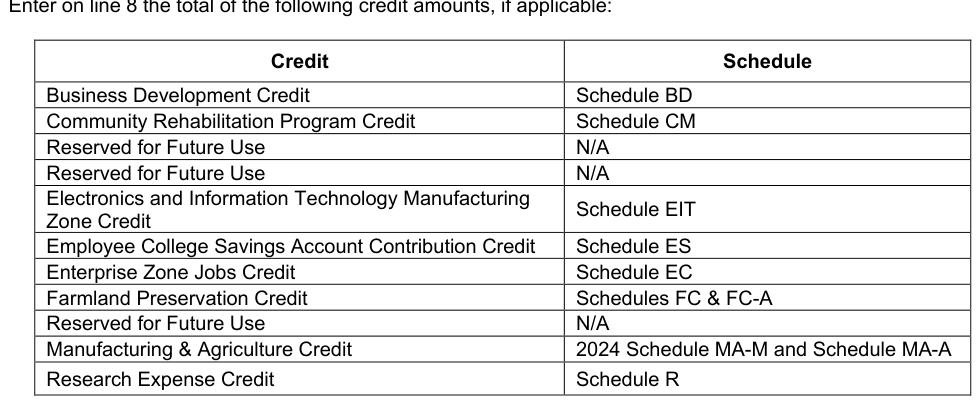
Text version of this table
| Credit | Schedule |
|---|---|
| Business Development Credit | Schedule BD |
| Community Rehabilitation Program Credit | Schedule CM |
| Reserved for Future Use | N/A |
| Reserved for Future Use | N/A |
| Electronics and Information Technology Manufacturing Zone Credit | Schedule EIT |
| Employee College Savings Account Contribution Credit | Schedule ES |
| Enterprise Zone Jobs Credit | Schedule EC |
| Farmland Preservation Credit | Schedules FC & FC-A |
| Reserved for Future Use | N/A |
| Manufacturing & Agriculture Credit | 2024 Schedule MA-M and Schedule MA-A |
| Research Expense Credit | Schedule R |
# Schedule EIT Employee College Savings Account Contribution Credit Schedule ES
Farmland Preservation Credit Schedules FC & FC-A
Reserved for Future Use N/A
Manufacturing & Agriculture Credit 2024 Schedule MA-M and Schedule MA-A Research Expense Credit Schedule R o Line 9. Other Additions - Enter any other amount subject to Wisconsin taxation, less any expense amount allocable to it, which has been excluded or deducted in the computation of federal unrelated business taxable income: o Enter all income that is realized from the sale of or purchase and subsequent sale or redemption of lottery prizes if the tickets were originally bought in Wisconsin. o Adjustments required because of changes made to the Internal Revenue Code which don't apply for Wisconsin. Refer to the list of provisions of the Internal Revenue Code not adopted by Wisconsin above for items that may require adjustment. o Moving expenses, as defined in sec. 71.01 (8j), Wis. Stats., paid or incurred during the taxable year to move the taxpayer's Wisconsin business operation, in whole or in part, to a location outside the state or to move the taxpayer's business operations outside the United States may not be deducted as provided under the Internal Revenue Code.
■ Line 4 - Subtractions - Enter the total subtractions from Part 2 on page 3.
Instructions for how to complete Part 2 - Subtractions:
- Line 1. Interest Income - Enter interest and dividend income, less related expenses, received on obligations and certain securities of the United States government that was included in federal unrelated business taxable income and is exempt from state income taxation.
- Line 2. Capital Gains and Losses For corporations, capital losses are allowed in the current taxable year only to the extent of capital gains.
- Line 3. Net Operating Loss Carryforward - Enter the amount of any Wisconsin net operating loss carryforward.
The Wisconsin net operating loss is the federal net operating loss plus or minus modifications required for Wisconsin tax purposes. Net operating losses from years before the exempt organization became subject to Wisconsin income taxation can't be included on line 3.
- Line 4. Related Entity Expenses - An exempt organization taxable as a corporation must make an addition modification to "add back" management fees, intangible expenses, interest expenses, or rental expenses that are paid, accrued, or incurred to a related entity if that interest was deducted from federal unrelated business taxable income.
The "addback" is reported on Part 1, line 5. After the corporation makes this addition modification, it completes Part II of Schedule RT to determine if it is eligible for a deduction for any of the amount added back. The corporation then makes a subtraction modification on Part 2, line 4, for the amount it is eligible to deduct. See the Schedule RT instructions for details of the conditions necessary to claim this subtraction.
If the corporation is a partner, member, or beneficiary of a pass-through entity, also include the amount of modification included on line 22a of Schedule 3K-1 and line 14a of Schedule 2K-1, as applicable.
- Line 6. Transitional Adjustments - Transitional adjustments are not applicable for organizations taxable as corporations.
- Line 7. Other Subtractions - Enter any amount not subject to Wisconsin taxation that was included in federal unrelated business taxable income, or any deduction allowed for Wisconsin that wasn't deducted federally (such as development zones investment credit recaptured): o Include on line 6 any income that was included in federal unrelated business taxable income but not sourced to Wisconsin. o Adjustments required because of changes made to the Internal Revenue Code which don't apply for Wisconsin. Refer to the list of provisions of the Internal Revenue Code not adopted by Wisconsin for items that may require adjustment.
■ Line 5. Nonapportionable and Separately Accounted Income -Nonapportionable Income - Form N:
Nonapportionable income is that income which is allocable directly to a particular state. It includes income or loss derived from the sale of nonbusiness real or tangible personal property or from rentals and royalties from nonbusiness real or tangible personal property. This income is assigned to the state where the property is located.
All income that is realized from the sale of or purchase and subsequent sale or redemption of lottery prizes if the winning tickets were originally bought in Wisconsin shall be allocated to Wisconsin.
Except for income from lottery prizes described above, the intangible income of a personal holding company is nonapportionable and is assigned to the state of incorporation.
Total nonapportionable income (loss) is removed from total company net income before the apportionment percentage is applied using Form N. The Wisconsin nonapportionable income (loss) is then combined with the Wisconsin apportionable income to arrive at Wisconsin net income.
Separate Accounting - Forms C and N:
If using the separate accounting method, don't complete lines 5 through 9. An exempt organization engaged in a nonunitary business in and outside Wisconsin must determine the amount of income attributable to Wisconsin by separate accounting. The exempt organization uses Form C, Wisconsin Allocation and Separate Accounting Data, to compute the amount attributable to Wisconsin by separate accounting and uses Form N, Wisconsin Nonapportionable, Separately Accounted, and Separately Apportioned Income, to report the separate accounting amount. This is because the income determined under separate accounting from Form C, line 16 is entered on Form N, line 6. A nonunitary business is one in which the operations in Wisconsin aren't dependent upon or contributory to the operations outside Wisconsin. Under separate accounting, the exempt organization must keep separate records of the sales, cost of sales, and expenses for the Wisconsin business.
■ Lines 6 through 8. Apportionment Data - If using the apportionment method, complete one of the following schedules to compute the apportionment percentage:
- Schedule A-01, Wisconsin Single Sales Factor Apportionment Data for Nonspecialized Industries • Schedule A-02, Wisconsin Apportionment Percentage for Interstate Financial Institutions, • Schedule A-03, Wisconsin Apportionment Percentage for Interstate Motor Carriers, • Schedule A-04, Wisconsin Apportionment Percentage for Interstate Telecommunications Companies,
- Schedule A-05, Wisconsin Premiums Factor for Insurance Companies,
- Schedule A-06, Wisconsin Receipts Factor for Interstate Brokers-Dealers, Investment Advisors, Investment Companies, and Underwriters,
- Schedule A-07, Wisconsin Apportionment Percentage for Interstate Air Carriers,
- Schedule A-08, Wisconsin Apportionment Percentage for Broadcasters,
- Schedule A-09, Wisconsin Apportionment Percentage for Interstate Railroads,
- Schedule A-10, Wisconsin Apportionment Percentage for Interstate Pipeline Companies, or
- Schedule A-11, Wisconsin Apportionment Percentage for Interstate Air Freight Forwarders Affiliated with a Direct
# Air Carrier
■ Line 9. Wisconsin nonapportionable and Separately Accounted Income -Nonapportionable Income - Form N:
Nonapportionable income is that income which is allocable directly to a particular state. It includes income or loss derived from the sale of nonbusiness real or tangible personal property or from rentals and royalties from nonbusiness real or tangible personal property. This income is assigned to the state where the property is located.
All income that is realized from the sale of or purchase and subsequent sale or redemption of lottery prizes if the winning tickets were originally bought in Wisconsin shall be allocated to Wisconsin.
Except for income from lottery prizes described above, the intangible income of a personal holding company is nonapportionable and is assigned to the state of incorporation.
Total nonapportionable income (loss) is removed from total company net income before the apportionment percentage is applied using Form N. The Wisconsin nonapportionable income (loss) is then combined with the Wisconsin apportionable income to arrive at Wisconsin net income.
Separate Accounting - Forms C and N:
If using the separate accounting method, don't complete lines 5 through 9. An exempt organization engaged in a nonunitary business in and outside Wisconsin must determine the amount of income attributable to Wisconsin by separate accounting. The exempt organization uses Form C, Wisconsin Allocation and Separate Accounting Data, to compute the amount attributable to Wisconsin by separate accounting and uses Form N, Wisconsin Nonapportionable, Separately Accounted, and Separately Apportioned Income, to report the separate accounting amount. This is because the income determined under separate accounting from Form C, line 16 is entered on Form N, line 6. A nonunitary business is one in which the operations in Wisconsin aren't dependent upon or contributory to the operations outside Wisconsin. Under separate accounting, the exempt organization must keep separate records of the sales, cost of sales, and expenses for the Wisconsin business.
■ Line 11. Gross Tax - Enter 7.9% of the Wisconsin unrelated business taxable income reported on line 10.
■ Line 12. Nonrefundable Credits - Enter any nonrefundable credits the exempt organization is claiming from Schedule CR. However, you may not offset these credits against the economic development surcharge. If you are claiming more than one credit, you must claim the credits in a specific order. To receive any credits, the taxpayer must include the appropriate credit computation schedules. See the Schedule CR instructions for details.
If you are using credits carried forward from prior years or have current year unused credits that are being carried forward, complete and include a Schedule CF for each credit.
To determine if the organization qualifies for any credits, see Publication 123, Business Tax Incentives, which is available on the Department of Revenue's web site at revenue.wi.gov/html/taxpubs.html.
■ Line 13. Net Tax - Subtract line 12 from line 11. If line 12 is greater than line 11, enter zero (0).
# Lines 14 Through 23 - Organizations Taxable as Trusts
■ Line 14. Federal Unrelated Business Taxable Income - Enter the amount from federal Form 990-T, Part I, line
- However, if the trust is required to file Form 4720, enter the amount of federal unrelated business taxable income as computed in the supporting schedules to Form 4720. The amount on line 14 should be after applying the net operating loss deduction and special deductions.
CAUTION: If any changes to the Internal Revenue Code or differences described earlier affect the computation of federal unrelated business taxable income but don't apply for Wisconsin purposes, account for the differences on Parts 1 and 2 on page 3.
■ Line 15. Trust Additions - Federal unrelated business taxable income on Form 4T, line 14, may include items that aren't deductible for Wisconsin tax purposes, or it may not include items that are taxable for Wisconsin tax purposes. Complete Part 1 on page 3 and enter the total to account for these differences.
Instructions for how to complete Part 1 - Additions:
- Line 1. Interest Income - Enter interest income, less related expenses, received on state and municipal obligations that was excluded from federal unrelated business taxable income, except interest which is by law exempt from Wisconsin taxation. Enter only the state or municipal interest that is considered unrelated business taxable income.
- Line 2. State Taxes - Enter the amount of taxes deducted from federal unrelated business taxable income under IRC section 164.
- Line 3. Capital Gains and Losses - If federal unrelated business taxable income includes capital gains or losses, complete Wisconsin Schedule 2WD (Form 2) to determine if an adjustment is necessary to arrive at Wisconsin unrelated business taxable income.
- Line 4. Net Operating Loss Carryover - Enter the amount of any federal net operating loss carryover.
- Lines 5. Related Entity Expenses - An exempt organization taxable as a trust must make an addition modification to "add back" management fees and intangible, interest or rental expenses paid, accrued, or incurred to a related entity. These expenses must generally also be disclosed on Schedule RT. See the Schedule RT instructions for further details of the expenses required to be disclosed on Schedule RT and added back to income on Part 1.
After the trust makes this addition modification, the trust uses Part II of Schedule RT to determine if it is eligible for a deduction for any of the amount added back. The trust then makes a subtraction modification on Part 2 in the amount it is eligible to deduct.
If the trust is a partner, member, beneficiary, or shareholder of a pass-through entity, also include the amount of modification included on line 22a of Schedule 3K-1; line 14a of Schedule 2K-1; and line 18a of Schedule 5K-1, as applicable.
- Line 6. Reserved for Future Use
- Line 7. Transitional Adjustments - Enter any transitional adjustments required by sec. 71.05(13), Wis. Stats., to account for differences between the federal and Wisconsin bases of changing basis assets (those subject to depreciation or amortization). Include a schedule showing the computation of each transitional adjustment made.
- Line 8. Credits Includable in Income - For certain credits, you must include the credit amount in your income.
# Schedule EIT Employee College Savings Account Contribution Credit Schedule ES
# Farmland Preservation Credit Schedules FC & FC-A
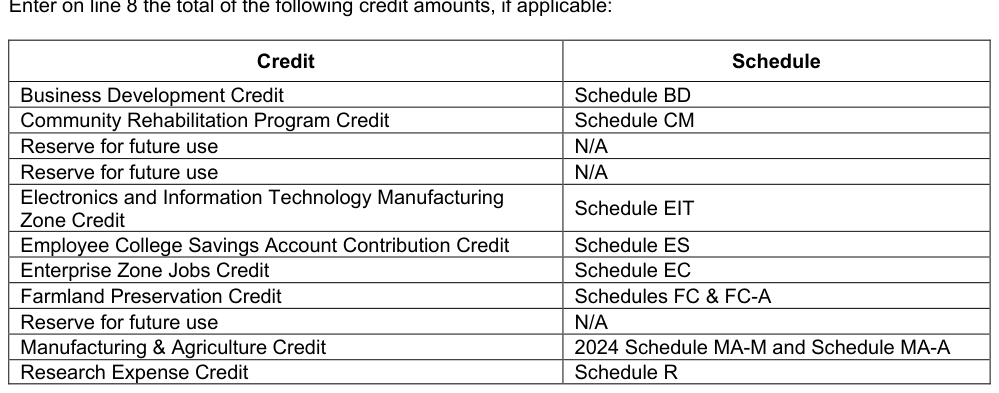
Text version of this table
Credit Schedule Business Development Credit Schedule BD Community Rehabilitation Program Credit Schedule CM Reserve for future use N/A Reserve for future use N/A Electronics and Information Technology Manufacturing Zone Credit Schedule EIT Employee College Savings Account Contribution Credit Schedule ES Enterprise Zone Jobs Credit Schedule EC Farmland Preservation Credit Schedules FC & FC-A Reserve for future use N/A Manufacturing & Agriculture Credit 2024 Schedule MA-M and Schedule MA-A Research Expense Credit Schedule R
Internal Revenue Code.
■ Line 17. Trust Subtractions - Federal unrelated business taxable income on Form 4T, line 14, may not include items that are deductible for Wisconsin tax purposes, or it may include items that aren't taxable for Wisconsin purposes. Complete Part 2 on page 3 and enter the total.
Instructions for how to complete Part 2 - Subtractions:
- Line 1. Interest Income - Enter interest and dividend income, less related expenses, received on obligations and certain securities of the United States government that was included in federal unrelated business taxable income and is exempt from state income taxation.
- Line 2. Capital Gains and Losses - If federal unrelated business taxable income includes capital gains or losses, complete Wisconsin Schedule 2WD (Form 2) to determine if an adjustment is necessary to arrive at Wisconsin unrelated business taxable income. For example, an adjustment may be required because Wisconsin law allows an exclusion of 30% of the net capital gain from assets held more than one year (60% on farm assets held more than one year and on all farm assets acquired from a decedent).
- Line 3. Net Operating Loss Carryforward - Enter the amount of any Wisconsin net operating loss carryforward.
The Wisconsin net operating loss is the federal net operating loss plus or minus modifications required for Wisconsin tax purposes. Net operating losses from years before the exempt organization became subject to Wisconsin income taxation can't be included on line 3.
- Line 4. Related Entity Expenses - An exempt organization taxable as a trust must make an addition modification to "add back" management fees, intangible expenses, interest expenses, or rental expenses that are paid, accrued, or incurred to a related entity if that interest was deducted from federal unrelated business taxable income. The "addback" is reported on Part 1, line 5. After the exempt organization makes this addition modification, it completes Part II of Schedule RT to determine if it is eligible for a deduction for any of the amount added back. The exempt organization then makes a subtraction modification on Part 2, line 4, for the amount it is eligible to deduct. See the Schedule RT instructions for details of the conditions necessary to claim this subtraction.
If the exempt organization is a partner, member, beneficiary, or shareholder of a pass-through entity, also include the amount of modification included on line 22b of Schedule 3K-1, line 14b of Schedule 2K-1, and line 18b of Schedule 5K-1, as applicable.
- Line 6. Transitional Adjustments - Enter any transitional adjustment required by sec. 71.05(13), Wis. Stats., to account for differences between the federal and Wisconsin bases of changing basis assets (those subject to depreciation or amortization). Include a schedule showing the computation of each transitional adjustment.
- Line 7. Other Subtractions - Enter any amount not subject to Wisconsin taxation that was included in federal unrelated business taxable income, or any deduction allowed for Wisconsin that wasn't deducted federally (such as development zones investment credit recaptured): o Include on line 6 any trust income that was included in federal unrelated business taxable income but not sourced to Wisconsin. o Adjustments required as a result of changes made to the Internal Revenue Code which don't apply for Wisconsin. Refer to the list of provisions of the Internal Revenue Code not adopted by Wisconsin for items that may require adjustment.
■ Line 19. Gross Tax - Compute the tax on the Wisconsin unrelated business taxable income on line 18 using the tax table located in the instructions.
■ Line 20. Nonrefundable Credits - Enter any nonrefundable credits the exempt organization is claiming from Schedule CR. However, you may not offset these credits against the economic development surcharge. If you are claiming more than one credit, you must claim the credits in a specific order. To receive any credits, the taxpayer must include the appropriate credit computation schedules. See the Schedule CR instructions for details.
To determine if the organization qualifies for any credits, see Publication 123, Business Tax Incentives, which is available on the Department of Revenue's web site at revenue.wi.gov/html/taxpubs.html.
■ Line 21. Net Income Tax Paid to Other States - Wisconsin resident trusts may claim a credit for income tax paid to another state or the District of Columbia, subject to the following requirements.
- The income taxed by the other state must be included in Wisconsin unrelated business taxable income,
- The credit claimed must be for the net amount of tax paid to the other state (this may be more or less than the amount paid as estimated tax), and
- A copy of Wisconsin Schedule OS and the other state's tax return must be included with Form 4T.
See Wisconsin Schedule OS for more information.
Lines 25 Through 41
■ Line 25. Economic Development Surcharge - Compute the surcharge as explained below. For further information, see Publication 400, Wisconsin's Economic Development Surcharge.
Exempt organizations taxable as corporations: Enter the greater of $25 or 3% (0.03) of the gross tax on line 11, but not more than $9,800. Note: The economic development surcharge does not apply to exempt organizations taxable as corporations that have less than $4 million of gross receipts from all unrelated trade or business activities for federal income tax purposes.
■ Line 26. Endangered Resources Donation - (For exempt organizations taxable as corporations.) Your donation supports the preservation and management of more than 200 endangered and threatened Wisconsin plants and animals. It also helps protect Wisconsin's finest remaining examples of prairies, forests, and wetlands. Support endangered resources in Wisconsin. Fill in line 26 with the amount you wish to donate. Your gift will either reduce your refund or be added to tax due.
You can also make an online donation at the following web site: https://www.billerpayments.com/app/donationsui/?bsn=swidnrdonations#/donations/payment You can also send a check directly to the Endangered Resources Fund, Department of Natural Resources, PO Box 7921, Madison WI 53707-7921.
■ Line 27. Veterans Trust Fund Donation - You may designate an amount as a veteran's trust fund donation. Your donation will be used by the Wisconsin Department of Veterans Affairs for the benefit of veterans or their dependents.
Fill in line 27 with the amount you wish to donate. Your donation will either reduce your refund or be added to tax due.
■ Line 29. Estimated Tax Payments - Enter estimated tax payments made or overpayments applied from prior years' returns. Subtract any "quick refund" applied for on Form 4466W.
■ Line 30. Wisconsin Tax Withheld - Enter your share of Wisconsin tax withheld from pass-through entities of which you are a member, as reported on Wisconsin Schedules 2K-1, 3K-1, or 5K-1. Include a copy of the Schedule 2K-1, 3K-1, or 5K-1 with the tax return that you file. Also enter the amount of Wisconsin tax withheld from lottery prizes.
If this is an amended return, enter the Wisconsin tax withheld reported on your original return, unless the amount you originally reported was incorrect.
■ Line 31. Refundable Credits - Enter any refundable credits the exempt organization is claiming from Schedule
CR. To determine if the organization qualifies for any credits, see Publication 123, Business Tax Incentives (available at revenue.wi.gov/html/taxpubs.html). To claim a credit, complete the appropriate credit schedule as instructed by Publication 123, enter the credit amount on the appropriate line of Schedule CR, and include the credit schedule and Schedule CR with your return.
■ Line 32. Amended Return - Amount Previously Paid - Complete this line only if this is an amended 2025 Form
4T. Fill in the amount of tax you paid with your original Form 4T plus any additional amounts paid after it was filed.
If you did not pay the full amount shown on your original Form 4T, fill in only the portion that you actually paid. Also, include any additional tax that may have resulted if your original return was changed or audited. This includes additional tax paid with a previously filed 2025 amended return and additional tax paid because of a department adjustment to your return. Do not include payments of interest or penalties.
■ Line 34. Amended Return - Amount Previously Refunded - Complete this line only if this is an amended 2025 Form 4T. Fill in the refund from your original 2025 return (not including the amount applied to your 2026 estimated tax).
If your refund was reduced because you owed underpayment interest or any penalties, fill in the amount of your refund before the reduction for underpayment interest or penalty. If your 2025 return was adjusted by the department, fill in the refund shown on the adjustment notice you received. If the adjustment notice shows a tax due rather than a refund, complete line 32 instead of line 34.
■ Line 36. Interest, Penalty, and Late Fee Due - Enter any interest, penalty, and late fee due from Form U, line 17 or 26; or Schedule U, line 15 or 29. Check the space after the arrow line if you computed underpayment interest using the annualized income installment method on Form U, page 2.
If you are filing an amended return and you were previously assessed interest for underpayment of estimated taxes, complete an amended Form U, Part I, or Schedule U based on the total of the amounts shown on Form 4T, lines 24 and 25. Enter the difference between the underpayment interest from the amended Form U, line 17, or Schedule U line 15 or 29, and the amount you previously paid on Form 4T, line 36. Show an overpayment as a negative number.
Include Form U or Schedule U with your amended return. Otherwise, leave line 36 blank. The department will compute interest on the amount of refund approved or tax owed.
■ Line 37. Amount Due - If the total of lines 28 and 36 is larger than line 35, subtract line 35 from the total of lines 28 and 36. Pay by electronic funds transfer or mail your check with a 2025 Form Corp-ES, Corporation Estimated Tax Voucher, to the address shown on the voucher. Otherwise, use paper clips to fasten your check to the front of Form 4T.
■ Line 38. Overpayment - If line 35 is larger than the total of lines 28 and 36, subtract the total of lines 28 and 36 from line 35.
■ Line 39. 2026 Estimated Tax - Enter the amount of any overpayment from line 38 that is to be credited to the organization's 2026 estimated tax. The balance of any overpayment will be refunded.
# Changing an Election to Apply a Refund to Estimated Tax
Sections 71.09(7) and 71.29(3), Wis. Stats., provide an election to apply all or a portion of a claimed refund to the following year's estimated tax payments, if the refund has not been paid or applied elsewhere (for example, against a delinquent tax liability).
An election to apply a refund to estimated tax may be changed to:
- request payment of the refund,
- credit the refund against an amended return tax liability for any year, or
- credit the refund against a notice of amount due for any year.
For individual and fiduciary income tax, notification of a change in election must occur on or before the due date of the final estimated tax installment payment (January 15, 2026, for a calendar-year filer).
For corporation franchise and income tax, notification of a change in election must occur on or before the unextended due date of the following year's tax return or before the following year's tax return is filed, whichever is earlier.
The change in election must be in writing. You can file an amended return or send an email, fax, or letter to:
Fiduciaries:
- DOREstateandFiduciary@revenue.wi.gov
- Fax: (608) 267-0834
- Wisconsin Department of Revenue PO Box 8906 Madison WI 53708-8906 Corporations:
- DORFranchise@revenue.wi.gov
- Fax: (608) 267-0834
- Wisconsin Department of Revenue PO Box 8906 Madison WI 53708-8906 If a timely election to move the estimated payments is not made, any tax due on the return is subject to interest at 12% per year from the unextended due date of the return until the date paid. Interest is due regardless of whether the original amount of estimated payments exceeded the tax due on the return because the estimated payments were moved to the next taxable year.
# Amended Returns
If this is an amended 2025 return, but you have already filed your original 2026 return, enter the overpayment that you claimed as a credit on your 2026 return from your previously filed original or amended 2025 return. Otherwise, you may allocate the overpayment from line 38 between line 39 and line 40 as you choose.
■ Line 41. Gross Receipts - Enter the "gross receipts from all unrelated trade or business activities" including gross receipts, gross sales, the gross sales price from the disposition of capital assets and business assets, gross rents, gross income from unrelated debt-financed property, gross interest, annuities, royalties, and rents from controlled organizations, gross investment income, gross exploited exempt activity income, gross advertising income, gross receipts passed through from other entities, and all other receipts that are included in unrelated business taxable income for Wisconsin tax purposes.
# Additional Information, Signatures, and Supplemental Schedules
■ Additional Information Required - Provide the requested information and answer the questions in items 1 through 5.
■ Third Party Designee - If you want to allow a tax preparer or tax preparation firm, or any other person you choose to discuss your 2025 tax return with the Department of Revenue, check "Yes" in the "Third Party Designee" area of your return. Also, fill in the designee's name, phone number, and any five digits the designee chooses as their personal identification number (PIN). If you check "Yes," you are authorizing the department to discuss with the designee any questions that may arise during the processing of your return. You are also authorizing the designee to:
- Give the department any information missing from your return,
- Call the department for information about the processing of your return or the status of your refund or payment(s), and
- Respond to certain department notices about math errors, offsets, and return preparation.
You are not authorizing the designee to receive any refund check, bind you to anything (including any additional tax liability), or otherwise represent you before the department. If you want to expand the designee's authorization, you must submit Form A-222 (Power of Attorney). The authorization will automatically end no later than the due date (without regard to extensions) for filing your 2026 tax return.
■ Signatures - An officer or trustee of the exempt organization must sign the form at the bottom of page 2. If the return is prepared by someone other than an employee of the exempt organization, the individual who prepared the return must sign the form, by hand, in the space provided for the preparer's signature and furnish the preparing firm's federal employer identification number. A self-employed individual must enter "PTIN" and their preparer tax identification number in the space for the preparer's federal employer identification number.
■ Supplemental Schedules - Include the following items as supplemental schedules to your Form 4T:
- Your federal Form 990-T or 4720 with all supporting schedules.
- A list of your solely owned LLCs (complete and include Schedule DE with your return).
- Any extension of time to file your return.
- Supporting schedules for Form 4T (supporting schedules that are not department-prescribed forms may be submitted as .pdf documents with electronic returns).
If you are filing Form 4T on paper, do not staple, fasten, or bind these supplemental schedules to your return.
Use paper clips instead.
Wisconsin Income of Multistate Organizations
# Who Must Use Apportionment
Under the apportionment method, an exempt organization shows all income and deductions from unrelated trade or business activities for the organization as a whole and then assigns a part to Wisconsin according to a formula that determines Wisconsin unrelated business taxable income.
An exempt organization engaged in unrelated trade or business activities in and outside Wisconsin is required to report a portion of its total unrelated business taxable income to Wisconsin using the apportionment method if its Wisconsin operations are a part of a unitary business, unless the department gives permission to use separate accounting. To use the apportionment method, an exempt organization must have unrelated trade or business activity sufficient to create nexus in Wisconsin and at least one other state or foreign country.
A unitary business is one that operates as a unit and can't be segregated into independently operating divisions or branches. The operations are integrated, and each division or branch is dependent upon or contributory to the operation of the business as a whole. It isn't necessary that each division or branch operating in Wisconsin contribute to the activities of all divisions or branches outside Wisconsin.
To use the apportionment method, an exempt organization must have business activity sufficient to create nexus in Wisconsin and at least one other state or foreign country. "Nexus" means that an exempt organization's business activity is of such a degree that the state or foreign country has jurisdiction to impose an income tax or franchise tax measured by net income.
Under Public Law 86-272, a state can't impose an income tax or franchise tax based on net income on an exempt organization selling tangible personal property if the organization's only activity in the state is the solicitation of orders, which orders are approved outside the state and are filled by delivery from a point outside the state.
# What Is the Apportionment Percentage
For unitary, multistate businesses (except direct air carriers, air freight forwarders affiliated with a direct air carrier, motor carriers, railroads, pipeline companies, financial institutions, brokers-dealers, investment advisers, investment companies, underwriters, and telecommunications companies whose incomes are apportioned by special rules of the department), the apportionment percentage is determined by the ratio of Wisconsin sales to total company sales.
For most companies, the apportionment percentage is computed on Schedule A-01. However, financial institutions, direct air carriers, air freight forwarders affiliated with a direct air carrier, motor carriers, railroads, pipeline companies, telecommunications companies, insurance companies, interstate brokers-dealers, investment advisors, investment companies, and underwriters, broadcasters, and interstate pipeline companies use alternative schedules:
The apportionment schedules consist of the following:
- Schedule A-01, Wisconsin Single Sales Factor Apportionment Data for Nonspecialized Industries • Schedule A-02, Wisconsin Apportionment Percentage for Interstate Financial Institutions, • Schedule A-03, Wisconsin Apportionment Percentage for Interstate Motor Carriers, • Schedule A-04, Wisconsin Apportionment Percentage for Interstate Telecommunications Companies,
- Schedule A-05, Wisconsin Premiums Factor for Insurance Companies,
- Schedule A-06, Wisconsin Receipts Factor for Interstate Brokers-Dealers, Investment Advisors, Investment Companies, and Underwriters,
- Schedule A-07, Wisconsin Apportionment Percentage for Interstate Air Carriers,
- Schedule A-08, Wisconsin Apportionment Percentage for Broadcasters,
- Schedule A-09, Wisconsin Apportionment Percentage for Interstate Railroads,
- Schedule A-10, Wisconsin Apportionment Percentage for Interstate Pipeline Companies, or
- Schedule A-11, Wisconsin Apportionment Percentage for Interstate Air Freight Forwarders Affiliated with a Direct
Air Carrier
# Corporate Partners or LLC Members
An exempt corporation that is a general or limited partner includes its share of the numerator and denominator of the partnership's apportionment factors in the numerator and denominator of its apportionment factors. An exempt corporation that is a member of a limited liability company (LLC) treated as a partnership for federal tax purposes includes its share of the numerator and denominator of the LLC's apportionment factors in the numerator and denominator of its apportionment factors. The exempt corporation should request a detailed breakdown of the partnership's or LLC's items and amounts to be included in the computation of its apportionment factors.
Note: Income from a partnership or LLC may be nontaxable under the principles of the U.S. Supreme Court decision in Allied-Signal v. Director, Div. of Taxation, 504 U.S. 768 (1992), if the investment is passive and does not serve an operational function. In this case, the exempt corporation would not include its share of the partnership's or LLC's apportionment factors in the numerator and denominator of its apportionment factors.
# Separate Accounting
An exempt organization engaged in a nonunitary business in and outside Wisconsin must determine the amount of income attributable to Wisconsin by separate accounting. The exempt organization uses Form C, Separate Accounting Data, to compute the amount attributable to Wisconsin by separate accounting and uses Form N, Wisconsin Nonapportionable and Separately Apportioned Income, to report the separate accounting amount. This is because the income determined under separate accounting from Form C, line 16 is entered on Form N, line 6. A nonunitary business is one in which the operations in Wisconsin aren't dependent upon or contributory to the operations outside Wisconsin. Under separate accounting, the exempt organization must keep separate records of the sales, cost of sales, and expenses for the Wisconsin business.
A unitary business may use separate accounting only with the approval of the department. An application for such approval must set forth, in detail, the reasons why separate accounting will more clearly reflect the exempt organization's Wisconsin net income. It should be mailed to the Wisconsin Department of Revenue, PO Box 8906, Madison,
# Applicable Laws and Rules
This document provides statements or interpretations of the following laws and regulations enacted as of October 24, 2025: Chapter 71 Wis. Stats., and Chapter Tax 2, Wis. Adm. Code WI 53708-8906 before the end of the taxable year for which the use of separate accounting is desired.
# Obtaining Forms and Assistance
If you need forms or publications, you may:
- Download them from the department's Internet web site at revenue.wi.gov.
- Request them online at revenue.wi.gov.
- Call (608) 266-1961.
- Call or visit any Department of Revenue office.
If you need help in preparing Form 4T, you may:
- E-mail your question to: DORFranchise@wisconsin.gov
- Send a FAX to (608) 267-0834
- Call (608) 266-2772
(Telephone help is also available using TTY equipment. Call the Wisconsin Telecommunications Relay System at 711 or, if no answer, (800) 947-3529. These numbers are to be used only when calling with TTY equipment.)
- Call or visit any Department of Revenue office.
# 2025 TAX TABLE
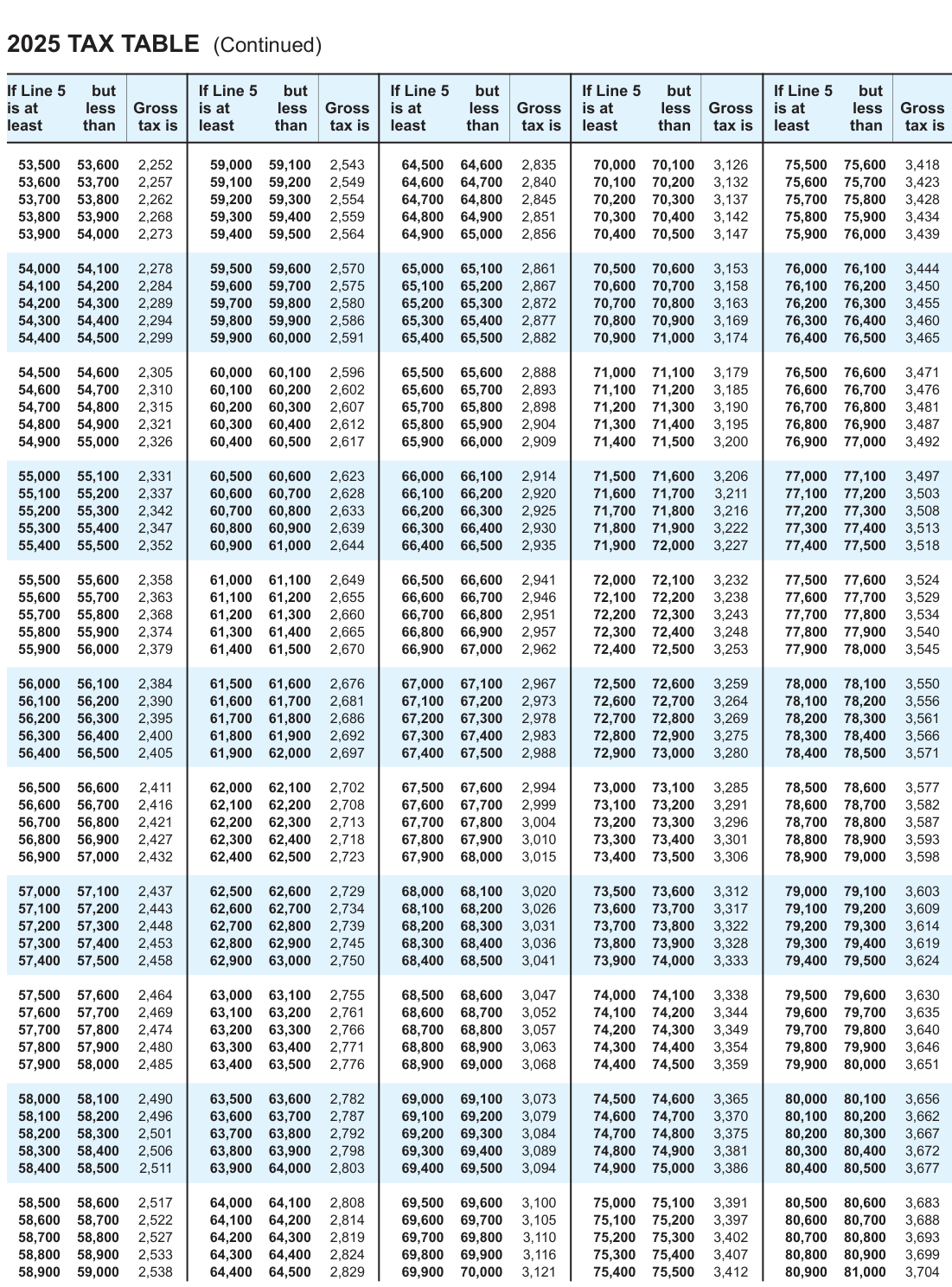
Text version of this table
| 2025 T | AX T | ABLE | (Conti | nued) | ||||||||||||||
| If Line 5 | but | If | Line 5 | but | If | Line 5 | but | If | Line 5 | but | If | Line 5 | but | |||||
| is at | less | Gross | is | at | less | Gross | is | at | less | Gross | is | at | less | Gross | is | at | less | Gros |
| least | than | tax is | le | ast | than | tax is | le | ast | than | tax is | le | ast | than | tax is | le | ast | than | tax i |
| 41,900 | 12,900 | 2,252 | 41,800 | 39,900 | 2,543 | 40,800 | 40,700 | 2,835 | 12,800 | 38,900 | 3,126 | 75,500 | 75,600 | 3,418 | ||||
| 41,900 | 41,800 | 2,257 | 39,900 | 59,200 | 2,549 | 41,700 | 64,700 | 12,800 | 11,800 | 38,900 | 3,132 | 75,600 | 75,700 | 3,423 | ||||
| 41,900 | 41,800 | 2,262 | 12,800 | 39,900 | 2,554 | 41,700 | 64,800 | 2,845 | 38,900 | 38,800 | 3,137 | 75,700 | 75,800 | 3,428 | ||||
| 41,900 | 39,900 | 2,268 | 41,800 | 39,800 | 2,559 | 64,800 | 64,900 | 2,851 | 41,700 | 38,800 | 3,142 | 75,800 | 75,900 | 3,434 | ||||
| 41,900 | 41,800 | 2,273 | 39,900 | 39,800 | 2,564 | 64,900 | 41,700 | 2,856 | 38,800 | 38,600 | 3,147 | 75,900 | 76,000 | 3,439 | ||||
| 41,900 | 41,800 | 2,278 | 39,900 | 39,800 | 38,800 | 41,700 | 65,100 | 2,861 | 11,800 | 38,700 | 3,153 | 76,000 | 38,600 | 3,444 | ||||
| 41,900 | 41,800 | 2,284 | 39,900 | 39,800 | 2,575 | 65,100 | 65,200 | 2,867 | 38,800 | 38,700 | 3,158 | 39,600 | 76,200 | 41,700 | ||||
| 41,900 | 41,800 | 2,289 | 39,900 | 39,800 | 38,800 | 65,200 | 65,300 | 2,872 | 11,800 | 70,800 | 3,163 | 39,700 | 76,300 | 3,455 | ||||
| 41,900 | 41,800 | 2,294 | 39,900 | 59,900 | 2,586 | 65,300 | 65,400 | 2,877 | 39,800 | 70,900 | 3,169 | 39,700 | 76,400 | 41,700 | ||||
| 41,900 | 41,800 | 2,299 | 39,900 | 39,800 | 2,591 | 65,400 | 65,500 | 2,882 | 70,900 | 39,700 | 3,174 | 39,600 | 76,500 | 3,465 | ||||
| 41,900 | 39,900 | 39,800 | 41,800 | 40,800 | 2,596 | 65,500 | 65,600 | 2,888 | 39,700 | 39,600 | 3,179 | 39,500 | 76,600 | 3,471 | ||||
| 41,900 | 41,800 | 39,900 | 11,800 | 41,700 | 2,602 | 65,600 | 65,700 | 2,893 | 39,800 | 41,600 | 3,185 | 39,700 | 76,700 | 3,476 | ||||
| 41,900 | 41,800 | 2,315 | 39,900 | 41,700 | 14,700 | 65,700 | 65,800 | 2,898 | 11,700 | 41,600 | 42,500 | 39,800 | 76,800 | 3,481 | ||||
| 41,900 | 54,900 | 2,321 | 41,800 | 41,700 | 2,612 | 65,800 | 65,900 | 2,904 | 14,700 | 41,600 | 3,195 | 39,900 | 76,900 | 3,487 | ||||
| 41,900 | 41,800 | 2,326 | 40,800 | 40,700 | 2,617 | 65,900 | 66,000 | 2,909 | 14,700 | 14,600 | 42,500 | 39,900 | 77,000 | 3,492 | ||||
| 41,900 | 55,100 | 2,331 | 40,900 | 39,900 | 2,623 | 66,000 | 66,100 | 2,914 | 40,800 | 40,700 | 40,600 | 77,000 | 39,800 | 3,497 | ||||
| 55,100 | 55,200 | 2,337 | 41,900 | 41,800 | 2,628 | 66,100 | 66,200 | 41,700 | 11,700 | 39,900 | 3,211 | 39,800 | 77,200 | 41,600 | ||||
| 55,200 | 55,300 | 2,342 | 41,900 | 41,800 | 2,633 | 66,200 | 66,300 | 2,925 | 41,700 | 39,900 | 3,216 | 39,800 | 77,300 | 41,600 | ||||
| 55,300 | 55,400 | 2,347 | 41,900 | 60,900 | 2,639 | 66,300 | 66,400 | 41,800 | 11,800 | 39,900 | 3,222 | 39,800 | 77,400 | 3,513 | ||||
| 55,400 | 55,500 | 2,352 | 41,900 | 41,800 | 2,644 | 66,400 | 66,500 | 2,935 | 39,900 | 41,700 | 3,227 | 39,800 | 77,500 | 3,518 | ||||
| 55,500 | 41,900 | 2,358 | 41,800 | 41,700 | 2,649 | 66,500 | 66,600 | 2,941 | 41,600 | 39,900 | 3,232 | 77,500 | 77,600 | 3,524 | ||||
| 41,900 | 55,700 | 2,363 | 41,800 | 41,700 | 2,655 | 66,600 | 66,700 | 2,946 | 41,600 | 39,900 | 3,238 | 77,600 | 77,700 | 3,529 | ||||
| 41,900 | 55,800 | 2,368 | 41,800 | 41,700 | 41,600 | 66,700 | 66,800 | 2,951 | 42,500 | 39,900 | 3,243 | 77,700 | 77,800 | 3,534 | ||||
| 41,900 | 55,900 | 2,374 | 41,800 | 41,700 | 2,665 | 66,800 | 66,900 | 2,957 | 41,600 | 39,900 | 3,248 | 77,800 | 77,900 | 42,500 | ||||
| 41,900 | 41,800 | 2,379 | 40,800 | 40,700 | 40,600 | 66,900 | 67,000 | 2,962 | 42,500 | 39,900 | 3,253 | 77,900 | 39,800 | 3,545 | ||||
| 41,900 | 56,100 | 2,384 | 40,900 | 39,900 | 2,676 | 67,000 | 39,800 | 2,967 | 40,800 | 72,600 | 3,259 | 39,700 | 78,100 | 40,700 | ||||
| 56,100 | 56,200 | 41,900 | 11,900 | 41,800 | 2,681 | 39,900 | 67,200 | 2,973 | 72,600 | 72,700 | 3,264 | 39,800 | 78,200 | 3,556 | ||||
| 56,200 | 56,300 | 2,395 | 41,900 | 41,800 | 2,686 | 39,900 | 67,300 | 2,978 | 41,700 | 72,800 | 3,269 | 39,800 | 78,300 | 3,561 | ||||
| 56,300 | 56,400 | 41,900 | 39,900 | 61,900 | 2,692 | 39,800 | 67,400 | 2,983 | 41,800 | 72,900 | 3,275 | 39,700 | 78,400 | 3,566 | ||||
| 56,400 | 56,500 | 41,900 | 11,900 | 41,800 | 2,697 | 39,900 | 67,500 | 2,988 | 72,900 | 41,700 | 39,800 | 78,400 | 78,500 | 3,571 | ||||
| 56,500 | 41,900 | 2,411 | 41,800 | 42,500 | 2,702 | 39,900 | 67,600 | 2,994 | 41,700 | 39,800 | 3,285 | 78,500 | 78,600 | 3,577 | ||||
| 41,900 | 56,700 | 2,416 | 41,800 | 42,500 | 2,708 | 39,900 | 67,700 | 2,999 | 41,700 | 39,800 | 3,291 | 78,600 | 78,700 | 3,582 | ||||
| 41,900 | 56,800 | 2,421 | 41,800 | 42,500 | 2,713 | 39,900 | 67,800 | 41,700 | 39,800 | 39,700 | 3,296 | 78,700 | 78,800 | 3,587 | ||||
| 41,900 | 56,900 | 2,427 | 41,800 | 42,500 | 2,718 | 39,900 | 67,900 | 41,700 | 39,800 | 39,700 | 39,500 | 78,800 | 78,900 | 3,593 | ||||
| 41,900 | 41,800 | 2,432 | 40,800 | 42,500 | 2,723 | 39,900 | 39,800 | 3,015 | 40,700 | 37,800 | 40,600 | 78,900 | 11,800 | 3,598 | ||||
| 41,900 | 39,900 | 2,437 | 40,900 | 11,900 | 2,729 | 39,800 | 68,100 | 40,800 | 39,700 | 73,600 | 3,312 | 39,400 | 79,100 | 3,603 | ||||
| 39,900 | 57,200 | 2,443 | 41,900 | 41,800 | 2,734 | 39,800 | 68,200 | 3,026 | 41,700 | 39,700 | 3,317 | 39,600 | 79,200 | 3,609 | ||||
| 39,900 | 57,300 | 2,448 | 41,900 | 41,800 | 2,739 | 39,800 | 68,300 | 3,031 | 41,700 | 73,800 | 3,322 | 11,800 | 39,700 | 3,614 | ||||
| 39,900 | 57,400 | 2,453 | 41,900 | 62,900 | 2,745 | 39,800 | 68,400 | 3,036 | 41,800 | 73,900 | 3,328 | 12,800 | 39,700 | 3,619 | ||||
| 39,900 | 57,500 | 2,458 | 41,900 | 41,800 | 12,800 | 39,800 | 68,500 | 3,041 | 73,900 | 41,700 | 3,333 | 11,800 | 39,700 | 3,624 | ||||
| 39,900 | 41,900 | 2,464 | 41,800 | 39,800 | 2,755 | 68,500 | 68,600 | 3,047 | 41,700 | 41,600 | 3,338 | 39,700 | 79,600 | 39,400 | ||||
| 41,900 | 39,900 | 2,469 | 41,800 | 39,800 | 2,761 | 68,600 | 68,700 | 3,052 | 41,700 | 41,600 | 3,344 | 39,700 | 79,700 | 3,635 | ||||
| 41,900 | 39,900 | 2,474 | 41,800 | 39,800 | 2,766 | 68,700 | 68,800 | 3,057 | 41,700 | 41,600 | 3,349 | 12,800 | 79,800 | 39,700 | ||||
| 41,900 | 39,900 | 41,800 | 41,700 | 39,800 | 2,771 | 68,800 | 68,900 | 3,063 | 41,600 | 42,500 | 3,354 | 11,800 | 79,900 | 3,646 | ||||
| 41,900 | 41,800 | 2,485 | 40,800 | 39,900 | 2,776 | 68,900 | 12,800 | 3,068 | 40,700 | 40,600 | 3,359 | 79,900 | 12,700 | 3,651 | ||||
| 41,900 | 39,900 | 40,900 | 40,800 | 11,900 | 2,782 | 39,800 | 69,100 | 3,073 | 40,700 | 37,900 | 3,365 | 11,800 | 40,600 | 3,656 | ||||
| 39,900 | 58,200 | 2,496 | 41,900 | 41,800 | 2,787 | 39,800 | 69,200 | 3,079 | 41,700 | 37,900 | 37,600 | 12,800 | 41,600 | 3,662 | ||||
| 39,900 | 58,300 | 41,900 | 11,900 | 41,800 | 2,792 | 11,800 | 39,800 | 3,084 | 41,700 | 37,900 | 3,375 | 37,700 | 41,600 | 3,667 | ||||
| 39,900 | 58,400 | 41,900 | 11,900 | 37,900 | 2,798 | 41,800 | 39,800 | 3,089 | 37,800 | 74,900 | 3,381 | 41,700 | 41,600 | 3,672 | ||||
| 39,900 | 58,500 | 2,511 | 41,900 | 41,800 | 37,900 | 11,800 | 39,800 | 3,094 | 74,900 | 41,700 | 3,386 | 37,700 | 40,700 | 3,677 | ||||
| 39,900 | 41,900 | 2,517 | 41,800 | 41,700 | 37,900 | 39,800 | 69,600 | 11,800 | 41,600 | 37,700 | 3,391 | 80,500 | 80,600 | 3,683 | ||||
| 41,900 | 39,900 | 2,522 | 41,800 | 41,700 | 2,814 | 39,800 | 69,700 | 37,900 | 37,700 | 75,200 | 3,397 | 12,800 | 80,700 | 3,688 | ||||
| 41,900 | 39,900 | 2,527 | 41,800 | 41,700 | 2,819 | 37,900 | 39,800 | 39,700 | 39,600 | 75,300 | 39,500 | 80,700 | 80,800 | 3,693 | ||||
| 41,900 | 39,900 | 2,533 | 41,800 | 41,700 | 2,824 | 37,900 | 69,900 | 3,116 | 39,800 | 75,400 | 39,700 | 80,800 | 80,900 | 3,699 | ||||
| 41,900 | 41,800 | 2,538 | 41,700 | 41,600 | 2,829 | 39,900 | 38,900 | 3,121 | 39,800 | 75,500 | 3,412 | 80,900 | 39,700 | 3,704 |
# Tax Computation
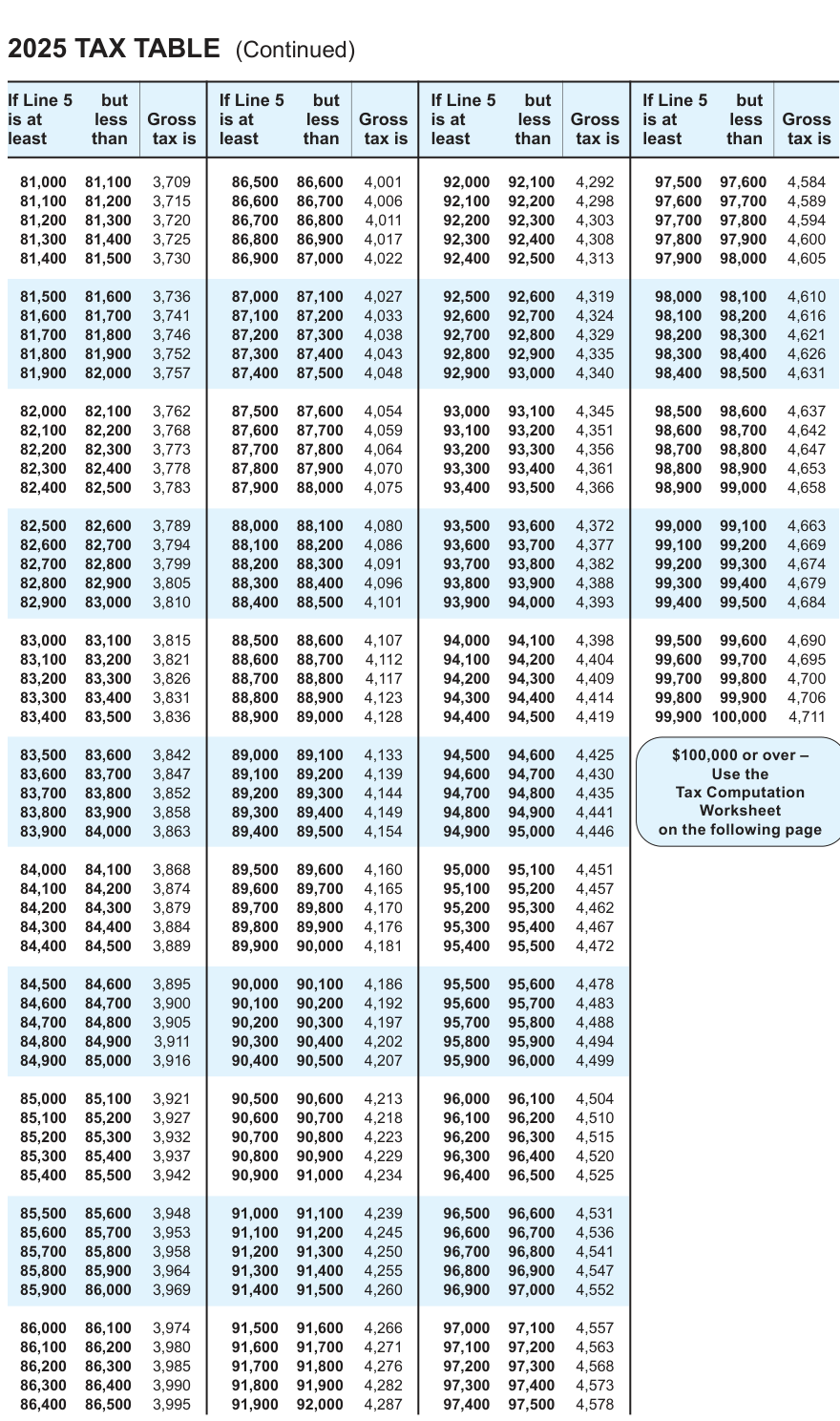
Text version of this table
| 2025 T | AX T | ABLE | (Conti | nued) | ||||||||||
| If Line 5 | but | If | Line 5 | but | If | Line 5 | but | If | Line 5 | but | ||||
| is at | less | Gross | is | at | less | Gross | is | at | less | Gross | is | at | less | Gros |
| least | than | tax is | le | ast | than | tax is | le | ast | than | tax is | le | ast | than | tax i |
| 81,000 | 81,100 | 3,709 | 86,500 | 86,600 | 4,001 | 92,000 | 92,100 | 4,292 | 97,500 | 97,600 | 4,584 | |||
| 81,100 | 81,200 | 3,715 | 86,600 | 86,700 | 4,006 | 92,100 | 92,200 | 4,298 | 97,600 | 97,700 | 4,589 | |||
| 81,200 | 81,300 | 3,720 | 86,700 | 86,800 | 4,011 | 92,200 | 92,300 | 4,303 | 97,700 | 97,800 | 4,594 | |||
| 81,300 | 81,400 | 3,725 | 86,800 | 86,900 | 4,017 | 92,300 | 92,400 | 4,308 | 97,800 | 97,900 | 4,600 | |||
| 81,400 | 81,500 | 3,730 | 86,900 | 87,000 | 4,022 | 92,400 | 92,500 | 4,313 | 97,900 | 98,000 | 4,605 | |||
| 81,500 | 81,600 | 3,736 | 87,000 | 87,100 | 4,027 | 92,500 | 92,600 | 4,319 | 98,000 | 98,100 | 4,610 | |||
| 81,600 | 81,700 | 3,741 | 87,100 | 87,200 | 4,033 | 92,600 | 92,700 | 4,324 | 98,100 | 98,200 | 4,616 | |||
| 81,700 | 81,800 | 3,746 | 87,200 | 87,300 | 4,038 | 92,700 | 92,800 | 4,329 | 98,200 | 98,300 | 4,621 | |||
| 81,800 | 81,900 | 3,752 | 87,300 | 87,400 | 4,043 | 92,800 | 92,900 | 4,335 | 98,300 | 98,400 | 4,626 | |||
| 81,900 | 82,000 | 3,757 | 87,400 | 87,500 | 4,048 | 92,900 | 93,000 | 4,340 | 98,400 | 98,500 | 4,631 | |||
| 82,000 | 82,100 | 3,762 | 87,500 | 87,600 | 4,054 | 93,000 | 93,100 | 4,345 | 98,500 | 98,600 | 4,637 | |||
| 82,100 | 82,200 | 3,768 | 87,600 | 87,700 | 4,059 | 93,100 | 93,200 | 4,351 | 98,600 | 98,700 | 4,642 | |||
| 82,200 | 82,300 | 3,773 | 87,700 | 87,800 | 4,064 | 93,200 | 93,300 | 4,356 | 98,700 | 98,800 | 4,647 | |||
| 82,300 | 82,400 | 3,778 | 87,800 | 87,900 | 4,070 | 93,300 | 93,400 | 4,361 | 98,800 | 98,900 | 4,653 | |||
| 82,400 | 82,500 | 3,783 | 87,900 | 88,000 | 4,075 | 93,400 | 93,500 | 4,366 | 98,900 | 99,000 | 4,658 | |||
| 82,500 | 82,600 | 3,789 | 88,000 | 88,100 | 4,080 | 93,500 | 93,600 | 4,372 | 99,000 | 99,100 | 4,663 | |||
| 82,600 | 82,700 | 3,794 | 88,100 | 88,200 | 4,086 | 93,600 | 93,700 | 4,377 | 99,100 | 99,200 | 4,669 | |||
| 82,700 | 82,800 | 3,799 | 88,200 | 88,300 | 4,091 | 93,700 | 93,800 | 4,382 | 99,200 | 99,300 | 4,674 | |||
| 82,800 | 82,900 | 3,805 | 88,300 | 88,400 | 4,096 | 93,800 | 93,900 | 4,388 | 99,300 | 99,400 | 4,679 | |||
| 82,900 | 83,000 | 3,810 | 88,400 | 88,500 | 4,101 | 93,900 | 94,000 | 4,393 | 99,400 | 99,500 | 4,684 | |||
| 83,000 | 83,100 | 3,815 | 88,500 | 88,600 | 4,107 | 94,000 | 94,100 | 4,398 | 99,500 | 99,600 | 4,690 | |||
| 83,100 | 83,200 | 3,821 | 88,600 | 88,700 | 4,112 | 94,100 | 94,200 | 4,404 | 99,600 | 99,700 | 4,695 | |||
| 83,200 | 83,300 | 3,826 | 88,700 | 88,800 | 4,117 | 94,200 | 94,300 | 4,409 | 99,700 | 99,800 | 4,700 | |||
| 83,300 | 83,400 | 3,831 | 88,800 | 88,900 | 4,123 | 94,300 | 94,400 | 4,414 | 99,800 | 99,900 | 4,706 | |||
| 83,400 | 83,500 | 3,836 | 88,900 | 89,000 | 4,128 | 94,400 | 94,500 | 4,419 | 99,900 | 100,000 | 4,711 | |||
| 83,500 | 83,600 | 3,842 | 89,000 | 89,100 | 4,133 | 94,500 | 94,600 | 4,425 | $100, | 000 or ove | r – | |||
| 83,600 | 83,700 | 3,847 | 89,100 | 89,200 | 4,139 | 94,600 | 94,700 | 4,430 | Use the | |||||
| 83,700 | 83,800 | 3,852 | 89,200 | 89,300 | 4,144 | 94,700 | 94,800 | 4,435 | Tax | Computati | on | |||
| 83,800 | 83,900 | 3,858 | 89,300 | 89,400 | 4,149 | 94,800 | 94,900 | 4,441 | W | orksheet | ||||
| 83,900 | 84,000 | 3,863 | 89,400 | 89,500 | 4,154 | 94,900 | 95,000 | 4,446 | on the | following | page | |||
| 84,000 | 84,100 | 3,868 | 89,500 | 89,600 | 4,160 | 95,000 | 95,100 | 4,451 | ||||||
| 84,100 | 84,200 | 3,874 | 89,600 | 89,700 | 4,165 | 95,100 | 95,200 | 4,457 | ||||||
| 84,200 | 84,300 | 3,879 | 89,700 | 89,800 | 4,170 | 95,200 | 95,300 | 4,462 | ||||||
| 84,300 | 84,400 | 3,884 | 89,800 | 89,900 | 4,176 | 95,300 | 95,400 | 4,467 | ||||||
| 84,400 | 84,500 | 3,889 | 89,900 | 90,000 | 4,181 | 95,400 | 95,500 | 4,472 | ||||||
| 84,500 | 84,600 | 3,895 | 90,000 | 90,100 | 4,186 | 95,500 | 95,600 | 4,478 | ||||||
| 84,600 | 84,700 | 3,900 | 90,100 | 90,200 | 4,192 | 95,600 | 95,700 | 4,483 | ||||||
| 84,700 | 84,800 | 3,905 | 90,200 | 90,300 | 4,197 | 95,700 | 95,800 | 4,488 | ||||||
| 84,800 | 84,900 | 3,911 | 90,300 | 90,400 | 4,202 | 95,800 | 95,900 | 4,494 | ||||||
| 84,900 | 85,000 | 3,916 | 90,400 | 90,500 | 4,207 | 95,900 | 96,000 | 4,499 | ||||||
| 85,000 | 85,100 | 3,921 | 90,500 | 90,600 | 4,213 | 96,000 | 96,100 | 4,504 | ||||||
| 85,100 | 85,200 | 3,927 | 90,600 | 90,700 | 4,218 | 96,100 | 96,200 | 4,510 | ||||||
| 85,200 | 85,300 | 3,932 | 90,700 | 90,800 | 4,223 | 96,200 | 96,300 | 4,515 | ||||||
| 85,300 | 85,400 | 3,937 | 90,800 | 90,900 | 4,229 | 96,300 | 96,400 | 4,520 | ||||||
| 85,400 | 85,500 | 3,942 | 90,900 | 91,000 | 4,234 | 96,400 | 96,500 | 4,525 | ||||||
| 85,500 | 85,600 | 3,948 | 91,000 | 91,100 | 4,239 | 96,500 | 96,600 | 4,531 | ||||||
| 85,600 | 85,700 | 3,953 | 91,100 | 91,200 | 4,245 | 96,600 | 96,700 | 4,536 | ||||||
| 85,700 | 85,800 | 3,958 | 91,200 | 91,300 | 4,250 | 96,700 | 96,800 | 4,541 | ||||||
| 85,800 | 85,900 | 3,964 | 91,300 | 91,400 | 4,255 | 96,800 | 96,900 | 4,547 | ||||||
| 85,900 | 86,000 | 3,969 | 91,400 | 91,500 | 4,260 | 96,900 | 97,000 | 4,552 | ||||||
| 86,000 | 86,100 | 3,974 | 91,500 | 91,600 | 4,266 | 97,000 | 97,100 | 4,557 | ||||||
| 86,100 | 86,200 | 3,980 | 91,600 | 91,700 | 4,271 | 97,100 | 97,200 | 4,563 | ||||||
| 86,200 | 86,300 | 3,985 | 91,700 | 91,800 | 4,276 | 97,200 | 97,300 | 4,568 | ||||||
| 86,300 | 86,400 | 3,990 | 91,800 | 91,900 | 4,282 | 97,300 | 97,400 | 4,573 | ||||||
| 86,400 | 86,500 | 3,995 | 91,900 | 92,000 | 4,287 | 97,400 | 97,500 | 4,578 |
# 2025 Tax Computation Worksheet - Line 6a
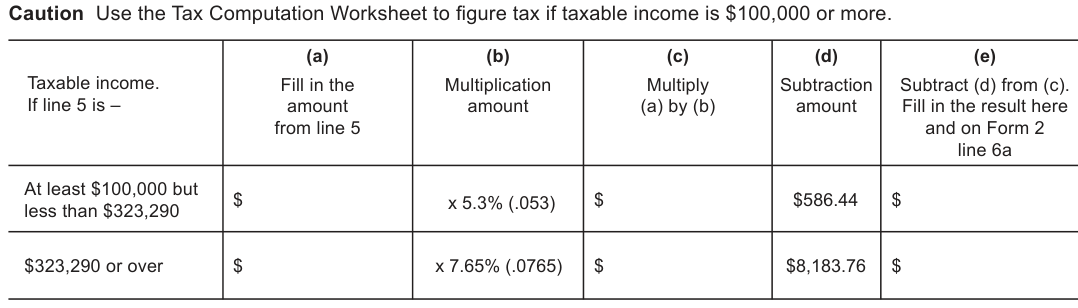
Text version of this table
| (a) Fill in the amount from line 5 | (b) Multiplication amount | (c) Multiply (a) by (b) | (d) Subtraction amount |
| $ | x 5.3% (.053) | $ | $586.44 |
| $ | x 7.65% (.0765) | $ | $8,183.76 |
Source: view the official PDF
Nearby sections (20 sections)
- a-222 · A-222 — Power of Attorney
- a-771 · A-771 — Disclosure Authorization (Third-Party Access)
- form-1 · Form 1 — Wisconsin Income Tax (resident)
- form-1npr · Form 1NPR — Nonresident & Part-Year Resident Income Tax
- form-2 · Form 2 — Wisconsin Fiduciary Income Tax (Estates & Trusts)
- form-3 · Form 3 — Wisconsin Partnership Return
- form-4 · Form 4 — Wisconsin Corporation Franchise/Income Tax
- form-4t · Form 4T — Exempt Organization Business Franchise/Income
- form-5s · Form 5S — Tax-Option (S) Corporation
- form-6 · Form 6 — Combined Wisconsin Corporation Franchise/Income
- pw-1 · PW-1 — Nonresident Pass-Through Withholding
- pw-2 · PW-2 — Nonresident Withholding Exemption
- s-211 · S-211 — Sales and Use Tax Exemption Certificate
- schedule-3-et · Schedule 3-ET — PTET Election (Partnership)
- schedule-3k-1 · Schedule 3K-1 — Partner's Share of Income
- schedule-5k-1 · Schedule 5K-1 — Shareholder's Share (S-Corp)
- schedule-cr · Schedule CR — Other Credits
- schedule-h · Schedule H / H-EZ — Homestead Credit Claim
- schedule-ms · Schedule MS — Manufacturing & Agriculture Credit
- st-12 · ST-12 — Sales and Use Tax Return