New Jersey Division of Taxation Form Instructions
Instructions for Form CBT-100U — Combined Corporation Business Tax Return
# Electronic Filing Mandate
All Corporation Business Tax returns and payments must be made electronically. This mandate includes all returns, estimated payments, extensions, and vouchers. Visit the Division's website or check with your software provider to see if they support any or all of these filings.
# Before You Begin
Read all instructions carefully before completing returns.
Include a complete copy of the federal Form 1120 (or any other federal corporate return) that was filed with the federal government for (or on behalf of) each member of the combined group, and include all related forms and schedules that were filed as part of the full and complete federal return of the member. For more information, see TB-98(R), Federal Return and the Forms and Schedules to Include with the Corporation
Business Tax Return.
Form 1120-F filers attach the 1120-F to the return. If no 1120-F was completed but the income was reported on Form 5471, attach the 5471. If a non-U.S. corporation did not file federal Form 1120-F and the income was not reported on federal Form 5471, it must complete an 1120-F reporting its income and tax attributes as though the entity filed a federal return.
# Managerial Member Responsibilities
The managerial member acts as the agent on behalf of the combined group. The managerial member is required to address all tax matters including, but not limited to: filing and amending tax returns, filing extensions, and making estimated tax payments and/or any tax liability payment on behalf of its taxable members. The managerial member is also responsible for responding to notices and assessments for its combined group. (N.J.S.A. 54:10A-4.10) The managerial member of the combined group must register the group in order to file the combined return. Information on managerial member registration is available on the Division's website.
# Personal Liability of Officers and Directors
Even though the managerial member is responsible for making payments on behalf of the combined group, each taxable member is jointly and severally liable for the tax due. In addition, any officer or director of any corporation who shall distribute or cause to be distributed any assets in dissolution or liquidation to the stockholders without having first paid all corporation franchise taxes, fees, penalties, and interest imposed on said corporation, in accordance with N.J.S.A. 14A:6-12, N.J.S.A.
54:50-18 and other applicable provisions of law, shall be personally liable for said unpaid taxes, fees, penalties, and interest. Compliance with N.J.S.A. 54:50-13 is also required in the case of certain mergers, consolidations, and dissolutions.
# Distortion of Net Income
The Director is authorized to adjust and redetermine items of gross receipts and expenses as may be necessary to make a fair and reasonable determination of tax payable under the Corporation Business Tax Act. For details regarding the conditions under which this authority may be exercised, see regulation N.J.A.C. 18:7-5.10.
# Accounting Method
The return must be completed using the same method of accounting, cash, accrual or other basis, that was used on the federal income tax return. If a federal income tax return was not filed, use the same accounting method that would have been used if a federal return was filed.
Note: Members that only use I.F.R.S. as their method of accounting can use I.F.R.S. when reporting their income; however, the member must include a rider noting the potential differences, if any, from the rest of the group.
# Riders
If space is insufficient, include riders as PDFs in the same form as the original printed sheets. The riders must be numbered and clearly list the schedule(s) and line(s) of each corresponding rider item.
# Federal/State Tax Agreement
The New Jersey Division of Taxation and the Internal Revenue Service participate in a federal/State program for the mutual exchange of tax information to verify the accuracy and consistency of information reported on federal and New Jersey tax returns.
# Mandatory Combined Reporting
For group privilege periods ending on and after July 31, 2019, members that are part of a combined group must file a combined New Jersey return, Form CBT-100U. Combined returns are mandatory, not elective.
# Definitions
Combined group is a group of companies that have common ownership and are engaged in a unitary business, and at least one company is subject to tax under this chapter. It includes all business entities except as provided for under any section of the Corporation Business Tax Act (1945), P.L.1945, c.162 (C.54:10A-1 et seq.). See N.J.S.A. 54:10A-4(z).
Note: Pursuant to N.J.S.A. 54:10A-4(h) a combined group is a taxpayer for the purposes of the Corporation Business Tax Act.
Common ownership means that more than 50% of the voting control of each member of a combined group is directly or indirectly owned by a common owner or owners, either corporate or noncorporate, whether or not the owner or owners are members of the combined group. Whether voting control is indirectly owned shall be determined in accordance with section 318 of the federal Internal Revenue Code, 26 U.S.C. s.318.
See: N.J.S.A. 54:10A-4(aa). The Division interprets N.J.S.A.
54:10A-4(aa) to mean that all of the ownership rules, including the beneficial and constructive ownership rules of I.R.C. section 318 apply since the definition of common ownership states that the control can be director indirect.
Managerial member is the common parent corporation if that corporation is a taxable member. If the common parent corporation is not a taxable member, the group must select a taxable member to be its managerial member or, at the discretion of the Director or upon failure of the combined group to select its managerial member, the Director will designate a taxable member of the combined group as managerial member.
Member is a business entity that is a part of a combined group, unless otherwise excluded. See "Corporations Required to File" for more information.
Taxable member is a member that is subject to tax pursuant to the Corporation Business Tax Act (1945), P.L.1945, c.162 (C.54:10A-1 et seq.). See N.J.S.A. 54:10A-4(ff).
Nontaxable member is a member that is not subject to tax.
See N.J.S.A. 54:10A-4(ee).
Unitary business is a single economic enterprise that is made up either of separate parts of a single business entity or of a group of business entities under common ownership that are sufficiently interdependent, integrated, or interrelated through their activities so as to provide a synergy and mutual benefit that produces a sharing or exchange of value among them and a significant flow of value among the separate parts. A unitary business shall be construed to the broadest extent permitted under the Constitution of the United States. See N.J.S.A.
54:10A-4(gg) and TB-93, The Unitary Business Principle and Combined Returns, for more information and the full definition of a unitary business for the purposes of combined reporting.
# Combined Return Filing Methods
P.L. 2023, c.96, included several changes impacting combined groups for privilege periods ending on and after July 31, 2023, and in future privilege periods. These changes may impact taxpayers' decisions on their combined return filing method option.
A combined return is a filing method for a group of business entities in a unitary business. Determining the combined group members involves imposing certain statutory limitations, which affect the treatment of income, allocation factors, and tax attributes. This decision is commonly referred to as "world-wide vs. water's-edge." As an alternative, there is an option to file the New Jersey combined return as an "affiliated group" as defined by statute.
Information on combined return filing methods is available in TB-109, Combined Group Filing Methods for Privilege Periods
Ending on and After July 31, 2023.
Mandatory Default Water's-Edge Group Basis returns include only entities with significant business operations within the United States, with several inclusions and exceptions. This is the mandatory default filing method. Combined reporting is not elective. See N.J.S.A. 54:10A-4.8; N.J.S.A. 54:10A-4.10; and N.J.S.A. 54:10A-4.11.
Elective World-Wide Group Election. When making a worldwide group election, the combined group must include all of the income, attributes, and allocation factors of all of the worldwide business entities that are members of the unitary combined group, regardless of whether such members filed a federal tax return or whether such members filed a federal consolidated return(s). See N.J.S.A. 54:10A-4(kk) for more information.
Elective Affiliated Group Election. For the purposes of the affiliated group election, "affiliated group" is defined pursuant to N.J.S.A. 54:10A-4(x). Only business entities that are U.S. domestic corporations (as defined in N.J.S.A. 54:10A-4(x)) for the purposes of the definition can be included in the affiliated group return. Non-U.S. corporations that do not file a federal return cannot be included in a New Jersey affiliated group combined return.
Note: In most cases, the New Jersey affiliated group combined return constitutes the multinational corporation's entire U.S. footprint.
The sole U.S. domestic corporation in a world-wide combined group cannot make the affiliated group election on its own. In this situation, the combined group must file a water's-edge or world-wide group combined return.
An affiliated group election by the U.S. domestic corporations does not relieve the non-U.S. corporations of their New Jersey Corporation Business Tax liability. Thus, a non-U.S. corporation organized outside the United States that does not file a federal return, but has with New Jersey, must still file a separate New Jersey Corporation Business Tax return.
# Allocation Methods for Combined Returns
For privilege periods ending on and after July 31, 2023, New Jersey has adopted the Finnigan method as the allocation method for all combined groups (see N.J.S.A. 54:10A-4.7.e and N.J.S.A. 54:10A-4.11.c). Additionally, the combined group is treated as one taxpayer for purposes of sourcing the unitary receipts. Under the Finnigan method, the allocation factor attributes in the numerator are derived from all of the members of the combined group.
Note: For combined returns filed for privilege periods ending before July 31, 2023, the allocation method was tied to the filing method (see TB-89(R) for more information on allocation methods for previous years).
# Nexus
Corporations will be deemed to have bright-line economic nexus if during the corporation's tax year:
- The receipts derived from New Jersey sources are more than $100,000, or
- 200 or more separate transactions are delivered to customers in New Jersey.
Corporations that do not meet either threshold above, and do not create nexus in another way, do not have nexus even if they have New Jersey receipts. Information on nexus is available in TB-108, Nexus for Corporation Business Tax for Privilege Periods Ending on and after July 31, 2023.
Each member that has nexus with New Jersey is subject to the $2,000 minimum tax. A member of a combined group has nexus if the member meets the standards of N.J.S.A. 54:10A-2 as either part of the unitary business of the combined group or independent of the combined group. If a member does not have nexus with New Jersey, the member is not subject to the minimum tax.
Unitary Partnerships. Corporate partners that are unitary with a partnership that have either New Jersey receipts or transactions with New Jersey customers have nexus with New Jersey if the corporate partner's proportionate share of the partnership's activities in New Jersey meet the thresholds for bright-line economic nexus. Corporate partners and unitary partnerships must use the flow-through method of accounting and the nexus determination is based on the corporate partner's proportionate share of the partnership's activities.
Disregarded Entities. The attributes and activities of the disregarded entity are included with the member's (owner of the disregarded entity) attributes and activities when determining whether the member has nexus.
Note: A taxpayer that is not in a unitary business relationship with a combined group must file a separate return if the taxpayer has nexus with New Jersey and the managerial member of the combined return does not make the election to file the affiliated group combined return.
# Corporations Required to File
If one member of a combined group has nexus, the combined group must file a New Jersey combined return.
In general, every corporation existing under the laws of the State of New Jersey is required to file a Corporation Business Tax return.
A foreign corporation has nexus if that foreign corporation:
- Holds a general certificate of authority to do business in this State issued by the Secretary of State; or
- Holds a certificate, license, or other authorization issued by any other department or agency of this State authorizing the company to engage in corporate activity within this State; or
- Does business in this State; or
- Employs or owns capital in this State; or
- Employs or owns property in this State; or
- Maintains an office in this State; or
- Derives receipts within this State that meet the thresholds for bright-line economic nexus; or
- Engages in contacts within this State; or
- Maintains a stock of goods in New Jersey.
Foreign corporations see N.J.A.C. 18:7-1.6; N.J.A.C. 18:7-1.8; N.J.A.C. 18:7-1.9; N.J.A.C. 18:7-1.10; N.J.A.C. 18:7-1.11;
N.J.A.C. 18:7-1.14 and TB-108 Nexus for Corporation Business Tax for Privilege Periods Ending on and After July 31, 2023, for more information on nexus.
The attributes and activities of a QSSS, disregarded entity, or unitary partnership are included as part of its parent corporation's attributes and activities when determining whether the corporation has nexus.
A foreign corporation that is a partner of a New Jersey partnership is deemed subject to tax in the State and must file a return.
Corporations Claiming P.L. 86-272. If the entire combined group is claiming immunity from tax pursuant to P.L. 86-272, each member must complete Schedule N, Nexus - Immune Activity Declaration, and all applicable schedules from the CBT-100U, and the Nexus Questionnaire. In addition, the combined group must complete page 1, the Members and Affiliates Schedule, and Schedules A, A-2, A-3, and A-4. Payment for the related minimum tax liability and the installment payment (if applicable) must be submitted. P.L. 86-272 filers are not subject to the Corporate Transit Fee enacted under N.J.S.A.
54:10A-5.41a.
New Corporations. Every New Jersey corporation acquires a taxable status beginning 1) on the date of its incorporation, or
- on the first day of the month following its incorporation if so stated in its certificate of incorporation. Every corporation that incorporates, qualifies, or otherwise acquires a taxable status in New Jersey must file a Corporation Business Tax return.
This includes both in-state and out-of-state corporations.
S corporation (or Qualified Subchapter S Subsidiary).
If an S corporation makes an election to be treated as a C corporation under either N.J.S.A. 54:10A-4(ff) or N.J.S.A.
54:10A-5.22.d (see TB-105 for information on electing C corporation status), the S corporation (and its QSSS(es), if applicable) is subject to the rules of combined reporting. An entity included on a combined return will be taxed in the same manner as the other members of the combined group. A copy of Form 1120-S as filed must be submitted. The entity does not need to file a CBT-100S for the privilege periods that it is included as a member of the combined group.
If a parent S corporation elects to be treated as a C corporation (see above), the parent and its QSSS(es) must be included on the CBT-100U. The entities do not file a CBT-100S for any privilege periods they are included on a CBT-100U.
Domestic International Sales Corporations (DISC). A DISC must complete this return as though no election had been made under Sections 992-999 of the Internal Revenue Code. A DISC must complete all applicable schedules on the return.
Combinable Captive Insurance Companies. Combinable captive insurance companies are not exempt from the Corporation Business Tax.
Note: A regular captive insurance company that does not meet the definition of a combinable captive insurance company in N.J.S.A. 54:10A-4(y) is still exempt from the Corporation Business Tax.
Captive Investment Company. Taxpayers that meet statutorily enumerated definitions of a "captive" must be included as members of the combined group.
Captive Regulated Investment Company. Taxpayers that meet statutorily enumerated definitions of a "captive" must be included as members of the combined group.
Captive Real Estate Investment Trust. Real estate investment trusts that meet the statutorily enumerated definitions of a "captive" must be included as members of the combined group.
For more information, see TB-86(R), Included and Excluded Business Entities in a Combined Group and the Minimum Tax of a Taxpayer that is a Member of a Combined Group.
Foreign Sales Corporations (FSC). An FSC must complete this return as though no election had been made under Sections 922-927 of the Internal Revenue Code. FSCs must complete all applicable schedules on the return. Under Section 5, P.L. 106-519, no corporation may elect to be an FSC after September 30, 2000.
Financial Business Corporations. Corporations that qualify as financial businesses, those that derive 75% of their gross income from the financial activities enumerated at N.J.A.C.
18:7-1.16(a)1 through (a)7, must use Form CBT-100U if it meets the combined group filing requirements.
Banking Corporations. A banking corporation filing as part of a combined group that uses a fiscal year basis must align its privilege period with the combined group. For more information, see TB-91, Banking Corporations and Combined Returns. The combined return must be filed electronically even if one or more members of the combined group is a banking corporation.
# Professional Corporations. Corporations formed under
N.J.S.A. 14A:17-1 et seq. or any similar laws of a possession or territory of the U.S., a state, or political subdivision thereof, must complete Schedule PC. Examples of licensed professionals include certified public accountants, architects, optometrists, professional engineers, land surveyors, land planners, chiropractors, physical therapists, registered professional nurses, dentists, osteopaths, physicians and surgeons, doctors of medicine, doctors of dentistry, podiatrists, veterinarians, and attorneys.
Inactive Corporations. Inactive corporations that, during the period covered by the return, did not conduct any business, did not have any income, receipts or expenses, and did not own any assets must complete Schedule I - Certificate of Inactivity in addition to page 1, the Members and Affiliates Schedule, and Schedules A, A-2, A-3, and A-4. Payment for the related minimum tax liability and the installment payment (if applicable) must be submitted electronically.
# Portion of a Company's Operations That are Nonunitary
With This Combined Group. There are instances when a portion of a member's business operations are independent of the unitary business activity of the combined group. Only the income, attributes, and allocation factors related to the portion of a company's operations that are part of a unitary business of the combined group are included in the calculation of the combined group's entire net income and allocation factor. The remaining portion of a member's business operations may be subject to tax separately from the combined group if such member individually conducts business in New Jersey or with another combined group (if it is engaged in a unitary business with that combined group that also conducts business in New Jersey and files a CBT-100U).
Note: A combined group member with business operations that are independent of the unitary business activity of the combined group must report such income on Schedule X. Schedule X will be used to calculate the New Jersey taxable net income of that separate activity income that must be reported in Part II of Schedule A, Section I and Section II of the CBT-100U. Include a copy of Schedule X if completed. See Schedule X instructions for more information.
See "Additional Forms and Instructions" for details on obtaining Schedule X.
Former Member of Combined Group. A taxpayer that was a member of a combined group filing a New Jersey combined return for part of the group privilege period and subsequently departs the combined group to file on a separate entity basis must report the income for months subsequent to departing the combined group on a separate return (Form CBT-100) unless the member joined a second combined group that files a New Jersey combined return. The taxpayer filing a separate return would not report the income on CBT-100 for the months the member was part of the combined group. Likewise, a taxpayer that joined a second combined group that files a New Jersey combined return would only report on the second group's return the income for the months the member was part of the second combined group. If determining what amount of income is attributable to the portions of the 12-month period are for the periods before and after departing a combined group, the taxpayer must prorate their income/losses and receipts.
Note: For a taxpayer that is a member of a combined group filing a New Jersey combined return and that member properly dissolved and received tax clearance during the group privilege period, the income and tax liabilities of that member for the part of the group privilege period the member existed prior to dissolution must be reported on the combined return.
# Included and Excluded Entity Types
Not all business entities are included in a combined group.
The lists below provide information on which entities are or are not included. Additional information is available in TB-86(R), Included and Excluded Business Entities in a Combined Group and the Minimum Tax of a Taxpayer that is a Member of a
Combined Group.
# Included Entity Types
- U.S. Corporations
- Foreign Corporations
- Casino Licensees
- Banking Corporations
- Financial Corporations
- Limited Liability Companies (unless treated as partnerships or disregarded entities for federal purposes)
- Foreign Limited Liability Companies (unless treated as partnerships or disregarded entities for federal purposes)
- S Corporations and Qualified Subchapter S Subsidiaries that have elected to be taxed as C corporations for New Jersey purposes (regardless of whether the election is under N.J.S.A. 54:10A-4(ff) or N.J.S.A. 54:10A-5.22.d). See TB-105 for information about electing C corporation status.
- Combinable Captive Insurance Companies
- Professional Corporations
- Captive investment companies as defined in N.J.S.A.
54:A-4(hh)
- Captive regulated investment companies as defined in
# N.J.S.A. 54:A-4(jj)
- Captive real estate investment trusts as defined in N.J.S.A.
54:10A-4(ii)
- Public utilities as defined at N.J.S.A. 54:10A-4(q) that are not excluded pursuant to N.J.S.A. 54:10A-4.6(k)
- Any other business entities however and/or wherever incorporated or formed that are treated as corporations for federal purposes except when excluded by statute or as described below
# Casino Licensees
Pursuant to the Casino Control Act, any business conducted by an individual, partnership, or corporation or any other entity, or any combination thereof, holding a license in New Jersey is required to file a consolidated return. A consolidated return is similar to an affiliated group combined return. See N.J.S.A.
5:12-148. All Casino licensees are taxable members. The affiliated businesses that are unitary with the casino licensees must also be included when completing CBT-100U.
Note: Casino licensees filing as members of a combined group on Form CBT-100U meet the consolidated filing requirements of both the Corporation Business Tax Act and Casino Control Act (N.J.S.A. 5:12-148). No other additional consolidated return is required for the privilege period as long as the casino licensee is included as a member of the New Jersey combined group filing the CBT-100U. Casino licensees should report their net gaming receipts in accordance with U.S. G.A.A.P. and federal tax purposes on Schedule J.
See Technical Bulletin, TB-117, Casino Licensees' Corporation Business Tax Obligations for reporting instructions.
# Disregarded Entities
A business entity that is treated as a disregarded entity for federal income tax purposes is also treated as a disregarded entity for New Jersey Corporation Business Tax purposes pursuant to N.J.S.A. 42:2C-92. Disregarded entities also include legal partnerships that are disregarded entities for federal purposes. A disregarded entity is not itself a member of a combined group. However, the tax attributes of a disregarded entity are reported by a member of a combined group when the member owns the disregarded entity. The attributes of a disregarded entity owned by a member of a combined group are included in the income and allocation factor of that member and the combined group. In making a determination of which members are included in a water's-edge combined group pursuant to N.J.S.A. 54:10A-4.11, the disregarded entity's attributes shall be used by the member that owns the disregarded entity.
A disregarded entity is not subject to the $2,000 minimum tax as a member of a combined group because a disregarded entity is not a member of the combined group. However, if a disregarded entity is part of a unitary business of a combined group, the owner of the disregarded entity will be a member of the combined group and must be included as part of the combined group except as otherwise excluded.
# Entities that File as Partnerships for Federal Purposes
Partnerships, limited partnerships, or limited liability companies treated as partnerships for federal purposes are business entities that can be unitary with a combined group. However, these entities are not members of a combined group for New Jersey Corporation Business Tax purposes. Their income flows through to the corporate partners that are members of the combined group. Partnerships, limited partnerships, and limited liability companies that are treated as partnerships for federal purposes are not subject to the $2,000 minimum tax as members of a combined group because they are not members of the combined group. However, Form NJ-CBT-1065 must still be filed.
# Excluded Entity Types
- S Corporations that do not elect inclusion in the combined group under N.J.S.A. 54:10A-4(ff) or did not elect to be taxed as a C corporation under N.J.S.A. 54:10A-5.22.d.
Qualified Subchapter S Subsidiaries are also excluded if the parent S corporation does not elect inclusion in the combined group. See TB-105 for information about electing C corporation status
- Captive Insurance Companies that do not meet the definition of a Combinable Captive Insurance Company as defined in N.J.S.A. 54:10A-4(y)
- All other insurance companies that are not Combinable
Captive Insurance Companies
- Corporations exempt from the Corporation Business Tax under N.J.S.A. 54:10A-3
- Corporations that are regulated, in whole or in part, by the
# Federal Energy Regulatory Commission, the New Jersey
Board of Public Utilities, or similar regulatory body of another state, with respect to rates charged to customers for electric or gas services and water and wastewater services.
However, per N.J.A.C. 18:7-21.3(f), a utility may petition the Director to join as a member of a combined group.
- Real estate investment trusts, investment companies, and regulated investment companies of which at least 50% of the shares, by vote or value, are owned or controlled, directly or indirectly, by a state or federally chartered bank, savings bank, or savings and loan association with assets that do not exceed $15 billion or that otherwise do not meet the definition of a "captive" real estate investment trusts, investment companies, or regulated investment companies.
A taxpayer that has nexus with New Jersey that is excluded from the New Jersey combined return must file a separate return.
# 2025 Accounting Periods and Due Dates
The 2025 Corporation Business Tax return should only be used for accounting periods ending on and after July 31, 2025, through June 30, 2026.
New Jersey Corporation Business Tax returns and payments, except estimated payments, are due the 15th day of the month following the month the federal corporate income tax return is originally due. If the due date falls on a weekend or a legal holiday, the return and payment are due on the following business day. Use the following schedule for 2025 CBT-100U forms and payments: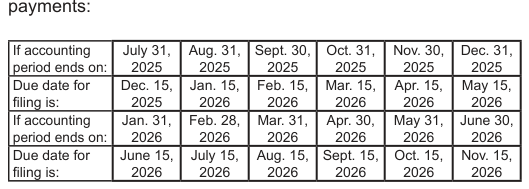
Text version of this table
If accounting period ends on: July 31, 2025 Aug. 31, 2025 Sept. 30, 2025 Oct. 31, 2025 Nov. 30, 2025 Dec. 31, 2025 Due date for filing is: Dec. 15, 2025 Jan. 15, 2026 Feb. 15, 2026 Mar. 15, 2026 Apr. 15, 2026 May 15, 2026 If accounting period ends on: Jan. 31, 2026 Feb. 28, 2026 Mar. 31, 2026 Apr. 30, 2026 May 31, 2026 June 30, 2026 Due date for filing is: June 15, 2026 July 15, 2026 Aug. 15, 2026 Sept. 15, 2026 Oct. 15, 2026 Nov. 15, 2026
A New Jersey combined return must be filed for the accounting period (calendar or fiscal, as applicable) of the managerial member of the combined group, or part of the period, beginning on the date the combined group acquired a taxable status in New Jersey regardless of whether it had any assets or conducted any business activities. All accounting periods must end on the last day of the month even if the managerial member uses the same 52-53 week accounting year that is used for federal income tax purposes. See N.J.A.C. 18:7-2.3. The Division is aware that taxpayers cannot properly input dates for 52-53 week accounting years. In this case, taxpayers must enter the last day of the month. Attach a rider showing the correct accounting period.
The combined group's reporting period for the New Jersey combined return is the same tax period that the managerial member uses for federal purposes. Generally, this is the same privilege period as the federal consolidated return since in most instances the managerial member is one of the members included in the federal consolidated return. Any members that operate under a different return period must file a short-period return to align their privilege periods with the group's privilege period. This is done on a separate return. Affected members must also fiscalize or annualize their income and attributes reported as part of the combined group. See N.J.S.A.
54:10A-4.10.c and N.J.S.A. 54:10A-4.8.b.
# Extension of Time to File
The Tentative Return and Application for Extension of Time to File, Form CBT-200-T, must be filed and paid electronically.
You can also check with your software provider to see if the software you use supports filing of extensions.
Combined groups filing Form CBT-100U will receive a sixmonth extension only if they have paid at least 90% of the tax liability and timely filed Form CBT-200-T.
An extension of time is granted only to file the New Jersey combined return. There is no extension of time to pay the tax due. The Division will notify you only if we deny your extension request, but not until after you actually file your return. Penalties and interest are imposed whenever tax is paid after the original due date.
Note: An extension payment must include any applicable professional corporation (PC) fees and/or installment payments. See the online application for more information.
# How to Pay
The managerial member acts as the agent on behalf of the combined group and is responsible for making payments on behalf of the group.
To make payments electronically, go to the Division of Taxation's website. Managerial members who do not have access to the internet can call the Division's Customer Service Center at (609) 292-6400.
If registered, payments can also be made by Electronic Funds Transfer (EFT). For information or to enroll in the program, visit the Division of Revenue and Enterprise Services' website, call
(609) 292-9292, fax (609) 984-6681, or write to NJ Division of Revenue and Enterprise Services, EFT Section, PO Box 191, Trenton, NJ 08646-0191.
Note: Managerial members that are required to remit payments by EFT can satisfy the EFT requirement by making e-check or credit card payments.
# Penalties and Interest
Each taxable member is jointly and severally liable for any penalties and interest assessed. See N.J.S.A. 54:10A-4.8 and N.J.S.A. 54:10A-4.10.
Insufficiency Penalty. If the amount paid with the Tentative Return, Form CBT-200-T, is less than 90% of the tax liability computed on Form CBT-100U, or in the case of a combined group with a preceding return covering a full 12-month period that is less than the amount of the tax computed at the rates applicable to the current accounting year but on the basis of the facts shown and the law applicable to the preceding accounting year, the combined group may be liable for a penalty of 5% per month or part of a month not to exceed 25% of the amount of underpayment from the original due date to the date of actual payment.
Late Filing Penalty. 5% per month or part of a month on the amount of underpayment not to exceed 25% of that underpayment, except if no return has been filed within 30 days of the date on which the first notice of delinquency in filing the return was sent, the penalty will accrue at 5% per month or part of a month of the total tax liability not to exceed 25% of such tax liability. Also, a penalty of $100 for each month the return is delinquent may be imposed.
Late Payment Penalty. 5% of the balance of tax due paid after the due date for filing the return may be imposed.
Interest. 3% above the average predominant prime rate for every month or part of a month the tax is unpaid, compounded annually. At the end of each calendar year, any tax, penalties, and interest remaining due will become part of the balance on which interest will be charged. The interest rates assessed by the Division of Taxation are published online.
Note: The average predominant prime rate is the rate as determined by the Board of Governors of the Federal Reserve System, quoted by commercial banks to large businesses on December 1st of the calendar year immediately preceding the calendar year in which payment was due or as redetermined by the Director in accordance with N.J.S.A. 54:48-2.
Collection Fees. In addition, if the tax bill is sent to our collection agency, a referral cost recovery fee of 11% of any tax, penalties, and interest due will be added to the liability in accordance with N.J.S.A. 54:49-12.3. If a certificate of debt is issued for the outstanding liability, a fee for the cost of collection of the tax may also be imposed.
Underpayment of Estimated Tax. To calculate the amount of interest for the underpayment of estimated tax, complete either Form CBT-160-A or Form CBT-160-B. If the combined group qualifies for any of the exceptions to the imposition of interest for any of the installment payments, Part II must be completed and submitted with the return as evidence of such exception.
Civil Fraud. If any part of an assessment is due to civil fraud, there shall be added to the tax an amount equal to 50% of the assessment in accordance with N.J.S.A. 54:49-9.1.
Transacting Business Without a Certificate of Authority. In addition to any other liabilities imposed by law, a foreign corporation that transacts business in this State without a certificate of authority shall forfeit to the State a penalty of not less than $200, nor more than $1,000 for each calendar year, not more than 5 years prior thereto, in which it shall have transacted business in this State without a certificate of authority. N.J.S.A.
14A:13-11(3).
# Amended Returns
To amend CBT-100U returns, use the CBT-100U form for the appropriate tax year.
All CBT-100U amended returns must be submitted electronically.
Final Determination of Net Income by Federal Government.
Any change or correction made by the Internal Revenue Service to the federal taxable income must be reported to the Division within 90 days.
# Page 1 Line-by-Line Instructions
Enter the unitary ID number (this is the ID assigned to the managerial member that begins with the letters "NU"), unitary group name, and complete mailing address in the space provided on the return. Also provide the managerial member's FEIN, name, complete mailing address, and contact information.
Check the box if this is an amended return.
If filing an amended return, enter the applicable code in the boxes provided. If using code 10, "Other," enter the reason in the lines provided. If more space is needed, include a rider.
- Change in allocation factor
- IRS audit
- Amended federal 1120 filed
- To take credit for payments/payments made by a partnership
- Adjustments to ENI
- To change credit request to refund request or refund request to credit request
- Change in filing period
- Change in tax credits reported
- Adding or subtracting a combined return member
# 10. Other
Note: The managerial member cannot amend Form CBT-100U to remove an S corporation from the group if the only reason is so that the S corporation can file Form CBT-
100S. Nor can a return be amended to change the filing method (i.e., water's-edge group, world-wide or affiliated group election).
Check the box to indicate which filing method is being used.
A New Jersey combined return will default to a water's-edge group, unless the managerial member makes a world-wide or affiliated group election (N.J.S.A. 54:10A-4.11). The election must be made on a timely filed original combined return in the privilege period it becomes effective. The world-wide group election and affiliated group election cannot be made at the same time, and the managerial member can only choose one election. The elections are binding for the privilege period of the election plus five subsequent privilege periods. If filing on an affiliated group or world-wide basis, indicate the number of years into the election period of the combined group.
Check the box to indicate the entire combined group is claiming P.L. 86-272.
Note: For the purposes of N.J.S.A. 54:10A-4.7.e, the group is one taxpayer. So although a member may have P.L. 86-272 protection for a single member, the combined group will not have P.L. 86-272 protection if one of the other members exceeds the protections of P.L. 86-272 or if one of the other members has activities in New Jersey that are not protected by P.L. 86-272.
# If claiming P.L. 86-272, Schedule N, Nexus - Immune Activity
Declaration and the Nexus Questionnaire, must be completed for each member. In addition the combined group must complete page 1, the Members and Affiliates Schedule, and Schedules A, A-2, A-3, and A-4. Payment for the related minimum tax liability and the installment payment (if applicable) must be submitted.
Line 1 - Total Tax of Combined Group
Enter the greater of line 4a or line 4b, from the Group Combined Total column of Schedule A, Section II, Part III.
Line 2 - Total Tax Credits Used by Combined Group Enter amount from the Group Combined column of Schedule A-3, Part I, line 39.
Line 3 - Total Combined Group CBT Tax Liability Subtract line 2 from line 1.
# Line 4 - Corporate Transit Fee
For privilege periods beginning on and after January 1, 2024, through December 31, 2028, any taxpayer with a taxable net income over $10 million is subject to the Corporate Transit Fee.
The Corporate Transit Fee does not apply to public utilities (defined in N.J.S.A. 54:10A-4(q)).
Multiply the amount on Schedule A, Section II, Part III, line 1 by 2.5% and enter the result.
Line 5 - Total Combined Group Tax Due
Add line 3 and line 4, if applicable.
Line 6a - Total Number of Taxable Members of the Combined Group Enter the number of entities included in this return that have nexus with New Jersey.
Line 6b - Installment Payment Threshold
Multiply line 6a by $1,500.
# Line 6c - Installment Payments
The managerial member is required to make installment payments of estimated tax on behalf of the combined group. The requirement for making these payments is:
- If the 2025 Total Tax Liability is greater than the aggregate of $1,500 for each member included on the combined return, the managerial member must make installment payments toward 2026. These payments are to be made electronically on Form CBT-150 and are due on or before the 15th day of the 4th, 6th, 9th, and 12th months of the tax year. If the combined group has gross receipts greater than or equal to $50,000,000, the managerial member must make installment payments on the 15th day of the 4th, 6th, and 12th months of the tax year. Information on making these payments can be found on the Division's website.
- If the 2025 Total Tax Liability does not exceed the aggregate of $1,500 for each member included on the combined return, installment payments may be made as indicated above OR in lieu of making installment payments, the managerial member may make a payment of 50% of the 2025 total tax liability. For a combined group that qualifies and wants to take advantage of this option, enter on line 6c, 50% of the amount on line 5. This will become part of the payment to be made with the 2025 return and installment payments will not be required. This payment should be claimed as a credit when filing the 2026 return. There are rare instances where tax credits can take the combined group's total tax liability to $1,500 or less. The only way a combined group could use this estimated payment method is if it claims such tax credit(s).
Line 7 - Professional Corporation Fees
Enter amount from the Group Combined Total column of Schedule PC, line 9.
Line 8 - Total Tax and Professional Corporation Fees Enter the total of lines 5, 6c, and 7.
# Line 9 - Payments and Credits
Any payment not made under the unitary ID number, which begins with the letters "NU," must be transferred. Visit the Division's website for more information.
Include on this line:
- Installment tax payments made for 2025;
- Amounts paid with tentative return (form CBT-200-T);
- Any overpayment from the preceding tax return that the taxpayer elected to have credited to the current year's tax.
Do not include any amount of the overpayment that the taxpayer elected to have refunded.
- If filing an amended return, include any payment that was made with the original return.
Note: Professional corporation installment payments from the prior year may not be used to offset any current year tax liability and are not eligible for refund.
Do not include withholdings reported on Form
1099-NEC provided by a production company to a loan-out company or post-production company.
These withholdings can only be claimed on the individual Income Tax returns of the employees of the loanout company or post-production company. See the Division's website or the New Jersey Film and Digital Media Jobs Act Credit FAQ for more information.
# Line 10 - Payments Made by Partnerships
Include the total payments made by partnerships on behalf of the members. Total the amounts reported in column 6 of Schedule P-1, Part I for all members. Submit copies of the NJK-1s or K-1s (as applicable) reflecting payments made by each partnership entity.
Note: Unitary partnerships are exempt from paying the portion of the partnership withholding tax (N.J.S.A. 54:10A-15.11) that is directly or indirectly (in the case of a tiered partnership) attributable to the member of the combined group that is a corporate partner in the unitary partnership.
Line 11a - Total Refundable Tax Credits Refunded to
Members
Enter the amount from the Group Combined Total column of Schedule A-3, Part II, line 6. This amount will be refunded to the managerial member, which is responsible for distributing to the appropriate group members.
Line 11b - Total Refundable Tax Credits Applied to Group Enter the amount from the Group Combined Total column of Schedule A-3, Part II, line 7.
# Line 12a - Total Payments and Credits
Add lines 9, 10, and 11b and enter the result.
Line 12b - Refund previously issued from original return Complete line 12b only if you are filing an amended return. If you were previously issued a refund for your 2025 CBT-100U, enter the amount of the refund you received.
Line 12c - Net Payments and Credits
Subtract line 12b from line 12a.
Amount Due or Overpayment - Lines 13-18
Compare lines 12c and 8.
- If line 12c is less than line 8, you have a balance due. Complete lines 13, 14, and 15.
- If line 12c is more than line 8, you have an overpayment.
Complete line 14 (if applicable) and lines 16 through 18.
Line 13 - Balance of Tax Due
Subtract line 12c from line 8 and enter the difference.
# Line 14 - Penalty and Interest Due
Include any penalties and interest. See "Penalties and Interest" for information.
Note: If the group has an overpayment or no tax liability and has calculated penalties and interest due, such amounts must be added to the balance due line or subtracted from the overpayment.
Line 15 - Total Balance Due
Enter the total of line 13 and line 14.
Line 16 - Amount Overpaid
Subtract the sum of line 8 and line 14 (if applicable) from the amount on line 12c.
Line 17 - Refund
Enter the amount of the overpayment to be refunded. This amount will be refunded to the managerial member.
Line 18 - Credit to 2026
Enter the amount of the overpayment that you want to credit to the 2026 combined group tax liability.
# Signature
Each return must be signed by an officer of the managerial member who is authorized to attest to the truth of the statements contained therein and to acknowledge that they understand they are required to include copies of their federal return(s), forms, and schedules. The fact that an individual's name is signed on the return shall be prima facie evidence that such individual is authorized to sign the return on behalf of all of the members of the combined group.
Tax preparers who fail to sign the return or provide their assigned tax identification number shall be liable for a $25 penalty for each such failure. If the tax preparer is not self-employed, the name of the tax preparer's employer and the employer's tax identification number should also be provided. In the case of a corporation in liquidation or in the hands of a receiver or trustee, certification shall be made by the person responsible for the conduct of the affairs of such corporation.
# ID Number
There are situations where a corporation does not have a federal ID number or does not have its own separate distinct federal ID number. When entering the ID number for these corporations, enter 999-999-991, 999-999-992, 999-999-993, etc., using consecutive numbers for each additional corporation included in the return. If the corporation has its own distinct New Jersey State ID number, enter that number instead.
# Parts I and II
All members that were part of the group for any part of the tax period must be included on this schedule. For each member, enter the corporation name, federal employer identification number (FEIN), and, if applicable, enter an Entity Type code and check any box(es) that apply to the member.
If a member is an owner of a disregarded entity, attach a rider detailing ownership.
If a member is inactive, they must complete Schedule I and include it with the return.
For entity types listed below, enter the corresponding letter.
Otherwise, leave blank.
Entity Types
H - Holding Company
B - Banking Corporation
F - Financial Corporation
CC - Combinable captive insurance company
CT - Captive real estate investment trust
CI - Captive investment company
CR - Captive regulated investment company
S - Federal S Corporation (1120-S filer)
Q - Federal QSSS (1120-S filer)
L - Casino Licensee
M - Cannabis Licensee
P - Public Utility
# Parts III and IV
These sections of the schedule are used to add and remove members from the group. Any members included on this schedule that were not included on the last CBT-100U that was filed will be added to the group.
Note: If an entity purchases assets, merges with, or acquires an entity that was part of an F reorganization (I.R.C.
Section 368(a)(1)(F)), include a rider detailing the dates and ID numbers.
# Part V
This section of the schedule is used to report members that have been excluded from the combined group.
# Part VI
Any differences between members of the consolidated group and members on the New Jersey combined return must be reconciled in this section of this schedule. Furthermore, differences between federal taxable income and taxable income/
(loss) of combined group as reported on Schedule A, Section II, Part II, line 1(c), column c must be reconciled here.
Note: If filing under the affiliated group election, the New Jersey combined group must match the members reported in Section A.
Section A - Federal Consolidated Group. List the entities included in the federal consolidated return(s). List the corporation name, federal employer identification number (FEIN), and the amount on line 28 of the federal Form 1120 or the appropriate line of any other federal corporate return that was filed. The entities listed must match the entities reported on the federal Form 851.
Note: Cannabis licensees must use the amounts reported for federal purposes. Do not include any New Jersey adjustments to cannabis licensee income when completing the Reconciliation with Consolidated Group.
Section B - Members Included in the New Jersey Combined Group Not Reported in Section A. List any members included in the New Jersey combined group (CBT-100U) not included in Section A. Any member of the New Jersey CBT-100U that is not reported in Section A (federal consolidated group) must be reported in this section.
Section C - Members Reported in Section A Not Included in the New Jersey Combined Group. List any entity from Section A that is not part of the New Jersey combined group.
Any member of the federal consolidated group that is reported in Section A and is not a member of the CBT-100U must be reported in Section C. Members in this section will not be part of the New Jersey combined return.
Section D - Adjustments to Federal Taxable Income. Any adjustment to federal taxable income must be reported in this section. Include a rider detailing each adjustment and the reason for the adjustment.
Schedule A - Members/Totals
Schedule A has two parts. The managerial member must complete Schedule A, Section I, Parts I-III for each member.
Schedule A , Section II, Parts I-III must be completed with the total amounts of all members reported. The lines in Schedule A, Section I and Section II are the same. Some lines will apply only to the members section or only to the totals section.
# Intercompany Eliminations
On Schedule A, Section II, column (a), enter the total amounts of all members prior to intercompany eliminations and adjustments. In column (b), enter the intercompany eliminations and adjustments. In column (c), enter the total amounts for the combined group after intercompany eliminations and adjustments. An item of income that was excluded under another provision cannot be included in intercompany eliminations.
# Income of the Combined Group
The relevant portions of N.J.S.A. 54:10A-4.6 require the income of the members derived from the unitary business of the combined group to include what was reported for federal purposes (federal taxable income before federal net operating losses and federal special deductions) modified for New Jersey modifications (additions and subtractions) required by the Corporation Business Tax Act. See N.J.S.A. 54:10A-4(k). For a member of the combined group that is a non-U.S. corporation, N.J.S.A. 54:10A-4.6.b requires all of the income be included even if the entity did not file a federal return. In instances where the other members of the combined group filed a federal form 5471 with the IRS reporting the non-U.S. members income, the form 5471 may be used if the non-U.S. member did not file Form 1120-F. However, the copy of the Form 5471 that was filed with the federal government must be included with the combined return. The member's income and tax attribute data from Form 5471 must be entered in Part I of Schedule A in that member's column as though the taxpayer filed a federal return. If a non-U.S. corporation did not file federal Form 1120-F or was not reported on federal Form 5471, it must complete an 1120-F reporting its income and tax attributes as though the entity filed a federal return. For New Jersey purposes, on Schedule A, the non-U.S. corporation will make the additions and deductions. All data must match the federal return that was filed or that would have been filed.
Note: Members that only use I.F.R.S. as their method of accounting can use I.F.R.S. when reporting their income; however, the member must include a rider noting the potential differences, if any, from the rest of the group.
Water's-Edge and Affiliated Group members that were formed in a foreign nation with a tax treaty with the U.S.
Members that were formed in a foreign nation with a comprehensive tax treaty with the United States do not include income or losses excluded or exempted from federal taxable income under the terms of the treaty in their New Jersey entire net income. However, no other deduction, exclusion, or elimination is permitted for the treaty excluded or exempted income or loss.
The combined group must keep track of the income, deductions, intercompany transactions, losses, and other attributes of each member to ensure such treaty protected items are not included on the Schedule A, J, S, P-1, R, X, Form 500, Form 306, and any other form/schedule.
A Water's-Edge or Affiliated combined group composed of the members reporting GILTI (Net CFC Tested Income (NCTI) for tax years beginning after December 31, 2025) for federal purposes cannot eliminate the GILTI for New Jersey purposes if the underlying income that generated the GILTI was excluded from Entire Net Income.
Water's-Edge and Affiliated Group members that were formed in a foreign nation and effectively connected income If the member files a federal tax return, only include the member's effectively connected income or loss reported for federal purposes, as modified by the provisions of the Corporation Business Tax Act (1945), P.L.1945, c.162 (C.54:10A-1 et seq.). If the member does not file a federal tax return but has United States source income or loss, only include that United States source income or loss, as modified by the provisions of the Corporation Business Tax Act (1945), P.L.1945, c.162 (C.54:10A-1 et seq.), to the extent that United States source income or loss would otherwise be effectively connected income or loss if the member had been conducting a business that is effectively connected to the United States. For the purpose of determining what income or loss to include in entire net income, the member must take into account only the items of expense and allocation factor receipts attributable to that income or loss. Do not include expenses and receipts attributable to excluded income or losses.
Note: A Water's-Edge or Affiliated combined groups composed of the members reporting GILTI for federal purposes cannot eliminate the GILTI for New Jersey purposes if the underlying income that generated the GILTI was excluded from Entire Net Income. This is true even for the foreign corporation member that had the underlying income which generated the GILTI. Once the underlying income is excluded as a result of the statutes, there is no stream of income to eliminate the GILTI against.
Worldwide Groups
All members must include all of their worldwide income. Members that are non-U.S. corporations must include their income regardless of the terms of a tax treaty applicable to the member. Members that are Non-U.S. corporations are entitled to the same deductions that members that are U.S. corporations are allowed for federal purposes, to the extent such deductions are allowed under the Corporation Business Tax Act.
Note: GILTI (Net CFC Tested Income (NCTI) for tax years beginning after December 31, 2025) may be eliminated as long as the underlying income is included in Entire Net Income.
# Federal Consolidated Return Principles
Combined returns are not necessarily the same as a consolidated return, although they are similar. The principles set forth in the Treasury regulations promulgated under Section 1502 of the Internal Revenue Code generally apply to the extent consistent with the New Jersey Corporation Business Tax Act and the unitary business principle to a combined group filling a New Jersey combined return. See N.J.S.A. 54:10A-4.6(h).
However, for purposes of the New Jersey Corporation Business Tax Act, the starting point for taxable income is entire net income before net operating losses and special deductions with several modifications for additions and deductions.
See N.J.S.A. 54:10A-4.6.e; N.J.S.A. 54:10A-4(k); N.J.S.A.
54:10A-4(bb); and MCI Communication Services, Inc. v. Director Division of Taxation, Docket No. 013905-2010, (Tax Court of New Jersey 2015); affirmed 2018 N.J. Super. Unpub. LEXIS 1401; cert. denied 195 A.3d 528 (October 18, 2018).
Note: If the members of the combined group were required to reduce their tax attributes for federal purposes as a result of a discharge of indebtedness, the members must also do so for New Jersey purposes in the same manner.
For the purposes of applying I.R.C. § 163(j) and N.J.S.A.
54:10A-4(k)(2)(K), the members included in a New Jersey combined return will be treated in the same manner as though they filed a single federal consolidated return. This is true regardless of whether the members of the New Jersey combined return are on one federal consolidated return. See TB-87,
Guidance for Corporation Business Tax Filers and the IRC §
163(j) Limitation, for more information.
Note: For the purposes of I.R.C. § 163(j), New Jersey follows the Coronavirus Aid, Relief, and Economic Security (CARES) Act.
To the extent consistent with the Corporation Business Tax Act (1945), the federal rules and regulations governing consolidated return net operating losses and net operating loss carryovers apply to the New Jersey net operating loss carryover provisions under N.J.S.A. 54:10A-4.6(h) as though the combined group filed a federal consolidated return, regardless of how the members of the combined group filed for federal purposes. See N.J.S.A. 54:10A-4.6(m) and N.J.S.A. 54:10A-4.5.
# Intercompany Dividend Elimination
N.J.S.A. 54:10A-4.6 allows a 100% intercompany dividend elimination for dividends and deemed dividends between members of the combined group included on the same New Jersey combined return. This elimination is a pre-allocation elimination that occurs in column (b) of Schedule A, Section II, Part I or on Schedule A, Section II, Part II (above line 20). Dividends and deemed dividends from subsidiaries that are not included as members of the combined group are not eligible for this elimination, but may be eligible for the dividend exclusion in Schedule R if those dividends and deemed dividends received from the excluded subsidiaries are part of the unitary business of the combined group. An item of income that was excluded under another provision cannot be included in intercompany eliminations.
Note: If the underlying income of the foreign corporation that generated the GILTI was excluded from entire net income, the GILTI is not eliminated as there is no corresponding amount to eliminate it against.
Part I - Computation of Entire Net Income
Cannabis Licensees. The income of a taxpayer, that is registered as a cannabis licensee with New Jersey, shall be determined without regard to 26 U.S.C. s.280E. However, Schedule A, Part I must be completed using the amounts that were reported for federal purposes. The taxpayer will calculate the expenditures that would have been eligible to be claimed as a federal income tax deduction (but that were disallowed for federal purposes because cannabis is a controlled substance under federal law) and include those amounts in New Jersey modifications to entire net income in Part II. The taxpayer must attach a rider detailing the math and the deductions being claimed.
Line 4 - Dividends and Other Inclusions
GILTI is treated as a dividend. Include a copy of federal Form
- The I.R.C. § 250 deductions for GILTI and FDII (Foreign-Derived Deduction Eligible Income (FDDEI) for tax years beginning after December 31, 2025) are no longer allowed.
Line 5 - Interest
Include a copy of federal Form 8916A if it was completed.
Line 8 and Line 9
Include a rider or schedules showing the same information shown on federal Form 1120, Schedule D and/or Form 4797.
Gains and losses resulting from the disposition of property where an I.R.C. § 179 expense deduction was passed through to S corporation shareholders are not reported on federal Form 4797, and should be reported on Schedule A, Part I, line 10.
If a sale of shares of stock or partnership interest resulted in a taxable transfer of a controlling interest in certain commercial real property under N.J.S.A. 54:15C-1, indicate so on a rider.
Line 18 - Interest
Include a copy of federal Form 8916A and/or federal Form 8990 if completed.
Line 25 - Energy efficient commercial buildings deduction Include a copy of federal Form 7205.
Line 28 - Taxable income before federal net operating loss deductions and federal special deductions The amount on line 28 must agree with line 28, page 1, of the federal Form 1120 or the appropriate line of any other federal corporate return that was filed or would have been filed by the member.
The managerial member must include a copy of the federal returns and any forms or schedules that accompanied the returns that were filed with the Internal Revenue Service. Failure to include the forms and schedules will result in an incomplete New Jersey Corporation Business Tax return and the taxpayer may be assessed penalties and interest for noncompliance. See Technical Bulletin, TB-98, Federal Return and the Forms and Schedules to Include with the Corporation Business Tax Return.
Part II - Modifications to Entire Net Income
# Additions
Line 1a - Taxable income/(loss)
Enter the amount from Schedule A, Part I, line 28.
Line 1b - Separate activity income
Enter the amount of entire net income that is not derived from the unitary business of the combined group. Also enter this amount on Schedule X, Part I, line 1. See "Portion of a Company's Operations That are Nonunitary With This Combined Group" for more information.
Line 1c - Taxable income/(loss) of combined group Subtract line 1b from line 1a and enter the result. The amount in Schedule A, Section II, column (c) represents the entire net income attributable to the unitary business of the combined group before New Jersey additions and subtractions.
Note: The amount reported on Schedule A, Section II, line 1c, column (c) must match the amount reported on Members and Affiliates Schedule, Part VI, line 9.
Line 2 - Income of non-U.S. group members (world-wide filers only) If filing on a world-wide basis, enter the income attributable to the unitary business of the combined group of the members that were organized in a foreign nation, if such income was not included on line 1c. See Income of the Combined Group for more information.
Line 3 - Other federally exempt income
All income that was exempt for federal income tax purposes under any provision of the Internal Revenue Code or any federal law must be added back. If such amounts were not added back on any other line of Schedule A, include such amounts on line 3 and include a rider detailing such amounts and such provisions of the Internal Revenue Code. See N.J.S.A.
54:10A-4(k)(2)(A).
Note: Items of income excluded from federal taxable net income pursuant to the specific terms of a treaty do not have to be added back to entire net income. Include a copy of federal Form 8833 that was included with the federal return or a pro forma Form 8833 if none was filed for the member.
Note: Include federal Previously Taxed Earnings & Profits
(PTEP) at this line. See instructions for Schedule R.
Line 4 - Interest on federal, state, municipal, and other obligations Include any interest income that was not taxable for federal income tax purposes and was not included in taxable net income reported on line 1c.
Line 5 - New Jersey State and other states taxes Enter the total taxes paid or accrued to the United States, a possession or territory of the United States, a state, a political subdivision thereof, or the District of Columbia, or to any foreign country, state, province, territory or subdivisions thereof, on or measured by profits or income, business presence or business activity, including any foreign withholding tax taken as a deduction in Part I of Schedule A and reflected in line 28. For additional information, see TB-80, Addback of Other States' Taxes, and the Schedule H instructions.
Line 6 - Depreciation modification being added to income Enter the depreciation and other adjustments being added to income if Schedule S, line 16, is a positive number. See Schedule S instructions for more information.
Line 7 - Other additions
Report any other additions to income for which a place has not been provided somewhere else on the return. This includes, but is not limited to:
- Gross income, less deductions and expenses in connection with such income, from sources outside the United States, not included in federal taxable income;
- I.R.C. § 199A amounts that were deducted for federal purposes;
- Any deductions for research and experimental expenditures, to the extent that those research and experimental expenditures are qualified research expenses or basic research payments for which an amount of credit is claimed pursuant to section 1 of P.L.1993, c.175 (C.54:10A-5.24) unless those research and experimental expenditures are also used to compute a federal credit claimed pursuant to I.R.C. § 41.
Note: See Notice: Timing of New Jersey Qualified Research
Expenditures.
Include separate riders explaining any items reported.
Line 8 - Taxable income/(loss) with additions
Add line 1c through line 7 and enter the total.
# Deductions
# Line 9 - Dividend Exclusion
Enter the amount from Schedule R, line 9 in column (c) of Schedule A, Section II, Part II.
Line 10 - Depreciation modification being subtracted from income Enter the depreciation and other adjustments being subtracted from income if Schedule S, line 16 is a negative number. Enter the amount on line 10 as a positive number. See Schedule S instructions for more information.
# Line 11 - Previously Taxed Dividends and Inclusions
If line 1 includes any dividends or GILTI that were previously taxed for New Jersey purposes, complete Schedule PT and Schedule R to determine the amount that can be deducted.
Include only dividends or GILTI that was taxed in a prior tax year by New Jersey. Do not include any federal previously taxed income that was not taxed by New Jersey. Schedule PT is available on the Division's website.
# Line 12 - International Banking Facility Deduction (I.B.F.)
If a combined group includes a taxable member that is a banking corporation with an international banking facility as defined by N.J.S.A. 54:10A-4(n), the combined group is eligible to deduct such income amounts that were not eliminated (so that the entire combined group is treated as one banking corporation). The income must have otherwise been eligible for the I.B.F. deduction under N.J.S.A. 54:10A-4(k)(4). See N.J.S.A.
54:10A-4.6(o).
For privilege periods ending on and after July 31, 2023, the I.B.F. deduction is a pre-allocation deduction. In addition, the historic ordering (preventing the I.B.F. deduction from increasing net operating losses) is no longer applicable. However, the change in historic ordering is prospective only. Taxpayers cannot adjust NOLs and PNOLs from privilege periods ending before July 31, 2023 using the law change from P.L. 2023, c.96.
Note: This deduction is taken in the Group Combined Total column of Schedule A, Section II, Part II. Income that was eliminated or excluded above line 12 is not eligible for the I.B.F deduction.
# Line 13 - I.R.C. § 78 Gross-Up
The portion of any I.R.C. § 78 gross-up included in dividend income on line 4 of Part I that is not excluded/deducted from taxable net income elsewhere may be treated as a deduction.
Include a copy of federal foreign tax credit, Form 1118.
Note: I.R.C. § 78 gross-up amounts cannot be included in the dividend exclusion calculation on Schedule R or Form 332, which is the form used to calculate the Tiered Subsidiary Dividend Pyramid Tax Credit.
Line 14a - Nonoperational Activity
Enter the net effect of the elimination of nonoperational activity from Schedule O, Part I, line 36. Schedule O is available on the Division's website.
Note: Members cannot net nonoperational losses against operational income.
# Line 14b - Nonunitary Partnership Income
Enter the net effect of the elimination of nonunitary partnership income and expenses from Schedule P-1, Part II, line 4 in column (c) of Schedule A, Section II, Part II.
Note: Members cannot net nonunitary partnership losses against operational income. However, nonunitary partnership losses can be used against future income recognized on Schedule P-1. Include a rider detailing the calculations.
# Line 15 - Net Deferred Tax Liability Deduction
The net deferred tax liability (NDTL) deduction can be taken for privilege periods beginning on and after January 1, 2023, by entities that submitted Form DT-1 (New Jersey Corporation Business Tax Statement of Net Deferred Tax Liability Deduction) on or before July 1, 2020.
Eligible applicants enter 1% of the deduction amount calculated on line 6 of Form DT-1. DO NOT use the amount from line 7 of Form DT-1. Taxpayers claiming a NDTL deduction must include a copy of Form DT-1 that was filed. For more information, see TB-96, Net Deferred Tax Liability Deduction and Combined Returns.
P.L 2023, c.96 mandates the deduction to be taken over a minimum of 27 group privilege periods. There is no requirement that the periods be consecutive. If an entity cannot use the deduction in a particular group privilege period, because of the income limitation in N.J.S.A. 54:10A-4(k)(16)(G), the balance is carried forward for use in a future period.
For group privilege periods beginning on or after January 1, 2023 but before January 1, 2030, the deduction is limited to 1% of the total NDTL deduction per period for the first seven group privilege periods.
Note: For group privilege periods beginning on or after January 1, 2030, the NDTLD will be recalculated using any remaining NDTL amount. The amount will be limited to 5% for each period until fully used.
For more information on the NDTLD and the calculation of the deduction amounts, see TB-96(R).
# Line 16 - Cannabis Licensee Deduction
A New Jersey cannabis licensee is allowed to deduct their expenditures that would be eligible to be claimed as a federal income tax deduction and their expenditures that would qualify as qualified research expenditures pursuant to section 174 of the Internal Revenue Code, but were disallowed for federal purposes because cannabis is a controlled substance under federal law. Any qualified research expenditure that is claimed as a deduction may also be claimed as a qualified research expense for purposes of the New Jersey Research and Development Tax Credit on Form 306. Attach a rider detailing the calculations.
# Line 17 - Other Deductions
Report any other deduction adjustments for which a place has not been provided somewhere else on the return. Include a rider detailing the information.
New Jersey qualified research expenditures that are included on the Corporation Business Tax Research and Development Tax Credit (Form 306) can be deducted on the tax return in the same year that the expenditures are claimed on the credit form, rather than amortizing the expenditures. This deduction only applies to New Jersey qualified research expenditures.
Non-New Jersey qualified research expenditures are deductible in the same manner and with the same timing as they are for federal purposes. Enter these amounts on line 17 and include a rider explaining the deduction. See Notice: Timing of New Jersey Qualified Research Expenditures for more information. Cannabis licensees, include these expenses on line 16, not line 17.
Line 18 - Total Deductions
Add lines 9 through 17 and enter the total.
Line 19 - Entire Net Income/(Loss) Subtotal
Subtract line 18 from line 8 and enter the result.
# If Schedule A, Section II, Part II, line 19, column
(c) is positive, all of the members will have entire net income derived from the unitary business of the combined group. Conversely, if Schedule A, Section II, Part II, line 19, column (c) is negative, all of the members will have a combined group net operating loss derived from the unitary business of the combined group. The members will determine their share of the combined group net operating loss by using the member's current year allocation factor calculated from Schedule J. This amount becomes the member's post allocation net operating loss for the current period available for carryover into future privilege periods.
# Line 20 - Allocation Factor from Schedule J
Enter the group allocation factor from Schedule J.
Line 21 - Allocated entire net income/(loss) before net operating loss deductions Multiply the group entire net income on Schedule A, Section II, Part II, line 19, column (c) by the group allocation factor on line 20 and enter the result.
If the amount is zero or less, this is the current year combined group net operating loss that can be carried forward as a post allocation net operating loss (NOL) deduction to a succeeding tax period pursuant to N.J.S.A. 54:10A-4(v) and N.J.S.A. 54:10A-4.6.h. Skip lines 21 through 24 and enter zero on line 25.
Line 22 - Allocated entire net income from Schedule X If the member completed Schedule X, include the allocated entire net income from Part I of Schedule X on this line. If the amount is zero or less, enter zero. See Schedule X instructions for more information.
Line 23 - Allocated entire net income/(loss) before net operating loss deductions Add lines 21 and 22 and enter the result. If zero or less, make no entry on line 24, and enter zero on line 25.
# Line 24 - Net Operating Loss Deduction
Enter the amount from Form 500U, Section C, line 3. Do not enter more than the amount on line 23. See Form 500U instructions.
When calculating the total taxable net income, the combined group must first add together the allocated entire net income from the unitary business of the group and the portion of allocated entire net income of members with activities independent of the group. They must then subtract the prior net operating loss conversion carryover before subtracting the net operating losses.
Line 25 - Combined group taxable net income/(loss) Subtract line 24 from line 23 and enter the result. If less than zero, enter zero.
# Part III - Calculation of Group Tax
For privilege periods ending on and after July 31, 2020, a combined group will be treated as one taxpayer for purposes of paragraph (1) of subsection (c) of section 5 of P.L.1945, c.162 (C.54:10A-5) and section 1 of P.L. 2018, c.48 (C.54:10A-5.41) for the income derived from the unitary business.
Line 1 - Combined group taxable net income/(loss) Enter the amount from Schedule A, Section II, Part II, line 25.
# Line 2a - New Jersey nonoperational income
Enter the amount from Schedule O, Part III. See Schedule O for more information. The schedule is available on the Division's website.
Note: Nonoperational losses cannot be netted against operational income.
Line 2b - Nonunitary partnership income
Enter the amount from Schedule P-1, Part II, line 5. See Schedule P-1 instructions for more information.
Note: Nonunitary partnership losses cannot be netted against operational income. However, nonuntiary partnership losses can be used against future income recognized on Schedule P-1. Taxpayers must include a rider detailing the calculations.
# Line 3 - Tax base
Add lines 1 through 2b in column (c) and enter the total.
Line 4a - Amount of tax
For the combined group, multiply the amount on line 3 column
(c) by the applicable tax rate. The tax rate is imposed at the group level.
- If line 3 is greater than $100,000, the tax rate is 9% (.09).
- If line 3 is greater than $50,000 and less than or equal to $100,000, the tax rate is 7.5% (.075). Tax periods of less than 12 months qualify for the 7.5% rate if the prorated entire net income does not exceed $8,333 per month.
- If line 3 is $50,000 or less, the tax rate is 6.5% (.065). Tax periods of less than 12 months qualify for the 6.5% rate if the prorated entire net income does not exceed $4,166 per month.
Line 4b - Aggregate minimum tax of combined group Multiply the number of taxable group members by $2,000 and enter the result.
Schedule A-2 - Members/Totals
# Cost of Goods Sold
Schedule A-2 has two parts. The managerial member must complete Schedule A-2 - Members for each member. Attach additional copies of Schedule A-2 - Members if the space provided is not sufficient. Schedule A-2 - Totals must be completed with the total amounts of all members reported.
Enter member's amounts in the member's column of Schedule A-2 - Members. On Schedule A-2 - Totals in column (a), enter the total amounts of all members prior to intercompany eliminations and adjustments. In column (b), enter the intercompany eliminations and adjustments. In column (c), enter the total amounts for the combined group after intercompany eliminations and adjustments.
The amounts reported on this schedule must be the same as the amounts reported on federal Form 1125-A. Include Form 1125-A with the return.
# Summary of Tax Credits
This schedule must be completed if any tax credits are being claimed for the current tax period. There are various tax credits with a variety of limitations. Each tax credit has its own limitations and carryovers.
Taxpayers must include the appropriate credit form in the year the credit was earned or the year the tax credit certificate was issued even if they are not claiming the credit on their tax return, except for certain credits that permit taxpayers to claim the tax credits differently. See the applicable tax credit certificate for additional information.
In general, tax credits are earned by the member of the combined group and are shareable among combined group members. However, members are not required to share their credits. See N.J.S.A. 54:10A-4.6.i and TB-90, Tax Credits and Combined Returns. See the instructions of the applicable credit form(s) for more information.
Any tax credit(s) claimed on this schedule must be documented with a valid New Jersey Corporation Business Tax Credit form and must be included with the tax return. See "Additional Forms and Instructions" for a list of available credit forms and for instructions on obtaining them. If a member is claiming a valid tax credit that is allowable in accordance with the New Jersey Corporation Business Tax Act for which a place has not been provided somewhere else on the schedule, report the amount on the "Other" line in the appropriate section of Schedule A-3.
Part I - Tax Credits Used Against Liability
On line 39, enter the total credits from all members in the combined group column. This amount must equal the amount reported on page 1, line 2. Amounts to be entered for each member are calculated on the credit forms. See the specific New Jersey Corporation Business Tax Credit form for information about each credit.
Note: Most tax credits cannot reduce the tax liability below the minimum tax. However, there are rare instances where it can. Follow the instructions on the credit form regarding how and where to record the information to ensure the credit is properly offsetting the tax liability.
Part II - Refundable Tax Credits
If a credit form for a member calculates an amount to be refunded, enter the refundable portion on the appropriate line for that member. On line 6, enter the total for all members in the combined group column. This amount must equal the amount reported on page 1, line 11a. On line 7, enter the total for all members in the combined group column. This amount must equal the amount reported on page 1, line 11b.
# Summary Schedule
This schedule must be completed for each member. Report the information on each line of Schedule A-4 from the return schedules indicated. All lines must be completed as applicable.
# Balance Sheet
Schedule B has four sections. The managerial member must complete Section I and Section III for each member. Sections II and Section IV must be completed with the total amounts of all members reported.
The amounts reported in Section I and Section III must be the same as the beginning-of-year and end-of-year figures shown on the member's books.
Where applicable, data must match amounts reported on Schedule L of the federal return.
# Schedule F
Corporate Officers - General Information and
# Compensation
Provide all applicable information for each corporate officer from the managerial member's corporation regardless of whether compensation was received. The data reported on Schedule F must match amounts reported on federal Form 1125-E. Include Form 1125-E with your return.
# Taxes
Itemize all taxes that were in any way deducted in arriving at taxable net income, whether reflected in Schedule A, Part I at line 2 (Cost of goods sold and/or operations), line 17 (Taxes), line 26 (Other deductions) or anywhere else on Schedule A.
If the member is an includable public utility corporation (i.e., a public utility that is not excluded from the combined group per N.J.S.A. 54:10A-4.6(k)(2)), enter the sales tax paid by the utility vendor.
# Schedule J
Computation of Group and Members' Allocation
# Factors
For privilege periods ending on and after July 31, 2023, all combined groups must use the Finnigan Method (see N.J.S.A. 54:10A-4.7.e and N.J.S.A. 54:10A-4.11.c). Additionally, the combined group is treated as one taxpayer for purposes of sourcing the unitary receipts.
Under the Finnigan method, the allocation factor attributes in the numerator are derived from all of the members of the combined group, regardless of whether a member has nexus with New Jersey.
The New Jersey receipts of all members of the combined group are included in the numerator of the allocation factor of the combined group; but a member's New Jersey receipts that are from activities that are not part of the unitary business of the combined group are included on Schedule X of that member and not the combined group.
Note: Pursuant to N.J.S.A. 54:10A-4.6, when an item of income is restored to a member, such restoration must be reflected in both the numerator (if applicable) and the group denominator.
Enter each member's amount in the member's column. All members must be included on this schedule to properly to calculate the allocation factor.
Only activities related to operational activity are to be used in computing the general allocation factors. Do not include income from nonoperational activities or from nonunitary partnerships. If the member has nonoperational activity, see Schedule
O. If the member has nonunitary partnership income, see Schedule P-1.
In computing the allocation factor for the members and the combined group as a whole, intercompany receipts are eliminated.
# Lines 1-5 - Receipts Fraction
Receipts from sales of tangible personal property are allocated to New Jersey if the goods are shipped to points within New Jersey. Receipts from the sale of goods are allocable to New Jersey if shipped to a New Jersey or a non-New Jersey customer where possession is transferred in New Jersey.
Receipts from the sale of goods shipped to a taxpayer from outside New Jersey to a New Jersey customer by a common carrier are allocable to New Jersey. Receipts from the sale of goods shipped from outside New Jersey to a New Jersey location where the goods are picked up by a common carrier and transported to a customer outside New Jersey are not allocable to New Jersey. Receipts from the following are allocable to New Jersey: services performed if the benefit of the service is received in New Jersey; rentals from property situated in New Jersey; royalties from the use in New Jersey of patents, copyrights, and trademarks; all other business receipts earned in New Jersey.
Services are sourced based on market sourcing.
World-Wide Groups. World-Wide groups must include worldwide receipts. However, to the extent the non-U.S. corporation member's reduced their income by being treated in the same manner as a U.S. corporation under N.J.S.A. 54:10A-4(kk), the receipts reported on Schedule J, must reflect the reduced amount.
FDII. The gross receipts of the FDII are included in Schedule J.
Receipts From Sales of Capital Assets. Receipts from sales of capital assets (property not held by the member for sale to customers in the regular course of business), either within or outside New Jersey, should be included in the numerator and the denominator based on the net gain recognized and not on gross selling prices. If the member's business is the buying and selling of real estate or the buying and selling of securities for trading purposes, gross receipts from the sale of such assets should be included in the numerator and the denominator of the receipts fraction.
Dividends and Inclusions. The amount of dividends or inclusions (deemed and/or paid dividends/inclusions) excluded from entire net income pursuant to N.J.S.A. 54:10A-4(k)(5), are not included in the numerator or denominator of the receipts fraction. However, the dividend/inclusion (deemed and/or paid dividend/inclusion) values that are not excluded are included in the numerator or denominator.
GILTI is treated as a dividend for New Jersey purposes and is reported on the dividends and other inclusions line (Schedule A, Part I, line 4).
Water's-Edge Group Basis or Affiliated Group Basis Returns - No CFCs included as members.
Only the portion of the receipts attributable to GILTI that has not been excluded or eliminated are included in Schedule J.
Water's-Edge Group Basis Returns - With CFCs included as members.
If the underlying income of the CFC that generated the GILTI was excluded from entire net income, the GILTI is not eliminated or excluded. The GILTI attributable to CFCs is ineligible for the exclusion. Only the portion of the receipts attributable to GILTI that has not been excluded or eliminated is included in Schedule J.
World-Wide Group Basis Returns - with CFCs included as members.
The GILTI attributable to CFCs included in the combined group is eliminated and not subject to the dividend exclusion. The CFC's underlying receipts are included in Schedule J.
# Line 9 - Allocation Factor
Divide line 6c by the group denominator from line 8 and enter the result. When computing the allocation factor on Schedule J, division must be carried to six (6) decimal places, e.g., 0.123456.
Note: Exclusions and adjustments are made before calculating the allocation factor, and the allocation factor must be calculated using post exclusion and adjustment numbers.
# Special Industry Sourcing Rules
Airlines. Airlines have special sourcing rules pursuant to N.J.S.A. 54:10A-6.3, which states: "Notwithstanding the provisions of section 6 of P.L.1945, c.162 (C.54:10A-6), the sales fraction for the transportation revenues of a taxpayer that is an airline shall be determined as the ratio of revenue miles in this State divided by total revenue miles; provided however, that if a taxpayer that is an airline is engaged in the transportation of passengers, the transportation of freight, or the rental of aircraft, the ratio under this section shall be determined by means of an average of a passenger revenue mile fraction, freight revenue mile fraction, and rental revenue mile fraction weighted to reflect the taxpayer's relative gross receipts from passenger transportation, freight transportation, and rentals." See also N.J.S.A. 54:10A-6.3; N.J.A.C. 18:7-8.1; N.J.A.C. 18:7-8.10; and N.J.A.C. 18:7-8.10A.
Transportation Companies. Transportation companies have special sourcing rules for combined groups pursuant to N.J.S.A. 54:10A-4.7.b, which states: "All business income of a combined group engaged in the transportation of freight by air or ground shall be apportioned to this State by multiplying the income by a fraction, the numerator of which is the ton miles traveled by the combined group's mobile assets in this State by type of mobile asset and the denominator of which is the total ton miles traveled by the combined group's mobile assets everywhere. This section applies if 50% or more of the combined group's entire net income is derived from the transportation of freight by air or ground." If the combined group meets the qualifications of N.J.S.A. 54:10A-4.7.b, attach a rider and enter the applicable amounts on line 9 of Schedule J.
# Partnership Investment Analysis
Part I - Partnership Information
Itemize the investment in each partnership, limited liability company, and any other entity that is treated for federal tax purposes as a partnership. List the name, the federal identification number, and the date and state where organized for each partnership. Also, check the type of ownership (general or limited), the tax accounting method used to reflect your share of partnership activity on this return (flow through method or separate accounting), and whether or not the partnership has nexus in New Jersey. Itemize in column 6 the amount of tax payments made on behalf of the member by partnership entities. Carry the total amount of taxes paid on behalf of members to page 1, line 10. Include a copy of Schedule NJK-1 from Form NJ-1065. Any single-member limited liability company must be included on this schedule.
Note: Members cannot net nonunitary partnership losses against operational income. However, nonunitary partnership losses can be used against future income recognized on Schedule P-1. Include a rider detailing the calculations.
Part II - Separate Accounting of Nonunitary Partnership
Income
Members that use a Separate Tax Accounting Method on nonunitary partnership investments must complete Part II to compute the appropriate amount of tax. Pursuant to N.J.S.A.
54:10A-6, members must enter a single sales factor allocation in column 3.
# Per Capita Licensed Professional Fee
Professional corporations (PC) formed under N.J.S.A.
14A:17-1 et seq. or any similar laws of a possession or territory of the U.S., a state, or political subdivision thereof, are liable for a fee on licensed professionals.
Examples of licensed professionals are: certified public accountants, architects, optometrists, professional engineers, land surveyors, land planners, chiropractors, physical therapists, registered professional nurses, dentist, osteopaths, physicians and surgeons, doctors of medicine, doctors of dentistry, podiatrists, veterinarians and, subject to the Rules of the Supreme Court, attorneys at law (N.J.S.A. 14A:17-3).
Note: Licenses acquired through vocational training and/or apprenticeships within those trades are not considered licensed professionals. Examples include plumbers, electricians, HVAC technicians, cosmetologists, fire and burglar alarm services, acupuncturists, hair stylists, elevator, escalator, and moving walkway mechanics, locksmiths, and court reporters.
The fee is assessed provided there are more than two professionals in the PC. The fee is assessed on professionals that are owners, shareholders, and/or employees of the professional corporation. The number of professionals should be calculated using a quarterly average. The fee for each resident and nonresident professional with physical nexus with New Jersey is $150. The fee for each nonresident professional without physical nexus with New Jersey is $150 multiplied by the allocation factor of the corporation. The fee is limited to $250,000 per year.
In the event of a period shorter than a year, the fee and limit may be prorated by months. A fraction of a month is deemed to be a month.
Check the box on the Members and Affiliates Schedule to indicate this is a professional corporation for applicable members.
Line 4 - Installment Payment: A 50% prepayment towards the subsequent year's fee is required with the current year's return.
Line 8 - Credit: Amount to be credited towards next year's fee.
This fee is not eligible for refund.
# Dividend Exclusion
- The dividend exclusion is a pre-allocation exclusion.
- The historic ordering limitation (preventing the dividend exclusion from increasing net operating losses) is no longer applicable. However, the change in historic ordering is prospective only. Taxpayers cannot adjust NOLs and PNOLs from privilege periods ending before July 31, 2023, using the law change from P.L. 2023, c.96.
- GILTI is treated as a dividend for New Jersey purposes and is reported on the dividends and other inclusions line (Schedule A, Part I, line 4).
- The maximum dividend exclusion is 100% from qualified subsidiaries if such dividends were included in the taxpayer's gross income on Schedule A. However, there is a claw-back provision that requires a 5% reduction of the exclusion amount (see N.J.S.A. 54:10A-4(k)(5)(F)(ii)). Note:
The claw-back provision does not apply to intercompany dividend transactions between members of the New Jersey combined return.
- Federal PTEP representative of dividends and deemed dividends that were previously taxed and reported for New Jersey purposes are eligible for the Previously Taxed Exclusion and the taxpayer must complete Schedule PT to report and deduct such PTEP amounts.
- Federal PTEP representative of dividends and deemed dividends that were not previously taxed for New Jersey purposes because they were not reported on the taxpayer's CBT return are included as part of the dividends and deemed dividends eligible for the dividend exclusion on Schedule R, and not the New Jersey previously taxed dividend exclusion.
Intercompany dividends (and deemed dividends) between members of the combined group that were eliminated/excluded above Schedule A, Part II, line 20 are not eligible for the dividend exclusion and are not to be included in the computation on Schedule R. Only dividends and deemed dividends that are a part of the unitary business of the combined group that were received from subsidiaries that were not included as members of the same New Jersey combined return are eligible for the exclusion. Water's-edge and world-wide basis filers, see Schedule X for more information.
Taxpayers cannot include the following as part of the dividend exclusion:
- Money market fund or REIT income;
- FDII (this is not considered income from dividends or deemed dividends for New Jersey Corporation Business Tax purposes); or
- The portion of I.R.C. § 78 gross-up deducted on Schedule A, Sections I and II, Part II, line 13; or
- Dividend income that was excluded or eliminated from entire net income of the combined group under another provision. For example, if the dividend income was excluded pursuant to N.J.S.A. 54:10A-4.6.b(2) or N.J.S.A.
54:10A-4(k)(18), it is ineligible for an additional deduction, elimination, or exclusion.
Dividends and deemed dividends from all sources must be included in Schedule A. However, taxpayers may exclude from entire net income 100% of dividends from qualified subsidiaries, less the 5% clawback, if such dividends were included in the taxpayer's gross income on Schedule A. A qualified subsidiary is defined as ownership by the taxpayer of at least 80% of the total combined voting power of all classes of stock entitled to vote and at least 80% of the total number of shares of all other classes of stock, except non-voting stock which is limited and preferred as to dividends.
With respect to other dividends, the exclusion is limited to 50% of such dividends included in the taxpayer's gross income on Schedule A, less the 5% clawback, provided the taxpayer owns at least 50% of voting stock and 50% of the total number of shares of all other classes of stock.
Any subsidiary that is owned less than 50% is not entitled to a dividend exclusion.
Note: If the underlying income of the foreign corporation's income that generated the GILTI was excluded from entire net income, the GILTI is not eliminated as there is no corresponding amount to eliminate it against.
If the taxpayer received tiered dividends from a tiered subsidiary that filed and paid tax to New Jersey on those same dividends, do not include these dividends on Schedule R.
The tiered dividend exclusion from certain subsidiaries is calculated separately on Form 332. See Form 332 for more information. This form is available on the Division's website.
New Jersey follows the federal ownership attribution rule changes under I.R.C. § 958(b) and I.R.C.
§ 318 that broadened the federal attribution rules that were retroactive to January 1, 2017, in addition to the already broad Corporation Business Tax attribution rules.
Schedule PT - Previously Taxed Dividends and Inclusions:
If a taxpayer had subsidiary dividend income that was reported in a previous privilege period for New Jersey Corporation Business Tax purposes and for which the taxpayer paid greater than the New Jersey minimum tax in that privilege period and those same dividends are included in entire net income this privilege period, complete Schedule PT in conjunction with Schedule R. See Schedule PT for more information. The schedule is available on the Division's website.
# Depreciation and Safe Harbor Leasing
This schedule must be completed for each member and a copy of a completed federal Depreciation Schedule, Form 4562 must be included with the return. Schedule S provides for adjustments to depreciation and certain safe harbor leasing transactions.
New Jersey has decoupled from I.R.C. § 168(k) bonus depreciation and I.R.C. § 179 expensing provisions. See N.J.S.A. 54:10A-4(k)(12) and N.J.S.A. 54:10A-4(k)(13). Adjustments must be made accordingly.
Line 1 through Line 6 - These lines detail the depreciation deduction reflected in the Computation of Entire Net Income (Schedule A) into several categories. In most circumstances, the information can be found on federal Form 4562.
Line 7 - Enter the amount reported on the federal Form 4562.
Line 8 - Enter the amount of current depreciation on property placed in service in prior years.
Line 9 - Enter the amount from Depreciation Worksheet I, line 10, column F.
Line 11 - I.R.C. § 179 limitation. Enter the lesser of line 1 or $25,000.
Line 12 - Enter the amount from Worksheet II, line 16, column F. If the amount is positive, add it to the total at line 16. If it is negative, subtract it from the total.
Line 13 - Enter any adjustment to depreciation that is an addition. This can include, but is not limited to, partnership activity.
Line 14 - P.L. 2024, c.1, provides for an alternate depreciation deduction for certain affordable housing developments placed in service during privilege periods beginning on and after January 1, 2025.
Housing developments are eligible if construction on the development begins on or after March 20, 2024; at least 20% of the units qualify as affordable housing; property taxes are not abated or exempted under the Long Term Tax Exemption Law, and the taxpayer does not receive an affordable housing subsidy for construction of the development.
Capital expenditures incurred by the member in connection with the construction of a new affordable housing development owned by the member qualify for the alternate calculation. The percentage of expenditures that can be deducted is calculated by dividing the affordable housing units in the development by the housing units in the development and multiplying the result by 2.
Line 15 - Enter any adjustment to depreciation that is a deduction. This can include, but is not limited to, partnership activity.
# Worksheet I
Column A - Sort the property you acquired and placed in service during Tax Year 2025 according to its classification (3-year property, 5-year property, etc.) as shown in column A.
Column B - Use the federal basis adding back the special depreciation reduction.
Column C - Enter the bonus depreciation claimed (50% or 30%). If both categories of bonus depreciation are claimed, provide a rider detailing the assets that used 50% and the assets that used 30%.
Column D - Enter the convention that was used for federal purposes. The applicable conventions are Half-Year Convention, Mid-Quarter Convention, or the Mid-Month Convention.
Column E - Enter the method that was selected for federal purposes. The applicable methods are 200% declining balance, 150% declining balance, or straight-line.
Column F - Enter the amount of federal depreciation claimed on federal Form 4562.
Column G - To determine the New Jersey depreciation, multiply column B by the applicable rate from the appropriate table (See IRS Pub. 946 for complete tables). Enter the total on Schedule S, line 9.
# Worksheet II
Column D - Enter the federal depreciation claimed up to the date the property was sold.
Column E - Enter the New Jersey depreciation claimed up to the date the property was sold.
Column F - Enter the difference between column D and column E. If the amount is positive, there is an excess of depreciation that must be added to the federal amount claimed on Part I, line 7. If the amount is negative, there is a deficiency that must be deducted from Part I, line 7.
# (NOL) Deductions
The historic ordering (preventing the dividend exclusion and international banking facility deduction from increasing net operating losses) is no longer applicable.
Note: The change in historic ordering is prospective only. Taxpayers cannot adjust NOLs and PNOLs from privilege periods ending before July 31, 2023, using the P.L.
2023, c.96 law change.
In addition, for privilege periods ending on and after July 31, 2023, the combined group post-allocation net operating losses/ loss carryovers are applied on a group level. Taxpayers must add the allocated entire net income from the unitary business of the combined group and the portion of allocated entire net income of members with activities independent of the group before subtracting the prior net operating loss conversion carryovers and the net operating losses.
The combined group and the members of the combined group must use tracing protocols for all PNOLs and NOLs.
For New Jersey Corporation Business Tax purposes, net operating losses and net operating loss carryovers have a 20-year carryover period and can only be carried forward. No carrybacks are allowed.
For tax years beginning on and after January 1, 2020, the federal rules and regulations governing consolidated return net operating losses and net operating loss carryovers apply to the New Jersey net operating loss carryover provisions to the extent they are consistent with the provisions of the New Jersey Corporation Business Tax Act. If the New Jersey and federal provisions differ, the New Jersey Corporation Business Tax Act provisions govern. New Jersey generally follows the federal rules governing mergers, acquisitions, reorganizations, spinoffs, split-offs, dissolution, bankruptcy, or any form of cessation of a business. New Jersey also follows any other provision of the federal rules that limits or reduces federal net operating losses and federal net operating loss carryovers. See N.J.S.A.
54:10A-4.6(m), and N.J.S.A. 54:10A-4.5(c).
Note: PNOLs and NOLs purchased through the EDA's Technology Business Tax Certificate Transfer Program may be claimed on Form 500 in the same manner as PNOLs and NOLs earned by the member. Attach a copy of the transfer certificate. Members do not reallocate these PNOLs and NOLs.
Post Allocation Net Operating Losses (NOLs) are losses that were generated in privilege periods ending on or after July 31, 2019. These losses occur on a post allocation basis.
For privilege periods ending on and after July 31, 2023, the NOLs of the combined group and the NOLs of any taxable members of the combined group can be pooled together for use by the combined group against the entire group's allocated entire net income (which includes both the income from the unitary business of the combined group and the portion of income from any member with activities independent of the group).
Members must keep track of their proportionate share of NOLs in case the members depart the combined group in a future period. See TB-95(R), Net Operating Losses and Combined Groups, for more information.
In addition, NOLs are limited to 80% of the combined group's taxable net income for tax years ending on or after July 31,
- N.J.S.A. 54:10A-4(w) mandates that the I.R.C. § 172(a)
(2) limitation applies to net operating losses calculated pursuant to N.J.S.A. 54:10A-4(v) and N.J.S.A. 54:10A-4.6(h). The I.R.C. § 172(a)(2) limitation applies at the combined group level. (August 1, 2023, is substituted for the reference to January 1, 2018, in 26 U.S.C. s.172(a)(2)(A), and July 31, 2023, is substituted for the reference to December 31, 2017, in 26 U.S.C. s.172(a)(2)(A).) Prior Net Operating Losses (PNOLs) are losses that were generated in privilege periods ending prior to July 31, 2019.
To use these losses, the unused, unexpired amounts were required to be converted to a post allocation basis using the member's allocation factor from their last tax return filed for privilege period ending prior to July 31, 2019.
For privilege periods ending on and after July 31, 2023, if members of the combined group have any remaining unused, unexpired PNOLs, the amounts are pooled together and used by the combined group against the entire group's allocated entire net income (which includes both the income from the unitary business of the combined group and the portion of income from any member with activities independent of the group).
Since the PNOLs are pooled, combined group members are no longer permitted to buy and sell PNOLs to each other.
PNOLs must be deducted from allocated entire net income before any NOLs can be deducted.
# Discharge of Indebtedness
If the member(s) has a discharge of indebtedness amount that is excluded from federal taxable income under subparagraph (A), (B), or (C) of paragraph (1) of subsection (a) of I.R.C. section 108, adjustments need to be made to the group's PNOLs, NOLs, and/or post allocation net operating loss carryovers. Since the discharge of indebtedness amount is not an allocated amount, the group must multiply the discharge of indebtedness amount by its current year allocation factor before making any adjustment to the net operating losses or net operating loss carryovers.
The group must first reduce the PNOLs by the allocated discharge of indebtedness amount. If the allocated discharge of indebtedness amount exceeds all of group's PNOLs and the group has post allocation net operating loss carryovers, the group must also reduce the post allocation net operating loss carryovers by the remaining balance. If, after reducing their post allocation net operating loss carryovers by the discharge of indebtedness amount, there are still post allocation net operating loss carryovers available, the group may then reduce their allocated entire net income by the remaining post allocation net operating loss carryover.
# Section A - Computation of Prior Net Operating Losses
(PNOL) Deduction
This section is only applicable if members of the combined group has loss carryovers from periods ending prior to July 31,
- Only complete this section if the total combined group allocated entire net income/(loss) before net operating loss deductions on Schedule A, Section II, Part II, line 23 is positive (i.e., income).
Note: PNOLs expire 20 privilege periods after the loss was originally generated. No carrybacks are allowed.
If the combined group is not claiming a PNOL, enter zero on Section C, line 1 and continue with Section B.
Line 1 - Enter the Aggregate Total Converted Prior Net Operating Losses of the Combined Group reported on Form 500U-P, Part II, line 22.
Line 2 - Enter the amount of PNOLs reported on line 1 that was deducted in a previous year.
Line 3 - Enter the amount of PNOLs reported on line 1 that has expired.
Line 4 - Enter the total amount excluded from federal taxable income under subparagraph (A), (B), or (C) of paragraph (1) of subsection (a) of Internal Revenue Code (26 U.S.C. s.108) in the current year. If the amount is greater than the PNOLs reported on line 1 (less lines 2 and 3), carry the remainder to Section B, line 4. If the amount recorded is based on multiple members, include a rider detailing the calculation by member Line 5 - Subtract the amounts reported on lines 2 through 4 from the amount on line 1. This is the total amount of PNOLs available for deduction in the current year.
Line 6 - Enter the amount from Schedule A, Section II, Part II, line 23.
Line 7 - Enter the lesser of lines 5 or 6. This is the current period PNOL deduction. Also enter this amount on line 7 of Section B and line 1 of Section C.
# Section B - Post Allocation Net Operating Losses (NOL)
This section is only applicable to loss carryovers from periods ending on and after July 31, 2019. Only complete this section if the total combined group allocated entire net income/(loss) before net operating loss deductions on Schedule A, Section II, Part II, line 23 is positive (i.e., income).
Losses, deductions, and expenditures that are excluded from entire net income pursuant to N.J.S.A. 54:10A-4.6.b(2) or N.J.S.A. 54:10A-4(k)(18), are not permitted to be included in net operating losses or net operating loss carryovers.
Section B is used to calculate the amount of the New Jersey post allocation net operating loss carryover.
The post allocation net operating loss deduction is subtracted from allocated entire net income after the combined group uses all of the available PNOLs.
Line 1 - Enter the Aggregate Total Post Allocation Net Operating Losses of the Combined Group reported on Form 500U-PA, line 22.
Line 2 - Enter the amount of NOLs reported on line 1 that was deducted in a previous period.
Line 3 - Enter the amount of NOLs reported on line 1 that has previously expired.
Line 4 - Enter the amount of any adjustments required under provisions of the federal Internal Revenue Code other than the I.R.C. § 172(a)(2) limitation. New Jersey generally follows the federal rules governing mergers, acquisitions, reorganizations, spin-offs, split-offs, dissolution, bankruptcy, or any form of cessation of a business. New Jersey also follows any other provision of the federal rules that limits or reduces federal net operating losses and federal net operating loss carryovers. See N.J.S.A. 54:10A-4.5(c) for more information. If the member reported an amount in Section A, line 3 of Form 500U, only enter the excess here. (Section A, line 1 minus lines 2 and 3.) Do not include any I.R.C. § 172(a)(2) limitation adjustments on line 4. The I.R.C. §172(a)(2) limitation computation is applied at lines 9 through 14. The I.R.C. § 172(a)(2) limitation applies at the combined group level.
Line 5 - Subtract the amounts reported on lines 2 through 4 from the amount on line 1. This is the total amount of post allocation NOLs available for deduction in the current year.
Line 6 - Enter the allocated entire net income/(loss) before net operating loss deductions from Schedule A, Section II, Part II, line 23. If the amount is less than zero, enter zero.
Line 7 - Enter the PNOL claimed on Section A, line 7.
Line 8 - Subtract line 7 from line 6. If the amount is zero, enter zero on Section C, line 2 and stop here.
Line 9 - Enter the total amount of NOLs included on line 5 that were generated in privilege periods ending on and after July 31, 2019, but beginning before August 1, 2023.
Line 10 - Enter the total the amount of NOLs included on line 5 that were generated in privilege periods beginning after July 31, 2023.
Line 11 - Subtract line 9 from line 8.
Line 12 - Enter 80% of line 11.
Line 13 - Add line 9 to the lesser of line 10 or line 12.
Line 14 - Enter the lesser of line 8 or line 13. This is the current period NOL deduction. Also enter on line 2 of Section C.
Note: A taxable member that leaves a New Jersey combined group must take their share of the combined group post allocation net operating loss carryover. The combined group cannot continue to use that portion of the loss.
Section C - Total Net Operating Loss Deduction
Line 1 - Enter the amount from from Section A, line 7.
Line 2 - Enter the amount from from Section B, line 14.
Line 3 - Add lines 1 and 2. Enter here and on Schedule A, Section II, Part II, line 24, column (c).
# Form 500U-P
was designed to help taxpayers transition to the new net operating loss regime. Taxpayers were required to convert these losses using the allocation factor from the last privilege period ending before July 31, 2019. A copy of this form must be included with the taxpayer's return each year until the losses are used up or expired but is not recomputed each year.
# Form 500U-PA
Net Operating Loss
Line (a) - Enter the date the privilege period ended. All periods must end on or after July 31, 2019.
Line (b) - Enter the net operating loss for each period. Enter the entire loss for the period. Do not net with previously deducted or expired amounts. Amounts that have been previously deducted or that are expired must be reported on Form 500U, Section B on lines 2 and 3. The converted losses can only be carried forward for the 20 privilege periods following the period of the initial loss.
Note: For privilege periods ending after June 30, 2014, the loss reported each year must not include any amount excluded from federal taxable income under subparagraph (A), (B), or (C) of paragraph (1) of subsection (a) of Internal Revenue Code (26 U.S.C. s.108).
Line 21 - Enter the total post allocation net operating loss carryover for each member. Add lines 1b through 20b.
Line 22 - Add the amounts on line 21 for all members and enter the total. This is the amount that is carried to Form 500U, Section B, line 1.
# Additional Forms and Instructions
Most of the forms and schedules needed to complete the return are included with Form CBT-100U. However, there are several stand alone forms and schedules that can be obtained on the Division's website. This includes:
- Schedule I: Certificate of Inactivity (Form CBT-100U Filers ONLY
- Schedule N: Nexus - Immune Activity Declaration and the Nexus Questionnaire
- Schedule O: Nonoperational Activity
- Schedule PT: Dividend Exclusion for Certain Previously Taxed Dividends
- Schedule X: Member's Taxable Income From Sources Other Than the Unitary Business of the Combined Group (Form CBT-100U Filers ONLY)
- Form 301: Urban Enterprise Zone Investment Tax Credit
- Form 302: Redevelopment Authority Project Tax Credit
- Form 304: New Jobs Investment Tax Credit
- Form 305: Manufacturing Equipment and Employment Investment Tax Credit
- Form 306: Research and Development Tax Credit
- Form 311: Neighborhood Revitalization State Tax Credit
- Form 312: Effluent Equipment Tax Credit
- Form 313: Economic Recovery Tax Credit
- Form 315: AMA Tax Credit
- Form 316: Business Retention and Relocation Tax Credit
- Form 317: Sheltered Workshop Tax Credit
- Form 318: Film Production Tax Credit
- Form 319: Urban Transit Hub Tax Credit
- Form 320: Grow New Jersey Tax Credit
- Form 321: Angel Investor Tax Credit
- Form 322: Wind Energy Facility Tax Credit
- Form 323: Residential Economic Redevelopment and Growth Tax Credit
- Form 324: Business Employment Incentive Program Tax
Credit
- Form 325: Public Infrastructure Tax Credit
- Form 326: Drug Donation Program Tax Credit
- Form 327: Film and Digital Media Tax Credit
- Form 328: Tax Credit for Employers of Employees With Impairments
- Form 329: Pass-Through Business Alternative Income Tax
Credit
- Form 330: Apprenticeship Program Tax Credit
- Form 331: Tax Credit for Employer of Organ/Bone Marrow Donor
- Form 332: Tiered Subsidiary Dividend Pyramid Tax Credit
- Form 333: Tax Credit for Investing in a Qualified Facility and Hiring Employees to Manufacture Personal Protective Equipment
- Form 334: Innovation Evergreen Fund Tax Credit
- Form 335: Unit Concrete Products Tax Credit
- Form 336: Food Desert Relief Tax Credit
- Form 337: Low Embodied Carbon Concrete Tax Credit
- Form 338: Historic Property Reinvestment Tax Credit
- Form 339: Emerge Program Tax Credit
- Form 340: Brownfields Redevelopment Incentive Program Tax Credit
- Form 341: Aspire Program Tax Credit
- Form 342: Cultural Arts Program Tax Credit
- Form 343: Next New Jersey Program Tax Credit
- Form 344: NJHMFA Project Financing Tax Credit Program
- Form 345: Next New Jersey Manufacturing Program Tax
Credit
# Technical Bulletins
TB-114 - The New Jersey Research and Development Tax
Credit
TB-113 - Captive Investment Companies, Real Estate Investment Trusts, and Regulated Investment Companies and Combined Groups TB-111 - Changes to the Dividend Exclusion and the Historic Ordering of Net Operating Losses, the Dividend Exclusion, and the International Banking Facility Deduction TB-110 - Corporation Business Tax GILTI Treatment for Privilege Periods Ending on and After July 31, 2023 TB-109 - Combined Group Filing Methods for Privilege Periods
Ending on and After July 31, 2023
TB-108(R) - Nexus for Corporation Business Tax for Privilege
Periods Ending on and after July 31, 2023
TB-107 - Changes to Corporation Business Tax, Gross Income
Tax, and Other Requirements from P.L. 2023, c.96
TB-106 - Cannabis Licensee Income Computation and Reporting for Corporation Business Tax and Gross Income Tax
Purposes Pursuant to P.L. 2023, c. 50
TB-105(R) - Corporation Business Tax and Gross Income Tax
Guidance regarding S Corporations and Qualified Subchapter
S Subsidiaries
TB-103(R) - Guidance on New Jersey's Conformity to I.R.C.
§1502 for Combined Returns
TB-102(R) - Net Operating Losses (NOLs) and Post Allocation Net Operating Losses (PNOLs) with Certain Mergers &
Acquisitions
TB-101(R) - Income Reporting and Accounting Methods of
Non-U.S. Corporations Members of a Combined Group
TB-100(R) - The Combined Group as a Taxpayer under the
Corporation Business Tax Act
TB-98(R) - Federal Return and the Forms and Schedules to
Include with the Corporation Business Tax Return Pursuant to
P.L. 2020, C. 118
TB-96(R) - Net Deferred Tax Liability Deduction and Combined
Returns
TB-95(R) - Net Operating Losses and Combined Groups TB-94(R) - General Information on the New Net Operating
Loss Regime for Tax Years Ending on and After July 31, 2019
TB-93 - The Unitary Business Principle and Combined Returns TB-90(R) - Tax Credits and Combined Returns TB-87(R) - Initial Guidance for Corporation Business Tax Filers and the IRC § 163(j) Limitation TB-86(R) - Included and Excluded Business Entities in a
Combined Group and the Minimum Tax of a Taxpayer That is a
Member of a Combined Group
TB-80 - Addback of Other States Taxes
Source: view the official PDF
Nearby sections (15 sections)
- cbt-100 · Instructions for Form CBT-100 — Corporation Business Tax…
- cbt-100s · Instructions for Form CBT-100S — S Corporation Business Tax…
- cbt-100u · Instructions for Form CBT-100U — Combined Corporation…
- cbt-150 · Instructions for Form CBT-150 — Estimated Tax Voucher
- nj-1040 · Instructions for Form NJ-1040 — Resident Income Tax Return
- nj-1040es · Form NJ-1040-ES — Gross Income Tax Declaration of Estimated…
- nj-1040nr · Instructions for Form NJ-1040NR — Nonresident Income Tax…
- nj-1041 · Instructions for Form NJ-1041 — Income Tax Return for Estates…
- nj-1065 · Instructions for Form NJ-1065 — Partnership Return
- nj-1080c · Form NJ-1080-C — Nonresident Composite Income Tax Return
- nj-1080c-instructions · Instructions for Form NJ-1080-C — Nonresident…
- nj-cbt-1065 · Instructions for Form NJ-CBT-1065 — Partnership Return…
- nj-wt · Form NJ-WT — Gross Income Tax Instructions for Employers
- pte-200-t · Form PTE-200-T — BAIT Application for Extension of Time to…
- pte-k-1 · Schedule PTE-K-1 — Member's Share of Tax (BAIT)