Massachusetts DOR Form Instructions
Schedule CMS — Combined Manufacturer Submission
2025 Instructions for Schedule CMS
# Credit Manager Schedule
Taxpayers must complete and submit a Credit Manager Schedule (Schedule
CMS) with their tax return to report all credits available for use and the total amount of credits actually used (either taken or shared) in the current tax year.
Failure to enclose a completed Schedule CMS may delay processing of your tax return.
# General Instructions
The method for reporting credits by a taxpayer is on Schedule CMS. Credits reported on Schedule CMS are generally identified by either:
- A certificate number assigned by the issuing agency (which may be the Department of Revenue) or
- The tax period end date in which the credit originated.
If a credit has been assigned a certificate number, only the certificate number should be entered on Schedule CMS. A taxpayer with an assigned certificate number should not enter a tax period end date. Enter the certificate number from left to right, omitting hyphens, spaces, decimals and other special symbols. If a credit has not been assigned a certificate number, include on Schedule CMS only the tax period end date in which the credit originated. A taxpayer that does not include either the assigned certificate number or the tax period end date in which the credit originated will not be allowed the claimed credit on the tax return and will have their tax liability adjusted by the Department of Revenue (DOR).
When a taxpayer is participating in a Massachusetts combined group and is eligible to share credits with other combined group members, it must directly report the amount of the credit being shared with other combined group members on Schedule CMS. It should not apply to DOR for a transfer of the credit certificate in order to share it with another group member. Limitations on sharing of credits among combined group members are set forth in the Massachusetts combined reporting regulation 830 CMR 63.32B.2 and in other DOR public written statements.
Every taxpayer that has credits available for use or credits that are being used in the current tax year must submit Schedule CMS with their tax return. Taxpayers must list all credits available on Schedule CMS even if the credits are not being used (either taken or shared) in the current tax year. Schedule CMS requires the reporting of all non-refundable or refundable credits regardless of whether they are tracked by an assigned certificate number or generated by operation of law. The total amount of credits claimed on the tax return may be disallowed if a taxpayer fails to complete and file Schedule CMS.
# Reporting Credits Tracked by Certificate Number
Some credits are tracked by a certificate number issued by DOR or by another state agency. When a credit is tracked by a certificate number, the taxpayer must enter the certificate number and the credit type associated with it on Schedule CMS. This includes a pass-through entity that is passing a credit to a partner or shareholder, and also a partner or shareholder that received a credit on a Massachusetts K-1 schedule from a pass-through entity or by credit transfer.
Note: The Film Incentive and Brownfields credits cannot be passed on a Massachusetts K-1 schedule from a pass-through entity, nor can such credits be transferred to another entity using the same certificate number. Instead, the taxpayer must apply to the DOR to request a transfer of such credits to a partner, shareholder or beneficiary. If approved, DOR will issue a new certificate number to the partner, shareholder or beneficiary who is receiving such credit.
# Reporting Credits Not Tracked by Certificate Number
For credits not tracked by a certificate number, the taxpayer must enter each credit separately on Schedule CMS by credit type and tax period end date.
The Credit Table at the end of these instructions lists all of the Massachusetts credit types with their respective attributes. The taxpayer should refer to this table for guidance when completing Schedule CMS.
# Disability Employment Tax Credit (DETC)
The DETC is allowed against tax imposed under MGL chapter 62 or 63 to an employer that employs a qualified employee with a disability certified by the Massachusetts Rehabilitation Commission (MRC). The DETC is equal to the lesser of $5,000 or 30% of wages paid to each qualified employee with a disability in the first taxable year of employment. In each subsequent taxable year of employment the DETC is equal to the lesser of $2,000 or 30% of wages paid to the qualified employee. The DETC may be claimed by the employer for tax years beginning on or after January 1, 2023 for wages paid to a qualified employee beginning on or after January 1, 2023. The DETC is refundable and is not transferable.
Employee MRC Verification Letter and W-2s Required. In order to qualify for the DETC, the employer must attach to their tax return the employee's MRC Verification Letter and all W-2 forms associated with the employee. Failure to submit this information with the tax return may result in denial and removal of the employer's claimed DETC.
# Harbor Maintenance Tax Credit Repealed
Eligibility for obtaining the Harbor Maintenance Tax Credit has been repealed for tax years beginning on or after January 1, 2022. As a result Schedule HM will no longer be available. Taxpayers can no longer generate the credit going forward but should continue to report and claim any unused available carryover credits from prior years on Schedule CMS to the extent they are allowed to do so.
# Medical Device Tax Credit Repealed
Eligibility for obtaining the Medical Device Tax Credit has been repealed for tax years beginning on or after January 1, 2022. Taxpayers can no longer generate the credit going forward but should continue to report and claim any unused available carryover credits from prior years on Schedule CMS to the extent they are allowed to do so.
# Angel Investor Tax Credit Repealed
The Angel Investor Tax Credit (AITC), is repealed effective for tax years beginning on or after January 1, 2024. The AITC was previously allowed under MGL ch 62, § 6(t), and was awarded by Massachusetts Life Sciences Center for certain investments in designated development projects. A taxpayer that has unused AITC from a tax year beginning before January 1, 2024, may carry such unused credit forward and use it in tax years beginning on or after January 1, 2024, subject to the limitations under 830 CMR 62.6.5(11).
# Section Instructions
The taxpayer must enter the beginning and ending dates of its taxable year and its name and identification number. It must also enter the total credits it has taken in the current tax year (by adding together lines 1h and 3i from sections 1 and 3 respectively) and the total refundable credits allowable to the taxpayer in the current tax year (by adding together lines 2g and 4h from sections 2 and 4 respectively).
For Sections 1 or 3, a credit identified by period end date eligible for indefinite or unlimited carry-over under MGL ch 63 § 32C (or other provision of law) should be reported as "non-expiring" and the period end date or certificate number should be left blank.
Note: Taxpayers reporting "non-expiring" credits must enclose a statement with their return indicating credits converted to non-expiring in a manner consistent with their Schedule CMS "non-expiring" credit reporting.
Following is a brief overview of each section of Schedule CMS and where certain credits should be reported.
# Section 1. Non-Refundable Credits
Section 1 is for reporting all credits available that the taxpayer did not receive via Massachusetts K-1 schedules (including credits which will not be used in the current year). This includes credits being used (i) to offset or reduce the taxpayer's total tax due (ii) to pass to any partner, shareholder or beneficiary of the taxpayer or (iii) to share with a taxpayer affiliate. Generally a taxpayer must report in section 1 all available credits that the taxpayer is using. Brownfields, Film Incentive or Medical Device credits should always be included in section 1 (unless the taxpayer is requesting a refund of the Film Incentive credit).
Note: A taxpayer that received a credit on a Massachusetts K-1 schedule from a pass-through entity should report such credit in section 3 or section 4 (whichever is applicable) and not in section 1.
# Section 2. Refundable Credits
Section 2 is for reporting refundable credits that may result in a refund being issued to the taxpayer. Generally a taxpayer must report all available refundable credits the taxpayer is using in order to request a refund in section 2. The Film Incentive credit should always be included in section 2 to the extent the taxpayer is requesting a refund of it. For each refundable credit, report the amount of the credit available after taking into consideration any amount of credits reported in section 1 that were taken to offset tax liability or were shared. Enter the amount by which the available credit balance is being reduced and the amount to be treated as refundable (which may be either 90% or 100% of the reduction). See TIR 13-6, example 3.
Note: Taxpayers that received a refundable credit on a Massachusetts K-1 schedule from a pass-through entity or by a credit transfer should report such credit in section 4 to the extent the taxpayer is requesting a refund of it.
# Massachusetts K-1 Schedules
Section 3 is for reporting credits the taxpayer received on a Massachusetts K-1 schedule (SK-1, 2K-1 or 3K-1). Generally a taxpayer must report in section 3 all available credits received on a Massachusetts K-1 schedule from a passthrough entity that the taxpayer is using (i) to offset or reduce the taxpayer's total tax due (ii) to pass to any partner, shareholder or beneficiary of the taxpayer or (iii) to share with taxpayer affiliates.
Note: The Brownfields, Film Incentive or Medical Device credits should never be included in section 3. These credits are issued new certificate numbers from DOR when they are received from a pass-through entity or by a credit transfer.
These credits should always be reported in section 1 unless the taxpayer is requesting a refund of the Film Incentive credit.
# Massachusetts K-1 Schedules
Section 4 is for reporting credits that are received on a Massachusetts K-1 schedule and may result in a refund to the taxpayer. Generally a taxpayer must report in section 4 all available refundable credits received on a Massachusetts K-1 schedule for which the taxpayer is requesting a refund. For each refundable credit, report the amount of the credit available after accounting for any amount of credits used to offset tax liability or shared as reported in section 3.
Enter the amount by which the available credit balance is being reduced and the amount to be treated as a refundable credit (which may be either 90% or 100% of the reduction). See TIR 13-6, example 3.
Note: Do not report the Film Incentive credit in section 4. These credits are issued new certificate numbers from DOR when they are received from a passthrough entity or by a credit transfer. If the taxpayer is requesting a Film Incentive credit refund it should be reported in section 2.
# Online Examples
DOR is compiling examples demonstrating the reporting of credits on Schedule CMS and will make them available at online at mass.gov/dor.
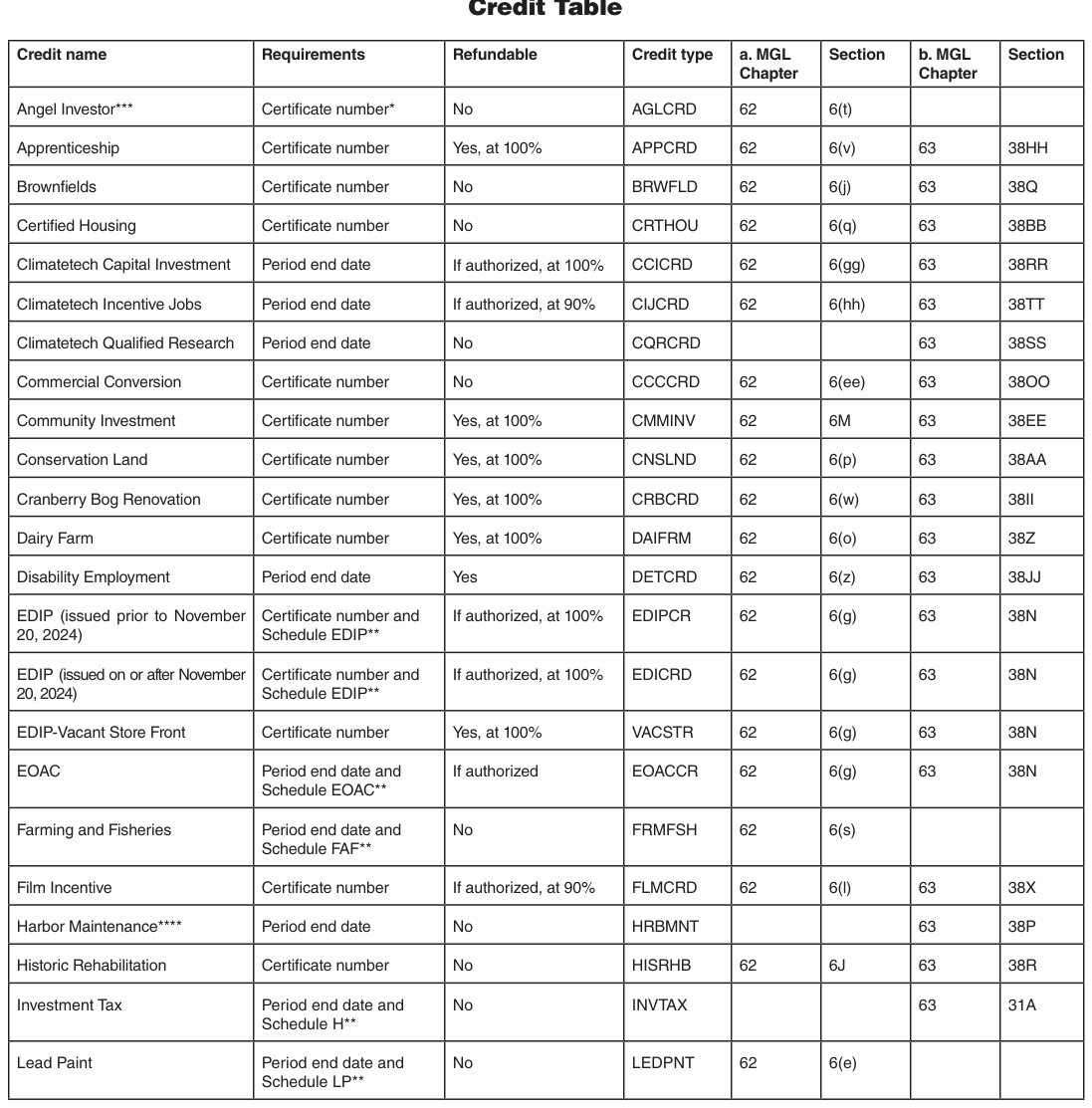
Text version of this table
| Credit name | Requirements | Refundable | Credit type | a. MGL Chapter | Section | b. MGL Chapter | Section |
|---|---|---|---|---|---|---|---|
| Angel Investor*** | Certifci ate number* | No | AGLCRD | 62 | 6(t) | ||
| Apprenticeship | Certifci ate number | Yes, at 100% | APPCRD | 62 | 6(v) | 63 | 38HH |
| Brownfei lds | Certifci ate number | No | BRWFLD | 62 | 6(j) | 63 | 38Q |
| Certifei d Housing | Certifci ate number | No | CRTHOU | 62 | 6(q) | 63 | 38BB |
| Climatetech Capital Investment | Period end date | If authorized, at 100% | CCICRD | 62 | 6(gg) | 63 | 38RR |
| Climatetech Incentive Jobs | Period end date | If authorized, at 90% | CIJCRD | 62 | 6(hh) | 63 | 38TT |
| Climatetech Qualifei d Research | Period end date | No | CQRCRD | 63 | 38SS | ||
| Commercial Conversion | Certifci ate number | No | CCCCRD | 62 | 6(ee) | 63 | 38OO |
| Community Investment | Certifci ate number | Yes, at 100% | CMMINV | 62 | 6M | 63 | 38EE |
| Conservation Land | Certifci ate number | Yes, at 100% | CNSLND | 62 | 6(p) | 63 | 38AA |
| Cranberry Bog Renovation | Certifci ate number | Yes, at 100% | CRBCRD | 62 | 6(w) | 63 | 38II |
| Dairy Farm | Certifci ate number | Yes, at 100% | DAIFRM | 62 | 6(o) | 63 | 38Z |
| Disability Employment | Period end date | Yes | DETCRD | 62 | 6(z) | 63 | 38JJ |
| EDIP (issued prior to November 20, 2024) | Certifci ate number and Schedule EDIP** | If authorized, at 100% | EDIPCR | 62 | 6(g) | 63 | 38N |
| EDIP (issued on or after November 20, 2024) | Certifci ate number and Schedule EDIP** | If authorized, at 100% | EDICRD | 62 | 6(g) | 63 | 38N |
| EDIP-Vacant Store Front | Certifci ate number | Yes, at 100% | VACSTR | 62 | 6(g) | 63 | 38N |
| EOAC | Period end date and Schedule EOAC** | If authorized | EOACCR | 62 | 6(g) | 63 | 38N |
| Farming and Fisheries | Period end date and Schedule FAF** | No | FRMFSH | 62 | 6(s) | ||
| Film Incentive | Certifci ate number | If authorized, at 90% | FLMCRD | 62 | 6(l) | 63 | 38X |
| Harbor Maintenance**** | Period end date | No | HRBMNT | 63 | 38P | ||
| Historic Rehabilitation | Certifci ate number | No | HISRHB | 62 | 6J | 63 | 38R |
| Investment Tax | Period end date and Schedule H** | No | INVTAX | 63 | 31A | ||
| Lead Paint | Period end date and Schedule LP** | No | LEDPNT | 62 | 6(e) |
# Schedule EOAC**
# Schedule FAF**
Harbor Maintenance Period end date
# Schedule H**
# Schedule LP**
No
No
No
No
# LEDPNT 62 6(e)
- As of 2023, the method for reporting the Angel Investor credit on Schedule CMS is by certificate number. Prior to 2023, the method of reporting was by period end date.
A schedule is required when the credit is generated or awarded in the current year.
* Eligibility for obtaining the Angel Investor Tax Credit has been repealed for tax years beginning on or after January 1, 2024. Taxpayers must continue to report available carryover credits on Schedule CMS to the extent they are allowed to use them.
Eligibility for obtaining the Harbor Maintenance Tax Credit has been repealed for tax years beginning on or after January 1, 2022. Taxpayers must continue to report available carryover credits on Schedule CMS to the extent they are allowed to use them.
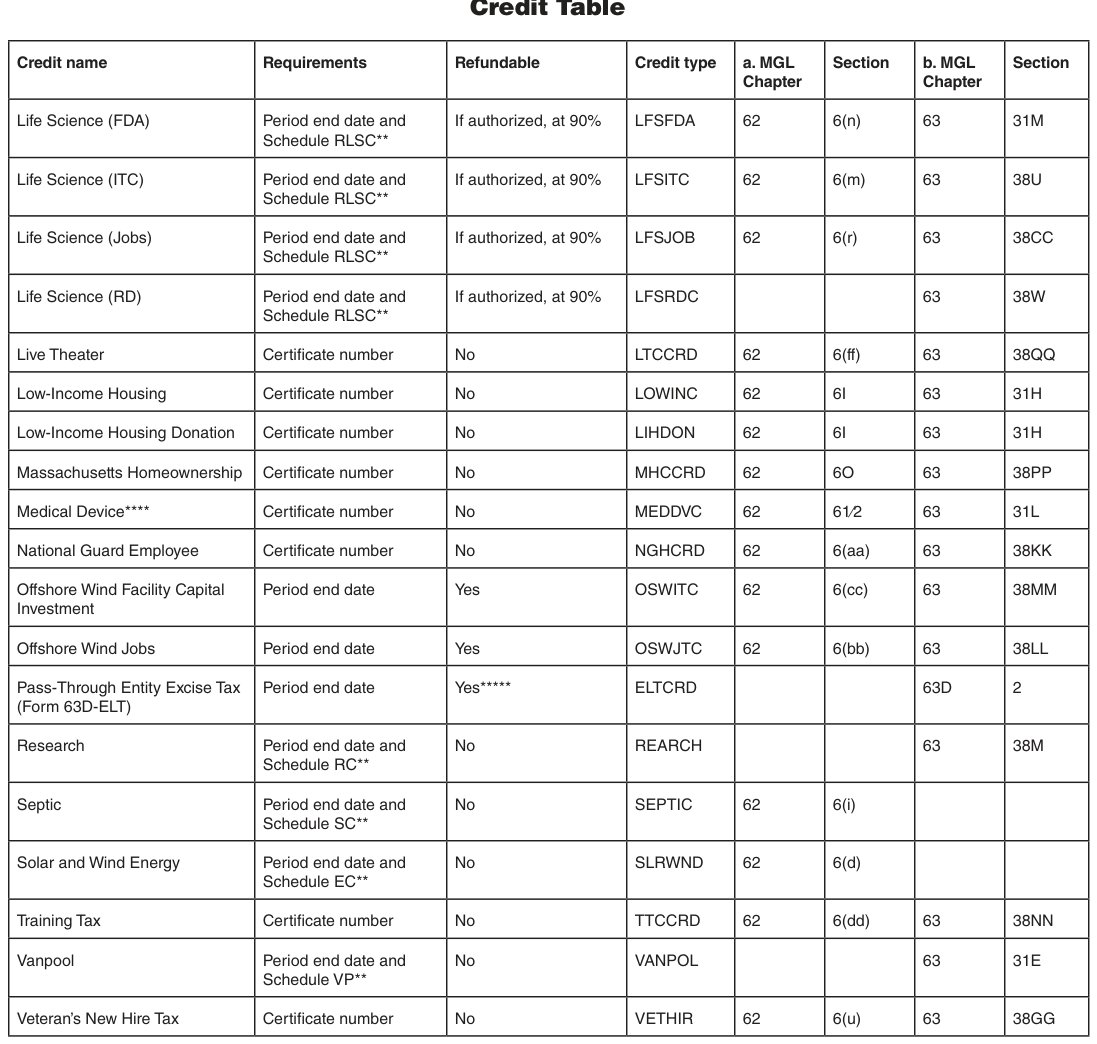
Text version of this table
| Credit name | Requirements | Refundable | Credit type | a. MGL Chapter | Section | b. MGL Chapter | Section |
|---|---|---|---|---|---|---|---|
| Life Science (FDA) | Period end date and Schedule RLSC** | If authorized, at 90% | LFSFDA | 62 | 6(n) | 63 | 31M |
| Life Science (ITC) | Period end date and Schedule RLSC** | If authorized, at 90% | LFSITC | 62 | 6(m) | 63 | 38U |
| Life Science (Jobs) | Period end date and Schedule RLSC** | If authorized, at 90% | LFSJOB | 62 | 6(r) | 63 | 38CC |
| Life Science (RD) | Period end date and Schedule RLSC** | If authorized, at 90% | LFSRDC | 63 | 38W | ||
| Live Theater | Certificate number | No | LTCCRD | 62 | 6(ff) | 63 | 38QQ |
| Low-Income Housing | Certificate number | No | LOWINC | 62 | 6I | 63 | 31H |
| Low-Income Housing Donation | Certificate number | No | LIHDON | 62 | 6I | 63 | 31H |
| Massachusetts Homeownership | Certificate number | No | MHCCRD | 62 | 6O | 63 | 38PP |
| Medical Device**** | Certificate number | No | MEDDVC | 62 | 61⁄2 | 63 | 31L |
| National Guard Employee | Certificate number | No | NGHCRD | 62 | 6(aa) | 63 | 38KK |
| Offshore Wind Facility Capital Investment | Period end date | Yes | OSWITC | 62 | 6(cc) | 63 | 38MM |
| Offshore Wind Jobs | Period end date | Yes | OSWJTC | 62 | 6(bb) | 63 | 38LL |
| Pass-Through Entity Excise Tax (Form 63D-ELT) | Period end date | Yes***** | ELTCRD | 63D | 2 | ||
| Research | Period end date and Schedule RC** | No | REARCH | 63 | 38M | ||
| Septic | Period end date and Schedule SC** | No | SEPTIC | 62 | 6(i) | ||
| Solar and Wind Energy | Period end date and Schedule EC** | No | SLRWND | 62 | 6(d) | ||
| Training Tax | Certificate number | No | TTCCRD | 62 | 6(dd) | 63 | 38NN |
| Vanpool | Period end date and Schedule VP** | No | VANPOL | 63 | 31E | ||
| Veteran’s New Hire Tax | Certificate number | No | VETHIR | 62 | 6(u) | 63 | 38GG |
# Schedule RC**
# Schedule SC**
Schedule EC
Schedule VP
Veteran's New Hire Tax Certificate number No No No No No No Yes Yes Yes* No No No No No No
# VETHIR 62 6(u) 63 38GG
A schedule is required when the credit is generated or awarded in the current year.
Eligibility for obtaining the Medical Device Tax Credit has been repealed for tax years beginning on or after January 1, 2022. Taxpayers must continue to report available carryover credits on Schedule CMS to the extent they are allowed to use them.
* Shareholders, partners, or beneficiaries of an eligible pass-through entity (qualified members) may claim a refundable credit equal to 90% of their allocable share of PTE Excise paid by such pass-through entity. See MGL ch 63D §§ 1-7; TIR 22-6 Pass-through Entity Excise. See also Elective passthrough entity excise FAQs.
Note: Certified life sciences companies with a Research Credit exceeding the amount of credit that may be claimed under section 38M for a taxable year may, to the extent authorized under the Life Sciences Tax Incentive Program, elect to make 90% of the balance of remaining credits refundable. See MGL ch 63, § 38M(j).
Source: official DOR forms index (mass.gov)
Nearby sections (13 sections)
- form-1 · Form 1 — Resident Income Tax Return
- form-1-nr-py · Form 1-NR/PY — Nonresident/Part-Year Resident Return
- form-2 · Form 2 — Fiduciary Income Tax Return
- form-3 · Form 3 — Partnership Return of Income
- form-355 · Form 355 — Business/Manufacturing Corporation Excise Return
- form-355s · Form 355S — S Corporation Excise Return
- form-355u · Form 355U — Combined Reporting (Unitary)
- form-63d-elt · Form 63D-ELT — Pass-Through Entity Excise Tax (PTET)
- form-m-941 · Form M-941 — Employer's Quarterly Withholding Return
- form-ma-nrcr · Form MA NRCR — Nonresident Composite Return
- schedule-62-wh · Schedule 62-WH — Withholding for Composite Returns
- schedule-cms · Schedule CMS — Combined Manufacturer Submission
- schedule-tds · Schedule TDS — Taxpayer Disclosure Statement