Massachusetts DOR Form Instructions
Form 3 — Partnership Return of Income
E M
N
E
S
T
E
E
PE I
V
T O
I
T
ATE
P T
L R
A E
C B
I
I D L
A B
M V
S
Commonwealth of Massachusetts Department of Revenue Instructions for Massachusetts Partnership Return Form 3 Includes Schedule 3K-1 instructions This form has an electronic filing requirement.
See instructions.
# What kind of help is available
Major Changes for 2025
# Filing Due Dates
General Instructions
Line Instructions
# Massachusetts Information
2 Income Apportionment Schedule 9 3 Schedule 3K-1. Partner's Massachusetts Information 9 3 Overview of Schedule CMS 14 4 Declaration 15 7 Credit Table 16
# What kind of help is available
The instructions in the Department of Revenue's tax forms should provide answers to most taxpayer questions. If you have questions about completing your Massachusetts tax form, you can call us at (617) 887-6367 or toll-free in Massachusetts at 1-800-392-6089 Monday through Friday.
DOR's website at mass.gov/dor is also a valuable resource for tax information 24 hours a day. Thousands of taxpayers use DOR's website to e-mail and receive prompt answers to their general tax inquiries. Interactive applications that allow taxpayers to check the status of their refunds and review their quarterly estimated tax payment histories are available through our website or by calling our main information lines listed above.
# Where to get forms and publications
Many Massachusetts tax forms and publications are available via the DOR website. The address for the Department's website is mass.gov/dor.
For general tax information. Please call (617) 887-6367 or toll-free in Massachusetts 1-800-392-6089. These main information lines can provide assistance with the following:
◗ corporate excise ◗ fiduciary taxes ◗ personal income taxes ◗ estate taxes ◗ nonresident information ◗ refunds ◗ estimated taxes ◗ partnerships ◗ withholding ◗ certificate of good standing
# For help in one of the following specific areas. Please call the number listed below.
◗ Installment sales (617) 887-6950 ◗ Vision-impaired taxpayers can contact any DOR office to receive assistance.
◗ Upon request, this publication is available in an alternative format. Please send your request to: Office of Diversity and Equal Opportunity, PO Box 9557, Boston, MA 02114-9557.
To report allegations of suspected misconduct or impropriety involving Department of Revenue employees, please call the Office of Ethics and Employee Responsibility Hot Line at 1-800-565-0085 or write to PO Box 9567, Boston, MA 02114.
Major 2025 Tax
Changes
For more up-to-date and detailed information and to view all of the public written statements referenced in these instructions, visit mass.gov/dor.
# Filing Due Dates
Massachusetts General Laws (MGL) ch 62C, § 7 requires partnerships to file their tax returns on or before the 15th day of the third month following the close of each taxable year (March 15th in the case of partnerships filing on a calendar year basis). For more information, see TIR 17-5: 2017 Supplemental Budget: Conforming Massachusetts Partnership and C Corporation Tax Return Filing Due Dates to Federal Due Dates.
For calendar year filers Form 3 is due on or before March 16, 2026.
# $1 Million
Starting with tax year 2023, personal income taxpayers must pay an additional 4% on taxable income over $1,000,000, increased annually for inflation. For the 2025 tax year, the threshold is $1,083,150.
Massachusetts Credits
Several new credits are available. In addition, certain existing credits have been revised. These are discussed in detail in TIR 24-16 and TIR 25-5.
New Climatetech Tax Incentive Program
The Climatetech Tax incentive program adds three new credits for eligible expenses incurred by climatetech companies in developing and deploying technologies aimed at mitigating or adapting to climate change. The credit takes effect for tax years beginning on or after January 1, 2024. A climatetech company must be certified as such by the Massachusetts clean energy technology center ("MassCEC").
The credits include the following.
- The Climatetech Incentive Jobs Credit is awarded in an amount determined by MassCEC (in consultation with the Department of Revenue) to climatetech companies that create at least five new jobs in the climatetech sector. The credit is available to both corporate excise and personal income tax filers.
- The Climatetech Capital Investment Credit is awarded in an amount, determined by MassCEC, up to fifty percent of a climatetech company's investment in a climatetech facility. The credit is available to both corporate excise and personal income tax filers.
- The Climatetech Qualified Research Expenses Credit is awarded at the discretion of MassCEC in an amount equal to the sum of (i)10% of the excess of qualified research expenses for the taxable year, over a base amount, and (ii)15% of the basic research payments as determined for federal tax purposes. The credit is available to corporate excise filers only.
See TIR 25-5, Section I, for a more detailed discussion of the credits, including eligibility, refundability, carryover of unused credits, and limitations on the credits.
New Live Theater Credit
The Live Theater Credit is available for costs incurred in presenting certain live theater productions in Massachusetts. The credit is equal to the sum of (i) 35% of a theater company's total instate payroll costs, (ii) 25% of its total in-state production and performance expenditures, and
(iii) 25% of its total in-state transportation expenses. The Massachusetts Office of Business Development awards the credit based on applications submitted by theater companies. The credit is available to both corporate excise and personal income tax filers. The credit is transferable but is not refundable. Unused credit may be carried forward for five years. The credit is available for tax years beginning on or after January 1, 2025, and will expire on January 1, 2030. For additional information see TIR 25-5, Section II.
New Homeownership Credit
The Homeownership Credit is available to real estate developers that build certain new housing units. The credit is awarded in an amount determined by the Massachusetts Housing Finance Agency based on applications submitted by developers. The credit is available to both corporate excise and personal income tax filers. The credit is transferable but not refundable. The credit is available for tax years beginning on or after January 1, 2025. For additional information, including eligibility rules, see TIR 24-16, Section II.
New Qualified Conversion Credit
The Qualified Conversion Credit is available to real estate developers that convert existing commercial property to residential or mixed use. The credit is awarded in an amount determined by the Executive Office of Housing and Livable Communities based on applications submitted by developers.
The credit cannot exceed 10% of a developer's costs. The credit is available to both corporate excise and personal income tax filers. The credit is transferable but not refundable. The credit is available for tax years beginning on or after January 1, 2025, and expires on or before December 31,
- For additional information see TIR 24-16, Section III.
Other Credits
Certain existing credits have been revised by recent legislation. These revisions expand the availability of the following credits for the tax years indicated:
- Community Investment Credit (effective for tax years beginning on or after January 1, 2025);
- Economic Development Incentive Program Credit, (effective for credits awarded on or after November 20, 2024);
- Historic Rehabilitation Credit, (effective for tax years beginning on or after January 1, 2024);
- Life Sciences Tax Incentive Program (effective for tax years beginning on or after January 1, 2024);
- Research Credit (effective for research expenses incurred on or after November 20, 2024);
- Offshore Wind Investment Tax Credit (effective retroactively for tax years beginning on or after January 1, 2023); and
- Offshore Wind Jobs Tax Credit (effective retroactively for tax years beginning on or after January 1, 2023).
For additional information see TIR 24-16 Sections IV and V and TIR 25-5 Sections V through VIII and X through XIII.
# Single Sales Factor Apportionment
Effective for tax years beginning on or after January 1, 2025, partnership, corporate excise and financial in stitution excise filers that apportion their income to Massachusetts must do so by using the sales or receipts factor only. In addition, for such tax years, the computation of the receipts factor for financial institutions has been changed with respect to receipts from investment and trading assets and activities. See TIR 24-4, Section IV.
Note: All filers that apportion their income to Massachusetts must complete the tangible property and payroll sections of their respective apportionment calculations , even if they are basing apportionment solely on the sales factor.
Special Rule when Sales Factor is
Inapplicable
A special rule will apply to partnership filers for tax years when the sales factor is inapplicable. For such years, a partnership filer will be required to base its apportionment on the percentage of property and payroll in Massachusetts. The sales factor of such partnership filer is inapplicable if: (i) both its numerator and denominator are zero; (ii) the denominator is less than 10 per cent of one third of the taxable net income; or (iii) it is otherwise determined by the Commissioner to be insignificant in producing income.
# Federal Conformity
Massachusetts generally conforms to the IRC as currently in effect for Massachusetts corporate and financial institution excise purposes. For more up-to-date and detailed information on tax changes and federal conformity, visit DOR's website at http://www.mass.gov/dor.
# Partnerships
Pass-through entities, including partnerships, have withholding obligations with regard to their non-resident partners or members. A partnership is required to determine which of its partners are non-residents, and to ascertain how its non-resident partners will be complying with their Massachusetts filing obligation. A partnership must withhold Massachusetts tax on the distributive share of any partner that does not certify to the partnership that the partner will be meeting its tax obligation in some other manner. For more information on how to comply with the withholding obligation, see the Guide for Pass-Through Entities, and 830 CMR 62B.2.2 Pass through Entity Withholding.
# Privacy Act Notice
The Privacy Act Notice is available upon request or at mass.gov/dor.
General Instructions
# Form 3 Electronic Filing
Massachusetts has an electronic filing requirement for all partnership returns. See TIR 21-9 for further information.
Under TIR 21-9, where a return is required to be filed electronically any schedules or supporting documents filed with the return must be submitted electronically. In addition, any amendment of that return, or request for abatement with respect to that return, must also be filed electronically. See TIR 21-9 for further information.
# Return?
A Massachusetts partnership return, Form 3, must be filed if the partnership:
- Has a usual place of business in Massachusetts;
- Receives federal gross income of more than $100 during the taxable year that is subject to Massachusetts taxation jurisdiction under the U.S.
Constitution.
PTE Excise Election Out-of-state Partnership
- An out-of-state partnership Eligible PTE which elects to pay the PTE Excise must file a Massachusetts partnership return even if it is not otherwise required to do so. The out-of-state Eligible PTE must make the election on a timely filed Form 3 and must complete and submit the form including all schedules. In addition, the out-of-state Eligible PTE must file Form 63D-ELT. For more information see the instructions for Form 63D-ELT available at mass.gov.
# How Is a Partnership Taxed?
A partnership is not directly subject to income tax. Instead, each partner is taxed on the partner's share of the partnership income, whether distributed or not. Form 3 is a legally required informational return under MGL ch 62C, and subject to penalty for late filing.
# Schedule 3K-1
is designed to allow the partnership to report each partner's distributive share of partnership income. A separate Schedule 3K-1 is required for each partner.
# Partnership Income?
Each partner must report the partner's distributive share of each item of partnership income during the taxable year on the partner's Massachusetts tax return. The following table shows which return should be filed by each type of partner:
Type of partner Form to file Full-year resident individual … 1 Nonresident/part-year resident individual … 1-NR/PY Trust or estate … 2 Business corporation, generally … 355 Corporation that is part of a Mass. combined report … 355U
Domestic or foreign S corporation . . . 355S
Each nonresident partner must report the partner's distributive share of the Massachusetts source income of the partnership, which includes income from any of the following categories:
- Income derived from or connected with the partnership business carried on in Massachusetts;
- Income from the ownership of any interest in real or tangible personal property located in Massachusetts; or
- Interest, dividends, annuities and capital gains from property employed in the partnership business carried on in Massachusetts.
Note: A nonresident limited partner of a limited partnership engaged exclusively in buying, selling, dealing in or holding securities on its own behalf and not as a broker is not subject to tax on income from such partnership.
What is a Nonresident Composite Return?
Massachusetts allows a partnership to file an electronic composite return on Form MA NRCR, Massachusetts Nonresident Composite Return, and make estimated tax payments as an agent on behalf of two or more qualified electing nonresident partners. For more information see the instructions for Form MA NRCR, available at mass.gov.
What is Massachusetts Gross Income?
For personal income taxpayers, Massachusetts gross income is divided into three classes: Part B is taxed at 5.0%, Part A is taxed at 5.0%, 12%, and 8.5% and Part C is taxed at 5.0%.
Part B income:
- Gross receipts from sales;
- Ordinary income or loss from other partnerships excluding all interest (other than interest from Massachusetts banks) and dividends;
- Ordinary income or loss from trusts and estates not subject to Massachusetts taxation;
- Royalty income or loss;
- Income from REMIC residual interest;
- Rental income or loss;
- Massachusetts bank interest; and
- Other income taxed at 5.0% (see Form 1 instructions).
Part A income:
- Interest other than from Massachusetts banks (taxed at 5.0%);
- Dividends (taxed at 5.0%);
- Short-term capital gains and losses (taxed at 8.5%);
- Gains and losses on the sale, exchange or involuntary conversion of property used in a trade or business and held for one year or less (taxed at 8.5%); and
- Long-term gains on collectibles and pre-1996 installment sales classified as capital gain income for Massachusetts purposes (taxed at 12%).
Part C income:
- Long-term capital gains and losses excluding long-term gains on collectibles; and
- Losses on the sale, exchange or involuntary conversion of property used in a trade or business and held for more than one year.
Note: Massachusetts gross income does not include interest on obligations of the U.S. or Massachusetts and its political subdivisions.
Are There Differences Between Massachusetts Tax Law and the Internal Revenue
Code Provisions Affecting Partnerships?
Yes. There are a number of differences between Massachusetts and U.S. personal income tax law.
For Massachusetts tax purposes, a partnership is allowed only those expense deductions that an individually owned business is allowed. Deductions that are itemized by an individual on Schedule A of U.S. Form 1040 are not generally allowed. The deduction for a net operating loss carryover or carryback is not allowed to the partnership nor to an individual under Massachusetts income tax law.
Explanations of these differences are provided in the appropriate lines and in the Forms 1 and 1-NR/ PY instructions.
Under MGL ch 62, § 2 (d)(1)(N), Massachusetts specifically disallows the bonus depreciation deduction allowed under IRC §168(k), as amended and in effect for the current taxable year. Therefore, a Massachusetts partnership that claims bonus depreciation under IRC § 168(k) for federal tax purposes must calculate a separate depreciation schedule for purposes of claiming depreciation on the Massachusetts partnership return. For more information, see TIRs 03-25 and 02-11.
Form 3 and Schedule 3K-1 isolate income and deduction items in order to produce the correct Massachusetts partnership total as well as each partner's correct Massachusetts distributive share. These amounts sometimes differ from those reported on U.S. Form 1065, Schedule K-1.
There are also differences between Massachusetts and U.S. corporate taxation.
For more information on difference related to the impact of the CARES Act in Massachusetts see TIR 20-9: Massachusetts Tax Implication of Selected Provisions of the Federal CARES Act.
For more information on differences related to the impact of the TCJA in Massachusetts see TIR 19-17: Application of IRC § 163(j) Interest Expense Limitation to Corporate Taxpayers; TIR 19-11: Legislation Impacting the Massachusetts Tax Treatment of Selected International Provisions of the Federal Tax Cuts and Jobs Act; and TIR 19-6:
Impact of the Federal Tax Cuts and Jobs Act on a Taxpayer's Overall Method of Accounting for Massachusetts Purposes.
When and Where Must a Partnership
Return Be Filed?
A partnership return is due on or before the 15th day of the third month after the close of the partnership's taxable year, calendar or fiscal. When a due date falls on a Saturday, Sunday or legal holiday, the filing and payment may be made on the next succeeding business day. If the partnership was dissolved or reorganized during the taxable year, Form 3 must be filed to reflect partnership activity as of the date of dissolution or reorganization. Form 3 must be signed by one of the general partners.
What if the Partnership is a Fiscal or Short
Year Filer
File the 2025 return for calendar year 2025 and fiscal years that began in 2025 and ended in 2026.
For a fiscal year return, fill in the tax year space at the top of page 1. Short year filers should file using the tax form for the calendar year within which the short year falls. If the short year spans more than one calendar year, the filer should file using the tax form for the calendar year in which the short year began. If the current form is not available at the time the short year filer must file, the filer should follow the rules explained in TIR 11-12.
What is a Proper Return?
A proper return is a return upon which all required amounts have been entered in all appropriate lines on all forms, and all required schedules, forms and other attachments have been submitted. Data sheets, account forms or other schedules must be available to explain amounts entered on the forms.
Referencing lines to enclo sures in lieu of entering amounts onto the return is not sufficient.
An exact copy of U.S. Form 1065, including all applicable schedules and any other documentation required to substantiate entries made on this return, must be submitted along with Form 3.
Automatic Extensions
All Form 3 filers are automatically granted a sixmonth extension of time to file their tax return.
See TIR 16-10.
What is the Penalty for Filing a Late
# Return?
A $5 per day penalty may be imposed for failure to file a partnership return on time. For information regarding extensions of time to file tax returns, see TIR 16-10.
# Pass-Through Entity Audit Procedures
The Massachusetts Unified Audit Procedures is an audit, assessment, and appeal procedure conducted at the entity level, rather than at the partner or member level. This procedure applies to partnerships, S corporations, and certain trusts. Unified audit procedures require that the partnership designate a Tax Matters Partner see Tax Matters Partner (Massachusetts Unified Audit Procedures) below to act as the partnership's representative to DOR. DOR will notify the Tax Matters Partner when a unified audit has commenced.
During the unified audit, the Tax Matters Partner has the authority, on behalf of the entity, to request a settlement, to agree to extend the statute of limitations, to request a conference, or to appeal a determination of passthrough entity items.
The Tax Matters Partner also has the responsibility, according to the terms of the partnership or other agreement governing the pass-through entity, to inform the members of the entity about the progress of the unified audit. For more information about unified audit procedures, see 830 CMR 62C.24A.1 and TIR 13-15.
Centralized Federal Partnership Audit
DOR has developed procedures for partnerships that have been subject to a federal partnership audit under the Centralized Federal Partnership Audit regime. For more information see TIR 22-1,
# Filing an Amended Return
Supporting Statement Required. If you are filing an amended return for any reason you must attach a statement to the amended return with an explanation of why you are filing the amended return, including the basis for submitting it.
If you need to change a line item on your return, complete a new return with the corrected information and fill in the Amended return oval. Your amended return must include all schedules filed with the original return even if there are no changes to the schedules. Mail your amended return to the same address used for the original return. Do not file Form ATB with your amended return. An amended return can be filed to either increase or decrease your tax. Generally, an amended return must be filed within three years of the date that your original return was filed. For further information regarding amended returns, visit mass. gov/dor/amend and see TIR 16-13, Changes to the Amended Return Process Expanded to Most Tax Types.
Federal Changes
If your amended return includes changes you have reported on an amended federal return filed with the IRS for the same tax year, fill in the Federal amendment oval.
Amended Return Due to IRS BBA
Partnership Audit
# The Amended return due to IRS BBA Partnership
Audit oval is only to be used if you are an upper-tier member of a partnership that was impacted by an IRS adjustment to a lower-tier partnership resulting from a federal centralized BBA audit.
If you are a partnership that was directly impacted by an IRS adjustment from a federal centralized BBA audit do not file an amended Form 3 return to report such IRS adjustments. Instead, a partnership directly impacted by such IRS adjustment must file a Centralized Federal Partnership Audit Report on MassTaxConnect. For further details see
TIR 22-1, Reporting Rules Related to Centralized Federal Partnership Audits.
Federal BBA Audit Assessment in Current
# Tax Year
If there has been a federal BBA Audit Assessment in the current tax year of this return then fill in the Federal BBA Audit Assessment in current tax year oval.
If your amended return does not report changes that result from the filing of a federal amended return or from a federal audit (for example, if the amended Massachusetts return is reporting a rental deduction not claimed on the original return) fill in only the Amended return oval.
# Enclosing Schedule DRE. Disclosure of Disregarded Entity
A partnership that is doing business in Massachusetts (including through the means of activities conducted by a disregarded entity that such partnership owns) and that is also the owner of a disregarded entity for any portion of the taxable year for which a return is being filed must identify each such disregarded entity by filing Schedule DRE with its return. A separate Schedule DRE is required for each such disregarded entity. See Schedule DRE instructions for additional information.
# Enclosing Schedule FCI. Foreign Corporation Income
Fill in the oval and enclose Schedule FCI (Foreign Corporation Income) if the partnership is required to complete and file Schedule FCI with Form 3.
All taxpayers with foreign corporation income (including GILTI income) must complete Schedule
FCI. See Schedule FCI and Instructions.
# Enclosing Schedule TDS. Inconsistent Filing Position Penalty
Fill in the oval and enclose Schedule TDS, Taxpayer Disclosure Statement, if you are disclosing any inconsistent filing positions. Schedule TDS is available on our website at mass.gov/dor. The inconsistent filing position penalty (see TIR 06-5, section IV) applies to taxpayers that take an inconsistent position in reporting income. These taxpayers must disclose the inconsistency when filing their Massachusetts return. If such inconsistency is not disclosed, the taxpayer will be subject to a penalty equal to the amount of tax attributable to the inconsistency. This penalty is in addition to any other penalties that may apply.
A taxpayer is deemed to have taken an inconsistent position when the taxpayer pays less tax in Massachusetts based upon an interpretation of Massachusetts law that differs from the position taken by the taxpayer in another state where the taxpayer files a return and the governing law in that other state is the same in all material respects as the Massachusetts law. The Commissioner may waive or abate the penalty if the inconsistency or failure to disclose was attributable to reasonable cause and not willful neglect.
Common-trust Fund
Fill in Common-trust fund if the partnership is a common trust fund.
Consent to Extend the Time to Act on an
# Amended Return treated as Abatement
Application
In certain instances, an amended return showing a reduction of tax may be treated by DOR as an abatement application. Under such circumstances, by filing an amended return, you are giving your consent for the Commissioner of Revenue to act upon the abatement application after six months from the date of filing. See TIR 16-11. You may withdraw such consent at any time by contacting the DOR in writing. If consent is withdrawn, any requested reduction in tax will be deemed denied either at the expiration of six months from the date of filing or the date consent is withdrawn, whichever is later.
# Filing an Application for Abatement
File an Application for Abatement, Form ABT, only to dispute one of the following:
- Penalties
- Audit assessments
- Responsible person determinations For the fastest response time, file your dispute online at mass.gov/masstaxconnect. If you are not required to file electronically or you cannot file online, use Form ABT.
Visit mass.gov/dor/amend for additional information about filing an amended return, or filing an application for abatement.
# Member of a Lower-Tier Entity
A tiered structure is a pass-through entity that has a pass-through entity as a member. (The term "pass-through entity" refers to an entity whose income, loss, deductions and credits flow through to members for Massachusetts tax purposes, and includes all entities treated as partnerships under Massachusetts tax law. The term "member" includes a partner in a partnership and a member of a limited liability company treated as a partnership in Massachusetts.) As between two entities, the pass-through entity that is a member is the uppertier entity, and the entity of which it is a member is the lower-tier entity. If the partnership is a member of another pass-through entity, it should fill in this oval.
Investment Partnership as Defined in the Pass-Through Entity Withholding
Regulation
An investment partnership, as defined in the Pass-Through Entity Withholding regulation, is a partnership that meets the following criteria:
- Substantially all of the partnership's assets consist of investment securities, deposits at banks or other financial institutions, or office equipment and office space reasonably necessary to carry on the activities of an investment partnership;
- Substantially all of the partnership's income is from interest, dividends, and capital gains; and
- The partnership is not engaged in a trade or business in Massachusetts.
A partnership that invests only in so-defined investment partnerships and has no other Massachusetts- source income may also fill in the Yes oval. Partnerships that meet these criteria are not required to withhold on their partners. See 830 CMR 62B.2.2(3)(b).
Election to opt out of Federal Centralized
# Partnership Audit Regime
Fill in this oval if the partnership elected out of the federal centralized partnership audit regime for this tax year.
An eligible partnership can elect to opt out of the federal centralized partnership audit regime for the tax year by reporting the election on Schedule B, line 30 of its timely filed U.S. Form 1065. See U.S.
Form 1065, Schedule B, line 30 and Instructions for U.S. Form 1065 for further details.
Number of Massachusetts and Worldwide
Employees
Enter the number of Massachusetts employees on line L and the number of worldwide employees on line M.
# Reporting on Form 63D-ELT (Entity Level Tax)
For purposes of reporting PTE Excise on Form 63D-ELT, a partnership will still include in its PTE Excise tax base the share of income attributable to an entity that is disregarded for tax purposes (if such disregarded entity is owned by an individual or trust). A partnership as Eligible PTE must disclose the identity of the legal or beneficial owner of any disregarded entity in its entity-level tax return (Form 3) so the applicable share of income is included in the PTE Excise. For Form 3 purposes, the Eligible PTE filer must indicate on its Form 3 the legal or beneficial owner of each disregarded entity so that it can include it in calculating the PTE Excise on Form 63D-ELT.
# Annual Voluntary Election to pay PTE Excise
Fill in the oval if you are making the annual voluntary election to pay tax at the entity level pursuant to MGL ch 63D. MA Form 63D-ELT must be filed by the Eligible PTE if it has made the annual voluntary election to pay PTE Excise on its Form 3 return. Once the election is made for a tax year it is irrevocable for that year and is binding on all qualified members. See Form 63D-ELT instructions for further information relating to the PTE Excise.
Note: Members of an electing Eligible PTE must report their share of distributive income from the PTE on their own returns. The distributive income may not be reduced by the amount of income reported by the electing PTE or by the amount of PTE Excise paid by the electing PTE.
At-Risk Limitations and Grouping Activities
Fill in the applicable oval(s) if the partnership's activities were aggregated for at-risk purposes or grouped for passive activity purposes. See Instructions for U.S. Form 1065 (At-Risk Limitations and Grouping Activities) for more information.
# Digital Assets
Fill in the ovals in line P if at any time during 2025 you received (as a reward, award, or payment for property or services) a digital asset, or sold, exchanged, gifted, or otherwise disposed of a digital asset (or a financial interest in a digital asset).
Digital assets include non-fungible tokens (NFTs) and virtual currencies, such as cryptocurrencies and stablecoins.
# Electing Large Partnerships
If a partnership is filing U.S. Form 1065-B, U.S.
Return of Income for Electing Large Partnerships, enter amounts from the lines on Form 1065-B corresponding to the line references from U.S. Form
- If there is no equivalent U.S. Form 1065-B line reference, enter the requested amount as if it had been reported on U.S. Form 1065.
# C-Corporate Partnerships
If a partnership is made up entirely of C-corporate partners, the partnership need not complete Form 3, lines 13 through 40. The partnership, however, must complete Form 3, lines 1 through 12, lines 41 through 53 to the extent applicable, and Schedule 3K-1, lines 21 through 35 (see instructions for Income Apportionment).
Tax Matters Partner (Massachusetts
# Unified Audit Procedures)
Unless a partnership designates a different Tax Matters Partner for Massachusetts tax purposes, the Tax Matters Partner for a Massachusetts unified audit will be the same as the federal Tax Matters Partner. If the partnership has not designated a federal or Massachusetts Tax Matters Partner, the Tax Matters Partner will be the general partner, managing member, or similar partner with primary management responsibility; or, if no member has primary management responsibility, the direct member having the largest profits interest in the partnership determined based on the year-end profits interests reported on the partnership return for the taxable year for which the determination is being made. If designation based on the largest profits interest is impracticable, the Commissioner will select an interim Tax Matters Partner, pending selection of a Tax Matters Partner by the entity, and shall notify Notice Members of the selection.
# Line instructions
Certain lines are addressed in detail. Those lines without specific instructions are considered to be self-explanatory.
DOR and the Internal Revenue Service (IRS) maintain an extensive exchange program and routinely share data and audit results. Discrepancies between income and deductions reported federally and on this return, except those allowed under state law, will be identified and may result in a state audit or further investigation.
# Massachusetts Information
Line 9. Withholding Amount
Enter the amount withheld by this partnership on behalf of its partners.
Line 10. Payments Made With Composite
Return
Enter the payments made by this partnership as part of a composite return on behalf of non-resident partners who are members of this partnership or members of upper-tier entities that participate in the composite return of this partnership.
Line 11. Credit for Amounts Withheld by
Lower-Tier Entity
Enter the amount withheld on behalf of this partnership, and reported to this partnership, by lower-tier pass-through entities.
Line 12. Payments Made With a
Composite Filing by Lower-Tier Entity
Enter the amount of composite payments reported to this partnership by lower-tier entities.
# Loss
# Line 13. Ordinary Income or Loss
Enter the total amount of ordinary income or loss from U.S. Form 1065, line 23.
# Line 14. Other Income or Loss
If reporting other income or loss from U.S. Form 1065, Schedule K, line 11, enclose a statement and explain. If any income or loss from U.S. Form 1065, Schedule K, line 11 is granted capital gains treatment by the federal government, omit it here and include it in lines 33 through 39, as applicable.
Line 15. State, Local and Foreign Income and Unincorporated Business Taxes or
Excises
Enter total state, local and foreign income and unincorporated business taxes or excises. These taxes are deductible for U.S. tax purposes, but are not deductible in Massachusetts.
# Line 17. Section 1231 Gains or Losses
Enter any gains or losses from the sale, exchange or involuntary conversion of IRC § 1231 property included in line 16 above. These amounts should be included in lines 35, 36 and 38 as applicable.
Line 19. Adjustments to Line 18
Report and describe any other adjustments to Massachusetts partnership income and deductions not reported elsewhere on Form 3. Use Line 19 to make any adjustments to the line 18 subtotal.
Enter the applicable line number from U.S. Form 1065 and the amount of the adjustment.
For Massachusetts tax purposes, a partnership is allowed only those expense deductions that an individually owned business is allowed. Deductions that are itemized by an individual on Schedule A of
U.S. Form 1040, are not allowed. The deduction for a net operating loss carryover or carryback is not allowed to the partnership nor to an individual under Massachusetts income tax law.
Also report the deductions for 10% of the costs of renovating a qualifying abandoned building located in an Economic Opportunity Area. Enclose a statement detailing the location and cost of renovating the qualifying abandoned building. The building must be designated as abandoned by the Economic Assistance Coordinating Council. For further information, contact the Massachusetts
# Office of Business Development, 1 Ashburton
Place, Room 2101, Boston, MA 02108.
The partnership should also provide each partner with the amount of the partner's share of the deductible costs of renovating a qualifying abandoned building. Each partner should use this amount to complete the partner's return. Personal income taxpayer use Forms 1 or 1-NR/PY, Schedule E, line 57; or Form 2.
Ordinary and Necessary Business Expense
Deductions Available for Licensed
# Massachusetts Marijuana Businesses
Internal Revenue Code (IRC) § 280E prohibits marijuana businesses from deducting expenses and claiming tax credits for federal tax purposes.
Effective for taxable years beginning on or after January 1, 2022, Massachusetts decoupled from the IRC § 280E deduction disallowance with respect to licensed marijuana businesses only. As a result, for Massachusetts tax purposes, a licensed Massachusetts marijuana business can deduct ordinary and necessary business expenses that would otherwise be disallowed under IRC § 280E.
These ordinary and necessary trade or business expenses should be reported on line 19 along with any other line 19 adjustments. Enter "99" as the line number in lieu of providing a U.S. Form 1065 line number reference to identify IRC § 280E as the source of the decoupled adjustment amount. Report the total amount of these allowed deductions on a single line.
Line 21. Net Income or Loss from Rental
Real Estate Activity(ies)
Enter the net income or loss from rental real estate activity from U.S. Form 1065, Schedule K, line 2.
# Line 22. Adjustments to U.S. Form 8825
Enter the applicable line number from U.S. Form 8825 and the amount of the adjustment, if any.
Line 24. Net Income or Loss from Other
# Rental Activity
Enter the net income or loss from other rental activity from U.S. Form 1065, Schedule K, line 3c.
Line 25. Adjustments to line 24 (Net income or loss from other rental activities
(from U.S. Form 1065, Schedule K, line
3c)
Enter the applicable line number from U.S. Form 1065 and the amount of the adjustment, if any.
# Income
Line 27. U.S. Interest, Dividend and
Royalty Income, Not Including Capital
Gains
Add U.S. Form 1065, Schedule K, lines 5, 6a and 7 and enter the total in line 27.
Line 28. Interest on U.S. Debt Obligations
Enter the total amount of interest on U.S. debt obligations reported in line 27. This income is taxable by the federal government but is tax-exempt in Massachusetts.
Line 29. 5.0% Interest from
Massachusetts Banks
Enter the total amount of interest from Massachusetts banks included in line 27. Report any interest from Massachusetts savings accounts, savings share accounts and NOW accounts. Also report any interest from term and time deposits. Enclose a statement listing bank sources and amounts.
Line 30. Interest and Dividend Income
Enter the total amount of interest (other than interest from Massachusetts banks) and dividend income included in line 27. Do not include interest on U.S. debt obligations, which is taxable by the federal government, but is tax-exempt in Massachusetts. Enclose a statement listing sources and amounts.
Line 31. Non-Massachusetts State and
Municipal Bond Interest
Enter the total amount of the partnership's non-Massachusetts state and municipal bond interest. This interest is taxable in Massachusetts, but not taxed by the federal government.
Line 32. Royalty Income
Enter the total amount of royalty income included in line 27.
# Losses
If the partnership had any other income or loss that is granted capital gains treatment by the federal government, include that amount in lines 33 through 39, as applicable.
Line 33. Total Short-Term Capital Gains
Enter the total amount of short-term capital gains included in U.S. Form 1065, Schedule D, line 7.
Line 34. Total Short-Term Capital Losses
Enter the total amount of short-term capital losses included in U.S. Form 1065, Schedule D, line 7.
Line 35. Gain On the Sale, Exchange or Involuntary Conversion of Property
Used in a Trade or Business and Held for
One Year or Less
Enter from U.S. Form 4797 the amount of gain from the sale, exchange or involuntary conversion of property used in a trade or business and held for one year or less.
Line 36. Loss On the Sale, Exchange or Involuntary Conversion of Property
Used in a Trade or Business and Held for
One Year or Less
Enter from U.S. Form 4797 the amount of loss from the sale, exchange or involuntary conversion of property used in a trade or business and held for one year or less.
Line 37. Net Long-Term Capital Gain or
# Loss
Enter the net long-term gain or loss from U.S. Form 1065, Schedule K, line 9a.
Line 38. Long-Term § 1231 Gains and
# Losses
Enter the amount of gain or loss under IRC § 1231 from U.S. Form 1065, Schedule K, line 10 from property held more than one year. Also, include any amounts included in U.S. Form 4797, Part II treated as capital gains or losses for Massachusetts purposes.
Line 39. Long-Term Gains on Collectibles and Pre-1996 Installment Sales Enter the amount of any long-term gain from collectibles held for more than one year and pre-1996 installment sales classified as capital gain income for Massachusetts purposes.
Collectibles are defined as any capital asset that is a collectible within the meaning of IRC § 408(m), as amended and in effect for the taxable year, including works of art, rugs, antiques, metals, gems, stamps, alcoholic beverages, certain coins, and any other items treated as collectibles for federal tax purposes.
Line 40. Differences and Adjustments
Report any adjustments to Massachusetts capital gains and losses. Enclose a complete statement explaining any such adjustments. For more information see Form 1, Schedule D instructions.
Income Apportionment Schedule
# New-Single Sales Factor Apportionment
Effective for tax years beginning on or after January 1, 2025, most partnership filers that apportion their income to Massachusetts must do so by using the sales factor only.
Complete the income apportionment schedule only if all of the following conditions are met:
- There is one or more corporate or nonresident individual partners;.
- There is any income from business activity or ownership of any interest in real or tangible property in another state; and
- Such business activities provide the other state the jurisdiction to levy an income or franchise tax.
The partnership should provide each corporate partner with the applicable apportionment factors to be used in completing Schedule F of the applicable corporate form.
Complete all lines, regardless of apportionment method used. Make certain that complete information is entered for all apportionment factors.
A return which is incomplete will be considered insufficient.
Special Rule when Sales Factor is
Inapplicable
A special rule will apply to partnership filers for tax years when the sales factor is inapplicable. For such years, a partnership filer will be required to base its apportionment on the percentage of property and payroll in Massachusetts. The sales factor of such partnership filer is inapplicable if: (i) both its numerator and denominator are zero; (ii) the denominator is less than 10 per cent of one third of the taxable net income; or (iii) it is otherwise determined by the Commissioner to be insignificant in producing income.
# Industry-Specific Apportionment
Regulations
All taxpayers must fill in the oval entitled Industry-Specific Regulations if they are subject to any of the following regulations:
- 830 CMR 63.38.2: Apportionment of Income of Airlines;
- 830 CMR 63.38.3: Apportionment of Income of Motor Carriers;
- 830 CMR 63.38.4: Apportionment of Income of Courier and Package Delivery Services;
- 830 CMR 63.38.8: Apportionment of Income of Pipeline Companies;
- 830 CMR 63.38.10: Apportionment of Income of Electric Industry; and
- 830 CMR 63.38.11: Apportionment of Income of Telecommunications Industry.
DOR has issued these industry-specific apportionment regulations to address industries where the application of the general apportionment provisions was not reasonably adapted to approximate the net income derived from business carried on within Massachusetts. See MGL ch 63, § 38(k). These rules remain unchanged for tax year 2025. As in prior years, taxpayers required to use these regulations must apportion their income for 2025 tax years using the three-factor formula with double-weighted sales, calculating the individual factors asset out in the regulation that pertains to them. Taxpayers in these industries that wish to use a different apportionment method should request alternative apportionment under MGL ch 63, § 42.
# Line 42. Tangible Property
Line 42a. For tax purposes, average value is based on original cost and is determined by averaging the property values at the beginning and end of the taxable year. If substantial changes occur during the taxable year, the Commissioner may require monthly averaging to properly reflect the average value of the property.
Line 42b. Property rented is valued at eight times the annual rental rate less any sub-rentals received.
# Line 43. Payroll
Enter the total amount of wages, salaries, or any other compensation paid to employees. An employee's compensation is apportioned to Massachusetts if any of the following apply:
- The employee's service is performed within Massachusetts;
- The employee's service is performed both in Massachusetts and in other state(s), but the non-Massachusetts service is secondary to the Massachusetts service;
- Part of the employee's service is performed in Massachusetts, and the service is controlled from a base of operations/place of control in Massachusetts; or
- Part of the employee's service is performed in Massachusetts and the base of operations/place of control of the service is not in a state in which some part of the service is performed, but the employee lives in Massachusetts.
# Line 44. Sales
For the sales factor, enter all gross receipts of the partnership with the exception of those receipts from interest, dividends and the sale or other disposition of securities or the sale of "good will" or similar intangible value.
Line 44a. Sales of tangible personal property are assigned to Massachusetts if:
- The property is delivered or shipped to any buyer, including the U.S. government, in Massachusetts; or
- The selling partnership is not taxable in the state of the buyer and the property is not sold by an agent or agencies chiefly situated at, connected with, or sent out from premises for the transaction of business owned or rented by the partnership outside Massachusetts. A buyer for this item includes the U.S. government.
Sales of tangible personal property are not assigned to Massachusetts if:
- The property is shipped or delivered to a buyer in a foreign country; or
- The property is sold to any branch or instrumentality of the U.S. government for resale to a foreign government.
Line 44b. Sales of services are assigned to Massachusetts, if and to the extent the service is delivered to a location in Massachusetts. See MGL ch 63, § 38(f) and 830 CMR 63.38.1(9)(d).
Line 44c. Rents from real or tangible property located or used in Massachusetts are assigned to Massachusetts. Royalties are assigned to Massachusetts if and to the extent the intangible property is used in Massachusetts. See MGL ch 63, § 38(f) and 830 CMR 63.38.1(9)(d).
Line 44f. Divide Massachusetts total sales by worldwide total sales (from line 44e) to calculate the sales apportionment percentage amount and enter it here.
# Line 45. Single Sales Factor-When Sales Factor
Inapplicable A special rule will apply to partnership filers for tax years when the sales factor is inapplicable. For such years, a partnership filer will be required to base its apportionment on the percentage of property and payroll in Massachusetts.
The sales factor of such partnership filer is inapplicable if: (i) both its numerator and denominator are zero; (ii) the denominator is less than 10 per cent of one third of the taxable net income; or (iii) it is otherwise determined by the Commissioner to be insignificant in producing income. See MGL ch 63, § 38(g) (as revised).
Complete line 45 only when sales factor is inapplicable (do not complete line 45 if the sales factor applies). Divide the sum of the remaining apportionment percentages (property and/or payroll) by 2 if both the property and payroll factors are applicable (or by 1 if only one such factor is applicable) and enter the amount here.
Note: If you are required to complete line 45 you must also fill in the "Sales factor is inapplicable" oval at the beginning of the Apportionment Factors section of the Income Apportionment Schedule.
Line 46. Massachusetts Apportionment
Percentage
Enter the sales apportionment percentage amount from line 44f. Note: If the sales factor is inapplicable enter the amount from line 45
# Line 47b. Other Credits (from Schedule
CMS)
Enter the combined total from Section 1 and 3 of the Credit Manager Schedule (Schedule CMS).
Be sure to enclose Schedule CMS with your return.
Failure to do so will delay the processing of your return.
The partnership must use Schedule CMS to calculate the partnership's credits, with the exception of the other jurisdiction credit. The partnership must report all credits, whether the credit is a non-refundable credit or a refundable credit, in Section 1 or 3 of Schedule CMS. Section 2 and 4 of Schedule CMS should be left blank.
Schedule 3K-1. Partner's
# Massachusetts Information
Schedule 3K-1 is designed to allow the partnership to report each partner's distributive share of partnership income. A separate Schedule 3K-1 is required for each partner.
# Credit Section
A separate Credit Section has been created on Schedule 3K-1 (and on all other Massachusetts K-1 schedules). The Credit Section must be used by the taxpayer to report specific amounts for the listed credits. The total amount reported in the Credit Section should be entered on Line 5b. Total
Other Credits.
A. Type of Partner (fill in one only)
The entity type should be indicated on a separate Schedule 3K-1 for each partner. The Partnership or other PTE oval should be filled in if the partner is a partnership or another type of pass-through entity, such as a limited liability corporation treated as a partnership for Massachusetts tax purposes. The IRA oval should be filled in if the partner is a trustee of retirement funds such as Individual Retirement Accounts or other retirement funds.
# When Partner is a Disregarded Entity
When a partner is a disregarded entity (DE), enter the name, address and taxpayer identification number of the beneficial owner of the DE partner in the block reserved for the part ner's information on Schedule 3K-1. Complete the rest of Schedule 3K-1 using the beneficial own er's status for "type of partner" and all subsequent lines. Also complete section A2. using the DE partner's information.
# When Partner is a Grantor Trust
When a partner is a grantor trust, enter the name, address and taxpayer identification number of the grantor of the grantor trust in the block reserved for the partner's information on Schedule 3K-1.
Complete the rest of the partner's Schedule 3K-1 using the grantor's status for "type of partner" and all subsequent lines.
# Exempt Organizations (Ch 62 or Ch 63)
The Ch 62 exempt organization oval should be filled in if the partner is exempt from federal income tax under IRC § 501 and is treated as a ch 62 taxpayer in Massachusetts. The Ch 63 exempt organization oval should be filled in if the partner is exempt from federal income tax under IRC § 501 and is treated as a ch 63 taxpayer in Massachusetts.
A1. Massachusetts Nonresident Partner
Each nonresident partner must report its distributive share of Massachusetts source income of the partnership. Fill in the oval if the partner is a nonresident of Massachusetts.
# A2. Partner is a Disregarded Entity
If a partner is a disregarded entity (DE), enter the DE partner's name, taxpayer identification number (TIN) and DE partner entity type. Fill in the appropriate DE partner status oval (Domestic (U.S.) or Foreign (Non-U.S.)) of DE partner. Leave section A2. blank if the partner receiving the Schedule 3K-1 is not a DE partner.
B2. Status of Partner (Domestic or Foreign)
Fill in to indicate whether the partner is a domestic (U.S.) or foreign (non-U.S.) partner as reported on U.S. Form 1065, Schedule K-1, Item H1.
# E. Installment Sales Transactions
An addition to tax applies for taxpayers who have deferred the gain, and the tax associated with that gain, on certain installment sales. This addition to tax is measured by an interest charge on the tax that has been deferred. The addition to tax is determined by each partner based on the partner's own situation. The partnership should fill in the Yes oval if the partnership participated in one or more installment sales transactions that might subject the partner to this addition to tax.
Partnerships that have indicated on Schedule 3K-1 that they are reporting transactions under MGL ch 62C, § 32A, identified as IRC § 453A or 453(l)(2)
(B) transactions, must separately communicate information to the partner that will enable the partner to calculate the addition to tax.
For IRC § 453A transactions, the partnership must inform the partner of the partner's share of the aggregate face amount of installment sales transactions arising in and outstanding as of the close of the taxable year, and any other information the partner may need to calculate the addition to tax.
The $150,000 and $5,000,000 thresholds apply at the level of the individual partner. The partnership must therefore communicate to the partner all IRC § 453A installment sale transactions exceeding $150,000. The applicable percentage is the ratio of the aggregate face amount of installment sale obligations arising in and outstanding as of the close of the taxable year in excess of $5,000,000 to the aggregate face amount of such obligations arising in and outstanding at the close of the taxable year.
The applicable percentage will be determined by each partner.
For IRC § 453(l)(2)(B) transactions, the partnership must inform the partner of the partner's share of gain on installment transactions, the date of the transactions, and any other information the partner may need to calculate the addition to tax.
# Line 1. Massachusetts Ordinary Income or Loss
Enter the amount of the partner's share of the partnership's Massachusetts ordinary income or loss from Form 3, page 2, line 20. For a nonresident partner eligible to apportion, enter the amount of the partner's share of the partnership's Massachusetts ordinary income or loss multiplied by the apportionment percentage in Form 3, Income Apportionment Schedule, line 46.
Line 2. Guaranteed Payments to Partners
Enter the guaranteed payments to each partner from U.S. Form 1065, Schedule K, line 4. Guaranteed payments made to non-resident partners are apportioned as ordinary income of the partnership.
Line 3. Separately Stated Deductions and
Exclusions
Report and describe in line 3 any other expenses that are required to be separately stated, which are not required to be reported elsewhere on Schedule K-1. Examples of such items include the partner's share of the partnership's charitable contributions, oil and gas depletion and the expense deduction for recovery property, IRC § 179. An estate or trust may not elect to expense recovery property.
Each partner should take these items into account on their Form 1 or Form 1-NR/PY. In particular, charitable contributions are not deductible from the partnership's distributive income. Rather, partners' shares of charitable contributions flow through the partnership to the partners, who may use that amount in determining their charitable deductions claimed on Form 1, Schedule Y, line 9c, or Form 1-NR/PY, Schedule Y, line 9c. Report and describe in line 3 the part ner's elective contribution to a qualified CODA retirement plan.
Line 4. Total of Lines 1 through 3
Combine the amounts in lines 1 through 3. The line 4 result includes each partner's share of the partnership's Massachusetts ordinary income and any guaranteed payments to the partner (deductible and capitalized).
The correct Massachusetts amount of the partner's share of ordinary income and guaranteed payments may differ from the comparable U.S. total reported on the partner's return. Personal income taxpayer use Forms 1 or 1-NR/PY, Schedule E-2, line 11; or Form 2. Each partner should make adjustments in Forms 1 or 1-NR/PY, Schedule E, lines 55 and 56, if applicable; or Form 2, to reflect the correct Massachusetts amount. Each partner should enclose a statement with the partner's Massachusetts tax return and explain.
The partnership should provide each partner with the amount of the partner's share of any interest (other than interest from Massachusetts banks) and dividend income and 5.0% interest from Massachusetts banks included in line 4. Each partner should use these amounts to complete the partner's return. Personal income taxpayer use Forms 1 or 1-NR/PY, Schedule E-2, lines 9 and 10; or Form 2.
# Line 5a. Income Tax Paid to Other
Jurisdictions
Enter the partner's share of any tax due from the partnership to any other state, territory or possession of the United States, or the Dominion of Canada or any of its provinces on income taxable to the partner in Massachusetts and otherwise allowable as a credit to the individual. The partnership should also provide each such partner with the names of each taxing jurisdiction, the amount of income and the amount taxed.
This credit is available only to resident partners and may be taken on Form 1, line 30, Form 1-NY/ PY, line 34 or where applicable, on Form 2, line
- For part-year residents the income that is subject to taxation in another state or jurisdiction must have been earned during the period of Massachusetts residency. The credit is not available for taxes paid on Massachusetts source income earned while a nonresident.
Note: The amount in line 5a is not simply the partner's share of the amount reported on Form 3, page 2, line 15, because the credit for taxes paid to other jurisdictions does not include local income taxes paid or taxes paid to nations other than Canada.
# Line 5b. Total Other Credits (from "Credit
Section")
The partnership must use Schedule CMS to calculate the partnership's credits, with the exception of the other jurisdiction credit which should be entered on line 5a. Based on those calculations, the partnership should use line 5b of Schedule 3K-1 to provide each partner with the amount of each partner's share of the partnership's credits according to the partner's ownership share. The partner will then include these credits on the partner's Schedule CMS.
# Credit Section
Each partner's share of credits according to such partner's ownership share must be separately listed on the Schedule 3K-1 Credit Section.
The partnership must also provide each partner with any required schedules, certificate numbers and/or other supporting documents related to each credit.
Report only those credits that are related to the partner's ownership share. Refer to the Credit Table at the end of these instructions to report each credit and its respective attributes in the Credit Section.
# Credit Table
The Credit Table located at the end of these instructions lists all of the Massachusetts credit types with their respective attributes. Credits that may be available to a taxpayer subject to tax under MGL ch 62 must be claimed on Schedule CMS.
The taxpayer should refer to this table for guidance when completing Schedule CMS.
Note: Some credits may only be claimed by individual partners and/or certain corporate partners.
See instructions to Schedule CMS, Form 1 and Form 355 for more information.
Line 6. Credit Recapture
If the partnership is required to recapture any
# Economic Opportunity Area Credit, Brownfields
Credit, Low-Income Housing Credit, Historic Rehabilitation Credit, or any other credit that requires recapture, enter the partner's share of any recapture as computed on Schedule CRS, Credit Recapture Schedule. This amount should then be used by each partner to complete their return.
Line 7. Net Income or Loss from Rental
# Real Estate Activity
Enter the partner's share of the partnership's net rental income or loss from real estate activity from Form 3, line 23.
The correct Massachusetts amount of the partner's share of net income or loss from rental real estate activity may differ from the comparable U.S. total reported on the partner's return. Personal income taxpayer use Forms 1 or 1-NR/PY, Schedule E-1, line 24; or Form 2. Each partner should make adjustments in Forms 1 or 1-NR/PY, Schedule E, line 55; or Form 2, to reflect the correct Massachusetts amount. Each partner should enclose a statement with the partner's Massachusetts tax return and explain.
Line 8. Net Income or Loss from Other
# Rental Activity
Enter the partner's share of the partnership's net rental income or loss from other activity from Form 3, line 26.
The correct Massachusetts amount of the partner's share of net rental income or loss from other activity may differ from the comparable U.S. total reported on the partner's return. Personal income taxpayer use Forms 1 or 1-NR/PY, Schedule E-1, line 24; or Form 2. Each partner should make adjustments in Forms 1 or 1-NR/PY, Schedule E, line 56; or Form 2, to reflect the correct Massachusetts amount. Each partner should enclose a statement with the partner's Massachusetts tax return and explain.
# Line 9. Interest on U.S. Debt Obligations
Enter the partner's share of the partnership's interest on U.S. debt obligations from Form 3, line
- For a nonresident partner eligible to apportion enter the partner's share without apportionment.
This income is taxable by the federal government, but tax-exempt in Massachusetts.
Each partner should include the line 9 total in the partner's return. Personal income taxpayer use-Forms 1 or 1-NR/PY, Schedule B, line 6; or Form 2, Schedule B.
Line 10. 5.0% Interest from
# Massachusetts Banks
Enter the partner's share of the partnership's 5.0% interest from Massachusetts banks from Form 3, line 29. For a nonresident partner eligible to apportion, enter the partner's share of the partnership's 5.0% interest from Massachusetts banks multiplied by the apportionment percentage in Form 3, Income Apportionment Schedule, line 46.
Each partner should include the line 9 total in Form 1, line 5; Form 1-NR/PY, line 7; or Form 2.
Each nonresident partner whose income is apportioned should receive from the partnership the amount of the partner's pre-apportionment share of 5.0% interest from Massachusetts banks. Each nonresident individual whose income is apportioned should include this amount in Form 1-NR/ PY, Schedule B, line 5. This amount should be used instead of any amount from Form 1-NR/PY, line 7 because the partner's full distributive share of such income is included in the U.S. amount reported in Schedule B, line 1. Each nonresident trust or estate whose income is apportioned should include its pre-apportionment share of 5.0% interest from Massachusetts banks in Form 2, Schedule B, line 6, instead of any amount from Form 2, line 16.
# Line 11. Interest and Dividend Income
Enter the partner's share of the partnership's interest (other than interest from Massachusetts banks) and dividend income from Form 3, line 30.
For a nonresident partner eligible to apportion, enter the partner's distributive share of the partnership's interest (other than interest from Massachusetts banks) and dividend income multiplied by the apportionment percentage in Form 3, Income Apportionment Schedule, line 46.
The correct Massachusetts amount of the partner's share of interest (other than interest from Massachusetts banks) and dividend income may differ from the comparable U.S. total reported on the partner's Forms 1, 1-NR/PY or 2, Schedule B, lines 1 and 2. Each partner should make adjustments in Form 1 and 1-NR/PY, Schedule B, line 6; or Form 2, Schedule B, line 7 to reflect the correct Massachusetts amount. Each partner should enclose a statement with the partner's Massachusetts tax return and explain.
Line 12. Non-Massachusetts State and
# Municipal Bond Interest
Enter the partner's share of the partnership's non-Massachusetts state and municipal bond interest. For a nonresident partner eligible to apportion, enter the partner's distributive share of the partnership's non-Massachusetts state and municipal bond interest multiplied by the apportionment percentage in Form 3, Income Apportionment Schedule, line 46. This income is not taxed by the federal government, but is taxable in Massachusetts.
Each partner should include the line 11 total in the partner's return. Personal income taxpayer use Forms 1, 1-NR/PY, or 2, Schedule B, line 3.
# Line 13. Royalty Income
Enter the partner's share of the partnership's royalty income.
For a nonresident partner eligible to apportion, enter the partner's distributive share of the partnership's royalty income multiplied by the apportionment percentage in Form 3, Income Apportionment Schedule, line 46.
The correct Massachusetts amount of the partner's share of royalty income may differ from the comparable U.S. total reported on the partner's return. Personal income taxpayer use Forms 1 or 1-NR/PY, Schedule E-1, line 24; or Form 2, Schedule E, line 1a. Each partner should make adjustments in Forms 1, 1-NR/PY, Schedule E, line 56; or Form 2, Schedule E, line 2, to reflect the correct Massachusetts amount. Each partner should enclose a statement with the partner's Massachusetts tax return and explain any adjustments.
# Line 14. Short-Term Capital Gains
Enter the partner's share of the partnership's short-term capital gain from Form 3, line 33. For a nonresident partner eligible to apportion, enter the partner's share of the partnership's short-term capital gain multiplied by the apportionment percentage in Form 3, Income Apportionment Schedule, line 46.
The correct Massachusetts amount of the partner's share of short-term capital gain may differ from the comparable U.S. total reported on the partner's return. Personal income taxpayer use Forms 1, 1-NR/PY, or 2, Schedule B. Each partner should make adjustments in Forms 1 or 1-NR/PY, Schedule B, line 10, or Form 2, Schedule B, line 12, to reflect the correct Massachusetts amount.
Each partner should enclose a statement with the partner's Massachusetts tax return and explain any adjustments.
# Line 15. Short-Term Capital Losses
Enter the partner's share of the partnership's short-term capital loss from Form 3, line 34. For a nonresident partner eligible to apportion, enter the partner's share of the partnership's short-term capital loss multiplied by the apportionment percentage in Form 3, Income Apportionment Schedule, line 46.
The correct Massachusetts amount of the partner's share of short-term capital loss may differ from the comparable U.S. total reported on the partner's return. Personal income taxpayer use Forms 1, 1-NR/PY or 2, Schedule B. Each partner should make adjustments in Forms 1 or 1-NR/PY,
# Schedule B, line 16, or Form 2, Schedule B, line
18, to reflect the correct Massachusetts amount.
Each partner should enclose a statement with the partner's Massachusetts tax return and explain any adjustments.
Line 16. Gain on the Sale, Exchange or
Involuntary Conversion of Property Used in a Trade or Business and Held for One
# Year or Less
Enter the partner's share of the partnership's gain on the sale, exchange or involuntary conversion of property used in a trade or business and held for one year or less from Form 3, line 35. For a nonresident partner eligible to apportion, enter the partner's share of the partnership's gain on the sale, exchange or involuntary conversion of property used in a trade or business and held for one year or less multiplied by the apportionment percentage in Form 3, Income Apportionment Schedule, line 46.
The correct Massachusetts amount of the partner's share of gain on the sale, exchange or involuntary conversion of property used in a trade or business and held for one year or less may differ from the comparable U.S. total reported on the partner's return. Personal income taxpayer use Forms 1, 1-NR/PY or 2, Schedule B. Each partner should make adjustments in Forms 1 or 1-NR/PY,
# Schedule B, line 12, or Form 2, Schedule B, line
14, to reflect the correct Massachusetts amount.
Each partner should enclose a statement with the partner's Massachusetts tax return and explain any adjustments.
Line 17. Loss on the Sale, Exchange or
Involuntary Conversion of Property Used in a Trade or Business and Held for One
# Year or Less
Enter the partner's share of the partnership's loss on the sale, exchange or involuntary conversion of property used in a trade or business and held for one year or less from Form 3, line 36. For a nonresident partner eligible to apportion, enter the partner's share of the partnership's loss on the sale, exchange or involuntary conversion of property used in a trade or business and held for one year or less multiplied by the apportionment percentage in Form 3, Income Apportionment Schedule, line 46.
The correct Massachusetts amount of the partner's share of loss on the sale, exchange or involuntary conversion of property used in a trade or business and held for one year or less may differ from the comparable U.S. total reported on the partner's return. Personal income taxpayer use Forms 1, 1-NR/PY or 2, Schedule B. Each partner should make adjustments in Forms 1 or 1-NR/PY, Schedule B, line 17, or Form 2, Schedule B, line 19, to reflect the correct Massachusetts amount.
Each partner should enclose a statement with the partner's Massachusetts tax return and explain any adjustments.
# Line 18. Long-Term Capital Gain or Loss
Enter the partner's share of the partnership's longterm capital gain or loss from Form 3, line
- For a nonresident partner eligible to apportion, enter the partner's share of the partnership's long-term capital gain or loss multiplied by the apportionment percentage in Form 3, Income Apportionment Schedule, line 46.
The correct Massachusetts amount of the partner's share of long-term capital gain or loss may differ from the comparable U.S. total reported on the partner's return. Personal income taxpayer use Forms 1, 1-NR/PY or 2, Schedule D. Each partner should make adjustments in Forms 1 or 1-NR/PY, Schedule D, line 10, or Form 2, Schedule D, line 9, to reflect the correct Massachusetts amount.
Each partner should enclose a statement with the partner's Massachusetts tax return and explain any adjustments.
Line 19. Long-Term IRC § 1231 Gains or
# Losses
Enter the partner's share of the partnership's longterm IRC § 1231 gain or loss (not included in line 17) from Form 3, line 38. For a nonresident partner eligible to apportion, enter the partner's share of the partnership's long-term IRC § 1231 gain or loss multiplied by the apportionment percentage in Form 3, Income Apportionment Schedule, line 46.
The correct Massachusetts amount of the partner's share of long-term IRC § 1231 gain or loss may differ from the comparable U.S. total reported on the partner's return. Personal income taxpayer use Forms 1, 1-NR/PY or 2, Schedule D. Each partner should make adjustments in Forms 1 or 1-NR/PY, Schedule D, line 10, or Form 2, Schedule D, line 9, to reflect the correct Massachusetts amount. Each partner should enclose a statement with the partner's Massachusetts tax return and explain any adjustments.
Line 20. Long-Term Gains on Collectibles and Pre-1996 Installment Sales Enter the partner's share of the partnership's long-term gains on collectibles and pre-1996 installment sales classified as capital gains for Massachusetts purposes from Form 3, line 39. For a nonresident partner eligible to apportion, enter the partner's share of the partnership's long-term gains on collectibles and pre-1996 installment sales multiplied by the apportionment percentage in Form 3, Income Apportionment Schedule, line 46.
The correct Massachusetts amount of the partner's share of long-term gains on collectibles and pre-1996 installment sales may differ from the comparable U.S. total reported on the partner's return.
Personal income taxpayer use Forms 1, 1-NR/PY or 2, Schedule D. Each partner should make adjustments in Forms 1 or 1-NR/PY, Schedule D; or Form 2, Schedule D. Each partner should report the correct Massachusetts amount in Forms 1 or 1-NR/PY, Schedule D; or Form 2, Schedule D. Each partner should enclose a statement with the partner's Massachusetts tax return and explain any adjustments.
# Corporate Partner Information
# For Corporate Partner Only
Complete lines 22 through 24 for corporate partners only. For all other partners, skip to line 25.
Lines 22 through 24 isolate income and deduction items where there are differences between Massachusetts and federal tax treatment. The information provided in lines 22 through 24 should be used by each corporate partner to complete Schedule E of the appropriate corporate return, supplementing other information on the corporate partner that is derived from U.S. Forms 1065 and 1120.
Provide each corporate partner with the apportionment factors in Form 3, lines 42 through 44 to assist each corporate partner in completing Schedule F of the appropriate corporate return. A corporate partner's distributive share of any item of income, loss, deduction or credit is determined by the partnership agreement. If the partnership agreement contains no provision with respect to the partner's distributive share of any item of income, loss, deduction or credit, such item shall be prorated in accordance with each partner's ratio of sharing income or losses of the partnership.
# Line 22. State and Municipal Bond
Interest
Enter the corporate partner's share of the partnership's state and municipal bond interest. This income is not reported in U.S. net income, but is taxable in Massachusetts. Each corporate partner should include the line 22 total in Form 355, 355U or 355S, Schedule E.
Line 23. Foreign, State or Local Income,
# Franchise, Excise or Capital Stock Taxes
Enter the corporate partner's share of the partnership's foreign, state or local income, franchise, excise or capital stock taxes. These taxes are deducted from U.S. net income, but not deductible in Massachusetts. Each corporate partner should include the amount in line 23 on Form 355, 355U or 355S, Schedule E.
# Line 24. Other Adjustments
Enter each corporate partner's share of any other adjustments to Massachusetts partnership income that reflect differences between Massachusetts and federal tax treatment of corporate partner income and deductions. The partnership should provide each corporation with the amount of the difference between the Massachusetts depreciation allowance and the federal "bonus" depreciation allowance. The partnership should also provide each corporate partner with the amount of the partner's share of the costs of renovating a qualifying abandoned building. Each corporate partner should use the line 24 amount in Forms 355, 355U or 355S, Schedule E.
Line 27. Net Income for the Year
Line 27 must include all income subject to taxation to resident and nonresident partners. Line 27 must include all line 26 income plus all income not subject to taxation and must reflect unallowable deductions.
# Pass-Through Entity Payment and Credit
Information
Note: Partnerships that answered Yes to line 4 of Form 3 (i.e., publicly traded partnerships) should not complete the Pass-Through Entity Payment and Credit Information section. In addition, investment partnerships, as defined in 830 CMR 62B.2.2(2), or partnerships that only invest in investment partnerships and have no other Massachusetts source income, are exempt from the pass-through entity withholding requirements and should not complete the Pass-Through Entity Payment and Credit Information section.
# Declaration Election Code
Indicate in this section how the partner will meet its Massachusetts tax obligation. Fill in the Composite oval if the partnership is filing a composite return on behalf of the partner, or if a lower-tier pass-through entity has filed a composite return on behalf of the partner. Fill in the the Member self-file oval if the partner has indicated to the partnership (by filling in ovals for Part 1 (Individual certification), lines 1 or 3; or Part 2 (Organization certification), lines 2 or 3 of Form PTE-EX) that the partner is a resident or will be filing its own return.
For more information about Form PTE-EX, see the Guide for Pass-Through Entities.
Fill in the Exempt PTE oval if the partner has indicated to the partnership (by filling in the oval for Part 2 (Organization certification), line 4 of Form PTE-EX) that the partner is a pass-through entity of which all members are exempt from withholding. Select "Insurance company" if the partner has indicated to the partnership (by filling in the oval for Part 2 (Organization certification), line 6 of Form PTE-EX) that the partner is an insurance company. Select Non-profit if the oval for Part 2 (Organization certification), line 1 of Form PTE-EX has been filled in. Select Exempt corporate limited partner if the ovals for Part 2 (Organization certification), lines 7 and 8 of Form PTE-EX have been filled in. If the partner has not made a declaration to the partnership that the partner is exempt from withholding, select the Withholding oval.
Line 38. Withholding Amount
If the Withholding oval has been filled in, indicate the amount of Massachusetts tax that the partnership withheld on the partner's distributive share and paid for the year on the partner's behalf.
Line 39. Payments Made in a Composite
Filing
If the Composite oval has been filled in, the partnership should indicate the partner's share of the tax amount entered on line 14 of the Form MA
NRCR, Massachusetts Nonresident Composite Return. This amount is informational only and is only to be used by certain eligible qualified nonresident taxpayers subject to the 4% Surtax. See also 4% Surtax FAQ (https://www.mass.gov/info-details/4-surtax-on-taxable-income-over-1000000).
Line 40. Credit for Amounts Withheld by
# Lower-Tier Entity
If the partnership is a member of one or more lower-tier entities, and amounts were withheld for the partnership by one or more of those entities, the partnership should indicate how much of the total amount withheld by all lower-tier entities of which the partnership is a member should be allocated to this partner.
If the partnership is a member of more than one lower-tier entity, enclose a statement listing the amount withheld and the Payer Identification Number of each entity.
Line 41. Payments Made With a
# Composite Filing by Lower-Tier Entity
If the partnership is a member of one or more lower-tier entities, and composite returns with tax payments were made on behalf of this partner by one or more of those entities, the partnership should indicate the amount of payments made on behalf of this partner. The amount should be the partner's share of the amount entered on line 13 of the Form MA NRCR, Massachusetts Nonresident Composite Return. This amount is informational only and is not to be used by the partnership or the partner for any other purpose.
Line 42. Partner's Share of Chapter 63D
# Refundable Credit (PTE Excise Credit)
A partnership making the annual voluntary election in its Form 3 return to pay entity-level taxes under MGL ch 63D must determine and report the separate amount of PTE Excise Credit available to each partner that is a resident or nonresident partner having qualified taxable income subject to the MGL ch 63D entity-level tax (a qualified member).
How is the Partnership's PTE Excise tax calculated?
When an Eligible PTE makes a ch 63D election, the total ch 63D Qualified Taxable Income and ch 63D tax due is calculated and reported by the electing Eligible PTE on Form 63D-ELT. See Form 63D-ELT instructions for further information relating to eligibility for and reporting of the PTE Excise.
# How is each Partner's PTE Excise Credit calculated?
The PTE Excise Credit is separately calculated and reported on the MA Schedule 3K-1 of each eligible qualified member. An eligible qualified member is:
- An individual resident
- An individual non-resident
- A resident trust or estate
- A non-resident trust or estate; or
- A ch 62 exempt organization with unrelated taxable business income Note: If the partner in a partner ship is a disregarded entity, enter the legal or beneficial owner of the disregarded entity on Schedule 3K-1.
If trust partner is a pass-through entity. If the partner for whom the Schedule 3K-1 has been reported is a trust, fill in this oval if the trust partner is a pass-through entity.
Total qualified income subject to 5.0% entity-level tax Separate tax calculation for each partner that is a qualified member (Schedule 3K-1, lines
42a through 42d).
The ch 63D tax with respect to the income of each partner that is a qualified member is calculated on Schedule 3K-1, lines 42a through 42d. Enter this information in the following manner:
Line 42a: Total of ordinary income or loss, interest, and dividend income: is the sum of the following lines on Schedule 3K1: (Schedule 3K-1 line 4, lines 7 and 8, lines 10 through 13 and line 21). Do not enter less than 0. Guaranteed payments are included in the tax base.
Line 42b: Net gain or loss from the sale of capital assets is the sum of the amounts on Schedule 3K-1, lines 14 through 19). Do not enter less than zero.
Line 42c: Total Partner's income subject to 5% entity-level tax is the sum of 42a and 42b.
Line 42d: Partner's Share of tax due under ch 63D is 5% of the amount on line 42c.
Note: The ch 63D tax liability for a partnership that is an electing Eligible PTE is the total sum of the separately calculated amounts reported on line 42d of each qualified member's Schedule 3K-1.
# Partner's 90% PTE Excise Credit amount
(Schedule 3K-1, line 42e).
The partner's 90% refundable PTE Excise Credit is reported on Schedule 3K-1 line 42e:
Line 42e: Partner's refundable credit is 90% of the amount reported on line 42d.
Note: Amounts reported on lines 42a through 42e should be 0 if the partner is not a qualified member.
# Overview of Schedule CMS
The following is a brief overview of the Schedule CMS sections and where certain credits should be reported. If a taxpayer is using a credit to reduce a taxpayer's current year tax liability, whether it is a non-refundable credit or a refundable credit, the credit should be reported in Section 1 or 3 of the Schedule CMS. Only a refundable credit that the taxpayer is seeking a refund for should be reported in either Section 2 or 4 of the Schedule
CMS. Generally, a credit should only be reported in one section on the Schedule CMS unless a portion of it is being used to offset a tax and a portion is being refunded.
For Sections 1 or 3, a credit identified by period end date eligible for indefinite or unlimited carry-over under MGL ch 63 § 32C (or other provision of law) should be reported as "non-expiring" and the period end date or certificate number should be left blank.
Note: Taxpayers reporting "non-expiring" credits must enclose a statement with their return indicating credits converted to non-expiring in a manner consistent with their Schedule CMS "non-expiring" credit reporting.
# Section 1. Non-Refundable Credits
Section 1 is for reporting credits the taxpayer is using (i) to offset or reduce the taxpayer's total tax due (ii) to pass to any partner, shareholder or beneficiary of the taxpayer or (iii) to share with taxpayer affiliates. The Brownfields Credit, Film Incentive Credit, or Medical Device Credit should always be included in Section 1, unless the taxpayer is requesting a refund of the Film Incentive Credit. However, a taxpayer that received a credit on a Massachusetts K-1 schedule from a passthrough entity or a credit transfer should report such credit in Section 3 or 4, as applicable.
# Section 2. Refundable Credits
Section 2 is for reporting refundable credits the taxpayer is using to request a refund. The Film Incentive Credit should always be included in Section 2 to the extent that the taxpayer is requesting a refund. However, a taxpayer that received a refundable credit on a Massachusetts K-1 from a pass-through entity or a credit transfer should report such credit in Section 4, to the extent that the taxpayer is requesting a refund. For each refundable credit, report the amount of the credit available after taking into consideration any amount of the credits that may have been taken to offset a tax or shared as reported in Section 1 of this schedule. Enter the amount by which the available credit balance is being reduced and the amount to be treated as a refundable credit, which may be either 90% or 100% of the reduction. See TIR 13-6, Example 3, for an illustration.
# Schedules
Section 3 is for reporting credits the taxpayer received on a Massachusetts K-1 schedule (SK-1, 2K-1 or 3K-1) that the taxpayer is using (i) to offset or reduce the taxpayer's total tax due (ii) to pass to any shareholder or beneficiary of the taxpayer or
(iii) to share with taxpayer affiliates. The Brownfields Credit, Film Incentive Credit, or Medical Device Credit should never be included in Section 3.
Note: Do not report the Brownfields Credit, Film Incentive Credit, and Medical Device Credit in this section because these credits are issued new certificate numbers from the DOR when they are received from a pass-through entity or a credit transfer. These credits should always be reported in Section 1, unless the taxpayer is requesting a refund of the Film Incentive Credit.
# Schedules
Section 4 is for reporting credits the taxpayer received on a Massachusetts K-1 schedule (SK-1, 2K-1 or 3K-1) and that the taxpayer is using to request a refund. The Film Incentive Credit should never be included in Section 4. For each refundable credit, report the amount of the credit available after taking into consideration any amount of the credits that may have been used to offset a tax or shared as reported in Section 3 of this schedule. Enter the amount by which the available credit balance is being reduced and the amount to be treated as a refundable credit, which may be either 90% or 100% of the reduction. See TIR 13-6, Example 3, for an illustration.
Note: Do not report the refundable Film Incentive Credit in this section because these credits are issued new certificate numbers from the DOR when they are received from a pass-through entity or a credit transfer. If the taxpayer is requesting a refund of the Film Incentive Credit, it should be reported in Section 2.
# Credit Recapture Schedule
The Credit Recapture Schedule (CRS), which eliminates Schedule RF, lists each credit for which a recapture calculation must be made.
Certain Massachusetts tax credits are subject to recapture as specified in the statute authorizing the credit (e.g. investment tax is subject to recapture under MGL ch 63, § 31A(e) if an asset for which the credit was taken is disposed of before the end of its useful life). Recapture may also be triggered if the corporation no longer qualifies for the credit (as when a manufacturing corporation ceases to qualify as such or a corporation's status as a Life Sciences Company is terminated as discussed in TIR 13-6).
If a recapture calculation is required, the amount of the credit allowed is redetermined and the reduction in the amount of credit allowable is recaptured to the extent the credit was taken or used in a prior year. See DD 89-7. Taxpayers who have a recapture calculation must complete this schedule whether or not a recapture tax is determined to be due.
Schedule CRS, Credit Recapture Schedule (which replaces Schedule RF), lists each credit for which a recapture calculation must be made. For credits tracked by certificate numbers that must be reported on the return to claim the credit, enter each certificate number and the associated credits separately. For credits not tracked by certificate number, enter credits separately by type and the year to which they relate. List only those credits and certificate numbers or tax years for which a reduction in the credit is being calculated.
For more information and examples, see the Schedule CRS instructions.
# Declaration
When Form 3 is complete, it must be signed by an authorized general partner of the partnership.
If you are signing as an authorized delegate of the appropriate general partner, check the box below the signature line on Form 3 and attach Form M-2848, Power of Attor ney, with the return. Form M-2848 should be uploaded through MassTax-Connect or electronically filed using other authorized software.
# Paid Preparer Authorization
If you want to allow the DOR to discuss your 2025 business tax return with the paid preparer who signed it, fill in the Yes oval in the signature area of the form at the bottom of page 1. This authorization applies only to the individual whose signature appears in the paid preparer section of your return. It does not apply to the firm (if any) shown in that section. If you fill in the Yes oval you are authorizing DOR to call the paid preparer to answer any questions that may arise during the processing of your return. You are also authorizing the paid preparer to:
- Give DOR any information that is missing from your return;
- Call DOR for information about the processing of your return or the status of your refund or pay ment(s); and
- Respond to certain DOR notices that you have shared with the preparer about math errors, off-sets and return preparation. The notices will not be sent to the preparer.
You are not authorizing the paid preparer to receive any refund check, to bind you to anything (including any additional tax liability) or other wise represent you before DOR. If you want to expand the paid preparer's authorization, see Form M-2848, Power of Attorney and Declaration of Representative. Form M-2848 is available at mass.gov/dor.
This authorization will automatically end no later than the due date (without regard to extensions) for filing your 2026 tax return. If you wish to revoke this authorization, you can do so by submitting a signed statement to the DOR listing the name and address of each representative whose authority is being revoked.
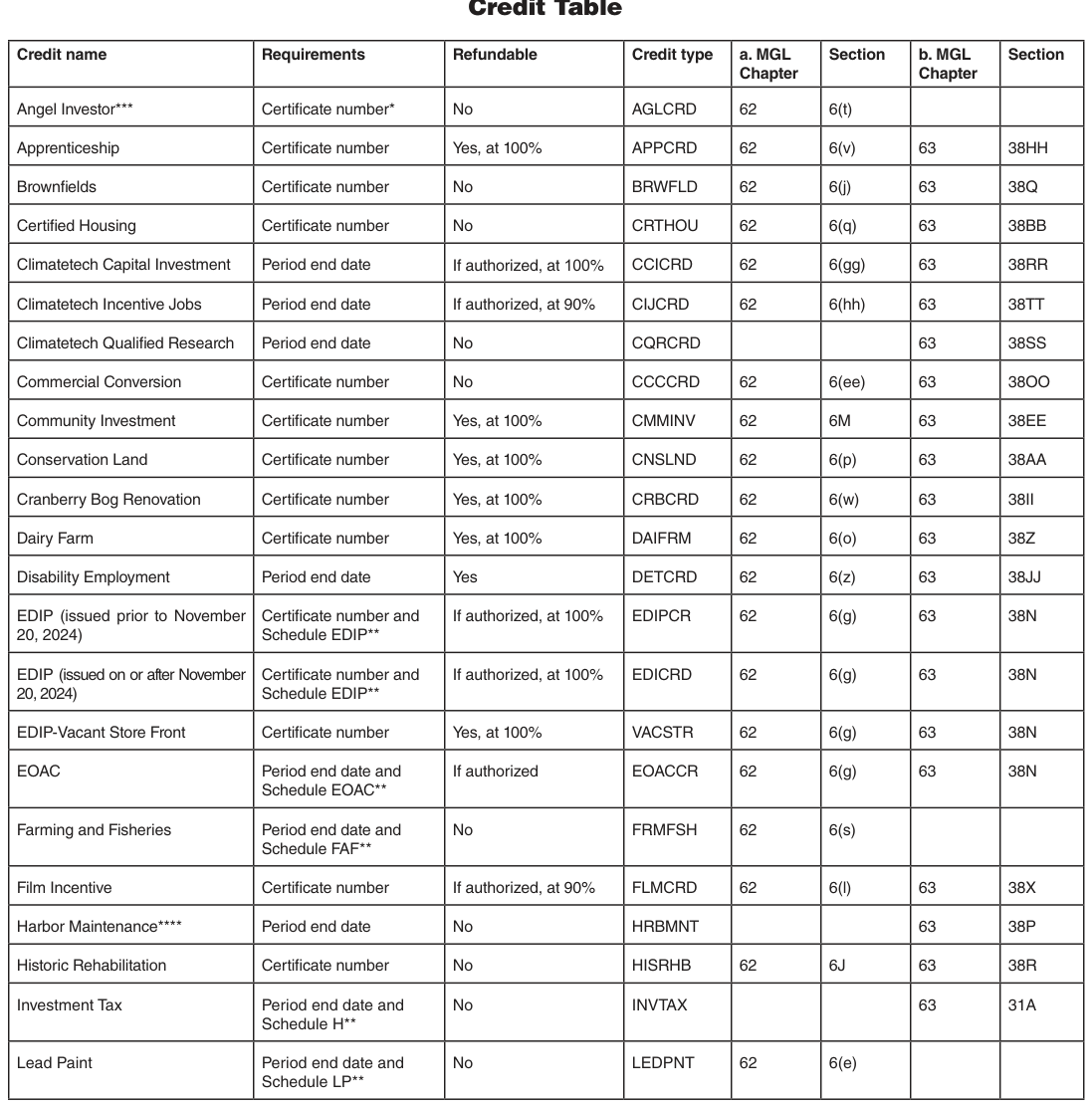
Text version of this table
| Credit name | Requirements | Refundable | Credit type | a. MGL Chapter | Section | b. MGL Chapter | Section |
|---|---|---|---|---|---|---|---|
| Angel Investor*** | Certifci ate number* | No | AGLCRD | 62 | 6(t) | ||
| Apprenticeship | Certifci ate number | Yes, at 100% | APPCRD | 62 | 6(v) | 63 | 38HH |
| Brownfei lds | Certifci ate number | No | BRWFLD | 62 | 6(j) | 63 | 38Q |
| Certifei d Housing | Certifci ate number | No | CRTHOU | 62 | 6(q) | 63 | 38BB |
| Climatetech Capital Investment | Period end date | If authorized, at 100% | CCICRD | 62 | 6(gg) | 63 | 38RR |
| Climatetech Incentive Jobs | Period end date | If authorized, at 90% | CIJCRD | 62 | 6(hh) | 63 | 38TT |
| Climatetech Qualifei d Research | Period end date | No | CQRCRD | 63 | 38SS | ||
| Commercial Conversion | Certifci ate number | No | CCCCRD | 62 | 6(ee) | 63 | 38OO |
| Community Investment | Certifci ate number | Yes, at 100% | CMMINV | 62 | 6M | 63 | 38EE |
| Conservation Land | Certifci ate number | Yes, at 100% | CNSLND | 62 | 6(p) | 63 | 38AA |
| Cranberry Bog Renovation | Certifci ate number | Yes, at 100% | CRBCRD | 62 | 6(w) | 63 | 38II |
| Dairy Farm | Certifci ate number | Yes, at 100% | DAIFRM | 62 | 6(o) | 63 | 38Z |
| Disability Employment | Period end date | Yes | DETCRD | 62 | 6(z) | 63 | 38JJ |
| EDIP (issued prior to November 20, 2024) | Certifci ate number and Schedule EDIP** | If authorized, at 100% | EDIPCR | 62 | 6(g) | 63 | 38N |
| EDIP (issued on or after November 20, 2024) | Certifci ate number and Schedule EDIP** | If authorized, at 100% | EDICRD | 62 | 6(g) | 63 | 38N |
| EDIP-Vacant Store Front | Certifci ate number | Yes, at 100% | VACSTR | 62 | 6(g) | 63 | 38N |
| EOAC | Period end date and Schedule EOAC** | If authorized | EOACCR | 62 | 6(g) | 63 | 38N |
| Farming and Fisheries | Period end date and Schedule FAF** | No | FRMFSH | 62 | 6(s) | ||
| Film Incentive | Certifci ate number | If authorized, at 90% | FLMCRD | 62 | 6(l) | 63 | 38X |
| Harbor Maintenance**** | Period end date | No | HRBMNT | 63 | 38P | ||
| Historic Rehabilitation | Certifci ate number | No | HISRHB | 62 | 6J | 63 | 38R |
| Investment Tax | Period end date and Schedule H** | No | INVTAX | 63 | 31A | ||
| Lead Paint | Period end date and Schedule LP** | No | LEDPNT | 62 | 6(e) |
# Schedule EOAC**
# Schedule FAF**
Harbor Maintenance Period end date
# Schedule H**
# Schedule LP**
No
No
No
No
# LEDPNT 62 6(e)
- As of 2023, the method for reporting the Angel Investor credit on Schedule CMS is by certificate number. Prior to 2023, the method of reporting was by period end date.
A schedule is required when the credit is generated or awarded in the current year.
* Eligibility for obtaining the Angel Investor Tax Credit has been repealed for tax years beginning on or after January 1, 2024. Taxpayers must continue to report available carryover credits on Schedule CMS to the extent they are allowed to use them.
Eligibility for obtaining the Harbor Maintenance Tax Credit has been repealed for tax years beginning on or after January 1, 2022. Taxpayers must continue to report available carryover credits on Schedule CMS to the extent they are allowed to use them.
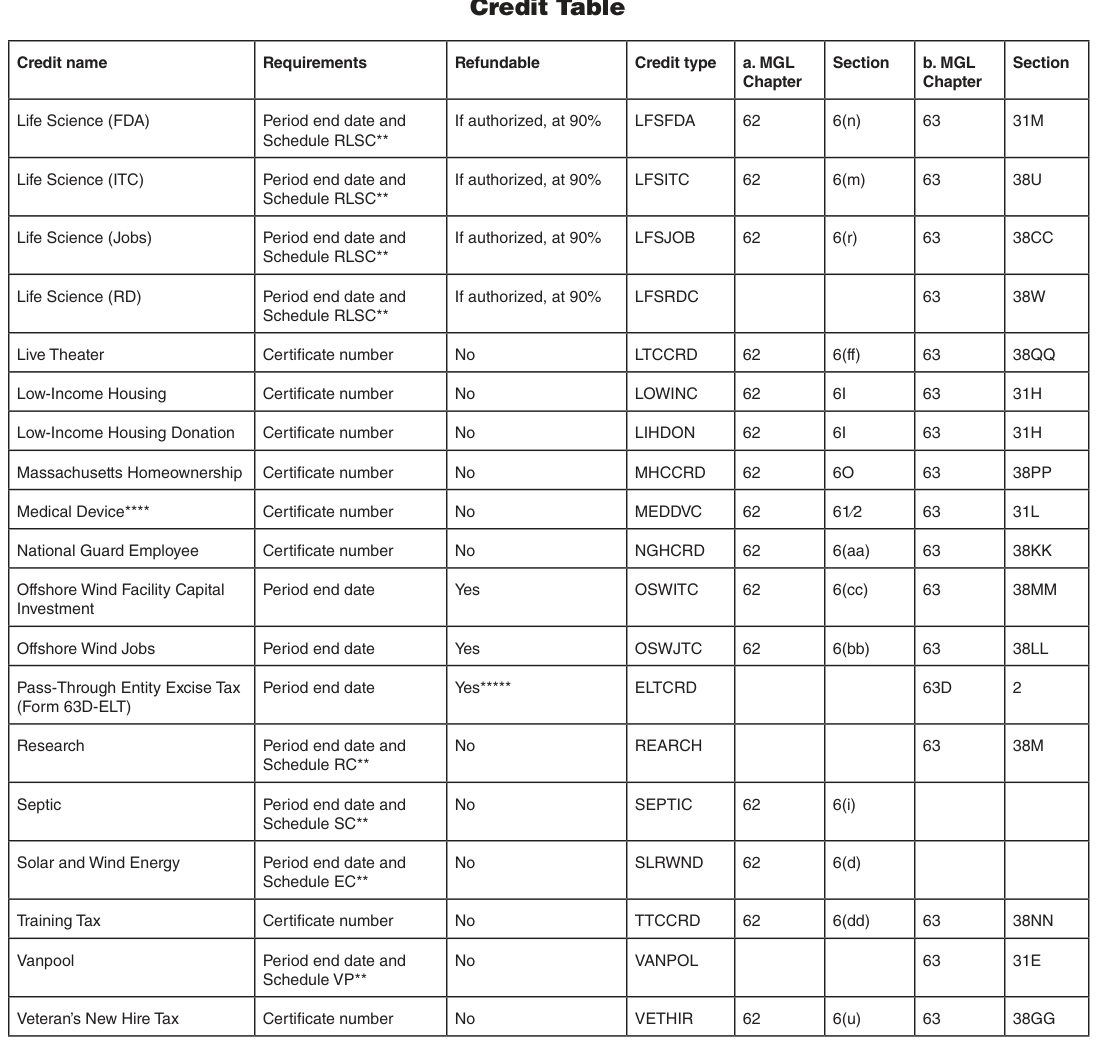
Text version of this table
| Credit name | Requirements | Refundable | Credit type | a. MGL Chapter | Section | b. MGL Chapter | Section |
|---|---|---|---|---|---|---|---|
| Life Science (FDA) | Period end date and Schedule RLSC** | If authorized, at 90% | LFSFDA | 62 | 6(n) | 63 | 31M |
| Life Science (ITC) | Period end date and Schedule RLSC** | If authorized, at 90% | LFSITC | 62 | 6(m) | 63 | 38U |
| Life Science (Jobs) | Period end date and Schedule RLSC** | If authorized, at 90% | LFSJOB | 62 | 6(r) | 63 | 38CC |
| Life Science (RD) | Period end date and Schedule RLSC** | If authorized, at 90% | LFSRDC | 63 | 38W | ||
| Live Theater | Certificate number | No | LTCCRD | 62 | 6(ff) | 63 | 38QQ |
| Low-Income Housing | Certificate number | No | LOWINC | 62 | 6I | 63 | 31H |
| Low-Income Housing Donation | Certificate number | No | LIHDON | 62 | 6I | 63 | 31H |
| Massachusetts Homeownership | Certificate number | No | MHCCRD | 62 | 6O | 63 | 38PP |
| Medical Device**** | Certificate number | No | MEDDVC | 62 | 61⁄2 | 63 | 31L |
| National Guard Employee | Certificate number | No | NGHCRD | 62 | 6(aa) | 63 | 38KK |
| Offshore Wind Facility Capital Investment | Period end date | Yes | OSWITC | 62 | 6(cc) | 63 | 38MM |
| Offshore Wind Jobs | Period end date | Yes | OSWJTC | 62 | 6(bb) | 63 | 38LL |
| Pass-Through Entity Excise Tax (Form 63D-ELT) | Period end date | Yes***** | ELTCRD | 63D | 2 | ||
| Research | Period end date and Schedule RC** | No | REARCH | 63 | 38M | ||
| Septic | Period end date and Schedule SC** | No | SEPTIC | 62 | 6(i) | ||
| Solar and Wind Energy | Period end date and Schedule EC** | No | SLRWND | 62 | 6(d) | ||
| Training Tax | Certificate number | No | TTCCRD | 62 | 6(dd) | 63 | 38NN |
| Vanpool | Period end date and Schedule VP** | No | VANPOL | 63 | 31E | ||
| Veteran’s New Hire Tax | Certificate number | No | VETHIR | 62 | 6(u) | 63 | 38GG |
# Schedule RC**
# Schedule SC**
Schedule EC
Schedule VP
Veteran's New Hire Tax Certificate number No No No No No No Yes Yes Yes* No No No No No No
# VETHIR 62 6(u) 63 38GG
A schedule is required when the credit is generated or awarded in the current year.
Eligibility for obtaining the Medical Device Tax Credit has been repealed for tax years beginning on or after January 1, 2022. Taxpayers must continue to report available carryover credits on Schedule CMS to the extent they are allowed to use them.
* Shareholders, partners, or beneficiaries of an eligible pass-through entity (qualified members) may claim a refundable credit equal to 90% of their allocable share of PTE Excise paid by such pass-through entity. See MGL ch 63D §§ 1-7; TIR 22-6 Pass-through Entity Excise. See also Elective passthrough entity excise FAQs.
Note: Certified life sciences companies with a Research Credit exceeding the amount of credit that may be claimed under section 38M for a taxable year may, to the extent authorized under the Life Sciences Tax Incentive Program, elect to make 90% of the balance of remaining credits refundable. See MGL ch 63, § 38M(j).
Source: official DOR forms index (mass.gov)
Nearby sections (13 sections)
- form-1 · Form 1 — Resident Income Tax Return
- form-1-nr-py · Form 1-NR/PY — Nonresident/Part-Year Resident Return
- form-2 · Form 2 — Fiduciary Income Tax Return
- form-3 · Form 3 — Partnership Return of Income
- form-355 · Form 355 — Business/Manufacturing Corporation Excise Return
- form-355s · Form 355S — S Corporation Excise Return
- form-355u · Form 355U — Combined Reporting (Unitary)
- form-63d-elt · Form 63D-ELT — Pass-Through Entity Excise Tax (PTET)
- form-m-941 · Form M-941 — Employer's Quarterly Withholding Return
- form-ma-nrcr · Form MA NRCR — Nonresident Composite Return
- schedule-62-wh · Schedule 62-WH — Withholding for Composite Returns
- schedule-cms · Schedule CMS — Combined Manufacturer Submission
- schedule-tds · Schedule TDS — Taxpayer Disclosure Statement