Massachusetts DOR Form Instructions
Form 2 — Fiduciary Income Tax Return
Instructions for
Massachusetts
Fiduciary
Income Tax
Form 2
Includes Schedule 2K-1 Instructions Massachusetts has electronic filing requirements for this form. See TIR 16-9 and TIR 21-9 for further information.
Commonwealth of Massachusetts Department of Revenue Major Changes for 2025 2 Common Form 2 Mistakes 4 Definitions 4 Common Questions 4 Line Instructions 8 Schedule B/R. Beneficiary/Remaindermen 13 Schedule B. Interest, Dividends and Certain Capital Gains 13 Schedule D. Long-Term Capital Gains and Losses 15 Schedule E. Rental, Royalty and REMIC Income or Loss 17 Form 2G. Grantor's/Owner's Share of a Grantor-Type Trust 18 Schedule H. Expenses and Fiduciary Compensation 18 Schedule IDD. Income Distribution Deduction 19 Schedule 2K-1. Beneficiary's Massachusetts Information 20 Tax Table at 5.0% Rate 28
Major 2025 Tax
Changes
For more up-to-date and detailed information and to view all of the public written statements referenced in these instructions, visit mass.gov/dor.
# Filing Due Dates
Form 2 is due on or before April 15, 2026.
# 4% Surtax
Starting with tax year 2023, personal income taxpayers must pay an additional 4% on taxable income over $1,000,000, increased annually for inflation. For the 2025 tax year, the threshold is $1,083,150.
Employer-Provided Parking, Transit Pass, and Commuter Highway Vehicle Benefits
# Exclusion Amounts
Massachusetts conforms to the federal income exclusion for employer-provided parking, transit pass, and commuter highway vehicle transportation benefits. The IRS has determined that the 2025 inflation-adjusted monthly exclusion amounts are $325 for employer-provided parking and $325 for combined transit pass and commuter highway vehicle transportation benefits.
# Penalty for Failure to Obtain Health
Insurance
Massachusetts requires most adults 18 and over with access to affordable health insurance to obtain it. In 2025, individuals must be enrolled in health insurance policies that meet minimum creditable coverage standards defined in regulations adopted by the Commonwealth Health Insurance Connector Authority (Health Connector).
Individuals who are deemed able to afford health insurance but fail to obtain it are generally subject to penalties in Massachusetts for each month of noncompliance in the tax year. The monthly penalties for 2025, which will be imposed through the individual's personal income tax return, are set out in Technical Information Release (TIR) 25-1 and are based on the monthly insurance premium for which an individual would have qualified through the Health Connector.
Withholding on Sales of Massachusetts
# Real Estate
Sales of Massachusetts real estate are subject to withholding on the gross sales price or estimated net gain from the sale, when the gross sales price equals or exceeds $1,000,000. The amount withheld is calculated based on the gross sales price of the real estate, unless the seller elects the alternative withholding calculation based on the seller's estimated net gain from the sale of the real estate. The seller must report gain from the sale of real estate on their return for the tax year in which the sale takes place, and the seller may claim the amount withheld as a credit on their return. The credit is available for tax years beginning on or after January 1, 2025, for real estate closings that occur on or after November 1, 2025. There are many exemptions from the withholding requirement, including for sales by residents, but there are reporting requirements applicable to all sellers.
For additional information see 830 CMR 62B.2.4 and the Department's website at mass.gov/dor.
# Circuit Breaker Tax Credit
Taxpayers aged 65 or older who own or rent residential property located in Massachusetts are allowed a credit equal to the amount by which their total real estate tax payments, or 25% of their rent in the case of a renter, exceeds 10% of the taxpayer's total income. The credit cannot exceed a certain maximum amount that is determined by multiplying a statutory base amount by a cost-ofliving adjustment for the calendar year in which the taxable year begins. The maximum credit for tax year 2025 is $2,820.
The amount of the credit is subject to limitations based on the taxpayer's total income and the assessed value of the real estate, which for tax year 2025 must not exceed $1,298,000. For purposes of calculating the credit, total income and maximum credit thresholds are adjusted annually for inflation. For tax year 2025, an eligible taxpayer's total income cannot exceed $75,000 in the case of a single filer who is not a head of household filer;
$94,000 in the case of a head of household filer; and $112,000 in the case of a joint filer.
To qualify for the credit, a taxpayer must be age 65 or older and must occupy the property as his or her principal residence.
Massachusetts Credits
Several new credits are available. In addition, certain existing credits have been revised. These are discussed in detail in TIR 24-16 and TIR 25-5.
# New Climatetech Tax Incentive Program
The Climatetech Tax incentive program adds three new credits for eligible expenses incurred by climatetech companies in developing and deploying technologies aimed at mitigating or adapting to climate change. The credit takes effect for tax years beginning on or after January 1, 2024. A climatetech company must be certified as such by the Massachusetts clean energy technology center ("MassCETC").
The credits include the following.
- The Climatetech Incentive Jobs Credit is awarded in an amount determined by MassCETC (in consultation with the Department of Revenue) to climatetech companies that create at least five new jobs in the climatetech sector. The credit is available to both corporate excise and personal income tax filers.
- The Climatetech Capital Investment Credit is awarded in an amount, determined by MassCETC, up to fifty percent of a climatetech company's investment in a climatetech facility. The credit is available to both corporate excise and personal income tax filers.
- The Climatetech Qualified Research Expenses Credit is awarded at the discretion of MassCETC in an amount equal to the sum of (i)10% of the excess of qualified research expenses for the taxable year, over a base amount, and (ii)15% of the basic research payments as determined for federal tax purposes. The credit is available to corporate excise filers only.
See TIR 25-5, Section I, for a more detailed discussion of the credits, including eligibility, refundability, carryover of unused credits, and limitations on the credits.
# New Live Theater Credit
The Live Theater Credit is available for costs incurred in presenting certain live theater productions in Massachusetts. The credit is equal to the sum of (i) 35% of a theater company's total instate payroll costs, (ii) 25% of its total in-state production and performance expenditures, and
(iii) 25% of its total in-state transportation expenses. The Massachusetts Office of Business Development awards the credit based on applications submitted by theater companies. The credit is available to both corporate excise and personal income tax filers. The credit is transferable but is not refundable. Unused credit may be carried forward for five years. The credit is available for tax years beginning on or after January 1, 2025, and will expire on January 1, 2030. For additional information see TIR 25-5, Section II. .
# New Homeownership Credit
The Homeownership Credit is available to real estate developers that build certain new housing units. The credit is awarded in an amount determined by the Massachusetts Housing Finance Agency based on applications submitted by developers. The credit is available to both corporate excise and personal income tax filers. The credit is transferable but not refundable. The credit is available for tax years beginning on or after January 1,
- For additional information, including eligibility rules, see TIR 24-16, Section II.
# New Qualified Conversion Credit
The Qualified Conversion Credit is available to real estate developers that convert existing commercial property to residential or mixed use. The credit is awarded in an amount determined by the Executive Office of Housing and Livable Communities based on applications submitted by developers.
The credit cannot exceed 10% of a developer's costs. The credit is available to both corporate excise and personal income tax filers. The credit is transferable but not refundable. The credit is available for tax years beginning on or after January 1, 2025, and expires on December 31, 2029. For additional information see TIR 24-16, Section III.
# Other Credits
Certain existing credits have been revised by recent legislation. These revisions expand the availability of the following credits for the tax years indicated:
- Community Investment Credit (effective for tax years beginning on or after January 1, 2025);
- Economic Development Incentive Program Credit, (effective for credits awarded on or after November 20, 2024);
- Historic Rehabilitation Credit, (effective for tax years beginning on or after January 1, 2024);
- Life Sciences Tax Incentive Program (effective for tax years beginning on or after January 1, 2024);
- Research Credit (effective for research expenses incurred on or after November 20, 2024);
- Offshore Wind Investment Tax Credit (effective retroactively for tax years beginning on or after January 1, 2023); and
- Offshore Wind Jobs Tax Credit (effective retroactively for tax years beginning on or after January 1, 2023).
For additional information see TIR 24-16 Sections IV and V and TIR 25-5 Sections V through VIII and X through XIII.
# Singles Sales Factor Apportionment
Effective for tax years beginning on or after January 1, 2025, personal income tax filers that are required to apportion their income to Massachusetts must do so by using the sales factor only.
See TIR 24-4, Section IV, for a general discussion of this change.
# Federal Conformity
In general, a taxpayer's Massachusetts gross income and many deductions are based on the taxpayer's federal gross income and deductions under the Internal Revenue Code (IRC) as of a specific date. For tax years beginning on or after January 1, 2024, the Massachusetts personal income tax generally conforms to the IRC as amended and in effect on January 1, 2024. For further information regarding federal tax law changes see
TIR 24-14 and Working Draft TIR: Massachusetts
# Conformity to Certain Provisions in Public Law
No. 119-21.
As a general rule, Massachusetts does not conform to personal income tax law changes to the IRC made after January 1, 2024. However, certain specific Massachusetts personal income tax provisions, asset forth in MGL ch. 62, § 1(c), automatically conform to the IRC currently in effect.
The provisions of the IRC that Massachusetts conforms to on a current basis include those provisions relating to:
- Roth IRAs;
- IRAs;
- The exclusion for gain on the sale of a principal residence;
- Trade or business expenses;
- Travel expenses;
- Meals and entertainment expenses;
- The maximum deferral amount of government employees' deferred compensation plans;
- The deduction for health insurance costs of self-employed taxpayers;
- Medical and dental expenses;
- Annuities;
- Health savings accounts;
- Employer-provided health insurance coverage;
- Amounts received by an employee under a health and accident plan; and
- Contributions to qualified tuition programs.
# Federal Tax Law Changes
Federal legislation passed in 2025 made a number of changes to the IRC. The Massachusetts personal income tax adopts only those changes that relate to provisions that Massachusetts adopts on a current basis (as listed above).
Note: Massachusetts does not adopt the federal deduction for tip income (IRC § 224) or the federal deduction for overtime pay (IRC § 225). For further information regarding federal tax law changes see TIR 24-14 and Working Draft TIR: Massachusetts Conformity to Certain Provisions in Public Law No. 119-21.
# Privacy Act Notice
Under the authority of 42 U.S.C. § 405(c)(2)(c)(i), and MGL ch 62C, § 5, the Department of Revenue
(DOR) has the right to require a taxpayer to furnish his Employer Identification number and/or Social Security number, as the case may be, on a state tax return. This information is mandatory. DOR uses these numbers for taxpayer identification, to assist in processing and keeping track of returns, and in determining and collecting the proper amount of tax due. Under MGL ch 62C, § 40, the taxpayer's identifying number is required to process a refund of overpaid taxes. Although tax return information is generally confidential pursuant to MGL ch 62C, § 21, DOR may disclose return information to other taxing authorities and those entities specified in MGL ch 62C, §§ 21, 22, or 23, and as otherwise authorized by law.
# Common Form 2 Mistakes
An incomplete or incorrect return can delay processing of your return. Below are tips to help us process your return as quickly as possible.
Incorrect Computation
Many returns must be corrected by DOR each year due to simple errors in computation. Before mailing your return, check your arithmetic to make sure the computations are correct.
Filing Status
Be sure to select the correct oval for filing status.
This requirement is frequently overlooked.
Fiscal Year
Clearly mark tax return "Fiscal Year" if applicable.
Missing Withholding Statement(s)
Enclose Schedule 62-WH and make certain all state copies of your Forms W-2 (Wages),1099-G, or 1099-R and W-2G (Winnings) that show Massachusetts income tax withheld are enclosed.
These forms are frequently missing and must be obtained from you later in order to process the return.
Missing Supporting Schedules
Make sure you have enclosed all required schedules to support the information on your Form 2.
These include Schedules B, B/R, C, C-2, CMS, CRS, D, E, H, IDD, OJC and 2K-1 of Massachusetts Form 2. We cannot process your return without these schedules.
Credits — Missing Certificate or Other
Identification Numbers and/or Supporting
# Schedules
Make sure you have included all required certificate or other identification numbers and/or schedules to support the credits you are claiming. Failure to include certificate or other identification numbers and/or schedules will result in the credit being disallowed on your tax return and an adjustment of your reported tax.
Missing Signatures
Thousands of unsigned forms and other documents are received by DOR every year. These forms must be returned to taxpayers for signatures. Make sure signatures are on the correct lines.
# Definitions
Complex Trust
A trust that, for any given taxable year, does not qualify as a simple trust, as defined below. Complex trusts are governed by IRC §§ 661 and 662.
Grantor Trust
Under MGL ch 62, § 10(e), if the grantor or another person is treated as the owner of any portion of a trust by reason of the provisions of IRC §§ 671 to 678, inclusive, the trust is a grantor trust and its income is taxable to the grantor or such other person, not to the trust.
Massachusetts Source Income
Gross income derived from or effectively connected with: (1) any trade or business, including any employment carried on by the taxpayer in the Commonwealth, regardless of where or when the income is received; (2) the participation in any lottery or wagering transaction within the Commonwealth; or (3) the ownership of any interest in real or tangible personal property located in the Commonwealth. Gross income derived from or effectively connected with any trade or business, including any employment, carried on by the taxpayer in the Commonwealth includes: gain from the sale of a business or of an interest in a business; distributive share income; separation, sick, or vacation pay; deferred compensation and nonqualified pension income not prevented from state taxation by the laws of the United States; and income from a covenant not to compete.
Nonresident Estate
An estate of a deceased non-Massachusetts resident. A nonresident estate is subject to the taxing jurisdiction of Massachusetts to the extent it earns Massachusetts source income. In other words, the income of a nonresident estate is taxable to the extent it would be taxable to a nonresident individual.
Nonresident Trust
A trust that earns Massachusetts source income and that is:
- A trust under the will of a decedent who was a non-Massachusetts resident at death;
- A trust all of whose trustees are nonresidents; or
- A trust all of whose grantors are nonresidents at the time of the creation of the trust or at any time during the year for which the income is computed.
These conditions must be met in order to subject the trust to the taxing jurisdiction of Massachusetts.
Qualified Settlement Fund
A qualified settlement fund as defined in IRC § 468B(g) and Treas. Reg. § 1.468B-1 et seq. See also Letter Ruling (LR) 08-7.
Resident Estate
An estate of a deceased Massachusetts resident.
Resident Trust
A resident trust may be one of two types. It may be a testamentary trust (a trust under the will of an individual who died an inhabitant of Massachusetts.
Alternatively, it may be an inter vivos trust) a trust created during the life of the grantor. To subject an inter vivos trust to the taxing jurisdiction of Massachusetts, the following conditions must exist: the trustee or other fiduciary, or at least one of them, is a Massachusetts inhabitant, and:
- The grantor, or at least one of them, was a Massachusetts inhabitant when the trust was created; or
- The grantor, or at least one of them, resided in Massachusetts during any part of the year for which the income is computed; or
- The grantor or at least one of them, died a Massachusetts inhabitant.
Simple Trust
A trust that is required to distribute all of its income currently, may not make distributions of principal, and does not provide for charitable contributions.
Simple trusts are governed by IRC §§ 651 and 652.
Unascertained Persons
A class of persons who cannot be identified with certainty until the happening of a specified event.
The term also applies to those of a class who fulfill some special qualification. It is the trust termination provisions that determine whether a remainder interest is ascertained or not. For example, if the termination provisions read "income to X for life, remainder to Y, if living, or, if not, to Y's estate," the remainder interest is vested in Y and is not unascertained. However, if they read "to X for life, remainder to Y, if living, or, if not, to Y's issue then living," the remainder interest is not vested in Y or Y's issue and is unascertained because it cannot be known for certain who will take the remainder interest until X's death. In the latter case, gains realized by the trust will be deemed to be income accumulated for the benefit of unascertained persons and taxable in full to the trust.
Uncertain Interest
A type of future interest such as a contingent remainder or a vested remainder subject to being cut off upon the happening of a contingency. In determining whether a person has an uncertain interest, a remainder interest in a trust that is vested and not subject to being divested by the happening of any contingency expressly mentioned in the trust instrument is not classified as an uncertain interest. Any other type of future interest is an uncertain interest.
# Common Questions
Once Massachusetts Jurisdiction is
Established, to Whom is the Income
# Taxable? Resident Estate or Trust
When income of a resident estate or trust subject to the taxing jurisdiction of Massachusetts is being accumulated for a Massachusetts beneficiary(ies), unborn persons, unascertained persons, or persons with uncertain interests, such income is taxable to the estate or trust. Otherwise, income from such resident estate or trust includable in the federal gross income of a beneficiary(ies) by reason of IRC §§ 652 and 662 is taxable to the beneficiary(ies).
# Nonresident Estate or Trust
When Massachusetts source income of a nonresident estate or trust is being accumulated, such income is taxable to the estate or trust regardless of whether it is being accumulated for Massachusetts beneficiaries, non-Massachusetts beneficiaries, unborn persons, unascertained persons, or persons with uncertain interests. Massachusetts source income of a nonresident estate or trust includable in the federal gross income of a Massachusetts or non-Massachusetts beneficiary by reason of IRC §§ 652 and 662, however, is taxable in Massachusetts to the beneficiary. All other income of a nonresident estate or trust, i.e., all non-Massachusetts source income, is taxable to a Massachusetts beneficiary if he receives it.
# Who Must File a Massachusetts Fiduciary
Return?
Every executor, administrator, trustee, guardian, conservator, trustee in a noncorporate bankruptcy or receiver of a trust or estate that received income in excess of $100 that is taxable under MGL ch 62 at the entity level or to a beneficiary(ies) and that is subject to Massachusetts jurisdiction must file a Form 2.
# What Other Forms Must Be Filed?
All applicable U.S. schedules, forms and enclosures must be filed with Form 2. A copy of U.S.
Schedule K-1 must be enclosed in all cases where a deduction is taken for the payment of income to a nonresident. DOR has developed an extensive information exchange program that includes the following forms:
- Form 1, Resident Income Tax Return;
- Form 1-NR/PY, Nonresident/Part-Year Resident;
- Form M-1310, Statement of Claimant to Refund Due on Behalf of Deceased Taxpayer;
- Form 2, Fiduciary Income Tax Return; and
- Form M-706, Estate Tax Return. Discrepancies and nonfilings, except those allowed under Massachusetts law, will be identified and may result in an audit or further investigation.
When is Form 2 Due?
The 2025 Form 2 is due on or before April 15, 2026.
# Fiscal Year Filers
If permission has been granted to file on a fiscal year basis, the return is generally due on or before the 15th day of the fourth month after the close of the fiscal year. Prior consent must be requested in order to file a return on a fiscal year basis. An application can be made on Form 13. Fiduciaries failing to obtain prior consent will be placed on a calendar year basis.
# E-File Mandate
Currently, fiduciaries filing Form 2 or Form 2G with total Part A, Part B, and Part C (as defined in MGL ch 62, § 2(b)) net taxable income of $50,000 or more are required to make all payments, including estimated payments, by electronic means.
Effective for payments made on or after January 1, 2022, all fiduciary income tax payments of $2,500 or more must be made electronically.
This includes estimated payments, extension payments and return payments. Payments may be made electronically using commercial software or through MassTaxConnect.
Effective for tax periods ending on or after December 31, 2021, tax return preparers must file all Massachusetts fiduciary income tax returns (Forms 2 and 2G) electronically, provided the tax return preparer reasonably expects to file more than 10 original Massachusetts Forms 2 and 2G during the calendar year. This requirement parallels the requirement stated in TIR 11-13 regarding the filing of personal income tax returns.
Forms 2 and 2G may be filed electronically using commercial software or through MassTaxConnect.
For more information about the E-file mandate, see TIRs 21-9, 16-9, 09-18, 05-22 and 04-30.
# Short Year and Fiscal Year Filers
Fiscal year filers whose fiscal year begins in 2025 and ends in 2026 should file the 2025 Form 2 return. Short year filers should file using the tax form for the calendar year within which the short year falls. If the short year spans more than one calendar year, the filer should file using the tax form for the calendar year in which the short year begins.
If the appropriate form is not available at the time the short year filer must file, the filer should follow the rules explained in TIR 11-12.
# What If I Am Unable to Pay?
If you are unable to pay the full amount of tax that you owe, you should pay as much of your tax liability as possible with your return. You will receive a bill from DOR for the remaining amount of tax due plus accrued interest and penalty charges. If the amount of the bill is less than $10,000 and you still cannot pay it in full, you must apply formally to DOR for a small payment agreement in order to avoid collection activity. Setting up a small payment agreement will allow you to make monthly payments over a set period to meet your unpaid liability. You can apply for a small payment agreement by visiting mass.gov/MassTaxConnect.
Are Wholly Charitable Trusts/Private
# Foundations Required to File Form 2?
Funds held in trust for public charitable purposes are exempt from tax under MGL ch 62, § 3, if such income is currently payable to, or irrevocably set aside for, public charitable purposes. Trustees of wholly charitable trusts, i.e., trusts with no noncharitable interests, are required to file a Form 2, however, even though such trusts' taxable income may be zero. Trustees of split-interest trusts, e.g., pooled income funds, charitable remainder annuity trusts, and charitable remainder unitrusts, are to file a Form 2G, not Form 2.
What Deductions and Exemptions
Are Allowable on the Guardianship/
# Conservatorship Form 2?
Every deduction and exemption that an individual is entitled to take on Form 1 may be claimed by a guardian or conservator on behalf of a ward on Form 2. Supporting documentation must be enclosed, including all applicable schedules from U.S. Form 1040, e.g., Schedule A, Itemized Deductions, if claiming the medical expense exemption.
Generally, deductions may be used only against 5.0% income. See Schedule C-2 for the limited circumstances under which deductions may be applied against interest (other than interest from Massachusetts banks), dividends, and capital gain income.
Any deduction or exemption claimed must be entered first on Schedule IDD, line 3, and then on line 8, line 13, and line 18, as appropriate; lines typically used by an estate or trust to claim an income distribution deduction. Such deduction is not allowable to a guardianship or conservatorship, however, thus, these lines are available to a guardian or conservator for claiming deductions and exemptions on behalf of a ward. Any deduction or exemption claimed must be explained via a supporting statement enclosed with the Form 2.
The preprinted language on Schedule IDD, lines 3, 8, 13 and 18 should be crossed out and the words "see supporting statement" should be added.
# Should I Be Making Estimated Tax
Payments?
Generally, every fiduciary receiving income taxable at the entity level must make estimated tax payments on Massachusetts Form 2-ES, if the entity expects to owe more than $400 in taxes for the taxable year. Estimated tax payments made by a fiduciary on behalf of a beneficiary of a pooled income fund, charitable remainder annuity trust, charitable remainder unitrust, or on behalf of a non-resident grantor of a grantor-type trust or a nonresident entity beneficiary that is a trust or other entity also must be made on Form 2-ES. In contrast. fiduciaries required to deduct and withhold payments under MGL ch 62, § 10(g) on behalf of a nonresident individual beneficiary must make estimated tax payments on the beneficiary's behalf on Form 1-ES using the beneficiary's identification number. For more information, see DOR Directive (DD) 07-4. Fiduciaries filing Form 2 with total net taxable income of $50,000 or more must make all estimated tax payments by electronic means. Fiduciaries with income less than the above cited threshold may make payments electronically as well, but are not required to.
Generally, the first payment voucher must be filed on or before April 15 of the taxable year. The estimated tax may be paid in full with the first payment voucher or in four installments on or before April 15, June 15, September 15 of the taxable year, and January 15 of the following year. Fiscal year taxpayers must file their first payment voucher on or before the 15th day of the fourth month of the fiscal year. The estimated tax may be paid in full with the first payment voucher or in four equal installments on or before the 15th day of the fourth, sixth, and ninth months of the fiscal year, and the 15th day of the next fiscal year. Be sure to use the appropriate voucher for each payment and fill in the tax year and date. Whenever a due date falls on a Saturday, Sunday, or legal holiday, the filing and payment may be made on the next succeeding business day.
Fiduciaries who underpay or fail to pay their estimated taxes may incur a penalty. Form M-2210F, Underpayment of Massachusetts Estimated Income Tax for Fiduciaries, is used to compute the additional charge. Finally, a resident beneficiary subject to tax at the beneficiary level pursuant to MGL ch 62, § 10 (h) must make estimated tax payments on his distributable share of the estate or trust income. Such payments are to be made on Massachusetts Form 1-ES. For more information, see DD 07-4.
Can Unused Capital Losses be Passed
Through to Beneficiaries?
Unused capital losses of an estate or trust are allocable to the estate's or trust's corpus and can be used by the estate or trust itself in future years.
These losses cannot be passed through to beneficiaries, even in the year of termination.
# Does Massachusetts Have a 65-Day
Election?
No. In determining the amount paid, credited, or otherwise required to be distributed to a beneficiary (lines 3, 8, 13, and 18 of Schedule IDD, Income Distribution Deduction), Massachusetts has not adopted the 65-day election available to estates and complex trusts federally under IRC § 663(b).
Therefore, any distribution or portion thereof to a beneficiary made within the first 65 days following the close of the 2025 taxable year, treated federally as having been distributed in 2025, is to be treated for Massachusetts purposes in 2025 as accumulated income and is taxable at the estate or trust level, with one exception. Non-Massachusetts source income accumulated for a vested nonresident beneficiary is not taxable at the estate or trust level, but is deductible on Form 2, lines 12, 19, 28, or 36, as applicable. Moreover, any distribution or portion thereof to a beneficiary made within the first 65 days following the close of the 2025 taxable year will be treated in the year of distribution, i.e., 2026 as a tax free distribution.
Does Massachusetts Offer Simplified
Filing and Reporting Options to Grantor
Trusts Similar to the Filing and Reporting
Options Available Federally Pursuant to
# Treasury Regulations § 1.671-4?
Generally, the fiduciary of a grantor trust is required to file with DOR an informational return, Form 2G, along with a schedule indicating the items of income, deductions, and credits against tax attributable to the trust that are treated as owned by and taxable to the grantor/owner. Additionally, the fiduciary must give a copy of the schedule to the grantor/owner, who is required to report the income, deductions, and credits reported on the schedule on his Massachusetts individual income tax return.
Notwithstanding the above, similar to one of two reporting options offered federally under Treasury Regulations § 1.671-4, no Form 2G will be required to be filed with DOR by the fiduciary of a grantor trust as long as the following three requirements are met:
- The grantor trust has only one owner, a Massachusetts resident;
- That owner is also the trustee or co-trustee of the trust; and
- The trustee has provided all payors of trust income the name and taxpayer identification number of the grantor and the address of the trust.
Does the Pass-Through Entity Withholding
# Program Apply to Estates and Trusts?
Most estates and trusts are not required to participate in the pass-through entity withholding program (adopted for tax years beginning on or after January 1, 2009) because they are required to withhold under other Massachusetts statutory provisions. See, e.g., MGL ch 62, § 10(g) (requiring trusts and estates to withhold or make estimated payments on payments to nonresidents, including nonresident grantors of grantor trusts).
For more information on the applicability of the pass-through entity withholding program to trusts and estates, see the Guide for Pass-Through Entities, Including Registration Information. See also 830 CMR 62B.2.2, Pass-Through Entity Withholding.
# Who is a Designated Tax Matters Partner?
MGL ch. 62C, § 24A, established a unified audit, assessment, and appeal procedure for passthrough entities (partnerships, S corporations, and certain trusts) that is completely separate from regular audit procedures. Individual members may, however, elect not to participate in the separate unified audit procedure. The tax matters partner (TMP) is the individual designated by the pass-through entity to act as its representative to DOR during the unified audit process. During the unified audit, the TMP has the authority to request a settlement, to agree to extend the statute of limitations, to request a conference, and to appeal a determination of pass-through entity items. For further discussion, see 830 CMR 62C.24A.1 and TIR 13-15.
Name of Estate or Trust
Enter the exact legal name of the entity. If an estate or trust, refer to the governing instrument. Other fiduciaries should use the exact legal name as their appointing court ruled.
# Estate or Trust Employer Identification
Number
Enter the U.S. Employer Identification Number. If you do not have one, U.S. Form SS-4, Application for Employer Identification Number, should be used to apply for one. Do not use a decedent's Social Security number for an estate. A separate Employer Identification Number is required for the estate and for each trust entity.
Name and Title of Fiduciary
Enter the exact legal name and title of the fiduciary. In case of multiple fiduciaries, one name is sufficient.
Mailing Address of Fiduciary
Enter the mailing address of the fiduciary listed on the first line.
Care/of Address
If the mailing address is the address of a legal firm or of a person other than the fiduciary, that person or firm should be listed on the c/o line.
Company Account Number
If applicable, enter the company account number your firm has assigned to this entity.
Date Entity Created
Enter the date the trust was created. If filing a return for an estate, enter the date of death. All other fiduciaries should enter the date of appointment.
# Filing Status
Select all applicable ovals. For example, if you are filing a first year return for an estate, select the ovals for Decedent's estate and Initial return.
If filing on a fiscal year basis, enter your fiscal year's beginning and ending dates in the appropriate boxes at the top of the return. If you have elected to file as a Qualified Funeral Trust (QFT) on U.S. Form 1041-QFT, select the Qualified funeral trust oval. If you file a composite Form 1041-QFT, you may also file a composite Form 2. Select the
Qualified funeral trust oval and write Composite QFT across the top of the return. You must enclose a schedule with a Composite QFT Form 2 that includes the following information for each QFT (or separate interest treated as a separate QFT):
- The name of the owner or the beneficiary (if you list the name of the owner and that trust has more than one beneficiary, you must separate the trust into shares held by the separate beneficiaries);
- The type and gross amount of each type of income earned by the QFT for the tax year (for longterm capital gains, identify separately the amount of capital gain by holding period);
- The type of each deduction allocable to the QFT;
- The tax and payments made for each QFT; and
- If the QFT was terminated during the year, give the date of termination.
Schedule TDS. Inconsistent Filing
# Position Penalty
Fill in the oval and enclose Schedule TDS, Taxpayer Disclosure Statement, if you are disclosing any inconsistent filing positions. Schedule TDS is available on the DOR website at mass.gov/dor.
The inconsistent filing position penalty (see TIR 06-5, section IV) applies to taxpayers that take an inconsistent position in reporting income. These taxpayers must disclose the inconsistency when filing their Massachusetts return. If such inconsistency is not disclosed, the taxpayer will be subject to a penalty equal to the amount of tax attributable to the inconsistency. This penalty is in addition to any other penalties that may apply. A taxpayer is deemed to have taken an inconsistent position when the taxpayer pays less tax in Massachusetts based upon an interpretation of Massachusetts law that differs from the position taken by the taxpayer in another state where the taxpayer files a return and the governing law in that other state is the same in all material respects as the Massachusetts law. The Commissioner of Revenue may waive or abate the penalty if the inconsistency or failure to disclose was attributable to reasonable cause and not willful neglect.
Massachusetts Schedule FCI, Foreign
# Corporation Income
Certain eligible businesses and individuals are required to complete and file Massachusetts Schedule FCI, Foreign Corporation Income, with their tax return to report their pro rata share of foreign corporation income that must be reported federally under the TCJA.
Business taxpayer reporting is required on an entity-level basis. C corporations and Pass-Through
Entities (S corporations, partnerships or trusts)
(PTEs) are required to complete Schedule FCI at the entity level only. Individual pass-through members of a PTE (i.e., individual S corporation shareholders, partners, or trust beneficiaries who are eligible pass-through income recipients are not required to complete and submit a Schedule FCI with their tax returns.
Note: A pass-through member of a PTE that is a business entity (non-individual) with a Massachusetts tax return filing requirement must also complete and submit Schedule FCI with its tax return if it is an eligible taxpayer or U.S. shareholder. Detailed instructions for completing Schedule FCI are available on DOR's website. See Schedule FCI and Instructions.
Fill in the oval and enclose Schedule FCI (Foreign Corporation Income) if the taxpayer is required to complete and file Schedule FCI with Form 2.
# Filing an Amended Return
Supporting Statement Required - If you are filing an amended return for any reason you must attach a statement to the amended return with an explanation of why you are filing the amended return, including the basis for submitting it.
If you need to change a line item on your return, complete a new return with the corrected information and fill in the Amended return oval. An amended return can be filed to either increase or decrease your tax. Generally, an amended return must be filed within three years of the date that your original return was filed. For further information regarding amended returns, visit mass. gov/dor/amend and see TIR 16-13, Changes to the Amended Return Process Expanded to Most Tax Types.
# Federal Changes
If your amended return includes changes you have reported on an amended federal return filed with the IRS for the same tax year, fill in the Amended return due to federal change oval.
If your amended return does not report changes that result from the filing of a federal amended return or from a federal audit, fill in only the
Amended return oval.
Amended Return Due to IRS BBA
Partnership Audit
# The Amended return due to IRS BBA Partnership
Audit oval is only to be used if you are an upper-tier member of a partnership that was impacted by an IRS adjustment to a lower-tier partnership result ing from a federal centralized BBA audit.
If you are a fiduciary that was directly impacted by an IRS adjustment from a federal centralized BBA audit do not file an amended Form 2 return to report such IRS adjustments. Instead, a fiduciary directly impacted by such IRS adjustment must file a Centralized Federal Partnership Audit Report on MassTaxConnect. For further details see TIR 22-1, Reporting Rules Related to Centralized Federal Partnership Audits.
Consent to Extend the Time to Act on an
# Amended Return treated as Abatement
Application
In certain instances, an amended return showing a reduction of tax may be treated by DOR as an abatement application. Under such circumstances, by filing an amended return, you are giving your consent for the Commissioner of Revenue to act upon the abatement application after six months from the date of filing. See TIR 16-11. You may withdraw such consent at any time by contacting DOR in writing. If consent is withdrawn, any requested reduction in tax will be deemed denied either at the expiration of six months from the date of filing or the date consent is withdrawn, whichever is later.
# Filing an Application for Abatement
File an Application for Abatement only to dispute an audit assessment or to request an abatement of penalties.
For the fastest response time, file your dispute online at mass.gov/masstaxconnect. If you are not required to file electronically or you cannot file online, use Form ABT (Application for Abatement).
Visit mass.gov/dor/amend for additional information about filing an amended return, or filing an application for abatement. See also TIR 16-13.
# Schedule DRE. Disclosure of Disregarded
Entity
A fiduciary that is doing business in Massachusetts (including through the means of activities conducted by a disregarded entity that such fiduciary owns) and that is also the owner of a disregarded entity for any portion of the taxable year for which a return is being filed must identify each disregarded entity by filing Schedule DRE with its return. A separate Schedule DRE is required for each such disregarded entity. See Schedule DRE instructions for additional information.
# Member of a Lower-Tier Entity
A tiered structure is a pass-through entity that has a pass-through entity as a member. Pass-through entity refers to an entity whose income, loss, deductions and credits flow through to members for Massachusetts tax purposes, and includes estates and trusts not taxed at the entity level. Member includes beneficiaries of a pass-through entity.
As between two entities, the pass-through entity that is a member is the uppertier entity, and the entity of which it is a member is the lower-tier entity. If the estate or trust is a member of another pass-through entity, it should answer Yes to this question.
Number of Employees
Enter the number of employees in Massachusetts and worldwide in the spaces provided.
# Annual Voluntary Election to Pay PTE
Excise
Fill in the oval if you are making the annual voluntary election to pay tax at the entity level pursuant to MGL ch 63D. MA Form 63D-ELT must be filed by the Eligible PTE if it has made the annual voluntary election to pay PTE Excise on its Form 3 return. Once the election is made for a tax year it is irrevocable for that year and is binding on all qualified members. See Form 63D-ELT instructions for further information relating to the PTE Excise.
Note: Do not complete if you were the recipient of an ELT credit, only if the election was made, filed and paid by you.
Total Amount Paid
Enter amount from Form 63D-ELT, page 2 line 2.
Note: Do not include any amount of ELT you received from a lower tier entity.
Line Instructions
Line items without specific instructions are considered to be self-explanatory.
# Part B Income
Line 1. Wages, Salaries, Tips, Other
# Employee Compensation
Enter wages, salaries, tips, and other compensation earned and received, and, if applicable, enter the amount reported as Massachusetts wages on Form W-2. For a decedent's estate, income in respect of a decedent is taxed on Form 2, line 1, in addition to being taxed on the Form M-706, Massachusetts Estate Tax Return, as an asset of the estate. Income in respect of a decedent is income the decedent had a right to receive prior to his date of death, but payment of which was made to the estate after the date of death. Wages, salaries, or other forms of compensation, including any fixed sum amount attributable to services rendered prior to the decedent's death, are to be included on line 1.
Note: Massachusetts does not adopt the federal deduction for tip income (IRC § 224) or the federal deduction for overtime pay (IRC § 225).
# Line 2. Taxable Pensions and Annuities
Income from most private pension or annuity plans is taxable in Massachusetts; however, income from a contributory annuity, pension, endowment or retirement fund of the U.S. government, the Commonwealth of Massachusetts or its political subdivisions, or any noncontributory pension or survivorship benefits from the United States uniformed services (Army, Navy, Marine Corps, Air
Force, Coast Guard, commissioned corps of the U.S. Public Health Service and National Oceanic and Atmospheric Administration) is exempt. Massachusetts allows a deduction for contributory pension income received from another state or one of its political subdivisions that does not tax such income from Massachusetts or its political subdivisions. For guidelines on determining which state pensions are exempt in Massachusetts, see TIR 95-9. Enter the fully taxable amounts received from pension or annuity plans on line 2. Amounts distributed from an IRA or Keogh plan should also be reported on line 2.
Line 3. Business/Profession or Farm
# Income or Loss
Enter on line 3 the amount of income or loss from a business or profession from Massachusetts Schedule C, line 31 or 33. Also, enclose Massachusetts Schedule C with this return.
Note: U.S. Schedule C is no longer allowed as a substitute for the Massachusetts Schedule C.
For entities engaged in operating a farm business, enter on line 3 the amount of income or loss from operating such business from U.S. Schedule F, line
- Enclose a copy of U.S. Schedule F. Additionally, complete and enclose a pro-forma U.S. Schedule F to report Massachusetts differences, if any, such as bonus depreciation.
# Line 4. Rental, Royalty and REMIC Income or Loss
Rental, Royalty, and Real Estate Mortgage Investment Conduit (REMIC) residual income are generally taxable in Massachusetts. Enter the amount from Massachusetts Form 2, Schedule E, line 4.
Enclose Massachusetts Schedule E. Enter and explain any differences between total rental, royalty, and REMIC income on the U.S. Schedule E and the Massachusetts Schedule E. Possible differences include part-year residency, trust provisions, deductible royalties from approved U.S. energy conservation plants, passive losses, and "bonus" depreciation. See the Massachusetts Schedule E instructions for further details of possible differences in reporting rental, royalty, and REMIC income or loss.
# Line 5. Interest from Massachusetts Banks
Enter in line 5 the total amount of interest received or credited to deposit accounts (term and time deposits, including certificates of deposit, savings accounts, savings shares, and NOW accounts) in all savings banks, cooperative banks, savings and loan associations, or credit unions located in Massachusetts. All other interest, unless exempt, should be entered on Schedule B, line 1.
# Line 6. Other 5.0% Income
Other 5.0% income not reported elsewhere must be included here. Items reported here include: partnership and S corporation income or loss; gambling winnings from lotteries, raffles, races or other events of chance, wherever held; fair market value of prizes and awards; lump-sum distributions from qualified employee benefit plans in excess of employee's contributions; and any other miscellaneous income. Income received by a Massachusetts trust or estate from sources not previously subject to Massachusetts jurisdiction or taxed in Massachusetts is reportable on the Form 2 as follows. Sources not previously subject to Massachusetts taxation include non-Massachusetts estates, trusts, and partnerships, wherever located. Enter the income or loss from these entities on the appropriate lines on Form 2 and Schedule D, according to the character and source of income. If no other line applies, enter the income or loss from these entities on line 6 of Form 2.
# Line 8. Deductions Allowed Decedents
The amount of any deduction attributable to a decedent that is not properly allowable to the decedent as a deduction on the income tax return for the taxable period in which his death occurs, or any prior period, shall be specifically allowed as a deduction on this line, provided the estate of the decedent is liable to discharge the obligation for which the deduction relates. The following deductions are allowed if attributable to the decedent and paid after the decedent's date of death (enclose a copy of Form 1 or 1-NR/PY):
- Amounts paid into Social Security (FICA), Railroad, U.S. or Massachusetts Retirement Systems are deductible up to a maximum of $2,000. Payments to an IRA, Keogh, Simplified Employee
# Pension Plan (SEP), or Savings Incentive Match
Plan for Employees (SIMPLE) Account are not deductible.
- Amounts paid for rent for the decedent's principal residence are deductible equal to 50% of the rent paid during the taxable year, up to a maximum of $4,000. Enclose a supplemental statement listing the landlord's name(s) and address(es), dates rented, and amount(s) of rent paid for each residence.
- A penalty charge for early withdrawal of savings and interest is deductible but only if the interest that the penalty is related to is reported on Form 2.
- Amounts paid to a former spouse during the taxable year for deductible alimony paid as reported on U.S. Form 1040, Schedule 1, line 19a.
Alimony payments specified as child support are not deductible.
- In addition, certain federal deductions are allowed including: interest payments due and paid on qualified student loans; qualified moving expenses paid or incurred by qualifying members of the Armed Forces; Business Expenses of National Guard and Reserve Members, Performing Artists and Fee-Based Government Officials; Impairmentre lated Work Expenses of Persons with Qualifying Disabilities; business expenses of state and local government employees who are compensated on a fee basis; jury duty pay surrendered by the decedent to his employer; and contributions to a Medical Savings Account by the decedent as an employee of a small business or as a self-employed individual.
# Line 10. Income Distribution Deduction
Enter on line 10 the amount reported on line 5 of Schedule IDD, Income Distribution Deduction.
Guardianships/Conservatorships
Enter on Schedule IDD, line 3 deductions and exemptions claimed on behalf of a ward. Any deduction or exemption claimed must be explained via a supporting statement enclosed with the Form
- The preprinted language on line 10 should be crossed out and the words "see supporting statement" should be added.
# Line 12. Nonresident/Charitable
Deduction
With one exception, the deductions under MGL ch 62, § 3.B(a)(1) and (2) for Part B 5.0% income accumulated or irrevocably set aside for vested nonresident beneficiaries and or charities are allowed on line 12. Massachusetts source income accumulated for vested nonresident beneficiaries is not deductible on line 12 however, but is taxable at the fiduciary level.
Note: Amounts actually paid to vested nonresident beneficiaries and/or charities are not reportable on line 12. Rather, they are to be included as part of the income distribution deduction calculation and are thus reportable, as appropriate, on lines 2 through 5 of Schedule IDD, Part 1. Enter on line 12 the amount of Part B 5.0% income included on line 11 accumulated or irrevocably set aside for vested nonresident beneficiaries and or charities. Do not include on line 12 any Massachusetts source income accumulated for vested nonresident beneficiaries or any amounts actually paid to vested nonresident beneficiaries and or charities.
# Income
Line 14. Part A 5.0% Interest and
Dividend Income
Enter amount from Form 2, Schedule B, line 39.
See Schedule B instructions for detailed information. Complete and enclose Schedule B.
Line 15. Part A 5.0% Common Trust Fund
Interest & Dividend Income
Enter the amount of Part A 5.0% interest and dividend income received from common trust funds, including any unrelated business taxable Part A 5.0% interest and dividend income.
Line 17. Income Distribution Deduction
Enter on line 17 the amount reported on line 10 of Schedule IDD, Income Distribution Deduction.
Guardianships/Conservatorships
Enter on Schedule IDD, line 8 deductions and exemptions claimed on behalf of a ward. Any deduction or exemption claimed must be explained via a supporting statement enclosed with the Form 2.
The preprinted language on Schedule IDD, line 8 should be crossed out and the words "see supporting statement" should be added.
Line 19. Nonresident/Charitable
Deduction
With one exception, the deductions under MGL ch 62, § 3.A(a)(1) and (2) for Part A 5.0% income accumulated or irrevocably set aside for vested nonresident beneficiaries and or charities are allowed on line 19. Massachusetts source income accumulated for vested nonresident beneficiaries is not deductible on line 19 however, but is taxable at the fiduciary level.
Note: Amounts actually paid to vested nonresident beneficiaries and/or charities are not reportable on line 19. Rather, they are to be included as part of the income distribution deduction calculation and are thus reportable, as appropriate, on lines 7 through 10 of Schedule IDD, Part 2. Enter on line 19 the amount of Part A 5.0% income included on line 18 accumulated or irrevocably set aside for vested nonresident beneficiaries and or charities. Do not include on line 19 any Massachusetts source income accumulated for vested nonresident beneficiaries or any amounts actually paid to vested nonresident beneficiaries and or charities.
Line 22. Tax from Table
Based upon the amount on line 21, find the proper amount of tax in the table and enter the tax on line
- If line 21 is greater than $24,000, multiply the amount on line 21 by 0.05 and enter the result on line 22. You must use the tax table if line 21 is $24,000 or less.
# Part A 8.5% or 12% Capital Gains
Line 23. Part A 8.5% or 12% Capital Gains
Enter amount from Form 2, Schedule B, line 40.
See Schedule B instructions for detailed information. Complete and enclose Schedule B.
Line 24. Part A 8.5% Short-Term Common
Trust Fund Capital Gains
Enter the amount of Part A 8.5% short-term capital gains received from common trust funds, including any unrelated business taxable Part A 8.5% short-term capital gain income.
Line 26. Income Distribution Deduction
Enter on line 26 the amount reported on line 15 of Schedule IDD.
Guardianships/Conservatorships
Enter on Schedule IDD, line 13 deductions and exemptions claimed on behalf of a ward. Any deduction or exemption claimed must be explained via a supporting statement enclosed with the Form 2.
The preprinted language on Schedule IDD, line 13 should be crossed out and the words "see supporting statement" should be added.
Line 28. Nonresident/Charitable
Deduction
With one exception, the deductions under MGL ch 62, § 3.A(a)(1) and (2) for Part A 8.5% or 12% capital gain income accumulated or irrevocably set aside for vested nonresident beneficiaries and or charities are allowed on line 28. Massachusetts source income accumulated for vested nonresident beneficiaries is not deductible on line 28 however, but is taxable at the fiduciary level.
Note: Amounts actually paid to vested nonresident beneficiaries and/or charities are not reportable on line 28. Rather, they are to be included as part of the income distribution deduction calculation and are thus reportable, as appropriate, on lines 12 through 15 of Schedule IDD, Part 3. Enter on line 28 the amount of Part A 8.5% or 12% capital gain income included on line 27 accumulated or irrevocably set aside for vested nonresident beneficiaries and or charities. Do not include on line 28 any Massachusetts source income accumulated for vested nonresident beneficiaries or any amounts actually paid to vested nonresident beneficiaries and or charities.
Line 30. Total Taxable 8.5% and 12%
Capital Gains
Form 2, Line 30 Worksheet
Complete only if Form 2, line 29 is greater than 0 and reporting an amount in Schedule B, line 13. If no entry in Schedule B, line 13, omit this worksheet. Multiply Form 2, line 29 by .085 (8.5%) and enter the result on Form
2, line 30.
- Total taxable Part A 8.5% and 12% capital gains from Form 2, Schedule B, Line 40 …
2. Long-term gains deductions from
Schedule B, line 29 less the amount on
Schedule B, line 37c.
Not less than 0 …
- Form 2, Line 23, Amount of Part A 12% capital gains. Enter the smaller of line 1 or line 2 …
4. Enter the amount of line 3
Part A 12% capital gains that was distributed and deductible on Form 2, line 26 …
- Form 2, line 27, amount of Part A 12% capital gains taxable to fiduciary.
Subtract line 4 from line 3 . . .
- Enter the amount of line 5 Part A 12% capital gains that is a nonresident/charitable deduction on Form 2, line 28
- Form 2, line 29 amount of net Part A 12% capital gain income taxable to a fiduciary. Subtract line 6 from line 5 …
8. Enter the amount from
Form 2, line 29 …
9. Form 2, line 29 amount of net
Part A 8.5% capital gain income taxable to a fiduciary.
Subtract line 7 from line 8 . . .
10. Tax on Part A 12%
Capital Gains. Multiply line
7 by .12 (12%) …
11. Tax on Part A 8.5%
Capital Gains. Multiply line
9 by .085 (8.5%) …
12. Total tax on Part A Capital Gains.
Add lines 10 and 11. Enter here and on Form 2, line 30 .
# Part C 5.0% Capital Gains
Line 31. Part C 5.0% Long-Term Capital
Gains
Enter amount from Form 2, Schedule D, line 18.
See Schedule D instructions for detailed information. Complete and enclose Schedule D.
Line 32. Part C 5.0% Long-Term Common
Trust Fund Capital Gains
Enter the amount of Part C 5.0% long-term capital gains received from common trust funds including any unrelated business taxable Part C 5.0% longterm capital gain income.
# Line 34. Income Distribution Deduction
Enter on line 34 the amount reported on line 20 of Schedule IDD.
Guardianships/Conservatorships
Enter on Schedule IDD, line 18 deductions and exemptions claimed on behalf of a ward. Any deduction or exemption claimed must be explained via a supporting statement enclosed with the Form 2.
The preprinted language on Schedule IDD, line 18 should be crossed out and the words "see supporting statement" should be added.
# Line 36. Nonresident/Charitable Deduction
With one exception, the deductions under MGL ch 62, § 3.C(a)(1) and (2) for Part C 5.0% long-term capital gain income accumulated or irrevocably set aside for vested nonresident beneficiaries and or charities are allowed on line 36. Massachusetts source income accumulated for vested nonresident beneficiaries is not deductible on line 36 however, but is taxable at the fiduciary level.
Note: Amounts actually paid to vested nonresident beneficiaries and/or charities are not reportable on line 36. Rather, they are to be included as part of the income distribution deduction calculation and are thus reportable, as appropriate, on lines 17 through 20 of Schedule IDD, Part 4. Enter on line 36 the amount of Part C 5.0% long-term capital gain income included on line 35 accumulated or irrevocably set aside for vested nonresident beneficiaries and or charities. Do not include on line 36 any Massachusetts source income accumulated for vested nonresident beneficiaries or any amounts actually paid to vested nonresident beneficiaries and or charities.
Line 39. Credit Recapture
If any Brownfields Credit (BC), Economic Opportunity Area Credit (EOA), Farming and Fisheries
Credit (FAF), Low-Income Housing Credit (LIH), or Historic Rehabilitation Credit (HR) property is disposed of or ceases to be in qualified use prior to the end of its useful life, the difference between the credit taken and the total credit allowed for actual use must be added back to the tax and reported on line 39. Complete and enclose Schedule CRS, Credit Recapture Schedule.
# Line 40. Additional Tax on Installment Sale
An addition to tax applies for taxpayers who have deferred the gain, and the tax associated with that gain, on certain installment sales. This addition to tax is measured by an interest charge on the tax that has been deferred. Enter on line 40 an additional tax, measured by an interest charge on the deferred tax, on gain from certain installment sales with a sales price over $150,000 if you are not a dealer and the aggregate face amount of installment obligations arising during the tax year and outstanding as of the close of the tax year exceeds $5 million. For more information see MGL ch 62C, § 32A (a) and IRC § 453A (a)-(c).
Also, include on line 40 an additional tax amount measured by an interest charge on the deferred gain from the installment sale of timeshares and residential lots, if the sale meets one of the following criteria: 1) the sale is of a timeshare right for six weeks or less; 2) the sale is for the recreational use of specified campgrounds; or 3) the sale is for a residential lot and neither the dealer nor someone related to the dealer is obligated to make any improvements on the lot. For more information see MGL ch 62C, § 32A (b) and IRC § 453(l)(2)(B). To the extent practicable, Massachusetts follows federal income tax rules in determining the deferred gain from installment sales subject to the interest-charge addition to tax. For more information visit DOR's website at mass.gov/dor and Internal Revenue Service Publication 537.
Line 42. Credit for Income Taxes Due to
# Other Jurisdictions
This credit is available to resident beneficiaries and to resident estates and trusts. It is not available to pooled income funds, charitable remainder annuity trusts, or charitable remainder unitrusts. If any of the income reported on this return is subject to taxation in another state or jurisdiction and you have filed a return and paid taxes in the other state or jurisdiction, complete the Taxes Due to Other Jurisdictions worksheet below and enter the amount of credit allowed from line 7 of the worksheet in line 42 of Form 2. Do not include taxes paid to the U.S. government or local or city taxes. The total credit calculated from the worksheet is the smaller of the amount of taxes due to other jurisdictions (net of certain adjustments) or the portion of your Massachusetts tax due on your gross income that is taxed in such other jurisdictions. Credit is not given for a property tax due to another jurisdiction on account of capital stock or property. This does not refer to a tax on gain or income from the sale of capital stock or property, as included on Form 2, Schedule B or D however.
Credit is also not given for any interest and penalties paid on a tax due to another jurisdiction. For more information on what taxes are allowed see the Form 1, line 30 instructions.
For residents that are subject to the 4% surtax and that paid tax in another jurisdiction, complete the online Schedule OJC worksheet(s).
Note: When using this worksheet to calculate credit for Part A interest (other than interest from Massachusetts banks) and dividend income, Part A 8.5% or 12% capital gain income, or Part C 5.0% capital gain income, enter on line 1 such income taxed in another jurisdiction calculated as if it was earned in Massachusetts.
You must complete separate worksheets if you had Part B 5.0% income, Part A interest (other than interest from Massachusetts banks) and dividend income, Part A 8.5% or 12% capital gain income, or Part C 5.0% capital gain income taxed by another jurisdiction. If you use this worksheet to calculate a credit for Part A interest (other than interest from Massachusetts banks) and dividend income, Part A 8.5% or 12% capital gain income, or Part C 5.0% capital gain income, substitute such income for Part B 5.0% income on lines 1, 2, and 4. You must also substitute Form 2, Schedule B, line 9 and line 15c or Form 2, Schedule D, line 12, but not less than 0, for Form 2, line 7 on line 2 of the worksheet, and the total of Form 2, line 20 multiplied by 0.05 and Form 2, line 30 or line 38 for Part B 5.0% tax on line 4 of the worksheet.
Taxes Due to Other Jurisdictions
1. Total Part B 5.0% income
subject to tax in another jurisdiction …
# 2. Total gross Part B 5.0%
income (from Form 2, line 7)
3. Divide line 1 by line 2.
Not greater than 1 …
4. Massachusetts tax on Part B 5.0% income
(Form 2, line 13 from tax table). If line 13 is more than $24,000, multiply by 0.05 …
5. Multiple line 3 by line 4 . . .
- Income tax paid on such income to other jurisdictions. If you are claiming a credit for tax due to Canada or a Province of Canada, the amount reported on this line must be reduced by the amount claimed as a foreign tax credit on U.S. Form 1041, Schedule G, line 2a …
- Allowable credit. Enter the smaller of lines 5 or 6 here and in line 42 on Form 2 …
If completing multiple worksheets, the amount calculated as an Other Jurisdiction Credit on each worksheet should be combined for the total allowable Other Jurisdiction Credit. Online worksheets are available. See https://www.mass.gov/info-details/learn-about-the-income-tax-paid-to-anotherjurisdiction-credit.
Note: Be sure to complete and enclose Schedule OJC, Income Tax Paid to Other Jurisdictions, and enter the two-letter state or jurisdictional postal code for each state or jurisdiction for which you are taking the credit. Taxpayers from a territory or dependency of the U.S., or the Dominion of Canada or any of its provinces, must enter "FC" as the postal code.
# Line 43. Other Credits (from Schedule CMS)
Enter the total from Schedule CMS, Credit Manager Schedule. Do not include refundable credits that you will be reporting on line 55 in the total reported on this line. Be sure to enclose Schedule CMS with your return. Failure to do so will delay the processing of your return.
Line 45. Credits Passed Through to
Beneficiaries
The credits reported on lines 42 and 43 may be passed through to beneficiaries on line 45 and the applicable lines on Schedule 2K-1. Alternatively, they may be taken at the estate or trust level on line 46. These alternatives are mutually exclusive.
If credits are passed through to a beneficiary, any credits that cannot be applied in the taxable year for which a carryover is allowed may be carried over and applied against the beneficiary's personal income tax liability in succeeding taxable years.
Carryovers may not be claimed at the estate or trust level in such cases.
# Line 46. Credits Remaining with Fiduciary
If the credits reported on lines 42 and 43 are taken at the estate or trust level on line 46, any credits that cannot be applied in the taxable year for which a carryover is allowed may be carried over and applied against the estate's or trust's income tax liability in succeeding taxable years. Unused credits may not be passed through to beneficiaries on line 45. Either the fiduciary or the beneficiaries may take the credits, but not both.
Line 48. Overpayment From Original
Return (amended return only)
Include on line 48 the amount reported on line 57 of your original return.
# Line 50. Massachusetts Income Tax
Withheld
Note: Non-resident trusts that sell real estate located in Massachusetts are subject to withholding based on the sales price or net gain from such sales. See 830 CMR 62B.2.4.
Massachusetts income taxes withheld under the Employer Identification number of the estate or trust, as indicated on your copies of Forms W-2, 1099, NRW, and W-2G, should be included on line 50. Add the amounts from Schedule 62-WH, line 5 of Part 1: Withholding from Form(s) 1099 or Form(s) PWH WA, Part 2: Withholding from Form(s) W-2G, 2G, or Massachusetts K-1s or Part 3: Withholding from Form(s) NRW (Nonresident Real Estate Withholding), if applicable to any Massachusetts withholding reported on form(s) W-2 and enter the total on line 50, only if not passed through to a beneficiary(ies) on Schedule 2K-1, line 18.
Be sure you enclose Schedule 62-WH and all state copies of your forms that show Massachusetts tax withheld; otherwise your claim of amounts withheld will not be allowed. If you have lost a form, ask the payer for a duplicate. For more information, see instructions for Schedule 2K-1, line 18.
Line 51. 2024 Overpayment Applied to
Your 2025 Estimated Tax
Include the exact amount of any 2024 overpayment you applied to your 2025 estimated taxes from your 2024 Massachusetts Form 2, line 59.
Do not include any 2024 refund in this line.
Line 52. 2025 Massachusetts Estimated
Tax Payments
Enter the total amount of Massachusetts Form 2-ES, estimated tax payments made for 2025 on line 52. Do not include on line 52 estimated tax payments made on Form 1-ES or Form 2-ES on behalf of beneficiaries or the amount in line 51.
See DD 07-4.
Line 53. Payments Made with Extension
If you filed Massachusetts Form M-8736, Application for Fiduciary Return Extension for 2025 on or before April 15, 2026, enter in line 53 the amount you paid with Massachusetts Form M-8736.
# Line 54. Payment with Original Return
Use this line only if you are amending the original return. Enter in line 54 the amount of tax you paid with the original return from line 61, "Tax Due." If estimated tax payments were made on the original return, they should be reflected on line 52, as on the original return. Select the appropriate Amended return oval on page 1. Complete the entire return, correct the appropriate line(s) with the new information and recompute the tax liability. On an enclosed sheet, explain the reason for the amendment(s) and identify the line(s) and amount(s) being changed on the amended return. Mail the amended return to Massachusetts Department of
Revenue, PO Box 7018, Boston, MA 02204.
Line 55. Refundable Credits (from
# Schedule CMS)
Enter the total refundable credits from Schedule CMS, Credit Manager Schedule that are being claimed at the estate or trust level. Do not include refundable credits that have been passed to a beneficiary on line 45. Be sure to enclose Schedule CMS with your return. Failure to do so will delay the processing of your return.
Line 56. Refundable Child and Family
# Tax Credit
The following credit may be allowed if attributable to a decedent or ward to the extent not claimed by the decedent on Form 1 or 1-NR/PY (enclose a copy of Form 1 or 1-NR/PY). You may not claim this credit if it is passed to a beneficiary on line 45.
Additionally, the credit may be allowed a guardian or conservator on behalf of a ward.
◗ A credit of $440 for dependent members of the decedent or ward's household under age 13, or dependent age 65 or over or disabled (not the decedent/ward or their spouse) as of December 31, 2025, or disabled dependent or taxpayer's spouse, who is physically or men tally incapable of taking care of himself or herself and principally lives with the taxpayer. For a decedent, the individual must be a dependent at the close of the taxable year in which the decedent's death falls.
Part-year residents may only claim a portion of these credits and full year nonresidents are not eligible for either of these credits.
Line 59. Amount of Overpayment to be
Applied to 2026 Massachusetts Estimated
Taxes
Enter the amount of the 2025 overpayment from line 58 that you want applied to your 2026 Massachusetts estimated taxes.
Line 60. Amount of Refund
Subtract line 59 from line 58, and enter the result in line 60. This is the amount of your refund.
# Line 61. Tax Due
If line 49 is larger than line 57, subtract line 57 from line 49, and enter the result on line 61. This is the amount of tax you owe. Pay in full with your return. Go to mass.gov/masstaxconnect for online payment options. If you need to mail your payment, make the check or money order payable to Commonwealth of Massachusetts and write the estate or trust Employer Identification number on the front of the check or money order in the lower left front corner.
Failure to file or failure to pay the proper amount of tax when due will result in an increasing amount of interest and penalties. It is to your advantage to file when your return is due, whether or not you are able to make full payment.
If you owe any interest, penalty or addition for the underpayment of estimated tax, add those amounts to the tax you owe when making your payment.
# Interest and Penalties
Interest
If you fail to pay the tax when due, interest will be charged. For an explanation of how interest is compounded in Massachusetts, see TIR 92-6 or call the Customer Service Bureau at (617) 887-MDOR or toll-free, in Massachusetts at 1-800-392-6089.
Penalty for Late Payment
The penalty for late payment is 1% of the tax due, per month (or fraction thereof) up to a maximum of 25%.
Penalty for Failure to File
The penalty for failure to file a tax return by the due date is 1% of the tax due, per month (or fraction thereof) up to a maximum of 25%.
Penalty for Protested ("Bad") Check If any check sent in payment of tax or other charge is not honored by your bank because of insufficient funds or for any other reason, a penalty of $30 or the amount of the payment, whichever is less, may be charged.
Federal (Audit) Change Penalty
If the U.S. Internal Revenue Service changes a tax return for a prior year (generally through audit), file an amended Form 2 together with any required schedules or additional payments within one year of the final federal determination to avoid a penalty. The penalty is equal to 10% of the additional tax due. Remember to select the appropriate Amended return oval on page 1 of Form 2. If the change indicates a refund, file an amended return within one year.
Addition for Underpayment of Estimated
Tax
If withholding and/or estimated tax payments do not equal 80% of the total tax liability required to be paid, an addition to tax will generally apply if your 2025 tax due after credits and withholding is greater than $400. If you failed to meet these requirements, you must complete and enclose Massachusetts Form M-2210F to calculate the amount of penalty you must add to line 61, or to show which exception applies. Most taxpayers who qualify for an exception made withholding and/or estimated payments equal to their tax liability for the previous year. You do not have to complete Form M-2210F if the balance due with your return is $400 or less.
Taxpayer's Declaration
At least one of the fiduciaries must sign and date the return, under penalties of perjury. Fiduciaries using facsimile signatures must follow the procedures in DD 89-9. Enclose Schedule 62-WH and all state copies of any Forms W-2, 1099, and W-2G with Massachusetts withholding with the Form
- Make the check or money order payable to the Commonwealth of Massachusetts and be sure to sign the check. The estate or trust Employer Identification number should be entered on the front of the check. Enclose all required U.S. forms and schedules to the back. Please enclose Massachusetts forms and schedules first, followed by Massachusetts Form M-2210F. The return, together with payment in full, is due, for calendar year filers on or before April 15, 2026. Fiscal year returns are generally due on the 15th day of the fourth month after the close of the fiscal year. Mail to Massachusetts Department of Revenue, PO Box 7018, Boston, MA 02204. Direct fiduciary inquiries (not returns) to Massachusetts Department of Revenue, Customer Service Bureau, PO Box 7010,
Boston, MA 02204, or call (617) 887-MDOR.
Schedule
Instructions
# Schedule B/R
Beneficiary/Remaindermen Name of
Estate or Trust
Enter the exact legal name of the entity. If an estate or trust, refer to the governing instrument. Other fiduciaries should use the exact legal name as their appointing court ruled.
Estate or Trust Employer Identification
Number
Enter the U.S. Employer Identification number.
If you do not have one, U.S. Form SS-4, Application for Employer Identification number, should be used to apply for one. Do not use a decedent's Social Security number for an estate. A separate Employer Identification number is required for the estate and for each trust entity.
Name of Beneficiary
As used in this form, beneficiary means income beneficiary. A trust income beneficiary is a beneficiary who is entitled to receive the income from the trust. If filing for other than a trust, enter the name and address of the person receiving the income.
Name of Remainderman
A remainderman is the person or entity entitled to an estate after the prior estate has expired. In returns where taxable stock dividends, taxable gains from the purchase or sale of real estate, tangible and intangible personal property, or dividends which are wholly or in part credited to capital have been received by the fiduciary during the tax year covered by this return and in all cases where all or part of the taxable income is accumulated for remainder interests, Schedule B/R must include the complete name and address of each remainderman.
Beneficiary's/Remainderman's
Identification Number
Enter the Social Security number of the income beneficiary or remainderman, if the income beneficiary or remainderman is an individual. Enter the Employer Identification number of the income beneficiary or remainderman, if the income beneficiary or remainderman is an entity.
Legal Domicile
A legal domicile is a person's permanent home.
Enter the legal domicile of the income beneficiary or remainderman.
Total Income
Enter the dollar amount of the income the beneficiary or remainderman received during the tax period covered by the return.
Percentage of Income
Enter the percentage of total income that was paid to/or accumulated for each beneficiary or remainderman.
Percentage of Taxable Income
Indicate the percentage of total income taxable in Massachusetts for each beneficiary or remainderman.
Income Summary
Line 1. Accumulated Income
Enter the amount of income accumulated, i.e., retained by the entity, for the year.
Line 3. Accumulated Capital Gain
Enter the amount of capital gain accumulated, i.e., retained by the entity, for the year.
# Schedule B
Interest, Dividends and Certain Capital
# Gains and Losses
You must file Massachusetts Form 2, Schedule B if you have:
- Dividend Income;
- Any interest income other than from Massachusetts banks taxed at 5.0%;
- Short-term capital gains or losses;
- Carryover short-term losses from prior years;
- Long-term gains on collectibles or pre-1996 installment sales classified as capital gain income for Massachusetts purposes;
- Gains or losses from the sale, exchange, or involuntary conversion of property used in a trade or business;
- Net long-term capital gains or losses; or
- Excess exemptions.
Collectibles are defined as any capital asset that is a collectible within the meaning of IRC § 408(m), as amended and in effect for the taxable year. Collectibles include works of art, rugs, antiques, metals, gems, stamps, alcoholic beverages, certain coins, and any other items treated as collectibles for federal tax purposes.
You need not fill out Massachusetts Form 2, Schedule B if the only interest income you have is from Massachusetts banks. Report it on Form 2, line 5 instead.
You must complete Massachusetts Form 2, Schedule B if your interest or dividend income includes: dividends taxed directly to trusts or estates on a Form 2, Fiduciary Income Tax Return; distributions that are returns of capital; or exempt portions of any interest or dividends from a mutual fund.
Name of Estate or Trust
Enter the exact legal name of the entity. If an estate or trust, refer to the governing instrument. Other fiduciaries should use the exact legal name as their appointing court ruled.
# Estate or Trust Employer Identification
Number
Enter the U.S. Employer Identification number.
If you do not have one, U.S. Form SS-4, Application for Employer Identification number, should be used to apply for one. Do not use a decedent's Social Security number for an estate. A separate Employer Identification number is required for the estate and for each trust entity.
# Line 1. Total Interest
Enter total interest from U.S. Form 1041, line 1 or 1041-QFT, line 1a.
Note: Interest from a common trust fund may be excluded here, provided it is entered on Form 2, line 15. If common trust fund interest is included in this line, enter the amount on line 7 and on Form 2, line 15.
# Line 2. Total Dividends
Enter total dividends from U.S. Form 1041, line 2a or 1041-QFT, line 2a.
Note: Dividends from a common trust fund may be excluded here, provided they are entered on Form 2, line 15. If common trust fund dividends are included in this line, enter the amount on line 7 and on Form 2, line 15.
# Line 3. Other Interest and Dividends
Enter on line 3 any other interest and dividends not included on lines 1 and 2. Line 3 includes such items as interest from obligations of other states and their political subdivisions that are not taxable federally but are taxable in Massachusetts. Any tax exempt municipal interest, including interest from all Massachusetts municipalities, should be entered here for Schedule H computations.
Line 4. Total Interest and Dividends
Add lines 1 through 3 and enter the total on line 4.
Line 5. Interest on U.S. Debt Obligations
Enter the total amount of U.S. government obligation interest included on line 4. Interest from obligations of the U.S. government are not taxable by the Commonwealth of Massachusetts.
Line 6. Total Interest from Massachusetts
Banks
Enter the total amount of interest from savings in Massachusetts banks included on Form 2, line 5.
# Line 7a. Other Exclusions
Enter any other interest or dividends to be excluded (a schedule and statement of explanation must be enclosed) only if it has been included in lines 1, 2 or 3 of this schedule and not applicable to be adjusted with line 7b, not less than 0.
Note: Common trust fund interest or dividends included on lines 1 or 2 must be entered here. Any tax-exempt municipal interest entered on line 3, for Schedule H computations, must be entered here.
Line 7b. Nonresident estates or trusts only
Enter any amounts included in lines 1, 2 and 3 of this schedule which you received from sources other than Massachusetts and not already adjusted for in lines 5, 6 or 7a, not less than 0.
Line 8. Total Adjustments
Add lines 5, 6, 7a and 7b then enter the total on line 8.
Line 9. Subtotal
Subtract line 8 from line 4, and enter the result on line 9.
Line 10. Allowable Deductions From Your
Trade or Business
Enter the amount from Massachusetts Schedule C-2, line 8 if you qualify for an excess trade or business deduction. See the instructions for Massachusetts Schedule C-2.
# Line 11. Subtotal
Subtract line 10 from line 9, and enter the result on line 11. Not less than 0.
Note: If there are any differences between U.S. and Massachusetts amounts reported on lines 12, 13, 14, 18, and 19, be sure to enter the Massachusetts amount and enclose a statement that includes the line item and an explanation of the differences.
Exclude short-term capital gains received from common trust funds from Form 2, Schedule B and enter short-term capital gains received from common trust funds on Form 2, line 24.
Line 12. Short-Term Capital Gains
Enter the total short-term capital gains included on U.S. Form 1041, Schedule D, Part I, lines 1 through 5.
Line 13. Long-Term Capital Gains on
Collectibles and Pre-1996 Installment
Sales
Enter the total amount of long-term capital gains on collectibles and pre-1996 installment sales from Massachusetts Form 2, Schedule D, line 11.
Line 14. Gain on Sale of Business
Property
Enter from U.S. Form 4797 the amount of gain from the sale, exchange, or involuntary conversion of property used in a trade or business and held for one year or less. Be sure to enclose U.S. Form 4797 with your return.
Line 15a. Gross Interest, Dividends and
Certain Capital Gains
Add lines 12 through 14.
Line 15b. Nonresident estates or trusts only
Enter non-Massachusetts source short-term gains included in line 12 and non-Massachusetts source gains from the sale of business property included in line 14, not less than 0.
Line 16. Allowable Deductions From Your
Trade or Business
Enter the amount from Massachusetts Schedule C-2, line 11 if you qualify for an excess trade or business deduction. See the instructions for Massachusetts Schedule C-2.
Line 17. Subtotal
Subtract line 16 from line 15c. Not less than 0.
Line 18. Short-Term Capital Losses
Enter the total short-term capital losses included on U.S. Form 1041, Schedule D, Part I, lines 1 through 5.
Line 19. Loss on Sale of Business
Property
Enter from U.S. Form 4797 the amount of loss from the sale, exchange, or involuntary conversion of property used in a trade or business and held for one year or less. Be sure to enclose U.S.
Form 4797 with your return.
# Line 20. Prior Years Short-Term Unused
Losses
You may use short-term losses accumulated in the previous taxable years beginning after 1981 in the computation of short-term gain or loss for the current year. Enter here the short-term loss amount from your 2024 Massachusetts Form 2, Schedule B, line 41.
# Line 21a. Subtotal
Combine lines 17, 18, 19 and 20. Nonresident estates or trusts, complete lines 21b and 21c; otherwise, omit line 21b and enter this amount in line 21c.
Line 21b. Nonresident estates or trusts only
Enter non-Massachusetts source short-term losses and non-Massachusetts source losses continue on next page ...
from the sale of business property included in line 21a, must be less than 0.
Line 21c. Subtotal
Exclude line 21b (losses) from line 21a. If 0 or greater, omit lines 22 through 25 and enter this amount in line
- If the total is a loss, go to line 22.
Line 22. Short-Term Capital Losses
Applied Against Interest and Dividends
Enter the smaller of line 11 or line 21c on line 22 (considered as a positive amount). Not more than $2,000.
# Line 23. Subtotal
Combine lines 21 and 22. If line 23 is less than 0, go to line 24. If line 23 is 0, omit lines 24 through 30 and go to line 31. If Form 2, Schedule B, line 23 is a loss and Form 2, Schedule D, line 12 is a loss, omit line 24, enter the amount from line 23 on line 25 and line 41, omit lines 26 through 30 and complete lines 31 through 39.
Line 24. Short-Term Capital Losses
# Applied Against Long-Term Capital Gains
If Form 2, Schedule B, line 23 is a loss and Form 2, Schedule D, line 12 is greater than 0, enter the smaller of Form 2, Schedule B, line 23 (considered as a positive amount) or Form 2, Schedule D, line 12 on Form 2, Schedule B, line 24 and on Form 2, Schedule D, line 13.
Line 25. Short-Term Capital Losses for
Carryover in 2026
Combine lines 23 and 24 and enter the result on
Line 29. Long-Term Gain Deduction
Schedule B, Line 29 Worksheet. Long-Term
# Gains Deduction
Complete only if line 28 is greater than 0 and there is an entry in line 13.
1. Enter amount from
Schedule B, line 13 …
- Enter the total of Schedule B, lines 12 and 14, minus line 15b …
3. Enter the total of Schedule
B, lines 18-20, and line 27 minus losses in line 21b …
- If line 3, considered as a positive amount, is less than line 2, enter 0. If line 3, considered as a positive amount, is greater than line 2, combine lines 2 and 3 …
5. Combine lines 1 and 4 . . .
6. Multiply line 5 by .5 (50%)
7. Enter the amount from
Schedule B, line 28 …
- Enter the smaller of line 6 or line 7 here and on Schedule
B, line 29. Not less than 0 . . .
Line 34. Long-Term Losses Applied Against
# Interest and Dividends
If Form 2, Schedule B, line 33 is a positive amount and Form 2, Schedule D, line 14 is a loss, complete the Long-Term Capital Losses Applied Against Interest and Dividends Worksheet for Form 2, Schedule B, line 34 and Form 2, Schedule D, line 15.
Note: Although under TIR 04-23, unused capital losses of a trust generally are allocable to trust corpus and cannot be passed through to beneficiaries, this does not preclude trustees or other fiduciaries from claiming on line 34 the deduction allowed under MGL ch 62, § 2(c)(4) of not more than an aggregate amount of $2,000 in Part A capital loss and Part C capital loss against interest and dividends included in Part A income.
Long-Term Capital Losses Applied Against
# Interest and Dividends Worksheet for Form
2, Schedule B, Line 34 and Form 2, Schedule D, Line 15 Complete only if Form 2, Schedule B, line 33 is a positive amount and Form 2, Schedule D, line 14 is a loss. Enter all losses as positive amounts.
1. Enter amount from Form
2, Schedule B, line 31 …
- Enter the lesser of line 1 or $2,000 …
3. Enter the amount from
- If there are no losses reported on lines 18, 19, lines 25 and 41, omit lines 26 through 29, enter 0 on line 30, and complete lines 31 through 40.
20 and 27, enter 50% of line 13.
Form 2, Schedule B, line 32 .
4. Subtract line 3 from line 2. If 0 or less
- If the losses reported on lines 18, 19, 20 and 27 Line 26. Short-Term Capital Gains and omit the remainder of worksheet.
do not exceed the total amount of gain on lines 12
# Long-Term Gains on Collectible
Enter the amount from Form 2, Schedule B, line and 14, enter 50% of line 13.
Otherwise, complete lines 5 and 6 …
- If the losses reported on lines 18, 19, 20 and 27
21c. If Form 2, Schedule D, line 12 is 0, or greater, 5. Enter any loss from Form 2, Schedule D, exceed the total amount of gain on lines 12 and 14 omit line 27 and enter the amount from line 26 on line 14 as a positive amount.
enter 50% of line 13 minus 50% of the excess loss line 28. If Form 2, Schedule D, line 12 is a loss go Otherwise, enter 0 … (total of lines 18, 19, 20 and 27 minus the total of to Form 2, Schedule B, line 27.
Line 27. Long-Term Capital Losses lines 12 and 14).
- If line 4 is smaller than or equal to line 5, enter line 4 here and on Form 2, Schedule B,
Line 30. Short-Term Gains After Long-Term
Applied Against Short-Term Capital Gains
If Form 2, Schedule B, line 26 is greater than 0, and Form 2, Schedule D, line 12 is a loss, enter the smaller of Form 2, Schedule B, line 26 or Form 2, Schedule D, line 12 (considered as a positive amount) on Form 2, Schedule B, line 27 and on
Gains Deduction
Subtract line 29 from line 28. Not less than 0.
Line 31. Subtotal
Enter the amount from line 11. line 34 and on Form 2, Schedule D, line 15.
If line 4 is larger than line 5, enter line 5 here and on Form 2, Schedule B, line 34 and on Form 2, Schedule D, line 15 …
Line 32. Short-Term Losses Applied Against
Form 2, Schedule D, line 13.
Line 28. Subtotal
Interest and Dividends
Line 35. Adjusted Interest and Dividends
Subtract line 34 from line 33.
Enter the amount from line 22. If line 22 is not Subtract line 27 from line 26. If line 28 is 0, omit line 29 and enter 0 on line 30. completed, enter 0.
Line 33. Subtotal
Line 36. Adjusted Gross Interest,
Dividends and Certain Capital Gains
Add lines 30 and 35. Not less than 0.
Subtract line 32 from line 31. If Form 2, Schedule
# Line 37. Expense and Fiduciary
D, line 14 is 0 or greater omit line 34 and enter the Compensation Deduction amount from line 33 on line 35. If Form 2, Schedule D, line 14 is a loss go to line 34.
Enter on 37a the allowable portion of expenses as computed on Schedule H, Part 1, line 5. Enter on
37b compensation as computed on Schedule H, Part 2, line 18. Enclose a copy of Schedule H.
Line 38. Taxable Interest, Dividends and
Certain Capital Gains
Subtract line 37c from line 36. Not less than 0.
Line 39. Interest and Dividends Taxable at 5.0% If line 38 is greater than or equal to line 11, enter the amount from line 11 here and on Form 2, line
- If line 38 is less than line 11, enter the amount from line 38 here and on Form 2, line 14.
Line 40. Taxable 8.5% and 12% Capital
Gains
Subtract line 39 from line 38. Not less than 0. Enter the result here and on Form 2, line 23.
Note: If reporting 12% Capital Gains on collectibles or Pre-1996 Installment Sales, see Schedule B instructions.
Line 41. Available Short-Term Losses for
Carryover in 2026
Enter the amount from line 25, only if it is a loss.
# Schedule D
Capital Gains and Losses
Long-Term Capital Gains and Losses
# Excluding Collectibles
You must complete Massachusetts Form 2, Schedule D if you had long-term capital gains or losses from the sale or exchange of capital assets or from similar transactions which are granted capital gain or loss treatment on your U.S. return or, if you had capital gain distributions. Include gains from all property, wherever located. Long-term capital gains are gains on the sale or exchange of capital assets that have been held for more than one year on the date of the sale or exchange. Long-term capital losses are losses on the sale or exchange of capital assets that have been held for more than one year on the date of the sale or exchange. Capital gain income is defined as gain from the sale or exchange of a capital asset. The definition of capital asset includes:
- An asset which is a capital asset under IRC § 1221; or
- Property that is used in a trade or business within the meaning of IRC § 1231(b), without regard to the holding period as defined in said section.
Significant Differences Between U.S. and
# Massachusetts Capital Gain Provisions
- IRC § 1244 losses reported as ordinary losses on your U.S. return must be reported on Massachusetts Form 2, Schedule D;
- If you made a federal election under § 311 of the Tax Relief Act of 1997 to recognize gain on the deemed sale of a capital asset held on January 1, 2001, Massachusetts does not follow the federal rules at § 311 for determining the basis of the asset. See TIR 02-3. If you sold a capital asset in 2025 for which you made a federal § 311 election, the Massachusetts initial basis will not be the federal basis. The Massachusetts initial basis will be determined as of the date the asset was first acquired;
- Upon the sale of stock of an S corporation, the federal basis must be modified according to Massachusetts Income Tax Regulation, 830 CMR 62.17A.1;
- Massachusetts has adopted basis adjustment rules to take into account differences between Massachusetts and federal tax laws. For more information regarding basis adjustment rules, see TIR 88-7; and
- Net ordinary losses that are itemized deductions on U.S. Schedule A are not allowable.
# Installment Sales
Taxpayers who are treated as electing installment sale treatment federally will automatically be treated as electing Massachusetts installment sale treatment if the Massachusetts gain for the entire transaction is less than $1 million. Such taxpayers are not allowed to elect out of Massachusetts installment sales treatment and do not have to post security with the Commissioner of Revenue ("Commissioner"). In contrast to the above, taxpayers who are treated as electing installment sale treatment federally must file a separate Massachusetts installment sale election and post security with the Commissioner if their Massachusetts gain for the entire transaction is equal to or greater than $1 million. An explanatory statement must be enclosed with each return for the life of the installment sale. For further information see TIR 04-28 or contact the Installment Sales Unit at
(617) 887-6950.
Note: If you are reporting capital gains on installment sales that occurred during January 1, 1996 through December 31, 2002, do not file Form 2, Schedule D. Instead, you must file Schedule D-IS, Installment Sales. If you are reporting an installment sale occurring on or after January 1, 2003, report those gains on Form 2, Schedule D.
Exclusion of Gains from the Sale of
Qualified Small Business (QSB) Stock or Reduced Capital Gains Tax Rate for Gains from the Sale of Stock in
# Certain Massachusetts-Based Start-Up
Corporations
Massachusetts excludes from gross income 100% of gain on sales or exchanges of qualified small business (QSB) stock held for more than 5 years to the same extent as allowed under IRC § 1202, as amended and in effect on January 1,
- The exclusion applies to gain on QSB stock acquired on or after September 27, 2010. See TIR 23-5 for more information.
Note: Massachusetts does not conform to the expansion of the exclusion made by Public Law
119-21. See Working Draft TIR: Massachusetts
Conformity to Certain Provisions in Public Law
# No. 119-21
In addition, gains derived from the sale of investments in small businesses which do not qualify for the above exclusion may be eligible for a reduced tax rate of 3%. In order to qualify for the 3% rate, investments must have been made within five years of the corporation's date of incorporation and must be in stock that generally satisfies the definition of QSB stock under IRC § 1202 (c), other than the requirement that the stock be stock of a C corporation. In addition, the stock must be held for three years or more and the investments must be in a corporation which:
- Is domiciled in Massachusetts;
- Is incorporated on or after January 1, 2011;
- Has less than $50 million in assets at the time of investment; and
- Complies with applicable portions of the active business requirements of § 1202 of the IRC, i.e., §§ 1202 (e)(1), (e)(2), (e)(5), and (e)(6).
Note: If you are reporting a sale of stock in a certain Massachusetts-based start-up corporation(s), do not file Schedule D. Instead, you must report that gain(s) on Schedule D-IS, Installment Sales or qualified small business stock gain. Schedule D-IS can be obtained on DOR's website at mass.gov/dor.
Name of Estate or Trust
Enter the exact legal name of the entity. If an estate or trust, refer to the governing instrument. Other fiduciaries should use the exact legal name as their appointing court ruled.
# Estate or Trust Employer Identification
Number
Enter the U.S. Employer Identification number.
If you do not have one, U.S. Form SS-4, Application for Employer Identification number, should be used to apply for one. Do not use a decedent's Social Security number for an estate. A separate Employer Identification number is required for the estate and for each trust entity.
Line 1. Long-Term Capital Gains and
Losses
Enter the gain or loss included on U.S. Form 1041, Schedule D, lines 8 through 10, column h.
Line 2. Additional Long-Term Capital
Gains and Losses
Enter the gain or loss included on U.S. Form 1041, Schedule D, line 11, column h.
Line 3. Net Long-Term Gain or Loss from
Partnerships, S Corporations, Estates, and Trusts Enter the gain or loss included on U.S. Form 1041, Schedule D, line 12, column h.
Line 4. Capital Gain Distributions
Enter the amount of capital gain distributions reported to you by a mutual fund or real estate investment trust included on U.S. Form 1041, Schedule D, line 13, column h.
Line 5. Gain From U.S. Form 4797
Enter the gain or loss included on U.S. Form 1041, Schedule D, line 14, column h.
Line 6. Massachusetts Long-Term Capital
Gains and Losses Included in U.S. Form
# 4797, Part II
Enter amounts included on U.S. Form 4797, Part II treated as capital gains or losses for Massachusetts purposes (not included on lines 1 through 5 above). These include ordinary gains from sales of IRC § 1231 property; recapture amounts under IRC §§ 1245, 1250 and 1255; IRC § 1244 losses (losses on small business stock); and the loss on the sale, exchange, or involuntary conversion of property used in a trade or business.
Line 7. Carryover Losses from Previous
Years
If you have a carryover loss from a prior year, enter on line 7 the amount of carryover loss from your 2024 Massachusetts Form 2, Schedule D, line 19.
Line 8. Subtotal
Combine lines 1 through 7 and enter the result on line 8.
# Line 9. Differences
Enter any differences between the gains or losses reportable for Massachusetts tax purposes and the U.S. gains or losses reported on Massachusetts Form 2, Schedule D and U.S. Form 4797, Part II.
Enter the amount of common trust fund gain included on line 8. This amount would have been carried over from your U.S. Form 1041, Schedule D, and is properly reported on Form 2, line 32.
Differences include:
- Capital gains or losses that occurred while the taxpayer was legally domiciled in another state or country during the taxable year;
- Capital gains or losses from transactions reported as installment sales for U.S. income tax purposes but not for Massachusetts;
- Massachusetts has adopted basis adjustment rules to take into account differences between Massachusetts and U.S. tax laws; and
- Gains from pre-1996 installment sales classified as ordinary income for Massachusetts purposes and reported on Massachusetts Form 2, Schedule D, line 8 should be reported on Massachusetts Form 2, Schedule D, line 9 ("Differences"). The amount of such gain classified as ordinary income should then be reported on Form 2, line 6 ("Other income") and identified as 2025 gain from pre-1996 installment sale. Any entry on line 9 must be clearly explained in an enclosed statement.
Line 10. Massachusetts 2025 Gains or
Losses
Exclude/subtract line 9 from line 8.
Line 11. Long-Term Gains on Collectibles and Pre-1996 Installment Sales Enter on line 11 the amount of long-term gains on collectibles and pre-1996 installment sales classified as capital gain income for Massachusetts purposes that are included on line 10. Gains from pre-1996 installment sales are classified as either capital gains or ordinary income under the Massachusetts law in effect on the date the sale or exchange took place. Gains from pre-1996 installment sales that are classified as capital gains and long-term gains on collectibles should be reported as 12% income on Massachusetts Form 2, Schedule B, line 13 and are eligible for a 50% long-term deduction. Gains from pre-1996 installment sales classified as ordinary income and reported on Massachusetts Form 2, Schedule D, line 8 should be reported on Massachusetts Schedule D, line 9 ("Differences"). The amount of such gain classified as ordinary income should then be reported on Form 2, line 6 ("Other income") and identified as 2025 gain from pre-1996 installment sale. Collectibles are defined as any capital asset that is a collectible within the meaning of IRC § 408(m), as amended and in effect for the taxable year, including works of art, rugs, antiques, metals, gems, stamps, alcoholic beverages, certain coins, and any other items treated as collectibles for federal tax purposes.
# Line 12. Subtotal
Subtract line 11 from line 10 and enter the result on line 12. If Form 2, Schedule D, line 12 is a loss and Form 2, Schedule B, line 23 is 0 or less, omit Form 2, Schedule D, line 13 and enter the amount from Form 2, Schedule D, line 12 on Form 2, Schedule D, line 14 and enter 0 on Form 2, line
- If Form 2, Schedule D, line 12 is a gain and Form 2, Schedule B, line 23 is a loss, go to Form 2, Schedule D, line 13. If Form 2, Schedule D, line 12 is a loss and Form 2, Schedule B, line 23 is a positive amount, go to Form 2, Schedule D, line 13. If Form 2, Schedule D, line 12 is a gain, and Form 2, Schedule B, line 23 is 0 or greater, omit Form 2, Schedule D, lines 13 through 15 and enter the amount from Form 2, Schedule D, line 12 on Form 2, Schedule D, line 16.
Line 13. Capital Losses Applied Against
# Capital Gains
If Form 2, Schedule D, line 12 is a positive amount and Form 2, Schedule B, line 23 is a loss, enter the smaller of Form 2, Schedule D, line 12 or Form 2, Schedule B, line 23 (considered as positive amount) on Form 2, Schedule D, line 13 and Form 2, Schedule B, line 24.
If Form 2, Schedule D, line 12 is a loss and Form 2, Schedule B, line 26 is a positive amount, enter the smaller of Form 2, Schedule D, line 12 (considered as a positive amount) or Form 2, Schedule B, line 26 on Form 2, Schedule D, line 13 and in Form 2, Schedule B, line 27.
Line 14. Subtotal
If line 12 is less than 0, combine lines 12 and
- If line 12 is greater than 0, subtract line 13 from line 12.
Line 15. Long-Term Capital Losses
Applied Against Interest and Dividends
Complete the Long-Term Capital Losses Applied
Against Interest and Dividends Worksheet for Form 2, Schedule B, Line 34 and Form 2, Schedule D, Line 15 only if Form 2, Schedule B, line 33 is a positive amount and Form 2, Schedule D, line 14 is a loss.
# Line 16. Subtotal
Combine line 14 with line 15 and enter the result on line 16. If Form 2, Schedule D, line 16 is 0, enter 0 in lines 17 through 19. If Form 2, Schedule D, line 16 is a loss, omit lines 17 and 18 and enter the amount from line 16 on line 19 and enter 0 on Form 2, line 31.
Line 17. Allowable Deductions From Your
# Trade or Business
Generally, taxpayers may not use excess 5.0% trade or business deductions to offset other income. However, Massachusetts law allows such offsets if the following requirements are met: the excess 5.0% deductions must be adjusted gross income deductions allowed under MGL ch 62, § 2(d) and these excess deductions may only be used to offset other income which is effectively connected with the active conduct of a trade of business or any other income allowed under IRC § 469(d)(1)(B) to offset losses from passive activities. Enclose Schedule C-2 with your return. Enter on line 17 the amount from Schedule C-2, line 14.
Line 18. Subtotal
Subtract line 17 from line 16 and enter the result on line 18 and on Form 2, line 31. Not less than 0.
Line 19. Available Losses for Carryover
Enter the amount from Form 2, Schedule D, line 16, only if it is a loss.
# Schedule E
Rental, Royalty and REMIC Income or
Loss
Enclose a copy of the U.S. Schedule E and U.S.
Form 8582.
Note: Income from rental property located in or outside Massachusetts is subject to taxation on Form 2, Fiduciary Income tax Return, if it is accumulated for unknown or unascertained persons, or persons with uncertain interests. For a decedent's estate, if the executor is authorized or directed in the will to occupy the decedent's realty and collect rents therefrom, or in the absence of a will, the court decree, appointing a temporary executor or administrator, authorizes the same, then to the extent of any income collected, it is reported on line 1a. Generally, the income is reported on the personal income tax return of the heir or devisee taking either title or control and possession of the property, because under Massachusetts law, title to real property vests immediately upon death in the devisees or heirs at law. However, the income is reported on Form 2 when the real estate is under administration or the person taking title or possession is the executor or administrator.
Name of Estate or Trust
Enter the exact legal name of the entity. If an estate or trust, refer to the governing instrument. Other fiduciaries should use the exact legal name as their appointing court ruled.
Estate or Trust Employer Identification
Number
Enter the U.S. Employer Identification number.
If you do not have one, U.S. Form SS-4, Application for Employer Identification number, should be used to apply for one. Do not use a decedent's Social Security number for an estate. A separate Employer Identification number is required for the estate and for each trust entity.
Line 1a. Rental and Royalty Income or Loss
Enter on line 1a the total rental and royalty income or loss from U.S. Form 1040, Schedule E, Part I, line 26 and Part V, line 40.
Line 1b. Real Estate Mortgage Investment
Conduit (REMIC) Income or Loss
Enter on line 1b the total Real Estate Mortgage Investment Conduit (REMIC) residual income or loss from U.S. Schedule E, Part IV, line 39.
Line 1. Subtotal
Combine lines 1a and 1b, and enter on line 1.
Line 2. Massachusetts Differences
Enter and explain on line 2 any differences between rental, royalty, and REMIC income reported on your U.S. return and your Massachusetts return. Possible differences include part-year resident status, trust provisions, and passive losses as described below. Explain the differences in the space provided or enclose an additional sheet if necessary.
Passive Losses
As a result of differences in U.S. and Massachusetts rules in 1987, the calculations you made for passive losses on your 1987 U.S. and Massachusetts returns may have differed. Differences in amounts reported in 1987 for U.S. and Massachusetts tax purposes should be adjusted when the property is disposed of or the deduction is used up. In addition, passive losses allowed for Massachusetts tax purposes in 1987, but carried over for U.S. tax purposes, cannot be used again for Massachusetts tax purposes when such carryover losses are eventually allowed for U.S. tax purposes. To the extent there are applicable adjustments for Massachusetts differences, taxpayers must calculate allowable losses on a pro forma U.S. Form 8582, Passive Activity Loss Limitations, which should then be enclosed with Form 2.
Line 3. Abandoned Building Renovation
Deduction
In line 3 enter 10% of the costs incurred in renovating a qualifying abandoned building that is part of an EACC certified project. See, TIR 18-13. For further information, contact the Massachusetts Office of Business Development at (617) 973-8600.
Line 4. Total Rental, Royalty and REMIC
Income or Loss for Massachusetts
Combine lines 1, 2 and 3. Enter the total on line 4 of Schedule E and on Form 2, line 4.
# Form 2G
Grantor's/Owner's Share of a Grantor-Type
Trust
Massachusetts follows the IRC grantor-type trust rules as contained in IRC §§ 671 through 678. See MGL ch 62, § 10. Under MGL ch 62, § 10(e), if the grantor or another person is treated as the owner of any portion of a trust by reason of the provisions of §§ 671 to 678, inclusive, of the IRC, the trust is a grantor trust and its income is taxable to the grantor or such other person, not to the trust.
Generally, a grantor-type trust exists when one of the following is present:
- The trust income is distributable to/or accumulated for the benefit of the grantor or the grantor's spouse;
- The grantor holds a reversionary interest in the trust which is not postponed beyond a 10year period;
- The grantor has the power to revoke the trust in his/her favor;
- The grantor has the power to control the beneficial enjoyment of the trust corpus or income;
- The grantor has retained certain administrative powers with respect to the trust; and
- A person, other than the grantor, has the power to obtain the trust corpus or income. Generally, the fiduciary of a grantor trust is required to file with DOR an informational return, Form 2G, along with a schedule indicating the items of income, deductions, and credits against tax attributable to the trust that are treated as owned by and taxable to the grantor/owner. Additionally, the fiduciary must give a copy of the schedule to the grantor/owner, who is required to report the income, deductions, and credits reported on the schedule on his Massachusetts individual income tax return. Notwithstanding the above, similar to one of two reporting options offered federally under Treasury Regulations § 1.671-4, no Form 2G will be required to be filed with DOR by the fiduciary of a grantor trust as long as the following three requirements are met:
- The grantor trust has only one owner, a Massachusetts resident;
- That owner is also the trustee or co-trustee of the trust; and
- The trustee has provided all payors of trust income the name and taxpayer identification number of the grantor and the address of the trust.
Note: A resident grantor treated as an owner of a grantor-type trust is liable for making his own estimated tax payments, as applicable, on Form 1-ES.
This is not the case when the owner is a nonresident grantor, however. In such cases, the trustee must make estimated tax payments on behalf of the nonresident grantor on Form 2-ES. Fiduciary expenses and compensation are not deductible.
All supporting details, e.g., Form 2, Schedule D, if there are long-term capital gains or losses, must be enclosed.
Note: Massachusetts has not adopted Treas. Reg. § 1.671-4(b) regarding consolidated filing of grantor-type trusts.
Due Date of Return
Form 2G is due on or before April 15, 2026. If filing on a fiscal year basis, the return is generally due on or before the 15th day of the fourth month after the close of the fiscal year. Mail Form 2G to Massachusetts Department of Revenue, PO Box 7017, Boston, MA 02204. Direct fiduciary inquiries (not returns) to Massachusetts Department of Revenue, Customer Service Bureau, PO Box 7010,
Boston, MA 02204, or call (617) 887-MDOR.
Line 22. Massachusetts Income Tax
Withheld
Massachusetts income taxes withheld under the Employer Identification number of the estate or trust, as indicated on your copies of Forms W-2, 1099, NRW, and W-2G, should be included on line 22.
Add the amounts from Schedule 62-WH, line 5 of Part 1: Withholding from Form(s) 1099 or Form(s) PWH-WA, Part 2: Withholding from Form(s) W-2G, 2G, or Massachusetts K-1s or Part 3: Withholding from Form(s) NRW (Nonresident Real Estate Withholding), if applicable to any Massachusetts withholding reported on form(s) W-2 and enter the total on line 22.
Be sure you enclose Schedule 62-WH and all state copies of your Forms W-2 (Wages),1099, W-2G (Winnings), and NRW that show Massachusetts tax withheld; otherwise your claim of amounts withheld will not be allowed. If you have lost a form, ask the payer for a duplicate. Copies of Forms 1099-G and 1099-R need only be enclosed if they show an amount for Massachusetts tax withheld.
Line 23. Nonresident Withholding and
Pooled Income Fund/Charitable Remainder
Annuity or Unitrust Withholding
Nonresident withholding. A trustee is required to deduct and withhold from any income subject to taxation (Massachusetts source income-MGL ch 62, § 5A) at the applicable rates when the grantor or other owner is a nonresident. Form 2-ES is to be used for this purpose. The total payments withheld must be entered on line 23 of Form 2G, and the nonresident grantor or owner must claim such total paid over by the trustee on his/her individual income tax return.
Pooled income fund/charitable remainder annuity or unitrust withholding. A Massachusetts trustee of a pooled income fund, a charitable remainder annuity trust or a charitable remainder unitrust who makes payment to a Massachusetts beneficiary of taxable income is required to deduct and withhold tax on that income at the applicable rates. Form 2-ES is to be used for this purpose.
The total payments withheld must be entered on line 23 of Form 2G, and the beneficiary must claim such total paid over by the trustee on his/her individual income tax return.
Line 24. Massachusetts Income Tax Paid
By Trustee
Add lines 22 and 23, and enter the result in line 24.
This is the amount the grantor or beneficiary will include on their Form 1, line 38 or Form 1-NR/ PY, line 42 as Massachusetts income tax withheld.
Line 25. Total amount of ch 63D Entity-
Level Tax paid for all participants
A qualified member of an electing eligible Pass-Through Entity (PTE) is allowed a refundable credit against the PTE excise tax paid at the entity-level.
The amount of credit available is 90% of each qualified member's proportionate share of PTE excise tax paid by the electing eligible PTE. In the box provided on line 25, enter 100% of the total amount of PTE excise paid and then calculate 90% of that amount and enter it on line 25. Enter the ID numbers of all ch 63D qualified members for whom the electing eligible PTE is paying entity-level tax.
# Schedule H
Expenses and Fiduciary Compensation
The Schedule H deductions apply to every executor, administrator, trustee, guardian, conservator, trustee in bankruptcy or receiver of a resident trust or estate, with the exception of a trustee of a pooled income fund or a trustee of a charitable remainder annuity trust or unitrust. Schedule H deductions are specifically allowed by statute and include an expense deduction and a fiduciary compensation deduction.
Expense Deduction
Fiduciaries may take an amortization deduction for premiums paid upon bonds held by the estate or trust, but only if the bond income is taxable. In addition, fiduciaries may take a deduction for a portion of their expenses for safe deposit box rentals and surety bond premiums. These expenses must have been incurred and actually paid during the tax year covered by the return in order to be allowed as a deduction. The expense deduction must be allocated between taxable and nontaxable Part A income, and only the taxable portion is deductible.
No deduction is allowed against Part B 5.0% income or Part C 5.0% Capital Gains. The deductible portion is calculated by computing the ratio of taxable Part A income, over total taxable and nontaxable Part A income, from all sources.
Expenses of Trustees in Bankruptcy
Ordinary and necessary business expenses of a trustee in bankruptcy engaged in the business of managing and liquidating a bankrupt estate are deductible against Part B 5.0% income. The remainder of these expenses may be taken as an excess trade or business deduction against other income as long as such income is derived from the trustee's investment of the liquidated assets which have not yet been distributed. For more information, see LR 82-66.
Note: These expenses are not deductible on Schedule H. They are to be reported on Massachusetts Schedule C-2, and a copy of Massachusetts Schedules C and C-2 must be enclosed with Form 2.
Part 1. Expense Deduction Computation
Line 1. Total Expenses
Enter on line 1a the amount actually paid during the taxable year for safe deposit box rentals. Enter on line 1b the amount actually paid during the taxable year for premiums on surety bonds. Add lines 1a and 1b, and enter the total on line 1.
Line 2. Total Taxable Part A Income
Add Form 2, Schedule B, line 36 and Form 2, lines 15 and 24. This is your total taxable Part A income for the year.
Line 3. Total Taxable and Nontaxable Part
A Income
Line 3a. Add Form 2, Schedule B, lines 4, 12, 13, 14, and Form 2, lines 15 and 24, and enter the total here.
Line 3b. Enter the total amount of common trust fund interest and dividends that are included in Form 2, line 15 that are also included in Schedule B, line 4 here.
Line 3c. Enter the total amount of Massachusetts bank interest included in Schedule B, line 6 that is also included in Schedule B, line 4 here.
Line 3d. Add lines 3b and 3c, and enter the total here.
Line 3. Subtract line 3d from 3a, and enter the total here. Not less than 0. This is your total Part A income (taxable and nontaxable) for the year.
Line 4. Percentage of Taxable Part A
# Income
Divide line 2 by line 3, and enter the percentage here. This is your percentage of taxable Part A income to total Part A income for the year.
# Line 5. Maximum Expense Deductions
Allowed
Multiply your total expenses in line 1 by the percentage in line 4, and enter the result here and on Form 2, Schedule B, line 37a. This is the maximum expense deduction you are allowed against Part A income.
# Part 2. Fiduciary Compensation Deduction
Computation
# Line 6. Total Fiduciary Compensation Paid
Enter the fiduciary compensation actually paid during the taxable year.
Note: None of the following expenses are deductible on Form 2: estate administrative expenses, executor's expenses, executor's commissions, attorney fees, accountant fees, and tax preparer fees.
# Line 7. Total Taxable 5.0% Income
Enter here the amount from Form 2, line 7. This is your total Part B 5.0% income for the year.
Line 8. Total Taxable and Nontaxable Part
# A Income
Line 8a. Add Form 2, Schedule B, lines 4, 12, 13 and 14; and Form 2, lines 15 and 24. Enter the total here.
Line 8b. Enter the total amount of common trust fund interest and dividends that are included in Form 2, line 15 that are also included in Schedule B, line 4.
Line 8c. Enter the total amount of Massachusetts bank interest included in Schedule B, line 6 that is also included in Schedule B, line 4.
Line 8d. Add lines 8b and 8c, and enter the total here.
Line 8. Subtract line 8d from 8a, and enter the total here. Not less than 0. This is your total Part A income (taxable and nontaxable) for the year.
Line 9. Long-Term Capital Gains (excluding collectibles)
Subtract Form 2, Schedule D, line 11 from Form 2, Schedule D, line 8 and add Form 2, line 32, and enter the total here.
# Line 10. Total Income
Add lines 7 through 9, and enter the total here.
Line 11. Percentage of Taxable Part A
# Income to Total Income
Divide line 8 by line 10 and enter the percentage here. This is your percentage of taxable Part A income to total income (Part B 5.0% income, Part A interest, dividend, and 8.5% and 12% capital gain income, and Part C capital gain income) for the year.
Line 12. Amount of Fiduciary Compensation
Paid on Part A Income
Multiply line 11 by line 6, and enter the result here.
This represents the amount of fiduciary compensation actually paid on Part A income. Compensation paid on Part B 5.0% or Part C capital gain income is not deductible.
Line 13. Total Interest, Dividend and
Short-Term Capital Gains
Add Form 2, Schedule B, line 36 and Form 2, lines 15 and 24, and enter the total here.
Line 14. Total Taxable and Nontaxable
# Income
Enter the amount from line 8. This is your total Part A income (taxable and nontaxable) for the year.
Line 15. Percentage of Taxable Part A
Income to Total Part A Income
Divide line 13 by line 14, and enter the percentage here. This is your percentage of taxable Part A income to total Part A income for the year.
Line 16. Amount of Fiduciary Compensation
Paid on Taxable Part A Income
Multiply line 15 by line 12, and enter the total here.
This represents the amount of fiduciary compensation actually paid on taxable Part A income.
Compensation allocated to nontaxable Part A income is not deductible.
Line 18. Maximum Fiduciary Compensation
Deduction Allowed
Enter here and on Form 2, Schedule B, line 37b, the amount from line 16 or 17, whichever is smaller. This is the maximum fiduciary compensation deduction you are allowed to take against Part A income.
# Schedule IDD
Income Distribution Deduction
Estate and trust income includable in the federal gross income of a beneficiary by reason of IRC § 652 (the section of the IRC that determines the amount and character of the gross income includable by a simple trust beneficiary) or § 662 (the section of the IRC that determines the amount and character of the gross income includable by a complex trust beneficiary) is no longer taxable at the estate or trust level; rather it is to be taken into account in calculating the beneficiary's Massachusetts taxable income under MGL ch 62, § 2. To avoid double taxation, a trustee or other fiduciary receiving income included in the gross income of a beneficiary by reason of IRC §§ 652 or 662 is allowed a deduction on Form 2 in computing the taxable income of the estate or trust for that portion of Part A, B or C income attributable to such beneficiary. The amount deductible on Form 2, line 10 from Part B income; line 17 from Part A Interest and Dividend Income; line 26 from Part A 8.5% or 12% Capital Gains; and line 34 from Part C 5.0% Capital Gains is to be calculated on Schedule IDD, Income Distribution Deduction.
Note: Schedule IDD does not apply when all of the income is accumulated within the estate or trust.
Note: The taxation of grantor-type trusts, pooled income funds, charitable remainder annuity trusts, and charitable remainder unitrusts has not been affected by the above law change. The income from these entities continues to be taxed as it has been taxed in the past. Additionally, estate or trust income not includable in the federal gross income of a beneficiary by reason of the above IRC sections continues to be taxable at the trust level.
65-Day Election Does Not Apply
In determining the amount paid, credited, or otherwise required to be distributed to a beneficiary (lines 3, 8, 13, and 18 of Schedule IDD), Massachusetts has not adopted the 65-day election available to estates and complex trusts federally under IRC § 663(b). Therefore, any distribution or portion thereof to a beneficiary made within the first 65 days following the close of the 2025 taxable year, treated federally as having been distributed in 2025, is not includible on Schedule IDD. Rather, it is to be treated for Massachusetts purposes in the 2025 taxable year as accumulated income and is taxable at the estate or trust level, with one exception. Non-Massachusetts source income accumulated for a vested nonresident beneficiary is not taxable at the estate or trust level, but is deductible on Form 2, lines 12, 19, 28, or 36, as applicable.
Note: Any distribution or portion thereof to a beneficiary made within the first 65 days following the close of the 2025 taxable year will be treated in the year of distribution, i.e., 2026, as a tax free distribution and will not be includible on the 2026 Schedule IDD.
Vested Nonresidents and Charities
Income actually paid to vested nonresident beneficiaries and or charities is to be included as part of the income distribution deduction calculation and is reportable on Schedule IDD, as applicable. Such income is not subject to the Nonresident/Charitable Deduction and is not includible on Form 2, lines 12, 19, 28, or 36. Income accumulated or irrevocably set aside for vested nonresident beneficiaries and or charities, on the other hand, is not subject to an income distribution deduction and is not reportable on Schedule IDD.
# Schedule 2K-1
Beneficiary's Massachusetts Information Use Schedule 2K-1 to report a beneficiary's share of income, deductions, and credits from a decedent's estate or a trust required under the Massachusetts General Laws to be reported by the beneficiary on a return of income. Such items are to be reported on the beneficiary's return of income in the same manner as the estate or trust reported the items on its return. Grantor-type trusts do not use Schedule 2K-1 to report the income, deductions or credits of the grantor or other person treated as the owner. Form 2G, Grantor's/ Owner's Share of a Grantor-Type Trust, is used for that purpose.
Who Must File
Trustees or other fiduciaries must enclose a copy of Schedule 2K-1 for each beneficiary with the estate's or trust's Form 2, Fiduciary Income Tax Return, filed with the Commonwealth. Each beneficiary must also be given a copy of his respective Schedule 2K-1. One copy of each Schedule 2K-1 must be retained for the trustee's or fiduciary's records.
Beneficiary's Tax Year
The beneficiary's income from the estate or trust as reported on the Schedule 2K-1 must be included in the beneficiary's return for the taxable year in which the estate's or trust's taxable year ends.
Nonresident Beneficiaries
A nonresident beneficiary receiving income from an estate or trust is subject to tax in Massachusetts only on income that is derived from Massachusetts sources. Where an estate or trust derives income from both within and outside Massachusetts, it will be necessary to determine what portion of the nonresident beneficiary's share of income received is from sources within and outside Massachusetts so as to properly allocate and report only the Massachusetts source income, loss, deductions, and credits on the applicable lines on Schedule 2K-1.
Fill in if beneficiary is a nonresident of
Massachusetts
Fill in this oval if a beneficiary is a nonresident of Massachusetts other than a nonresident individual, estate or trust referenced in the other ovals.
Massachusetts Source Income
Gross income derived from or effectively connected with: (1) any trade or business, including any employment carried on by the taxpayer in the Commonwealth, regardless of where or when the income is received; (2) the participation in any lottery or wagering transaction within the Commonwealth; or (3) the ownership of any interest in real or tangible personal property located in the Commonwealth. Gross income derived from or effectively connected with any trade or business, including any employment, carried on by the taxpayer in the Commonwealth includes: gain from the sale of a business or of an interest in a business; distributive share income; separation, sick, or vacation pay; deferred compensation and nonqualified pension income not prevented from state taxation by the laws of the United States; and income from a covenant not to compete.
Name of Estate or Trust
Enter the exact legal name of the entity. If an estate or trust, refer to the governing instrument. Other fiduciaries should use the exact legal name as their appointing court ruled.
Estate or Trust Employer Identification
Number
Enter the U.S. Employer Identification number.
If you do not have one, U.S. Form SS-4, Application for Employer Identification number, should be used to apply for one. Do not use a decedent's Social Security number for an estate. A separate Employer Identification number is required for the estate and for each trust entity.
Beneficiary's Identification Number Enter the Social Security number of the beneficiary if the beneficiary is an individual beneficiary. Enter the Employer Identification number of the beneficiary if the beneficiary is an entity beneficiary.
Name of Fiduciary
Enter the exact legal name and title of the fiduciary. In case of multiple fiduciaries, one name is sufficient.
Mailing Address of Fiduciary
Enter the mailing address of the fiduciary listed on the first line.
Care/of Address
If the mailing address is the address of a legal firm or of a person other than the fiduciary, that person or firm should be listed on the c/o line.
# Line 14 and Credit Section
The credits reported on Form 2, lines 42 and 43 may be passed through to beneficiaries on Form 2, line 45 and on the Credit Section of Schedule 2K-1. Alternatively, they may be taken at the estate or trust level on Form 2, line 46. These alternatives are mutually exclusive. If the credits are passed through to a beneficiary, any credits that cannot be applied in the taxable year for which a carryover is allowed may be carried over and applied against the beneficiary's personal income tax liability in succeeding taxable years. Carryovers may not be claimed at the estate or trust level in such cases.
The refundable credits reported on Form 2 may be passed through to a beneficiary on the appropriate refundable credit lines of the Credit Section of the Schedule 2K-1 only if not claimed at the estate or trust level on line 55 of Form 2. These alternatives are mutually exclusive. If the credit is passed through to a beneficiary via refundable credits (refundable film, refundable dairy, refundable conservation and community investment), be sure to enter the certificate numbers and/or enclose the appropriate schedules. Failure to do so will result in the credit being disallowed on the beneficiary's tax return and an adjustment of the beneficiary's reported tax. See Schedule CMS instructions for more information on DOR credits.
# Line 15. Refundable Child and Family Tax
Credit
Starting with tax years beginning on or after January 1, 2023, individuals subject to tax under MGL ch 62 may claim a refundable, non-transferable child and family tax credit ("CFTC"). This credit may be passed to a beneficiary if attributable to a decedent or ward. The amount of this credit passed to a beneficiary is reflected on line 40.
Note: The maximum amount of credit a beneficiary can claim may be further limited on Form 1 or Form 1-NR/PY.
# Credit Section
Each beneficiary's share of credits according to such beneficiary's ownership share must be separately listed on the Schedule 2K-1 Credit Section.
The taxpayer must also provide each beneficiary with any required schedules, certificate numbers and/or other supporting documents related to each credit.
Report only those credits that are related to the beneficiary's ownership share. Refer to the Credit Table at the end of these instructions to report each credit and its respective attributes in the Credit Section.
# Line 16. Total Other Credits (from Credit Section)
Schedule CMS must be used to calculate credits (with the exception of the other jurisdiction credit).
Based on those calculations, the taxpayer should use line 16 of Schedule 2K-1 to provide each beneficiary with their share of credits according to their respective ownership share. The beneficiary will then include these credits on their Schedule CMS.
Line 17. Estimated Tax Payments Made on Behalf of Nonresident Beneficiary by
Fiduciary
A trustee or other fiduciary having control of the payment to a nonresident individual beneficiary subject to tax at the beneficiary level under MGL ch 62, §§ 5A and 10(h), must make estimated tax payments on behalf of the nonresident individual beneficiary on Form 1-ES, Massachusetts Estimated Income Tax. In reporting the estimated tax payments made on behalf of the nonresident individual beneficiary on Schedule 2K-1, the amount withheld should be entered on line 17. Such amount cannot be used to reduce the amount of income taxable to the beneficiary; rather, it is allowed as a credit on his return of income against the amount of income tax computed thereon and should be reported by the beneficiary on the "Massachusetts estimated tax payments" line of Form 1-NR/PY. For more information, see DD 07-4. A trustee or other fiduciary having control of the payment to a nonresident entity beneficiary subject to tax at the beneficiary level under MGL ch 62, §§ 5A and 10(h), must make estimated tax payments on behalf of the nonresident entity beneficiary on Form 2-ES. In reporting the estimated tax payments made on behalf of the nonresident entity beneficiary on Schedule 2K-1, the amount withheld should be entered on line 17. Such amount cannot be used to reduce the amount of income taxable to the entity beneficiary; rather, it is allowed as a credit on its return of income against the amount of income tax computed thereon and should be reported by the entity beneficiary on the "Massachusetts estimated tax payments" line of the form used as an income tax return by the beneficiary. For more information, see DD 07-4.
# Line 18. Other Payments
Enter here Massachusetts income taxes withheld under the Employer Identification number of the es- tate or trust, as indicated on your copies of Forms W-2, 1099, W-2G or NRW, but only if not claimed at the estate or trust level on line 50 of Form 2. For more information, see the instructions for Form 2, line 50.
Line 19. Beneficiary's Share of Chapter 63D
# Refundable Credit (PTE Excise Credit)
A beneficiary making the annual voluntary election in its Form 2 return to pay entity-level taxes under MGL ch 63D must determine and report the separate amount of PTE Excise Credit available to each beneficiary that is a resident or nonresident beneficiary having qualified taxable income subject to the MGL ch 63D entity-level tax (a qualified member).
How is the Beneficiary's PTE Excise tax calculated?
When an Eligible PTE makes a ch 63D election, the total ch 63D Qualified Taxable Income and ch 63D tax due is calculated and reported by the electing Eligible PTE on Form 63D-ELT. See Form 63D-ELT instructions for further information relating to eligibility for and reporting of the PTE Excise.
# How is each Beneficiary's PTE Excise
Credit calculated?
The PTE Excise Credit is separately calculated and reported on the MA Schedule 2K-1 of each eligible qualified member. An eligible qualified member is:
- An individual resident;
- An individual non-resident;
- A resident trust or estate;
- A non-resident trust or estate; or
- A ch 62 exempt organization with unrelated taxable business income.
Note: If the beneficiary of a trust is a disregarded entity, enter the legal or beneficial owner of the disregarded entity on Schedule 2K-1.
If trust beneficiary is a pass-through entity. If the beneficiary for whom the Schedule 2K-1 has been reported is a trust, fill in this oval if the trust beneficiary is a pass-through entity.
# 5.0% Entity-level Tax
Separate tax calculation for each beneficiary that is a qualified member (Schedule 2K-1, lines 19a through 19d).
The ch 63D tax with respect to the income of each beneficiary that is a qualified member is calculated on Schedule 2K-1, lines 19a through 19d.
Enter this information in the following manner:
Line 19a: Total of ordinary income or loss, interest, and dividend income: is the sum of the following lines on Schedule 2K1: (Schedule 2K-1 lines 1 through 9). Do not enter less than 0. Guaranteed payments are included in the tax base.
Line 19b: Net gain or loss from the sale of capital assets is the sum of the amounts on Schedule 2K-1, lines 10 through 13). Do not enter less than zero.
Line 19c: Total Beneficiary's income subject to 5% entity-level tax is the sum of 42a and 42b.
Line 19d: Beneficiary's Share of tax due under ch 63D is 5% of the amount on line 42c.
Note: The ch 63D tax liability for a trust that is an electing Eligible PTE is the total sum of the separately calculated amounts reported on line 42d of each qualified member's Schedule 2K-1.
Beneficiary's 90% PTE Excise Credit amount
(Schedule 2K-1, line 19e)
The beneficiary's 90% refundable PTE Excise Credit is reported on Schedule 2K-1 line 19e.
Line 19e: Beneficiary's refundable credit is 90% of the amount reported on line 19d.
Note: Amounts reported on lines 19a through 19e should be 0 if the beneficiary is not a qualified member.
# Schedule DRE
Notice to filers of combined report (Form 355U)
This schedule is only required if the owner of the disregarded entity is a taxable member of the combined group.
Disclosure of Disregarded Entity
An entity that is disregarded as a separate entity from its owner for federal income tax purposes shall similarly be disregarded for purposes of MGL ch 63. Likewise, a qualified subchapter S subsidiary ("QSub"), which under the Internal Revenue Code is not treated as an entity separate from its owner, is also not treated as a separate entity under MGL ch 63. For purposes of Schedule DRE, such as a QSub is also considered to be a disregarded entity.
A corporation or partnership that is doing business in Massachusetts (including through the means of activities conducted by a disregarded entity that such corporation or partnership owns) and that is also the owner of a disregarded entity for any portion of the taxable year for which a return is being filed must identify each such disregarded entity by filing Schedule DRE with its return. A separate Schedule DRE is required for each such disregarded entity.
A corporation that is a taxable member participating in the filing of a combined report must file a Schedule DRE for each disregarded entity that the taxable member owns. Thus, for example, if Corporation A participates as a taxable member in the combined report filed by Corporations A, B, and C, and A owns disregarded entities X and Y, A must file one Schedule DRE for entity X and one Schedule DRE for entity Y. Non-taxable members of a combined group are not required to file Schedule DRE. Also, disregarded entities that are owned by non-taxable members of the combined group do not have to be reported on a Schedule DRE filed by one or more other taxable members of the combined group. However, although there is no requirement that Schedule DRE must be filed as to a disregarded entity owned by a non-taxable member of a combined group, the income and expenses of such a disregarded entity must nonetheless be included in the amounts reported for the non-taxable member that owns such disregarded entity on Schedule U-M.
# General Information
Taxpayer Name and Taxpayer Identification Number. Reference the partnership or corporation filing the tax return or schedule that includes the items of income of the disregarded entity as its own for federal and Massachusetts tax purposes.
If the disregarded entity is owned through a chain of one or more other disregarded entities, the first entity going up the chain that is not a disregarded entity must file Schedule DRE.
Example 1
Corporation A owns 100% of Corporation B and also owns 100%of C, a disregarded entity. Corporation B, in turn, owns 100% of D which in turn owns 100% of E. Both D and E are disregarded entities. A and B are members of a Massachusetts combined group filing a combined report and both are doing business in Massachusetts. Corporation A files Schedule DRE with respect to C. Corporation B files Schedule DRE with respect to D and files a second Schedule DRE with respect to E.
Example 2
Same facts as above except that Corporation B is a non-taxable member of the Massachusetts combined group. Corporation A files schedule DRE with respect to C. No Schedule DRE is filed with respect to either D or E because B is a non-taxable member.
Is the disregarded entity a QSub? If the disregarded entity referenced on Form DRE is a QSub, fill in circle.
Address, date of organization and Effective date as a disregarded entity. Enter the principal business address of the disregarded entity. Do not use the address of the owner of the disregarded entity if the disregarded entity maintains an office, retail store or other location from which it regularly conducts business. Also report the organization date of the disregarded entity and the effective date of its current classification as a disregarded entity for federal income tax purposes.
# Schedule FE
Report with Respect to Foreign Entities
A corporation that is required to file U.S. Form 5471 with respect to its ownership of certain foreign corporations must file Schedule FE with its
Massachusetts return for each such foreign corporation. Such filing is required irrespective as to whether the corporation making the filing is filing a return as part of a combined report, Form 355U.
In the case of a combined report, if any member of the combined group files U.S. Form 5471 with its U.S. income tax return, the principal reporting corporation of the combined group must attach a Schedule FE to the combined report on behalf of that member.
Note: Schedule FE currently tracks the line items on US Form 5471 Schedule C. Where the U.S.
Form 1120 is submitted as an attachment to the Massachusetts Form 355U and includes the U.S.
Form 5471 filed with respect to a foreign corporation, the member is not required to also submit Schedule FE for that foreign corporation.
# General Information
The information to be reported on Schedule FE generally corresponds to specific items on U.S.
Form 5471. The total amounts referenced on the Schedule FE should correspond to the amounts reported on the federal form.
Name of corporation filing return and Taxpayer
Identification number. Enter the name and tax identification number of the corporation that is filing the Massachusetts return to which the Schedule FE is attached. In the case of a combined report filing (e.g., Form 355U), the corporation name and taxpayer identification number referenced should be that of the combined group's principal reporting corporation, regardless of which member or members of the group file the U.S. Form 5471.
Name of person filing U.S. Form 5471 and Taxpayer Identification number. This must correspond to the name of the filer and the identifying number reported in item A of the U.S. Form 5471.
This may be the same as the name and tax identification number shown above.
Category of filer and percent of foreign corporation stock ownership. This information must correspond to that stated on the U.S. Form 5471 as actually filed. Check the boxes that correspond to the categories checked in Item B of U.S. Form 5471 and provide the percentage of ownership reported in Item C of U.S Form 5471.
Name and address of foreign corporation. This information must correspond to the name and address as shown in item 1a of U.S. Form 5471 as actually filed. The entries for taxpayer identification number, country of incorporation, principal business activity code and principal business activity must correspond to items 1b, 1c, 1f and 1g of U.S. Form 5471 as filed.
Foreign corporation's annual accounting period.
This information must correspond to the information as reported on U.S. Form 5471. (Note that the top header line on Schedule FE references the taxable year of the corporation filing Schedule FE and not the accounting period of the foreign entity; these positions are re-versed from their presentation on the U.S. Form 5471).
Taxable income or loss from U.S. return as filed.
This information should match the amount reported on line 2b of U.S. Form 5471. Leave blank if not applicable.
Income statement. Taxpayers required to complete Schedule C included on U.S. Form 5471 must report the U.S. dollar amounts from that schedule on the appropriate lines of Schedule FE.
Line 8
Enter foreign currency transaction gain or loss.
Enter unrealized gain or loss on line 8a and realized gain or loss on line 8b.
Line 9
Attach a supporting statement showing a detailed breakout of other income per U.S. Form 5471, Schedule C, line 9.
Line 21
Enter income tax expense (benefit) reported in accordance with U.S. GAAP (ASC 740 (Income Taxes)). Income tax expense (benefit) includes current and deferred income tax expense (benefit). It also may reflect uncertain tax positions (ASC 740-10) and would not include taxes paid in respect of uncertain tax positions recorded in prior years. Enter the current income tax expense (benefit) on line 21a and deferred income tax expense (benefit) on line 21b.
Note: If there is an income tax expense amount on line 21a or 21b, subtract that from the line 19 net income or (loss) amount in arriving at line 22 current year net income or (loss) per the books. If there is an income tax benefit amount on line 21a or 21b, add that amount to the line 19 net income or (loss) amount in arriving at line 22 current year net income or (loss) per the books.
# Schedule CMS
Credit Manager Schedule
Be sure to enclose with Form 2.
You must complete Schedule CMS to claim most credits available for use in the current taxable year (the Earned Income, Limited Income and Circuit Breaker Tax credits are claimed directly on the tax return). Credits may be used to offset a tax due, may be passed or shared with another person or entity, or, in some cases credits may be fully or partially refundable.
For each credit claimed on a Schedule CMS, report the amount of the credit available for use and the amount of credit claimed to reduce tax for the current taxable year. For pass-through entities, report the amount of credit distributed to partners/shareholders/beneficiaries in the credit shared column.
Taxpayers also report the amount of a refundable credit they are using to request a refund of tax.
See the Credit Manager Schedule Instructions for more information on how to complete the Schedule CMS and claim the credits.
Credits reported on the Schedule CMS are generally identified either by a certificate number assigned by the issuing agency (which may be the Department of Revenue) or by the tax period end date in which the credit originated. If a credit has been assigned a certificate number, the certificate number must be included on the Schedule CMS.
A taxpayer that does not include an assigned certificate number on the Schedule CMS will not be allowed the credit on the tax return and will have their tax liability adjusted by the Department of Revenue. Be sure to omit hyphens, spaces, decimals and other special symbols when entering the certificate number. Also, enter the number from left to right.
Likewise, a taxpayer that is required to complete a separate schedule to claim a credit must include the separate schedule with the taxpayer's return filing. Failure to do so may result in the credit being disallowed.
If, by operation of MGL ch 63, § 32C or another provision of law, a credit normally identified by tax period end date is eligible for indefinite carryover, the credit should be reported as "non-expiring" and identification of the tax period of origin is not necessary.
# Overview of Schedule CMS
The following is a brief overview of the Schedule CMS sections and where certain credits should be reported. If a taxpayer is using a credit to reduce a taxpayer's current year tax liability, whether it is a non-refundable credit or a refundable credit, the credit should be reported in Section 1 or 3 of the Schedule CMS. Only a refundable credit that the taxpayer is seeking a refund for should be reported in either Section 2 or 4 of the Schedule CMS. Generally, a credit should only be reported in one section on the Schedule CMS unless a portion of it is being used to offset a tax and a portion is being refunded or passed through.
For Sections 1 or 3, a credit identified by period end date eligible for indefinite or unlimited carry-over under MGL ch 63 § 32C (or other provision of law) should be reported as "non-expiring" and the period end date or certificate number should be left blank.
Note: Taxpayers reporting "non-expiring" credits must enclose a statement with their return indicating credits converted to non-expiring in a manner consistent with their Schedule CMS "non-expiring" credit reporting.
# Section 1. Non-Refundable Credits
Section 1 is for reporting credits the taxpayer is using (i) to offset or reduce the taxpayer's total tax due (ii) to pass to any partner, shareholder or beneficiary of the taxpayer or (iii) to share with taxpayer affiliates. The Brownfields Credit, Film Incentive Credit, or Medical Device Credit should always be included in Section 1, unless the taxpayer is requesting a refund of the Film Incentive Credit. However, a taxpayer that received a credit on a Massachusetts K-1 schedule from a passthrough entity or a credit transfer should report such credit in Section 3 or 4, as applicable.
# Section 2. Refundable Credits
Section 2 is for reporting refundable credits the taxpayer is using to request a refund. The Film Incentive Credit should always be included in Section 2 to the extent that the taxpayer is requesting a refund. However, a taxpayer that received a refundable credit on a Massachusetts K-1 from a pass-through entity or a credit transfer should report such credit in Section 4, to the extent that the taxpayer is requesting a refund. For each refundable credit, report the amount of the credit available after taking into consideration any amount of the credits that may have been taken to offset a tax or shared as reported in Section 1 of this schedule. Enter the amount by which the available credit balance is being reduced and the amount to be treated as a refundable credit, which may be either 90% or 100% of the reduction. See TIR 13-6, Example 3, for an illustration.
# Schedule CMS, Example 1
2b. Period end date
2a. Credit type
(mm/dd/yyyy)
FLMCRD
CNSLND
# Schedules
Section 3 is for reporting credits the taxpayer received on a Massachusetts K-1 schedule (SK-1, 2K-1 or 3K-1) that the taxpayer is using (i) to offset or reduce the taxpayer's total tax due (ii) to pass to any partner, shareholder or beneficiary of the taxpayer or (iii) to share with taxpayer affiliates.
The Brownfields Credit, Film Incentive Credit, or Medical Device Credit should never be included in Section 3.
Note: You do not report the Brownfields Credit, Film Incentive Credit, and Medical Device Credit in this section because these credits are issued new certificate numbers from the Department of Revenue when they are received from a pass-through entity or a credit transfer. These credits should always be reported in Section 1, unless the taxpayer is requesting a refund of the Film Incentive Credit.
Note: Any ELT credit being passed through must be reported in Section 3. The amount of the credit claimed by the Trust is entered in column g and the amount passed through in column h.
# Schedules
Section 4 is for reporting credits the taxpayer received on a Massachusetts K-1 schedule (SK-1, 2K-1 or 3K-1) and that the taxpayer is using to request a refund. The Film Incentive Credit should never be included in Section 4. For each refundable credit, report the amount of the credit available after taking into consideration any amount of the credits that may have been used to offset a tax or shared as reported in Section 3 of this sched-
2d. Credit available or
2c. Certificate number certificate balance 0000000011 $10,000 1110000000 $1,000 ule. Enter the amount by which the available credit balance is being reduced and the amount to be treated as a refundable credit, which may be either 90% or 100% of the reduction. See TIR 13-6, Example 3, for an illustration.
Note: You do not report the refundable Film Incentive Credit in this section because these credits are issued new certificate numbers from the Department of Revenue when they are received from a pass-through entity or a credit transfer. If the taxpayer is requesting a refund of the Film Incentive Credit, it should be reported in Section 2.
Note: The amount of ELT credit not passed through but claimed at the Trust level is reported in section 4.
# Credit Table
The Credit Table located at the end of these instructions lists all of the Massachusetts credit types with their respective attributes. Credits that may be available to a taxpayer subject to tax under MGL ch 62 must be claimed on Schedule CMS.
The taxpayer should refer to this table for guidance when completing Schedule CMS.
2e. Reduction in 2f. Refundable credit balance for refund taken (100% or 90%) $10,000 $9,000 $1,000 $1,000 The total of the amounts shown in column f are shown on the appropriate line of the taxpayer's return.
# Schedule CMS, Example 2
1e. Credit available
1c. Period end date
1b. Fill in if 1d. Certificate 1f. Credit taken 1g. Credit shared or certificate
1a. Credit type non-expiring number this year this year (mm/dd/yyyy) balance 12/31/2025 O SEPTIC $18,000 $4,000 12/31/2025 O LEAD PAINT $1,000 $1,000 The Credit Manager Schedule will now also be used by individual taxpayers tor certain credits. In Example 2, the taxpayer is an individual filing a return for the taxable year ending December 31, 2025 and has an available Septic Credit of $18,000 in the current year. The individual taxpayer must also enclose a Schedule SC. The individual should file Part 1 of the Schedule CMS to reflect a claimed credit of $4,000 (Schedule SC, line 13).
# Credit Table
Text version of this table
| Credit name | Requirements | Refundable | Credit type | a. MGL Chapter | Section | b. MGL Chapter | Section |
|---|---|---|---|---|---|---|---|
| Angel Investor*** | Certifci ate number* | No | AGLCRD | 62 | 6(t) | ||
| Apprenticeship | Certifci ate number | Yes, at 100% | APPCRD | 62 | 6(v) | 63 | 38HH |
| Brownfei lds | Certifci ate number | No | BRWFLD | 62 | 6(j) | 63 | 38Q |
| Certifei d Housing | Certifci ate number | No | CRTHOU | 62 | 6(q) | 63 | 38BB |
| Climatetech Capital Investment | Period end date | If authorized, at 100% | CCICRD | 62 | 6(gg) | 63 | 38RR |
| Climatetech Incentive Jobs | Period end date | If authorized, at 90% | CIJCRD | 62 | 6(hh) | 63 | 38TT |
| Climatetech Qualifei d Research | Period end date | No | CQRCRD | 63 | 38SS | ||
| Commercial Conversion | Certifci ate number | No | CCCCRD | 62 | 6(ee) | 63 | 38OO |
| Community Investment | Certifci ate number | Yes, at 100% | CMMINV | 62 | 6M | 63 | 38EE |
| Conservation Land | Certifci ate number | Yes, at 100% | CNSLND | 62 | 6(p) | 63 | 38AA |
| Cranberry Bog Renovation | Certifci ate number | Yes, at 100% | CRBCRD | 62 | 6(w) | 63 | 38II |
| Dairy Farm | Certifci ate number | Yes, at 100% | DAIFRM | 62 | 6(o) | 63 | 38Z |
| Disability Employment | Period end date | Yes | DETCRD | 62 | 6(z) | 63 | 38JJ |
| EDIP (issued prior to November 20, 2024) | Certifci ate number and Schedule EDIP** | If authorized, at 100% | EDIPCR | 62 | 6(g) | 63 | 38N |
| EDIP (issued on or after November 20, 2024) | Certifci ate number and Schedule EDIP** | If authorized, at 100% | EDICRD | 62 | 6(g) | 63 | 38N |
| EDIP-Vacant Store Front | Certifci ate number | Yes, at 100% | VACSTR | 62 | 6(g) | 63 | 38N |
| EOAC | Period end date and Schedule EOAC** | If authorized | EOACCR | 62 | 6(g) | 63 | 38N |
| Farming and Fisheries | Period end date and Schedule FAF** | No | FRMFSH | 62 | 6(s) | ||
| Film Incentive | Certifci ate number | If authorized, at 90% | FLMCRD | 62 | 6(l) | 63 | 38X |
| Harbor Maintenance**** | Period end date | No | HRBMNT | 63 | 38P | ||
| Historic Rehabilitation | Certifci ate number | No | HISRHB | 62 | 6J | 63 | 38R |
| Investment Tax | Period end date and Schedule H** | No | INVTAX | 63 | 31A | ||
| Lead Paint | Period end date and Schedule LP** | No | LEDPNT | 62 | 6(e) |
- As of 2023, the method for reporting the Angel Investor credit on Schedule CMS is by certificate number. Prior to 2023, the method of reporting was by period end date.
A schedule is required when the credit is generated or awarded in the current year.
* Eligibility for obtaining the Angel Investor Tax Credit has been repealed for tax years beginning on or after January 1, 2024. Taxpayers must continue to report available carryover credits on Schedule CMS to the extent they are allowed to use them.
Eligibility for obtaining the Harbor Maintenance Tax Credit has been repealed for tax years beginning on or after January 1, 2022. Taxpayers must continue to report available carryover credits on Schedule CMS to the extent they are allowed to use them.
# Credit Table
Text version of this table
| Credit name | Requirements | Refundable | Credit type | a. MGL Chapter | Section | b. MGL Chapter | Section |
|---|---|---|---|---|---|---|---|
| Life Science (FDA) | Period end date and Schedule RLSC** | If authorized, at 90% | LFSFDA | 62 | 6(n) | 63 | 31M |
| Life Science (ITC) | Period end date and Schedule RLSC** | If authorized, at 90% | LFSITC | 62 | 6(m) | 63 | 38U |
| Life Science (Jobs) | Period end date and Schedule RLSC** | If authorized, at 90% | LFSJOB | 62 | 6(r) | 63 | 38CC |
| Life Science (RD) | Period end date and Schedule RLSC** | If authorized, at 90% | LFSRDC | 63 | 38W | ||
| Live Theater | Certificate number | No | LTCCRD | 62 | 6(ff) | 63 | 38QQ |
| Low-Income Housing | Certificate number | No | LOWINC | 62 | 6I | 63 | 31H |
| Low-Income Housing Donation | Certificate number | No | LIHDON | 62 | 6I | 63 | 31H |
| Massachusetts Homeownership | Certificate number | No | MHCCRD | 62 | 6O | 63 | 38PP |
| Medical Device**** | Certificate number | No | MEDDVC | 62 | 61⁄2 | 63 | 31L |
| National Guard Employee | Certificate number | No | NGHCRD | 62 | 6(aa) | 63 | 38KK |
| Offshore Wind Facility Capital Investment | Period end date | Yes | OSWITC | 62 | 6(cc) | 63 | 38MM |
| Offshore Wind Jobs | Period end date | Yes | OSWJTC | 62 | 6(bb) | 63 | 38LL |
| Pass-Through Entity Excise Tax (Form 63D-ELT) | Period end date | Yes***** | ELTCRD | 63D | 2 | ||
| Research | Period end date and Schedule RC** | No | REARCH | 63 | 38M | ||
| Septic | Period end date and Schedule SC** | No | SEPTIC | 62 | 6(i) | ||
| Solar and Wind Energy | Period end date and Schedule EC** | No | SLRWND | 62 | 6(d) | ||
| Training Tax | Certificate number | No | TTCCRD | 62 | 6(dd) | 63 | 38NN |
| Vanpool | Period end date and Schedule VP** | No | VANPOL | 63 | 31E | ||
| Veteran’s New Hire Tax | Certificate number | No | VETHIR | 62 | 6(u) | 63 | 38GG |
# VETHIR 62 6(u) 63 38GG
A schedule is required when the credit is generated or awarded in the current year.
Eligibility for obtaining the Medical Device Tax Credit has been repealed for tax years beginning on or after January 1, 2022. Taxpayers must continue to report available carryover credits on Schedule CMS to the extent they are allowed to use them.
* Shareholders, partners, or beneficiaries of an eligible pass-through entity (qualified members) may claim a refundable credit equal to 90% of their allocable share of PTE Excise paid by such pass-through entity. See MGL ch 63D §§ 1-7; TIR 22-6 Pass-through Entity Excise. See also Elective passthrough entity excise FAQs.
Note: Certified life sciences companies with a Research Credit exceeding the amount of credit that may be claimed under section 38M for a taxable year may, to the extent authorized under the Life Sciences Tax Incentive Program, elect to make 90% of the balance of remaining credits refundable. See MGL ch 63, § 38M(j).
# 2025 Massachusetts Income Tax Table at the 5.0% Rate
Use this table to calculate tax for taxable 5.0% income (line 21) of not more than $24,000
Line 22 instructions: To find your tax on 5.0% Income (line 22), read down the tax table income column to the line containing the amount you entered in line 21. Then read across to the TAX column and enter this amount in line 22. If your taxable 5.0% income in line 21 is greater than $24,000, multiply the amount by .05. Enter the result in line 22.
If your 5.0% income for the tax table is less than $10, your tax is 0. Note: If choosing the optional 5.85% tax rate, multiply line 21 and the amount in Schedule D, line 21 by .0585.
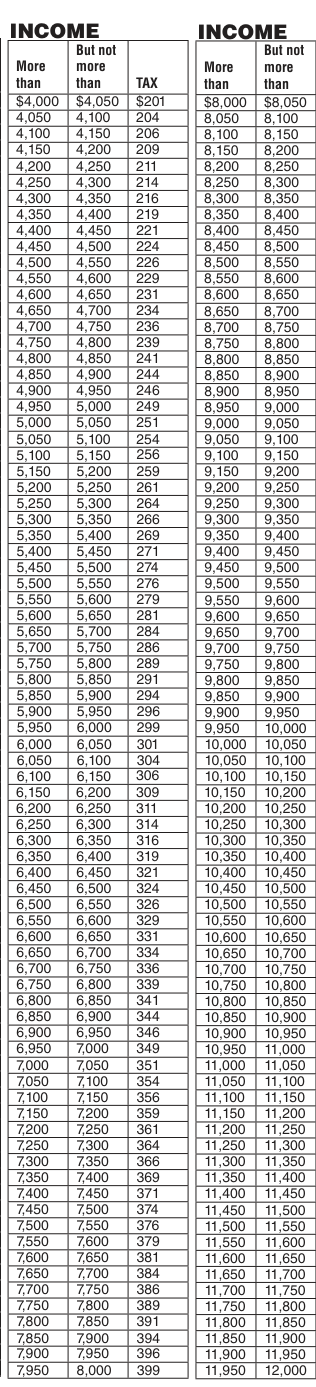
Text version of this table
| More than | But not more than | TAX |
|---|---|---|
| $4,000 | $4,050 | $201 |
| 4,050 | 4,100 | 204 |
| 4,100 | 4,150 | 206 |
| 4,150 | 4,200 | 209 |
| 4,200 | 4,250 | 211 |
| 4,250 | 4,300 | 214 |
| 4,300 | 4,350 | 216 |
| 4,350 | 4,400 | 219 |
| 4,400 | 4,450 | 221 |
| 4,450 | 4,500 | 224 |
| 4,500 | 4,550 | 226 |
| 4,550 | 4,600 | 229 |
| 4,600 | 4,650 | 231 |
| 4,650 | 4,700 | 234 |
| 4,700 | 4,750 | 236 |
| 4,750 | 4,800 | 239 |
| 4,800 | 4,850 | 241 |
| 4,850 | 4,900 | 244 |
| 4,900 | 4,950 | 246 |
| 4,950 | 5,000 | 249 |
| 5,000 | 5,050 | 251 |
| 5,050 | 5,100 | 254 |
| 5,100 | 5,150 | 256 |
| 5,150 | 5,200 | 259 |
| 5,200 | 5,250 | 261 |
| 5,250 | 5,300 | 264 |
| 5,300 | 5,350 | 266 |
| 5,350 | 5,400 | 269 |
| 5,400 | 5,450 | 271 |
| 5,450 | 5,500 | 274 |
| 5,500 | 5,550 | 276 |
| 5,550 | 5,600 | 279 |
| 5,600 | 5,650 | 281 |
| 5,650 | 5,700 | 284 |
| 5,700 | 5,750 | 286 |
| 5,750 | 5,800 | 289 |
| 5,800 | 5,850 | 291 |
| 5,850 | 5,900 | 294 |
| 5,900 | 5,950 | 296 |
| 5,950 | 6,000 | 299 |
| 6,000 | 6,050 | 301 |
| 6,050 | 6,100 | 304 |
| 6,100 | 6,150 | 306 |
| 6,150 | 6,200 | 309 |
| 6,200 | 6,250 | 311 |
| 6,250 | 6,300 | 314 |
| 6,300 | 6,350 | 316 |
| 6,350 | 6,400 | 319 |
| 6,400 | 6,450 | 321 |
| 6,450 | 6,500 | 324 |
| 6,500 | 6,550 | 326 |
| 6,550 | 6,600 | 329 |
| 6,600 | 6,650 | 331 |
| 6,650 | 6,700 | 334 |
| 6,700 | 6,750 | 336 |
| 6,750 | 6,800 | 339 |
| 6,800 | 6,850 | 341 |
| 6,850 | 6,900 | 344 |
| 6,900 | 6,950 | 346 |
| 6,950 | 7,000 | 349 |
| 7,000 | 7,050 | 351 |
| 7,050 | 7,100 | 354 |
| 7,100 | 7,150 | 356 |
| 7,150 | 7,200 | 359 |
| 7,200 | 7,250 | 361 |
| 7,250 | 7,300 | 364 |
| 7,300 | 7,350 | 366 |
| 7,350 | 7,400 | 369 |
| 7,400 | 7,450 | 371 |
| 7,450 | 7,500 | 374 |
| 7,500 | 7,550 | 376 |
| 7,550 | 7,600 | 379 |
| 7,600 | 7,650 | 381 |
| 7,650 | 7,700 | 384 |
| 7,700 | 7,750 | 386 |
| 7,750 | 7,800 | 389 |
| 7,800 | 7,850 | 391 |
| 7,850 | 7,900 | 394 |
| 7,900 | 7,950 | 396 |
| 7,950 | 8,000 | 399 |
# INCOME
But not But not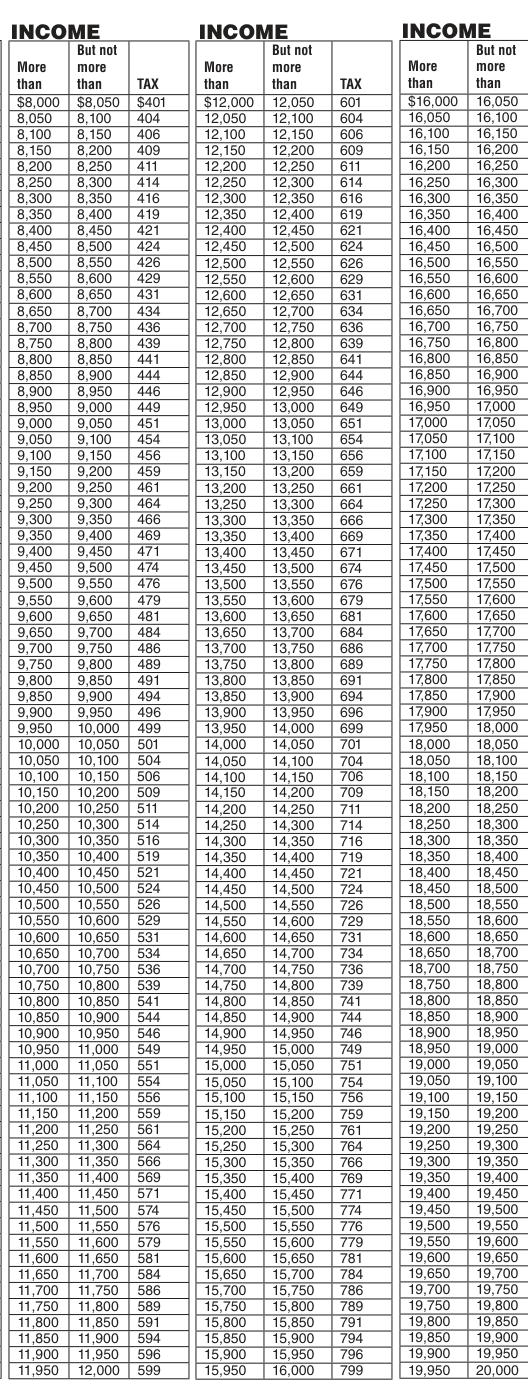
Text version of this table
More than But not more than TAX More than But not more than TAX $8,000 $8,050 $401 $12,000 12,050 601 8,050 8,100 404 12,050 12,100 604 8,100 8,150 406 12,100 12,150 606 8,150 8,200 409 12,150 12,200 609 8,200 8,250 411 12,200 12,250 611 8,250 8,300 414 12,250 12,300 614 8,300 8,350 416 12,300 12,350 616 8,350 8,400 419 12,350 12,400 619 8,400 8,450 421 12,400 12,450 621 8,450 8,500 424 12,450 12,500 624 8,500 8,550 426 12,500 12,550 626 8,550 8,600 429 12,550 12,600 629 8,600 8,650 431 12,600 12,650 631 8,650 8,700 434 12,650 12,700 634 8,700 8,750 436 12,700 12,750 636 8,750 8,800 439 12,750 12,800 639 8,800 8,850 441 12,800 12,850 641 8,850 8,900 444 12,850 12,900 644 8,900 8,950 446 12,900 12,950 646 8,950 9,000 449 12,950 13,000 649 9,000 9,050 451 13,000 13,050 651 9,050 9,100 454 13,050 13,100 654 9,100 9,150 456 13,100 13,150 656 9,150 9,200 459 13,150 13,200 659 9,200 9,250 461 13,200 13,250 661 9,250 9,300 464 13,250 13,300 664 9,300 9,350 466 13,300 13,350 666 9,350 9,400 469 13,350 13,400 669 9,400 9,450 471 13,400 13,450 671 9,450 9,500 474 13,450 13,500 674 9,500 9,550 476 13,500 13,550 676 9,550 9,600 479 13,550 13,600 679 9,600 9,650 481 13,600 13,650 681 9,650 9,700 484 13,650 13,700 684 9,700 9,750 486 13,700 13,750 686 9,750 9,800 489 13,750 13,800 689 9,800 9,850 491 13,800 13,850 691 9,850 9,900 494 13,850 13,900 694 9,900 9,950 496 13,900 13,950 696 9,950 10,000 499 13,950 14,000 699 10,000 10,050 501 14,000 14,050 701 10,050 10,100 504 14,050 14,100 704 10,100 10,150 506 14,100 14,150 706 10,150 10,200 509 14,150 14,200 709 10,200 10,250 511 14,200 14,250 711 10,250 10,300 514 14,250 14,300 714 10,300 10,350 516 14,300 14,350 716 10,350 10,400 519 14,350 14,400 719 10,400 10,450 521 14,400 14,450 721 10,450 10,500 524 14,450 14,500 724 10,500 10,550 526 14,500 14,550 726 10,550 10,600 529 14,550 14,600 729 10,600 10,650 531 14,600 14,650 731 10,650 10,700 534 14,650 14,700 734 10,700 10,750 536 14,700 14,750 736 10,750 10,800 539 14,750 14,800 739 10,800 10,850 541 14,800 14,850 741 10,850 10,900 544 14,850 14,900 744 10,900 10,950 546 14,900 14,950 746 10,950 11,000 549 14,950 15,000 749 11,000 11,050 551 15,000 15,050 751 11,050 11,100 554 15,050 15,100 754 11,100 11,150 556 15,100 15,150 756 11,150 11,200 559 15,150 15,200 759 11,200 11,250 561 15,200 15,250 761 11,250 11,300 564 15,250 15,300 764 11,300 11,350 566 15,300 15,350 766 11,350 11,400 569 15,350 15,400 769 11,400 11,450 571 15,400 15,450 771 11,450 11,500 574 15,450 15,500 774 11,500 11,550 576 15,500 15,550 776 11,550 11,600 579 15,550 15,600 779 11,600 11,650 581 15,600 15,650 781 11,650 11,700 584 15,650 15,700 784 11,700 11,750 586 15,700 15,750 786 11,750 11,800 589 15,750 15,800 789 11,800 11,850 591 15,800 15,850 791 11,850 11,900 594 15,850 15,900 794 11,900 11,950 596 15,900 15,950 796 11,950 12,000 599 15,950 16,000 799
# Where to find help
DOR's website at mass.gov/dor is a valuable resource for tax information 24 hours a day. Thousands of taxpayers use it to find answers to tax questions and to check the status of their refunds. Through MassTaxConnect, taxpayers can make estimated tax payments or review their estimated tax payment histories, in addition to many other options.
# Where to get forms and publications
Most Massachusetts tax forms and publications are available via the DOR website at mass.gov/dor/forms.
To obtain Massachusetts forms and publications by phone, call DOR's customer service at (617) 887-6367 or toll-free in Massachusetts at (800) 392-6089.
During the income tax filing season, you can pick up Massachusetts personal income tax forms at most local libraries.
Forms may also be available at local IRS district offices. Note: Call in advance to check on availability.
To obtain federal tax information and forms online, go to irs.gov or call the IRS toll-free at (800) 829-3676.
# For help in one of the following specific areas
◗ Certificates of Good Standing: Call (617) 887-6400 ◗ Installment Sales: Call (617) 887-6950 ◗ Requests for this publication in an alternative format, such as large print, can be sent to the Problem Resolution Office at (617) 626-3833.
Requests for other reasonable accommodations for individuals with disabilities can be directed to the Office of Diversity and Equal Opportunity by phone at (857) 286-1554 or by email at knightg@dor.state.ma.us.
To report allegations of suspected misconduct or impropriety involving DOR employees, call the Office of Ethics and Employee Responsibility's Integrity Hotline at (800) 568-0085 or write to PO Box 9568, Boston, MA 02114-9567.
Tables and rate charts from the source document
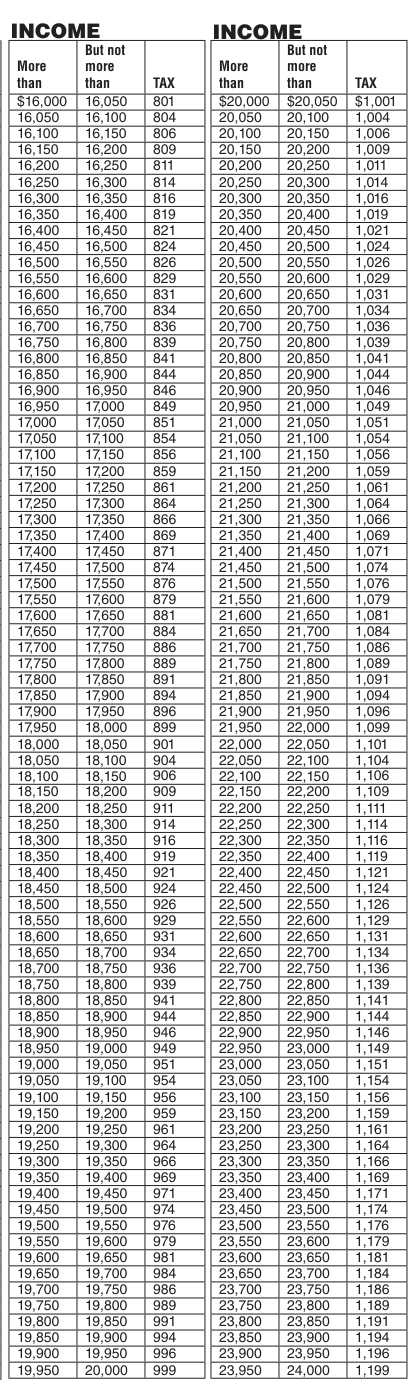
Text version of this table
| More than | But not more than | TAX | More than | But not more than | TAX |
|---|---|---|---|---|---|
| $16,000 | 16,050 | 801 | $20,000 | $20,050 | $1,001 |
| 16,050 | 16,100 | 804 | 20,050 | 20,100 | 1,004 |
| 16,100 | 16,150 | 806 | 20,100 | 20,150 | 1,006 |
| 16,150 | 16,200 | 809 | 20,150 | 20,200 | 1,009 |
| 16,200 | 16,250 | 811 | 20,200 | 20,250 | 1,011 |
| 16,250 | 16,300 | 814 | 20,250 | 20,300 | 1,014 |
| 16,300 | 16,350 | 816 | 20,300 | 20,350 | 1,016 |
| 16,350 | 16,400 | 819 | 20,350 | 20,400 | 1,019 |
| 16,400 | 16,450 | 821 | 20,400 | 20,450 | 1,021 |
| 16,450 | 16,500 | 824 | 20,450 | 20,500 | 1,024 |
| 16,500 | 16,550 | 826 | 20,500 | 20,550 | 1,026 |
| 16,550 | 16,600 | 829 | 20,550 | 20,600 | 1,029 |
| 16,600 | 16,650 | 831 | 20,600 | 20,650 | 1,031 |
| 16,650 | 16,700 | 834 | 20,650 | 20,700 | 1,034 |
| 16,700 | 16,750 | 836 | 20,700 | 20,750 | 1,036 |
| 16,750 | 16,800 | 839 | 20,750 | 20,800 | 1,039 |
| 16,800 | 16,850 | 841 | 20,800 | 20,850 | 1,041 |
| 16,850 | 16,900 | 844 | 20,850 | 20,900 | 1,044 |
| 16,900 | 16,950 | 846 | 20,900 | 20,950 | 1,046 |
| 16,950 | 17,000 | 849 | 20,950 | 21,000 | 1,049 |
| 17,000 | 17,050 | 851 | 21,000 | 21,050 | 1,051 |
| 17,050 | 17,100 | 854 | 21,050 | 21,100 | 1,054 |
| 17,100 | 17,150 | 856 | 21,100 | 21,150 | 1,056 |
| 17,150 | 17,200 | 859 | 21,150 | 21,200 | 1,059 |
| 17,200 | 17,250 | 861 | 21,200 | 21,250 | 1,061 |
| 17,250 | 17,300 | 864 | 21,250 | 21,300 | 1,064 |
| 17,300 | 17,350 | 866 | 21,300 | 21,350 | 1,066 |
| 17,350 | 17,400 | 869 | 21,350 | 21,400 | 1,069 |
| 17,400 | 17,450 | 871 | 21,400 | 21,450 | 1,071 |
| 17,450 | 17,500 | 874 | 21,450 | 21,500 | 1,074 |
| 17,500 | 17,550 | 876 | 21,500 | 21,550 | 1,076 |
| 17,550 | 17,600 | 879 | 21,550 | 21,600 | 1,079 |
| 17,600 | 17,650 | 881 | 21,600 | 21,650 | 1,081 |
| 17,650 | 17,700 | 884 | 21,650 | 21,700 | 1,084 |
| 17,700 | 17,750 | 886 | 21,700 | 21,750 | 1,086 |
| 17,750 | 17,800 | 889 | 21,750 | 21,800 | 1,089 |
| 17,800 | 17,850 | 891 | 21,800 | 21,850 | 1,091 |
| 17,850 | 17,900 | 894 | 21,850 | 21,900 | 1,094 |
| 17,900 | 17,950 | 896 | 21,900 | 21,950 | 1,096 |
| 17,950 | 18,000 | 899 | 21,950 | 22,000 | 1,099 |
| 18,000 | 18,050 | 901 | 22,000 | 22,050 | 1,101 |
| 18,050 | 18,100 | 904 | 22,050 | 22,100 | 1,104 |
| 18,100 | 18,150 | 906 | 22,100 | 22,150 | 1,106 |
| 18,150 | 18,200 | 909 | 22,150 | 22,200 | 1,109 |
| 18,200 | 18,250 | 911 | 22,200 | 22,250 | 1,111 |
| 18,250 | 18,300 | 914 | 22,250 | 22,300 | 1,114 |
| 18,300 | 18,350 | 916 | 22,300 | 22,350 | 1,116 |
| 18,350 | 18,400 | 919 | 22,350 | 22,400 | 1,119 |
| 18,400 | 18,450 | 921 | 22,400 | 22,450 | 1,121 |
| 18,450 | 18,500 | 924 | 22,450 | 22,500 | 1,124 |
| 18,500 | 18,550 | 926 | 22,500 | 22,550 | 1,126 |
| 18,550 | 18,600 | 929 | 22,550 | 22,600 | 1,129 |
| 18,600 | 18,650 | 931 | 22,600 | 22,650 | 1,131 |
| 18,650 | 18,700 | 934 | 22,650 | 22,700 | 1,134 |
| 18,700 | 18,750 | 936 | 22,700 | 22,750 | 1,136 |
| 18,750 | 18,800 | 939 | 22,750 | 22,800 | 1,139 |
| 18,800 | 18,850 | 941 | 22,800 | 22,850 | 1,141 |
| 18,850 | 18,900 | 944 | 22,850 | 22,900 | 1,144 |
| 18,900 | 18,950 | 946 | 22,900 | 22,950 | 1,146 |
| 18,950 | 19,000 | 949 | 22,950 | 23,000 | 1,149 |
| 19,000 | 19,050 | 951 | 23,000 | 23,050 | 1,151 |
| 19,050 | 19,100 | 954 | 23,050 | 23,100 | 1,154 |
| 19,100 | 19,150 | 956 | 23,100 | 23,150 | 1,156 |
| 19,150 | 19,200 | 959 | 23,150 | 23,200 | 1,159 |
| 19,200 | 19,250 | 961 | 23,200 | 23,250 | 1,161 |
| 19,250 | 19,300 | 964 | 23,250 | 23,300 | 1,164 |
| 19,300 | 19,350 | 966 | 23,300 | 23,350 | 1,166 |
| 19,350 | 19,400 | 969 | 23,350 | 23,400 | 1,169 |
| 19,400 | 19,450 | 971 | 23,400 | 23,450 | 1,171 |
| 19,450 | 19,500 | 974 | 23,450 | 23,500 | 1,174 |
| 19,500 | 19,550 | 976 | 23,500 | 23,550 | 1,176 |
| 19,550 | 19,600 | 979 | 23,550 | 23,600 | 1,179 |
| 19,600 | 19,650 | 981 | 23,600 | 23,650 | 1,181 |
| 19,650 | 19,700 | 984 | 23,650 | 23,700 | 1,184 |
| 19,700 | 19,750 | 986 | 23,700 | 23,750 | 1,186 |
| 19,750 | 19,800 | 989 | 23,750 | 23,800 | 1,189 |
| 19,800 | 19,850 | 991 | 23,800 | 23,850 | 1,191 |
| 19,850 | 19,900 | 994 | 23,850 | 23,900 | 1,194 |
| 19,900 | 19,950 | 996 | 23,900 | 23,950 | 1,196 |
| 19,950 | 20,000 | 999 | 23,950 | 24,000 | 1,199 |
Source: official DOR forms index (mass.gov)
Nearby sections (13 sections)
- form-1 · Form 1 — Resident Income Tax Return
- form-1-nr-py · Form 1-NR/PY — Nonresident/Part-Year Resident Return
- form-2 · Form 2 — Fiduciary Income Tax Return
- form-3 · Form 3 — Partnership Return of Income
- form-355 · Form 355 — Business/Manufacturing Corporation Excise Return
- form-355s · Form 355S — S Corporation Excise Return
- form-355u · Form 355U — Combined Reporting (Unitary)
- form-63d-elt · Form 63D-ELT — Pass-Through Entity Excise Tax (PTET)
- form-m-941 · Form M-941 — Employer's Quarterly Withholding Return
- form-ma-nrcr · Form MA NRCR — Nonresident Composite Return
- schedule-62-wh · Schedule 62-WH — Withholding for Composite Returns
- schedule-cms · Schedule CMS — Combined Manufacturer Submission
- schedule-tds · Schedule TDS — Taxpayer Disclosure Statement