Illinois Department of Revenue Form Instructions
Instructions for Schedule K-1-P (Part 2) — Partner's/Shareholder's Share
# Illinois Department of Revenue
Schedule K-1-P(2) Partner's and Shareholder's Instructions
What's New for 2025?
- A new step, Step 8, Your partner's share of retirement payments, has been added to Schedule K-1-P.
- The Illinois Gives income tax credit (Code 5670) has been added as Line 52q for tax years ending on or after December 31, 2025.
- The Advancing Innovative Manufacturing for Illinois income tax credit (Code 1050) has been added as Line 52v for tax years beginning on or after January 1, 2026.
- The Illinois Income Tax Act was amended to remove the expiration date for the pass-through entity tax.
# Table of Contents
What's New? . . . . . . . . . . . . . . . . . . . . . . . . . . . . . . . . . . . . . . . . . . . . . . . . . . . . . . . . . . . . . . . . . . . . . . . 1
# What is the purpose of Schedule K-1-P?
The partnership or the S corporation listed on the front of Schedule K-1-P has completed and provided you with the schedule to reflect your specific share of the partnership's or the S corporation's income, modifications, and credits. Use the completed schedule and these instructions to help you report the items shown on Schedule K-1-P on your Illinois Income Tax return.
# What must I attach?
You must attach a copy of any Schedule K-1-P you receive from partnerships and S corporations to your tax return. You should also keep a copy for your records.
If you receive a Schedule K-1-P that has "the following information is included in the Schedule K-1-P from __" (the name of the partnership or S corporation) written at the top, it is a pro forma Schedule K-1-P. The pro forma Schedule K-1-P has been included to aid you in the completion of your return and should not be submitted with your tax return.
# Definitions
• Pass-through entity - the partnership or S corporation that sent you Schedule K-1-P is a pass-through entity.
• Pass-through entity income is the income reported on your Schedule K-1-P.
• Pass-through withholding is the amount paid by the pass-through entity on your behalf. This amount is listed on Line 55 of your Schedule K-1-P. Not everyone who receives a Schedule K-1-P will have pass-through withholding reported. If you are a resident of Illinois or if you submitted Form IL-1000-E, Certificate of Exemption for Pass-through Withholding Payments, to the pass-through entity, then you will not have pass-through withholding reported on your Schedule K-1-P. In this case, you will be responsible for reporting and paying Illinois Income tax on the pass-through income.
Schedule K-1-P(2) (R-12/25) Printed by the authority of the state of Illinois - electronic only - one copy.
- Investment partnership withholding is the amount paid by an investment partnership on your behalf. This amount is listed on Line 55 of your Schedule K-1-P. Not everyone who receives a Schedule K-1-P will have investment partnership withholding reported. If you are an Illinois resident partner of an investment partnership, or if the investment partnership in which you are a partner does not have any income subject to investment partnership withholding, then you will not have investment partnership withholding reported on your Schedule K-1-P. In this case, you will be responsible for reporting and paying Illinois Income tax on any income distributed to you on the Illinois Schedule K-1-P less any Pass-through Entity tax credit distributed to you.
- Pass-through Entity (PTE) tax is an amount equal to 4.95 percent (.0495) of the taxpayer's calculated net income for the taxable year paid by a partnership (other than a publicly traded partnership under Section 7704 of the Internal Revenue
Code) or subchapter S corporation who elects to pay the tax for taxable years ending on or after December 31, 2021.
• PTE tax credit is the amount distributed to partners or shareholders by a partnership or S corporation if the election to pay PTE tax was made. This amount is reported on Schedule K-1-P.
If a PTE made the election to pay PTE tax, then it passed through to its members both
○the credit for PTE tax it paid and
○each member's distributive share of the PTE tax credit it received from electing pass-through entities in which it is a member.
Note: Investment partnerships may use the PTE tax credit to offset their investment partnership liability, to the extent that such credit would otherwise be distributable to its nonresident partners. See the Form IL-1065 and Schedule K-1-P(1) for more information.
A nonresident individual member of a partnership or S corporation for a taxable year in which the election to pay PTE tax was made shall not be required to file an income tax return under the Illinois Income Tax Act (IITA) for such taxable year if the only source of net income of the individual (or the individual and the individual's spouse in the case of a joint return) is from an entity making the PTE election and the credit allowed to the member equals or exceeds the individual's liability for the tax imposed under subsections (a) and (b) of Section 201 of the IITA for the taxable year.
# When is pass-through entity income earned?
Pass-through entity income is considered earned on the last day of the pass-through entity's taxable year. Pass-through entity income is not considered received equally throughout the year. The pass-through entity's tax year ending date is listed in the upper right corner of the Schedule K-1-P you received.
# What if the partnership is an investment partnership?
If the partnership that completed the Schedule K-1-P entered "investment partnership" in Step 1, Line 4, all of the income you receive from the partnership is usually treated as nonbusiness income that is allocable to your state of residence (individuals) or state of commercial domicile (all other persons or entities). However, the income you receive from the partnership will be treated as business income if your investment in the partnership is related to another business activity of yours or serves an operational function to another business activity of yours or where your contribution to the partnership was made out of working capital from your trade or business.
If you are a nonresident partner and your income is treated as nonbusiness income, you are not eligible to use the investment partnership withholding credit reported to you on Schedule K-1-P, Step 7, Line 55, from the investment partnership.
If your income is treated as business income, you must apportion it as if you had earned the income directly, rather than through the partnership, and you may use the investment partnership withholding reported to you on Schedule K-1-P, Step 7, Line 55, to offset your liability. The apportionment should be completed on the correct forms, as follows:
• Nonresident individuals - use Form IL-1040, Schedule NR.
• Nonresident trusts and estates - use Form IL-1041, Schedule NR.
• Corporations (excluding S corporations) - use Form IL-1120 and complete Step 4, Figure your income allocable to Illinois.
- Partnerships or S corporations - use Form IL-1065 or Form IL-1120-ST and complete Step 6, Figure your income allocable to Illinois.
• Exempt organizations - use Form IL-990-T and complete Step 3, Figure your income allocable to Illinois.
If you are eligible to use the investment partnership withholding to offset your liability, treat the investment partnership withholding credit the same way you treat the pass-through withholding credit, unless specific instructions are given.
Illinois residents may not include any income from an investment partnership in Column B of their Schedule CR.
Note: Investment partnerships receiving income from other investment partnerships must determine if the income received is considered business income. If so, they must complete a pro-forma Form IL-1065 where the business income received from investment partnerships is apportioned as if the receiver had earned it directly. The apportioned amount will be used to calculate investment partnership withholding on Schedule(s) K-1-P(4). See Schedule K-1-P (1) for more information.
What if I am engaged in a unitary business with this partnership?
If you are engaged in a unitary business with this partnership but the partnership is not included in your Schedule UB, Combined Apportionment for Unitary Business Group, the partnership should have attached a schedule showing your share of the partnership's apportionment factors and business income. You must determine the portion of your business income taxed by Illinois by adding your share of the partnership's business income and apportionment factors to your own business income and apportionment factors. If the partnership is included in your Schedule UB, report the items on the Schedule K-1-P in the same manner as you would report the items from a non-unitary partner.
What if I am a Grantor Trust or Disregarded Entity?
If you are a grantor trust or other disregarded entity for federal and Illinois income tax purposes, check the applicable box on Line 9b, enter the name and identification number of the taxpayer that will report the income or loss from your Schedule K-1-P on their tax return, and provide them with a copy of the Schedule K-1-P and a copy of these instructions.
What if I received Schedule K-1-P from a Grantor Trust or Disregarded Entity?
If the grantor trust or disregarded entity checkbox on Line 9b is checked and your name and identification number are listed, report the items from the Schedule K-1-P as if it were provided to you by the taxpayer in Step 1.
What if I believe the partnership or the S corporation has made an error on my Schedule K-1-P?
If you believe the partnership or the S corporation has made an error on your Schedule K-1-P, notify the partnership or the S corporation and ask for a corrected Schedule K-1-P. Do not change any items on your copy.
What does Column A represent?
Column A represents your specific share of the partnership's or the S corporation's income, modifications, and credits. The partnership or the S corporation is required to complete this column if you were a partner or shareholder at any time during the partnership's or the S corporation's tax year. If you were a resident of Illinois on the last day of the partnership's or S corporation's taxable year, all amounts in Column A must be included as income, modifications, and credits allocated to Illinois. If you were a resident of Illinois on the last day of the partnership's or the S corporation's tax year, and you are claiming a credit for taxes paid to another state, see "What does Column B represent?" below.
What does Column B represent?
Column B represents the portion of Column A that is allocated or apportioned to Illinois. If you were not a resident of Illinois on the last day of the partnership's or the S corporation's tax year, be sure the amounts reported in Column B are included in the Illinois amounts reported on your
- Form IL-1040, Schedule NR, Nonresident and Part-Year Resident Computation of Illinois Tax, Column B;
- Form IL-1041, Schedule NR, Nonresident Computation of Fiduciary Income, Column B;
- Form IL-1120, Step 4, Figure your income allocable to Illinois;
- Form IL-1065 or Form IL-1120-ST, Step 6, Figure your income allocable to Illinois; or
- Form IL-990-T, Step 3, Figure your income allocable to Illinois.
If you were a resident of Illinois on the last day of the partnership's or the S corporation's tax year, and you are claiming a credit for taxes paid to another state, subtract the amount of each item in Column B from the amount of that item in Column A, and include the difference in the Non-Illinois Portion column for that item on your
- Form IL-1040, Schedule CR, Credit for Tax Paid to Other States, or
- Form IL-1041, Schedule CR, Credit for Tax Paid to Other States.
What does Steps 3 and 4, Column B, represent?
Step 3, Column B, represents your share of the partnership's or the S corporation's nonbusiness income allocated to Illinois. Step 4, Column B, represents your share of the partnership's or the S corporation's business income apportioned to Illinois.
Why are retirement payments to retired partners included on Schedule K-1-P?
Retirement payments distributed to retired partners are eligible as a subtraction modification for individual, trust, and estate taxpayers to the extent that the income realized from the payments are included in the individual's federal adjusted gross income or the trust's or estate's federal taxable income.
Should I round?
You must round the dollar amounts on Schedules K-1-P and Schedules K-1-P(3) to whole-dollar amounts. To do this, you should drop any amount less than 50 cents and increase any amount of 50 cents or more to the next higher dollar.
What if I need additional assistance or forms?
- For assistance, forms, or schedules, visit our website at tax.illinois.gov or scan the QR code provided.
- Write us at:
ILLINOIS DEPARTMENT OF REVENUE
PO BOX 19001
SPRINGFIELD IL 62794-9001
- Call 1 800 732‑8866 or 217 782-3336 (TTY at 1 800 544-5304).
- Visit a taxpayer assistance office - 8:00 a.m. to 5:00 p.m. (Springfield office) and 8:30 a.m. to 5:00 p.m. (all other offices), Monday through Friday.
# Step-by-Step Instructions for individuals filing Form IL-1040
If you were a resident of Illinois on the last day of the partnership's or S corporation's taxable year and you are not claiming a credit for taxes paid to another state, you will follow the Column A instructions beginning with Step 5. The figures in Steps 3 and 4 are included in the Adjusted Gross Income reported on Line 1 of your Form IL-1040.
If the partnership that completed the Schedule K-1-P entered "investment partnership" in Step 1, Line 4, then Column B should be blank. Do not use the Column B instructions. Instead, refer to the instructions under General Information, "What if the partnership is an investment partnership?"
# Column A Column B
Line 12
Line 13
Line 14
Line 15
Line 20
Line 21
Line 22
Line 25
Line 28
Line 29
Total
Do not double count items reported as both unrecaptured Section 1250 gains on Schedule K-1-P, Line 28, and as Section 1231 gains on Schedule K-1-P, Line 30.
Nonresidents: Include the total amount from Column B on your Form IL-1040, Schedule NR, Step 3, Line 15, Column B.
Residents claiming taxes paid in other states: Subtract the amount in Column B from the total amount in Column A, and include the result on your Form IL-1040, Schedule CR, Step 2, Line 11, Column B.
Capital gain or loss - (Lines 16 - 18 and 26 - 27)
Enter the amounts from Columns A and B for each line, and total the amounts for each column.
# Column A Column B
Line 16
Line 17
Line 18
Line 26
Line 27
Total
Nonresidents: Include the total amount from Column B on your Form IL-1040, Schedule NR, Step 3, Line 11, Column B.
You may include any capital loss amounts on your Form IL-1040, Schedule NR, Step 3, Line 11, Column B, only to the extent those loss amounts are included in your federal adjusted gross income.
Residents claiming taxes paid in other states: Subtract the amount in Column B from the total amount in Column A, and include the result on your Form IL-1040, Schedule CR, Step 2, Line 7, Column B.
Other gains or losses - (Lines 28 and 30)
Do not double count items reported as both unrecaptured Section 1250 gains on Schedule K-1-P, Line 28, and as Section 1231 gains on Schedule K-1-P, Line 30.
Nonresidents: Include the amount from Step 4, Line 30, Column B, on your Form IL-1040, Schedule NR, Step 3, Line 12, Column B.
Residents claiming taxes paid in other states: Subtract the amount on Step 4, Line 30, Column B, from the amount on Step 4, Line 30, Column A, and include the result on your Form IL-1040, Schedule CR, Step 2, Line 8, Column B.
Other income - (Lines 19 and 31)
The partnership or the S corporation is required to identify or send you a breakdown of the items reported on Step 3, Line 19, and Step 4, Line 31. This identification or breakdown will determine on what lines of your federal return you need to report the income in Column A.
Nonresidents: The amounts reported in Column B need to be reported on the corresponding lines of your Form IL-1040, Schedule NR, Step 3, Column B.
Residents claiming taxes paid in other states: Subtract the amounts in Column B from the corresponding amounts in Column A, and include the results on the appropriate lines of your Form IL-1040, Schedule CR, Step 2, Column B.
# Step-by-Step Instructions for trusts or estates filing Form IL-1041
If you were a resident of Illinois on the last day of the partnership's or S corporation's taxable year and you are not claiming a credit for taxes paid to another state, you will follow the Column A instructions beginning with Step 5. The figures in Steps 3 and 4 are included in the Federal Taxable Income reported on Line 1 of your IL-1041.
If the partnership that completed the Schedule K-1-P entered "investment partnership" in Step 1, Line 4, then Column B should be blank. Do not use the Column B instructions for this step. Instead, refer to the instructions under General Information, "What if the partnership is an investment partnership?"
# Step-by-Step Instructions for corporations filing Form IL-1120
If the partnership that completed the Schedule K-1-P entered "investment partnership" in Step 1, Line 4, then Column B should be blank. Do not use the Column B instructions for this step. Instead, refer to the instructions under General Information, "What if the partnership is an investment partnership?"
# Step 5 - Your share of Illinois additions and subtractions —
Column A - Member's share of business amounts —
Lines 32 through 47 (excluding Line 38b) -
Enter the total of any business amounts from Lines 32 through 37 and 38a through 47 (excluding Line 38b), Column A.
A Total of business amounts from Lines 32 through 37, Column A.
B Total of business amounts from Lines 38a through 47 (excluding Line 38b), Column A.
C Subtract Line B from Line A.
Include the total amount from Line C in the total amount reported on Step 3, Line 4, of your Form IL-990-T.
Column B - Illinois share of business amounts —
Lines 32 through 47 (excluding Line 38b) -
Enter the total of any business amounts from Lines 32 through 37 and 38a through 47 (excluding Line 38b), Column B.
A Total of business amounts from Lines 32 through 37, Column B.
B Total of business amounts from Lines 38a through 47 (excluding Line 38b), Column B.
C Subtract Line B from Line A.
Include the total amount from Line C in the total amount reported on Step 3, Line 10, of your Form IL-990-T.
Step 7 - Your share of Illinois credits, recapture, withholding payments, pass-through entity tax credit, and federal income subject to surcharge — If the partnership or S corporation has passed through to you any credit, recapture amounts, income tax payments made on your behalf, or federal income subject to surcharge on Lines 52a through 57, see the specific instructions for Step 7 at the end of these instructions for more information.
Step 8 - Your partner's share of retirement payments — Disregard this section. Exempt organizations are not eligible to report Line 58 as a modification.
Step-by-Step Instructions for Step 7 - Your share of the Illinois credits, recapture, withholding, pass-through entity tax credit, and federal income subject to surcharge
Line 52 - Illinois Income Tax Credits — For each Line 52a through 52ee that has an amount listed in Step 7 of Schedule K-1-P, enter, on your Schedule 1299, the corresponding Credit Code and the amount of Distributive Share of Credit from 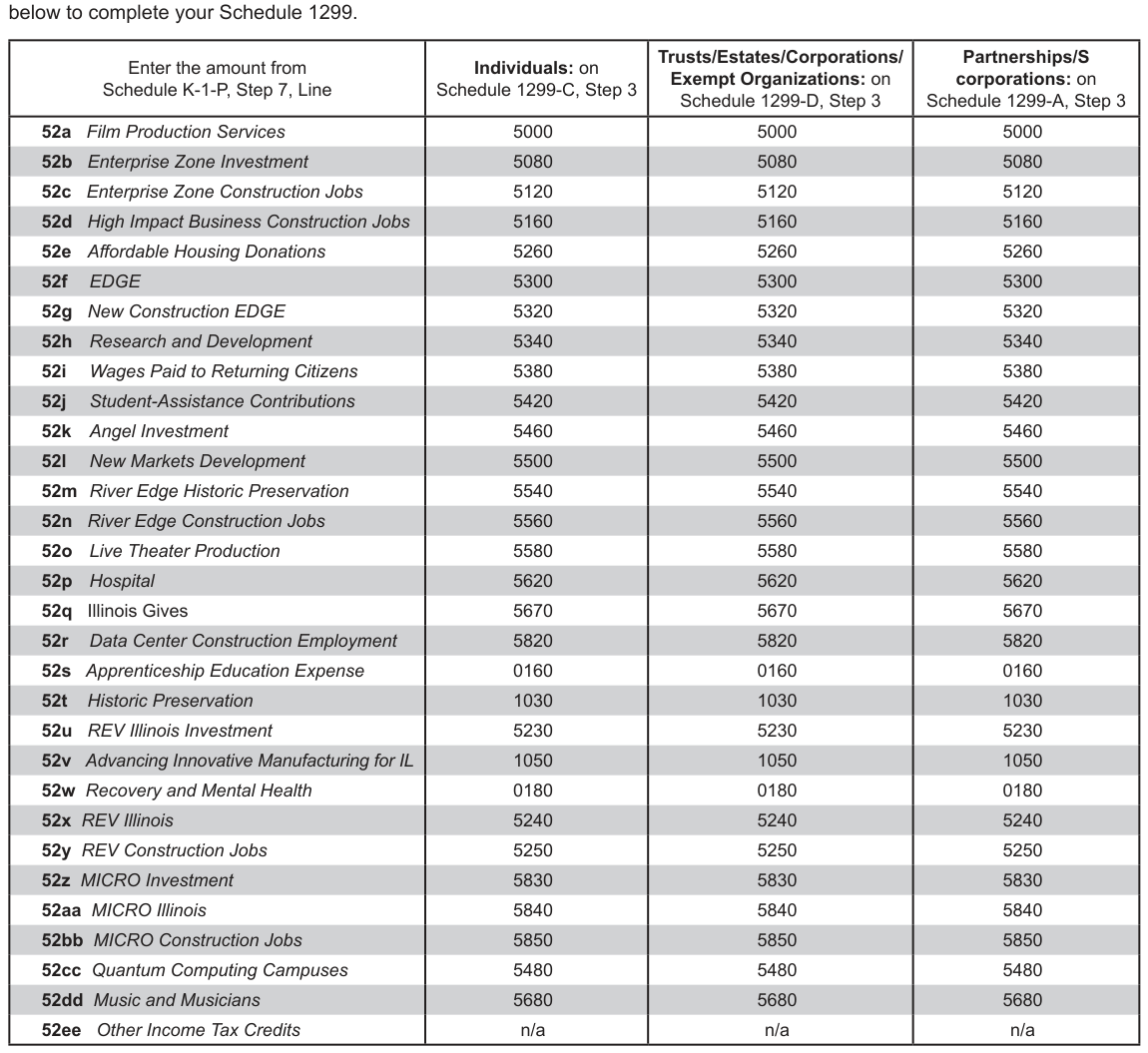
Text version of this table
Enter the amount from Schedule K-1-P, Step 7, Line Individuals: on Schedule 1299-C, Step 3 Trusts/Estates/Corporations/ Exempt Organizations: on Schedule 1299-D, Step 3 Partnerships/S corporations: on Schedule 1299-A, Step 3 52a Film Production Services 5000 5000 5000 52b Enterprise Zone Investment 5080 5080 5080 52c Enterprise Zone Construction Jobs 5120 5120 5120 52d High Impact Business Construction Jobs 5160 5160 5160 52e Affordable Housing Donations 5260 5260 5260 52f EDGE 5300 5300 5300 52g New Construction EDGE 5320 5320 5320 52h Research and Development 5340 5340 5340 52i Wages Paid to Returning Citizens 5380 5380 5380 52j Student-Assistance Contributions 5420 5420 5420 52k Angel Investment 5460 5460 5460 52l New Markets Development 5500 5500 5500 52m River Edge Historic Preservation 5540 5540 5540 52n River Edge Construction Jobs 5560 5560 5560 52o Live Theater Production 5580 5580 5580 52p Hospital 5620 5620 5620 52q Illinois Gives 5670 5670 5670 52r Data Center Construction Employment 5820 5820 5820 52s Apprenticeship Education Expense 0160 0160 0160 52t Historic Preservation 1030 1030 1030 52u REV Illinois Investment 5230 5230 5230 52v Advancing Innovative Manufacturing for IL 1050 1050 1050 52w Recovery and Mental Health 0180 0180 0180 52x REV Illinois 5240 5240 5240 52y REV Construction Jobs 5250 5250 5250 52z MICRO Investment 5830 5830 5830 52aa MICRO Illinois 5840 5840 5840 52bb MICRO Construction Jobs 5850 5850 5850 52cc Quantum Computing Campuses 5480 5480 5480 52dd Music and Musicians 5680 5680 5680 52ee Other Income Tax Credits n/a n/a n/a
Line 52a - Film Production Services
Line 52b - Enterprise Zone Investment
Line 52c - Enterprise Zone Construction Jobs
Line 52d - High Impact Business Construction Jobs
Line 52e - Affordable Housing Donations
Line 52f - Economic Development for a Growing Economy (EDGE)
Line 52g - New Construction EDGE
Line 52h - Research and Development
Line 52i - Wages Paid to Returning Citizens
Line 52j - Student-Assistance Contributions
Line 52k - Angel Investment
Line 52l - New Markets Development
Line 52m - River Edge Historic Preservation
Line 52n - River Edge Construction Jobs
Line 52o - Live Theater Production
Line 52p - Hospital
Line 52q - Illinois Gives
Line 52r - Data Center Construction Employment
Line 52s - Apprenticeship Education Expense
Line 52t - Historic Preservation
Line 52u - REV Illinois Investment
Line 52v - Advancing Innovative Manufacturing for Illinois
Line 52w - Recovery and Mental Health
Line 52x - REV Illinois
Line 52y - REV Construction Jobs
Line 52z - MICRO Investment
Line 52aa - MICRO Illinois
Line 52bb - MICRO Construction Jobs
Line 52cc - Quantum Computing Campuses
# Line 52dd - Music and Musicians
Line 52ee - Other income tax credits
Note: Partnerships and S corporations that receive income tax credit may use the credit to offset their nonresident members' withholding liability. Amounts or portions of the amounts received on Lines 52a through 52ee may be entered on Schedule K-1-P(3), Step 3, Line 17, to offset pass-through withholding or Schedule K-1-P(4), Step 4, Line 10, to offset investment partnership withholding. See Schedule K-1-P(1) for more information.
Line 53a — PTE tax credit — If the partnership or S corporation distributed PTE tax credit to you, include the amount on
• Individuals — Form IL-1040, Step 8, Line 28.
• Trusts or Estates —
○Form IL-1041, Line 55d, if the PTE tax credit amount is retained by the fiduciary.
○Schedule K-1-T, Line 50, if the PTE tax credit amount is distributed to your beneficiaries.
- Partnerships or S corporations — each partner's or shareholder's Schedule K-1-P, Line 53a. Enter that partner's or shareholder's distributive share.
• Corporations — Form IL-1120, Line 61d.
• Exempt organizations — Form IL-990-T, Line 29d.
The credit on Line 53a is allowed against the tax imposed on the member under IITA subsections 201(a) and (b).
A nonresident individual member of a partnership or S corporation for a taxable year in which the election to pay PTE tax was made shall not be required to file an income tax return under the IITA for such taxable year if the only source of net income of the individual (or the individual and the individual's spouse in the case of a joint return) is from an entity making the PTE election and the credit allowed to the member equals or exceeds the individual's liability for the tax imposed under subsections
(a) and (b) of Section 201 of the IITA for the tax year.
Note: Investment partnerships that receive PTE tax credit may use the credit to offset their investment partnership withholding liability, to the extent that such credit would otherwise be distributable to its nonresident partners. The amount or a portion of the amount received on Line 53a may be entered on Schedule K-1-P(4), Step 4, Line 12, to offset investment partnership withholding. See Schedule K-1-P (1) for more information.
Line 53b — Enter this amount on Form IL-477, Line 4.
Note: Partnerships and S corporations that receive replacement tax investment credit may use the credit to offset their nonresident members' withholding liability. The amount or a portion of the amount received on Lines 53b may be entered on Schedule K-1-P(3), Step 3, Line 14, to offset pass-through withholding or Schedule K-1-P(4), Step 4, Line 11, to offset investment partnership withholding. See Schedule K-1-P(1) for more information.
Lines 54a, 54b, 54c, 54d, and 54e — Recapture — Your share of recapture is based on your share of the original investment credit.
- If you shared in the original investment credit and you are no longer a partner or shareholder of the partnership or the S corporation in the year of recapture, Lines 54a, 54b, 54c, 54d, and 54e will be the only lines completed on this schedule.
- If your share in the year of the original investment credit is different from your share in the year of the recapture, Lines 54a, 54b, 54c, 54d, and 54e will be completed and the partnership or the S corporation will attach a sheet explaining the difference.
If recapture is reported to you for a particular investment credit, and you claimed the corresponding credit against your Illinois income or replacement tax liability in a previous year, you must file a completed Illinois Income Tax return including Schedule 4255. Include the total amount from
- Schedule K-1-P, Lines 54a, 54b, 54c, and 54d on Schedule 4255, Step 6, Line 19, and
- Schedule K-1-P, Line 54e on Schedule 4255, Step 7, Line 32.
Line 55 — If the partnership or S corporation made income tax payments on your behalf, include the amount on your
- Form IL-1040, Step 8, Line 27,
- Form IL-1041, Step 7, Line 55c,
- Form IL-1065, Step 10, Line 65c,
- Form IL-1120-ST, Step 10, Line 65c,
- Form IL-1120, Step 8, Line 61c, or
- Form IL-990-T Step 6, Line 29c.
Schedule K-1-P, Step 1, Line 3, must be completed or the pass-through withholding (including any applicable investment partnership withholding) reported on this line may not be credited to your return.
Note: Individuals, trusts, estates, partnerships, and corporations (including S corporations) only - Pass-through withholding payments made on your behalf and reported to you on Schedule K-1-P, Line 55, are based on items of business income and certain items of nonbusiness income only. If you had Illinois income from other sources and the payments made on your behalf do not cover your liability, you must file a return to report the tax on all of your Illinois income and claim a credit for pass-through withholding payments made on your behalf.
Note: Partners in an investment partnership that have been distributed an investment partnership withholding credit must determine if they are eligible to claim the credit prior to claiming the credit on their return. See "What if the partnership is an investment partnership?" section in these instructions for more information.
Line 56 — This is your share of taxable gains attributable to transactions subject to the Compassionate Use of Medical Cannabis Program Act surcharge. Use this information when calculating the surcharge on your return.
See the following instructions and the instructions for the return you are filing for more information.
Definitions related to the surcharge —
Organization registrant means a corporation, partnership, trust, limited liability company (LLC), or other organization that holds either a medical cannabis cultivation center registration issued by the Illinois Department of Agriculture or a medical cannabis dispensary registration issued by the Illinois Department of Financial and Professional Regulation.
Transactions subject to the surcharge means sales and exchanges of
- capital assets;
- depreciable business property;
- real property used in the trade or business; and
- Section 197 intangibles of an organization registrant.
What is the surcharge?
For each taxable year beginning or ending during the Compassionate Use of Medical Cannabis Program, a surcharge is imposed on all taxpayers on income arising from the transactions subject to the surcharge of an organization registrant under the Compassionate Use of Medical Cannabis Program Act.
The amount of the surcharge is equal to the amount of federal income tax liability for the taxable year attributable to the transactions subject to the surcharge.
To whom does the surcharge apply?
The surcharge is imposed on any taxpayer who incurs a federal income tax liability on the income realized on a "transaction subject to the surcharge," including individuals and other taxpayers who are not themselves the "organization registrant" that engaged in the transaction.
A partner or shareholder who incurs a federal income tax liability on income from a transaction subject to surcharge passed through from a partnership or S corporation will incur a surcharge.
Note: Although a unitary business group filing combined Illinois returns is treated as a single taxpayer and its members are jointly and severally liable for any surcharge imposed on the group, the group itself is not an organization registrant and transactions of any member that is not itself an organization registrant are not subject to the surcharge.
How do I use the amount reported on Line 56?
The amount reported on Line 56 identifies your share of any taxable gains attributable to transactions subject to the surcharge.
The partnership and S corporation listed in Step 1 should have also provided you with a breakdown itemizing any amount reported on Line 56.
Use this information when completing the "Surcharge Worksheet" found in the Form IL-1120 Instructions. Line 56 identifies taxable gains attributable to transactions subject to the surcharge that should not be included when you complete Line 2 of the worksheet.
Note: The amount on Line 56 identifies taxable gains attributable to transactions subject to the surcharge, not federal income tax liability for the taxable year attributable to the transactions subject to the surcharge. Exclude this income before figuring the federal income tax amount on Line 2 of the worksheet.
For more information, see 86 Ill. Adm. Code Section 100.2060. Line 57 — This is your share of taxable gains attributable to transactions subject to the surcharge on the sale of assets by gaming licensee. Use this information when calculating the surcharge on your return.
See the instructions below and the instructions for the return you are filing for more information.
Definitions related to the surcharge —
Gaming licensee is an organization licensee under the Illinois Horse Racing Act of 1975 and/or an organization gaming licensee under the Illinois Gambling Act.
Transactions subject to the surcharge means sales and exchanges of
- capital assets;
- depreciable business property;
- real property used in the trade or business; and
- Section 197 intangibles of a gaming licensee.
What is the surcharge?
For each taxable year 2019 through 2027, a surcharge is imposed on all taxpayers on income arising from the transactions subject to the surcharge on the sale of assets by gaming licensee.
The amount of the surcharge is equal to the amount of federal income tax liability for the taxable year attributable to the transactions subject to the surcharge.
To whom does the surcharge apply?
The surcharge is imposed on any taxpayer who incurs a federal income tax liability on the income realized on a "transaction subject to the surcharge," including individuals and other taxpayers who are not themselves the "gaming licensee" that engaged in the transaction.
The surcharge imposed shall not apply if
- the organization gaming license, organization license, or racetrack property is transferred as a result of any of the following:
○bankruptcy, a receivership, or a debt adjustment initiated by or against the initial licensee or the substantial owners of the initial licensee;
○cancellation, revocation, or termination of any such license by the Illinois Gaming Board or the Illinois Racing Board;
○a determination by the Illinois Gaming Board that transfer of the license is in the best interests of Illinois gaming;
○the death of an owner of the equity interest in a licensee;
○acquisition of a controlling interest in the stock or substantially all of the assets of a publicly traded company;
○a transfer by a parent company to a wholly owned subsidiary; or
○the transfer or sale to or by one person to another person where both persons were initial owners of the license when the license was issued; or
- the controlling interest in the organization gaming license, organization license, or racetrack property is transferred in a transaction to lineal descendants in which no gain or loss is recognized or as a result of a transaction in accordance with Section 351 of the Internal Revenue Code in which no gain or loss is recognized; or
- live horse racing was not conducted in 2010 at a racetrack located within 3 miles of the Mississippi River under a license issued pursuant to the Illinois Horse Racing Act of 1975.
The transfer of an organization gaming license, organization license, or racetrack property by a person other than the initial licensee to receive the organization gaming license is not subject to a surcharge.
A partner or shareholder who incurs a federal income tax liability on income from a transaction subject to surcharge passed through from a partnership or S corporation will incur a surcharge.
Note: Although a unitary business group filing combined Illinois returns is treated as a single taxpayer and its members are jointly and severally liable for any surcharge imposed on the group, the group itself is not a gaming licensee and transactions of any member that is not itself a gaming licensee are not subject to the surcharge.
How do I use the amount reported on Line 57?
The amount reported on Line 57 identifies your share of any taxable gains attributable to transactions subject to the surcharge.
The partnership and S corporation listed in Step 1 should have also provided you with a breakdown itemizing any amount reported on Line 57.
Use this information when completing the "Surcharge Worksheet" found in the Form IL-1120 instructions. Line 57 identifies federal income attributable to transactions subject to the surcharge that should not be included when you complete Line 2 of the worksheet.
Note: The amount on Line 57 identifies taxable gains attributable to transactions subject to the surcharge, not federal income tax liability for the taxable year attributable to the transactions subject to the surcharge. Exclude this income before figuring the federal income tax amount on Line 2 of the worksheet.
Source: view the official PDF
Nearby sections (17 sections)
- il-1065 · Instructions for Form IL-1065 — Partnership Replacement Tax…
- il-1065-x · Instructions for Form IL-1065-X — Amended Partnership…
- il-1120 · Instructions for Form IL-1120 — Corporation Income &…
- il-1120-st · Instructions for Form IL-1120-ST — Small Business…
- il-1041 · Instructions for Form IL-1041 — Fiduciary Income &…
- il-1041-sch-k-1-t-1 · Instructions for Schedule K-1-T (Part 1) —…
- il-1041-sch-k-1-t-2 · Instructions for Schedule K-1-T (Part 2) —…
- sch-k-1-p-1 · Instructions for Schedule K-1-P (Part 1) —…
- sch-k-1-p-2 · Instructions for Schedule K-1-P (Part 2) —…
- sch-ub · Instructions for Schedule UB — Combined Apportionment for…
- il-1040 · Instructions for Form IL-1040 — Individual Income Tax Return
- il-1040-sch-cr · Instructions for Schedule CR — Credit for Tax Paid to…
- il-1040-sch-nr · Instructions for Schedule NR — Nonresident & Part-Year…
- il-941 · Instructions for Form IL-941 — Illinois Withholding Income Tax…
- il-w-4 · Form IL-W-4 — Employee's Illinois Withholding Allowance…
- st-1 · Instructions for Form ST-1 — Sales and Use Tax Return
- st-1-x · Instructions for Form ST-1-X — Amended Sales and Use Tax Return