Illinois Department of Revenue Form Instructions
Instructions for Form IL-1040 — Individual Income Tax Return
# Protecting Illinois Taxpayers
Our enhanced efforts to protect Illinois taxpayers from identity theft and tax fraud have proven to be highly successful. We will continue to combat the criminals attempting to steal your identity to file fraudulent tax returns while making every effort to get your tax refund to you as quickly as possible.
Please remember, filing your return electronically and requesting direct deposit is still the fastest way to receive your refund. You can file for free using MyTax Illinois, our online account management program for taxpayers. For more information, go to mytax. illinois.gov or visit our website.
# Form IL-1040 Due Date
The due date for filing your 2025 Form IL-1040 and paying any tax you owe is April 15, 2026.
# Income Tax Rate
The Illinois income tax rate is 4.95 percent (.0495).
# Exemption Allowance
The personal exemption amount for tax year 2025 is $2,850.
# Specific Form Changes
Forms IL-1040 and IL-1040-X
Step 1, Line A - Full date of birth is now required.
Step 12, Line 42 - Checkboxes and additional information were added to the Health Insurance Checkbox. (IL-1040 only)
Schedule M
Step 3, Line 18 - medical debt relief subtraction was added.
Step 3, Line 30 - was re-worded per legislative update.
Schedule IL-E/EITC
Step 2, Line 1 - dependent amount was updated.
Step 5 - Illinois Child Tax Credit amount was increased to 40 percent of the Illinois Earned Income Tax Credit.
Illinois Expanded EITC Worksheet - Part 5, Lines 16 and 21 - income limits were updated per federal guidance.
What's New for 2025?
IL-1040 Instructions (R-02/25)
Printed by authority of the state of Illinois. Electronic only, one copy.
# Mailing your income tax return:
If no payment is enclosed, mail your return to: If a payment is enclosed, mail your return to:
ILLINOIS DEPARTMENT OF REVENUE ILLINOIS DEPARTMENT OF REVENUE PO BOX 19041 PO BOX 19027 SPRINGFIELD IL 62794-9041 SPRINGFIELD IL 62794-9027
# Table of Contents
General Information and Frequently Asked Questions … 3 - 5 Step-by-Step Instructions … 6 - 16 Filing a decedent's return, Foreign addresses … 6 Filing status … 6 File household employment tax using Form IL-1040 … 9 Pay use tax using Form IL-1040 … 9 - 10 Refund options … 14 Payment options … 15 Mailing addresses … 15 Allocation Worksheet … 17 Illinois Comptroller's Revenue and Expenditure Report for 2025 … 18 Tax Assistance Information … 19
# Tips To Speed Up The Processing Of Your Return
- File your return electronically! Visit mytax.illinois.gov or see your tax professional.
- Enter your correct Social Security number (SSN) or Individual Taxpayer Identification Number (ITIN) and name. If you are married, you must include your spouse's SSN or ITIN and name.
- If you received federally taxed Social Security benefits or qualified retirement income, you may be able to subtract it on Line 5.
See the Line 5 Instructions and Publication 120, Retirement Income, for details.
- Attach a completed Schedule IL-WIT and all withholding forms (W-2s, 1099s, etc.) to support the amount you claim as Illinois Income Tax withheld on Line 25.
- Enter the correct amount of estimated payments you made, including any overpayment applied from a prior year return on Line
- You may verify the amount using the estimated payment inquiry on our website.
- Include any required attachments (e.g., Schedule M, Schedule ICR, Schedule IL-E/EITC, Schedule CR, federal Form 1040 and Schedules) with your Form IL-1040.
- Make sure to have any support documentation available if requested.
- If you are claiming a property tax credit, you must enter the county in which your property is located and the property index number on Schedule ICR, Illinois Credits.
- If you enter an amount you want refunded to you on Line 38, you must check one box on Line 39 to indicate how you would like us to issue your refund. You may select direct deposit or paper check.
- Review the entries you made on each line for accuracy and verify your calculations.
- Sign your return.
# Who must file an Illinois tax return?
If you were
► an Illinois resident, you must file Form IL-1040 if you were required to file a federal income tax return, or you were not required to file a federal income tax return, but your Illinois base income from Line 9 is greater than your Illinois exemption allowance.
► an Illinois resident who worked in Iowa, Kentucky, Michigan, or Wisconsin, you must file Form IL-1040 and include as Illinois income any compensation you received from an employer in these states. Compensation paid to Illinois residents working in these states is taxed by Illinois. Based on reciprocal agreements between Illinois and these states, these states do not tax the compensation of Illinois residents.
If your employer in any of these states withheld that state's tax from your compensation, you may file the correct form with that state to claim a refund. You may not use tax withheld by an employer for these states as a credit on your Illinois return.
► a retired Illinois resident who filed a federal return, you must file Form IL-1040. However, certain types of retirement income (e.g., pension, Social Security, railroad retirement, governmental deferred compensation) may be subtracted from your Illinois income. For more information, see the instructions for Line 5 and Publication 120, Retirement Income.
► a part-year resident, you must file Form IL-1040 and Schedule NR, Nonresident and Part-Year Resident Computation of Illinois Tax, if you earned income from any source while you were a resident, you earned income from Illinois sources while you were not a resident, or you want a refund of any Illinois Income Tax withheld.
► a nonresident, you must file Form IL-1040 and Schedule NR if you earned enough taxable income from Illinois sources to have a tax liability (i.e., your Illinois base income from Schedule NR, Step 5, Line 46, is greater than your Illinois exemption allowance on Schedule NR, Step 5, Line 50), or you want a refund of any Illinois Income Tax withheld in error. You must attach a letter of explanation from your employer.
Note: If you are a nonresident and your only income in Illinois is from one or more partnerships, S corporations, or trusts that withheld enough Illinois Income Tax to pay your liability, you are not required to file a Form IL-1040.
► an Iowa, Kentucky, Michigan, or Wisconsin resident who worked in Illinois, you must file Form IL-1040 and Schedule NR if you received income in Illinois from sources other than wages, salaries, tips, and commissions, or you want a refund of any Illinois Income Tax withheld.
If you received wages, salaries, tips, and commissions from Illinois employers, you are not required to pay Illinois Income Tax on this income. This is based on reciprocal agreements between Illinois and these states.
The reciprocal agreements do not apply to any other income you might have received, such as Illinois lottery winnings and Illinois unemployment income.
► an Illinois resident who was claimed as a dependent on your parents' or another person's return, you must file Form IL-1040 if your Illinois base income from Line 9 is greater than $2,850, or you want a refund of Illinois Income Tax withheld from your pay.
If your parent reported your interest and dividend income through federal Form 8814, Parents' Election to Report Child's Interest and Dividends, do not count that income in determining if you must file your own Form IL-1040.
► the surviving spouse or representative of a deceased taxpayer who was required to file in Illinois, you must file any return required of that taxpayer.
► a student, you are not exempt from tax nor are there special residency provisions for you. However, income, such as certain scholarships or fellowships, that is not taxable under federal income tax law, is also not taxed by Illinois.
► a nonresident alien, you must file Form IL-1040 if your income is taxed under federal income tax law. Note: You must attach a copy of your federal Form 1040-NR, U.S. Nonresident Alien Income Tax Return.
Note: Even if you are not required to file Form IL‑1040, you must file to get a refund of
- Illinois Income Tax withheld from your pay,
- estimated tax payments you made, or
- withholding on income passed through to you by a partnership, S Corporation, or trust.
# Who is an Illinois resident?
You are an Illinois resident if you were domiciled in Illinois for the entire tax year. Your domicile is the place where you reside and the place where you intend to return after temporary absences. Temporary absences may include duty in the U.S. Armed Forces, residence in a foreign country, out-of-state residence as a student, or out-of-state residence during the winter or summer.
If you filed a joint federal return and one spouse is an Illinois resident while the other spouse is a nonresident or a part-year resident, you may file separate Illinois returns. If you file a joint Illinois return, you will both be taxed as residents.
# What is Illinois income?
Your Illinois income includes the adjusted gross income (AGI) amount figured on your federal return, plus any additional income that must be added to your AGI. Note: Some of your income may be subtracted when figuring your Illinois base income. For more information, see the Step-by-Step Instructions. You should follow the federal law concerning passive activity income and losses. You are not allowed to refigure your federal passive activity losses.
Also, federal law will govern the taxation of income from community property sources in the case of spouses who file joint federal returns and who file separate Illinois returns.
# How may I file?
File your individual income tax return electronically by using
- MyTax Illinois, available on our website for free,
- a tax professional, or
- tax preparation software.
Almost all taxpayers can file electronically. Visit mytax.illinois.gov or see your tax professional. If you do not wish to file electronically, you may use the paper Form IL-1040.
# When must I file?
Your Illinois filing period is the same as your federal filing period. We will assume that you are filing your Form IL-1040 for calendar year 2025 unless you are filing for a fiscal year and indicate a different filing period in the space provided at the top of the return. The due date for calendar year filers is April 15. If this date falls on a weekend or holiday, then the due date is the next business day after the weekend or holiday.
The due date to file and pay for 2025 is April 15, 2026.
We grant an automatic six-month extension of time to file your return. If you receive a federal extension of more than six months, you are automatically allowed that extension for Illinois. These extensions do not grant you an extension of time to pay any tax you owe. If you determine that you will owe tax, you must use Form IL-505-I, Automatic Extension Payment for Individuals, to pay any tax you owe to avoid penalty and interest on tax not paid by April 15, 2026.
The extended due date to file is October 15, 2026.
# Should I round?
You must round cents to whole dollars on Form IL-1040 and most schedules, as directed. To round you must
- drop amounts under 50 cents and
- increase amounts of 50 to 99 cents to the next dollar.
For example, $1.49 becomes $1 and $2.50 becomes $3.
If you have to add two or more amounts to figure the amount to enter on a line, include cents when adding the amounts and round only the total.
# Will I owe penalties and interest?
You will owe
- a late-filing penalty if you do not file a return that we can process by the extended due date.
- a late-payment penalty for tax not paid by the original due date of the return.
- a late-payment penalty for underpayment of estimated tax if you were required to make estimated tax payments and failed to pay the required amount by the payment due dates.
- a bad check penalty if your remittance is not honored by your financial institution.
- a cost of collection fee if you do not pay the amount you owe within 30 days of the date printed on any IDOR-2-BILL, Final Notice of Tax Due for Form IL-1040, Individual Income Tax Return, you receive.
- a frivolous return penalty if you file a return that does not contain information necessary to figure the correct tax or shows a substantially incorrect tax, because you are taking a frivolous position or are trying to delay or interfere with collection of the tax.
- interest on unpaid tax from the day after the original due date of your return through the date you pay the tax.
We will bill you for penalties and interest. For more information about penalties and interest, see Publication 103, Penalties and Interest for Illinois Taxes.
# What if I cannot pay?
If you cannot pay the tax you owe but you can complete your return on time, file your return by the due date without the payment. This will prevent a late-filing penalty from being assessed. You will, however, owe a late-payment penalty and interest on any tax you owe after the original due date, even if you have an extension of time to file.
You have the option to pay the amount you owe electronically by using our website or by credit card. See the instructions for Line 41.
# When must I file an amended return?
Do not file another Form IL-1040 to make changes to a previously filed Form IL-1040. You must file Form IL-1040-X, Amended Individual Income Tax Return, if
- you discover that you made an error on your Illinois return after it was filed, or
- your federal return has been adjusted either by the Internal Revenue Service (IRS) or on a federal Form 1040X, Amended U.S. Individual Income Tax Return, you filed; the change affects your Illinois income, additions, subtractions, exemptions, or credits; and the change is final.
Note: If the federal change results in a refund, do not file Form IL-1040-X until you receive notification that your change has been accepted by the IRS.
For more information, see Form IL-1040-X and Instructions. What if I have household employees?
You may use Form IL-1040 to pay your household employees' Illinois withholding. For more details on how to pay withholding for your employees, see the instructions for Line 20.
# What if I change my address?
If you change your address after you file, visit our website or call us to tell us your new address and the date you moved.
# What if I am an injured spouse?
If you are married and you filed a joint federal return with your spouse and you are an injured spouse (e.g., your spouse owes a liability, for which you are not responsible, to a government agency), you may elect to file separate Illinois returns using the "married filing separately" filing status. You may make this election up until the extended due date of your return. After the extended due date of the return, the election is irrevocable.
Note: If you file a joint Illinois return, we may take the entire refund to pay your spouse's liability.
# What if I participated in a potentially abusive tax avoidance transaction?
If you participated in a reportable transaction, including a "listed transaction," during this tax year and were required to disclose that to the IRS, you are also required to disclose that information to Illinois.
You must send us two copies of the form you used to disclose the transaction to the IRS. You must
- attach one copy to your tax return, and
- mail a second copy to the Illinois Department of Revenue, P.O. Box 19029, Springfield, Illinois 62794-9029.
Note: Employee benefit plans and other subtractions allowed on Form IL-1040, Lines 5 through 7, are not reportable transactions. For more information, contact the IRS or your tax professional.
# Line A
Name, date of birth, Social Security number, mailing address, and email address Print your full name, date of birth (MM/DD/YYYY), Social Security number (SSN), address, and email address. If you are married and filing a joint return, print both names, dates of birth, and SSNs as they appear on your federal return. If you are married and filing separate returns, print your full name and SSN and your spouse's full name and SSN if you have it. Also include the Illinois county you lived in as of 12/31/2025. If you were an Illinois resident during any part of the year but are no longer living in Illinois, enter the county name you lived in while an Illinois resident. If you did not live in Illinois during the tax year, leave the county name blank.
Note: If you do not qualify for a SSN and were issued an Individual Taxpayer Identification Number (ITIN) by the IRS, enter your ITIN.
Note: Do not redact your SSN as it can cause processing delays.
Filing a decedent's return
When you are filing a joint return as a surviving spouse
- print your name and your spouse's name on the appropriate lines.
- write "deceased" and the date of death above your spouse's name.
- sign your name in the area provided for your signature, and write "filing as surviving spouse" in place of the decedent's signature.
If you, as the surviving spouse, are due a refund, the refund will be issued directly to you. You are not required to complete Form IL-1310, Statement of Person Claiming Refund Due a Deceased Taxpayer.
When you are filing a return on behalf of a single deceased taxpayer
- print the name of the taxpayer on the appropriate line.
- write "deceased" and the date of death above the decedent's name.
- write "in care of," and the executor's name and address.
A personal representative, such as an executor or administrator, must sign and date the return. The representative's title and telephone number must be provided.
Attach: If you are filing a return on behalf of a single deceased taxpayer and a refund is due, attach Form IL-1310, Statement of Person Claiming Refund Due a Deceased Taxpayer.
# Foreign addresses
Enter your
- street address on the "Mailing address" line.
- apartment number, if applicable.
- city, province or state, and postal code on the "City, State, ZIP" lines in that order. Follow the country's practice for entering the postal code.
- country name on the "Foreign Nation" line. Do not abbreviate the country name.
# Line B
Filing status
In general, you should use the same filing status as on your federal return. However,
- if you file a federal return as a "Qualifying Surviving Spouse (QSS)," choose "Widowed" for your filing status.
- if you file a joint federal return and you are an injured spouse (your spouse owes a liability, for which you are not responsible, to a government agency), you should file separate Illinois returns using the "married filing separately" filing status.
Do not recalculate any items on your federal return. Instead, you must divide each item of income and deduction shown on your joint federal return between your separate Illinois returns following the Allocation Worksheet on Page 17.
You may choose to file separately as an injured spouse only until the extended due date of the return, and once you choose a filing status, the decision is irrevocable for the tax year.
Note: If you choose to file a joint Illinois return, we may take the entire refund to pay your spouse's liability.
- If you file a joint federal return and one spouse is a full-year Illinois resident while the other is a part-year resident or a nonresident (e.g., military personnel), file "married filing separately." Do not recalculate any items on your federal return.
Instead, you must divide each item of income and deduction shown on your joint federal return between your separate Illinois returns following the Allocation Worksheet on Page 17.
If you elect to file a joint Illinois return, you must treat both your spouse and yourself as residents. You may make this election up until the extended due date of your return. After the extended due date of the return, the election is irrevocable. You may be allowed a credit for income tax paid to another state on Schedule CR, Credit for Tax Paid to Other States. For more information, see the Schedule CR Instructions.
# Line C
Dependent status
If someone else can claim you, or your spouse if you are married and filing a joint return, as a dependent, check the corresponding box.
# Line D
Resident status
If you are filing your return as a nonresident of Illinois, check the Nonresident box. If you are filing your return as a part-year resident of Illinois, check the Part-year resident box. Be sure to complete and attach Schedule NR to your IL-1040.
Attach: Schedule NR
Step 2 Income
# Line 1
Adjusted gross income
Enter the adjusted gross income from your federal return. If you are not required to file a federal income tax return, use a federal Form 1040 as a worksheet to determine your adjusted gross income.
# Net operating loss (NOL)
If you have a federal NOL this year, you may enter a negative amount on Line 1. However, you must reduce the amount you enter on your 2025 Form IL-1040, Line 1, by any NOL that you carry back to prior years.
If you deducted an NOL carryforward on your federal return for this year and some of that NOL remains available to carry forward to next year, your loss is limited to the amount used in this tax year to reduce your federal taxable income. Any amounts carried forward to future years should not be used to reduce IL-1040, Line 1. Illinois does not allow you to deduct the same NOL twice.
Federal Administrative Adjustment Request ("AAR")
If you are a partner in a partnership that filed a federal AAR using IRS Form 8082 and the AAR changed the partnership's taxable income in the year being audited and the partnership elected to report this change in the current tax year federally, unlike the Federal AAR process your partnership will have to file an amended return for the year impacted by the audit and report revised replacement tax and nonresident withholding. You should be given a revised K-1-P and file an amended return to report the change in the tax year impacted by the audit to Illinois, and then exclude the change from your AGI on your current tax return.
# Line 2
Federally tax-exempt income
Enter the amount of federally tax-exempt interest and dividend income reported on federal Form 1040, U.S. Individual Income Tax Return, Line 2a.
Note: Your distributive share of federally tax-exempt interest and dividend income received from a partnership, S corporation, trust, or estate is added back on Schedule M, Line 2.
# Line 3
Other additions
Complete Schedule M if you have any of the following items:
- your child's federally tax-exempt interest and dividend income as reported on federal Form 8814
- a distributive share of additions you received from a partnership, S corporation, trust, or estate
- Lloyd's plan of operation loss, if reported on your behalf on Form IL-1065, and included in your adjusted gross income
- earnings distributed from IRC Section 529 college savings and tuition programs and ABLE plans if these earnings are not included in your adjusted gross income, Line 1
- an addition amount calculated on Form IL-4562, Special Depreciation
- business expense recapture (nonresidents only)
- recapture of deductions for contributions to Illinois college savings plans and ABLE plans transferred to an out-of-state plan
- credit received on Schedule 1299-C for student-assistance contributions made as an employer on behalf of your employees
- deductions claimed in prior years for college savings plan and ABLE plan contributions if you made a nonqualified withdrawal this tax year
- any other amounts that you are required to add to your federal adjusted gross income For more information, see the Schedule M Instructions.
Attach: Schedule M and any required supporting documents.
# Line 5
Social Security benefits and certain retirement plans
Enter the amount of federally taxed Social Security and retirement income included in your adjusted gross income on Form IL-1040, Line 1 that you received from
- qualified employee benefit plans (including railroad retirement and 401(K) plans) and Individual Retirement Accounts or self-employed retirement plans reported on federal Form 1040 or 1040-SR, Line 4b and 5b.
- Social Security and railroad retirement benefits reported on federal Form 1040 or 1040-SR, Line 6b.
- government retirement and government disability plans and group term life insurance premiums paid by a qualified retirement plan reported as wages on your federal Form 1040 or 1040-SR, Line 1z.
- state or local government deferred compensation plans reported on federal Form 1040 or 1040-SR, Line 1z and 5b.
- certain capital gains on employer securities reported on federal Form 1040 or 1040-SR, Line 7a.
Note: Your beneficiary share of payments from certain retirement plans and retirement payments to retired partners reported on Schedule K-1-T, Beneficiary's Share of Income and Deductions, and Schedule K-1-P, Partner's or Shareholder's Share of Income, Deductions, Credits, and Recapture, should not be included on Line 5. For more information, see the Schedule M Instructions. See Publication 120 for detailed information about what retirement income you may subtract.
Attach: Federal Form 1040 or 1040-SR, Page 1 and Schedule 1, and any W-2 and 1099 forms. If your retirement income is not reported on your federal Form 1040 or 1040-SR, Lines 4b, 5b, or 6b, or shown on your W-2 and 1099 forms, see Publication 120 for a list of any additional required attachments.
# Line 6
Illinois Income Tax overpayment
Enter the total amount of any Illinois Income Tax overpayment (including any amount that was credited to another tax liability. Do not include other states' refunds on this line.
# Line 7
Other subtractions
You may be entitled to subtract other items from your income. See the instructions for Schedule M to see if you are eligible for other subtractions.
Attach: Schedule M and any required supporting documents.
# Line 9
Base income
This line may not be less than zero. If the result is a negative number, enter "0" (zero).
# Step 4
Line 10b
# Line 10
Illinois exemption allowance
If you (or your spouse if married filing jointly) were 65 or older, check the appropriate box(es). Multiply the number of boxes checked by $1,000 and enter the amount on Line 10b.
See Income Exceptions in the box below.
Line 10a
Line 10c
If you (or your spouse if married filing jointly) were legally blind, check the appropriate box(es). Multiply the number of boxes checked 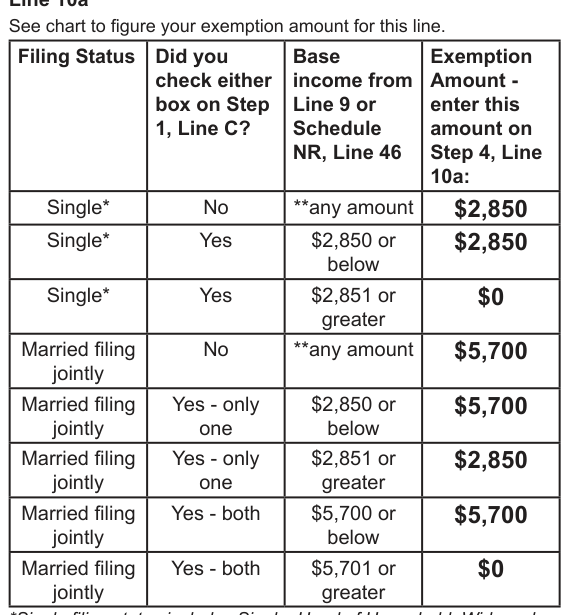
Text version of this table
Filing Status Did you check either box on Step 1, Line C? Base income from Line 9 or Schedule NR, Line 46 Exemption Amount - enter this amount on Step 4, Line 10a: Single* No **any amount $2,850 Single* Yes $5,700 or below $2,850 Single* Yes $5,701 or greater $0 Married filing jointly No **any amount $5,700 Married filing jointly Yes - only one $5,700 or below $5,700 Married filing jointly Yes - only one $5,701 or greater $2,850 Married filing jointly Yes - both $5,700 or below $5,700 Married filing jointly Yes - both $5,701 or greater $0
Line 10d
If you are claiming dependents, complete Schedule IL-E/EITC, and enter the amount from Step 2, Line 1, on Line 10d.
Attach: Schedule IL-E/EITC.
Income Exceptions
If your federal filing status is married filing jointly and your federal AGI is greater than $500,000, you are not entitled to an exemption allowance on Line 10. Enter "zero" on Line 10.
If your federal filing status is single, head of household, married filing separately, or widowed and your federal AGI is greater than $250,000, you are not entitled to an exemption allowance on Line 10.
Enter "zero" on Line 10.
*Single filing status includes Single, Head of Household, Widowed, and Married filing separately.
See Income Exceptions.
# Line 12
Tax amount
Illinois residents: Follow the instructions on the form.
Illinois residents only - Net income
Nonresidents and part-year residents only: Enter your tax from This line may not be less than zero. If the result is a negative number, enter zero "0."
Schedule NR, Line 52.
Attach: Schedule NR.
Nonresidents and part-year residents only - Net income Line 13 Complete Schedule NR. Enter the amount from Schedule NR, Line
Recapture of investment tax credits
51, on Line 11. This line may not be less than zero. If the result is a negative number, enter zero "0."
If you claimed an investment credit in a previous year, and the property considered in the computation of that investment credit was Note: Be sure to check the box in Step 1, Line D, to identify whether disqualified within 48 months after being placed in service, or if you you were a nonresident or a part-year resident of Illinois during 2025.
Attach: Schedule NR. are required to recapture an additional income tax credit claimed in a prior tax year, you must complete Schedule 4255, Recapture of Investment Tax Credits, and enter the recapture amount on this line.
Attach: Schedule 4255.
# Credits
Form IL-1040, Line 15 + Line 16 + Line 17 cannot be greater than Line 14.
# Line 15
Income tax paid to another state - Illinois residents and part-year residents only If you were taxed by another state on income you received while you were an Illinois resident, you may be entitled to this credit. See the Schedule CR Instructions and Publication 111, Illinois Schedule CR for Individuals, to see if you are eligible to take this credit.
Attach: Schedule CR, Pages 1 through 3.
# Line 16
Property tax, K-12 education expense, and Volunteer
Emergency Worker credits
You may be entitled to credit for property tax and K-12 education expenses you paid. If you received a voluntary emergency worker credit certificate, then you are entitled to the volunteer emergency worker credit. See the instructions for Schedule ICR to see if you are eligible for these credits.
Step 7 Other Taxes
# Line 20
Household employment tax
Enter the amount of Illinois Income Tax you withheld from a household employee. See Publication 121, Illinois Income Tax Withholding for Household Employees, for details on how to figure the amount to withhold and report.
Note: Do not report household employee withholding here if you have already reported or paid this amount using Form IL-941, Illinois Withholding Income Tax Return.
# Line 21
Use tax
Enter the amount of Illinois Use Tax you owe. Use the Use Tax (UT) Worksheet or Use Tax (UT) Table to determine your use tax. You must make an entry on Line 21 (enter "zero" if you are not paying use tax on Form IL-1040).
Note: If you owe more than $600 in use tax ($1,200 for married filing jointly taxpayers), you must file Form ST-44, Illinois Use Tax Return.
Note: You cannot change the amount of Illinois Use Tax you enter on Form IL-1040 by filing a Form IL-1040-X.
Note: Do not report Illinois Use Tax here if you have already reported or paid this amount using Form ST-44.
# What is Illinois Use Tax?
Illinois Use Tax is a form of sales tax that you, as the purchaser, owe on items that you buy for use in Illinois. If the seller does not collect this tax from you, you must pay the tax to the Illinois Department of Revenue (IDOR). The most common purchases on which the seller does not collect Illinois Use Tax are those made through the internet, from a mail order catalog, or when traveling outside Illinois.
Income Exceptions for the property tax and K-12 education expense credit If your federal filing status is married filing jointly and your federal AGI is greater than $500,000, you are not entitled to a property tax credit or a K-12 education expense credit.
If your federal filing status is single, head of household, married filing separately, or widowed and your federal AGI is greater than $250,000, you are not entitled to a property tax credit or a K-12 education expense credit.
Note: These exceptions do not apply to the Volunteer Emergency Worker Credit
Attach: Schedule ICR and any required supporting documents.
# Line 17
Credit from Schedule 1299-C
You may be entitled to credits from Schedule 1299-C. See the instructions for Schedule 1299-C and Schedule 1299-I to determine if you are eligible for these credits.
Attach: Schedule 1299-C and any required supporting documents.
# When must I pay Illinois Use Tax to IDOR?
You must pay Illinois Use Tax to IDOR if
- the items you bought are taxable in Illinois, you used or consumed these items in Illinois, and
- when you purchased the items you either
- did not pay any sales tax to the seller, or paid sales tax at less than Illinois' Use Tax rates of 6.25 percent for general merchandise and 1 percent for food and drugs.
For example, if you purchased
- a computer over the internet for use in Illinois and paid no sales tax, you owe 6.25 percent Illinois Use Tax.
- jewelry while vacationing in Georgia upon which you paid 4 percent sales tax and which you brought back to Illinois, you will owe Illinois Use Tax on the 2.25 percent difference in tax rates.
- cheese by mail order from a company in Wisconsin and paid no sales tax, you owe 1 percent Illinois Use Tax.
# How do I determine the Illinois Use Tax I owe?
To determine the Illinois Use Tax you owe, check your records to see if you were charged tax on internet, mail order, or other out-of-state purchases and use the UT Worksheet to calculate your tax.
If your records are incomplete and you had
- major purchases, add the actual cost of your major purchases to the estimated cost of any other purchases you made during the year. Enter the total on Lines 1a or 2a of the UT Worksheet to calculate the use tax you owe.
- no major purchases, use the UT Table to help you estimate the use tax you owe.
Enter the Illinois Use Tax from the UT Worksheet or UT Table on Form IL-1040, Line 21.
Note: If we find that you owe additional tax, we may assess the additional tax plus applicable penalties and interest. We conduct routine audits based on information received from third parties, including the U.S. Customs Service and other states.
# Use Tax (UT) Worksheet
Complete this worksheet to report and pay your use tax on Form IL-1040. If your annual use tax liability is over $600 ($1,200 if married filing jointly), you must file and pay your use tax with Form ST-44.
Note: Do not include any
- items for which you paid sales tax in another state (but not in another country) of 6.25% or more on Line 1a and 1% or more on Line 2a.
- sales tax you paid in another state, on Line 4, for items not included in Lines 1a or 2a.
1a Enter the total cost of general merchandise you purchased to use in Illinois on which you did not pay the required amount of Illinois Use Tax. 1a .00 1b Multiply Line 1a by 6.25% (.0625). Round the result to whole dollars. 1b .00 2a Enter the total cost of qualifying food, non-prescription drugs, and medical appliances you purchased to use in Illinois on which you did not pay the required amount of Illinois Use Tax. 2a .00 2b Multiply Line 2a by 1% (.01). Round the result to whole dollars. 2b .00 3 Add Lines 1b and 2b. This is your use tax on purchases. 3 .00 4 Enter the amount of sales tax you paid in another state (not in another country) on the items included on Lines 1a and 2a. 4 .00 5 Subtract Line 4 from Line 3. Enter the result here and on Form IL-1040, Line 21 (if the result is less than zero, enter "zero").
5 .00
Note: Be sure to keep this worksheet with your income tax records. You must send us this information if we request it.
# Use Tax (UT) Table
If you had no major purchases and you do not have receipts to figure your purchases, use this table to estimate your annual Illinois Use Tax liability.
AGI (from Form IL-1040, Line 1) Use Tax
$0 - $10,000 $3
$10,001 - $20,000 $8
$20,001 - $30,000 $13
$30,001 - $40,000 $18
$40,001 - $50,000 $23
$50,001 - $75,000 $31
$75,001 - $100,000 $44
Above $100,000 Multiply AGI by
0.05% (0.0005)
# Line 22
Compassionate Use of Medical Cannabis Program Act and sale of assets by gaming licensee surcharges
Compassionate Use of Medical Cannabis Program Act
Definitions
Organization registrant means a corporation, partnership, trust, limited liability company (LLC), or other organization, that holds either a medical cannabis cultivation center registration issued by the Illinois Department of Agriculture or a medical cannabis dispensary registration issued by the Illinois Department of Financial and Professional Regulation.
Transactions subject to the surcharge means sales and exchanges of
- capital assets,
- depreciable business property,
- real property used in the trade or business, and
- Section 197 intangibles of an organization registrant.
What is the Compassionate Use of Medical Cannabis Program
Act surcharge?
# Line 22
What is the Sale of Assets by Gaming Licensees surcharge?
For each taxable year beginning in 2019 through 2027, the amount of the surcharge is equal to the amount of federal income tax liability attributable to those sales and exchanges.
To whom does the Sale of Assets by Gaming Licensees surcharge apply?
The surcharge is imposed on any taxpayer who incurs a federal income tax liability on the income realized on a "transaction subject to the surcharge," including individuals and other taxpayers who are not themselves the "organization licensee" that engaged in the transaction.
The surcharge imposed shall not apply if
- the organization gaming license, organization license, or racetrack property is transferred as a result of any of the following:
- bankruptcy, a receivership, or a debt adjustment initiated by or against the initial licensee or the substantial owners of the initial licensee;
- cancellation, revocation, or termination of any such license by the Illinois Gaming Board or the Illinois Racing Board;
- a determination by the Illinois Gaming Board that transfer of For each taxable year beginning or ending during the Compassionate Use of Medical Cannabis Program, a surcharge is imposed on all taxpayers on income arising from the transactions subject to the surcharge of an organization registrant under the Compassionate Use of Medical Cannabis Program Act.
The amount of the surcharge is equal to the amount of federal the license is in the best interests of Illinois gaming;
- the death of an owner of the equity interest in a licensee;
- the acquisition of a controlling interest in the stock or substantially all of the assets of a publicly traded company;
- a transfer by a parent company to a wholly owned subsidiary; or income tax liability for the taxable year attributable to the transactions subject to the surcharge.
To whom does the surcharge apply?
The surcharge is imposed on any taxpayer who incurs a federal income tax liability on the income realized on a "transaction subject to the surcharge," including individuals and other taxpayers who are not themselves the "organization registrant" that engaged in the transaction.
A line has been included on Schedule K-1-P, Partner's or Shareholder's Share of Income, Deductions, Credits, and Recapture, and Schedule K-1-T, Beneficiary's Share of Income and Deductions, to identify the amount of federal income attributable to transactions subject to the surcharge that was passed through to you on federal Schedule K-1.
Sale of Assets by Gaming Licensees
Definitions
Gaming licensee means an organization licensee under the Illinois Horse Racing Act of 1975 and/or an organization gaming licensee under the Illinois Gambling Act.
Transactions subject to the surcharge means income arising from sales and exchanges of
- capital assets,
- depreciable business property,
- real property used in the trade or business, and
- Section 197 intangibles of a gaming licensee.
- the transfer or sale to or by one person to another person where both persons were initial owners of the license when the license was issued; or
- the controlling interest in the organization gaming license, organization license, or racetrack property is transferred in a transaction to lineal descendants in which no gain or loss is recognized or as a result of a transaction in accordance with Section 351 of the Internal Revenue Code in which no gain or loss is recognized; or
- live horse racing was not conducted in 2010 at a racetrack located within 3 miles of the Mississippi River under a license issued pursuant to the Illinois Horse Racing Act of 1975.
The transfer of an organization gaming license, organization license, or racetrack property by a person other than the initial licensee to receive the organization gaming license is not subject to a surcharge.
A line has been included on Schedule K-1-P, Partner's or Shareholder's Share of Income, Deductions, Credits, and Recapture, and Schedule K-1-T, Beneficiary's Share of Income and Deductions, to identify the amount of federal income attributable to transactions subject to the surcharge that was passed through to you on federal Schedule K-1.
How do I figure the surcharge?
If either surcharge applies to you, complete the Surcharge Worksheet.
# Surcharge Worksheet
1 Enter your federal income tax liability for the taxable year. 1 __ 2 Enter your federal income tax liability for the taxable year computed as if transactions subject to the surcharge made in that year had not been made.
2 __
3 Subtract Line 2 from Line 1. This is your Surcharge. Enter the result here and on Form IL-1040, Line 22. 3 __
# Refundable Credit
Total payments and refundable credit
# Line 25
Add Lines 25, 26, 27, 28, 29, and 30, and enter the total on Line 31.
Illinois Income Tax withheld
If Illinois income tax was withheld from your income for 2025, see the instructions for Schedule IL-WIT.
# Total
Attach: Schedule IL-WIT and all your Forms W-2 and 1099 showing Illinois income and withholding.
# Line 32
Estimated income tax payments
Enter the total of any payments you made with If Line 31 is greater than Line 24, subtract Line 24 from Line 31.
- Form IL-1040-ES, Estimated Income Tax Payments for Individuals;
# Line 33
- Form IL-505-I, Automatic Extension Payment for Individuals Filing Form IL-1040; and If Line 24 is greater than Line 31, subtract Line 31 from Line 24.
- any overpayment applied to your 2025 estimated tax from a prior year return.
Note: If you expect your yearly tax liability to be greater than $1,000 after subtracting your withholding, pass-through withholding payments, and credits, you may be required to make estimated income tax payments. For more information, see Line 34 and the instructions for Form IL-2210, Computation of Penalties for Individuals, and Publication 105, Illinois estimated Payments requirements for Individuals and Businesses.
# Line 27
Pass-through withholding
Enter the total of any pass-through withholding (income tax paid) made on your behalf by a partnership, S corporation, or trust and shown on Schedule K-1-P or Schedule K-1-T for this tax year.
Attach: Schedule K-1-P or Schedule K-1-T.
# Line 28
Pass-through entity tax credit
Enter the total share of pass-through entity tax credit passed through to you by a partnership, S corporation, or trust and shown on Schedule K-1-P or Schedule K-1-T for this tax year.
Attach: Schedule K-1-P or Schedule K-1-T.
# Line 29
Earned Income Tax Credit
If you did not qualify for a federal Earned Income Tax Credit (EITC), you may qualify for the Illinois Earned Income Tax Credit.
See Schedule IL-E/EITC Instructions and Publication 132, Illinois Earned Income Tax Credit (EITC) Information, for more information.
Complete Schedule IL-E/EITC to determine the amount of your credit.
Attach: Schedule IL-E/EITC.
# Line 30
Child Tax Credit
Taxpayers who receive the Illinois EITC and have at least one child that is your dependent and under the age of 12 years old, may also receive the Child Tax Credit in the amount of 40 percent of their EITC amount.
Complete Schedule IL-E/EITC to determine the amount of your credit.
Attach: Schedule IL-E/EITC.
# Step 10
Estimated Tax Penalty and Donations
Note: Only complete this step for late-payment penalty for underpayment of estimated tax or to make a voluntary charitable donation.
# Line 34
Late-payment penalty for underpayment of estimated tax
If you
- have a tax liability greater than $1,000 after subtracting your withholding, pass-through withholding payments, and credits, or
- were required to make estimated tax payments and failed to pay the required amount by the payment due dates, you may owe a late-payment penalty for underpayment of estimated tax.
See Form IL-2210 for details.
Note: If you are 65 years of age or older and you permanently live in a nursing home, or if at least two-thirds of your federal gross income is from farming, you are not required to make estimated tax payments and are not subject to a late-payment penalty for underpayment of estimated tax.
Note: You do not owe a late-payment penalty for underpayment of estimated tax if you were not required to file a Form IL-1040 last year.
Note: If you owe this penalty, you should consider increasing your withholding or the amount of your estimated tax payments. For more information, see the Form IL-1040-ES Instructions, Publication 105, and Form IL-W-4, Employee's Illinois Withholding Allowance Certificate.
# Let us figure your penalty and bill you
Figuring your own penalty can be difficult. We encourage you to file your Form IL-1040 and pay the tax you owe without including any penalty. If you owe this penalty, we will figure the amount and bill you.
Note: If you annualized your income, you must complete Form IL-2210. See the instructions for Line 34c.
# Line 34a
Farmers
Check the box if at least two-thirds of your total federal gross income came from farming. Total federal gross income includes your spouse's income if your filing status is "married filing jointly."
# Federal gross income from farming
" is the amount of income you received from your participation in the production of crops, fruits, fish, livestock (used for draft, breeding, or dairy purposes), or other agricultural products. This includes income from the operation of a stock, dairy, poultry, fruit, or truck farm, plantation, ranch, nursery, range, or orchard - regardless of whether the operation is organized as a sole proprietorship, a partnership, an S corporation, or a trust. "Federal gross income from farming" also includes a share of crops produced in exchange for the use of the land. See IRS Publication 225, Farmer's Tax Guide.
"Federal gross income from farming" does not include payments from the sale of farmland and farm equipment, nor does it include income received by a custom grain harvester who performs grain harvesting and hauling services on farms he or she does not own, rent, or lease. It also does not include the wages of a farm employee or cash rent.
# Line 34b
Nursing home residents
Check the box if you or your spouse are 65 years of age or older and permanently living in a nursing home.
# Line 34c
Annualized income
Check the box if you annualized your income on Form IL-2210, Step 6.
Attach: Form IL-2210.
# Line 34d
Previous year Form IL-1040 not required
Check the box if you were not required to file a Form IL-1040 in the previous tax year.
# Line 35
Donations
You may contribute to one or more charitable contribution funds.
Contributions to the funds may be in any amount of $1 or more and will decrease your refund or increase your balance due.
Note: You cannot change your contributions to these funds on an amended return.
Attach: Schedule G.
# Line 36
Add Lines 34 and 35.
# Lines 37- 40
Step 11 Refund or amount you owe
# Line 37
Overpayment
If you have an amount on Line 32 and this amount is greater than Line 36, subtract Line 36 from Line 32. If the amount on Line 32 is less than the amount on Line 36, leave this Line blank. If you would like to receive your overpayment as a refund, complete Lines 38 and For a savings account, you must contact your financial institution for your account number.
Do not take your account and routing numbers from your checking or savings account deposit slip or include your check number. Include hyphens, but omit spaces and special symbols. You may have unused boxes.
Note: Some financial institutions may not allow a refund to be deposited into an account if the names on the account are not the same names that appear on the refund. If your financial institution does not honor your request for direct
- If you would like to have your overpayment credited to your future Illinois individual income taxes, complete Line 40. Note: You can split your overpayment to receive part as a refund and part as a credit carry forward. Enter the amount of each on the corresponding lines and make sure the total of Lines 38 and 40 are equal to Line 37.
# Line 38
Refund
We will not refund any amount less than $1. We also will reduce any overpayment by the amount of any outstanding tax, penalties, and interest you owe and by amounts you owe to other agencies or governments, if those debts have been certified to us.
# Line 39
Choose your refund method
Check the box next to the method by which you would like to receive your refund. You may only check one box. deposit, we will send you a check instead.
Note: We do not support international ACH transactions. We will only deposit refunds into accounts located within the United States. If your financial institution is located outside the United States, we will send you a check instead of depositing your refund into your account.
Direct deposit into "Bright Start" or "Bright
Directions"
If you choose to deposit your refund into your "Bright Start" or "Bright Directions" College Savings Pool account, follow the instructions below.
For "Bright Start" you must,
- enter "011001234" as the routing number.
- check the "Checking" box.
- enter "822" plus your eleven digit "Bright Start" account number.
For "Bright Directions" you must,
Note: If this is the first year you are filing a Form IL-1040, your refund will be issued as a paper check.
Direct Deposit
If you use direct deposit, you will get your refund faster. You must enter your routing number, account number, and select either checking or savings.
# Direct deposit into checking or savings
- enter "104910795" as the routing number.
- check the "Savings" box.
- enter "529" plus your nine digit "Bright Directions" account number.
Paper Check
If you choose to receive a paper check, your check will be mailed to If you choose to deposit your refund directly into your checking or savings account, you must
- enter your routing number. For a checking account, your routing number must be nine digits and the first two digits must be 01 through 12 or 21 through 32. The sample check below has an example of a routing number. For a savings account, you must contact your financial institution for your routing number.
- check the appropriate box to indicate that you want your refund deposited into your checking or savings account.
- enter your account number. For a checking account, your account number may be up to 17 digits. The sample check below has an example of an account number. the address entered on your return.
# Line 40
Amount of overpayment to be credited forward
Subtract Line 38 from Line 37. This is the amount of overpayment you elect to be applied against your estimated tax obligation.
Note: We will reduce any credit to your estimated tax by the amount of any outstanding tax, penalties, and interest you owe. If your credit is reduced, you may owe a late-payment penalty for underpayment of estimated tax. For more information, see Form IL-1040-ES.
To which tax period will my credit apply?
We will apply your credit to the tax period for which estimated payments currently are due based on the date you file this 2025 return.
Example 1: You file your 2025 calendar year return on October 6, 2026, which is before the last estimated tax due date for 2026 (January 15, 2027, for calendar year filers). You request your $500 overpayment be applied against your estimated tax. We will apply $500 to your 2026 estimated tax.
Example 2: You file your 2025 calendar year return on February 3, 2027, which is after the last estimated tax due date for 2026 (January 15, 2027, for calendar year filers). You request your $500 overpayment be applied against your estimated tax. We will apply $500 to your 2027 estimated tax.
With what date will my credit apply against my estimated
Line 41 tax?
Amount you owe
If your 2025 return was filed
If you owe less than $1, you do not have to pay, but you still must file
- on or before the extended due date of your return your tax return.
(October 15, 2026, for calendar year filers), your credit is Your tax payment is due on or before April 15, 2026. considered to be paid on the original due date of your 2025 return (April 15, 2026, for calendar year filers).
Example 1: You file your 2025 calendar year return on or before the extended due date of your return requesting $500 be applied against estimated tax. All of your payments are made before the original due date of your return. Your credit of $500 will be considered to be paid on April 15, 2026.
However, if all or a portion of your overpayment results from payments made after the original due date of your 2025 return, that portion of your credit is considered to be paid on the date you made the payment.
Example 2: You file your 2025 calendar year return on or before the extended due date of your return requesting $500 be applied against estimated tax. Your overpayment includes payments of $400 you made before the original due date of your return, and a $100 payment you made on June 1, 2026. Your credit of $400 will be considered to be paid on April 15, 2026. The remaining $100 credit will be considered to be paid on June 1, 2026.
- after the extended due date of your return, your credit is considered to be paid on the date you filed the return on which you made the election.
Example 3: You file your 2025 calendar year return on December 1, 2026, requesting $500 be applied against estimated tax. Your credit of $500 will be considered to be paid on December 1, 2026, because you filed your return after the extended due date of your 2025 calendar year return.
May I apply my credit to a different tax period?
Yes. If you wish to apply your credit to a tax period other than the one described above, you must submit a separate request in writing to:
ILLINOIS DEPARTMENT OF REVENUE
PO BOX 19023
SPRINGFIELD IL 62794-9023
Note: You must submit your request to the address above at the time you file your return.
Your request must include
- your name,
- your SSN,
- the tax period of the return creating the overpayment, and
- the tax period you wish to have the credit apply.
If your request does not contain this information, your election will be considered invalid and we will not apply your credit as you requested.
If you submit a valid request, we will apply your credit as you requested and notify you. Once made, your election to change the tax period to which your credit will apply is irrevocable.
Payment options - scan this QR code for electronic payment options.
You may pay by
- electronic payment. To have your payment electronically taken from your checking or savings account, visit mytax.illinois.gov, or ask your tax professional. You need the same information that is required for direct deposit (see the instructions for Line 39) plus your IL-PIN (Illinois Personal Identification Number). Warning: Many credit unions will not allow an electronic debit from a savings account. Please check with your financial institution.
Note: We do not support international ACH transactions.
We will only debit your account if your financial institution is located within the United States. If your financial institution is located outside the United States, you must choose another payment option.
- credit card. Use your MasterCard, Discover, American
Express, or Visa. The credit card service provider will assess a convenience fee. Have your credit card ready and visit our website, or call one of the following:
# ACI Payments, Inc. (formerly known as Official
Payments Corporation) at 1 833 747-1434. payILtax at 1 888 9-PAY-ILS (1 888 972-9457).
Link2Gov/FIS at 1 877 578-2937.
In person at any IDOR Regional office.
- check or money order. Make the check or money order payable to "Illinois Department of Revenue" (not IRS).
Write the taxpayer's Social Security number, the spouse's Social Security number if filing jointly, and the tax year in the lower left corner of the payment.
Payments must be U.S. negotiable currency, expressed in U.S. dollars, and drawn on a U.S. bank.
- cash. Pay by cash at the Springfield or Chicago IDOR office.
Attach: Staple your check or money order and Form
IL-1040-V, Payment Voucher for Individual Income Tax, to the front of your paper Form IL-1040.
# Late filing or late payment
Note: You may only apply your credit to tax periods occurring after the period of the return creating the overpayment. If you request to apply more credit than our records show you have available, we will apply the maximum amount available and notify you of the difference.
If you do not file or pay your tax on time, you may owe penalties and interest. We will send you a bill.
If you prefer to figure the penalties yourself, complete Form IL-2210.
# Line 42
By checking this box, you are authorizing IDOR to share your contact, income and other information from this return with the Illinois Department of Insurance.
This information will be used to determine your options for affordable health insurance coverage through Get Covered Illinois, the state's Health Insurance Marketplace.
Check the "Self" box if the primary taxpayer (yourself) is uninsured. Check the "Spouse" box if the primary taxpayer's spouse is uninsured. Check the "Dependent(s)" box if one or more of the primary taxpayer's dependent(s) is uninsured.
Check all boxes that apply.
Get Covered Illinois will mail you information about your eligibility for affordable health insurance coverage. If you provide your email address in Step 1, Get Covered Illinois will send you this information via email.
If you are uninsured, you may qualify to enroll in health coverage now. For more information about Get Covered Illinois, go to GetCoveredIllinois.gov.
The information shared with the other state agencies will be kept confidential and used only in determining your eligibility for health coverage.
Sign and date
You, and your spouse if filing jointly, must sign and date your return.
If you are filing for a minor as a parent or guardian, you must sign and date the return.
If you do not sign your return,
- it will be considered not filed and you may be subject to a nonfiler penalty.
- and three years have passed since the extended due date of that return, any overpayment will be forfeited.
Attach: Staple all required copies of forms and schedules, powers of attorney, and letters of estate or office to the tax return.
# Mailing your income tax return
If no payment is enclosed, mail your return to:
SPRINGFIELD IL 62794-9041
Paid preparer
If you pay someone to prepare your return, the paid preparer must also sign and date your return, provide a phone number, and enter their Preparer Tax Identification Number (PTIN) issued by the IRS.
Check the box if the paid preparer is self-employed. If the paid preparer is employed with a professional tax preparation firm, the paid preparer also must provide the name, the Federal Employer Identification Number (FEIN), the address, and phone number of the firm.
Third party designee (optional)
If you want to allow another person to discuss this return and any previous return that affects the liability reported on this return with us, check the box and print the designee's name and telephone number.
The authorization will allow your designee to answer any questions that arise during the processing of your return, call us with questions about your return, and receive or respond to notices we send. You may revoke the authorization at any time by calling or writing us.
If a payment is enclosed, mail your return to:
# Allocation Worksheet
Keep this worksheet with your income tax records.
- -
Primary taxpayer's name Primary taxpayer's Social Security number
- -
Spouse's name Spouse's Social Security number
Column A Column B Column C
Your joint Primary's portion Spouse's portion federal return of Column A of Column A 1 Wages, salaries, tips, etc. (federal Form 1040 or 1040-SR, Line 1z) 1 2 Taxable interest (federal Form 1040 or 1040-SR, Line 2b) 2 3 Ordinary dividends (federal Form 1040 or 1040-SR, Line 3b) 3 4 Taxable refunds, credits, or offsets of state and local income taxes (federal Form 1040 or 1040-SR, Schedule 1, Line 1) 4 5 Alimony received (federal Form 1040 or 1040-SR, Schedule 1, Line 2a) 5 6 Business income or loss (federal Form 1040 or 1040-SR, Schedule 1, Line 3) 6 7 Capital gain or loss (federal Form 1040 or 1040-SR, Line 7a) 7 8 Other gains or losses (federal Form 1040 or 1040-SR, Schedule 1, Line 4) 8 9 Taxable IRAs (federal Form 1040 or 1040-SR, Line 4b) 9 10 Pensions & annuities (federal Form 1040 or 1040-SR, Line 5b) 10 11 Rental real estate, royalties, partnerships, S corporations, trusts, etc.
(federal Form 1040 or 1040-SR, Schedule 1, Line 5) 11
12 Farm income or loss (federal Form 1040 or 1040-SR, Schedule 1, Line 6) 12 13 Unemployment compensation (federal Form 1040 or 1040-SR, Schedule 1, Line 7) 13 14 Taxable Social Security benefits (federal Form 1040 or 1040-SR, Line 6b) 14 15 Other income (federal Form 1040 or 1040-SR, Schedule 1, Line 9) 15 16 Educator Expenses (federal Form 1040 or 1040-SR, Schedule 1, Line 11) 16 17 Certain business expenses of reservists, performing artists, and fee-basis government officials (federal Form 1040 or 1040-SR, Schedule 1, Line 12) 17 18 Health savings account deduction (federal Form 1040 or 1040-SR, Schedule 1, Line 13) 18 19 Moving expenses for members of the Armed Forces (federal Form 1040 or 1040-SR, Schedule 1, Line 14) 19 20 Deductible part of self-employment tax (federal Form 1040 or 1040-SR, Schedule 1, Line 15) 20 21 Self-employed SEP, SIMPLE, and qualified plans (federal Form 1040 or 1040-SR, Schedule 1, Line 16) 21 22 Self-employed health insurance deduction (federal Form 1040 or 1040-SR, Schedule 1, Line 17) 22 23 Penalty on early withdrawal of savings (federal Form 1040 or 1040-SR, Schedule 1, Line 18) 23 24 Alimony paid (federal Form 1040 or 1040-SR, Schedule 1, Line 19a) 24 25 IRA deduction (federal Form 1040 or 1040-SR, Schedule 1, Line 20) 25 26 Student loan interest deduction (federal Form 1040 or 1040-SR, Schedule 1, Line 21) 26 27 RESERVED 27 28 Archer MSA deduction (federal Form 1040 or 1040-SR, Schedule 1, Line 23) 28 29 Other Adjustments (federal Form 1040 or 1040-SR, Schedule 1, Line 25) 29 30 Adjusted gross income (federal Form 1040 or 1040-SR, Line 11a) 30 You must complete the Allocation Worksheet if you file a joint federal return, but choose to file "married filing separately" on your Illinois returns. In Column A, report the items of income and deductions as actually shown on your federal return, and then divide each item between you and your spouse in Columns B and C.
Column A: Enter the amounts from your joint federal return.
Column B: Enter the primary taxpayer's portion of the amount from Column A.
Column C: Enter the spouse's portion of the amount from Column A.
For more information on how your money is being spent, call 217 782-6000 or 312 814-2451, or visit illinoiscomptroller.gov.
General Funds Expenditures
By Function
Where the Fiscal Year 2025 Dollar Came From
Individual Income
Taxes
52.2%
Miscellaneous
9.0%
Investment
# Income
1.3%
Gaming-related transfers
2.1%
Corporate
Income Taxes
8.8%
Federal
Revenues
7.0%
Sales Taxes
19.6%
General Funds Revenues
Health and
Social
Services
37.0%
Transfers Out
5.1%
Education
41.0%
Public Protection and
Justice
6.1%
All Other
0.7%
General
Government
10.1%
General Funds revenues totaled $53.998 billion in fiscal year 2025.
The largest source of revenue to the General Funds was the individual income tax with receipts of $28.174 billion, accounting for 52.2% of total revenues. Sales taxes were the second-largest source of revenue with $10.574 billion, or 19.6% of total revenues. Other major sources included corporate income tax receipts of $4.728 billion, or 8.8%; federal revenues of $3.780 billion, or 7.0%; gaming related transfers (lottery, riverboat, and sports wagering) of $1.116 billion, or 2.1%; and investment income receipts of $741 million, or 1.3%. All other sources of revenue, including public utility taxes, insurance, cigarette, inheritance and liquor taxes, cannabis regulation transfers, and other miscellaneous sources totaled $4.835 billion for fiscal year 2025, accounting for 9.0% of total revenues.
In fiscal year 2025, expenditures from the General Funds totaled $53.850 billion, which is $148 million less than revenues received for the fiscal year. Education encompassed the largest portion of the General Funds budget with fiscal year 2025 spending of $22.050 billion, or 41.0% of total expenditures, including $17.479 billion for elementary and secondary education (includes teacher retirement contributions) and $4.571 billion for higher education (includes retirement contributions).
Health and Social Services expenditures (including spending for medical assistance, children and family services, the operation of mental health and developmentally disabled facilities and other related services) totaled $19.933 billion in fiscal year 2025, accounting for 37.0% of total General Funds expenditures. Transfers-out of $2.759 billion from the General Funds primarily supported debt service payments on bonds issued.
Expenditures of $3.310 billion for Public Protection and Justice included funding for the operation of prisons, courts and law enforcement. Other spending included $5.480 billion for General Government, and $386 million for environmental assistance and employment and economic development.
According to Illinois Office of Comptroller records, Illinois lottery revenues deposited into the State Treasury totaled $1.630 billion in fiscal year 2025. Most of these revenues ($1.629 billion) were deposited into the State Lottery Fund, however, sales of special instant games resulted in $12.1 million being deposited and/or transferred to 10 other separate funds. Total Illinois State Lottery Fund expenditures of $1.678 billion in fiscal year 2025 included $546 million, or 32.5%, for prizes; $777 million, or 46.3%, in transfers to the Common School Fund for education; and $355 million, or 21.2%, for operational expenses of the lottery, the largest component of which was $205 million for expenses of developing and promoting lottery games.
# How the Fiscal Year 2025 Lottery Dollar Was Spent
Lottery Expenditures
Operational
Expenses
21.2%
Education
46.3%
Prizes
32.5%
# Visit our website for faster, easier service - 24 hours a day, 7 days a week.
Learn about our electronic filing and payment options and get your IL-PIN
Get your 1099-G amount
Check your estimated payments
Check your refund status
Get information about a notice or a bill
Get answers to frequently asked questions
Find a tax professional in your area
Change your address
Get information about Illinois Use Tax and Illinois Cigarette Use Tax you may owe
Phone — Call 1 800 732-8866 or 217 782-3336 to speak with our staff . . . Business hours: 8:00 a.m. to 5:00 p.m. Monday through Friday
Extended telephone hours for the 2025 filing season:
- Tuesday, April 14, 2026 8:00 AM to 7:00 PM
- Wednesday, April 15, 2026 7:30 AM to 7:00 PM for automated tax assistance . . . 24 hours a day, 7 days a week The number for our TTY is 1 800 544-5304. Walk-in — Business hours for the Springfield office are 8:00 a.m. to 5:00 p.m. Monday through Friday. Springfield, IL — Willard Ice Building — 1 800 732-8866 or 217 782-3336 101 West Jefferson Street — 62702 Business hours for the following are 8:30 a.m. to 5:00 p.m. Monday through Friday.
Chicago — 1 800 732-8866
555 West Monroe Street — Suite 1100 — 60661
Des Plaines — Suburban North Regional Building — 1 800 732-8866 9511 West Harrison Street — 60016
Marion — 1 800 732-8866
2309 West Main Street — Suite 114 — 62959
Fairview Heights — 1 800 732-8866
15 Executive Drive — Suite 2 — 62208
Rockford — 1 800 732-8866
200 South Wyman Street — 61101
# For Assistance or Forms, Instructions, and Publications
Visit our website at tax.illinois.gov for assistance, publications, forms, instructions or schedules.
Write us at Illinois Department of Revenue, P.O. Box 19001, Springfield, Illinois 62794-9001.
During the filing season, Illinois forms are available at most libraries and at any taxpayer assistance office.
# Other Assistance
For federal tax information — Call the IRS at 1 800 829-1040 or visit their website at www.irs.gov.
For other free tax help for low-income and senior taxpayers — Visit a free tax preparation assistance location. To locate a site near you, visit our website, call us, or, if you live in Chicago, call 311.
Source: view the official PDF
The source document contains 3 figures (charts or worksheet graphics) not reproduced in this text version. See the official PDF above.
Nearby sections (17 sections)
- il-1065 · Instructions for Form IL-1065 — Partnership Replacement Tax…
- il-1065-x · Instructions for Form IL-1065-X — Amended Partnership…
- il-1120 · Instructions for Form IL-1120 — Corporation Income &…
- il-1120-st · Instructions for Form IL-1120-ST — Small Business…
- il-1041 · Instructions for Form IL-1041 — Fiduciary Income &…
- il-1041-sch-k-1-t-1 · Instructions for Schedule K-1-T (Part 1) —…
- il-1041-sch-k-1-t-2 · Instructions for Schedule K-1-T (Part 2) —…
- sch-k-1-p-1 · Instructions for Schedule K-1-P (Part 1) —…
- sch-k-1-p-2 · Instructions for Schedule K-1-P (Part 2) —…
- sch-ub · Instructions for Schedule UB — Combined Apportionment for…
- il-1040 · Instructions for Form IL-1040 — Individual Income Tax Return
- il-1040-sch-cr · Instructions for Schedule CR — Credit for Tax Paid to…
- il-1040-sch-nr · Instructions for Schedule NR — Nonresident & Part-Year…
- il-941 · Instructions for Form IL-941 — Illinois Withholding Income Tax…
- il-w-4 · Form IL-W-4 — Employee's Illinois Withholding Allowance…
- st-1 · Instructions for Form ST-1 — Sales and Use Tax Return
- st-1-x · Instructions for Form ST-1-X — Amended Sales and Use Tax Return