Illinois Department of Revenue Form Instructions
Instructions for Schedule K-1-P (Part 1) — Partner's/Shareholder's Share
# Schedule K-1-P(4)
What's New for 2025?
- A new step, Step 8, Your partner's share of retirement payments, has been added to Schedule K-1-P.
- The Illinois Gives income tax credit (Code 5670) has been added as Line 52q for tax years ending on or after December 31, 2025.
- The Advancing Innovative Manufacturing for Illinois income tax credit (Code 1050) has been added as Line 52v for tax years beginning on or after January 1, 2026.
- The Illinois Income Tax Act was amended to remove the expiration date for the pass-through entity tax.
# Table of Contents
What's New? . . . . . . . . . . . . . . . . . . . . . . . . . . . . . . . . . . . . . . . . . . . . . . . . . . . . . . . . . . . . . . . . . . . . . . . 1
# Schedule K-1-P —
The purpose of Schedule K-1-P, Partner's or Shareholder's Share of Income, Deductions, Credits, and Recapture, is for you to supply each individual or entity who was a partner or shareholder at any time during your tax year with that individual's or entity's share of the amounts you reported on your federal income tax return and your Illinois business income tax return.
For Illinois Income Tax purposes, you must give a completed Schedule K-1-P and a copy of the Schedule K-1-P(2), Partner's and Shareholder's Instructions, to each partner or shareholder. This must be done by the due date, including any extended due date, of your Form IL-1065 or Form IL-1120-ST.
# Schedule K-1-P(3) —
The purpose of Schedule K-1-P(3), Pass-through Withholding Calculation for Nonresident Members, is to calculate the required tax you must report and pay on behalf of your nonresident partners or shareholders that receive business or nonbusiness income from your partnership or S corporation.
Important - Investment partnerships are required to withhold an amount on behalf of their nonresident partners. To calculate investment partnership withholding, investment partnerships must complete a Schedule K-1-P(4) for each of their nonresident partners. Investment partnerships do not complete Schedule K-1-P(3) for any of their partners.
Do not complete Schedule K-1-P(3) for any of your members if you elect to pay pass-through entity (PTE) tax.
You are required to report and pay tax on behalf of your members if
- you are an S corporation or partnership with an Illinois filing obligation, and
- you have business or nonbusiness income distributable to Illinois nonresident partners or shareholders who have not provided you with Form IL-1000-E, Certificate of Exemption for Pass-through Withholding.
Do not accept Form IL-1000-E from an individual member. Individuals may not make the pass-through withholding exemption election. You are required to report and pay tax on behalf of your nonresident individual members.
You must complete a Schedule K-1-P(3) for each such member. The pass-through withholding amount calculated on Schedule K-1-P(3) will be reported to each applicable member on the Schedule K-1-P you issue to them. Each member's amounts from each Schedule K-1-P(3) you complete must also be reported to the Illinois Department of Revenue (IDOR) on your Schedule B.
For Illinois Income Tax purposes, you must complete Schedule K-1-P(3) to calculate the amount of pass-through withholding for each of your applicable members and keep the schedule with your income tax records.
Printed by the authority of the state of Illinois - electronic only - one copy.
# Schedule K-1-P(4) —
The purpose of Schedule K-1-P(4), Investment Partnership Withholding Calculation for Nonresident Partners, is to calculate the required withholding that investment partnerships must report and pay on behalf of their nonresident partners.
You are required to report and pay investment partnership withholding on behalf of your nonresident partners if
- you are an investment partnership as defined in the Illinois Income Tax Act (IITA), Section 1501(a)(11.5) and
- you have business or nonbusiness income from other partnerships that is distributable to nonresident partners.
You must complete a Schedule K-1-P(4) for each nonresident partner unless that partner is
- exempt from tax under Internal Revenue Code (IRC) Section 501(a) or IITA Section 205, or
- a retired partner whose distributions are exempt from tax under IITA Section 203(a)(2)(F).
Note: Form IL-1000-E, Certificate of Exemption for Pass-through Withholding, will not exempt an investment partnership from investment partnership withholding.
The investment partnership withholding amount calculated on the Schedule K-1-P(4) will be reported to each applicable partner on the Schedule K-1-P you issue to them. Use Schedule K-1-P, Step 7, Line 55, Pass-through withholding or investment partnership withholding, to report each partner's share of investment partnership withholding. Additionally, all investment partnership withholding amounts calculated from each Schedule K-1-P(4) you complete will be entered on the corresponding partner's Schedule B, Section B, Line J, carried to the applicable line of Schedule B, Section A, Lines 4a through 4e, and added to the total to be entered on Schedule B, Section A, Line 5. The amount from Schedule B, Section A, Line 5 will be entered on Form IL-1065, Step 9, Line 59b.
For Illinois Income Tax purposes, you must complete Schedule K-1-P(4) to calculate the amount of investment partnership withholding for each of your applicable partners and keep the schedule with your income tax records.
Do not attach any Schedule K-1-P that you complete and issue to your partners or shareholders or any Schedule K-1-P(3) or
Schedule K-1-P(4) you complete to your Form IL-1065 or Form IL-1120-ST. However, you must
- keep a copy of each Schedule K-1-P and Schedule K-1-P(3) or Schedule K-1-P(4) available for inspection by our authorized agents and employees, and
- attach any Schedule K-1-P issued to you by another partnership or S corporation, as described in Schedule K-1-P(2).
# What is a resident?
A resident is
- an individual who is present in Illinois for other than a temporary or transitory purpose;
- an individual who is absent from Illinois for a temporary or transitory purpose but who is domiciled in Illinois;
- the estate of a decedent who at his or her death was domiciled in Illinois;
- a trust created by a will of a decedent who at his or her death was domiciled in Illinois; or
- an irrevocable trust, whose grantor was domiciled in Illinois at the time the trust became irrevocable. For purposes of this definition, a trust is irrevocable to the extent that the grantor is not treated as the owner of the trust under Internal Revenue Code (IRC) Sections 671 through 678.
# What is a nonresident?
A nonresident is a person who is not a resident, as previously defined. Corporations, S corporations, partnerships, and exempt organizations are considered nonresident for purposes of Schedule K-1-P, Schedule K-1-P(3), and Schedule K-1-P(4).
# What is business income?
Business income means all income, other than employee compensation, that may be apportioned by formula among the states in which you are doing business without violating the Constitution of the United States. All income of a partnership or subchapter S corporation is business income unless it is clearly attributable to only one state and is earned or received through activities totally unrelated to any business you are conducting in more than one state. Business income is net of all deductions attributable to that income.
# When is business income allocable to Illinois?
For a resident of Illinois, all income received, regardless of the source, is allocable to Illinois.
For a nonresident of Illinois whose business income is derived
- wholly inside Illinois, the entire amount of business income is allocable to Illinois.
- wholly outside Illinois, none of the business income is allocable to Illinois.
- inside and outside Illinois, Step 6 of Form IL-1065 or Form IL-1120-ST should be completed. See the specific instructions for these forms.
- from trusts, estates, and other partnerships or S corporations, the business income paid to this partnership or S corporation may be allocable to Illinois. See the Schedule K-1-T, Beneficiary's Share of Income and Deductions, furnished by the fiduciary, or Schedule K-1-P furnished by the other partnership or S corporation to determine what income is allocable to Illinois.
# What is nonbusiness income?
Nonbusiness income is all income other than business income or employee compensation. It is income you can clearly classify as having no connection to your business. For information about types of nonbusiness income, see the instructions for Illinois Schedule NB, Nonbusiness Income.
# When is nonbusiness income allocable to Illinois?
For a resident of Illinois, all nonbusiness income is allocable to Illinois.
For a nonresident partner or shareholder, items of income and deduction that constitute nonbusiness income received through the partnership or S corporation completing Schedule K-1-P are treated as if received directly by the partner or shareholder and are allocable to Illinois according to the following rules:
- Interest and dividend income received by partnerships or S corporations is allocable to Illinois if the entity's commercial domicile was in Illinois at the time the interest or dividend was paid or accrued. Interest and dividend income received by a nonresident individual, trust, or estate is not allocable to Illinois.
• Net rents and royalties
Real property - Rents and royalties from real property are allocable to Illinois if the property is located in Illinois.
Tangible personal property - Rents and royalties from tangible personal property are allocable to Illinois to the extent that the property is used in Illinois. The extent of use of tangible personal property in a state is determined by multiplying the rents and royalties derived from the property by a fraction. The numerator is the number of days of physical location of the property in Illinois during the rental and royalty period in the tax year, and the denominator is the number of days of physical location of the property everywhere during all rental or royalty periods in the tax year.
• Patent and copyright royalties are allocable to Illinois to the extent that the patent or copyright is used in Illinois.
A patent is used in Illinois to the extent that it is employed in production, fabrication, manufacturing, or other processing in Illinois or to the extent that a patented product is produced in Illinois.
A copyright is used in Illinois to the extent that printing or other publication originates in Illinois.
- Gains and losses from sales or exchanges of real or tangible personal property are in Illinois if the property is located in Illinois at the time of the sale or exchange. Gains or losses from the sale or exchange of intangible personal property are allocable to the state of residence or commercial domicile of the partner or shareholder. Gains and losses from sales or exchanges of shares and of interests in pass-through entities are allocable to Illinois if the pass-through entity is taxable in Illinois.
- Income from trusts, estates, and other partnerships or S corporations paid to this partnership or S corporation is allocable as if your partner or shareholder received it directly. See the Schedule K-1-T furnished by the fiduciary or Schedule K-1-P furnished by the other partnership or S corporation to determine what income is allocable to Illinois.
- Income from Illinois Lottery prizes and winnings from gambling games conducted on a riverboat or in a casino or organization gaming facility licensed under the Illinois Gambling Act, pari-mutuel wagering winnings from a facility licensed under the Illinois Horse Racing Act of 1975, and sports wagering winnings conducted in accordance with the Sports Wagering Act is allocable to Illinois.
• Other income allocable to Illinois, see Schedule NB Instructions for detailed instructions.
# What is pass-through entity (PTE) tax and PTE tax credit?
PTE tax is an amount equal to 4.95 percent (.0495) of the taxpayer's calculated net income for the taxable year paid by a partnership (other than a publicly traded partnership under Section 7704 of the Internal Revenue Code) or subchapter S corporation who elects to pay the tax for taxable years ending on or after December 31, 2021.
PTE tax credit is the distributive share of the credit allowed as a result of a partnership or S corporation having elected to pay the PTE tax.
PTE tax credit is
- reported to you on Schedule(s) K-1-P and K-1-T, and
- reported by you
○to IDOR on Form IL-1065 or Form IL-1120-ST, Schedule B, Line K and ○to your partners and shareholders on Schedule K-1-P, Line 53a.
An investment partnership may use PTE tax credit to offset its investment partnership withholding requirement, to the extent that such credit would otherwise be distributable to its nonresident partners. An investment partnership must complete a Schedule K-1-P(4) for each of its nonresident partners indicating the amount of PTE tax credit (Schedule K-1-P(4), Step 4, Line 12) that will be used to offset that partner's withholding amount. The Schedule K-1-P(4), Line 12 amount may not exceed the amount of investment partnership withholding before credits. In addition, the total of all Schedule K-1-P(4), Line 12 amounts, may not exceed the amount of PTE tax credit distributed to you from other entities. See Schedule K-1-P(2) for more information.
You may not use PTE tax credit to offset PTE tax liability. Any additional PTE tax credit that has been distributed to you beyond the amount used against your investment partnership withholding liability must be distributed to your partners.
See the Form IL-1065 instructions for more information.
# What if a partner is engaged in a unitary business with this partnership?
If partners owning substantially all of a partnership are engaged in a unitary business with that partnership, the partners and the partnership must be included on a Schedule UB, Combined Apportionment for Unitary Business Group. Substantial ownership is defined as owning more than 90 percent of all the interest in the partnership. Otherwise, if a partner is engaged in a unitary business with this partnership, the partner must determine the portion of its business income taxed by Illinois by adding its share of this partnership's business income and apportionment factors (Illinois and everywhere) to its own business income and apportionment factors (Illinois and everywhere). See 86 Ill. Adm. Code Section 100.3380(d) for more information. The business income and factors of this partnership that must be added to the unitary partner's business income and factors must include any business income and factors that flow through to this partnership from another unitary partnership. See the "Unitary instructions" in the following steps to help you report the unitary partner's share.
# What if I am an investment partnership?
If you are an investment partnership as defined in the Illinois Income Tax Act (IITA), Section 1501(a)(11.5), you are exempt from Illinois income taxation. Also, all income that one of your partners receives from you is treated as nonbusiness income that is allocable to the partner's state of residence or commercial domicile, unless the partner's investment in you is directly or integrally related to another business activity of the partner; or serves an operational function to another business activity of the partner; or where the partner's contribution to you was made out of working capital from its trade or business. Because you cannot be expected to know the facts necessary to make this determination, you should complete the Schedule K-1-P by filling in only Column A and attaching the Schedule K-1-P(2), to allow the partner to make its own determination.
Investment partnerships are required to withhold an amount on behalf of their nonresident partners. Investment partnerships must complete a Schedule K-1-P(4) for each of its nonresident partners to determine the amount of investment partnership withholding required. See Schedule K-1-P(4) and the "K-1-P(4) Step-by-Step Instructions" section below for more information.
An investment partnership that elects to pay PTE tax will determine its PTE income by completing the PTE Income Worksheet in the Form IL-1065 Instructions as if it did not qualify as an investment partnership.
Note: Electing to pay PTE tax does not exempt the investment partnership from withholding on behalf of its nonresident members. Instead, the investment partnership must calculate its investment partnership withholding prior to calculating PTE tax. The income used to determine the investment partnership withholding will be deducted from the PTE income on the PTE Income Worksheet.
# Should I round?
You must round the dollar amounts on Schedules K-1-P and Schedules K-1-P(3) to whole-dollar amounts. To do this, you should drop any amount less than 50 cents and increase any amount of 50 cents or more to the next higher dollar.
# What if I need additional assistance or forms?
- For assistance, forms, or schedules, visit our website at tax. illinois. gov or scan the QR code provided.
- Write us at:
ILLINOIS DEPARTMENT OF REVENUE
PO BOX 19001
SPRINGFIELD IL 62794-9001
- Call 1 800 732‑8866 or 217 782-3336 (TTY at 1 800 544-5304).
- Visit a taxpayer assistance office - 8:00 a.m. to 5:00 p.m. (Springfield office) and 8:30 a.m. to 5:00 p.m.
(all other offices), Monday through Friday.
# K-1-P Step-by-Step Instructions
Important: To avoid a common error, before completing any step of Schedule K-1-P, you must enter your tax year ending in the space provided on the front of the Schedule K-1-P. Failure to provide this information will result in processing delays for your partner or shareholder.
In addition, they may be advised by IDOR to contact you for a corrected Schedule K-1-P that includes a completed tax year ending.
# Step 1 — Identify your partnership or S corporation
Line 1 - Check the appropriate box to identify yourself as a partnership or an S corporation.
Line 2 - Enter the name of your partnership or S corporation as shown on your Form IL-1065 or Form IL-1120-ST.
Line 3 - Enter your entire federal employer identification number (FEIN). If you are a foreign entity and do not have a FEIN, you must receive approval from IDOR to leave this line blank or to provide partial information. Send your request to:
BUSINESS PROCESSING
ILLINOIS DEPARTMENT OF REVENUE
PO BOX 19004
SPRINGFIELD, IL 62794-9004
Line 4 - Enter the apportionment factor from Step 6, Line 42, of your Form IL-1065 or Form IL-1120-ST. If you were not required to complete Step 6, enter "1" on this line.
Note: If you are an investment partnership, enter "investment partnership" on Line 4.
Unitary instructions (Form IL-1065 filers only): If the partner to whom you are sending this Schedule K-1-P is engaged in a unitary business with your partnership, enter "see attached schedule of factors" on Line 4. Attach a schedule showing the partner's share of the partnership's apportionment factors (Illinois and everywhere), and business income that the partnership directly earns, plus any factors and business income passed up to your partnership from another unitary partnership. The schedule must direct the partner to include the apportionment factors and business income shown on the schedule with its own apportionment factors and business income in apportioning its business income to Illinois.
Step 2 — Identify your partner or shareholder Line 5 - Enter the name of the partner or shareholder to whom you will issue the Schedule K-1-P.
Line 6 - Enter the mailing address of the partner or shareholder.
Line 7 - Enter the entire Social Security number or FEIN of the partner or shareholder here and in the space provided at the top of Page 2.
Line 8 - Enter the percentage that represents this partner's or shareholder's share of income, gain, loss, deduction, or credit that was allocated among the members as required by the Internal Revenue Code (IRC) Section 704 for partners, and IRC Section 1366 for shareholders. In the event that the partnership agreement provides for a specific allocation of certain items that differs from that used to allocate income or loss, report the special items and percentage allocation on a separate sheet and attach it to this schedule.
Line 9a - Check the appropriate box to identify this partner or shareholder as an individual, a partnership, a corporation, an S corporation, a trust, or an estate.
If this partner or shareholder is
- an exempt organization and is taxed as a corporation, check the corporation box on this Schedule K-1-P.
- an exempt organization and is taxed as a trust, check the trust box on this Schedule K-1-P.
- a grantor trust or other disregarded entity, check the box on this Schedule K-1-P that corresponds to the tax type of the grantor or owner.
Line 9b - Do not check the grantor trust or disregarded entity checkbox, or enter a name or identification number on this line. These are available for your partner or shareholder to complete, as applicable.
# Steps 3 through 6 —
Note: If you are a partner in a partnership, a shareholder in an S corporation, or a beneficiary of a trust or estate, you need to complete a pro forma Schedule K-1-P that identifies each partner's or shareholder's share of your share of items received from that entity. Write across the top of the pro forma Schedule K-1-P "the following information is included in the Schedule K-1-P from __" (the name of your partnership or S corporation). Send this pro forma Schedule K-1-P along with the Schedule K-1-P you issue to your partners or shareholders.
Column A — Member's share — If the individual or entity was a partner or shareholder at any time during your tax year, you must complete Column A of Steps 3 through 6.
Column B — Illinois share — You must determine how much of each item in Column A is allocable or apportionable to Illinois and enter that amount in Column B for each partner or shareholder. Nonresidents are taxed only on the Illinois share of each item, and residents need to know the Illinois share of each item to compute the credit they are allowed for taxes paid to other states.
For all line items: If you are an investment partnership, leave Column B blank.
ALERT
Failure to complete Column A when entering an amount in Column B may result in processing delays and further correspondence from the Illinois Department of Revenue.
Step 3 — Figure your partner's or shareholder's share of your nonbusiness income or loss Column A - Member's share Lines 10 through 19 - Enter the partner's or shareholder's share of nonbusiness income reported on the equivalent lines of your federal Schedule K-1. Line 19 should include any items of nonbusiness income or deduction (e.g., IRC Section 179) which are included in the computation of unmodified base income on Step 3, Line 13, of your Form IL-1065 or Form IL-1120-ST and are not included in Schedule K-1-P, Lines 10 through 18.
If you filed a federal Form 1065-B, you should complete a pro forma federal Form 1065, Schedule K-1, for each partner to use as a guide for completing Step 3.
Note: Enter "0" on Lines 10 through 19 if you made the election on your Form IL-1065 or IL-1120-ST to treat all of your income as business income. All items of income and expense from your federal K-1 should be reported in Step 4 - Figure your partner's or shareholder's share of your business income or loss.
Unitary instructions (Form IL-1065 filers only): If the partner to whom you are sending this Schedule K-1-P is engaged in a unitary business with your partnership, report the partner's share of all items of nonbusiness income in the same manner as you would for any other partner.
# Column B - Illinois share
For all line items - If you are an investment partnership, leave Column B blank.
Lines 48 through 51 - Enter the partner's or shareholder's share of the August 1, 1969, appreciation amounts that are allocated or apportioned to Illinois.
If these appreciation amounts result from a gain on the disposition of nonbusiness property, include the August 1, 1969, amount from Column A in Column B, only if the gain from the disposition of the property was included in Column B.
Unitary instructions: If you are included in a Schedule UB, include the combined amount of each item of Illinois August 1, 1969, appreciation reported in Step 3, Column E of the Schedule UB, multiplied by the apportionment factor in Step 1, Line 4 of this Schedule K-1-P.
If you are a partnership and the partner to whom you are sending this Schedule K-1-P is engaged in a unitary business with you, and you are not included in the Schedule UB with this partner, report only this partner's share of the items of business income and expense you derived from non-unitary partnerships, partnerships included on a Schedule UB, S corporations, trusts, or estates.
Step 7 — Figure your partner's or shareholder's share of your Illinois credits, recapture, withholding, pass-through entity tax credit, and federal income subject to surcharge 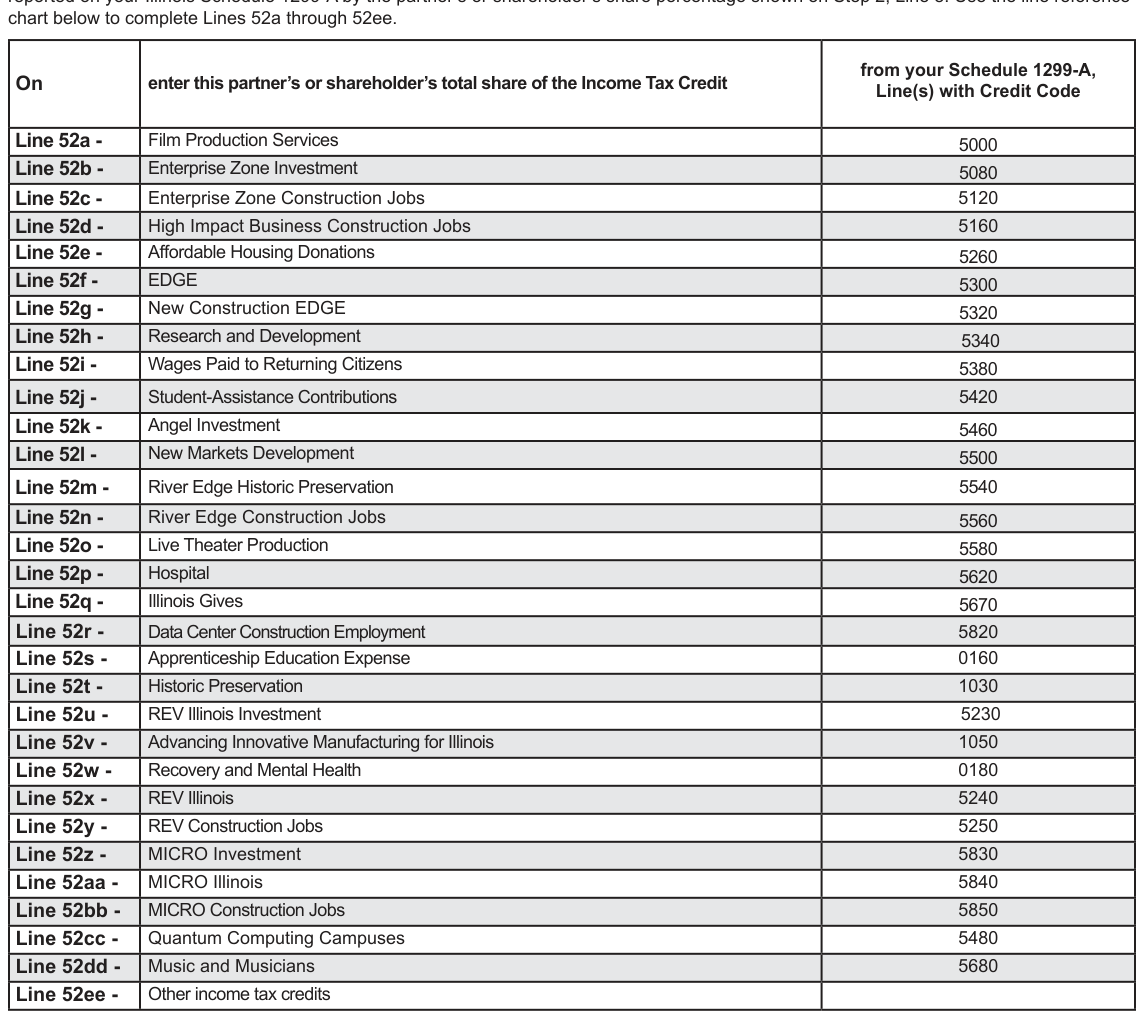
Text version of this table
On enter this partner’s or shareholder’s total share of the Income Tax Credit from your Schedule 1299-A, Line(s) with Credit Code Line 52a - Film Production Services 5000 Line 52b - Enterprise Zone Investment 5080 Line 52c - Enterprise Zone Construction Jobs 5120 Line 52d - High Impact Business Construction Jobs 5160 Line 52e - Afof rdable Housing Donations 5260 Line 52f - EDGE 5300 Line 52g - New Construction EDGE 5320 Line 52h - Research and Development 5340 Line 52i - Wages Paid to Returning Citizens 5380 Line 52j - Student-Assistance Contributions 5420 Line 52k - Angel Investment 5460 Line 52l - New Markets Development 5500 Line 52m - River Edge Historic Preservation 5540 Line 52n - River Edge Construction Jobs 5560 Line 52o - Live Theater Production 5580 Line 52p - Hospital 5620 Line 52q - Illinois Gives 5670 Line 52r - Data Center Construction Employment 5820 Line 52s - Apprenticeship Education Expense 0160 Line 52t - Historic Preservation 1030 Line 52u - REV Illinois Investment 5230 Line 52v - Advancing Innovative Manufacturing for Illinois 1050 Line 52w - Recovery and Mental Health 0180 Line 52x - REV Illinois 5240 Line 52y - REV Construction Jobs 5250 Line 52z - MICRO Investment 5830 Line 52aa - MICRO Illinois 5840 Line 52bb - MICRO Construction Jobs 5850 Line 52cc - Quantum Computing Campuses 5480 Line 52dd - Music and Musicians 5680 Line 52ee - Other income tax credits
# Line 52dd - Music and Musicians 5680
Line 52ee - Other income tax credits
Note: Partnerships may no longer make the election to flow through their investment credits to their partners. Investment credits earned by the partnership or the S corporation and allocable to their partners or shareholders subject to replacement tax will automatically flow through to those partners or shareholders.
Investment partnerships - If this member is a nonresident partner, complete Schedule K-1-P(4) prior to completing this line. Enter the partner's distributable shares of income tax credit on each line as instructed above less any amount associated with the same income tax credit used on this partner's Schedule K-1-P(4), Step 4, Line 10.
Note: Some credits listed above (and on Schedule K-1-P) may have expired during the previous year. However, due to differences in the filing periods between some partnerships or S corporations and their members, the affected lines have been kept on Illinois Schedule K-1-P for an additional year for flow through purposes. Please review Illinois Schedule 1299-I for more information about Illinois credits.
# Line 53a - PTE Tax Credit - Enter the member's
- share of the PTE tax on Form IL-1065, Schedule B, Line K, or Form IL-1120-ST, Schedule B, Line K, and
- distributive share(s) of any PTE tax credit you received on Schedules K-1-P and K-1-T.
The credit on Line 53a is allowed against the tax imposed on the member under IITA subsections 201(a) and (b).
Investment partnerships - If this member is a nonresident partner, complete Schedule K-1-P(4) prior to completing this line. Enter the partner's distributable share of PTE tax credit as instructed above less the amount, if applicable, reported on this partner's Schedule K-1-P(4), Step 4, Line 12.
Line 53b - Replacement Tax Investment Credits - Enter this member's share of the Replacement Tax Investment Credit listed on Form IL-477, Step 1, Line 5.
Investment partnerships - If this member is a nonresident partner, complete Schedule K-1-P(4) prior to completing this line. Enter the partner's distributable share of replacement tax investment credit distributed to you on your Schedule K-1-P, Step 7, Line 53b, less the amount, if applicable, reported on this partner's Schedule K-1-P(4), Step 4, Line 11.
Text version of this table
On On enter this partner's or shareholder's share of the from your Schedule 4255, from your Schedule 4255, Line 54a - Enterprise Zone/River Edge Redevelopment Zone Investment Credit recapture Step 6, Column A, Line 22 Line 54b - REV Illinois Investment Credit recapture Step 6, Column C, Line 22 Line 54c - Replacement Tax Investment Credit recapture Step 6, Column D, Line 22 Line 54d - MICRO Investment Credit recapture Step 6, Column E, Line 22 Line 54e - Additional income tax credit recapture Step 7, Line 33
Each partner's or shareholder's share of any recapture is limited to his or her share of the original investment credit. If a partner or shareholder who shared in the original credit is no longer an owner in the year of recapture, report that former owner's share of the recapture on Lines 54a, 54b, 54c, 54d, and 54e. You must send a copy of Schedule K-1-P (that will show an amount only on Lines 54a, 54b, 54c, 54d, and 54e) and Schedule 4255, Recapture of Investment Tax Credits, to this former owner.
If the partner's or shareholder's share in the year of the credit is different from his or her share in the year of the recapture, report that member's share of the recapture on Lines 54a, 54b, 54c, 54d, and 54e and attach a separate sheet explaining the difference. You must attach a copy of Schedule 4255 to this partner's or shareholder's Schedule K-1-P.
Unitary instructions: If a partner is engaged in a unitary business with your partnership, report the partner's share of credits and recapture amounts in the same manner as you would for any other partner.
Line 55 - If this member is a nonresident and has not submitted Form IL-1000-E to you, complete Schedule K-1-P(3), as applicable, for this member before completing this line. After you have completed Schedule K-1-P(3) for this member, enter on Line 55 the partner's or shareholder's share of pass-through withholding from Schedule K-1-P(3), Step 3, Line 19. You must also report specific amounts from Schedule K-1-P(3) on Schedule B of your Form IL-1065 or IL-1120-ST. See the instructions for Schedule K-1-P(3) and the Schedule B instructions for more information. Do not complete this line or Schedule K-1-P(3) if you elected to pay PTE tax.
You must complete Schedule K-1-P, Step 1, Line 3, or your member may not be able to claim this pass-through withholding.
Do not accept Form IL-1000-E from an individual member. See "What is the purpose of Schedule K-1-P and Schedule K-1-P(3)?" in the General Information section.
Investment partnerships - Line 55 is used to report both pass-through withholding and investment partnership withholding. Investment partnership withholding is calculated using Schedule K-1-P(4) rather than Schedule K-1-P(3). As a result, an investment partnership must complete a Schedule K-1-P(4) for a nonresident partner prior to completing Line 55 for that partner. Enter the amount from Schedule K-1-P(4), Step 4, Line 14, for this partner. You must also report specific amounts from Schedule K-1-P(4) on Schedule B of your Form IL-1065 or IL-1120-ST. See the instructions for Schedule K-1-P(4) and the Schedule B instructions for more information.
Note: Pass-through withholding credits distributed to investment partnerships cannot be passed through to their partners. Investment partnerships must claim the pass-through withholding distributed to them on Form IL-1065, Step 10, Line 65c.
Line 56 - Enter the partner's or shareholder's share of any taxable gains attributable to transactions subject to the Compassionate Use of Medical Cannabis Program Act surcharge. Attach a breakdown of any items reported on this line.
Definitions
Organization registrant means a corporation, partnership, trust, limited liability company (LLC), or other organization, that holds either a medical cannabis cultivation center registration issued by the Illinois Department of Agriculture or a medical cannabis dispensary registration issued by the Illinois Department of Financial and Professional Regulation.
Transactions subject to the surcharge means sales and exchanges of
- capital assets;
- depreciable business property;
- real property used in the trade or business; and
- Section 197 intangibles of an organization registrant.
What is the surcharge?
For each taxable year beginning or ending during the Compassionate Use of Medical Cannabis Program, a surcharge is imposed on all taxpayers on income arising from the transactions subject to the surcharge of an organization registrant under the Compassionate Use of Medical Cannabis Program Act.
The amount of the surcharge is equal to the amount of federal income tax liability for the taxable year attributable to the transactions subject to the surcharge.
To whom does the surcharge apply?
The surcharge is imposed on any taxpayer who incurs a federal income tax liability on the income realized on a "transaction subject to the surcharge", including individuals and other taxpayers who are not themselves the "organization registrant" that engaged in the transaction.
A partnership will not incur a surcharge because it has no federal income tax obligation. An S corporation would incur a surcharge on a transaction subject to built-in gains tax. Partners and shareholders who incur a federal income tax liability on income from a transaction subject to surcharge passed through to them by a partnership or S corporation will incur a surcharge.
Note: Although a unitary business group filing combined Illinois returns is treated as a single taxpayer and its members are jointly and severally liable for any surcharge imposed on the group, the group itself is not an organization registrant and transactions of any member that is not itself an organization registrant are not subject to the surcharge.
What do I report to my partners or shareholders?
Enter this partner's or shareholder's share of any federal income attributable to transactions subject to the surcharge on Line 56. In order to enable your partner or shareholder to correctly figure the surcharge, attach a report itemizing any amount reported on Line 56 and provide it to your partner or shareholder along with this schedule.
Note: Report federal income attributable to transactions subject to the surcharge on Line 56. Do not report your federal income tax liability for the taxable year attributable to the transactions subject to the surcharge on this line.
For more information, see 86 Ill. Adm. Code Section 100.2060. Line 57 - Enter the partner's or shareholder's share of any taxable gains attributable to transactions subject to the surcharge on the sale of assets by gaming licensee. Attach a breakdown of any items reported on this line.
Definitions
Gaming licensee is an organization licensee under the Illinois Horse Racing Act of 1975 and/or an organization gaming licensee under the Illinois Gambling Act.
Transactions subject to the surcharge means sales and exchanges of
- capital assets;
- depreciable business property;
- real property used in the trade or business; and
- Section 197 intangibles of a gaming licensee.
What is the surcharge?
For each taxable year 2019 through 2027, a surcharge is imposed on all taxpayers on income arising from the transactions subject to the surcharge on the sale of assets by gaming licensee.
The amount of the surcharge is equal to the amount of federal income tax liability for the taxable year attributable to the transactions subject to the surcharge.
To whom does the surcharge apply?
The surcharge is imposed on any taxpayer who incurs a federal income tax liability on the income realized on a "transaction subject to the surcharge," including individuals and other taxpayers who are not themselves the "gaming licensee" that engaged in the transaction.
The surcharge imposed shall not apply if
- the organization gaming license, organization license, or racetrack property is transferred as a result of any of the following:
○bankruptcy, a receivership, or a debt adjustment initiated by or against the initial licensee or the substantial owners of the initial licensee;
○cancellation, revocation, or termination of any such license by the Illinois Gaming Board or the Illinois Racing Board;
○a determination by the Illinois Gaming Board that transfer of the license is in the best interests of Illinois gaming;
○the death of an owner of the equity interest in a licensee;
○acquisition of a controlling interest in the stock or substantially all of the assets of a publicly traded company;
○a transfer by a parent company to a wholly owned subsidiary; or ○the transfer or sale to or by one person to another person where both persons were initial owners of the license when the license was issued;
- the controlling interest in the organization gaming license, organization license, or racetrack property is transferred in a transaction to lineal descendants in which no gain or loss is recognized or as a result of a transaction in accordance with Section 351 of the Internal Revenue Code in which no gain or loss is recognized; or
- live horse racing was not conducted in 2010 at a racetrack located within 3 miles of the Mississippi River under a license issued pursuant to the Illinois Horse Racing Act of 1975.
The transfer of an organization gaming license, organization license, or racetrack property by a person other than the initial licensee to receive the organization gaming license is not subject to a surcharge.
A partnership will not incur a surcharge because it has no federal income tax obligation. An S corporation would incur a surcharge on a transaction subject to built-in gains tax. Partners and shareholders who incur a federal income tax liability on income from a transaction subject to surcharge passed through to them by a partnership or S corporation will incur a surcharge.
Note: Although a unitary business group filing combined Illinois returns is treated as a single taxpayer and its members are jointly and severally liable for any surcharge imposed on the group, the group itself is not a gaming licensee and transactions of any member that is not itself a gaming licensee are not subject to the surcharge.
What do I report to my partners or shareholders?
Enter this partner's or shareholder's share of any federal income attributable to transactions subject to the surcharge on Line 57. In order to enable your partner or shareholder to correctly figure the surcharge, attach a report itemizing any amount reported on Line 57 and provide it to your partner or shareholder along with this schedule.
Note: Report federal income attributable to transactions subject to the surcharge on Line 57. Do not report your federal income tax liability for the taxable year attributable to the transactions subject to the surcharge on this line.
Step 8 — Your partner's share of retirement payments
Line 58 -
# K-1-P(3) Step-by-Step Instructions
Read this information first:
• Do not complete Schedule K-1-P(3) if you elected to pay PTE Tax.
- Individuals may not complete Form IL-1000-E.
- You must complete Schedule K-1-P(3) for each of your nonresident partners or shareholders who have not submitted a Form IL-1000-E to you.
• Do not complete Schedule K-1-P(3) for any member who is a resident or who has submitted Form IL-1000-E to you.
- You must keep Schedule K-1-P(3) with your income tax records.
- Do not send Schedule K-1-P(3) to your partners or shareholders or submit it to the Illinois Department of Revenue (IDOR) unless we request it from you.
Note: See "What is a resident?" and "What is a nonresident?" in the General Information section of these instructions for help determining if your member is a resident or nonresident.
Completion of Schedule K-1-P(3) for each of your applicable members is required and will aid in the completion of your Form IL-1065 or Form IL-1120-ST, Schedule B.
Complete all lines of Schedule K-1-P except Step 7, Line 55 before completing this schedule.
Important: Investment partnerships must use Schedule K-1-P(4) instead of Schedule K-1-P(3) to calculate withholding for its nonresident partners. See the "K-1-P(4) Step-by-Step Instructions" section in these instructions for more information.
# Step 1 — Identify your partnership or S corporation
Line 1 - Enter the name of your partnership or S corporation as shown on your Form IL-1065 or Form IL-1120-ST.
Line 2 - Enter your entire federal employer identification number (FEIN). If you are a foreign entity and do not have a FEIN, leave Line 2 blank. If you leave this line blank or provide partial information and we request that you submit this schedule, you may be contacted for further information.
# K-1-P(4) Step-by-Step Instructions
Read this information first:
- Investment partnerships complete Schedule K-1-P(4) instead of Schedule K-1-P(3) for their nonresident partners.
- You must complete Schedule K-1-P(4) for each of your nonresident partners, unless a nonresident partner is:
- exempt from tax under IRC Section 501(a) or IITA Section 205, or
- a retired partner whose distributions are exempt from tax under IITA Section 203(a)(2)(F).
• Do not complete Schedule K-1-P(4) for any partner who is a resident.
- You must complete Schedule K-1-P(4) for each partner that is a partnership or S corporation.
- You must keep Schedule K-1-P(4) with your income tax records.
• Do not send Schedule K-1-P(4) to your partners or submit it to the Illinois Department of Revenue (IDOR) unless we request it from you.
- Form IL-1000-E, Certificate of Exemption for Pass-through Withholding, will not exempt an investment partnership from investment partnership withholding.
Note: See "What is a resident?" and "What is a nonresident?" in the General Information section of these instructions for help determining if your partner is a resident or nonresident. For the purpose of this schedule, treat all partnerships and S corporations as nonresident partners.
Complete all lines (as applicable) of Schedule K-1-P except Step 7, Lines 52a through 52ee, Lines 53a and 53b, and Line 55, before completing this schedule.
Enter your tax year ending in the space provided on the front of the Schedule K-1-P(4).
# Step 1 — Identify your investment partnership
Line 1 - Enter the name of your partnership as shown on your Form IL-1065.
Line 2 - Enter your entire federal employer identification number (FEIN). If you are a foreign entity and do not have a FEIN, leave Line 2 blank. If you leave this line blank or provide partial information and we request that you submit this schedule, you may be contacted for further information.
# Step 2 — Identify your nonresident partner
Line 3 - Enter the name of the nonresident partner for whom you are reporting investment partnership withholding.
Line 4 - Enter the entire Social Security number or FEIN of the nonresident partner.
Line 5 - Check the appropriate box to identify this nonresident partner as an individual, a partnership, a corporation, an S corporation, a trust, or an estate.
If this partner is a grantor trust or other disregarded entity, check the box on this schedule that corresponds to the tax type of the grantor or owner and treat it as that type of taxpayer for the purposes of completing this schedule.
Step 3 — Figure your nonresident partner's investment partnership withholding before credits Line 6 - Enter the partner's share of Illinois apportioned business income from other partnerships under IITA Section 305(a). Illinois apportioned business income is typically reported to you on Schedule K-1-P, Step 4, Column B, Lines 20 through 27 and Lines 29 through 31.
If you received income from another partnership but did not receive a Schedule K-1-P, you must calculate the partner's share as if the amounts were reported on Schedule K-1-P, Step 4.
If you received income from other investment partnerships, you must calculate how much of the income received on the Schedule(s) K-1-P is considered business income and, if applicable, calculate its apportionment by completing a pro-forma Form IL-1065 as instructed in Schedule K-1-P(2). Use the apportioned business income calculated to determine the partner's share.
Line 7 - Enter the partner's share of Illinois allocated nonbusiness income from other partnerships under IITA Sections 305(b) and 303 (other than nonbusiness income that is allocated based on commercial domicile). Illinois allocated nonbusiness income is typically reported to you on Schedule(s) K-1-P, Step 3, Column B, Lines 12 through 17 and 19. If you received income from another partnership but did not receive a Schedule K-1-P, you must calculate the partner's share as if the amounts were reported on Schedule K-1-P, Step 3.
Line 8 - Investment partnerships may not adjust a partner's income subject to investment partnership withholding by income modifications that the investment partnership itself may be provided to use pursuant to the IITA. However, the investment partnership may adjust the partner's income subject to investment partnership withholding by the partner's share of income modifications distributed to the investment partnership on a Schedule K-1-P by an operating partnership.
If this partner is entitled to addition or subtraction modifications from Schedule(s) K-1-P, see the Line 8 Modification Worksheet. Otherwise, add Line 6 to Line 7 and enter the result.
Note: If this partner is an individual, partnership, trust, or estate and is entitled to their share of Illinois August 1, 1969, appreciation amounts, include those amounts in the total you enter on Line 5 of the modification worksheet. The amounts should be added as follows:
If this partner is
- an individual, and their share of Schedule K-1-P, Line 50 is ○zero, total their share allocable to Illinois from Schedule K-1-P, Lines 48, 49, and 51 and include it in the total you enter on Line 5.
○greater than zero, total their share allocable to Illinois from Schedule K-1-P, Lines 48, 50, and 51 and include it in the total you enter on their Line 5.
- a partnership, trust, or estate, total their share allocable to Illinois from Schedule K-1-P, Lines 48, 49, and 51 and include it in the total you enter on Line 5. Do not include any amount shown on Schedule K-1-P, Line 50.
If this partner is a corporation (including S corporations), do not include any amounts shown on their Schedule K-1-P, Lines 48 through 51, in the total you enter on Line 5.
# Line 8 Modification Worksheet
Complete this worksheet for each partner entitled to addition or subtraction modifications reported to the investment partnership on Schedule(s) K-1-P.
1 Enter this partner's share of business income from other partnerships allocable to Illinois from Schedule K-1-P(4), Line 6.
1 __
2 Enter this partner's share of nonbusiness income from other partnerships allocable to Illinois from Schedule K-1-P(4), Line 7.
2 __
3 Enter this partner's distributive share of additions from other partnerships that is allocable to Illinois and received by the investment partnership on Schedule(s) K-1-P, Lines 32 through 37.
3 __
4 Add Lines 1, 2, and 3. 4 __
5 Enter this partner's distributive share of subtractions from other partnerships that is allocable to Illinois and received by the investment partnership on Schedule(s) K-1-P, Lines 38a through 47.
- If this partner is an individual, partnership, trust, or estate and is entitled to their Illinois share of
Illinois August 1, 1969, appreciation amounts from Schedule(s) K-1-P, Lines 48 through 51, include those amounts on this line.
- If the retirement payments that you distributed to this partner on Schedule K-1-P, Line 58, were included in your federal reporting, include those payments on this line.
This is your member's share of subtractions allocable to Illinois.
5 __
6 Subtract Line 5 from Line 4.
If zero or negative, enter zero on this line and on this partner's Schedule K-1-P(4), Line 8.
If positive, enter the result here and on this partner's Schedule K-1-P(4), Line 8.
6 __
Line 9 - Multiply Line 8 by the applicable rate.
- If the partnership, S corporation, individual, or estate checkbox was selected on Step 2, Line 5, multiply Line 8 by 4.95% (.0495) and enter the result.
- If the trust checkbox was selected on Step 2, Line 5, multiply Line 8 by 6.45% (.0645) and enter the result.
- If the corporation checkbox was selected on Step 2, Line 5, multiply Line 8 by 9.5% (.095) and enter the result.
Step 4 — Figure your nonresident partner's investment partnership withholding The sum of the credit amounts entered on Lines 10 through 12 cannot be greater than the investment partnership withholding before credits amount on Line 9 of this schedule. Any excess credits must be distributed to your partners. See the "K-1-P Step-by-Step Instructions" section in these instructions for more information.
You may only use tax credits passed through in this reporting period to offset the investment partnership withholding liability. Credit carry forward amounts may not be used to reduce investment partnership withholding.
Note: Credits are distributed to partners in accordance with IRC Section 704 and the partnership agreement. Each partner is entitled to only their distributive share of credits when offsetting their investment partnership withholding liability.
Line 10 - Enter the total amount of Illinois income tax credits that is being used to offset this partner's investment partnership withholding.
This amount would be the partner's share of any income tax credits distributed to you on Schedule(s) K-1-P, Step 7, Lines 52a through 52ee.
Line 11 - Enter the total amount of Illinois replacement tax investment credits that is being used to offset this partner's investment partnership withholding. This amount would be the partner's share of any replacement tax investment credits distributed to you on Schedule(s) K-1-P, Step 7, Line 53b.
Line 12 - Enter the total amount of pass-through entity (PTE) tax credit that is being used to offset this partner's investment partnership withholding. This amount would be the partner's share of any PTE tax credits distributed to you on Schedule(s) K-1-P, Step 7, Line 53a and Schedule(s) K-1-T, Step 7, Line 50.
Line 13 - Follow the instructions on the schedule.
Line 14 - Follow the instructions on the schedule. The amount on this line cannot be negative. Enter this amount on Line 55 of this partner's Schedule K-1-P. In addition, this amount will be entered on the corresponding partner's Schedule B, Section B, Line J, carried to the applicable line of Schedule B, Section A, Lines 4a through 4e, and added to the total to be entered on Schedule B, Section A, Line 5. The amount from Schedule B, Section A, Line 5 will be entered on your Form IL-1065, Step 10, Line 59b. See Form IL-1065 instructions for more information.
Source: view the official PDF
Nearby sections (17 sections)
- il-1065 · Instructions for Form IL-1065 — Partnership Replacement Tax…
- il-1065-x · Instructions for Form IL-1065-X — Amended Partnership…
- il-1120 · Instructions for Form IL-1120 — Corporation Income &…
- il-1120-st · Instructions for Form IL-1120-ST — Small Business…
- il-1041 · Instructions for Form IL-1041 — Fiduciary Income &…
- il-1041-sch-k-1-t-1 · Instructions for Schedule K-1-T (Part 1) —…
- il-1041-sch-k-1-t-2 · Instructions for Schedule K-1-T (Part 2) —…
- sch-k-1-p-1 · Instructions for Schedule K-1-P (Part 1) —…
- sch-k-1-p-2 · Instructions for Schedule K-1-P (Part 2) —…
- sch-ub · Instructions for Schedule UB — Combined Apportionment for…
- il-1040 · Instructions for Form IL-1040 — Individual Income Tax Return
- il-1040-sch-cr · Instructions for Schedule CR — Credit for Tax Paid to…
- il-1040-sch-nr · Instructions for Schedule NR — Nonresident & Part-Year…
- il-941 · Instructions for Form IL-941 — Illinois Withholding Income Tax…
- il-w-4 · Form IL-W-4 — Employee's Illinois Withholding Allowance…
- st-1 · Instructions for Form ST-1 — Sales and Use Tax Return
- st-1-x · Instructions for Form ST-1-X — Amended Sales and Use Tax Return