Illinois Department of Revenue Form Instructions
Instructions for Form IL-1065 — Partnership Replacement Tax Return
Illinois Department of Revenue
Use for tax year ending on or
IL-1065 Instructions 2025 after December 31, 2025, and before December 31, 2026.
What's New?
- Gains and losses from sales or exchanges of shares in Subchapter S corporations or from interest in partnerships, other than investment partnerships, are attributable to Illinois if the pass-through entity is taxable in Illinois.
- Effective for tax years ending on or after December 31, 2025, Illinois adopts the "Finnigan" method of apportionment for unitary businesses when computing the sales factor numerator and applying the throwback and throw-out rules.
- A new step, Step 8, Your partner's share of retirement payments, has been added to Schedule K-1-P. See Schedule K-1-P(1), Instructions for Partnerships and S Corporations Completing Schedule K-1-P, Schedule K-1-P(3), and Schedule K-1-P(4), for more information.
# Table of Contents
What's New? … 1
General Information … 1
Specific Instructions … 10
Apportionment Formulas … 19
Illinois Schedule B Instructions … 23
Appendix A - Extension Tax Payment Worksheet … 28
Appendix B - Pass-through Withholding Prepayment Worksheets … 29 Appendix C - Estimated Payment and Prepayment Worksheet … 31
# Who must file Form IL-1065?
You must file Form IL-1065, Partnership Replacement Tax Return, if you are a partnership (see "Definitions to help you complete your Form IL-1065") and you have base income or loss as defined under the Illinois Income Tax Act (IITA) allocable to Illinois.
If you are a partnership organized for the sole purpose of playing the Illinois State Lottery, you are not required to file a Form IL-1065.
A person transacting an insurance business organized under a Lloyd's plan of operation may file a Form IL-1065 on behalf of all its underwriters, including corporations and residents. You must refer to 86 Ill. Adm. Code Section 100.5130, for specific instructions on how to properly complete Form IL-1065 and determine what you need to attach to your return.
All underwriters who are members of an insurance business organized under a Lloyd's plan of operation may be included on Form IL-1065. No credit is allowed to any underwriter for its share of tax paid on Form IL-1065.
# What forms must I use?
In general, you must obtain and use forms prescribed by the Illinois Department of Revenue (IDOR). Separate statements not on forms provided or approved by IDOR will not be accepted and you will be asked for appropriate documentation. Failure to comply with this requirement may result in failure to file penalties, a delay in the processing of your return, or a delay in the generation of any overpayment. Additionally, failure to submit appropriate documentation when requested may result in a referral to our Audit Bureau for compliance action.
Partnerships must complete Form IL-1065. Do not send a computer printout with line numbers and dollar amounts attached to a blank copy of the return. Computer generated printouts are not acceptable, even if they are in the same format as IDOR's forms. Computer generated forms from an IDOR-approved software developer are acceptable.
If you are a member of a unitary business group, you may not file a combined return, but you may have special filing requirements. See the instructions for Illinois Schedule UB and "What if I am a member of a unitary group?" in these instructions for information about your filing requirements.
Note: 2025 Form IL-1065 is for tax year ending on or after December 31, 2025, and before December 31, 2026. For tax years ending on or after December 31, 2024, and before December 31, 2025, use the 2024 form. Using the wrong form will delay the processing of your return.
IL-1065 Instructions (R-07/26) Page 1 of 34
Printed by the authority of the state of Illinois - electronic only - one copy.
# How do I register my business?
If you are required to file Form IL-1065, you should register with IDOR. You may register
- online with MyTax Illinois, our free online account management program for taxpayers;
- by completing Form REG-1, Illinois Business Registration Application, and mailing it to the address on the form; or
- by visiting a regional office. Visit our website at tax.illinois.gov for more information.
Registering with IDOR prior to filing your return ensures that your tax returns are accurately processed.
Your identification numbers as an Illinois business taxpayer are your federal employer identification number (FEIN) and your Illinois account number.
# When should I file?
In general, Form IL-1065 is due on or before the 15th day of the 4th month following the close of the tax year.
If you are operating as a business organized under the Lloyd's plan of operation, your due date is the same as your federal return due date.
Automatic six-month extension — We grant you an automatic six-month extension of time to file your partnership tax return. The automatic extension of time to file is granted whether or not you request it. You are not required to file a form in order to obtain this automatic extension.
If you expect tax to be due, you must pay any tentative tax due, by the original due date of the return, in order to avoid interest and penalty on tax not paid by that date. To pay any tax due by the original due date of your return:
- pay using a credit card at tax.illinois.gov/payments/creditcard,
- visit tax.illinois.gov, for information about ACH credit,
- pay using mytax.illinois.gov, or
- mail Form IL-1065-V, Payment Voucher for Partnership Replacement Tax, using the address on the form.
If an unpaid liability is disclosed when you file your return, then you may owe penalty and interest charges in addition to the tax. See the "What are the penalties and interest?" section for more information. An extension of time to file your Form IL-1065 is not an extension of time for payment of Illinois tax.
If you are operating as a business organized under the Lloyd's plan of operation, the length of your Illinois automatic extension of time to file is the same as your federal extension.
Additional extensions beyond the automatic extension period — We will grant an additional extension only if an extension is granted by the Internal Revenue Service (IRS) beyond the date of the Illinois automatic extension. Your additional Illinois extension will be for the length of time approved by the IRS. You must attach a copy of the approved federal extension to your Form IL-1065.
# When should I pay?
Payment of tax — You must pay your Illinois Replacement Tax and pass-through withholding reported on behalf of your members or PTE tax in full on or before the original due date of the return. Failure to pay the tax due on or before the original due date of the return may result in penalty and interest. This payment date applies even though an automatic extension for filing your return has been granted. All payments must be made using Form IL-1065-V, Payment Voucher for Partnership Replacement Tax.
Extension Payments — If you expect tax to be due, you must pay any tentative tax due by the original due date of the return using Form IL-1065-V. See Appendix A for more information.
Estimated tax payments — Partnerships who elect to pay PTE tax and reasonably expect their total tax liability to exceed $500 are required to make estimated tax payments using Form IL-1065-V. Estimated payments are due on the 15th day of the 4th, 6th, 9th, and 12th months of the tax year. All other partnerships are not required to make estimated tax payments. See Appendix C for more information.
Voluntary Prepayments — Partnerships who do not elect to pay PTE tax or partnerships who elect to pay PTE tax and reasonably expect their total tax liability to be $500 or less, may make voluntary prepayments of their own tax liability using Form IL-1065-V. Partnerships who do not elect to pay PTE tax may also use Form IL-1065-V to make pass-through withholding prepayments on behalf of your partner. See Appendix B and Appendix C for more information.
We encourage you to make your payments electronically using MyTax Illinois or Modernized E-File (MeF) systems, by credit card at tax.illinois.gov/payments/creditcard, or using Form EFT-1, Authorization Agreement for Certain Electronic Payments, to set up an ACH credit or phone debit transaction. These options can be found on our website at tax.illinois.gov. If you make your payments using MyTax Illinois, MeF, credit card, or EFT, do not mail us your IL-1065-V forms. You must use one of our electronic payment options if IDOR has notified you that you are required to make payments electronically.
We will apply each payment to the earliest due date until that liability is paid, unless you provide specific instructions to apply it to another period. You may also be assessed a bad check penalty if your remittance is not honored by your financial institution.
# Who should sign the return?
Your Form IL-1065 must be signed by a partner or any other officer duly authorized to sign the return. In the case of a bankruptcy, a receiver, trustee, or assignee must sign any return required to be filed on behalf of the partnership. The signature verifies by written declaration (and under penalties of perjury) that the signing individual has personally examined the return and the return is true, correct, and complete. The fact that an individual's name is signed to a return is prima facie evidence that the individual is authorized to sign the return on behalf of the partnership.
If you are operating as a business organized under the Lloyd's plan of operation, an officer of that plan must sign Form IL-1065.
Any person paid to prepare the return (other than a regular employee of the taxpayer, such as a clerk, secretary, or bookkeeper) must provide a signature, date the return, enter the preparer tax identification number (PTIN) issued to them by the Internal Revenue Service, and provide their firm's name, FEIN, address, and phone number.
Note: If your return is not signed, any overpayment of tax is considered forfeited if, after notice and demand for signature, you fail to provide a signature within three years from the date your return was filed.
# What are the penalties and interest?
Penalties — You will owe
- a late-filing penalty if you do not file a processable return by the extended due date;
- a late-payment penalty if you do not pay the tax you owe by the original due date of the return;
- a late-payment penalty for underpayment of estimated tax if you were required to make estimated tax payments and failed to do so, or failed to pay the required amount by the payment due date;
- a bad check penalty if your remittance is not honored by your financial institution; and
- a cost of collection fee if you do not pay the amount you owe within 30 days of the date printed on your bill.
Interest — Interest is calculated on tax from the day after the original due date of your return through the date you pay the tax.
We will bill you for penalties and interest. For more information about penalties and interest, see Publication 103, Penalties and Interest for Illinois Taxes.
# What if I am discontinuing my business?
Liquidation or withdrawal from Illinois — If you are a partnership that is liquidated or withdraws either voluntarily or involuntarily from Illinois during any tax year, you are still required to file tax returns. Also, we will pursue the assessment and collection of any taxes owed by you or your partners.
Sales or transfers — If you are a partnership that, outside the usual course of business, sells or transfers the major part of any one or more of
- the stock of goods which you are in the business of selling,
- the furniture or fixtures of your business,
- the machinery and equipment of your business, or
- the real property of your business, you or the purchaser must complete and send us Form CBS-1, Notice of Sale, Purchase, or Transfer of Business Assets, no later than 10 business days prior to the date the sale takes place. Send this form, along with copies of the sales contract and financing agreement, to:
ILLINOIS DEPARTMENT OF REVENUE
BULK SALES UNIT
PO BOX 19035
SPRINGFIELD IL 62794-9035 or
REV.BulkSales@illinois.gov
# What if I need to correct or change my return?
Do not file another Form IL-1065 with "amended" figures to change your originally filed Form IL-1065. If you need to correct or change your return after it has been filed, you must file Form IL-1065-X, Amended Partnership Replacement Tax Return. Returns filed before the extended due date of the return are treated as your original return for all purposes. For more information, see Form IL-1065-X instructions.
You should file Form IL-1065-X only after you have filed a processable Illinois Income Tax return. You must file a separate Form IL-1065-X for each tax year you wish to change.
State changes only — File Form IL-1065-X promptly if you discover an error on your Illinois return that does not relate to an error on your federal return but rather was caused by
- a mistake in transferring information from your federal return to your Illinois return;
- failing to report or misreporting to Illinois an item that has no effect on your federal return; or
- a mistake in another state's tax return that affects the computation of your Illinois tax liability.
If you are claiming an overpayment, Form IL-1065-X must be filed within three years after the extended due date or the date the return was filed, or within one year after the tax giving rise to the overpayment was paid, whichever is latest.
Federal changes only — File Form IL-1065-X if you have filed an amended federal return or if you have been notified by the IRS that they have made changes to your return. This includes any change in your federal income tax liability, any tax credit, or the computation of your federal taxable income as reported for federal income tax purposes, if the change affects any item entering into the computation of net income, net loss, or any credit for any year under the IITA. You must file Form IL-1065-X no later than 120 days after the federal changes have been agreed to or finally determined to avoid a late-payment penalty.
If your federal change decreases the tax due to Illinois and you are entitled to a refund or credit carryforward, you must file Form IL-1065-X within two years plus 120 days of federal finalization.
Attach a copy of federal finalization or proof of acceptance from the IRS along with a copy of your amended federal form, if applicable, to your Form IL-1065-X. Examples of federal finalization include a copy of one or more of the following items:
- your audit report from the IRS and
- your federal record of account verifying your ordinary business income.
Note: For amended tax returns filed on or after January 1, 2024, a late payment penalty will be assessed for any amended return not filed and the resulting liability not paid within 120 days of the federal change. See 35 ILCS 735/3-3(b-25) for more information.
# What records must I keep?
You must maintain books and records to substantiate any information reported on your Form IL-1065. Your books and records must be available for inspection by our authorized agents and employees.
# Do IDOR and the IRS exchange income tax information?
The IRS and IDOR exchange income tax information for the purpose of verifying the accuracy of information reported on federal and Illinois tax returns. All amounts you report on Form IL-1065 are subject to verification and audit.
# Should I round?
You must round the dollar amounts on Form IL-1065 and accompanying schedules to whole-dollar amounts. To do this, you should drop any amount less than 50 cents and increase any amount of 50 cents or more to the next higher dollar.
# What if I have an Illinois net loss deduction (NLD)?
An Illinois net loss deduction (NLD) can be used to reduce the base income allocable to Illinois only if the loss year return has been filed and to the extent the loss was not used to offset income from any other tax year. S corporations and partnerships, including any that are members of a unitary group, trusts, and non-unitary corporations should use the Illinois Schedule NLD, Illinois Net Loss Deduction, to determine any NLD.
To determine your "Illinois net loss" start with federal taxable income and apply all addition and subtraction modifications and all allocation and apportionment provisions.
In order to have any available NLD applied to your return, you must claim the deduction on Step 7, Line 48. See specific instructions for Step 7, Line 48.
If you have an Illinois net loss for this tax year, you must file Form IL-1065 reporting the loss in order to carry the loss forward to another year.
If corrections have been made to the loss amount (e.g., federal audit or amended return), you must report the corrected amount when you file.
Note: Ensure you have filed returns for all periods in which you were required to file an Illinois return. Unfiled returns may result in disallowed losses, processing delays, and further correspondence from IDOR.
If you need more information about Illinois NLD, see Schedule NLD instructions or the 86 Ill. Adm. Code Sections 100.2050 and 100.2300 through 100.2330, available on our website at tax.illinois.gov.
# What are the carry provisions of the Illinois NLD?
For tax years ending on or after December 31, 2021, Illinois net losses cannot be carried back and can only be carried forward for 20 tax years.
For tax years ending on or after December 31, 2003, and before December 31, 2021, Illinois net losses cannot be carried back, and can only be carried forward for 12 years. However, the carryover period of any net loss that had not expired as of November 16, 2021, shall be extended from 12 years to 20 years.
For tax years ending on or after December 31, 1999, and before December 31, 2003, all Illinois net losses must be carried back two years (unless an election to only carry forward is made) then forward 20 years. The election to carry a loss forward only was made by checking the appropriate box on the original or amended loss-year return, whichever showed the loss first. Once the election was made to forgo the Illinois carryback provision, the election was irrevocable.
Losses incurred in tax years ending before December 31, 1999, can be carried back and carried forward for the periods allowed under Internal Revenue Code (IRC) Section 172, for the tax year in which the loss was incurred. In general, losses incurred in tax years beginning
- after August 5, 1997, and ending before December 31, 1999, must be carried back two years, then forward 20 years.
- on or before August 5, 1997, must be carried back three years, then forward 15 years.
Note: For tax years ending on or after December 31, 1996, and before December 31, 2003, you may have made the election to forgo any of the previously mentioned Illinois NLD carryback periods by checking the appropriate box on your loss year return. This election must have been made by the extended due date of your return and once made was irrevocable for that tax year.
In addition, the special carryover periods in IRC Section 172, as in effect for a particular tax year, would apply to losses incurred in that year.
For example, a "specified liability loss" incurred in 1998 may be carried back 10 years under IRC Section 172(b)(1)(c).
Also, no limitations under IRC Section 382 or the separate return limitation year provisions of the federal consolidated return regulations apply to any NLD carryover.
# What is the standard exemption?
The standard exemption is $1,000 multiplied by a fraction in which the numerator is your base income allocable to Illinois and the denominator is your total base income. If you have a change in your tax year end, and the result is a tax period of less than 12 months, the standard exemption is prorated based on the number of days in the short tax year. However, if this is your first or final return, you are allowed to use the full-year standard exemption even if it is a short tax year. If you need further information, see 35 ILCS 401(b).
Note: For tax years beginning on or after January 1, 2017, the standard exemption may not be claimed if your unmodified base income is greater than $250,000. See Specific Instructions for more information.
# What attachments do I need?
When filing your return there are certain types of income items and subtraction modifications that require the attachment of Illinois or federal forms and schedules. Breakdowns, statements, and other documentation may also be required. Instructions for these attachments appear throughout the specific instructions for completing your return.
If you are operating as a business organized under the Lloyd's plan of operation, refer to 86 Ill. Adm. Code Section 100.5130, to determine what you need to attach to your Form IL-1065.
If you are an investment partnership, attach your federal return and any additional documentation that supports your status as an investment partnership when filing Form IL-1065.
Note: All Illinois forms and schedules include an "IL Attachment No." in the upper right corner of the form. Required attachments should be ordered numerically behind the tax return, as indicated by the IL Attachment No. Failure to attach forms and schedules in the proper order may result in processing delays.
Required copies of documentation from your federal return or other sources should be attached behind the completed Illinois return.
You must attach a copy of your federal Form 1065, Pages 1 through 6, to your Illinois return if you are required to file federally.
Schedule B, Partners' or Shareholders' Information, must be completed and attached to all Form IL-1065 filings.
You are required to attach any Schedule(s) K-1-P, Partner's or Shareholder's Share of Income, Deductions, Credits, and Recapture, and Schedule(s) K-1-T, Beneficiary's Share of Income and Deductions, you receive. Attach Schedule(s) K-1-P and K-1-T you received which lists your name and FEIN in Step 2 of Schedule K-1-P or K-1-T. Do not attach copies of Schedule(s) K-1-P you issued and which lists your name and FEIN in Step 1 of Schedule K-1-P.
Note: When filing your Form IL-1065, include only forms and schedules required to support your return. Send correspondence separately to:
ILLINOIS DEPARTMENT OF REVENUE
TAXPAYER CORRESPONDENCE
PO BOX 19044
SPRINGFIELD IL 62794-9044
# Definitions
All references to "income" include losses.
Base income means federal ordinary income plus separately stated items, modified by additions and subtractions as shown in Steps 2 through 5 of Form IL-1065. See specific instructions for Steps 2 through 5.
Business income means all income (other than compensation) that may be apportioned by formula among the states in which you are doing business without violating the Constitution of the United States. All income of a partnership is business income unless it is clearly attributable to only one state and is earned or received through activities totally unrelated to any business you are conducting in more than one state.
Business income is net of all deductions attributable to that income.
Commercial domicile means the principal place from which your trade or business is directed or managed.
Nonbusiness income means all income other than business income or compensation. For more information about the different types of nonbusiness income, see the instructions for Illinois Schedule NB, Nonbusiness Income.
A partnership is an entity that is treated as a partnership for federal income tax purposes. A partnership that elects an IRC Section 761 exclusion from the federal partnership provisions is also excluded for purposes of the IITA.
A partnership is classified as an investment partnership if at least 90 percent of its assets are investments in stocks, bonds, options, and similar intangible assets, and at least 90 percent of its income is derived from that kind of asset. For tax years ending on or after December 31, 2023, that 90 percent may also include the distributive share of partnership income from lower-tier partnership interests that meet the definition of qualifying investment securities.
Partner includes a person treated as a partner for federal income tax purposes.
A resident partner means
- an individual who is present in Illinois for other than a temporary or transitory purpose;
- an individual who is absent from Illinois for a temporary or transitory purpose but who is domiciled in Illinois;
- the estate of a decedent who at his or her death was domiciled in Illinois;
- a trust created by a will of a decedent who at his or her death was domiciled in Illinois; or
- an irrevocable trust if the grantor was domiciled in Illinois at the time the trust became irrevocable. For purposes of this definition, a trust is irrevocable to the extent that the grantor is not treated as the owner of the trust under IRC Sections 671 through 678. For a more detailed explanation of "domicile" and "resident," see the General Instructions for Form IL-1040, Individual Income Tax Return.
Nonresident partner means a partner who is not a resident of Illinois, as defined previously.
A pass-through entity is any entity treated as a partnership, subchapter S corporation, or trust for federal income tax purposes.
Pass-through entity income is the income that any partnership, subchapter S corporation, or trust passes through to its partners, shareholders, or beneficiaries.
PTE tax is an amount equal to 4.95 percent (.0495) of the taxpayer's calculated net income for the taxable year paid by a partnership (other than a publicly traded partnership under Section 7704 of the Internal Revenue Code) or subchapter S corporation who elects to pay the tax for taxable years ending on or after December 31, 2021.
PTE tax credit is the distributive share of the credit allowed as a result of a partnership or S corporation having elected to pay the PTE tax.
PTE tax credit is
- reported to your partners on the Schedule K-1-P and
- reported to IDOR on your Form IL-1065 and Illinois Schedule B.
A nonresident individual partner of a partnership for a taxable year in which the election to pay PTE tax was made shall not be required to file an income tax return under the IITA for such taxable year if the only source of net income of the individual (or the individual and the individual's spouse in the case of a joint return) is from an entity making the PTE election and the credit allowed to the partner equals or exceeds the individual's liability for the tax imposed under subsections (a) and (b) of Section 201 of the IITA for the taxable year.
Pass-through withholding is the amount required to be reported and paid by the pass-through entity, who does not elect to pay PTE tax, on behalf of its nonresident partners, shareholders, and beneficiaries
- who have not submitted Form IL-1000-E, Certificate of Exemption for Pass-through Withholding, to the pass-through entity, and
- who receive business and nonbusiness income from the pass-through entity.
Pass-through withholding is
- reported to your partners on the Schedule K-1-P you send to them,
- reported to IDOR on your Form IL-1065 and Illinois Schedule B, and
- paid with your return or voluntarily prepaid with Form IL-1065-V.
Note: If any of your partners are pass-through entities themselves, they are required to report and pay pass-through withholding on behalf of their own nonresident partners, shareholders, or beneficiaries on the income you passed through. Your partners may claim a credit on their Illinois Income Tax return for pass-through withholding you reported and paid on their behalf.
Partnerships can both make and receive pass-through withholding.
- Pass-through withholding you owe on behalf of your members is a payment of pass-through withholding you make on behalf of your nonresident partners who have not submitted Form IL-1000-E to you. This amount will be reported on Form IL-1065, Line 59a.
- Pass-through withholding reported to you is a credit for pass-through withholding you receive on Schedules K-1-P and K-1-T as a partner, shareholder, or beneficiary of a pass-through entity. This amount will be reported on Form IL-1065, Line 65c.
If you are a nonresident and the pass-through withholding reported to you satisfies your Illinois Income Tax liability, you are not required to file an Illinois Income Tax return. If you had Illinois income from other sources and the pass-through withholding made on your behalf does not cover your liability, you must file a return to report the tax on all of your Illinois income and claim a credit for pass-through withholding made on your behalf.
All residents and pass-through entities must file their own annual Illinois Income Tax return and claim a credit for any pass-through withholding reported to them.
Investment partnership withholding is the amount required to be reported and paid by the investment partnership on behalf of its nonresident partners who have received partnership income allocable to Illinois.
Investment partnership withholding is
- reported to your partners on Line 55 of the Schedule K-1-P you send to them,
- reported to IDOR on Form IL-1065, Line 59b, and on Schedule B, and
- paid with your return or prepaid with Form IL-1065-V.
Note: Form IL-1000-E, Certificate of Exemption for Pass-through Withholding, will not exempt an investment partnership from investment partnership withholding.
# What if I am an investment partnership?
Effective for tax years ending on or after December 31, 2004, any partnership that qualifies as an "investment partnership" as defined in the IITA shall not be subject to replacement tax.
For tax years ending on or after December 31, 2023, any partnership that qualifies as an "investment partnership" as defined in the IITA Section 1501(a)(11.5)(A-5) is required to withhold for their nonresident partners (other than a partner who is exempt from tax under Section 501(a) of the Internal Revenue Code or under Section 205 of the IITA, or who is a retired partner, to the extent that partner's distributions are exempt from tax under Section 203(a)(2)(F) of the IITA) the partner's share of partnership income allocable to Illinois. See 35 ILCS 5/709.5(d) and 86 Ill. Adm. Code Section 100.7034 for more information. Investment partnerships with nonresident partners must complete and submit Form IL-1065 to report their investment partnership withholding. Investment partnerships will calculate the investment partnership withholding for each nonresident partner using Illinois Schedule K-1-P(4), Investment Partnership Withholding Calculation for Nonresident Partners, will carry the withholding amounts from Schedule(s) K-1-P(4) to Illinois Schedule B, and enter the total amount on Form IL-1065 or Form IL-1065-X.
Note: Investment partnerships must attach their federal return and any additional documentation that supports their status as an investment partnership (including a balance sheet and an organization chart showing the tiered partnership) to their Form IL-1065 or Form IL-1065-X.
Special Note: If the investment partnership has no income subject to investment partnership withholding, the investment partnership is not required to file Form IL-1065.
Investment partnerships may elect to pay PTE tax for their partners. However, electing to pay PTE tax does not exempt the investment partnership from investment partnership withholding. Instead, investment partnerships must calculate their investment partnership withholding prior to calculating the PTE tax. The income subject to investment partnership withholding will be deducted from the base income used to calculate PTE tax prior to making the PTE tax calculation. See the PTE Tax Worksheet in these instructions for more information.
Note: Partnerships, including investment partnerships, are required to make estimated tax payments if they elect to pay PTE tax and their total tax liability is reasonably expected to exceed $500. Failure to make estimated tax payments or failure to make the required amount of estimated tax payments will result in late-payment penalties for underpayment of estimated tax. For more information about penalties, see
Publication 103, Penalties and Interest for Illinois Taxes.
To report the investment partnership withholding on Form IL-1065, check the appropriate box on Form IL-1065, Line F, and complete the return with the appropriate figures through Step 7. Skip Step 8 and enter the total amount of investment partnership withholding on Form IL-1065, Line 59b. Complete the remainder of the return with the appropriate figures. Investment partnerships are also required to complete all applicable lines of Schedule B. Schedule B must be attached to your return.
All investment partnerships must also complete
- Illinois Schedule K-1-P(4) for each of their nonresident partners,
- Illinois Schedule K-1-P for each of their partners (and distribute the Schedules K-1-P to the partners), and
- all applicable lines of Schedule B, Section B, for each of their partners if the investment partnership files Form IL-1065.
Note: In addition, each amount entered on Schedule B, Section B, Line J, must match the corresponding Schedule K-1-P(4), Line 14, and be carried to the applicable line of Schedule B, Section A, Lines 4a through 4e, and added to the total to be entered on Schedule B, Section A, Line 5. For reporting purposes, treat any investment partnership withholding amounts entered on Schedule B, Section B, Line J, as if they were pass-through withholding amounts, with the exception that the amount from Schedule B, Section A, Line 5, would be entered on Form IL-1065, Line 59b, rather than on Line 59a.
Investment partnerships making the election to pay PTE tax must also complete
- all other applicable lines of Schedule B, Section B (most notably Lines K and L), for each of their partners, and
- Schedule B, Section A, Lines 6 and 7.
See the specific form, schedule, or line instructions for more detail.
Credit for investment partnership withholding is distributed to partners on Illinois Schedule K-1-P, Step 7, Line 55. Partners in an investment partnership may not be eligible to claim an investment partnership withholding credit reported to them by an investment partnership. See Schedule K-1-P(2) for information about when a partner may claim investment partnership withholding credit.
How do I determine if my partnership interests are "Qualifying Investment Securities?"
For tax years ending on or after December 31, 2023, qualifying investment securities can be a partnership interest that, in the hands of the partnership, qualifies as a security within the meaning of 15 U.S.C. 77b(a)(1). (IITA Section 1501(a)(11.5)(B)(xiii)) To determine whether an interest in a partnership or limited liability company (LLC) constitutes a security within the meaning of the Securities Act of 1933 [15 U.S.C. 77b(1)], the Illinois Department of Revenue will follow the federal courts' examples by determining whether such an interest is considered an "investment contract" by applying a four-factor test to the interest's key attributes. An interest in a partnership or LLC is considered an investment contract if all of the following factors are true:
- The investor has made an investment of money.
- The money is invested in a common enterprise.
- The investor has an expectation of profits.
- Profits are derived solely from the efforts of persons other than the investor.
Because investment contracts must adhere to the regulations in the Securities Act of 1933, interest that is considered an investment contract is also considered a security.
Securities and Exchange Commission v. W.J. Howey Co., 328 U.S. 293 (1946)
NOTE: Duties performed by an investor to further a business venture will not disqualify the investor's interest as a security, providing that the duties are "nominal or limited and would have little direct effect upon receipt by the participants of the benefits promised by the promoters."
Lino v. City Investing Co., 487 F.2d 689, 692 (3rd Cir. 1973)
A quick predetermination can be made by comparing the organizational structure of the partnership or LLC, along with the rights and duties of the partners or members, with the organizational structure of a corporation. The more a partner's rights, powers, duties and obligations resemble those of a director or manager of a corporation, the less likely the interest will be considered a security. On the other hand, the more a partner's rights, powers, duties and obligations resemble those of a shareholder in a corporation, the more likely the interest will be considered a security.
IDOR will make the following presumptions (based on the results of the four-factor investment contract test applied to the common circumstances associated with the type of partnership) when determining whether an interest in partnerships is considered a security. IDOR will not make a presumption regarding LLCs.
General Partnerships - A general partnership interest is presumptively not a security. Under normal circumstances, an interest in a general partnership is 1) an investment of money, 2) in a common enterprise, with 3) an expectation of profits. However, because the investors in a general partnership typically exercise a managerial role in the general partnership's affairs, the investor is instrumental in how the profits are derived. In this scenario, the interest is not considered a security because the fourth factor in the investment contract test is false. This presumption may be rebutted by the terms of the partnership agreement and circumstances of its operation.
For example, if a partnership allocates powers to the general partners that are sufficient to allow those partners to exercise ultimate control, as a majority, over the partnership and its business but it is not possible for the partners to exercise those powers, the general partnership would be considered a security.
Limited Partnerships - A limited partnership interest is presumptively a security. Under normal circumstances, an interest in a limited partnership is 1) an investment of money, 2) in a common enterprise, with 3) an expectation of profits. Holders of limited partnership interests generally do not exercise a managerial role in the limited partnership's affairs, so 4) the profits are derived solely from the efforts of persons other than the investor. This presumption may be rebutted where the facts and circumstances indicate that the limited partners retained sufficient control over their investment.
Limited Liability Companies - No presumption applies to whether an interest in an LLC qualifies as a security. An interest in an LLC is typically 1) an investment of money, 2) in a common enterprise, with 3) an expectation of profits. However, because Illinois statutes provide a great amount of flexibility in how LLCs are structured and governed, a presumption cannot be made as to whether the profits are derived solely from the efforts of persons other than the investor or not. It can be noted that an interest in a member-managed LLC is less likely to constitute a security than an interest in a manager-managed LLC.
# What if I am a publicly-traded partnership?
A publicly-traded partnership is not required to withhold tax from its partners. A publicly-traded partnership cannot elect to file and pay PTE tax.
# What does taxable in other states mean?
Taxable in other states means you are subject to and actually pay "tax" in another state. "Tax" means net income tax, franchise tax measured by net income, or franchise tax for the privilege of doing business. You are considered taxable in another state if that state has jurisdiction to subject you to a net income tax even though that state does not impose such a tax. This definition is for purposes of allocating nonbusiness income and apportioning business income inside or outside Illinois.
# What are throwback sales and throw-out sales?
Throwback sales are items shipped from an office, store, warehouse, factory, or other place of storage in Illinois to a purchaser in a state or foreign location where the taxpayer is not taxable.
For business income tax purposes, throwback sales should be included in both the sales everywhere and Illinois sales figures when determining apportionment.
Throw-out sales are sales of services which are "thrown out" because the taxpayer is not taxable in the state in which the services are received. Throw-out sales are excluded from both the sales everywhere and Illinois sales figures when determining apportionment.
See 86 Ill. Adm. Code Section 100.3370 and 86 Ill. Adm. Code Section 100.3380 for more information.
# When must I use Illinois Schedules K-1-P, K-1-P(3), and B?
You must use Illinois Schedule K-1-P to supply each partner with that individual's or entity's share of the amounts reported on your federal and Illinois tax returns. For Illinois Income Tax purposes, you must give a completed Illinois Schedule K-1-P and a copy of the Illinois Schedule K-1-P(2), Partner's and Shareholder's Instructions, to each partner. Do not file copies of Illinois Schedule K-1-P that you issue to your partners with your Form IL-1065. However, you must keep a copy of each Illinois Schedule K-1-P with your tax records. See Illinois Schedule K-1-P(1), Instructions for Partnerships and S Corporations Completing Schedule K-1-P and Schedule K-1-P(3), for more information.
You must use Illinois Schedule K-1-P(3), Pass-through Withholding Calculation for Nonresident Members, to calculate the required tax you must report and pay on behalf of your nonresident partners who receive business or nonbusiness income from your partnership. You must complete the schedule if you have business or nonbusiness income distributable to Illinois nonresident partners who have not provided you with Form IL-1000-E, Certificate of Exemption for Pass-through Withholding. You are required to complete Schedule K-1-P(3) for each such partner and keep a copy of the completed schedule in your files. Do not submit Schedule K-1-P(3) to IDOR unless we request it from you. The information entered on this schedule will assist you in completing Illinois Schedule B. See Schedule K-1-P(1) for more information.
You must use Illinois Schedule B to supply us with a listing of your partners, certain items of income and credits they received from you, and pass-through withholding you made on their behalf. You must complete all lines of Illinois Schedule B, as applicable, and file it with your Form IL-1065.
# What if I am a member of a unitary group?
Partnerships may not join in the filing of a combined return. However, you may be required to file a separate unitary return, and file a Schedule UB, Combined Apportionment for Unitary Business Group, to apportion your business income.
If the following applies, do not file a Schedule UB: If a partnership is engaged in a unitary business with one or more of its partners, but the unitary partners do not own substantially all of the interest in the partnership, the partnership should not be included on a Schedule UB with the partners. Substantial ownership is defined as owning more than 90 percent of all the interest in the partnership. If a Schedule UB should not be filed, each unitary partner must determine the portion of its business income taxed by Illinois by adding its share of that partnership's business income and apportionment factors (Illinois and everywhere) to its own business income and apportionment factors (Illinois and everywhere). This rule applies to you if you are unitary with one or more of your partners or if you are a partner in another partnership and are engaged in a unitary business with that partnership. See 86 Ill. Adm. Code Section 100.3380(d), for more information.
If the following applies, you must file a Schedule UB: If you are a partnership who is a shareholder in a corporation and are engaged in a unitary business with that corporation, or if you are owned more than 90 percent by members of your unitary business group (determined without regard to the rule prohibiting taxpayers who use different apportionment formulas from being included in a unitary business group and the rule prohibiting taxpayers conducting 80 percent or more of their business activities outside the United States from being included in a unitary business group), and you:
- use the same taxable year as a combined group that includes your partners or your subsidiary, you should use the Schedule UB prepared by the combined group in completing your Form IL-1065;
- use a different taxable year from the combined group that includes your partners or your subsidiary, or there is no combined group, you must complete your own Schedule UB using your own taxable year.
If you are required to file a Schedule UB: Use the line reference chart in the Schedule UB instructions to help complete your Form IL-1065.
Steps 2 and 3 of your Form IL-1065 must be completed showing only your separate-company items. The amounts on your Form IL-1065, lines 14 through 22 (less Lines 20 and 21) and Lines 24 through 33 (less Line 25, 26, and 27) shall be the combined totals shown on Schedule UB, Step 3, Column E.
Notes concerning specific Form IL-1065 income modifications:
- The addition modification for guaranteed payments on Form IL-1065, Line 20, should be zero. This addition modification for all partnerships included on the Schedule UB is included in the "other additions" on Schedule UB, Step 3, Column E, Line 8, and so included in Line 22 of the Form IL-1065.
- The subtraction modifications for August 1, 1969, valuation limitation amounts on Form IL-1065, Line 25, and personal service income or reasonable allowance for compensation of partners on Form IL-1065, Line 26, should be zero. These subtraction modifications for all partnerships included on the Schedule UB are included in the "other subtractions" on Schedule UB, Step 3, Column E, Line 21, and so included in Line 33 of the Form IL-1065.
- The modifications for Form IL-1065, Lines 21 and 27 are not included as modifications on the Schedule UB. The amount on your Form IL-1065, Lines 21 or 27, must be computed on the Illinois Schedule B, Column E Worksheet, found in these instructions. Carry the combined total amounts from Schedule UB, Step 3, Column E for each line item of the Column E Worksheet.
Use the Line 21 and Line 27 amounts to compute your base income on Form IL-1065 Line 35. Check the box on Form IL-1065, Line 35 B, and complete Form IL-1065, Step 6 by subtracting:
- on Line 36, the combined nonbusiness income of the entire unitary business group, minus the portion allocable to partners subject to replacement tax, and
- on Line 37, the amount received by the entire unitary business group from non-unitary partnerships, partnerships included on the Schedule UB, S corporations, trusts, and estates, minus the portion allocable to partners subject to replacement tax.
On Form IL-1065, Step 6, Line 40, include the everywhere sales amount from Schedule UB, Step 4, Column D, Line 2. On Line 41 of Step 6 of Form IL-1065, include your Illinois sales. On Form IL-1065, Step 6, Lines 44 and 45, include only your separate-company nonbusiness income, and the business income or loss apportionable to Illinois you received from trusts, estates, non-unitary partnerships, partnerships included on the Schedule UB, and S corporations minus the portion of those amounts allocable to partners subject to replacement tax.
Schedules used to compute any amounts shown must be attached to Form IL-1065.
If you need more information, visit our website at tax.illinois.gov and view the 86 Ill. Adm. Code Section 100 referenced in these instructions and in the Schedule UB instructions.
# What if I participated in a reportable transaction?
If you participated in a reportable transaction, including a "listed transaction," during this tax year and were required to disclose that transaction to the IRS, you are also required to disclose that information to Illinois.
You must send us two copies of the form you used to disclose the transaction to the IRS.
- Mail the first copy of the federal disclosure statement to:
ILLINOIS DEPARTMENT OF REVENUE
PO BOX 19029
SPRINGFIELD IL 62794-9029
- Attach the second copy to your Illinois Income Tax return for the tax year that the IRS disclosure was required. Mail the second copy and your Illinois Income Tax return to the address shown on your return. Do not mail the second copy and your Illinois Income Tax return to the address listed above.
# What if I need additional assistance or forms?
- For assistance, forms, or schedules, visit our website at tax.illinois.gov or scan the QR code provided.
- Write us at:
ILLINOIS DEPARTMENT OF REVENUE
PO BOX 19001
SPRINGFIELD IL 62794-9001
- Call 1 800 732‑8866 or 217 782-3336 (TTY at 1 800 544-5304).
- Visit a taxpayer assistance office - 8:00 a.m. to 5:00 p.m. (Springfield office) and 8:30 a.m. to 5:00 p.m. (all other offices), Monday through Friday.
# Where should I file?
File electronically -
- Modernized e-File (MeF)
- Third-party Tax-Prep Software File on paper -
- If a payment is enclosed, mail your Form IL-1065 to:
ILLINOIS DEPARTMENT OF REVENUE
PO BOX 19053
SPRINGFIELD IL 62794-9053
- If a payment is not enclosed, mail your Form IL-1065 to:
ILLINOIS DEPARTMENT OF REVENUE
PO BOX 19031
SPRINGFIELD IL 62794-9031
If you are operating as a business organized under the Lloyd's plan of operation, you should mail your Form IL-1065 to:
ATTN: LLOYD'S OF LONDON
BUSINESS PROCESSING DIVISION
PO BOX 19014
SPRINGFIELD IL 62794-9014
# Specific Instructions
for most of the lines are provided on the following pages. If a specific line is not referenced, follow the instructions on the form.
# Step 1 — Identify your partnership
A — All taxpayers: Type or print your legal business name. If you have a name change from last year, check the corresponding box.
B — Type or print your mailing address.
Note: Any related correspondence issued by IDOR will be mailed to the address entered on Step 1, Line B.
C — If this is your first or final return, check the appropriate box and the box on Line 68 if you have a credit carryforward on your final return.
D — If you checked final return on Line C, answer the questions on Line D, if applicable.
E — Apportionment Formulas - If you earn income both inside and outside of Illinois, check the appropriate box(es). If you are a unitary business group, check as many boxes as applicable. If more than one box is checked, you must complete a Subgroup Schedule for each checked box that is not a sales company. If you earn income only inside Illinois, leave this line blank. For more information, see the specific instructions for "Apportionment Formulas."
F — Check the appropriate box if:
- you are an investment partnership. See "What if I am an investment partnership?" under General Information for more information; or
- you are a publicly-traded partnership. See "What if I am a publicly-traded partnership?" under General Information for more information.
Note: Investment partnerships must attach documentation that supports their status as an investment partnership.
G — Check the box if you are making the election to not be treated as a partnership under IRC Section 761.
H — Check this box if you are a 52/53-week filer. A 52/53-week filer is a fiscal filer with a tax year that varies from 52 to 53 weeks because their tax year ends on the same day of the week instead of the last day of the month.
I — Check this box if you elect to file and pay PTE tax in an amount equal to 4.95 percent (.0495) of the taxpayer's calculated net income for the taxable year on Line 61.
J — Check this box if you are paying Pass-through Entity (PTE) Tax and you annualized your income on Form IL-2220, Computation of Penalties for Businesses. Attach Form IL-2220.
K — Enter your entire federal employer identification number (FEIN). A partial FEIN will delay processing of your return.
L — If you are a member of a unitary business group and are included on a Schedule UB, Combined Apportionment for Unitary Business Group, check the box. Enter the entire FEIN of the member who prepared the Illinois Schedule UB and attach the Schedule UB to this return.
M — Enter your North American Industry Classification System (NAICS) Code. If you are unsure of your code, you can research the information at www.census.gov/naics or www.irs.gov.
N — If you keep your accounting records in a location different from the address indicated on Line B, enter the city, the two-letter state abbreviation, and the Zip Code for the location the records are kept.
O — If you are making the election to treat all of your income other than compensation as business income for this tax year, you must check the box on this line and enter zero on Step 6, Lines 36 and 44. This election must be made by the extended due date of this return.
Once made, the election is irrevocable.
P — If you are required to disclose reportable transactions and you have completed federal Form 8886 or federal Schedule M-3, Part II, Line 10, check the appropriate box and attach a copy of the federal form or schedule to this return. See "What if I participated in a reportable transaction?" for more information.
Q — If you are claiming a special depreciation addition or subtraction modifications on Form IL-1065, check the box and attach Form IL-4562, Special Depreciation, to your tax return.
R — If you are claiming other addition or subtraction modifications on Form IL-1065, check the box and attach Schedule M, Other Additions and Subtractions (for businesses), to your tax return.
S — If you are claiming related-party expenses modifications on your Form IL-1065, check the box and attach Schedule 80/20, Related-Party Expenses, to your tax return.
T — Check the box if you are claiming deductions or credits listed on Illinois Schedule 1299-A, Tax Subtractions and Credits. You must check the box and attach Illinois Schedule 1299-A and any other required support listed on Schedule 1299-A to your tax return to support any deductions or credits you are claiming or passing to your partners.
U — Check this box only if you have sales into Illinois and you are not required to allocate them because you are protected by Public Law 86-272. Complete Steps 1 through 7 of the IL-1065.
V — If you are attaching Subgroup Schedule to your Schedule UB, check the box. See Subgroup Schedule and Schedule UB instructions for more information.
Note: You must complete an IDOR-issued or previously approved Form IL-1065 and corresponding schedules. Do not send a computer printout or spreadsheets with line numbers and dollar amounts attached to a blank copy of the return.
If you are operating a business organized under a Lloyd's plan of operation, you must refer to 86 Ill. Adm. Code Section 100.5130, for specific instructions on how to properly complete Form IL-1065.
Step 2 — Figure your ordinary income or loss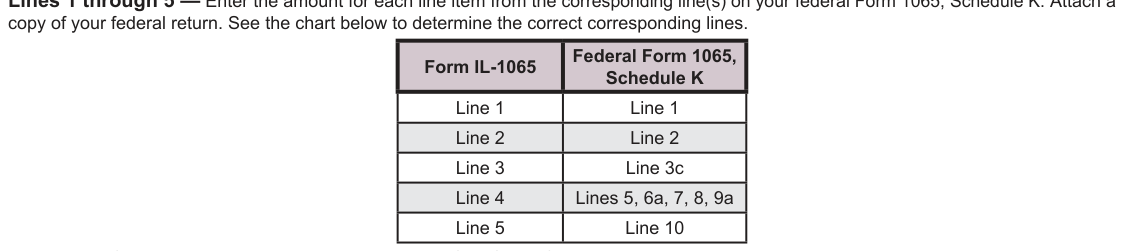
Text version of this table
Form IL-1065 Federal Form 1065, Schedule K Line 1 Line 1 Line 2 Line 2 Line 3 Line 3c Line 4 Lines 5, 6a, 7, 8, 9a Line 5 Line 10
# Schedule K
Line 4 Lines 5, 6a, 7, 8, 9a
Line 5 Line 10
Note: Under federal law, Paycheck Protection Program (PPP) loan forgiveness is not considered taxable income and the business expenses covered by the PPP loan proceeds are deductible business expenses. Currently, Illinois tax law has no addition modification to change this; therefore, the same treatment flows through to the Illinois return and is included as part of federal taxable income.
Line 6 — Include any items of income or loss from federal Form 1065, Schedule K, that are not included on any other line of Step 2 or Step 3 of this Form IL-1065.
# Step 3 — Figure your unmodified base income or loss

Text version of this table
Form IL-1065 Federal Form 1065, Schedule K Line 8 Sum of Lines 13a and 13b Line 9 Line 12 Line 10 Line 13c
Line 11 — Include any items of expense
- that you are required to state separately to your partners, rather than include in ordinary income, and
- that would be taken into account by an individual in computing his or her taxable income, and
- that are not included on any other line of Step 2 or Step 3 of this Form IL-1065.
Do not include any of the following items on this line:
- net operating loss carryovers;
- any qualified business income deduction allowed under IRC Section 199A;
- any depletion amounts allowed federally on all of your oil and gas properties; and
- any excess business interest expense under IRC Section 163(j).
Line 13 — This is your total unmodified base income or loss. If you are a member of a unitary group see "What if I am a member of a unitary group?" in the General Instructions for what to enter on Line 13.
# Step 4 — Figure your income or loss
Line 14 — Follow the instructions on the form. If you are a member of a unitary group see "What if I am a member of a unitary group?" in the General Instructions for what to enter on Line 14.
Note: Do not enter negative amounts on Lines 15 through 22.
Line 15 — Enter the total of all amounts excluded from unmodified base income that were received or accrued as federally tax-exempt interest (e.g. state, municipal and other interest) and all distributions of exempt interest received from regulated investment companies during the tax year.
Line 16 — You must add back any amount of Illinois Replacement taxes that you deducted on your federal Form 1065 to arrive at your federal ordinary income. You are not required to add back taxes from other states that you included as a federal deduction.
A partnership that elects to pay PTE tax must add back the amount of that tax deducted federally, in addition to the add back for replacement tax deducted.
Line 17 — Enter the addition amount calculated on Form IL-4562, Step 2, Line 4. For more information, see Form IL-4562 Instructions.
Attach Form IL-4562 to your Form IL-1065.
Line 18 — Enter the interest or intangible expenses, or insurance premiums paid to an affiliated company, to the extent these expenses exceed any taxable dividends you received from the affiliated company. To compute the amount of this addition, complete Step 2 of Illinois Schedule 80/20 and enter on Line 18 the total from Illinois Schedule 80/20, Step 2, Line 9. Attach Illinois Schedule 80/20 to your
Form IL-1065.
Some interest and intangible expenses may be exempt from this add-back provision. See Illinois Schedule 80/20 Instructions for more information including definitions of "affiliated company," "intangible expenses," and "intangible assets."
Line 19 — If you are a partner in a partnership, a shareholder in a subchapter S corporation, or a beneficiary of a trust or an estate, include your distributive share of additions received from the partnership, S corporation, trust or estate on Schedules K-1-P or K-1-T. If you receive multiple schedules because you are a recipient from multiple entities, you should enter the combined total of Step 5, Column A, Lines 32 through 37, from all Illinois Schedules K-1-P you receive and Step 5, Column A, Lines 30 through 35, from all Illinois Schedules K-1-T you receive. Attach a copy of all Illinois Schedules K-1-P and K-1-T you received to your form IL-1065.
Note: The S corporation or the partnership is required to send you an Illinois Schedule K-1-P and the trust or the estate is required to send you an Illinois Schedule K-1-T, specifically identifying your share of income.
Special Note: Include only additions reported to you on the Schedule(s) K-1-P or K-1-T you received from a pass-through entity in which you are an investing partner or shareholder or a beneficiary. Do not attach copies of Schedules K-1-P you issued to your partners. You should keep copies of these schedules in your records.
Line 20 — Enter the guaranteed payments to partners from federal Form 1065, Schedule K, Line 4, excluding the amounts you capitalized.
Line 21 — Complete Illinois Schedule B. Illinois Schedule B, Section A, Line 3 represents the share of distributable income or loss that is to be added to or subtracted from base income. If the total amount on Illinois Schedule B, Section A, Line 3 is a negative amount (loss), it should be entered on Line 21 as a positive amount. See the "Illinois Schedule B Instructions" following these "Specific Instructions" for more information. Attach Illinois Schedule B to your Form IL-1065.
Line 22 — Enter the addition amount calculated on Illinois Schedule M, Step 2, Line 11. Attach a copy of Illinois Schedule M to your
Form IL-1065. The following are examples of items that must be added to taxable income and are included on Illinois Schedule M.
- Notes, bonds, debentures, or obligations issued by the Governments of Guam, American Samoa, Puerto Rico, the Northern Mariana Islands, or the Virgin Islands.
- Lloyd's plan of operations loss if reported on your behalf on Form IL-1065, Partnership Replacement Tax Return, and included in your taxable income.
- Deductions you claimed this year and in your two most recent tax years for expenses connected with income from an asset or activity which were reported as business income in prior years and as nonbusiness income on this return. See Illinois Schedule NB, Nonbusiness Income, Line 11, and Illinois Schedule NB Instructions for more information.
# Step 5 — Figure your base income or loss
Do not enter negative amounts on Lines 24 through 34.
Note: A double deduction is prohibited by IITA Section 203(g). You cannot deduct the same item more than once.
Line 24 — Enter the total interest received or accrued from U.S. Treasury bonds, notes, bills, federal agency obligations, and savings bonds included in federal ordinary income. You may not subtract anything that is not identified in Illinois Publication 101. This amount is net of any bond premium amortization deducted federally.
Line 25 — Enter the amount from Illinois Schedule F (Form IL-1065), Gains from Sales or Exchanges of Property Acquired Before August 1, 1969, Line 14. Capital gain, or Section 1245 or 1250 gain, on property acquired before August 1, 1969, may be limited by the value of the property on August 1, 1969. See Illinois Schedule F (Form IL-1065) Instructions for more information. Attach Illinois Schedule F and a copy of federal Schedule D (or federal Form 8949), federal Form 4797, and federal Form 6252, if filed.
Line 26 — Enter the greater of
- your personal service income as defined in the now-repealed IRC Section 1348(b)(1); or
- a reasonable allowance for compensation paid or accrued for services rendered by partners to you.
See 86 Ill. Adm. Code Section 100.2850 for more information.
Line 27 — Complete Illinois Schedule B. Illinois Schedule B, Section A, Line 3 represents the share of distributable income or loss that is to be added to or subtracted from base income. If the total amount on Illinois Schedule B, Section A, Line 3 is a positive amount, enter that amount on Line 27. If the total amount on Illinois Schedule B, Section A, Line 3 is negative, leave Line 27 blank and see the instructions for Line 21. For more information, see the "Illinois Schedule B Instructions" following these "Specific Instructions". Attach Illinois Schedule B to your Form IL-1065.
Line 28 — Enter the River Edge Redevelopment Zone Dividend subtraction from Illinois Schedule 1299-A, Step 1, Line 3.
Line 29 — Enter the High Impact Business Dividend subtraction from Illinois Schedule 1299-A, Step 1, Line 6.
Note: You must attach Illinois Schedule 1299-A, Tax Subtractions and Credits, and any other required support listed on Schedule
1299-A to your Form IL-1065 if you have an amount on Line 28 or Line 29.
Line 30 — Enter the subtraction allowance from Form IL-4562, Step 3, Line 19. Attach Form IL-4562 to your Form IL-1065.
Line 31 — Enter the amount from Illinois Schedule 80/20, Step 4, Line 23. Attach Illinois Schedule 80/20 to your Form IL-1065.
You should use Illinois Schedule 80/20 if
- you added back interest paid to an affiliated company on Step 4, Line 18. You may subtract any interest received from that company during this tax year, up to the amount of your addition for interest expense paid to that company. Also, if you added back intangible expenses from a transaction with an affiliated company on Line 18, you may subtract any income you received during the tax year from similar transactions with the affiliated company, up to the amount of your addition for intangible expense for that company. To compute the amount of this subtraction, complete Illinois Schedule 80/20.
- you are an affiliated company, and you received interest or intangible income from someone who had to add back the interest and intangible expense, or insurance premiums on their Illinois Schedule 80/20. You may subtract your interest or intangible income from that person.
Line 32 — Enter your distributive share of subtractions passed through to you by a partnership, trust, or estate on Schedules K-1-P or K-1-T. Do not include any amounts passed through that are reflected on Illinois Schedule 1299-A. Attach a copy of all Illinois Schedules
K-1-P and K-1-T you received to your Form IL-1065.
Note: The partnership or S corporation is required to send you an Illinois Schedule K-1-P and the trust or the estate is required to send you an Illinois Schedule K-1-T, specifically identifying your share of subtractions.
Special Note: Include only subtractions reported to you on the Schedule(s) K-1-P or K-1-T you received from a pass-through entity in which you are an investing partner, shareholder, or beneficiary. Do not attach copies of Schedules K-1-P you issued to your partners. You should keep copies of these schedules in your records.
Line 33 — Enter the subtraction amount calculated on Illinois Schedule M, Step 3, Line 40. Attach a copy of Illinois Schedule M to your
Form IL-1065.
You may not subtract anything that is not identified below, on Schedule M (for businesses), or in Illinois Publication 101. Subtractions allowed on Illinois Schedule M include:
- notes, bonds, debentures, or obligations issued by the Governments of Guam, American Samoa, Puerto Rico, the Northern Mariana Islands, or the Virgin Islands, to the extent that you were required to add these amounts to your federal ordinary income.
- the refund of Illinois replacement tax for a prior year, to the extent included in your federal ordinary income.
- any other income included on Step 4, Line 23, exempt from taxation by Illinois by reason of its Constitution or statutes or by the Constitution, treaties, or statutes of the United States. This amount is net of any bond premium amortization deducted federally. For more information, see Illinois Publication 101.
- the amount equal to the deduction used to compute the federal tax credit for restoration of amounts held under claim of right under IRC Section 1341.
- contributions you made under the Tax Increment Allocation Redevelopment Act to a job training project. For more information, see FY Bulletin 1990-40.
Line 35 — This is your base income or loss.
Follow the instructions on the form and check a box on Line A or B. You must check one of these boxes and follow the instructions for that line.
Check the box on Line A if
- all of your base income or loss is derived inside Illinois; and
- you do not have any income or loss to report on Lines 36, 37, 44, or 45.
If you check the box on Line A, do not complete Step 6. All of your base income or loss is allocable to Illinois. Skip Step 6, enter the amount from Step 5, Line 35 on Step 7, Line 47, and complete the remainder of the return.
Check the box on Line B if any of the following apply
- your base income or loss is derived inside and outside Illinois;
- all of your base income or loss is derived outside Illinois; or
- you have income or loss to report on Lines 36, 37, 44, or 45.
If you check the box on Line B, you must complete all lines of Step 6. Submitting Form IL-1065 with an incomplete Step 6, including Lines 40, 41, and 42 may result in a delay in processing your return, further correspondence, and you may be required to submit further information to support your filing. See the Specific Instructions for Step 6 for more information.
# Step 6 — Figure your income allocable to Illinois
You must check the box on Line B and complete all lines of Step 6 if any portion of Line 35, base income or loss, is derived outside Illinois, or you have any income or loss to report on Lines 36, 37, 44, or 45.
If you do not complete all of Step 6, Lines 36 through 46, we may issue a notice and demand proposing 100 percent of income as being allocated to Illinois, or in the case of a loss return, a notice indicating none of your loss as being allocated to Illinois.
In order to properly allocate your base income or loss you need to determine what portion of the total base income is business income or loss that is to be apportioned among all the states in which you do business, and what portion is nonbusiness income or loss that is to be allocated to a particular state.
Note: Unitary filers who are required to file a Schedule UB - You must complete both Step 4 of the Schedule UB and Step 6 of the
Form IL-1065.
Note: Investment partnerships that are not required to but elect to complete Form IL-1065 should check the box on Line 35 B, enter zero on Step 6, Lines 36 through 46 and Step 7, Line 47, and check the corresponding box in Step 1, Line F.
Note: You must complete all lines of Step 6.
Line 36 — Enter the amount of all nonbusiness income or loss included in base income, net of any related deductions, plus any recaptured business expenses from Illinois Schedule NB, Column A. Include any nonbusiness income you received from Illinois Schedules K-1-P or K-1-T in the amounts reported on Schedule NB. Attach Illinois Schedule NB and all Illinois Schedules K-1-P or K-1-T you received to your Form IL-1065. If you do not have an amount to report on this line, enter zero.
Note: If you are making the election to treat all income other than compensation as business income for this tax year, you must check the box in Step 1, Line O, and enter zero here and on Line 44. This election must be made by the extended due date of this return. Once made, the election is irrevocable.
Line 37 — Enter the amount of all business income or loss included in base income received from any non-unitary partnership, partnership included on a Schedule UB, S corporation, trust, or estate, of which you are a partner, or a beneficiary, net of any amount distributable to partners subject to replacement tax. See Illinois Schedules K-1-P(2) or K-1-T(2) for more information. Attach a copy of all Illinois
Schedules K-1-P and K-1-T you received to your Form IL-1065. If you do not have an amount to report on this line, enter zero.
Note: The partnership or S Corporation is required to send you an Illinois Schedule K-1-P and Schedule K-1-P(2) and the trust or the estate is required to send you an Illinois Schedule K-1-T and Schedule K-1-T(2), specifically identifying your share of income.
Special Note: If you are a partner engaged in a unitary business with your partnership, you must either file a Schedule UB with that partnership or include your distributable share of the partnership's business income in your business income. Do not subtract this business income on Line 37.
# Lines 40 through 42 —
You must complete Lines 40 through 42 if any of the following apply
- your business income or loss is derived inside and outside Illinois;
- all of your business income or loss is derived outside Illinois; or
- you have income or loss to report on Lines 36, 37, 44, or 45.
Follow specific instructions below for Lines 40 through 42.
Note: If you are a financial organization, a transportation company, sales company, or a federally regulated exchange, check the appropriate box in Step 1, Line E (financial organization, transportation company, sales company, or federally regulated exchange) and see "Apportionment Formulas" in these instructions.
Special Note: If you are a partner engaged in a unitary business with your partnership, you must either file a Schedule UB with that partnership or include your distributive share of the "everywhere" and "Illinois" sales factors from the partnership in your "everywhere" and "Illinois" sales factors. For more information, see 86 Ill. Adm. Code Section 100.3380(d).
Line 40 — Enter your total sales everywhere.
Line 41 — Enter your total sales inside Illinois. If you have no sales in Illinois, enter zero.
Note: Lines 40 and 41 cannot be less than zero. The amount on Line 41 cannot exceed the amount on Line 40.
Line 42 — Divide Line 41 by Line 40 and enter the result, rounded to six decimal places. The result cannot be greater than one or less than zero.
Note: If you checked the box on Line 35 B and do not complete Lines 40, 41, and 42 we may issue a notice and demand proposing 100 percent of your income as being allocated to Illinois, or in the case of a loss return, a notice indicating none of your loss as being allocated to Illinois.
Line 43 — Follow the instructions on the form.
Line 44 — Enter the amount of nonbusiness income or loss allocable to Illinois from Illinois Schedule NB, Column B. Include any nonbusiness income you received from Illinois Schedules K-1-P or K-1-T in the amounts reported on Schedule NB. This amount is net of the portion of your Illinois nonbusiness income distributable to partners subject to replacement tax. Attach a copy of Schedule NB and all Illinois Schedules K-1-P and K-1-T you received to your Form IL-1065. If you do not have an amount to report on this line, enter zero.
Note: If you checked the box in Step 1, Line O, making the election to treat all of your income other than compensation as business income, then enter zero on Line 44.
Line 45 — Enter the amount of the income or loss reported on Step 6, Line 37 that is apportionable to Illinois as reported by the non-unitary partnership, partnership included on a Schedule UB, S corporation, trust, or estate, on Illinois Schedules K-1-P or K-1-T, net of the portion distributable to partners subject to replacement tax. See Illinois Schedules K-1-P(2) or K-1-T(2) for more information. Attach a copy of all Illinois Schedules K-1-P and K-1-T you received to your Form IL-1065. If you do not have an amount to report on this line, enter zero.
# Step 7 — Figure your net income
Line 47 — Follow the instructions on the form. If this amount is a loss, you may carry it forward to later years as an Illinois net loss deduction (NLD).
Line 48 — Enter your Illinois net loss deduction carryforward as determined on Illinois Schedule NLD, Step 1, Line 7, total box. Attach
Illinois Schedule NLD to your Form IL-1065.
If you are a cooperative and you separate your patronage and nonpatronage income or loss, complete Schedule INL and follow the instructions for computation of your Illinois net loss deduction.
If you are reporting losses from an entity or entities that you acquired during the filing period of this return or reporting previously unreported losses from prior acquisitions, check the box on Line 48 and,
- if Line 48 is zero, attach a detailed statement to your return that includes:
○the FEIN of the entity from which you acquired the loss, ○the reason (e.g., merger) you are allowed to use that entity's losses, ○the date you acquired the loss, ○the tax period(s) the entity reported the loss(es) on their return(s), and ○the amount of loss acquired.
- if Line 48 is greater than zero, report the losses on page 2 of the Schedule NLD that you attach to your return.
Note: Each acquisition must be reported in detail separately. Do not report acquired losses that were previously reported.
Special Note: For more information, see the Schedule NLD Instructions.
Line 51 — Divide Line 47 by Line 50 and enter the result, rounded to six decimal places. This figure cannot be greater than one.
Line 52 — The standard exemption is $1,000 multiplied by a fraction in which the numerator is your base income allocable to Illinois and the denominator is your total base income. This figure cannot be greater than "$1,000." The standard exemption is $0.00 if your unmodified base income amount on Step 3, Line 13 is greater than $250,000.
If you have a change in your tax year end, and the result is a tax period of less than 12 months, the standard exemption is prorated based on the number of days in the short tax year. However, if this is your first or final return, you are allowed to use the full-year standard exemption even if it is a short tax year.
Line 53 — If Line 49 is a loss, enter the amount from Line 49 on 53. Do not increase your loss by the exemption allowance on Line 52.
# Step 8 — Figure your net replacement tax
Note: Skip this step if you are an investment partnership.
Line 55 — Enter your recapture of investment credits from Illinois Schedule 4255, Recapture of Investment Tax Credits, Step 6, Column D, Line 22.
If you claimed an Illinois investment tax credit in a prior year on Form IL-477, Replacement Tax Investment Credits, and any of the property was disqualified within 48 months of being placed in service, you must use Illinois Schedule 4255 to compute the amount of recapture. Credit must be recaptured in the year the property became disqualified.
Line 57 — Enter the amount from Form IL-477, Step 1, Line 13. Attach Form IL-477 and any other required support listed on
Form IL-477 to your Form IL-1065.
You may claim a replacement tax investment credit of .5 percent (.005) of the basis of qualified property placed in service in Illinois during the tax year.
An additional credit of up to .5 percent (.005) of the basis of qualified property is available if your Illinois base employment increased by 1 percent (.01) or more over the preceding year or if your business is new to Illinois. Excess credit may be carried forward for five years following the excess credit year. For more information, see Form IL-477 Instructions.
# Step 9 — Figure the taxes, withholding, and penalty you owe
Line 59a — For partnerships other than those that qualify as "investment partnerships" as defined in the IITA Section 1501(a)(11.5)(A-5).
Complete all sections of Illinois Schedule B and enter the amount from Illinois Schedule B, Section A, Line 5, on this line. This is the amount of pass-through withholding you owe on behalf of your members. Attach Illinois Schedule B to your Form IL-1065. See "Definitions to help you complete your Form IL-1065" in these instructions for more information. If you complete Line 59a, then Line 61 should be blank.
Note: Investment partnerships calculating investment partnership withholding will enter the amount from Schedule B, Section A, Line 5, on Line 59b. See the Line 59b instructions and "What if I am an investment partnership?" for more information.
Note: Do not include any amount from Schedule B, Section B, Line K, PTE tax credit paid to members, or Line L, PTE tax credit received and distributed to members.
Note: Do not include on Line 59a any pass-through withholding reported to you on Schedule(s) K-1-P or K-1-T. Pass-through withholding amounts reported to you are included on Step 10, Line 65c.
Line 59b — Investment partnerships only. If you are an investment partnership, enter the total amount of investment partnership withholding you are withholding for your nonresident partners as reported on Schedule B, Section A, Line 5. Nonresident partner investment partnership withholding is calculated on Schedule K-1-P(4) and carried over to Schedule B, Section B, Line J, for each applicable partner.
Schedule B, Section B, Line J amounts must be carried to the applicable line of Schedule B, Section A, Lines 4a through 4e, and added to the total to be entered on Schedule B, Section A, Line 5. See "What if I am an investment partnership?" in these instructions and Illinois Schedule K-1-P(4) for more information.
Line 60 — Complete this line if you elect to file and pay PTE tax on your calculated base income. The total amount of PTE credit allocated to partners cannot exceed the PTE liability reported and actually paid by the partnership. Follow the instructions on the PTE Income Worksheet to determine the amount to enter on this line.
Line 61 — Enter the amount from Schedule B, Section A, Line 6. Do not include any PTE tax credit you received on Schedule(s) K-1-P or
K-1-T on this line.
Note: If you complete Line 61, then Line 59a should be blank.
Special Note: Traditionally, partnership income is distributed based on each partner's share in the partnership. In a traditional partnership, the amount entered on Line 61 would be equal to the amount from Line 60 multiplied by 4.95% (.0495). However, Line 61 may not equal Line 60 multiplied by 4.95% (.0495) in instances where special business agreements allocate income in a nontraditional way.
Line 63 — If you elected to pay PTE tax and your total tax liability is greater than $500, enter the amount of any self-assessed underpayment of estimated tax penalty you figured on Form IL-2220, Penalty Worksheet 1, Line 22.
If you annualized your income in Step 6 of Form IL-2220, be sure to check the box in Step 1, Line J of this Form IL-1065. Attach a completed Form IL-2220 to your Form IL-1065.
Note: If you do not need to annualize your income and do not wish to complete Form IL-2220, we encourage you to let us figure your penalties and interest and send you a bill instead of determining these amounts yourself. We will compute any penalty or interest due and notify you.
# Step 10 — Figure your refund or balance due
Note: Do not include any PTE tax or PTE tax credit on Lines 65a through 65d. PTE tax is reported on Line 61 and PTE Tax credit is reported for each partner on Schedule B, Section B, Line L.
Line 65a — Enter the sum of any overpayment to be applied to this year's tax return. Take into account any correspondence we may have sent you that changed the amount of your credit carryforward from the previous year.
Line 65b — Enter the sum of any
- estimated payments or tax prepayments made before the date this return is filed,
- extension payments before the date this return is filed, and
- any other payments made before the date this return is filed.
PTE Income Worksheet
1a Base Income from Line 35.
Investment Partnerships - Subtract income subject to withholding from base income. 1a 00 1b Exempt distributions for retired partners included in Line 1a. 1b 1 Subtract Line 1b from Line 1a. 1
2a Amount from Line 26. 2a
# 2b Amount from Line 27. 2b
3 Add Lines 2a and 2b. 3
4 PTE base income. Add Lines 1 and 3. 4
5 Nonbusiness income or loss. 5 00
6 Business income or loss included in Line 4 from non-unitary partnerships, partnerships included on a Schedule UB, S corporations, trusts, or estates. 6 00 7 Add Lines 5 and 6. 7 00 8 Business income or loss. Subtract Line 7 from Line 4. 8 00 9 Total sales everywhere. This amount cannot be negative. 9 00 10 Total sales inside Illinois. This amount cannot be negative. 10 00 11 Divide Line 10 by Line 9. Round to six decimal places. 11 12 Business income or loss apportionable to Illinois. Multiply Line 8 by Line 11. 12 00 13 Nonbusiness income or loss allocable to Illinois. 13 00 14 Business income or loss apportionable to Illinois from non-unitary partnerships, partnerships included on a Schedule UB, S corporations, trusts, or estates. 14 00 15 PTE Income. Add Lines 12 through 14. Enter this amount on Line 60. 15 00
# PTE Worksheet Instructions
Line 1a — Enter the base income from Line 35 of your return. If you are an investment partnership, subtract any income that is subject to investment partnership withholding.
Line 1b — Enter the amount of distributions for retired partners to the extent that the partner's distributions are exempt from tax under 35 ILCS 5/203(a)(2)(F). Only enter amounts included in the base income from Line 1a.
Lines 1 through 4 — Follow the instructions on the worksheet.
Lines 5 and 13 — Complete a pro forma Illinois Schedule NB allocating nonbusiness income amounts to Illinois including the portion of nonbusiness income or loss distributable to partners subject to replacement tax reported from Form IL-1065, Lines 21 and 27.
Line 6 through 12 — Follow the instructions for Form IL-1065, Lines 37 through 43.
Line 14 — Follow the instructions for Form IL-1065, Line 45, but do not include any income from a partnership or S corporation that made the PTE election.
Line 65c — Enter the amount you wish to claim of Illinois pass-through withholding (including any eligible investment partnership withholding) reported to you by partnerships, S corporations, or trusts on Schedule(s) K-1-P or K-1-T. If you received more than one Schedule K-1-P or K-1-T, add the amounts you wish to claim from all the schedules and enter the total on Line 65c. Attach copies of the Schedules K-1-P and K-1-T you received from the pass-through entities to your Form IL-1065. Schedules K-1-P and K-1-T, Step 1, Line 3, must be completed or the pass-through withholding reported on this line may not be credited to your return.
Note: To claim Illinois pass-through withholding from Schedule(s) K-1-P or K-1-T, all pages of the Schedule(s) K-1-P or K-1-T you received from pass-through entities must be attached and the tax year ending field of the Schedule(s) K-1-P and K-1-T must be completed.
Special Note: Partners in an investment partnership may not be eligible to claim a Schedule K-1-P, Step 7, Line 55 amount reported to them by the investment partnership. See Schedule K-1-P(2) for information about when a partner may claim investment partnership withholding credit.
See "Definitions to help you complete your Form IL-1065" in these instructions for more information.
Note: Do not include on Line 65c any pass-through withholding you owe on behalf of your members. Pass-through withholding you owe on behalf of your members is included on Step 9, Line 59a.
Line 65d — Enter the amount of Illinois income tax withheld on Forms W-2G from gambling and sports wagering winnings that were received by you.
Line 68 — Enter the amount of overpayment you elect to be carried forward to your next tax year. Check the box on this line if this is your final return and any remaining carryforward is being transferred to another entity. Attach a detailed statement to your return listing the FEIN of the entity receiving the credit carryforward, the date the credit was transferred, and the reason for the transfer.
Note: Step 1, Line C, must also be completed if you are transferring an overpayment to another entity.
Your credit carryforward will not be applied if you do not file a processable return.
Note: Your credit carryforward may be reduced by us due to corrections we make to your return, or to satisfy any unpaid tax, penalty, and interest due for this year or any other year. If we reduce your credit carryforward, it may result in a late-payment penalty in a subsequent year.
To which tax year will my credit apply?
If your 2025 return was filed
- on or before the original filing and payment due date of your return, your credit will be applied to the next full tax year, unless you elect to apply the credit to a different tax year.
Example 1: You file your 2025 calendar-year return on March 3, 2026, requesting to receive your overpayment as a credit. March 3, 2026, falls before the original filing and payment due date of the 2025 tax year (April 15, 2026, for calendar-year filers). Your credit will be applied against your 2026 tax year liability.
- after the original filing and payment due date of your return, your credit will be applied to the next full tax year in which timely payments can be made as of the date you are filing this return, unless you elect to apply the credit to a different tax year.
Example 2: You file your 2025 calendar-year return on August 5, 2026, requesting to receive your overpayment as a credit. August 5, 2026, is after the original filing and payment due date of the 2025 tax year (April 15, 2026, for calendar-year filers), but is before the original filing and payment due date of the 2026 tax year (April 15, 2027, for calendar-year filers). Your credit will be applied against your 2026 tax year liability.
Example 3: You file your 2025 calendar-year return on April 28, 2027, requesting to receive your overpayment as a credit. April 28, 2027, is after the original filing and payment due date of the 2026 tax year (April 15, 2027, for calendar-year filers), but is before the original filing and payment due date of the 2027 tax year (April 15, 2028, for calendar-year filers). Your credit will be applied against your 2027 tax year liability.
Note: If you are filing your return after the extended due date, you may only elect to claim an overpayment credit for payments received on or before the date you filed your return. Any payments made after the date you filed that return can only be claimed as an overpayment credit on a subsequent amended return.
With what date will my credit apply against mytax liability?
If your 2025 return was filed
- on or before the extended due date of your return (October 15, 2026, for calendar-year filers), your credit is considered to be paid on the original due date of this return (April 15, 2026, for calendar-year filers).
However, if all or a portion of your overpayment results from payments made after the original due date of this return, that portion of your credit is considered to be paid on the date you made the payment.
Example 1: You file your 2025 calendar-year return on or before the extended due date of your return requesting $500 be applied as a credit. All of your payments are made before the original due date of your return. Your credit of $500 will be considered to be paid on April 15, 2026.
Example 2: You file your 2025 calendar-year return on or before the extended due date of your return requesting $500 be applied as a credit. Your overpayment includes payments of $400 you made before the original due date of your return, and a $100 payment you made on June 3, 2026. Your credit of $400 will be considered to be paid on April 15, 2026. The remaining $100 credit will be considered to be paid on June 3, 2026.
- after the extended due date of your return, your credit is considered to be paid on the date you filed the return on which you made the election.
Example 3: You file your 2025 calendar-year return on December 2, 2026, requesting $500 be applied as a credit. Your credit of $500 will be considered to be paid on December 2, 2026, because you filed your return after the extended due date of your 2025 calendar-year return.
May I apply my credit to a different tax year?
Yes. If you wish to apply your credit to a tax year other than the one during which you file this return, you must submit a separate request in writing to:
ILLINOIS DEPARTMENT OF REVENUE
PO BOX 19004
SPRINGFIELD IL 62794-9004
Note: Submit your request at the time you file your return. Do not submit your return to this address.
Your request must include
- your name,
- your FEIN,
- the tax year of the return creating the overpayment, and
- the tax year you wish to have the credit apply.
If you do not follow these instructions, your election will be considered invalid and we will not apply your credit as you requested.
If you submit a valid request, we will apply your credit as you requested and notify you. Once made, your election to change the tax year to which your credit will apply is irrevocable. Requests will be worked in the order we receive them.
Note: You may only apply your credit to tax years occurring after the year of the return creating the overpayment. If you request to apply more credit than our records show you have available, we will apply the maximum amount available and notify you of the difference.
Line 69 — Follow the instructions on the form. Your refund will not be issued if you do not file a processable return.
Note: Your refund may be reduced by us to satisfy any unpaid tax, penalty, and interest due for this year or any other year.
Line 70 — Direct deposit information.
If you choose to deposit your refund directly into your checking or savings account, you must
- Enter your routing number.
○For a checking account, your routing number must be nine digits and the first two digits must be 01 through 12 or 21 through 32.
The sample check following these instructions has an example of a routing number.
○For a savings account, you must contact your financial institution for your routing number.
- Check the appropriate box to indicate whether you want your refund deposited into your checking or savings account.
- Enter your account number.
○For a checking account, your account number may be up to 17 digits.
The sample check following these instructions has an example of an account number.
○For a savings account, you must contact your financial institution for your account number.
Do not use your account and routing numbers from your checking or savings account deposit slip. Do not include your check number.
Include hyphens, but omit spaces and special symbols. You may have unused boxes.
Note: If your financial institution does not honor your request for direct deposit, we will send you a check instead.
Note: We do not support international ACH transactions. We will only deposit refunds into accounts located within the United States. If your financial institution is located outside the United States, we will send you a check instead of depositing your refund into your account.
Line 71 — Follow the instructions on the form. This is your amount of tax due that must be paid in full if $1 or more. If you are not paying electronically, complete a payment voucher, Form IL-1065-V, make your check or money order payable to "Illinois Department of Revenue", write your FEIN, tax year ending, and "IL-1065-V" on your check or money order, and attach the payment and voucher to the front of the return.
Note: If you are paying electronically do not complete and attach a payment voucher.
You should also enter the payment amount you are submitting with this return in the box located on the top of Page 1 of the Form IL-1065.
We encourage you to let us figure your penalties and interest and send you a bill instead of determining these amounts yourself. We will compute any penalty and interest due and notify you. See General Information, "What are the penalties and interest?"
Step 11 — Signature, date, and paid preparer's information You must sign and date your return. If you do not sign your return, it will not be considered filed and you may be subject to a non-filer penalty.
If you pay someone to prepare your return, the income tax return preparer must also sign and date the return, enter the preparer tax identification number (PTIN) issued to them by the Internal Revenue Service, and provide their firm's name, FEIN, address, and phone number.
If you want to allow the paid preparer listed in this step to discuss this return with IDOR check the box. This authorization will allow your paid preparer to answer any questions that arise during the processing of your return, call us with questions about your return, and receive or respond to notices we send. The authorization will automatically end no later than the due date for filing your next year's tax return (excluding extensions). You may revoke the authorization at any time by calling or writing us.
# Apportionment Formulas
Certain businesses that derive their income from inside and outside Illinois require an apportionment formula. The following definitions will help in completing Step 6.
Business income — See General Information, "Business income" under "Definitions to help you complete your Form IL-1065."
Financial organization — any bank, bank holding company, trust company, savings bank, industrial bank, land bank, safe deposit company, private banker, savings and loan association, building and loan association, credit union, currency exchange, cooperative bank, small loan company, sales finance company, investment company, or any person owned by a bank or bank holding company.
Revenue miles — A revenue mile is the transportation of one passenger, or one net ton of freight, the distance of one mile.
Federally regulated exchange — A federally regulated exchange is:
- a regulated entity as defined in 7 U.S.C. Sections 1a(40)(A), 1a(40)(B), or 1a(40)(C);
- an exchange or clearing agency as defined in 15 U.S.C. Sections 78c(a)(1) or 78c(a)(23);
- any entity regulated under any successor regulatory structure to a registered entity, exchange, or clearing agency; or
- any member of the same unitary group if 50 percent or more of the business receipts of the unitary business group for the taxable year are attributable to the matching, execution, or clearing of transactions conducted by members of the group described in the first three bullet points above.
# What if I am a sales company?
If you checked the box in Step 1, Line E, indicating that you are a sales company and your income is derived from inside and outside Illinois, you must apportion your business income as follows:
Include gross receipts from the license, sale, or other disposition of patents, copyrights, trademarks, and similar items of intangible personal property in the numerator and denominator of your sales factor only if these gross receipts are more than 50 percent of the total gross receipts included in gross income for this tax year and each of the two immediately preceding tax years.
Do not include the following items of income in the numerator or denominator of your sales factor:
- dividends;
- amounts included under IRC Section 78;
- IRC Section 965 inclusion;
- Net Controlled Foreign Corporation Tested Income (NCTI) or Global Intangible Low-Taxed Income (GILTI) income under IRC Section 951A;
- subpart F income as defined in IRC Section 952; and
- any item of income excluded or deducted from base income.
For more information on what should be included in the numerator or denominator of your sales factor, see 86 Ill. Adm. Code Sections 100.3370 and 100.3380.
Sales of tangible personal property are in Illinois if
- the property is delivered or shipped from anywhere to a purchaser in Illinois, other than the United States government, regardless of the Free on Board (f.o.b.) point or other conditions of the sale;
- the property is shipped from Illinois to any place and the purchaser is the United States government; or
- the property is shipped from Illinois to another state and you are not taxable in the state of the purchaser.
For radio and television broadcasting (including cable and satellite broadcasting), the following sales are in Illinois:
- advertising revenue received from an advertiser whose headquarters is in Illinois;
- fees received by a broadcaster from its viewers or listeners in Illinois;
- in the case of fees received by a broadcaster from the producer or other owner of the contents of a program, the percentage of the fees equal to the percentage of the broadcast's viewing or listening audience located in Illinois; or
- in the case of a person who owns the contents of a program and who provides the contents to a broadcaster for a fee or other charge, the fees received for that program from a broadcaster located in Illinois.
If the "sales everywhere" amount includes gross receipts from the licensing, sale, or other disposition of patents, copyrights, trademarks, and other similar items of intangible personal property, and the receipts are not covered by the broadcasting rules, then these receipts should be allocated in Illinois to the extent the item is used in Illinois during the year the gross receipts are included in gross income. An item is used in Illinois if
- a patent is employed in production, fabrication, manufacturing, or other processing in Illinois or if the patented product is produced in Illinois;
- copyrighted material is printed or other publications originated in Illinois; or
- the commercial domicile of the licensee or purchaser of a trademark or other item of intangible personal property is in Illinois.
Note: If you cannot determine from your (or your related party's) books and records in which state an item is used, do not include the gross receipts from that item in the numerator or the denominator of the sales factor.
For sales of telecommunications services, the following sales are in Illinois:
- sales of telecommunications service sold on a call-by-call basis, where the call both originates and terminates in Illinois, or the call either originates or terminates in Illinois and the customer's service address is in Illinois;
- retail sales of postpaid telecommunications service if the point of origination of the signal is in Illinois;
- retail sales of prepaid telecommunications service where the purchaser receives the prepaid card or other means of conveyance at a location in Illinois;
- charges imposed at a channel termination point in Illinois;
- charges for channel mileage between two channel termination points in Illinois;
- charges for channel mileage between one or more channel termination points in Illinois and one or more channel termination points outside Illinois, times the number of channel termination points in Illinois divided by total termination channels;
- charges for services ancillary to sales of services in Illinois. If you provide ancillary services, but cannot determine where the sales of the related services are located, your sales are in Illinois if your customer is in Illinois;
- access fees charged to a reseller of telecommunication for a call that both originates and terminates in Illinois;
- 50 percent of access fees charged to a reseller of telecommunications services for an interstate call that originates or terminates in Illinois; and
- end user access line charges, if the customer's service address is in Illinois.
For more information, see 86 Ill. Adm. Code Section 100.3371.
Illinois lottery winnings and proceeds from sales or other transfers of rights to lottery winnings are in Illinois.
For taxable years ending on or after December 31, 2019, gross receipts from winnings from pari-mutuel wagering conducted at a wagering facility licensed under the Illinois Horse Racing Act of 1975 or from winnings from gambling games conducted on a riverboat or in a casino or organization gaming facility licensed under the Illinois Gambling Act are Illinois sales and must be included in the numerator of the sales factor.
For taxable years ending on or after December 31, 2021, payments from Illinois sources of wagering and winnings conducted in accordance with the Sports Wagering Act are allocable to Illinois.
Sales, other than sales of tangible personal property or telecommunications service, and gross receipts from broadcasting, or the licensing, sale, or other disposition of patents, copyrights, trademarks, and similar items of intangible personal property, or Illinois lottery winnings or sales proceeds, are in Illinois as follows:
- sales or leases of real property in Illinois;
- leases or rentals of tangible personal property, to the extent it is located in Illinois during the rental period;
- interest, net gains, and other items of income from intangible personal property received by a taxpayer who is a dealer in that property from a customer who is a resident of Illinois (for individuals) or who is commercially domiciled in Illinois (for all other customers). A taxpayer without actual knowledge of the residence or commercial domicile of a customer may use the customer's billing address.
- interest, net gains, and other items of income from intangible personal property received by a taxpayer who is not a dealer in that property, if the income-producing activity is performed in Illinois or if the income-producing activity is performed inside and outside Illinois, and a greater proportion of the income-producing activity is performed inside Illinois rather than outside Illinois, based on performance costs; or
- in all other cases, if the services are received in Illinois.
Note: Gains and losses from sales or exchanges of shares in Subchapter S corporations or interest in partnerships (other than investment partnerships) are attributable to Illinois if those pass-through entities (PTEs) are taxable in Illinois. Gains and losses from sales or exchange of shares in pass-through entities, and which are considered business income, must be apportioned by multiplying the average of the PTE's apportionment factor for this year and the apportionment factors of the PTE's previous two tax years by the gains or losses from sales or exchanges of shares in pass-through entities. If the PTE filed a tax return for only one tax year prior to this year, use the average of the PTE's apportionment factors from this year's tax return and the prior year's tax return. If the PTE has no prior tax returns, use the PTE's apportionment factor from this year's tax return only. The result will be included in the amount reported on Line 41.
For more information, see 86 Ill. Adm. Code Section 100.3370.
# What if I am a financial organization?
If you checked the box in Step 1, Line E, indicating that you are a financial organization and your income is derived from inside and outside Illinois, cross out the word "sales" on Lines 40 and 41 and write "Financial organization."
On Line 40, enter the amount of gross receipts from all sources.
On Line 41 enter the amount of gross receipts from:
- sales or leases of real property located in Illinois;
- leases or rentals of tangible personal property, to the extent it is located in Illinois during the rental period;
- interest income, commissions, fees, gains on disposition, and other receipts from:
○loans secured by real or tangible personal property located in Illinois;
○unsecured consumer loans to a resident of Illinois;
○unsecured commercial or installment loans where the proceeds of the loan are applied in Illinois. If the place of application cannot be determined, the gross receipts are in Illinois if the office of the borrower from which the loan was negotiated is in Illinois. If neither the place of application nor the office of the borrower can be determined, do not include the gross receipts in Lines 40 or 41; and ○credit card receivables billed to a customer in Illinois.
- sales of travelers checks and money orders at a location in Illinois;
- investment and trading income (which includes interest, dividends, net gains, and other income from investment and trading assets and activities) that is attributable to Illinois. To determine the amount of investment and trading income attributable to Illinois, multiply the total amount of investment and trading income by a ratio of:
○the total Illinois sourced receipts excluding investment and trading income; to ○the total receipts excluding investment and trading income.
- any other transaction, if the gross receipts would be included on Line 41 under the general instructions for Line 41.
For more information, see 35 ILCS 5/304(c). Divide Line 41 by Line 40 and enter the result, rounded to six decimal places, on Line 42. Complete Lines 43 through 46 as indicated in Specific Instructions for Step 6, Figure your income allocable to Illinois.
# What if I am a transportation company?
If you checked the box in Step 1, Line E, indicating that you are a company that furnishes transportation service both inside and outside Illinois, cross out the word "sales" on Lines 40 and 41 and write "Transportation." You must apportion business income as follows:
Transportation by airline — On Line 40, enter the amount of revenue miles everywhere. On Line 41, enter the amount of revenue miles in Illinois. Divide Line 41 by Line 40 and enter the result, rounded to six decimal places, on Line 42.
Other modes of transportation — On Line 40, enter the amount of your gross receipts from providing transportation services. On Line 41 enter the amount of gross receipts from Illinois, as follows:
- all gross receipts from transportation that both originates and terminates in Illinois; and
- gross receipts from interstate transportation, multiplied by a fraction equal to the miles traveled in Illinois on all interstate trips divided by miles traveled everywhere on all interstate trips.
Divide Line 41 by Line 40 and enter the result, rounded to six decimal places, on Line 42.
Transportation of both freight and passengers or transportation by airline and other modes — Compute separate fractions for freight transportation and passenger transportation by airline and for freight transportation and passenger transportation by all other modes of transportation under A and B, in the list above and enter on Line 42 the average of those fractions, weighted by the gross receipts from freight or passenger transportation by airline or other modes, rounded to six decimal places For more information, see 86 Ill. Adm. Code Section 100.3450.
Complete Lines 43 through 46 as indicated in Specific Instructions for Step 6, Figure your income allocable to Illinois.
# What if I am a federally regulated exchange?
If you checked the box in Step 1, Line E, indicating that you are a federally regulated exchange and your income is derived from inside and outside Illinois, cross out the word "sales" on Lines 40 and 41 and write "Exchange." You may apportion your business income as follows:
On Line 40, enter the amount of business income from all sources.
On Line 41, enter the amount of business income from:
- receipts attributable to transactions executed on a physical trading floor located in Illinois;
- receipts attributable to all other matching, execution, or clearing transactions. This includes, without limitation, receipts from the provision of matching, execution, or clearing services to another entity.
○Multiply this amount by 27.54 percent (.2754) for tax years ending on or after December 31, 2013; and
- all other receipts for sales in Illinois.
Divide Line 41 by Line 40 and enter the result, rounded to six decimal places, on Line 42. Complete Lines 43 through 46 as indicated in Specific Instructions for Step 6, Figure your income allocable to Illinois.
Note: For any tax year, the Illinois apportionment percentage computed using this formula may never be less than the Illinois apportionment percentage computed for the first full tax year ending on or after December 31, 2013, for which the taxpayer used this formula.
# What if I am a member of a unitary group?
The term "unitary business group" means a group of persons related through common ownership, whose business activities are integrated with, dependent on, and contribute to each other. In the case of a corporation, common ownership is defined as the direct or indirect ownership or control of more than 50 percent of the outstanding voting stock of a corporation.
If the following applies, do not file a Schedule UB: If a partnership is engaged in a unitary business with one or more of its partners, but the unitary partners do not own substantially all of the interest in the partnership, the partnership should not be included on a Schedule UB with the partners. Substantial ownership is defined as owning more than 90 percent of all the interest in the partnership. If a Schedule UB should not be filed, the partnership completes its Form IL-1065 in the same manner as a non-unitary partnership, and each unitary partner must determine the portion of its business income taxed by Illinois by adding its share of that partnership's business income and apportionment factors (Illinois and everywhere) to its own business income and apportionment factors (Illinois and everywhere). This rule applies to you if you are unitary with one or more of your partners or if you are a partner in another partnership and are engaged in a unitary business with that partnership.
If the following applies, you must file a Schedule UB: If you are a partnership who is a shareholder in a corporation and are engaged in a unitary business with that corporation, or if you are owned more than 90 percent by members of a unitary business group (determined without regard to the rule prohibiting taxpayers conducting 80 percent or more of their business activities outside the United States from being included in a unitary business group), you are required to use a Schedule UB to apportion your business income. See the instructions for the Schedule UB for more information. Once the Schedule UB has been completed, you must apportion your business income as follows:
On Line 40, enter the "everywhere" sales factor of the entire unitary business group from Illinois Schedule UB, Step 4, Line 2, Column D. On Line 41, enter only your Illinois sales (including your share of sales of any unitary partnerships in which you are a partner).
On Lines 44 and 45, enter your own nonbusiness income and the Illinois portion of business income from non-unitary partnerships in which you are a partner, from partnerships included on a Schedule UB and in which you are a partner, from S corporations in which you are a shareholder, or from trusts or estates of which you are a beneficiary.
Note: Illinois requires the use of the "Finnigan" method of apportionment for unitary businesses. Under the "Finnigan" method, when calculating the apportionment numerator, a unitary group shall include all Illinois income or loss from all members of the unitary group as long as one or more members has nexus with Illinois. In addition, the numerator should also include any throwback sales from Illinois to a destination in which none of the unitary members have nexus or are taxable.
# What if I want to use an alternative apportionment formula?
If the apportionment methods prescribed by IITA Sections 304(a) through (e), and (h) do not fairly and accurately represent the market for your goods, services, or other sources of business income, or lead to a grossly distorted result, you may want to use a more accurate alternative method. If you want to use an alternative apportionment method, you must receive permission from IDOR prior to filing your return.
Note: Your request for an alternative apportionment formula must follow the requirement of 86 Ill. Adm. Code Section 100.3390. See the regulations or contact IDOR for more information.
If you receive permission to use an alternative formula, you must attach to your Form IL-1065 a copy of the letter granting permission.
Send your request to:
ILLINOIS DEPARTMENT OF REVENUE
LEGAL SERVICES OFFICE
SENIOR COUNSEL - INCOME TAX, 5-500
101 WEST JEFFERSON STREET
SPRINGFIELD IL 62702 or email to: REV.GCO@illinois.gov
# Read this information before completing Illinois Schedule B.
Amounts listed on the Schedule(s) K-1-P, Schedule(s) K-1-P(3), and Schedule(s) K-1-P(4) you complete are carried to your Illinois Schedule B and then reported on your Form IL-1065. Therefore, you must complete Schedule(s) K-1-P and Schedule(s) K-1-P(3) or Schedule(s) K-1-P(4) before completing Schedule B.
In order to ensure you complete Schedule B correctly, do the following in order:
- Complete all Schedule(s) K-1-P and Schedule(s) K-1-P(3) or Schedule(s) K-1-P(4), as applicable, for your partners before completing any section of Illinois Schedule B. The information reported on Schedule(s) K-1-P, Schedule(s) K-1-P(3), and Schedule(s) K-1-P(4) will be used to complete Illinois Schedule B. See Schedule K-1-P(1) instructions for more information.
- Complete Section B of Illinois Schedule B before completing Section A of Illinois Schedule B. Section B reports specific amounts from each Schedule(s) K-1-P, Schedule(s) K-1-P(3), and Schedule(s) K-1-P(4) you completed. Section B is required to be completed in full in order to avoid processing delays, further correspondence, or delays in the processing of any overpayments.
- Complete Section A of the Illinois Schedule B. Section A reports total amounts from Section B, and is required to be completed in full in order to avoid processing delays, further correspondence, or delays in the processing of any overpayments.
- Carry the amount from Illinois Schedule B, Section A, Line 3 and Line 5 to your Form IL-1065, as applicable.
See the Schedule K-1-P(1) instructions and Illinois Schedule B specific instructions for more information.
# What is the purpose of Illinois Schedule B?
The purpose of Illinois Schedule B, Partners' or Shareholders' Information, is for you to identify any person who was a partner at any time during your tax year.
The Illinois Schedule B also allows you to identify your partners that are subject to the Illinois Personal Property Tax Replacement Income Tax and to figure the share of distributable income or loss that is to be added to or subtracted from your base income.
# Is Schedule B required?
Yes. You are required to have a copy of this form on file. You must attach a copy of Schedule B to your Form IL-1065, Illinois Partnership Replacement Tax Return to support
- the addition modification claimed on Form IL-1065, Step 4, Line 21,
- the subtraction modification claimed on Form IL-1065, Step 5, Line 27,
- the pass-through withholding you owe on behalf of your nonresident members on Form IL-1065, Step 9, Line 59a,
- the investment partnership withholding you owe on behalf of your nonresident partners on Form IL-1065, Step 9, Line 59b.
- the pass-through entity tax you pay on behalf of your members on Form IL-1065, Step 9, Line 61, and
- the PTE tax credit you received and distributed to your partners on Schedule(s) K-1-P.
Therefore, you must follow the instructions for Illinois Schedule B, complete it in full, and attach it to your return.
Note: You must use forms prescribed by IDOR. Separate statements not on forms provided or approved by IDOR will not be accepted and you will be asked for appropriate documentation. Failure to comply with this requirement may delay the processing of your return or the generation of any overpayment. Additionally, failure to submit appropriate documentation when requested may result in a referral to our Audit Bureau for compliance action.
Partnerships must complete Illinois Schedule B. Do not send a computer printout with line numbers and dollar amounts attached to a blank copy of the schedule. Computer generated printouts are not acceptable, even if they are in the same format as IDOR's forms. Computer generated forms from an IDOR-approved software developer are acceptable.
Note: Investment partnerships that file Form IL-1065 must complete all applicable lines of Schedule B, Section B for each of their partners. Each amount entered on Schedule B, Section B, Line J, must match the corresponding Schedule K-1-P(4), Line 14, and be carried to the applicable line of Schedule B, Section A, Lines 4a through 4e, and added to the total to be entered on Schedule B, Section A, Line 5. For reporting purposes, investment partnerships must treat any investment partnership withholding amounts entered on Schedule B, Section B, Line J, as if they were pass-through withholding amounts, with the exception that the amount from Schedule B, Section A, Line 5, would be entered on Form IL-1065, Line 59b, rather than on Line 59a. Investment partnerships making the election to pay PTE tax must complete all other applicable lines of Schedule B, Section B (most notably Lines K and L), for each of their partners, and Schedule B, Section A, Lines 6 and 7.
# What is a resident?
A resident is
- an individual who is present in Illinois for other than a temporary or transitory purpose;
- an individual who is absent from Illinois for a temporary or transitory purpose but who is domiciled in Illinois;
- the estate of a decedent who at his or her death was domiciled in Illinois;
- a trust created by a will of a decedent who at his or her death was domiciled in Illinois; or
- an irrevocable trust, whose grantor was domiciled in Illinois at the time the trust became irrevocable. For purposes of this definition, a trust is irrevocable to the extent that the grantor is not treated as the owner of the trust under IRC Sections 671 through 678.
# What is a nonresident?
A nonresident is a person who is not a resident, as previously defined. Corporations, S corporations, partnerships, and exempt organizations are considered nonresidents for purposes of Illinois Schedule B.
# What do Section B, Lines G through J report?
Lines G through J report certain items of income, credits, and pass-through withholding you reported to your nonresident partners on the Schedule K-1-P you issued to them.
# How do I determine the amounts to report in Section B, Lines G through J?
Before completing Illinois Schedule B you must complete Schedule(s) K-1-P and Schedule(s) K-1-P(3) or Schedule(s) K-1-P(4) for each of your nonresident partners, as applicable. The amounts reported on those schedules will be used to complete Illinois Schedule B, Section B, Lines G through J.
See Schedule K-1-P(1) for instructions and more information about Schedule K-1-P(3). See Schedule K-1-P(1) for more information about Schedule K-1-P(4).
# What do I report in Section B, Line K?
Line K is used to report the PTE tax credit you distribute to your partners if you elected to file and pay pass-through entity tax.
# How do I determine the amounts to report in Section B, Line K?
Before completing Illinois Schedule B, Line K, you must determine each partner's portion of the PTE tax credit using the formula in the Schedule B, Section B, Line K instructions.
# What do I report in Section B, Line L?
Line L is used to report the PTE tax credit you receive and distribute to your partners. Do not include any PTE tax you are paying on this line.
# How do I determine the amounts to report in Section B, Line L?
Use the Schedule(s) K-1-P or K-1-T you received to determine the amount of PTE tax credit you received. Distribute the PTE tax credit based on each partner's share.
# Specific Instructions
Section A: Total members' information
Note: Complete Schedule(s) K-1-P and Schedule(s) K-1-P(3), as applicable, and all of Illinois Schedule B, Section B, before completing Section A.
Illinois Schedule B, Section A should be completed using the totals from Illinois Schedule B, Section B. When you submit your return you should only attach a single page of Section A. If you require multiple pages of Section B, you may attach as many pages of Section B as required behind Section A.
Lines 1 through 3 — Report amounts for both resident and nonresident partners.
Line 1 — Add the amounts you reported on Step 3, Column A, Line 10 through Line 19, of all the Schedule(s) K-1-P you issued to your partners and enter the total here. Include amounts you reported to both your resident and nonresident partners.
Line 2 — Add the amounts you reported on Step 7, Line 52a through Line 52ee, and Step 7, Lines 53a through 53b, of all the Schedule(s) K-1-P you issued to your partners and enter the total here. Include amounts you reported to both your resident and nonresident partners.
Line 3 — Add the amounts shown in Section B, Line E for all the partners for which you have checked the box in Section B, Line D.
Note: Do not include
- partners that are identified as individuals or estates in Section B, Line B, or
- grantor trusts or other disregarded entities whose grantor or owner is an individual or estate.
Enter the total amount on this line. If this is a
- positive amount, enter this amount on your Form IL-1065, Line 27.
- negative amount (loss), enter this amount as a positive amount on your Form IL-1065, Line 21.
Lines 4 through 5 — Report amounts for nonresident partners only.
Line 4a — Enter the total amount of pass-through withholding or investment partnership withholding you reported on the Schedule(s) K-1-P you issued to your nonresident individual members only. Total the amounts reported in Section B, Line J, for partners that are identified with an "I" in Section B, Line B, and enter it here.
Line 4b — Enter the total amount of pass-through withholding or investment partnership withholding you reported on the Schedule(s) K-1-P you issued to your nonresident estate members only. Total the amounts reported in Section B, Line J, for partners that are identified with an "M" in Section B, Line B, and enter it here.
Line 4c — Enter the total amount of pass-through withholding or investment partnership withholding you reported on the Schedule(s) K-1-P you issued to your partnership and S corporation members only. Total the amounts reported in Section B, Line J, for partners that are identified with a "P" or "S" in Section B, Line B, and enter it here.
Line 4d — Enter the total amount of pass-through withholding or investment partnership withholding you reported on the Schedule(s) K-1-P you issued to your nonresident trust members only. Include partners identified as an exempt organization (trust). Total the amounts reported in Section B, Line J, for partners that are identified with a "T" or "A" in Section B, Line B, and enter it here.
Line 4e — Enter the total amount of pass-through withholding or investment partnership withholding you reported on the Schedule(s) K-1-P you issued to your C corporation members only. Include partners identified as an exempt organization (corporation). Total the amounts reported in Section B, Line J, for partners that are identified with a "C" or "N" in Section B, Line B, and enter it here.
Line 5 — Add Section A, Lines 4a through 4e of this Illinois Schedule B and enter this amount here and on
- Form IL-1065, Line 59a, for pass-through withholding, or
- Form IL-1065, Line 59b, for investment partnership withholding.
The amount on Line 5 should match the total amount from Schedule B, Section B, Line J, for all partners on all pages.
Lines 6 and 7 —
Line 6 — Add Section B, Line K, for all partners of this Illinois Schedule B and enter the total here. Enter zero if you paid pass-through withholding.
Line 7 — Add Section B, Line L, for all partners of this Illinois Schedule B and enter the total here. This amount should equal the total of all Schedule(s) K-1-P, Step 7, Line 53a, and Schedule(s) K-1-T, Step 7, Line 50, you received. Attach copies of all Schedule(s) K-1-P and
K-1-T you received to your Form IL-1065.
If you completed multiple pages of Section B, only complete Section A once reporting the totals from all pages of Section B. Place all pages of Section B behind the single page of Section A, and attach them to your return.
Section B: Members' information
Columns 1 through 3 — Enter each partner's information using the instructions below.
Line A — Enter the name and address of each partner. Use the following examples as a guide.
If the partner is an individual, use the following formats:
John Doe
111 W. Main Street
Anytown
IL 62666
John and Mary Doe
111 W Main Street
Anytown
IL 62666
John Doe
% Mary Doe
111 W Main St. #5A
Anytown
IL 62666
If the partner is a trust or an estate, use the following formats:
John Doe Bankruptcy Trust
% Mary Doe, Trustee
111 W Main Street, Suite 4A
Anytown
IL 62666
Estate of John Doe
111 W Main St., Ste 4A
Anytown
IL 62666
If the partner is a corporation (including S corporations), or a partnership, use the following formats:
Illinois Big Business Group
% John Doe, VP Finance
111 West Main Street, Suite 4
Anytown
IL 62666
Illinois Small Business Group
% Mary Doe
111 West Main Street
Anytown
IL 62666
Line B — Indicate each partner's entity type. Enter
- "I" for individual
- "P" for partnership
- "M" for estate
- "T" for trust
- "C" for C corporation
- "S" for S corporation
- "A" for exempt organization (trust)
- "N" for exempt organization (corporation)
Note: If this partner is a grantor trust or other disregarded entity, enter the letter that corresponds to the tax type of the grantor or owner.
Line C — Enter the entire Social Security number (SSN) or federal employer identification number (FEIN) of each partner.
Note: If the partner is a foreign entity and does not have an SSN or FEIN, leave this line blank for that partner. If you leave this line blank, you may be contacted for further information.
Line D — Check the box if the partner is subject to the Illinois Personal Property Tax Replacement Income Tax or is an exempt organization (including an Employee Stock Ownership Plan (ESOP)). Individuals, estates, or grantor trusts and other disregarded entities whose grantors or owners are individuals or estates are not subject to this tax.
Line E — Enter the total amount of base income or loss distributable to this partner, using the Line E Worksheet. Enter the amount from Line E Worksheet, Line 5, here. The total of all the amounts in Line E must equal your total base income, computed without regard to the addition claimed on your Form IL-1065, Step 4, Line 21, or the subtractions claimed on your Form IL-1065, Step 5, Lines 26 and 27.
# Line E Worksheet
Complete this worksheet for each partner.
1 Enter the share of income from Form IL-1065, Line 14, for this partner. 1 __ 2 Enter the share of additions distributable to this partner from Form IL-1065, Lines 15 through 20 and Line 22.
2 __
3 Add Lines 1 and 2. 3 __
4 Enter the share of subtractions distributable to this partner from Form IL-1065, Lines 24 through 25 and 28 through 33.
4 __
5 Subtract Line 4 from Line 3. If Line 3 is greater than Line 4 (income), enter the result as a positive amount in Line E for this partner.
If Line 4 is greater than Line 3 (loss), enter the result as a negative amount in Line E for this partner.
5 __
Line F — If the partner was excluded from pass-through withholding indicate the reason by entering
- "T" if you elect to pay PTE tax,
- "R" if the partner is an Illinois resident,
- "E" if the partner provided you a Form IL-1000-E, Certificate of Exemption for Pass-through Withholding, indicating that they would pay their own tax liability,
Note: Partners who provide you Form IL-1000-E must not be individual taxpayers.
- "P" if you are a publicly-traded partnership or an investment partnership and therefore not required to make pass-through withholding payments on behalf of your partners, or
- "N" if the partner was an exempt organization and you did not make pass-through withholding payments on their behalf.
Note: Taxpayers are not required to make pass-through withholding payments on behalf of their exempt organization partners, but may do so for tax year ending on or after December 31, 2014.
If you elected to make pass-through withholding payments on behalf of an exempt organization partner, leave this line blank for that partner and complete Lines G through J.
Lines G through J — Provide the following information from the Schedule(s) K-1-P and Schedule(s) K-1-P(3) or Schedule(s) K-1-P(4) you completed for each partner listed.
Line G — For pass-through withholding - Enter the amount you reported on Step 3, Line 12, of the Schedule K-1-P(3) you completed for this partner. This amount is this partner's share of Illinois income subject to pass-through withholding.
For investment partnership withholding - Enter the amount you reported on Step 3, Line 8, of the Schedule K-1-P(4) you completed for this partner. This amount is this partner's share of Illinois income subject to investment partnership withholding.
Note: The amount reported on Line G is a dollar amount. Do not list a percentage on this line.
Line H — For pass-through withholding - Total the amount you reported on Step 3, Line 13, and Step 3, Line 16, of the Schedule K-1-P(3) you completed for this partner. Enter that amount on Line H for this partner. This amount is this partner's pass-through withholding before credits.
For investment partnership withholding - Enter the amount you reported on Step 3, Line 9, of the Schedule K-1-P(4) you completed for this partner. This amount is this partner's investment partnership withholding before credits.
Line I — For pass-through withholding - Total the amount you reported on Step 3, Line 14, and Step 3, Line 17, of the Schedule K-1-P(3) you completed for this partner. Enter that amount on Line I for this partner. This amount is this partner's distributable share of credits.
For investment partnership withholding - Enter the amount you reported on Step 4, Line 13, of the Schedule K-1-P(4) you completed for this partner. This amount is this partner's distributive share of credits.
Line J — Enter the amount of pass-through withholding or investment partnership withholding that you made on behalf of each partner and reported to them on Schedule K-1-P, Step 7, Line 55. This should match the amount reported on Step 3, Line 19, of the Schedule K-1-P(3), or on Step 4, Line 14, of Schedule K-1-P(4), you completed for this partner. This amount cannot be negative.
Note: For partnerships other than those that qualify as investment partnerships, this line should be blank if you elected to pay PTE tax.
Lines K and L - If the pass-through entity is itself a member in an electing pass-through entity, the credit for PTE tax paid by the electing pass-through entity passes through to its partners as follows:
- If the pass-through entity does not make the election to pay PTE tax, it will only be passing through each partner's distributive share of the PTE tax credit that it received on Schedule(s) K-1-P from electing pass-through entities in which it is a member (Line L).
- If the pass-through entity does make the election to pay PTE tax, then it passes through to its partners both ○the credit for the PTE tax it pays (Line K) and ○each partner's distributive share of the PTE tax credit it received from electing pass-through entities in which it is a member (Line L).
Add each partner's Line K and Line L. Enter the total on each partner's Schedule K-1-P, Step 7, Line 53a.
Note: Investment partnerships are allowed to use PTE tax credit that was distributed to them to offset their investment partnership withholding liability. Investment partnerships should reduce the amount of PTE tax credit available for distribution to its partners by the amount used to offset their investment partnership withholding liability as calculated on Illinois Schedule(s) K-1-P(4). See the Schedule K-1-P(1) for more information.
Line K — Enter the partner's share of the PTE tax credit. To determine the share of PTE tax credit due for each partner, multiply the partner's distributive share of pass-through entity income reported on Form IL-1065, Line 60, by 4.95 percent (.0495). This amount cannot be negative.
Special Note: The total credits allocated to all partners may not exceed the PTE amount actually paid to IDOR. If you overpaid your PTE liability, the overpayment may be refunded to the electing partnership or S corporation.
Include this amount on each partner's Schedule K-1-P, Step 7, Line 53a.
Note: This line should be blank if you made pass-through withholding payments.
Member's Schedule B,
# Line E amount ×
Total
PTE tax paid
=
Member's share of PTE tax credit
Total of positive Schedule B,
# Line E amounts
Line L — Enter each partner's distributive share of PTE tax credit you are passing through from Schedule(s) K-1-P or K-1-T you received.
The PTE tax credit is passed through to your partners in the same proportion that the pass-through income is distributed to your partners.
Also include this amount on each partner's Schedule K-1-P, Step 7, Line 53a. This amount cannot be negative.
If you have more than three partners to report, and additional space is needed, complete and attach additional pages of Illinois Schedule B, Section B. After you have completed Section B, listing all required amounts for your partners, complete the single page of Illinois Schedule B, Section A.
Note: To avoid potential delays in processing, IDOR recommends that you add page numbers to Illinois Schedule B, Section B, when additional pages are needed.
# Appendix A - Extension Tax Payment Worksheet
Use this worksheet if all of the following apply to you:
- you are required to file Form IL-1065,
- you cannot file your annual tax return by the due date, and
- you complete this worksheet and determine you owe a tentative tax.
If Line 7 of the worksheet shows you owe tentative tax, pay the full amount due either by filing and paying with Form IL-1065-V or by making your payment electronically. An extension of time to file does not extend the amount of time you have to make your payment.
Reminder: Entities electing to pay PTE tax must make estimated payments if their total tax due is expected to be greater than $500. See Appendix C.
# Extension Tax Payment Worksheet (for your records)
1 Enter the total tax you expect to owe for this tax year. 1 2 Enter the total amount of estimated tax payments or prepayments you made and any overpayment you elected to be credited for this tax year. 2 3 Enter any withholding reported to you and pass-through withholding (including any eligible investment partnership withholding) made on your behalf for this tax year. 3 4 Enter the amount of any previous tax payment you have made for this tax year. 4 5 Enter the estimated replacement tax investment credits. 5 6 Add lines 2 through 5 and enter the result here. 6 7 Subtract Line 6 from Line 1. This is your tentative tax due. Enter the result here and on
# Extension Tax Payment Worksheet Instructions
Line 1 — Enter the total amount of replacement tax you expect to owe for this tax year (including recapture of investment credits using Schedule 4255 and pass-through withholding payments you will owe on behalf of your partners or PTE tax you elect to pay on Schedule B).
Line 2 — Enter the total amount of estimated tax payments or prepayments you made and any overpayment you elected to be credited for this tax year.
Line 3 — Enter the total amount of Illinois income tax withheld on Form(s) W-2G and the amount of pass-through withholding (including any eligible investment partnership withholding) paid on your behalf and reported to you on Illinois Schedule(s) K-1-P or K-1-T.
Line 4 — Enter the amount of any previous tax payment you have made for this tax year.
Line 5 — Enter the amount of any estimated replacement tax investment credits from Form IL-477, Replacement Tax Investment Credit.
Line 6 — Add Lines 2 through 5. This is your total tax payments and credits.
Line 7 — Subtract Line 6 from Line 1. This is your tentative tax due. If Line 7 is $1 or more, you must pay the amount due. If Line 7 is less than $1, you do not have to pay. Do not attach your federal Form 7004 to your Form IL-1065-V.
Note: Pay electronically at tax.illinois.gov or use Form IL-1065-V, Payment Voucher for Partnership Replacement Tax.
Failure to use the correct voucher for your payments may result in your payment being misapplied, penalties and interest, a delay in the processing of your return, or a delay in the generation of any overpayment.
# Appendix B - Pass-through Withholding Prepayment Worksheets
Use this worksheet to determine the amount to voluntarily prepay pass-through withholding on behalf of your partners.
Pass-through withholding prepayments are entirely voluntary; however, we suggest that you make your prepayments in four equal installments during the course of a year.
Note: Use Appendix C to prepay your own estimated tax liability, including investment partnership withholding and PTE tax.
Special Note: If you are an investment partnership or elect to file and pay PTE tax, do not use this worksheet. Investment partnerships and taxpayers electing to file and pay PTE tax cannot report and pay pass-through withholding for their partners.
Check the following boxes to determine which worksheets you should complete. (You may check multiple boxes.) 1 If you have nonresident individual and estate partners that you wish to voluntarily prepay pass-through withholding on behalf of, check this box and complete Worksheet 1. . . . . . . . . . . . . . . . . . . . . . . . . . . . . . . .
2 If you have partnership or S corporation partners that you wish to voluntarily prepay pass-through withholding on behalf of, check this box and complete Worksheet 2. . . . . . . . . . . . . . . . . . . . . . . . . . . . . . . . . . . . . .
3 If you have nonresident trust partners that you wish to voluntarily prepay pass-through withholding on behalf of, check this box and complete Worksheet 3. . . . . . . . . . . . . . . . . . . . . . . . . . . . . . . . . . . . . . . . . . . .
4 If you have corporation partners that you wish to voluntarily prepay pass-through withholding on behalf of, check this box and complete Worksheet 4. . . . . . . . . . . . . . . . . . . . . . . . . . . . . . . . . . . . . . . . . . . . . . . .
Once the worksheets are complete, add the total from each worksheet:
Worksheet 1, Line 7
Worksheet 2, Line 7
Worksheet 3, Line 11
Worksheet 4, Line 11
TOTAL
This is the amount of each of your voluntary quarterly prepayments for pass-through withholding. Add this total to the amount from Appendix C, Step 3, Line 27 to determine your voluntary quarterly prepayments to be made with Form IL-1065-V. These payments may be made at any time, up to and including the original due date of your return.
Note: Pay electronically at tax.illinois.gov or use Form IL-1065-V to mail your payment.
Failure to use the correct voucher for your pre-payments may result in your payment being misapplied, penalties and interest, a delay in the processing of your return, or a delay in the generation of any overpayment.
Worksheet 1: Figure your pass-through withholding prepayments for nonresident individual and estate partners. If you have nonresident individual and estate partners that you wish to voluntarily prepay pass-through withholding on behalf of, complete this worksheet to determine the amount of your prepayment. Keep this record for your files.
1 Enter your nonresident individual and estate partners' share of business income apportioned to Illinois expected in the tax year (cannot be less than zero). 1 2 Enter your nonresident individual and estate partners' share of nonbusiness income allocable to Illinois expected in the tax year (cannot be less than zero). 2 3 Add Lines 1 and 2 and enter the result. 3 4 Multiply Line 3 by 4.95 percent (.0495) and enter the result. 4 5 Enter the amount of Illinois income tax credits expected in the tax year to be passed to the partners whose income is included on Lines 1 or 2. 5 6 Subtract Line 5 from Line 4 and enter the result. 6 7 Divide Line 6 by 4. This is the amount of each of your voluntary prepayments for nonresident individual and estate partners. 7
# Appendix B - continued
Worksheet 2: Figure your pass-through withholding prepayments for partnership or S corporation partners. If you have partnership or S corporation partners that you wish to voluntarily prepay pass-through withholding for, complete this worksheet to determine the amount of your prepayment. Keep this record for your files.
1 Enter your partnership or S corporation partners' share of business income apportioned to Illinois expected in the tax year (cannot be less than zero). 1 2 Enter your partnership or S corporation partners' share of nonbusiness income allocable to Illinois expected in the tax year (cannot be less than zero). 2 3 Add Lines 1 and 2 and enter the result. 3 4 Multiply Line 3 by 1.5 percent (.015) and enter the result. 4 5 Enter the amount of Illinois replacement tax investment credits expected in the tax year to be passed to the partners whose income is included on Lines 1 or 2. 5 6 Subtract Line 5 from Line 4 and enter the result. 6 7 Divide Line 6 by 4. This is the amount of each of your voluntary prepayments for partnership or
S corporation partners. 7
Worksheet 3: Figure your pass-through withholding prepayments for nonresident trust partners. If you have nonresident trust partners that you wish to voluntarily prepay pass-through withholding for, complete this worksheet to determine the amount of your prepayment. Keep this record for your files.
1 Enter your nonresident trust partners' share of business income apportioned to Illinois expected in the tax year (cannot be less than zero). 1 2 Enter your nonresident trust partners' share of nonbusiness income allocable to Illinois expected in the tax year (cannot be less than zero). 2 3 Add Lines 1 and 2 and enter the result. 3 4 Multiply Line 3 by 1.5 percent (.015) and enter the result. 4 5 Enter the amount of Illinois replacement tax investment credits expected in the tax year to be passed to the partners whose income is included on Lines 1 or 2. 5 6 Subtract Line 5 from Line 4 and enter the result. 6 7 Multiply Line 3 by 4.95 percent (.0495) and enter the result. 7 8 Enter the amount of Illinois income tax credits expected in the tax year to be passed to the partners whose income is included on Lines 1 or 2. 8 9 Subtract Line 8 from Line 7 and enter the result. 9 10 Add Line 6 and Line 9 and enter the result. 10 11 Divide Line 10 by 4. This is the amount of each of your voluntary prepayments for nonresident trust partners. 11
# Appendix B - continued
Worksheet 4: Figure your pass-through withholding prepayments for corporation partners. If you have corporation partners that you wish to voluntarily prepay pass-through withholding for, complete this worksheet to determine the amount of your prepayment. Keep this record for your files.
1 Enter your corporation partners' share of business income apportioned to Illinois expected in the tax year (cannot be less than zero). 1 2 Enter your corporation partners' share of nonbusiness income allocable to Illinois expected in the tax year (cannot be less than zero). 2 3 Add Lines 1 and 2 and enter the result. 3 4 Multiply Line 3 by 2.5 percent (.025) and enter the result. 4 5 Enter the amount of Illinois replacement tax investment credits expected in the tax year to be passed to the partners whose income is included on Lines 1 or 2. 5 6 Subtract Line 5 from Line 4 and enter the result. 6 7 Multiply Line 3 by 7 percent (.07) and enter the result. 7 8 Enter the amount of Illinois income tax credits expected in the tax year to be passed to the partners whose income is included on Lines 1 or 2. 8 9 Subtract Line 8 from Line 7 and enter the result. 9 10 Add Line 6 and Line 9 and enter the result. 10 11 Divide Line 10 by 4. This is the amount of each of your voluntary prepayments for corporation partners. 11
# Instructions
If you elect to file and pay PTE tax and reasonably expect your total tax liability, including replacement tax and PTE tax, to exceed $500 after Illinois tax credits and withholding payments made on your behalf, you are required to make estimated payments.
Estimated Payments are due on the 15th day of the 4th, 6th, 9th, and 12th months of the tax year. Complete Steps 1, 2, and 3 of this worksheet to compute your next tax year's estimated tax payments.
If you elect to file and pay PTE tax but you do not expect your tax liability, including replacement tax and PTE tax, to exceed $500, you may voluntarily prepay next year's taxes including PTE tax. Complete Steps 1, 2, and 3 of this worksheet to determine the amount of your quarterly prepayment.
If you do not elect to file and pay PTE tax, you may voluntarily prepay next year's tax liability. Complete Steps 2 and 3 of this worksheet to determine the amount of your quarterly tax liability prepayment. If you completed Appendix B, add the total from Step 3 to the total amount from Appendix B to determine your quarterly prepayments to be made with Form IL-1065-V.
If you are an investment partnership with an expected investment partnership withholding liability, are electing to file and pay PTE tax, and reasonably expect your total tax liability to exceed $500 after Illinois tax credits and withholding payments made on your behalf, you are required to make estimated payments. Estimated Payments are due on the 15th day of the 4th, 6th, 9th, and 12th months of the tax year. Complete Steps 1 and 4 of this worksheet to compute your next tax year's estimated tax payments.
If you are an investment partnership with an expected investment partnership withholding liability and are electing to file and pay PTE tax, but do not expect your total tax liability to exceed $500, you may voluntarily prepay by completing Steps 1 and 4 of this worksheet.
If you are an investment partnership with an expected investment partnership withholding liability but are not electing to file and pay PTE tax, you may voluntarily prepay by completing Step 4 of this worksheet.
If your income or your original estimated tax changes during the year, complete Step 5 of this worksheet to determine your adjusted payment.
Note: Keep this record for your files.
Note: Pay electronically at tax.illinois.gov or use Form IL-1065-V to mail your payment.
Failure to use the correct voucher for your estimated payments or prepayments may result in your payment being misapplied, penalties and interest, a delay in the processing of your return, or a delay in the generation of any overpayment.
# Step 1 - Figure your PTE Tax - Complete Step 1 only if you are filing and paying PTE tax.
1a Enter the amount of base income (Line 35) expected in the next tax year.
Investment partnerships - Subtract any income subject to investment partnership withholding from the base income (Line 35) amount.
1a
1b Enter the amount of distributions included in Line 1a for retired partners whose distributions are exempt from tax under 35 ILCS 5/203(a)(2)(F).
1 Subtract Line 1b from Line 1a.
2a Enter the amount of Personal service income or reasonable allowance for compensation of partners expected in the next tax year (Line 26). 2a 2b Enter the amount of income distributable to a partner subject to replacement tax expected in the next tax year (Line 27). 2b 3 Add Lines 2a and 2b.
4 PTE base income. Add Lines 1 and 3.
5 Enter the amount of nonbusiness income or loss expected in the next tax year.
1b
Enter the amount of business income or loss included in Line 4 from non-unitary partnerships, partnerships included on a Schedule UB, S corporations, trusts, or estates expected in the next tax year.
7 Add Lines 5 and 6.
8 Expected base income or loss. Subtract Line 7 from Line 4.
9 Enter the amount of total sales everywhere expected in the next tax year. 9 10 Enter the amount of total sales inside Illinois expected in the next tax year. 10 11 Divide Line 10 by Line 9. Round to six decimal places. 11 12 Business income or loss apportionable to Illinois expected in the next tax year.
Multiply Line 8 by Line 11.
Enter the amount of nonbusiness income or loss allocable to Illinois expected in the next tax year.
13 13
Enter the amount of business income or loss apportionable to Illinois from non-unitary partnerships, partnerships included on a Schedule UB, S corporations, trusts, or estates expected in the next tax year.
Do not include any income from a partnership or S corporation that will make the PTE election.
15 PTE Income. Add Lines 12 through 14.
PTE Tax. Multiply Line 15 by 4.95 percent (.0495).
# Step 2 - Figure your Replacement Tax
17 Enter the amount of Illinois net income expected in the next tax year.
18 Multiply Line 17 by 1.5 percent (.015) and enter the result.
Enter the amount of recapture of investment credits expected in the next tax year.
20 Add Lines 18 and 19. Enter the result.
Enter the amount of Illinois tax credits expected in the next tax year as calculated on the corresponding Form IL-477 or Schedule 1299-A. 00 Enter the amount of pass-through withholding (including any eligible investment partnership withholding) expected to be made on your behalf in the next tax year on any Schedule K-1-P or Schedule K-1-T you receive. 00 Enter the amount of any Illinois gambling and sports wagering winnings withholding shown on the next tax year Form W-2G you expect to receive.
24 Add Lines 21 through 23. Enter the result.
25 Subtract Line 24 from Line 20 and enter the result.
# Step 3 - Figure your Estimated Payments or Prepayments
If you completed Step 1, add Lines 16 and 25. Otherwise, enter the amount from Line 25.
26 26
Divide Line 26 by 4. This is the amount of your quarterly estimated payments or prepayments.
# Step 4 - Figure your investment partnership withholding - Complete Step 4 only if you are an investment partnership.
1 Enter the total amount of Illinois apportioned business income from other partnerships under IITA Section 305(a).
2 Enter the total amount of Illinois allocated nonbusiness income from other partnerships under
IITA Sections 305(b) and 303 (other than nonbusiness income that is allocated based on commercial domicile) Add Lines 1 and 2. This is the amount of income subject to investment partnership withholding.
4a Enter the share of the amount on Line 3 for your partners identified as estates, partnerships, S corporations, and nonresident individuals. 4a 4 Multiply the amount on Line 4a by 4.95 percent (.0495).
5a Enter the share of the amount on Line 3 for your partners identified as trusts. 5a 5 Multiply the amount on Line 5a by 6.45 percent (.0645).
6a Enter the share of the amount on Line 3 for your partners identified as corporations. 6a 6 Multiply the amount on Line 6a by 9.5 percent (.095).
7 Add Lines 4, 5, and 6.
Enter the amount of PTE tax credit you expect to be made on your behalf in the next tax year and in which you want to use to offset your investment partnership withholding.
9 Subtract Line 7 by Line 8.
10 Enter the amount from Appendix C, Step 1, Line 16, if applicable.
11 Add Lines 9 and 10.
Enter the amount of Illinois tax credits expected to be earned in the next tax year as would be calculated on the Form IL-477 or Schedule 1299-A. 00 Enter the amount of pass-through withholding (including any eligible investment partnership withholding) expected to be made on your behalf in the next tax year as would be reported to you on any
Schedule K-1-P or Schedule K-1-T you receive. 00
Enter the amount of any Illinois gambling and sports wagering winnings withholding expected to be made on your behalf in the next tax year as would be reported to you on Form W-2G.
15 Add Lines 12 through 14. Enter the result.
16 Subtract Line 15 from Line 11 and enter the result.
Divide Line 16 by 4. This is the amount of your quarterly estimated payments or prepayments.
# Special Note
- You may use pass-through withholding (including any eligible investment partnership withholding) made on your behalf on any Schedule K-1-P or K-1-T you received to reduce the estimated tax payment for the quarter in which the tax year shown on the Schedule K-1-P or K-1-T falls and any subsequent tax payment until the entire credit is used.
- You may use Illinois gambling and sports wagering withholding shown on any Form W-2G you receive to reduce the estimated tax payment for the quarter in which the gambling winnings were received and any subsequent tax payment until the entire credit is used.
- If you made the election to credit a prior year overpayment to the next tax year and ○the election was made on or before the extended due date of that prior year return, use the credit to reduce the first estimated tax payment and any subsequent tax payments until the entire credit is used.
○the election was made after the extended due date of that prior year return, the credit will be treated as paid on the date you submitted the election. If that payment date is on or before an estimated payment due date, you may use the credit to reduce that estimated tax payment and any subsequent tax payments until the entire credit is used.
IL-1065 Instructions (R-07/26) Page 33 of 34
# Step 5 - Amended worksheet - Complete Step 5 if a change occurs in your original estimated tax.
1 Enter the amount of PTE income expected in the next tax year.
If you are not electing to file and pay PTE tax, enter zero. 1 2 PTE Tax. Multiply Line 1 by 4.95 percent ( .0495). 2 3 Enter the amount of Illinois net income expected in the next tax year. 3 4 Multiply Line 3 by 1.5 percent (.015) and enter the result. 4 5 Enter the amount of recapture of investment credits expected in the next tax year. 5 6 Replacement Tax. Add Lines 4 through 5 and enter the result. 6 7 Enter the amount of Illinois tax credits expected in the next tax year as calculated on the corresponding Form IL-477 or Schedule 1299-A. 7 8 Enter the amount of pass-through withholding (including any eligible investment partnership withholding) expected to be made on your behalf in the next tax year on any Schedule K-1-P or Schedule K-1-T you receive. 8 9 Enter the amount of any Illinois gambling and sports wagering winning withholding expected on the next tax year Form W-2G. 9 10 Add Lines 7 through 9 and enter the result. 10 11 Subtract Line 10 from Line 6 and enter the result. This amount may be negative. 11 12 Add Line 2 and 11. 12 13 Divide Line 12 by 4. 13 14 Multiply Line 13 by the number of previously due estimated payments. 14 15 Enter the amount of any estimated tax payments actually paid, timely prior year overpayments, timely pass-through withholding (including any eligible investment partnership withholding) and pass-through entity tax credit paid on your behalf, or timely Illinois gambling and sports wagering winnings withholding shown on Form W-2G you received. 15 16 Subtract Line 15 from Line 14 and enter the result. This amount may be negative. 16 17 Add Lines 13 and 16 and enter the result.
If positive, this is the amount due on your next payment due date.
If zero or negative, the amount due on your next payment due date is zero.
If Line 17 is negative, continue to Line 18. Otherwise, stop here. 17 18 If Line 17 is negative, enter that amount as a positive number. 18 19 Subtract Line 18 from Line 13 and enter the result.
This is the amount due on the following due date, if applicable. 19
Note: Pay electronically at tax.illinois.gov or use Form IL-1065-V to mail your payment.
Failure to use the correct voucher for your estimated payments or prepayments may result in your payment being misapplied, penalties and interest, a delay in the processing of your return, or a delay in the generation of any overpayment.
Source: view the official PDF
The source document contains 1 figure (charts or worksheet graphics) not reproduced in this text version. See the official PDF above.
Nearby sections (13 sections)
- il-1065 · Instructions for Form IL-1065 — Partnership Replacement Tax…
- il-1065-x · Instructions for Form IL-1065-X — Amended Partnership…
- il-1120 · Instructions for Form IL-1120 — Corporation Income &…
- il-1120-st · Instructions for Form IL-1120-ST — Small Business…
- il-1041 · Instructions for Form IL-1041 — Fiduciary Income &…
- il-1041-sch-k-1-t-1 · Instructions for Schedule K-1-T (Part 1) —…
- il-1041-sch-k-1-t-2 · Instructions for Schedule K-1-T (Part 2) —…
- sch-k-1-p-1 · Instructions for Schedule K-1-P (Part 1) —…
- sch-k-1-p-2 · Instructions for Schedule K-1-P (Part 2) —…
- sch-ub · Instructions for Schedule UB — Combined Apportionment for…
- il-1040 · Instructions for Form IL-1040 — Individual Income Tax Return
- il-1040-sch-cr · Instructions for Schedule CR — Credit for Tax Paid to…
- il-1040-sch-nr · Instructions for Schedule NR — Nonresident & Part-Year…