South Carolina Department of Revenue Form Instructions
I-435 — Active Trade or Business Income for Electing Partnerships (SC PTE election)
# STATE OF SOUTH CAROLINA DEPARTMENT OF REVENUE ACTIVE TRADE OR BUSINESS INCOME FOR
(Rev 1/30/25)
ELECTING PARTNERSHIPS AND S CORPORATIONS
Complete one I-435 for each return Attach the I-435 to your SC1065 or SC1120S Name of Partnership or S Corporation FEIN 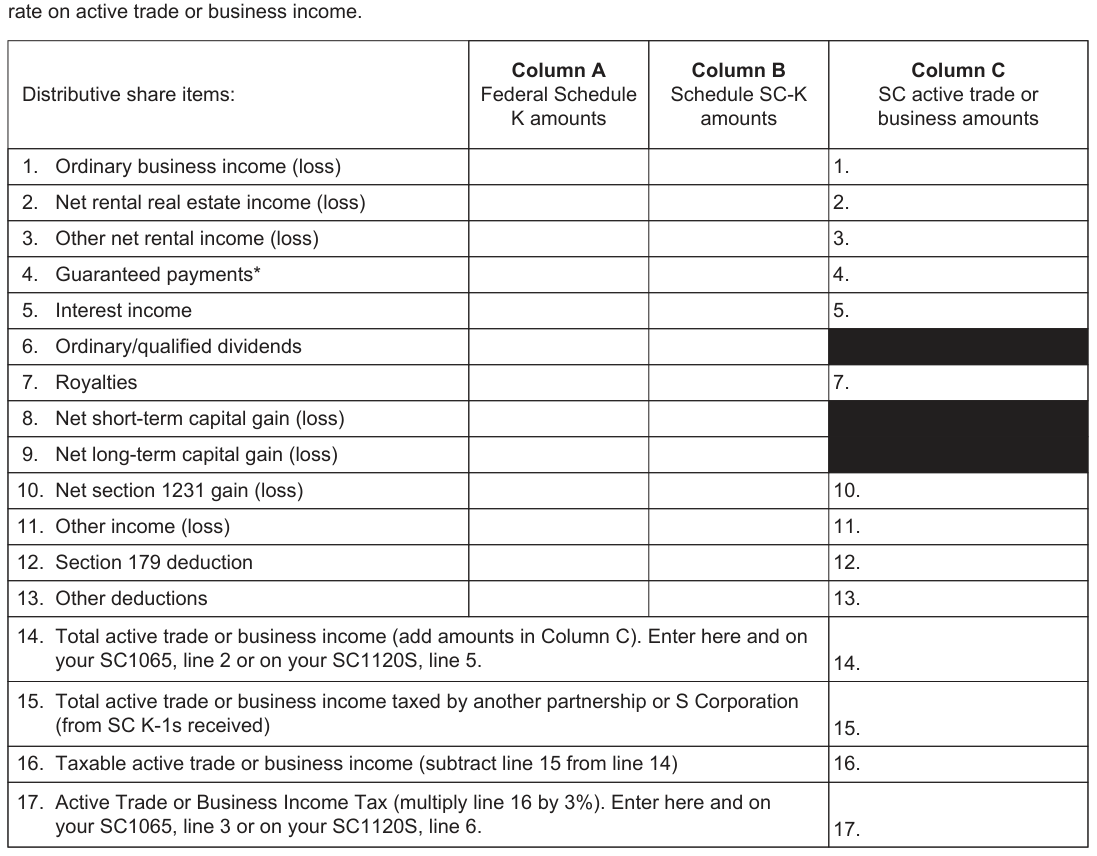
Text version of this table
Distributive share items: Column A Federal Schedule K amounts Column B Schedule SC-K amounts Column C SC active trade or business amounts 1. Ordinary business income (loss) 1. 2. Net rental real estate income (loss) 2. 3. Other net rental income (loss) 3. 4. Guaranteed payments* 4. 5. Interest income 5. 6. Ordinary/qualified dividends 7. Royalties 7. 8. Net short-term capital gain (loss) 9. Net long-term capital gain (loss) 10. Net section 1231 gain (loss) 10. 11. Other income (loss) 11. 12. Section 179 deduction 12. 13. Other deductions 13. 14. Total active trade or business income (add amounts in Column C). Enter here and on your SC1065, line 2 or on your SC1120S, line 5. 14. 15. Total active trade or business income taxed by another partnership or S Corporation (from SC K-1s received) 15. 16. Taxable active trade or business income (subtract line 15 from line 14) 16. 17. Active Trade or Business Income Tax (multiply line 16 by 3%). Enter here and on your SC1065, line 3 or on your SC1120S, line 6. 17.
The I-435 combines elements of Schedule Ks for the 1065 and the 1120-S.
- Items on the 1065, Schedule K but not on the 1120-S, Schedule K.
# INSTRUCTIONS
Beginning with the 2021 tax year, a qualified entity can elect to have its active trade or business income taxed at a 3% flat tax rate imposed on the entity itself instead of its qualified owners. Electing qualified entities must use the I-435 to identify active trade or business income and calculate the tax.
Electing entities will report the active trade or business income taxed at the entity level to their partners or shareholders on the SC K-1s. Partners or shareholders will use the I-335, Active Trade or Business Income Reduced Rate Computation, with their SC1040, Individual Income Tax Return, to account for active trade or business income taxed at the entity level.
A qualified entity is a Partnership, S Corporation, or LLC taxed as a Partnership or S Corporation whose owners are all qualified owners or partnerships directly owned by qualified owners or by qualified owners through other partnerships.
A qualified owner is a partner, shareholder, or member of a qualified entity who is:
- an individual
- a trust
- an estate
- an entity type not included in SC Code Sections 12-6-530 through 12-6-540 and 12-6-550 and not exempt from
# South Carolina Income Tax
Qualified entities elect each year whether or not to have the active trade or business income taxed at the entity level. The election must be made by the due date for filing the applicable Income Tax return, including any extensions.
Active trade or business income is apportioned by the entity according to SC Code Section 12-6-2240. Active trade or business income does not include passive investment income and related expenses or capital gains and losses. No amounts included in active trade or business income should be treated as income from personal services allocated based on SC Code Section 12-6-2220(6). For more information, SC Code Sections are available at dor.sc.gov/policy.
Line instructions
Enter amounts from the federal Schedule K in Column A. Enter amounts allocated or apportioned to South Carolina from the Schedule SC-K in Column B. Enter South Carolina active trade or business amounts in Column C. Amounts entered in Column C should not be greater than the amounts entered in Column B.
Line 1: Ordinary business income (loss)
In Column C, enter amounts from Column B that are not capital gains or losses or passive investment income or losses.
Do not enter income from personal services in Column C.
Line 2 and Line 3: Net rental real estate income (loss)/other net rental income (loss)
Rental income is typically passive investment income and not active trade or business income. In Column C, enter from Column B only rental income from the active trade or business of renting property if, based on all the facts and circumstances, the pass-through business either provides significant services or has substantial expenses in the rental business. The determination is based in part on the number of people employed to provide services and the types and amounts of expenses, other than depreciation. Examples of qualifying rents are those from operating a hotel or a shortterm car rental business. See IRC Section 1362(d) and applicable regulations for more information.
Line 4: Guaranteed payments (from partnerships)
In Column C, enter Column B guaranteed payments for use of capital that are not passive investment income. Do not include guaranteed payments for services.
# Line 5: Interest income
Interest income is considered passive income and is not included in Column C unless it results from the sale of:
- stock in trade
- inventory
- property held for sale to customers in the ordinary course of trade or business
- services performed in the ordinary course of trade or business
Line 6: Ordinary/qualified dividends
Dividends are not included in active trade or business income or loss because they are passive investment income.
# Line 7: Royalties
Royalties are considered passive investment income and are not included in Column C unless they are from the ordinary course of a trade or business of franchising or licensing property, or are active business computer software royalties as defined in IRC Section 543(d).
Line 8 and Line 9: Net short-term and long-term capital gains (losses)
Active trade or business income or loss does not include these amounts.
Line 10: Net section 1231 gain (loss)
After determining if gains and losses are capital, enter in Column C the net of ordinary gains and losses, but not capital gains or losses.
Line 11: Other income (loss)
In Column C, do not enter Column B capital gains or losses or passive investment income or losses.
# Line 12: Section 179 deduction
In Column C, enter amounts from Column B that are not capital gains or losses or passive investment income or losses.
Line 13: Other deductions
Active trade or business income or loss does not include these amounts.
# Line 14: Total active trade or business income
Add amounts in Column C. Enter the total active trade or business income to be taxed at the entity level on line 2 of the SC1065 or line 5 of the SC1120S.
# Line 15: Total active trade or business income taxed by another partnership or S Corporation
Enter amounts that were already taxed, as shown on the SC K-1s provided by another partnership or S Corporation.
Line 16: Taxable active trade or business income Subtract line 15 from line 14.
# Line 17: Active Trade or Business Income Tax
Multiply line 16 by 3%. This is your tax on active trade or business income. Enter this amount on line 3 of the SC1065 or line 6 of the SC1120S.
For more information about the Active Trade or Business Income Tax for pass-through entities, refer to SC Revenue Ruling 21-15 and SC Revenue Ruling 22-5, available at dor.sc.gov/policy.
It is mandatory that you provide your Social Security Number on this tax form if you are an individual taxpayer. 42 U.S.C. 405(c)(2)(C)(i) permits a state to use an individual's Social Security Number as means of identification in administration of any tax. SC Regulation 117-201 mandates that any person required to make a return to the SCDOR must provide identifying numbers, as prescribed, for securing proper identification. Your Social Security Number is used for identification purposes.
The Family Privacy Protection Act
Under the Family Privacy Protection Act, the collection of personal information from citizens by the SCDOR is limited to the information necessary for the SCDOR to fulfill its statutory duties. In most instances, once this information is collected by the SCDOR, it is protected by law from public disclosure. In those situations where public disclosure is not prohibited, the Family Privacy Protection Act prevents such information from being used by third parties for commercial solicitation purposes.
Source: view the official PDF
Nearby sections (15 sections)
- i338 · I-338 — Composite Return Affidavit
- i348 · I-348 — Composite Filing Instructions
- i435 · I-435 — Active Trade or Business Income for Electing…
- iit-packet · Individual Income Tax Packet — SC1040 Instructions (full…
- sc1040 · SC1040 — Individual Income Tax Return
- sc1040es · SC1040ES — Individual Declaration of Estimated Tax
- sc1041 · SC1041 — Fiduciary Income Tax Return
- sc1041es · SC1041ES — Fiduciary Declaration of Estimated Tax
- sc1065 · SC1065 — Partnership Return
- sc1065es · SC1065ES — Partnership Declaration of Estimated Income Tax
- sc1120 · SC1120 — 'C' Corporation Income Tax Return
- sc1120cdp · SC1120-CDP — Corporation Declaration of Estimated Income Tax
- sc1120i · SC1120 Instructions — 'C' and 'S' Corporation Income Tax…
- sc1120s · SC1120S — 'S' Corporation Income Tax Return
- sc1120swh · SC1120S-WH — Withholding Tax on Income of Nonresident…