West Virginia State Tax Department Forms & Instructions
WV Corporation Net Income Tax Instructions — CIT-120
CIT-120
West Virginia Corporate Net Income Tax
Instructions
This publication provides general information and is not meant to be a substitute for tax laws or regulations.
# CONTENTS
IMPORTANT INFORMATION FOR 2025 2
TAXPAYER RESPONSIBILITIES 3
GENERAL INFORMATION 4
FORM CIT-120 INSTRUCTIONS 8
SCHEDULE 1-SEPARATE ENTITY FILER WEST VIRGINIA CORPORATIONS WHOLLY IN WV 8 SCHEDULE 2 - SEPARATE ENTITY FILER WITH MULTI STATE ACTIVITY 9 CIT-120, PAGE 2 10 SCHEDULE B: ADJUSTMENTS TO FEDERAL TAXABLE INCOME 11
# SCHEDULE B-1 ALLOWANCE FOR GOVERNMENTAL OBLIGATIONS/
OBLIGATIONS SECURED BY RESIDENTIAL PROPERTY (§ 11-24-6 (f)) 13 SCHEDULE C - SCHEDULE OF TAX PAYMENTS 13 SCHEDULE D - REPORTABLE ENTITIES 13 CIT-120TC: SUMMARY OF CORPORATION NET INCOME TAX CREDITS 14 SCHEDULE NOL: WV NET OPERATING LOSS CARRYFORWARD CALCULATION (§11-24-6(d)) 14 CIT-120APT - ALLOCATION AND APPORTIONMENT FOR MULTISTATE CORPORATIONS 16 COMBINED REPORTING 19
Hawk's Nest
# IMPORTANT INFORMATION FOR 2025
AnnualreturnswillhaveaduedateofApril15andanextendedduedateofOctober15.Fiscaland52/53-weekreturns will be due on the 15th day of the fourth month following the end of the period with an extension period of six months.
# TAX RATES
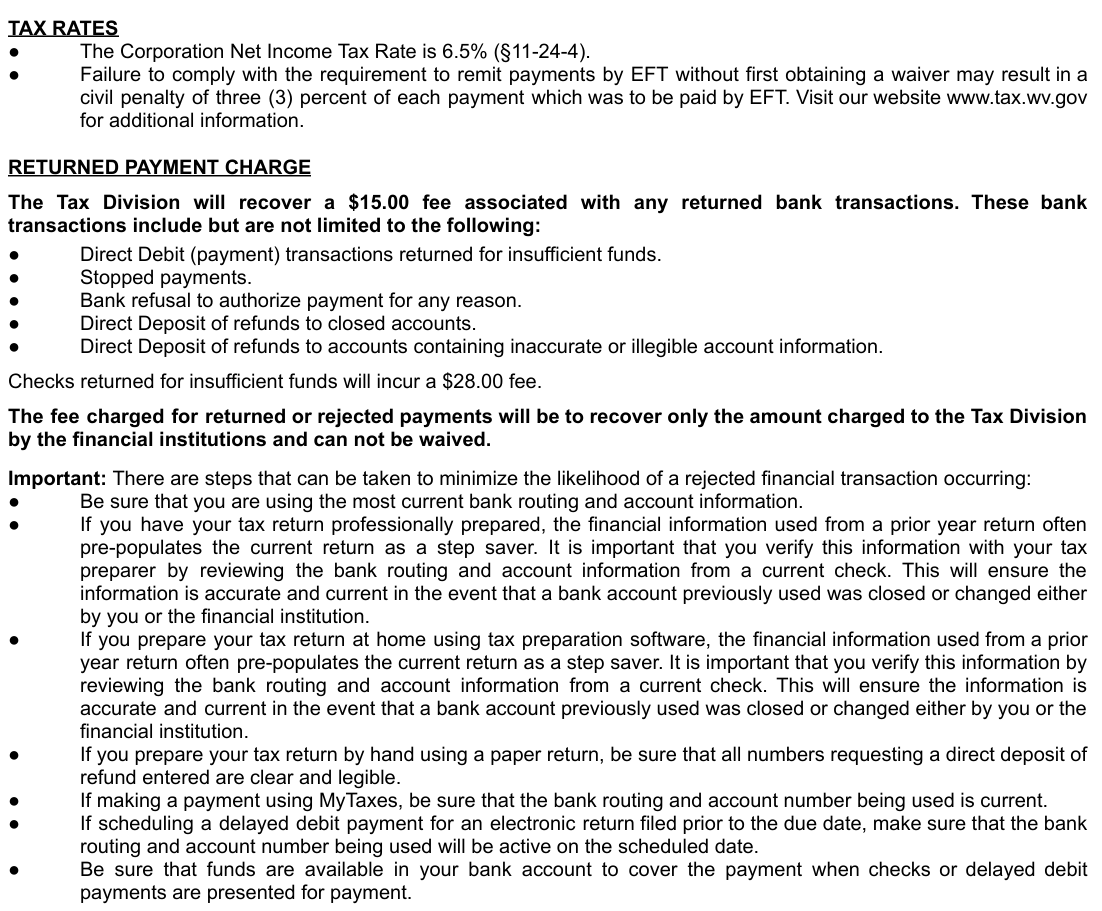
Text version of this table
| ● | The Corporation Net Income Tax Rate is 6.5% (§11-24-4). |
| ● | FailuretocomplywiththerequirementtoremitpaymentsbyEFTwithoutfirstobtainingawaivermayresultina |
| civilpenaltyofthree(3)percentofeachpaymentwhichwastobepaidbyEFT.Visitourwebsitewww.tax.wv.gov | |
| for additional information. | |
| RETUR | NED PAYMENT CHARGE |
| The Ta | x Division will recover a $15.00 fee associated with any returned bank transactions. These bank |
| transac | tions include but are not limited to the following: |
| ● | Direct Debit (payment) transactions returned for insufficient funds. |
| ● | Stopped payments. |
| ● | Bank refusal to authorize payment for any reason. |
| ● | Direct Deposit of refunds to closed accounts. |
| ● | Direct Deposit of refunds to accounts containing inaccurate or illegible account information. |
| Checks | returned for insufficient funds will incur a $28.00 fee. |
| Thefee | chargedforreturnedorrejectedpaymentswillbetorecoveronlytheamountchargedtotheTaxDivision |
| by the f | inancial institutions and cannot be waived. |
| Importa | nt:There are steps that can be taken to minimizethe likelihood of a rejected financial transaction occurring: |
| ● | Be sure that you are using the most current bank routing and account information. |
| ● | Ifyouhaveyourtaxreturnprofessionallyprepared,thefinancialinformationusedfromaprioryearreturnoften |
| pre-populates the current return as a step saver. Itisimportantthatyouverifythisinformationwithyourtax | |
| preparer by reviewing the bank routing and account information from a current check. This will ensure the | |
| informationisaccurateandcurrentintheeventthatabankaccountpreviouslyusedwasclosedorchangedeither | |
| by you or the financial institution. | |
| ● | Ifyouprepareyourtaxreturnathomeusingtaxpreparationsoftware,thefinancialinformationusedfromaprior |
| yearreturnoftenpre-populatesthecurrentreturnasastepsaver.Itisimportantthatyouverifythisinformationby | |
| reviewing the bank routing and account information from acurrentcheck.Thiswillensuretheinformationis | |
| accurateandcurrentintheeventthatabankaccountpreviouslyusedwasclosedorchangedeitherbyyouorthe | |
| financial institution. | |
| ● | Ifyouprepareyourtaxreturnbyhandusingapaperreturn,besurethatallnumbersrequestingadirectdepositof |
| refund entered are clear and legible. | |
| ● | If making a payment using MyTaxes, be sure that the bank routing and account number being used is current. |
| ● | Ifschedulingadelayeddebitpaymentforanelectronicreturnfiledpriortotheduedate,makesurethatthebank |
| routing and account number being used will be active on the scheduled date. | |
| ● | Be sure that funds are available in your bank account to cover the payment whenchecksordelayeddebit |
| payments are presented for payment. |
# RETURNED PAYMENT CHARGE
The Tax Division will recover a $15.00 fee associated with any returned bank transactions. These bank
transactions include but are not limited to the following:
● Direct Debit (payment) transactions returned for insufficient funds. ● Stopped payments. ● Bank refusal to authorize payment for any reason. ● Direct Deposit of refunds to closed accounts. ● Direct Deposit of refunds to accounts containing inaccurate or illegible account information. Checks returned for insufficient funds will incur a $28.00 fee.
ThefeechargedforreturnedorrejectedpaymentswillbetorecoveronlytheamountchargedtotheTaxDivision
by the financial institutions and cannot be waived.
Important:There are steps that can be taken to minimizethe likelihood of a rejected financial transaction occurring: ● Be sure that you are using the most current bank routing and account information. ● Ifyouhaveyourtaxreturnprofessionallyprepared,thefinancialinformationusedfromaprioryearreturnoften pre-populates the current return as a step saver. Itisimportantthatyouverifythisinformationwithyourtax preparer by reviewing the bank routing and account information from a current check. This will ensure the informationisaccurateandcurrentintheeventthatabankaccountpreviouslyusedwasclosedorchangedeither by you or the financial institution. ● Ifyouprepareyourtaxreturnathomeusingtaxpreparationsoftware,thefinancialinformationusedfromaprior yearreturnoftenpre-populatesthecurrentreturnasastepsaver.Itisimportantthatyouverifythisinformationby reviewing the bank routing and account information from acurrentcheck.Thiswillensuretheinformationis accurateandcurrentintheeventthatabankaccountpreviouslyusedwasclosedorchangedeitherbyyouorthe financial institution. ● Ifyouprepareyourtaxreturnbyhandusingapaperreturn,besurethatallnumbersrequestingadirectdepositof refund entered are clear and legible. ● If making a payment using MyTaxes, be sure that the bank routing and account number being used is current. ● Ifschedulingadelayeddebitpaymentforanelectronicreturnfiledpriortotheduedate,makesurethatthebank routing and account number being used will be active on the scheduled date. ● Be sure that funds are available in your bank account to cover the payment whenchecksordelayeddebit payments are presented for payment. Page2of24 West Virginia CIT-120 Information & Instructions 2025 | West Virginia Tax Division
TAXPAYER RESPONSIBILITIES
# FILING YOUR CORPORATE RETURNS
Returnsshouldbefiledbytheduedate.FormsmayalsobeobtainedfromanyofourregionalfieldofficesorfromtheTax Division website at tax.wv.gov. You may obtain forms by calling 1-800-982-8297. FailuretofilereturnswillresultinyouraccountbeingreferredtoourComplianceDivisionforcorrectiveaction.Pleasefile all required tax returns even if you owe no tax for the reporting period. All applicable pages of the return must be filed.
# PAYMENT OF THE TAX
Thefullamountoftaxowedisdueandpayableontheoriginalduedateofthetaxreturn.Failuretopaythefullamountof taxbytheduedatewillresultininterestandpenaltiesbeingaddedtoanyunpaidamountoftax.Ifyouareunabletopay thefullamountoftaxontheduedate,youshouldfileyourtaxreturnalongwithawrittenexplanationofwhyyouare unable to pay and when you will pay the tax due.
# REFUNDS
Youareentitledtoarefundofanyamountthatyouoverpaid.Allorpartofanyoverpaymentmaybeappliedasacredit againstyourliabilityforsuchtaxforotherperiods.Aclaimforrefund(usuallyataxreturnshowinganoverpayment)must befiledwithinthreeyearsoftheduedateofthereturnortwoyearsfromthedatethetaxwaspaid,whicheverexpires later. The overpayment will be used by the Tax Division against other tax liabilities due.
SELLING OR DISCONTINUING YOUR BUSINESS
Ifyousellordiscontinueyourbusiness,notifytheTaxDivisioninwritingassoonaspossibleafteryourbusinessissoldor discontinued. All final tax returns should be filed. Page3of24 West Virginia CIT-120 Information & Instructions 2025 | West Virginia Tax Division
# GENERAL INFORMATION
Theinformationinthisbookletisforcalendaryear2025returnsandforfiscalyearreturnsbeginningin2025 andendingin 2026.Theinformationinthisbookisintendedtohelpyoucompleteyourreturnsandisnota substitute for tax laws and regulations. Starting in tax year 2020, the forms have been redesignated, changing "CNF" to "CIT".
# CORPORATION NET INCOME TAX
TheCorporationNetIncomeTaxisataxontheWestVirginiataxableincomeofeverydomesticorforeigncorporation whichenjoysthebenefitsandprotectionsofthegovernmentandlawsintheStateofWestVirginiaorderivesincomefrom property, activity or other sources in West Virginia. The term "corporation" includes a joint stock company and any association or other organization which is taxable as a corporation under federal income tax laws. TheWestVirginiaCorporationNetIncomeTaxisafederalconformitytaxinthatthestartingpointincomputingWest Virginiataxableincomeisthefederaltaxableincomeofthecorporation.Certainincreasinganddecreasingadjustments, asrequiredbystatelaw,mustbemadetofederaltaxableincometoarriveatWestVirginiataxableincome.Corporations arerequiredtoallocatecertaintypesofnonbusinessincometoWestVirginiaandapportiontheirremainingincome.The Corporation Net Income Tax rate is six and one-half percent (.065).
# EXEMPT ORGANIZATIONS
Any corporation exempt from federal income tax is also exempt from West Virginia CorporationNetIncomeTax.In addition,certaininsurancecompanies,certainproductioncreditassociations,trustsestablishedunder29U.S.C.186,and other organizations specifically exempt under the laws of West Virginia are also exempt. Ifyouareatax-exemptorganizationwithunrelatedbusinessincomethatissubjecttofederaltax,youmustpaytheWest Virginia Corporation Net Income Tax.
# PAYMENT OF TAX
DUEDATE:Acorporation'sannualWestVirginiaCorporationNetIncomeTaxReturnisdueonorbeforethe15thdayof thefourthmonthafterthecloseofthetaxableyear.Thefilingofreturnsisrequiredwhetheranytaxisdue.Atax-exempt organization'sannualWestVirginiaCorporationNetIncomeTaxReturnisdueonorbeforethe15thdayofthefifthmonth after the close of the taxable year. Make your remittance payable to the West Virginia Tax Division.
PAYMENT OPTIONS: Taxpayers with an annual remittance of any single tax equal to or greater than $50,000 are required to electronically filereturnsandmakepaymentsusingElectronicFundsTransfer(EFT).Returnsfiledwitha balanceduemayuseanyofthefollowingpaymentoptions:CheckorMoneyOrdermadepayabletotheWestVirginiaTax Division, Electronic Funds Transfer or Payment by Credit Card. Visit tax.wv.gov for additionalpaymentinformation. TaxpayersfilingasaCombinedSeparateorCombinedGroup must paywithEFTtotheSuretyaccount,nottoeach separate member within the group.
# EXTENSION OF TIME TO FILE
AnextensionoftimetofileafederalreturnisautomaticallyacceptedbyWestVirginiaasanextensionoftimetofilethe WestVirginiareturn.AcopyofthefederalextensionformmustbeattachedtotheWestVirginiareturnwhenfiledandthe extendedduedatemustbeenteredontopofthereturn.Returnsfiledaftertheduedate,withoutsupportingdocuments andextendedduedateenteredonthetopofthereturn,willbeprocessedaslatefiledandinterestandpenaltieswillbe assessed. Astateextensionoftimetofilemaybeobtained,evenifafederalextensionhasnotbeenrequested.Anextensionoftime tofiledoesnotextendthetimeforpaymentofanytaxdue.Ifyouhaveanextensionoftimetofile,paymentofanytax duemaybemadebyfilingaWestVirginiaextensionform(seeinstructionsforFormCIT-120EXT).Toavoidinterestand penalties, payment must be received on or before the due date of the return. Page4of24 West Virginia CIT-120 Information & Instructions 2025 | West Virginia Tax Division
# ESTIMATED TAXES
EstimatedCorporationNetIncomeTaxpaymentsarerequiredforanycorporationwhichcanreasonablyexpectitsWest Virginiataxableincometobemorethan$10,000(whichequalsataxliabilityaftertaxcreditsofmorethan$650)andare due in four equal installments on the 15th day of the fourth, sixth, ninth, and twelfth months of the tax year.
RETURN CHANGES
The following Schedules are new or have been updated in the 2025 tax period:
● Revised - UB-CR
● Mandatory E-File of returns including Withholding credits or a Schedule D ● NRW-2 has been removed ● The Opportunity Zone Modification is no longer available ● The Alternative Fuel Tax Credit is not longer available
# FILING METHOD
The following filing methods may be used for filing your Corporation Net Income Tax (WV Code §11-24-13a).
SEPARATEENTITYBASED:Usethismethodiffilingaseparatereturnandyouarenotengagedinaunitarybusiness with one or more other corporations. Forms and schedules you may/will need to complete for a separate entity-based corporation return: CIT-120 pages 1 & 2 CIT-120 Schedule 1 CIT-120 Schedule 2
CIT-120 Schedules B, B-1
CIT-120 Schedule C
CIT-120 Schedule D
CIT-120APTSchedulesA1,
A2
CIT-120 APT Schedule B
CIT-120 Schedule TC
CIT-120 Schedule U
CIT-120 Schedule NOL
# Schedule WV-K1, WV-K1C
What are the filing requirements? Corporations that are members of the same unitary business group must file a combinedreportincludingallrequiredinformationofeverybusinessengagingintheunitarybusinesswiththecorporation. Thisreportmustbefiledwitheachmembers'separatereturnunlessthegroupelectstodesignateacorporationassurety and file a combined return.
ALL COMBINED Filers: Must complete UB-CR and electronically file with return.
SEPARATECOMBINED: Usethismethodoffilingacombinedreportbutaseparatereturn.Formsandschedulesyou may/willneedtocompleteaseparatecombinedreturnarethesameasrequiredforSeparateEntityFilersexceptthatthe
Schedule UB-CRis required.
GROUPCOMBINED: Corporationsusethismethodiftheyaremembersofthesameunitarybusinessgroupandelectto designate a surety. Taxpayers must designate surety FEIN in space provided. Forms and schedules you may/will need to complete a group combined return: CIT-120 pages 1 & 2
CIT-120 Schedule UB
CIT-120 Schedule UB-CR
CIT-120 Schedule C
CIT-120 Schedule D
CIT-120 Schedule TC
CIT-120 Schedule NOL
Schedule WV-K1, WV-K1C
TAXABLE YEAR/METHOD OF ACCOUNTING
You must use the same taxable year and method of accounting as you use for federal tax purposes. Page5of24 West Virginia CIT-120 Information & Instructions 2025 | West Virginia Tax Division
# SUPPORTING FEDERAL INFORMATION
Attach a copy of pages 1 through 6 of your signed federal income tax return and any applicable supporting documents/schedules,asfiledwiththeInternalRevenueServicetotheWestVirginiataxreturn.Ifyouattachaproforma federalincometaxreturn,thefollowingconsolidatedreturndataisalsorequired:acopyofpages1through6ofthe consolidated federal return plus supporting schedules showing the consolidation income statement, balance sheet, eliminations and adjustments; a copyoffederalForm851;andasignedstatementexplainingthedifferences,ifany, between the income statement and balance sheet reported forfederalconsolidatedfilingandthatreportedforWest Virginia purposes. Include Schedule M-3 when applicable. Corporations shall attach the federal documents to the West Virginia Corporation Net Income Tax Return.
For All Combined Filers: Copy of Federal Return up to and including the Federal M-3's and proof of any other adjustments you are claiming on the West Virginia return.
# INTEREST
Theentiretaxduemustbepaidonorbeforetheduedateofthetaxreturn(determinedwithoutregardforanextensionof time to file). If the entiretaxdueisnotpaidonorbeforetheduedate,youmustpayinterestontheamountofthe underpayment from the due date to the date paid. Interest is always due, without exception, on any underpayment of tax. InterestisimposedbyanadjustedrateestablishedbytheTaxCommissioner.Theinterestratewillbedeterminedandin effect for periods of six months. Interest rates in effect for various periods are: 7/1/02 to 12/31/16 9.5% 1/1/17 to 12/31/17 8% 1/1/18 to 12/31/18 8.75% 1/1/19 to 12/31/19 9.75% 1/1/20 to 12/31/20 9.25% 1/1/21 to 12/31/22 7. 75% 1/1/23 to 12/31/23 11.50% 1/1/24 to 12/31/24 13.00% 1/1/25 to 12/31/25 12.25% ContacttheWestVirginiaTaxDivision,TaxpayerServicesDivisionat1-800-982-8297,fortheinterestrateineffectfor other periods. Also, Administrative Notices may be found online at tax.wv.gov notifying of adjusted interest rates.
# ADDITIONS TO TAX
LATEFILING.Additionstotaxareimposedforfailuretofileareturnonorbeforetheduedate(determinedwithregardto anextensionoftimetofile).Onanyamountoftaxshowntobedueonthereturn,theadditiontotaxforlatefilingisfive percent (.05) per month or any part of a month not to exceed twenty-five percent (.25). LATEPAYMENT. Additionstotaxareimposedforfailuretopayalltaxshowntobedueonareturnonorbeforethedue date(determinedwithoutregardtoanextensionoftimetofile).Theadditiontotaxforlatepaymentisimposedattherate of one half of one percent (.005) per month or part of a month not to exceed twenty-five percent (.25). Whenboththefivepercent(.05)additionstotaxforlatefilingandtheonehalfofonepercent(.005)additionstotaxfor latepaymentareimposed,themaximummonthlypercentageisfivepercent(.05)nottoexceedfiftypercent(.50)ofthe tax due.
FAILURETOPAYESTIMATEDTAX.Corporationsthatarerequiredtomakeestimatedpaymentsoftheirtaxliabilityare subject toadditionstotaxforfailingtopayatleastninetypercent(.90)oftheirannualtaxliability.Theadditionsare imposed at the same rate as interest is imposed.
COMPLETION AND SIGNATURE
All applicable sectionsofthereturnmustbecompletedandallrequiredsupportingdocumentsmustbeattached.An incompletereturnwillnotbeacceptedastimelyfiled.Thereturnmustbesignedbyanauthorizedofficer.Ifthereturnis prepared by someone other than thetaxpayer,thepreparermustalsosignthereturnandenterhisorhercomplete address.
# CHANGES MADE BY THE IRS TO FEDERAL RETURN
Any corporation whose reported income or deductions arechangedorcorrectedbytheInternalRevenueServiceor through renegotiation of a contract with the UnitedStatesisrequiredtoreportthechangeorcorrectiontotheWest VirginiaTaxDivision.Thisreportmustbemadewithinninetydaysofthefinaldeterminationbyfilinganamended/RAR return and attaching a copy of the revenue agent's report detailing such adjustments. ForAllCombinedFilers: Amended/RARReturnsMUSTbeE-Filed.Completenewreturnwithallnewschedules,a copy of the prior return is not required. Page6of24 West Virginia CIT-120 Information & Instructions 2025 | West Virginia Tax Division
# CORPORATE AMENDED RETURNS
AcorporationthatfiledanamendedreturnwiththeInternalRevenueServicemustfileanamendedreturnwiththeWest Virginia Tax Division within ninety days of filing the amended federal return. ● FileFormCIT-120,pages1and2,completingallappropriatelinesandcheckingtheAmendedboxunder"Return Type"onpage1.Yearspriorto2020shouldfileCNF-120,andenteranyrefundoramountcreditedonline14, page 2. ● Attachallschedulesthathaveamendedfiguresinordertoverifythechangesmadetothereturn. Example: TherewasachangemadetoyourAdjustmentstoFederalTaxableIncome;besuretoattachScheduleBwiththe amended figures. AmendedReturnsfiledforthepurposeofobtainingarefundofanoverpaymentmustbefiledwithinthreeyearsofthedue dateofthereturn(withregardtoanextensionoftimetofile),ortwoyearsfromthedatethetaxwaspaid,whichever expires later. If your Amended Return has a balance due, send the payment along with the tax return.
CONSISTENCY IN REPORTING
IncompletingyourWestVirginiaCorporationNetIncomeTaxReturn,ifyoudepartfromormodifypastproceduresfor classifyingbusinessincomeandnonbusinessincome,valuingpropertyorincludingorexcludingpropertyintheproperty factor,treatingcompensationpaidinthepayrollfactor,includingorexcludinggrossreceiptsinthesalesfactor,youmust disclose by attaching a separate schedule detailing the nature and extent of the variances or modifications. Ifacorporationmakessalesoftangiblepersonalpropertywhichareshippedintoastateinwhichthecorporationisnot taxable,youmustidentifythestatetowhichthepropertyisshippedandreportthetotalamountofsalesassignedtosuch state.
# CONFIDENTIAL INFORMATION
Tax information which is disclosed to the West Virginia Tax Division, whether through returns or through Division investigation,isheldinstrictconfidencebylaw.TheTaxDivision,theUnitedStatesInternalRevenueServiceandother states have agreements under which taxinformationisexchanged.Thisistoverifytheaccuracyandconsistencyof information reported on federal, other state, and West Virginia tax returns.
REPORTING WEST VIRGINIA INCOME TAX WITHHOLDING CREDIT AWestVirginiaIncomeTaxWithholdingCreditiscreatedwhenapaymentismadebyanotherentityforthebenefitofthe Corporation filing this return.
# ELECTRONIC FILED RETURNS
IfyouareclaimingawithholdingcredityoumustsubmitFormWVK-1C,WVK-1or1099aspartofyourelectronicreturn. Only electronically submitted data is acceptable. No PDF attachments will be accepted for claiming a
withholdingcredit.Thesedocumentswillbeusedtoverifythewithholdingcreditsclaimedonyourreturn. Ifwithholding is claimed as a result of theNonresidentSaleofRealEstate,theformWV/NRSRandallsupportingdocumentation shouldbeonfilewiththeTaxDivisionpriortofilingtheCIT-120.NoPDFattachmentswillbeacceptedforclaiminga NRSRwithholdingcredit. FailuretofiletherequiredWV/NRSR,federalScheduleDandothersupportingdocuments prior to filing the CIT-120 will result in returns having to be Amended for credit of Withholding..
# PAPER FILED RETURNS
No Withholding credits will be accepted for paper filed returns, all filings that have withholding credits must be electronically filed. Page7of24 West Virginia CIT-120 Information & Instructions 2025 | West Virginia Tax Division
# FORM CIT-120 INSTRUCTIONS
Enterbeginningandendingtaxyeardatescoveredbythisreturn.Clearlyprintortypeyournameandaddress.Iffiling under extension, enter the extended due date. In the "Check Applicable Boxes" section, mark all that apply to the corporate return being filed. * Attachmentsandstatementsrequired:Attachalladditionalinformationandstatementsrequiredastheyapplytoyourfiling method. Attachacopyofpages1through6ofyoursignedfederalreturn(Form1120),andScheduleM-3ifapplicable.Iffiling separateWestVirginiaandconsolidatedfederal,attachyourproformafederal,consolidatedfederalForm851(Affiliation Schedule),plusspreadsheetsoftheincomeandexpenses,andbalancesheetentriesforEVERYcorporationincludedin the consolidated federal return. Attachascheduleofotherstatesinwhichyouhavepropertyorpaidsalariesduringthetaxableyear.Indicatethosestates in which you are filing corporate tax returns based on, or measured by, net income for this taxable year. Attachascheduleofotherstatesinwhichyouhavesalesoftangiblepersonalpropertyduringthetaxableyearandin which you are not taxed (e.g. P.L.86-272). Indicate by state the amount of sales not subject to tax. IffilingasaSeparateFiler,completeSchedule1ifyouareawhollyWVcorporationorSchedule2ifyouhavemultistate activity. SCHEDULE 1-SEPARATE ENTITY FILER WEST VIRGINIA CORPORATIONS WHOLLY IN WV Line 1 -Enter total taxable income from your federalincome tax return Form 1120 or your pro forma return. Line 2 -Enter total increasing adjustments fromForm CIT-120, Schedule B, line 12. Line 3 -Enter total decreasing adjustments fromForm CIT-120, Schedule B, line 25. Line 4 -West Virginia adjusted taxable income. Add line 1 plus line 2 minus line 3. Line 5 -Enter the total from column 7 of ScheduleNOL. Line 6 -Subtract line 5 from line 4. Line 7 -REIT Inclusion and other Taxable income. Line 8 -Add lines 6 and 7. Line 9 -2025 WV Corporate Tax Rate .065. Line 10-Multiply line 8 by the Corporation NetIncome Tax Rate in line 9. Line11-Enter the result fromcolumn2,TOTALCREDITSLineofcompletedFormCIT-120TC.Thetotalamountof credits cannot exceed the net income tax on line 10. Line12-Subtractline11fromline10.ThisisyourAdjustedCorporationNetIncomeTax. EnterthisamountonCIT-120, page 2, line 9. Page8of24 West Virginia CIT-120 Information & Instructions 2025 | West Virginia Tax Division
# SCHEDULE 2 - SEPARATE ENTITY FILER WITH MULTISTATE ACTIVITY
Line 1 -Enter total taxable income from your federalincome tax return Form 1120 or your pro forma return. Line 2 -Enter total increasing adjustments fromForm CIT-120, Schedule B, line 12. Line 3 -Enter total decreasing adjustments fromForm CIT-120, Schedule B, line 25. Line 4 -West Virginia adjusted taxable income. Add line 1 plus line 2 minus line 3. Line 5 -Total nonbusiness income allocated everywhere(Form CIT-120APT, Schedule A1, line 9, column 3). Line 6 -Subtract line 5 from line 4. This is yourtotal income subject to apportionment. Line 7 -Complete Form CIT-120 APT Schedule B andenter the result of Part 1, Part 2 or Part 3, column 3. Line 8 -Line 6 multiplied by line 7 Line9 -EnterthetotalallocationofnonbusinessincomeallocatedtoWestVirginiafromCIT-120APT,ScheduleA2,line 13. Line 10-Add lines 8 and 9. Line 11-Enter the total from column 7 of ScheduleNOL. Line 12-Subtract line 11 from line 10. Line 13-REIT Inclusion and other Taxable income. Line 14-Add lines 12 and 13. Line 15-2025 WV Corporate Tax Rate .065. Line 16-Multiply line 14 by the Corporation NetIncome Tax Rate in line 15. Line17-Enter the result fromcolumn2,TOTALCREDITSLineofcompletedFormCIT-120TC.Thetotalamountof credits cannot exceed the net income tax on line 16. Line18-Subtractline17fromline16.ThisisyourAdjustedCorporationNetIncomeTax. EnterthisamountonCIT-120, page 2, line 9. Page9of24 West Virginia CIT-120 Information & Instructions 2025 | West Virginia Tax Division
CIT-120, PAGE 2
Line9 -EntertheadjustedCorporationNetIncomeTaxamountfromeitherSchedule1,line12,Schedule2,line18or Schedule UB-CR, total of all groups. Line 10- Enterunderpayment of estimated penalty Line 11-If this is an amended return, enter theamount of any overpayment previously refunded or credited. Line 12- Total Amount Due. Add lines 9 through 11 Line 13-Prior year carryforward credit from yourprevious Corporation Net Income Tax return. Line 14-Enter total estimated tax payments andany extension payment made with Form CIT-120EXT. Line15-EnterthetotalamountofwithholdingcreditfromFormWVK-1C and/or1099. Checkboxifwithholdingisfrom NRSR (nonresident sale of real estate).
# Line 16-Build WV Property Value Adjustment Credit
Line17-A. EnteryourtotalWVPropertyTaxMotorVehicleCredit.PaperfilersmustincludetheMV-1thatwasissued bytheTaxDivision.IfyouhavenotreceivedyourMV-1,youmayrequestacopyfromTaxpayerServicesat (304) 558-3333 or you can include a copy of your property tax receipts. - B. Enter your total WV Property Tax Small BusinessCredit. You must include a completed SB-1. Line 18-Add lines 13 through 17B. The sum of lines13 through 15 should match the total payments on Schedule C. Line 19-If line 12 is larger than line 18 enterthe tax due on this line. Line20- Determinetheamountofinterestdue.Forinformationregardinginterest,seethegeneralinformationonpage6 of this instruction booklet. Line21-Determineadditionstotaxdue.Forinformationregardingadditionstotax,seethegeneralinformationonpage 6 of this instruction booklet. Line22-Addlines19through21.Thisisthebalanceduewiththisreturn.MakecheckspayabletotheWestVirginiaTax Division or see www.tax.wv.gov for other payment options. Line 23-If line 18 is larger than line 12 enterthe overpayment on this line. Line 24-Enter the amount of the overpayment on line23 to be credited to next year's taxes. Line 25-Enter the amount of the overpayment on line23 to be refunded (subtract line 24 from line 23). Page10of24 West Virginia CIT-120 Information & Instructions 2025 | West Virginia Tax Division
SCHEDULE B: ADJUSTMENTS TO FEDERAL TAXABLE INCOME
# ADJUSTMENTS INCREASING FEDERAL TAXABLE INCOME
Line1 -EnterexemptinterestordividendsfromanystateorlocalbondsorsecuritiesfromyourfederalreturnForm 1120, Schedule K or on Schedule M-1. Line2 -EntertheamountofUSGovernmentobligationinterestordividendsnotexemptfromstatetax,lessanyrelated expenses not deducted on the federal return. Attach supporting documentation. Line3 -Attachanitemizedscheduleoftaxesbaseduponincomefromline17ofyourfederalincometaxreturn,Form 1120 or pro forma Form 1120. Line4 -Taxpayers can elect to expense the costofcertainairandwaterpollutioncontrolfacilitieslocatedinWest Virginiaintheyearinwhichthecostofacquisition,constructionordevelopmentwaspaidorincurred.Eligible airandwaterpollutioncontrolfacilitiesarethoselocatedinWestVirginiathatare"certifiedpollutioncontrol facilities"asdefinedbySection169oftheInternalRevenueCode.Ifthiselectionismade,thetotalamountof anyfederaldeductionfordepreciationoramortizationofsuchfacilitiesisdisallowed.Theelectionismadeon the return for the year in which the cost is paid or incurred. Once made, the election or non-election is irrevocable. AtaxpayerwhoreportsallincometothisstatewillmaketheadjustmentsforthecostofthefacilitiesonCIT-120 Schedule B, line 20. The depreciation or amortization on the facilities, including that attributable to cost expensedthisyearaswellasprioryears,deductedonthefederalreturn,isenteredonCIT-120ScheduleB, line 4. A taxpayerwhoissubjecttoallocationandapportionmentmakestheadjustmentforthecostofthe facilitiesonFormCIT-120APTScheduleA2,line10,column3.Thedepreciationoramortizationonthefacilities deducted on the federal return for this year as well as previous years, is entered on Form CIT-120APT Schedule A2, lines 11 and 12 of column 3. Line5 -CorporationswhichareexemptfromfederalincometaxarealsoexemptfromWestVirginiaCorporationNet IncomeTax.Ifsuchacorporationhasunrelatedbusinesstaxableincome(asdefinedbySection512ofthe InternalRevenueCode),theymustpayWestVirginiaCorporationNetIncomeTaxontheunrelatedbusiness taxable income. Enter the unrelated business taxable income as reported on Federal Form 990T. Line 6 -Enter the amount of Federal Net OperatingLoss from Federal Form 1120, line 29a. Line7 -If you claim the West Virginia Neighborhood Investment Program Tax Credit, any deduction, decreasing adjustment,ordecreasingmodificationtakenonyourfederalreturnforanycharitablecontributionmadetosuch NeighborhoodInvestmentProgramandforwhichtheWestVirginiacreditisclaimed,mustbeaddedbackon this line. Line8 -Taxpayerswithforeignsourceincomemustadjusttheirfederaltaxableincomebytheamountoftheirtaxable incomeorlossfromsourcesoutsidetheUnitedStates.Indeterminingforeignsourceincome,theprovisionsof Sections 861, 862, and 863 of the Internal Revenue Code apply. Complete the following worksheet.
FOREIGN SOURCE INCOME WORKSHEET PETITIONING FOR AN ALTERNATIVE METHOD OF APPORTIONMENT
1. Taxable income from sources outside the United States 2. LESS foreign dividend gross-up 3. LESS subpart F income
# 4. West Virginia adjustment
Iftheamountonline4oftheworksheetisapositivefigure,enteritonCIT-120,ScheduleB,line19.Ifitisanegative figure, enter the amount of the loss on CIT-120, Schedule B, line 8 without the negative sign. AttachcopiesofFederalForm1118tosupportyourcalculation.IfyoudidnotfileFederalForm1118,youmustprepare andfileaproformaFederalForm1118tosupportyouradjustment.IfyoufiledaconsolidatedFederalForm1118andfile separateorunitaryWestVirginiareturns,attachboththetrueconsolidatedandaproformaFederalForm1118tosupport your adjustment. Line 9 -Enter the amount of foreign taxes as deductedon your Federal Form 1120. Page11of24 West Virginia CIT-120 Information & Instructions 2025 | West Virginia Tax Division
Line10-AddbackforexpensesrelatedtocertainREIT'sandregulatedinvestmentcompaniesandcertaininterestand intangible expenses (WV Code §11-24-4b). Line 11-Other increasing adjustments.Enter a briefdescription of any adjustment in the space provided.
Submit a statement for any adjustment entered.
Line 12-Add lines 1 through 11. Enter the totalon Form CIT-120, Schedule 1, line 2 or CIT-120, Schedule 2, line 2.
# ADJUSTMENTS DECREASING FEDERAL TAXABLE INCOME
Line13-Entertheamountofrefundorcreditofincometaxesortaxesbaseduponnetincomeimposedbythisstateor any other jurisdiction included in federal taxable income. Attach supporting documentation. Line14-Enter the amount of interest expense on obligations or securities of any state or its political subdivisions disallowed in determining federal taxable income. Attach supporting documentation. Line15-EntertheamountofUSGovernmentobligationinterestordividendsincludedinfederalbutexemptfromstate tax, less related expenses deducted on your federal return. Attach supporting documentation. Line16-Entertotalsalaryexpensenotallowedonyourfederalreturnduetoclaimingthefederaljobscreditandinclude a copy of Federal Form 3800 or 5884. Note: this decreasing adjustment is only applicable to the Work Opportunity Credit from Federal Form 5884. Line 17-Enter the total foreign dividend gross-up(IRC Section 78) from Federal Form 1120. Line 18-Enter the total subpart F income (IRC Section951) from Federal Form 1120. Line19-See instructions forCIT-120 Schedule B,line 8. IfForeignSourceIncomefromworksheetline4ispositive, enter the amount here. Line20-See instructions forCIT-120 Schedule B,line 4.MultistatecorporationsmustuseCIT-120APT,ScheduleA2, line 10. Line21-Adecreasingadjustmenttofederaltaxableincomeisallowedforemployercontributionstoamedicalsavings accountestablishedpursuanttoWVCode§33-16-15,totheextentincludedinfederaltaxableincome,lessany portion ofthe employer's contributionswithdrawnforpurposesotherthanpaymentofmedicalexpenses.The amount taken as a decreasing adjustment may not exceed the maximum amount that would have been deducted from the corporation's federal taxable income if the aggregate amount of the corporation's contributions to individual medical savings accounts established under WV Code §33-16-15 had been contributions to a qualified plan as defined under the Employee Retirement Income Security Act of 1974 (ERISA), as amended. Line 22 -Other decreasing adjustments.Enter a brief description of any adjustment in the space provided.
Submit a statement for any adjustment entered.
Line23-Taxpayersthatowncertaintax-exemptgovernmentobligationsand/orobligationssecuredbycertainresidential property located in West Virginia can take a special allowance thatfurther reduces federal taxable income. Complete Form CIT-120, Schedule B-1 to determine the amount of the allowance. Line24-Addlines13through23.EntertheamounthereandonCIT-120,Schedule1,line3orCIT-120,Schedule2, line 3. Page12of24 West Virginia CIT-120 Information & Instructions 2025 | West Virginia Tax Division
SCHEDULE B-1 ALLOWANCE FOR GOVERNMENTAL OBLIGATIONS/
# OBLIGATIONS SECURED BY RESIDENTIAL PROPERTY(§ 11-24-6(f))
Taxpayers thatowncertaintax-exemptgovernmentobligationsandobligationssecuredbycertainresidentialproperty located in West Virginiacantakeaspecialallowancethatfurtherreducesfederaltaxableincome.CompleteCIT-120 ScheduleB-1todeterminetheamountoftheallowance.Thevalueoftheseobligationsandloansisdeterminedusingthe averageofthemonthlybeginningandendingaccountbalances.Theseaccountbalancesaredeterminedatcostinthe same manner that such obligations, investments and loans are reported on the balance sheet of your federal tax return.
Lines 1 through 4 -Attach copy of worksheets supportingthe calculation of average monthly balance. Line 6 -Average the beginning and ending balanceof Federal Form 1120, Schedule L, line 15. Line8 -CIT-120,Schedule1,line1orSchedule2,line1plusCIT-120,ScheduleB,line12minusthesumoflines13 through 22, plus Form CIT-120APT, Schedule A2, lines 10, 11, and 12.
# SCHEDULE C - SCHEDULE OF TAX PAYMENTS
If the number of payments reported on Schedule C exceeds 10, you must file electronically.
Column 1 -Enter the name of the entity making thepayment or issuing the withholding credit. Column 2 -Enter the FEIN of the entity making thepayment or issuing the withholding credit. Column 3 -Enter the date of any payments made by,or on behalf of, the entity. Column 4- Enter a description of the type of paymentmade by, or on behalf of, the entity, Column 5- Enter the amount of the payment made by,or on behalf of, the entity. Total Line- Sum of the payments shown in Column 5.
# SCHEDULE D - REPORTABLE ENTITIES
IfanyboxischeckedintheReportableEntitiesSectionofpage1,thenameandFEINofeachreportableentitymustbe entered on Schedule D. Column 1-Enter the name of the reportable entity. Column 2-Enter the FEIN of the reportable entity. Column 3-Enter the name of the reportable entity'sparent. Column 4-Enter the FEIN of the parent. Column5-EntertheAlphaCharacterdesignationfortheexplanationoftherelationshipbetweenreportableentity and entity submitting this West Virginia Return. A Pass through entity you are a partner, member, or shareholder doing business in WV B Entity you own 80% of voting stock C Entity that owned more than 80% of your stock
D Disregarded entity or QSUB
E Controlled Foreign Corporation
If the number of entities reported on Schedule D exceeds 10, you must file electronically. Page13of24 West Virginia CIT-120 Information & Instructions 2025 | West Virginia Tax Division
# CIT-120TC: SUMMARY OF CORPORATION NET INCOME TAX CREDITS
TheCIT-120TC,SummaryofCorporationNetIncomeTaxCredits,isaformusedbycorporationstosummarizethetax creditsthattheyclaimagainsttheirCorporationNetIncomeTaxliability.InadditiontocompletingtheCIT-120TC,eachtax credithasascheduleorformthatisusedtodeterminetheamountofcreditthatcanbeclaimed.Pleasenotethatsome taxcreditschedulesrequireacompletedapplicationtobesubmittedandapprovedbeforethetaxcreditschedulecanbe filed.BoththeCIT-120TCandtheappropriatecreditcalculationschedule(s)orform(s)mustbeattachedtoyourreturnin order to claim a tax credit. Line 26 - Total credits: Add column 2, lines 1 through25.
IfyouareclaimingtheNeighborhoodInvestmentProgramCredit,youarenolongerrequiredtoenclosetheWV
NIPA-2 credit schedule with your return. You must maintain the schedule in your files.
SCHEDULE NOL: WV NET OPERATING LOSS CARRYFORWARD CALCULATION (§11-24-6(d))
# WHO SHOULD COMPLETE SCHEDULE NOL?
AllcorporationsclaimingaWestVirginianetoperatinglosscarryforwarddeductiononFormCIT-120,Schedule1,line5, CIT-120,Schedule2,line11orScheduleUB-CR,column16mustcompletethisscheduletosupporttheirnetoperating loss deduction.ScheduleNOLisnotaclaimforrefund.Itisacalculationscheduletosupportthenetoperatingloss carryforward deduction. AnyamountclaimedasafederalnetoperatinglossdeductionmustbeaddedbacktofederaltaxableincomeonWest Virginia Form CIT-120, Schedule B, line 6 for a separate filer orcolumn2F(entityspecificofapplicablegroup)ifa combinedfiler.TheWestVirginianetoperatinglosscarryforwarddeductionisenteredonFormCIT-120,Schedule1,line 5, Schedule 2, line 11 or Schedule UB-CR, column 16 of each applicable group. West Virginia NOL generated in periods after 2017 can be carried forwardindefinitely.AnyWVNetOperatingLoss deductionislimitedto80%oftaxableincomestartinginthe2018taxableyear.Notethatrulesforpre-2018WVNOL remain the same. A net operating loss deduction of a multistate corporation is subject to West Virginia allocation and apportionment rules. The West Virginia net operating loss deduction is limited to net operating losses incurred by a corporation which performed business in West Virginia and filed Corporation Net Income Tax Returns in prior taxable years. The amount of net operating loss deduction available to an affiliated group, which elects for the first time to file a consolidatedreturnforataxableyearendingafterJuly1,1988,islimitedtothenetoperatinglossesincurredbymembers of the affiliated group which did business in West Virginia and filed separate West Virginia returns in prior years. AWestVirginianetoperatinglossdeductionwillnotbeallowedfornetoperatinglossesofthosemembersoftheaffiliated groupwhichdidnobusinessinWestVirginiainpriortaxableyearsandwerenotrequiredtofileWestVirginiaCorporation Net Income Tax Returns.
SRLY RULES.
The separate return limitation years (SRLY) rules set forth in Treasury Regulation §1.1502 applyindeterminingthe allowable West Virginia net operating loss deduction. WhentheSRLYrulesapply,amemberofanaffiliatedgroup'snetoperatinglosscarriedforwardfromitsseparatereturn year can only offset that portion of the taxable income attributable to that member of the group. Page14of24 West Virginia CIT-120 Information & Instructions 2025 | West Virginia Tax Division
Schedule NOL is designed to support the claiming of a West Virginia net operating loss carryforward deductionby providing information on the year of the loss and how the loss was/is being used. Column 1- Enter the applicable tax year ending date(s)for the year(s) that you had net operating loss(es). Column2- Toclaim lossintaxyears2009andlater(includingeachunitarygroupmember),providethenameand FEIN of the entity that incurred the loss. Column3- Enter the amount of West Virginia net operatinglossthatcorrespondstotheyearofthelossshownin Column 1. Column4- Enterthetotalamountoflossforthetaxableyearenteredincolumn1thatwascarriedbacktoayear,or years prior to the year of the actual loss. Column5- Enterthetotalamountoflossforthetaxableyearenteredincolumn1thatwascarriedforwardtoayear,or years, prior to the current taxable year. Column6- Entertheamountremainingfromtheprioryear.ThisshouldmatchthelastcolumnoftheNOLfromtheprior year. Column7- Entertheamountoflossforthetaxableyearenteredincolumn1thatisbeingusedtooffsetWestVirginia taxable income for the current taxable year. Column8- Entertheamountoflossforthetaxyearenteredincolumn1thatremainstobecarriedtoataxableyear subsequent to the current taxable year.
TOTAL NET OPERATING LOSS CARRYFORWARD DEDUCTION FOR CURRENT TAXABLE YEAR.
The amount of the West Virginia net operating loss carryforward deduction claimed on Form CIT-120, Schedule 1, Schedule2orScheduleUB-CRofthecurrentyear'staxreturnmustequalthesumofFormCIT-120,ScheduleNOL, column7.TheWestVirginianetoperatinglosscarryforwarddeductioncannotreduceWestVirginiataxableincomebelow zeroandwhenusinglossesaftertaxyear2018tooffsetliability,itcannotreduceWestVirginiataxableincomelessthan 20%. Page15of24 West Virginia CIT-120 Information & Instructions 2025 | West Virginia Tax Division
CIT-120APT - ALLOCATION AND APPORTIONMENT FOR MULTISTATE CORPORATIONS
# SCHEDULES A1 & A2 - ALLOCATION OF NONBUSINESS INCOME
Ifthecorporation'sbusinessactivitiestakeplacebothinsideandoutsideofWestVirginiaandthecorporationisalso taxableinanotherstate,certainitemsofnonbusinessincomethatareincludedinfederaltaxableincomearedirectly allocated. All other income must be apportioned. Businessincomearisesfromtransactionsandactivitiesintheregularcourseofthecorporation'stradeorbusiness and includes income from tangible and intangible property if the acquisition, management ordispositionofthe property constitutes integral parts of the corporation's trade or business. Nonbusiness income includes all income that is not properly classified as business income less all expenses attributabletotheproductionofthisincome.NonbusinessincomeisallocatedtoWestVirginiaif(1)thecorporation's commercialdomicile,theprincipalplacefromwhichthetradeorbusinessismanagedislocatedinWestVirginia;or (2)propertycreatingthenonbusinessincomeisutilizedinWestVirginia.Nonbusinessincomefromrealpropertyis allocated to West Virginiaifthecorporation'scommercialdomicileislocatedinWestVirginia,or,inthecaseof patents or copyrights, if they are used in West Virginia. For additional information regarding the nonbusiness income, youmayrequestacopyofPublicationTSD-392, "Corporation Net Income Tax Nonbusiness Income", online at tax.wv.gov. Determine nonbusiness income allocated to West Virginia and outside West Virginia by completing Form CIT-120APT, Schedules A1 and A2. Only those types of nonbusiness income listed on Form CIT-120APT, SchedulesA1andA2canbeallocated.Anyothertypesofincomethatthecorporationclassifiesasnonbusiness must be apportioned. Line8 -EntertheamountofeitherthetotalofScheduleA1EverywhereK1,K1-Cincome,A2WestVirginiaK1, K1-C income Line9 -EntertheamountfromFormCIT-120APT,ScheduleA1,column3,line9onFormCIT-120,Schedule2, line 5. Line13 -EntertheamountfromFormCIT-120APT,ScheduleA2,column3,line13toFormCIT-120,Schedule2, line 9.
# SCHEDULE B - APPORTIONMENT FORMULA
Ifthecorporation'sbusinessactivitiestakeplacebothwithinandwithoutWestVirginiaandthecorporationisalso taxable in another state, all net income, after deducting thoseitemsofnonbusinessincomeallocatedonForm CIT-120APT,SchedulesA1andA2mustbeapportionedtoWestVirginiabyusingtheappropriateapportionment formula. Completion of CIT-120APT, Schedule B is required even if apportionment is zero. Specialapportionmentformulasapplytomotorcarriersandtofinancialorganizations.Ifyouarefilingforafinancial organization,followtheapportionmentinstructionsforFormCIT-120APT,ScheduleB,Part3.Ifyouarefilingfora motor carrier, follow the apportionment instructions for Form CIT-120APT Schedule B, Part 2.
MULTISTATE CORPORATIONS - SINGLE SALES FACTOR
PART 1
To determine your West Virginia apportionment percentage, first determine the following factors:
SALES FACTOR.
Theterm"sales"meansallgrossreceiptsofthetaxpayerthatarebusinessincome.Thesalesfactorincludesallgross receipts derived from transactions and activity in the regular course of your trade or business, less returns and allowances.DonotincludeinterestordividendsfromobligationsoftheUnitedStatesgovernment,whichareexemptfrom taxation in West Virginia, or gross receipts from an activity that produced nonbusiness income.
The numerator (column 1) ofthesalesfactorincludesallgrossreceiptsattributabletoWestVirginiaand derived from transactions and activity in theregularcourseofyourtradeorbusiness.Allinterestincome, servicechargesortime-pricedifferentialchargesincidentaltosuchgrossreceiptsmustbeincludedregardless oftheplacewheretheaccountingrecordsaremaintainedorthelocationofthecontractorotherevidenceof indebtedness. Page16of24 West Virginia CIT-120 Information & Instructions 2025 | West Virginia Tax Division
The denominator (column 2) ofthesalesfactorincludesallgrossreceiptsderivedfromtransactionsand activityintheregularcourseofyourtradeorbusinessthatwasreflectedinyourgrossincomereportedandas appearingonyourfederalincometaxreturnunlessotherwiseexcluded.Salesoftangiblepersonalproperty deliveredorshippedtoapurchaserwithinastateinwhichthecorporationisnottaxed(e.g.underPublicLaw 86-272) are no longer to be excluded from the denominator. Dividecolumn1bycolumn2andentertheresultincolumn3.Statetheresultasadecimalfractionandroundtosix(6) places after the decimal. Enter the six (6) digit decimal fraction from column 3 on CIT-120, Schedule 2, line 7.
MOTOR CARRIERS - SPECIAL SINGLE FACTOR FORMULA PART 2 - VEHICLE MILES. Motorcarriersofpropertyorpassengersaresubjecttospecialapportionmentrules.Motorcarriersmustapportiontheir business income by using a single factor formula of vehicle miles. Amotorcarrierisanypersonengagedinthetransportationofpassengersand/orpropertyforcompensationbyamotor propelledvehicleoverroadsinWestVirginia,whetheronascheduledrouteorotherwise.Theterm"vehiclemiles"means the operations of a motor carrier over one mile. The special apportionment formula for motor carriers does NOT apply if: a. ThemotorcarrierneitherownsnorrentsanyrealortangiblepersonalpropertylocatedinWestVirginia,hasmade nopickupsordeliverieswithinWestVirginia,andhastraveledlessthan50,000milesinWestVirginiaduringthe taxable year; or b. ThemotorcarrierneitherownsnorrentsanytangiblepersonalpropertylocatedinWestVirginiaexceptvehicles and makes no more than 12 trips into or through West Virginia during the taxable year. Undereither(A)or(B),themileagetraveledinWestVirginiamaynotbemorethanfivepercent(.05)ofthetotalvehicle miles traveled in all states during the taxable year. DeterminetheapportionmentfactorbyenteringtheappropriatevehiclemilesforWestVirginiaincolumn1,andvehicle miles everywhere in column 2. Dividecolumn1bycolumn2andentertheresultincolumn3.Statetheresultasadecimalfractionandroundtosix(6) places after the decimal. Enter the six (6) digit decimal fraction from column 3 on CIT-120, Schedule 2, line 7.
FINANCIAL ORGANIZATIONS - SPECIAL SINGLE FACTOR FORMULA PART 3 - GROSS RECEIPTS. Financial organizations subject toapportionmentmustapportiontheirbusinessincomebyusingasinglefactorgross receipts formula. Afinancialorganizationisanyholdingcompanyorregulatedfinancialcorporationorsubsidiarythereof,oranycorporation deriving more than fifty percent (.5) of its gross receipts from one or more of the following: 1. Making, acquiring, selling, or servicing loans or extensions of credit. 2. Leasingoractingasanagent,broker,oradvisorinconnectionwithleasingrealandpersonalpropertythatisthe economic equivalent of an extension of credit. 3. Operating a credit card business. 4. Rendering estate or trust services. 5. Receiving, maintaining, or otherwise handling deposits. 6. Engaging in any other activity with an economic effect comparable to any of the above. FinancialorganizationsregularlyengaginginbusinessinWestVirginiashallapportiontheirbusinessincomebymeans ofasinglefactorofgrossreceiptsapportionmentformula.Afinancialorganizationnothavingitscommercialdomicilein WestVirginiaispresumedtoberegularlyengaginginbusinessinWestVirginiaifduringanyyearitobtainsorsolicits businesswith20ormorepersonswithinWestVirginia,orthesumofitsgrossreceiptsattributabletosourcesinWest Virginia equals or exceeds $100,000.00. Grossreceiptsfromthefollowingownershipinterest(andcertainrelatedactivities)willnotbeconsideredindetermining whether a financial organization is subject to taxation. 1. An interest in arealestatemortgageinvestmentconduit,arealestateinvestment,oraregulatedinvestment company; Page17of24 West Virginia CIT-120 Information & Instructions 2025 | West Virginia Tax Division
2. Aninterestinaloanbackedsecurityrepresentingownershiporparticipationinapoolofpromissorynotesor certificatesorinterestthatprovideforpaymentsinrelationtopaymentsorreasonableprojectionsofpaymentson the notes or certificates; 3. Aninterestinaloanorotherassetfromwhichtheinterestisattributedtoaconsumerloan,acommercialloanor asecuredcommercialloan,andinwhichthepaymentobligationsweresolicitedandenteredintobyapersonthat isindependentandnotactingonbehalfoftheowner;oraninterestintherighttoserviceorcollectincomefrom such a loan or asset; or 4. An amount held in an escrow or trust account with respect to property described above. However,ifafinancialorganizationissubjecttotaxationwhengrossreceiptsfromtheseinterestsarenotconsidered, such receipts must then be included when determining the amount of taxes owed. Neitherthenumeratornorthedenominatorofthegrossreceiptsfactorshouldincludegrossreceiptsfromobligationsand certain loans on which you claim the special allowance on Form CIT-120, Schedule B-1. Dividecolumn1bycolumn2andenterincolumn3.Statetheresultasadecimalfractionandroundtosixplacesafterthe decimal. Enter the six (6) digit decimal fraction from column 3 on Form CIT-120, Schedule 2, line 7.
PETITIONING FOR AN ALTERNATIVE METHOD OF APPORTIONMENT OR ALLOCATION
To use analternatemethodofallocationandapportionmenttodetermineyourtaxablenetincome,youmust
petitiontheTaxCommissioner.Yourpetitionforanalternatemethodmustbefilednolaterthanthenormalduedateof your return. You must have written permission to use an alternate apportionment method before filing your return. Permissionwillonlybegrantedifyoucanshowthatthestatutoryformuladoesnotproperlyreflectyourtaxableincome, and if the alternate method properly and fairly shows your West Virginia taxable income. Yourpetitionshouldincludeyournameandaddress,stateofincorporationandprincipalplaceofbusiness,adescription ofthekind(s)ofbusinessinwhichyouareengaged,adetailedstatementofhowsalesaremadeinWestVirginia,a computationofyourWestVirginiataxableincomeusingthestatutoryapportionmentformulaandusingyourproposed alternate formula, and a summary of the facts that support your position. SendyourpetitiontotheWestVirginiaTaxDivision,TaxAccountAdministrationDivision,CorporateTaxUnit,POBox 1202, Charleston, WV 25324-1202. Page18of24 West Virginia CIT-120 Information & Instructions 2025 | West Virginia Tax Division
# COMBINED REPORTING
COMBINED CORPORATION NET INCOME REPORTING REQUIRED (§11-24-13a(j)).
FortaxyearsbeginningonorafterJanuary1,2009,anytaxpayerengagedinaunitarybusinesswithoneormore othercorporationsshallfileacombinedreportwhichincludestheincome,allocation,andapportionmentofincome ofallcorporationsthataremembersoftheunitarybusiness.Notwithstandinganyprovisiontothecontraryinthis article,theincomeofaninsurancecompany,theallocationorapportionmentrelatedthereto,andtheapportionment factorsofaninsurancecompanyshallnotbeincludedinacombinedreportfiledunderthisarticleunlessspecifically required to be included by the Tax Commissioner. Net operating loss (NOL) carryovers earned duringayearinwhichthetaxpayerfiledaconsolidatedtaxreturn (§11-24-13c). WestVirginiacomputesnetoperatinglossesonapost-apportionmentbasis,includingbusinessand nonbusiness incomeadjustments.NOLscanonlybecarriedforward(orbackwards)tobeappliedagainstWest Virginiasourceincomeofthecombinedgroupmemberstowhichitisattributable.NOL'sthatwereincurredbyan entityinaperiodinwhichtheentityfiledseparately,cannotbeusedbyothermembersofthecombinedgroup. ThereisanexceptionforNOL'searnedwhenthetaxpayerwasfilingonaconsolidatedbasis.ThoseNOL'scanbe carriedoverandappliedagainsttheincomeofanyformermemberoftheconsolidated(controlled)group.(seeNOL Calculationinstructionsonpage14);foranyControlledForeignCorporation,ifnoEINisavailable,pleaseusethe generic EIN 11-9999999 when reporting the Net Operating Loss on the NOL Schedule. WATER'S-EDGE REPORTING. Water's-Edge Reporting is mandated absent an affirmative election to report based upon a worldwide unitary combined report. Members of the Water's-Edge Reporting group include: 1. AnyunitarymemberincorporatedintheUnitedStatesorformedunderthelawsofanystate,theDistrictof Columbia or any territory or possession of the United States; 2. Anyunitarymemberwhoseaverageproperty,payrollandsalesfactorswithintheUnitedStatesistwenty percent or more; 3. Anyunitarymemberwhichisadomesticinternationalsalescorporation,aforeignsalescorporation,oran export trade corporation as defined by federal law; 4. Anyunitarymemberwitheffectivelyconnectedincomewiththeconductofatradeorbusinesswithinthe United States to the extent of that effectively connected income; 5. Any unitary member that is a "controlled foreign corporation", to the extent ofthemembers'SubpartF income,unlessthatincomeissubjecttoaneffectiverateoftaxthatisgreaterthanninetypercentofthe maximum federal rate; 6. Any unitary member that earns more than twenty percent of its income from intangible property or service-related activities that are deductible against the business income of other members of the Water's-Edge group; and 7. Any unitary member doing business in a tax haven. Worldwide Unitary Combined Reporting: A corporation may choose to file Worldwide Unitary Combined Reporting.Todoso,pleasefilloutandsignWestVirginiaFormCIT-120OPTandattachtoyourreturn.Thiselection isbindingfor10yearsunlessawrittenrequesttowithdrawforreasonablecausehasbeensenttothecommissioner and granted.
# GENERAL INFORMATION
WhatisthepurposeoftheUBSchedules? ThepurposeoftheUBSchedulesistoenableaunitarybusiness grouptodeterminetheamountofitsunitarybusinessincomethatisattributabletoWestVirginia.Aunitarybusiness group'sbusinessincomeincludesallincomethatmaybeapportionedbyformulaamongthestatesinwhichthe group is doing business without violating the Constitution of the United States. Whatisaunitarybusinessgroup?Theterm"unitarybusinessgroup"meansagroupofpersonsrelatedthrough commonownershipwhosebusinessactivitiesareintegratedwith,dependentupon,andcontributetoeachother.In thecaseofacorporation,commonownershipisdefinedasthedirectorindirectownershiporcontrolofmorethan fiftypercent(.5)oftheoutstandingvotingstock.ForfurtherinstructionsseeWVCode11-24-13f(a)waters-edge reporting-subdivision(1) through (7).
Whatarethefilingrequirements?Corporationsthataremembersofthesameunitarybusinessgroupmustfilea combined report including all required information of every business engaging in the unitary businesswiththe Page19of24 West Virginia CIT-120 Information & Instructions 2025 | West Virginia Tax Division
corporation.Thisreportmustbefiledwitheachmember'sseparatereturnunlessthegroupelectstodesignatea corporation as surety and file a combined return.
# SPECIFIC INSTRUCTIONS
SCHEDULE UB - LIST OF MEMBERS IN A UNITARY COMBINED GROUP. Listallmembersoftheunitarybusinessgroupincludinggroupnumber(1-3),name,FEIN,monthandyearending, totaltaxfromUB-CR,totalpayments,andprioryearcredits.MakecopiesoftheblankScheduleUBasneeded.The following list defines the group numbers:
Group 1 - Regular entities
Group 2 - Motor carriers
# Group 3 - Financial organizations
SCHEDULE UB-CR. COMBINED REPORT.
ThepurposeoftheScheduleUB-CRCombinedReportistoprovideamethodofreportingtheseparatebusiness income of multiple companies within aunitarygroupontoonestatement.Thebusinessincomeisreportedand apportionedforeachcompanyasifitwerefiledseparately.Theincomeforallcompaniesisthencombined,after eliminations, to allow the business income of the unitary group to be filed on one CIT-120 return. TheUB-CRMUSTbeusedwhenfilingacombinedreportand/orcombinedreturn.Taxpayerswhofilecombined returns must file their West Virginia CIT-120 return electronically. The UB-CR must be supported within the electronic filing software in order to file a combined return. Formostfilers,theunitarybusinessstructurewillbeinoneofthefollowinggroups:RegularEntities,MotorCarriers, or Financial Organizations. Therefore, the Combined row of the appropriate WV Net Income Tax group from ScheduleUB-CRwillbewhatistransferredtotheCIT-120,page2,line9.Intheeventofmultiplegroups,addthe Taxable Income from each group together and enter on CIT-120, page 2, line 9.
Group 1 - Regular Entities
Group 2 - Motor Carriers
# Group 3 - Financial Organizations
Note: The Schedule for each Group type is the same except for the way the WV apportionment is calculated.
Enter Name of each entity on the appropriate Group tab Enter the FEIN of each entity on the appropriate Group tab Column 1- Enter the Federal taxable income for eachentity in the appropriate group When preparing a return for a Combined Group that includes a Captive Insurancecompanythatfilesareturn through the West Virginia Insurance Commission, please include a Proforma 1120 return or statement of reconciliation to explain the difference between the Federal 1120 Line 30 amount and the UB-CR. Page20of24 West Virginia CIT-120 Information & Instructions 2025 | West Virginia Tax Division
# PART 1 - INCREASING ADJUSTMENTS TO FEDERAL INCOME
Column2aEnter the interest or dividends on obligationsorsecuritiesfromanystateorpoliticalsubdivisionnot exempt from state tax. Column 2bEnter US obligation interest/dividends not exempt from state tax Column2cEnter income/other taxes based upon net income, imposed by this state or any other jurisdiction, deducted on your federal return Column 2dEnter federal depreciation/amortization for wholly WV corporation water/air pollution facilities Column 2eEnter unrelated business taxable income of a corporation exempt from federal tax (IRC Sec 512) Column 2f Enter federal net operating loss
# Column 2gEnter contributions to Neighborhood Investment Program (NIPA)
Column 2hEnter net operating losses from sources outside the US Column 2i Enter foreign taxes deducted on your federal return Column2j EnteraddbackforexpensesrelatedtocertainREIT'sandRegulatedInvestmentCompaniesandcertain interest and intangible expenses (WV Code §11-24-4b) Column 2kEnter other increasing adjustments (youmust include a statement of explanation with your return) Column 3 Sum of the increasing adjustments
# PART 2 - DECREASING ADJUSTMENTS TO FEDERAL INCOME
Column 4aEnter refund/credit on taxes based upon net income included in federal taxable income Column4bEnter interest expense on obligations/securities of any state or political subdivision disallowed in determining federal taxable income Column 4cEnter salary expense not allowed on federal return due to claiming Work Opportunity Credit Column 4dEnter foreign dividend gross-up (IRC Sec 78)
# Column 4eEnter Subpart F income (IRC Sec 951)
Column 4f Enter taxable income from sources outside the US Column 4gEnter cost of wholly WV water/air pollution control facilities Column4hEnterfederaltaxableincomeemployercontributionstomedicalsavingsaccountswithdrawnfornonmedical purposes Column 4i Enter allowance for obligations/investments Column 4j Enter other decreasing adjustments (youmust include a statement of explanation with your return) Column 5 Sum of the decreasing adjustments
# PART 3 - TAXABLE INCOME CALCULATION
Column 6 Adjusted taxable income of each entity Column 7 Total nonbusiness income from everywhere of each entity, Everywhere K1, K1-C income Column 8 Total non-unitary business income everywhere of each entity Column 9 Income subject to apportionment per entity Column 10Group income subject to apportionment Column 11WV apportionment factor per entity Column 12WV apportioned income Column 13Enter nonbusiness income allocated to WV, WV K1, K1-C Sourced Income Column 14Enter total non-unitary business income apportioned to WV
# Column 15WV Taxable Income
Page21of24 West Virginia CIT-120 Information & Instructions 2025 | West Virginia Tax Division
APPORTIONMENT FACTOR CALCULATIONS
GROUP 1 - REGULAR ENTITIES
WV Sales - Enter the amount of WV sales for each entity EverywhereSales -EntertheamountoftheSalesbyeachentityinalllocations(WVplusallothers). Allsales
aretobeincluded(Throw-outruleisnolongervalid)unlessotherwiseexcludedonthefederalreturn. That sum will be used as the denominator in the apportionment factor calculation.
GROUP 2 - MOTOR CARRIERS
WV Vehicle Mileage -Enter the WV vehicle mileagefor each entity Everywhere Vehicle Mileage - Enter theamountofvehiclemileageinalllocations(WVandallothers). This amountwillbesummedinthe"Combinedentities"row. Thatsumistheamountthatwillbeusedinthe apportionment factor calculation.
GROUP 3 - FINANCIAL ORGANIZATIONS
WV Gross Receipts -Enter the WV gross receipts foreach entity EverywhereGrossReceipts-Entertheamountofgrossreceiptsinalllocations(WVandallothers). Thisamount will be summed in the "Combined entities" row. That sum is the amount that will be used inthe apportionment factor calculation.
# PART 4 - WV NOL SECTION
NOL1 NOLbeingusedastheresultoffilingaconsolidatedreturnpriorto2009(Amountmustagreewiththe
# Schedule NOL)
NOL2 NOLcarryforwardbeingusedbytheentityfromanindividualreturnoracombinedreportfrom2009to 2017 (Amount must agree with the Schedule NOL) NOL3 NOLcarryforwardbeingusedbytheentityfromanindividualreturnoracombinedreportafter2017 (Amount must agree with the Schedule NOL) NOL 4 Total WV NOL Used in the tax period per entity NOL 5 NOL generated by entity in this period NOL 6 NOL available for use in future periods by entity Column 16 (NOL 7) WV Net Operating Loss used this tax period per entity
Column 17Subtotal (See NOL pg 14)
Column 18REIT inclusion and other WV taxable income Column 19WV net taxable income per entity Column 20Tax rate in 2025 tax period (.065) Column 21WV income tax before credits per entity
PART 5 - CREDITS SECTION
C1. a Economic Opportunity Tax Credit (§11-13Q) Schedule EOTC-1 C1. b High Technology Manufacturing Business (§11-13Q-10a) Schedule EOTC-HTM
# C1.c Manufacturing Investment Tax Credit (§11-13S)Schedule WV/MITC-1
C1.d Historic Rehabilitated Buildings InvestmentCredit (§11-24-23a) Schedule RBIC C1.e West Virginia Neighborhood Investment ProgramCredit(§11-13J) Form WV/NIPA-2 C1.f Environmental Agricultural Equipment Tax Credit(§11-13k) Form WV/AG-1 C1.g Electric, Gas, and Water Utilities Rate ReductionCredit (§11-24-11) Schedule L
C1.h West Virginia Military Incentive Credit (§11-24-12)Schedule J
C1.i Apprentice Training Tax Credit (§11-13w) ScheduleATTC-1 Page22of24 West Virginia CIT-120 Information & Instructions 2025 | West Virginia Tax Division
C1. j Manufacturing Property Tax Adjustment Credit (§11-13Y) Schedule WV/MPTAC-1
C1. k Alternative Fuel Tax Credit (§11-6d) Schedule AFTC-1 C1. l Innovative Mine Safety Technology Tax Credit (§11-13BB) Schedule IMSTTC-1
C1.m Farm to Food Bank Tax Credit (§11-13DD)
C1.n Post Coal Mine Site Business Credit (§11-28) Schedule PCM-1 C1.0 DownstreamNatural Gas Manufacturing InvestmentTax Credit (§11-13GG) Schedule DNG-1
# C1.p Natural Gas Liquids (§11-13HH) Schedule NGL-1
C1.q Donation or Sale of Vehicle to charitable Organizations (§11-13FF) Schedule DSV-1 C1.r Small Arms And Ammunition Manufacturers Credit (§11-13KK) Schedule SAAM-1 C1.s Capital Investment in Child-Care Property Tax Credit (§11-24-44) Schedule CIP C1.t Operating Costs of Child Care Property Tax Credit (§11-24-44) Schedule OCF
# C1.u Industrial Advancement Act Credit (§11-13LL-1)
C1.v West Virginia Film Industry Investment Tax Credit(§11-13X) Schedule FIIA-TCS C1.w Build WV Property Value Adjustment Tax Credit (§5B-2L) Schedule PVA-1 C2. Total credits claimed C3. Total credits available for use by each entity this period
# PART 5 - WV NET INCOME
C4 WVNetIncomeTaxperentity(enterthesumoftheCombinedTotalrowofthiscolumnforRegular Entities, plus the Combined Total row of this column for Motor Carriers plus the sum of the Combined Total row of this column for Financial Organizations on the CIT-120, page 2, line 9).
MULTISTATE CORPORATIONS - APPORTIONMENT FACTOR FORMULA To determine the corporation's West Virginia apportionmentpercentage,firstdeterminethefollowingfactorsforeach member of the unitary groups PART 1 - SALES. RegularEntitiesmustapportiontheirbusinessincomebyusingasinglefactorformulaofsales.Theterm"sales"means all gross receipts ofthetaxpayerthatarebusinessincome.Thesalesfactorincludesallgrossreceiptsderivedfrom transactions andactivityintheregularcourseofyourtradeorbusiness,lessreturnsandallowances.Donotinclude interestordividendsfromobligationsoftheUnitedStatesgovernment,whichareexemptfromtaxationinWestVirginia,or gross receipts from an activity that produced nonbusiness income.
The numerator (column 1) ofthesalesfactorincludesallgrossreceiptsattributabletoWestVirginiaand derived from transactions and activity in theregularcourseofyourtradeorbusiness.Allinterestincome, servicechargesortime-pricedifferentialchargesincidentaltosuchgrossreceiptsmustbeincludedregardless oftheplacewheretheaccountingrecordsaremaintainedorthelocationofthecontractorotherevidenceof indebtedness.
The denominator (column 2) ofthesalesfactorincludesallgrossreceiptsderivedfromtransactionsand activityintheregularcourseofyourtradeorbusinessthatwasreflectedinyourgrossincomereportedandas appearingonyourfederalincometaxreturnunlessotherwiseexcluded.Salesoftangiblepersonalproperty deliveredorshippedtoapurchaserwithinastateinwhichthecorporationisnottaxed(e.g.underPublicLaw 86-272) are no longer to be excluded from the denominator. Dividecolumn1bycolumn2andentertheresultincolumn3.Statetheresultasadecimalfractionandroundtosix(6) places after the decimal. Enter the six (6) digit decimal fraction from column 3 on CIT-120, Schedule 2, line 7. Page23of24 West Virginia CIT-120 Information & Instructions 2025 | West Virginia Tax Division
MOTOR CARRIERS - SPECIAL SINGLE FACTOR FORMULA PART 2 - VEHICLE MILES. Motorcarriersofpropertyorpassengersaresubjecttospecialapportionmentrules.Motorcarriersmustapportiontheir business income by using a single factor formula of vehicle miles. Amotorcarrierisanypersonengagedinthetransportationofpassengersand/orpropertyforcompensationbyamotor propelledvehicleoverroadsinWestVirginia,whetheronascheduledrouteorotherwise.Theterm"vehiclemiles"means the operations of a motor carrier over one mile. The special apportionment formula for motor carriers does NOT apply if: A. ThemotorcarrierneitherownsnorrentsanyrealortangiblepersonalpropertylocatedinWestVirginia,hasmade nopickupsordeliverieswithinWestVirginia,andhastraveledlessthan50,000milesinWestVirginiaduringthe taxable year; or B. ThemotorcarrierneitherownsnorrentsanytangiblepersonalpropertylocatedinWestVirginiaexceptvehicles and makes no more than 12 trips into or through West Virginia during the taxable year. Undereither(A)or(B),themileagetraveledinWestVirginiamaynotbemorethanfivepercent(.05)ofthetotalvehicle miles traveled in all states during the taxable year. DeterminetheapportionmentfactorbyenteringtheappropriatevehiclemilesforWestVirginiaincolumn1,andvehicle miles everywhere in column 2. Dividecolumn1bycolumn2andentertheresultincolumn3.Statetheresultasadecimalfractionandroundtosix(6) places after the decimal. Enter the six (6) digit decimal fraction from column 3 on CIT-120, Schedule 2, line 7.
FINANCIAL ORGANIZATIONS - SPECIAL SINGLE FACTOR FORMULA PART 3 - GROSS RECEIPTS. Financial organizations subject toapportionmentmustapportiontheirbusinessincomebyusingasinglefactorgross receipts formula. Afinancialorganizationisanyholdingcompanyorregulatedfinancialcorporationorsubsidiarythereof,oranycorporation deriving more than fifty percent (.5) of its gross receipts from one or more of the following: 1. Making, acquiring, selling, or servicing loans or extensions of credit. 2. Leasingoractingasanagent,broker,oradvisorinconnectionwithleasingrealandpersonalpropertythatisthe economic equivalent of an extension of credit. 3. Operating a credit card business. 4. Rendering estate or trust services. 5. Receiving, maintaining, or otherwise handling deposits. 6. Engaging in any other activity with an economic effect comparable to any of the above. FinancialorganizationsregularlyengaginginbusinessinWestVirginiashallapportiontheirbusinessincomebymeans ofasinglefactorofgrossreceiptsapportionmentformula.Afinancialorganizationnothavingitscommercialdomicilein WestVirginiaispresumedtoberegularlyengaginginbusinessinWestVirginiaifduringanyyearitobtainsorsolicits businesswith20ormorepersonswithinWestVirginia,orthesumofitsgrossreceiptsattributabletosourcesinWest Virginia equals or exceeds $100,000.00. Grossreceiptsfromthefollowingownershipinterest(andcertainrelatedactivities)willnotbeconsideredindetermining whether a financial organization is subject to taxation. 1. An interest in arealestatemortgageinvestmentconduit,arealestateinvestment,oraregulatedinvestment company; 2. Aninterestinaloanbackedsecurityrepresentingownershiporparticipationinapoolofpromissorynotesor certificatesorinterestthatprovideforpaymentsinrelationtopaymentsorreasonableprojectionsofpaymentson the notes or certificates; 3. Aninterestinaloanorotherassetfromwhichtheinterestisattributedtoaconsumerloan,acommercialloanor asecuredcommercialloan,andinwhichthepaymentobligationsweresolicitedandenteredintobyapersonthat isindependentandnotactingonbehalfoftheowner;oraninterestintherighttoserviceorcollectincomefrom such a loan or asset; or 4. An amount held in an escrow or trust account with respect to property described above. However,ifafinancialorganizationissubjecttotaxationwhengrossreceiptsfromtheseinterestsarenotconsidered, such receipts must then be included when determining the amount of taxes owed. Page24of24 West Virginia CIT-120 Information & Instructions 2025 | West Virginia Tax Division
Source: view the official PDF
The source document contains 1 figure (charts or worksheet graphics) not reproduced in this text version. See the official PDF above.
Nearby sections (13 sections)
- cit-120-instructions · WV Corporation Net Income Tax Instructions —…
- cst-200cu-instructions · WV Combined Sales and Use Tax Return…
- cst-240-instructions · WV Claim for Refund of Sales and Use Tax…
- industrial-property-return-instructions · WV Industrial Property Return…
- it-140-booklet · WV Personal Income Tax Forms and Instructions Booklet…
- it-140es · WV Individual Estimated Income Tax Payment — IT-140ES (with…
- it-141-instructions · WV Fiduciary Income Tax Return Instructions —…
- nrw-4 · WV NRW-4 — Nonresident Income Tax Agreement (composite, with…
- oil-gas-survey-instructions · WV Oil and Gas Survey Instructions…
- pte-100-instructions · WV Pass-Through Entity Tax Return Instructions —…
- schedule-heptc-1 · WV Schedule HEPTC-1 — Homestead Excess Property Tax…
- stc-1235-oil-gas-instructions · WV STC-1235 — Oil and Gas…
- stc-1236-coal-instructions · WV STC-1236 — Coal Producer/Operator…