Vermont Department of Taxes Forms & Instructions
Vermont Homestead Declaration and Property Tax Credit Instructions (HS-122 / HI-144, 2025)
# Be on Guard against Identity Theft and Tax Scams
Identity theft, tax refund fraud, and similar tax scams continue to target taxpayers in Vermont. Taxpayers have reported emails and phone calls from people posing as employees of the Internal Revenue Service (IRS) and the Vermont Department of Taxes. Some scammers are clever enough to pose as their victims' tax preparers to obtain private information. A common ploy scammers use is to falsely claim taxes are owed and demand immediate payment using threats and bullying. Scammers often target the elderly using these tactics.
# How to protect yourself from becoming a victim
- Never give out personal information unless you are sure of the identity of the person requesting it.
- If you suspect that an email or phone call is fraudulent, do not engage in conversation. Contact the Department at (802) 828-2865 or 1-866-828-2865 (toll-free) to verify an email or phone call.
# How to report fraud
- Report suspected fraud immediately to the Vermont Department of Taxes and the IRS. Information about how to report fraud is available on the Department website at tax.vermont.gov/identity-theft.
- Suspected fraud also should be reported to the Vermont Attorney General's Consumer Assistance Program at 1-800-649-2424 (toll-free).
# You can do more online through myVTax.
- File extensions for Personal Income Tax
- File Renter Credit Claim (Form RCC-146)
- Landlords can file the Landlord Certificate (Form LRC-140) and Statement of Rent for Mobile
Home Park Lot Rent, Co-ops, and Land Trusts (Form LRC-147)
- File the Homestead Declaration and Property Tax Credit (Form HS-122/Schedule HI-144)
- Set up third party access for your tax preparer
- Respond to correspondence
- Access "Check the Status of your Return" service to view information on your return and refund status
- Check your estimated payments and carryforwards
- Make your Personal Income Tax payments electronically for no charge via ACH Debit
- File and pay Property Transfer Tax
- Enter into a payment plan
Please note: To e-file your IN-111 and associated schedules, you must use a commercial software vendor. If you are eligible, you may file for free using one of the software vendors offering free services to Vermonters.
For eligibility and to see the offers, visit tax.vermont.gov/free-file.
# FORM HS-122 SECTION A Vermont Homestead Declaration
THE HOMESTEAD DECLARATION must be filed each year by Vermont residents for purposes of the state education tax rate.
The Declaration identifies the property as the homestead of the Vermont resident. A Vermont homestead is taxed at the homestead education property tax rate, while a different education property tax rate applies to nonhomestead property (previously known as the "nonresidential" rate). Nonhomestead property is property used for commercial purposes or property not used as the principal (primary) residence, such as a second home, camp, or summer cottage.
A property may be classified as both homestead and nonhomestead. This occurs when a part of the home is used for commercial purposes or as a rental. The property tax bill will show a homestead education property tax rate and a nonhomestead education property tax rate. For more information on the Homestead Declaration, please visit our website tax.vermont.gov for our quick reference guides and statutes.
You must file a declaration by April 15, 2026, if you meet all of the following eligibility requirements:
- Own the Vermont property as your principal residence as of April 1, 2026, AND
- Expect to physically occupy the Vermont property as your domicile. The declaration must be filed even if it is late.
NOTE: If you meet these requirements, except that your homestead is leased to a tenant on April 1, 2026, you may still claim it as a homestead if it is not leased for more than 182 days in the calendar year. Other ownership circumstances include the following:
- When there is more than one owner (joint ownership), only one owner occupant should file.
- Owners with a life estate interest who occupy the dwelling as their principal residence must file.
- Certain trusts may qualify as a homestead. For more information, read Reg. § 1.5401(7) Homestead on our website. Please note that changes to this regulation are being proposed to conform to amendments made to this statute.
- An estate holding a residence that was the homestead of the deceased person at the time of death may file a homestead if the residence is not rented.
- When the residence is owned by the estate of the deceased spouse, the widow or widower may file a homestead declaration as long as it is likely that the residence will pass to the widow or widower when the estate is settled.
Homestead Declarations filed by April 15, 2026, are considered timely, classified as homesteads on the grand list, and taxed at the homestead education property tax rate.
Homestead Declarations filed after April 15, 2026, are classified as homesteads but may be assessed the following penalty by the town:
- Up to 3% if the nonhomestead rate is higher than the homestead education property tax rate.
- Up to 8% if the nonhomestead rate is lower than the homestead education property tax rate.
Homestead Declarations filed after Oct. 15, 2026, will be classified as nonhomestead. The owner will be charged the higher of the two rates, assessed a penalty, and must pay any additional property tax and interest due.
What if you SELL your property before April 1, 2026? If you filed a Homestead Declaration and Property Tax Credit Claim before April 1, 2026, you must withdraw the declaration and claim using Form HS-122W, Vermont Homestead Declaration and/or Property Tax Credit Withdrawal, available on our website.
What if you rent your homestead on April 1 and occupy it yourself for fewer than 183 days in the calendar year? You must withdraw the declaration using Form HS-122W. Form HS-122W is available on our website. If you occupy your home fewer than 183 days, you are disqualified from filing both the Homestead Declaration and the Property Tax Credit Claim.
Claimant Information: Enter your Social Security Number, name, and mailing address. If applicable, enter the Social Security Number and name of your spouse/civil union partner. Enter your date of birth. Example: March 27, 1948, is entered as 03 27 1948 Location of Homestead: Enter the physical location (street, road name). Please do not enter a post office box or write "same," "see above," or the city/town name. Examples: 123 Maple Street or 276 Route 12A Legal Residence: Enter the town or city name of your legal residence as of April 1, 2026. If there is both a city and town with the same name, please specify. Examples: Barre City or Barre Town, St. Albans City or St. Albans Town Federal Filing Status: Check the box to indicate the filing status used on your 2025 federal income tax return. If you are not required to file a federal income tax return, leave the box blank.
Line A1 SPAN (School Property Account Number): This is a unique 11-digit identification number assigned by the town or city and is printed on the property tax bill. It is very important to verify your SPAN. The property tax credit is credited to the property tax bill for this SPAN.
Line A2 Business Use of Dwelling: Enter percentage of the dwelling used for business. Leave blank if there is no business use or the business use is 25% or less.
Line A3 Rental Use of Dwelling: Enter the percentage of the dwelling that is rented. All rental use is required to be reported even if it is 25% or under.
Line A4 Business or Rental Use of Improvements and Other Buildings on the Property Check the applicable "Yes" or "No" box. Check the "Yes" box if any improvements or other buildings are rented out or used for business.
Lines A5-A8 Special Situations: Check situation applicable.
# FORM HS-122 SECTION B Property Tax Credit Claim
To be eligible for a Property Tax Credit, you must meet all of the following eligibility requirements:
- The property must be declared as your homestead.
- You were domiciled in Vermont for the entire 2025 calendar year.
- You own the property as your principal residence on April 1, 2026.
- You were not claimed as a dependent of another taxpayer for the 2025 tax year.
- You meet the household income criteria of $115,400 or less.
# Due Date - April 15, 2026
2026 Property Tax Credits filed after Oct. 15, 2026, generally cannot be accepted.
Incomplete claims cannot be processed and are considered unfiled.
Receipt Date Forms mailed through the U.S. Post Office are considered timely if received by the Vermont Department of Taxes within three business days of the due date. If you file electronically, the receipt date is the transmission date.
HOMEOWNER DECEASED before April 1, 2026? The right to file for a Property Tax Credit ends if the homeowner dies before April 1, 2026. However, if a single homeowner has filed a claim before April 1 but then dies before April 1, the claim will be paid under Vermont Law. If two homeowners have filed jointly before April 1, but then one of them dies before April 1, the claim belongs to the surviving homeowner.
PURCHASED a home as your principal residence on or before April 1, 2026? You must file Form HS-122 Sections A and B to make a property tax credit claim. You can file online on our website at myVTax.vermont.gov.
Amending Form HS-122 Certain lines of your Property Tax Credit claim form can be amended. This includes housesite value, housesite education tax, housesite municipal tax, ownership percentage, and household income. Original return must be filed timely.
INJURED SPOUSE CLAIMS: To make an "injured spouse" claim, send the following information prior to filing your claim:
- Copy of federal Form 8379, Injured Spouse Allocation (if you filed this form with the IRS)
- A signed letter of request for your claim
- Documentation of your ownership interest, for example, your deed
Mail information to:
ATTN: Injured Spouse Unit
# 133 State Street
Montpelier VT 05633-1401
The Department will notify you if the property tax credit is taken to pay a bill. You have 30 days from the date on the notice to submit the injured spouse claim to the Department.
Before you begin to file for the Property Tax Credit, you must first determine if you meet household income criteria. Complete Schedule HI-144, Household Income, to see if you are eligible for a credit.
Schedule HI-144 must be submitted with Form HS-122.
Lines B1 - B3 Eligibility Questions: Check the appropriate "Yes" or "No" box to answer the eligibility questions. ALL eligibility questions must be answered.
Information for Lines B4 - B6 is found on your 2025/2026 property tax bill.
Line B4 Housesite Value: Enter the assessed housesite value shown on the 2025/2026 property tax bill. See the instructions under "Special Situations" for information on new construction or purchase of a new home.
Line B5 Housesite Education Property Tax: Enter the education property tax shown on the 2025/2026 property tax bill.
Line B6 Housesite Municipal Tax: Enter the municipal property tax shown on the 2025/2026 property tax bill.
Line B7 Ownership Interest: Any person who meets eligibility requirements to file a Homestead Declaration should be included in the ownership interest. For example, if all owners are members of the household, occupying the property as their principal residence, enter 100%. If some owners are not members of the household, meaning they do not occupy the property as their principal residence, then ownership interest is the percentage of ownership for household members only. For example, if there are four owners but only two of them occupy the property as their principal residence, enter 50%.
Line B8 Household Income: Enter the amount calculated on Schedule HI-144, Line z. If you are amending your Household Income Schedule, please mark the box with an "X."
Line B9 Lot Rent: If you rent a lot in a privately owned mobile home park, obtain Form LRC-147, Statement of Rent for Mobile Home Park Lot Rent, Co-Ops, and Land Trusts, from your landlord and enter the amount of Allocable Rent.
Lines B10 - B11 Allocated Tax from Land Trust, Cooperative, or Nonprofit Mobile Home Park: Enter the amount of education and municipal property tax shown on Form LRC-147 by the land trust, cooperative, or nonprofit mobile home park.
Lines B12 - B13 Property Tax from Contiguous Property: If you own contiguous property, you may use the property taxes from that parcel if the property tax bill for your dwelling has under two acres or part of the dwelling or a building, such as a garage, is on the contiguous property.
Signature: Sign the property tax credit claim.
Date: Enter the date you sign the claim.
Disclosure Authorization: Check this box if you wish to give the Vermont Department of Taxes authorization to discuss this claim with your tax preparer. Be sure the tax preparer's name is included. This authorization will automatically end April 15, 2031.
Preparer: If you are a paid preparer, you must sign this claim, enter your Social Security Number or PTIN, and if employed by a business, include the Federal Employer Identification Number of the business. If someone other than the homeowner prepared this claim without charging a fee, the preparer's signature is optional.
If mailing this return, send to:
PO Box 1881
Montpelier, VT 05601-1881
The maximum 2026 Property Tax Credit is $8,000.
The Property Tax Credit will appear as a state payment on your 2026/2027 property tax bill.
# 2025 SCHEDULE HI-144 Household Income Schedule
Domicile For a definition of "domicile," please refer to Reg. § 1.5811(11)(A)(i)-Domicile on our website.
Homeowner You are the homeowner if you own and occupy the housesite as your principal residence.
Household Income means modified Adjusted Gross Income, but not less than zero (0), received in a calendar year by all persons of a household while members of that household.
Household Members include you, your spouse/civil union partner, roommates, and family members (including children) even if they file their own income tax returns and are not considered dependents. You must include a spouse/civil union partner as a member of your household even if your spouse/civil union partner does not live with you in the same home. If, however, your spouse/civil union partner does not live with you and you and your spouse/civil union partner are legally separated by court order, then this person is not considered a household member.
Exceptions - The following are not considered household members:
- A spouse/civil union partner who is at least 62 years of age and who has moved to a nursing home or other care facility with no reasonable prospect of returning to the household
- A person who is not related to any member of the household and who is living in the household under a written home sharing agreement with a nonprofit home sharing program authorized by the Vermont Department of Disabilities, Aging and Independent Living
- A person living in the household who is a bona fide employee hired to provide personal care to a member of the household and who is not related to the person for whom the care is provided
- A person who resides with you (the person filing the claim) for the primary reason of providing attendant care services or homemaker or companionship services with or without compensation that allows you to remain in your home or avoid institutionalization. To qualify for this exception, you must be disabled or 62 years of age or older as of Dec. 31, 2025.
- A person living in the household who is a refugee, asylum seeker, or asylee on a temporary basis.
Members of the household for a portion of the year. You must include the income received by all persons residing in the home during the period they resided in the home.
Household Income On Schedule HI-144, Lines a through n, list the items of income that are required to be reported for Household Income.
- Report your income (if filing jointly, include the income of your spouse) under Column 1.
- Report the income of your spouse or civil union partner if filing separately, under Column 2.
Exceptions applying to spouse/civil union partner
- You do not have to include your spouse/civil union partner when the person is not living with you as a member of your household and you are legally separated by court order or previously established protective/restraining order.
- You do not have to include the income of a spouse who is age 62 or older and has moved permanently to a nursing home or other care facility.
- You do not have to include the income of a spouse who has a court-ordered restraining order in place prohibiting contact with you.
- Report the income of your spouse if filing separately, or civil union partner under Column 2.
Exclusions: The following are not part of household income:
- Economic Impact Payments (federal stimulus checks/payments)
- Paycheck Protection Program (PPP) loans that have been forgiven
- Payments by the State of Vermont for foster care under Vermont law at 33 V.S.A. Chapters 49 and 55
- Payments by the State of Vermont to a family for the support of an eligible person with a developmental disability
- Payments by the State of Vermont or an agency for adult foster care payments (formerly "difficulty of care" payments) found in 18 V.S.A. § 8907
- Surplus food or other relief in-kind supplied by a government agency
- The first $6,500 of income received (earned or unearned) by a person who qualifies as a dependent of the claimant under the Internal Revenue Code and who is the claimant's parent or disabled adult child
- The first $6,500 of income earned, such as wages, salaries, tips, etc., by a full-time student who qualifies as a dependent of the claimant (all unearned income must be reported)
- The first $6,500 of gifts of cash and/or cash equivalents received by all household members
- Distributions from the contributions to a ROTH IRA (distributions from the earnings of the ROTH IRA are to be reported in household income)
- Gifts from a nongovernmental source, such as aid provided by the Red Cross, Salvation Army, a church, to assist paying a living expense (for example, fuel, utilities, rent)
- Any income that resulted from cancellation of debt. Refer to 32 V.S.A. § 6061(5)(C)
# Household Income
Line a Cash public assistance and relief Enter all payments from the State of Vermont Agency of Human Services except for foster care payments, difficulty of care payments, food stamps, and fuel assistance. The first $6,500 of refugee settlement payment is excluded.
Line b Social Security, Social Security Income (SSI), Social Security Disability Income (SSDI), railroad retirement, and veterans' benefits (taxable and nontaxable) Enter payments from Social Security as reported in Box 5 of your SSA-1099 (this box adjusts for any repayment of Social Security benefits you were required to make) or from federal Form 1040, U.S. Individual Income Tax Return. Social Security benefits also include SSI and SSDI payments. Enter all railroad retirement from RRB-1099 and veteran's benefits.
Line c Unemployment compensation and workers' compensation Enter the full unemployment compensation shown on Form 1099-G, Certain Government Payments, plus any workers' compensation you received.
Line d Wages, salaries, tips, etc. Enter the income shown on Form W-2, Box 1. Also report Form 1099-MISC, Miscellaneous Income, issued for nonemployee compensation if this is income not included as part of Line i, Business Income. See "Exclusions" in "Household Income" section before completing this line.
Line e Interest and dividends Enter the income reported on federal Form 1040, Lines 2b and 3b.
Line f Interest on U.S., state, or municipal obligations Enter the income reported on federal Form 1040, Line 2a, and all interest income from federal, state or municipal government bonds. This includes interest taxed at the federal level but exempted for Vermont income tax purposes and interest not taxed at the federal level.
Line g Alimony, support money Enter the total received for alimony and support money. Support money includes payment of housing expenses for a household member or other financial assistance that makes it possible for the household member to live in the homestead or rental unit.
Line h Child support and cash gifts List all child support payments received in the calendar year as well as all cash gifts.
Cash gifts include any and all cash received by you or other household members, as well as cash equivalents. Cash equivalents include gifted stocks, bonds, treasury obligations, certificates of deposit or other household instruments convertible to cash. Specify the type of income you are reporting on the indicated line.
Line i Business income Enter income attributable to a business. If there is a business loss, leave blank. For taxpayers filing Married Filing Jointly, where both spouses have business income or loss from sole proprietorships, enter the amount from federal Form 1040 or leave blank if a negative, in the Claimant column.
Line j Capital gains Report nontaxable gains from the sale of your home and gains from federal Schedule D, Capital Gains and Losses: A capital loss carryforward cannot be used to offset a current year capital gain. Add back federal Schedule D, Lines 6 and 14 to Line 16. This cannot be less than zero (0).
Exception: A business loss may offset a capital gain on the sale of the business' property provided all three of the following are true for the business: (1) the loss and capital gain are for the same business; (2) the IRS requires the capital gain to be reported; and (3) the business loss and capital gain from the sale of the business's property both occurred in the 2025 tax year. If the offset of the capital gain by the loss creates a negative amount, leave blank.
A capital loss cannot offset business income.
Line k Taxable pensions, annuities, IRAs, and retirement fund distributions Enter the income from retirement, deferred compensation plans, and annuities as reported on federal Form 1040. Household income includes non-qualified distributions from retirement and deferred compensation plans and both taxable and nontaxable federal pension and annuity benefits.
Line l Rental and Royalty income Enter the income from each rental property you own as reported on federal Schedule E, Supplemental Income and Loss, Part I. Each rental property stands on its own. A loss generated by one property may not be used to reduce income from a different property. Room and board payments received as difficulty of care payments for a member of your household are rental income and must be reported on this line.
Report royalty income from federal Form 1099-MISC, Miscellaneous Income, 1099-S, Proceeds from Real Estate Transactions; Schedule K-1, Share of Income Deductions, Credits, etc.; or federal Schedule E, Supplemental Income and Loss, Part I.
Line m Income from Partnerships, S Corporations, LLCs, Farms, Trusts and Estates Federal Schedule K-1 pass-through income as required to be reported on federal Schedules E and/or F, Profit or Loss from Farming. Report ordinary business income, rental income and guaranteed payments from K-1 on this line. The loss from one K-1 cannot offset income from another K-1. A loss is reported as -0-. See Line j instructions for the only provision allowing netting of a business loss.
Line n Other income Sources of other income include, but are not limited to, prizes and awards, gambling or lottery winnings, director's fees, employer allowances, taxable refunds from federal Form 1040, allowances received by dependents of armed service personnel and military subsistence payments (Basic Allowance for Housing, flexible spending arrangement or account), loss of time insurance, cost of living adjustment paid to federal employees, and other gains from federal Form 1040. Report on this line income reported to you on federal Form 1099-MISC or W-2G, Certain Gambling Winnings. For more information on military income, see GB-1099, Vermont Tax Guide for Military and National Services, available on the Department's website.
Line o Add items a through n by column. Carry those amounts over to the top of the next page.
# Adjustments to Income:
The following adjustments to household income may be made for each member of the household.
Line p Social Security and Medicare Tax Withheld and Railroad Retirement Tier 1 and Self-Employment Tax on Income Reported Social Security and Medicare, or equivalent tier 1 payroll tax payments are deducted from household income, but only to the extent that the salary and wages are included in household income. Examples:
- Deferred compensation - If you made a deferred compensation contribution for the tax year, the amount of the contribution is not included in the federal Adjusted Gross Income as stated on Form W-2, Box 1, Wage and Tax Statement. The Social Security and Medicare taxes on Form W-2 must be reduced for the purposes of reporting household income on Schedule HI-144. Generally, this amount is 7.65% of the amount stated on Form W-2, Box 1.
- Military pay - Multiplying the amount stated on Form W-2, Box 1, by 7.65% provides the correct value for this deduction.
- Allocated tips - In addition to the figures included on Form W-2, add the Social Security and Medicare payments you made as the result of completing federal Form 4137, Social Security and Medicare Tax On Unreported Tip Income.
Self-Employed Social Security and Medicare Taxes Paid Self-employed claimants may subtract from household income the amount from federal Schedule SE, Self-Employment Tax, Part I, Line 12, that represents the Social Security and Medicare taxes paid for 2025 for income reported on Schedule HI-144. For income not required to be reported upon which Social Security and Medicare taxes were paid, multiply the income not reported on Schedule HI-144 by 15.3% and subtract the result from the federal Schedule SE amount. The amount of Social Security and Medicare taxes reported on this line includes the allowable deduction for one-half self-employment tax on federal Form 1040, Schedule 1, Line 15. You may be asked for a copy of your federal Schedule SE.
Line q Child support paid Report only those payments for which receipts or other evidence of payment is available. This evidence may include cancelled checks or a statement from the Office of Child Support in addition to the name and Social Security Number of the parent receiving the payment.
Line r Allowable Adjustments from federal Schedule 1. The following expenses may be subtracted from income. r1. Certain business expenses of reservists r2. Alimony paid r3. Self-employed health insurance deduction r4. Health savings account deduction Line s Add Lines p, q, and the total of Lines r1 through r4 for each column.
Line t Subtract the total adjustments on Line s from the total income on Line o for each column. The adjustments for any individual in your household cannot exceed the income of that individual. If Line o minus Line s is negative, enter -0-.
Line u Add columns 1, 2, and 3 and enter sum. Entry cannot be less than zero (0).
Line v For claimants under the age of 65 as of Dec. 31, 2025, enter the total interest and dividends for all household members reported on Lines e and f in each column.
Line w Add the three columns on Line v.
Line x For purposes of calculating the Property Tax Credit, household income is increased by the household total of interest and dividend income greater than $10,000. Refer to 32 V.S.A. § 6061(5)(E).
Line y Subtract Line x from Line w. If Line x is more than Line w, enter -0-.
Line z Household Income Add Line u and Line y. Enter this figure on Form HS-122.
# SPECIAL SITUATIONS
Deceased Homeowner
Property Tax Credit: An estate cannot make a Property Tax Credit Claim on behalf of a deceased homeowner. If a homeowner files a Property Tax Credit Claim for themselves, but dies prior to April 1, 2026, the claim will be paid. However, if the estate files on behalf of a deceased homeowner in error, the claim should be withdrawn using Form HS-122W. If the claim is paid to the town, the estate will be held responsible for repaying any credit issued.
If the homeowner filed a Property Tax Credit Claim between January 1 and March 31 and dies after April 1, 2026, the commissioner may pay the credit to the town on behalf of the deceased taxpayer.
An estate may continue classification of the property as a homestead until the following April provided the property was the deceased homeowner's homestead at the time of death and the property is not rented.
Delinquent Property Tax The 2026 property tax credit applies to the current year property tax. The municipality may use any remaining credit towards penalty, interest, or prior year property taxes.
Nursing Home or Residential Care If the homeowner is age 62 or older and another owner who also lived in the homestead is the homeowner's spouse/civil union partner or sibling and has moved indefinitely from the homestead to a nursing home or residential care facility, the homeowner makes the Property Tax Credit Claim with 100% ownership. This applies only if the spouse/civil union partner or sibling does not make a Renter Credit Claim or the spouse/civil union partner or sibling does not make a Property Tax Credit Claim for the same homestead.
If the homeowner has moved to a nursing home or residential care facility, a Property Tax Credit Claim may be made if there is a reasonable likelihood that the homeowner will be returning to the homestead and the homeowner does not make a Renter Credit Claim. The Department may ask for a doctor's certificate to help determine whether the nursing home or residential care facility is a temporary location.
Renting at the End of the Year You may be eligible for a Renter Credit Claim for rent paid in 2025 under the following circumstances:
- If you owned a Vermont homestead in 2025, 2) sold the homestead before April 1, 2025, 3) withdrew or did not file a 2025 Property Tax Credit Claim and 4) rented between the date of the sale and Dec. 31, 2025.
# OWNERSHIP SITUATIONS
Homeowner Age 62 or Older in 2025 If the homeowner shares ownership of the homestead with their descendant(s), the homeowner may claim 100% ownership interest on the Property Tax Credit Claim, even if the other owners (descendants) do not live in the homestead. The Department may request a letter of explanation.
Divorced or Legally Separated Joint Owners When the divorce decree or court order has declared a specific percentage of home ownership for the purpose of property taxes, you must use that percentage if the following apply: 1) you are divorced or legally separated from your spouse/civil union partner; 2) your name and the name of the spouse/civil union partner from whom you are divorced or legally separated remain on the deed; and 3) you are awarded possession of the home. If the divorce decree or court order does not specify responsibility for the property taxes, the person residing in the homestead uses 50% ownership interest. The person not living in the homestead cannot make a Property Tax Credit Claim.
The Department may ask for a copy of your court documents.
Duplex Housing Both owners occupy the building as their principal residence. The eligible housesite education property tax is the tax on the portion owned by each homeowner. If the town issues a property tax bill to each homeowner for their portion of the homestead, use the housesite value, housesite property tax, and 100% ownership interest. If the property tax bill is for the total property, prorate the housesite value, housesite property tax, and ownership interest.
Only one owner occupies the building as their principal residence. The owner occupying the duplex as their principal residence must prorate for the other owner's interest.
Entity Ownership Property owned by a C or S corporation, partnership, or limited liability company cannot be claimed as an individual's homestead and is not eligible for property tax credit. The only exception is for a homestead located on a farm. Read Reg. § 1.5401(7)-Homestead at tax.vermont.gov/regulations.
Life Estate A person who holds a life estate interest in a property that they occupy as a principal residence may make a Property Tax Credit Claim as if the life estate holder was the owner of the property. The deed does not have to be attached to the Property Tax Credit Claim but must be available for review upon Department request.
Trust Ownership A dwelling owned by a trust is not the homestead of the beneficiary unless the claimant is the sole beneficiary of the trust and one of the following:
- The claimant or the claimant's spouse was the grantor of the trust, and the trust is revocable or became irrevocable solely by reason of the grantor's death;
OR
- The claimant is the parent, grandparent, child, grandchild or sibling of the grantor; the claimant is mentally disabled or severely physically disabled; and the grantor's modified Adjusted Gross Income is included in the household income calculation.
The term "sole beneficiary" is satisfied if the homeowner and the spouse/civil union partner are the only beneficiaries of the trust. A property owned by an irrevocable trust cannot be a homestead except as stated in (1) above. The trust document does not have to be attached to the Property Tax Credit Claim but must be available for review upon Department request.
# BUYING and SELLING PROPERTY
Buying after April 1, 2025 For property purchased as your principal residence, you need to file a 2026 Homestead Declaration. If you are eligible to make a 2026 Property Tax Credit Claim and the property was declared as a homestead, use the seller's 2025/2026 property tax bill. If the property was not a homestead in 2025, ask the town for the housesite value and the property taxes on the housesite as if it was a homestead in 2025.
Property Transactions after April 1, 2026 The property tax credit stays with the property. In the case of the sale or transfer of a residence, any property tax credit amounts related to that residence shall be allocated to the seller at closing unless the parties agree otherwise.
# NEW CONSTRUCTION
New homestead construction that was built after April 1, 2025, and is owned and occupied as a principal residence on April 1, 2026, must file Form HS-122 Homestead Declaration. Eligible homeowners may make a 2026 Property Tax Credit Claim. The claim will be based on the value of the parcel as of April 1, 2025.
Text version of this table
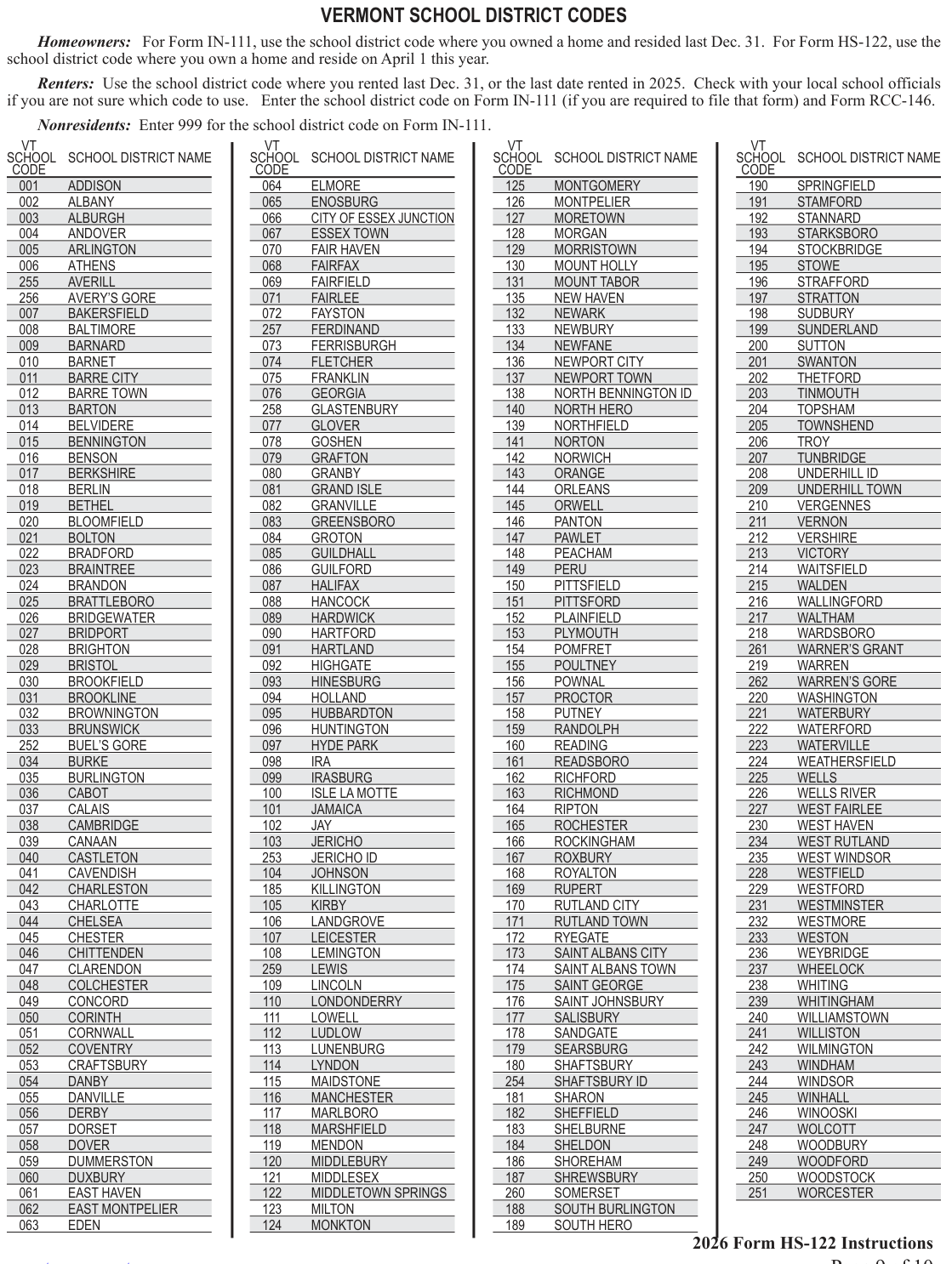
| Hom | eowners: For | Form | IN-111, | use the | school district | code where yo | u owned | a home and resided l | ast Dec. | 31. For | Form HS-122, |
| school di | strict code wher | e you | own a h | ome and | reside on Ap | ril 1 this year. | |||||
| Rent | ers: Use the sc | hool d | istrict c | ode whe | re you rented | last Dec. 31, o | r the last | date rented in 2025. | Check | with you | r local school o |
| if you are | not sure which | code | to use. | Enter th | e school distri | ct code on For | m IN-111 | (if you are required | to file t | hat form) | and Form RC |
| Non | residents: Ente | r 999 | for the s | chool di | strict code on | Form IN-111. | |||||
| VT | VT | VT | VT | ||||||||
| SCHOOL | SCHOOL DISTRIC | T NAM | E S | CHOOL | SCHOOL DISTRI | CT NAME S | CHOOL | SCHOOL DISTRICT NAM | E S | CHOOL | SCHOOL DISTRIC |
| CODE | C | ODE | CODE | CODE | |||||||
| 001 | ADDISON | 064 | ELMORE | 125 | MONTGOMERY | 190 | SPRINGFIELD | ||||
| 002 | ALBANY | 065 | ENOSBURG | 126 | MONTPELIER | 191 | STAMFORD | ||||
| 003 | ALBURGH | 066 | CITY OF ESSEX J | UNCTION | 127 | MORETOWN | 192 | STANNARD | |||
| 004 | ANDOVER | 067 | ESSEX TOWN | 128 | MORGAN | 193 | STARKSBORO | ||||
| 005 | ARLINGTON | 070 | FAIR HAVEN | 129 | MORRISTOWN | 194 | STOCKBRIDGE | ||||
| 006 | ATHENS | 068 | FAIRFAX | 130 | MOUNT HOLLY | 195 | STOWE | ||||
| 255 | AVERILL | 069 | FAIRFIELD | 131 | MOUNT TABOR | 196 | STRAFFORD | ||||
| 256 | AVERY’S GORE | 071 | FAIRLEE | 135 | NEW HAVEN | 197 | STRATTON | ||||
| 007 | BAKERSFIELD | 072 | FAYSTON | 132 | NEWARK | 198 | SUDBURY | ||||
| 008 | BALTIMORE | 257 | FERDINAND | 133 | NEWBURY | 199 | SUNDERLAND | ||||
| 009 | BARNARD | 073 | FERRISBURGH | 134 | NEWFANE | 200 | SUTTON | ||||
| 010 | BARNET | 074 | FLETCHER | 136 | NEWPORT CITY | 201 | SWANTON | ||||
| 011 | BARRE CITY | 075 | FRANKLIN | 137 | NEWPORT TOWN | 202 | THETFORD | ||||
| 012 | BARRE TOWN | 076 | GEORGIA | 138 | NORTH BENNINGTON ID | 203 | TINMOUTH | ||||
| 013 | BARTON | 258 | GLASTENBURY | 140 | NORTH HERO | 204 | TOPSHAM | ||||
| 014 | BELVIDERE | 077 | GLOVER | 139 | NORTHFIELD | 205 | TOWNSHEND | ||||
| 015 | BENNINGTON | 078 | GOSHEN | 141 | NORTON | 206 | TROY | ||||
| 016 | BENSON | 079 | GRAFTON | 142 | NORWICH | 207 | TUNBRIDGE | ||||
| 017 | BERKSHIRE | 080 | GRANBY | 143 | ORANGE | 208 | UNDERHILL ID | ||||
| 018 | BERLIN | 081 | GRAND ISLE | 144 | ORLEANS | 209 | UNDERHILL TOW | ||||
| 019 | BETHEL | 082 | GRANVILLE | 145 | ORWELL | 210 | VERGENNES | ||||
| 020 | BLOOMFIELD | 083 | GREENSBORO | 146 | PANTON | 211 | VERNON | ||||
| 021 | BOLTON | 084 | GROTON | 147 | PAWLET | 212 | VERSHIRE | ||||
| 022 | BRADFORD | 085 | GUILDHALL | 148 | PEACHAM | 213 | VICTORY | ||||
| 023 | BRAINTREE | 086 | GUILFORD | 149 | PERU | 214 | WAITSFIELD | ||||
| 024 | BRANDON | 087 | HALIFAX | 150 | PITTSFIELD | 215 | WALDEN | ||||
| 025 | BRATTLEBORO | 088 | HANCOCK | 151 | PITTSFORD | 216 | WALLINGFORD | ||||
| 026 | BRIDGEWATER | 089 | HARDWICK | 152 | PLAINFIELD | 217 | WALTHAM | ||||
| 027 | BRIDPORT | 090 | HARTFORD | 153 | PLYMOUTH | 218 | WARDSBORO | ||||
| 028 | BRIGHTON | 091 | HARTLAND | 154 | POMFRET | 261 | 261 WARNER'S GRANT | ||||
| 029 | BRISTOL | 092 | HIGHGATE | 155 | POULTNEY | 219 | WARREN | ||||
| 030 | BROOKFIELD | 093 | HINESBURG | 156 | POWNAL | 262 | 262 WARREN'S GORE | ||||
| 031 | BROOKLINE | 094 | HOLLAND | 157 | PROCTOR | 220 | WASHINGTON | ||||
| 032 | BROWNINGTON | 095 | HUBBARDTON | 158 | PUTNEY | 221 | WATERBURY | ||||
| 033 | BRUNSWICK | 096 | HUNTINGTON | 159 | RANDOLPH | 222 | WATERFORD | ||||
| 252 | BUEL’S GORE | 097 | HYDE PARK | 160 | READING | 223 | WATERVILLE | ||||
| 034 | BURKE | 098 | IRA | 161 | READSBORO | 224 | WEATHERSFIELD | ||||
| 035 | BURLINGTON | 099 | IRASBURG | 162 | RICHFORD | 225 | WELLS | ||||
| 036 | CABOT | 100 | ISLE LA MOTTE | 163 | RICHMOND | 226 | WELLS RIVER | ||||
| 037 | CALAIS | 101 | JAMAICA | 164 | RIPTON | 227 | WEST FAIRLEE | ||||
| 038 | CAMBRIDGE | 102 | JAY | 165 | ROCHESTER | 230 | WEST HAVEN | ||||
| 039 | CANAAN | 103 | JERICHO | 166 | ROCKINGHAM | 234 | WEST RUTLAND | ||||
| 040 | CASTLETON | 253 | JERICHO ID | 167 | ROXBURY | 235 | WEST WINDSOR | ||||
| 041 | CAVENDISH | 104 | JOHNSON | 168 | ROYALTON | 228 | WESTFIELD | ||||
| 042 | CHARLESTON | 185 | KILLINGTON | 169 | RUPERT | 229 | WESTFORD | ||||
| 043 | CHARLOTTE | 105 | KIRBY | 170 | RUTLAND CITY | 231 | WESTMINSTER | ||||
| 044 | CHELSEA | 106 | LANDGROVE | 171 | RUTLAND TOWN | 232 | WESTMORE | ||||
| 045 | CHESTER | 107 | LEICESTER | 172 | RYEGATE | 233 | WESTON | ||||
| 046 | CHITTENDEN | 108 | LEMINGTON | 173 | SAINT ALBANS CITY | 236 | WEYBRIDGE | ||||
| 047 | CLARENDON | 259 | LEWIS | 174 | SAINT ALBANS TOWN | 237 | WHEELOCK | ||||
| 048 | COLCHESTER | 109 | LINCOLN | 175 | SAINT GEORGE | 238 | WHITING | ||||
| 049 | CONCORD | 110 | LONDONDERRY | 176 | SAINT JOHNSBURY | 239 | WHITINGHAM | ||||
| 050 | CORINTH | 111 | LOWELL | 177 | SALISBURY | 240 | WILLIAMSTOWN | ||||
| 051 | CORNWALL | 112 | LUDLOW | 178 | SANDGATE | 241 | WILLISTON | ||||
| 052 | COVENTRY | 113 | LUNENBURG | 179 | SEARSBURG | 242 | WILMINGTON | ||||
| 053 | CRAFTSBURY | 114 | LYNDON | 180 | SHAFTSBURY | 243 | WINDHAM | ||||
| 054 | DANBY | 115 | MAIDSTONE | 254 | SHAFTSBURY ID | 244 | WINDSOR | ||||
| 055 | DANVILLE | 116 | MANCHESTER | 181 | SHARON | 245 | WINHALL | ||||
| 056 | DERBY | 117 | MARLBORO | 182 | SHEFFIELD | 246 | WINOOSKI | ||||
| 057 | DORSET | 118 | MARSHFIELD | 183 | SHELBURNE | 247 | WOLCOTT | ||||
| 058 | DOVER | 119 | MENDON | 184 | SHELDON | 248 | WOODBURY | ||||
| 059 | DUMMERSTON | 120 | MIDDLEBURY | 186 | SHOREHAM | 249 | WOODFORD | ||||
| 060 | DUXBURY | 121 | MIDDLESEX | 187 | SHREWSBURY | 250 | WOODSTOCK | ||||
| 061 | EAST HAVEN | 122 | MIDDLETOWN S | PRINGS | 260 | SOMERSET | 251 | WORCESTER | |||
| 062 | EAST MONTPELIE | R | 123 | MILTON | 188 | SOUTH BURLINGTON | |||||
| 063 | EDEN | 124 | MONKTON | 189 | SOUTH HERO | ||||||
| 2026 F | orm H | S-122 Instruc |
# Visit Our Website for Forms Not Included in This Booklet
We have provided the forms in this booklet that most Vermonters need to file their taxes. All forms are available at tax.vermont.gov. The following forms are not included in this booklet:
Vermont Credit for Income Tax Paid to Other State or Canadian Province
- IN-117
Vermont Tax Adjustments and Nonrefundable Credits
- IN-119
- IN-153 Vermont Capital Gains Exclusion
Application for Extension of Time to File Form IN-111. A Vermont extension is not
- IN-151 required to be filed if a federal extension was filed and you are not required to submit a payment with your extension.
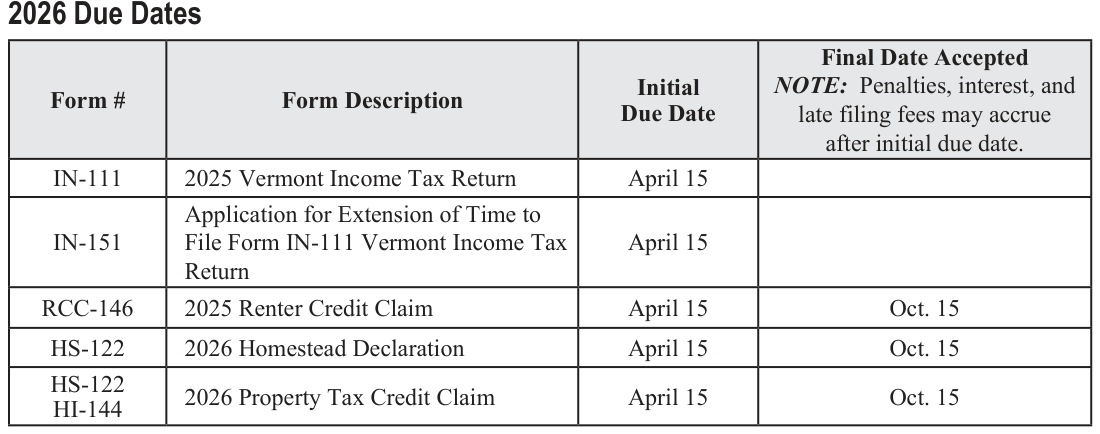
# 2026 Due Dates
Text version of this table
| Form # | Form Description | Initial Due Date | Final Date Accepted NOTE: Penalties, interest, and late filing fees may accrue after initial due date. |
|---|---|---|---|
| IN-111 | 2025 Vermont Income Tax Return | April 15 | |
| IN-151 | Application for Extension of Time to File Form IN-111 Vermont Income Tax Return | April 15 | |
| RCC-146 | 2025 Renter Credit Claim | April 15 | Oct. 15 |
| HS-122 | 2026 Homestead Declaration | April 15 | Oct. 15 |
| HS-122 HI-144 | 2026 Property Tax Credit Claim | April 15 | Oct. 15 |
# Final Date Accepted
# Initial
Due Date late filing fees may accrue after initial due date.
April 15
April 15
April 15 Oct. 15
April 15 Oct. 15
April 15 Oct. 15
The Vermont Department of Taxes offers free, confidential service when a taxpayer encounters difficulty resolving tax issues. The Taxpayer Advocate may be able to help if:
You are experiencing extreme economic hardship from the Department's action, or
•
It is taking more than 180 days to resolve your tax issue, or
•
You have not received a response or resolution to the problem by the date promised by the Vermont
•
Department of Taxes.
The Taxpayer Advocate will review your situation, help you understand what needs to be done to resolve it, and keep you updated on the progress of your situation. Please note that the Taxpayer Advocate cannot override the provisions of the law or represent taxpayers at Department hearings.
To contact the Taxpayer Advocate:
Telephone: 802-828-6848
Fax: 802-828-6982
Mail: ATTN: Taxpayer Advocate
133 State Street
Montpelier, VT 05633-1401 tax.taxpayeradvocate@vermont.gov
# Email:
Source: view the official PDF
The source document contains 1 figure (charts or worksheet graphics) not reproduced in this text version. See the official PDF above.
Nearby sections (17 sections)
- bi-471-business-income-instructions · Vermont Business Income Tax…
- bi-472-non-composite · Vermont Non-Composite Schedule (BI-472, 2025) —…
- bi-473-composite · Vermont Composite Income Tax Schedule (BI-473, 2025)…
- bi-476-pe-adjustments · Vermont PE Income Adjustments Schedule…
- bi-477 · Vermont Income Adjustment Calculation: Pass-Through Vermont…
- co-411-corporate-instructions · Vermont Corporate Income Tax Return…
- co-414-corporate-estimated · Vermont Corporate Estimated Tax Payment…
- est-191-estate-instructions · Vermont Estate Tax Return Instructions…
- fit-161-fiduciary-instructions · Vermont Fiduciary Income Tax Return…
- hs-122-homestead-instructions · Vermont Homestead Declaration and…
- in-111-income-booklet · Vermont Income Tax Return Booklet (IN-111) —…
- in-114-individual-estimated · Vermont Individual Estimated Income Tax…
- in-152-underpayment · Vermont Underpayment of Estimated Tax by…
- k-1vt · Schedule K-1VT (2025) — Vermont Shareholder, Partner, or Member…
- sut-451-sales-use-return · Vermont Sales and Use Tax Return (SUT-451,…
- w-4vt-employee-withholding · Vermont Employee Withholding Allowance…
- wht-436-quarterly-withholding · Vermont Quarterly Withholding…