Virginia Department of Taxation Form Instructions
Instructions for Form 765 — Unified Nonresident Individual Income Tax Return for Pass-Through Entities
# Department of Taxation
Richmond, Virginia www.tax.virginia.gov
2601042 Rev. 08/25
What's New
Virginia's Conformity to the Internal Revenue Code Virginia's rolling conformity with the Internal Revenue Code has been suspended for periods beginning on or after January 1, 2025, and before January 1, 2027. Virginia will continue to conform to the Inflation Reduction Act and the Consolidated Appropriations Act of 2023. Conformity refers to how closely Virginia follows definitions and other provisions of the federal tax code, including the definition of income. If changes are made to federal law that could impact your return and require adjustments, Virginia Tax will post information about this on its website at www.tax.virginia.gov.
Virginia will continue to deconform from the following: bonus depreciation allowed for certain assets under federal law; the five-year carryback of certain federal net operating loss (NOL) deductions generated in the 2008 or 2009 taxable years; the federal income treatment of applicable high yield discount obligations; and the federal income tax treatment of cancellation of debt income realized in connection with certain business debts. In addition, Virginia will continue to deconform from the following temporary changes made by the Coronavirus Aid, Relief, and Economic Security ("CARES") Act: suspension of certain NOL limitations for Taxable Years 2018, 2019, and 2020 and increasing the business interest limitation for Taxable Year 2019 and 2020.
At the time these instructions were published, the only required conformity adjustments were those mentioned above.
However, if legislation is enacted that results in changes to the IRC for the 2025 taxable year, taxpayers may need to make adjustments to their Virginia returns that are not described in these instructions. Information about any such adjustments will be posted on the Department's website at www.tax.virginia.gov.
# Online Resources:
The Department's website, www.tax.virginia.gov, contains valuable information to help you.
- Online Services - Link to online registration, filing, payment, and other electronic services.
- Laws, Rules, & Decisions - Access the Code of Virginia, Tax Regulations, Legislative Summaries, Rulings by the Tax Commissioner, Tax Bulletins, and Attorney General Opinions.
- Email Updates - Sign up and stay informed. By subscribing, you will periodically receive automatic email notifications regarding legislative changes, filing reminders, and other relevant information.
# Contact Us:
Customer Services
Virginia Department of Taxation
P.O. Box 1115
Richmond, Virginia 23218-1115
Phone: (804) 367-8031
Forms Requests
Virginia Department of Taxation
P.O. Box 1317
Richmond, Virginia 23218-1317
Visit www.tax.virginia.gov
Mail Your Return to:
Virginia Department of Taxation
P.O. Box 760
Richmond, VA 23218-0760
# GENERAL INSTRUCTIONS
Explanation of Forms
Every pass-through entity (PTE) doing business in Virginia or having income from Virginia sources is required to file a return of income for each taxable year with the Department of Taxation (the Department). This is done on the Form
502, Pass-Through Entity Return of Income and Return of Nonresident Withholding Tax. The Form 502 is not optional.
It must be filed by every PTE doing business in Virginia or having income from Virginia sources.
Every PTE doing business in Virginia or having income from Virginia sources is required to pay a withholding tax equal to 5% of its nonresident owners' shares of income from Virginia sources. This tax is reported by the PTE on the Form 502W.
See the Form 502W Instructions for more information.
When a PTE is required to file a Virginia return of income, the owners of the entity will usually have a Virginia filing requirement also. For owners who are not residents of Virginia, filing may be simplified through the use of the Form
- Form 765 is an optional "unified return" (henceforth referred to as a composite return) that is filed by the PTE on behalf of its qualified nonresident owners. All of the Virginia source income from the PTE that is passed through to the qualified nonresident owners who participate is reported on a single return. These owners are thereby relieved of the requirement that each file a return and pay tax separately.
The PTE is not required to pay the withholding tax for nonresident owners who are included on the Form 765.
# Who May File
A partnership, S corporation, LLC, or any other type of PTE that transacts business in Virginia and has 2 or more nonresident individual owners may file a composite nonresident individual income tax return on behalf of its qualified nonresident individual owners (participants) who elect to participate, provided that certain conditions are met. In addition, certain estates and trusts which qualify and have income passed through to their nonresident beneficiaries may elect to file a composite return. These filers will complete Form 765 in a similar manner as a PTE filer. A composite return is an alternative to the filing of a nonresident individual income tax return by each nonresident individual owner of the PTE.
The composite return is filed in the name of the PTE, using the PTE's federal employer identification number (FEIN) and Virginia account number. An owner, officer, or employee of the PTE who is authorized to act on behalf of the PTE in tax matters (authorized representative) must sign the composite return. By signing the return, the signer is declaring that they are the authorized representative of the PTE and that each participant has signed a consent form authorizing the PTE to act on the participant's behalf in the matter of composite returns and acknowledging the participant's understanding and acceptance of all of the terms and conditions of participation in a composite return as described in these instructions.
The consent form must continue in force indefinitely until revoked in writing by the participant and must permit the PTE to file amendments or to take other actions concerning the composite return without additional authorization from the participant. The consent forms must be maintained by the PTE and provided to the Department for inspection upon demand.
A pass-through entity may file a composite return for only a portion of its qualified nonresident owners, provided that the pass-through entity pays the pass-through entity withholding tax for any qualified nonresident owners who are not included in the composite return.
By filing a composite return, the participants join in a collective return, which is prepared and submitted by the PTE on behalf of the participants. The composite return satisfies the requirement that each participant file a separate Virginia nonresident individual income tax return with respect to the PTE income, but it does not transform the PTE into a taxable entity or transfer the tax liability of the participants to the PTE.
A composite return may be filed without prior approval from the Department provided the PTE and the participants agree to comply with the Department's rules described in these instructions. If all of the rules described in these instructions cannot be met, the PTE must receive written approval from the Tax Commissioner before submitting a composite return.
All requests must be submitted in writing to:
Tax Commissioner
# Virginia Department of Taxation
P.O. Box 2475
Richmond, VA 23218-2475
The Department may deny any PTE permission to file a composite return. In addition, the Department may refuse acceptance of any composite return not filed in a timely manner or in accordance with the prescribed rules and procedures. In such cases, the Department will require each owner to file their own separate return in accordance with Virginia law and regulations.
# Who Qualifies to Participate
A qualified owner is a natural person who is:
- A direct owner of the PTE filing the return; and
- A nonresident of Virginia with Virginia source income for the taxable year from the PTE filing the return. If an individual nonresident owner has other income from Virginia sources in addition to PTE income, they must file a Nonresident Individual Income Tax Return (Form 763) to account for that income. The individual may deduct income reported on Form 765.
A pass-through entity may not include a corporation or any other entity in a Virginia composite return.
# How Taxable Income and Amount of Tax are Determined
For the composite return, Virginia taxable income is the aggregate of each participant's income from the PTE, as allocated and apportioned to Virginia, adjusted by any modifications applicable to Virginia individual income tax, without benefit of any personal exemptions, or itemized or standard deductions. Virginia taxable income cannot be reduced by carryovers from any other taxable years or returns of the PTE or any participant for net operating losses, charitable contributions, Internal Revenue Code § 179 expenses, or other deductions. In addition, Virginia taxable income cannot be reduced by deductions or subtractions nor may any tax be offset by credits that did not flow through from the PTE to the participants. Only Virginia modifications and credits reported on the participants' Schedules VK-1 or SVK-1 that are applicable to individual income tax may be claimed on the composite return. Although Virginia credits may not be carried over to other taxable years on the PTE's return (Form 502), the owners may be able to carryover unused credits on their Virginia returns. Refer to the section titled What Forms and Schedules to Use for instructions on claiming Virginia credits and carryover credits on the composite return.
The amount of tax is computed on the Virginia taxable income by applying the tax rates for individual income tax specified in Va. Code § 58.1-320 or by reference to the tax tables published by the Department, without regard to the number of participants.
NOTE: The composite return is an option the Department provides to qualifying nonresident individual owners of a PTE to simplify the return filing process. Its use may result in the loss of certain benefits and tax advantages available to nonresident individuals filing separate Virginia returns.
In addition, the amount of tax computed on a composite filing basis may exceed the aggregate of the participants' tax liabilities had each participant filed their own return. The qualifying owners of each PTE must decide whether to file a composite return. If the composite return option is not elected, each nonresident owner should consult a tax professional to determine if they are required to file a separate Virginia return.
# When the Return is Due
If the PTE's taxable year is:
- Calendar year (January 1 - December 31) - the composite return for 2025 taxable year must be postmarked no later than May 1, 2026, to avoid late filing penalties and interest; or
- Fiscal year or short year - the composite return is due on or before the 15th day of the 4th month following the close of the PTE's taxable year.
The composite return must be submitted to the Department at the same time or after the PTE submits its Virginia return (Form 502).
# Estimated Tax and Extension Payments
The PTE is required to electronically file all installment payments of estimated tax and all payments made with regard to a return or an extension of time to file if:
(i) any one payment exceeds or is required to exceed $1,500, or
(ii) the taxpayer's total liability exceeds or can be reasonably expected to exceed $6,000.
If either of the thresholds above apply, all future unified nonresident income tax payments must be made electronically. This includes all payments for estimated taxes, extensions of time to file, and any other amounts due when a return is filed.
The Department provides 2 secure electronic options for submitting estimated payments for unified nonresident taxpayers: eForms is a debit EFT program through which you may schedule your payment for a future date or you may pay by an ACH credit transaction through your bank.
Some banks may charge a fee for this service. An Electronic Payment Guide is available on the Department's website, www.tax.virginia.gov, with information on how to submit ACH credit payments to the Department.
How to Make Estimated Payments
The rules and procedures for payment of estimated individual income tax apply to composite returns. To submit estimated tax payments, use Form 770ES, Virginia Estimated Income
# Tax Payment Vouchers for Estates, Trusts, and Unified
Nonresidents which can be filed electronically using the Department's eForm available at www.tax.virginia.gov.
Payments of the estimated tax must be made in the name of the PTE, using the PTE's FEIN. The estimated tax is computed using the estimated Virginia taxable income for the composite return, without regard to the number of participants. Estimated tax paid by a participant to their own account may not be applied to a composite return, and estimated tax paid by a PTE for use on a composite return may not be applied to a participant's individual account.
# Automatic Extension to File
An automatic extension of time to file is granted to the date 6 months after the original due date or 30 days after the extended date for filing the federal income tax return, whichever is later, provided the full amount estimated as the tax due has been paid on or before the original due date. If sufficient payments have been made, no further action is required to obtain the extension to file. If an additional tax payment is needed to ensure the tax liability has been paid, use Form 770IP, Virginia Fiduciary and Unified Nonresident Automatic Extension Payment Voucher, to remit the payment.
The payment must be made in the name of the PTE, using the PTE's FEIN. If either of the thresholds detailed in the Estimated Tax and Extension Payments section apply to the tentative tax payment, the Form 770IP and payment must be submitted electronically.
# Unified Nonresident Individual Income Tax Return (Composite Return)
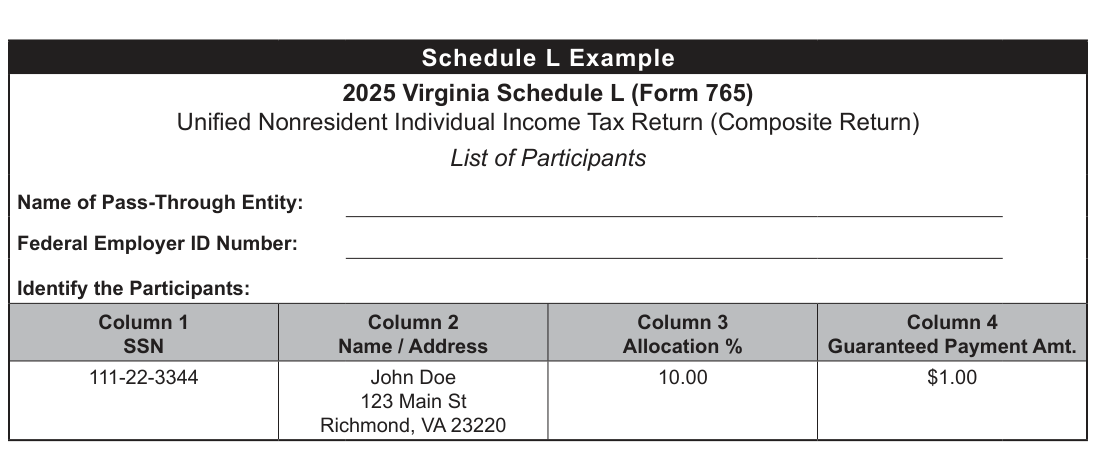
Text version of this table
Schedule L Example 2025 Virginia Schedule L (Form 765) Unified Nonresident Individual Income Tax Return (Composite Return) List of Participants Name of Pass-Through Entity: Federal Employer ID Number: Identify the Participants: Column 1 SSN Column 2 Name / Address Column 3 Allocation % Column 4 Guaranteed Payment Amt. 111-22-3344 John Doe 123 Main St Richmond, VA 23220 10.00 $1.00
If you are not required to submit the 770IP and payment electronically, you have the option to mail Form 770IP and payment to:
Virginia Department of Taxation
P.O. Box 760
Richmond, VA 23218-0760
An automatic 6-month extension is also granted to the PTE (Form 502). Penalties are assessed for returns filed after the extended due date. See the Form 502 instructions for further information.
# How the Department will Mail Refunds, Assessments, and Correspondence
The Department will issue correspondence and all assessments of tax, penalty, and interest in the name of the PTE. Although the PTE is required to make all payments of tax, penalty, and interest, and is authorized to act on the participants' behalf, each participant remains liable for their respective share of any tax, penalty, and interest owed. The Department will refund overpaid tax to the PTE.
# What Forms and Schedules to Use
Form 765 may not be filed unless the entity has also filed Form 502. Form 502 is a separate return and not an enclosure.
Do not mail Form 765 with Form 502.
A composite return filing must include:
- A completed and signed Form 765, Unified Nonresident
Individual Income Tax Return (Composite Return); and
- A Schedule L, Unified Nonresident Individual Income Tax Return (Composite Return) List of Participants, which includes the name, home address, Social Security number, allocation percentage, and guaranteed payment amount of each participant.
Schedule L can be replaced by a spreadsheet or word processing document in either portrait or landscape orientation on 8.5" x 11" paper. The document should be in table format with grid lines, including the same 4 columns and the same information in the same order as shown on Schedule L. The substitute form cannot Column 3 Column 4 Allocation % Guaranteed Payment Amt.
10.00 $1.00 contain additional columns of data. The year, the title "Schedule L," the name of the PTE, and the FEIN of the PTE must be clearly printed at the top of the substitute version. The data must be in 10 point font or larger. An example of a substitute Schedule L is provided above.
If claiming more additions or subtractions than the Form 765 allows, the composite return must also include:
• Schedule ADJS.
If any Virginia credits are claimed on the composite return, then the composite return must also include:
- A Schedule CR, Credit Computation Schedule; and
- The required forms and documentation, as described in the Schedule CR instructions, for each credit claimed; and
- If any carryover credit is claimed, a reconciliation of the available carryover credit accounting for any change in the participants from the prior year.
Credits: When claiming an original credit, add the credit amount allocated to each participant (from the participants' Schedules VK-1) and enter the total on the appropriate line on Schedule CR. If a credit reported on the participants' Schedules VK-1 is not listed on the Schedule CR, it may not be used as a credit to lower an individual income tax liability. For instance, a credit limited by the Code of Virginia to corporations may not be used to reduce individual income tax, either on a composite return or on a separate individual income tax return. Credit for income tax paid to another state may not be claimed on a composite return.
If any credit is unused and the credit allows for carryover, report the carryover on Schedule CR. Unused credits may be carried over in accordance with each credit's specific carryover provisions. If a participant who did not previously qualify to participate in a composite filing has carryover credit, that participant's carryover credit may be included on the composite return, provided such credit was originally passed through to the participant by the PTE and the carryover credit is within the carryover period allowed for that credit.
Conversely, any portion of a carryover credit allocated to an owner who qualified to participate in a composite filing for a prior taxable year but who no longer qualifies may not be included on the composite return, as that portion of the carryover credit may only be used by that owner when filing their separate Virginia return.
If any carryover credit is claimed, enclose with the Schedule CR, along with all required forms and documentation, a reconciliation of the available carryover credit accounting for any change in the participants from the prior year. The reconciliation must include the type of credit, amount and taxable year earned, and amount(s) and taxable year(s) used or partially used for each participant having a carryover.
Amended Returns: When filing an amended composite return, always provide an amended return reconciliation and a statement substantiating the reason for the amendment. If you are filing an amended return as the result of a partnershiplevel federal adjustment, you must enclose a copy of the partnership's Form 502FED-1, Virginia Partnership-Level Federal Adjustments Report, with the Form 765. Refer to the instructions for filing an amended composite return provided below.
# When and How to File an Amended Return
If the PTE files an amended federal return reflecting changes to the taxable income amount or any other amounts that flow through to the owners, the PTE is required to file an amended Form 502 and issue each owner an amended Schedule VK-1 within 1 year of filing the amended federal return. If the PTE's federal return is adjusted by the Internal Revenue Service, the PTE is required to file an amended Form 502 and issue each owner an amended Schedule VK-1 and SVK-1, if applicable, within 1 year following the final determination of such federal change, correction, or renegotiation.
In addition, the PTE must amend the Form 765, within 1 year of filing its amended federal return or within 1 year following the final determination date of the federal change, correction, or renegotiation. When amending a composite return, whether the amendment is the result of the PTE filing an amended return, a federal change, or any other reason, always enclose a statement with the amended composite return substantiating the reason for the amendment. If Form 765 is being amended as a result of a partnership-level federal adjustment, enclose
# Form 502FED-1, Virginia Partnership-Level Adjustments
Report, and all associated schedules, with the Form 765, within 90 days of the final determination date.
To amend the composite return, complete a new composite return using the corrected figures, as if the return were the original return. Mark the amended return check box located on the top left of Form 765, Page 1 and enter a reason code in the space provided (see the next page for a list of amended return reason codes). In addition, enclose a reconciliation of any tax due amounts paid or refunds received based on the original return filing with the amount of tax due or refund computed for the amended composite return.
If the amended composite return increases the tax liability and results in a net tax due, enclose a check or money order for the net tax due with the return and mail it to the Department with the amended composite return.
If the amended composite return reduces the tax liability and results in a net overpayment of tax, by law, the Department may issue a refund only if the amended return is filed within:
- 3 years from the due date of the original return, including valid filing extensions;
- 1 year from the final determination date of the amended federal return or federal change, whichever is later, provided that the allowable refund is not more than the decrease in Virginia tax attributable to the federal change or correction;
- 2 years from the filing of an amended Virginia return resulting in the payment of additional tax, provided that the current amended return raises issues relating solely to the prior amended return and that the refund does not exceed the amount of tax payment made as a result of the prior amended return; or
- 2 years from the payment of an assessment, provided the amended return raises issues relating only to the prior assessment and the refund does not exceed the amount of tax paid on the prior assessment.
Where to Mail the Composite Return
Submit the return to:
Virginia Department of Taxation
P.O. Box 760
Richmond, VA 23218-0760
Do not mail the composite return with the PTE's return to the Department in the same envelope. Follow the instructions for submitting the Form 502, provided in the Form 502 instructions.
# How to Pay Tax Due Amounts
If any tax is due, payment must be submitted at the time the return is filed. The PTE is required to electronically file all installment payments of estimated tax and all payments made with regard to a return or an extension of time to file if
(i) any one payment exceeds or is required to exceed $1,500, or
(ii) the taxpayer's total liability exceeds or can be reasonably expected to exceed $6,000.
Return payments can be submitted electronically using the eForm 770-PMT available on the Department's website, www.tax.virginia.gov.
If you are not required to submit payments electronically, you have the option to pay by check. Make your check payable to the Virginia Department of Taxation and staple it to the left front of Form 765.
How to Contact Customer Services
For forms, instructions, and information, or to email the Department a question, pay a bill, or file an extension, visit the Department's website at www.tax.virginia.gov, or call
(804) 367-8031. You can mail inquiries to:
Virginia Department of Taxation
P.O. Box 1115
Richmond, VA 23218-1115
# RETURN PREPARATION INSTRUCTIONS
Requirement for the Provision of Preparer Tax
Identification Numbers
An income tax return preparer who has the primary responsibility for the overall substantive accuracy of the preparation of a return or claim for refund is required to include their Preparer Tax Identification Number on such return.
# STEP 1
Fiscal or Short Year Filer: The taxable period for the composite return is the same as the taxable period for the
PTE. If the taxable period is other than a calendar year, enter the beginning and ending dates of the PTE's taxable year.
Name and Address: Enter the name and address of the PTE.
FEIN: Enter the PTE's federal employer identification number.
Virginia Account Number: Enter the PTE's Virginia account number.
Change in Address or Legal Name Change: If the PTE's legal name or address has changed, check the appropriate box.
Amended Return: Check the box and refer to the instructions provided in the When and How to File an Amended Composite Return section.
Amended Return Reason Codes
If you are amending your return, use one of the following codes to indicate the reason you are filing an amended return. Enter the 2-digit code next to the "Amended Return" check box on the "Enter Reason Code" line.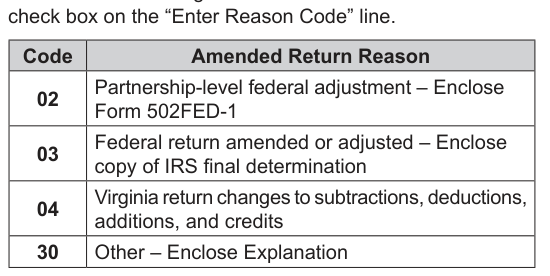
Text version of this table
Code Amended Return Reason 02 Partnership-level federal adjustment - Enclose 03 Federal return amended or adjusted – Enclose copy of IRS final determination 04 Virginia return changes to subtractions, deductions, additions, and credits 30 Other – Enclose Explanation
30 Other - Enclose Explanation
Form 760C: If Form 760C is enclosed claiming an exception or providing the addition to tax computation, check the appropriate box.
# STEP 2
Complete Page 2, the summary of the participants' income and Virginia modifications, as reported on each participant's Schedule VK-1.
# Determine the Participants' Income
Complete Lines 1 through 5. Line 1 and Line 4 are aggregate amounts, computed by totaling the corresponding amounts reported on the participants' Schedules VK-1. Line 2 is not an aggregate number; it is the Virginia Apportionment Percentage reported to each participant on Schedule VK-1, Page 1, Line 7.
Follow the line instructions on Form 765.
# Determine the Participants' Additions to Income
Complete Lines 6 through 11. For each line item, enter the aggregate amount in Column A, computed by totaling the corresponding amounts reported on the participants' Schedules VK-1. Multiply any amount reported in Column A by the Virginia apportionment percentage, Line 2, and enter the result in Column B. Enter guaranteed payments to partners on Line 10, using Code 99, and enclose an explanation with the return. Only those additions that flow through from the PTE to the participants and are required by Virginia in the computation of individual income tax may be reported on the composite return.
The additions applicable to individual income tax are listed on Form 765 (Lines 6, 7, and 9) or reported on the Form 765 (Line 10) using the addition codes listed below. If you have more than 2 additions, use the Schedule ADJS to provide the code and amount for each addition in excess of 2. Enter the total of all additions on Line 11 of Form 765 and check the box to indicate the Schedule ADJS is enclosed.
Code Description
10 Interest on Federally Exempt U.S. Obligations.
Enter the amount of interest or dividends exempt from federal income tax, but taxable in Virginia, less related expenses. See Va. Code § 58.1-322.01 2.
# 18 Income from Dealer Disposition of Property
Enter the amount that would be reported under the installment method from certain dispositions of property. If, in a prior year, the taxpayer was allowed a subtraction for certain income from dealer dispositions of property made on or after January 1, 2009, in the years following the year of disposition, the taxpayer is required to add back the amount that would have been reported under the installment method. Each disposition must be tracked separately for purposes of this adjustment. See Va. Code § 58.1-322.04 4.
# 23 Federal Partnership Income Addition
Income related to certain partnership-level adjustments that result from federal tax changes and other changes to federal taxable income must be claimed as an addition on an amended composite return filed in response to a federal partnership-level audit or a federal administrative adjustment request if the income was not previously reported on the original Virginia return. The amount of the addition is equal to the federal taxable income that was not included in Virginia taxable income on the original composite return but should have been included. When reporting this addition, enclose the partnership's completed Form 502FED-1.
99 Other (Enclose Explanation)
Enter the amount of any other income not included in federal adjusted gross income that is taxable in Virginia. Enclose an explanation and supporting documentation, if applicable. Refer to the Form 760 instructions for further information.
# Determine the Participants' Subtractions from Income
Complete Lines 12 through 17. For each line item, enter the aggregate amount, computed by totaling the amounts reported on the participants' Schedules VK-1. Multiply any amount reported in Column A by the Virginia apportionment percentage, Line 2, and enter the result in Column B. Only those subtractions that flow through from the PTE to the participants and are allowed by Virginia in the computation of individual income tax may be reported on the composite return.
The subtractions applicable to individual income tax are listed on Form 765 (Lines 12, 13, and 15) or reported on Form 765 (Line 16) using the subtraction codes listed below. If you have more than 3 subtractions, use the Schedule ADJS to provide the code and amount for each subtraction in excess of 3.
Enter the total of all subtractions on Line 17 of Form 765 and check the box to indicate the Schedule ADJS is enclosed.
Code Description
20 Income from Virginia Obligations
Enter the amount of income from Virginia obligations included in your federal adjusted gross income. See
Va. Code § 58.1-322.02 2.
21 Federal Work Opportunity Tax Credit Wages
Enter the amount of wages or salaries eligible for the Federal Work Opportunity Tax Credit that is included in federal adjusted gross income. Do not enter the federal credit amount. See Va. Code § 58.1-322.02 6.
51 Gains from Land Preservation
Enter the amount of gain or loss recognized on the sale or transfer of a Land Preservation Tax Credit that was included in federal adjusted gross income. See
Va. Code § 58.1-513(D).
# 52 Certain Long-Term Capital Gain
Enter any income taxed as a long-term capital gain for federal income tax purposes, or any income taxed as investment services partnership interest income (otherwise known as investment partnership carried interest income) for federal income tax purposes. To qualify for this subtraction, the income must be attributable to an investment in a "qualified business," as defined in Va. Code § 58.1-339.4, or in any other technology business approved by the appropriate Secretariat provided the business has its principal office or facility in the Commonwealth and less than $3 million in annual revenues in the fiscal year prior to the investment. Under current law, Secretary of Administration is the Secretariat charged with this approval. The investment must be made between the dates of April 1, 2010, and June 30, 2020. Taxpayers claiming the Qualified Equity and Subordinated Debt Investments Credit cannot claim this subtraction relating to investments in the same business. In addition, no investment is "qualified" for this subtraction if the business performs research in Virginia on human embryonic stem cells.
# 53 Gains from Historic Rehabilitation
To the extent included in federal adjusted gross income, any amount of gain or income recognized by a taxpayer in connection with the Historic Rehabilitation Tax Credit is allowed as a subtraction on the Virginia return. See Va. Code § 58.1-339.2(F).
58 Gain from Eminent Domain
For taxable years beginning on or after January 1, 2019, taxpayers may claim a subtraction for any gain recognized from the taking of real property by condemnation proceedings.
# 59 Business Interest Deduction
For taxable years beginning on and after January 1, 2024, taxpayers may claim a deduction of 50% of business interest disallowed as a deduction pursuant to § 163(j) of the Internal Revenue Code, to the extent included in and not otherwise subtracted from federal taxable income. If claiming this deduction, enclose a copy of federal Form 8990.
# 60 Federal Partnership Income Subtraction
Income related to certain partnership-level adjustments that result from federal tax changes and other changes to federal taxable income may be claimed as a subtraction on an amended composite return filed in response to a federal partnership-level audit or a federal administrative adjustment request if the income was previously reported on the original composite return. The amount of the subtraction is equal to the federal taxable income that was included in Virginia taxable income on the original composite return but should not have been included.
When claiming this subtraction, include a copy of the partnership's Form 502FED-1.
99 Other (Enclose Explanation)
Enter the amount of any other subtractions from federal adjusted income as allowed for Virginia individual income tax purposes and supporting documentation, if applicable. Refer to the Form 760 instructions for further information.
# STEP 3
Complete Form 765, Page 1, Lines 1 through 17. Lines not listed below are explained on Form 765.
Line 6 - Amount of Tax:
Use the amount on Line 5, Virginia Taxable Income, to compute the tax amount as follows:
- If Line 5 is not over $3,000, the tax is 2% of Line 5.
- If Line 5 is over $3,000 but not over $5,000, the tax is $60 plus 3% of the excess over $3,000.
- If Line 5 is over $5,000 but not over $17,000, the tax is $120 plus 5% of the excess over $5,000.
- If Line 5 is over $17,000, the tax is $720 plus 5.75% of the excess over $17,000 Tax tables can be downloaded at www.tax.virginia.gov.
Line 7 - Estimated Payments
Enter the total of the estimated tax payments reported on Form 770ES, if any, made by the PTE on behalf of the participants.
Include overpayment credited from the prior tax year.
Line 8 - Extension Payment:
Enter the extension payment reported on Form 770IP, if any, made by the PTE on behalf of the participants.
Line 9 - Total Credits
Enclose a completed Schedule CR and all required documentation. Refer to the Schedule CR instructions for details and read the section in these instructions titled What Forms and Schedules to Use. Enter the total of all allowable credit amounts from Section 5, Part 1, Line 1A of Virginia Schedule CR.
Line 13 - Overpayment Credited to Next Year
Enter the amount of overpayment the PTE would like credited to next year's estimated taxes.
Line 15a - Addition to Tax
An addition to tax is not owed if:
- All estimated tax payments for the taxable year were made timely;
- The amount, if any, on Form 765, Line 11, is less than $150; and
- Total estimated payments were at least 90% of the composite filers' 2025 tax liability after nonrefundable credits or 100% of the 2024 tax liability after nonrefundable credits.
Use Form 760C to compute the addition to tax, if applicable.
Check the box in the upper left corner of Form 765 if Form 760C is enclosed.
Line 15b - Late Filing Penalty or Extension Penalty:
Late Filing Penalty: If a tax due return is filed after the extended due date, it is subject to a late filing penalty. The penalty is 30% of the tax due.
Extension Penalty: If the return is filed on or before the extended due date, an extension penalty is assessed if the tax due (Form 765, Line 11) is greater than 10% of the tax amount (Form 765, Line 6). The extension penalty is 2% per month or part of a month from the original due date of the return until the date the tax is paid. The maximum extension penalty is equal to 12% of the tax due. If a tax due return is submitted after the extended due date, the extension is invalid and the late filing penalty is assessed.
NOTICE: A late payment penalty may be assessed if a tax due return is filed after the original due date but before the extended due date AND full payment is not made when the return is filed. The late payment penalty is 6% per month or part of a month during which any tax due amount remains unpaid, not to exceed 30%. For any month that the late filing penalty applies, the late payment penalty will not apply. The total of any late filing penalty and late payment penalty cannot exceed 30% of the tax due.
Line 15c - Interest
If a tax due return is filed after the original due date, interest is assessed on the amount of tax due from the original due date to the date the return is filed. Interest is assessed even if the return is submitted by the extended due date. To obtain the daily interest factor, visit www.tax.virginia.gov or call
(804) 367-8031.
Line 17 - Refund
Refunds are paid to the PTE, except that:
- the Department may apply the overpayment to any outstanding amounts related to composite returns filed by the same PTE, without regard to the identities of the participants; and
- an overpayment may be applied to the estimated tax for the following taxable year.
# STEP 4
Complete Schedule L, List of Participants (see instructions for Schedule L on Page 4 under the heading "What Forms and Schedules to Use"). Schedule L is a required enclosure and must include the name, home address, Social Security number, allocation percentage, and guaranteed payment amount of each participant.
# STEP 5
Assemble the composite return as follows:
• Form 765, Unified Nonresident Individual Income Tax Return (Composite Return).
- Schedule CR, Credit Computation Schedule, if applicable, along with all supporting documentation and the carryover reconciliation.
• Schedule ADJS, Virginia Supplemental Schedule of Adjustments, if you have more additions or subtractions than the Form 765 allows.
• Schedule L, List of Participants.
• Form 502FED-1, Virginia Partnership-Level Federal Adjustments Report, if you are submitting an amended return as the result of certain partnership adjustments that result from federal tax changes and other changes to federal taxable income.
For a tax due composite return, payment must be submitted at the time the return is filed. You must submit payment of any tax due with your return electronically if you meet any of the thresholds detailed in the Estimated Tax and Extension Payments section above. Use the Department's eForm 770-PMT available on the Department's website, www.tax.virginia.gov, to submit your payment electronically.
If you are not required to submit your payment electronically, you have the option to pay by check. If you choose this option, make your check payable to the Virginia Department of Taxation and staple it to the front left of the return.
Form 765 cannot be filed electronically. Even if the return payment is submitted electronically, Form 765 and applicable enclosures must be mailed to the Department at the address below.
Mail the return to:
Virginia Department of Taxation
P.O. Box 760
Richmond, VA 23218-0760
Source: view the official PDF
The source document contains 1 figure (charts or worksheet graphics) not reproduced in this text version. See the official PDF above.
Nearby sections (15 sections)
- employer-withholding-instructions · Virginia Employer Withholding…
- form-500 · Instructions for Form 500 — Corporation Income Tax Return
- form-500cr · Instructions for Form 500CR — Credit Computation Schedule…
- form-502 · Instructions for Form 502 — Pass-Through Entity Income Tax…
- form-502ptet · Form 502PTET — Pass-Through Entity Tax (PTET)…
- form-760 · Instructions for Form 760 — Resident Individual Income Tax…
- form-760py · Instructions for Form 760PY — Part-Year Resident…
- form-763 · Instructions for Form 763 — Nonresident Individual Income…
- form-765 · Instructions for Form 765 — Unified Nonresident Individual…
- form-770 · Instructions for Form 770 — Fiduciary Income Tax Return
- form-st-9 · Form ST-9 — Retail Sales and Use Tax Return (form +…
- form-va-4 · Form VA-4 — Employee's Virginia Income Tax Withholding…
- form-va-5-monthly · Form VA-5 (Monthly) — Employer's Return of Virginia…
- form-va-5-quarterly · Form VA-5 (Quarterly) — Employer's Return of…
- form-va-6 · Form VA-6 — Employer's Annual or Final Summary of Virginia…