Ohio Department of Taxation Form Instructions
IT 1040 Booklet — Ohio Individual Income Tax Return & Instructions (incl. SD 100 school district)
Instructions for Filing Original and Amended:
- Individual Income Tax (IT 1040)
Tax Year 2025
Check Your Refund Status Anytime, Anywhere!
¬ Online at tax.ohio.gov/refund
¬ 24-Hour Hotline: 1-800-282-1784
Online at tax.ohio.gov/refund
# Table of Contents
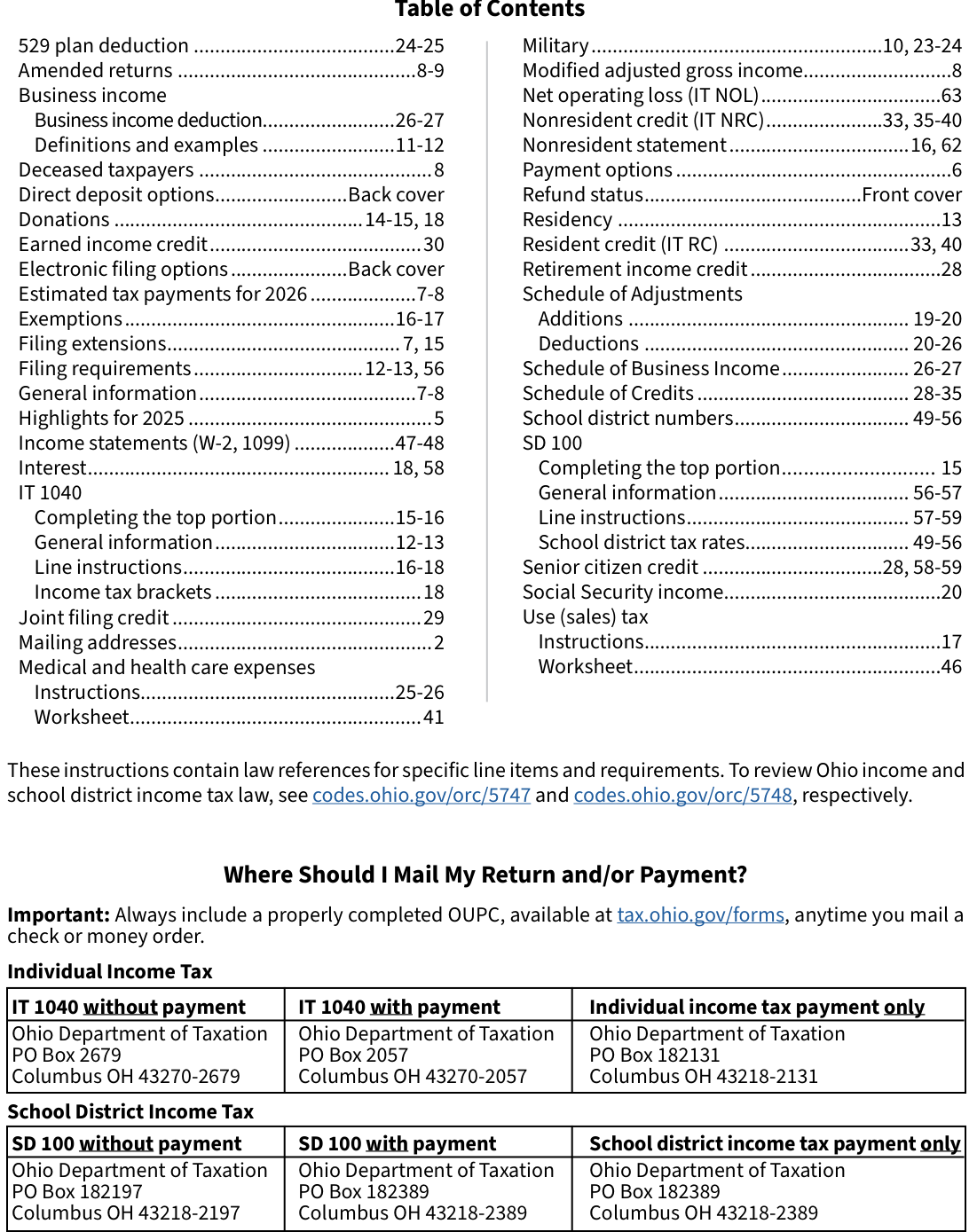
Text version of this table
| 529 plan deduction..................... | ..... | ........ | .....24-25 | Military........................................................10, 23-24 | |
| Amended returns........................ | ..... | ........ | .........8-9 | Modified adjusted gross income............................8 | |
| Business income | Net operating loss (IT NOL)..................................63 | ||||
| Business income deduction....... | ..... | ........ | .....26-27 | Nonresident credit (IT NRC)......................33, 35-40 | |
| Definitions and examples........ | ..... | ........ | .....11-12 | Nonresident statement...................................16, 62 | |
| Deceased taxpayers.................... | ..... | ........ | ............8 | Payment options.....................................................6 | |
| Direct deposit options................ | ..... | ....B | ack cover | Refund status.........................................Front cover | |
| Donations.................................... | ..... | ....... | 14-15, 18 | Residency..............................................................13 | |
| Earned income credit................. | ..... | ........ | ..........30 | Resident credit (IT RC)....................................33, 40 | |
| Electronic filing options.............. | ..... | ....B | ack cover | Retirement income credit.....................................28 | |
| Estimated tax payments for 202 | 6.... | ........ | .........7-8 | Schedule of Adjustments | |
| Exemptions.................................. | ..... | ........ | .....16-17 | Additions...................................................... 19-20 | |
| Filing extensions......................... | ..... | ........ | ......7, 15 | Deductions................................................... 20-26 | |
| Filing requirements.................... | ..... | ....... | 12-13, 56 | Schedule of Business Income........................ 26-27 | |
| General information................... | ..... | ........ | .........7-8 | Schedule of Credits......................................... 28-35 | |
| Highlights for 2025...................... | ..... | ........ | ............5 | School district numbers................................. 49-56 | |
| Income statements (W-2, 1099).. | ..... | ........ | .....47-48 | SD 100 | |
| Interest........................................ | ..... | ........ | ....18, 58 | Completing the top portion............................ 15 | |
| IT 1040 | General information.................................... 56-57 | ||||
| Completing the top portion.... | ..... | ........ | .....15-16 | Line instructions.......................................... 57-59 | |
| General information................ | ..... | ........ | .....12-13 | School district tax rates............................... 49-56 | |
| Line instructions...................... | ..... | ........ | .....16-18 | Senior citizen credit...................................28, 58-59 | |
| Income tax brackets................. | ..... | ........ | ..........18 | Social Security income.........................................20 | |
| Joint filing credit......................... | ..... | ........ | ..........29 | Use (sales) tax | |
| Mailing addresses....................... | ..... | ........ | ............2 | Instructions........................................................17 | |
| Medical and health care expens | es | Worksheet..........................................................46 | |||
| Instructions.............................. | ..... | ........ | .....25-26 | ||
| Worksheet................................ | ..... | ........ | ..........41 | ||
| T | hese instructions contain law re | fere | nce | s for specific line it | ems and requirements. To review Ohio income and |
| s | chool district income tax law, se | e co | des | .ohio.gov/orc/574 | 7 and codes.ohio.gov/orc/5748, respectively. |
| Where | Sh | oul | d I Mail My Ret | urn and/or Payment? | |
| mportant: Always include a pro | per | ly co | mpleted OUPC, a | vailable at tax.ohio.gov/forms, anytime you mail a | |
| c | heck or money order. | ||||
| ndividual Income Tax | |||||
| I | T 1040 without payment | IT 1 | 040 | with payment | Individual income tax payment only |
| Ohio Department of Taxation | Ohi | o De | partment of Taxa | tion Ohio Department of Taxation | |
| P | O Box 2679 | PO | Box | 2057 | PO Box 182131 |
| C | olumbus OH 43270-2679 | Col | umb | us OH 43270-2057 | Columbus OH 43218-2131 |
| S | chool District Income Tax | ||||
| S | D 100 without payment | SD | 100 | with payment | School district income tax payment only |
| Ohio Department of Taxation | Ohi | o De | partment of Taxa | tion Ohio Department of Taxation | |
| P | O Box 182197 | PO | Box | 182389 | PO Box 182389 |
| C | olumbus OH 43218-2197 | Col | umb | us OH 43218-2389 | Columbus OH 43218-2389 |
# IT 1040
# Schedule of Adjustments
Where Should I Mail My Return and/or Payment?
Important: Always include a properly completed OUPC, available at tax.ohio.gov/forms, anytime you mail a check or money order.
Taxpayer Assistance
# Contact Us
Examiners are available by phone and for in-person visits to the Welcome Center during the Department's normal business hours of 8:00 a.m. to 5:00 p.m., Monday through Friday, excluding holidays.
Appointments - While appointments are not required, you can schedule a phone call back or a Welcome Center visit at tax.ohio.gov/contact.
Phone - Call 1-800-282-1780* to speak to an examiner during normal business hours.
Welcome Center - Get assistance in person by visiting us at:
# 4485 Northland Ridge Blvd
Columbus OH 43229-6596
All visitors to the Welcome Center must present a photo I.D. such as a current driver's license, state or military I.D., or passport.
Live Chat - Message with an examiner in real time through a text-based chat at tax.ohio.gov/OHTAX. Live Chat is available from 9:00 a.m. to 3:00 p.m., Monday through Friday, excluding holidays.
# Online Resources
OH|TAX eServices - Create a username and password to securely file returns, make payments, view and respond to notices, and more at tax.ohio.gov/OHTAX.
Forms - Find all individual and school district income tax forms (including fill-in versions) at tax.ohio.gov/ forms. You can also request forms anytime by calling 1-800-282-1782*.
FAQs - Find answers to frequently asked questions for all tax types at tax.ohio.gov/FAQ.
Pilot - Pilot is a virtual assistant, available 24/7 to answer questions for all tax types.
The Finder - Visit tax.ohio.gov/finder to look up your address to determine if your school district has an income tax.
Ohio Virtual Tax Academy - View webinars presented by the Department on Ohio's state taxes at tax.ohio. gov/OVTA.
Social Media - To keep up to date with everything taxation, follow us on social media:
YouTube - @OhioDeptOfTaxation
LinkedIn - The Ohio Department of Taxation *Persons who use text telephones or adaptive telephone equipment - Contact the Ohio Relay Service at 7-1-1 or 1-800-750-0750 and give the communication assistant the phone number you wish to contact.
# Additional Resources
Volunteer Income Tax Assistance Program (VITA) and Tax Counseling for the Elderly (TCE): These programs help people who generally make $67,000 or less, persons with disabilities, and limited English-speaking taxpayers complete their state and federal returns. For locations in your area, call 1-800-906-9887, or visit their website: http://www.irs.gov/Individuals/Free-Tax-Return-Preparation-for-Qualifying-Taxpayers AARP: IRS-certified Tax-Aide volunteers provide tax assistance with a focus on taxpayers who are over 50 and have low to moderate income. For more information, call 1-888-227-7669 or visit their website: http://www.aarp.org/money/taxes/aarp_taxaide/ IMPORTANT: The printed version of these instructions are accurate as of November 27, 2025. Any changes made after this date will be listed below in the online version of the instructions at tax.ohio.gov/forms.
● Page 24: The line 36 instruction was updated to reflect the correct law references.
● Updated the following instructions to reflect law reference changes per H.B. 96, effective January 1, 2026.
- Page 29: Line 8 Campaign Contribution Credit Page 34: Line 45 Credit for Film and Theater Capital Improvement Projects •
Page 58: Line 22 Resident Portion of MAGI Less Exemptions •
- Page 59: Line 32 Resident Portion of MAGI ● Page 62: Updated instruction to clarify Ohio law presumes individuals with an abode in Ohio are Ohio residents.
# A Message From the Ohio Tax Commissioner
Hello,
Thank you for filing your Ohio income tax return! At the Ohio Department of Taxation, we are here to support you with clear guidance and information every step of the way.
This year's tax season brings a few updates to Ohio tax laws, and this booklet will walk you through them to make filing your 2025 return as smooth as possible. Here are three key changes to note:
1. New Income Tax Rates
For 2025, Ohio has lowered the tax rate applied to taxable nonbusiness income above $100,000 to 3.125%.
2. Ohio Educator Expense Deduction
The deduction for educational expenses incurred by Ohio educators has been increased to $300 per taxpayer.
# 3. Home School Expenses Credit
The credit for educational expenses related to home schooling has been changed from $250 per return to $250 per qualifying student.
If you haven't tried it yet, our OH|TAX eServices platform is the fastest, most accurate way to file your Ohio and school district income tax returns. It's free, secure, and the quickest way to receive any refund.
# Important Dates
The deadline to file both your Ohio and federal tax returns is April 15, 2026. Please note that an extension to file does not extend the deadline for payment.
For any questions, our Taxpayer Assistance team is here to help! Call us at 1-800-282-1780 or visit the 'Contact Us' section at tax.ohio.gov.
Thank you again for being a part of Ohio's mission to fund education, protect our communities, and support a healthy environment.
Best regards, Patricia Harris
# Ohio Tax Commissioner
Highlights for Tax Year 2025
Ohio Income Tax Brackets. For tax year 2025, the highest tax rate has been reduced to 3.125%. See the updated tax brackets on page 18.
# Contributions to a Pregnancy Resource Center
Deduction. A new deduction is available for contributions made to a qualifying pregnancy resource center. See the instructions on page 22.
Ohio Educator Expense Deduction. The deduction for educational expenses incurred by Ohio educators has been increased to $300 per taxpayer. See the instructions on page 25.
Home School Expense Credit. The credit for educational expenses related to home schooling has been changed from $250 per return to $250 per qualifying student. See the instructions on page 30.
Transformational Mixed-Use Development Credit.
A new certificate-based credit is available related to transformational mixed-use development. See the instructions on page 31.
Ohio Nonresident Statement. Beginning with tax year 2025, Ohio will no longer be using form IT NRS.
Individuals who meet the required criteria can claim Ohio's nonresident presumption by checking the Ohio Nonresident Statement box on either the form IT 10 or IT 1040. See the instructions on page 62.
OH|TAX eServices. File your returns for free using our electronic portal at tax.ohio.gov/OHTAX. You can also make payments, view transcripts, respond to notices, and more.
# Common Filing Tips for Paper Filers
Use black ink and UPPERCASE letters.
Verify your name(s), SSN(s), and address are correct.
Verify the forms are for the correct tax year.
- Do not change the year on the form. If you do this, processing of your return may be delayed.
Do not write on software-generated returns.
- Do not make written changes to returns printed from your tax preparation program. Use the program to make the needed changes and reprint the return.
- The Department's system will not pick up handwritten changes on returns generated by tax preparation software.
Pay your tax electronically.
- You can pay online even when filing by paper. See tax.ohio.gov/pay for more information.
When paying by check, always use the Ohio
Universal Payment Coupon (OUPC).
- When paying Ohio income tax, make sure the
OUPC indicates "Individual Income Tax."
- When paying school district tax, make sure the
OUPC indicates "School District Income Tax."
Do not staple, paper clip, or otherwise attach your return together.
Round all figures to the nearest dollar.
Include all necessary schedules and worksheets.
Ensure your return is placed in the proper order:
- Ohio IT 1040 (pages 1 and 2)
- Ohio Schedule of Business Income
- Ohio Schedule of Credits
- Ohio Schedule of Dependents
# 6. Ohio Schedule of Withholding
- Worksheets and attachments
- Wage and income statements
Include verification for withholding and credits.
- When claiming withholding, include the proper withholding schedule(s) as well as copies of your wage and income statements.
- When claiming certificate-based credits, include copies of the required certificates.
- When claiming pass-through entity credits, include the Ohio IT K-1(s).
Do not include any banking information with your return.
- Direct deposit is not available to paper filers.
When filing both Ohio and school district income tax returns, send each return in its own envelope.
# Payment Options
Generally, Ohio income and school district income tax is due by April 15, 2026. There are several options for paying these taxes. To ensure your payments are applied correctly, you must make Ohio and school district income tax payments separately. Additionally, do not combine income tax payments for multiple tax years.
The Department is not authorized to set up payment plans. You may submit partial payments toward any outstanding tax, interest, or penalty. However, such payments will not stop the Department's billing process or collection attempts by the Ohio Attorney General's Office.
Note: The Department cannot take payments over the phone.
# Electronic Check
Most filers can pay by electronic check via the Department's OH|TAX eServices available at tax.ohio. gov/pay.
Note: If you are filing in Ohio for the first time, you may not be eligible to use the Department's OH|TAX eServices to pay your Ohio income taxes.
Additionally, electronic filers can follow their filing software's payment prompts at the time they file.
An electronic check withdraws funds directly from your checking or savings account. There is no fee for using this payment method. Generally, your payment will be withdrawn within 24 hours of the date you choose for payment. You must ensure that the funds are in your account and available on the date you choose for payment. The payment will show on your bank statement as "STATE OF OHIO".
You can delay payment until the payment deadline of April 15, 2026. You can also pay your quarterly 2026 Ohio individual and/or school district estimated income tax with this method.
Important: Future-dated payments can only be modified through the Department's OH|TAX eServices at tax.ohio.gov/OHTAX.
Debit or Credit Card
Any filer can pay using a debit or credit card (Discover, Visa, MasterCard, or American Express) at tax.ohio. gov/pay.
Note: A third-party payment processor handles all card payments. The third-party will charge your account a convenience fee.
# Paper Check or Money Order
Any filer can pay by check or money order. If you pay with this method, you must include an Ohio Universal Payment Coupon (OUPC), available at tax.ohio.gov/ forms. If you use a money order, keep a copy for your records. You will be charged a $50 fee for writing a bad check. See page 2 for mailing addresses.
Ohio IT 1040: Make your check or money order payable to "Ohio Treasurer of State." Include the tax year, "IT 1040," and the last four digits of your SSN on the "Memo" line. Include an OUPC that indicates
# "Individual Income Tax."
SD 100: Make your check or money order payable to "School District Income Tax." Include the tax year, "SD 100," the last four digits of your SSN, and the school district number on the "Memo" line. Include an OUPC that indicates "School District Income Tax." If you are filing for multiple districts on page 3 of the SD 100, use the first school district number from Column A.
Federal Privacy Act Notice: Because we require you to provide us with a Social Security number, the Federal Privacy Act of 1974 requires us to inform you that providing us with your Social Security number is mandatory.
42 U.S.C. 405 and Ohio Revised Code sections 5703.057 and 5747.08 authorize us to request this information.
We need your Social Security number to administer this tax.
General Information for the Ohio IT 1040 and SD 100
# When Are My Ohio Returns Due?
Most taxpayers must file their Ohio IT 1040 and SD 100 (if applicable) by April 15, 2026. You must file your return by this date even if you are unable to pay the tax due. For an exception for certain military servicemembers, see page 10.
Filing extensions: Ohio does not have an extension request form but honors the IRS extension. If you filed an IRS extension, your due date for filing your Ohio IT 1040 and SD 100 is October 15, 2026. Include a copy of your IRS extension or IRS acknowledgment, and/or your extension confirmation number.
An extension of time to file does not extend the time for payment of the tax due. You must make extension payments by April 15, 2026. Interest will accrue on any tax not paid by April 15, 2026, and penalties may also apply.
See R.C. 5747.08(G) and Ohio Adm. Code 5703-7-05.
# What Tax Records Do I Need to Keep?
Keep a copy of your:
● Income tax returns and schedules;
● Wage and income statements;
● Supporting documentation;
● Payment records; for at least four years from the later of the filing due date or the date you filed the return. You must be able to support all items listed on your return. See R.C. 5747.17.
How Should I Complete My Income Tax Returns?
● Only use black ink.
● Round numbers to the nearest dollar.
● Print numbers and letters (UPPER CASE only) inside the boxes as shown:
1 2 3 A N Y S T R E E T
When Will I Receive My Refund?
Most taxpayers who file their returns electronically and request direct deposit will receive their refunds in approximately 15 business days. Paper returns will take approximately 8 to 10 weeks to process.
# What Information Must a Preparer Provide?
A tax return preparer must provide their printed name and Preparer Tax Identification Number (PTIN) on all returns. The PTIN serves as the preparer's signature. The preparer should not otherwise sign the return. Non-paid preparers should check the appropriate box. See R.C. 5703.263(C) and 5747.08(F).
Can My Tax Preparer Contact the Department
# About My Tax Return?
You may check the box below your tax preparer's name on page 2 of the return to authorize your preparer to:
● Contact the Department about the status of your return, payments, or refund;
● Provide the Department with information missing from your return; AND ● Respond to inquiries or notices from the Department related to the return.
Note: This checkbox is only for paid preparers. Nonpaid preparers are not authorized to check the box.
You may also complete form TBOR 1, Declaration of Tax Representative available at tax.ohio.gov/forms. This form authorizes a tax representative to represent you in any matter before the Department.
See R.C. 5747.08(J).
Should I Make Estimated Tax Payments for Tax
# Year 2026?
If your income is subject to Ohio withholding, you generally do not need to make estimated payments.
You should make estimated payments for tax year 2026 if your estimated Ohio tax liability (total tax minus total credits) less Ohio withholding is more than $500.
Estimated payments are made quarterly according to the following schedule:
1st quarter - April 15, 2026
2nd quarter - June 15, 2026
3rd quarter - Sept. 15, 2026
4th quarter - Jan. 15, 2027
Use the appropriate OUPC to make estimated Ohio income tax and/or school district tax payments.
You can determine your estimated payments using the worksheet included with the coupons. Married taxpayers unsure of their filing status for 2026 should make separate estimated payments based on their individual estimated tax liabilities. Estimated payments will only be applied to the return associated with the
Social Security number listed on the OUPC. Payments will not be split between you and your spouse if you combine your tax liabilities, but file separately.
Instead of making estimated payments, you can increase your Ohio withholding by filing a revised Ohio IT 4 with your employer. Also, special rules regarding estimated payments apply to certain taxpayers with farming and/ or fishing income. See Adm. Code 5703-7-04.
If you do not make the required estimated payments, you may be subject to an interest penalty for underpayment of estimated taxes. See form IT/SD 2210.
For more information, see the FAQs at tax.ohio. gov/2210. See also R.C. 5747.09.
# What Is Modified Adjusted Gross Income?
Modified adjusted gross income (MAGI) is your Ohio adjusted gross income (Ohio IT 1040, line 3) plus your business income deduction (Ohio Schedule of Adjustments, line 13). If you did not take a business income deduction, your MAGI matches your Ohio adjusted gross income.
You will need to know your MAGI to determine your:
● Exemption amount;
● Retirement income credit;
● Lump sum retirement credit;
● Senior citizen credit;
● Lump sum distribution credit;
● Child care and dependent care credit;
● Exemption credit; AND
● Joint filing credit.
Additionally, if you live in an earned income tax base school district, your taxable income is limited to only earned income included in your MAGI.
Use the worksheet on page 40 to calculate your MAGI.
See R.C. 5747.01(II).
# What if a Taxpayer Is Deceased?
The taxpayer's representative, such as an executor or administrator, must file the deceased taxpayer's return by:
● Checking the "Deceased" box after their SSN;
● Selecting the filing status from the federal income tax return; AND ● Signing the return on behalf of the deceased.
If the taxpayer is due a refund, the check will be issued in the taxpayer's name. The taxpayer's representative can present proof that they are the executor or administrator to the bank when cashing the check.
If the taxpayer's representative needs the check reissued to include their name, see the FAQs at tax. ohio.gov/faq-IncomeGeneral for instructions.
See R.C. 5747.08(A).
# What if I Move After Filing My Return?
If you move after filing your return, notify the Department of your new address as soon as possible.
You should also notify the post office at moversguide. usps.com.
Amending Your Ohio IT 1040 and SD 100
You can file an amended Ohio IT 1040 or SD 100 to report changes to your originally filed return(s).
An amended return can result in either a tax due or a refund based on the changes. Under certain circumstances, an amended return may be required.
To amend the Ohio IT 1040 or SD 100, you should file a new return, reflecting all proposed changes, and indicate that it is amended by checking the box at the top of page 1. You must include the IT RE with your amended IT 1040 and/or the SD RE with your amended SD 100.
Use your current mailing address on the amended return. Allow at least 120 days from the date of receipt to process your amended return. For more information, see the FAQs at tax.ohio.gov/faq-Amended.
# When Not to Amend Your Return
Some common mistakes may not require an amended return. Some examples include:
● Math errors;
● Missing pages, schedules, or worksheets;
● Demographic errors;
● Missing income statements (W-2, 1099, K-1) or credit certificates;
● Unclaimed estimated and/or extension payments.
In these situations, the Department will either make the corrections or contact you to request documentation.
For more information, see the FAQs at tax.ohio.gov/ faq-Amended.
# Requesting a Refund
You may amend your return to claim additional credits, deductions, payments, or withholding. Such changes may result in a refund. Generally, you have four years from the date of the payment to request a refund. You must include documentation to support the changes reported on your amended return. Some common required documentation includes:
● Business Income: Page 1 of your federal return, the federal schedules reporting your business income, and IT K-1 forms;
● Social Security, disability, survivorship, and retirement benefits: Copies of 1099(s), page 1 of your federal return, and the retirement plan paying the benefits;
● Residency status: Any document supporting your residency change including property records (mortgage statements, lease agreements, etc.), driver's licenses or state IDs, voter registration, resident state tax returns, armed services records, and utility bills;
● Payments/withholding/credits: Copies of your income statements (W-2, 1099, etc.), Ohio IT K-1, or credit certificates;
● Nonresident credit: Ohio form IT NRC.
See R.C. 5747.11.
Reporting Additional Tax Due
You should amend your return to report additional income or reduce a previously claimed credit or deduction. Such changes may result in additional tax due.
# Changes to Your Federal Return
If the IRS makes changes to your federal return, either based on an audit or an amended return, and those changes affect your Ohio return(s), you are required to file an amended IT 1040 and/or SD 100. The IRS notifies the Department of these changes.
Do not file your amended Ohio return(s) until the IRS has finalized the changes to your federal return. Once they are finalized, include a copy of all of the following:
● Your federal 1040X;
● The IRS acceptance letter; AND
● The refund check from the IRS, if applicable.
Note: Instead of providing these documents, you may be able to submit a copy of the IRS Tax Account Transcript reflecting your updated federal return information.
If there is a change in your filing status and/or dependents, it must be reflected on your amended Ohio return(s). Additionally, for changes to dependents, complete an updated Ohio Schedule of Dependents.
Net Operating Loss: To claim a federal NOL carryback, check both boxes at the top of the return(s) and include a completed Ohio Schedule IT NOL. See the instructions for the Ohio Schedule IT NOL on page 63.
Your amended Ohio IT 1040 and/or SD 100 must be filed no later than 90 days after the IRS completes its review of your federal return, even after the four-year period has passed. Failure to file the return within the 90-day period may result in an assessment or a denial of your refund claim.
See R.C. 5747.10.
# Changes to Your Resident Credit
You must file an Ohio amended return based on changes made by another state if all of the following are true:
● You claimed a resident credit on your Ohio IT 1040;
● You filed income tax returns in other states;
● The Ohio resident credit claimed was based on the taxes due or the taxes paid to the other states;
● The other states made changes to the returns; AND ● The changes will affect your Ohio resident credit calculation.
Your income taxes paid to other states may change after the four-year period has passed. If the taxes paid would otherwise qualify for the Ohio resident credit, you have an additional 90 days after the changes have been finalized by the state(s) to file an amended return and request any refund that results from the changes.
Once the changes are finalized, please include a copy of all of the following:
● A revised Ohio form IT RC;
● The other state return(s) or correction notice(s); AND ● Proof of payment to the other state(s).
See R.C. 5747.05(B)(4).
# Ohio Income Tax for Military Servicemembers and Their Civilian Spouses
Residency. A military servicemember is a resident of their "state of legal residence." This is generally the same as the servicemember's "home of record" unless it is subsequently changed. The servicemember's state of legal residence does not change based on military orders.
Generally, a servicemember's civilian spouse will also retain their original state of legal residence. A civilian spouse's residency does not change by reason of being present or absent in a state solely to be with the servicemember as part of military orders.
Both the servicemember and their spouse can elect to use any of the following as their residence for state income tax purposes:
● The residence or domicile of the servicemember;
● The residence or domicile of the spouse; OR ● The permanent duty station of the servicemember.
Deductions. Ohio provides five deductions to military servicemembers. Only income included in the taxpayer's federal adjusted gross income (AGI) is eligible for these deductions. For example, Ohio Veterans Bonus payments are not included in federal AGI and thus are not deductible. The following deductions are in the "Uniformed Services" section of the Ohio Schedule of Adjustments:
● Line 32 - Deduction for military pay and allowances for active duty servicemembers stationed outside
Ohio
● Line 33 - Deduction for military pay earned by a nonresident servicemember ● Line 34 - Deduction for uniformed services retirement income ● Line 35 - Deduction for military injury relief fund grants and veteran's disability severance payments ● Line 36 - Deduction for certain reimbursements and benefits received for service in the Ohio National Guard Additionally, a servicemember's nonresident civilian spouse can deduct compensation earned in Ohio on line 33.
See pages 23-24 for specific instructions on each of these deductions.
Withholding. A servicemember who qualifies for the deduction on line 32 or a civilian spouse who qualifies for the deduction on line 33 can complete form IT 4 to avoid Ohio withholding on income not subject to tax.
Such taxpayers should check the appropriate box in Section III of the IT 4 and provide the form to their employers.
Filing. Military servicemembers may not have a filing requirement due to the deductions available under Ohio law. However, the Department recommends that such taxpayers file an Ohio IT 1040 or IT 10 to avoid delinquency billings. For more information on who must file an Ohio income tax return, see page 12.
Extensions to File/Pay. Generally, Ohio recognizes any extensions granted by the IRS. Certain military servicemembers will have the same extensions to file their Ohio returns and pay any Ohio tax due. These servicemembers do not owe interest, penalties, or the interest penalty in connection with this extension period. See R.C. 5747.026 for more information.
Taxability. The charts on page 42 summarize the taxability of income for military servicemembers and their civilian spouses.
School District Income Tax. Military servicemembers and their civilian spouses may be liable for school district income tax if they are Ohio residents, even if they are not present in Ohio due to military orders. To determine if you are liable for school district income tax, see page 56.
For more information, see tax.ohio.gov/military, or Information Release IT 2008-02, "Ohio Taxable Income and Deductions for Servicemembers and Civilian Spouses." You can also email the Department at military-info@tax.ohio.gov.
2025 Ohio IT 1040
# Ohio Definitions and Examples of Business and Nonbusiness Income
# How Is Business Income Treated on My Return?
Taxpayers can deduct the first $250,000 ($125,000 for married separate filers) of their business income included in their federal adjusted gross income. Also, any business income not deducted is taxed at a flat 3%.
See the instructions for the Ohio Schedule of Business Income on pages 26-27.
Additionally, Ohio-related business income earned by nonresidents is taxable to Ohio. See the instructions for the IT NRC on pages 35-40.
# How Does Ohio Law Define Business and Nonbusiness Income?
"Business income" is income, including gain/loss, arising from any of the following:
● Transactions, activities, and sources in the regular course of a trade or business operation;
● Real, tangible, and intangible property if the acquisition, rental, management, and disposition of the property constitute integral parts of the regular course of a trade or business operation;
● A partial or complete liquidation of a business, including gain or loss from the sale or other disposition of goodwill;
● Income from certain sales of equity or ownership interests in a business; OR ● Compensation and guaranteed payments paid by a pass-through entity, or a professional employer organization on its behalf, to an investor who directly or indirectly owns 20% or more of the entity.
"Nonbusiness income" is any income other than business income.
See R.C. 5747.01(B), 5747.01(C) and 5733.40(A)(7).
# How Do I Determine What Income Is Business
Income?
Business income can be determined by using either test:
Transactional Test: Looks to the nature, frequency, and regularity of the transaction.
Functional Test: Looks to if the property was integral to the trade or business, or if it generated business income in the past.
See Kemppel v. Zaino, 2001-Ohio-92.
Sale of an equity or ownership interest in a business means the sale was treated as an asset sale for federal income tax purposes and/or the seller materially participated, as described in 26 C.F.R. 1.469-5T, in the activities of the business during the taxable year in which the sale occurs or during any of the five preceding taxable years.
Generally, income recognized by a sole proprietorship or pass-through entity is business income. However, determining if income is business income is highly dependent upon the specific facts and circumstances.
What Are Some Examples of Business Income vs.
# Nonbusiness Income?
Interest and Dividends: John reports $1,500 of interest and dividend income on federal Schedule
B. $200 of his interest income is from a pass-through entity that primarily operates an investment business.
The remaining $1,300 is from personal, nonbusiness sources. Thus, only $200 of John's interest is business income.
Capital Gains and Losses: Andrew recognizes a capital gain from the sale of a tractor used to harvest wheat on his farm. Since the tractor was integral to his farming business, the capital gain is business income.
Capital Gains and Losses: Paul reports $8,000 of capital gain income on his federal Schedule D. $2,000 of the capital gains are from a pass-through entity that primarily operates an investment business. The remaining $6,000 is from personal, nonbusiness sources. Thus, only $2,000 of Paul's capital gains are business income.
Rental Income and Losses: Debbie owns a rental property. She actively advertises, manages, and maintains the property. Debbie is in the trade or business of property rental. Therefore, her rental income is business income.
Rental Income and Losses: Ryan occupies a home on a golf course. The golf course hosts a two-week tournament every year. Ryan annually takes a vacation to Florida and rents out his home during the tournament. While the rental might be considered regular, Ryan is not in the trade or business of property rental. Therefore, his rental income is not business income.
Royalty Income: Hannah works full-time from her home writing children's books. Hannah has an agreement with a publisher that pays her a royalty for each copy of her book that is sold. Hannah is in the trade or business of writing books. Therefore, her royalty income is business income.
Mineral Rights Income: Cynthia allows a company to extract minerals from her residential property. She receives income based on the company's usage of her land. Since Cynthia is not engaged in a related trade or business, it is not business income.
Pass-Through Income: Ellen owns 15% of a passthrough entity. She reports $50,000 of ordinary income, $10,000 of bonus depreciation, and $60,000 of guaranteed payments on federal Schedule E. Since Ellen owns less than 20% of the entity, the guaranteed payments are nonbusiness income. Thus, her net business income from federal Schedule E is $40,000 (her ordinary income less bonus depreciation).
Guaranteed Payments: Stan owns 25% of a passthrough entity. He reports a $60,000 guaranteed 2025 Ohio IT 1040 payment on federal Schedule E. Because he owns at least 20% of the entity, the guaranteed payment is business income.
Wages/Compensation: Jim owns 80% of an S corporation. Jim receives $200,000 of wages from the S corporation, which are reported on a W-2. Because he owns at least 20% of the corporation, the wages are reclassified as business income.
Trust Income: Brett sets up a trust, with himself as the beneficiary, that invests in multiple pass-through entities. Operating income from these entities is distributed to the trust, which further distributes the income to Brett. Since the income was business income to the entities, it retains its character as business income as it passes through to the trust and to Brett.
Trust Income: David sets up a trust, with himself as the beneficiary, to hold his personal investments. Although David uses a trust, the usage of a trust does not create a trade or business. Therefore, the investment income is nonbusiness income to both the trust and to David.
General Information for the Ohio IT 1040
# Who Must File an Ohio Income Tax Return?
Every Ohio resident and every part-year resident is subject to the Ohio income tax. Every nonresident having Ohio-sourced income must also file. Examples of Ohio-sourced income include the following:
● Wages or other compensation earned in Ohio (see "Exception" below);
● Ohio lottery, casino, and/or sports gaming winnings;
● Income or gain from Ohio property;
● Income or gain from a sole proprietorship doing business in Ohio;
● Income or gain from a pass-through entity doing business in Ohio.
Exception: A full-year nonresident living in Indiana, Kentucky, Michigan, Pennsylvania, or West Virginia does not have to file if the nonresident's only Ohiosourced income is wages.
Example: Charley lives in Kentucky but commutes to Cincinnati every day to her job. Charley's wages are not taxable in Ohio even though they are earned here.
You do not have to file an Ohio income tax return if:
● Your Ohio adjusted gross income (Ohio IT 1040, line
- is less than or equal to $0;
● The total of your senior citizen credit, lump sum distribution credit, and joint filing credit (Ohio Schedule of Credits, lines 4, 5 and 12) is equal to or exceeds your income tax liability (Ohio IT 1040, line
8c) and you are not liable for school district income tax; OR ● Your exemption amount (Ohio IT 1040, line 4) is the same as or more than your Ohio adjusted gross income (Ohio IT 1040, line 3).
However, even if you meet one of these exceptions, if you have a school district income tax liability (SD 100, line 25 or 35), you are required to file the Ohio IT 1040.
Note: If your federal adjusted gross income is greater than $28,450, the Department recommends that you file an Ohio IT 1040 or IT 10, even if you do not owe any tax, to avoid delinquency billings.
Ohio IT 10: Certain taxpayers can file Ohio form IT 10 instead of the Ohio IT 1040. The four types of taxpayers
2025 Ohio IT 1040 described on form IT 10 are eligible to file the form if:
● They do not have an Ohio individual income or school district income tax liability; AND ● They are not requesting a refund.
Do not file the IT 10 if you file the IT 1040.
See R.C. 5747.08.
# Ohio Residency
# What Is My Ohio Residency Status?
Resident: You are an Ohio resident for income tax purposes if you are domiciled in Ohio. Thus, under Ohio law, the terms "domiciled" and "resident" mean the same thing.
Generally, any individual with an abode in Ohio is presumed to be a resident. The abode can be either owned or rented. Temporary absence from your Ohio abode, no matter how long, does not change your residency status. Thus, if you live in Ohio, the presumption is that you are an Ohio resident.
Example: Brent travels to Florida each winter and returns to Ohio each spring. However, he maintains his Ohio driver's license, voter registration, etc. and has not established permanent residence in Florida.
Therefore, he is a full-year resident of Ohio.
Part-year resident: You are a part-year resident of Ohio if you were a resident of Ohio for a portion of the tax year and a nonresident for the rest of the tax year.
Thus, you are a part-year resident if you permanently moved into or out of Ohio during the tax year.
Part-year residents are entitled to the nonresident credit for any income earned while they were a resident of another state. They are also eligible for the resident credit on non-Ohio income earned while they were an Ohio resident if they were subject to, and paid tax on, that income in another state.
Nonresident: You are a nonresident if you were a resident of another state for the entire tax year.
Nonresidents who earn or receive income within Ohio will be able to claim the nonresident credit with respect to all items of income not earned and not received in Ohio.
If you are currently a member of the military and you have questions about residency status, see page 10.
For more information, see tax.ohio.gov/residency, or
Information Release IT 2018-01, "Residency Guidelines
- Tax Imposed on Resident and Nonresident Individuals for Taxable Years 2018 and Forward." See also R.C.
5747.01(I)(1) and Cunningham v. Testa, 2015-Ohio-2744.
# How Do I Show I Am a Nonresident of Ohio?
Any individual can challenge the presumption of Ohio residency by providing documentation showing that they are a nonresident. Ohio uses a contact period test to determine the burden of proof needed to show that an individual is a nonresident.
If you had fewer than 213 contact periods in Ohio during the tax year, you must provide enough documentation to show that it is more likely than not that you were a nonresident. If you had 213 or more contact periods, you must provide clear and convincing documentation that you were a nonresident.
Individuals who meet certain required criteria can establish a presumption that they were a nonresident of Ohio for the tax year by filing form IT 10 or IT 1040 and checking the Ohio Nonresident Statement check box. Once an individual establishes this nonresident presumption, the Department cannot later determine the individual was an Ohio resident for income tax purposes for the tax year. See pages 61-62.
See R.C. 5747.24(B), (C), and (D).
# What Is a Contact Period?
You have a contact period in Ohio if all of the following are true:
● You have an abode outside of Ohio;
● You are away overnight from your abode; AND ● While away, you spend any portion of two consecutive days in Ohio.
You do not have to spend the night in Ohio. For example, if you spend portions of Monday and Tuesday in Ohio, but stay in a hotel in Kentucky on Monday night, you would still have a contact period in Ohio.
You must spend consecutive days in Ohio to have a contact period. For example, if you spend portions of Monday and Wednesday in Ohio, but not Tuesday, then you would not have a contact period in Ohio.
See R.C. 5747.24(A).
14 2025 Ohio IT 1040
# Donations That Apply to the Ohio IT 1040
A donation will reduce the amount of the refund that you are due. If you decide to donate, this decision is final.
You cannot change your mind and later ask for your donations to be refunded. If you do not want to donate, do not enter an amount on Ohio IT 1040, lines 25a-g. See R.C. 5747.113.
Because your tax return is confidential, the Department cannot release your name to the fund administrators, but the administrators extend appreciation to those who donate. Your donation may be tax-deductible on a future federal income tax return.
# Breast and Cervical Cancer Project
Contributions made to the project are used to provide free breast and cervical cancer screening, diagnostic and outreach/case management services to uninsured and underinsured Ohio women. The project is administered by the Ohio Department of Health which enrolls women in the program and schedules them for services with clinical providers.
If you do not have an overpayment on your Ohio IT 1040, but you want to donate to provide grants for free breast and cervical cancer screening, you may do so by writing a check payable to "Ohio Department of Health" and mailing it to:
# Ohio Department of Health
Revenue Unit
Attn: Breast & Cervical Cancer
P.O. Box 15278
Columbus, Ohio 43215-0278
In the description on the check, please write "BCCP Donation."
Military Injury Relief Fund
The Military Injury Relief Fund provides grants to individuals injured while in active service as a member of the U.S. armed forces and to individuals diagnosed with post-traumatic stress disorder while serving, or after having served, in Operation Iraqi Freedom, Operation New Dawn, or Operation Enduring Freedom.
If you do not have an overpayment on your Ohio IT 1040, but you want to donate to provide grants to such individuals, you may do so by writing a check payable to "Ohio Treasurer of State (ODVS)" and mailing it to:
Ohio Department of Veterans Services
Military Injury Relief Fund
P.O. Box 373
Sandusky, OH 44871
# Ohio History Fund
The Ohio History Fund is a 501(c)(3) nonprofit organization that allocates these funds toward a matching grants program to support state and local history-related projects throughout Ohio.
If you do not have an overpayment on your Ohio IT 1040, but you want to donate to provide grants to promote and protect Ohio's rich history, you may do so by writing a check payable to "The Ohio History Connection Income Tax Contribution Fund" and mailing it to:
The Ohio History Connection
Attn: Business Office
800 E. 17th Avenue
Columbus, OH 43211-2474
Go to www.ohiohistory.org to donate online.
# State Nature Preserves and Scenic Rivers
Contributions are used to protect Ohio's state nature preserves, scenic rivers, rare species and unique habitats. Your donations play a critical role in caring for Ohio's most exceptional forests, wetlands, prairies, rivers and streams. Donations fund educational outreach programs, research and monitoring for rare species, and construction of facilities that improve public access.
If you do not have an overpayment on your Ohio IT 1040, direct donations may also be made by check or online. Please visit the "Support Natural Areas" section at naturepreserves.ohiodnr.gov for information.
# Wildlife Species and Endangered Wildlife
The Division of Wildlife uses these funds to establish habitat and protect open spaces for wildlife. Past donations have helped to restore populations of endangered species. Your generous donation will continue to help support Ohio's native wildlife - a natural treasure!
2025 Ohio IT 1040 / SD 100 / IT 10
If you do not have an overpayment on your Ohio IT 1040, but you want to donate to provide grants to protect Ohio's natural heritage, you may do so by writing a check payable to the "Nongame and Endangered Wildlife Special Account" and mailing it to:
# Ohio Department of Natural Resources
Division of Wildlife
2045 Morse Road, Building G-1
Columbus, OH 43229-6693
To learn more, go to wildlife.ohiodnr.gov.
Wishes for Sick Children
Contributions are distributed by the Ohio Department of Health to fund a program administered by nonprofit corporations that grant the wishes of Ohioans who are under the age of 18 and have been diagnosed with a life-threatening medical condition.
If you do not have an overpayment on your Ohio IT 1040, but you want to donate to provide funds for Wishes for Sick Children, you may do so by writing a check payable to "Ohio Department of Health" and mailing it to:
# Ohio Department of Health
Revenue Unit
Attn: Wishes for Sick Children
P.O. Box 15278
Columbus, OH 43215-0278
In the description on the check, please write "Wishes for Sick Children Donation."
Completing the Top Portion of Your Ohio Returns
IT 1040 and SD 100
Amended Return Check Box
Check this box if you are amending your previously filed return. Include the Ohio IT RE and/or SD RE with your amended return. See pages 8-9 for amended return instructions.
Net Operating Loss (NOL) Check Box
Check this box if you are amending due to a net operating loss carryback. You must include the Ohio Schedule IT NOL with your amended return.
IT 1040, SD 100, and IT 10
Name(s), Address, and SSN(s)
Enter your name and current address on page 1 and your SSN on all pages of your return (if filing jointly, also enter your spouse's name and SSN on page 1).
Do not include your spouse's name and SSN if you are not filing jointly.
Note: If you and/or your spouse have an Individual Taxpayer Identification Number (ITIN), enter the ITIN in the spaces provided on the return as the SSN.
County
If you were an Ohio resident for any part of the tax year, enter the first four letters of the county in which you lived during the majority of the tax year. Full-year nonresidents should leave these boxes blank.
# Filing Status
Your filing status must be the same as your federal income tax filing status for the tax year. See R.C.
5747.08(E).
If you check "married filing separately," enter your spouse's SSN in the spaces provided.
If you and your spouse filed a joint federal return, you must file a joint Ohio income tax return even if one or both of you are nonresidents of Ohio. You may claim the nonresident credit (see the Ohio Schedule of Credits) for income not earned or received in Ohio.
If you and your spouse filed separate federal returns, you must file separate Ohio returns.
Extension Filer
Any taxpayer with a valid federal extension is allowed an extension of time to file their Ohio returns. Such taxpayers should check the box indicating they are a federal extension filer for this tax year to qualify for the Ohio extension. For more information on filing extensions, see page 7.
IT 1040 and IT 10
School District Number
If you were an Ohio resident for any part of the tax year, enter the number of the school district in which you lived during the majority of the year. Full-year nonresidents should enter 9999.
See pages 49-56 for a full list of Ohio's school districts or use The Finder at tax.ohio.gov/Finder.
Note: Some school districts levy an income tax on their residents. See pages 56-57 for more information.
# Residency Status
Check the box corresponding to your residency status.
If your filing status is married filing jointly, each spouse must indicate their residency status.
If you checked the box for "part-year resident" or "nonresident," write, in the space provided, the two-letter abbreviation of the state (other than Ohio) where you resided for the majority of the tax year.
For more information on Ohio residency, see page 13.
2025 Ohio IT 1040 / IT 10
# Ohio Nonresident Statement
Individuals who meet the required criteria can claim Ohio's nonresident presumption by checking the Ohio Nonresident Statement box on form IT 10 or IT 1040.
The five required criteria are listed on page 62.
If both taxpayers on a joint return wish to establish this presumption, both boxes must be checked.
Note: Individuals who do not meet the required criteria are still able to file as nonresidents. Residents and part-year residents cannot check these boxes to claim Ohio's nonresident presumption.
# Line 1 - Federal Adjusted Gross Income
Enter the amount from line 11a of your 2025 federal 1040, 1040-SR, or 1040-NR. Line 1 of your Ohio income tax return must match your federal adjusted gross income (AGI) as defined in the Internal Revenue Code.
Zero or Negative Federal Adjusted Gross Income.
If you have a zero or negative federal AGI, you must include a copy of page 1 of your federal return.
A foreign trust that files federal form 1040-NR should not use the IT 1040 to file with Ohio. Such trusts must file form IT 1041.
See R.C. 5747.01(A).
# Line 2a - Ohio Schedule of Adjustments
(Additions)
The Ohio Schedule of Adjustments lists the additions to your federal AGI. For more information about the additions you must make, see pages 19-20.
● If you have no additions to your Ohio income, leave line 2a blank.
● Any additions listed on this line must be supported by the applicable Schedule of Adjustments line item(s). Enter the amount from Schedule of Adjustments, line 12 on this line.
You must include a copy of the Ohio Schedule of Adjustments with your return.
# Line 2b - Ohio Schedule of Adjustments
(Deductions)
The Ohio Schedule of Adjustments lists the deductions from your federal AGI. For more information about the deductions you must make, see pages 20-26.
● If you have no deductions to your Ohio income, leave line 2b blank.
● Any deductions listed on this line must be supported by the applicable Schedule of Adjustments line item(s). Enter the amount from Schedule of Adjustments, line 47 on this line.
You must include a copy of the Ohio Schedule of Adjustments with your return.
# Line 4 - Personal and Dependent Exemptions
Ohio allows an exemption for the following:
● You, if not claimed as a dependent on another person's return;
● Your spouse, if filing jointly and not claimed as a dependent on another person's return; AND ● Your dependents claimed on your federal tax return.
2025 Ohio IT 1040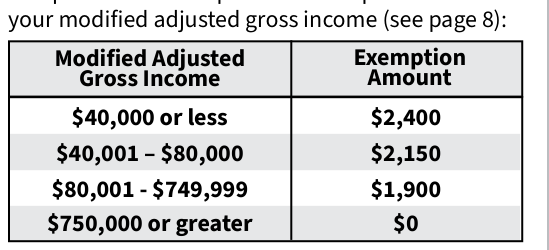
Text version of this table
Modified Adjusted Gross Income Exemption Amount $40,000 or less $2,400 $40,001 - $80,000 $2,150 $80,001 - $749,999 $1,900 $750,000 or greater $0
Enter your number of exemptions in the spaces provided. Multiply your exemptions by the appropriate amount from above and enter the result on line 4.
Example: John and Mary claim their son Patrick as an exemption on their jointly filed federal income tax return. Their modified adjusted gross income is $75,000. Thus, they claim three exemptions totaling $6,450 on their Ohio return. Patrick files his own tax return. Since Patrick is a dependent and his parents claim an exemption for him, he is not eligible for an exemption on his return. He should check the box indicating he can be claimed by someone else and enter $0 on line 4.
Ohio Schedule of Dependents. If you included dependents on your Ohio return, complete the Ohio Schedule of Dependents. If your dependent has an individual tax identification number (ITIN) or adoption taxpayer identification number (ATIN), enter that number in the boxes for the dependent's
SSN. If the dependent information is not provided, incomplete, or contains errors, you may be asked for supporting documentation.
See R.C. 5747.025 and 5747.01(O).
# Line 8a - Tax on Line 7
Calculate your tax on your Ohio income tax base less business income using the Income Tax Brackets found on page 18. Additionally, the Department provides a tool to assist you with this calculation at tax.ohio.gov/ taxcalculator. See R.C. 5747.02(A)(3).
# Line 11 - Interest Penalty
Generally, if you are a wage earner and have Ohio withholding, you will not owe an interest penalty. If you have non-wage income or no Ohio withholding, use Ohio IT/SD 2210 to determine if an interest penalty is due. For more information, see the FAQs at tax.ohio. gov/2210. See also R.C. 5747.09(D) and (E).
Line 12 - Unpaid Use (Sales) Tax
Report the amount of unpaid use (sales) tax due for the tax year. You owe Ohio use tax if both of the following are true:
● You made purchases where sales tax was not collected; AND ● The purchases were not qualifying purchases made during Ohio's sales tax holiday.
Use tax eliminates the disadvantage to Ohio retailers when Ohio shoppers buy from out-of-state sellers who do not collect sales tax. Use tax is most commonly due on out-of-state purchases such as those made from the internet, television, or catalogs.
Use the worksheet on page 46 to calculate your use tax. For more information, see the "Sales and Use Tax" topics at tax.ohio.gov/FAQ. See also R.C.
5747.083.
# Line 14 - Ohio Income Tax Withheld
Enter your Ohio income tax withheld as reported on Part A, line 1 of the Schedule of Ohio Withholding.
Schedule of Ohio Withholding. Complete this schedule if you are reporting an amount on line 14 of the IT 1040. Enter only income statements (W-2, W-2G, 1099) reporting Ohio income tax withheld. Do not include:
● Taxes withheld for another state, a city, or a school district; OR ● Taxes paid by a pass-through entity and reported to you on an Ohio IT K-1 (report these amounts on Ohio Schedule of Credits, line 43).
See the sample statements on pages 47-48. Place copies of your income statements after the last page of your return. Do not include income statements that are handwritten, self-created, or generated by your tax preparation software.
See R.C. 5747.08(H).
# Line 15 - Payments and Credit Carryforward
Amounts
Enter the following amounts:
● Estimated payments;
● Timely extension payments;
● Any credit carryforward amount from your prior year Ohio IT 1040; AND ● Amounts previously paid with an original and/or amended 2025 return.
Do not include:
● A prior year's refund that you requested but did not receive. Contact the Department about the status of any such refund.
● Taxes paid by a pass-through entity and reported to you on an Ohio IT K-1 (report these amounts on Ohio Schedule of Credits, line 43).
See R.C. 5747.09(B).
# Line 18 - Overpayment Previously Requested
(Amended Returns Only)
When filing an amended return, enter the amount you reported on line 23 on your previously filed return(s).
# Line 21 - Interest Due
Interest is due from the unextended due date until the date the tax is paid. Generally, you do not owe interest if you are due a refund. An extension of time to file does not extend the payment due date. The interest rate for calendar year 2026 is 7%. The Department provides a tool to assist you with this calculation at tax.ohio.gov/ interestcalculator.
Certain military servicemembers may not be subject to interest. See page 10 for more information.
See R.C. 5747.08(G).
# Line 22 - Total Amount Due
This amount must be paid by April 15, 2026. Do not mail cash. Instead, make payment by electronic check, credit or debit card, paper check, or money order.
Make your check or money order payable to "Ohio Treasurer of State" and include an Ohio Universal 2025 Ohio IT 1040 / Tax Brackets Payment Coupon (OUPC). Include the tax year and the last four digits of your SSN on the "Memo" line.
For more information regarding payment options, see page 6.
# Line 24 - Credit Carryforward
Enter the portion of your refund you want applied to tax year 2026. This is only allowed on timely filed, original returns; it is not allowed on amended returns.
# Line 25 - Donations
You may donate all or a portion of the amount on line 23 to one or more of the organizations listed.
Such donations will reduce your refund, and are only allowed on timely filed, original returns; they are not allowed on amended returns.
If you decide to donate, this decision is final. For more information on the donation options, see pages 14-15.
See also R.C. 5747.113.
# Line 26 - Your Refund
If you do not request direct deposit, or you filed by paper, your refund will be mailed to the address on the tax return. You can check your refund status anytime at tax.ohio.gov/refund.
Note: Your refund may be offset pursuant to R.C.
5747.12, 5747.121, 5747.122, and 5747.123. You will be notified if your refund is subject to offset. See tax. ohio.gov/offset for more information.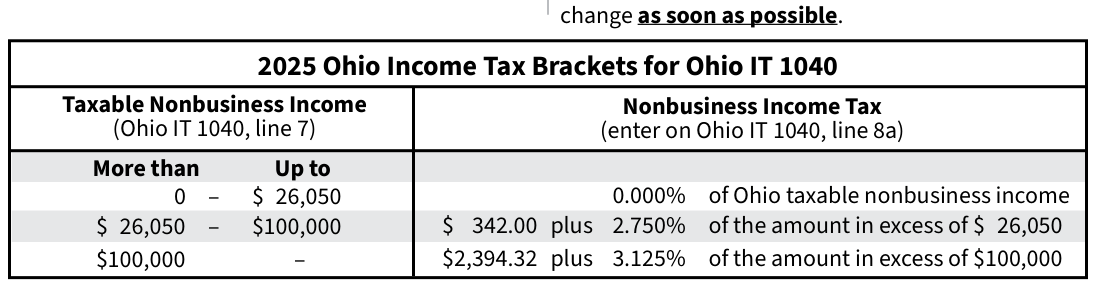
Text version of this table
2025 Ohio Income Tax Brackets for Ohio IT 1040 Taxable Nonbusiness Income (Ohio IT 1040, line 7) Nonbusiness Income Tax (enter on Ohio IT 1040, line 8a) More than Up to 0 - $ 26,050 0.000% of Ohio taxable nonbusiness income $ 26,050 - $100,000 $ 342.00 plus 2.750% of the amount in excess of $ 26,050 $100,000 – $2,394.32 plus 3.125% of the amount in excess of $100,000
$100,000 -
Nonbusiness Income Tax Liability Calculation Example: Mitchell's taxable nonbusiness income (Ohio IT 1040, line 7) is $68,050. Using the tax brackets above, he owes $342 on the first $26,050 of income. The rest is taxed at 2.75%. He subtracts $26,050 from his total taxable nonbusiness income: $68,050 - $26,050 = $42,000.
Then, he multiplies this amount by 2.75%: $42,000 x 0.0275 = $1,155. Next, he adds this amount to the $342:
$1,155 + $342 = $1,497. He enters $1,497 as his nonbusiness income tax liability on line 8a of his IT 1040.
# Line 1 - Non-Ohio State or Local Government
Interest and Dividends
Enter interest and/or dividends paid on obligations or securities from a non-Ohio state, city, county, or other local government.
Do not include:
● Any amounts already included in federal adjusted gross income (AGI);
● Amounts paid on obligations or securities from Ohio, or an Ohio city, county, school district, or other local government; OR ● Amounts paid on obligations or securities from a U.S. territory or the federal government.
See R.C. 5747.01(A)(1).
# Line 2 - Pass-Through Entity Add-Back
Enter Ohio pass-through entity tax (from the IT 1140 and/or IT 4738) to the extent it was not included in your federal AGI. These amounts may be reported to you on the Ohio IT K-1, lines 3a or 4a. See R.C. 5747.01(A)
(15) and (36).
# Line 4 - Non-Qualified College Tuition Expenses
Enter any amount reported to you on a 1099-Q representing distributions from a 529 savings plan that meet all of the following:
● The amount is not otherwise included in your federal AGI;
● The amount was not used to pay for qualified highereducation expenses and was not distributed due to the beneficiary's death, disability, or receipt of a scholarship; AND ● The amount was deducted as a 529 plan contribution or tuition credit purchase on the Ohio Schedule of Adjustments in any prior tax year.
See R.C. 5747.01(A)(9) and 5747.70.
# Line 5 - Ohio Public Obligations
Enter any loss resulting from the sale/disposition of Ohio public obligations to the extent that such losses have been deducted in determining federal AGI. See R.C. 5747.01(A)(8).
# Line 6 - Medical Savings Account
Enter amounts from a medical savings account withdrawn for nonmedical purposes only if the amount was deducted on the Ohio Schedule of Adjustments in any tax year. Use the worksheet on page 42 to calculate this adjustment. See R.C. 5747.01(A)(14).
# Line 7 - Reimbursement of Expenses
Enter reimbursements received in 2025 for any expenses that you deducted on a previously filed Ohio income tax return if the amount of the reimbursement was not included in federal AGI for 2025. See R.C.
5747.01(A)(11)(b).
# Line 8 - Ineligible Withdrawals From an Ohio
# Homebuyer Plus Account
Enter any amount withdrawn or transferred from an Ohio Homebuyer Plus account owned by you or your spouse, if filing jointly, that was not used to pay eligible expenses.
"Eligible expenses" are:
● A down payment and/or closing costs for the purchase of the account owner's primary residence located in Ohio;
● Account fees charged by the financial institution administering the account;
● The transfer of funds from your Ohio Homebuyer Plus account to another account owned by you at a different financial institution; OR ● Amounts withdrawn and redeposited into the same or another account owned by you within 90 days of the initial withdrawal.
Additionally, add any amounts remaining upon closure of an Ohio Homebuyer Plus account that were not used for eligible expenses.
This addition is limited to the total of:
● Amounts you previously deducted for an account owned by you; PLUS ● Amounts deposited into your account by anyone other than you.
See R.C. 135.70(F) and 5747.01(A)(43).
# Line 9 - IRC 168(k) and 179 Depreciation
Add 5/6 of your bonus depreciation allowed under Internal Revenue Code section 168(k). Also add 5/6 of your depreciation expense allowed under Internal Revenue Code section 179 less the amount that would have been allowed under section 179 as it existed on
Dec. 31, 2002.
Replace "5/6" with "2/3" for employers who increased their Ohio income taxes withheld by at least 10% over the previous year. Replace "5/6" with "6/6" for taxpayers who incur a net operating loss for federal income tax purposes if the loss was a result of the 168(k) and/or 179 depreciation expenses.
No add-back is required for:
● Employers who increased their Ohio income taxes withheld over the previous year by at least their total 168(k) and 179 depreciation expenses; OR ● 168(k) or 179 depreciation from a pass-through entity in which the taxpayer owns less than 5%.
This add-back is deductible on the Ohio Schedule of Adjustments in future tax years. A worksheet is available at tax.ohio.gov/worksheets to assist you in calculating your future years' deductions.
For more information, see the FAQs at tax.ohio.gov/faq-IncomeDepreciation. See also R.C. 5747.01(A)(17).
# Line 10 - Federal Interest and Dividends
Enter interest or dividends on obligations of the U.S. government exempt from federal taxation but not exempt from state taxation. See R.C. 5747.01(A)(2).
# Line 11 - Federal Conformity Additions
This line is only for federal conformity adjustments.
Do not enter any federal Schedule A adjustments on this line. For updates on Ohio conformity, see tax.ohio. gov/conformity. See also R.C. 5701.11.
Deductions
# Line 13 - Business Income Deduction
In order to take this deduction, you must complete the Ohio Schedule of Business Income. See the instructions on pages 26-27. Enter the amount from the Ohio Schedule of Business Income, line 13, on this line. See R.C. 5747.01(A)(28).
# Line 14 - Reciprocity Wages
Enter compensation amounts earned in Ohio during the portion of the year that you were a resident of Indiana, Kentucky, Michigan, Pennsylvania, and/or West Virginia.
Do not include any Ohio sourced business income, lottery, casino, or sports gaming winnings, rental or royalty income, capital gains, or non-employee wages.
Exception: This deduction does not apply to compensation from a pass-through entity in which you directly or indirectly own at least 20%. R.C. 5733.40(A)
(7) reclassifies such compensation as a distributive share of income from the pass-through entity.
See R.C. 5747.01(A)(33) and 5747.05(A)(2).
# Line 15 - State and Local Income Tax Overpayments
Enter the amount from your 2025 federal income tax return, Schedule 1, line 1. See R.C. 5747.01(A)(11)(a).
# Line 16 - Taxable Social Security Benefits
Deduct the amount on your federal 1040 or 1040-SR, line 6b. Do not enter any non-taxable portion of your Social Security benefits. See R.C. 5747.01(A)(5).
# Line 17 - Certain Railroad Benefits
Deduct railroad benefits, to the extent they are exempt from state taxation and included in your federal adjusted gross income, such as:
● Railroad retirement benefits;
● Supplemental railroad retirement benefits;
● Dual railroad retirement benefits;
● Railroad disability benefits; OR
● Railroad unemployment benefits.
Note: Do not report any amounts already included on line 16 as taxable Social Security benefits.
See R.C. 5747.01(A)(5).
# Line 18 - Income From Ohio Public Obligations
Deduct any of the following to the extent included in your federal adjusted gross income (AGI):
● Interest income earned from Ohio public obligations and Ohio purchase obligations;
● Gains from the sale or disposition of Ohio public obligations; OR ● Income from a certain transfer agreement or an enterprise transferred under that agreement.
See R.C. 5747.01(A)(7), (8), and (26).
# Line 19 - Individual Development Accounts
Enter contributions you made to an Ohio county's individual development account program. Only amounts contributed for the purpose of matching funds are eligible for this deduction. You cannot enter amounts you deposited into your own individual development account.
For more information, contact your local county department of job and family services. See R.C.
5747.01(A)(16).
# Line 20 - STABLE Contributions
Deduct contributions you made to a STABLE (Ohio
ABLE) account, up to $4,000 per beneficiary per year. Contributions exceeding the $4,000 limitation may be deducted on future years' returns until fully utilized, subject to the annual limitation of $4,000 per beneficiary. Married taxpayers may deduct up to a maximum of $4,000 per beneficiary whether their filing status is married filing jointly or married filing separately.
For more information, including a worksheet to assist you in calculating the unused portion of your STABLE account contributions, see the FAQs at tax.ohio.gov/ faq-STABLE. See also R.C. 5747.01(A)(29) and 5747.78.
# Line 21 - Nonresident Income From Ohio Disaster
Work
Deduct income included in your federal AGI if all of the following are true:
● You are a nonresident of Ohio;
● The income was received for disaster work in Ohio during a disaster response period; AND ● You did not receive any other Ohio sourced income during the tax year.
For the purposes of this line, "income" includes compensation paid to an employee of a business performing disaster work in Ohio, as well as amounts paid to a business performing disaster work in Ohio.
"Disaster work" means repairing, renovating, installing, or constructing property and equipment destroyed by the declared disaster, provided that the property or equipment is owned by a public utility, commercial mobile radio service provider, cable service provider, or video service provider. Disaster work also includes any preparation for these activities.
The "disaster response period" is based on when the president of the U.S. or the governor of Ohio declares that an emergency exists in Ohio. It begins 10 days prior to the declaration and ends 60 days after the declaration expires or is rescinded.
See R.C. 5747.01(A)(30) and 5703.94.
# Line 23 - Ohio Adoption Grant Payments
Deduct amounts received from the Ohio Department of Children & Youth (ODCY) as a one-time grant payment for an adopted child and included in your federal adjusted gross income (AGI).
There are three types of grants available for adoptions finalized on or after January 1, 2023: (1) $10,000 for a conventional adoption, (2) $15,000 if the adoptive parent was a foster caregiver for the child prior to the adoption, and (3) $20,000 if the adopted child has a diagnosed special need.
For more information, see AdoptionGrant.ohio.gov. See also R.C. 5747.01(A)(38) and 5180.451.
Line 24 - Contributions to and Interest Earned on
# Ohio Homebuyer Plus Accounts
Deduct contributions you made to an Ohio Homebuyer Plus account owned by:
● You;
● Your spouse;
● Your sibling;
● Your children (including stepchildren); OR ● Your grandchildren.
This deduction is limited to $5,000 per account per year.
If you are filing a joint return and both you and your spouse make eligible contributions, each of you may claim this deduction, up to $10,000 per account per year.
If your contributions exceed the yearly limit, you may not carry over the excess amounts to the next tax year.
Only the person making the contribution is entitled to the deduction. An account owner may not deduct amounts contributed by another person or any amounts gifted by their financial institution upon opening their account. The total deduction for all tax years cannot exceed $25,000 per contributor to any account owned by a single account owner.
Additionally, deduct interest income, to the extent included in federal AGI, paid by an Ohio Homebuyer Plus account owned by you or your spouse, if filing jointly.
Also deduct amounts contributed by an employer to an Ohio Homebuyer Plus account owned by you or your spouse, if filing jointly. The contributions must be included in your federal AGI to be eligible for this deduction.
These deductions are only available for 5 years after the Ohio Homebuyer Plus account is opened with an eligible savings institution. This 5-year period does not "reset" if you transfer your account from one eligible savings institution to another. For more information, see ohiotreasurer.gov/homebuyerplus.
See R.C. 5747.01(A)(42) and R.C. 5747.85.
# Line 25 - Contributions to a Pregnancy Resource
Center
Deduct amounts you contributed to a qualifying pregnancy resource center on or after September 30, 2025 and before January 1, 2026. The deduction amount equals the lesser of $750 or the total amount you donated to a qualifying pregnancy resource center during the tax year. If you are filing a joint return and both you and your spouse make eligible contributions, each of you can claim this deduction (up to $1,500 total).
See R.C. 5180.71 and 5747.01(A)(44).
# Line 26 - Federal Interest and Dividends Exempt
From State Taxation
Enter interest and dividend income, to the extent included in federal AGI, from obligations issued by the U.S. government or its possessions/territories that are exempt from Ohio tax by federal law. Examples include:
● U.S. savings bonds (Series E, EE, H or I);
● Treasury notes, bills and bonds;
● Sallie Maes.
Examples of interest income that are not deductible:
● Interest paid on a federal income tax refund;
● Interest income from Fannie Maes or Ginnie Maes.
For more examples, see Information Release IT 1992-01 titled "Exempt Federal Interest Income," at tax. ohio.gov/info. See also R.C. 5747.01(A)(3).
# Line 27 - Ohio Depreciation Deduction
Deduct:
● 1/5 of prior year 5/6 add-backs,
● 1/2 of prior year 2/3 add-backs, AND
● 1/6 of prior year 6/6 add-backs, of Internal Revenue Code sections 168(k) and 179 depreciation adjustments. The deduction must be taken in equal increments in consecutive tax years and any unused portion from any given tax year is not eligible to be carried forward.
You can only deduct amounts that you added back in a prior year on your Ohio IT 1040. If you receive an Ohio IT K-1 reporting a deduction, you must verify it is consistent with your prior year add-back(s). You can take this deduction even if you no longer directly or indirectly own the asset.
Additionally, in tax years with an NOL, an NOL carryback or an NOL carryforward, you cannot claim this deduction. Instead, you must carry the deduction forward to the next tax year in which you have no NOL, carryback, or carryforward.
For more information, see the FAQs at tax.ohio.gov/faq-IncomeDepreciation. See also R.C. 5747.01(A)(18).
# Line 28 - Refund or Reimbursement for Itemized
Deductions
Deduct amounts included in your federal adjusted gross income (AGI) that represent refunds or reimbursements of expenses that you previously deducted on federal Schedule A. Do not include any amounts that were previously deducted on the Ohio Schedule of Adjustments in any tax year. See R.C. 5747.01(A)(11)(a).
Example: Sue claimed an itemized deduction of $500 for attorney fees on her 2023 federal Schedule A. In 2025 she received a reimbursement for $200 of those fees from her attorney. She reported this $200 on her 2025 federal income tax return as other income. Sue is entitled to deduct the $200 reimbursement on this line.
# Line 29 - Repayment of Income Reported
Deduct amounts, described in section 1341(a)(2) of the Internal Revenue Code, that you repaid in the current tax year if:
● You recognized the amount as income on your federal return in a prior year;
● You have not deducted this income on any other line on your Ohio income tax return for any tax year;
● In the year you recognized the income, it did not qualify for either the Ohio resident or nonresident credit; AND ● In the current tax year, you claimed either (i) an itemized deduction on your federal Schedule A for the amount repaid OR (ii) a tax credit on your federal 1040 based upon the amount repaid.
See R.C. 5747.01(A)(12).
Line 30 - Wage Expense Not Deducted Due to the
Federal Work Opportunity Tax Credit
Deduct the amount you reported as your work opportunity tax credit on your federal income tax return. See R.C. 5747.01(A)(6).
# Line 31 - Federal Conformity Deductions
This line is only for federal conformity adjustments. Do not enter any federal Schedule A adjustments on this line. For updates on Ohio conformity, see tax.ohio.gov/ conformity. See also R.C. 5701.11.
# Line 32 - Military Pay for Ohio Residents
Important: Nonresidents and resident servicemembers stationed in Ohio are not eligible for this deduction.
Deduct military pay and allowances only if all of the following are true:
● They are included in your federal AGI;
● You received them while stationed outside Ohio;
● You are a resident of Ohio; AND
● You were active duty service in the U.S. Army, Air Force, Navy, Marine Corp, Coast Guard, Space Force, or any other military service branch that is designated by Congress as a part of the armed forces of the United States or reserve components thereof, or the National Guard.
For more information on taxation of military servicemembers and their civilian spouses, see page
- See also R.C. 5747.01(A)(21) and 5907.01(A)(1).
# Line 33 - Nonresident Military and Civilian Spouse
Wages
Important: Ohio residents are not eligible for this deduction.
Deduct military pay and allowances included in federal AGI and earned by the military servicemember only if the servicemember is a nonresident of Ohio.
Also deduct compensation earned in Ohio by a nonresident civilian spouse if the spouse is in Ohio solely because of the servicemember's military orders.
For more information on taxation of military servicemembers and their civilian spouses, see page
- See also 50 U.S.C. §4001.
# Line 34 - Uniformed Services Retirement Income
Deduct military retirement income if both of the following are true:
● The income is included in federal adjusted gross income (AGI); AND ● The income is related to your service in the uniformed services or reserve components thereof, or the National Guard.
The term "uniformed services" includes armed forces of the United States, the commissioned corps of the National Oceanic and Atmospheric Administration, and the Public Health Service.
If you served in the military and receive a federal civil service retirement pension, you are eligible for a limited deduction based on the amount of your federal retirement pay that is attributable to your years of military service. You can contact the Office of Personnel Management if you need assistance in determining your military and total service time used in your retirement calculation.
Example: Joe served in the Army for 10 years and then worked for the U.S. National Parks Service for an additional 20 years before retiring, a total of 30 years of federal service time. Joe's total federal pension is $100,000, $90,000 of which is included in his federal
AGI. In calculating his Ohio deduction, Joe should divide 10 years by 30 years, and then multiply the result by $90,000 [90,000 X 10/30]. Thus, Joe can deduct $30,000 or 1/3 of the portion of his retired personnel pay included in federal AGI.
Additionally, deduct amounts collected under a "survivor benefit" plan by a surviving spouse or former spouse of a deceased member of the "uniformed services." You may be required to provide a copy of the federal 1099-R to verify this deduction.
Note: Amounts deducted on this line cannot be used to calculate the retirement credit or the lump sum retirement credit on the Ohio Schedule of Credits.
For more information on taxation of military servicemembers and their civilian spouses, see page
- See also R.C. 5747.01(A)(23), 5747.01(FF), and 5907.01(A)(1).
# Line 35 - Military Injury Relief Fund and Disability
Severance Payments
Enter military injury relief fund and disability severance payments included in your federal AGI. For more information on taxation of military servicemembers and their civilian spouses, see page 10. See also R.C.
5747.01(A)(24), (32), and R.C. 5747.023.
# Line 36 - Ohio National Guard Reimbursements and Benefits
Deduct reimbursements of group life insurance premiums paid by the Ohio Adjutant General if all of the following are true:
● The reimbursements are included in your federal AGI;
● You purchased group life insurance pursuant to the "Servicemembers' Group Life Insurance Act"; AND ● You were on active duty in the Ohio National Guard for the months during which premiums were paid.
Also deduct death benefits included in your federal AGI that are paid by the Ohio Adjutant General due to the death of an active duty member of the Ohio National Guard.
For information on taxation of military servicemembers and their civilian spouses, see page 10. See also R.C.
5747.01(A)(19) and (20).
# Line 37 - Contributions to a 529 Plan
Deduct contributions you made to a 529 savings plan.
This deduction is limited to $4,000 per beneficiary per year. Contributions exceeding the $4,000 limitation may be deducted on future years' returns until fully utilized, subject to the annual limitation of $4,000 per beneficiary. Married taxpayers may deduct up to a combined maximum of $4,000 per beneficiary whether their filing status is married filing jointly or married filing separately.
Additionally, deduct income from a 529 savings plan that is included in federal AGI. Such amounts may be reported as "other income" on your federal return. Also deduct negative amounts reported in box 2 of your federal 1099-Q, that were not deducted in computing your federal AGI.
You may not deduct:
● Income related to a 529 savings plan that is not included in federal AGI; OR ● Amounts contributed by another person.
For more information, including a worksheet to assist you in calculating the unused portion of your 529 account contributions, see the FAQs at tax.ohio.gov/ faq-529. See also R.C. 5747.01(A)(9) and 5747.70.
Line 38 - Portion of Certain College Grants Used to
# Pay Room and Board
Deduct any portion of a federal Pell grant and/or Ohio College Opportunity Grant included in your federal adjusted gross income (AGI) that was:
● Received by you, your spouse or your dependent; AND ● Used to pay qualifying room and board expenses.
Qualifying room and board expenses include only those amounts paid for room and board, including meal plans, furnished by the educational institution.
See R.C. 5747.01(A)(27).
# Line 39 - Ohio Educator Expenses
Deduct any education expenses incurred by a qualifying Ohio educator during the tax year to the extent not otherwise deducted or excluded in calculating your Ohio adjusted gross income. This deduction is limited to $300 per qualifying Ohio educator.
"Qualifying Ohio educator" means a kindergarten through grade 12 Ohio public or private school teacher, instructor, counselor, principal, or aide who worked at least 900 hours during the school year. "Education expenses" means any expenses described in Internal Revenue Code section 62(a)(2)(D).
See R.C. 5747.01(A)(31) and (JJ).
# Line 40 - Rural Practice Incentive Program
Repayments
To the extent included in federal AGI, deduct governmental or other educational loan principal and interest repayments made on your behalf by the Ohio Department of Higher Education (ODHE) under the rural practice incentive program. These repayments must be for certain qualifying expenses incurred while enrolled in law school.
Individuals employed or practicing as service attorneys within underserved communities are eligible for a repayment of up to $30,000 for a threeyear service obligation or up to an additional $20,000 for an additional fourth or fifth year of service.
See R.C. 5747.01(A)(40), 3333.131, and 3333.135.
Line 41 - Grant Payments for Students Who Are
Adopted
To the extent included in federal AGI, deduct amounts paid as grant payments for the benefit of you, your spouse, or your dependents by the Ohio Department of Higher Education (ODHE) to a state institution of higher education or a private college. Such grants are available as a one-time $2,500 grant for adopted students in Ohio who apply with ODHE. See R.C.
5747.01(A)(38) and 3333.128.
# Line 42 - Disability Benefits
Deduct disability benefits to the extent included in federal AGI. To determine if amounts are disability benefits, you should refer to the terms of the plan under which the benefits are paid.
You may not deduct:
● Retirement benefits that converted from disability benefits upon reaching a minimum retirement age;
● Temporary wage continuation payments; OR ● Payments for temporary illnesses or injuries (such as sick pay provided by an employer or third party).
See R.C. 5747.01(A)(4) and Ohio Adm. Code 5703-7-08.
# Line 43 - Survivor Benefits
Deduct survivor benefits to the extent included in federal AGI. Most life insurance benefits are not included in federal AGI and thus are not deductible.
Generally, survivor benefits include any amount received because of the death of another individual.
The decedent's age, recipient's age, relationship to the decedent, and prior tax treatment of the income on the decedent's return are not relevant in determining if income qualifies as survivor benefits.
To determine if amounts are survivor benefits, you should refer to the terms of the plan under which the benefits are paid. Any amounts payable without the death of a covered individual as a precondition are not survivor benefits.
See R.C. 5747.01(A)(4) and Ohio Adm. Code 5703-7-08.
# Line 44 - Unreimbursed Medical and Health Care
Expenses
Deduct the following amounts to the extent not otherwise deducted or excluded in calculating your federal AGI:
2025 Ohio Schedule of Adjustments / Schedule of Business Income ● Certain dental, vision and health insurance premiums;
● Long-term care insurance premiums; AND
● Medical care expenses (such as prescription medication, copays, doctor visits) in excess of 7.5% of your federal adjusted gross income (AGI).
Include any of the above amounts that you paid for you, your spouse, or your dependents.
Do not deduct any amounts:
● Paid with pre-tax dollars (such as health savings or flexible spending accounts);
● Paid by you but later reimbursed or refunded; OR ● Paid by insurance or another person.
Use the worksheet on page 41 to calculate this deduction and include a copy with your return. For more information, see the FAQs at tax.ohio.gov/faq-HealthExpenses. See also R.C. 5747.01(A)(10).
# Line 45 - Medical Savings Account
Deduct the amount of funds you and your spouse (if filing jointly) deposited into a medical savings account. For 2025, the maximum deduction for contributions is $6,003 per taxpayer. Do not include amounts deducted on your federal return for contributions to a health savings account.
You may also deduct any investment income or interest earned on your deposits into a medical savings account to the extent included in your federal AGI.
Use the worksheet on page 42 to calculate this deduction and include a copy with your return. See R.C. 5747.01(A)(13).
# Line 46 - Qualified Organ Donor Expenses
Deduct qualified organ donation expenses you incurred during the tax year to the extent not otherwise deducted or excluded in calculating your federal AGI. This one-time deduction is limited to $10,000 per taxpayer.
"Qualified organ donation expenses" means travel expenses, lodging expenses, and wages and salary forgone by a taxpayer in connection with the taxpayer's donation of a qualifying organ to another human being. A "qualifying organ" includes all or any portion of a human liver, pancreas, kidney, intestine, lung, or human bone marrow.
See R.C. 5747.01(A)(22).
# Ohio Schedule of Business Income
Enter all business income that you (and your spouse, if filing jointly) received during the tax year, from all sources, on this schedule. Only one Schedule of Business Income should be used for each return filed.
# Part 1 - Business Income
Enter only amounts that are both included in federal adjusted gross income and are "business income" under Ohio law.
Important: Due to differences between federal and Ohio law, some amounts reported as business income on your federal return may not be business income on this schedule. Do not simply list the amounts from your federal return.
For more information on how Ohio defines business income and examples of business income, see pages 11-12. See also R.C. 5747.01(B) and (C).
# Line 1 - Schedule B, Interest and Ordinary Dividends
Enter taxable interest and ordinary dividends reported on federal Schedule B that qualify as business income.
Do not include interest or dividend income from personal bank accounts or personal investments.
# Line 2 - Schedule C, Net Profit or Loss From Business
Enter net profit or loss from a business reported on federal Schedule C. If you have multiple businesses, you must net business losses against business gains.
Example: Sam has a business that incurs a loss of -$15,000. Sam's spouse Suzy has a separate business
2025 Ohio Schedule of Business Income that generates a profit of $10,000. The net Schedule C loss reported on their jointly filed federal return is -$5,000. Thus, they must report -$5,000 on this line.
# Line 3 - Schedule D, Capital Gains and Losses
Enter capital gains or losses reported on federal Schedule D that qualify as business income. Do not include gains or losses from the sale of property that was not used in a trade or business.
# Line 4 - Schedule E, Supplemental Income and Loss
Enter your net business income or loss reported on federal Schedule E. If you have multiple sources of business income, you must net any business losses against any business income. Do not include any guaranteed payments on this line, even if included on federal Schedule E.
Line 5 - Guaranteed Payments and/or
Compensation
Enter guaranteed payments and/or compensation (i.e., wages or salaries) paid to you by a pass-through entity, or a professional employer organization on its behalf, in which you have at least a 20% direct or indirect ownership. Please note, "indirect" ownership does not include beneficial or constructive ownership via Internal Revenue Code attribution rules.
Example: Matt and Sarah are married and both work for PTE A. Matt is the owner of PTE A. Thus, he directly owns 100% of PTE A and his wages from PTE A qualify as business income. However, Sarah's wages from PTE A do not qualify as business income. While Sarah constructively owns 100% of PTE A (through attribution of Matt's ownership), she does not directly or indirectly own any portion of PTE A.
# Line 6 - Schedule F, Net Profit or Loss From Farming
Enter net profit or loss from farming reported on federal Schedule F. You must net any farming losses against any farming gains.
# Line 7 - Ohio Electing Pass-Through Entity Taxes
Enter any portion of the taxes you reported on line 2 of the Ohio Schedule of Adjustments for which both of the following are true:
● The amount represents your proportionate share of the tax paid by an electing pass-through entity that filed Ohio form IT 4738; AND ● The income on which the tax is based qualifies as business income under Ohio law.
See pages 11-12 for the definition of "business income".
See also R.C. 5747.01(A)(36).
# Line 9 - Other Business Income
Enter any business income or loss included in your federal adjusted gross income that was not entered on lines 1 through 8. Include on this line any amounts reported on the federal 4797 that are business income.
# Part 2 - Business Income Deduction
Use these lines to calculate your Ohio business income deduction. If the amount on line 11 is zero, you do not have a business income deduction or any taxable business income.
# Part 3 - Taxable Business Income
Do not complete these lines if your Ohio taxable income (Ohio IT 1040, line 5) is zero. Ohio taxes business income at a flat 3% rate. See R.C. 5747.02(A)(4).
# Part 4 - Business Entities
For each pass-through entity in which you or your spouse are an investor, enter the following:
● The FEIN;
● Your and your spouse's ownership percentage; AND ● The business name.
When listing sole proprietorships, enter the owner's SSN and name or the "doing business as" name.
28 2025 Ohio Schedule of Credits
# Ohio Schedule of Credits
Nonrefundable Credits
Many of these credits are based, in part, on your modified adjusted gross income (MAGI). For more information on MAGI, see page 8.
Additionally, many of these credits can be carried forward to future tax years. A worksheet is available at tax.ohio.gov/worksheets to assist you in calculating the carryforward amounts.
If you received an Ohio IT K-1 from a pass-through entity that includes one or more of the credits listed in this section, include a copy of the IT K-1 with your return.
# Line 2 - Retirement Income Credit
To qualify, all of the following must be true:
● Your MAGI less exemptions is less than $100,000;
● You received income from a pension, profit-sharing, or retirement plan (such as traditional IRAs or 401(k) plans);
● This income was received on account of retirement;
● This income is included in your Ohio adjusted gross income (AGI); AND ● You have not previously taken the Ohio lump sum retirement credit.
Use Table 2 on page 44 to determine your credit based on your and your spouse's (if filing jointly) total eligible retirement income. Amounts deducted on the Ohio Schedule of Adjustments (such as Social Security benefits and uniformed services retirement income) do not qualify for this credit. The maximum credit per return is $200.
See R.C. 5747.055(B).
# Line 3 - Lump Sum Retirement Credit
Important: If you take this credit, you cannot take the retirement income credit on this year's return or any future return.
To qualify, all of the following must be true:
● Your MAGI less exemptions is less than $100,000;
● You received a total, lump sum distribution on account of retirement;
● The income is included in your Ohio AGI;
● The distribution must have come from a qualified pension, retirement, or profit-sharing plan; AND ● You have not previously claimed this credit.
A "total distribution" is generally indicated in box 2b of your 1099-R. Use the worksheet on page 43 to calculate this credit. See R.C. 5747.055(C), (D), and (E).
# Line 4 - Senior Citizen Credit
To qualify, all of the following must be true:
● Your MAGI less exemptions is less than $100,000;
● You were 65 or older at the end of the tax year; AND ● You have not previously taken the Ohio lump sum distribution credit.
The credit is equal to $50 per return. See R.C.
5747.055(F).
# Line 5 - Lump Sum Distribution Credit
Important: If you take this credit, you cannot take the $50 senior citizen credit on this year's return or any future return.
To qualify, all of the following must be true:
● Your MAGI less exemptions is less than $100,000;
● You were 65 or older at the end of the tax year;
● You received a total, lump sum distribution from a qualified pension, retirement, or profit-sharing plan;
AND
● You have not previously claimed this credit.
A "total distribution" is generally indicated in box 2b of your 1099-R. Use the worksheet on page 44 to calculate this credit. See R.C. 5747.055(G).
# Line 6 - Child Care and Dependent Care Credit
To qualify, your MAGI must be less than $40,000 and you must have claimed the federal "credit for child and dependent care expenses" on federal form 2441.
Use the worksheet on page 45 to calculate this credit.
See R.C. 5747.054.
# Line 7 - Displaced Worker Training Credit
To qualify for this credit as a "displaced worker", all of the following must be true:
● You lost or left your job due to the closing or moving of your job location or the abolishment of your position or shift;
● You paid for job training to enhance your ability to get a job; AND ● You worked no more than 20 hours per week at a new job.
The credit equals the lesser of $500 or 50% of the amount you paid, less any reimbursements, during the 12-month period immediately following the loss or leaving of your job. If the 12-month period extends over two tax years, your maximum credit for both tax years combined is $500.
Expenses that generally qualify as job training include:
● College tuition and fees;
● Vocational training;
● Course materials (such as books and software) required as part of a course or training.
Expenses that do not qualify are generally those that do not teach or improve skills used in a job, such as:
● Computer purchases and upgrades;
● Professional organization fees/dues;
● Job placement or career planning services (resume workshops, interview critiques, skills assessment, etc.);
● Certification or licensure expenses (tests, fees, etc.).
Use the worksheet on page 45 to calculate this credit and include a copy along with all supporting documentation with your return. For more information, see tax.ohio.gov/ credits. See also R.C. 5747.27.
# Line 8 - Campaign Contribution Credit
To qualify, you must have contributed money to the campaign committee of a candidate for any of the following Ohio offices:
● Governor or lieutenant governor
● Secretary of state
● Auditor of state
● Treasurer of state
● Attorney general
● Chief justice of the Ohio Supreme Court ● Justice of the Ohio Supreme Court ● Ohio Board of Education ● Ohio Senate ● Ohio House of Representatives The credit equals the amount contributed during the tax year up to $50 per return, or $100 if you are filing jointly. Contributions to local candidates (such as city or county officials) or federal candidates (such as President or U.S. Senator) do not qualify for this credit.
Note: This credit will no longer be available after tax year 2025.
See former R.C. 5747.29, repeal in 2025 Am. Sub. H.B.
No. 96.
# Line 9 - Exemption Credit
To qualify, your modified adjusted gross income (MAGI) less exemptions must be less than $30,000. The credit equals $20 for each exemption claimed on your return.
See R.C. 5747.022.
# Line 12 - Joint Filing Credit
To qualify, you and your spouse must each have at least $500 of qualifying income, jointly file your return, and have an MAGI less than $750,000. "Qualifying income" is any amount included in Ohio adjusted gross income (AGI), other than the following:
● Interest;
● Dividends and distributions;
● Capital gains; AND
● Rents and royalties.
Amounts deducted on the Ohio Schedule of Adjustments are not included in Ohio AGI, and thus are not "qualifying income." Examples of such amounts include business income, state and local tax refunds, Social Security and railroad retirement benefits, and certain military compensation and retirement benefits.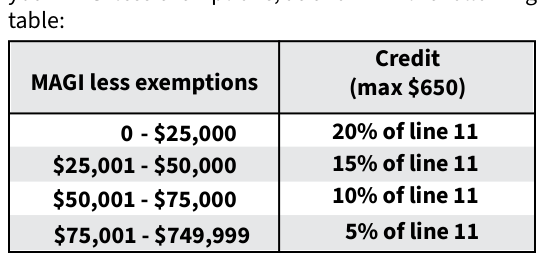
Text version of this table
MAGI less exemptions Credit (max $650) 0 - $25,000 20% of line 11 $25,001 - $50,000 15% of line 11 $50,001 - $75,000 10% of line 11 $75,001 - $749,999 5% of line 11
Example: Kevin and Krysten file jointly. Kevin has $50,000 of wage income and $5,000 of interest income.
Krysten has $40,000 of business income and $20,000 of taxable Social Security benefits. While Kevin has $50,000 of qualifying income (his wages), Krysten has no qualifying income because her business income and taxable Social Security benefits were both deducted in calculating their Ohio AGI. Therefore, they are not entitled to the joint filing credit.
Please include a separate statement listing the qualifying income for each spouse. See R.C. 5747.05(E).
# Line 13 - Earned Income Credit
Your nonrefundable Ohio earned income credit (EIC) equals 30% of your federal EIC (federal 1040 and 1040-SR, line 27a). See R.C. 5747.71.
# Line 14 - Home School Expenses Credit
To qualify, you must pay for "educational expenses" for your qualifying student who is home schooled in Ohio.
The credit equals the lesser of $250 per qualifying student or the amount you paid for educational expenses.
"Educational expenses" includes books, subscriptions, school supplies, supplementary materials, computer software, or applications used directly for home education.
"Educational expenses" does not include expenses or fees for computers or similar electronic devices or accessories.
Important: Only expenses for students who are exempt from compulsory attendance law for the purpose of home education qualify for this credit.
For more information, see tax.ohio.gov/credits. See also R.C. 5747.72.
# Line 15 - Scholarship Donation Credit
To qualify, you must make a monetary donation directly to an eligible scholarship granting organization (SGO). The credit equals the lesser of $750 or the total amount you donated to SGOs during the tax year. If you are filing a joint return and both you and your spouse make eligible donations, each of you can claim this credit (up to $1,500 total).
You may also include amounts donated in 2026, prior to April 16. However, the same contribution cannot be used to claim the credit in two different tax years.
You may also qualify if a pass-through entity, in which you have ownership interest, made a monetary donation to an eligible SGO. You may claim your proportionate or distributive share of the credit to the extent it does not exceed $750 per investor.
For a list of eligible SGOs, see tax.ohio.gov/SGO. See also R.C. 5747.73.
# Line 16 - Nonchartered, Nonpublic School Tuition
Credit
To qualify, you must pay tuition for your compulsory aged dependent(s) to an eligible nonchartered, nonpublic school (K-12) that has been approved by the Ohio Department of Education. For a list of approved schools, see tax.ohio.gov/credits.
The credit equals the lesser of the total tuition paid for all dependents or:
● $1,000 if your federal AGI is less than $50,000; OR ● $1,500 if your federal AGI is $50,000 and above.
Only one credit can be claimed per return, regardless of your filing status.
See R.C. 5747.75.
# Line 17 - Credit for Work-Based Learning Experiences
This credit is granted by the Ohio Department of Education (ODE). To claim the credit, you must attach a copy of the certificate from ODE that indicates the amount of the credit and the tax year for which the credit is awarded. Additionally, if this credit is based on your ownership of a pass-through entity that holds the certificate, you must also include documentation showing your portion of the credit.
For more information about the requirements for this credit, visit education.ohio.gov. See R.C. 5747.057.
# Line 18 - Ohio Adoption Credit Carryforward
The Ohio adoption credit was repealed and is no longer available. However, this nonrefundable credit had a five-year carryforward. Therefore, you may continue to claim any unused credit for the five-year period or until it is fully utilized.
See former R.C. 5747.37, repealed in 2023 Am. Sub.
H.B. No. 45.
# Line 19 - Nonrefundable Job Retention Credit
This credit is granted by the Ohio Department of Development (ODOD). To claim the credit, you must attach a copy of the certificate from ODOD that indicates the amount of the credit and the tax year for which the credit is awarded. Additionally, if this credit is based on your ownership of a pass-through entity that holds the certificate, you must also include documentation showing your portion of the credit. To the extent this credit exceeds your tax liability, any remaining balance can be carried forward up to three years.
For more information about the requirements for this credit, visit development.ohio.gov, or call 1-800-848-
- See R.C. 122.171(B) and 5747.058(B).
# Line 20 - Credit for New Employees in an Enterprise
Zone
This credit is granted by the Ohio Department of Development (ODOD). To claim the credit, you must attach a copy of the certificate from ODOD that indicates the amount of the credit and the tax year for which the credit is awarded. Additionally, if this credit is based on your ownership of a pass-through entity that holds the certificate, you must also include documentation showing your portion of the credit. To the extent this credit exceeds your tax liability, any remaining balance can be carried forward up to three years.
For more information about the requirements for this credit, visit development.ohio.gov, or call 1-800-848-
- See R.C. 5709.66(B)(1).
# Line 21 - Credit for the Beginning Farmers Financial
Management Program
This credit is granted by the Ohio Department of Agriculture (ODA). To claim the credit, you must attach a copy of the certificate from ODA that indicates the amount of the credit and the tax year for which the credit is awarded. To the extent this credit exceeds your tax liability, any remaining balance can be carried forward up to three years.
For more information about the requirements for this credit, visit agri.ohio.gov. See R.C. 901.61(E) and 5747.77(B).
# Line 22 - Credit for Commercial Vehicle Operator
Training Expenses
This credit is granted by the Ohio Department of Development (ODOD). To claim the credit, you must attach a copy of the certificate from ODOD that indicates the amount of the credit and the tax year for which the credit is awarded. Additionally, if this credit is based on your ownership of a pass-through entity that holds the certificate, you must also include documentation showing your portion of the credit. To the extent this credit exceeds your tax liability, any remaining balance can be carried forward up to five years.
This credit cannot be claimed based on the amount of estimated tax credit-eligible training expenses approved by ODOD prior to the application for the credit.
For more information about the requirements for this credit, visit development.ohio.gov, or call 1-800-848-
- See R.C. 5747.82.
# Line 23 - Welcome Home Ohio Credit
This credit is granted by the Ohio Department of Development (ODOD). To claim the credit, you must attach a copy of the certificate from ODOD that indicates the amount of the credit and the tax year for which the credit is awarded. Additionally, if this credit is based on your ownership of a pass-through entity that holds the certificate, you must also include documentation showing your portion of the credit. To the extent this credit exceeds your tax liability, any remaining balance can be carried forward up to five years.
For more information about the requirements for this credit, visit development.ohio.gov, or call 1-800-848-
- See R.C. 122.633.
# Line 24 - Credit for Transformational Mixed-Use
Development
This credit is granted by the Ohio Department of Development (ODOD). To claim this credit, you must attach a copy of the certificate from ODOD that indicates the amount of credit and the tax year for which the credit is awarded. Additionally, if this credit is based on your ownership of a pass-through entity that holds the certificate, you must also include documentation showing your portion of the credit. To the extent that this credit exceeds your tax liability, any remaining balance can be carried forward up to five years.
Note: This credit cannot be claimed for certificates issued prior to September 30, 2025.
For more information about the requirements for this credit, visit development.ohio.gov, or call 1-800-848-1300. See R.C. 122.09 and 5747.87.
Line 25 - Credit for Sale/Rental of Agricultural Assets to Beginning Farmers This credit is granted by the Ohio Department of Agriculture (ODA). To claim the credit, you must attach a copy of the certificate from ODA that indicates the amount of the credit and the tax year for which the credit is awarded. Additionally, if this credit is based on your ownership of a pass-through entity that holds the certificate, you must also include documentation showing your portion of the credit. To the extent this credit exceeds your tax liability, any remaining balance can be carried forward up to seven years.
For more information about the requirements for this credit, visit agri.ohio.gov. See R.C. 901.61(D) and 5747.77(A).
# Line 26 - Grape Production Credit
To qualify, you must be engaged in the business of producing grapes and purchase qualifying property during the tax year. "Qualifying property" means any property, plant, or equipment used to produce grapes in Ohio.
The credit equals 10% of the cost of purchasing and installing or constructing the qualifying property. If the producer is a pass-through entity, each investor in the pass-through entity may claim a proportionate share of the credit.
To the extent this credit exceeds your tax liability, any remaining balance can be carried forward up to seven years. The credit is subject to recapture if the taxpayer disposes of the property or ceases to use it as qualifying property within seven years of placing it in operation.
See R.C. 5747.28.
# Line 27 - InvestOhio Credit
This credit is granted by the Ohio Department of Development (ODOD). To claim the credit, you must attach a copy of the certificate from ODOD that indicates the amount of the credit and the tax year for which the credit is awarded. Additionally, if this credit is based on your ownership of a passthrough entity that holds the certificate, you must also include documentation showing your portion of the credit. To the extent this credit exceeds your tax liability, any remaining balance can be carried forward up to seven years.
For more information about the requirements for this credit, visit development.ohio.gov, or call 1-800-848-
- See R.C. 5747.81.
# Line 28 - Lead Abatement Credit
This credit is granted by the Ohio Department of Health (ODH). To claim this credit, you must attach a copy of the certificate from ODH that indicates the amount of the credit and the tax year for which the credit is based. To the extent this credit exceeds your tax liability, any remaining balance can be carried forward up to seven years.
For more information about the requirements for this credit, visit odh.ohio.gov. See R.C. 5747.26.
# Line 29 - Opportunity Zone Investment Credit
This credit is granted by the Ohio Department of Development (ODOD). To claim this credit, you must attach a copy of the certificate from ODOD that indicates the amount of the credit and the tax year for which the credit is awarded. Additionally, if this credit is based on your ownership of a pass-through entity that holds the certificate, you must also include documentation showing your portion of the credit. To the extent this credit exceeds your tax liability, any remaining balance can be carried forward up to five years.
For more information about the requirements for this credit, visit development.ohio.gov, or call 1-800-848-
- See R.C. 122.84.
# Line 30 - Technology Investment Credit Carryforward
Effective Sept. 29, 2013, the technology investment credit was repealed, and thus is no longer available.
However, this nonrefundable credit had a 15-year carryforward. Therefore, you may continue to claim any unused credit for the 15-year period or until it is fully utilized. See R.C. 122.152 and former R.C. 5747.33.
# Line 31 - Enterprise Zone Day Care and Training
Credit
This credit is granted by the Ohio Department of Development (ODOD). To claim the credit, you must attach a copy of the certificate from ODOD that indicates the amount of the credit and the tax year for which the credit is awarded. Additionally, if this credit is based on your ownership of a pass-through entity that holds the certificate, you must also include documentation showing your portion of the credit. To the extent this credit exceeds your tax liability, any remaining balance can be carried forward until fully utilized.
For more information about the requirements for this credit, visit development.ohio.gov, or call 1-800-848-
- See R.C. 5709.65(A)(4) and (5).
# Line 32 - Research and Development Credit
This credit is granted by the Ohio Department of Development (ODOD). To claim the credit, you must attach a copy of the certificate from ODOD that indicates the amount of the credit and the tax year for which the credit is awarded. Additionally, if this credit is based on your ownership of a pass-through entity that holds the certificate, you must also include documentation showing your portion of the credit. To the extent this credit exceeds your tax liability, any remaining balance can be carried forward until fully utilized.
For more information about the requirements for this credit, visit development.ohio.gov, or call 1-800-848-
- See R.C. 166.21 and 5747.331.
# Line 33 - Nonrefundable Ohio Historic Preservation
Credit
This credit is granted by the Ohio Department of Development (ODOD). To claim the credit, you must attach a copy of the certificate from ODOD that indicates the amount of the credit and the tax year for which the credit is awarded. Additionally, if this credit is based on your ownership of a pass-through entity that holds the certificate, you must also include documentation showing your portion of the credit. To the extent this credit exceeds your tax liability, any remaining balance can be carried forward up to five years.
Important: If you received an amended certificate for a project approved between June 30, 2020 and September 13, 2022 that qualifies for the enhanced credit or an original certificate issued after September 13, 2022 and before July 1, 2024, this credit is fully refundable up to $10,000,000 claimed per project in any tax year and should be reported on line 41 of the Ohio Schedule of Credits.
For more information about the requirements for this credit, visit development.ohio.gov, or call 1-800-848-
- See R.C. 149.311, 5747.76(D), and Sub. S.B. 225.
# Line 34 - Ohio Low-Income Housing Credit
This credit is granted by the Ohio Housing Finance Agency (OHFA). To claim the credit, you must attach a copy of the credit certificate from OHFA that indicates the annual amount of the credit and the period for which the credit is awarded. If available, include a copy of the report from the designated reporter that indicates the amount of the annual credit allocated to you. The credit cannot be claimed unless you are included on this report. To the extent this credit exceeds your tax liability, any remaining balance can be carried forward up to five years.
For more information about the requirements for this credit, visit ohiohome.org or call 1-888-362-6432. See R.C. 175.16 and 5747.83.
# Line 35 - Affordable Single-Family Housing Credit
This credit is granted by the Ohio Housing Finance Agency (OHFA). To claim the credit, you must attach a copy of the credit certificate from OHFA that indicates the annual amount of the credit and the period for which the credit is awarded. If available, include a copy of the report from the designated reporter that indicates the amount of the annual credit allocated to you. The credit cannot be claimed unless you are included on this report. To the extent this credit exceeds your tax liability, any remaining balance can be carried forward up to five years.
For more information about the requirements for this credit, visit ohiohome.org or call 1-888-362-6432. See R.C. 175.17 and 5747.84.
Residency Credits
To determine your residency status, see page 13 as well as tax.ohio.gov/residency.
# Line 38 - Nonresident Credit
Only income earned while a nonresident of Ohio is eligible for this credit. Full-year Ohio residents are not entitled to this credit.
To calculate this credit, you must use form IT NRC. See pages 35-40 for the IT NRC instructions.
See R.C. 5747.05(A) and Ohio Adm. Code 5703-7-03.
# Line 39 - Resident Credit
The credit equals the lesser of the income taxes paid to another state or the District of Columbia, or the portion of your Ohio tax liability attributable to income taxed by another state. Full-year nonresidents are not entitled to this credit.
To calculate this credit, you must use form IT RC. See page 40 for the IT RC instructions.
See R.C. 5747.05(B) and Ohio Adm. Code 5703-7-03.
Refundable Credits
If you received an Ohio IT K-1 from a pass-through entity that includes one or more of the credits listed in this section, include a copy of the IT K-1 with your return.
# Line 41 - Refundable Ohio Historic Preservation
Credit
This credit is granted by the Ohio Department of Development (ODOD). To claim the credit, you must attach a copy of the certificate from ODOD that indicates the amount of the credit and the tax year for which the credit is awarded. Additionally, if this credit is based on your ownership of a pass-through entity that holds the certificate, you must also include documentation showing your portion of the credit.
This amount can be refunded to the extent that it exceeds your total Ohio tax liability. If your certificate was issued on or before September 13, 2022, or after June 30, 2024, and the credit exceeds $3,000,000, your credit must be taken as a nonrefundable credit (Ohio Schedule of Credits, line 33).
For more information about the requirements for this credit, visit development.ohio.gov, or call 1-800-848-
- See R.C. 5747.76 and Sub. S.B. 225.
# Line 42 - Refundable Job Creation Credit and Job
Retention Credit
These credits are granted by the Ohio Department of Development (ODOD). To claim the credit, you must attach a copy of the certificate from ODOD that indicates the amount of the credit and the tax year for which the credit is awarded. Additionally, if this credit is based on your ownership of a passthrough entity that holds the certificate, you must also include documentation showing your portion of the credit. This amount can be refunded to the extent that it exceeds your total Ohio tax liability.
For more information about the requirements for this credit, visit development.ohio.gov, or call 1-800-848-
- See R.C. 5747.058(A), 122.17, and former R.C.
122.171(B).
# Line 43 - Pass-Through Entity Credit
This credit is for taxes paid on your behalf by a passthrough entity (PTE) on Ohio forms IT 4708, IT 4738, and/ or IT 1140. To claim this credit, attach a copy of the Ohio IT K-1 issued to you by the PTE reporting:
● Income taxes paid by the PTE (IT K-1, line 3); AND/OR ● Indirect PTE credits (IT K-1, line 4) from taxes paid by a PTE you indirectly own.
If you do not have an IT K-1, you must provide a narrative and/or diagram, including ownership percentages and FEINs, detailing the ownership structure of the PTEs.
This credit is related to the adjustment on the Ohio Schedule of Adjustments, line 2. See the instruction on page 19.
See R.C. 5747.08(I), 5747.059, and 5747.39.
# Line 44 - Motion Picture and Broadway Theatrical
Production Credit
This credit is granted by the Ohio Department of Development (ODOD). To claim the credit, you must attach a copy of the certificate from ODOD that indicates the amount of the credit and the tax year for which the credit is awarded. Additionally, if this credit is based on your ownership of a pass-through entity that holds the certificate, you must also include documentation showing your portion of the credit. This amount can be refunded to the extent that it exceeds your total Ohio tax liability.
For more information about the requirements for this credit, visit development.ohio.gov, or call 1-800-848-
- See R.C. 5747.66.
# Line 45 - Credit for Film and Theater Capital
Improvement Projects
This credit is granted by the Ohio Department of Development (ODOD). To claim the credit, you must attach a copy of the certificate from ODOD that indicates the amount of the credit and the tax year for which the credit is awarded. Additionally, if this credit is based on your ownership of a pass-through entity that holds the certificate, you must also include documentation showing your portion of the credit. This amount can be refunded to the extent that it exceeds your total Ohio tax liability.
For more information about the requirements for this credit, visit development.ohio.gov, or call 1-800-848-
- See former R.C. 5747.67, repeal in 2025 Am. Sub.
H.B. No. 96.
# Line 46 - Venture Capital Credit
This credit is granted by the Ohio Venture Capital Authority. To claim the credit, you must attach a copy of the certificate that indicates the amount of the credit and the tax year for which the credit is awarded.
Additionally, if this credit is based on your ownership
2025 Ohio IT NRC of a pass-through entity that holds the certificate, you must also include documentation showing your portion of the credit. This amount can be refunded to the extent that it exceeds your total Ohio tax liability.
See R.C. 5747.80.
# IT NRC - Ohio Nonresident Credit Calculation
Individuals must use the IT NRC to calculate the nonresident portion of their Ohio adjusted gross income, which is used to calculate the Ohio nonresident credit. Include this form with your Ohio IT 1040 and retain a copy for your records.
Generally, only Ohio part-year residents and full-year nonresidents should use this form. However, a full-year resident who jointly files with a nonresident or part-year resident must include all income in Column B, even if it is not Ohio-sourced. Part-year residents should enter the dates that they resided in Ohio during the tax year.
For more information, see tax.ohio.gov/residencycredits.
# Section I - Nonresident Credit Calculation
All Ohio part-year residents and full-year nonresidents must complete Part A and Part C. Only Ohio part-year residents must complete Part B.
Except for line 5, list only non-business income amounts in Column B. All Ohio business income should be listed on line 5 after completing Sections II and III.
# Line 1 - Compensation and Guaranteed Payments
Enter compensation (e.g. wages, salaries, tips) in Column B paid to you:
● While you were an Ohio resident; OR
● For services performed in Ohio while you were a nonresident.
A nonresident must allocate compensation using either:
● The location of the specific services generating the compensation; OR ● The ratio of days worked in Ohio to total days worked.
Also enter guaranteed payments in Column B paid to you while you were an Ohio resident.
Do not enter in Column B any compensation deducted on lines 14, 21, 32, 33, or 38 of the Ohio Schedule of Adjustments.
Note: Compensation and guaranteed payments reclassified as business income under Ohio law should be included on line 5 of this form. See pages 11-12 for more information.
For more information, see the FAQs at tax.ohio.gov/ faq-Allocation. See also R.C. 5747.20(A) and (B)(1), and Hillenmeyer v. Cleveland Bd. of Rev., 2015-Ohio-1623.
Line 2 - Nonbusiness Capital Gain/Loss
Enter capital gains and/or losses in Column B that:
● Were received while an Ohio resident;
● Resulted from the transfer of real property located in Ohio; OR ● Resulted from the transfer of tangible personal property that, when transferred, was located in Ohio.
See R.C. 5747.20(A) and (B)(2).
# Line 3 - Nonbusiness Rents and Royalties
Enter rents and royalties in Column B that were received or derived:
● While you were an Ohio resident;
● From real property located in Ohio;
● From tangible personal property to the extent utilized in Ohio; OR ● From patents or copyrights to the extent they were utilized in Ohio.
Ohio law defines when tangible personal property, patents, and copyrights are "utilized in Ohio."
See R.C. 5747.20(A), (B)(3) and (B)(4).
# Line 4 - Lottery, Casino, and Sports Gaming Winnings
Enter lottery prizes and casino or sports gaming winnings in Column B that were:
● Received while you were an Ohio resident;
● Paid by the Ohio lottery commission;
● Paid by a casino located in Ohio; OR
● Paid for sports gaming conducted in Ohio.
Also enter any income from the sale of a lottery prize issued by the Ohio lottery commission.
See R.C. 5747.20(A), (B)(5) and (B)(7).
Line 7 - Net Additions From Ohio Schedule of
Adjustments
Enter only the portions of the Ohio Schedule of Adjustments additions that were:
● Paid or accrued while you were an Ohio resident; OR ● Related to Ohio activities.
Do not enter any amount reported on line 9 of the Ohio Schedule of Adjustments. Such amounts are already included in the calculation of line 6.
See R.C. 5747.20(B)(6).
Line 8 - Net Deductions From Ohio Schedule of
Adjustments
Enter only the portions of Ohio Schedule of Adjustments lines 18, 19, 20, 30, 31, 37, 39, 44, 45, and 46 that were:
● Paid or accrued while you were an Ohio resident; OR ● Related to Ohio activities.
See R.C. 5747.20(B)(6).
# Line 10 - Nonbusiness Interest and Dividend
Income
Enter interest and dividends paid or accrued while you were an Ohio resident in Column B.
Do not enter any interest or dividends deducted on lines 18, 26, or 45 of the Ohio Schedule of Adjustments.
See R.C. 5747.20(B)(6).
# Line 11 - Pensions, Annuities and IRA Distributions
Enter pension, annuities, and IRA distributions paid or accrued while you were an Ohio resident in Column B.
Do not enter any pension, annuity, or IRA amounts deducted on lines 16, 17, 34, 42, or 43 of the Ohio Schedule of Adjustments.
See R.C. 5747.20(B)(6).
# Line 12 - Unemployment Compensation
Enter unemployment compensation paid or accrued while you were an Ohio resident in Column B. See R.C.
5747.20(B)(6).
# Line 13 - Other Nonbusiness Income
Enter other nonbusiness income reported on your federal return, and paid or accrued while you were an Ohio resident, in Column B.
2025 Ohio IT NRC
Do not enter any amounts deducted on lines 15, 18, 28, or 29 of the Ohio Schedule of Adjustments.
See R.C. 5747.20(B)(6).
# Line 14 - Federal Deductions
Enter the portion of your federal "above-the-line" deductions paid or accrued while you were an Ohio resident in Column B. See R.C. 5747.20(B)(6).
Section II - Ohio Business Income
List every sole proprietorship or pass-through entity in which you held an ownership interest during the tax year. If you have more than 20 businesses, include additional copies of page 2, with only lines 1-20 completed. Total the amounts in each column of any additional pages on line 21.
For each business, enter:
● The total business income included on your federal return in Column A;
● The Ohio depreciation adjustment in Column B (from Section III, line 22);
● The Ohio apportioned income in Column C (from Section III, line 18).
Each column is independently calculated for each business. Column A is not a total of Columns B and C.
If you have an Ohio IT K-1 for a business, you must still list that business and check the "IT K-1" box.
Additionally, you must enter:
● The total business income included on your federal return in Column A;
● The Ohio depreciation adjustment in Column B (from Ohio IT K-1, the Ohio portion of line 2c);
● The Ohio apportioned income in Column C (from Ohio IT K-1, the Ohio portion of line 2a plus 2b).
You must complete Section III, even if you received an IT K-1 from the entity, if the IT K-1 depreciation worksheet includes amounts not added back on your previous Ohio income tax returns.
# Line 22 - Column Totals
Column A: This is the total of all business income reported on your federal return.
Column B: This is the total of all Ohio apportioned depreciation adjustments. The total may be a positive or negative number. Enter this amount on Section I, line 6.
2025 Ohio IT NRC
Column C: This is the total of all Ohio apportioned business income. It may be positive or negative. If the amount is positive, complete lines 23 and 24.
Otherwise, enter the amount on Section I, line 5.
Section III - Business-Level Income &
Apportionment
Complete a separate Section III for each sole proprietorship or pass-through entity having property, payroll, and/or sales in Ohio. However, if an Ohio IT K-1 reporting income from a pass-through entity is attached with the IT NRC, a Section III does not need to be completed for that entity.
Important: If both spouses on a joint return have an ownership interest in the same business, complete a separate Section III for each spouse.
For more information, see Information Release IT 2001-01 titled "Nexus Standards & Filing Safe Harbors for Individuals," at tax.ohio.gov/info.
Part A
Calculate a separate apportionment ratio for each sole proprietorship or pass-through entity. Ohio apportionment is based on a three-factor, weighted ratio.
The three factors are property and payroll, each weighted at 20%, and sales, weighted at 60%, for a total of 100%. However, if any factor's "total everywhere" is zero, the weights of the remaining factors must be proportionately increased so that the total remains 100%. You must show the reweighted factors by crossing out the listed weights and replacing them with the correct weights.
Example: ABC LLC is a single-member LLC with no employee payroll. In calculating its Ohio apportionment ratio, ABC LLC must weight its property factor at 25% and its sales factor at 75%.
If this business receives income from pass-through entities, its apportionment ratio calculation must include the proportionate share of each lower-tiered entity's property, payroll, and sales.
# Line 1 - Property Factor
The property factor is the ratio of:
Average value of property in Ohio
Average value of property everywhere
"Property" includes any real and tangible personal property that is owned, rented, subrented, leased, and/or subleased in the course of a trade or business.
Property does not include any of the following:
● Construction in progress;
● Property not used in a trade or business;
● Property for which Ohio has issued an air, noise, or industrial water pollution control certificate; AND ● Property used exclusively during the tax year for qualified research.
Note: The original cost of qualifying improvements to property in an enterprise zone, for which Ohio has issued a Tax Incentive Qualification Certificate, should be included only in Column B.
The "average value" of business property is calculated by averaging the total value of all applicable property owned or rented at the beginning and end of the tax year.
See R.C. 5747.21(B) and 5733.05(B)(2)(a).
Line 1(a) - Property Owned
Column A: Enter the average value of all Ohio business property owned during the tax year.
Column B: Enter the average value of all business property owned during the tax year.
Property owned by the business is valued at its original cost.
Line 1(b) - Property Rented
Column A: Enter the average value of all Ohio business property rented during the tax year.
Column B: Enter the average value of all business property rented during the tax year.
Property rented by the business is valued at eight times the net annual rental rate (annual rental expense less subrental receipts).
# Line 2 - Payroll Factor
The payroll factor is the ratio of:
Total compensation paid in Ohio
Total compensation paid everywhere
"Compensation" means any form of remuneration paid to an employee for personal services. Compensation does not include any of the following:
● Amounts paid to employees for services unrelated to a trade or business;
● Amounts paid to employees who are primarily engaged in qualified research; AND ● Amounts reclassified as a distributive share of income from a pass-through entity under R.C. 5733.40(A)(7).
Note: Compensation paid to certain employees at an urban job and enterprise zone facility, for which Ohio has issued a Tax Incentive Qualification Certificate, should be included only in Column B.
See R.C. 5747.21(B) and 5733.05(B)(2)(b).
Column A: Enter the total compensation paid in Ohio during the tax year. Compensation is paid in Ohio if:
● The employee's job is entirely in Ohio;
● The employee's job is primarily in Ohio with only incidental work outside Ohio;
● The employee performs services in Ohio and either the headquarters, or, if no headquarters exists, the place from which the service is directed or controlled, is in Ohio; OR ● The employee is a resident of and performs some services in Ohio, and the headquarters or the place from which the service is directed or controlled is not in a state where part of the service is performed.
Column B: Enter the total compensation paid everywhere during the tax year.
# Line 3 - Sales Factor
The sales factor is the ratio of:
Total sales in Ohio
Total sales everywhere
"Sales" includes gross business receipts such as:
● Receipts from the sale of real property, tangible personal property, or services;
● Receipts from rents and royalties from real and tangible personal property; OR ● Receipts from the transfer of or the right to use intellectual property such as trademarks, trade names, patents, and copyrights.
"Sales" does not include:
● Interest and dividends;
● Receipts from the transfer of intangible property other than trademarks, trade names, patents, copyrights, or other similar intellectual property;
● Receipts from the transfer of real or tangible personal 2025 Ohio IT NRC property that is either a capital asset or an Internal Revenue Code section 1231 asset; AND ● Receipts from sales to certain public utilities, insurance companies, and financial institutions described in R.C.
5733.05(B)(2)(c).
Note: Income amounts excluded from the sales factor may still be considered business income under Ohio law.
See R.C. 5747.21(B) and 5733.05(B)(2)(c).
Column A: Enter gross receipts from sales within Ohio during the tax year. Sales within Ohio include all of the following:
● Receipts from sales of tangible personal property, less returns and allowances, to the extent the property was received by the purchaser in Ohio;
● Receipts from services to the extent the purchaser ultimately used or received the benefit of the services in Ohio;
● Rents and royalties from tangible personal property to the extent the property was used in Ohio;
● Receipts from the transfer of certain intellectual property to the extent the property was used in Ohio;
● Receipts from the right to use certain intellectual property in Ohio;
● Receipts from the sale of real property located in Ohio; AND ● Rents and royalties from real property located in Ohio.
Note: For tangible personal property, where the property is "received by the purchaser" is not the same as where the purchaser takes physical or legal possession. Instead, it is considered "received" where it is ultimately used by the purchaser.
See R.C. 5733.05(B)(2)(c)(i) and (ii). Column B: Enter the gross receipts from sales everywhere during the tax year.
# Line 4 - Ohio Apportionment Ratio
This is the Ohio apportionment ratio for this business.
Use this ratio in Parts B and C to determine:
● Ohio apportioned income; AND
● Ohio apportioned depreciation adjustments from the Ohio Schedule of Adjustments.
Part B
Enter only amounts that are both included in the calculation of your federal adjusted gross income
2025 Ohio IT NRC and are "business income" under Ohio law. Because of differences between federal and Ohio law, some amounts reported as business income on the federal return may not be business income on this schedule.
Do not simply list the amounts from the federal return.
For more information on how Ohio defines business income and examples of business income, see pages 11-12. See also R.C. 5747.01(B) and 5733.40(A)(7).
# Line 5 - Schedule B, Interest and Ordinary
Dividends
Enter taxable interest and ordinary dividends reported on federal Schedule B that qualify as business income.
# Line 6 - Schedule C, Net Profit or Loss from Business
Enter the net profit or loss from the business reported on federal Schedule C. Show a business loss as a negative number.
# Line 7 - Schedule D, Capital Gains and Losses
Enter capital gains or losses reported on federal Schedule D that qualify as business income. Show a net capital business loss as a negative number.
Do not include any amounts that represent a R.C.
5747.212 gain or loss. Instead, include those amounts on line 15.
# Line 8 - Schedule E, Supplemental Income and Loss
Enter the net business income or loss reported on federal Schedule E. Show a net business loss as a negative number. Do not include any guaranteed payments on this line, even if included on federal Schedule E.
Line 9 - Guaranteed Payments, Compensation, and/or Wages If this business is a pass-through entity in which you have at least a 20% direct or indirect ownership, enter any guaranteed payments or compensation paid to you by the entity, or a professional employer organization on its behalf. "Indirect" ownership does not include beneficial or constructive ownership via Internal Revenue Code attribution rules.
# Line 10 - Schedule F, Net Profit or Loss From Farming
Enter the net profit or loss from farming reported on federal Schedule F. Show a new business loss as a negative number.
# Line 11 - Certain Pass-Through Entity Additions
Enter any portion of the additions you reported on lines 2 and 3 of the Ohio Schedule of Adjustments that qualify as business income and are not deducted on line 13 of the Ohio Schedule of Adjustments.
Line 12 - Other Business Income and/or Federal
Conformity Additions
Enter any business income included in your federal adjusted gross income (AGI) that was not entered on lines 5 through 11. Include on this line any amounts reported on the federal 4797 that are business income.
Also, enter any federal conformity additions reported on the Ohio Schedule of Adjustments related to this business.
Line 13 - Other Business Deductions and/or Federal
Conformity Deductions
Enter any business deductions included in your federal AGI that were not entered on lines 5 through 11 of this section. Include on this line any amounts reported on the federal 4797 that are business loss.
Also, enter any federal conformity deductions reported on the Ohio Schedule of Adjustments related to this business.
Line 16 - Total R.C. 5747.212 Income
Enter any R.C. 5747.212 income or loss included in your federal AGI. "R.C. 5747.212 income" is gain or loss resulting from the transfer of an ownership interest in a closely held business having nexus with Ohio. Show the amount as a negative number if the amount was a loss.
Line 17 - R.C. 5747.212 Income Apportioned to
Ohio
R.C. 5747.212 amounts are apportioned differently than other business income. For more information on how to apportion these amounts, see R.C 5747.212 as well as Corrigan v. Testa, 2016-Ohio-2805.
Enter the Ohio portion of the R.C. 5747.212 amount entered on line 16. Show a loss as a negative number.
Include your apportionment calculation with this form.
Part C
# Line 19 - Ohio Depreciation Add-Back
Enter any portion of the amount reported on line 7 of the Ohio Schedule of Adjustments attributable to this business.
2025 Ohio IT NRC / IT RC / MAGI Worksheet
# Line 20 - Ohio Depreciation Deduction
Enter any portion of the amount reported on line 27 of the Ohio Schedule of Adjustments attributable to this business. Calculate this amount using the current year's Ohio Schedule of Adjustments. Do not use an amount from a prior year's filing.
# IT RC - Ohio Resident Credit Calculation
Individuals must use the IT RC to calculate their Ohio Resident Credit. Include this form with your Ohio IT 1040 and retain a copy for your records.
"State" means only the 50 U.S. states. State does not include any country, province, territory, or city. Additionally, individuals cannot claim a resident credit for income earned in a state without an individual income tax. Thus, those states are not listed on form IT RC.
Only Ohio full-year and part-year residents may use this form. Income earned while a nonresident of Ohio is not eligible for the Ohio resident credit but may be eligible for the nonresident credit. See pages 35-40 for the IT NRC instructions.
For more information, see tax.ohio.gov/residencycredits.
# Column A - Income Taxed
Enter the portion of your Ohio adjusted gross income
(AGI) included on an income tax return for another state or the District of Columbia. This includes composite returns or returns reporting a tax enacted for purposes of complying with IRS Notice 2020-75. Amounts deducted on the Ohio Schedule of Adjustments (for example, business income and state and local tax refunds) are not included in Ohio AGI, and thus are not eligible to be included on this line.
Do not enter wages, salaries, or other compensation earned in Indiana, Kentucky, Michigan, Pennsylvania, or West Virginia while you were an Ohio resident.
These amounts are not taxed by those states because of agreements they have with Ohio.
# Column B - Tax Paid
Enter any income taxes paid for the current tax year on an income tax return for another state or the District of Columbia. This includes composite returns or returns reporting a tax enacted for purposes of complying with IRS Notice 2020-75. Generally, this will be the amount shown on the line of the return that is equivalent to Ohio IT 1040, line 10.
Do not include:
● Taxes paid to any country, province, territory, or city; OR ● Taxes that are not on or measured by net income.
Also, do not include taxes deducted or that should have been deducted in computing your federal adjusted gross income, unless they are added back on line 3 of the Ohio Schedule of Adjustments and not deducted on line 13 of the Ohio Schedule of Adjustments.
# Modified Adjusted Gross Income Less Exemptions
- Enter your Ohio adjusted gross income (Ohio IT 1040, line 3) … 1.
- Enter your business income deduction (Ohio Schedule of Adjustments, line 13)
- Modified adjusted gross income (line 1 plus line 2) … 3.
- Enter your exemption amount (Ohio IT 1040, line 4) … 4.
- Modified adjusted gross income less exemptions (line 3 minus line 4) … 5.
2025 Ohio Schedule of Adjustments Worksheets 41
Unreimbursed Medical Care Expenses Worksheet (Ohio Schedule of Adjustments, Line 44)
Only include amounts you paid for yourself, your spouse, and your dependents.
- Enter amounts paid for unreimbursed dental, vision, and health insurance premiums during any portion of the year in which you were not eligible for Medicare or an employer-paid health care plan through your or your spouse's employer … 1.
- Enter amounts paid for unreimbursed long-term care insurance premiums … 2.
- Enter amounts paid for unreimbursed dental, vision, and health insurance premiums during any portion of the year in which you were eligible for Medicare or an employer-paid health care plan through your or your spouse's employer … 3.
- Enter amounts paid for medical care during the year (exclude insurance premiums) … 4.
- Add lines 3 and 4 … 5.
- Enter your federal AGI (Ohio IT 1040, line 1). If less than zero, enter zero … 6.
- Line 6 times 7.5% (0.075) … 7.
- Line 5 minus line 7. If less than zero, enter zero … 8.
- Add lines 1, 2, and 8. Enter on Ohio Schedule of Adjustments, line 44 … 9.
Note: Reduce amounts reported on lines 1-3 by any related premium refunds, reimbursements, or dividends received during the year.
Line 1: You must reduce the amount you enter on this line by your federal self-employed health insurance deduction (federal 1040, Schedule 1, line 17).
For purposes of this line, "health insurance premiums" includes amounts you paid for health insurance under the Affordable Care Act, even if you received a federal subsidy for purchasing it.
Example 1: From January 1 through June 30, Dan was not eligible for Medicare or health insurance through his employer. Dan paid $100 per month in premiums, totaling $600, for insurance he obtained under the Affordable Care Act. Dan became eligible for Medicare on July 1. He began to pay Medicare Part B premiums as well as premiums for supplemental health insurance.
Dan can enter only $600 on line 1 of the worksheet.
Line 2: Long-term care insurance plans include those that cover the costs of nursing home care, in-home care, and adult day care.
Line 3: Include any premiums that you were unable to include on line 1 due to qualifying for Medicare or an employer-paid health care plan should be reported on this line. For example, Medicare Part D insurance premiums would be included on this line.
Example 2: Refer back to Example 1 on this page.
After Dan became eligible for Medicare on July 1, he paid a total of $1,000 in premiums for Medicare Part B and additional supplemental health insurance premiums. He did not enter those premiums on line 1 due to qualifying for Medicare. Instead, he enters the $1,000 on line 3 of the worksheet.
Line 4: For the purpose of this line, "medical care" has the same meaning found in Internal Revenue Code section 213, excluding premiums already reported on lines 1, 2, and 3. Some examples of eligible expenses are amounts paid for:
● Prescription medication or insulin;
● Hospital costs and nursing care;
● Medical, dental, and vision examinations and treatment by a certified health professional including copays;
● Eyeglasses, hearing aids, braces, crutches, and wheelchairs.
Refer to IRS Publication 502 for a comprehensive list of potentially eligible expenses.
# 2025 Ohio Schedule of Adjustments Worksheets / Military Income Charts
Medical Savings Account Worksheet (Ohio Schedule of Adjustments, Lines 6 and 45)
- Enter the lesser of $6,003 or your contributions* to a medical savings account
(MSA) during the tax year … 1.
- If filing jointly, enter the lesser of $6,003 or your spouse's contributions* to an MSA during the tax year … 2.
- Enter any investment earnings from your MSA included in your federal AGI … 3.
- Add lines 1, 2, and 3 … 4.
- Enter any withdrawals from your MSA used for nonmedical purposes … 5.
- If line 5 is less than line 4, line 4 minus line 5. Enter on Ohio Schedule of Adjustments, line 45 … 6.
- If line 4 is less than line 5, line 5 minus line 4. Enter on Ohio Schedule of Adjustments, line 6 … 7.
*Do not include amounts reported on your federal 1040, Schedule 1, line 13.
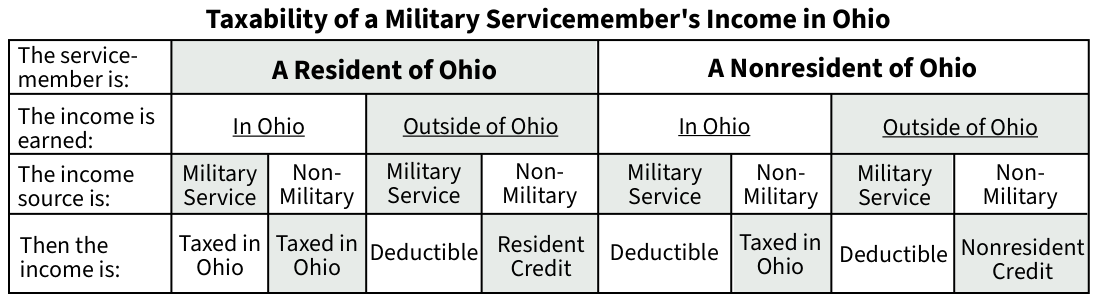
Text version of this table
| The servicemember is: | A Resident of Ohio | A Nonresident of Ohio | ||||||
| The income is earned: | In Ohio | Outside of Ohio | In Ohio | Outside of Ohio | ||||
| The income source is: | Military Service | Non- Military | Military Service | Non- Military | Military Service | Non- Military | Military Service | Non- Military |
| Then the income is: | Taxed in Ohio | Taxed in Ohio | Deductible | Resident Credit | Deductible | Taxed in Ohio | Deductible | Nonresident Credit |
# Ohio Deductible Resident
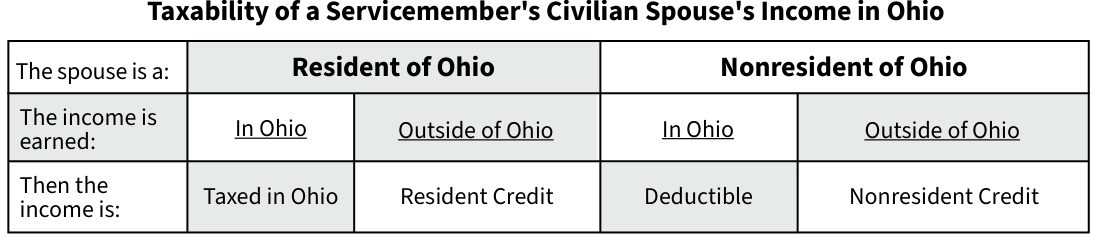
Text version of this table
| The spouse is a: | Resident of Ohio | Nonresident of Ohio | ||
| The income is earned: | In Ohio | Outside of Ohio | In Ohio | Outside of Ohio |
| Then the income is: | Taxed in Ohio | Resident Credit | Deductible | Nonresident Credit |
Taxability of a Servicemember's Civilian Spouse's Income in Ohio
The spouse is a:
The income is earned:
Then the income is:
Deductible Nonresident Credit
Important: See page 10 for a detailed explanation of these charts.
Lump Sum Retirement Credit Worksheet (Ohio Schedule of Credits, Line 3)
# 2025 Ohio Schedule of Credits Worksheets
Line 1: "Retirement income" means retirement benefits, annuities, or distributions that are made from or pursuant to a pension, retirement, or profitsharing plan. Additionally, these amounts must have been received on account of retirement and must be included in your Ohio adjusted gross income.
Do not include any of the following:
● Rollovers from one retirement plan into another that are not included in your federal adjusted gross income;
● Amounts deducted on lines 16, 17, 34, 42, or 43 of the Ohio Schedule of Adjustments; OR ● Any Social Security benefits.
Line 2: Use the recipient's age as of the last day of the tax year (generally, December 31).
Lines 8-10: If your lump sum retirement credit is greater than your tax liability, complete lines 8 through 10 to calculate your lump sum retirement credit for future tax years.
Line 9: Subtract 1 from the amount you entered on line 2 of this worksheet. For example, if your multiple on line 2 was 19.2, you would enter 18.2 (19.2 - 1) on this line. Do not round.
Line 10: Report this amount in each subsequent tax year as your lump sum retirement credit.
If filing jointly and only one taxpayer qualifies for this credit, use Column A. If each taxpayer qualifies for this credit, use both Columns A and B.
- Enter the lump sum recipient's total income received on account of retirement and included in Ohio AGI (Ohio IT 1040, line 3) … 1.
- Using Table 1 on page 44, enter the multiple corresponding to the lump sum recipient's age … 2.
- Divide line 1 by line 2 … 3.
- Using Table 2 on page 44, enter the retirement income credit based on the amount on line 3 … 4.
- Line 2 times line 4. This is your lump sum retirement credit … 5.
- Add the amounts on line 5, Columns A and B. Enter on the Ohio Schedule of Credits, line 3 … 6.
- Ohio Schedule of Credits, line 1 minus Ohio Schedule of Credits, line 2 … 7.
If line 6 is greater than line 7, continue to lines 8-10. Otherwise, stop here.
- Line 6 minus line 7 … 8.
- Subtract 1 from the amount on line 2 … 9.
- Divide line 8 by line 9. This is your lump sum retirement credit for future tax years … 10.
(B)
Spouse
(A)
Taxpayer
2025 Ohio Schedule of Credits Worksheets
Lump Sum Distribution Credit Worksheet (Ohio Schedule of Credits, Line 5)
If filing jointly and only one taxpayer qualifies for this credit, use Column A. If each taxpayer qualifies for this credit, use both Columns A and B.
(A) (B)
# Taxpayer Spouse
- Using Table 1 below, enter the multiple corresponding to the lump sum recipient's age … 1.
- Line 1 times $50. This is your lump sum distribution credit..2.
- Add the amounts on line 2, Columns A and B. Enter on the Ohio Schedule of Credits, line 5 … 3.
Line 1: Use the recipient's age as of the last day of the tax year (generally, December 31). Remember, this credit is not available to individuals younger than 65.
Table 1
Age Multiple Age Multiple Age Multiple Age Multiple Age Multiple Age Multiple
46 56
36.8 66
27.7
47 57
35.9 67
26.8
48 58
34.9 68
25.9
49 59
34.0 69
25.0
50 60
33.1 70
24.2
51 61
32.2 71
23.3
52 62
31.3 72
22.5
53 63
30.4 73
21.6
54 64
29.5 74
20.8
55 65
28.6 75
20.0
Table 2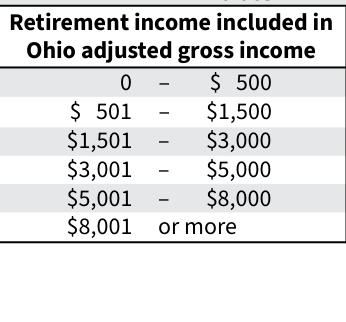
19.2 86
76 6.5
11.9
18.4 87
77 6.1
11.2
17.6 88
78 5.7
10.6
16.8 89
79 5.3
10.0
16.0 90
80 5.0
9.5
15.3 91
81 4.7
8.9
14.6 92
82 4.4
8.4
13.9 93
83 4.1
7.9
13.2 94
84 3.9
7.4
12.5 95
85 3.7
6.9
Retirement income credit
$ 25
$ 50
$ 80
$130
$200
3.4
3.2
3.0
2.8
2.7
2.5
2.3
2.1
1.9
1.8
2025 Ohio Schedule of Credits Worksheets 45
Child and Dependent Care Credit Worksheet (Ohio Schedule of Credits, Line 6)
- Enter your modified adjusted gross income (see line 3 of the worksheet on page 40) If line 1 is $40,000 or more, STOP. You do not qualify for this credit … 1.
- Enter the amount on your federal form 2441, line 9c … 2.
- Enter 25% of the amount on your federal form 2441, line 11 … 3.
- If line 1 of this worksheet is less than $20,000, enter the amount from line 2.
If line 1 is equal to or greater than $20,000 but less than $40,000, enter the amount from line 3. This is your credit. Enter on the Ohio Schedule of Credits, line 6 … 4.
Displaced Worker Training Credit Worksheet (Ohio Schedule of Credits, Line 7)
If filing jointly and only one taxpayer qualifies for this credit, use Column A. If each taxpayer qualifies for this credit, use both Columns A and B.
(A) (B)
# Taxpayer Spouse
- Enter the amount you paid for job training during the 12-month period after you became a displaced worker … 1.
- Line 1 times 50% (0.50) … 2.
- Enter the lesser of line 2 or $500 … 3.
- Enter the displaced worker training credit, if any, claimed on last year's Ohio Schedule of Credits … 4.
- Line 3 minus line 4. If less than zero, enter zero … 5.
- Add the amounts on line 5, Columns A and B. Enter on the Ohio Schedule of Credits, line 7 … 6.
Note: Do not include any amounts that were refunded, reimbursed, or paid on your behalf by another person. Include amounts you paid with your personal funds or loan amounts (such as a student loan).
# 46 2025 Ohio Use Tax Worksheet
Important: If you owe use tax to more than one county, you can use the Ohio Use Tax Voluntary Payment Form, available at tax.ohio.gov/forms.
Use Tax Worksheet for Ohio IT 1040, Line 12
- Enter the total of all purchases you made during the tax year on which you owe Ohio use tax … 1.
- Using the table below, enter your county's use tax rate … 2.
- Line 1 times line 2. Round to the nearest dollar. Enter on the Ohio IT 1040, line 12... 3.
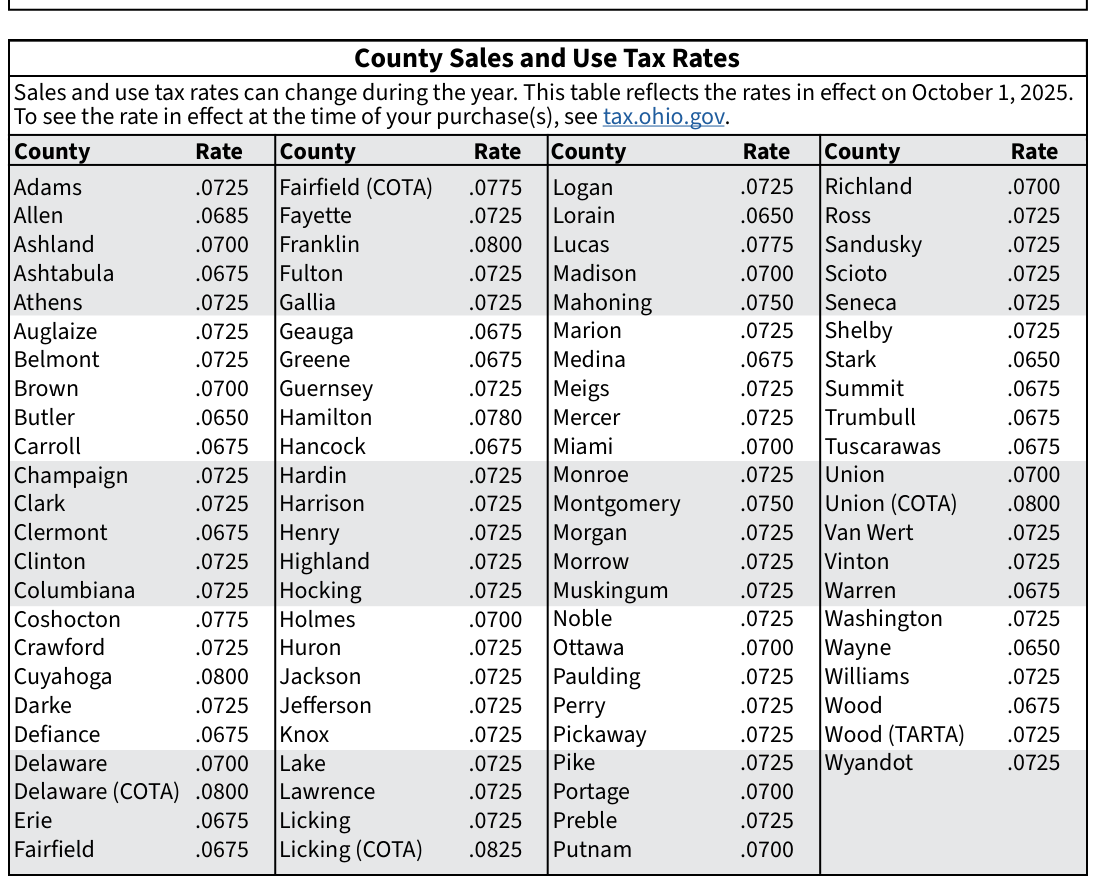
Text version of this table
County Sales and Use Tax Rates Sales and use tax rates can change during the year. This table reflects the rates in efefct on October 1, 2025. To see the rate in efefct at the time of your purchase(s), see tax.ohio.gov. County Rate County Rate County Rate County Rate Adams .0725 Allen .0685 Ashland .0700 Ashtabula .0675 Athens .0725 Fairfield (COTA) .0775 Fayette .0725 Franklin .0800 Fulton .0725 Gallia .0725 Logan .0725 Lorain .0650 Lucas .0775 Madison .0700 Mahoning .0750 Richland .0700 Ross .0725 Sandusky .0725 Scioto .0725 Seneca .0725 Auglaize .0725 Belmont .0725 Brown .0700 Butler .0650 Carroll .0675 Geauga .0675 Greene .0675 Guernsey .0725 Hamilton .0780 Hancock .0675 Marion .0725 Medina .0675 Meigs .0725 Mercer .0725 Miami .0700 Shelby .0725 Stark .0650 Summit .0675 Trumbull .0675 Tuscarawas .0675 Champaign .0725 Clark .0725 Clermont .0675 Clinton .0725 Columbiana .0725 Hardin .0725 Harrison .0725 Henry .0725 Highland .0725 Hocking .0725 Monroe .0725 Montgomery .0750 Morgan .0725 Morrow .0725 Muskingum .0725 Union .0700 Union (COTA) .0800 Van Wert .0725 Vinton .0725 Warren .0675 Coshocton .0775 Crawford .0725 Cuyahoga .0800 Darke .0725 Defiance .0675 Holmes .0700 Huron .0725 Jackson .0725 Jefefrson .0725 Knox .0725 Noble .0725 Ottawa .0700 Paulding .0725 Perry .0725 Pickaway .0725 Washington .0725 Wayne .0650 Williams .0725 Wood .0675 Wood (TARTA) .0725 Delaware .0700 Delaware (COTA) .0800 Erie .0675 Fairfield .0675 Lake .0725 Lawrence .0725 Licking .0725 Licking (COTA) .0825 Pike .0725 Portage .0700 Preble .0725 Putnam .0700 Wyandot .0725
2025 Ohio IT 1040 / SD 100 47
# Sample W-2 - Wages and Withholding
See "Ohio Income Tax Withheld" on page 17 and "School District Income Tax Withheld" on pages 57-58 for more information on reporting your Ohio and school district withholding on your return.
Box b - This is your employer identification number (EIN).
Box 15 - For states other than Ohio, do not include the amount in box 17 as Ohio income tax withheld.
Box 16/17 - Your state wages and state income tax withholding. Only include Ohio amounts on the Schedule of Ohio Withholding.
# School District Withholding
Both city and school district tax information is reported in boxes 19 and 20. Do not include any city income tax withholding on either the SD 100 or the IT 1040. A locality name that begins with "R" followed by a 3 or 4-digit number indicates city income tax, not school district income tax.
Box 19/20 - Only include the school district tax in box 19 for the school district that is identified in box 20 (which typically shows "SD" and a four-digit code or "SD" and the abbreviated name of the school district).
Do not include any amounts in box 19 on the IT 1040.
Box 14 - Your school district withholding and its school district name/number may be reported here instead of in boxes 19 and 20.
# Sample W-2G - Gambling Winnings and Withholding
See "Ohio Income Tax Withheld" on page 17 for more information on reporting Ohio withholding on your return.
Box 13 - For states other than Ohio, do not include the amount in box 15 as Ohio income tax withheld.
Box 15 - Your state income tax withholding. Only include Ohio amounts on the
Schedule of Ohio
Withholding.
# Sample 1099-R - Retirement Income and Withholding
See "Ohio Income Tax Withheld" on page 17 for more information on reporting Ohio withholding on your return.
Box 2b -
The "total distribution" box must be checked to claim the "lump sum" credits. See pages 28 and 43-44.
Box 14 - Your state income tax withholding. Only include Ohio amounts on the
Schedule of Ohio
Withholding.
Box 15 - For states other than Ohio, do not include the amount on the IT 1040.
2025 Ohio School Districts 49
# Ohio School District Numbers
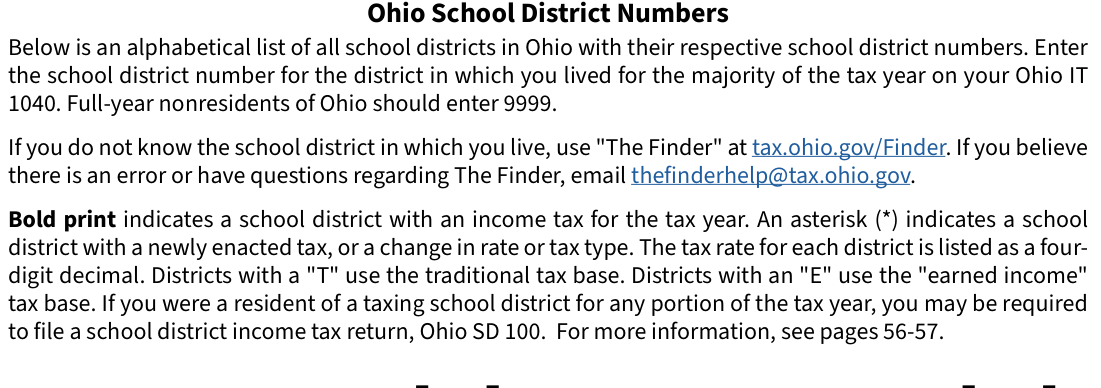
Text version of this table
| elow is an alph e school distric 040. Full-year n | abetical list of all school districts in Ohio with their respective school district numbers. Ent t number for the district in which you lived for the majority of the tax year on your Ohio onresidents of Ohio should enter 9999. |
| you do not kno ere is an error old print indic | w the school district in which you live, use "The Finder" at tax.ohio.gov/Finder. If you belie or have questions regarding The Finder, email thefinderhelp@tax.ohio.gov. ates a school district with an income tax for the tax year. An asterisk (*) indicates a scho |
| istrict with a newly enacted tax, or a change in rate or tax type. The tax rate for each district is listed as a fo igit decimal. Districts with a "T" use the traditional tax base. Districts with an "E" use the "earned incom x base. If you were a resident of a taxing school district for any portion of the tax year, you may be requir file a school district income tax return, Ohio SD 100. For more information, see pages 56-57. | wly enacted tax, or a change in rate or tax type. The tax rate for each district is listed as a fo stricts with a "T" use the traditional tax base. Districts with an "E" use the "earned incom ere a resident of a taxing school district for any portion of the tax year, you may be requir |
Tax Tax Tax Tax
School District Name
School District Name SD #
A
Ada EVSD 3301
Adams County/Ohio Valley
LSD 0101
Adena LSD 7101
Rate .0150
-
-
Type
T
-
-
Beachwood CSD
Beaver LSD
Beavercreek CSD
Bedford CSD
Bellaire LSD
SD # Rate Type
1802 - -
1501 - -
2901 - -
1803 - -
0702 - -
Bellbrook-Sugarcreek LSD
Akron CSD 7701
Alexander LSD 0501
Allen East LSD 0201
Alliance CSD 7601
Amanda-Clearcreek LSD 2301
-
-
-
- .0200 -
-
-
-
E
Bellefontaine CSD
Bellevue CSD
Belpre CSD
Benjamin Logan LSD
2905 - -
4601 - -
3901 .0050 T
8401 - -
4602 - -
Benton-Carroll-Salem LSD
Amherst EVSD 4701
Anna LSD 7501
Ansonia LSD 1901
Anthony Wayne LSD 4801
Antwerp LSD 6301
Arcadia LSD 3201
Arcanum-Butler LSD 1902
Archbold Area LSD 2601
Arlington LSD 3202
Ashland CSD 0301
Ashtabula Area CSD 0401
- .0150 .0175
- .0150 .0100 .0150
- .0175
-
-
-
T
T
-
T
T
T
-
T
-
-
Berea CSD
Berkshire LSD
Berne Union LSD
Bethel LSD
Bethel-Tate LSD
Bexley CSD
Big Walnut LSD
Black River LSD
Blanchester LSD
Bloom-Carroll LSD
6201 - -
1804 - -
2801 .0100 E
2302 .0200 E
5501 .0075 E
1302 - -
2501 .0075 T
2101 .0075 T
5201 - -
1401 .0100 E
2303 .0125 T
Bloomfield-Mespo LSD
Athens CSD 0502
Aurora CSD 6701
Austintown LSD 5001
Avon Lake CSD 4702
Avon LSD 4703
Ayersville LSD 2001
B .0100
-
-
-
- .0100
E
-
-
-
-
T
Bloom-Vernon LSD
Bluffton EVSD
Boardman LSD
Botkins LSD
Bowling Green CSD
Bradford EVSD
7801 - -
7301 - -
0203 .0050 T
5002 - -
7502 .0125 E
8701 .0050 T
5502 .0175 T
Brecksville-Broadview
Barberton CSD 7702
Barnesville EVSD 0701
Batavia LSD 1301
Bath LSD 0202
Bay Village CSD 1801
E = Earned Income
T = Traditional
-
-
-
-
-
-
-
-
-
-
Heights CSD
Bridgeport EVSD
Bright LSD
Bristol LSD
1806 - -
0703 - -
3601 - -
7802 - -
*New tax/rate
2025 Ohio School Districts / SD 100
Tax Tax Tax Tax
School District Name
School District Name SD #
Brookfield LSD 7803
Brooklyn CSD 1807
Brookville LSD 5701
Rate
-
-
-
Type
-
-
-
Clinton-Massie LSD
Cloverleaf LSD
SD # Rate Type
1402 - -
5204 .0100 E
Clyde-Green Springs EVSD
Brown LSD 1001
Brunswick CSD 5202
Bryan CSD 8601
-
- .0100 - -
T
Coldwater EVSD
College Corner LSD
7201 .0150 E
5402 .0050 T
6801 - -
Colonel Crawford LSD
Buckeye LSD (Ashtabula) 0402
Buckeye LSD (Jefferson) 4101
Buckeye LSD (Medina) 5203
Buckeye Central LSD 1701
-
-
- .0150 - - -
T
Columbia LSD
Columbiana EVSD
Columbus CSD
1703 .0125 T
4705 - -
1502 .0100 T
2503 - -
Columbus Grove LSD
Buckeye Valley LSD 2102
Bucyrus CSD 1702 .0100
-
T
-
Conneaut Area CSD
6901 .0100 T
0403 - -
Conotton Valley Union LSD
C
Caldwell EVSD 6101
Cambridge CSD 3001
Campbell CSD 5003
Canal Winchester LSD 2502
Canfield LSD 5004
Canton CSD 7602
Canton LSD 7603
-
-
- .0075
-
-
-
-
-
-
T
-
-
-
Continental LSD
Copley-Fairlawn CSD
Cory-Rawson LSD
Coventry LSD
Covington EVSD
Crestline EVSD
3401 - -
6902 .0100 T
7703 - -
3203 .0175 T
1601 - -
7704 - -
5503 .0200 T
1704 .0025 E
Crestview LSD (Columbiana) 1503
Cardinal LSD 2802 - - .0100 T
Crestview LSD (Richland)
Cardington-Lincoln LSD 5901 .0075 E
7002 - -
Crestview LSD (Van Wert)
Carey EVSD 8801
Carlisle LSD 8301
Carrollton EVSD 1002 .0100 .0100
-
T
T
-
Crestwood LSD
Crooksville EVSD
Cuyahoga Falls CSD
8101 .0100 T
6702 - -
6401 - -
7705 - -
Cuyahoga Heights LSD
Cedar Cliff LSD 2902
Celina CSD 5401
Centerburg LSD 4201
Centerville CSD 5702
Central LSD 2002
Chagrin Falls EVSD 1808
Champion LSD 7804
Chardon LSD 2803 .0125 .0100 .0075
- .0125
-
-
-
T
E
T
-
T
-
-
-
Dalton LSD
Danbury LSD
*Danville LSD
Dawson-Bryant LSD
Dayton CSD
1811 - -
D
8502 .0075 T
6202 - -
4202 .0175 T
4402 - -
5703 - -
Deer Park Community CSD
Chesapeake Union EVSD 4401
Chillicothe CSD 7102
Chippewa LSD 8501
Cincinnati PSD 3101
Circleville CSD 6501
Clark-Shawnee LSD 1207
Clay LSD 7302
Claymont CSD 7901
Clear Fork Valley LSD 7001
Clearview LSD 4704
Clermont-Northeastern LSD 1303
Cleveland Hts.-University
Hts. CSD 1810
Cleveland MSD 1809
T = Traditional E = Earned Income
-
- .0100
- .0075
-
-
- .0100
- .0100
-
-
-
-
E
-
E
-
-
-
E
-
T
-
-
Defiance CSD
Delaware CSD
Delphos CSD
Dover CSD
Dublin CSD
East Cleveland CSD
East Clinton LSD
East Guernsey LSD
East Holmes LSD
East Knox LSD
East Liverpool CSD
East Muskingum LSD
East Palestine CSD
3102 - -
2003 .0050 T
2103 - -
0204 .0050 T
7902 - -
2513 - -
E
1812 - -
1403 - -
3002 - -
3801 - -
4203 - -
1504 - -
6001 - -
1505 .0050 E
*New tax/rate
2025 Ohio School Districts
Tax Tax
Tax Tax
School District Name
School District Name SD #
Eastern LSD (Brown) 0801
Eastern LSD (Meigs) 5301
Rate
-
-
Type
-
-
SD # Rate Type
G
Gahanna-Jefferson CSD
Eastern LSD (Pike) 6601
Eastwood LSD 8702
Eaton CSD 6803
Edgerton LSD 8602
Edgewood CSD 0901
- .0100 .0150 .0100
-
- Galion CSD
E Gallia County LSD
T Gallipolis CSD
T Garaway LSD
-
2506 - -
1705 - -
2701 - -
2702 - -
7903 - -
Garfield Heights CSD
Edison LSD (Erie) 2201
Edison LSD (Jefferson) 4102
Edon-Northwest LSD 8603
Elgin LSD 5101
Elida LSD 0205
Elmwood LSD 8703
Elyria CSD 4706
Euclid CSD 1813
-
- .0100 .0075
- .0125
-
-
Geneva Area CSD
-
- Genoa Area LSD
E Georgetown EVSD
E Gibsonburg EVSD
- Girard CSD
T Goshen LSD
- Graham LSD
- Grand Valley LSD
1815 - -
0404 .0125 E
6203 - -
0803 - -
7203 .0100 E
7807 - -
1305 .0100 T
1101 - -
0405 - -
Grandview Heights CSD
Evergreen LSD 2602
F .0150 T
Granville EVSD
2504 - -
4501 .0075 T
Green LSD (Scioto)
Fairbanks LSD 8001 .0100 T 7303 - -
Green LSD (Summit)
Fairborn CSD 2903
Fairfield CSD 0902 .0050
-
T
-
7707 - -
Green LSD (Wayne)
Fairfield LSD 3602
Fairfield Union LSD 2304
Fairland LSD 4403
Fairlawn LSD 7503
Fairless LSD 7604
- .0200
- .0075
-
Greeneview LSD
-
T Greenfield EVSD
- Greenon LSD
T Greenville CSD
-
8503 .0050 E
2904 .0100 T
3603 .0125 E
1201 - -
1904 .0050 T
Groveport Madison LSD
Fairport Harbor EVSD 4301
Fairview Park CSD 1814
Fayette LSD 2603
Fayetteville-Perry LSD 0802
-
- .0100
-
-
- Hamilton CSD
T Hamilton LSD
-
2507 - -
H
0903 - -
2505 - -
Hardin-Houston LSD
Federal Hocking LSD 0503 - -
7505 .0075 T
Hardin Northern LSD
Felicity-Franklin LSD 1304
Field LSD 6703
Findlay CSD 3204
Finneytown LSD 3103
-
-
-
-
- Harrison Hills CSD
- Heath CSD
Hicksville EVSD
-
-
3302 .0175 T
3402 - -
4502 - -
2004 .0150 T
Highland LSD (Medina)
Firelands LSD 4707 - -
5205 - -
Highland LSD (Morrow)
Forest Hills LSD 3104
Fort Frye LSD 8402
Fort Loramie LSD 7504
Fort Recovery LSD 5406
Fostoria CSD 7402
-
- .0150 .0150
-
- Hilliard CSD
Hillsboro CSD
-
T Hillsdale LSD
T Holgate LSD
-
5902 .0050 T
2510 - -
3604 .0100 T
0302 .0125 E
3501 .0150 T
Hopewell-Loudon LSD
Franklin CSD 8304
Franklin LSD 6002
-
-
- Howland LSD
- Hubbard EVSD
7403 .0050 E
7808 - -
7809 - -
Huber Heights CSD
Franklin Monroe LSD 1903
Fredericktown LSD 4204
Fremont CSD 7202
Frontier LSD 8403
E = Earned Income
T = Traditional .0075
- .0125
-
T
- Hudson CSD
T Huntington LSD
- Huron CSD
5715 - -
7708 - -
7103 - -
2202 - -
*New tax/rate
I
Independence LSD 1816 - -
Indian Creek LSD 4103 - -
Indian Hill EVSD 3106 - -
Indian Lake LSD 4603 - -
Indian Valley LSD 7904 - -
Ironton CSD 4404 - -
J
Jackson Center LSD 7506 .0150 E
Jackson CSD 4001 - -
Jackson LSD 7605 - -
Jackson-Milton LSD 5005 - -
James A. Garfield LSD 6704 .0150 E
Jefferson Area LSD 0406 - -
Jefferson LSD 4901 .0100 E
Jefferson Township LSD 5704 - -
Jennings LSD 6903 .0075 T
Johnstown-Monroe LSD 4503 .0100 T
Jonathan Alder LSD 4902 .0125 E
Joseph Badger LSD 7810 - -
K
Kalida LSD 6904 .0100 T
Kelleys Island LSD 2203 - -
Kenston LSD 2804 - -
Kent CSD 6705 - -
# Kenton CSD 3303 .0100 T
Kettering CSD 5705 - -
Keystone LSD 4708 - -
Kings LSD 8303 - -
Kirtland LSD 4302 - -
L
LaBrae LSD 7811 - -
Lake LSD (Stark) 7606 - -
Lake LSD (Wood) 8704 - -
Lakeview LSD 7812 - -
Lakewood CSD 1817 - -
Lakewood LSD 4504 - -
Lakota LSD (Butler) 0904 - -
Lakota LSD (Sandusky) 7204 .0150 T
Lancaster CSD 2305 .0150 E
Lebanon CSD 8305 - -
Leetonia EVSD 1506 - -
Leipsic LSD 6905 .0075 T
Lexington LSD 7003 - -
Liberty LSD 7813 - -
Liberty Center LSD 3502 .0175 T
Liberty Union-Thurston LSD 2306 .0175 T
Liberty-Benton LSD 3205 .0075 T
Licking Heights LSD 4505 - -
Licking Valley LSD 4506 .0100 T
Lima CSD 0206 - -
Lincolnview LSD 8102 - -
Lisbon EVSD 1507 - -
Little Miami LSD 8306 - -
Lockland CSD 3107 - -
Logan Elm LSD 6502 .0100 E
Logan-Hocking LSD 3701 - -
London CSD 4903 .0100 T
Lorain CSD 4709 - -
Lordstown LSD 7814 - -
Loudonville-Perrysville EVSD 0303 .0125 T Louisville CSD 7607 - -Loveland CSD 3108 - -Lowellville LSD 5006 - -Lucas LSD 7004 - -Lynchburg-Clay LSD 3605 - -M Mad River LSD 5706 - -Madeira CSD 3109 - -
Madison LSD (Butler) 0905 .0050 T
Madison LSD (Lake) 4303 - -
Madison LSD (Richland) 7005 - -
Madison-Plains LSD 4904 .0125 E
Manchester LSD (Adams) 0102 - -
Manchester LSD (Summit) 7706 - -
Mansfield CSD 7006 - -
Maple Heights CSD 1818 - -
Mapleton LSD 0304 - -
Maplewood LSD 7815 - -
Margaretta LSD 2204 - -
Mariemont CSD 3110 - -
Marietta CSD 8404 - -
Marion CSD 5102 - -
Marion LSD 5403 .0050 E
Marlington LSD 7608 - -
Martins Ferry CSD 0704 - -
Marysville EVSD 8002 - -
Mason CSD 8307 - -
Massillon CSD 7609 - -
Mathews LSD 7806 - -
Maumee CSD 4802 - -
Mayfield CSD 1819 - -
Maysville LSD 6003 - -
McComb LSD 3206 .0150 T
School District Name SD #
Tax
Rate
Tax
Type
School District Name SD #
Tax
Rate
Tax
Type
*New tax/rate
T = Traditional E = Earned Income
52 2025 Ohio School Districts / SD 100
2025 Ohio School Districts
Tax Tax
Tax Tax
School District Name
School District Name
McDonald LSD
SD #
Rate
-
Type
- Newton LSD
SD # Rate Type
5506 .0175 T
Mechanicsburg EVSD
Medina CSD
Meigs LSD
Mentor EVSD .0150
-
-
-
T
-
-
-
Niles CSD
Noble LSD
Nordonia Hills CSD
7818 - -
6102 - -
7710 - -
North Baltimore LSD
Miami East LSD
Miami Trace LSD
Miamisburg CSD
Middle Bass LSD .0175
-
-
-
E
-
-
-
North Bass LSD
North Canton CSD
North Central LSD
8705 .0125 E
6205 - -
7611 - -
8606 - -
North College Hill CSD
Middletown CSD
Midview LSD
Milford EVSD
-
-
-
-
-
-
North Fork LSD
North Olmsted CSD
North Ridgeville CSD
3112 - -
4508 .0100 E
1820 - -
4711 - -
Millcreek-West Unity LSD
Miller City-
8604 .0100 T
North Royalton CSD
North Union LSD
1821 - -
8003 .0100 T
New Cleveland LSD 6906 .0125 T Northeastern LSD (Clark)
Milton-Union EVSD 5505 .0125 E
1203 .0100 E
Northeastern LSD (Defiance)
Minerva LSD
Minford LSD
Minster LSD
-
- .0100 - -
T
Northern LSD
Northmont CSD
Northmor LSD
2005 - -
6403 - -
5709 - -
5904 .0100 T
Mississinawa Valley LSD 1905 .0175 T Northridge LSD (Licking) Mogadore LSD 7709 - -
4509 .0050 E
Northridge LSD (Montgomery) 5710
Mohawk LSD 8802 .0100 T
- -
Northwest LSD (Hamilton)
Monroe LSD 0910 - -
3113 - -
Northwest LSD (Scioto)
Monroeville LSD 3902 .0150 E
7306 - -
Northwest LSD (Stark)
Montpelier EVSD 8605 .0125 E
7612 .0100 E
Northwestern LSD (Clark)
Morgan LSD 5801 - -
1204 .0100 E
Northwestern LSD (Wayne)
*Mount Gilead EVSD
Mount Healthy CSD
Mount Vernon CSD
Napoleon Area CSD
National Trail LSD
Nelsonville-York CSD
N .0075
-
-
- .0175
-
T
-
-
-
T
-
Northwood LSD
Norton CSD
Norwalk CSD
Norwayne LSD
Norwood CSD
Oak Hill Union LSD
8505 .0125 T
8706 .0025 E
7711 .0050 E
3904 .0050 T
8504 .0075 E
3114 - -
O
4002 - -
New Albany-Plain LSD
New Boston LSD
New Bremen LSD
New Knoxville LSD
New Lebanon LSD
New Lexington CSD
New London LSD
New Miami LSD
-
- .0100 .0125 .0125
- .0100 .0100 - -
T
T
T
-
T
T
Oak Hills LSD
Oakwood CSD
Oberlin CSD
Old Fort LSD
Olentangy LSD
Olmsted Falls CSD
Ontario LSD
Orange CSD
3115 - -
5711 - -
4712 .0200 T
7405 .0100 T
2104 - -
1822 - -
7009 - -
1823 - -
New Philadelphia CSD
New Richmond EVSD
New Riegel LSD
Newark CSD
-
- .0150 .0100 - -
T
T
Oregon CSD
Orrville CSD
Osnaburg LSD
Otsego LSD
4803 - -
8506 - -
7613 - -
8707 .0100 T
Newcomerstown EVSD
Newton Falls EVSD
-
-
-
-
Ottawa Hills LSD 4804 - -
Ottawa-Glandorf LSD 6907 .0150 T
*New tax/rate
E = Earned Income
T = Traditional
2025 Ohio School Districts / SD 100
Tax Tax Tax Tax
School District Name
School District Name SD #
Ottoville LSD 6908
P
Painesville City LSD 4305
Paint Valley LSD 7104
Pandora-Gilboa LSD 6909
Parkway LSD 5405
Parma CSD 1824
Patrick Henry LSD 3504
Paulding EVSD 6302
Perkins LSD 2205
Perry LSD (Allen) 0207
Perry LSD (Lake) 4307
Perry LSD (Stark) 7614
Perrysburg EVSD 8708
Pettisville LSD 2604
Rate .0075
-
- .0175 .0100
- .0175 .0100
-
-
-
- .0050 .0100
Type
T
-
-
T
T
-
T
T
-
-
-
-
T
T
Rolling Hills LSD
Rootstown LSD
Ross LSD
Rossford EVSD
Russia LSD
Salem CSD
Sandusky CSD
Sandy Valley LSD
Scioto Valley LSD
Sebring LSD
Seneca East LSD
Shadyside LSD
Shaker Heights CSD
Shawnee LSD
SD # Rate Type
3003 - -
6707 - -
0908 .0125 E
8709 - -
7507 .0075 T
S
1508 - -
2206 - -
7616 - -
6602 - -
5008 .0100 E
7406 .0100 T
0705 - -
1827 - -
0208 - -
Sheffield-Sheffield Lake CSD
Pickerington LSD 2307
Pike-Delta-York LSD 2605
Piqua CSD 5507
Plain LSD 7615
Pleasant LSD 5103 .0100 .0100 .0125
- .0100
T
T
T
-
E
Shelby CSD
Sidney CSD
Solon CSD
South Central LSD
4713 - -
7008 .0100 T
7508 .0075 E
1828 - -
3905 .0125 T
South Euclid-Lyndhurst CSD
Plymouth-Shiloh LSD 7007
Poland LSD 5007
Port Clinton CSD 6206 .0100
-
-
T
-
-
South Point LSD
South Range LSD
1829 - -
4406 - -
5009 - -
Southeast LSD (Portage)
Portsmouth CSD 7307 - - 6708 - -
Southeastern LSD (Clark)
Preble Shawnee LSD 6804 .0175 T 1205 .0100 T
Southeastern LSD (Ross)
Princeton CSD 3116 - - 7105 - -
Southern LSD (Columbiana)
Put-In-Bay LSD 6207 - - 1509 - -
Southern LSD (Meigs)
Pymatuning Valley LSD 0407 - - 5303 - -
Southern LSD (Perry)
R
Ravenna CSD 6706
Reading Community CSD 3117
Revere LSD 7712
-
-
-
-
-
-
Southington LSD
Southwest LSD
6404 - -
7819 - -
3118 .0075 E
Southwest Licking LSD
Reynoldsburg CSD 2509
Richmond Heights LSD 1825 .0050
-
T
-
South-Western CSD
Spencerville LSD
4510 .0075 T
2511 - -
0209 .0100 T
Springboro Community CSD
Ridgedale LSD 5104
Ridgemont LSD 3304 .0100 .0175
E
T Springfield CSD
8302 - -
1206 - -
Springfield LSD (Lucas)
Ridgewood LSD 1602
Ripley Union Lewis
- - 4805 - -
Springfield LSD (Mahoning) 5010 .0100 T
Springfield LSD (Summit)
Huntington LSD 0804
Rittman EVSD 8507
-
-
-
- St. Bernard-
7713 - -
Elmwood Place CSD
River Valley LSD 5105 .0100 E 3119 - -
St. Clairsville-Richland CSD
River View LSD 1603 - - 0706 - -
St. Henry Consolidated LSD
Riverdale LSD 3305
Riverside LSD (Lake) 4306
Riverside LSD (Logan) 4604 .0100
- .0150
T
-
E
St. Marys CSD
Steubenville CSD
5407 - -
0604 .0100 E
4104 - -
Stow-Munroe Falls CSD
Rock Hill LSD 4405 - - 7714 - -
Strasburg-Franklin LSD
Rocky River CSD 1826
T = Traditional E = Earned Income
- - 7907 - -
*New tax/rate
2025 Ohio School Districts
School District Name SD #
Streetsboro CSD 6709
Strongsville CSD 1830
Struthers CSD 5011
Stryker LSD 8607
Swanton LSD 2606
Tax
Rate
-
-
- .0150 .0075
Tax
Type
-
-
-
T
T
School District Name
Versailles EVSD
Vinton County LSD
Wadsworth CSD
Tax Tax
SD # Rate Type
1907 .0100 T
8201 - -
W
5207 - -
Walnut Township LSD
Switzerland of Ohio LSD 5601
Sycamore Community CSD 3120
Sylvania Schools 4806
Symmes Valley LSD 4407
-
-
-
-
-
-
-
-
Wapakoneta CSD
Warren CSD
Warren LSD
2308 .0175 E
0605 .0075 T
7820 - -
8405 - -
Warrensville Heights CSD
T
1831 - -
Washington Court House CSD 2402
Talawanda CSD 0909
Tallmadge CSD 7715
Teays Valley LSD 6503
Tecumseh LSD 1202
Three Rivers LSD 3121
Tiffin CSD 7407
Tipp City EVSD 5508
Toledo CSD 4807
Toronto CSD 4105 .0100
- .0150
-
-
-
-
-
-
T
-
E
-
-
-
-
-
-
Washington-Nile LSD
Waterloo LSD
Wauseon EVSD
Waverly CSD
Wayne LSD
Wayne Trace LSD
Waynedale LSD .0100 E
4808 - -
7309 - -
6710 - -
2607 .0175 E
6603 - -
8308 - -
6303 .0125 T
8508 - -
Waynesfield-Goshen LSD
Triad LSD 1103
Tri-County North LSD 6806
Trimble LSD 0505
Tri-Valley LSD 6004
Tri-Village LSD 1906
Triway LSD 8509
Trotwood-Madison CSD 5712
Troy CSD 5509
Tuscarawas Valley LSD 7908
Tuslaw LSD 7617 .0150 .0100
-
- .0150 .0100
- .0150
-
-
T
E
-
-
T
E
-
E
-
-
Weathersfield LSD
Wellington EVSD
Wellston CSD
Wellsville LSD
West Branch LSD
West Carrollton CSD
West Clermont LSD
West Geauga LSD
West Holmes LSD
0606 .0100 T
7821 - -
4715 .0100 T
4003 - -
1511 - -
5012 - -
5716 - -
1308 - -
2807 - -
3802 - -
West Liberty-Salem LSD
Twin Valley Community LSD 6805
Twinsburg CSD 7716
U
Union LSD 0707 .0150
-
-
T
-
-
West Muskingum LSD
Western Brown LSD
Western LSD
1105 .0175 T
6005 - -
0805 - -
6604 - -
Western Reserve LSD (Huron) 3906
Union-Scioto LSD 7106
United LSD 1510
Upper Arlington CSD 2512
Upper Sandusky EVSD 8803
Upper Scioto Valley LSD 3306
Urbana CSD 1104
V
Valley LSD 7308
Valley View LSD 5713
Van Buren LSD 3207
Van Wert CSD 8104 .0050 .0050
- .0125 .0050
-
- .0175 .0100 .0100
T
T
-
T
T
-
-
T
T
T
Western Reserve LSD
(Mahoning)
Westerville CSD
Westfall LSD
Westlake CSD
Wheelersburg LSD
Whitehall CSD
Wickliffe CSD
Willard CSD
Williamsburg LSD .0125 T
5013 - -
2514 - -
6504 - -
1832 - -
7310 - -
2515 - -
4308 - -
3907 .0075 E
1309 - -
Willoughby-Eastlake CSD
Vandalia-Butler CSD 5714
Vanlue LSD 3208
Vermilion LSD 2207
E = Earned Income
T = Traditional
- .0100
-
-
T
-
Wilmington CSD
Windham EVSD
Winton Woods CSD
4309 - -
1404 - -
6711 - -
3105 - -
*New tax/rate
Tax Tax
School District Name SD # Rate Type
Wolf Creek LSD 8406 - -
Woodmore LSD 7205 - -
Woodridge LSD 7717 - -
Wooster CSD 8510 - -
Worthington CSD 2516 - -
Wynford LSD 1706 - -
Wyoming CSD 3122 .0125 T
T = Traditional E = Earned Income
2025 Ohio School Districts / SD 100
Tax Tax
School District Name SD # Rate Type
XYZ
Xenia Community CSD 2906 .0050 T
Yellow Springs EVSD 2907 .0200 T
Youngstown CSD 5014 - -
Zane Trace LSD 7107 .0075 E
Zanesville CSD 6006 - -
*New tax/rate
General Information for the SD 100
# Who Must File a School District Income Tax Return?
Only Ohio residents who lived in a taxing school district during any portion of the year are subject to Ohio's school district income tax. Individuals who worked, but did not live, in a taxing school district are not subject to the district's income tax.
Not all school districts have an income tax. See pages 49-56 for a complete list of Ohio's school districts and their respective tax rates.
You must file an SD 100 if all of the following are true:
● You lived in a taxing school district for any portion of the tax year;
● You received income while living in the district; AND ● Based on that income, you have a school district income tax liability (SD 100, lines 25 or 35).
If you have a tax liability for more than one school district, you will file only one SD 100.
You may have a school district income tax liability even if you do not have an Ohio income tax liability. In that case, you must file both a school district income tax return and an Ohio income tax return.
Note: If you lived in a taxing school district and received income, the Department recommends you file an SD 100, even if you don't have a tax liability, to avoid delinquency billings.
See R.C. 5747.08.
# How Is the School District Income Tax Calculated?
School district income tax is levied based on one of the following methods:
The traditional tax base uses modified adjusted gross income (MAGI) less exemptions to calculate the school district income tax base. Traditional filers must complete lines 22-28 on the SD 100.
The earned income tax base is based on the taxpayer's "earned income" and must be calculated by completing lines 29-38 on the SD 100.
"Earned income" includes only the following items to the extent they are included in MAGI:
● Employee compensation such as wages, salaries and tips; AND ● Self-employment income from sole proprietorships and partnerships.
"Earned income" does not include items such as retirement income, interest, dividends, capital gains, and unemployment benefits.
For more information, see "What is Modified Adjusted Gross Income?" on page 8 and the worksheet on page 40.
See R.C. 5748.01(E)(1).
How Do I Determine If I'm a Resident of a School
District?
You are a resident of a school district if your primary residence is in that district. Your voter registration, driver's license, and vehicle registration can help determine your primary residence. If you lived in Ohio for any portion of the year, you were a resident of at least one school district. For information on how to determine your school district, see page 49. See also R.C. 5748.01(F)(1).
# How Do I Complete the Schedule of School District
Residency?
Complete the schedule to provide school district residency information for the entire tax year, including any dates you lived outside Ohio or in a non-taxing school district. Use 9999 as the school district number for any portion of the year you were a nonresident of Ohio. You may need more than one entry for the same period of time if your and your spouse's dates of residency do
2025 Ohio SD 100 not match and you are filing jointly. The Department provides a tool to calculate your "days as resident" and "residency factor" at tax.ohio.gov/SDresidency.
# What If I Lived in More Than One School District?
You will file a single SD 100 regardless of how many school districts in which you resided. Complete the Schedule of School District Residency on page 1.
Page 3 of the return has space to report two traditional base districts and two earned income base districts. If you resided in more than two districts of either base, complete additional copies of page 3.
# Determining Your Income
Ohio's school district income tax is levied on the portion of taxable income received by an individual while a resident of the taxing district.
For both tax bases, if you know the exact amounts of income/adjustments you received or made in each district, you should specifically match up those amounts to the proper school district. However, if you do not know the exact amounts, you may prorate your income and/or adjustments by multiplying the amounts by the residency factor(s) on page 1 of the return for each school district you resided in.
For more information and examples, see pages 59-61.
What If My Employer Withheld School District Tax in
Error?
You must file an SD 100 to request a refund of the erroneous withholding. All of your school district withholding must be reported on a single Schedule of School District Withholding and combined on line 11 of the SD 100. The total withholding will be applied toward any tax liability you have on line 10. If you do not have a tax liability, the erroneous withholding will be refunded to you.
Additionally, you should file a new IT 4 with your employer to report your current school district of residence.
For more information, see tax.ohio.gov/schooldistrict.
# Ohio SD 100 - School District Income Tax Return
The traditional tax base is determined using modified adjusted gross income (MAGI) less exemptions, which is calculated on line 5. The earned income tax base is limited by MAGI, which is calculated on line 3. For more information on MAGI, see page 8. See also R.C.
5748.01(E)(1).
# Line 6 - Traditional Tax Base Liability
If you were a resident of one or more traditional tax base school districts for any part of the year, complete the Traditional Tax Base Schedule (lines 22-28) on page 3.
Start with Column A and complete additional columns if necessary. Enter the total tax from line 28 on this line.
# Line 7 - Earned Income Tax Base Liability
If you were a resident of one or more earned income tax base school districts for any part of the year, complete the Earned Income Tax Base Schedule (lines 29-38) on page
- Start with Column A and complete additional columns if necessary. Enter the total tax from line 38 on this line.
# Line 9 - Interest Penalty
Generally, if you are a wage earner and have Ohio school district withholding, you will not owe an interest penalty. If you have non-wage income or no Ohio school district withholding, use Ohio IT/SD 2210 to determine if an interest penalty is due. For more information, see the FAQs at tax.ohio.gov/2210. See also R.C. 5747.09(D) and (E).
# Line 11 - School District Income Tax Withheld
Enter your school district income tax withheld as reported on Part A, line 1 of the Schedule of School District Withholding.
Schedule of School District Withholding. Complete this schedule if you are reporting an amount on line 11 of the SD 100. Enter only income statements (W-2,
- for which you have school district income tax withheld. Do not include any city income tax withheld.
School district withholding is generally indicated by the four-digit school district number in box 20 or 14. If you have an income statement reporting withholding for more than one school district, list each amount on a separate line in Part B or Part C.
See the sample statements on pages 47-48. Do not list income statements that do not report school district income tax withheld. Place copies of all income statements that list school district withholding information after the last page of your return. Do not include income statements that are handwritten, self-created, or generated by your tax preparation software.
See R.C. 5747.08(H).
# Line 12 - Payments and Credit Carryforward
Amounts
Enter the following amounts:
● Estimated payments;
● Timely extension payments;
● Any credit carryforward amount from your prior year SD 100; AND ● Amounts previously paid with an original and/or amended 2025 return.
Do not include a prior year's refund that you requested but did not receive. Contact the Department about the status of any such refund.
See R.C. 5747.09(B).
# Line 14 - Overpayment Previously Requested
(Amended Returns Only)
When filing an amended return, enter the amount you reported on line 19 on your previously filed return(s).
# Line 17 - Interest Due
Interest is due from the unextended due date until the date the tax is paid. Generally, you do not owe interest if you are due a refund. An extension of time to file does not extend the payment due date. The interest rate for calendar year 2026 is 7%. The Department provides a tool to assist you with this calculation at tax.ohio.gov/ interestcalculator.
Certain military servicemembers may not be subject to interest. See page 10 for more information.
See R.C. 5747.08(G).
# Line 18 - Total Amount Due
This amount must be paid by April 15, 2026. Do not mail cash. Instead, make payment by electronic check, credit or debit card, paper check, or money order.
Make your check or money order payable to "School District Income Tax" and include an Ohio Universal Payment Coupon (OUPC). If you are filing for multiple districts on page 3, use the first school district number from Column A. Include the tax year, the last four digits of your SSN, and the school district number on the "Memo" line.
2025 Ohio SD 100
For more information regarding payment options, see page 6.
# Line 20 - Credit Carryforward
Enter the portion of your refund you want applied to tax year 2026. This is only allowed on timely filed, original returns; it is not allowed on amended returns.
# Line 21 - Your Refund
If you do not request direct deposit, or you filed by paper, your refund will be mailed to the address on the tax return.
If you move after filing your tax return, your refund may be delayed. Notify the Department of your address change as soon as possible.
Traditional Tax Base Schedule
Complete this schedule for each traditional tax base school district in which you resided during the year, starting with Column A. If you resided in more than two traditional tax base school districts, complete additional copies of page 3.
# Line 22 - Resident Portion of MAGI Less Exemptions
Enter the portion of your MAGI less exemptions (line 5) that you received while a resident of the school district entered at the top of the column. Do not exceed the amount listed on line 5. Full-year residents should enter the exact amount from line 5. Part-year residents should refer to the guidance on pages 59-61. See R.C.
5748.01(E)(1) and (G).
# Line 24 - Tax Rate
See pages 49-56 for a complete list of Ohio's school districts and their respective tax rates. See R.C.
5748.03(C) and R.C. 5747.021.
# Line 26 - Senior Citizen Credit
To qualify for this credit, you must have been 65 or older at the end of the tax year. You qualify for this credit even if you were ineligible to claim it on your Ohio IT 1040.
The credit is equal to $50 per district. See R.C. 5748.06.
Earned Income Tax Base Schedule
Complete this schedule for each earned income tax base school district in which you resided during the
2025 Ohio SD 100 year, starting with Column A. If you resided in more than two earned income tax base school districts, complete additional copies of page 3.
# Line 29 - Wages and Other Compensation
Enter any amount you reported as "wages, salaries, tips, etc." on your federal income tax return that was received while you were a resident of the school district entered at the top of the column. See the guidance for part-year residents on pages 59-61.
# Line 30 - Net Earnings From Self-Employment
Enter your federal "net earnings from self-employment" that were received while you were a resident of the school district entered at the top of the column. See the guidance for part-year residents on pages 59-61.
# Line 32 - Resident Portion of MAGI
Enter the portion of your MAGI (line 3) that you received while a resident of the school district entered at the top of the column. Do not exceed the amount listed on line 3. Full-year residents should enter the exact amount from line 3. Part-year residents should refer to the guidance on pages 59-61. See R.C. 5748.01(E)
(2) and (G).
# Line 34 - Tax Rate
See pages 49-56 for a complete list of Ohio's school districts and their respective tax rates. See R.C.
5748.03(C) and R.C. 5747.021.
# Line 36 - Senior Citizen Credit
To qualify for this credit, you must have been 65 or older at the end of the tax year. You qualify for this credit even if you were ineligible to claim it on your Ohio IT 1040.
The credit is equal to $50 per district. See R.C. 5748.06.
Guidance for Part-Year Residents of a School District
Calculating Your Income Received While a Part-Year
Resident of a School District
Ohio's school district income tax is levied on the portion of taxable income received by a taxpayer while a resident of the taxing district. Ohio law does not specify how to calculate the portion of income received while a resident of a school district.
If you can specifically identify the exact amount of income and deductions you received/incurred in a school district, then you should report those exact amounts on the appropriate schedule on page 3.
However, many taxpayers are unable to identify where each item of income was received or how to allocate deductions that are not tied to specific events. In these situations where specific identification is not available, you should prorate your income and deductions based on how long you resided in the district.
Important: This guidance assumes that if you are filing jointly, you and your spouse have the same dates of residency on your Schedule of School District Residency. If you are filing jointly but your and your spouse's dates of residency do not match, see tax.ohio. gov/schooldistrict for additional guidance.
Traditional Tax Based Districts
For traditional tax base districts, "taxable income" is defined as modified adjusted gross income (MAGI) less exemptions, which is calculated on line 5 of the SD 100. On line 22, you should enter only the portion of line 5 that was received while a resident of the district.
If you can specifically identify the different items that make up your line 5 amount, and you know when those amounts were received, you should enter the net portion of those amounts received while you were a resident of the district.
If you cannot specifically identify the amounts, you can prorate by multiplying line 5 of the SD 100 by the residency factor calculated on page 1 for the school district. See Example 1 below.
Example 1 - Traditional Tax Base
Hannah moved into a traditional tax base school district on September 1st. She determines her residency factor as 0.3342. Her MAGI less exemptions (SD 100, line 5) is $65,000. However, she isn't able to specifically identify the portion of that amount that was received while she was a resident of the school district. So, Hannah multiplies her line 5 amount by her residency factor for the school district:
$65,000 X 0.3342 = $21,723
Example 1 - Traditional Tax Base Schedule
Earned Income Tax Based Districts
For earned income tax base districts, "taxable income" is defined as compensation (wages, salaries, tips, etc.) and net earnings from self-employment to the extent included in modified adjusted gross income (MAGI). You should enter only the portion of these amounts received while a resident of the district.
If you can specifically identify the wages and net self-employment you received while a resident of the district, you should enter those amounts on lines 29 and 30, respectively. Also, if you can specifically identify the different items that make up your line 3 amount, and you know when those amounts were received, you should enter the net portion of those amounts received while you were a resident of the district on line 32.
If you cannot specifically identify these amounts, you can prorate by multiplying the total figure by the residency factor calculated on page 1 for the school district. See Example 2 below.
Example 2 - Earned Income Tax Base
Eric and Angela moved into an earned income tax base school district on June 1st. They determine their residency factor as 0.5863 and their MAGI as $166,000. Eric changed jobs when he moved so he can specifically identify his wages earned as a resident to 2025 Ohio SD 100 Hannah enters $21,723 as her resident portion of MAGI less exemptions on line 22 of her SD 100. See the Traditional Tax Base Schedule below. be $58,000 and enters this amount on line 29. Angela has $89,000 of self-employment income for the entire year but she isn't sure how to determine what portion was received while she was a resident of the school district. So, she multiplies her self-employment income by her residency factor for the school district and enters the result on line 30:
$89,000 X 0.5863 = $52,181
Next, they determine which portions of the other amounts included in their MAGI were received or incurred as residents. They claim $9,000 in deductions on line 10 of their federal return. They are unable to identify when these deductions were incurred so they prorate this amount also by using their residency factor:
$9,000 X 0.5863 = $5,277
They claim an Ohio deduction of $4,000 for contributions to a 529 account. However, they can specifically identify that these contributions took place in March, before moving into the taxing school district, so they don't prorate the amount.
Using these specifically identified and prorated figures, they determine their resident portion of MAGI and enter the amount on line 32:
$58,000 + $52,181 - $5,277 = $104,904
See their Earned Income Tax Base Schedule on page 61.
2025 Ohio SD 100
Example 2 - Earned Income Tax Base Schedule
Ohio IT 10 - Zero Liability / No Refund Individual Income Tax Return
Certain taxpayers can file Ohio form IT 10 instead of the Ohio IT 1040 if:
● They do not have an Ohio individual income or school district income tax liability; AND ● They are not requesting a refund.
See R.C. 5747.08.
Reasons for Filing Form IT 10
By filing the form IT 10, you are declaring that your correctly calculated tax liability (Ohio IT 1040, line 8c) is $0.00 for one or more of the following reasons:
● There is no tax liability on your Ohio taxable nonbusiness income (Ohio IT 1040, line 7) and taxable business income (Ohio IT 1040, line 6);
● You were a nonresident of Ohio for the entire tax year and did not have Ohio-sourced income;
● You were a nonresident military servicemember for the entire tax year and your only source of income earned in Ohio was from the military; AND/OR ● You were a civilian spouse of a nonresident servicemember stationed in Ohio.
62 2025 Ohio IT NRS
# Ohio Nonresident Statement
Ohio law presumes all individuals with an abode in Ohio are Ohio residents. However, individuals who meet certain required criteria can establish a presumption that they were a nonresident for the tax year. Once an individual establishes this nonresident presumption, the Department cannot later determine the individual was an Ohio resident for income tax purposes for the tax year.
Note: If you moved into or out of Ohio during the tax year (i.e., you were a part-year resident), you are not eligible for the Ohio nonresident presumption.
How Do I Claim Ohio's Nonresident Presumption?
Individuals who meet the required criteria can claim Ohio's nonresident presumption by checking the Ohio Nonresident Statement box on form IT 10 or IT 1040. If both taxpayers on a joint return wish to establish this presumption, both boxes must be checked.
Note: Beginning with tax year 2025, individuals must file form IT 10 or 1040 to claim Ohio's nonresident presumption.
When Must I Claim Ohio's Nonresident Presumption?
Individuals who meet the required criteria must timely claim Ohio's nonresident presumption for each tax year no later than the 15th day of the 10th month following the close of their tax year. For most taxpayers, this will be October 15th.
The deadline to claim Ohio's nonresident presumption does not change the due date of form IT 10 or IT 1040.
If you do not have an extension to file, your return is still due on the normal due date of the return, typically April 15th.
Note: The nonresident presumption only applies to the tax year for which it is claimed; it does not cover past or future years.
See R.C. 5747.24(B)(2).
What Are the "Required Criteria" to Claim Ohio's
Nonresident Presumption?
Only individuals who meet the following criteria are eligible for Ohio's nonresident presumption:
(1) Contact Periods: You had no more than 212 contact periods in Ohio. For the definition of a "contact period," see page 13.
(2) Non-Ohio Abode: You had an abode outside of Ohio for which you did not claim depreciation during the tax year. This does not include a vacation home, rental, or other income-generating property.
(3) Ohio Identification: You did not hold an Ohio driver's license or Ohio state ID card. To meet this requirement, you must surrender your Ohio license or ID card prior to the beginning of the tax year to a bureau or department of motor vehicles of any state.
(4) Ohio Property Tax Reductions: You did not receive the Ohio homestead property tax exemption or the owner-occupied tax reduction.
(5) Ohio In-State Tuition: The individual claiming the Ohio nonresident presumption did not receive in-state tuition at an Ohio college, university, branch campus, community college, or technical college.
For more information, see page 13, or tax.ohio.gov/ residencycredits. See also R.C. 5747.24(B)(1).
2025 Ohio Schedule IT NOL 63
# Ohio Schedule IT NOL
Ohio does not have its own net operating loss (NOL) carryback deduction. However, an NOL carryback can sometimes be claimed in Ohio for the same tax years claimed on your federal return. Such carrybacks are limited by your Ohio depreciation add-back.
Individuals must use Schedule IT NOL and file an amended IT 1040 for each carryback year to claim an NOL carryback.
Important: When carrying back an NOL, you cannot claim the Ohio depreciation deduction on the Ohio Schedule of Adjustments. See page 22 for more information.
Section I - NOL Carryback Calculation
# Line 2 - Federal NOL Amount
Enter your federal NOL amount for the year in which the NOL occurred.
For tax years 2023 and prior, use federal form 1045, Schedule A, line 24. For tax year 2024 and forward, use federal form 172, line 24.
# Line 3 - Ohio Depreciation Add-Back
Enter your Internal Revenue Code 168(k) and 179 depreciation expense add-back reported on your Ohio Schedule of Adjustments for the year of the NOL.
This amount should be the entire amount of such depreciation expense reported on your federal return.
For more information, see the FAQs at tax.ohio.gov/faq-IncomeDepreciation. See also R.C. 5747.01(A)(17)(a)(v).
Section II - Amended Ohio Federal Adjusted
Gross Income
Indicate the applicable carryback period for your Ohio
NOL. The carryback period must match the period allowed federally. List the earliest carryback year in Column A.
Line 5 - Federal Adjusted Gross Income Prior to the
Carryback
Enter your federal adjusted gross income (AGI) prior to the carryback. Generally, this is the amount reported on line 1 of your originally filed Ohio IT 1040.
However, if you are amending one or more of your Ohio returns for a reason other than an NOL carryback, then this amount is your amended federal AGI not including the federal NOL carryback.
Line 6 - Federal Adjusted Gross Income After the
Carryback
Enter your amended federal AGI from your federal amended return or form 1045, line 11.
# Line 7 - Available Carryback
Column A: Enter the amount from line 4.
All other columns: Enter the amount from line 11 of the previous column.
# Line 9 - Ohio NOL Adjustment
For each respective tax year, you must enter the amount calculated on line 9 of the IT NOL as an addition on the following line of the Ohio Schedule of Adjustments (formerly Ohio Schedule A):
● For tax years 2016-2022, use line 9;
● For tax year 2023, use line 10;
● For tax years 2024 and forward, use line 11.
# NOLs and Ohio's Depreciation Adjustment
Ohio's "deduction of prior year 168(k) and 179 depreciation add-backs," reported on the Ohio Schedule of Adjustments (formerly Ohio Schedule A), cannot be claimed in any tax year with a federal NOL, NOL carryback, or NOL carryforward.
When filing your amended returns to report an NOL and/or NOL carryback, you must remove any such amounts from your Ohio Schedule of Adjustments (formerly Ohio Schedule A).
These deductions must be carried forward to the next year that does not report an NOL, NOL carryback, or NOL carryforward.
For more information, see pages 8-9 and the FAQs at
# IRS Free File
You can file your federal, Ohio, and school district income tax returns using approved tax software.
If you qualify, the IRS Free File program lets you file electronically with the IRS and Ohio for free using certain software. For more information, visit irs.gov/filing/e-file-options.
Direct deposit
When filing electronically, you have the option to direct deposit your entire refund into one of the following:
A checking account
A savings account
# An Individual Retirement Account or Annuity
(IRA) or an Ohio 529 (College Advantage) savings plan account.
Once your return is submitted, you cannot change the banking information provided for direct deposit. The Ohio Department of Taxation is not responsible for a lost refund if you enter the wrong account information.
# Go Paperless and File Electronically! with OH|TAX eServices
You can file your Ohio individual and/or school district income tax returns for free using the Department's online portal at tax.ohio.gov/OHTAX.
With OH|TAX eServices, you can create a secure account with a username and password to:
Secure identity verification
Online filing and payment of taxes
View account balances
Direct deposit your refund
Update name and address information
Access filing and payment history
Request wage and income statements
Electronic delivery and viewing of tax notices Respond to notices online Web messaging with tax examiners Real-time screen sharing assistance with the
# CORE VALUES
- Collaborate and Innovate
- Listen Before Talking
- Say Yes Before No
- Do the Right Thing the Right Way
- Bring a Solution
- Embrace Diversity and Inclusion
- If it's Worth Doing, It's Worth
Doing NOW
VISION
To create a seamless and user-centric experience for all Ohio taxpayers.
# MISSION
ONE TEAM providing education, innovation, outreach, and exceptional service to our customers.
Source: view the official PDF
The source document contains 7 figures (charts or worksheet graphics) not reproduced in this text version. See the official PDF above.
Nearby sections (8 sections)
- cat-1-ins · CAT 1 INS — Commercial Activity Tax Instructions for…
- cat-2023-01 · CAT 2023-01 — Information Release: Changes to the CAT…
- it-1040-booklet · IT 1040 Booklet — Ohio Individual Income Tax Return &…
- it-1041 · IT 1041 — Fiduciary Income Tax Return, Instructions for Filing
- it-1140 · IT 1140 — Pass-Through Entity & Trust Withholding Tax Return,…
- it-4708 · IT 4708 — Pass-Through Entity Composite Income Tax Return,…
- it-4738 · IT 4738 — Electing Pass-Through Entity Income Tax Return…
- ust-1-ins · UST 1 — Ohio Universal Sales Tax Return Instructions