NM Taxation & Revenue Department Forms & FYI Publications
2025 S-Corp Instructions for Tax Return
# Recent changes to Pass-Through Withholding
Starting with tax year 2023, pass-through withholding is reported on the S-Corp-D, FID-D, or PTE-D, whichever applies to the taxpayer. In tax years before 2023, pass-through withholding was reported on the RPD-41367, PTW-D Pass-through Entity Withholding Detail Report, which has been retired.
Due Dates
The Sub-Chapter S Corporate Income and Franchise Tax Return is due on or before the due date of the federal tax return required for the corporation for the taxable year. This is the case whether filing using a calendar year or a fiscal year. Enter the due date of the required federal return for the corporation on the New Mexico S-Corp return.
Privacy Notification and Confidentiality
The New Mexico Taxation and Revenue Department requires each taxpayer to furnish a federal employer identification number (FEIN) for taxpayer identification. The Department protects all information supplied electronically by taxpayers using encryption and firewalls. Taxpayer information on returns is protected in accordance with the confidentiality provisions of the Tax Administration Act, Section 7-1-8 NMSA 1978.
IMPORTANT: If a taxpayer furnishes a truncated FEIN, such as XX-XXX1234, the return is incomplete and the Department sends it back to the taxpayer to refile.
Forms Covered in These Instructions
- S-Corp, Sub-Chapter S Corporate Income and Franchise Tax Return
- S-Corp-1, Income Taxable to Owners
- S-Corp-A, New Mexico Apportionment Factors
Schedule
- S-Corp-B, Allocated Non-business Income Taxable to Owners
- S-Corp-C, Allocated and Apportioned Income
Taxed to S Corporations
- S-Corp-D, Detail of Owner Withholding, Composite Tax and Entity-Level Tax
- S-Corp-CR, Tax Credit Schedule
- S-Corp-EXT, Extension Payment Voucher
- S-Corp-PV, Tax Payment Voucher
- S-Corp-ES, Estimated Tax Payment Voucher
2025 Legislative Summary
For information about New Mexico tax law changes enacted during 2025, see LS-2025 Legislative Summary. To view the summary, go to https://www.tax.newmexico.gov/forms-publications/, and click Publications, then Legislative Summaries.
Publications
FYI-350, Corporate Income Tax and Corporate Franchise Tax, details various aspects of the New Mexico corporate income and franchise tax program. For a copy, navigate to https://www.tax.newmexico.gov/forms-publications/, and click Publications, then FYIs.
Contact Information
Contact the Department by mail, email, or phone:
Corporate Income and Franchise Tax Unit
P. O. Box 25127
Santa Fe, NM 87504-5127
CIT.TaxReturnHelp@tax.nm.gov
(505) 827-0825 in Santa Fe or toll free (866) 809-2335 FYI-106, Claiming Business-Related Tax Credits for Individuals and Businesses, provides information about the various non-refundable and refundable tax credits to claim on S-Corp-CR. Go to https://www.tax.newmexico.gov/formspublications/, and click Publications, then FYIs.
E-File and E-Pay Services
You can use Taxpayer Access Point (TAP) or third-party software through Federal/State filing to e-file tax returns.
- E-file and e-pay the 2025 S-Corp using TAP by going to https://tap.state.nm.us. First-time filers will need to create a login name and password.
- Pay via credit card. A convenience fee is calculated on the amount of the transaction and covers costs that the companies bill the state when you use your card.
- Pay via electronic check at no charge. An electronic check authorizes the Department to debit your checking account in the amount and on the date you specify.
# Contacting the New Mexico Secretary of State
Visit https://www.sos.nm.gov/ for more information about Profit and Non-Profit Corporate Reporting. You may contact the New Mexico Secretary of State Office by mail, email, or phone:
New Mexico Secretary of State
Corporations Bureau
325 Don Gaspar, Suite 300
Santa Fe, NM 87501
Email: Business. Services@sos.nm.gov
Phone: (505) 827-4508 in Santa Fe or Toll free (800) 477-3632
# Contact Our Local Offices
Local tax offices can provide full service and information about the Department's taxes, programs, and forms, as well as specific information about your filing situation.
Albuquerque: Farmngton:
10500 Copper Avenue NE, Suite C 3501 E. Main Street, Suite N
Albuquerque, NM 87123 Farmington, NM 87402
Roswell: Santa Fe:
400 North Pennsylvania, Suite 200 Manuel Lujan Senior Building
Roswell, NM 88201 1200 South St. Francis Drive
Santa Fe, NM 87505
# Use Our Online Services
- Ask a question.
Las Cruces:
2540 S. El Paseo, Building #2
Las Cruces, NM 88001
Call Center: 1-866-285-2996
For questions about state tax policies, legislation, regulations, and rulings, email policy.office@tax.nm.gov. For questions about the S-Corp return, email CIT.TaxReturnHelp@tax.nm.gov
- E-file and e-pay taxes with TAP using a credit card or an electronic check.
Taxpayer Access Point (TAP), our secure resource at https://tap.state.nm.us, lets you e-file certain returns and e-pay taxes.
A convenience fee will be calculated on credit card transaction amounts. It covers costs companies bill us when you use this payment option. Or e-pay by electronic check at no charge. An electronic check authorizes us to debit the checking account in the amount and on the date you specify.
- Check the status of an account and more with TAP.
With TAP you can also check the status of tax accounts, register a business, change an address, and manage tax account history.
- Save time with a direct deposited refund.
To request direct deposit of a refund, fill in the Refund Express section at the bottom of the S-Corp return.
- Download forms and publications.
For the latest and prior year forms and publications, go to https://www.tax.newmexico.gov/forms-publications/.
# Table of Contents
Instructions for 2025 New Mexico Subchapter S Corporate Income & Franchise Tax Return … 4 General Instructions … 4 Who Must File … 4 Who is Required to Pay Franchise Tax … 4 Due Dates … 4 Extension Of Time To File … 4 Fiscal-Year and Short-Year Filers … 4 File Electronically … 5 Requirement for an S-Corp to Report and Pay New Mexico Withholding Tax … 5 After You File Your Return … 6 If You File … 6 If You File Federal Form 1120 … 6 If You File Federal Form 1120S … 6 If You File Federal Form 1120-REIT … 6 If You File Federal Form 1041 … 6 If You File Federal Form 1040 … 7 Obtaining Forms … 7 Required Attachments to Form S-Corp … 7 Other Forms or Attachments You May Have to File … 7 Amended Returns … 8 Payments and Payment Vouchers … 8 S-Corp-PV … 9 S-Corp-ES … 9 S-Corp-EXT … 10 Estimated Tax Payment Chart … 10 Interest and Penalties … 10 Instructions for 2025 S-Corp Form … 11 Instructions for S-Corp-1 Income Taxable To Owners … 15 Instructions for S-Corp-A: New Mexico Apportionment Factors … 17 Instructions for 2025 S-Corp-B: Allocated Non-Business Income Taxable to Owners … 21 Instructions for 2025 S-Corp-C: Allocated and Apportioned Income Taxed to S Corporations … 22 Instructions for 2025 S-Corp-D: Detail of Owner Withholding, Composite Tax and Entity-Level Tax Detail … 22
T2. Reason Codes: Withholding Not Required … 25 New Mexico Taxpayer Bill of Rights … 26
# GENERAL INSTRUCTIONS
# Who Must File
Corporations and Limited Liability Companies (LLCs) that elect to be taxed as S corporations for federal income tax purposes must file a New Mexico S Corporate Income and Franchise Tax Return if any of the following is true about the entity. The entity is:
- Registered to do business in New Mexico
- Transacts business in, into, or from New Mexico
- Derives any income from property or employment within New Mexico
Exceptions
The following entities are exempt and not required to file an S-Corp return:
- Insurance companies and reciprocal or interinsurance exchanges that pay a premium tax to New Mexico
- Rural electric cooperatives established under the Rural
Electric Cooperative Act, Section 62-15-28 NMSA 1978
# Who is Required to Pay Franchise Tax
All S corporations engaging in business in New Mexico and every domestic or foreign corporation having or exercising its corporate franchise in this state, whether actively engaged in business or not, must file a S-Corp return and pay the $50 franchise tax, even if no income tax is due. This includes the following:
- Disregarded corporations doing business in New Mexico
- Limited liability companies that are required or elect to file as a corporation for federal income tax purposes and exercise its franchise in New Mexico
- Entities with no nexus in New Mexico pursuant to P.L.
86-272 (not immune from paying franchise tax)
Exceptions
The only exceptions are the following:
- Corporations exempt from federal income tax under the Internal Revenue Code (IRC) that have no unrelated business income
- Insurance companies and reciprocal or interinsurance exchanges that pay a premium tax to New Mexico
- Rural electric cooperatives established under the Rural
Electric Cooperative Act
Due Dates
The due dates of the S-Corp return for the taxable year conform to the due dates instituted at the federal level. The due date of the federal return is entered on the S-Corp return.
# Timely Returns
An S-Corp return and payment are timely if the United States Postal Service (USPS) postmark on the envelope bears a date on or before the due date. If the due date falls on a Saturday, Sunday, or a state or national legal holiday, the return is timely if the postmark bears the date of the next business day. Delivery through a private delivery service is timely if the date recorded or marked by the private delivery service is on or before the due date.
# Extension Of Time To File
The Department accepts an extension of time granted by the Internal Revenue Service if a copy of the automatic federal extension accompanies the S-Corp return at the time of filing.
If the entity needs an extension of time to file the New Mexico S-Corp return but has not obtained a federal extension, or if additional time to file the New Mexico return is needed beyond the federal extension date, the entity should request an extension by letter or by filing New Mexico Form RPD-41096, Extension of Time to File, on or before the due date of the return.
An extension of time to file your return does not also extend the time to pay tax due. If tax is due, interest continues to accrue.
Which Return to File
In general, the federal return you are required to or elect to file determines the New Mexico income tax return you file see "If you file federal form" on page 6.
Fiscal-Year and Short-Year Filers
Fiscal-year and short-year filers use the S-Corp return for the tax year when the fiscal year or short year begins. For example, if the tax year begins June 30, 2025, use the 2025 S-Corp return, even though the ending date of the tax year is 2026.
When to File Other Returns
If the business does not file a New Mexico S-Corp return, New Mexico may require you to file one of the following returns for New Mexico instead:
- CIT-1, New Mexico Corporate Income and Franchise
Tax Return
- PTE, New Mexico Pass-Through Entities Tax Return
- PIT-1, New Mexico Personal Income Tax Return
- FID-1, New Mexico Fiduciary Income Tax Return
NOTE: Entities that file a 2025 S-Corp do not also file a 2025 PTE.
# File Electronically
If an S-Corp has 51 or more payees who receive New Mexico net income, the S-Corp is required to electronically file Form S-Corp through TAP or approved third-party software. If the S-Corp has 51 or more New Mexico payees, and is unable to file electronically because a hardship exists, the S-Corp may request Department approval to file by paper. The S-Corp may request approval by filing Form RPD-41350, E-File and E-Pay Exception Request Form. The request must be received by the Department at least 30 days before the taxpayer's electronic report is due.
If the S-Corp has 50 or fewer payees who receive New Mexico taxable net income, the S-Corp may choose to submit the completed return electronically or in paper format.
IMPORTANT: When required to file electronically, a paper filed return will be rejected by the Department.
Requirement for an S-Corp to Report and Pay New
# Mexico Withholding Tax
S-Corps are subject to withholding tax from allocable net income distributions to their non-resident owners (partners, members, shareholders, beneficiaries) according to the Oil and Gas Proceeds and Pass-Through Entity Withholding Tax Act (Sections 7-3A-1 through 7-3A-10 NMSA 1978). An S-Corp must annually report each owner's share of net income allocable to New Mexico and remit the New Mexico tax withheld for each owner. A Pass-through entity (PTE), such as an S-Corp, that passes taxable income to its owners, must report the New Mexico taxable net income or losses of all resident and non-resident owners on its return, even if no tax is being withheld. An S-Corp remits New Mexico withholding tax for each non-resident owner, unless there exists an exception corresponding to a reason code see "T2. Reason Codes:
Withholding Not Required" on page 25. The required annual reporting of distributed net income and withholding is reported on the S-Corp tax return, on Schedule S-Corp-D.
Additionally, S-Corps are required to provide sufficient information to enable the owners to whom they are passing taxable income to comply with the provisions of the Income Tax Act and the Corporate Income and Franchise Tax Act by reporting these amounts on statements sent to the owners. Read more about reporting to owners under Reporting
New Mexico Income, Withholding, Entity-Level Tax, and/or Composite Income Tax to Owners, below.
NOTE: Unless it is a PTE that is a personal services business, the S-Corp may enter into an agreement with the owner, using Form RPD-41353, Owner's or Remittee's Agreement to Pay Withholding On Behalf of a Pass-Through Entity or Remitter, for the owner to file and pay tax due on the owner's share of allocable net income. If this agreement with the owner is reached, the S-Corp does not withhold and enters "2" in the S-Corp-D box 6, "Reason Code." A personal services business is a business organization that receives payments for the services of a performing artist for purposes of the film production tax credit. A PTE that is a personal services business cannot enter into an agreement with its owners using RPD-41353.
IMPORTANT: An S-Corp that elects to file and pay entitylevel tax may have owners for which it is not allowed to pay tax under Section 7-3A-10. Owners that the entity may not file and pay entity-level tax for include owners that are corporations that file New Mexico corporate income tax as part of a unitary group, and owners that are themselves PTEs.
Since the S-Corp may not pay entity-level tax these owners, there may be a requirement to pay withholding tax for those non-resident owners under Section 7-3A-3 that will need to pay income tax. In this scenario, the entity filing the S-Corp return may pay be paying withholding tax and entity-level tax on the same return. This could also include composite income tax if there is an owner for which the S-Corp may not pay entity-level tax and the owner elects to have the S-Corp file composite income tax on its behalf. See more on the election to file entity-level tax below.
# Election to File and Pay Entity-Level Tax
Under Section 7-3A-10 NMSA 1978, a PTE, such as an S-Corp, that passes taxable income to its owners, may elect on an annual basis to file and pay tax directly for its owners on the S-Corp return. The election is binding on all members of the electing entity. The entity makes the election on the S-Corp return and pays the entity-level tax based on the share of New Mexico distributed net income of the owners for which it is allowed to pay. The S-Corp return will calculate the income on which the entity is paying tax, and determine the amount of the tax. The S-Corp will then report the credit for entity-level tax to the owner on Form RPD-41359, Annual Statement of Pass-Through Entity Withholding.
It is important to note, however, that, though the election is binding on all members of the S-Corp, under Section 7-3A-10(D) the entity may not be able to pay tax for all its owners.
Owners for whom the S-Corp may not pay entity-level tax include owners who are:
(a) the United States, this state or a political subdivision of either;
(b) a federally recognized Indian nation, tribe or pueblo located wholly or partially in New Mexico, or any political subdivision thereof;
(c) an organization that has been granted exemption from the federal income tax by the United States commissioner of internal revenue as an organization described in Section 501(c)(3) of the Internal Revenue Code;
(d) a corporate partner that would properly include the income in the partner's New Mexico tax return as part of the partner's unitary business income; or
(e) a pass-through entity that is an owner of the electing pass-through entity.
Since the S-Corp is not paying entity-level tax on behalf of these owners, the owners will not receive a credit for entitylevel tax and may be required to pay tax on their individual income tax returns. The S-Corp may also have a requirement to pay pass-through entity withholding tax for any non-resident owners for which it is not permitted to pay entity-level tax.
# Composite Income Tax Return Election
Any non-resident owner whose only source of income in New Mexico is from pass-through entities, such as an S-Corp, and for which the PTE is not paying entity-level tax, may, under Section 7-3-14 NMSA 1978, elect to have the PTE file a composite income tax return on their behalf. The PTE, the S-Corp, in this case, will pay tax for this owner at the same rate as it would for withholding. The S-Corp return calculates the tax owed by the S-Corp, and the S-Corp issues a statement, Form RPD-41359, Annual Statement of Pass-Through Entity Withholding, to report that the tax was paid for the owner.
Reporting New Mexico Income, Withholding, Entity-
# Level Tax, and/or Composite Income Tax to Owners
An S-Corp that uses a Schedule K-1 or equivalent form to report to its owners their share of the net income must also provide its owners federal Form 1099-Misc, a pro forma 1099-Misc, or Form RPD-41359, Annual Statement of Pass-Through Entity Withholding, to report to the owners the allocable net income and the New Mexico tax withheld. A Schedule K-1 may not be used by the owners to obtain credit for New Mexico tax withheld. If the owner elects to have the entity file a composite income tax return on their behalf, the S-Corp will provide Form RPD-41359 as support to the owner that the tax has been paid. Only nonresident members may elect to have the S-Corp file a composite income tax return.
Forms 1099-Misc, pro forma 1099-Misc, or Form RPD-41359, must be provided to the owner by February 15th of the year following the year for which the statement is made. The S-Corp is not required to submit these forms to the Department.
# Basic Guidelines
- Round up to the next dollar.
- References to federal form line numbers correspond to the most recent federal forms available. If they're incorrect, please use information from the line on the federal form that matches the description of the information requested.
- Use approved, high-quality original state forms and vouchers. The Department only accepts prescribed forms.
- Separately pay tax due and estimated taxes.
- Do not staple or tape the return or any attachments.
Keep copies of the return and all attachments.
# After You File Your Return
At any time after filing your return, it may be subject to further review, verification or correction. The State of New Mexico, pursuant to reciprocal information exchange agreements, exchanges information with the Internal Revenue Service, certain other state agencies and taxing authorities in other states.
If your tax return is adjusted or an assessment of additional tax is issued, you will be provided a description of your rights as a taxpayer. Our Publication FYI-406, Your Rights Under the Tax Laws, describes in detail how to dispute an adjustment or assessment made by the Department. Publication FYI-406 is available by contacting your local district tax office or online https://www.tax.newmexico.gov/forms-publications/.
# If You File Federal Form 1120
Every entity having income from activities or sources within New Mexico that is required to file a federal corporation income tax return or equivalent return must file a New Mexico CIT-1 return. These include all corporations organized under the laws of the State of New Mexico and corporations exempt from federal income tax under the Internal Revenue Code which have unrelated business income.
# If You File Federal Form 1120S
Corporations and Limited Liability Companies (LLCs) electing to be taxed as S corporations for federal income tax purposes must file a New Mexico S Corporate Income and Franchise Tax Return (S-Corp) if the entity is registered to do business in the state, transacts business in, into or from the state, or derives any income from property or employment within the state.
You must file New Mexico form
FID-1 Fiduciary Income Tax Return
Each owner of the partnership, limited liability corporation, S corporation or similar business association must include his or her share of the pass-through entity income on the New Mexico personal or corporate income tax return.
If You File Federal Form 1120-REIT
A Real Estate Investment Trust (REIT), which does business in New Mexico and files a federal Form 1120-REIT, must file a New Mexico S-Corp return.
# If You File Federal Form 1041
Estates and trusts are subject to New Mexico personal income tax. The fiduciary for an estate or trust must file a FID-1 return.
Each beneficiary of an estate or trust must include his or her share of the estate or trust income on the New Mexico personal or corporate income tax return even if the estate or trust was not required to file FID-1.
# If You File Federal Form 1040
If you are a New Mexico resident, you must file a New Mexico return if you meet any of the following conditions:
- You have to file a federal return.
- You want to claim a refund of any New Mexico state income tax withheld from your pay.
- You want to claim any New Mexico rebates or credits.
New Mexico's law says every person who has income from New Mexico sources and who is required to file a federal income tax return must file a personal income tax return in New Mexico. This includes non-residents who have income from wages, rents, royalties, businesses, estates...every New Mexico source. Even foreign nationals and persons who reside in states that do not have income taxes must file here when they have a federal filing requirement and have income from any New Mexico source whatsoever.
A single-owner LLC or similar organization doing business in New Mexico who is required to or elects to file a federal Form 1040 Schedule C instead of a federal corporate income tax return or a federal pass-through entity return, must file a New Mexico PIT-1 return. No franchise tax is due.
A non-resident owner's and remittee's requirement to file a New Mexico personal income tax return is met when the S-Corp or remitter withholds from oil and gas proceeds and/or pass-through entity withholding, and the owner or remittee has no other income from New Mexico sources.
IMPORTANT: Entities that file an S-Corp return do not file PTE, New Mexico Pass-Through Entities Tax Return.
# Obtaining Forms
All New Mexico Taxation and Revenue Department forms, instructions and publications are available on the Department's website https://www.tax.newmexico.gov/forms-publications/.
IMPORTANT: File Returns on Approved State Forms. Always submit 2025 S-Corp Returns on official state forms provided by or approved by the Department. Never submit a return with a form that has been photocopied or photo shopped as it will not be accepted.
# Required Attachments to Form S-Corp
Your return can be processed more quickly if you submit all required forms, schedules, and attachments in the following sequence:
- S-Corp, New Mexico Sub-Chapter S Corporate Income and Franchise Tax Return
- S-Corp-1, Income Taxable To Owners
- S-Corp-A, New Mexico Apportionment Factors
- S-Corp-B, Allocated Non-Business Income Taxable
To Owners
- S-Corp-C, Allocated And Apportioned Income
# Taxed To S Corporations
- S-Corp-D, Detail of Owner Withholding, Composite
Tax and Entity-level tax
- S-Corp-D Supplemental, Detail of Owner Withholding, Composite Tax and Entity-Level Tax
- S-Corp-CR, New Mexico Tax Credits Schedule and required attachments.
- Federal Form 1120-S, pages 1 through 5 only *
- Any other required forms and attachments.
*Corporations filing under separate corporate entity or combined filing methods must attach a pro forma federal Form 1120-S, pages 1 through 5.
NOTE: If you include with the S-Corp return a pro forma federal return, write pro forma across the top of the federal return. If you include a copy of a state form as backup for an amended return, write Do Not Process across the top of the return.
IMPORTANT: If any required forms or attachments are omitted when required, the New Mexico return is not complete and the Department cannot process it.
Fully completed means a return that complies with all the instructions for the return and contains all attachments required by those instructions.
# Other Forms or Attachments You May Have to File
If the S-Corp is not required to electronically file because it has 50 or fewer payees or has obtained an exception for electronically filing from the Department, submit the completed S-Corp return by mail.
If a S-Corp has 51 or more payees who receive New Mexico net income, the S-Corp is required to electronically file their S-Corp return in TAP or by using an approved third party software.
A copy of the approved federal extension or the approved New Mexico extension if the return is filed after the original due date of the return. If a copy is omitted, a late-filing penalty will be assessed.
If the corporation has not received a federal extension and needs an extension of time to file its S-Corp return, or if the corporation needs additional time to file the S-Corp return beyond the federal extension date, request an extension from the Department. New Mexico requires the request by letter or by filing RPD-41096, Extension of Time to File, on or before the due date of the return.
If the corporation has seasonal or annualized income and wants to reduce penalty and interest on underpayment of estimated tax, complete and file RPD-41287, 2025 Calculation of Penalty and Interest on Underpayment of Estimated Tax.
To claim any non-refundable or refundable credits, complete and file Schedule S-Corp-CR with any required backup documents. For information about credits, see FYI-106, Claiming Business-Related Tax Credits for Individuals and Businesses.
To find FYI-106, click https://www.tax.newmexico.gov/formspublications/, then click Publications, and FYIs All annual returns and withholding statements issued to the entity. Attach a copy of all annual returns and withholding statements showing income and New Mexico income tax withheld, if reporting amounts withheld on lines 14 or 15 of the S-Corp return. Attach New Mexico Forms RPD-41285, Annual Statement of Withholding of Oil and Gas Proceeds, or RPD-41359, Annual Statement of Pass-Through Entity Withholding, or federal Form 1099-Misc or equivalent.
IMPORTANT: To receive proper credit for withholding, all annual statements of income and withholding must be issued to the entity filing the New Mexico return. A Schedule K-1 or equivalent is not sufficient evidence of New Mexico income tax withheld.
Federal Forms and Schedules. The Department may require you to furnish a true and correct copy of your federal tax return and attachments.
# AMENDED RETURNS
To amend an S-Corp return, follow these steps:
- Complete the S-Corp return for the year amended. Selfgenerated schedules or other documents will not be accepted in lieu of a completed and accurate return.
- Check the "Amended" box and indicate the Type of amended return. If applicable, provide the Final Determination Date.
- Attach all schedules previously filed with the original return.
- If additional tax is due, include payment for the full amount and include interest calculated from the date the original return was due and any applicable penalty.
NOTE: Do not attach a copy of the originally filed S-Corp return as backup for the amended return.
For more detailed information related to Amended Returns see instructions for S-Corp boxes 4A and 4B on page 11.
Revenue Agent Report Requirements
Report changes resulting from an IRS audit and their Revenue Agent's Report (RAR) within 180 days of the date federal adjustments are final. Attach a copy of the RAR including spreadsheets that detail the federal adjustments by company name.
If the New Mexico amended return reports changes as the result of filing an amended federal return, attach copies of the applicable federal forms and schedules. In all other cases, attach an explanation of the changes. If the New Mexico amended return shows changes as the result of a Revenue Agent Report (RAR), the changes must be reported within 180 days of the date the federal adjustments are final. Attach a copy of the RAR.
# PAYMENTS AND PAYMENT VOUCHERS
# Pay Online
Using the Department website, you may pay by electronic check at no charge. Your electronic check authorizes the Taxation and Revenue Department to debit your checking account in the amount and on the date you specify. Directions are available on the website. Pay your tax due online using the Department's website at https://tap.state.nm.us.
You may also make tax payments using a credit card. A convenience fee is applied for using a credit card. The State of New Mexico uses this fee, calculated on the transaction amount, to pay charges from the credit card companies.
# Making Payment By Check or Money Order
Whether submitting payment separately or attached to your return, complete the S-Corp-PV, S-Corp-ES, or S-Corp-EXT and include your check or money order with the payment voucher.
Make your check or money order payable to New Mexico Taxation and Revenue Department. Do not mail cash.
Mail the return, payment voucher, payment and required attachments to:
# Corporate Income and Franchise Tax Unit
P.O. Box 25127
Santa Fe, New Mexico 87504-5127
When you provide a check as payment, you authorize the Department to use information from your check to make a one-time electronic fund transfer from your account. When we use information from your check to make an electronic fund transfer, funds may be withdrawn from your account as soon as the same day you make your payment.
A check that is not paid by the financial institution on which it is drawn does not constitute payment, and a minimum penalty of $20 is assessed in addition to other applicable penalties and interest.
Corporations Required to Make Estimated Payments
An S-Corp is required to make estimated payments on that portion of income subject to corporate income tax, if its tax after applicable credits is $5,000 or more in the current tax year.
# When to Make an Extension Payment
Make an extension payment when you receive either a federal automatic extension or a New Mexico extension. An extension payment towards the tax liability avoids accrual of interest.
IMPORTANT: An extension of time to file the S-Corp return does not extend the time to pay. If tax is due, interest continues to accrue. See the next section for details.
# What Makes a Payment On Time
Tax payments are timely if the envelope's postmark bears a date on or before the due date. If the due date is on a Saturday or a Sunday, or on a state or national legal holiday, the payment is timely if the postmark bears the date of the next business day. Delivery through a private delivery service is timely if the date recorded or marked by the service is on or before the due date.
Collection of Debts from a Refund
If the entity owes other taxes to the Department, the Department may retain all or part of an overpayment. The Department applies the amount due to the liability and notifies the entity.
If the entity owes amounts due under the Unemployment Compensation Law or the Workers' Compensation Administration Act, the law under the Intercept Act also requires the Department to transfer all or part of an overpayment to those accounts. The Department refunds any amount over the liability and debt.
# Payment Vouchers
The Department uses high-speed scanners, a quality form helps ensure accuracy. Do not photocopy and be sure to cut on the dotted line only. When printing the voucher from the Internet or a software product, prevent resizing by setting the printer's page scaling function to none. If your payment voucher has a scanline (a very long row of numbers) within the bottom 1 and 1/2 inch of the voucher do not write in the area around the scanline.
To avoid misapplication of funds write "2025 S-Corp" and your federal employer identification number on the check or money order.
When you submit a regular S-Corp tax payment, complete and include S-Corp-PV, New Mexico Sub Chapter-S Corporate Income and Franchise Tax Payment Voucher, with the payment. You can send vouchers and payments with or without the S-Corp return.
To complete the S-Corp-PV, fill in the following fields:
- Name and address of corporation responsible for filing the S-Corp return
Tax Year Ended, in MM/DD/CCYY format
•
FEIN of corporation responsible for filing the S-Corp
- return
# AMOUNT ENCLOSED
To complete the check or money order, do the following:
Make it payable to NM Taxation & Revenue Dept.
•
Write the FEIN and 2025 S-Corp-PV on it.
•
When you make an estimated payment, complete and include S-Corp-ES, New Mexico Sub-Chapter S Corporate Income and Franchise Estimated Tax Payment Voucher, with the payment.
The "Estimated Tax Payment Chart" on page 10 shows when the estimated payments are due.
To complete the S-Corp-ES, fill in the following fields and boxes:
- Name and address of corporation responsible for filing the S-Corp return.
Tax Year Ended, in MM/DD/CCYY format. For calen-
- dar year returns, enter December 31 of the year of the return, or 12/31/2025. For fiscal year returns, enter the last day of the fiscal year.
Mark the box for the quarter (1ST QTR, 2ND QTR, 3RD •
QTR, or 4TH QTR) to apply the payment.
FEIN of corporation responsible for filing the S-Corp
- return.
AMOUNT ENCLOSED
•
To complete the check or money order, do the following:
Make it payable to NM Taxation & Revenue Dept.
•
Write the FEIN, S-Corp-ES, and tax year/quarter on it.
•
# Calculating a Quarterly Estimated Payment
Use the corporate income tax rates of 5.9% to estimate the income tax liability. To avoid penalty and interest for underpayment of estimated tax, calculate the estimated tax using one of these methods:
Method 1. 80% of the current year's estimated tax li-
- ability.
Method 2. 100% of the previous year's tax liability if it
- was a full 12-month or a 52/53-week year.
Method 3. 110% of the liability for the year immediately
- preceding the previous tax year if it was a full 12-month tax year or a 52/53-week year and both the following are true:
- Return for the previous tax year has not been filed
- Extended due date for filing the previous tax year's return has not occurred by the time the current tax year's first estimated payment is due.
Method 4. 80% of the estimated tax liability for each
- quarter of the current tax year, calculated period by period (not cumulatively). Use this method if the income is seasonal or varied throughout the year. NOTE: Method 4 lets you adjust required payments due for each fiscal quarter based on actual income received.
# Payment Requirements for Each Method
When you use methods 1, 2, or 3, you are required to pay estimated tax in four installments, each equal to 25% of the estimated tax. When you use method 4, you are required to pay the full 80% for each quarter.
Instructions for Using Method 4
To use method 4, follow these steps:
- Complete RPD-41287, 2025 Calculation of Estimated Corporate Income Tax Penalty and Interest on Underpayment.
- Submit RPD-41287 with the S-Corp return.
# Penalty and Interest Assessments and Methods
The Department assesses estimated penalty and interest on the difference between the underpayment or non-payment of estimated payments and the amount of estimated tax due. The Department automatically computes estimated payments using the lower of methods 1, 2, or 3, only using method 4 when you include RPD-41287, 2025 Calculation of Estimated Corporate Income Tax Penalty and Interest on
Underpayment.
NOTE: For more information about computing penalty and interest, "Interest and Penalties" on page 10.
# Tax Act Rule and Estimated Payments
The amount of tax deducted and withheld under the Withholding Tax Act or the Oil and Gas Proceeds and Pass-Through Entity Withholding Tax Act shall be deemed a payment of estimated tax.
An equal amount of withheld tax shall be deemed paid on each due date for the applicable tax year unless the taxpayer establishes the dates on which all amounts were actually withheld, in which case the amounts withheld shall be deemed payments of estimated tax on the dates on which the amounts were actually withheld.
The taxpayer may apply this rule separately to amounts withheld under the Withholding Tax Act or the Oil and Gas Proceeds and Pass-Through Entity Withholding Tax Act.
When you make an S-Corp extension payment, complete and include S-Corp-EXT, New Mexico Sub-Chapter S Corporate Income and Franchise Tax Extension Payment Voucher, with the payment.
To complete the S-Corp-EXT, fill in the following fields:
- Name and address of corporation responsible for filing the S-Corp return.
- Tax Year Ended, in MM/DD/CCYY format.
- FEIN of corporation responsible for filing the S-Corp return.
- AMOUNT ENCLOSED
To complete the check or money order, do the following:
- Make it payable to NM Taxation & Revenue Dept.
- Write the FEIN and 2025 S-Corp-EXT on it.
# ESTIMATED TAX PAYMENT CHART
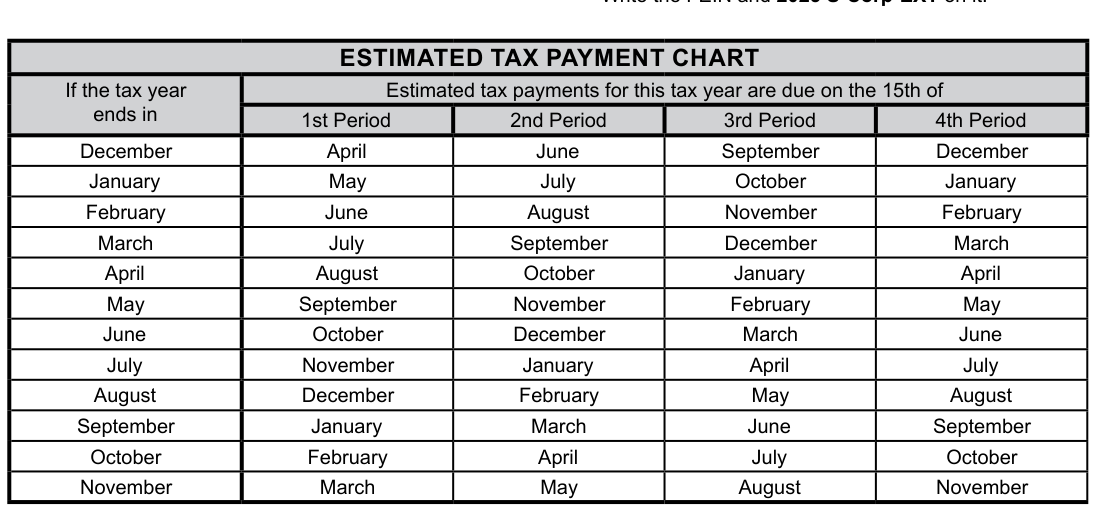
Text version of this table
| ESTIMATED TAX PAYMENT CHART | ||||
| If the tax year ends in | Estimated tax payments for this tax year are due on the 15th of | |||
| 1st Period | 2nd Period | 3rd Period | 4th Period | |
| December | April | June | September | December |
| January | May | July | October | January |
| February | June | August | November | February |
| March | July | September | December | March |
| April | August | October | January | April |
| May | September | November | February | May |
| June | October | December | March | June |
| July | November | January | April | July |
| August | December | February | May | August |
| September | January | March | June | September |
| October | February | April | July | October |
| November | March | May | August | November |
# INTEREST AND PENALTIES
This section gives you general instructions and information about interest and penalties.
Interest on Taxes Underpaid or Not Paid and Internal
# Revenue Code (IRC) Rates
Interest accrues on tax, including estimated tax, underpaid or not paid on or before the due date of the S-Corp return, even if you receive an extension of time to file. Interest is a charge for the use of money and by law cannot be waived.
Interest is calculated on a daily basis at the rate established for individual income tax purposes by the IRC. The IRC rate, which changes quarterly, is announced by the IRS in the last month of the previous quarter. The annual and daily interest rates for each quarter are posted on our website at overview/penalty-interest-rates/.
# Negligence Penalty for Late Filing or Late Payment
The Department imposes a penalty when a return is not filed or paid timely. The penalty is 2% of the tax due for each month, or partial month, from the date the return was due, not to exceed 20% of tax due. The penalty does not apply if the entity has an extension of time to file and the tax is paid by the extended due date.
Underpayment Penalty and Interest for Estimated Tax
The penalty is 2% of the tax due for each month, or partial month, from the date the return was due. Interest is calculated on a daily basis at the rate established for individual income tax purposes by the IRC.
When Penalty and Interest Stop Accruing
After the principal tax liability is paid, penalty and interest stop accruing.
Penalty on a Check Not Paid
A check not paid by the financial institution on which it is drawn does not constitute payment. The Department assesses the corporation a minimum penalty of $20 in addition to other applicable penalties and interest.
# A Refund and Possible Interest on the Refund
If the return shows an overpayment and you requested a refund of all or part of the overpayment, please allow at least 12 weeks for processing before contacting the Department.
Processing time varies according to when you file the return.
You may be entitled to interest on an overpayment under certain conditions. The interest rate is the same charged for underpayments.
The Department shall pay no interest in any of these situations:
- If the interest is less than $1.00
- If the refund is approved within 55 days of the date of the claim for refund for current tax year
- If the refund is approved within 120 days of the date of the claim for refund for prior tax years
- If the Department cannot process the S-Corp return due to missing information
- If the interest is for a refund of any credits claimed for the Investment Credit Act, Laboratory Partnership with
Small Business Tax Credit Act, Technology Jobs and Research and Development Tax Credit Act, Film Production Tax Credit Act, Affordable Housing Tax Credit Act, Rural Job Tax Credit, or High wage Job Tax Credit.
To process an S-Corp return, the return must be fully completed. This means the return complies with all instructions for the return and contains all attachments required by those instructions. The Department pays any refund interest due when a return is complete.
# Taxpayer Information Data Block
Lines 1a through Line 6d , and Lines A through F
Type or print the entity's information at the top of the S-Corp return as described here. Then complete all information in lines A through F, and mark all relevant boxes. If the return is received with an incomplete address it will be rejected
Line 1a. Enter the entity's registered name.
Line 2a. Enter the number and street name of the entity's mailing address.
If the entity has a foreign address, enter the street address, city name and postal code in the appropriate line. Also complete the spaces for the foreign province and/or state and country.
Line 3a. Enter the city of the entity's mailing address.
Line 3b. Enter the state of the entity's mailing address.
Line 3c. Enter the postal/zip code of the entity's mailing address.
Line 3d. If the entity's address is a foreign address, enter the country's full name. Do not abbreviate the country name.
Line 3e. Enter the foreign province and/or state of the entity's mailing address. Follow the country's practice to enter the foreign province and/or state.
Box 4a. If this is an original return, mark box 4a.
Box 4b. If this is an amended return, mark box 4b and continue to lines 4b.(i) and 4b.(ii) for Type and Date below.
If you check the amended box, you must complete the Type and Date lines, if they are applicable, for your amendment reason. See the table "T1. Amended Reasons" on page 12 for more information.
# Line 4b.(i) Type. (Required) Review table "T1. Amended
Reasons" on page 12 and determine which Amended Reason fits your tax situation. Enter the two-digit Type Code .
Line 4b.(ii) Date. If your amended reason is due to an RAR (Type 01) or FAR (Type 03) enter the Final Determination
Date on this line. IMPORTANT: Format requirement MM/ DD/CCYY.
NOTE: A complete amended return indicating Amended-
FAR is sufficient to meet the requirement of filing a Federal Adjustment Report (FAR) with the New Mexico Taxation and Revenue Department under Section 7-1-13 NMSA 1978.
NOTE: For more information about amended returns, see "Amended Returns" on page 8.
# Code Reason Description
Report changes resulting from an IRS audit and their Revenue Agent's Report (RAR) within 180 days of the 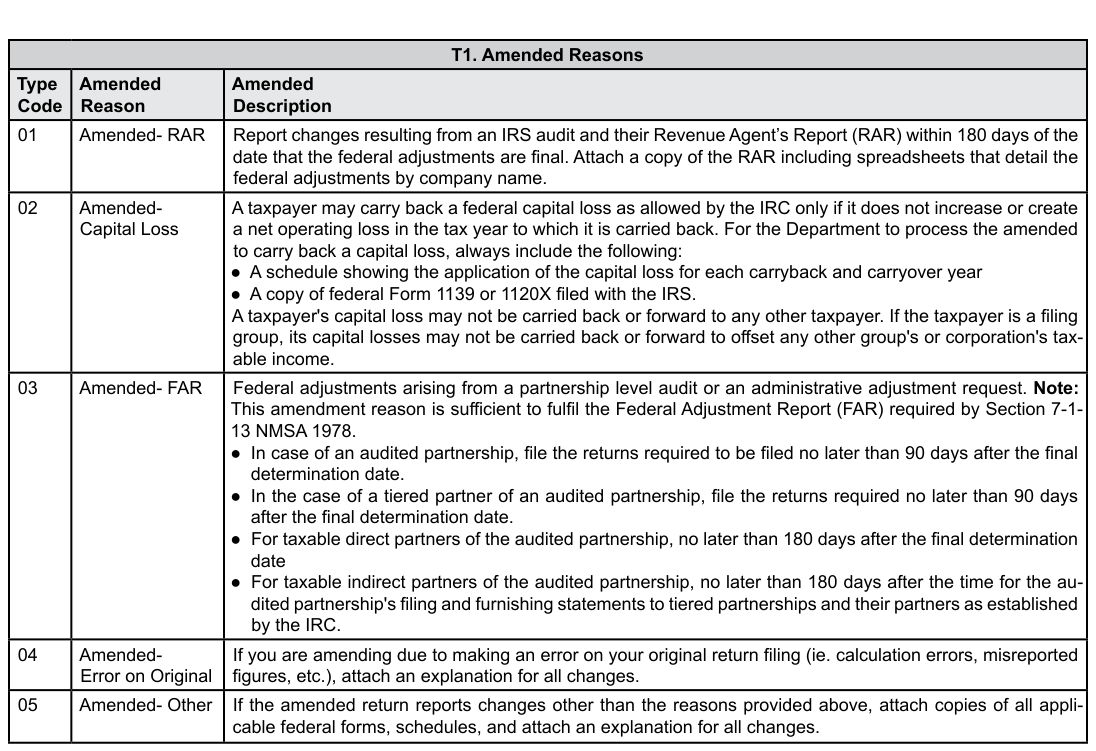
Text version of this table
T1. Amended Reasons Type Code Amended Reason Amended Description 01 Amended- RAR Report changes resulting from an IRS audit and their Revenue Agent’s Report (RAR) within 180 days of the date that the federal adjustments are final. Attach a copy of the RAR including spreadsheets that detail the federal adjustments by company name. 02 Amended- Capital Loss A taxpayer may carry back a federal capital loss as allowed by the IRC only if it does not increase or create a net operating loss in the tax year to which it is carried back. For the Department to process the amended to carry back a capital loss, always include the following: ● A schedule showing the application of the capital loss for each carryback and carryover year ● A copy of federal Form 1139 or 1120X filed with the IRS. A taxpayer's capital loss may not be carried back or forward to any other taxpayer. If the taxpayer is a filing group, its capital losses may not be carried back or forward to offset any other group's or corporation's tax able income. 03 Amended- FAR Federal adjustments arising from a partnership level audit or an administrative adjustment request. Note: This amendment reason is sufficient to fulfil the Federal Adjustment Report (FAR) required by Section 7-1- 13 NMSA 1978. ● In case of an audited partnership, file the returns required to be filed no later than 90 days after the final determination date. ● In the case of a tiered partner of an audited partnership, file the returns required no later than 90 days after the final determination date. ● For taxable direct partners of the audited partnership, no later than 180 days after the final determination date ● For taxable indirect partners of the audited partnership, no later than 180 days after the time for the au dited partnership's filing and furnishing statements to tiered partnerships and their partners as established by the IRC. 04 Amended- Error on Original If you are amending due to making an error on your original return filing (ie. calculation errors, misreported figures, etc.), attach an explanation for all changes. 05 Amended- Other If the amended return reports changes other than the reasons provided above, attach copies of all appli cable federal forms, schedules, and attach an explanation for all changes.
# Error on Original
If the amended return reports changes other than the reasons provided above, attach copies of all appli-05 Amended- Other cable federal forms, schedules, and attach an explanation for all changes.
Line 5a. (Required) Enter the entity's complete Federal Employer's Identification Number (FEIN).
IMPORTANT: The Department cannot process a return without the FEIN. Failure to provide the FEIN will cause rejection of the return.
Line 5b. Enter the entity's 5- or 6-digit NAICS code. This is the North America Industry Classification System business activity code reported for New Mexico and federal filing purposes. If you do not know the NAICS code, see the instructions for federal returns at https://www.irs.gov.
Line 6a and 6b. Fiscal year or short-year filers enter tax year start and end dates (the dates the entities' books open and close for the tax year) from their federal returns.
Line 6c. Enter the original due date of the corporation's required federal return. If the federal return provides an electronic due date for that return, enter that date. The original federal due date is not the extension due date.
Line 6d. If the due date was extended, enter the extension date and include a copy of the federal or New Mexico extension with the S-Corp return.
Line A. Enter the state where the entity was organized.
Line B. Enter the date the entity was organized.
Line C. Enter the date business began in New Mexico.
Line D. If the New Mexico business was terminated in New Mexico, enter that date.
Line E. Enter the name of the entity's registered agent in New Mexico.
Line F. Enter the entity's registered agent's mailing address including city, state, and postal/zip code.
# Line and Other Entries on S-Corp
Follow these instructions to complete lines 1 through 23 on the S-Corp return, and the signature and preparer information at the bottom of the page.
Lines 1 through 4 are for S corporations with income subject to federal tax. S corporations use these lines to calculate New Mexico tax.
Line 1. Income taxable to corporation. From S-Corp-C, column 1, line 4, enter the total allocated and apportioned income taxed to the corporation.
Line 2. Tax on amount on line 1. Multiply line 1 income taxable to corporation by 5.9%, then enter the result on this line.
Line 3. New Mexico percentage. If on S-Corp-C, line 5 you show the percentage of New Mexico allocated and apportioned income, enter the percentage. Otherwise, enter 100%.
Line 4. New Mexico income tax. Multiply the amount on line 2 tax on amount on line 1 by the percentage on line 3 New Mexico percentage, then enter the result on this line.
Line 5. Total tax credits applied against the income tax liability on line 4. If you are claiming any tax credits to apply to the income tax liability, complete Schedule S-Corp-CR.
Then enter the amount on S-Corp-CR, line A, the total of the credits to apply to the tax liability due.
# About Tax Credits and Backup Documents
- The sum of credits claimed on S-Corp-CR may not exceed the income tax claimed on S-Corp, line 4.
- To calculate the amount an entity may claim for any tax year, follow the directions on the tax credit claim form or in the tax credit instructions.
- For the Department to consider a credit claim, you must include with the S-Corp return the required documents for each tax credit, along with applicable forms, statements, or other required backup.
To see which backup documents are required to claim a tax credit, use the S-Corp-CR Instructions available at https:// NOTE: For more information about business-related credits, see FYI-106, Claiming Business-Related Tax Credits for Individuals and Businesses. Find FYI-106 at https://www.tax.newmexico.gov/forms-publications/. Click Publications then FYIs.
Line 6. New Mexico income tax less tax credits. Subtract line 5 credits from line 4 income tax, then enter the result or zero whichever number is larger on this line. This line cannot be a negative number Line 7. Franchise Tax. Enter the total franchise tax due on this line.
The $50 franchise tax is due for each tax year, including short years. You may not prorate the franchise tax based on a short-year return.
Every domestic or foreign entity taxed as an S corporation must pay the $50 franchise tax if any of the following requirements are true. The entity:
- Transacts business in, into, or from New Mexico
- Derives income from property or employment within this state
- Has or exercises its corporate franchise in New Mexico, whether engaged in active business or not
- Is an otherwise tax-exempt corporation with unrelated business income IMPORTANT: It is your responsibility to comply with all additional filing requirements imposed by the New Mexico
# Secretary of State, Corporations Bureau. For information call
(505) 827-4511 in Santa Fe or toll free (800) 477-3632, or visit http://www.sos.nm.gov.
Line 8. Total income and franchise tax. Add line 6 net income tax amount and line 7 franchise tax amount, then enter the result on this line.
Line 9. Total withholding, composite, and entity-level tax.
Enter the amount from S-Corp-1, line 28.
Line 10. Total New Mexico tax. Add line 8 total income and franchise tax and line 9 total withholding, composite, and entity-level tax, then enter the result on this line.
Line 11. Amended Returns Only. If this is an amended return, enter the total amount of all 2025 refunds received and overpayments applied to 2026.
Line 12. Subtotal. Add line 10 total New Mexico income tax and line 11 refunds received and overpayments applied, then enter the result on this line.
Line 13. Total Payments. Mark one or more of these boxes to show the source of the entity's total payments:
Extension
•
Estimated
•
Applied from prior year
•
Enter the total amount of all extension, estimated, and tax payments applied from the prior year. For amended returns, include additional tax paid on or after the due date of the return.
IMPORTANT: If any amounts on line 13 were paid using an FEIN other than the one entered at the top of the S-Corp return, a schedule is required with the name and FEIN under which the payment was made.
Line 14. New Mexico income tax withheld from oil and gas proceeds. From annual withholding statements 1099-MISC and RPD-41285, Annual Statement of Withholding of Oil and Gas Proceeds, enter the total of all New Mexico income tax withheld from distributions of oil and gas proceeds made to this S-Corp. Include a copy of each statement with the S-Corp return.
Requirements
- Do not include on this line any withholding reported on Line 17 of the S-Corp-1.
- Only report New Mexico tax withheld on oil and gas proceeds received by the entity.
- The only withholding statements the Department accepts for oil and gas proceeds are the forms 1099-MISC and RPD-41285 issued to the entity.
Line 15. New Mexico income tax withheld from passthrough entities. From annual withholding statements 1099-MISC and RPD-41359, Annual Statement of Pass-Through Entity Withholding, enter the total of all New Mexico income tax withheld for the S-Corp from payments of another PTE made to this S-Corp. Include a copy of each statement with the S-Corp return.
Requirements
- Do not include on this line any withholding reported on Line 17 of the S-Corp-1.
- Only report New Mexico tax withheld on the net income received from a PTE.
- The only withholding statements the Department accepts for PTE withholding are the forms 1099-MISC and RPD-41359 issued to the entity.
Line 16. Total payments and tax withheld. Add line 13 total payments, line 14 oil and gas proceeds, and line 15 passthrough entities, then enter the result on this line.
Line 17. TAX DUE. If line 12 subtotal is greater than line 16 total payments and tax withheld, subtract line 16 from line 12, then enter the result on this line.
Line 18. Penalty. Calculate penalty if any of the following is true:
- You file late.
- You do not pay the tax on or before the due date of the return.
- You do not pay the tax on or before the extended due date of the return.
Calculate penalty by multiplying the unpaid or late filed amount of tax due on line 17 by 0.02 (2%). Then multiply this amount by the number of months or partial months for which your return or payment is late. Penalty is not to exceed 20% of the tax due and cannot be less that $5.00.
Line 19. Interest. If the entity fails to file timely or to pay the amount on line 17 when due, add interest on this line. Interest accrues daily on the unpaid principal of tax due. The interest accrual rate can change on a quarterly basis.
# Interest Changes Quarterly
The IRC rate, which changes quarterly, is announced by the IRS in the last month of the previous quarter. The annual and daily interest rates for each quarter are posted on our website at https://www.tax.newmexico.gov/individuals/fileyour-taxesoverview/penalty-interest-rates/.
Formula to Calculate Interest
Calculate interest by multiplying the unpaid or late filed amount of tax due on line 17 by the daily interest rate for the quarter. Then multiply this amount by the number of days which your return or payment is late.
# Line 20. TAX, PENALTY, AND INTEREST DUE. Add line
17 tax due line 18 penalty, and line 19 interest; then enter the result on this line.
Line 21. Overpayment. If the amount in line 16 total payments and tax withheld is greater than the amount line 12 subtotal, subtract line 12 from line 16, then enter the result on this line.
Line 21a. If you want to apply some or all of an overpayment from line 21 to the 2026 liability, enter the amount to apply.
Otherwise, enter zero.
Line 21b. If you want to receive a refund of all or part of an overpayment, subtract line 21a amount of overpayment to apply to the 2026 income tax liability from line 21 overpayment, then enter the result on this line.
Line 22. Total portion of tax credits to refund. Enter from Schedule S-Corp-CR, line B, the portion of approved tax credits the Department may refund to you.
NOTE: S-Corp-CR, line A shows the amount of these credits to apply to the tax due on the S-Corp return. This is the same amount as on S-Corp, line 5.
Line 23. AMOUNT TO BE REFUNDED. Add line 21b amount of overpayment to refund and line 22 tax credit to refund, then enter the result on this line.
# Refund Express
If you want a refund of overpaid tax and any refundable credit (S-Corp, line 23) directly deposited into a checking or savings account, complete the Refund Express section.
Failure to complete all lines and boxes in this section results in the Department denying the request and mailing a paper check to you.
NOTE: The Department is not responsible if a financial institution refuses a direct deposit, or if misapplication of a direct deposit refund was caused by a taxpayer's error, negligence, or malfeasance.
# Requirements for Refund Express
- Lines 1 and 2 and boxes 3 and 4 are complete in the
Refund Express section.
- The account must be located in the territorial jurisdiction of the U.S.
- Direct deposits are only allowable to the taxpayer's account. The Department denies any request to deposit funds into another payee's account.
- The financial institution accepts direct deposits payable to the name on the S-Corp return.
# Why Use Refund Express
Prevent any mailed check delays. Refund Express
- does not guarantee that you receive a refund sooner, but the refund reaches the bank more quickly.
- Payment is more secure. There is no check to get lost.
- It is convenient. Avoid an extra trip to the bank.
- It saves tax dollars. Direct deposit costs less than a check.
Refund Express Lines 1 and 2 and Boxes 3 and 4
Line RE1. The routing number, for bank identification, has nine digits. If the first two digits are not 01 through 12 or 21 through 32, the system rejects the direct deposit and you receive a check. On the sample check, the routing number is 211500151.
Line RE2. The account number has up to 17 characters. Include hyphens, but omit spaces and special symbols as you enter the number from left to right. Leave unused boxes blank.
On the sample check, the account number is 2015551517.
Do not include the check number.
Box RE3. Mark an X in the Checking or Savings box to indicate the type of account.
Box RE4. Mark an X in the YES or NO box to answer whether the funds for a refund would go to or through an account located outside the U.S. Marking NO means the financial
S CORPORATION'S NAME
123 Main Street
SAMPLE
Anyplace, NM 87000
PAY TO THE
$
ORDER OF __ tries, the Department mails a check to you.
15-000000000
Taxpayer's Signature and Preparer Information
Taxpayer's Signature
An officer of the corporation must sign and date the S-Corp return. Enter the following
__ DOLLARS
Routing Account
Number Number
ANYPLACE BANK
Anyplace, NM 87000 information:
Do not include the • Signature of Officer, Member, or check number Partner
For __
A211500151 A 2015551517 C 1540 institution's location is within the territorial jurisdiction of the U.S., which includes any of the following:
- Within the U.S.
- On a U.S. military base
- In American Samoa, Guam, the Northern Mariana Islands, Puerto Rico, or the U.S. Virgin Islands
# What Happens for Different Answers
If you check the YES box, you cannot use Refund Ex-
- press. Either use a different bank account or to leave the Refund Express section blank to receive a paper check.
- If you do not answer the question, the Department mails the refund to you in a paper check. To comply with federal banking rules, anyone who wants their refund directly deposited into their account must answer this question.
- If you answer the question incorrectly, the National Automated Clearing House Association (NACHA) or the Office of Foreign Assets Control (OFAC) may delay, reject, or freeze the refund.
If the bank does not accept the Refund Express en-•
- Date of signature
- Title of officer, member, or partner
- Contact phone number
- Taxpayer's email address
# Paid Preparer's Use Only
Any person, other than an employee of the corporation, who prepares the return for compensation must also sign and date the return. A preparer other than an employee of the corporation is required to enter the following:
- Signature of preparer
- Date of signature
- Firm name, or if preparer is self-employed their name.
- Printed preparer's name
- New Mexico Business Tax Identification Number (NMB-TIN), if the preparer has one.
- FEIN, if applicable
- PTIN, the Preparer Tax Identification Number
- Preparer's phone number
The Department considers an improperly signed or unsigned return invalid and incomplete for filing purposes. If the Department receives completed information after the due date, the Department may assess penalty and interest.
# S-CORP-1 INCOME TAXABLE TO OWNERS
Computation of net income
NOTE: If electing to file entity-level tax, the net income subject to PTE withholding on line 14 will only include income of owners whose income is not included in distributed net income subject to entity-level tax on line 27. If all net income of the entity is included on line 27, there is no requirement to withhold.
Line 1. Ordinary business income (loss) from federal
Form 1120S, Schedule K. Enter the ordinary income or loss as recognized from federal tax return Form 1120S, Schedule K.
Line 2. Other income (loss) from federal Form 1120S,
Schedule K. Except for guaranteed payments to partners and health insurance payments made on behalf of the partners or partners' dependents, enter the summation of all other income or losses recognized on federal tax return Form 1120S, Schedule K.
Line 3. Interest income from municipal bonds, excluding
New Mexico bonds. Enter interest income from non-New Mexico state and local bonds not subject to federal income tax under Internal Revenue Code (IRC) Section 103.
Line 4. Subtotal of lines 1, 2, and 3. Add line 1 ordinary business income (loss), line 2 other income (loss), and line 3 interest income from municipal bonds excluding New Mexico bonds, then enter the result on this line.
Line 5. Interest from U.S. government obligations or federally-taxed New Mexico bonds. An S corporation may deduct interest or dividend income from U.S. government obligations from the corporation's taxable income only if, and to the extent that, it was included in taxable income on line 1.
IMPORTANT: Income from Fannie Mae, Ginnie Mae, Freddie Mac, and other U.S. guarantee entities is not deductible.
Income from repurchasing agreements (REPOs) of U.S.
obligations is not deductible. Interest on notes issued by Federal Home Loan Bank obligations are deductible, but not dividends issues by the Federal Home Loan Bank. That portion of income paid by mutual funds, unit investment trusts, and simple trusts derived from investments in U.S. obligations may be deductible.
Interest income from bonds issued by the State of New Mexico or its political subdivisions may also deductible on this line to the extent that income was included in federal taxable income.
Line 6. Allowable deductions from Schedule K. Except for health insurance payments made on behalf of the partners or partners' dependents, enter the allowable deductions recognized on federal Form 1120S, Schedule K. Not allowed to claim at the entity level on the S-Corp return are net operating loss carryover nor oil and gas depletion deductions.
Line 7. Deduction for certain expenses related to a New
Mexico licensed cannabis business. A licensed cannabis business may enter an amount equal to any expenditure that is eligible to be claimed as a federal income tax deduction but is disallowed pursuant to Section 280E of the Internal Revenue Code, as that section may be amended or renumbered.
Line 8. Total New Mexico Allocated income. Enter the total allocated income from S-Corp-B, column 1, line 8, if applicable.
Line 9. Apportionable income. Add line 5 interest, line 6 allowable deductions, line 7 cannabis expense, and line 8 allocated income; subtract the result from line 4 subtotal, then enter the final result on this line.
Line 10. Average New Mexico percentage. Enter the average New Mexico percentage from S-Corp-A, line 5.
Line 11. New Mexico apportionable income. Multiply line 9 apportionable income by line 10 average New Mexico percentage, then enter the result on this line.
Line 12. New Mexico allocated income. Enter New Mexico allocated income from S-Corp-B, line 9, column 2, if applicable.
Line 13. New Mexico net income. Add line 11 New Mexico apportionable income and line 12 New Mexico allocated income, then enter the result on this line.
Line 14. Amount of net income from line 13 that is subject to PTE withholding tax. Enter the portion of New Mexico net income that the entity has determined is subject to PTE withholding tax, including any additional amounts that the entity has decided to withhold on for owners. Also include any income on this line for which withholding tax was paid by another entity and this withholding is being reported as passed directly to owners on line 17. Note that no withholding is due with respect to any net income on which the entity pays tax directly, i.e. any amount included in line 25. If electing to file entity-level tax (see later), include only the net income of owners whose income is not included in the distributed net income subject to entity-level tax on line 25. If all net income of the owners is included on line 25, leave line 14 blank.
For more information on what income distributed to owners is required to have New Mexico income tax withheld, see "Requirement for an S-Corp to Report and Pay New Mexico Withholding Tax" on page 5.
Line 15. Withholding tax rate. The withholding tax rate is 5.9%.
Line 16. Amount of withholding tax on net income. Multiply line 14 amount of net income subject to PTE withholding tax by line 15 withholding tax rate, then enter the result on this line.
Line 17. Total withholding tax passed directly to owners.
Enter the amount of withholding tax that was withheld from a payment made to this S-Corp or an owner of this S-Corp, which payment was passed directly on to an owner or owners of this S-Corp. This line allows the S-Corp to subtract any withholding tax that was already paid by another entity.
If this S-Corp has had tax withheld from the oil and gas proceeds or the allocable net income received from another PTE, this S-Corp may pass credit for the tax withheld to its owners by issuing each owner a 1099-Misc, a pro forma 1099-Misc or a New Mexico Form RPD-41359, Annual Statement of Pass-Through Entity Withholding. Do not include on this line any tax that was or is to be withheld and paid by the S-Corp which files this return. The withholding tax reported on this line must not be reported on the S-Corp lines 14 and 15.
Line 18. Total withholding tax. Subtract line 17 withholding passed directly to owners from line 16 amount of withholding on net income, then enter the result on this line.
Line 19. Amount of net income from line 13 subject to composite income tax. Enter the portion of net income distributed to owners that have elected to have the entity file a composite income tax on their behalf.
Line 20. Composite income tax rate. The composite tax rate is 5.9%.
Line 21. Total composite income tax. Multiply line 19 net income subject to composite income tax by line 20 composite income tax rate, then enter the result on this line.
COMPUTATION OF ENTITY-LEVEL TAX
Complete lines 22 through 27 if electing to file and pay entitylevel tax. If not electing to file entity-level tax, you may leave Section 2, lines 22 through 29, blank. The election to file entity-level tax is binding on all owners of the pass-through entity whose income is included in the net income subject to entity-level tax. The S-Corp calculates the distributed net income subject to entity-level tax on the lines below and will pay tax directly on this income. All owners whose income is included in distributed net income subject to entity-level tax on line 25 will be allocated a share of the entity-level tax paid and be able to claim a credit for the tax paid on the owner's PIT and CIT return.
Line 22. New Mexico net income from line 13. Enter the amount entered on line 13.
Line 23. New Mexico net capital gains deduction. Enter the amount of net capital gains that may be deducted from net income pursuant to Section 7-2-34 NMSA 1978 for owners who are subject to the Income Tax Act. The PTE may deduct from net income all or part of net capital gains reported and claimed on the federal tax return that is allocated to owners subject to personal income tax. For purposes of this deduction, "net capital gains" are defined by Section 1222(11) of the Internal Revenue Code as the excess of net long-term capital gains over short-term capital losses for the tax year.
The PTE may deduct the greater of:
- 100% of the owner's net capital gains, not to exceed $2,500; or
- 40% of up to one million dollars ($1,000,000) of the owner's net capital gain income from the sale of a business that is allocated or apportioned to New Mexico pursuant to Section 7-2-11 NMSA 1978 for the taxable year for which the deduction is being claimed.
The PTE may claim only one-half of the net capital gains deduction allocated to an owner who files a married filing separate return.
Line 24. Distributions not subject to entity-level tax.
Income of certain owners is not included in distributed net income, and the entity may not pay tax directly on such income. Income distributed to the entities listed below is not subject to entity-level tax, and the taxpaying pass-through entity may not pay entity-level tax directly with respect to or on behalf of such owners.
(a) the United States, this state or a political subdivision of either;
(b) a federally recognized Indian nation, tribe or pueblo located wholly or partially in New Mexico, or any political subdivision thereof;
(c) an organization that has been granted exemption from the federal income tax by the United States commissioner of internal revenue as an organization described in Section 501(c)(3) of the Internal Revenue Code;
(d) a corporate partner that would properly include the income in the partner's New Mexico tax return as part of the partner's unitary business income; or
(e) a pass-through entity that is an owner of the electing pass-through entity.
Line 25. Distributions subject to entity-level tax. Add line 23 New Mexico net capital gains deduction and line 24 distributions not subject to entity-level tax; subtract the result from line 22 New Mexico taxable income, then enter the final result on this line.
Line 26. Entity-level tax rate. The entity-level tax rate is 5.9%.
Line 27. Total entity-level tax. Multiply the amount on line 25 distributions subject to entity-level tax by line 26 entitylevel tax rate, then enter the result on this line.
Line 28. Total withholding, composite and entity-level tax. Add line 18 total withholding tax, line 21 total composite income tax, and line 27 total entity-level tax; then enter the result on this line. Also enter this amount on S-Corp, line 9.
# S-CORP-A: NEW MEXICO APPORTIONMENT FACTORS
# When to Use Schedule S-Corp-A
If the entity's income is derived from both inside and outside New Mexico, use S-Corp-A to apportion the entity's income from the entity's regular trade or business activities.
All reporting entities, except those with 100% New Mexico activity, must complete Schedule S-Corp-A in its entirety, including reporting entities with:
- Activities in New Mexico that are immune from corporate income tax under P.L. 86-272
- No business activity in New Mexico during the tax year Apportionable income means income arising from transactions and activities in the regular course of a corporation's trade or business. If the acquisition, management, or disposition of the property constitutes integral parts of the entity's regular trade or business, apportionable income includes income from both tangible and intangible property. It includes investment income related to or used in the entity's overall business operations.
You are required to include on S-Corp-A the following sources of apportionable income:
- Dividend income from the investment of working capital or dividend income from an investment that is functionally connected to the entity's trade or business
- Interest income from the investment of working capital, interest income from capital investments used in the overall business operations, or interest income from an investment that is functionally connected to the entity's trade or business
- Royalty income and fees from patents, copyrights, franchises, trademarks, and licenses developed in the regular course of the entity's trade or business, or royalty income and fees from a product or mineral interest used in the regular course of the entity's trade or business
- Rental or subrental income from property purchased, leased, or used in the regular course of the entity's trade or business
- Gains or losses from the sale of assets used in the regular course of the entity's trade or business, or assets sold that had been treated as business assets in prior years
- If held within the regular course of the entity's trade or business, income from a partnership or non-corporate entity
Construction contractors, railroads, airlines, trucking companies, financial institutions, television and radio broadcasters, and publishers are subject to special apportionment rules.
Taxpayers electing the combined or consolidated methods of reporting must apply these apportionment rules to each qualifying entity included on the return.
# Consistency in Reporting
Consistency in a entity's reporting is required and includes:
- Classification of income as allocable or apportionable
- Valuation of property and inclusion in the property factor
- Treatment of compensation for the payroll factor
- Exclusion or inclusion of receipts in the sales factor for returns filed in all states An entity must disclose any change or inconsistency from prior year returns in a statement attached to the return.
The statement identifies the amounts and reasons for the changes or inconsistencies.
# Petition Procedure Open to Taxpayers
If the procedures for allocation and apportionment required for S-Corp-A and S-Corp-B do not fairly represent the extent of the taxpayer's business activity in New Mexico, the taxpayer may petition to use, or the Secretary of Taxation and Revenue may require taxpayers to use, another method to apportion or allocate all or part of the taxpayer's income.
# Completing Schedule S-Corp-A
When you complete S-Corp-A, follow these basic requirements for the property, payroll, and sales factor sections:
Percentages. Calculate each percentage to four deci-
- mal places. For example, 22.5431%.
Lines 1, 2, and 3. If you complete column 2, you must
- complete column 1, Total Everywhere.
IMPORTANT: If column 1 is blank or zero(0) , the Department apportions 100% of the income to New Mexico.
# PROPERTY FACTOR
Lines 1a, 1b, 1c, and 1d. For each line, as applicable, enter amounts in the columns for inventory, real property, personal property, and rented property.
Line 1e. In column 1, enter the total of the column amounts for lines 1a, 1b, 1c, and 1d. In column 2, enter the total of the column amounts for lines 1a, 1b, 1c, and 1d.
Line 1. Property factor. In columns 1 and 2, enter a positive number or, if the result is a negative number, enter zero.
Calculate the percentage for this factor as follows: amount in column 2 x 100 = property factor percentage amount in column 1 In other words:
- Divide the average value of the real and tangible personal property owned or rented and used in New Mexico during the tax year to produce apportionable income by the average value of all real and tangible personal property owned or rented everywhere and used during the tax year to produce apportionable income.
- To find the property factor percentage, multiply the result by 100.
# Valuation of Property
Property shall be valued according to the following rules:
- Inventory shall be valued according to the valuation method used for federal income tax purposes.
- Value property owned during the tax year shall be valued at its original cost before the allowance for depreciation amount at the time of acquisition by the taxpayer and adjusted by the taxpayer and adjusted by subsequent capital additions, improvements, and partial dispositions.
- Value property rented from others shall be valued at eight times the net annual rental rate. The net annual rate is the annual rent paid less any annual rent received from subrental of the same property. If property owned by others is used by the corporation at no charge or rented by the corporation at a nominal rate, the net annual rental rate is determined on the basis of a reasonable market rental rate for the property.
Determine the average value of property by doing the following:
- Add the total value of property held by the taxpayer at the beginning of the tax period to the total value of property held at the end of the tax period.
- Divide the sum by two.
NOTE: If the Department determines a monthly average is necessary to correctly reflect the average value of the taxpayer's property, the Department may require the taxpayer to calculate an average value on a monthly basis.
# PAYROLL FACTOR
Line 2a. In columns 1 and 2, enter the total wages, salaries, commissions, and other compensation of employees related to apportionable income.
Line 2. Payroll factor. In columns 1 and 2, enter a positive number or, if the result is a negative number, enter zero.
Calculate the percentage for this factor as follows: amount in column 2 x 100 = property factor percentage amount in column 1 In other words:
- Divide the total amount paid as compensation to employees in New Mexico during the tax year by the total amount paid as compensation to employees everywhere during the tax year.
- To find the payroll factor percentage, multiply the result by 100.
Compensation means wages, salaries, commissions, and any other form of remuneration paid to employees for personal services. Only amounts paid directly to employees are includable in the payroll factor.
Employees include leased employees where the taxpayer is considered an employer for payroll tax purposes. Employees are not independent contractors to whom the taxpayer issues federal Form 1099.
Include in the payroll factor only compensation attributable to business operations subject to apportionment. Exclude from the payroll factor compensation of an employee whose primary activities relate to the production of non-business income; however, you may include this compensation as a related expense of the allocated activity.
# SALES FACTOR
Line 3a. In columns 1 and 2, enter the total amounts of gross receipts.
Line 3. Sales factor. If you have a federal taxable income or loss, in column 1 enter only a positive number. Otherwise, in columns 1 and 2 enter a positive number or, if the result is a negative number, enter zero. Calculate the percentage for this factor as follows: amount in column 2 x 100 = property factor percentage amount in column 1 In other words:
- Divide the total gross receipts attributable to New Mexico during the tax year, excluding returns, allowances, and allocated income, by the total gross receipts attributable to New Mexico during the tax year, excluding returns, allowances, and allocated income.
- To find the sales factor percentage, multiply the result by 100.
Gross receipts means all income from transactions and activities in the regular course of business including income from licensing intangible personal property.
# What are New Mexico Sales?
Sales of tangible personal property are New Mexico sales if either of the following is true. The property is:
- Delivered or shipped to a purchaser other than the U.S. government within New Mexico regardless of the FOB (free on board) point or other conditions of the sale
- Shipped from an office, store, warehouse, factory, or other place of storage in New Mexico and either of the following is true:
- The purchaser is the U.S. government.
- The taxpayer is not taxable in the state of the purchaser.
Sales other than sales of tangible personal property are New Mexico sales if any of the following are true:
- The income-producing activity was performed in New Mexico.
- The income-producing activity was performed both inside and outside New Mexico, but a greater proportion was performed within New Mexico than in any other single state. The proportion shall be determined by the cost of performance in each state.
- The gross receipts were from the rental, lease, licensing, or any other use of either real or tangible personal property during the time the property was in New Mexico.
- The gross receipts were from the performance of personal services in New Mexico.
Line 4. Sum of factor percentages. Add lines 1, 2, and 3 to find the sum of factor percentages and then enter the percentage sum.
Line 4a. Count of factors. Count all the factors you used and enter the total count here.
Line 5. Average New Mexico Percentage. New Mexico uses an evenly weighted three-factor formula. Taxpayers who use the three-factor formula complete lines 4, 4a, and 5 on Schedule S-Corp-A.
IMPORTANT: You are required to provide the average percentage on line 5 to all owners of the entity. Also enter this percentage on S-Corp-1, line 10.
The three-factor formula is for all taxpayers except the following exclusions, described in detail later in this section:
Exclusion 1. Qualifying manufacturers who elect to
- use the apportionment formula with a single-weighted sales factor.
Exclusion 2. A taxpayer whose principal business ac-
- tivity in New Mexico is a headquarters operation and who elects to use the single-weighted sales factor formula.
Exclusion 3. Taxpayers allowed or required to elimi-
- nate one or more factors because the three-factor formula does not fairly represent the extent of their business activity in New Mexico.
Taxpayers who elect to use the manufacturers apportionment formula or who are required to use one of the other exclusions, must follow the instructions described next.
For Help Electing an Exclusion Method
For help electing any exclusion method or if you have any questions, call (505) 827-0825 or toll free (866) 809-2335, or email CIT.TaxReturnHelp@tax.nm.gov.
Exclusion 1
# Electing Manufacturers Apportionment Formula
Taxpayers whose principal activity is manufacturing may elect to use the special apportionment formula shown in this section. For tax years beginning on or after January 1, 2014, the election allows taxpayers to apportion their business income to New Mexico using a single weighted calculation by dividing total sales within New Mexico by total everywhere sales.
On or after January 1, 2020, if eighty percent or more of the New Mexico numerators of the property and payroll factors for a filing group, or for a taxpayer that is not a member of a filing group, are employed in manufacturing or operating a computer processing facility, the filing group or the taxpayer may elect to have business income apportioned to this state by multiplying the income by the sales factor for the taxable year
The statutory authority for this elective method is Section 7-4-10B NMSA 1978.
# Definition of Manufacturing
"Manufacturing" means combining or processing components or materials to increase their value for sale in the ordinary course of business,but does not include:
(a) construction;
(b) farming;
(c) power generation; provided "manufacturing" includes electricity generation at a facility that does not require location approval and a certificate of convenience and necessity prior to commencing construction or operation of the facility pursuant to the Public Utility Act;
(d) processing natural resources, including hydrocarbons; or
(e) processing or preparation of meals for immediate consumption.
How to Make the Election: To elect to use the manufacturers apportionment formula, you must notify the Department in writing no later than the filing date of the first return to which your election applies. NOTE: On Schedule S-Corp-A, complete line 5B.
Submit your notification to make your election or to terminate your election to:
Corporate Income and Franchise Tax Unit, P.O. Box 630, Santa Fe, NM 87504-0630.
For assistance, call (505) 827-0825 or toll free: (866) 809-2335, option 4 e-mail: CIT.TaxReturnHelp@tax.nm.gov.
Election Period: If the election is made for taxable years beginning prior to January 1, 2020, it applies to the taxable year in which the election is made and to each taxable year thereafter for three years, or until the taxable year ending prior to January 1, 2020, whichever is earlier.
Elections made for a taxable year beginning on or after January 1, 2020, apply to the taxable year in which the election is made and to each taxable year thereafter until the taxpayer notifies the department, in writing, that the election is terminated, except that the taxpayer shall not terminate the election until the method of apportioning business income has been used by the taxpayer for at least three consecutive taxable years, including a total of at least thirty-six calendar months.
Exclusion 2
# Electing Headquarters Operation Apportionment Formula
Taxpayers whose principal business activity in New Mexico is a headquarters operation may elect to use a single-weighted sales factor apportionment formula. For tax years beginning on or after January 1, 2014, the election allows taxpayers to apportion the business income to New Mexico using a single weighted calculation by dividing total sales within New Mexico by total everywhere sales.
On or after January 1, 2020, if a filing group, or a taxpayer that is not a member of a filing group, has a headquarters operation in New Mexico, the filing group or the taxpayer may elect to have business income apportioned to this state by multiplying the income by the sales factor for the taxable year.
The statutory authority for this elective method is Section 7-4-10C NMSA 1978.
Headquarters operation means (a) and all its items are true or (b) and all its items are true:
(a) the center of operations of a business:
- where corporate staff employees are physically employed
- where centralized functions are performed, including administrative, planning, managerial, human resources, purchasing, information technology, and accounting, but not including a call center
- the function and purpose of which is to manage and direct most aspects and regional and regional headquarters, if the national headquarters is subordinate only to the ownership of the business or its representatives and the regional headquarters is subordinate to the national headquarters
(b) the center of operations of a business:
- the function and purpose of which is to manage and direct most aspects of one or more centralized functions
- from which final authority over one or more centralized functions is issued How to Make the Election: To elect to use the manufacturers apportionment formula, you must notify the Department in writing no later than the filing date of the first return to which your election applies. NOTE: On Schedule S-Corp-A, complete line 5B.
Submit your notification to make your election or to terminate your election to:
Taxation and Revenue Department, Corporate Income and Franchise Tax Unit, P.O. Box 630, Santa Fe, NM 87504-0630 For assistance, call (505) 827-0825 or toll free: (866) 809-2335, option 4 e-mail: CIT.TaxReturnHelp@tax.nm.gov.
Election Period: If the election is made for taxable years beginning prior to January 1, 2020, it applies to the taxable year in which the election is made and to each taxable year thereafter for three years, or until the taxable year ending prior to January 1, 2020, whichever is earlier.
Elections made for a taxable year beginning on or after January 1, 2020, apply to the taxable year in which the election is made and to each taxable year thereafter until the taxpayer notifies the department, in writing, that the election is terminated, except that the taxpayer shall not terminate the election until the method of apportioning business income has been used by the taxpayer for at least three consecutive taxable years, including a total of at least thirty-six calendar months.
# To Calculate the Line 5 Apportionment Percentage
Follow the next steps to calculate the headquarters operation apportionment percentage for S-Corp-A, line 5:
- Complete the property factor and payroll factor information in column 1 and column 2. Although an election for a single weighted formula has been made, this information is still necessary. The percentage factors for property and payroll are not included in the calculation of the Average New Mexico Percentage.
- Enter gross receipts in line 3a, columns 1 and 2.
- On line 3, calculate the sales factor percentage by dividing 3a, column 2 by column 1, and then multiplying by 100.
- In line 4, copy the amount in line 3.
- In line 4a, enter 1.
- In line 5, copy the amount in line 3.
Exclusion 3
# Eliminating One or More Factors
If the allocation and apportionment provisions of the Uniform Division of Income for Tax Purposes Act do not fairly represent the extent of the business activity in New Mexico, an election may be made for, or the Department may require the exclusion of, any one or more insignificant factors. A factor is considered insignificant if column 1 (the denominator) is less than 3% of net income.
Finishing the Last Entries Under Line 5
Line A. If the entity submitted written notification to use the Manufacturers or Headquarters Operation method of apportionment, enter the tax year ending date and the effective date of the election in MM/DD/CCYY format. Otherwise, leave blank and go to line B.
Line B. If you completed line A, mark the Manufacturers or
Headquarters Operation box.
# S-CORP-B: ALLOCATED NON-BUSINESS INCOME TAXABLE TO OWNERS
When to Use Schedule S-Corp-B
Use S-Corp-B to allocate income not connected to the entity's regular trade or business. From the gross amount of income, deduct all direct and indirect expenses related to allocated income.
The entity's books and records determine expenses related to allocated income.
NOTE: If the entity's books and records do not reflect proper amounts for deduction, the entity may rely on other reasonable methods.
Line 1 through Line 9
Complete lines 1 through 9 to allocate non-business income to New Mexico. For applicable lines 1 through 7, do the following:
- In column 1, enter the total income.
- In column 2, enter the total of all direct and indirect expenses related to income to allocate to New Mexico.
Line 1. Net non-business dividends. If the taxpayer's commercial domicile is in New Mexico, allocate to New Mexico the total amount of dividends in column 1 by entering the column 1 amount in column 2.
Commercial domicile means the principal place from which the taxpayer's trade or business is directed or managed.
Line 2. Net non-business interest. If the taxpayer's commercial domicile is in New Mexico, allocate to New Mexico the total amount of interest in column 1 by entering the column 1 amount in column 2.
Line 3. Net non-business rents (loss). From column 1, allocate to New Mexico in column 2 the following non-business net rent income loss:
- Income from real property in New Mexico
- If the taxpayer's commercial domicile is in New Mexico and the entity is not organized under the laws of or taxable in the state where the property is used, income from all tangible personal property
- Income from tangible personal property used in New Mexico Line 4. Net non-business royalties. From column 1, allocate to New Mexico in column 2 the following net nonbusiness royalty income:
- Income from intangibles (patents, copyrights, franchises, trademarks, and licenses) used in New Mexico
- If the taxpayer's commercial domicile is in New Mexico, but the income from the intangible is not taxable in the state where the intangible is used, income from intangibles NOTE: A patent is used in New Mexico if it is used in production, fabrication, manufacturing, or other processing in New Mexico. A copyright is used in New Mexico if printing or other production occurs in New Mexico.
Line 5. Net non-business profit or loss on sale of assets.
From column 1, allocate to New Mexico in column 2 the net gain or loss from the sale or exchange of the following nonbusiness income:
- Real property in New Mexico
- Tangible personal property located in New Mexico at the time it was sold
- If both the following are true, tangible personal property not located in New Mexico at the time it was sold:
- The corporation's commercial domicile is within New Mexico.
- The gain was not taxable in the state where the tangible personal property was located.
- If the corporation's commercial domicile is in New Mexico, intangible personal property Line 6. Net non-business partnership income (loss). From column 1, allocate to New Mexico in column 2 non-business partnership income to the extent the partnership conducts business in this state.
Line 7. Other net non-business income (loss). From column 1, allocate to New Mexico in column 2 other nonbusiness income. If you enter an amount in column 2, you must include a schedule to identify all other income allocated to New Mexico.
Line 8. Total allocated income. Add the amounts in column 1, lines 1 through 7, and enter the total allocated income. Also enter this amount on S-Corp-1, line 8.
Line 9. Total New Mexico allocated income. Add the amounts in column 2, lines 1 through 7, and then enter the total income to allocate to New Mexico. Also enter this amount on S-Corp-1, line 12.
INSTRUCTIONS FOR
S-CORP-C: ALLOCATED AND APPORTIONED INCOME TAXED TO S CORPO-
# RATIONS
When to Use Schedule S-Corp-C
S corporations with federal taxable income must complete Schedule S-Corp-C. S corporations without federal taxable income should not complete this schedule.
Line 1. Capital gains. In column 1, enter net capital gains from federal Form 1120S, Schedule D. In column 2, enter net capital gains allocated to New Mexico.
Real property. Gains and losses from sales and exchanges of real property in New Mexico are allocated to New Mexico.
Tangible property. Gains and losses from sales and exchanges of tangible personal property are allocated to New Mexico if either of the following is true:
- The property was in New Mexico at the time of sale.
- The taxpayer's commercial domicile is in New Mexico and the taxpayer is not taxable in the state where the property was located.
Intangible property. If the taxpayer's commercial domicile is in New Mexico, gains and losses from the sale of intangible property is allocated to New Mexico.
Line 2. Passive income. Refer to the worksheet in the instructions for federal Form 1120S. In column 1, enter the worksheet's excess net passive income on line 22a. In column 2, enter the excess net passive income allocated to New Mexico.
Line 3. Net recognized built-in gain. In column 1, enter the net recognized built-in gain from federal Form 1120S, Schedule D. In column 2, enter the net recognized built-in gain allocated to New Mexico.
Line 4. Total. This entry = line 1 capital gains + line 2 passive income + line 3 net recognized built-in gain.
Line 5. New Mexico percentage. Calculate and show the percentage of non-business income allocated and apportioned to New Mexico, using this formula: line 4, column 2 x 100 = New Mexico percentage line 4, column 1 Carry the percentage to four decimal places and round to the fourth decimal place (example, 22.4653%).
Enter the percentage on line 5 of Schedule S-Corp-C and on line 3 of the S-Corp return.
INSTRUCTIONS FOR
S-CORP-D: DETAIL OF OWNER WITHHOLDING, COMPOSITE TAX AND ENTI-
# TY-LEVEL TAX DETAIL
Annually, an S-Corp that passes tax to its owner and therefore is subject to withholding tax from the allocable net income of its owners, according to the Oil and Gas Proceeds and Pass-Through Entity Withholding Tax Act (Sections 7-3A-1 through 7-3A-10 NMSA 1978), will file the S-Corp return and use the S-Corp-D Detail of Owner Withholding, Composite Tax and Entity-level tax, to report withholding for each owner, composite income tax for any electing owners, and/or the amount of entity-level tax paid on behalf of each owner. The S-Corp-D:
- Lists only payees who have New Mexico net allocable income and losses
- Reports each owner's share of net income allocable to New Mexico for withholding tax and reports the owner's share of withholding
- Reports the amount of composite income tax paid for any electing owners
- If electing to file entity-level tax, reports each owner's share of allocable net income subject to entity-level tax if electing to file entity-level tax The S-Corp reports all resident and non-resident owners on the S-Corp-D, even when no tax has been withheld. Do not include owners who did not receive New Mexico allocated net income.
To complete the S-Corp-D and S-Corp-D Supplemental, do the following:
- Determine every S-Corp owner with net allocable income or loss.
- Calculate the share of withholding tax paid on any each owners behalf if applicable.
- Calculate the composite income tax paid for any electing owners.
- If the entity has elected to file entity-level tax, determine each owners share of allocable net income subject to entity-level tax. For owners that are subject to personal income tax, the entity will adjust the amount of allocable net income subject to entity-level tax with respect to the capital gains deduction allowed for these taxpayers. Be sure that for owners that are subject to corporate income tax, or owners that are another pass-through entity, the owners allocable share of net income subject to entity-level tax does not reflect this deduction.
- If the entity has elected to file entity-level tax, determine the amount of each owner's share of entity-level tax.
Complete all fields for each S-Corp as described in the Line Instructions section below.
- If the S-Corp has more than 8 owners, print more copies of the S-Corp-D Supplemental directly from the website.
NOTE: If you use more than 12 additional pages (over 50 owners), you must file electronically.
- Attach all S-Corp-D Supplemental pages to the first page of the S-Corp-D.
IMPORTANT: Do not use a copy machine to make more pages. Copied forms delay processing your report because high-throughput scanning machines have difficulty reading copied barcodes. It is easier for the machines to read printed barcodes than photocopied barcodes.
# Line Instructions for S-Corp-D
Line 1a. Owner's SSN/ITIN/FEIN. This information is required.
Line 1b. ID Provided. Check the box to indicate which ID type was provided on line 1a. SSN/ITIN or FEIN Line 2. Owner's Name. Provide the owners first, middle, and last name.
Line 3a. Owner's Address (Number Street). This field allows for two row entry, please provide full address.
Line 3b. City. Enter the city for the address provided on 3a.
Line 3c. State. Enter in the state for the address provided on 3a.
Line 3d. ZIP Code/ Postal Code. Enter the zip code and if applicable the postal code for the address provided on 3a.
Line 3e. Mark if outside of the US/Country Code. If outside of the US check the box and provide the two-character country code in the space allowed. You can find the country codes listed on the IRS website: https://www.irs.gov/e-fileproviders/foreign-country-code-listing-for-modernized-e-file.
Line 4. Residency Status. Provide the owner's New Mexico residency status.
N- Non-resident
•
# R- Resident
•
Line 5. Withholding required.
Y for Yes, withholding required, skip line 6.
•
N for No, withholding not required. If No, line 6 is re-
- quired.
Withholding is not required if the S-Corp is filing a composite return or paying entity-level tax for the owner. See table "T2.
Reason Codes: Withholding Not Required" on page 25, for additional reasonable causes for not withholding.
Line 6. Reason Code. Enter the Reason Code in the box to identify the reasonable cause for not withholding. New Mexico regulations recognize the following reasonable causes for not withholding. See table "T2. Reason Codes:
Withholding Not Required" on page 25.
# Approval Required for Other Reasonable Causes
If you believe the S-Corp has a valid reason for not withholding from an owner, other than the reasons listed on page 24, the Secretary's approval of your reason before filing gives the S-Corp the right not to withhold. A request requires detailed information to support an alternative reasonable cause for not withholding.
To request the Secretary's approval, submit a written request to:
# Corporate Income and Franchise Tax Unit
P.O. Box 630
Santa Fe, NM 87504-0630
Line 7. Owner share of allocable net income. Enter the owner's share of allocable net income. The total of all line 7 amounts for all schedules corresponds to the amount on the S-Corp-1 line 13, New Mexico net income.
Line 8. Owner share of withholding tax. Enter the owner's share of withholding tax. The total of all line 8 amounts for all schedules corresponds to the amount on the S-Corp-1, line 18, Total withholding tax.
NOTE: When determining the amount of tax to withhold for each owner, see Adjustments To The Amount Withheld at the end of these instructions.
Line 9. Owner's Percentage. Enter the owner's percentage of ownership.
Line 10. Amount of owner composite tax. Amount of composite tax the S-Corp has paid for the owner. The total of all line 10 amounts for all schedules corresponds to the amount on the S-Corp-1, line 21, Total composite income tax.
Line 11. Owner share of allocable net income subject to entity-level tax. Enter the amount of allocable net income subject to entity level for this owner. The total of all line 11 amounts for all schedules corresponds to the amount on the S-Corp-1, line 25, Distributions subject to entity-level tax.
Line 12. Owner share of entity-level tax. Enter the share of entity-level tax for this owner. A total of all line 12 amounts for all schedules may not equal the amount of entity-level tax on S-Corp-1, line 27, Total entity-level tax. This line may include amounts of entity-level tax passed on from other pass-through entities.
# Adjustments To The Amount Withheld
An S-Corp may make the following adjustments to the amount withheld:
- You may reduce, but not below zero, the amount of tax withheld from the owner's net income by the amount required to withhold for oil and gas proceeds.
- If an S-Corp deducted and withheld an amount, pursuant to the Oil and Gas Proceeds and Pass-Through Entity Withholding Tax Act, from the net income of an owner that is also a PTE, the payee PTE may take credit for that amount in determining the amount the payee PTE must withhold and deduct.
# T2. REASON CODES: WITHHOLDING NOT REQUIRED
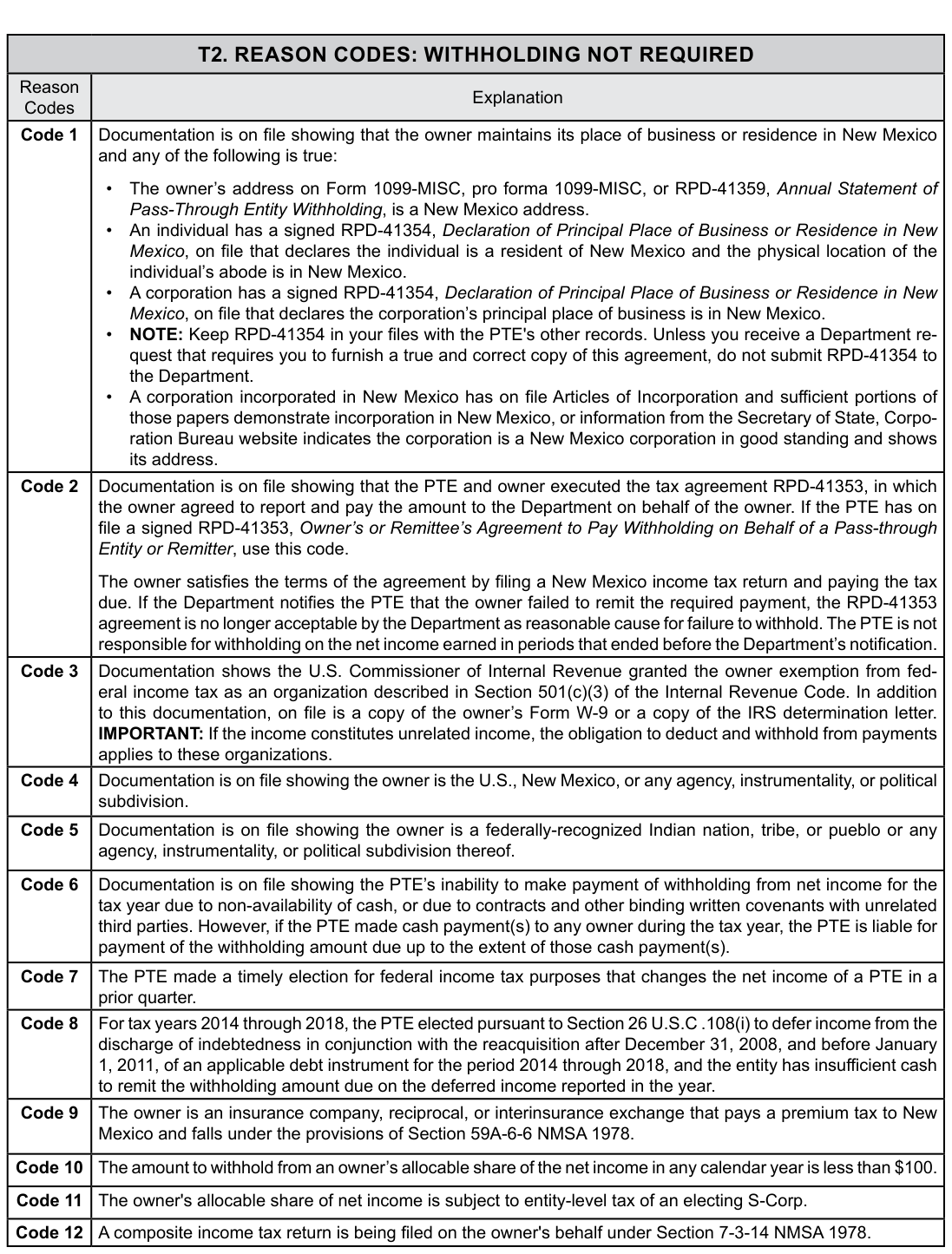
Text version of this table
| T2. REASON CODES: WITHHOLDING NOT REQUIRED | |
| Reason Codes | Explanation |
| Code 1 | Documentation is on file showing that the owner maintains its place of business or residence in New Mexico and any of the following is true: • The owner’s address on Form 1099-MISC, pro forma 1099-MISC, or RPD-41359, Annual Statement of Pass-Through Entity Withholding, is a New Mexico address. • An individual has a signed RPD-41354, Declaration of Principal Place of Business or Residence in New Mexico, on file that declares the individual is a resident of New Mexico and the physical location of the individual’s abode is in New Mexico. • A corporation has a signed RPD-41354, Declaration of Principal Place of Business or Residence in New Mexico, on file that declares the corporation’s principal place of business is in New Mexico. • NOTE: Keep RPD-41354 in your files with the PTE's other records. Unless you receive a Department re quest that requires you to furnish a true and correct copy of this agreement, do not submit RPD-41354 to the Department. • A corporation incorporated in New Mexico has on file Articles of Incorporation and sufficient portions of those papers demonstrate incorporation in New Mexico, or information from the Secretary of State, Corpo ration Bureau website indicates the corporation is a New Mexico corporation in good standing and shows its address. |
| Code 2 | Documentation is on file showing that the PTE and owner executed the tax agreement RPD-41353, in which the owner agreed to report and pay the amount to the Department on behalf of the owner. If the PTE has on file a signed RPD-41353, Owner’s or Remittee’s Agreement to Pay Withholding on Behalf of a Pass-through Entity or Remitter, use this code. The owner satisfies the terms of the agreement by filing a New Mexico income tax return and paying the tax due. If the Department notifies the PTE that the owner failed to remit the required payment, the RPD-41353 agreement is no longer acceptable by the Department as reasonable cause for failure to withhold. The PTE is not responsible for withholding on the net income earned in periods that ended before the Department’s notification. |
| Code 3 | Documentation shows the U.S. Commissioner of Internal Revenue granted the owner exemption from fed eral income tax as an organization described in Section 501(c)(3) of the Internal Revenue Code. In addition to this documentation, on file is a copy of the owner’s Form W-9 or a copy of the IRS determination letter. IMPORTANT: If the income constitutes unrelated income, the obligation to deduct and withhold from payments applies to these organizations. |
| Code 4 | Documentation is on file showing the owner is the U.S., New Mexico, or any agency, instrumentality, or political subdivision. |
| Code 5 | Documentation is on file showing the owner is a federally-recognized Indian nation, tribe, or pueblo or any agency, instrumentality, or political subdivision thereof. |
| Code 6 | Documentation is on file showing the PTE’s inability to make payment of withholding from net income for the tax year due to non-availability of cash, or due to contracts and other binding written covenants with unrelated third parties. However, if the PTE made cash payment(s) to any owner during the tax year, the PTE is liable for payment of the withholding amount due up to the extent of those cash payment(s). |
| Code 7 | The PTE made a timely election for federal income tax purposes that changes the net income of a PTE in a prior quarter. |
| Code 8 | For tax years 2014 through 2018, the PTE elected pursuant to Section 26 U.S.C .108(i) to defer income from the discharge of indebtedness in conjunction with the reacquisition after December 31, 2008, and before January 1, 2011, of an applicable debt instrument for the period 2014 through 2018, and the entity has insufficient cash to remit the withholding amount due on the deferred income reported in the year. |
| Code 9 | The owner is an insurance company, reciprocal, or interinsurance exchange that pays a premium tax to New Mexico and falls under the provisions of Section 59A-6-6 NMSA 1978. |
| Code 10 | The amount to withhold from an owner’s allocable share of the net income in any calendar year is less than $100. |
| Code 11 | The owner's allocable share of net income is subject to entity-level tax of an electing S-Corp. |
| Code 12 | A composite income tax return is being filed on the owner's behalf under Section 7-3-14 NMSA 1978. |
# NEW MEXICO TAXPAYER BILL OF RIGHTS
Most tax transactions happen without problems. Sometimes, though, troubles arise through misunderstanding, mathematical error, missed deadlines, lost papers, high volume of transactions and many other situations. Changes in the law may make earlier information outdated.
Over the years the Legislature and the Department have created ways to handle difficulties according to the provisions of the state tax code.
Following are some of your rights as outlined in Sections 7-1-4.1 through 7-1-4.3 NMSA 1978:
- The right to available public information and prompt and courteous tax assistance;
- The right to representation and advice by counsel or other qualified representatives at any time during your interactions with the Department according to provisions of Section 7-1-24 NMSA 1978, or with the Administrative Hearings Office in accordance with the provisions of the Administrative Hearings Office Act;
- The right to have audits, inspections of records and meetings conducted at a reasonable time and place according to Section 7-1-11 NMSA 1978;
- The right to have the Department conduct its audits in a timely and efficient manner and be entitled to the correct calculation of interest as provided in the Tax Administration Act under Section 7-1-67 and 7-1-68 NMSA 1978;
- The right to simple, non-technical information explaining procedures, remedies and rights during audit, protest, appeals and collection proceedings under the Tax Administration Act;
- The right to receive an explanation of audit results and the basis for audits, assessments or denials of refunds that identify tax, interest or penalty due;
- The right to seek review through formal or informal proceedings of findings or unfavorable decisions arising from determinations during audit or protest procedures according to Section 7-1-24 NMSA 1978 and the Administrative Hearings Office Act;
- The right to have your tax information kept confidential unless otherwise specified by law in Sections 7-1-8 through 7-1-8.11 NMSA 1978;
- The right to an abatement of an assessment of taxes incorrectly, erroneously or illegally made (Section 7-1-28 NMSA 1978) and a right to seek a compromise of an asserted tax liability. When the Secretary of Taxation and Revenue in good faith doubts that you owe us what we claim you owe, you also have the right to seek a compromise if one exists in your particular case (Section 7-1-20 NMSA 1978);
- The right to clear information about penalties if a tax assessment is not paid, secured, protested or otherwise provided for according to Section 7-1-16 NMSA 1978. If you become a delinquent taxpayer, upon notice of delinquency you have the right to timely notice of collection actions that require sale or seizure of your property under the Tax Administration Act, and
- The right to apply to pay your tax obligations by installment payment agreements according to the provisions of Section 7-1-21 NMSA 1978.
Confidentiality Provisions:
Statutes protecting the privacy of your taxes are strict and are outlined in Sections 7-1-8 through 7-1-8.11 NMSA 1978. Section 7-1-8.2 NMSA 1978 limits requiring the Department to answer questions about whether a taxpayer is registered to do business in New Mexico or is registered for other tax programs. It does not allow employees to say whether you have filed a return. Employees may discuss your account only with you or your authorized representative. A hearing officer's written ruling on questions of evidence or procedure pursuant to the Administrative Hearings Office Act are in the public domain. The name and identification number of the taxpayer requesting the ruling are not public record. Public record includes the monthly gasoline tax reports of numbers of gallons of gasoline and ethanol-blended fuels received and deducted, and the tax paid by each filer or taxpayer pays. Identities of rack operators, importers, blenders, suppliers or distributors and the number of gallons of gasoline and other fuels are public record. The Department may reveal to the Gaming Control Board the tax returns of license applicants and their affiliates.
Audit Provisions:
The Department must provide you with written, dated notice that an audit is about to begin on a specific date, and the notice must tell you which tax programs and reporting periods will be covered. We must issue a second notice, which states any outstanding records or books of account requested and not yet received, between 60 and 180 days after the audit begins. If you do not produce the records within 90 days, the Department can issue an assessment of tax on the basis of the information as it stands. If you need additional time, you must submit a specific request in writing. Interest on outstanding liabilities accrues if the Department does not issue an assessment within 180 days of the notice of outstanding records or books, or within 90 days after time has expired under your request for additional time; however, you are entitled to an abatement of interest for the period of time after you have complied with Department requests and the Department has not acted on the audit.
Administrative Hearing Procedures:
A hearing officer may not engage or participate in any way in the enforcement or formulation of general tax policy other than to conduct hearings.
You may request the Chief Hearing Officer of the Administrative Hearings Office determine if a hearing officer has engaged or participated in the enforcement or formulation of tax policy and if the hearing officer's activities have affected his or her impartiality. The Chief Hearing Officer may designate another hearing officer for the matter. Hearing officers may not communicate unilaterally about a matter you have protested while that matter is still pending. The chief hearing officer may appoint another hearing officer if that occurs. You may request a written ruling on any contested question of evidence in matters in which you have filed a pending written protest. You also may request that two or more protests on related issues be combined and heard jointly, and the hearing officer shall grant the request unless it creates an unreasonable burden on the Department.
Credit Claims:
The Department has 120 days from the filing date to approve or deny a statutory tax credit. If it does not act, the credit is approved. For more information see Section 7-1-29.2 NMSA 1978.
Refund Offsets:
The Secretary decides whether a refund of tax due you may be offset against your other tax liabilities, and you will receive notice that the refund will be made accordingly. You are entitled to interest until the tax liability is credited with the refund amount. Please see the paragraph above on "Audit Provisions" for interest due to you if the Department does not offset a refund or credit against your other tax liabilities within the prescribed time. The Department may make a direct refund of overpaid taxes to the taxpayer without requiring the taxpayer to file a refund claim. The Department does not have to pay interest on credits or refunds if it applies the amount to a tax interception program, to an estimated payment, or to offset prior liabilities of the taxpayer.
Awarding of Costs and Fees:
If you prevail in an administrative or court proceeding brought by you or against you after July 1, 2003, under the Tax Administration Act, you may be entitled to a judgment or a settlement for reasonable administrative costs connected to the action.
Penalty:
The Department may not assess penalty against you if you fail to pay tax when due because of a mistake of law made in good faith and on reasonable grounds. If the Secretary determines that it is unfair to hold a spouse or former spouse liable for payment of unpaid taxes, the Secretary may decline to take action against the spouse or former spouse of the person who actually owes the tax. In extreme cases of delinquency under Section 7-1-53 NMSA 1978 the Department may enjoin a taxpayer from continuing in business after a hearing and until the delinquency is cleared.
Source: view the official PDF
Nearby sections (14 sections)
- fyi-105 · FYI-105 Gross Receipts & Compensating Taxes – An Overview
- fyi-106 · FYI-106 Claiming Business-Related Tax Credits for Individuals…
- fyi-200 · FYI-200 Gross Receipts Reporting Location and The Appropriate…
- fyi-204 · FYI-204 Nontaxable Transaction Certificates NTTCs
- fyi-230 · FYI-230 Compensating Tax
- fyi-320 · FYI-320 PIT-ES Personal Income Tax Estimated Payments
- fyi-330 · FYI-330 Income and Withholding Information Returns and Filing…
- pit-1-instructions · 2025 PIT-1 Personal Income Tax Return Instructions
- pit-b-instructions · 2025 PIT-B Instructions
- pit-es · 2025 PIT-ES Estimated Payment Voucher
- pte-instructions · 2025 Instructions for PTE New Mexico Pass-through…
- s-corp-cr-instructions · 2025 S-Corp-CR Instructions
- s-corp-instructions · 2025 S-Corp Instructions for Tax Return
- trd-41413-instructions · TRD-41413ins Gross Receipts Tax Return…