Kansas Department of Revenue Form Instructions & Guides
KW-100 Kansas Withholding Tax Guide
# Tax Guide
NEW WITHHOLDING TAX RATES for wages paid on or after July 1, 2024
KW-100
(Rev. 10-24)
# TABLE OF CONTENTS
During the 2024 Special Legislative Session, Senate Bill 1 was passed and signed into law. The Bill changed the individual income tax rates, increased the standard deduction for individuals, and increased the amount of the allowable personal exemption for individuals filing Kansas income tax returns. All changes are effective for tax year 2024. Because the income tax rates for tax year 2024 are changing mid-year, it is recommended employees review their Kansas withholding to ensure the amount withheld from wages approximates the employee's expected income tax liability.
It is also recommended that employees review their Kansas tax withholding for tax year 2025. See Notice 24.08.
INTRODUCTION TO KANSAS WITHHOLDING TAX … 3 Who Must Withhold Kansas Income Tax?
Who are Employees/Payees?
Sole Proprietors and Partners KANSAS CUSTOMER SERVICE CENTER … 8 File, Pay and Make Updates Electronically What Can I Do Electronically Requirements to File and Pay Pay by Credit Card
PAYMENTS SUBJECT TO KANSAS WITHHOLDING.. 3
Wages
Supplemental Wages
Fringe Benefits
Cafeteria, 401K, and Profit-Sharing Plans Payments Other Than Wages Pensions, Annuities & Deferred Income Interest and Dividends Lottery and Gambling Winnings Wire Transfers Record Keeping Filing Frequencies and Due Dates Completing a KW-5 Deposit Report Correcting a KW-5 Deposit Report ANNUAL RETURNS AND FORMS … 12 Completing a Withholding Tax Return (KW-3) Wage and Tax Statements (W-2) Annual Information Returns (1099 and 1096) WITHHOLDING REGISTRATION … 4 Who Must Register How and When to Register Your Kansas Tax Account Number Your Registration Certificate ADDITIONAL INFORMATION … 13 When Returns are Late Employer/Payer and Officer Liability About Our Billing Process Reporting Business Changes HOW TO WITHHOLD KANSAS TAX … 5 Kansas Withholding Allowance Certificate Additional Kansas Withholding Exclusion from Kansas Withholding How to Compute Kansas Withholding Sample Withholding Computations Changing Your Filing Frequency Closing Your Withholding Account When in Doubt… OTHER REQUIREMENTS AND RESOURCES … 15 Federal Requirements Kansas Requirements SPECIFIC WITHHOLDING SITUATIONS … 7 Kansas Residents Nonresidents of Kansas Employees of Interstate Carriers Entertainers and Athletes Gambling Winnings Management and Consulting Fees Nonresident Aliens Other Miscellaneous Payments Supplemental Wages Business Resource Directory FORM K-4 … 17 FORM CR-108 … 18 TABLES FOR PERCENTAGE METHOD … 19 WAGE BRACKET TABLES … 21 TAXPAYER ASSISTANCE … BACK COVER If there is a conflict between the law and information found in this publication, the law remains the final authority. Under no circumstances should the contents of this publication be used to set or sustain a technical legal position. A library of current policy information is also available on the Kansas Department of Revenue's website at: ksrevenue.gov
# WITHHOLDING TAX
Kansas has a state income tax on personal income. Kansas withholding tax is the money that is required to be withheld from wages and other taxable payments to help prepay the Kansas income tax of the recipient.
An employer or payer pays no part of this tax, but is responsible for deducting it from wages or taxable payments made to an employee or payee. The employer or payer holds the tax in trust for the state, and then remits these funds to the Kansas Department of Revenue on a regular basis.
NOTE: Requirements for income tax withholding generally apply to both employers and payers. Throughout this publication, we may use the term "employer" to denote either an employer or a payer, and the term "employee" to mean either an employee or payee.
# WHO MUST WITHHOLD KANSAS INCOME TAX
As a general rule, every Kansas employer or payer who is required to withhold federal income tax according to the Internal Revenue Code must also withhold Kansas income tax.
EMPLOYERS
Kansas law defines an employer as any person, firm, partnership, limited liability company, corporation, association, trust, fiduciary or any other organization:
- who qualifies as an employer for federal income tax withholding purposes;
- who maintains an office, transacts business, or derives any income from sources within the state of Kansas (whether or not the paying agency is in Kansas);
- for whom an individual performs or performed services of any nature as the employee of such employer; and,
- who has control of the payment of wages for such services or is the officer, agent or employee of the person having control of the payment of wages.
A professional employer organization (PEO) is considered to be an employer for the purpose of withholding Kansas income tax from its assigned workers. A PEO is anyone engaged in providing, or representing itself as providing, the services of employees in accordance with one or more professional employer arrangements.
PAYERS
A payer is any person or organization, other than an employer, who makes a payment other than wages, or a payment of a pension, annuity or deferred income that is taxable under the Kansas income tax act. Kansas income tax withholding is required on payments other than wages (defined on page 4) that are made by payers to payees. Payers include trustees of pension funds and gambling establishments.
IMPORTANT: Even though the employer or payer itself may not be subject to Kansas income tax (such as governmental agencies or nonprofit religious, educational, or charitable institutions), the employer or payer is still required to withhold income tax from payments made to its employees or payees.
# WHO ARE EMPLOYEES/PAYEES
EMPLOYEES
For Kansas withholding tax purposes an employee is either:
- a resident of Kansas performing services either inside or outside of Kansas; or, 2) a nonresident of Kansas performing services within the state of Kansas.
Employers in other states are required to withhold Kansas income tax when the employee is a Kansas resident or when wages paid are for services performed in Kansas. Although an individual may be allowed considerable discretion and freedom of action, that person is considered an employee as long as the employer has the legal right to control what will be done, how it will be done, and the result of the services performed.
If you have questions about whether an individual performing services for you is your employee (you are responsible for the payroll taxes on the wages paid) or is an independent contractor (the individual is responsible for taxes on the income), contact the Internal Revenue Service (IRS) or the Kansas Department of Labor in determining how to classify a worker.
IMPORTANT: Penalties may be imposed on persons who knowingly and intentionally mis-classify an employee as an independent contractor and fail to report state income tax withholding or unemployment insurance contributions.
PAYEES
A payee is any person or organization who receives a payment other than wages, or payment of a pension, annuity or deferred income which is subject to Kansas withholding.
Examples include: 1) Kansas residents receiving a taxable non-wage payment, or a taxable pension, annuity or other deferred income; and, 2) nonresident individuals or organizations receiving a management/consulting fee.
See the Payments Subject to Kansas Withholding section that follows for the types of payments subject to withholding tax. For examples of how to calculate Kansas withholding on taxable payments, see pages 5 through 8.
# SOLE PROPRIETORS and PARTNERS
If you are a sole proprietor or a partner in a partnership, you are not considered to be an employee of your business, and therefore will not withhold income tax on your compensation. Instead you will make quarterly estimated income tax payments to prepay your state income tax liability on taxable income. Visit our website (ksrevenue.gov) for more information about these payments.
# KANSAS WITHHOLDING TAX
As a general rule, if federal income tax withholding is required on the payment, Kansas withholding is also required.
If federal withholding is voluntary, Kansas withholding is generally voluntary as well.
# WAGES
Wages are all payments, whether in cash or other form, paid by an employer to an employee for services performed. If the payment is a wage as defined by section 3401(a) of the federal internal revenue code, it is subject to Kansas income tax withholding when 1) the recipient is a resident of Kansas OR the services were performed in Kansas; and, 2) the payment is subject to federal income tax withholding. Exception: Wages paid to an individual who performs services as an "extra" in connection with any phase of a motion picture or television production or commercial for less than 14 days during any calendar year are not subject to Kansas withholding tax. An "extra" is an individual who pantomimes in the background, adds atmosphere and performs such actions without speaking.
# SUPPLEMENTAL WAGES
are compensation paid to an employee in addition to the employee's regular wage. They include, but are not limited to, bonuses, commissions, overtime pay, accumulated sick leave, severance pay, and back pay.
Kansas withholding is required on all supplemental wage payments. How you calculate the Kansas withholding depends on how the payment is made; see page 8, Supplemental Wages.
# FRINGE BENEFITS
In general, any fringe benefit that is included in an employee's gross income and subject to federal withholding tax is also subject to Kansas withholding tax. Fringe benefits include cars and flights on aircraft you provide, free or discounted commercial flights, vacations, discounts on goods or services, memberships in country clubs or other social clubs, and tickets to entertainment or sporting events.
# CAFETERIA, 401K, and PROFIT SHARING PLANS
Kansas law requires withholding on wages. If your cafeteria,
401K, profit sharing, or other employee plan is considered to be wages by the federal government and federal income tax withholding is required, Kansas withholding is also required.
# PAYMENTS OTHER THAN WAGES
Kansas withholding is required on these taxable payments other than wages when federal withholding is required [K.S.A.
79-3295]. Any determination by the IRS that relieves a payer from withholding on these payments also will apply for Kansas income tax withholding purposes.
- Any supplemental unemployment compensation, annuity or sick pay
- Payments made pursuant to a voluntary withholding agreement
- Gambling winnings
- Taxable payments of Indian casino profits
- Payments of any vehicle fringe benefit
MANAGEMENT AND CONSULTING FEES
Kansas requires withholding on management and consulting fees paid in the ordinary course of a trade, business or other for profit venture to a nonresident of Kansas performing these services in Kansas (i.e., earning taxable Kansas source income). The requirement to withhold Kansas tax on these fees does not apply to individuals, governmental or nonprofit entities, since they are not for-profit ventures. See the sample calculation on page 8.
# INCOME
Kansas withholding may also apply to pensions, annuities or deferred income paid to a Kansas resident. To be subject to withholding, the payment must be taxable under the Kansas income tax act and be: 1) periodic payments of pensions, annuities and other deferred income; or, 2) nonperiodic distributions of pensions, annuities and other deferred income; or, eligible rollover distributions of pensions, annuities and other deferred income.
NOTE: Kansas withholding is required only when federal withholding is required. If federal withholding is voluntary on these payments, Kansas withholding is also voluntary.
EXAMPLE: You are a payer of a taxable pension on which federal withholding is not required; however, the Kansas resident payee elects to have federal withholding deducted from that pension. Since the federal withholding is voluntary, Kansas withholding is also voluntary.
Kansas withholding on deferred compensation plans follows federal withholding rules. Contributions to a deferred compensation plan are generally not subject to withholding.
However, if federal withholding is required on a taxable distribution from a deferred compensation plan, Kansas withholding is also required.
# INTEREST and DIVIDENDS
Federal law requires back-up withholding on interest and dividend income in some situations. Kansas law does not contain a similar provision, therefore there is no Kansas withholding on interest and dividend income.
# LOTTERY and GAMBLING WINNINGS
Kansas income tax must be withheld from prizes paid by a Kansas-based lottery, casino or pari-mutuel wagering establishment when federal withholding is required. How to withhold Kansas tax on gambling winnings is explained on page 8, Gambling Winnings.
# WHO MUST REGISTER
If you are an employer or payer as defined on page 3, you must register with the Kansas Department of Revenue to withhold Kansas income tax from wages and other taxable payments subject to Kansas withholding tax. If you are an employer in another state, you must register and withhold Kansas income tax when you have employees working in Kansas for any period of time.
COMMON PAYMASTERS
If your corporation is acting as a common paymaster (as defined by the Internal Revenue Service) for employees who are working for and being paid by two corporations at the same time, you will register and report your Kansas income tax withholding as a common paymaster using the Kansas Tax Account Number with the same EIN as is used to report the federal withholding as a common paymaster.
REPORTING AGENTS
If you are a reporting agent for one or more employers, you must report Kansas income tax withholding for these employers under the Kansas Tax Account Number(s) of the individual employers, not under your Kansas Tax Account Number.
# HOW and WHEN TO REGISTER
You do not need to apply for a Kansas withholding tax account number until you have employees working in Kansas, or are required to withhold on payments that are subject to Kansas withholding tax.
To apply for a tax number, visit ksrevenue.gov and sign in to the KDOR Customer Service Center. After you complete the application you will receive a confirmation number for your registration and account number(s). For complete instructions about the application process, obtain Pub. KS-1216, Business
Tax Application and Instructions, from our website.
If you prefer, you may apply in person or by mail. An owner, partner, or a principal officer may bring the completed application to our assistance center. We will process your application, assign a registration number, and issue a Certificate of Registration if you have no outstanding tax liability. You may, instead, mail or fax your completed application to our office 3-4 weeks before you begin making withholding tax payments.
# YOUR KANSAS TAX ACCOUNT NUMBER
Your Kansas account number for withholding tax is a
15 character number based on your federal Employer
Identification Number (EIN) as illustrated here.
036 481234578 F01
(Tax Type) (EIN) (Tax Account)
The tax type prefix for withholding tax on wages and taxable non-wage payments is 036; for nonresident owner withholding it is 037. If you are registered with the Department of Revenue for sales or use tax, the prefix will change to denote those tax types. Include your tax account number on any correspondence mailed to the department.
If there is a change in the ownership of the business, a new
Kansas Tax Account Number may be required. See Reporting
Business Changes on page 14.
YOUR REGISTRATION CERTIFICATE
After your account number is assigned, a withholding tax registration certificate is issued to you (see following sample).
Be sure to review it for accuracy and report any corrections to the Department of Revenue immediately (see page 14).
ITEM 1: Employer/Payer Name and Address: The name/ business name under which your account is registered.
The address is the current physical location of your business. DBA means "Doing Business As."
ITEM 2: Tax Account Number: A number assigned by the
Department of Revenue to record your withholding account information.
ITEM 3: Inception Date: The start date of your business, the date wages were first paid, or the date you began making payments subject to withholding as indicated on your Business Tax Application.
ITEM 4: Filing Frequency: How often you will report and pay
Kansas withholding tax: quad-monthly; semi-monthly, monthly, quarterly, or annually. Your filing frequency is assigned based on the size of your payroll. See Filing Frequencies and Due Dates and the chart on page 10.
# CERTIFICATE
In order to have Kansas tax withheld, every employee must furnish to the employer a signed K-4 Kansas Withholding Allowance Certificate, for use in computing Kansas withholding. For federal withholding purposes, you will continue to use form W-4.
The K-4 form (page 17) should be completed as soon as an employee is hired or taxable payments begin. The amount of tax withheld should be reviewed each year and new forms should be filed whenever there is a change in either the marital status or number of exemptions of the individual. If an employee does not complete a form K-4, the employer must withhold wages at the single rate with no allowances.
NOTE: Individuals who have a balance of more than $500 on their Kansas income tax return after all credits may be subject to an underpayment penalty. To avoid this, you can make estimated tax payments, reduce the number of withholding allowances claimed, or request an additional amount of Kansas withholding.
# ADDITIONAL KANSAS WITHHOLDING
The amounts calculated using the tables in this booklet represent the minimum amount of Kansas withholding on each payment. Because of their particular tax situation, employees may request additional amounts above the regular Kansas withholding amount in order to have sufficient credits to avoid a balance due on their income tax return or a penalty for underpayment of estimated tax. Employees will use line 5 of form K-4 to report additional amounts of Kansas tax to be withheld.
# EXCLUSION FROM KANSAS WITHHOLDING
When an employee claims exemption from federal withholding, the employee is also exempt from Kansas withholding. However, if the IRS requires withholding for an individual who has previously claimed exemption from withholding, Kansas withholding tax is also required.
IMPORTANT: An exemption or exclusion from Kansas withholding does not mean an individual does not have to file a Kansas individual income tax return and pay the Kansas income tax due.
# HOW TO COMPUTE KANSAS WITHHOLDING
There are two methods you may use to determine the amount of Kansas income tax to be withheld from a wage or other payment subject to Kansas income tax withholding
- the percentage formula and the wage bracket tables.
Both methods use a series of tables for single and married taxpayers for each type of payroll period frequency (weekly, monthly, etc.). Be sure to use the correct table for your payroll frequency and the martial status of the payee so that you arrive at an accurate withholding amount.
Using the wage bracket tables is considered to be the easier of the two methods. However, if you have highly paid employees/payees or are using a computerized payroll system, you (or your software) will use the percentage formula. Both methods are acceptable and produce almost identical results. Choose the method that best suits your payroll situation.
# PERCENTAGE FORMULA
The percentage formula is a mathematical formula based on the Kansas personal income tax rates. This method uses the tables that are on pages 19 and 20. The percentage rate tables are based on the net wage or payment amount.
To compute the net amount of the payment, you must first calculate the employee's/payee's withholding allowance amount and deduct it from the gross wage or payment for the period before using the percentage rate tables.
# WITHHOLDING ALLOWANCE AMOUNT
An individual's withholding allowance amount is their total
Kansas individual income tax personal exemption amount divided by the number of payroll periods in the calendar year.
The personal exemption amount is $9,160 for those who are single, head of household, or married filing separate.
For individuals who are married filing joint, the personal exemption amount is $18,320 (equivalent to two exemptions of $9,160). Individuals filing as Head of Household may claim an additional withholding allowance in the amount of $2,320.
There is also an additional $2,320 personal exemption per dependent.
ROUNDING Kansas withholding computed using the percentage method may be rounded. Round to the nearest whole dollar by dropping amounts under 50 cents and increasing amounts from 50 to 99 cents to the next higher dollar. For example, $2.49 becomes $2 and $2.50 becomes
WAGE BRACKET TABLES
This method uses the series of tables that begin on page 21.
The wage bracket tables are calculated using the percentage formula, with the results rounded and placed in convenient brackets for you. Withholding is computed by plotting the gross wage and the number of withholding allowances on the table that corresponds with your payroll frequency and the individual's marital status.
IMPORTANT: When the payment for the period exceeds the last bracket of a wage bracket table, you must use the percentage formula to calculate the amount of tax to withhold on the entire payment.
# SAMPLE WITHHOLDING COMPUTATIONS
The two methods of calculating Kansas withholding tax
(Percentage Formula and Wage Bracket Table) are illustrated for you using the following example.
EXAMPLE: Esmeralda Espinoza is paid $2,000 semimonthly. She is married and has one dependent. Her spouse does not have income. She has filed the Kansas K-4 form with her employer, claiming three withholding allowances.
# PERCENTAGE FORMULA
STEP 1: Add up Esmeralda's withholding allowances. Because she is married and her spouse has no income, the first and second allowance total to $18,320 (equivalent to $9,160 for Esmeralda plus $9,160 for Esmeralda's spouse).
An additional withholding allowance of $2,320 is added for her dependent. $18,320 + $2,320 = $20,640. Divide this amount by the number of annual pay periods for Esmeralda. $20,640 ÷ 24 = $860. This amount can also be found by using the table to the left.
$763.33 + (1 dependent × 96.67) = $860
STEP 2: Subtract the result in Step 1 from Esmeralda's gross payment for the period to arrive at the net payment amount:
$2,000 - $860 = $1,140
Use the appropriate rate table (Table 3b for Married and
Semi-Monthly payroll) to figure the amount to be withheld for Esmeralda. The withholding rate is 5.2% of the net amount of the wage or payment that is over $343.
$1,140 - $343 = $797
$797 × 5.2% = $41.44
STEP 3: The Kansas withholding on Esmeralda's wages is
$41.44 per pay period, which may be rounded to $41
(see table below).
# TABLE 3 - SEMI-MONTHLY PAYROLL PERIOD
(a) SINGLE person (including Head of Household)
If amount of wages (after The amount of KANSAS income withholding allowance) is: tax to be withheld is:
Over But not over
$0 $150 … $0
$150 $1,109 … 5.2% of excess over $150
$1,109 … $49.83 plus 5.58% of excess over $1,109
(b) MARRIED person
If amount of wages (after The amount of KANSAS income withholding allowance) is: tax to be withheld is:
Over But not ove
$0 $343 … $0
$343 $2,260 … 5.2% of excess over $343
$2,260 … $99.67 plus 5.58% of excess over $2,260
# WAGE BRACKET TABLE
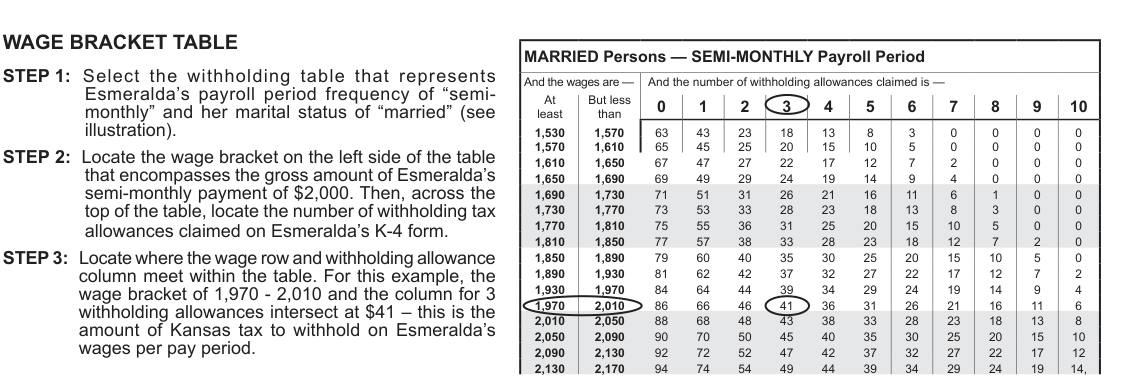
Text version of this table
| MARRIED Persons — SEMI-MONTHLY Payroll Period | ||||||||||||
| And the wages are — And the number of withholding allowances claimed is — At But less 0 1 2 3 4 5 6 7 8 9 10 least than 1,530 1,570 63 43 23 18 13 8 3 0 0 0 0 1,570 1,610 65 45 25 20 15 10 5 0 0 0 0 1,610 1,650 67 47 27 22 17 12 7 2 0 0 0 1,650 1,690 69 49 29 24 19 14 9 4 0 0 0 | And the number of withholding allowances claimed is — 0 1 2 3 4 5 6 7 8 9 10 | |||||||||||
| 3 5 7 9 | 0 0 2 4 | 0 0 0 0 | 0 0 0 0 | 0 0 0 0 | ||||||||
| 1,690 | 1,730 | 71 | 51 | 31 | 26 | 21 | 16 | 11 | 6 | 1 | 0 | 0 |
| 1,730 | 1,770 | 73 | 53 | 33 | 28 | 23 | 18 | 13 | 8 | 3 | 0 | 0 |
| 1,770 | 1,810 | 75 | 55 | 36 | 31 | 25 | 20 | 15 | 10 | 5 | 0 | 0 |
| 1,810 | 1,850 | 77 | 57 | 38 | 33 | 28 | 23 | 18 | 12 | 7 | 2 | 0 |
| 1,850 1,890 1,930 1,970 | 1,890 79 60 40 35 30 25 1,930 81 62 42 37 32 27 1,970 84 64 44 39 34 29 2,010 86 66 46 41 36 31 | 20 22 24 26 | 15 17 19 21 | 10 12 14 16 | 5 7 9 11 | 0 2 4 6 | ||||||
| 2,010 | 2,050 | 88 | 68 | 48 | 43 | 38 | 33 | 28 | 23 | 18 | 13 | 8 |
| 2,050 | 2,090 | 90 | 70 | 50 | 45 | 40 | 35 | 30 | 25 | 20 | 15 | 10 |
| 2,090 | 2,130 | 92 | 72 | 52 | 47 | 42 | 37 | 32 | 27 | 22 | 17 | 12 |
| 2,130 | 2,170 | 94 | 74 | 54 | 49 | 44 | 39 | 34 | 29 | 24 | 19 | 14, |
MARRIED Persons - SEMI-MONTHLY Payroll Period
And the wages are - And the number of withholding allowances claimed is -
# At But less
0 1 2 3 4 5 6 7 8 9 10 least than 1,530 1,570 63 43 23 18 13 8 3 0 0 0 0 1,570 1,610 65 45 25 20 15 10 5 0 0 0 0 1,610 1,650 67 47 27 22 17 12 7 2 0 0 0 1,650 1,690 69 49 29 24 19 14 9 4 0 0 0 1,690 1,730 71 51 31 26 21 16 11 6 1 0 0 1,730 1,770 73 53 33 28 23 18 13 8 3 0 0 1,770 1,810 75 55 36 31 25 20 15 10 5 0 0 1,810 1,850 77 57 38 33 28 23 18 12 7 2 0 1,850 1,890 79 60 40 35 30 25 20 15 10 5 0 1,890 1,930 81 62 42 37 32 27 22 17 12 7 2 1,930 1,970 84 64 44 39 34 29 24 19 14 9 4 1,970 2,010 86 66 46 41 36 31 26 21 16 11 6 2,010 2,050 88 68 48 43 38 33 28 23 18 13 8 2,050 2,090 90 70 50 45 40 35 30 25 20 15 10 2,090 2,130 92 72 52 47 42 37 32 27 22 17 12 2,130 2,170 94 74 54 49 44 39 34 29 24 19 14, CAUTION: The column headings for the wage brackets are "At Least … But Less Than." If the gross payment falls on a break, use the next wage bracket or line down. For example, if the payment is $1,970 you would use the $1,970 - $2,010 wage bracket, NOT the $1,930 - $1,970 wage bracket.
SPECIFIC WITHHOLDING SITUATIONS resident individual.
This section is designed to help employers and payers Nonresident Working Full Time in Kansas. If a accurately calculate Kansas withholding tax on the various nonresident works full time in Kansas, the employer must residency situations and taxable payments subject to Kansas withholding.
KANSAS RESIDENTS withhold Kansas income tax from the employee's total wages as if the employee were a Kansas resident.
Nonresident Working Inside and Outside of Kansas.
A Kansas resident is any individual who has established a The computation of Kansas withholding tax for a nonresident employee who performs services for an employer both permanent residence in Kansas for any period of time during inside and outside of Kansas is a two-step process. First, the year, or spent a total of more than 6 months in Kansas during the year. the employer computes the Kansas withholding tax amount on the total wages paid during the period. Second, the Resident Working Full Time In Kansas. If your employee resulting amount of Kansas withholding is then multiplied by is a Kansas resident performing services entirely in Kansas, Kansas withholding tax is due on the total earnings. a nonresident percentage factor.
The nonresident percentage is obtained by dividing the Resident Working Outside Kansas. When you employ or employee's services performed in Kansas by the total services pay a Kansas resident for services performed outside Kansas performed.
(either full time or part time), withhold from that employee's total wages the amount of withholding tax due Kansas, less Kansas Withholding Percentage = Kansas Services the amount of withholding tax required by the other state(s). Total Services
EXAMPLE: Jane lives in Kansas but she works in Missouri.
Form K-4C, Kansas Employee Certificate for Allocation of The amount of Kansas withholding tax due on Jane's total Withholding Tax may be used by resident and nonresident wage is $250 and the Missouri withholding is $130. The recipients of taxable Kansas income to report the approximate difference, $120, will be withheld from Jane's paycheck and sent to Kansas. percentage of income earned in Kansas and subject to Kansas withholding. The form is completed by the recipient and kept NOTE: If the other state's withholding is more than the Kansas amount, then no Kansas withholding tax is due. on file by the employer or payer.
Computing the nonresident percentage: The numerator
Resident Working Inside and Outside of Kansas. In (Kansas services) and denominator (total services) of the a situation where an employee has performed services in nonresident percentage are usually determined by how Kansas and one or more other states and is a resident of the employee is paid: hourly, salary, commission, etc. The Kansas, the employer computes the Kansas withholding following are examples of how to compute these types of tax amount on the total wages paid during the period. The wage payments. However, any logical method that accurately resulting amount of Kansas withholding is then multiplied and fairly reflects the percentage of income earned in Kansas by a withholding percentage. The withholding percentage may be used. is obtained by dividing the employee's services performed in Kansas by the total services performed. The numerator Hourly Employee (Kansas services) and denominator (total services) of the Hours worked in KS = % of income applicable to KS withholding percentage are usually determined by how the employee is paid: hourly, salary, commission, etc.
# NONRESIDENTS OF KANSAS
Total hours worked
EXAMPLE: Rick lives in Missouri but works in Missouri and
Kansas for the same employer. He is paid by the hour. He worked 33 of 80 hours in Kansas and the Kansas withholding A nonresident individual is any individual other than a on his total wage is $34. Determine his nonresident percentage by dividing the number of hours worked in Kansas (33) by the total hours worked in the pay period (80). 33 ÷ 80 = 41% Since Rick's Kansas earnings are 41% of the total, his nonresident Kansas withholding is .41 X $34 = $13.94, which is rounded to $14.
Salaried Employee
Days worked in KS = % of income applicable to KS
Total days worked
EXAMPLE: Susan lives in Nebraska and paid a salary for her work in Nebraska and Kansas. During a two-week pay period, she worked 7 of 10 days in Kansas. The Kansas withholding on her total salary for the period is $50. To determine her nonresident percentage, divide the number of days she worked in Kansas (7) by the total number of days worked in the pay period (10). 7 ÷ 10 = 70% Therefore, Susan's nonresident Kansas withholding tax is 70% of the Kansas withholding tax on her total salary: $50 X .70 = $35.
Commission Sales Associate
Commission earned in KS = % of income applicable to KS
Total commission earned
EXAMPLE: Jonathan lives in Colorado and is a commission salesman in several states, including Kansas. His total commissions for the period were $2,612, of which $523 were from Kansas. Kansas withholding on his total commissions is $116. His nonresident percentage is determined by dividing his Kansas commissions by his total commission:
$523 ÷ $2,612 = 20%.
Jonathan's Kansas commissions are 20% of his total commissions, so his nonresident Kansas withholding is: .20 X $116 = $23.20, which is rounded to $23.
INDIVIDUALS CLAIMED AS A DEPENDENT
As of July 1, 2024, any employee may claim a withholding allowance on their K-4, regardless of whether or not they can be claimed as dependent by another Kansas taxpayer.
EXAMPLE: Eric is a high school student who lives at home with his parents and works part time at his local coffee shop.
Eric's parents claim him as a dependent on their federal tax return each year. Still, Eric claims one withholding allowance on his K-4.
EMPLOYEES OF INTERSTATE CARRIERS
Employees in interstate commerce (railroads, motor carriers, air carriers, etc.) often perform their regularly assigned duties in more than one state. Kansas withholding rules for employees of interstate carriers are governed by federal law - Public Law 91-569. Wages paid to these employees are subject only to the income tax laws of their state of residence. Interstate carriers are required to file an information return (Form W-2 or 1099) with the state of the employee's residence.
# ENTERTAINERS and ATHLETES
Individuals working in sports and entertainment often have income in more than one state. Like others working in Kansas, athletes and entertainers are subject to the Kansas personal income tax on earnings for services performed in Kansas. Therefore, Kansas withholding is required on their Kansas earnings if the Internal Revenue Service considers them your employees.
If the individual employee is a nonresident of Kansas, the nonresident percentage may be calculated as the ratio of the number of hours, number of games or number of performances in Kansas to the total number of hours, games or performances for the pay period.
EXAMPLE: Jack is a resident of Iowa and plays semi-pro baseball. During a pay period he played in 7 games, 2 of which were in Kansas. The Kansas withholding on his total wage is $150. His nonresident percentage is the number of games played in Kansas (2) divided by the total games in the pay period (7): 2 ÷ 7 = 28%. Since his Kansas earnings are 28% of the total, his nonresident Kansas withholding is .28 X $150 = $42.
EXAMPLE: Jane is a Texas resident and an actor who is paid a weekly salary. Her touring company spent 36 days in Kansas. For pay periods when all performances were in Kansas, Kansas withholding is due on the total weekly wage.
For pay periods when only part of the performances were in
Kansas, her employer would apply a nonresident percentage
(the ratio of Kansas performances to the total) to the Kansas withholding on her total earnings for the week.
Kansas withholding is not required if the individual is considered to be an independent contractor. Independent contractors with Kansas taxable earnings would make estimated tax payments on their Kansas taxable income.
# GAMBLING WINNINGS
Kansas withholding on gambling proceeds is not computed using the wage bracket or percentage formula tables, but is instead 5% of the proceeds paid. To figure the Kansas withholding on gambling winnings, multiply the proceeds paid (the amount won less the amount of the bet) by 5%. Enter the Kansas information in the applicable boxes of the W-2G.
# MANAGEMENT and CONSULTING FEES
paid to a nonresident are subject to Kansas withholding tax at the rate of 5% of the fee when payment is made by a Kansas entity in the normal course of its trade, business or other for-profit venture, and the nonresident physically performs these services in Kansas.
EXAMPLE: A Kansas real estate firm pays a Missouri company $1,000 per month to manage its Kansas rental property. Since the Missouri firm performs the management services in Kansas, the Kansas firm is required to withhold Kansas tax at the rate of 5% from each payment made to the Missouri company.
# NONRESIDENTS ALIENS
Citizens of other countries working in Kansas may be subject to Kansas withholding and Kansas personal income tax on their earnings. If the wages paid to a nonresident alien for services performed in Kansas are subject to federal income tax withholding, Kansas income tax withholding is also required.
# OTHER MISCELLANEOUS PAYMENTS
You will use the percentage formula or wage bracket tables to figure Kansas withholding on most payments.
However, when you are making a payment subject to Kansas withholding not discussed here, and the federal withholding is a percentage (20%, 25%, etc.), the Kansas withholding rate is 5% of the payment.
# SUPPLEMENTAL WAGES
Kansas withholding on a supplemental wage payment is computed using the same method that you use at the federal level. If you are adding regular and supplemental wages together and computing federal withholding on the total using the federal tables, compute the Kansas withholding using the same steps.
EXAMPLE: You pay Joan a $1,000 bonus in addition to her regular wage of $1,000. Since you are not separating the payment, you calculate federal and state withholding using a gross wage amount of $2,000 for the period.
In contrast: If you state the supplemental wage separately and compute federal withholding as a percentage of the payment (usually 25%), then compute Kansas withholding at 5% of the gross payment. For example, Kansas withholding on a $1,000 bonus paid would be $50 ($1,000 X 5%).
- Homestead Claim
# CENTER
FILE, PAY and MAKE UPDATES ELECTRONICALLY
- IFTA
- Individual Estimated Income Tax
- Individual Income Tax
- Liquor Drink and Liquor Enforcement
Most businesses have chosen the KDOR Customer Service
- Mineral Tax
Center (KCSC) for their online filing and payment solution. To • Motor Fuel
- Petition for Abatement Service Fee use this solution, you simply create a user login ID and select a
- Privilege Tax password, then you can attach your business tax accounts. Each
- Privilege Estimated Tax tax account has a unique access code that only needs to be
- Sales and Use Tax entered once. This access code binds your account to your login
- Tire Excise Tax
ID. For future filings, you simply log into your account using your
- Tobacco Return/Tax Payment self-selected user login and password. A history of all filed returns and/or payments made is retained in the KCSC.
WHAT CAN I DO ELECTRONICALLY?
- Register to collect, file and pay taxes and fees
- Add new locations
- Complete and submit a Power of Attorney form
- Update contact information
- Update mailing address
- Upload W-2's and 1099's
- Upload and retain Sales and Compensating Use Tax jurisdictions
- File the following tax returns:
- Consumers' Compensating Use Tax
- Consumable Material
- Liquor Drink and Liquor Enforcement Tax
- Retailers' Compensating Use Tax
- Retailers' Sales Tax
- Transient Guest Tax
- Vehicle Rental Tax
- Make payments for the following taxes:
- ABC Taxes and Fees
- Charitable Gaming
- Cigarette Tax Stamp Payment
- Cigarette Tax, Fees, Fines and Bonds
- Cigarette/Tobacco Fine Payment
- Cigarette/Tobacco License Fee
- Consumable Materials Return/Tax Payment
- Consumable Material
- Corporate Estimated Income tax
- Corporate Income Tax
- Dry Cleaning Payment Plan Fee
- Environmental and Solvent Fee
- Fiduciary Income Tax
- Tobacco Tax, Fees, Fines and Bonds
- Transient Guest Tax
- Vehicle Rental Excise Tax
- Withholding Tax
REQUIREMENTS TO FILE and PAY
You must have the following in order to file and pay your taxes online:
- Internet Access
- Access Code(s) by calling 785-368-8222 or send an email to kdor_businesstaxeservice@ks.gov
- EIN
- ACH Debit: Kansas Department of Revenue debits the tax payment from your bank account
- ACH Credit: Complete an EF-101 online to initiate a tax payment through your bank
Electronic tax payments must settle on or before the due date.
Using the KCSC, you may have your tax payment electronically debited from your bank account (ACH Debit)or you may initiate your tax payment through your bank (ACH Credit). This payment method requires a completed authorization EF-101, available on our Customer Service Center.
Our FREE electronic systems are simple, safe, and conveniently available 24 hours a day, 7 days a week. You will receive immediate confirmation that your return is filed and/or payment is received. If you need assistance with your access code, you may call 785-368-8222 or email kdor_businesstaxeservice@ks.gov.
# PAY BY CREDIT CARD
Payment by credit card is available online through third-party vendors. Visit our Electronic Services website at https://www. ksrevenue.gov/taxpayment.html for a current list of vendors authorized to accept individual income tax and business tax payments for Kansas. A convenience fee, based on the amount of tax you are paying, will be charged.
WIRE TRANSFERS estimated tax amount you enter in Part 6 of the business tax application. Your filing frequency is shown on your Withholding Wire Transfers are accepted from both domestic and Registration Certificate as illustrated on page 5. foreign banking institutions as long as it is received as Each filing frequency has a different set of due dates (see American currency. For more information call 785-368-8222.
RECORD KEEPING chart on prior page). Do not file your Kansas withholding tax either more or less frequently than your established filing frequency. If a change in filing frequency is needed (monthly Like all other aspects of your business operation, you must to quarterly, etc.), follow the instructions on page 15. If the keep current, complete and accurate withholding records. due date falls on a Saturday, Sunday or legal holiday, use the Keep records for at least 3 years after the date the withholding tax was due, or paid, whichever is later. next regular business day.
CAUTION: Annual withholding amounts and filing frequencies
- Name, current address, and Social Security number of each employee or payee
- Period(s) of employment
- All compensation amounts paid by pay period
- Date(s) and amount(s) of all tax withheld are prescribed by Kansas law [K.S.A. 79-3298(a)]. If the taxation director has cause to believe money withheld by an employer or payer may be converted, diverted, lost, or otherwise not timely paid, the director may at any time require returns/payments more frequent than prescribed in
- Copies of documents filed with the Department of
Revenue (KW-5, KW-3, W-2, 1096 and 1099) the following chart. [K.S.A. 79-3298(f)]
Return" box. Enter the correct amount of tax for each reporting
- Federal form W-4 (W-4P, W-4S, W-4V, etc.) and Kansas form K-4 for each employee/payee
FILING FREQUENCIES and DUE DATES period on line 1 of the amended KW-5. You should include a letter explaining the error that caused the overpayment.
CREDIT MEMO
When any overpayment during a calendar year cannot be
How often you will file and pay Kansas withholding tax recaptured during that same calendar year, or when an audit depends on the size of your payroll. The larger your payroll, of the KW-3 Annual Withholding Tax Return and W-2 and/ the larger the Kansas withholding, and therefore the more or W-2c forms results in an overpayment, the Department of Revenue will issue a Credit Memo. A Credit Memo is a letter frequently you will report and pay the tax. Kansas has five that explains the source of the credit, the amount of the credit filing frequencies - annual, quarterly, monthly, semi-monthly, and instructions for its use. and quad-monthly. Your initial filing frequency is based on the
# DUE DATES FOR WITHHOLDING TAX DEPOSIT REPORTS
If a due date falls on a Saturday, Sunday or legal holiday, use the next regular workday.
MONTHLY
QUAD-MONTHLY SEMI-MONTHLY QUARTERLY ANNUALLY
ANNUAL WITHHOLDING
ANNUAL WITHHOLDING ANNUAL WITHHOLDING ANNUAL WITHHOLDING ANNUAL WITHHOLDING
$1,200.01 to $8,000.00
$100,000.01 and ABOVE $8,000.01 to $100,000.00
REPORTING DUE DATE REPORTING DUE DATE
PERIOD
Jan
Feb
Mar
Apr
May
Jun
Jul
Aug
Sep
Oct
Nov
Dec
$200.01 to $1,200.00 $.00 to $200.00
DUE DATE REPORTING DUE DATE REPORTING DUE DATE
# Jan, Feb, Jan - Dec
Mar
Mar 15 Jul 25
Apr, May,
Jun
Apr 15 Oct 25
Jul, Aug,
Sep
Oct, Nov, Jan 25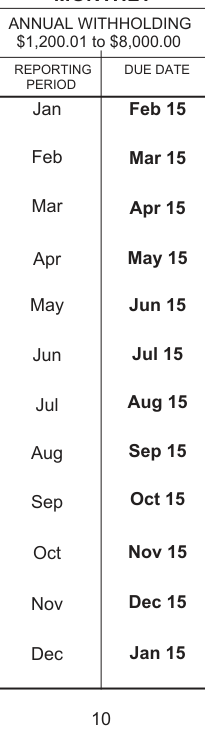
Jan 15 available to file and pay electronically, the following example
COMPLETING A KW-5 DEPOSIT REPORT illustrates how to use our simple and FREE online application,
You must file a KW-5 Withholding Tax Deposit Report available through the Kansas Customer Service Center (KCSC) for EACH reporting period even when no Kansas tax was on our website (ksrevenue.gov). withheld. Even annual filers must file a KW-5 for the tax year
- a KW-3 annual return does NOT take the place of an annual For more information about filing and paying your Kansas business taxes, see File, Pay and Make Updates herein.
KW-5 Deposit Report.
Kansas withholding tax reports must be filed and payment of tax made electronically. Although there are several methods EXAMPLE: Amara, president of XYZ Mining Company, pays her employees on a weekly basis. Her filing frequency for Kansas withholding tax is monthly and she uses a spreadsheet to maintain her payroll records-a portion of which is shown here. Using her spreadsheet, she follows the five steps shown here to report and pay Kansas withholding tax for her July 2024 tax period.
STEP 1: Go to ksrevenue.gov to begin the sign-in process for the
KDOR Customer Service Center (KCSC). If you are a first time user, click Register Now and complete the registration page. (NOTE: First time users will need to obtain an access code from the Department of Revenue by contacting the Taxpayer Assistance Center. See page 41 for contact information.) If already registered, enter your e-mail address and password to sign-in. If using "ACH Credit" method of payment, follow instructions in step 2; otherwise go to Step 3.
# UNDERPAYMENTS
If you have paid less than the actual taxes withheld in a period, you will need to file an additional KW-5 for that period.
To file your additional KW-5, log into the KCSC and access your Withholding tax account. Select the option Payment with KW-5 coupon to process another return and payment for the amount of tax that was underpaid for that tax period.
An additional KW-5 deposit filed after the original due date is subject to a penalty (and interest when applicable) on the additional amount of tax. For more information about late charges, see page 13.
STEP 4: Select Accounts on the yellow menu bar at the top of the page, then select Manage Account for your withholding tax account. Click Payment with KW-5 Coupon and then complete the KW-5.
- Select the Period and Year (in this example "July" and
"2024") from the dropdown menu for your reporting period.
- Select Withholding Payment & Return from the dropdown menu. Enter the total amount of Kansas withholding tax due in dollars and cents ($289.00 for this example
- If applicable, enter credit memo information.
- Enter the Total Amount you want to pay.
- Select a Settlement Date.
- Complete the Payment Funding Source section and click Continue.
STEP 5: Verify the information you entered and click Submit
Payment. A Payment Detail page will provide your confirmation number. This page can be printed or downloaded for your business tax records. It is also retained in the KCSC in the Account History page.
# OVERPAYMENTS
Credit to next period(s). If you paid more than the actual taxes withheld in a period, the credit may be applied to the tax due for subsequent withholding period(s) within the same calendar year. To use a credit from a prior deposit period in the same calendar year, complete line 2 of a paper KW-5 form.
Amended KW-5s. When an overpayment cannot be recaptured or used in subsequent periods within the same calendar year, the overpayment will generally be reflected on your KW-3 Annual Withholding Tax Return and resolved the following calendar year-see Credit Memo that follows. However, for situations where a refund of the overpayment is requested during that calendar year, you will need to file an amended KW-5 for each affected period. Using a paper KW-5, complete all the information on the form and place an "X" in the "Amended
Return" box. Enter the correct amount of tax for each reporting period on line 1 of the amended KW-5. You should include a letter explaining the error that caused the overpayment.
# CREDIT MEMO
When any overpayment during a calendar year cannot be recaptured during that same calendar year, or when an audit of the KW-3 Annual Withholding Tax Return and W-2 and/ or W-2c forms results in an overpayment, the Department of Revenue will issue a Credit Memo. A Credit Memo is a letter that explains the source of the credit, the amount of the credit and instructions for its use.
Report the credit memo amount on your next KW-5 filing.
If the credit is greater than the tax being reported, report the remainder on the following tax period. If you have questions, contact our tax assistance center.
IMPORTANT: A copy of the credit memo letter must accompany each KW-5 Deposit Report that is using the credit. A credit from a prior year cannot be deducted on line 2 of a KW-5 Deposit Report without a credit memo.
# FORMS
As an employer/payer, you have additional forms to complete after the close of the calendar year for your employees, payees, state and federal government.
COMPLETING AN ANNUAL KW-3 WITHHOLDING TAX
RETURN
Form KW-3 is your annual Kansas withholding tax return for the calendar year and serves two important purposes. First, it summarizes your withholding deposits for the calendar year, allowing us to match your deposit record with ours. Second, it is the transmittal document for sending the "State" copy of the Wage and Tax Statement (form W-2) and any 1099 forms that have Kansas withholding to the Department of Revenue.
The annual return, W-2s and 1099s are due by January 31 of the following year. Form KW-3 must be filed electronically (see File, Pay and Make Updates herein).
PARTIAL-YEAR REPORTING
If you begin business or begin withholding during a calendar year, file the KW-3 and W-2s for that portion of the year Kansas income tax was withheld. See the example that follows.
IMPORTANT: If you close or sell the business or discontinue withholding, your final reports are due within thirty (30) days after the end of the month in which the business closed or the last date wages were paid. File the KW-3, W-2s, and 1099s/W-2Gs with the Department of Revenue, along with notification of business closure or change of ownership. See Closing Your Withholding Account herein.
EXAMPLE: Juan, a monthly filer, began a curbside pickup restaurant business in Kansas in March 2024. He filed his monthly KW-5 deposit reports using the Kansas online application. His annual return (KW-3) is now due. He uses the following steps to complete it electronically.
STEP 1: Go to ksrevenue.gov to begin the sign-in process for the
KDOR Customer Service Center (KCSC). If you are a first-time user, click Register Now and complete the registration page. (NOTE: First time users will need to obtain an access code from the Department of Revenue by contacting the Taxpayer Assistance Center See page 41 for contact information). If already registered, enter your e-mail address and password to sign-in.
STEP 2: On the Home Menu, select Accounts on the yellow menu bar at the top of the page, then click Add an Existing or Register a New account to this login. Enter your Identification number and access code and click Continue, then Save. NOTE: Once you have added your account, it will be retained in the system for future filing periods.
STEP 3: Select Accounts on the yellow menu bar at the top of the page, then select Manage Account for your withholding tax account. Click File your KW-3 Tax Information to
KDOR and then complete the KW-3.
- Read the KW-3 Withholding Instructions and then click
Continue.
- Click Start a new Return.
- Enter your Name and Address information.
- Select the tax year from the drop down menu. Then select a return type and click Continue.
- Add all KW-5 payments made during the filing year Enter payments amounts and click Calculate Totals. Then click Continue.
- Enter the Total Kansas Tax Withheld on W-2s and
1099s, Amount of credit memos for the overpayment from previous year used this year (if applicable), and the Total number of Kansas W-2s and/or federal 1099 forms. Penalty and Interest are automatically calculated. Click Continue.
- If a balance is due, a KW-3 payment screen will display. Enter your payment information and click
Continue.
- Verify the displayed information is correct. Complete the Verification and Agreement section, then click
Submit Return.
# WAGE and TAX STATEMENT (W-2)
Furnishing W-2s to Employees. Employers must give each employee three copies of the Wage and Tax Statement, form W-2, by January 31 of the following year, even if no Kansas tax was withheld. Payers must also provide each recipient for whom Kansas tax was withheld with three copies of the appropriate Wage and Tax Statement (W-2, W-2G, W-2P, etc.) by January 31 of the following year.
If an employee/payee leaves during the year, you may either furnish the appropriate W-2 with the last payment, or wait until the end of the year. Keep any W-2 forms returned by the postal service with your other payroll records as proof of attempted delivery.
You may obtain paper W-2 forms (copies for federal, state and employer/payer) from the IRS - an order blank is in federal
Pub. 15 (Circular E). W-2s are also available from office supply retailers or may be printed using payroll software. A sample completed W-2 follows.
COMPLETING A W-2
You will report Kansas wages and withholding in the
State information boxes of the W-2 form. You must enter the complete Kansas Withholding Tax Account Number (i.e., 036-XXXXXXXXXF-01) in the box labeled Employer's state I.D. number on the W-2.
If you are completing a W-2 for an employee for whom you have withheld taxes for more than one state, enter in the Kansas boxes only the wages and withholding applicable to Kansas.
Be sure that the figures and information are legible on all copies. If they are not, you may need to reissue the W-2.
REISSUING A W-2
If an individual's W-2 form has been lost, destroyed, or is illegible, you may reissue the W-2. Complete another W-2 for that tax year and mark it "Reissued by Employer." Do not send copies of reissued W-2 forms to the Department of Revenue.
# CORRECTING A W-2 (USING FORM W-2C)
To correct the information on a W-2, use federal form W-2c,
Statement of Corrected Income and Tax Amounts. Furnish three copies to the employee and submit a copy to the Department of Revenue only when the correction affects the Kansas information. If the error is found before filing the KW-3 and W-2s with the department (due January 31), include only the W-2c for that employee with the other W-2s and your KW-3. If the error is found after the KW-3 and W-2s have been filed, send the state copy of the W-2c to the Department of Revenue with an amended KW-3 (when applicable) and a short letter of explanation.
# FILING THE STATE COPY OF THE W-2 WITH KANSAS
Once completed, a copy of the W-2 form must be submitted to the Department of Revenue. Employers submitting more than 50 W-2 records must file electronically (see File, Pay and Make Updates herein). Employers reporting less than 51 records can file on paper but are encouraged to use our online application to submit their W-2s.
Submitting W-2 forms electronically gives you the option of inputting the W-2 information individually or uploading pre-formatted files as specified in the Record Format and Layout Specifications section that follows.
NOTE: Your Kansas KW-3 Annual Withholding Tax Return must be filed electronically along with the W-2s and 1099s.
If you have less than 51 forms you may submit the paper W-2 copies marked "For State, City or Local Tax Department" (Copy 1) to the Department of Revenue in either Social Security Number or alphabetical order. Also include a copy of the electronically filed KW-3 submission done online.
RECORD FORMAT AND LAYOUT SPECIFICATIONS
Electronic W-2 filers have the option of uploading fixed-length or comma separated value (CSV) files.
For fixed-length format, filers are required to follow the filing specifications listed in the Social Security Administration booklet (EFW2/EFW2C, Specifications for Filing forms W-2 and W-2c Electronically) for all records except the Code RS (state) record.
These specifications are available at: ssa.gov/employer/pub.htm
For details regarding the Kansas Code RS record, refer to the
K-2MT Kansas W-2 Specifications for Electronic Filing (EFW2 format) document available on our website: ksrevenue.gov/forms-btwh. html Most popular spreadsheet programs can create CSV files suitable for upload. It may also be possible to export withholding information out of your accounting software into CSV format. In both cases, it is necessary that CSV files be formatted as outlined in the KW-2CSV, W-2 Specifications for Electronic Filing.
CAUTION: Electronic W-2 files that do not conform to either the
EFW2 or CSV specifications will not be accepted.
ANNUAL INFORMATION RETURNS (1099 and 1096)
In addition to W-2 forms, you may be required to file information returns for the taxable non-wage payments you made during the tax year. Information returns include federal forms 1098, the 1099 series, 5498 and W-2G. If you are required to file an information return with the Internal Revenue Service (IRS), a copy must also be filed with the Department of Revenue by January 31 following the end of the calendar year. As with W-2s, Kansas requires that employers/ payors with more than 50 records, per type of information return, file electronically. Filers can upload files that are in a fixed-length format consistent with the layout specified in the IRS Pub. 1220 available on the IRS website. Filers may also upload a properlyformatted CSV file. These files must be formatted as outlined in the K-99CSV Information Returns Specifications for Electronic
Filing, available on our website.
# COMBINED FEDERAL/STATE FILING PROGRAM (CF/SF)
A separate filing of information returns to Kansas may not be necessary if you participate in the IRS CF/SF Program. Established to simplify filing, participants in this program send the 1099s and 1096 to the IRS only. The IRS then forwards the information to the Department of Revenue. Obtain IRS Pub. 1220 for details about the combined filing program.
CAUTION: Information returns that have Kansas withholding may NOT be filed under the CF/SF program. You must use the electronic application to submit 1099s with Kansas withholding, along with the KW-3. As with electronically filed W-2s, KW-3, information is entered during the 1099 upload process.
# ADDITIONAL INFORMATION
# WHEN RETURNS ARE LATE
There are penalties for late filing or late payment of Kansas withholding deposit reports and returns. All late charges are computed as a percentage of the tax due, and are automatically billed by the Department of Revenue when you do not calculate and pay them with a late deposit or return.
IMPORTANT: You may be subject to non-filer penalties when
KW-5 deposits, KW-3 returns, or W-2 forms are not filed. If you have a Kansas withholding tax registration, you must file these returns and documents even when no Kansas tax was withheld.
# PENALTY
will be assessed whenever the full amount of tax due is not remitted to KDOR by its due date. Reports filed on time without payment of tax due have the same penalties as those that are filed late. The penalty rate will be applied to the underpayment (the difference between the amount of the tax required to be withheld and the amount remitted on or before the due date). Penalty rates for late payments increase over time.
•2% of the underpayment if remitted within one to five days of the due date
•5% if remitted within six to 15 days
•10% if remitted after 15 days
•15% if remitted after 15 days and the Department of Revenue has issued a notice to the taxpayer regarding the underpayment and the amount due was not remitted within 10 days of issuance of the notice.
An additional penalty of 1% per month (up to a maximum of 24%) is assessed on the unpaid balance of tax due.
A 50% penalty may be assessed when an employer fails to submit a delinquent return within 20 days following written notice from the Director of Taxation. This penalty is in addition to the total KW-5 and KW-3 underpayment penalties.
# INTEREST
is not charged if the tax due on a KW-5 report or KW-3 return is filed and paid prior to the due date of the annual return (February 1 of the following year). Tax paid on or after February 1 of the following year is charged interest from that February 1 to the date the return is filed and/or the tax paid.
Since the Kansas interest rate is based on the federal underpayment rate in effect on July 1 of the prior year, it is subject to change each year [K.S.A. 79-2968]. See our website at ksrevenue.gov for a chart of Kansas interest rates.
# WAIVER OF PENALTY
If your deposit is late due to an event beyond your control, you may request a waiver of the penalty. Simply write a letter with the specific circumstance(s) that caused the delinquency and request that the penalty be eliminated. Be sure to include your EIN, filing period and a daytime phone number. Send your request with the billing that you received for the late charges.
IMPORTANT: If there is interest due it must be paid before a request for waiver of penalty will be considered or approved.
While interest may not be waived, the rate of interest may be reduced.
# OTHER PENALTIES
Returned check fee. A fee of $30 (plus the cost for a registered letter) is charged on returned checks. This fee is in addition to any other penalty or interest.
Form W-2. An employer/payer who willfully fails to furnish an employee/payee with a W-2 by January 31 of the following year may be subject to a fine up to $100 for each occurrence.
An employer/payer who fails to file the "State" copy of the W-2 with the Department of Revenue by January 31 may be subject to a penalty of $50 for each W-2 not submitted.
Bond. Any employer/payer who fails to pay withholding tax for more than one period may be required to post a sum of money as a bond to secure against non-payment of the tax. The bond amount is determined by the Department of Revenue, and may be up to a maximum of the tax estimated to be due and payable for two quarterly payment periods.
[K.S.A. 79-3294b]
Fraud. The law imposes fines up to $1,000, imprisonment and penalties on any employer/payer who with fraudulent intent fails to file or pay withholding tax, or who signs a fraudulent return.
# EMPLOYER/PAYER and OFFICER LIABILITY
Every employer/payer is liable to the state for payment of the income tax deducted and withheld from wages and other payments subject to Kansas income tax withholding.
Officers and directors of a corporation, like sole proprietors and partners, are personally liable for the Kansas withholding tax, penalty and interest due during the period they hold office.
[K.S.A. 79-32,100c]
EXAMPLE: A corporation fails to remit its withholding tax. The corporation and each officer, director, or other responsible party having control, receipt, custody or disposal of, or paying the wages of employees, will be personally liable for this corporate debt.
ABOUT OUR BILLING PROCESS
Most functions of the Department of Revenue's billing process are computerized. A tax bill is automatically generated when our system detects a deficiency on your account. A deficiency may be either a balance due or a missing return. It is important that you immediately respond to a tax bill from the Department of Revenue and, when making payment, follow the instructions on the bill.
If the only problem on an account is a missing return, the bill will show a zero balance due. However, the missing periods are listed on page 2 of the bill with a "Y" for "Yes" in the column entitled "Non-Filed Returns." To avoid assessments for these missing periods, file the missing reports or contact us with the filing information.
If you have questions about a tax bill, have already paid the balance or filed the missing periods, call us at the number on the billing. Our customer representatives can help you understand and respond to a tax bill.
REPORTING BUSINESS CHANGES
When changes occur in your business, promptly notify the
Department of Revenue (see Taxpayer Assistance on the back cover). Please have your tax account number available when calling our office.
BUSINESS NAME AND/OR ADDRESS CHANGE
You may report business name or address changes to us by mail or fax, using company letterhead or by completing our form DO-5 Name or Address Change. This form is available on our website.
CHANGE OF CORPORATE OFFICERS OR DIRECTORS
When there is a change in your corporate officers or directors, complete and return form CR-18 Ownership Change and provide the name(s) and title(s) of the resigning officer(s) or director(s). If you prefer, mail or fax us a letter with the name, title, home address, and Social Security number of each new corporate officer or director, the name and title of each officer or director resigning, and the effective date of the change.
Change of partners. If your business is a partnership, and less than 50% of the partnership is changed, follow the Change of Corporate Officers or Directors instructions to report the new information on each partner. However, if 50% or more of the partners in a partnership change, a new Kansas Tax Account Number is required. Follow the Change of Business Ownership instructions below to cancel your existing number and apply for a new number.
Change of business ownership. When the ownership changes, a new registration is required. Examples of ownership changes are: 1) sole proprietorship to a partnership, 2) 50% or more of the partners in a partnership change 3) partnership to a corporation, 4) one corporation to another corporation, or, 5) any change in corporate structure that requires a new charter, certificate of authority or new federal EIN.
To apply for a new Kansas Tax Account Number, see How and When to Register herein.
IMPORTANT: Before a new registration can be issued, the existing registration must be canceled as of the effective date of the ownership change. See Closing Your Withholding Account that follows.
# CHANGING YOUR FILING FREQUENCY
Once a filing frequency is established for a calendar year, do not increase or decrease the frequency of filing your KW-5 reports. Filing less frequently will cause you to receive non-filer tax bills for missing periods.
The Department of Revenue periodically reviews the deposit history of each Kansas withholding account to ensure the filing frequency is in accordance with the guidelines mandated by law. This is usually done late in a calendar year, so that any change necessary will take effect January 1 of the upcoming year. A notice of change is usually mailed to the affected accounts in November.
We realize errors can occur when a filing frequency is assigned to a new business. In addition, a business can change extensively over a calendar year, causing the withholding filing frequency to be too often or not often enough.
If you believe your filing frequency is out of line with the chart on page 10, contact the Department of Revenue.
# CLOSING YOUR WITHHOLDING ACCOUNT
When you sell or change the ownership of the business, close your business, or are no longer making payments subject to Kansas withholding, you must cancel your Kansas Tax Account Number. Use one of the following forms to notify the Department of Revenue:
- CR-108 Notice of Discontinuation of Business - copy herein.
- The Discontinuation of Business portion of your Withholding
Tax Registration Certificate.
- CR-18 Ownership Change - available on our website.
When you close your withholding account, all of the required forms (KW-5s, KW-3, W-2s, etc.) must be filed within 30 days after the end of the month in which the business closed or payment of wages ceased, regardless of the usual reporting period due date.
# WHEN IN DOUBT...
Kansas withholding tax law generally conforms with the federal law. Therefore, if you have questions about whether a payment is subject to withholding, or whether a worker is your employee or is an independent contractor, contact the IRS or the Kansas Department of Labor.
When you have a Kansas tax question or situation that is not addressed in this publication, contact the Department of Revenue for assistance. Although our customer service personnel are able to answer most questions, there are situations that may require an interpretation or clarification based upon the law, regulations and specific facts. When this happens, document the situation in writing and request a written opinion from the Kansas Department of Revenue.
Email your letter to:
KDOR_tac@ks.gov
In the Subject Line RE: Request for Opinion Letter
Attn: Policy and Research
KANSAS DEPARTMENT OF REVENUE WEBSITE
(KSREVENUE.GOV)
Perhaps the most useful resource available to taxpayers is our website. Items there include tax forms and instructions, informational publications, electronic filing information, economic development incentives, links to the IRS and other business sites, and our Policy Information Library.
POLICY INFORMATION LIBRARY (ksrevenue.gov/prpil. html).
A library of policy information for all taxes administered by the Department of Revenue is a part of our website. This policy library contains the Kansas Statutes and Regulations, Revenue Notices, Revenue Rulings and other written advice issued by the Department of Revenue. Opinion Letters and Private Letter Rulings are also included, however, these letters have been "scrubbed" to protect the privacy of the taxpayer-any information that would identify the taxpayer, such as name, address, product, etc., is blanked out. For ease in locating information, you may search the library by tax type and topic.
KEY STATUTES
Kansas Statutes Annotated (K.S.A.) that were used as the basis for this guide include K.S.A. 79-3228, K.S.A. 79-3294 et seq., and K.S.A. 79-32,107.
# RESOURCES
Income tax withholding is just one responsibility of an employer. This section summarizes and provides resource information on some of the other federal and state obligations you have as an employer.
# FEDERAL REQUIREMENTS
EMPLOYER IDENTIFICATION NUMBER (EIN)
If you pay wages to one or more employees, or if your business structure is a partnership, corporation, trust, estate, or nonprofit organization, you must have a federal EIN. This is a nine-digit number (00-0000000) issued by the IRS. It is used to identify the tax accounts of businesses for federal tax purposes. To apply for a number, complete federal form SS-4,
Application for Employer Identification Number.
To obtain an EIN or for information about federal income tax withholding, Social Security, Medicare or federal unemployment tax, visit their website (www.irs.gov).
U.S. CITIZENSHIP AND IMMIGRATION SERVICES
(USCIS)
The Federal Immigration Reform and Control Act of 1986 requires all employers to verify the employment eligibility of new employees. For assistance with this process or to obtain forms, visit the INS website (uscis.gov).
U.S. DEPARTMENT OF LABOR
The Fair Labor Standards Act (FLSA) is the federal law that sets minimum wage, overtime, record keeping and child labor standards. More information is available by visiting the website for the Wage and Hour Divisions (dol.gov/agencies/whd).
# KANSAS REQUIREMENTS
KANSAS UNEMPLOYMENT TAX AND WORKERS
COMPENSATION
The Kansas Employment Security Law was enacted to provide some income during limited unemployment for those who are out of work due to conditions in the economy and through no fault of their own. All Kansas employers are required to file a report with the Kansas Department of Labor (KDOL), to determine their unemployment tax status.
Kansas workers compensation is a private insurance plan where the benefits are not paid by the State of Kansas but rather by the employer, generally through an insurance carrier.
For more information on Kansas unemployment tax or Kansas workers compensation visit KDOL website (www.dol.ks.gov).
BUSINESS RESOURCE DIRECTORY
SAFETY AND HEALTH
The Occupational Safety and Health Administration (OSHA) outlines specific health and safety standards adopted by the U.S. Department of Labor. For more information, visit their website (www.osha.gov).
The Industrial Safety and Health Section of the Kansas
Department of Labor (KDOL) offers free safety and health consultations. For additional information, visit KDOL's website
(www.dol.ks.gov).
SMALL BUSINESS ADMINISTRATION (SBA)
The SBA is the only federal agency solely dedicated to serving the needs of America's small businesses. For more information visit their website (sba.gov).
KANSAS DEPARTMENT OF HEALTH AND
ENVIRONMENT
The Kansas Department of Health and Environment provides resource information for questions or issues of an environmental nature (kdheks.gov).
AMERICANS WITH DISABILITIES ACT (ADA)
The ADA prohibits discrimination on the basis of disability, providing coverage for employment, public services, government, transportation and telecommunications. For more information regarding your responsibilities under this act, contact the Kansas Commission on Disability Concerns at 1-800-295-5232.
KANSAS DEPARTMENT OF COMMERCE
The Kansas Department of Commerce provides resource and referral information for Kansas businesses
(kansascommerce.gov).
KANSAS SECRETARY OF STATE
To register a corporation in Kansas, or to obtain corporate annual reports, visit the Kansas Secretary of State website sos.ks.gov
KANSAS SMALL BUSINESS DEVELOPMENT CENTER
(KSBDC)
There are a number of campus-based centers throughout
Kansas that specialize in providing direct one-on-one counseling on small business issues. Contact their website for more information kansassbdc.net.
(Rev. 7-24)
# KANSAS
Attach
EMPLOYEE'S WITHHOLDING ALLOWANCE CERTIFICATE
Use the following instructions to accurately complete your K-4 form, then detach the lower portion and give it to your employer.
For assistance, call the Kansas Department of Revenue at 785-368-8222.
Purpose of the K-4 form: A completed withholding allowance certificate will let your employer know how much Kansas income tax should be withheld from your pay on income you earn from Kansas sources.
Because your tax situation may change, you may want to re-figure your withholding each year.
Exemption from Kansas withholding: To qualify for exempt status you must verify with the Kansas Department of Revenue that: 1) last year you had the right to a refund of all STATE income tax withheld because you employer. If your employer does not receive had no tax liability; and 2) this year you will a K-4 form from you, they must withhold receive a full refund of all STATE income Kansas income tax from your wages without tax withheld because you will have no tax exemption at the "Single" allowance rate. liability.
Head of household: Generally, you may
Basic Instructions: If you are not exempt, claim head of household filing status on complete the Personal Allowance Worksheet your tax return only if you are unmarried that follows. The total on line F should not and pay more than 50% of the cost of exceed the total exemptions you claim keeping up a home for yourself and for under "Exemptions and Dependents" on your dependent(s). your Kansas income tax return.
Non-wage income: If you have a large
NOTE: Your status of "Single" or "Joint" amount of non-wage Kansas source income, may differ from your status claimed on your such as interest or dividends, consider federal form W-4). making Kansas estimated tax payments on Form K-40ES. Without these payments, you Using the information from your Personal may owe additional Kansas tax when you Allowance Worksheet, complete the K-4 file your state income tax return. form below, sign it and provide it to your
Personal Allowance Worksheet (Keep for your records)
A o Single
A Allowance Rate: If you are a single filer mark "Single" o Joint
If you are married and your spouse has income mark "Single"
If you are married and your spouse does not have income mark "Joint"
B Enter "0" or "1" if you are married or single(entering "0" may help you avoid having too little tax withheld) … B _ C Enter "0" or "1" if you are married and only have one job, and your spouse does not work (entering "0" may help you avoid having too little tax withheld) … C _
D. Enter "2" if you will file head of household on your tax return (see conditions under Head of Household above) … D _ E Enter the number of dependents you will claim on your tax return. Do not claim yourself or your spouse or dependents that your spouse has already claimed on their form K-4 … E F Add lines B through E and enter the total here … F _ Cut here and give the lower portion to your employer. Keep the top portion for your records. Kansas Employee's Withholding Allowance Certificate Whether you are entitled to claim a certain number of allowances or exemption from withholding is subject to review by the
(Rev. 7-24)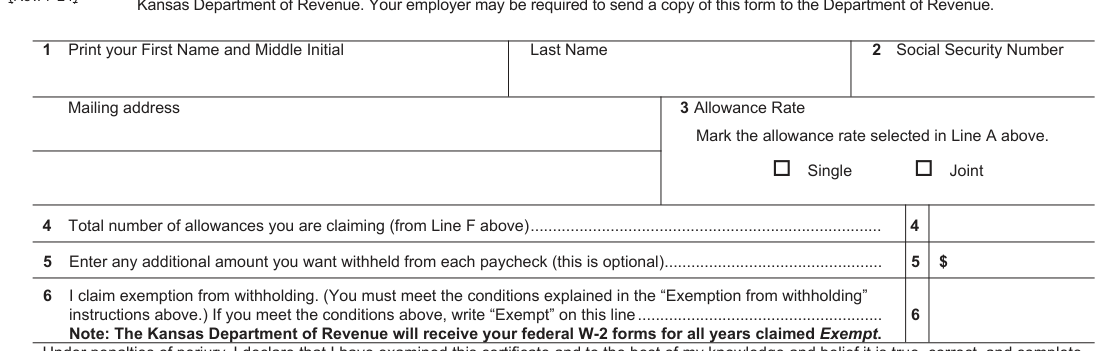
Text version of this table
1 Print your First Name and Middle Initial Last Name 2 Social Security Number Mailing address 3 Allowance Rate Mark the allowance rate selected in Line A above. o Single o Joint 4 Total number of allowances you are claiming (from Line F above)............................................................................... 4 5 Enter any additional amount you want withheld from each paycheck (this is optional)................................................. 5 $ 6 I claim exemption from withholding. (You must meet the conditions explained in the “Exemption from withholding” instructions above.) If you meet the conditions above, write “Exempt” on this line........................................................ Note: The Kansas Department of Revenue will receive your federal W-2 forms for all years claimed Exempt. 6
Under penalties of perjury, I declare that I have examined this certificate and to the best of my knowledge and belief it is true, correct, and complete.
SIGN
HERE
7 Employer's Name and Address
Date
8 EIN (Employer ID Number)
FOR OFFICE USE ONLY
NOTICE OF TAX ACCOUNT CLOSURE Inactive:__
Date/Initial
Date/Initial
Date/Initial
Kansas Tax Account No. Federal Employer's ID No. Business Telephone Number Officer's Telephone Number Business Name Business Mailing Address City State Zip Code Owner's/Officer's Name Current Address City State Zip Code
- Effective _, _ I wish to cancel my registration for the following tax(es). Check each box that applies and enter the specific account number for that tax type.
Retailers' Sales:_ _ Bingo Enforcement: __
Retailers' Compensating:_ _ Dry Cleaning Surcharge: __
Liquor Enforcement:_ _ Withholding: __
Liquor Drink:_ _ Transient Guest Tax:_
Consumer's Use:_ Vehicle Rental Tax:_
Tire Excise:_ Water Protection Fee: __
- Does this business currently have employees? Yes No If no, enter effective date:__
- Has there been a transfer or a change in ownership?
No Yes If yes, complete lines a, b and c: c. Starting date of new business:_ _ Taxpayer ID No.: __
- This business has a cash bond an escrow bond no bond unknown a surety bond
- Have all applicable forms for the taxes marked above been filed to date of closing? Yes No If no, file them with this form.
- If this is a consolidated registration, are all locations being closed? Yes No If no, list the specific locations to be closed under "Remarks" on line 15.
- Remarks and final settlement or arrangement for settlement:_ __
SIGN
Signature of Retailer/Employer Title Date Signature of Preparer
FOR OFFICE USE ONLY
Was the date that the business was discontinued estimated? No Yes If yes, give source of information:_ Accounts receivable remain to be collected: No Yes If yes, tax type: A Jeopardy Assessment is recommended: No Yes If yes, tax type:_ A warrant is recommended: No Yes If yes, tax type:_ __ You can fax this form to 785-296-2073 or mail to: Kansas Department of Revenue, Customer Relations, PO Box 75680, Topeka, KS 66675-0680; if you have any questions regarding this form you may call 785-368-8222 CR-108 (Rev. 2-20)
# TABLES FOR PERCENTAGE METHOD OF KANSAS WITHHOLDING
(For wages paid on and after July 1, 2024)
NOTE: The wage amounts are after withholding allowances have been subtracted.
TABLE 1 - WEEKLY PAYROLL PERIOD
(a) SINGLE person (including Head of Household)
If amount of wages (after The amount of KANSAS income withholding allowance) is: tax to be withheld is:
Over But not over
$0 $69 $0
$69 $512 5.2% of excess over $69
$512 $23.00 plus 5.58% of excess over $512
(b) MARRIED person
If amount of wages (after The amount of KANSAS income withholding allowance) is: tax to be withheld is:
Over But not over
$0 $158 $0
$158 $1,043 5.2% of excess over $158 $1,043 $46.00 plus 5.58% of excess over $1,043 TABLE 2 - BI-WEEKLY PAYROLL PERIOD
(a) SINGLE person (including Head of Household)
If amount of wages (after The amount of KANSAS income withholding allowance) is: tax to be withheld is:
Over But not over
$0 $139 $0
$139 $1,023 5.2% of excess over $139 $1,023 $46.00 plus 5.58% of excess over $1,023
(b) MARRIED person
If amount of wages (after The amount of KANSAS income withholding allowance) is: tax to be withheld is:
Over But not over
$0 $317 $0
$317 $2,086 5.2% of excess over $317 $2,086 $92.00 plus 5.58% of excess over $2,086 TABLE 3 - SEMI-MONTHLY PAYROLL PERIOD
(a) SINGLE person (including Head of Household)
If amount of wages (after The amount of KANSAS income withholding allowance) is: tax to be withheld is:
Over But not over
$0 $150 $0
$150 $1,109 5.2% of excess over $150 $1,109 $49.83 plus 5.58% of excess over $1,109
(b) MARRIED person
If amount of wages (after The amount of KANSAS income withholding allowance) is: tax to be withheld is:
Over But not over
$0 $343 $0
$343 $2,260 5.2% of excess over $343 $2,260 $99.67 plus 5.58% of excess over $2,260 TABLE 4 - MONTHLY PAYROLL PERIOD
(a) SINGLE person (including Head of Household)
If amount of wages (after The amount of KANSAS income withholding allowance) is: tax to be withheld is:
Over But not over
$0 $300 $0
$300 $2,217 5.2% of excess over $300 $2,217 $99.67 plus 5.58% of excess over $2,217
(b) MARRIED person
If amount of wages (after The amount of KANSAS income withholding allowance) is: tax to be withheld is:
Over But not over
$0 $687 $0
$687 $4,520 5.2% of excess over $687 $4,520 $199.33 plus 5.58% of excess over $4,520
# TABLES FOR PERCENTAGE METHOD OF KANSAS WITHHOLDING
(For wages paid on and after July 1, 2024)
NOTE: The wage amounts are after withholding allowances have been subtracted.
# TABLE 5 - QUARTERLY PAYROLL PERIOD
(a) SINGLE person (including Head of Household)
If amount of wages (after The amount of KANSAS income withholding allowance) is: tax to be withheld is:
Over But not over
$0 $901 $0
$901 $6,651 5.2% of excess over $901
$6,651 $299.00 plus 5.58% of excess over $6,651
(b) MARRIED person
If amount of wages (after The amount of KANSAS income withholding allowance) is: tax to be withheld is:
Over But not over
$0 $2,060 $0
$2,060 $13,560 5.2% of excess over $2,060
$13,560 $598.00 plus 5.58% of excess over $13,560
# TABLE 6 - SEMI-ANNUAL PAYROLL PERIOD
(a) SINGLE person (including Head of Household)
If amount of wages (after The amount of KANSAS income withholding allowance) is: tax to be withheld is:
Over But not over
$0 $1,803 $0
$1,803 $13,303 5.2% of excess over $1,803
$13,303 $598.00 plus 5.58% of excess over $13,303
(b) MARRIED person
If amount of wages (after The amount of KANSAS income withholding allowance) is: tax to be withheld is:
Over But not over
$0 $4,120 $0
$4,120 $27,120 5.2% of excess over $4,120
$27,120 $1,196.00 plus 5.58% of excess over $27,120
# TABLE 7 - ANNUAL PAYROLL PERIOD
(a) SINGLE person (including Head of Household)
If amount of wages (after The amount of KANSAS income withholding allowance) is: tax to be withheld is:
Over But not over
$0 $3,605 $0
$3,605 $26,605 5.2% of excess over $3,605
$26,605 $1,196.00 plus 5.58% of excess over $26,605
(b) MARRIED person
If amount of wages (after The amount of KANSAS income withholding allowance) is: tax to be withheld is:
Over But not over
$0 $8,240 $0
$8,240 $54,240 5.2% of excess over $8,240
$54,240 $2,392.00 plus 5.58% of excess over $54,240
# TABLE 8 - DAILY OR MISCELLANEOUS PAYROLL PERIOD
(a) SINGLE person (including Head of Household)
If amount of wages (after The amount of KANSAS income withholding allowance) is: tax to be withheld is:
Over But not over
$0 $14 $0
$14 $102 5.2% of excess over $14
$102 $4.60 plus 5.58% of excess over $102
(b) MARRIED person
If amount of wages (after The amount of KANSAS income withholding allowance) is: tax to be withheld is:
Over But not over
$0 $32 $0
$32 $209 5.2% of excess over $32
$209 $9.20 plus 5.58% of excess over $209
# SINGLE Persons - WEEKLY Payroll Period
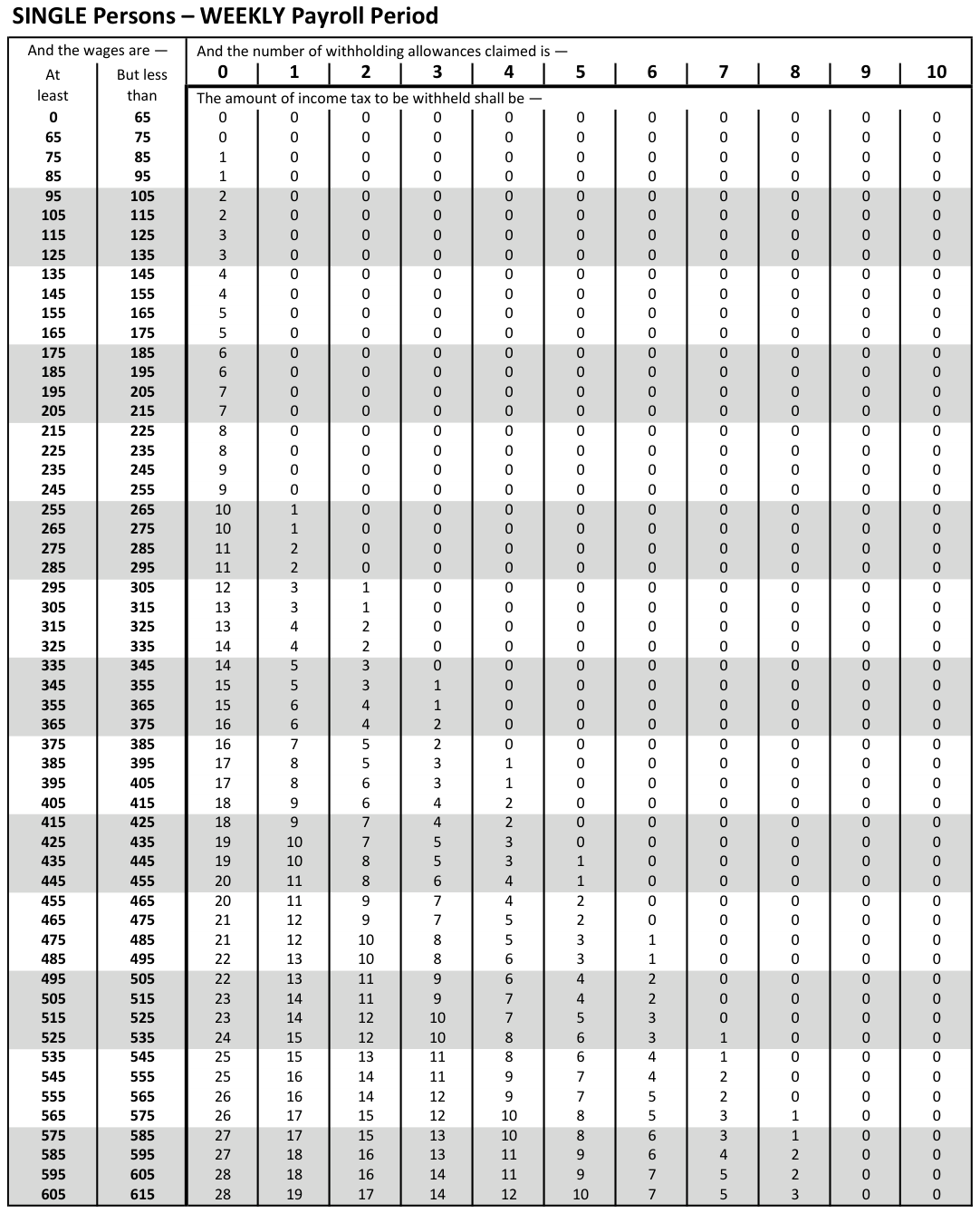
Text version of this table
| And the wages are — At But less least than 0 65 65 75 75 85 85 95 | And the number of withholding allowances claimed is — 0 1 2 3 4 5 6 7 8 9 10 | |||||||||||
| The amount of income tax to be withheld shall be - | ||||||||||||
| 0 0 1 1 | 0 0 0 0 | 0 0 0 0 | 0 0 0 0 | 0 0 0 0 | 0 0 0 0 | 0 0 0 0 | 0 0 0 0 | 0 0 0 0 | 0 0 0 0 | 0 0 0 0 | ||
| 95 105 115 125 | 105 115 125 135 | 2 2 3 3 | 0 0 0 0 | 0 0 0 0 | 0 0 0 0 | 0 0 0 0 | 0 0 0 0 | 0 0 0 0 | 0 0 0 0 | 0 0 0 0 | 0 0 0 0 | 0 0 0 0 |
| 135 145 155 165 | 145 155 165 175 | 4 | 0 | 0 | 0 | 0 | 0 | 0 | 0 | 0 | 0 | 0 |
| 4 | 0 | 0 | 0 | 0 | 0 | 0 | 0 | 0 | 0 | 0 | ||
| 5 | 0 | 0 | 0 | 0 | 0 | 0 | 0 | 0 | 0 | 0 | ||
| 5 | 0 | 0 | 0 | 0 | 0 | 0 | 0 | 0 | 0 | 0 | ||
| 175 185 195 205 | 185 195 205 215 | 6 6 7 7 | 0 0 0 0 | 0 0 0 0 | 0 0 0 0 | 0 0 0 0 | 0 0 0 0 | 0 0 0 0 | 0 0 0 0 | 0 0 0 0 | 0 0 0 0 | 0 0 0 0 |
| 215 225 235 245 | 225 235 245 255 | 8 | 0 | 0 | 0 | 0 | 0 | 0 | 0 | 0 | 0 | 0 |
| 8 | 0 | 0 | 0 | 0 | 0 | 0 | 0 | 0 | 0 | 0 | ||
| 9 | 0 | 0 | 0 | 0 | 0 | 0 | 0 | 0 | 0 | 0 | ||
| 9 | 0 | 0 | 0 | 0 | 0 | 0 | 0 | 0 | 0 | 0 | ||
| 255 265 275 285 | 265 275 285 295 | 10 10 11 11 | 1 1 2 2 | 0 0 0 0 | 0 0 0 0 | 0 0 0 0 | 0 0 0 0 | 0 0 0 0 | 0 0 0 0 | 0 0 0 0 | 0 0 0 0 | 0 0 0 0 |
| 295 305 315 325 | 305 315 325 335 | 12 | 3 | 1 | 0 | 0 | 0 | 0 | 0 | 0 | 0 | 0 |
| 13 | 3 | 1 | 0 | 0 | 0 | 0 | 0 | 0 | 0 | 0 | ||
| 13 | 4 | 2 | 0 | 0 | 0 | 0 | 0 | 0 | 0 | 0 | ||
| 14 | 4 | 2 | 0 | 0 | 0 | 0 | 0 | 0 | 0 | 0 | ||
| 335 345 355 365 | 345 355 365 375 | 14 15 15 16 | 5 5 6 6 | 3 3 4 4 | 0 1 1 2 | 0 0 0 0 | 0 0 0 0 | 0 0 0 0 | 0 0 0 0 | 0 0 0 0 | 0 0 0 0 | 0 0 0 0 |
| 375 385 395 405 | 385 395 405 415 | 16 | 7 | 5 | 2 | 0 | 0 | 0 | 0 | 0 | 0 | 0 |
| 17 | 8 | 5 | 3 | 1 | 0 | 0 | 0 | 0 | 0 | 0 | ||
| 17 | 8 | 6 | 3 | 1 | 0 | 0 | 0 | 0 | 0 | 0 | ||
| 18 | 9 | 6 | 4 | 2 | 0 | 0 | 0 | 0 | 0 | 0 | ||
| 415 425 435 445 | 425 435 445 455 | 18 19 19 20 | 9 10 10 11 | 7 7 8 8 | 4 5 5 6 | 2 3 3 4 | 0 0 1 1 | 0 0 0 0 | 0 0 0 0 | 0 0 0 0 | 0 0 0 0 | 0 0 0 0 |
| 455 465 475 485 | 465 475 485 495 | 20 | 11 | 9 | 7 | 4 | 2 | 0 | 0 | 0 | 0 | 0 |
| 21 | 12 | 9 | 7 | 5 | 2 | 0 | 0 | 0 | 0 | 0 | ||
| 21 | 12 | 10 | 8 | 5 | 3 | 1 | 0 | 0 | 0 | 0 | ||
| 22 | 13 | 10 | 8 | 6 | 3 | 1 | 0 | 0 | 0 | 0 | ||
| 495 505 515 525 | 505 515 525 535 | 22 23 23 24 | 13 14 14 15 | 11 11 12 12 | 9 9 10 10 | 6 7 7 8 | 4 4 5 6 | 2 2 3 3 | 0 0 0 1 | 0 0 0 0 | 0 0 0 0 | 0 0 0 0 |
| 535 545 555 565 | 545 555 565 575 | 25 | 15 | 13 | 11 | 8 | 6 | 4 | 1 | 0 | 0 | 0 |
| 25 | 16 | 14 | 11 | 9 | 7 | 4 | 2 | 0 | 0 | 0 | ||
| 26 | 16 | 14 | 12 | 9 | 7 | 5 | 2 | 0 | 0 | 0 | ||
| 26 | 17 | 15 | 12 | 10 | 8 | 5 | 3 | 1 | 0 | 0 | ||
| 575 585 595 605 | 585 595 605 615 | 27 27 28 28 | 17 18 18 19 | 15 16 16 17 | 13 13 14 14 | 10 11 11 12 | 8 9 9 10 | 6 6 7 7 | 3 4 5 5 | 1 2 2 3 | 0 0 0 0 | 0 0 0 0 |
# SINGLE Persons - WEEKLY Payroll Period
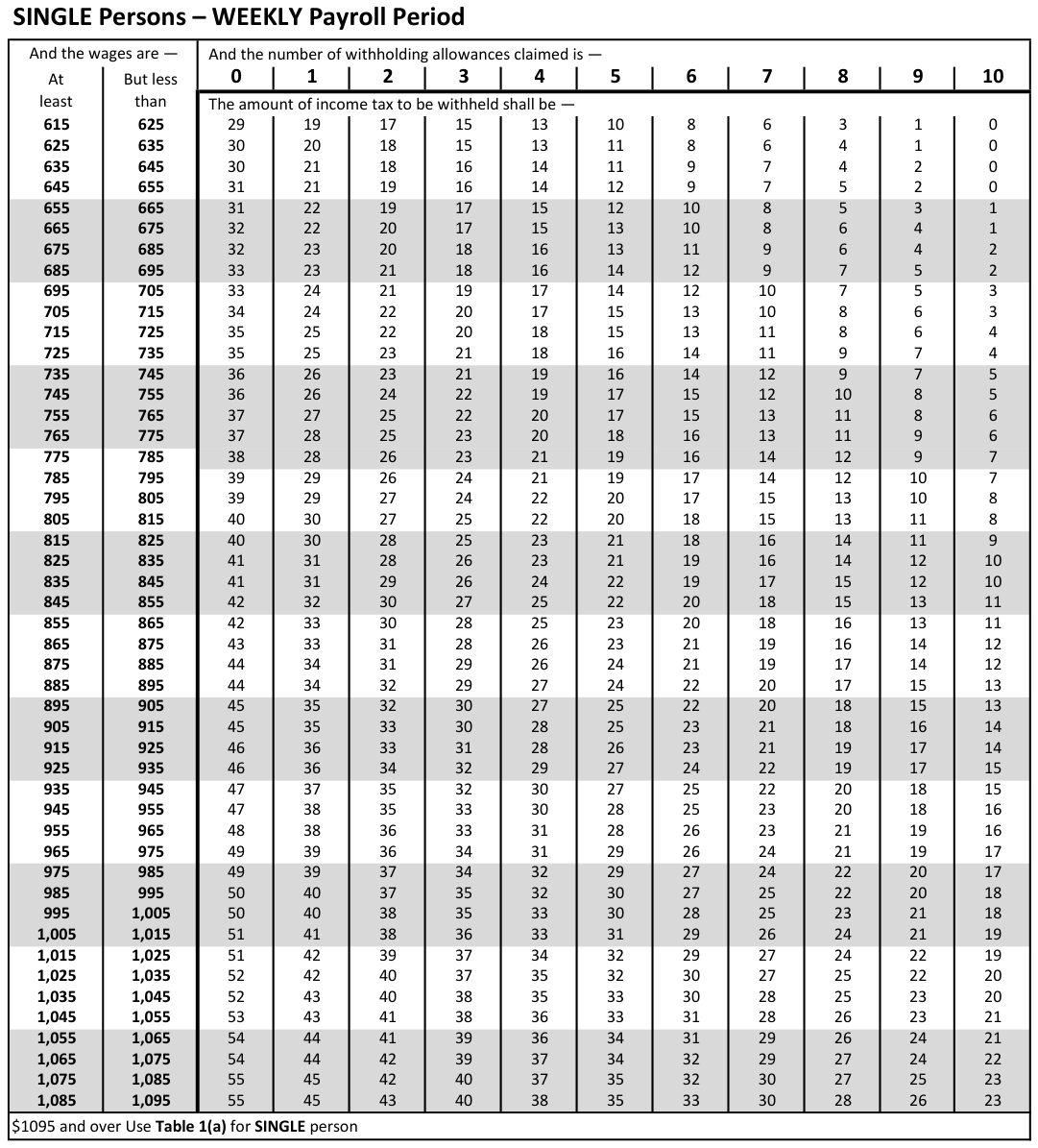
Text version of this table
| And the wages are — At But less least than 615 625 625 635 635 645 645 655 | And the number of withholding allowances claimed is — 0 1 2 3 4 5 6 7 8 9 10 | |||||||||||
| The amount of income tax to be withheld shall be — 29 19 17 15 13 10 8 6 3 1 0 30 20 18 15 13 11 8 6 4 1 0 30 21 18 16 14 11 9 7 4 2 0 31 21 19 16 14 12 9 7 5 2 0 | ||||||||||||
| 655 665 675 685 | 665 675 685 695 | 31 32 32 33 | 22 22 23 23 | 19 20 20 21 | 17 17 18 18 | 15 15 16 16 | 12 13 13 14 | 10 10 11 12 | 8 8 9 9 | 5 6 6 7 | 3 4 4 5 | 1 1 2 2 |
| 695 705 715 725 | 705 715 725 735 | 33 34 35 35 | 24 24 25 25 | 21 22 22 23 | 19 20 20 21 | 17 17 18 18 | 14 15 15 16 | 12 13 13 14 | 10 10 11 11 | 7 8 8 9 | 5 6 6 7 | 3 3 4 4 |
| 735 745 755 765 | 745 755 765 775 | 36 36 37 37 | 26 26 27 28 | 23 24 25 25 | 21 22 22 23 | 19 19 20 20 | 16 17 17 18 | 14 15 15 16 | 12 12 13 13 | 9 10 11 11 | 7 8 8 9 | 5 5 6 6 |
| 775 785 795 805 | 785 795 805 815 | 38 | 28 | 26 | 23 | 21 | 19 | 16 | 14 | 12 | 9 | 7 |
| 39 39 40 | 29 29 30 | 26 27 27 | 24 24 25 | 21 22 22 | 19 20 20 | 17 17 18 | 14 15 15 | 12 13 13 | 10 10 11 | 7 8 8 | ||
| 815 825 835 845 | 825 835 845 855 | 40 41 41 42 | 30 31 31 32 | 28 28 29 30 | 25 26 26 27 | 23 23 24 25 | 21 21 22 22 | 18 19 19 20 | 16 16 17 18 | 14 14 15 15 | 11 12 12 13 | 9 10 10 11 |
| 855 865 875 885 | 865 875 885 895 | 42 43 44 44 | 33 33 34 34 | 30 31 31 32 | 28 28 29 29 | 25 26 26 27 | 23 23 24 24 | 20 21 21 22 | 18 19 19 20 | 16 16 17 17 | 13 14 14 15 | 11 12 12 13 |
| 895 905 915 925 | 905 915 925 935 | 45 45 46 46 | 35 35 36 36 | 32 33 33 34 | 30 30 31 32 | 27 28 28 29 | 25 25 26 27 | 22 23 23 24 | 20 21 21 22 | 18 18 19 19 | 15 16 17 17 | 13 14 14 15 |
| 935 945 955 965 | 945 955 965 975 | 47 47 48 49 | 37 38 38 39 | 35 35 36 36 | 32 33 33 34 | 30 30 31 31 | 27 28 28 29 | 25 25 26 26 | 22 23 23 24 | 20 20 21 21 | 18 18 19 19 | 15 16 16 17 |
| 975 985 995 1,005 | 985 995 1,005 1,015 | 49 50 50 51 | 39 40 40 41 | 37 37 38 38 | 34 35 35 36 | 32 32 33 33 | 29 30 30 31 | 27 27 28 29 | 24 25 25 26 | 22 22 23 24 | 20 20 21 21 | 17 18 18 19 |
| 1,015 1,025 1,035 1,045 | 1,025 1,035 1,045 1,055 | 51 52 52 53 | 42 42 43 43 | 39 40 40 41 | 37 37 38 38 | 34 35 35 36 | 32 32 33 33 | 29 30 30 31 | 27 27 28 28 | 24 25 25 26 | 22 22 23 23 | 19 20 20 21 |
| 1,055 1,065 1,075 1,085 | 1,065 1,075 1,085 1,095 | 54 54 55 55 | 44 44 45 45 | 41 42 42 43 | 39 39 40 40 | 36 37 37 38 | 34 34 35 35 | 31 32 32 33 | 29 29 30 30 | 26 27 27 28 | 24 24 25 26 | 21 22 23 23 |
| $1095 and over Use Table 1(a) for SINGLE person |
# MARRIED Persons - WEEKLY Payroll Period
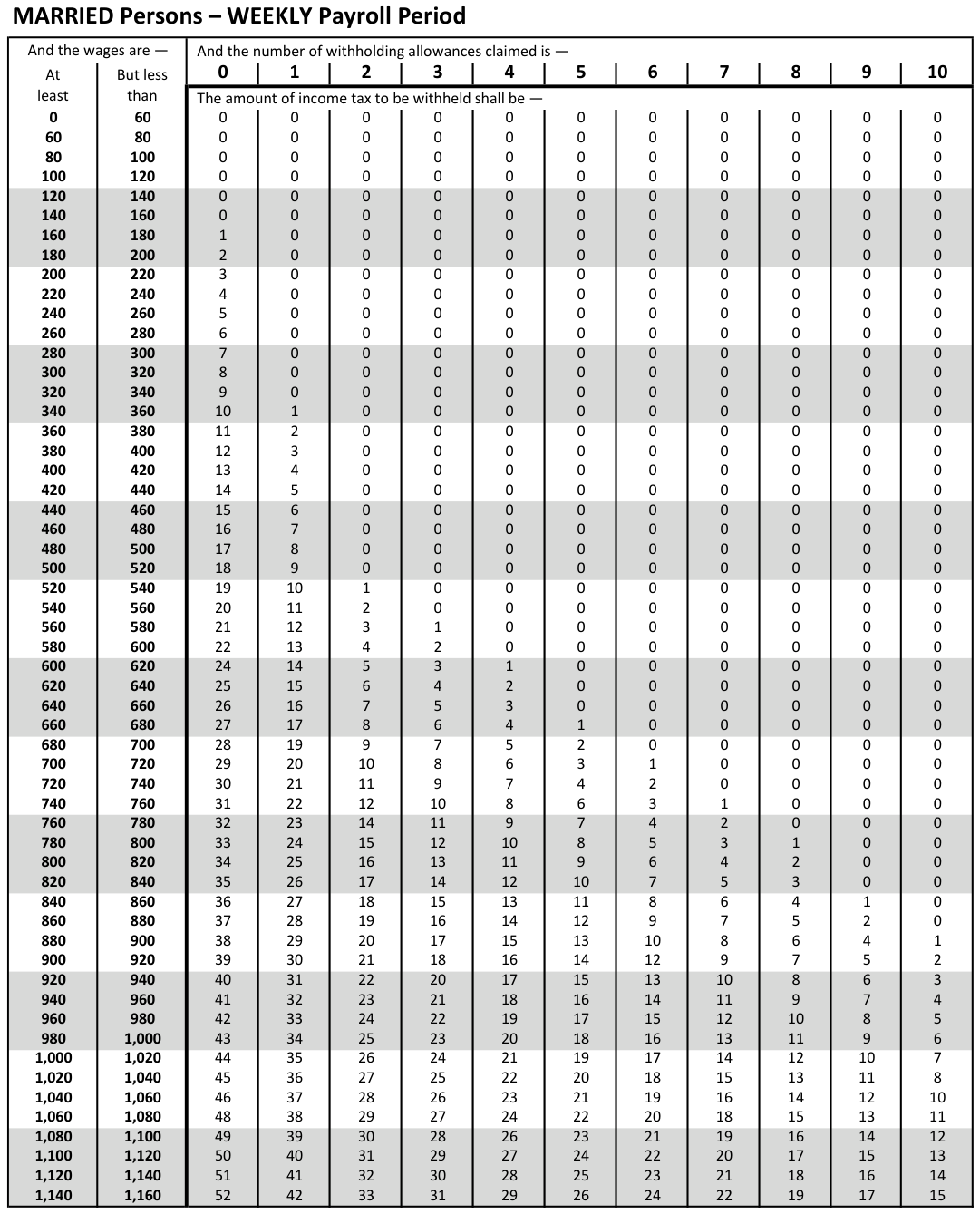
Text version of this table
| And the wages are — At But less least than 0 60 60 80 80 100 100 120 | And the number of withholding allowances claimed is — 0 1 2 3 4 5 6 7 8 9 10 | |||||||||||
| The amount of income tax to be withheld shall be — 0 0 0 0 0 0 0 0 0 0 0 0 0 0 0 0 0 0 0 0 0 0 0 0 0 0 0 0 0 0 0 0 0 0 0 0 0 0 0 0 0 0 0 0 | ||||||||||||
| 120 140 160 180 | 140 160 180 200 | 0 0 1 2 | 0 0 0 0 | 0 0 0 0 | 0 0 0 0 | 0 0 0 0 | 0 0 0 0 | 0 0 0 0 | 0 0 0 0 | 0 0 0 0 | 0 0 0 0 | 0 0 0 0 |
| 200 220 240 260 | 220 240 260 280 | 3 4 5 6 | 0 0 0 0 | 0 0 0 0 | 0 0 0 0 | 0 0 0 0 | 0 0 0 0 | 0 0 0 0 | 0 0 0 0 | 0 0 0 0 | 0 0 0 0 | 0 0 0 0 |
| 280 300 320 340 | 300 320 340 360 | 7 8 9 10 | 0 0 0 1 | 0 0 0 0 | 0 0 0 0 | 0 0 0 0 | 0 0 0 0 | 0 0 0 0 | 0 0 0 0 | 0 0 0 0 | 0 0 0 0 | 0 0 0 0 |
| 360 380 400 420 | 380 400 420 440 | 11 12 13 14 | 2 3 4 5 | 0 0 0 0 | 0 0 0 0 | 0 0 0 0 | 0 0 0 0 | 0 0 0 0 | 0 0 0 0 | 0 0 0 0 | 0 0 0 0 | 0 0 0 0 |
| 440 460 480 500 | 460 480 500 520 | 15 16 17 18 | 6 7 8 9 | 0 0 0 0 | 0 0 0 0 | 0 0 0 0 | 0 0 0 0 | 0 0 0 0 | 0 0 0 0 | 0 0 0 0 | 0 0 0 0 | 0 0 0 0 |
| 520 540 560 580 | 540 560 580 600 | 19 20 21 22 | 10 11 12 13 | 1 2 3 4 | 0 0 1 2 | 0 0 0 0 | 0 0 0 0 | 0 0 0 0 | 0 0 0 0 | 0 0 0 0 | 0 0 0 0 | 0 0 0 0 |
| 600 620 640 660 | 620 640 660 680 | 24 25 26 27 | 14 15 16 17 | 5 6 7 8 | 3 4 5 6 | 1 2 3 4 | 0 0 0 1 | 0 0 0 0 | 0 0 0 0 | 0 0 0 0 | 0 0 0 0 | 0 0 0 0 |
| 680 700 720 740 | 700 720 740 760 | 28 29 30 31 | 19 20 21 22 | 9 10 11 12 | 7 8 9 10 | 5 6 7 8 | 2 3 4 6 | 0 1 2 3 | 0 0 0 1 | 0 0 0 0 | 0 0 0 0 | 0 0 0 0 |
| 760 780 800 820 | 780 800 820 840 | 32 33 34 35 | 23 24 25 26 | 14 15 16 17 | 11 12 13 14 | 9 10 11 12 | 7 8 9 10 | 4 5 6 7 | 2 3 4 5 | 0 1 2 3 | 0 0 0 0 | 0 0 0 0 |
| 840 860 880 900 | 860 880 900 920 | 36 37 38 39 | 27 28 29 30 | 18 19 20 21 | 15 16 17 18 | 13 14 15 16 | 11 12 13 14 | 8 9 10 12 | 6 7 8 9 | 4 5 6 7 | 1 2 4 5 | 0 0 1 2 |
| 920 940 960 980 | 940 960 980 1,000 | 40 41 42 43 | 31 32 33 34 | 22 23 24 25 | 20 21 22 23 | 17 18 19 20 | 15 16 17 18 | 13 14 15 16 | 10 11 12 13 | 8 9 10 11 | 6 7 8 9 | 3 4 5 6 |
| 1,000 1,020 1,040 1,060 | 1,020 1,040 1,060 1,080 | 44 45 46 48 | 35 36 37 38 | 26 27 28 29 | 24 25 26 27 | 21 22 23 24 | 19 20 21 22 | 17 18 19 20 | 14 15 16 18 | 12 13 14 15 | 10 11 12 13 | 7 8 10 11 |
| 1,080 1,100 1,120 1,140 | 1,100 1,120 1,140 1,160 | 49 50 51 52 | 39 40 41 42 | 30 31 32 33 | 28 29 30 31 | 26 27 28 29 | 23 24 25 26 | 21 22 23 24 | 19 20 21 22 | 16 17 18 19 | 14 15 16 17 | 12 13 14 15 |
# MARRIED Persons - WEEKLY Payroll Period
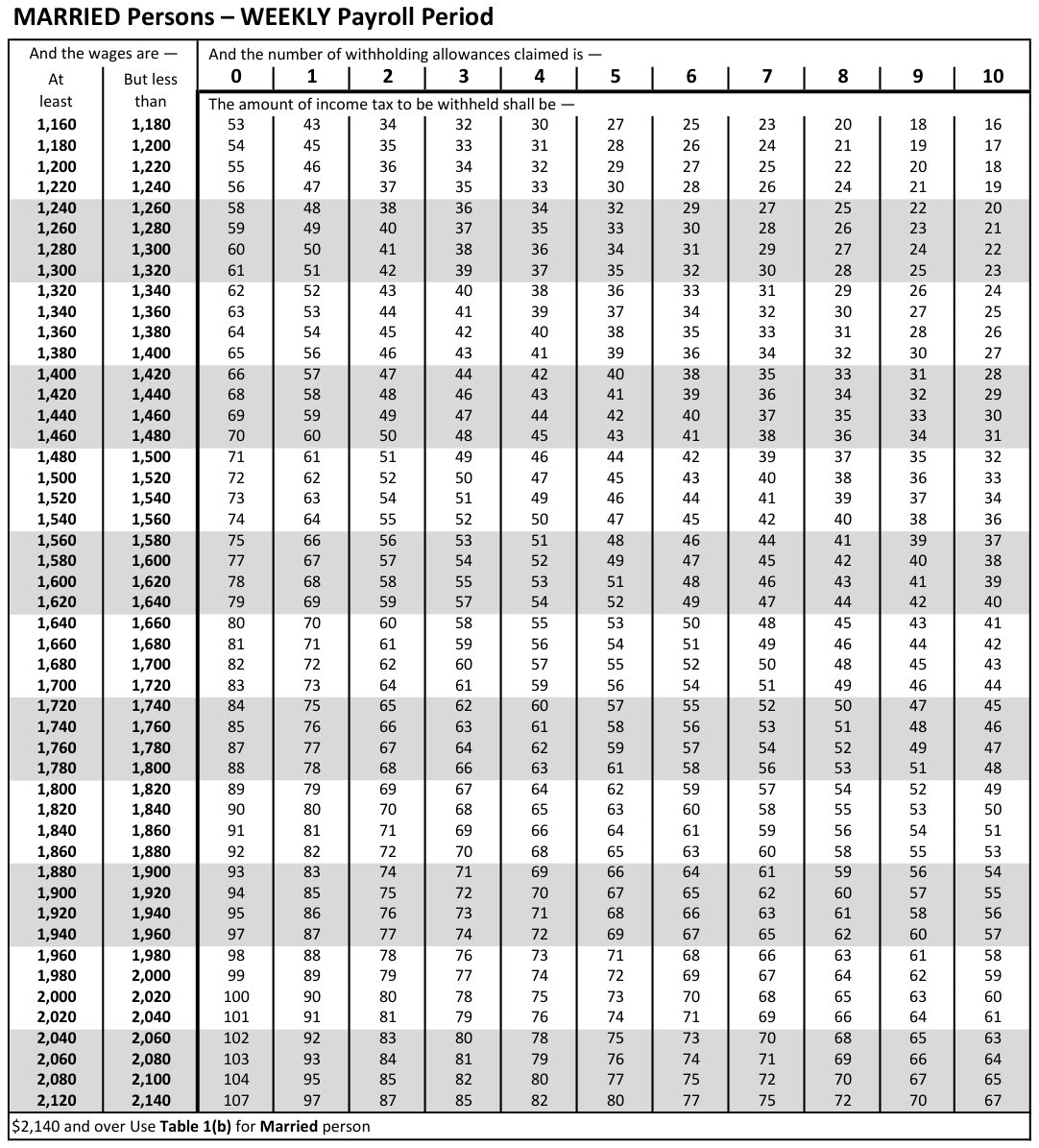
Text version of this table
| And the wages are — At But less least than 1,160 1,180 1,180 1,200 1,200 1,220 1,220 1,240 | And the number of withholding allowances claimed is — 0 1 2 3 4 5 6 7 8 9 10 | |||||||||||
| The amount of income tax to be withheld shall be - | ||||||||||||
| 53 54 55 56 | 43 45 46 47 | 34 35 36 37 | 32 33 34 35 | 30 31 32 33 | 27 28 29 30 | 25 26 27 28 | 23 24 25 26 | 20 21 22 24 | 18 19 20 21 | 16 17 18 19 | ||
| 1,240 1,260 1,280 1,300 | 1,260 1,280 1,300 1,320 | 58 59 60 61 | 48 49 50 51 | 38 40 41 42 | 36 37 38 39 | 34 35 36 37 | 32 33 34 35 | 29 30 31 32 | 27 28 29 30 | 25 26 27 28 | 22 23 24 25 | 20 21 22 23 |
| 1,320 1,340 1,360 1,380 | 1,340 1,360 1,380 1,400 | 62 | 52 | 43 | 40 | 38 | 36 | 33 | 31 | 29 | 26 | 24 |
| 63 | 53 | 44 | 41 | 39 | 37 | 34 | 32 | 30 | 27 | 25 | ||
| 64 | 54 | 45 | 42 | 40 | 38 | 35 | 33 | 31 | 28 | 26 | ||
| 65 | 56 | 46 | 43 | 41 | 39 | 36 | 34 | 32 | 30 | 27 | ||
| 1,400 1,420 1,440 1,460 | 1,420 1,440 1,460 1,480 | 66 68 69 70 | 57 58 59 60 | 47 48 49 50 | 44 46 47 48 | 42 43 44 45 | 40 41 42 43 | 38 39 40 41 | 35 36 37 38 | 33 34 35 36 | 31 32 33 34 | 28 29 30 31 |
| 1,480 1,500 1,520 1,540 | 1,500 1,520 1,540 1,560 | 71 | 61 | 51 | 49 | 46 | 44 | 42 | 39 | 37 | 35 | 32 |
| 72 | 62 | 52 | 50 | 47 | 45 | 43 | 40 | 38 | 36 | 33 | ||
| 73 | 63 | 54 | 51 | 49 | 46 | 44 | 41 | 39 | 37 | 34 | ||
| 74 | 64 | 55 | 52 | 50 | 47 | 45 | 42 | 40 | 38 | 36 | ||
| 1,560 1,580 1,600 1,620 | 1,580 1,600 1,620 1,640 | 75 77 78 79 | 66 67 68 69 | 56 57 58 59 | 53 54 55 57 | 51 52 53 54 | 48 49 51 52 | 46 47 48 49 | 44 45 46 47 | 41 42 43 44 | 39 40 41 42 | 37 38 39 40 |
| 1,640 1,660 1,680 1,700 | 1,660 1,680 1,700 1,720 | 80 | 70 | 60 | 58 | 55 | 53 | 50 | 48 | 45 | 43 | 41 |
| 81 | 71 | 61 | 59 | 56 | 54 | 51 | 49 | 46 | 44 | 42 | ||
| 82 | 72 | 62 | 60 | 57 | 55 | 52 | 50 | 48 | 45 | 43 | ||
| 83 | 73 | 64 | 61 | 59 | 56 | 54 | 51 | 49 | 46 | 44 | ||
| 1,720 1,740 1,760 1,780 | 1,740 1,760 1,780 1,800 | 84 85 87 88 | 75 76 77 78 | 65 66 67 68 | 62 63 64 66 | 60 61 62 63 | 57 58 59 61 | 55 56 57 58 | 52 53 54 56 | 50 51 52 53 | 47 48 49 51 | 45 46 47 48 |
| 1,800 1,820 1,840 1,860 | 1,820 1,840 1,860 1,880 | 89 | 79 | 69 | 67 | 64 | 62 | 59 | 57 | 54 | 52 | 49 |
| 90 | 80 | 70 | 68 | 65 | 63 | 60 | 58 | 55 | 53 | 50 | ||
| 91 | 81 | 71 | 69 | 66 | 64 | 61 | 59 | 56 | 54 | 51 | ||
| 92 | 82 | 72 | 70 | 68 | 65 | 63 | 60 | 58 | 55 | 53 | ||
| 1,880 1,900 1,920 1,940 | 1,900 1,920 1,940 1,960 | 93 94 95 97 | 83 85 86 87 | 74 75 76 77 | 71 72 73 74 | 69 70 71 72 | 66 67 68 69 | 64 65 66 67 | 61 62 63 65 | 59 60 61 62 | 56 57 58 60 | 54 55 56 57 |
| 1,960 1,980 2,000 2,020 | 1,980 2,000 2,020 2,040 | 98 | 88 | 78 | 76 | 73 | 71 | 68 | 66 | 63 | 61 | 58 |
| 99 | 89 | 79 | 77 | 74 | 72 | 69 | 67 | 64 | 62 | 59 | ||
| 100 | 90 | 80 | 78 | 75 | 73 | 70 | 68 | 65 | 63 | 60 | ||
| 101 | 91 | 81 | 79 | 76 | 74 | 71 | 69 | 66 | 64 | 61 | ||
| 2,040 2,060 2,080 2,120 | 2,060 2,080 2,100 2,140 | 102 103 104 107 | 92 93 95 97 | 83 84 85 87 | 80 81 82 85 | 78 79 80 82 | 75 76 77 80 | 73 74 75 77 | 70 71 72 75 | 68 69 70 72 | 65 66 67 70 | 63 64 65 67 |
| $2,140 and over Use Table 1(b) for Married person |
# SINGLE Persons - BI-WEEKLY Payroll Period
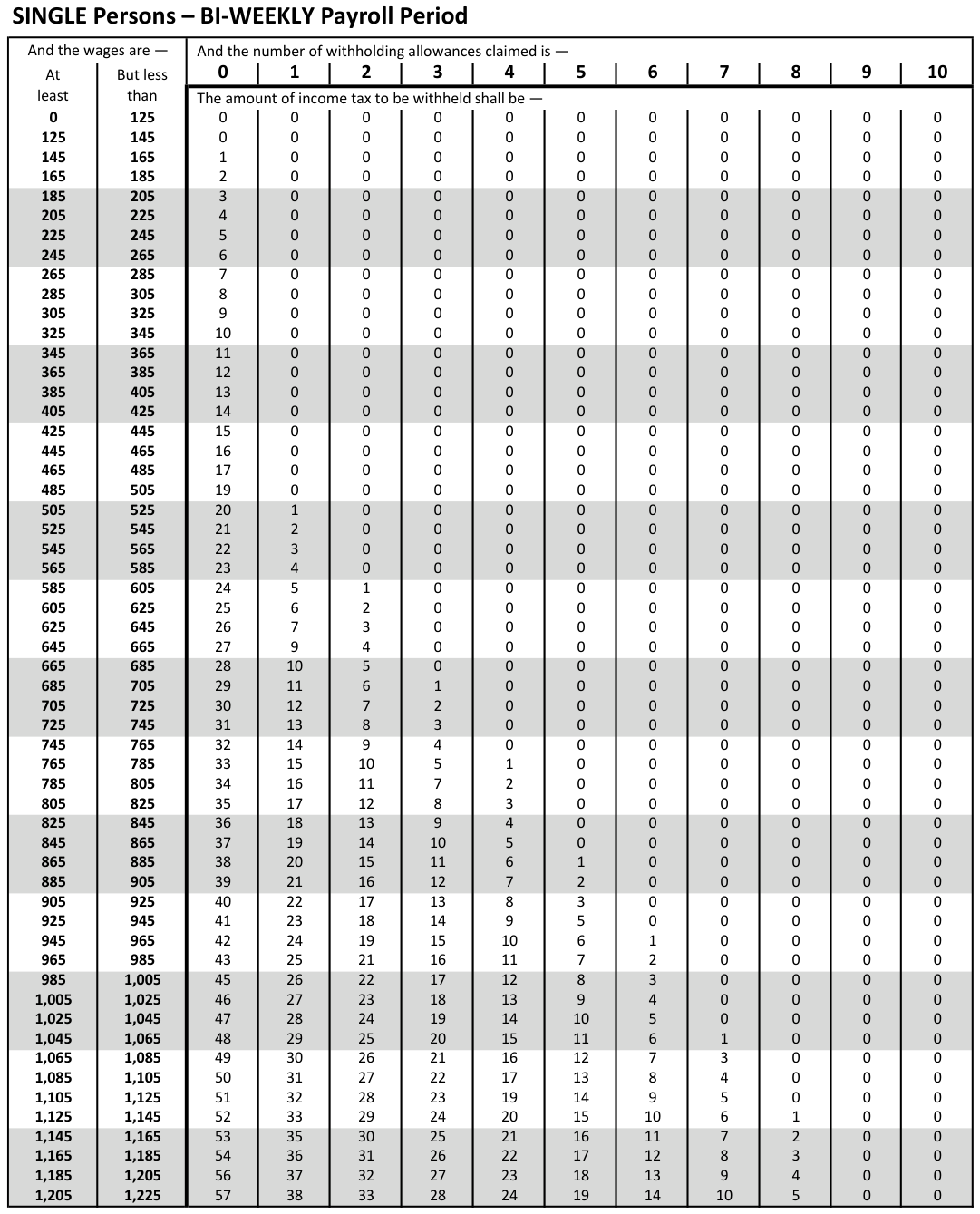
Text version of this table
| And the wages are — At But less least than 0 125 125 145 145 165 165 185 | And the number of withholding allowances claimed is — 0 1 2 3 4 5 6 7 8 9 10 | |||||||||||
| The amount of income tax to be withheld shall be — 0 0 0 0 0 0 0 0 0 0 0 0 0 0 0 0 0 0 0 0 0 0 1 0 0 0 0 0 0 0 0 0 0 2 0 0 0 0 0 0 0 0 0 0 | ||||||||||||
| 185 205 225 245 | 205 225 245 265 | 3 4 5 6 | 0 0 0 0 | 0 0 0 0 | 0 0 0 0 | 0 0 0 0 | 0 0 0 0 | 0 0 0 0 | 0 0 0 0 | 0 0 0 0 | 0 0 0 0 | 0 0 0 0 |
| 265 285 305 325 | 285 305 325 345 | 7 8 9 10 | 0 0 0 0 | 0 0 0 0 | 0 0 0 0 | 0 0 0 0 | 0 0 0 0 | 0 0 0 0 | 0 0 0 0 | 0 0 0 0 | 0 0 0 0 | 0 0 0 0 |
| 345 365 385 405 | 365 385 405 425 | 11 12 13 14 | 0 0 0 0 | 0 0 0 0 | 0 0 0 0 | 0 0 0 0 | 0 0 0 0 | 0 0 0 0 | 0 0 0 0 | 0 0 0 0 | 0 0 0 0 | 0 0 0 0 |
| 425 445 465 485 | 445 465 485 505 | 15 16 17 19 | 0 0 0 0 | 0 0 0 0 | 0 0 0 0 | 0 0 0 0 | 0 0 0 0 | 0 0 0 0 | 0 0 0 0 | 0 0 0 0 | 0 0 0 0 | 0 0 0 0 |
| 505 525 545 565 | 525 545 565 585 | 20 21 22 23 | 1 2 3 4 | 0 0 0 0 | 0 0 0 0 | 0 0 0 0 | 0 0 0 0 | 0 0 0 0 | 0 0 0 0 | 0 0 0 0 | 0 0 0 0 | 0 0 0 0 |
| 585 605 625 645 | 605 625 645 665 | 24 25 26 27 | 5 6 7 9 | 1 2 3 4 | 0 0 0 0 | 0 0 0 0 | 0 0 0 0 | 0 0 0 0 | 0 0 0 0 | 0 0 0 0 | 0 0 0 0 | 0 0 0 0 |
| 665 685 705 725 | 685 705 725 745 | 28 29 30 31 | 10 11 12 13 | 5 6 7 8 | 0 1 2 3 | 0 0 0 0 | 0 0 0 0 | 0 0 0 0 | 0 0 0 0 | 0 0 0 0 | 0 0 0 0 | 0 0 0 0 |
| 745 765 785 805 | 765 785 805 825 | 32 33 34 35 | 14 15 16 17 | 9 10 11 12 | 4 5 7 8 | 0 1 2 3 | 0 0 0 0 | 0 0 0 0 | 0 0 0 0 | 0 0 0 0 | 0 0 0 0 | 0 0 0 0 |
| 825 845 865 885 | 845 865 885 905 | 36 37 38 39 | 18 19 20 21 | 13 14 15 16 | 9 10 11 12 | 4 5 6 7 | 0 0 1 2 | 0 0 0 0 | 0 0 0 0 | 0 0 0 0 | 0 0 0 0 | 0 0 0 0 |
| 905 925 945 965 | 925 945 965 985 | 40 41 42 43 | 22 23 24 25 | 17 18 19 21 | 13 14 15 16 | 8 9 10 11 | 3 5 6 7 | 0 0 1 2 | 0 0 0 0 | 0 0 0 0 | 0 0 0 0 | 0 0 0 0 |
| 985 1,005 1,025 1,045 | 1,005 1,025 1,045 1,065 | 45 46 47 48 | 26 27 28 29 | 22 23 24 25 | 17 18 19 20 | 12 13 14 15 | 8 9 10 11 | 3 4 5 6 | 0 0 0 1 | 0 0 0 0 | 0 0 0 0 | 0 0 0 0 |
| 1,065 1,085 1,105 1,125 | 1,085 1,105 1,125 1,145 | 49 50 51 52 | 30 31 32 33 | 26 27 28 29 | 21 22 23 24 | 16 17 19 20 | 12 13 14 15 | 7 8 9 10 | 3 4 5 6 | 0 0 0 1 | 0 0 0 0 | 0 0 0 0 |
| 1,145 1,165 1,185 1,205 | 1,165 1,185 1,205 1,225 | 53 54 56 57 | 35 36 37 38 | 30 31 32 33 | 25 26 27 28 | 21 22 23 24 | 16 17 18 19 | 11 12 13 14 | 7 8 9 10 | 2 3 4 5 | 0 0 0 0 | 0 0 0 0 |
# SINGLE Persons - BI-WEEKLY Payroll Period
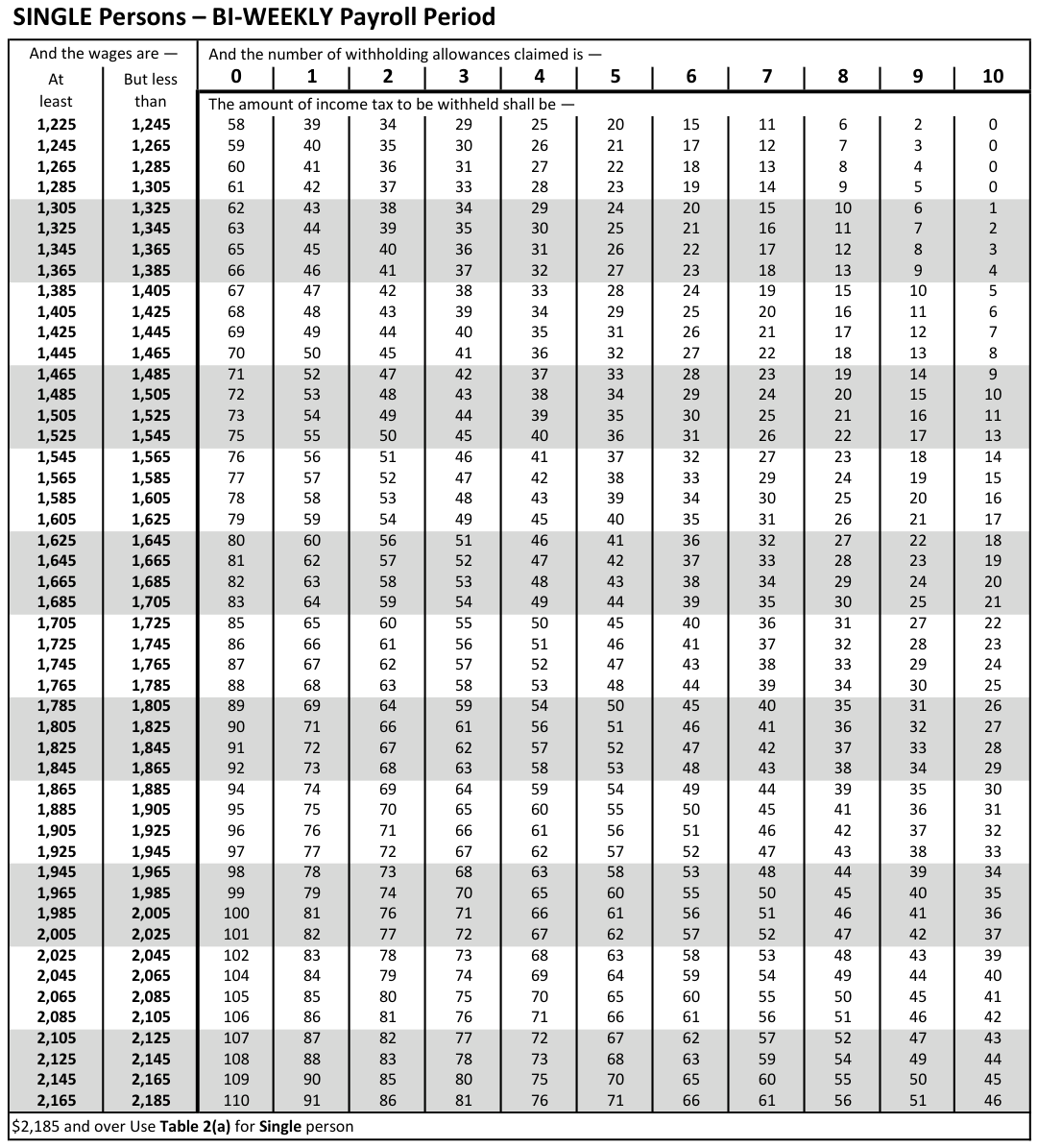
Text version of this table
| And the wages are — At But less least than 1,225 1,245 1,245 1,265 1,265 1,285 1,285 1,305 | And the number of withholding allowances claimed is — 0 1 2 3 4 5 6 7 8 9 10 | |||||||||||
| The amount of income tax to be withheld shall be — 58 39 34 29 25 20 15 11 6 2 0 59 40 35 30 26 21 17 12 7 3 0 60 41 36 31 27 22 18 13 8 4 0 61 42 37 33 28 23 19 14 9 5 0 | ||||||||||||
| 1,305 1,325 1,345 1,365 | 1,325 1,345 1,365 1,385 | 62 63 65 66 | 43 44 45 46 | 38 39 40 41 | 34 35 36 37 | 29 30 31 32 | 24 25 26 27 | 20 21 22 23 | 15 16 17 18 | 10 11 12 13 | 6 7 8 9 | 1 2 3 4 |
| 1,385 1,405 1,425 1,445 | 1,405 1,425 1,445 1,465 | 67 68 69 70 | 47 48 49 50 | 42 43 44 45 | 38 39 40 41 | 33 34 35 36 | 28 29 31 32 | 24 25 26 27 | 19 20 21 22 | 15 16 17 18 | 10 11 12 13 | 5 6 7 8 |
| 1,465 1,485 1,505 1,525 | 1,485 1,505 1,525 1,545 | 71 72 73 75 | 52 53 54 55 | 47 48 49 50 | 42 43 44 45 | 37 38 39 40 | 33 34 35 36 | 28 29 30 31 | 23 24 25 26 | 19 20 21 22 | 14 15 16 17 | 9 10 11 13 |
| 1,545 1,565 1,585 1,605 | 1,565 1,585 1,605 1,625 | 76 77 78 79 | 56 57 58 59 | 51 52 53 54 | 46 47 48 49 | 41 42 43 45 | 37 38 39 40 | 32 33 34 35 | 27 29 30 31 | 23 24 25 26 | 18 19 20 21 | 14 15 16 17 |
| 1,625 1,645 1,665 1,685 | 1,645 1,665 1,685 1,705 | 80 81 82 83 | 60 62 63 64 | 56 57 58 59 | 51 52 53 54 | 46 47 48 49 | 41 42 43 44 | 36 37 38 39 | 32 33 34 35 | 27 28 29 30 | 22 23 24 25 | 18 19 20 21 |
| 1,705 1,725 1,745 1,765 | 1,725 1,745 1,765 1,785 | 85 86 87 88 | 65 66 67 68 | 60 61 62 63 | 55 56 57 58 | 50 51 52 53 | 45 46 47 48 | 40 41 43 44 | 36 37 38 39 | 31 32 33 34 | 27 28 29 30 | 22 23 24 25 |
| 1,785 1,805 1,825 1,845 | 1,805 1,825 1,845 1,865 | 89 90 91 92 | 69 71 72 73 | 64 66 67 68 | 59 61 62 63 | 54 56 57 58 | 50 51 52 53 | 45 46 47 48 | 40 41 42 43 | 35 36 37 38 | 31 32 33 34 | 26 27 28 29 |
| 1,865 1,885 1,905 1,925 | 1,885 1,905 1,925 1,945 | 94 95 96 97 | 74 75 76 77 | 69 70 71 72 | 64 65 66 67 | 59 60 61 62 | 54 55 56 57 | 49 50 51 52 | 44 45 46 47 | 39 41 42 43 | 35 36 37 38 | 30 31 32 33 |
| 1,945 1,965 1,985 2,005 | 1,965 1,985 2,005 2,025 | 98 99 100 101 | 78 79 81 82 | 73 74 76 77 | 68 70 71 72 | 63 65 66 67 | 58 60 61 62 | 53 55 56 57 | 48 50 51 52 | 44 45 46 47 | 39 40 41 42 | 34 35 36 37 |
| 2,025 2,045 2,065 2,085 | 2,045 2,065 2,085 2,105 | 102 104 105 106 | 83 84 85 86 | 78 79 80 81 | 73 74 75 76 | 68 69 70 71 | 63 64 65 66 | 58 59 60 61 | 53 54 55 56 | 48 49 50 51 | 43 44 45 46 | 39 40 41 42 |
| 2,105 2,125 2,145 2,165 | 2,125 2,145 2,165 2,185 | 107 108 109 110 | 87 88 90 91 | 82 83 85 86 | 77 78 80 81 | 72 73 75 76 | 67 68 70 71 | 62 63 65 66 | 57 59 60 61 | 52 54 55 56 | 47 49 50 51 | 43 44 45 46 |
| $2,185 and over Use Table 2(a) for Single person |
# MARRIED Persons - BI-WEEKLY Payroll Period
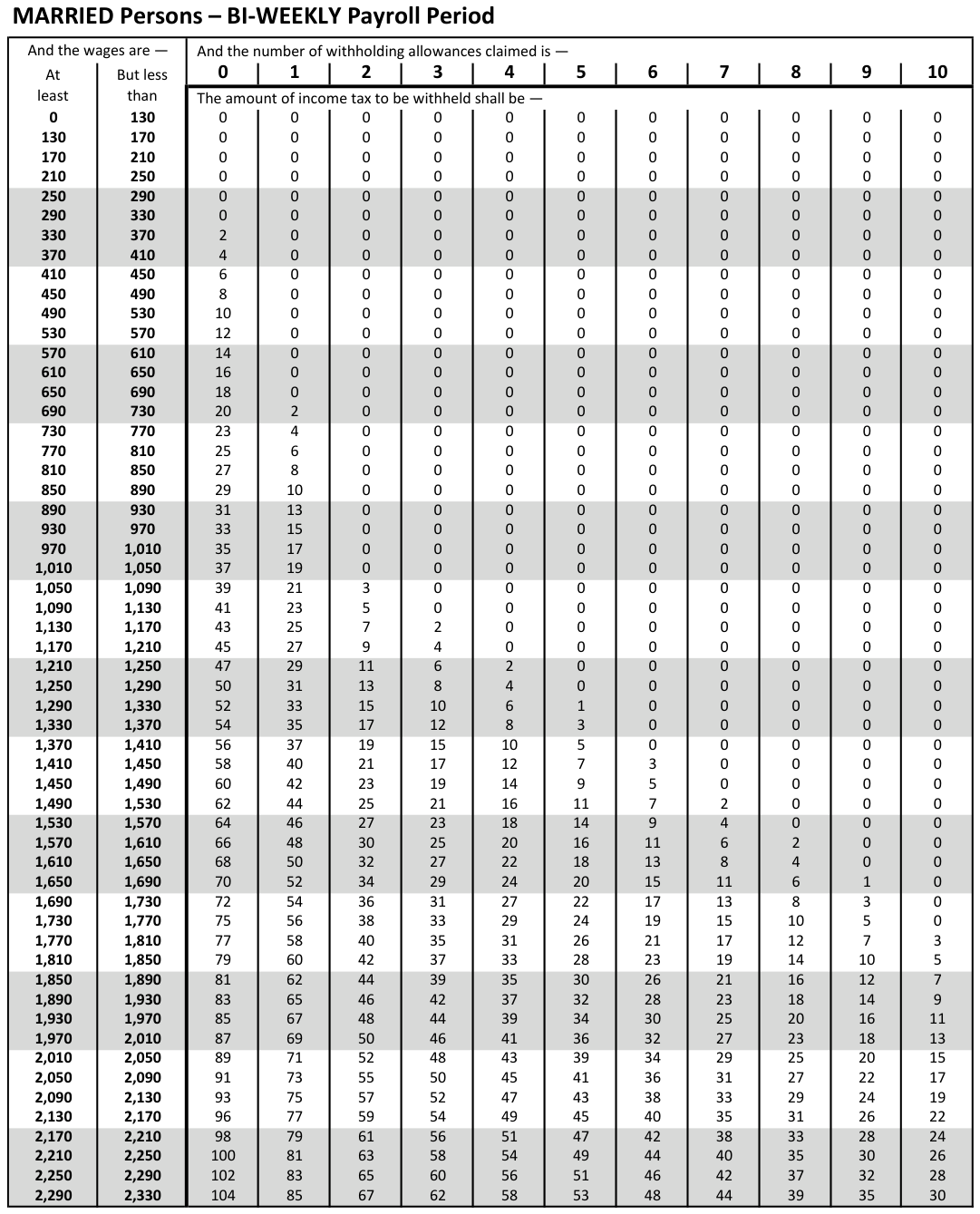
Text version of this table
| And the wages are — At But less least than 0 130 130 170 170 210 210 250 | And the number of withholding allowances claimed is — 0 1 2 3 4 5 6 7 8 9 10 | |||||||||||
| The amount of income tax to be withheld shall be — 0 0 0 0 0 0 0 0 0 0 0 0 0 0 0 0 0 0 0 0 0 0 0 0 0 0 0 0 0 0 0 0 0 0 0 0 0 0 0 0 0 0 0 0 | ||||||||||||
| 250 290 330 370 | 290 330 370 410 | 0 0 2 4 | 0 0 0 0 | 0 0 0 0 | 0 0 0 0 | 0 0 0 0 | 0 0 0 0 | 0 0 0 0 | 0 0 0 0 | 0 0 0 0 | 0 0 0 0 | 0 0 0 0 |
| 410 450 490 530 | 450 490 530 570 | 6 8 10 12 | 0 0 0 0 | 0 0 0 0 | 0 0 0 0 | 0 0 0 0 | 0 0 0 0 | 0 0 0 0 | 0 0 0 0 | 0 0 0 0 | 0 0 0 0 | 0 0 0 0 |
| 570 610 650 690 | 610 650 690 730 | 14 16 18 20 | 0 0 0 2 | 0 0 0 0 | 0 0 0 0 | 0 0 0 0 | 0 0 0 0 | 0 0 0 0 | 0 0 0 0 | 0 0 0 0 | 0 0 0 0 | 0 0 0 0 |
| 730 770 810 850 | 770 810 850 890 | 23 25 27 29 | 4 6 8 10 | 0 0 0 0 | 0 0 0 0 | 0 0 0 0 | 0 0 0 0 | 0 0 0 0 | 0 0 0 0 | 0 0 0 0 | 0 0 0 0 | 0 0 0 0 |
| 890 930 970 1,010 | 930 970 1,010 1,050 | 31 33 35 37 | 13 15 17 19 | 0 0 0 0 | 0 0 0 0 | 0 0 0 0 | 0 0 0 0 | 0 0 0 0 | 0 0 0 0 | 0 0 0 0 | 0 0 0 0 | 0 0 0 0 |
| 1,050 1,090 1,130 1,170 | 1,090 1,130 1,170 1,210 | 39 41 43 45 | 21 23 25 27 | 3 5 7 9 | 0 0 2 4 | 0 0 0 0 | 0 0 0 0 | 0 0 0 0 | 0 0 0 0 | 0 0 0 0 | 0 0 0 0 | 0 0 0 0 |
| 1,210 1,250 1,290 1,330 | 1,250 1,290 1,330 1,370 | 47 50 52 54 | 29 31 33 35 | 11 13 15 17 | 6 8 10 12 | 2 4 6 8 | 0 0 1 3 | 0 0 0 0 | 0 0 0 0 | 0 0 0 0 | 0 0 0 0 | 0 0 0 0 |
| 1,370 1,410 1,450 1,490 | 1,410 1,450 1,490 1,530 | 56 58 60 62 | 37 40 42 44 | 19 21 23 25 | 15 17 19 21 | 10 12 14 16 | 5 7 9 11 | 0 3 5 7 | 0 0 0 2 | 0 0 0 0 | 0 0 0 0 | 0 0 0 0 |
| 1,530 1,570 1,610 1,650 | 1,570 1,610 1,650 1,690 | 64 66 68 70 | 46 48 50 52 | 27 30 32 34 | 23 25 27 29 | 18 20 22 24 | 14 16 18 20 | 9 11 13 15 | 4 6 8 11 | 0 2 4 6 | 0 0 0 1 | 0 0 0 0 |
| 1,690 1,730 1,770 1,810 | 1,730 1,770 1,810 1,850 | 72 75 77 79 | 54 56 58 60 | 36 38 40 42 | 31 33 35 37 | 27 29 31 33 | 22 24 26 28 | 17 19 21 23 | 13 15 17 19 | 8 10 12 14 | 3 5 7 10 | 0 0 3 5 |
| 1,850 1,890 1,930 1,970 | 1,890 1,930 1,970 2,010 | 81 83 85 87 | 62 65 67 69 | 44 46 48 50 | 39 42 44 46 | 35 37 39 41 | 30 32 34 36 | 26 28 30 32 | 21 23 25 27 | 16 18 20 23 | 12 14 16 18 | 7 9 11 13 |
| 2,010 2,050 2,090 2,130 | 2,050 2,090 2,130 2,170 | 89 91 93 96 | 71 73 75 77 | 52 55 57 59 | 48 50 52 54 | 43 45 47 49 | 39 41 43 45 | 34 36 38 40 | 29 31 33 35 | 25 27 29 31 | 20 22 24 26 | 15 17 19 22 |
| 2,170 2,210 2,250 2,290 | 2,210 2,250 2,290 2,330 | 98 100 102 104 | 79 81 83 85 | 61 63 65 67 | 56 58 60 62 | 51 54 56 58 | 47 49 51 53 | 42 44 46 48 | 38 40 42 44 | 33 35 37 39 | 28 30 32 35 | 24 26 28 30 |
# MARRIED Persons - BI-WEEKLY Payroll Period
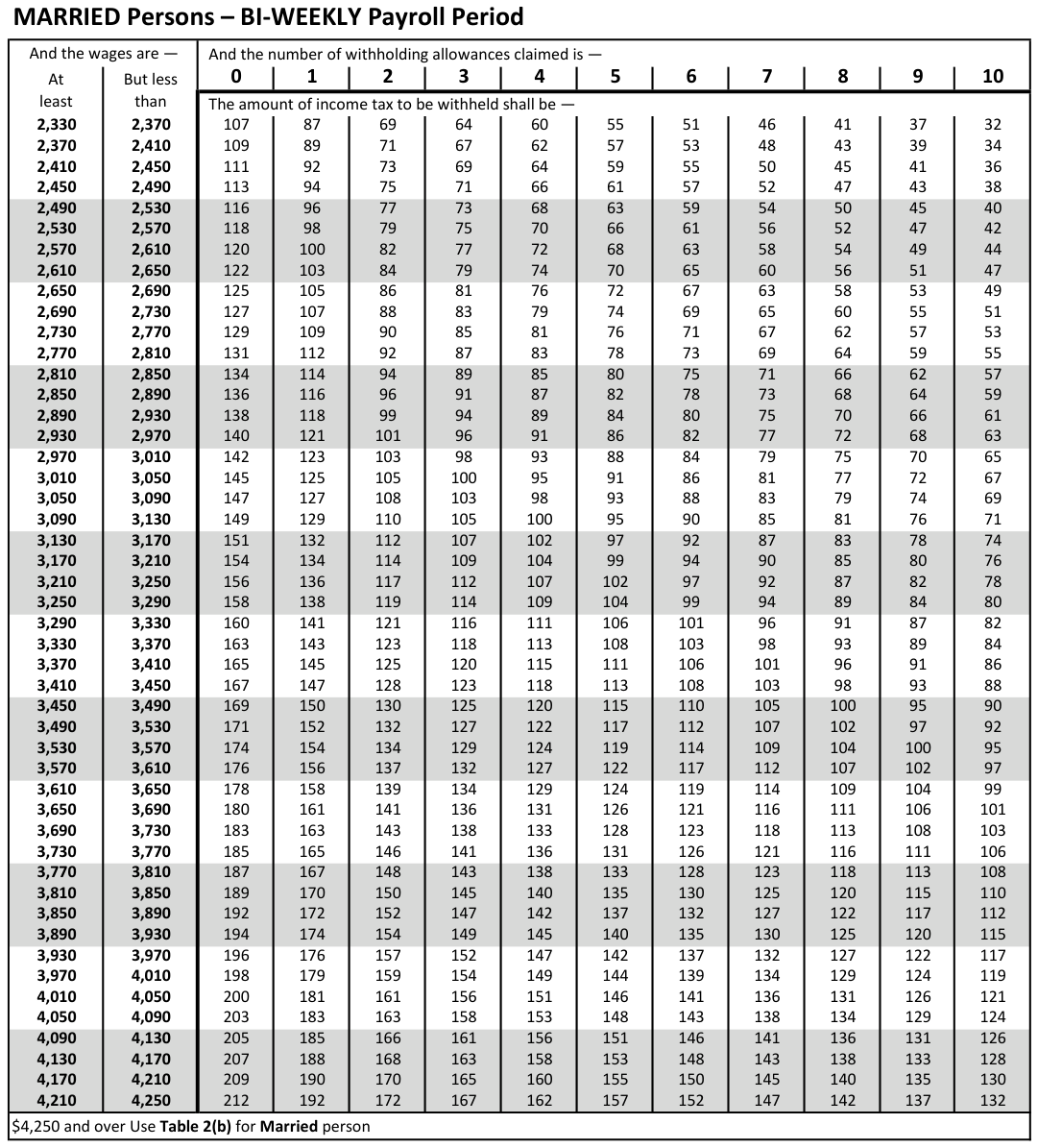
Text version of this table
| And the wages are — At But less least than 2,330 2,370 2,370 2,410 2,410 2,450 2,450 2,490 | And the number of withholding allowances claimed is — 0 1 2 3 4 5 6 7 8 9 10 | |||||||||||
| The amount of income tax to be withheld shall be — 107 87 69 64 60 55 51 46 41 37 32 109 89 71 67 62 57 53 48 43 39 34 111 92 73 69 64 59 55 50 45 41 36 113 94 75 71 66 61 57 52 47 43 38 | ||||||||||||
| 2,490 2,530 2,570 2,610 | 2,530 2,570 2,610 2,650 | 116 118 120 122 | 96 98 100 103 | 77 79 82 84 | 73 75 77 79 | 68 70 72 74 | 63 66 68 70 | 59 61 63 65 | 54 56 58 60 | 50 52 54 56 | 45 47 49 51 | 40 42 44 47 |
| 2,650 2,690 2,730 2,770 | 2,690 2,730 2,770 2,810 | 125 127 129 131 | 105 107 109 112 | 86 88 90 92 | 81 83 85 87 | 76 79 81 83 | 72 74 76 78 | 67 69 71 73 | 63 65 67 69 | 58 60 62 64 | 53 55 57 59 | 49 51 53 55 |
| 2,810 2,850 2,890 2,930 | 2,850 2,890 2,930 2,970 | 134 136 138 140 | 114 116 118 121 | 94 96 99 101 | 89 91 94 96 | 85 87 89 91 | 80 82 84 86 | 75 78 80 82 | 71 73 75 77 | 66 68 70 72 | 62 64 66 68 | 57 59 61 63 |
| 2,970 3,010 3,050 3,090 | 3,010 3,050 3,090 3,130 | 142 145 147 149 | 123 125 127 129 | 103 105 108 110 | 98 100 103 105 | 93 95 98 100 | 88 91 93 95 | 84 86 88 90 | 79 81 83 85 | 75 77 79 81 | 70 72 74 76 | 65 67 69 71 |
| 3,130 3,170 3,210 3,250 | 3,170 3,210 3,250 3,290 | 151 154 156 158 | 132 134 136 138 | 112 114 117 119 | 107 109 112 114 | 102 104 107 109 | 97 99 102 104 | 92 94 97 99 | 87 90 92 94 | 83 85 87 89 | 78 80 82 84 | 74 76 78 80 |
| 3,290 3,330 3,370 3,410 | 3,330 3,370 3,410 3,450 | 160 163 165 167 | 141 143 145 147 | 121 123 125 128 | 116 118 120 123 | 111 113 115 118 | 106 108 111 113 | 101 103 106 108 | 96 98 101 103 | 91 93 96 98 | 87 89 91 93 | 82 84 86 88 |
| 3,450 3,490 3,530 3,570 | 3,490 3,530 3,570 3,610 | 169 171 174 176 | 150 152 154 156 | 130 132 134 137 | 125 127 129 132 | 120 122 124 127 | 115 117 119 122 | 110 112 114 117 | 105 107 109 112 | 100 102 104 107 | 95 97 100 102 | 90 92 95 97 |
| 3,610 3,650 3,690 3,730 | 3,650 3,690 3,730 3,770 | 178 180 183 185 | 158 161 163 165 | 139 141 143 146 | 134 136 138 141 | 129 131 133 136 | 124 126 128 131 | 119 121 123 126 | 114 116 118 121 | 109 111 113 116 | 104 106 108 111 | 99 101 103 106 |
| 3,770 3,810 3,850 3,890 | 3,810 3,850 3,890 3,930 | 187 189 192 194 | 167 170 172 174 | 148 150 152 154 | 143 145 147 149 | 138 140 142 145 | 133 135 137 140 | 128 130 132 135 | 123 125 127 130 | 118 120 122 125 | 113 115 117 120 | 108 110 112 115 |
| 3,930 3,970 4,010 4,050 | 3,970 4,010 4,050 4,090 | 196 198 200 203 | 176 179 181 183 | 157 159 161 163 | 152 154 156 158 | 147 149 151 153 | 142 144 146 148 | 137 139 141 143 | 132 134 136 138 | 127 129 131 134 | 122 124 126 129 | 117 119 121 124 |
| 4,090 4,130 4,170 4,210 | 4,130 4,170 4,210 4,250 | 205 207 209 212 | 185 188 190 192 | 166 168 170 172 | 161 163 165 167 | 156 158 160 162 | 151 153 155 157 | 146 148 150 152 | 141 143 145 147 | 136 138 140 142 | 131 133 135 137 | 126 128 130 132 |
| $4,250 and over Use Table 2(b) for Married person |
# SINGLE Persons - SEMI-MONTHLY Payroll Period
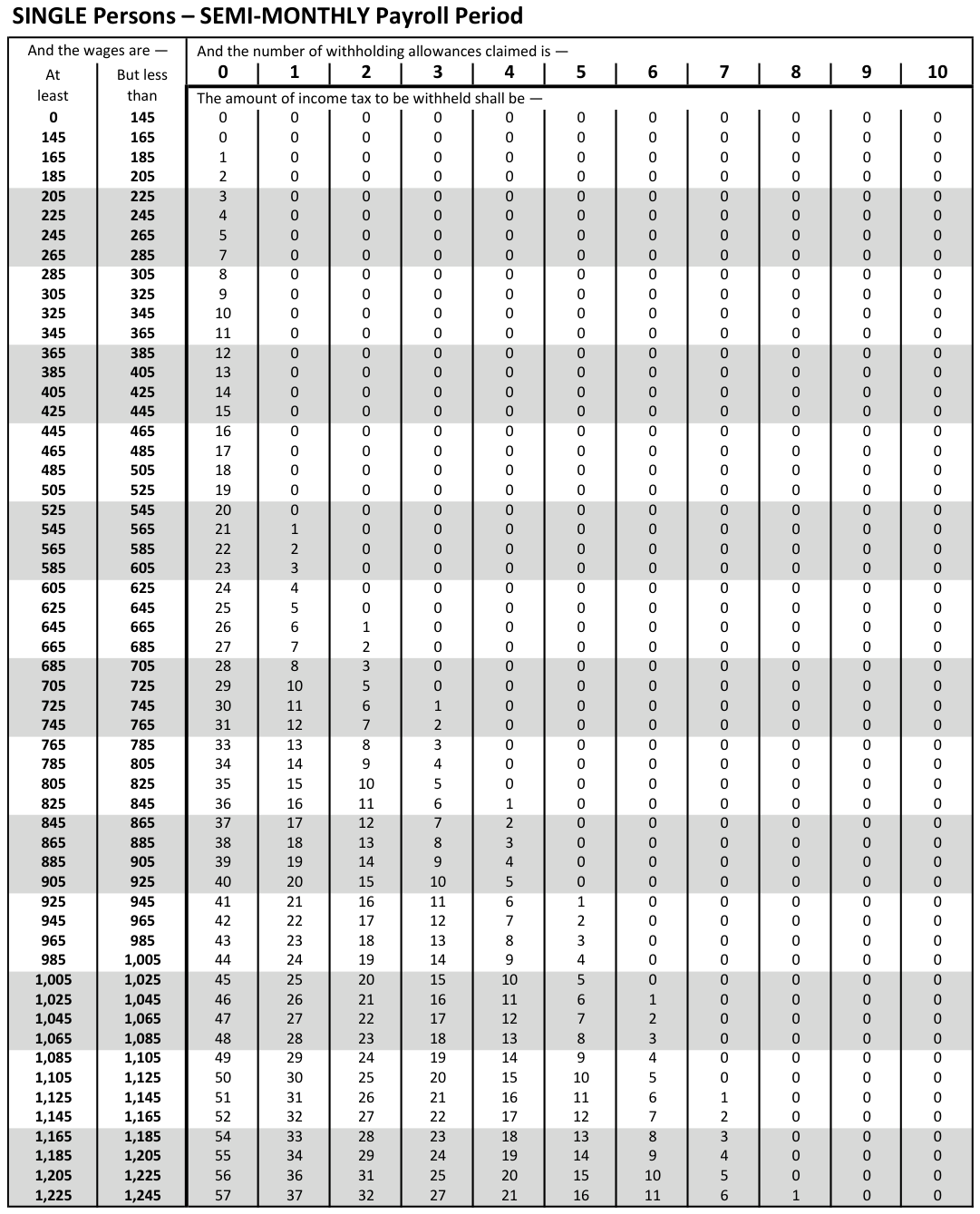
Text version of this table
| And the wages are — At But less least than 0 145 145 165 165 185 185 205 | And the number of withholding allowances claimed is — 0 1 2 3 4 5 6 7 8 9 10 | |||||||||||
| The amount of income tax to be withheld shall be — 0 0 0 0 0 0 0 0 0 0 0 0 0 0 0 0 0 0 0 0 0 0 1 0 0 0 0 0 0 0 0 0 0 2 0 0 0 0 0 0 0 0 0 0 | ||||||||||||
| 205 225 245 265 | 225 245 265 285 | 3 4 5 7 | 0 0 0 0 | 0 0 0 0 | 0 0 0 0 | 0 0 0 0 | 0 0 0 0 | 0 0 0 0 | 0 0 0 0 | 0 0 0 0 | 0 0 0 0 | 0 0 0 0 |
| 285 305 325 345 | 305 325 345 365 | 8 9 10 11 | 0 0 0 0 | 0 0 0 0 | 0 0 0 0 | 0 0 0 0 | 0 0 0 0 | 0 0 0 0 | 0 0 0 0 | 0 0 0 0 | 0 0 0 0 | 0 0 0 0 |
| 365 385 405 425 | 385 405 425 445 | 12 13 14 15 | 0 0 0 0 | 0 0 0 0 | 0 0 0 0 | 0 0 0 0 | 0 0 0 0 | 0 0 0 0 | 0 0 0 0 | 0 0 0 0 | 0 0 0 0 | 0 0 0 0 |
| 445 465 485 505 | 465 485 505 525 | 16 17 18 19 | 0 0 0 0 | 0 0 0 0 | 0 0 0 0 | 0 0 0 0 | 0 0 0 0 | 0 0 0 0 | 0 0 0 0 | 0 0 0 0 | 0 0 0 0 | 0 0 0 0 |
| 525 545 565 585 | 545 565 585 605 | 20 21 22 23 | 0 1 2 3 | 0 0 0 0 | 0 0 0 0 | 0 0 0 0 | 0 0 0 0 | 0 0 0 0 | 0 0 0 0 | 0 0 0 0 | 0 0 0 0 | 0 0 0 0 |
| 605 625 645 665 | 625 645 665 685 | 24 25 26 27 | 4 5 6 7 | 0 0 1 2 | 0 0 0 0 | 0 0 0 0 | 0 0 0 0 | 0 0 0 0 | 0 0 0 0 | 0 0 0 0 | 0 0 0 0 | 0 0 0 0 |
| 685 705 725 745 | 705 725 745 765 | 28 29 30 31 | 8 10 11 12 | 3 5 6 7 | 0 0 1 2 | 0 0 0 0 | 0 0 0 0 | 0 0 0 0 | 0 0 0 0 | 0 0 0 0 | 0 0 0 0 | 0 0 0 0 |
| 765 785 805 825 | 785 805 825 845 | 33 34 35 36 | 13 14 15 16 | 8 9 10 11 | 3 4 5 6 | 0 0 0 1 | 0 0 0 0 | 0 0 0 0 | 0 0 0 0 | 0 0 0 0 | 0 0 0 0 | 0 0 0 0 |
| 845 865 885 905 | 865 885 905 925 | 37 38 39 40 | 17 18 19 20 | 12 13 14 15 | 7 8 9 10 | 2 3 4 5 | 0 0 0 0 | 0 0 0 0 | 0 0 0 0 | 0 0 0 0 | 0 0 0 0 | 0 0 0 0 |
| 925 945 965 985 | 945 965 985 1,005 | 41 42 43 44 | 21 22 23 24 | 16 17 18 19 | 11 12 13 14 | 6 7 8 9 | 1 2 3 4 | 0 0 0 0 | 0 0 0 | 0 0 0 | 0 0 0 0 | 0 0 0 0 |
| 0 | 0 | |||||||||||
| 1,005 1,025 1,045 1,065 | 1,025 1,045 1,065 1,085 | 45 46 47 48 | 25 26 27 28 | 20 21 22 23 | 15 16 17 18 | 10 11 12 13 | 5 6 7 8 | 0 1 2 3 | 0 0 0 0 | 0 0 0 0 | 0 0 0 0 | 0 0 0 0 |
| 1,085 1,105 1,125 1,145 | 1,105 1,125 1,145 1,165 | 49 50 51 52 | 29 30 31 32 | 24 25 26 27 | 19 20 21 22 | 14 15 16 17 | 9 10 11 12 | 4 5 6 7 | 0 0 1 2 | 0 0 0 0 | 0 0 0 0 | 0 0 0 0 |
| 1,165 1,185 1,205 1,225 | 1,185 1,205 1,225 1,245 | 54 55 56 57 | 33 34 36 37 | 28 29 31 32 | 23 24 25 27 | 18 19 20 21 | 13 14 15 16 | 8 9 10 11 | 3 4 5 6 | 0 0 0 1 | 0 0 0 0 | 0 0 0 0 |
# SINGLE Persons - SEMI-MONTHLY Payroll Period
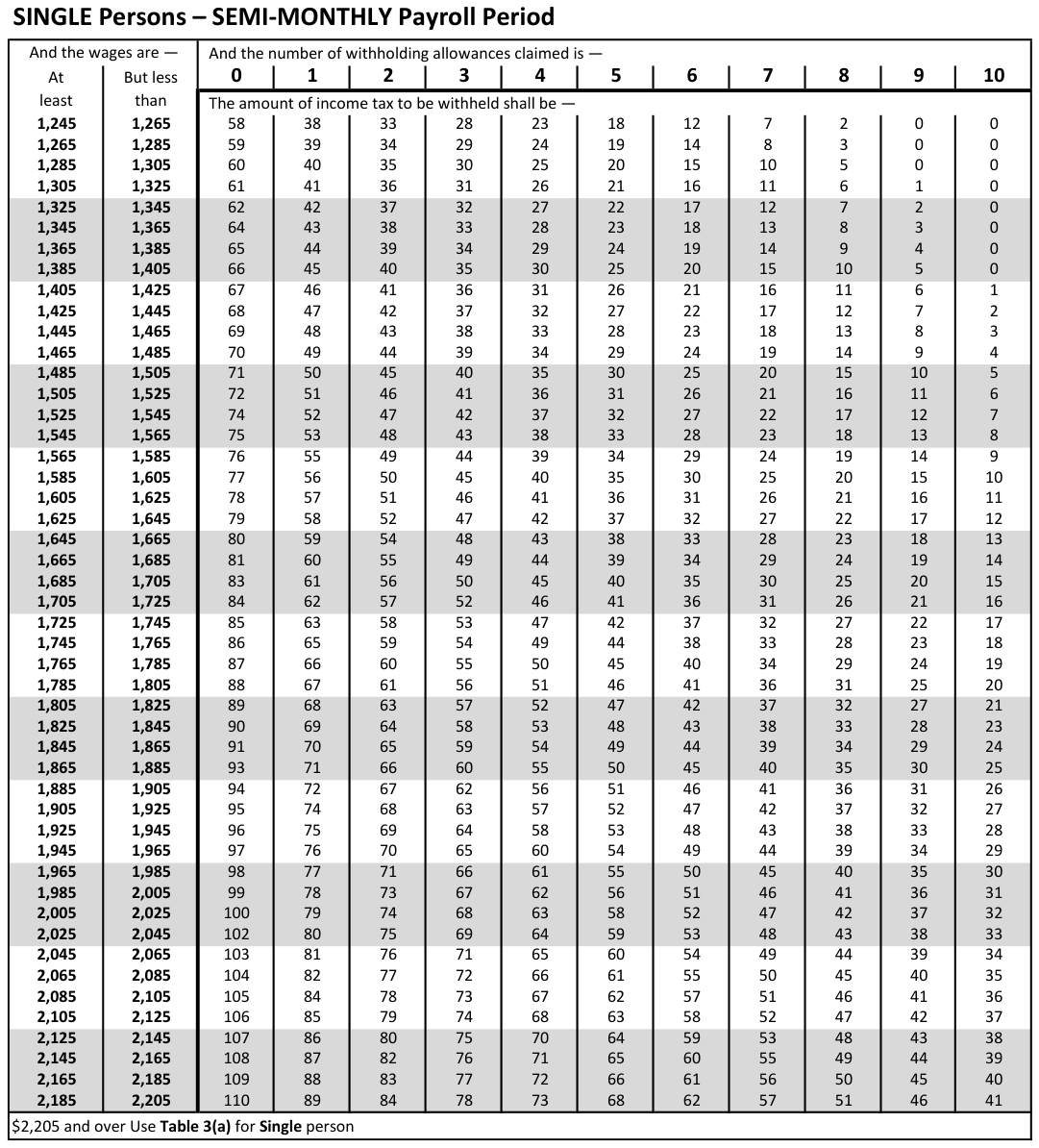
Text version of this table
| And the wages are — At But less least than 1,245 1,265 1,265 1,285 1,285 1,305 1,305 1,325 | And the number of withholding allowances claimed is — 0 1 2 3 4 5 6 7 8 9 10 | |||||||||||
| The amount of income tax to be withheld shall be — 58 38 33 28 23 18 12 7 2 0 0 59 39 34 29 24 19 14 8 3 0 0 60 40 35 30 25 20 15 10 5 0 0 61 41 36 31 26 21 16 11 6 1 0 | ||||||||||||
| 1,325 1,345 1,365 1,385 | 1,345 1,365 1,385 1,405 | 62 64 65 66 | 42 43 44 45 | 37 38 39 40 | 32 33 34 35 | 27 28 29 30 | 22 23 24 25 | 17 18 19 20 | 12 13 14 15 | 7 8 9 10 | 2 3 4 5 | 0 0 0 0 |
| 1,405 1,425 1,445 1,465 | 1,425 1,445 1,465 1,485 | 67 68 69 70 | 46 47 48 49 | 41 42 43 44 | 36 37 38 39 | 31 32 33 34 | 26 27 28 29 | 21 22 23 24 | 16 17 18 19 | 11 12 13 14 | 6 7 8 9 | 1 2 3 4 |
| 1,485 1,505 1,525 1,545 | 1,505 1,525 1,545 1,565 | 71 72 74 75 | 50 51 52 53 | 45 46 47 48 | 40 41 42 43 | 35 36 37 38 | 30 31 32 33 | 25 26 27 28 | 20 21 22 23 | 15 16 17 18 | 10 11 12 13 | 5 6 7 8 |
| 1,565 1,585 1,605 1,625 | 1,585 1,605 1,625 1,645 | 76 77 78 79 | 55 56 57 58 | 49 50 51 52 | 44 45 46 47 | 39 40 41 42 | 34 35 36 37 | 29 30 31 32 | 24 25 26 27 | 19 20 21 22 | 14 15 16 17 | 9 10 11 12 |
| 1,645 1,665 1,685 1,705 | 1,665 1,685 1,705 1,725 | 80 81 83 84 | 59 60 61 62 | 54 55 56 57 | 48 49 50 52 | 43 44 45 46 | 38 39 40 41 | 33 34 35 36 | 28 29 30 31 | 23 24 25 26 | 18 19 20 21 | 13 14 15 16 |
| 1,725 1,745 1,765 1,785 | 1,745 1,765 1,785 1,805 | 85 86 87 88 | 63 65 66 67 | 58 59 60 61 | 53 54 55 56 | 47 49 50 51 | 42 44 45 46 | 37 38 40 41 | 32 33 34 36 | 27 28 29 31 | 22 23 24 25 | 17 18 19 20 |
| 1,805 1,825 1,845 1,865 | 1,825 1,845 1,865 1,885 | 89 90 91 93 | 68 69 70 71 | 63 64 65 66 | 57 58 59 60 | 52 53 54 55 | 47 48 49 50 | 42 43 44 45 | 37 38 39 40 | 32 33 34 35 | 27 28 29 30 | 21 23 24 25 |
| 1,885 1,905 1,925 1,945 | 1,905 1,925 1,945 1,965 | 94 95 96 97 | 72 74 75 76 | 67 68 69 70 | 62 63 64 65 | 56 57 58 60 | 51 52 53 54 | 46 47 48 49 | 41 42 43 44 | 36 37 38 39 | 31 32 33 34 | 26 27 28 29 |
| 1,965 1,985 2,005 2,025 | 1,985 2,005 2,025 2,045 | 98 99 100 102 | 77 78 79 80 | 71 73 74 75 | 66 67 68 69 | 61 62 63 64 | 55 56 58 59 | 50 51 52 53 | 45 46 47 48 | 40 41 42 43 | 35 36 37 38 | 30 31 32 33 |
| 2,045 2,065 2,085 2,105 | 2,065 2,085 2,105 2,125 | 103 104 105 106 | 81 82 84 85 | 76 77 78 79 | 71 72 73 74 | 65 66 67 68 | 60 61 62 63 | 54 55 57 58 | 49 50 51 52 | 44 45 46 47 | 39 40 41 42 | 34 35 36 37 |
| 2,125 2,145 2,165 2,185 | 2,145 2,165 2,185 2,205 | 107 108 109 110 | 86 87 88 89 | 80 82 83 84 | 75 76 77 78 | 70 71 72 73 | 64 65 66 68 | 59 60 61 62 | 53 55 56 57 | 48 49 50 51 | 43 44 45 46 | 38 39 40 41 |
| $2,205 and over Use Table 3(a) for Single person |
# MARRIED Persons - SEMI-MONTHLY Payroll Period
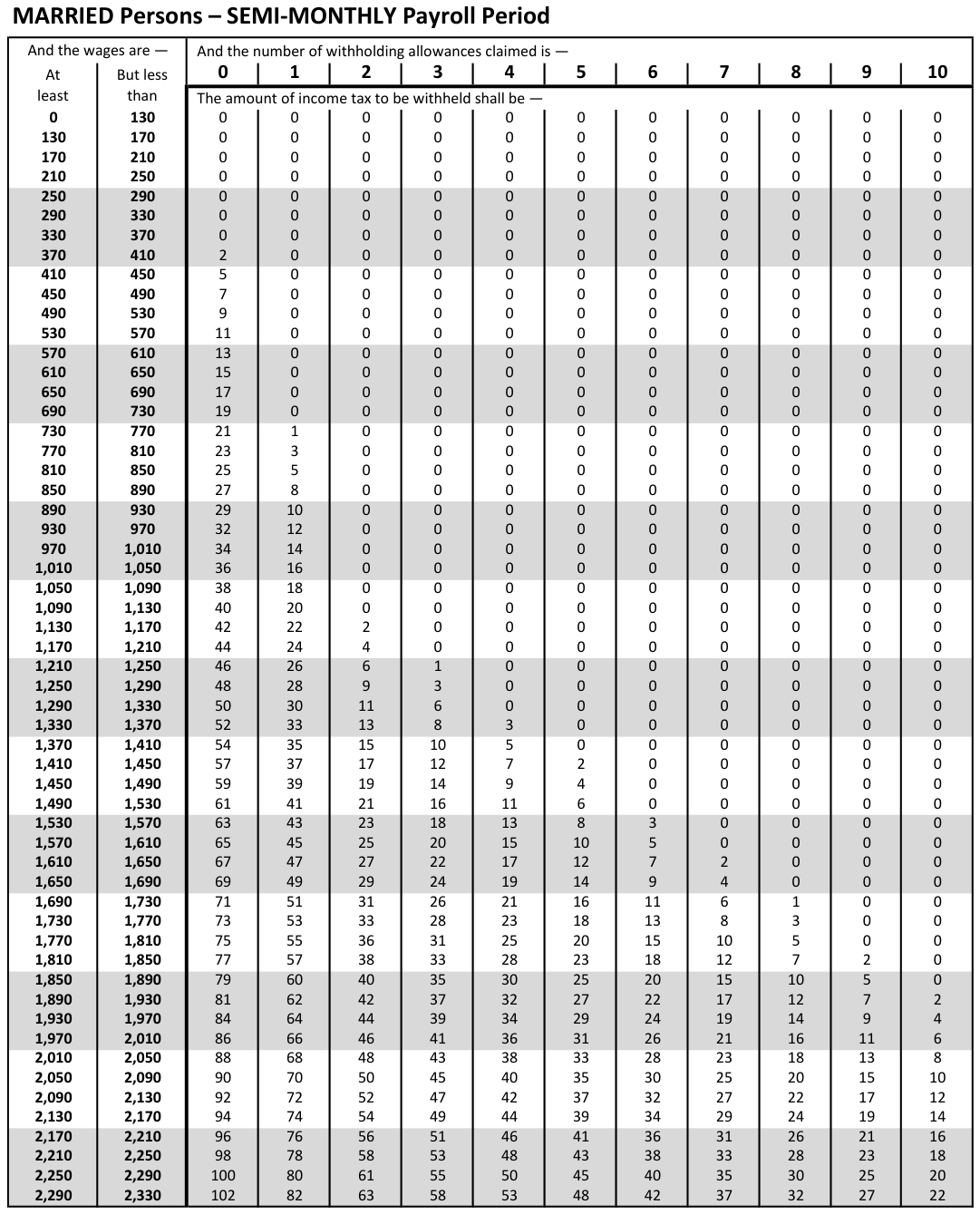
Text version of this table
| And the wages are — At But less least than 0 130 130 170 170 210 210 250 | And the number of withholding allowances claimed is — 0 1 2 3 4 5 6 7 8 9 10 | |||||||||||
| The amount of income tax to be withheld shall be — 0 0 0 0 0 0 0 0 0 0 0 0 0 0 0 0 0 0 0 0 0 0 0 0 0 0 0 0 0 0 0 0 0 0 0 0 0 0 0 0 0 0 0 0 | ||||||||||||
| 250 290 330 370 | 290 330 370 410 | 0 0 0 2 | 0 0 0 0 | 0 0 0 0 | 0 0 0 0 | 0 0 0 0 | 0 0 0 0 | 0 0 0 0 | 0 0 0 0 | 0 0 0 0 | 0 0 0 0 | 0 0 0 0 |
| 410 450 490 530 | 450 490 530 570 | 5 7 9 11 | 0 0 0 0 | 0 0 0 0 | 0 0 0 0 | 0 0 0 0 | 0 0 0 0 | 0 0 0 0 | 0 0 0 0 | 0 0 0 0 | 0 0 0 0 | 0 0 0 0 |
| 570 610 650 690 | 610 650 690 730 | 13 15 17 19 | 0 0 0 0 | 0 0 0 0 | 0 0 0 0 | 0 0 0 0 | 0 0 0 0 | 0 0 0 0 | 0 0 0 0 | 0 0 0 0 | 0 0 0 0 | 0 0 0 0 |
| 730 770 810 850 | 770 810 850 890 | 21 23 25 27 | 1 3 5 8 | 0 0 0 0 | 0 0 0 0 | 0 0 0 0 | 0 0 0 0 | 0 0 0 0 | 0 0 0 0 | 0 0 0 0 | 0 0 0 0 | 0 0 0 0 |
| 890 930 970 1,010 | 930 970 1,010 1,050 | 29 32 34 36 | 10 12 14 16 | 0 0 0 0 | 0 0 0 0 | 0 0 0 0 | 0 0 0 0 | 0 0 0 0 | 0 0 0 0 | 0 0 0 0 | 0 0 0 0 | 0 0 0 0 |
| 1,050 1,090 1,130 1,170 | 1,090 1,130 1,170 1,210 | 38 40 42 44 | 18 20 22 24 | 0 0 2 4 | 0 0 0 0 | 0 0 0 0 | 0 0 0 0 | 0 0 0 0 | 0 0 0 0 | 0 0 0 0 | 0 0 0 0 | 0 0 0 0 |
| 1,210 1,250 1,290 1,330 | 1,250 1,290 1,330 1,370 | 46 48 50 52 | 26 28 30 33 | 6 9 11 13 | 1 3 6 8 | 0 0 0 3 | 0 0 0 0 | 0 0 0 0 | 0 0 0 0 | 0 0 0 0 | 0 0 0 0 | 0 0 0 0 |
| 1,370 1,410 1,450 1,490 | 1,410 1,450 1,490 1,530 | 54 57 59 61 | 35 37 39 41 | 15 17 19 21 | 10 12 14 16 | 5 7 9 11 | 0 2 4 6 | 0 0 0 0 | 0 0 0 0 | 0 0 0 0 | 0 0 0 0 | 0 0 0 0 |
| 1,530 1,570 1,610 1,650 | 1,570 1,610 1,650 1,690 | 63 65 67 69 | 43 45 47 49 | 23 25 27 29 | 18 20 22 24 | 13 15 17 19 | 8 10 12 14 | 3 5 7 9 | 0 0 2 4 | 0 0 0 0 | 0 0 0 0 | 0 0 0 0 |
| 1,690 1,730 1,770 1,810 | 1,730 1,770 1,810 1,850 | 71 73 75 77 | 51 53 55 57 | 31 33 36 38 | 26 28 31 33 | 21 23 25 28 | 16 18 20 23 | 11 13 15 18 | 6 8 10 12 | 1 3 5 7 | 0 0 0 2 | 0 0 0 0 |
| 1,850 1,890 1,930 1,970 | 1,890 1,930 1,970 2,010 | 79 81 84 86 | 60 62 64 66 | 40 42 44 46 | 35 37 39 41 | 30 32 34 36 | 25 27 29 31 | 20 22 24 26 | 15 17 19 21 | 10 12 14 16 | 5 7 9 11 | 0 2 4 6 |
| 2,010 2,050 2,090 2,130 | 2,050 2,090 2,130 2,170 | 88 90 92 94 | 68 70 72 74 | 48 50 52 54 | 43 45 47 49 | 38 40 42 44 | 33 35 37 39 | 28 30 32 34 | 23 25 27 29 | 18 20 22 24 | 13 15 17 19 | 8 10 12 14 |
| 2,170 2,210 2,250 2,290 | 2,210 2,250 2,290 2,330 | 96 98 100 102 | 76 78 80 82 | 56 58 61 63 | 51 53 55 58 | 46 48 50 53 | 41 43 45 48 | 36 38 40 42 | 31 33 35 37 | 26 28 30 32 | 21 23 25 27 | 16 18 20 22 |
# MARRIED Persons - SEMI-MONTHLY Payroll Period
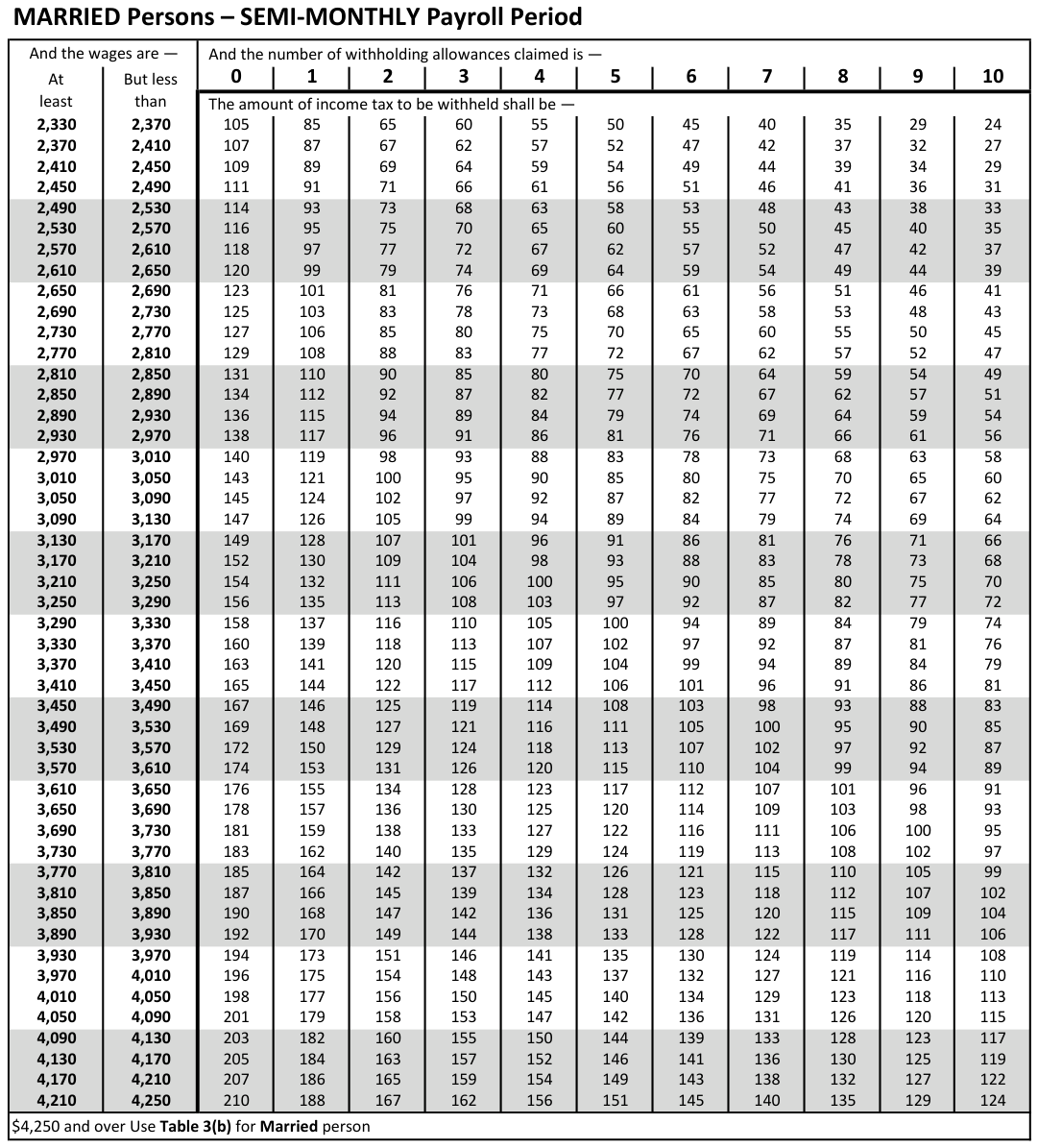
Text version of this table
| And the wages are — At But less least than 2,330 2,370 2,370 2,410 2,410 2,450 2,450 2,490 | And the number of withholding allowances claimed is — 0 1 2 3 4 5 6 7 8 9 10 | |||||||||||
| The amount of income tax to be withheld shall be — 105 85 65 60 55 50 45 40 35 29 24 107 87 67 62 57 52 47 42 37 32 27 109 89 69 64 59 54 49 44 39 34 29 111 91 71 66 61 56 51 46 41 36 31 | ||||||||||||
| 2,490 2,530 2,570 2,610 | 2,530 2,570 2,610 2,650 | 114 116 118 120 | 93 95 97 99 | 73 75 77 79 | 68 70 72 74 | 63 65 67 69 | 58 60 62 64 | 53 55 57 59 | 48 50 52 54 | 43 45 47 49 | 38 40 42 44 | 33 35 37 39 |
| 2,650 2,690 2,730 2,770 | 2,690 2,730 2,770 2,810 | 123 125 127 129 | 101 103 106 108 | 81 83 85 88 | 76 78 80 83 | 71 73 75 77 | 66 68 70 72 | 61 63 65 67 | 56 58 60 62 | 51 53 55 57 | 46 48 50 52 | 41 43 45 47 |
| 2,810 2,850 2,890 2,930 | 2,850 2,890 2,930 2,970 | 131 134 136 138 | 110 112 115 117 | 90 92 94 96 | 85 87 89 91 | 80 82 84 86 | 75 77 79 81 | 70 72 74 76 | 64 67 69 71 | 59 62 64 66 | 54 57 59 61 | 49 51 54 56 |
| 2,970 3,010 3,050 3,090 | 3,010 3,050 3,090 3,130 | 140 143 145 147 | 119 121 124 126 | 98 100 102 105 | 93 95 97 99 | 88 90 92 94 | 83 85 87 89 | 78 80 82 84 | 73 75 77 79 | 68 70 72 74 | 63 65 67 69 | 58 60 62 64 |
| 3,130 3,170 3,210 3,250 | 3,170 3,210 3,250 3,290 | 149 152 154 156 | 128 130 132 135 | 107 109 111 113 | 101 104 106 108 | 96 98 100 103 | 91 93 95 97 | 86 88 90 92 | 81 83 85 87 | 76 78 80 82 | 71 73 75 77 | 66 68 70 72 |
| 3,290 3,330 3,370 3,410 | 3,330 3,370 3,410 3,450 | 158 160 163 165 | 137 139 141 144 | 116 118 120 122 | 110 113 115 117 | 105 107 109 112 | 100 102 104 106 | 94 97 99 101 | 89 92 94 96 | 84 87 89 91 | 79 81 84 86 | 74 76 79 81 |
| 3,450 3,490 3,530 3,570 | 3,490 3,530 3,570 3,610 | 167 169 172 174 | 146 148 150 153 | 125 127 129 131 | 119 121 124 126 | 114 116 118 120 | 108 111 113 115 | 103 105 107 110 | 98 100 102 104 | 93 95 97 99 | 88 90 92 94 | 83 85 87 89 |
| 3,610 3,650 3,690 3,730 | 3,650 3,690 3,730 3,770 | 176 178 181 183 | 155 157 159 162 | 134 136 138 140 | 128 130 133 135 | 123 125 127 129 | 117 120 122 124 | 112 114 116 119 | 107 109 111 113 | 101 103 106 108 | 96 98 100 102 | 91 93 95 97 |
| 3,770 3,810 3,850 3,890 | 3,810 3,850 3,890 3,930 | 185 187 190 192 | 164 166 168 170 | 142 145 147 149 | 137 139 142 144 | 132 134 136 138 | 126 128 131 133 | 121 123 125 128 | 115 118 120 122 | 110 112 115 117 | 105 107 109 111 | 99 102 104 106 |
| 3,930 3,970 4,010 4,050 | 3,970 4,010 4,050 4,090 | 194 196 198 201 | 173 175 177 179 | 151 154 156 158 | 146 148 150 153 | 141 143 145 147 | 135 137 140 142 | 130 132 134 136 | 124 127 129 131 | 119 121 123 126 | 114 116 118 120 | 108 110 113 115 |
| 4,090 4,130 4,170 4,210 | 4,130 4,170 4,210 4,250 | 203 205 207 210 | 182 184 186 188 | 160 163 165 167 | 155 157 159 162 | 150 152 154 156 | 144 146 149 151 | 139 141 143 145 | 133 136 138 140 | 128 130 132 135 | 123 125 127 129 | 117 119 122 124 |
| $4,250 and over Use Table 3(b) for Married person |
# SINGLE Persons - MONTHLY Payroll Period
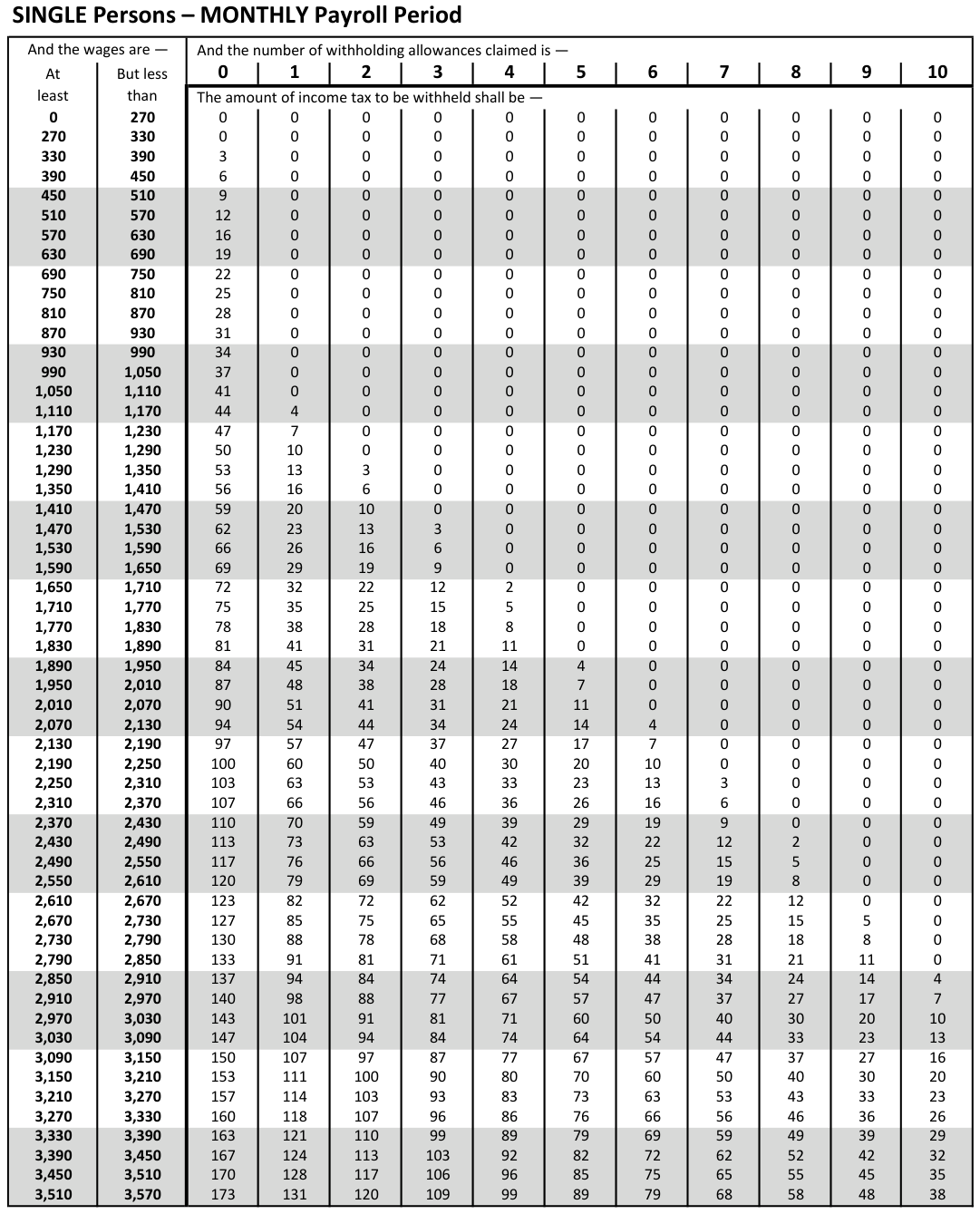
Text version of this table
| And the wages are — At But less least than 0 270 270 330 330 390 390 450 | And the number of withholding allowances claimed is — 0 1 2 3 4 5 6 7 8 9 10 | |||||||||||
| The amount of income tax to be withheld shall be — 0 0 0 0 0 0 0 0 0 0 0 0 0 0 0 0 0 0 0 0 0 0 3 0 0 0 0 0 0 0 0 0 0 6 0 0 0 0 0 0 0 0 0 0 | ||||||||||||
| 450 510 570 630 | 510 570 630 690 | 9 12 16 19 | 0 0 0 0 | 0 0 0 0 | 0 0 0 0 | 0 0 0 0 | 0 0 0 0 | 0 0 0 0 | 0 0 0 0 | 0 0 0 0 | 0 0 0 0 | 0 0 0 0 |
| 690 750 810 870 | 750 810 870 930 | 22 25 28 31 | 0 0 0 0 | 0 0 0 0 | 0 0 0 0 | 0 0 0 0 | 0 0 0 0 | 0 0 0 0 | 0 0 0 0 | 0 0 0 0 | 0 0 0 0 | 0 0 0 0 |
| 930 990 1,050 1,110 | 990 1,050 1,110 1,170 | 34 37 41 44 | 0 0 0 4 | 0 0 0 0 | 0 0 0 0 | 0 0 0 0 | 0 0 0 0 | 0 0 0 0 | 0 0 0 0 | 0 0 0 0 | 0 0 0 0 | 0 0 0 0 |
| 1,170 1,230 1,290 1,350 | 1,230 1,290 1,350 1,410 | 47 50 53 56 | 7 10 13 16 | 0 0 3 6 | 0 0 0 0 | 0 0 0 0 | 0 0 0 0 | 0 0 0 0 | 0 0 0 0 | 0 0 0 0 | 0 0 0 0 | 0 0 0 0 |
| 1,410 1,470 1,530 1,590 | 1,470 1,530 1,590 1,650 | 59 62 66 69 | 20 23 26 29 | 10 13 16 19 | 0 3 6 9 | 0 0 0 0 | 0 0 0 0 | 0 0 0 0 | 0 0 0 0 | 0 0 0 0 | 0 0 0 0 | 0 0 0 0 |
| 1,650 1,710 1,770 1,830 | 1,710 1,770 1,830 1,890 | 72 75 78 81 | 32 35 38 41 | 22 25 28 31 | 12 15 18 21 | 2 5 8 11 | 0 0 0 0 | 0 0 0 0 | 0 0 0 0 | 0 0 0 0 | 0 0 0 0 | 0 0 0 0 |
| 1,890 1,950 2,010 2,070 | 1,950 2,010 2,070 2,130 | 84 87 90 94 | 45 48 51 54 | 34 38 41 44 | 24 28 31 34 | 14 18 21 24 | 4 7 11 14 | 0 0 0 4 | 0 0 0 0 | 0 0 0 0 | 0 0 0 0 | 0 0 0 0 |
| 2,130 2,190 2,250 2,310 | 2,190 2,250 2,310 2,370 | 97 100 103 107 | 57 60 63 66 | 47 50 53 56 | 37 40 43 46 | 27 30 33 36 | 17 20 23 26 | 7 10 13 16 | 0 0 3 6 | 0 0 0 0 | 0 0 0 0 | 0 0 0 0 |
| 2,370 2,430 2,490 2,550 | 2,430 2,490 2,550 2,610 | 110 113 117 120 | 70 73 76 79 | 59 63 66 69 | 49 53 56 59 | 39 42 46 49 | 29 32 36 39 | 19 22 25 29 | 9 12 15 19 | 0 2 5 8 | 0 0 0 0 | 0 0 0 0 |
| 2,610 2,670 2,730 2,790 | 2,670 2,730 2,790 2,850 | 123 127 130 133 | 82 85 88 91 | 72 75 78 81 | 62 65 68 71 | 52 55 58 61 | 42 45 48 51 | 32 35 38 41 | 22 25 28 31 | 12 15 18 21 | 0 5 8 11 | 0 0 0 0 |
| 2,850 2,910 2,970 3,030 | 2,910 2,970 3,030 3,090 | 137 140 143 147 | 94 98 101 104 | 84 88 91 94 | 74 77 81 84 | 64 67 71 74 | 54 57 60 64 | 44 47 50 54 | 34 37 40 44 | 24 27 30 33 | 14 17 20 23 | 4 7 10 13 |
| 3,090 3,150 3,210 3,270 | 3,150 3,210 3,270 3,330 | 150 153 157 160 | 107 111 114 118 | 97 100 103 107 | 87 90 93 96 | 77 80 83 86 | 67 70 73 76 | 57 60 63 66 | 47 50 53 56 | 37 40 43 46 | 27 30 33 36 | 16 20 23 26 |
| 3,330 3,390 3,450 3,510 | 3,390 3,450 3,510 3,570 | 163 167 170 173 | 121 124 128 131 | 110 113 117 120 | 99 103 106 109 | 89 92 96 99 | 79 82 85 89 | 69 72 75 79 | 59 62 65 68 | 49 52 55 58 | 39 42 45 48 | 29 32 35 38 |
# SINGLE Persons - MONTHLY Payroll Period
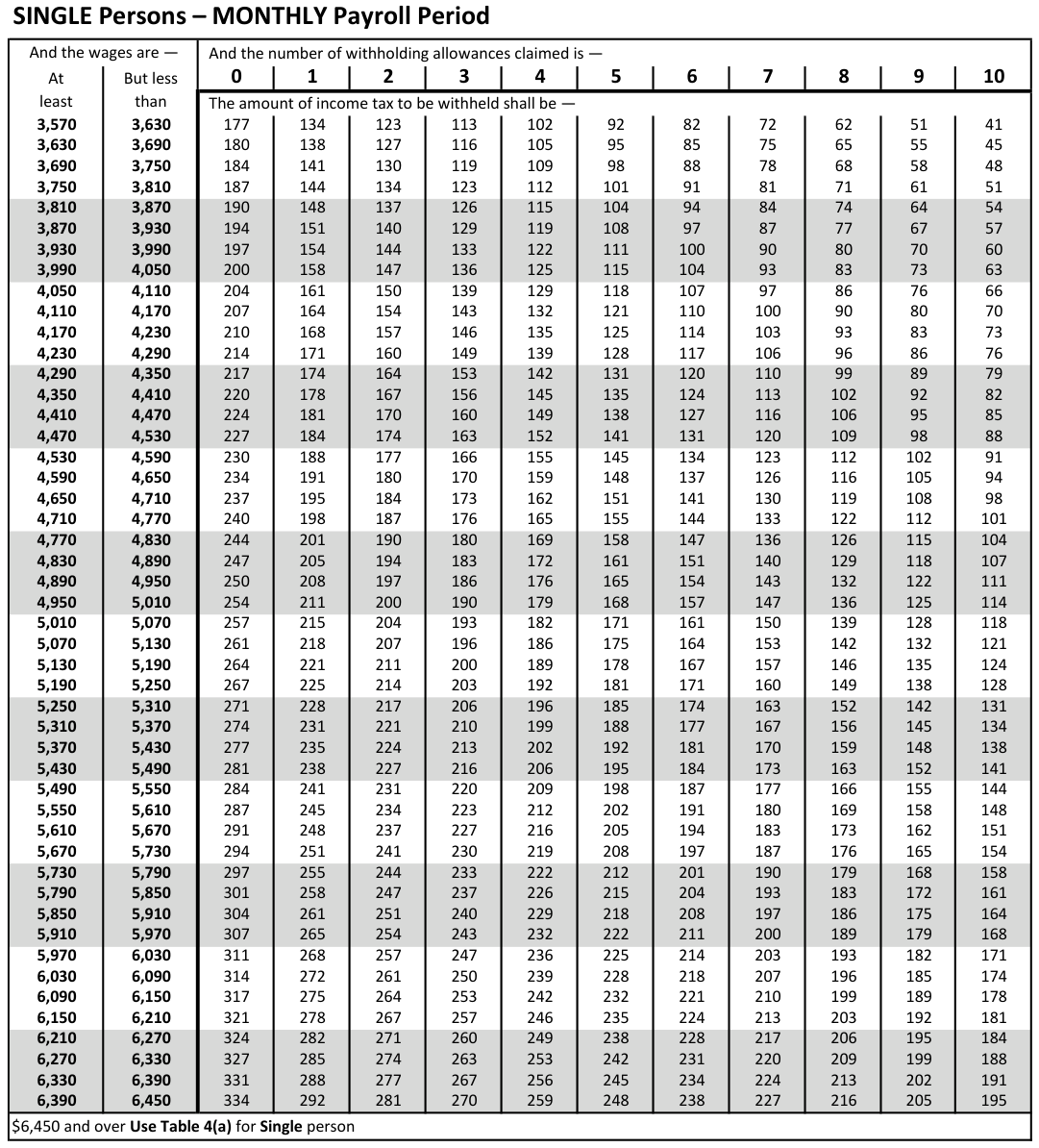
Text version of this table
| And the wages are — At But less least than 3,570 3,630 3,630 3,690 3,690 3,750 3,750 3,810 | And the number of withholding allowances claimed is — 0 1 2 3 4 5 6 7 8 9 10 | |||||||||||
| The amount of income tax to be withheld shall be — 177 134 123 113 102 92 82 72 62 51 41 180 138 127 116 105 95 85 75 65 55 45 184 141 130 119 109 98 88 78 68 58 48 187 144 134 123 112 101 91 81 71 61 51 | ||||||||||||
| 3,810 3,870 3,930 3,990 | 3,870 3,930 3,990 4,050 | 190 194 197 200 | 148 151 154 158 | 137 140 144 147 | 126 129 133 136 | 115 119 122 125 | 104 108 111 115 | 94 97 100 104 | 84 87 90 93 | 74 77 80 83 | 64 67 70 73 | 54 57 60 63 |
| 4,050 4,110 4,170 4,230 | 4,110 4,170 4,230 4,290 | 204 207 210 214 | 161 164 168 171 | 150 154 157 160 | 139 143 146 149 | 129 132 135 139 | 118 121 125 128 | 107 110 114 117 | 97 100 103 106 | 86 90 93 96 | 76 80 83 86 | 66 70 73 76 |
| 4,290 4,350 4,410 4,470 | 4,350 4,410 4,470 4,530 | 217 220 224 227 | 174 178 181 184 | 164 167 170 174 | 153 156 160 163 | 142 145 149 152 | 131 135 138 141 | 120 124 127 131 | 110 113 116 120 | 99 102 106 109 | 89 92 95 98 | 79 82 85 88 |
| 4,530 4,590 4,650 4,710 | 4,590 4,650 4,710 4,770 | 230 234 237 240 | 188 191 195 198 | 177 180 184 187 | 166 170 173 176 | 155 159 162 165 | 145 148 151 155 | 134 137 141 144 | 123 126 130 133 | 112 116 119 122 | 102 105 108 112 | 91 94 98 101 |
| 4,770 4,830 4,890 4,950 | 4,830 4,890 4,950 5,010 | 244 247 250 254 | 201 205 208 211 | 190 194 197 200 | 180 183 186 190 | 169 172 176 179 | 158 161 165 168 | 147 151 154 157 | 136 140 143 147 | 126 129 132 136 | 115 118 122 125 | 104 107 111 114 |
| 5,010 5,070 5,130 5,190 | 5,070 5,130 5,190 5,250 | 257 261 264 267 | 215 218 221 225 | 204 207 211 214 | 193 196 200 203 | 182 186 189 192 | 171 175 178 181 | 161 164 167 171 | 150 153 157 160 | 139 142 146 149 | 128 132 135 138 | 118 121 124 128 |
| 5,250 5,310 5,370 5,430 | 5,310 5,370 5,430 5,490 | 271 274 277 281 | 228 231 235 238 | 217 221 224 227 | 206 210 213 216 | 196 199 202 206 | 185 188 192 195 | 174 177 181 184 | 163 167 170 173 | 152 156 159 163 | 142 145 148 152 | 131 134 138 141 |
| 5,490 5,550 5,610 5,670 | 5,550 5,610 5,670 5,730 | 284 287 291 294 | 241 245 248 251 | 231 234 237 241 | 220 223 227 230 | 209 212 216 219 | 198 202 205 208 | 187 191 194 197 | 177 180 183 187 | 166 169 173 176 | 155 158 162 165 | 144 148 151 154 |
| 5,730 5,790 5,850 5,910 | 5,790 5,850 5,910 5,970 | 297 301 304 307 | 255 258 261 265 | 244 247 251 254 | 233 237 240 243 | 222 226 229 232 | 212 215 218 222 | 201 204 208 211 | 190 193 197 200 | 179 183 186 189 | 168 172 175 179 | 158 161 164 168 |
| 5,970 6,030 6,090 6,150 | 6,030 6,090 6,150 6,210 | 311 314 317 321 | 268 272 275 278 | 257 261 264 267 | 247 250 253 257 | 236 239 242 246 | 225 228 232 235 | 214 218 221 224 | 203 207 210 213 | 193 196 199 203 | 182 185 189 192 | 171 174 178 181 |
| 6,210 6,270 6,330 6,390 | 6,270 6,330 6,390 6,450 | 324 327 331 334 | 282 285 288 292 | 271 274 277 281 | 260 263 267 270 | 249 253 256 259 | 238 242 245 248 | 228 231 234 238 | 217 220 224 227 | 206 209 213 216 | 195 199 202 205 | 184 188 191 195 |
| $6,450 and over Use Table 4(a) for Single person |
# MARRIED Persons - MONTHLY Payroll Period
And the number of withholding allowances claimed is -
And the wages are -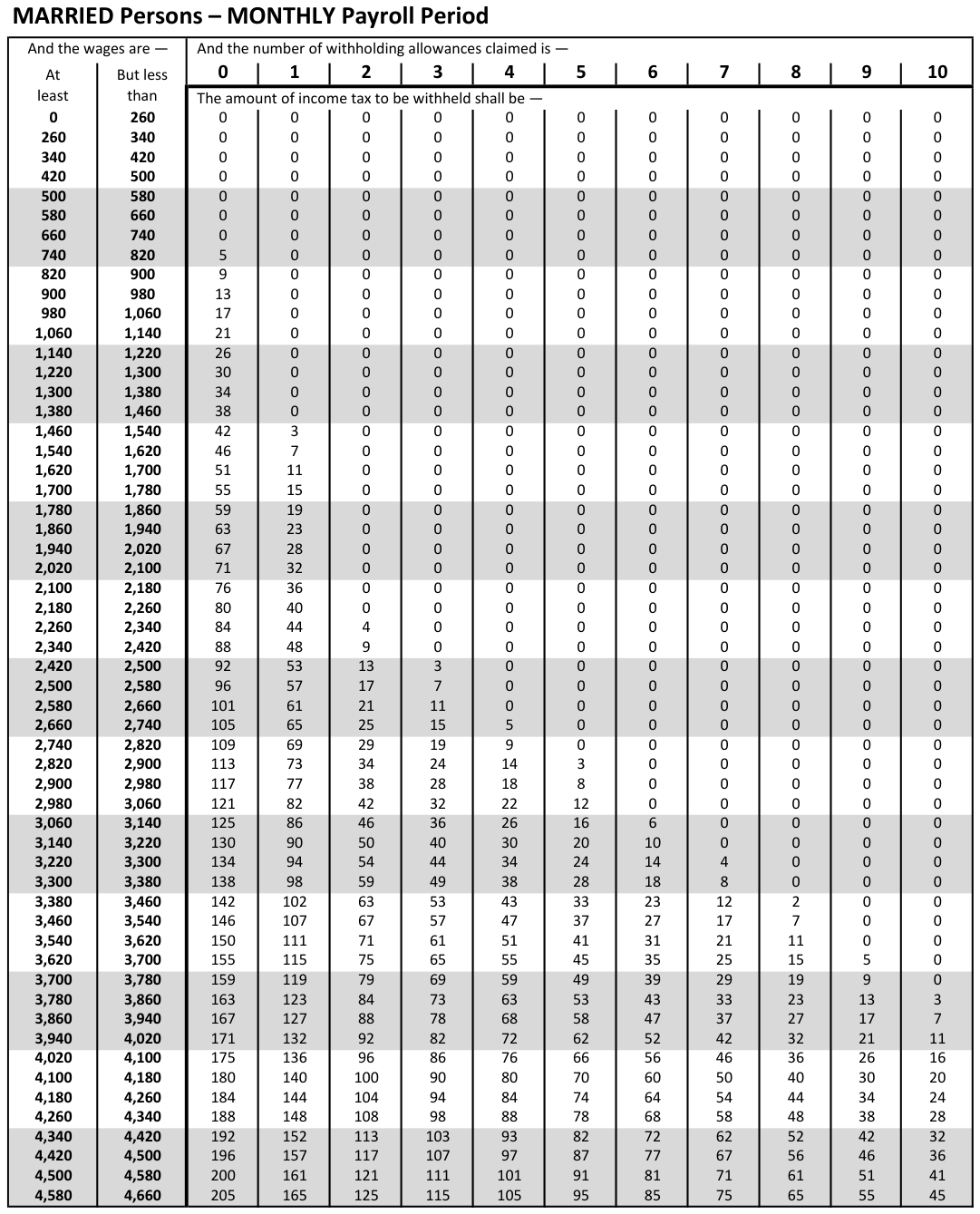
Text version of this table
And the wages are — At But less least than 0 260 260 340 340 420 420 500 And the number of withholding allowances claimed is — 0 1 2 3 4 5 6 7 8 9 10 The amount of income tax to be withheld shall be — 0 0 0 0 0 0 0 0 0 0 0 0 0 0 0 0 0 0 0 0 0 0 0 0 0 0 0 0 0 0 0 0 0 0 0 0 0 0 0 0 0 0 0 0 500 580 660 740 580 660 740 820 0 0 0 5 0 0 0 0 0 0 0 0 0 0 0 0 0 0 0 0 0 0 0 0 0 0 0 0 0 0 0 0 0 0 0 0 0 0 0 0 0 0 0 0 820 900 980 1,060 900 980 1,060 1,140 9 13 17 21 0 0 0 0 0 0 0 0 0 0 0 0 0 0 0 0 0 0 0 0 0 0 0 0 0 0 0 0 0 0 0 0 0 0 0 0 0 0 0 0 1,140 1,220 1,300 1,380 1,220 1,300 1,380 1,460 26 30 34 38 0 0 0 0 0 0 0 0 0 0 0 0 0 0 0 0 0 0 0 0 0 0 0 0 0 0 0 0 0 0 0 0 0 0 0 0 0 0 0 0 1,460 1,540 1,620 1,700 1,540 1,620 1,700 1,780 42 46 51 55 3 7 11 15 0 0 0 0 0 0 0 0 0 0 0 0 0 0 0 0 0 0 0 0 0 0 0 0 0 0 0 0 0 0 0 0 0 0 0 0 1,780 1,860 1,940 2,020 1,860 1,940 2,020 2,100 59 63 67 71 19 23 28 32 0 0 0 0 0 0 0 0 0 0 0 0 0 0 0 0 0 0 0 0 0 0 0 0 0 0 0 0 0 0 0 0 0 0 0 0 2,100 2,180 2,260 2,340 2,180 2,260 2,340 2,420 76 80 84 88 36 40 44 48 0 0 4 9 0 0 0 0 0 0 0 0 0 0 0 0 0 0 0 0 0 0 0 0 0 0 0 0 0 0 0 0 0 0 0 0 2,420 2,500 2,580 2,660 2,500 2,580 2,660 2,740 92 96 101 105 53 57 61 65 13 17 21 25 3 7 11 15 0 0 0 5 0 0 0 0 0 0 0 0 0 0 0 0 0 0 0 0 0 0 0 0 0 0 0 0 2,740 2,820 2,900 2,980 2,820 2,900 2,980 3,060 109 113 117 121 69 73 77 82 29 34 38 42 19 24 28 32 9 14 18 22 0 3 8 12 0 0 0 0 0 0 0 0 0 0 0 0 0 0 0 0 0 0 0 0 3,060 3,140 3,220 3,300 3,140 3,220 3,300 3,380 125 130 134 138 86 90 94 98 46 50 54 59 36 40 44 49 26 30 34 38 16 20 24 28 6 10 14 18 0 0 4 8 0 0 0 0 0 0 0 0 0 0 0 0 3,380 3,460 3,540 3,620 3,460 3,540 3,620 3,700 142 146 150 155 102 107 111 115 63 67 71 75 53 57 61 65 43 47 51 55 33 37 41 45 23 27 31 35 12 17 21 25 2 7 11 15 0 0 0 5 0 0 0 0 3,700 3,780 3,860 3,940 3,780 3,860 3,940 4,020 159 163 167 171 119 123 127 132 79 84 88 92 69 73 78 82 59 63 68 72 49 53 58 62 39 43 47 52 29 33 37 42 19 23 27 32 9 13 17 21 0 3 7 11 4,020 4,100 4,180 4,260 4,100 4,180 4,260 4,340 175 180 184 188 136 140 144 148 96 100 104 108 86 90 94 98 76 80 84 88 66 70 74 78 56 60 64 68 46 50 54 58 36 40 44 48 26 30 34 38 16 20 24 28 4,340 4,420 4,500 4,580 4,420 4,500 4,580 4,660 192 196 200 205 152 157 161 165 113 117 121 125 103 107 111 115 93 97 101 105 82 87 91 95 72 77 81 85 62 67 71 75 52 56 61 65 42 46 51 55 32 36 41 45
# MARRIED Persons - MONTHLY Payroll Period
And the number of withholding allowances claimed is -
And the wages are -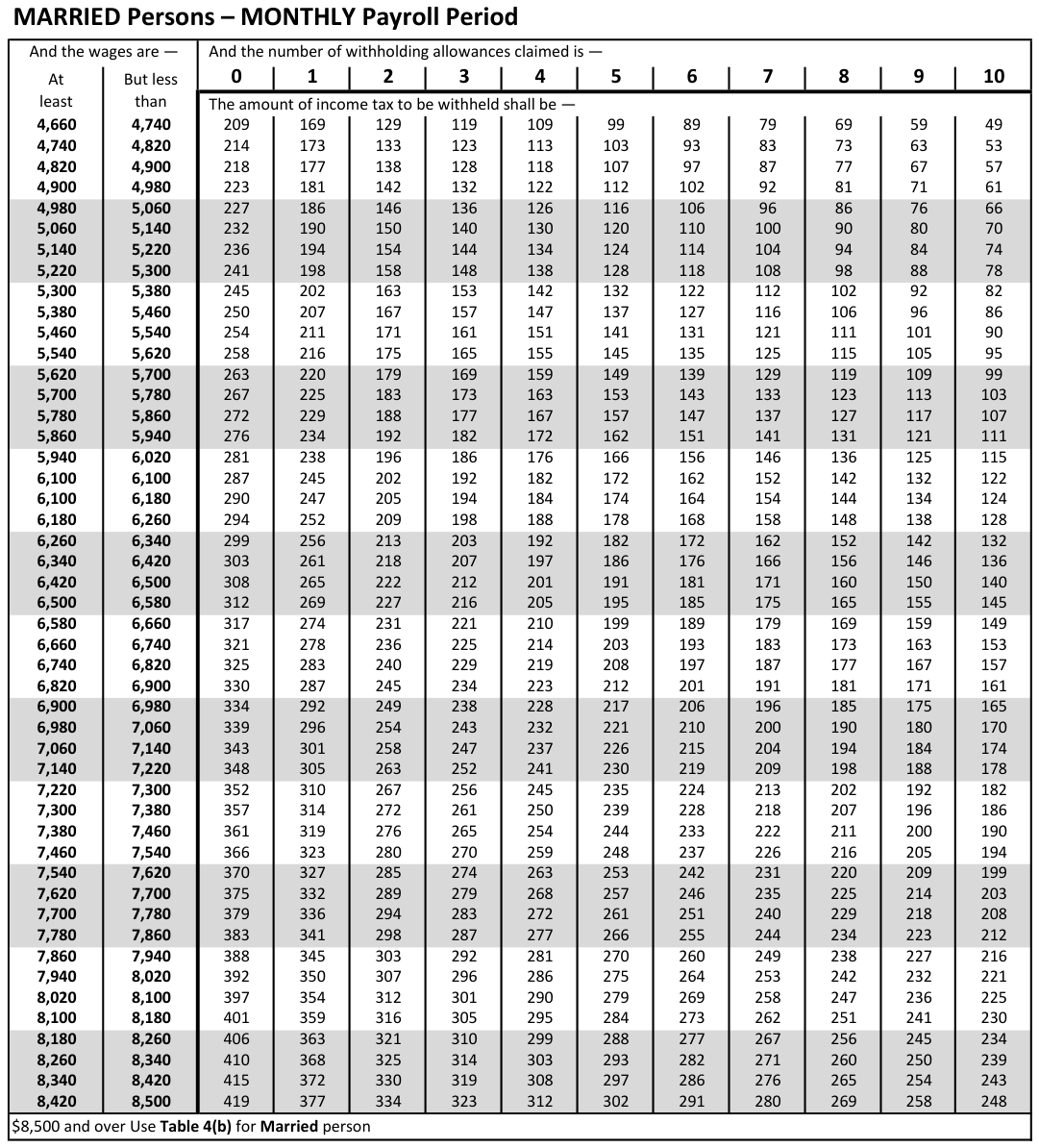
Text version of this table
And the wages are — At But less least than 4,660 4,740 4,740 4,820 4,820 4,900 4,900 4,980 And the number of withholding allowances claimed is — 0 1 2 3 4 5 6 7 8 9 10 The amount of income tax to be withheld shall be — 209 169 129 119 109 99 89 79 69 59 49 214 173 133 123 113 103 93 83 73 63 53 218 177 138 128 118 107 97 87 77 67 57 223 181 142 132 122 112 102 92 81 71 61 4,980 5,060 5,140 5,220 5,060 5,140 5,220 5,300 227 232 236 241 186 190 194 198 146 150 154 158 136 140 144 148 126 130 134 138 116 120 124 128 106 110 114 118 96 100 104 108 86 90 94 98 76 80 84 88 66 70 74 78 5,300 5,380 5,460 5,540 5,380 5,460 5,540 5,620 245 250 254 258 202 207 211 216 163 167 171 175 153 157 161 165 142 147 151 155 132 137 141 145 122 127 131 135 112 116 121 125 102 106 111 115 92 96 101 105 82 86 90 95 5,620 5,700 5,780 5,860 5,700 5,780 5,860 5,940 263 267 272 276 220 225 229 234 179 183 188 192 169 173 177 182 159 163 167 172 149 153 157 162 139 143 147 151 129 133 137 141 119 123 127 131 109 113 117 121 99 103 107 111 5,940 6,100 6,100 6,180 6,020 6,100 6,180 6,260 281 287 290 294 238 245 247 252 196 202 205 209 186 192 194 198 176 182 184 188 166 172 174 178 156 162 164 168 146 152 154 158 136 142 144 148 125 132 134 138 115 122 124 128 6,260 6,340 6,420 6,500 6,340 6,420 6,500 6,580 299 303 308 312 256 261 265 269 213 218 222 227 203 207 212 216 192 197 201 205 182 186 191 195 172 176 181 185 162 166 171 175 152 156 160 165 142 146 150 155 132 136 140 145 6,580 6,660 6,740 6,820 6,660 6,740 6,820 6,900 317 321 325 330 274 278 283 287 231 236 240 245 221 225 229 234 210 214 219 223 199 203 208 212 189 193 197 201 179 183 187 191 169 173 177 181 159 163 167 171 149 153 157 161 6,900 6,980 7,060 7,140 6,980 7,060 7,140 7,220 334 339 343 348 292 296 301 305 249 254 258 263 238 243 247 252 228 232 237 241 217 221 226 230 206 210 215 219 196 200 204 209 185 190 194 198 175 180 184 188 165 170 174 178 7,220 7,300 7,380 7,460 7,300 7,380 7,460 7,540 352 357 361 366 310 314 319 323 267 272 276 280 256 261 265 270 245 250 254 259 235 239 244 248 224 228 233 237 213 218 222 226 202 207 211 216 192 196 200 205 182 186 190 194 7,540 7,620 7,700 7,780 7,620 7,700 7,780 7,860 370 375 379 383 327 332 336 341 285 289 294 298 274 279 283 287 263 268 272 277 253 257 261 266 242 246 251 255 231 235 240 244 220 225 229 234 209 214 218 223 199 203 208 212 7,860 7,940 8,020 8,100 7,940 8,020 8,100 8,180 388 392 397 401 345 350 354 359 303 307 312 316 292 296 301 305 281 286 290 295 270 275 279 284 260 264 269 273 249 253 258 262 238 242 247 251 227 232 236 241 216 221 225 230 8,180 8,260 8,340 8,420 8,260 8,340 8,420 8,500 406 410 415 419 363 368 372 377 321 325 330 334 310 314 319 323 299 303 308 312 288 293 297 302 277 282 286 291 267 271 276 280 256 260 265 269 245 250 254 258 234 239 243 248 $8,500 and over Use Table 4(b) for Married person
# SINGLE Persons - DAILY or MISC. Payroll Period
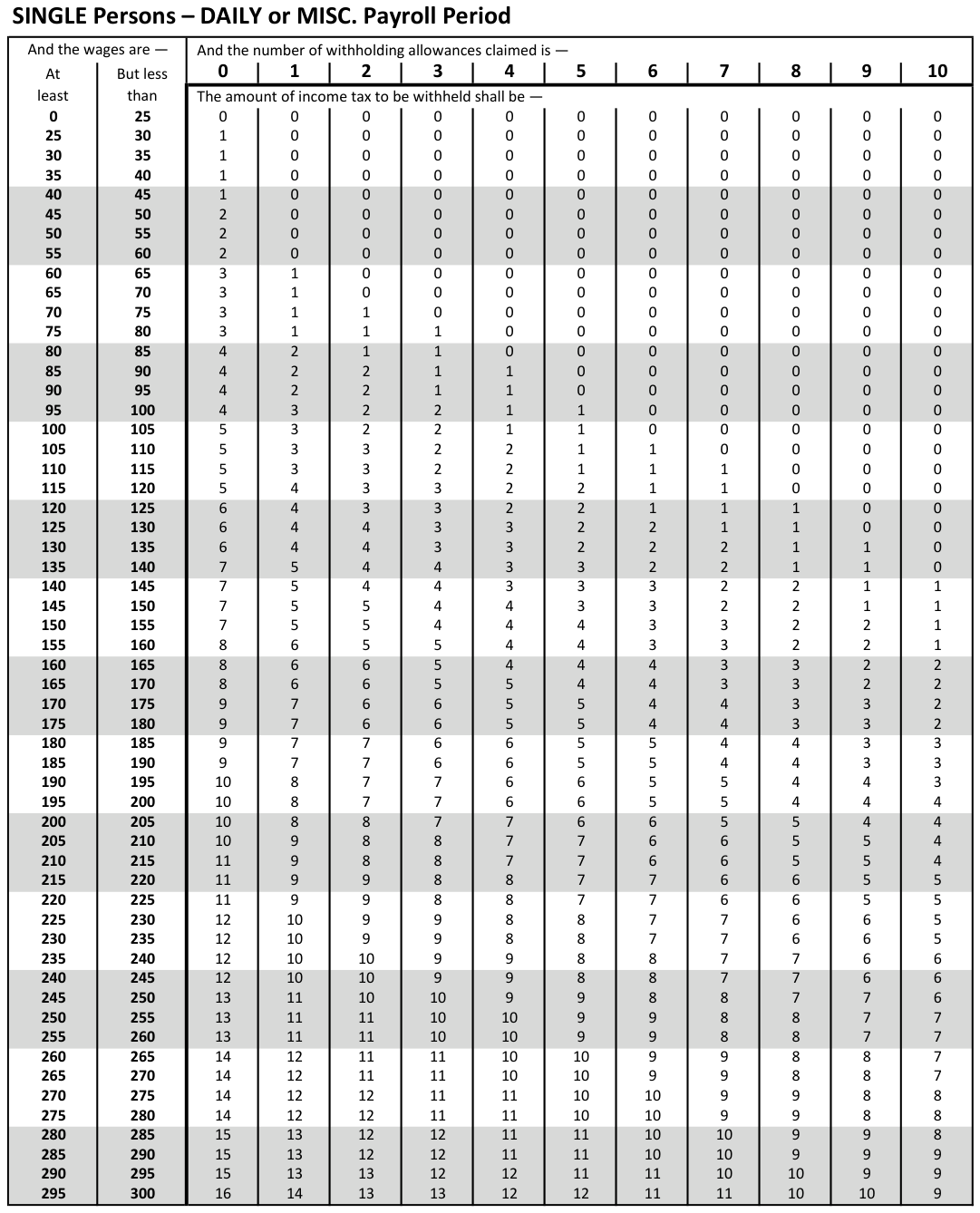
Text version of this table
| And the wages are — At But less least than 0 25 25 30 30 35 35 40 | And the number of withholding allowances claimed is — 0 1 2 3 4 5 6 7 8 9 10 | |||||||||||
| The amount of income tax to be withheld shall be — 0 0 0 0 0 0 0 0 0 0 0 1 0 0 0 0 0 0 0 0 0 0 1 0 0 0 0 0 0 0 0 0 0 1 0 0 0 0 0 0 0 0 0 0 | ||||||||||||
| 40 45 50 55 | 45 50 55 60 | 1 2 2 2 | 0 0 0 0 | 0 0 0 0 | 0 0 0 0 | 0 0 0 0 | 0 0 0 0 | 0 0 0 0 | 0 0 0 0 | 0 0 0 0 | 0 0 0 0 | 0 0 0 0 |
| 60 65 70 75 | 65 70 75 80 | 3 3 3 3 | 1 1 1 1 | 0 0 1 1 | 0 0 0 1 | 0 0 0 0 | 0 0 0 0 | 0 0 0 0 | 0 0 0 0 | 0 0 0 0 | 0 0 0 0 | 0 0 0 0 |
| 80 85 90 95 | 85 90 95 100 | 4 4 4 4 | 2 2 2 3 | 1 2 2 2 | 1 1 1 2 | 0 1 1 1 | 0 0 0 1 | 0 0 0 0 | 0 0 0 0 | 0 0 0 0 | 0 0 0 0 | 0 0 0 0 |
| 100 105 110 115 | 105 110 115 120 | 5 5 5 5 | 3 3 3 4 | 2 3 3 3 | 2 2 2 3 | 1 2 2 2 | 1 1 1 2 | 0 1 1 1 | 0 0 1 1 | 0 0 0 0 | 0 0 0 0 | 0 0 0 0 |
| 120 125 130 135 | 125 130 135 140 | 6 6 6 7 | 4 4 4 5 | 3 4 4 4 | 3 3 3 4 | 2 3 3 3 | 2 2 2 3 | 1 2 2 2 | 1 1 2 2 | 1 1 1 1 | 0 0 1 1 | 0 0 0 0 |
| 140 145 150 155 | 145 150 155 160 | 7 7 7 8 | 5 5 5 6 | 4 5 5 5 | 4 4 4 5 | 3 4 4 4 | 3 3 4 4 | 3 3 3 3 | 2 2 3 3 | 2 2 2 2 | 1 1 2 2 | 1 1 1 1 |
| 160 165 170 175 | 165 170 175 180 | 8 8 9 9 | 6 6 7 7 | 6 6 6 6 | 5 5 6 6 | 4 5 5 5 | 4 4 5 5 | 4 4 4 4 | 3 3 4 4 | 3 3 3 3 | 2 2 3 3 | 2 2 2 2 |
| 180 185 190 195 | 185 190 195 200 | 9 9 10 10 | 7 7 8 8 | 7 7 7 7 | 6 6 7 7 | 6 6 6 6 | 5 5 6 6 | 5 5 5 5 | 4 4 5 5 | 4 4 4 4 | 3 3 4 4 | 3 3 3 4 |
| 200 205 210 215 | 205 210 215 220 | 10 10 11 11 | 8 9 9 9 | 8 8 8 9 | 7 8 8 8 | 7 7 7 8 | 6 7 7 7 | 6 6 6 7 | 5 6 6 6 | 5 5 5 6 | 4 5 5 5 | 4 4 4 5 |
| 220 225 230 235 | 225 230 235 240 | 11 12 12 12 | 9 10 10 10 | 9 9 9 10 | 8 9 9 9 | 8 8 8 9 | 7 8 8 8 | 7 7 7 8 | 6 7 7 7 | 6 6 6 7 | 5 6 6 6 | 5 5 5 6 |
| 240 245 250 255 | 245 250 255 260 | 12 13 13 13 | 10 11 11 11 | 10 10 11 11 | 9 10 10 10 | 9 9 10 10 | 8 9 9 9 | 8 8 9 9 | 7 8 8 8 | 7 7 8 8 | 6 7 7 7 | 6 6 7 7 |
| 260 265 270 275 | 265 270 275 280 | 14 14 14 14 | 12 12 12 12 | 11 11 12 12 | 11 11 11 11 | 10 10 11 11 | 10 10 10 10 | 9 9 10 10 | 9 9 9 9 | 8 8 9 9 | 8 8 8 8 | 7 7 8 8 |
| 280 285 290 295 | 285 290 295 300 | 15 15 15 16 | 13 13 13 14 | 12 12 13 13 | 12 12 12 13 | 11 11 12 12 | 11 11 11 12 | 10 10 11 11 | 10 10 10 11 | 9 9 10 10 | 9 9 9 10 | 8 9 9 9 |
# SINGLE Persons - DAILY or MISC. Payroll Period
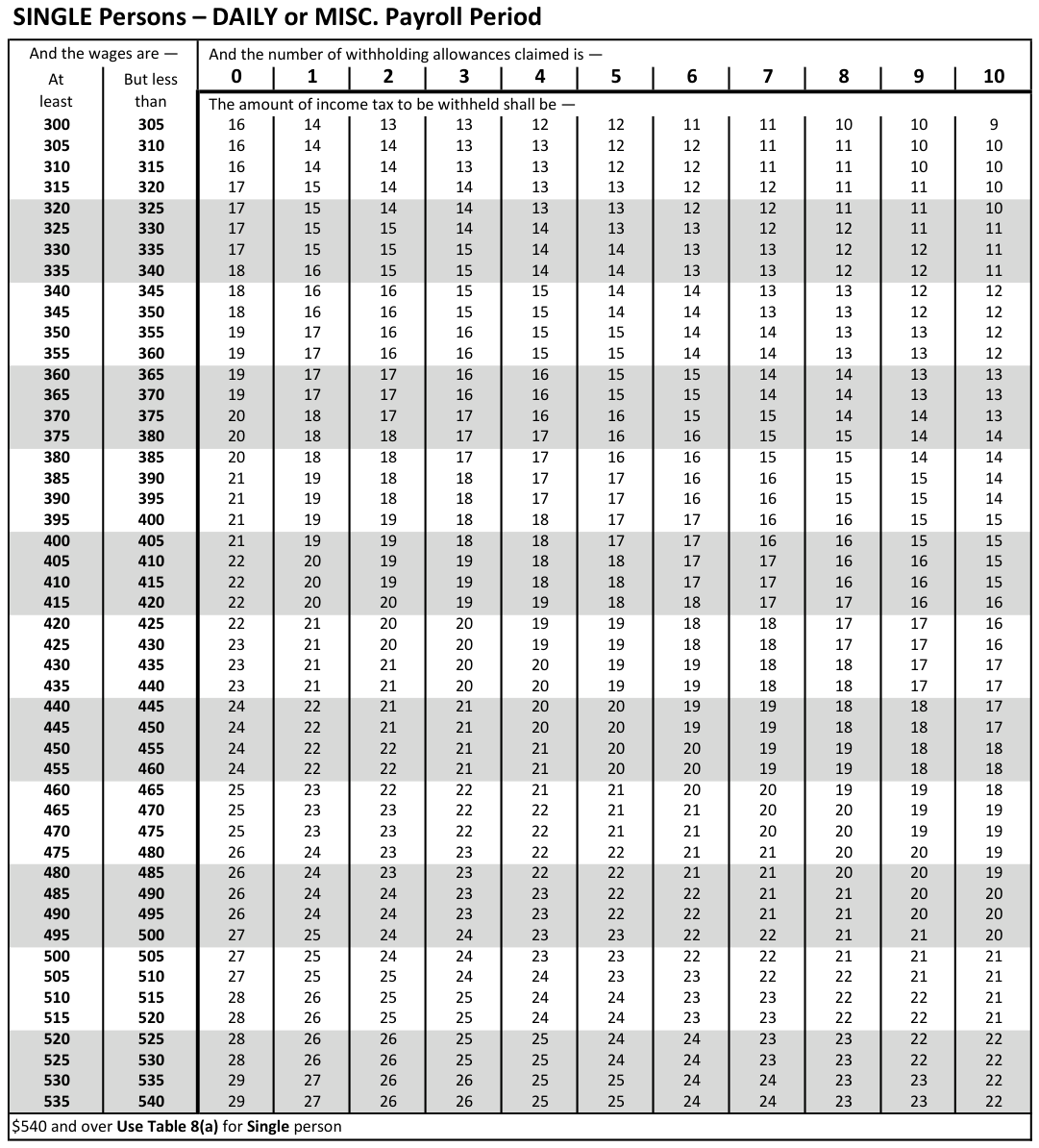
Text version of this table
| And the wages are — At But less least than 300 305 305 310 310 315 315 320 | And the number of withholding allowances claimed is — 0 1 2 3 4 5 6 7 8 9 10 | |||||||||||
| The amount of income tax to be withheld shall be — 16 14 13 13 12 12 11 11 10 10 9 16 14 14 13 13 12 12 11 11 10 10 16 14 14 13 13 12 12 11 11 10 10 17 15 14 14 13 13 12 12 11 11 10 | ||||||||||||
| 320 325 330 335 | 325 330 335 340 | 17 17 17 18 | 15 15 15 16 | 14 15 15 15 | 14 14 15 15 | 13 14 14 14 | 13 13 14 14 | 12 13 13 13 | 12 12 13 13 | 11 12 12 12 | 11 11 12 12 | 10 11 11 11 |
| 340 345 350 355 | 345 350 355 360 | 18 18 19 19 | 16 16 17 17 | 16 16 16 16 | 15 15 16 16 | 15 15 15 15 | 14 14 15 15 | 14 14 14 14 | 13 13 14 14 | 13 13 13 13 | 12 12 13 13 | 12 12 12 12 |
| 360 365 370 375 | 365 370 375 380 | 19 19 20 20 | 17 17 18 18 | 17 17 17 18 | 16 16 17 17 | 16 16 16 17 | 15 15 16 16 | 15 15 15 16 | 14 14 15 15 | 14 14 14 15 | 13 13 14 14 | 13 13 13 14 |
| 380 385 390 395 | 385 390 395 400 | 20 21 21 21 | 18 19 19 19 | 18 18 18 19 | 17 18 18 18 | 17 17 17 18 | 16 17 17 17 | 16 16 16 17 | 15 16 16 16 | 15 15 15 16 | 14 15 15 15 | 14 14 14 15 |
| 400 405 410 415 | 405 410 415 420 | 21 22 22 22 | 19 20 20 20 | 19 19 19 20 | 18 19 19 19 | 18 18 18 19 | 17 18 18 18 | 17 17 17 18 | 16 17 17 17 | 16 16 16 17 | 15 16 16 16 | 15 15 15 16 |
| 420 425 430 435 | 425 430 435 440 | 22 23 23 23 | 21 21 21 21 | 20 20 21 21 | 20 20 20 20 | 19 19 20 20 | 19 19 19 19 | 18 18 19 19 | 18 18 18 18 | 17 17 18 18 | 17 17 17 17 | 16 16 17 17 |
| 440 445 450 455 | 445 450 455 460 | 24 24 24 24 | 22 22 22 22 | 21 21 22 22 | 21 21 21 21 | 20 20 21 21 | 20 20 20 20 | 19 19 20 20 | 19 19 19 19 | 18 18 19 19 | 18 18 18 18 | 17 17 18 18 |
| 460 465 470 475 | 465 470 475 480 | 25 25 25 26 | 23 23 23 24 | 22 23 23 23 | 22 22 22 23 | 21 22 22 22 | 21 21 21 22 | 20 21 21 21 | 20 20 20 21 | 19 20 20 20 | 19 19 19 20 | 18 19 19 19 |
| 480 485 490 495 | 485 490 495 500 | 26 26 26 27 | 24 24 24 25 | 23 24 24 24 | 23 23 23 24 | 22 23 23 23 | 22 22 22 23 | 21 22 22 22 | 21 21 21 22 | 20 21 21 21 | 20 20 20 21 | 19 20 20 20 |
| 500 505 510 515 | 505 510 515 520 | 27 27 28 28 | 25 25 26 26 | 24 25 25 25 | 24 24 25 25 | 23 24 24 24 | 23 23 24 24 | 22 23 23 23 | 22 22 23 23 | 21 22 22 22 | 21 21 22 22 | 21 21 21 21 |
| 520 525 530 535 | 525 530 535 540 | 28 28 29 29 | 26 26 27 27 | 26 26 26 26 | 25 25 26 26 | 25 25 25 25 | 24 24 25 25 | 24 24 24 24 | 23 23 24 24 | 23 23 23 23 | 22 22 23 23 | 22 22 22 22 |
| $540 and over Use Table 8(a) for Single person |
# MARRIED Persons - DAILY or MISC. Payroll Period
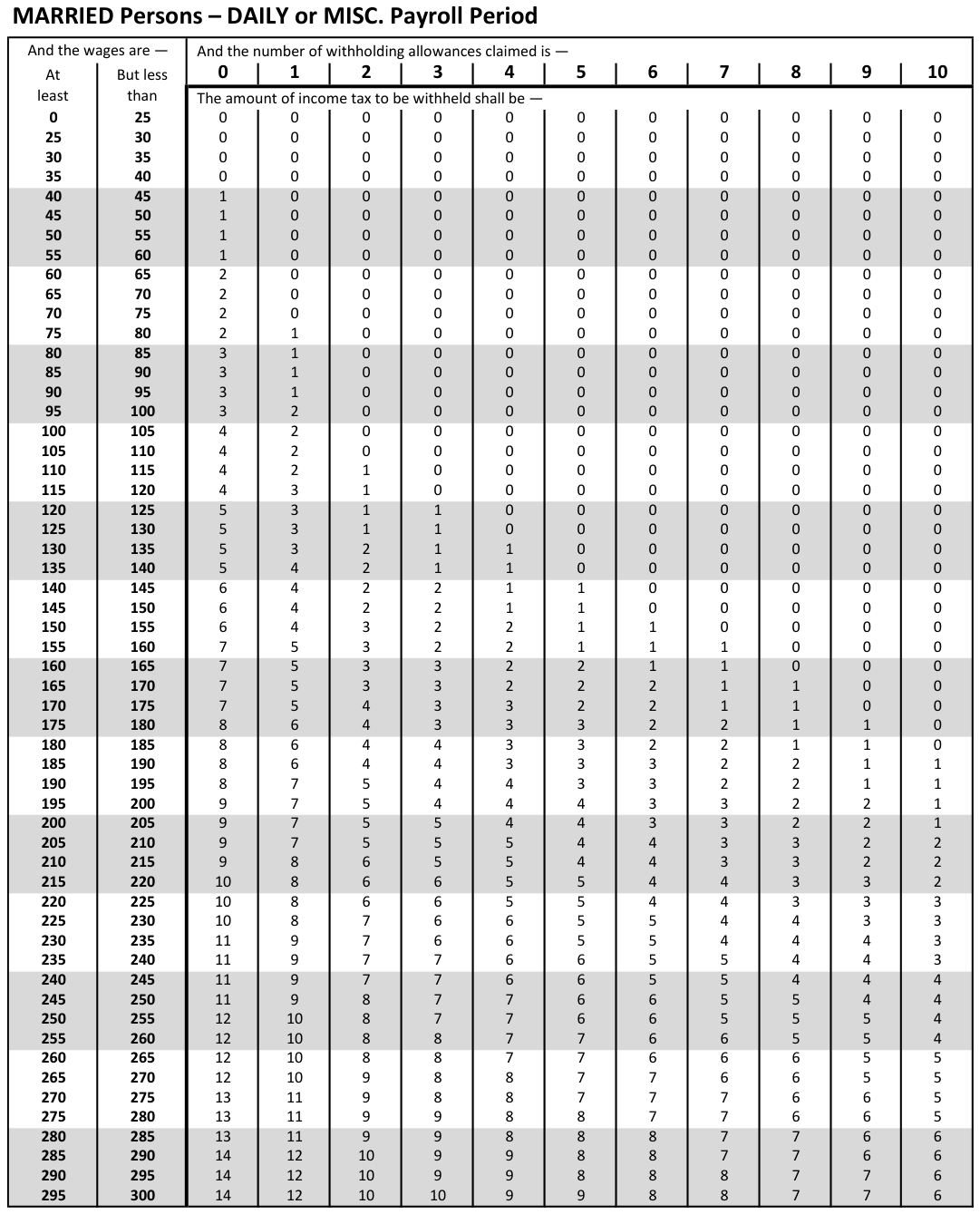
Text version of this table
| And the wages are — At But less least than 0 25 25 30 30 35 35 40 | And the number of withholding allowances claimed is — 0 1 2 3 4 5 6 7 8 9 10 | |||||||||||
| The amount of income tax to be withheld shall be — 0 0 0 0 0 0 0 0 0 0 0 0 0 0 0 0 0 0 0 0 0 0 0 0 0 0 0 0 0 0 0 0 0 0 0 0 0 0 0 0 0 0 0 0 | ||||||||||||
| 40 45 50 55 | 45 50 55 60 | 1 1 1 1 | 0 0 0 0 | 0 0 0 0 | 0 0 0 0 | 0 0 0 0 | 0 0 0 0 | 0 0 0 0 | 0 0 0 0 | 0 0 0 0 | 0 0 0 0 | 0 0 0 0 |
| 60 65 70 75 | 65 70 75 80 | 2 2 2 2 | 0 0 0 1 | 0 0 0 0 | 0 0 0 0 | 0 0 0 0 | 0 0 0 0 | 0 0 0 0 | 0 0 0 0 | 0 0 0 0 | 0 0 0 0 | 0 0 0 0 |
| 80 85 90 95 | 85 90 95 100 | 3 3 3 3 | 1 1 1 2 | 0 0 0 0 | 0 0 0 0 | 0 0 0 0 | 0 0 0 0 | 0 0 0 0 | 0 0 0 0 | 0 0 0 0 | 0 0 0 0 | 0 0 0 0 |
| 100 105 110 115 | 105 110 115 120 | 4 4 4 4 | 2 2 2 3 | 0 0 1 1 | 0 0 0 0 | 0 0 0 0 | 0 0 0 0 | 0 0 0 0 | 0 0 0 0 | 0 0 0 0 | 0 0 0 0 | 0 0 0 0 |
| 120 125 130 135 | 125 130 135 140 | 5 5 5 5 | 3 3 3 4 | 1 1 2 2 | 1 1 1 1 | 0 0 1 1 | 0 0 0 0 | 0 0 0 0 | 0 0 0 0 | 0 0 0 0 | 0 0 0 0 | 0 0 0 0 |
| 140 145 150 155 | 145 150 155 160 | 6 6 6 7 | 4 4 4 5 | 2 2 3 3 | 2 2 2 2 | 1 1 2 2 | 1 1 1 1 | 0 0 1 1 | 0 0 0 1 | 0 0 0 0 | 0 0 0 0 | 0 0 0 0 |
| 160 165 170 175 | 165 170 175 180 | 7 7 7 8 | 5 5 5 6 | 3 3 4 4 | 3 3 3 3 | 2 2 3 3 | 2 2 2 3 | 1 2 2 2 | 1 1 1 2 | 0 1 1 1 | 0 0 0 1 | 0 0 0 0 |
| 180 185 190 195 | 185 190 195 200 | 8 8 8 9 | 6 6 7 7 | 4 4 5 5 | 4 4 4 4 | 3 3 4 4 | 3 3 3 4 | 2 3 3 3 | 2 2 2 3 | 1 2 2 2 | 1 1 1 2 | 0 1 1 1 |
| 200 205 210 215 | 205 210 215 220 | 9 9 9 10 | 7 7 8 8 | 5 5 6 6 | 5 5 5 6 | 4 5 5 5 | 4 4 4 5 | 3 4 4 4 | 3 3 3 4 | 2 3 3 3 | 2 2 2 3 | 1 2 2 2 |
| 220 225 230 235 | 225 230 235 240 | 10 10 11 11 | 8 8 9 9 | 6 7 7 7 | 6 6 6 7 | 5 6 6 6 | 5 5 5 6 | 4 5 5 5 | 4 4 4 5 | 3 4 4 4 | 3 3 4 4 | 3 3 3 3 |
| 240 245 250 255 | 245 250 255 260 | 11 11 12 12 | 9 9 10 10 | 7 8 8 8 | 7 7 7 8 | 6 7 7 7 | 6 6 6 7 | 5 6 6 6 | 5 5 5 6 | 4 5 5 5 | 4 4 5 5 | 4 4 4 4 |
| 260 265 270 275 | 265 270 275 280 | 12 12 13 13 | 10 10 11 11 | 8 9 9 9 | 8 8 8 9 | 7 8 8 8 | 7 7 7 8 | 6 7 7 7 | 6 6 7 7 | 6 6 6 6 | 5 5 6 6 | 5 5 5 5 |
| 280 285 290 295 | 285 290 295 300 | 13 14 14 14 | 11 12 12 12 | 9 10 10 10 | 9 9 9 10 | 8 9 9 9 | 8 8 8 9 | 8 8 8 8 | 7 7 8 8 | 7 7 7 7 | 6 6 7 7 | 6 6 6 6 |
# MARRIED Persons - DAILY or MISC. Payroll Period
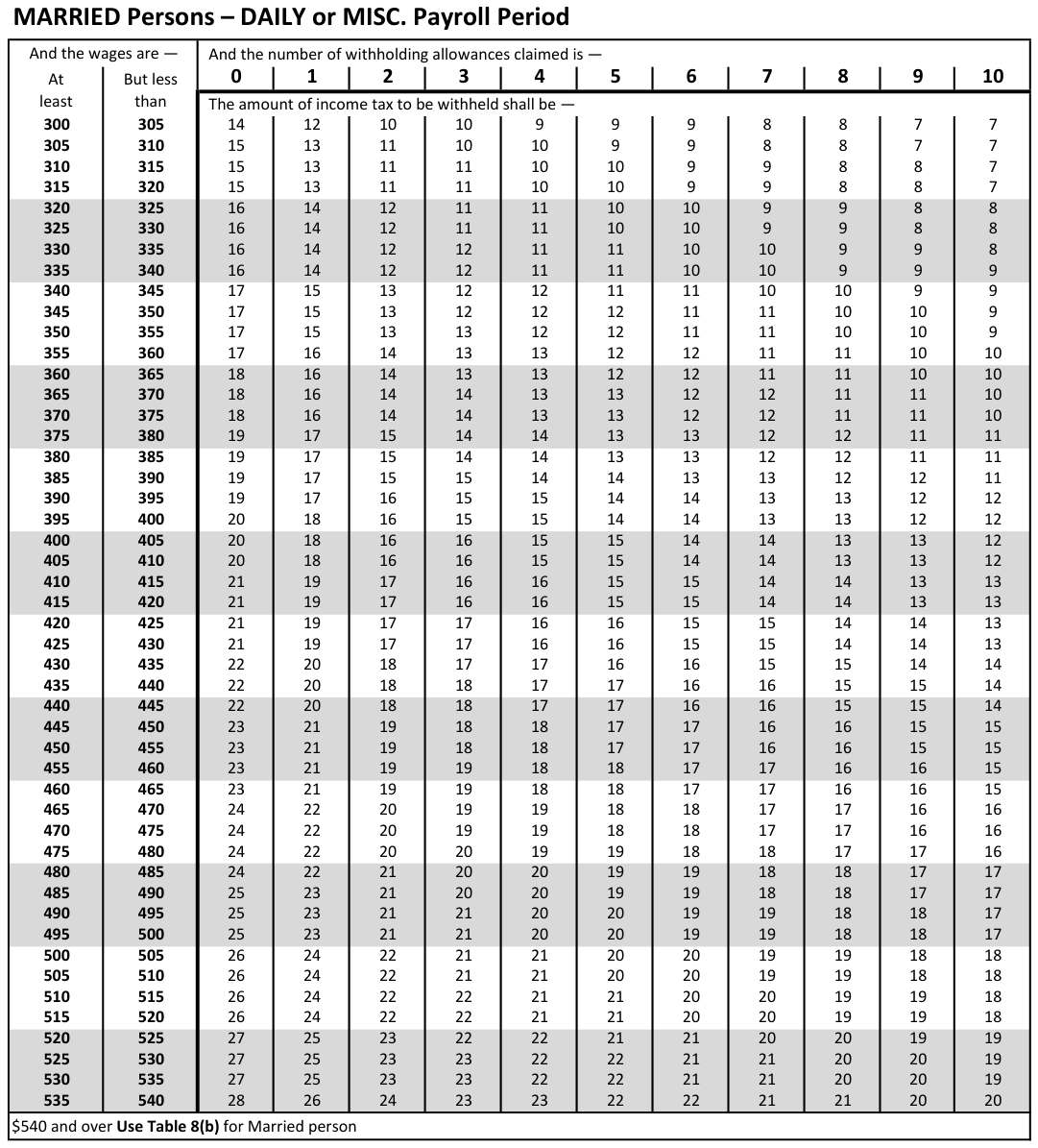
Text version of this table
| And the wages are — At But less least than 300 305 305 310 310 315 315 320 | And the number of withholding allowances claimed is — 0 1 2 3 4 5 6 7 8 9 10 | |||||||||||
| The amount of income tax to be withheld shall be — 14 12 10 10 9 9 9 8 8 7 7 15 13 11 10 10 9 9 8 8 7 7 15 13 11 11 10 10 9 9 8 8 7 15 13 11 11 10 10 9 9 8 8 7 | ||||||||||||
| 320 325 330 335 | 325 330 335 340 | 16 16 16 16 | 14 14 14 14 | 12 12 12 12 | 11 11 12 12 | 11 11 11 11 | 10 10 11 11 | 10 10 10 10 | 9 9 10 10 | 9 9 9 9 | 8 8 9 9 | 8 8 8 9 |
| 340 345 350 355 | 345 350 355 360 | 17 17 17 17 | 15 15 15 16 | 13 13 13 14 | 12 12 13 13 | 12 12 12 13 | 11 12 12 12 | 11 11 11 12 | 10 11 11 11 | 10 10 10 11 | 9 10 10 10 | 9 9 9 10 |
| 360 365 370 375 | 365 370 375 380 | 18 18 18 19 | 16 16 16 17 | 14 14 14 15 | 13 14 14 14 | 13 13 13 14 | 12 13 13 13 | 12 12 12 13 | 11 12 12 12 | 11 11 11 12 | 10 11 11 11 | 10 10 10 11 |
| 380 385 390 395 | 385 390 395 400 | 19 19 19 20 | 17 17 17 18 | 15 15 16 16 | 14 15 15 15 | 14 14 15 15 | 13 14 14 14 | 13 13 14 14 | 12 13 13 13 | 12 12 13 13 | 11 12 12 12 | 11 11 12 12 |
| 400 405 410 415 | 405 410 415 420 | 20 20 21 21 | 18 18 19 19 | 16 16 17 17 | 16 16 16 16 | 15 15 16 16 | 15 15 15 15 | 14 14 15 15 | 14 14 14 14 | 13 13 14 14 | 13 13 13 13 | 12 12 13 13 |
| 420 425 430 435 | 425 430 435 440 | 21 21 22 22 | 19 19 20 20 | 17 17 18 18 | 17 17 17 18 | 16 16 17 17 | 16 16 16 17 | 15 15 16 16 | 15 15 15 16 | 14 14 15 15 | 14 14 14 15 | 13 13 14 14 |
| 440 445 450 455 | 445 450 455 460 | 22 23 23 23 | 20 21 21 21 | 18 19 19 19 | 18 18 18 19 | 17 18 18 18 | 17 17 17 18 | 16 17 17 17 | 16 16 16 17 | 15 16 16 16 | 15 15 15 16 | 14 15 15 15 |
| 460 465 470 475 | 465 470 475 480 | 23 24 24 24 | 21 22 22 22 | 19 20 20 20 | 19 19 19 20 | 18 19 19 19 | 18 18 18 19 | 17 18 18 18 | 17 17 17 18 | 16 17 17 17 | 16 16 16 17 | 15 16 16 16 |
| 480 485 490 495 | 485 490 495 500 | 24 25 25 25 | 22 23 23 23 | 21 21 21 21 | 20 20 21 21 | 20 20 20 20 | 19 19 20 20 | 19 19 19 19 | 18 18 19 19 | 18 18 18 18 | 17 17 18 18 | 17 17 17 17 |
| 500 505 510 515 | 505 510 515 520 | 26 26 26 26 | 24 24 24 24 | 22 22 22 22 | 21 21 22 22 | 21 21 21 21 | 20 20 21 21 | 20 20 20 20 | 19 19 20 20 | 19 19 19 19 | 18 18 19 19 | 18 18 18 18 |
| 520 525 530 535 | 525 530 535 540 | 27 27 27 28 | 25 25 25 26 | 23 23 23 24 | 22 23 23 23 | 22 22 22 23 | 21 22 22 22 | 21 21 21 22 | 20 21 21 21 | 20 20 20 21 | 19 20 20 20 | 19 19 19 20 |
| $540 and over Use Table 8(b) for Married person |
# TAXPAYER ASSISTANCE
This publication is a general guide and will not address every situation. If you have questions, you may contact the Kansas Department of Revenue:
By Phone By Mail By Appointment
785-368-8222 Tax Operations Go to ksrevenue.gov to set up an appointment by using the
PO Box 3506 Appointment Scheduler.
Topeka KS 66625-3506
Office hours are 8 a.m. to 4:45 p.m., Monday through Friday.
# PUBLICATIONS
Below is a list of publications available on the Kansas Department of Revenue's website. These publications contain instructions applicable to specific business industries and general information for all business owners.
- Publication KS-1216, Kansas Business Tax Application
- Publication KS-1223 Kansas Food Sales Tax Rate Reduction
- Publication KS-1510, Kansas Sales Tax and Compensating Use Tax
- Publication KS-1515, Kansas Tax Calendar of Due Dates
- Publication KS-1520, Kansas Exemption Certificates
- Publication KS-1525, Kansas Sales and Use Tax for Contractors, Subcontractors and Repairmen
- Publication KS-1526, Kansas Business Taxes for Motor Vehicle Transactions
- Publication KS-1527, Kansas Business Taxes for Political Subdivisions
- Publication KS-1530, Kansas Tire Excise Tax
- Publication KS-1540, Kansas Business Taxes for Hotels, Motels and Restaurants
- Publication KS-1550, Kansas Business Taxes for Agricultural Industries
- Publication KS-1560, Kansas Business Taxes for Schools and Educational Institutions
- Publication KS-1700, Kansas Sales & Use Tax Jurisdiction Code Booklet
- KW-100, Kansas Withholding Tax Guide
STATE SMALL BUSINESS WORKSHOPS
As part of our commitment to provide tax assistance to the business community, Tax Specialists within the Kansas Department of Revenue conduct small business workshops on Kansas taxes at various locations throughout Kansas.
Whether you are a new business owner, an existing business owner, or an accountant, these workshops will give you the tools and understanding necessary to make Kansas taxes easier and less time consuming for you. Topics covered include filing and reporting requirements and methods, what is taxable, what is exempt and how to work with the department in collecting and remitting Kansas taxes.
For a schedule of our workshops, visit our website. Pre-registration is required and a fee may be charged by the sponsoring Small Business Development Center (SBDC).
Tables and rate charts from the source document
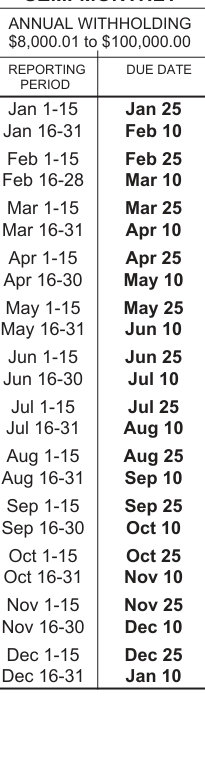
Source: view the official PDF
The source document contains 4 figures (charts or worksheet graphics) not reproduced in this text version. See the official PDF above.
Nearby sections (13 sections)
- corpbook25 · 2025 Corporate Income Tax Instructions (K-120)
- fiduciarybook25 · 2025 Fiduciary Income Tax Instructions (K-41)
- homesteadbook25 · 2025 Homestead Refund Instructions (K-40H / K-40PT /…
- incomebook25 · 2025 Individual Income Tax Booklet (K-40 and Schedules)
- k-120es26 · 2026 K-120ES Corporate / Electing Pass-Through Entity…
- k-13025 · 2025 K-130 Privilege Tax Form and Original and Amended…
- k-40c · K-40C Composite Income Tax Schedule
- k-40es26 · 2026 K-40ES Individual Estimated Income Tax Voucher and…
- k-41es26 · 2026 K-41ES Fiduciary Estimated Tax Voucher and Instructions
- kw100 · KW-100 Kansas Withholding Tax Guide
- pub1216 · KS-1216 Kansas Business Tax Application Guide
- pub1510 · KS-1510 Sales Tax and Compensating Use Tax Guide
- scorpbook25 · 2025 Small Business Income Tax Booklet (K-120S —…