Delaware Division of Revenue Form Instructions
Instructions for Form PIT-RES — Resident Personal Income Tax Return
# RESIDENT INSTRUCTIONS
FOR THE FASTEST DELAWARE REFUND, SUBMIT YOUR RETURN ELECTRONICALLY
Advantages of electronic submission:
- If we do not need additional information, you may receive your refund in as little as 10 days.
- Direct deposit into checking or savings account, if to a U.S. bank account.
- Convenient, fast, easy, and electronic receipt verification.
For more information regarding electronic and online filing options, visit revenue.delaware.gov.
NOTE: The average refund time for paper returns and returns that require supporting documentation or a manual review is 12 weeks.
Complete your federal tax return before preparing your state return!
Refund Inquiry: You can check the status of your refund by visiting tax.delaware.gov. Select "Check the Status of Your Refund." You will need your SSN and the requested 'Net Refund' amount to complete your inquiry.
Return review items which require manual review and supporting documentation:
- Be sure you have all W-2s, 1099Rs, and other withholding information before filing your return. Don't rely on your year-end pay stub information. It may not match what your employer reports to us. Please note that some employers may issue more than one W-2. You should wait to file your return until you have all W-2s and 1099s so you can report all of your income received. Omissions will cause delays in processing of your return.
- Be sure you use your legal name on the return. Initials or middle names will cause a delay in posting your return for processing.
- Ensure your social security number is correct on the return. Typos will cause a delay in posting of your return for processing.
- Please ensure your return reflects an accurate filing status.
- Complete all applicable Delaware schedules (I, II, III, IV and V).
- All supporting federal schedules must be included with your return.
- If claiming a credit for other state credits you must include a copy of the other state return(s).
- Do not claim credits you are not entitled to receive. Credits such as firefighter and business credits are verified before return is processed.
- If you are filing a form RSA for a married filing combined separate return that columns A and B equal the total amounts claimed on the return before submitting the return electronically or by paper.
- Only include Delaware withholding on Line 35 of Form PIT-RES.
- Do not send in additional copies of your return. If you file electronically, you do not need to submit a paper copy.
- The Division of Revenue reviews returns with significant losses on Schedule C, E, and F. We may request supporting documentation.
- The Division of Revenue reviews returns with significant itemized deductions. We may request supporting documentation.
Reminder: You will receive a 1099G from the State if last year you a) itemized deductions on your federal return and b) received a Delaware refund, requested a carryover, contributed to one of the Special Funds OR had your refund intercepted.
# Contents
Who Must File … 2
What Form to File … 2
Who is a Resident? … 2
Taxpayers with Disabilities-Minors-Deceased Taxpayers . 2 When to File … 2 Extension of Time to File a Return … 2 Steps for Preparing Your Return … 2 What Documents to Attach … 3 Persons 60 or Over Checklist … 3 Members of Armed Forces … 3 Military Spouses … 3 When to Make Your Estimated Tax Payment … 4 Estimated Tax Penalty … 4 Penalties and Interest … 4 Federal Privacy Act Information … 4 Amended Returns … 4 Rounding Off Dollars … 4 Address Change … 4 Name, Address and Taxpayer ID … 5 Filing Status … 5 PIT-UND Indicator … 5 Line-by-Line Instructions … 5 Section A - Additions … 5 Section B - Subtractions … 5 Pension Exclusion for Individuals Under 60 … 6 Section C - Deductions … 7 Itemized Deductions … 7 Page 2 of Form PIT-RES … 8 Section D - Calculations … 8 Page 3 of Form PIT-RES … 10 Section E - Direct Deposit Information … 11 Direct Deposit or Refund … 11 Delaware College Investment Plan (529 Plan) … 11 Deceased Taxpayers … 11 Paid Preparer … 11 PIT-RSA Instructions … 12 Medical and Dental Expenses … 12 Interest You Paid … 12 Gifts to Charity … 12 Casualty and Theft Losses … 12 Other Itemized Deductions … 12 Total Itemized Deductions … 12 Instructions For Tax Year 2025 Amended Returns Only … 12 Who Must File: … 13 What To File: … 13 Specific Instructions … 13 Line By Line Instruction … 13 Form PIT-RSS Instructions … 13 DE Schedule I - Credit for Income Taxes Paid to Another State … 13 DE Schedule II - Earned Income Tax Credit (EITC) … 13 DE Schedule III - Contributions to Special Funds … 14 DE Schedule V - Delaware S Corporation Payments … 14 SPECIAL FUNDS … 15 Revised 03/26/26
# Form PIT-RES
RESIDENT INDIVIDUAL INCOME TAX RETURN
# Who Must File
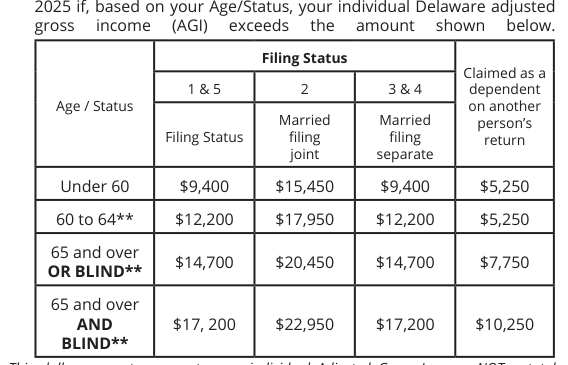
- If you are a Full-Year Resident of the State, you must file a tax return for 2025 if, based on your Age/Status, your individual Delaware adjusted gross income (AGI) exceeds the amount shown below.
# Filing Status
Text version of this table
Age / Status Filing Status Claimed as a dependent on another person’s return 1 & 5 2 3 & 4 Filing Status Married filing joint Married filing separate Under 60 $9,400 $15,450 $9,400 $5,250 60 to 64** $12,200 $17,950 $12,200 $5,250 65 and over OR BLIND** $14,700 $20,450 $14,700 $7,750 65 and over AND BLIND** $17, 200 $22,950 $17,200 $10,250
This dollar amount represents your individual Adjusted Gross Income, NOT a total combined with anyone else.
Assumes only one spouse meets age or blindness criteria.
- If you were a Part-Year Resident, you must file a Delaware tax return: a. If you had income from any source while a resident of Delaware, or b. If you had income from a Delaware source while you were a nonresident of Delaware.
Part-year residents may elect to file either a resident or non- resident return. You may wish to prepare both. File only the return which is more advantageous for you.
Part-Year Residents electing to file a resident return - this option may be advantageous if, during the period of non-residency, you had no income from sources in other states and/or your only income was from Delaware.
Part-Year Residents electing to file a non-resident return - This option may be advantageous if, during the period of non-residency, you had any income from other states or sources outside of Delaware. Please refer to the instructions for Form PIT-NON to review this option.
Note: Volunteer Firefighter, Child Care and Earned Income Tax Credits cannot be taken on the non-resident return (Form PIT-NON).
- If you are a Non-Resident who had gross income in 2025 from sources in Delaware, you must file a Delaware Tax return.
# What Form to File
PIT-RES PIT-NON
Full-year residents
Part-year residents
Non-residents
# Who is a Resident?
A resident is an individual who either:
- Is domiciled in this State for any part of the taxable year; or
- Maintains a place of abode in this State and spends more than 183 days of the taxable year in this State.
A domicile is the place an individual intends to be his permanent home; a place to which he intends to return whenever he may be absent. An individual can have only one domicile. A domicile, once established, continues until the individual moves to a new location and exhibits a bona fide intention of making it his or her permanent home.
Full-Time Students with a legal residence in another state remain legal residents of that state unless they exhibit intentions to make Delaware their permanent residence.
# GENERAL INSTRUCTIONS
NOTE*: Foreign Travelers - If you were out of the United States for at least 495 days in the last 18 consecutive months and (at the same time) you did not maintain a permanent place of abode in this State at which you, your spouse, your children, or your parents were present for more than 45 days, you are not considered a resident of this State.
*The above NOTE does not apply to members of the Armed Forces, employees of the United States, its agencies, or instrumentalities.
# Taxpayers with Disabilities-Minors-Deceased Taxpayers
If an individual is unable to file a return because they are a minor or are disabled, the return shall be filed by their authorized agent, guardian, fiduciary, or the person charged with the care of the person or property of such individual. See the federal Form 1040 instructions for those authorized to sign. If an individual is deceased, their final return shall be filed by their executor, administrator, or other person responsible for the property of the decedent. Please see 'Deceased Taxpayer' on Page 11 for further instructions on deceased taxpayers.
# When to File
Individual income tax returns are due on or before April 30, 2026 for all taxpayers filing on a calendar year basis. All others must file by the last day of the fourth month following the close of their taxable year.
# Extension of Time to File a Return
CAUTION: THERE IS NO EXTENSION OF TIME FOR PAYMENT OF TAX
An extension of time to file your tax return is granted when the
Application for Automatic Extension (Form PIT-EXT) is filed prior to the due date of your return. Interest accrues on any unpaid tax at a rate of ½% per month, or fraction of a month, from the return's original due date until paid.
To extend your due date for submitting your completed income tax return (from April 30, 2026 to October 15, 2026 submit the following to the Division of Revenue no later than April 30, 2026.
- The completed copy of Form PIT-EXT; and
- Your payment of any balance of tax liability estimated to be due for tax year 2025.
The application for an automatic extension, Form PIT-EXT, may be filed on-line on our portal at tax.delaware.gov . If you owe tax with your extension for 2025 and file on-line, you may use a direct debit from your checking or savings account or pay by credit card. If you are paying by direct debit, you may specify a later payment date, up to the due date.
Payments by direct debit must not come from an account outside the U.S. and may be made in any amount without dollar limitation. Payments up to $10,000 can be made by credit card. If you choose not to file online, a blank copy of Form PIT-EXT is available from the Division of Revenue or from our website.
Blanket requests for extensions will not be granted. YOU MUST submit a separate extension request for each return.
# Steps for Preparing Your Return
Step 1
Complete your federal income tax return and any other state return(s).
They will be used in preparing your Delaware return.
Step 2
Fill in your name, address and filing status.
Step 3
Using the line-by-line instructions, begin by completing all lines relevant to your return on the front of the form and complete each section in order.
Step 4
When you are finished, attach the appropriate documents to your Delaware return. See "What Documents to Attach" on page 3.
Step 5
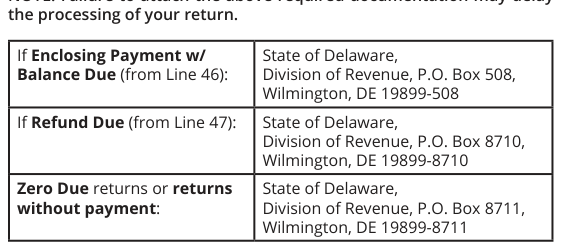
Sign, date, enter your phone number, and send Form PIT-RES along with all required attachments to the applicable address listed below. If the return is prepared by a paid preparer, the paid preparer must also sign the return.
# Notes:
- The return is not complete unless it is signed and dated.
- If filing a joint return or a married combined separate return, both spouses must sign the return.
- In order to aid in timely processing of your return, please include a telephone number where you can be reached during normal working hours.
- Each preparer is responsible for including all relevant items about which he/she has information.
- Separate filers MUST submit their returns in separate envelopes.
Please DO NOT include duplicate copies of a spouse's return.
# What Documents to Attach
Attach the following documents to your Delaware return:
- DE Schedule I, II, III, IV, and V (PIT-RSS), if completed.
- W-2 Form(s) issued by your employer and all 1099-R forms to receive credit for Delaware tax withheld.
- A copy of Page 1 and Page 2 of your federal Form 1040 and supporting 1040 schedules (1,2,3,4, etc.).
- A copy of all federal schedules you are required to file with your federal return (for example, Schedule C, D, E, F, etc.).
- A copy of federal Schedule EIC - Earned Income Credit.
- Delaware (PIT-RSA), if you claim itemized deductions.
- A signed copy of other state's income tax return(s) if you claim a credit for taxes paid to another State. Do NOT use the amount from your W-2 form(s).
- A copy of federal Form 2441, if you claim a credit for Child and Dependent Care expenses.
- A copy of Form SCT-SSR, if you claim a credit for taxes paid by an S Corporation.
- Form PIT-UND, pages 1 and 2, if you completed Part 3 of the PIT-UND or if the calculated estimated tax penalty is greater than zero.
- Forms PIT-CRS and Form BUS-LHR (formerly 1801AC), and/or Form BUS-NAC (formerly 2001AC), if applicable. See page 9 for a description of Form PIT-CRS Credits.
- A copy of Form REW-EST, Real Estate Tax Return, if you declared and paid estimated taxes on the sale of real estate owned in Delaware.
- A copy of deposit information for 529 or ABLE accounts if you claim an exclusion for contributions to a Delaware-sponsored tuition program or ABLE program.
Text version of this table
| If Enclosing Payment w/ Balance Due (from Line 46): | State of Delaware, Division of Revenue, P.O. Box 508, Wilmington, DE 19899-508 |
| If Refund Due (from Line 47): | State of Delaware, Division of Revenue, P.O. Box 8710, Wilmington, DE 19899-8710 |
| Zero Due returns or returns without payment: | State of Delaware, Division of Revenue, P.O. Box 8711, Wilmington, DE 19899-8711 |
# Persons 60 or Over Checklist
Text version of this table
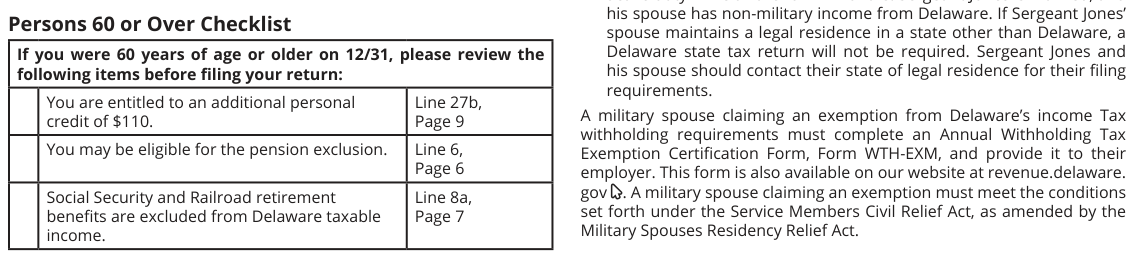
If you were 60 years of age or older on 12/31, please review the following items before filing your return: You are entitled to an additional personal credit of $110. Line 27b, Page 9 You may be eligible for the pension exclusion. Line 6, Page 6 Social Security and Railroad retirement benefits are excluded from Delaware taxable income. Line 8a, Page 7
You may be eligible for an exclusion if your Line 11, earned income was less than $2,500. Page 7 If you were 65 years of age or older on 12/31, Line 21, you are eligible for an additional standard Page 8 deduction of $2,500, if you did not itemize.
# Members of Armed Forces
Text version of this table
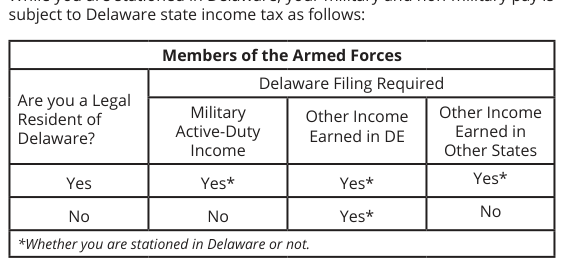
Members of the Armed Forces Are you a Legal Resident of Delaware? Delaware Filing Required Military Active-Duty Income Other Income Earned in DE Other Income Earned in Other States Yes Yes* Yes* Yes* No No Yes* No *Whether you are stationed in Delaware or not.
Your state of legal residence is the same as it was when you entered the Armed Forces unless you voluntarily changed it while in the Armed Forces. For example, if you were a legal resident of Delaware when you entered the Armed Forces, you remain a legal resident of Delaware for Delaware state income tax purposes unless you voluntarily abandoned your Delaware residency and established a new legal domicile in another state.
If you change your legal residence, in the year you change, you are a partyear resident of both states. A change in legal residence is documented by filing DD Form 2058 and DD Form 2058-1 with your military personnel office.
The following examples illustrate this:
- Airman John Green, who is a legal resident of Delaware (domiciled in Delaware), was ordered to duty in, and moved his family to, New Jersey. The family has no income other than Green's military pay.
Airman Green will file a federal and Delaware Resident tax return only.
A New Jersey state tax return is not required.
- Sergeant Paul Smith, whose domicile is Ohio, to which he is liable for income taxes, has been on active duty in Delaware for 12 months.
Sergeant Smith is single and has non-military income from Delaware.
Sergeant Smith will file as a non-resident of Delaware (using Form PIT-
NON) reporting all his income in Column A. He will deduct his military compensation from his Delaware Non-Resident Return as a federal adjustment to gross income. (Column A, Line 16.) Sergeant Smith should contact Ohio for his filing requirements for Ohio.
# Military Spouses
All income of a non-military spouse is taxed in the state of their legal residence. The following examples illustrate this:
- Airman Dan Brown and his spouse are legal residents of Delaware (domiciled in Delaware). Airman Brown was ordered to duty in, and moved with his spouse to, New Jersey. Besides Airman Brown's military pay, his spouse has New Jersey source wages. Airman Brown and his spouse will file both a federal and Delaware Resident tax return reporting both military and nonmilitary income. A New Jersey state tax return is not required.
- Sergeant Michael Jones, whose domicile is not Delaware, has been on active duty in Delaware for 12 months. Sergeant Jones is married, and his spouse has non-military income from Delaware. If Sergeant Jones' spouse maintains a legal residence in a state other than Delaware, a Delaware state tax return will not be required. Sergeant Jones and his spouse should contact their state of legal residence for their filing requirements.
# Requirement to File Estimated Taxes
Every person who is either a resident of Delaware or has income from Delaware sources may be required to file quarterly Declarations of Estimated Tax to the Delaware Division of Revenue if the Delaware tax liability less Delaware withholding and credits can reasonably be expected to exceed $800 (See worksheet on page 4).
You may be required to make estimated tax payments if you receive unemployment compensation, a lump sum distribution, or a large bonus at the end of the year.
You may also be required to make estimated tax payments if you are a Delaware resident and:
- Your employer does not withhold Delaware tax or
- You work in another state whose tax withholding rate is lower than Delaware's.
The estimated tax instructions contain the worksheet for computing your estimated tax liability and will be available after January 15, 2026 If you need estimated tax coupons, you may find them on our website at revenue.delaware.gov/personal-income-tax-forms/ , leave a message on the forms voice mailbox at (302) 577-8588 to request them, or call toll free 1-800-292-7826 (Delaware only).
Estimated tax payments may be made on-line at tax.delaware.gov by direct debit from your checking or savings account or by credit card. If you are paying by direct debit you may specify a later payment date, up to the due date. Payments through direct debit must be from a U.S. account and can be of any amount without a dollar limit. Payments up to $10,000 can be made by credit card. If you want to pay by check, you must use the paper form PIT-EST available on our website at revenue.delaware.gov.
# When to Make Your Estimated Tax Payment
For estimated tax purposes, the year is divided into four payment periods.
Each period has a specific payment due date as indicated below:
Who Must File Estimated Taxes for 2026?
To determine if you must pay estimated income tax payment complete the following:
Enter the amount of your total estimated tax
- liability for 2026 (See the tax table or tax rate schedule). 1 Enter the amount of your estimated Delaware
- withholding taxes and other credits for 2026. 2
Enter the balance due (Line 1 minus Line 2). 3
3.
You DO NOT have to file estimated taxes if:
4.
- Line 3 is less than $800, or
- Line 2 is at least 90% of Line 1, or
- Line 2 is at least equal to 100% of your total tax liability for
- If your 2025 Delaware AGI exceeded $150,000, or if you are filing status 3 and your 2025 Delaware AGI exceeded $75,000, line 2 must at least equal 110% of your 2025 tax liability.
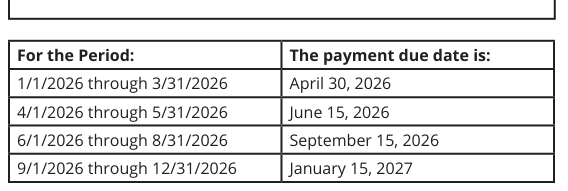
Text version of this table
For the Period: The payment due date is: 1/1/2026 through 3/31/2026 April 30, 2026 4/1/2026 through 5/31/2026 June 15, 2026 6/1/2026 through 8/31/2026 September 15, 2026 9/1/2026 through 12/31/2026 January 15, 2027
For more information concerning estimated taxes or to access the payment voucher and worksheet, visit tax.delaware.gov, or call (302) 577-8200.
# Estimated Tax Penalty
You may owe this penalty if the amount you owe (Line 41, Balance Due) is more than 10% of the tax shown on your return (Line 33, Balance).
# Exceptions to the Penalty
You will not owe the penalty if your 2025 tax return was for a period of 12 full months AND ONE of the following applies:
- You had no tax liability for 2024 (Line 17), or
- The total of Line 32 (Total Non-Refundable Credits) , Line 34 (Earned Income Tax Credit) and Line 40 (Total Refundable Credits) on your 2025 return equals at least 100% of the tax liability shown on your 2024 return and estimated tax payments for 2025 were made on time. Use 110% of your 2024 tax liability if your 2024 Delaware AGI exceeded $150,000, or if you are filing status 3 and your 2024 Delaware AGI exceeded $75,000.
- For Special Rules regarding Farmers and Fishermen and for waivers of the penalty, please see the separate instructions for Form PIT-EST and/ or Form PIT-UND.
# Penalties and Interest
- Interest - Underpayment or late payment
The Delaware Code provides that interest on any underpayment or late payment of income taxes due shall accrue at the rate of ½% per month, from the date prescribed for payments to the date paid.
- Penalty - Late-filing of balance due return
The law imposes substantial penalties for failure to file a timely return. Late-filed returns with a balance due are subject to a penalty of 5% per month of the balance due.
- Penalty - Negligence/fraud/substantial understatement
The law also provides severe penalties for filing a false or fraudulent return, or for a false certification. The mere fact that the figures you report on your Delaware return are taken from your federal return will not relieve you from the imposition of penalties for negligence or for filing a false or fraudulent return.
- Penalty - Failure to pay
The law provides a penalty of 1% per month (not to exceed 25%) of the net tax liabilities for failure to pay the tax liability due on a timely filed or late-filed return. This penalty is in addition to the interest charged for late payment.
- Penalty - Failure to File/Pay Estimated Taxes
The law provides a penalty of 1½% per month of the computed tax payment for failure to file/pay estimated taxes due. This penalty is in addition to those penalties and interest listed above. The penalty is also assessed if an estimated payment is filed late.
# Federal Privacy Act Information
Taxpayer IDs must be included on your income tax return. The mandatory disclosure of your Taxpayer ID is authorized by Section 306, Title 30 of the Delaware Code. Such numbers are used primarily to administer and enforce all tax laws, both civil and criminal, for which the Division of Revenue has statutory responsibility.
# Amended Returns
If any changes made to your federal return affect your state income tax liability, you are required to report the change to the Delaware Division of Revenue within ninety (90) days after the final determination of such a change and indicate your agreement with the determination or the grounds of your disagreement. Use Form PIT-RES to change an income tax return you have filed and attach a copy of any federal adjustments.
# Rounding Off Dollars
Dollar amounts on your return must be rounded off to the nearest whole dollar. This means that amounts from 50 to 99 cents are increased to the next dollar. For example, $1.50 becomes $2.00 and $1.49 becomes $1.00.
# Address Change
If you move after you file your return, you should notify the Division of Revenue of your address change in writing. Please be sure to include your and your spouse's Taxpayer ID(s) in any correspondence with the Division of Revenue.
# Name, Address and Taxpayer ID
Print your name(s), address, and taxpayer ID(s) in the space provided.
If you are married, give names and taxpayer ids for both you and your spouse whether you file joint or separate returns. If you are a Jr., Sr., II, III, etc., please indicate it in the Jr., Sr., III, box.
If either the primary taxpayer or spouse is deceased, the surviving spouse information should be entered first under "Your Taxpayer ID and Your Last Name". The deceased person's data should be entered under "Spouse's Taxpayer ID and Spouse's Last Name". Also, write
DECD after their first name. For an example, please see Page 11.
# Filing Status
Please indicate your filing status by marking the appropriate box.
FILING STATUS 1 - SINGLE TAXPAYER
If you were single on December 31, 2025, consider yourself Single for the whole year and use Filing Status 1.
FILING STATUS 2, 3, AND 4 - MARRIED TAXPAYERS
You may file Joint, Separate, or Combined Separate Delaware returns. If you use Filing Status 4, you are in fact filing two separate returns which have been combined on the same form for convenience.
NOTE: Generally, separate returns (filing status 3 or 4) will be advantageous if both spouses have Delaware adjusted gross income in excess of $9,400.
If you elect to use Filing Status 3 or 4, both you and your spouse must compute your taxable income the same way. This means if one itemizes deductions, the other must itemize. If one takes the standard deduction, the other must take the standard deduction in computing taxable income.
If you elect to use Filing Status 3, you must include your spouse's name and taxpayer ID on your return.
For Filing Status 3 or 4, you must each report your own income, personal credits, deductions, and one-half of the income derived from securities, bank accounts, real estate, etc., which are titled or registered in joint names.
FILING STATUS 5 - HEAD OF HOUSEHOLD
If you filed as Head of Household on your federal return or qualify as certain married persons living apart, you may file as Head of Household on your Delaware return.
Part Year Residents
If you were a part-year resident of Delaware in 2025 electing to file as a full-year resident, indicate the dates of your Delaware residency.
# PIT-UND Indicator
Check the "Form PIT-UND Attached" box and attach a copy of Form PIT-UND to your return if you have calculated the underpayment of estimated taxes and an estimated penalty is due OR if you completed Part 3. Use Form PIT-UND to determine if you owe a penalty for the underpayment of estimated tax and to calculate the amount of the penalty.
To obtain Form PIT-UND, please contact our offices or visit the Division of Revenue website at revenue.delaware.gov. Do NOT check this box if a completed Form PIT-UND (Pages 1 and 2) is not being sent with your return. Do NOT submit a federal Form 2210 instead of a Form PIT-UND.
Do not submit computer worksheets in lieu of Form PIT-UND.
# Line-by-Line Instructions
Next, complete the front of the form beginning with Line 1. Instructions below.
# Section A - Additions
Line 1 Federal Adjusted Gross Income
If you are using filing status 1, 2 or 5, enter your federal Adjusted Gross Income from federal Form 1040, Line 11 into Column B. If you were not required to file a federal return, complete federal Form 1040 to determine your federal adjusted gross income. If you are using Filing Status 3 or 4, use the worksheet on page 6 to assist in separating income, losses, and deductions between spouses. You must each report your own income, losses, and deductions, and one-half of income derived from securities, bank accounts, real estate, etc., which are titled or registered in joint names.
Interest on State and Local Obligations other than
# Line 2
Delaware
Interest you received from any obligations of States other than Delaware, or their political subdivisions is taxable and must be added on Line 2.
Examples of interest that is taxable:
- Interest received on Pennsylvania Turnpike Bonds.
- Mutual fund dividends not included on Line 1 that are attributable to interest on state or local obligations (minus those attributable to the State of Delaware and its authorities and political subdivisions provided the mutual fund reports that amount to you in writing).
Line 3 Fiduciary Adjustments, Oil Percentage Depletion
Net additions from fiduciary adjustments derived from income received from an estate or trust as shown on federal Form K-1, Beneficiary's Share of federal Income and Deductions, should be included on Line 3.
Oil Percentage Depletion
The law provides for the disallowance of any percentage depletion deduction allowable under federal law, to the extent it is in excess of cost depletion. Add the excess to the amount of fiduciary adjustments and enter the total on Line 3.
# Section B - Subtractions
# Line 5 Interest Received on U.S. Obligations
Interest received on obligations of the United States included on your federal tax return is exempt from Delaware tax and should be entered on Line 5. Failure to identify the payor on federal Schedule B will result in the disallowance of the deduction. Interest received on obligations for which the United States is NOT the primary obligor, or which are NOT guaranteed by the full faith and credit of the United States is not exempt from tax and may not be entered on Line 5 (Examples are shown in the table below).
# LINE 5 EXAMPLES. INTEREST RECEIVED ON U.S. OBLIGATIONS
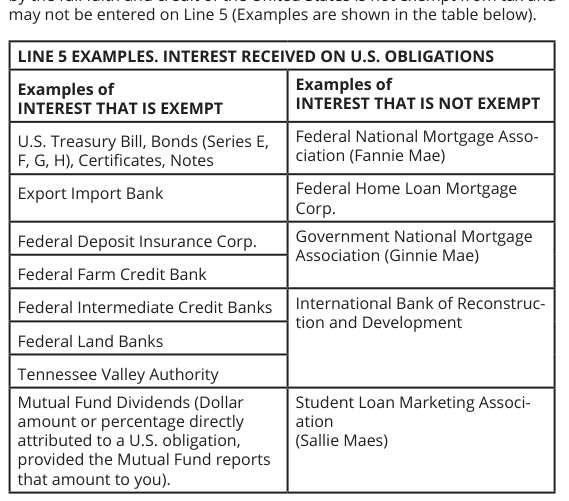
Text version of this table
| LINE 5 EXAMPLES. INTEREST RECEIVED ON U.S. OBLIGATIONS | |
| Examples of INTEREST THAT IS EXEMPT | Examples of INTEREST THAT IS NOT EXEMPT |
| U.S. Treasury Bill, Bonds (Series E, F, G, H), Certificates, Notes | Federal National Mortgage Asso ciation (Fannie Mae) |
| Export Import Bank | Federal Home Loan Mortgage Corp. |
| Federal Deposit Insurance Corp. | Government National Mortgage Association (Ginnie Mae) |
| Federal Farm Credit Bank | |
| Federal Intermediate Credit Banks | International Bank of Reconstruc tion and Development |
| Federal Land Banks | |
| Tennessee Valley Authority | |
| Mutual Fund Dividends (Dollar amount or percentage directly attributed to a U.S. obligation, provided the Mutual Fund reports that amount to you). | Student Loan Marketing Associ ation (Sallie Maes) |
# LINE 1 WORKSHEET
# Federal/Pro forma Spouse Yourself
- 1.
- 2.
- 3.
- taxes
- 4.
- 5.
- 6.
- 8.
- 9.
- 10.
- 11.
- 12.
- 13.
- 14.
- 15.
- 16.
- 17.
# Line 6 Pension Exclusion
NOTE: Each taxpayer may receive ONLY ONE pension exclusion, even if he or she is receiving more than one Amounts received as pensions from employers (including pensions of a pension or other retirement distribution. Spouses who each deceased taxpayer) may qualify for an exclusion from Delaware taxable income, subject to the limitations described below. receive pensions are entitled to one exclusion each.
Disability pension income paid by your employer is reported as wages
An early distribution from an IRA or pension fund for emergency on the federal return, until you reach the minimum retirement age. reasons or following a separation from employment does not qualify Minimum retirement age generally is the age at which you can first for the pension exclusion. If the distribution code listed in Box 7 of receive a pension or annuity if you are not disabled. Therefore, disability your 1099 R is a 1 (one), or if you were assessed an early withdrawal pension income would not qualify for the pension exclusion. penalty on federal 1040, Schedule 2, Line 8 for the distribution, then that distribution DOES NOT qualify for the pension exclusion.
Pension Exclusion Example: The primary taxpayer received $10,000 in pension income. The secondary taxpayer received no pension income.
# Pension Exclusion for Individuals Under 60
The taxpayers had joint bank accounts and mutual fund accounts. They earned $5,000 in interest from the bank, $1,000 in dividends and $3,000 in IF YOU WERE UNDER 60 on December 31, 2025 and retired from the capital gains. The income from these joint accounts would be split equally United States military and received pension income during the year, between the two taxpayers. your exclusion equals $12,500 or the amount of your pension, whichever is less. Please check the box indicating your pension is from the United States military.
Both taxpayers, in this example, are over 60 years old. The primary taxpayer has $14,500 of eligible retirement income (10,000+ 2,500+500+1,500=14,500), so the pension exclusion for the primary IF YOU WERE UNDER 60 on December 31, 2025, and you receive a nontaxpayer is $12,500, the maximum exclusion. The eligible retirement military pension, your exclusion equals $2,000 or the amount of your pension, whichever is less. income of the secondary taxpayer is $4,500 (2,500+500+1,500= 4,500), so the secondary taxpayer is entitled to a pension exclusion of $4,500. The secondary taxpayer cannot include in the pension exclusion calculation IF YOU WERE 60 OR OVER on December 31, 2025, your exclusion is determined as follows:
- Amount of pension …
Amount of "eligible retirement income"
2.
(See definition below) …
- Total (add lines 1 and 2) …
Enter Line 3 or $12,500, whichever is less
- here and on Line 6 … the amount by which the primary taxpayer exceeded the $12,500 maximum exclusion. When filing a joint return, the combined exclusion for the primary and secondary taxpayer would be $17,000 (12,500+4,500).
$
Please remember to enclose the 1099R forms and other supporting
$ schedules to support your pension exclusion.
$
Delaware State Tax Refund, Fiduciary Adjustment, Work
# Line 7
Opportunity Tax Credit, Delaware NOL Carryovers
$
Delaware State Tax Refund
Eligible retirement income includes dividends, capital gains net If some or all of your Delaware state tax refund was included in federal of capital losses, interest, net rental income from real property and adjusted gross income, include the amount on line 7 to reduce your qualified retirement plans (IRC Sec. 4974), such as IRA, 401(k), Keogh Delaware AGI. plans, and government deferred compensation plans (IRC Sec. 457).
Fiduciary Adjustment
Net subtractions from fiduciary adjustments derived from income received from an estate or trust, as shown on your federal Form K-1, Beneficiary's Share of Income and Deductions, should be included on Line 7.
Work Opportunity Tax Credit
The law allows a deduction for the portion of wages paid but disallowed as a deduction for federal tax purposes by reason of claiming the work opportunity credit on the federal return. That portion of the deduction for wages, which is disallowed for federal purposes, should be entered on Line 7. In order to claim this modification, you must attach federal Form 5884.
Delaware Net Operating Loss Carryovers
Taxpayers who were prevented in previous years from carrying back federal net operating losses to their Delaware returns (because of Delaware's $30,000 limit on net operating loss carrybacks) are permitted to carry these additional losses forward on their Delaware return in years following the loss year.
Taxable Social Security/RR Retirement Benefits/Higher
# Line 8a
Education Exclusion/Certain Lump Sum Distributions
Social Security/Railroad Retirement Benefits
Social Security and Railroad Retirement benefits are not taxable in Delaware and, therefore, should not be included in taxable income. Enter on Line 8a the total of any taxable payments included on Line 1.
Higher Education
Distributions received from qualified retirement plans (IRC Sec. 4974, including IRAs), deferred arrangements (such as 401(k) plans) and government deferred compensation plans (IRC Sec. 457) may be excluded from Delaware adjusted gross income to the extent they are used in the same tax year to pay for books, tuition or fees at an institution of higher education attended by the taxpayer or by his or her dependents who have NOT attained the age of 26 by December 31, 2025, as long as such amounts have been included in federal adjusted gross income. Please include a copy of all 1098T forms and proof of payment(s) with your return to support your deduction.
Certain Lump Sum Distributions
Enter on Line 8a the amount, if any, of lump sum distributions included in federal adjusted gross income for which you used Form PIT-STC to calculate the tax on Line 24.
529 Contribution to Delaware-sponsored Tuition
# Line 8b
Program and ABLE Program
529 Contribution to Delaware-sponsored Tuition Program
Contributions made to a Delaware-sponsored tuition program may be excluded from Delaware adjusted gross income up to a maximum. For a single, married filing separately combined, married filing separately, or head of household filer whose individual federal adjusted gross income is less than $100,000 the maximum exclusion is $1,000. For married filing joint filers whose federal adjusted gross income is less than $200,000 the maximum exclusion is $2,000. Contributions to an account in a Delawaresponsored tuition program for expenses used for tuition in connection with enrollment or attendance at an elementary or secondary public, private, or religious school are not deductible. Please mark the box indicating your deduction is related to a 529 Contribution to a Delawaresponsored tuition program.
ABLE Program Contributions
Contributions made to a qualified ABLE program (IRC Sec. 529A(b)) up to a maximum of $5,000 for individual filers and $10,000 for joint filers may be excluded from Delaware adjusted gross income. Please mark the box indicating your deduction is related to an ABLE program.
Line 11 Persons 60 or Over or Disabled
The law provides for exclusions from gross income to persons meeting certain qualifications. Please refer to the Line 11 worksheet.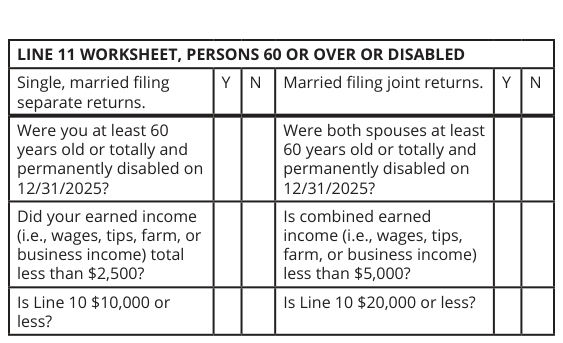
Text version of this table
LINE 11 WORKSHEET, PERSONS 60 OR OVER OR DISABLED Single, married filing separate returns. Y N Married filing joint returns. Y N Were you at least 60 years old or totally and permanently disabled on 12/31/2025? Were both spouses at least 60 years old or totally and permanently disabled on 12/31/2025? Did your earned income (i.e., wages, tips, farm, or business income) total less than $2,500? Is combined earned income (i.e., wages, tips, farm, or business income) less than $5,000? Is Line 10 $10,000 or less? Is Line 10 $20,000 or less?
If you answered YES to all, If you answered YES to all, enter $2,000 on Line 11. enter $4,000 on Line 11.
NOTE: If you are filing a joint return and only one spouse qualifies for this exclusion, you should consider filing separate returns (Filing Status 3 or 4).
# Itemized Deductions
If you elect to itemize deductions, complete Section C, Lines 13-19, to determine the amount of itemized deductions that you may claim on your Delaware return; otherwise, skip this section.
NOTE: If you claimed a standard deduction on your federal return, you may still elect to itemize your deductions on the Delaware return. In this case, complete and attach Form PIT-RSA.
NOTE: Do not enter motor vehicle title, realty transfer tax fees or transfer fees as other taxes. They do not qualify.
Total Itemized Deductions from Form PIT-RSA
# Line 13
(Must attach Form PIT-RSA)
Enter the total amount of itemized deductions shown on Form PIT-RSA.
All federal limitations apply to the calculation of Delaware itemized deductions. See Instructions on page 12.
If you are unable to specifically allocate deductions between spouses, prorate the deductions based on the ratio of each spouse's separate income to the total joint income. For example, if one spouse earns 60% of the household income, allocate 60% of the itemized deductions to that spouse and the other 40% of the itemized deductions to the spouse earning 40% of the household income. Enter the allocated itemized deductions on Line 17b in the respective columns.
Line 14 Foreign Taxes Paid
If you elected the Foreign Tax Credit on your federal return, you may add the amount of foreign taxes that were actually paid to your federal itemized deductions to calculate your allowable Delaware itemized deductions. Foreign taxes accrued, but not paid, are not allowed as an addition. On Line 14, enter the amount of foreign tax paid included on federal Form 1116, or if you were not required to file federal Form 1116, enter the amount of foreign tax paid.
Line 15 Charitable Mileage Deduction
If you used your automobile to perform a voluntary service for a charitable organization, you may increase your itemized deductions as follows:
Miles driven 1/1/2025-12/31/2025 x .26 = $
(Enter this amount on Line 15).
Active Labor Organization Dues Instructions
# Line 16
If you were an active member of a labor union during the tax year, you may add up to $500 or the actual amount paid, which ever is less, to stay in the union to your federal itemized deductions to calculate your allowable Delaware itemized deductions. Union dues amounts may not be added to federal itemized deductions if they already part of the federal itemized deduction total or to the extent they are used by the union to: cover benefits such as health insurance or retirement plans, or lobby or engage in political activities, or pay for legal costs or fines. Enter the eligible amount of union dues line 16 of your tax form.
Line 18 Form PIT-CRS Tax Credits
Enter the amount of the charitable contribution claimed in your federal itemized deductions for permanent gifts of land, or interest in land, to public agencies and qualified private nonprofit charitable organizations for which you claimed a tax credit for Form PIT-CRS on Line 12 of your Delaware return. Form BUS-LHR (formerly 1801AC), and/or Form BUS-NAC (formerly 2001AC) and the Division of Revenue approval letter must be attached to your return.
Line 19 Net Itemized Deduction
Calculate the amount of your net itemized deductions by subtracting Line 18 from Line 17.
# Page 2 of Form PIT-RES
Line 20a Standard Deduction
The law allows you to take a standard deduction in lieu of itemizing your deductions. If you elect to take the Delaware STANDARD DEDUCTION, be sure to check the box on Line 20a and enter the appropriate amount as listed below: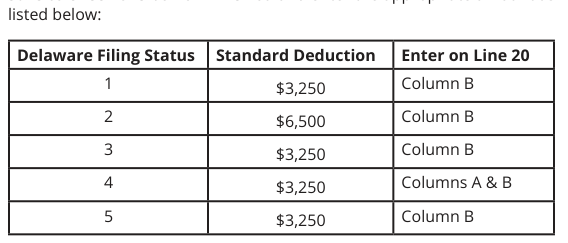
Text version of this table
Delaware Filing Status Standard Deduction Enter on Line 20 1 $3,250 Column B 2 $6,500 Column B 3 $3,250 Column B 4 $3,250 Columns A & B 5 $3,250 Column B
NOTE: If you claimed a standard deduction on your federal return, you may still elect to itemize your deductions on the Delaware return. In this case, complete and attached Delaware Form PIT-RSA.
NOTE: If one spouse elects the standard deduction, the other spouse must also take the standard deduction.
Line 20b Itemized Deductions
If you elect to itemize deductions: a. Check the box on Line 20b. b. Complete Section C, Lines 13 through 19 on the front of your Delaware return. c. Enter the amount from Line 19 on Line 20. d. Attach a copy of Form PIT-RSA.
Line 21 Additional Standard Deduction
The additional standard deduction is allowable only for those persons 65 years of age or older and/or blind, electing to use the Delaware standard deduction.
NOTE: If you elect to itemize your deductions, you do not qualify for the additional standard deduction even though you may be 65 years of age or older and/or blind. If you itemize deductions, do not check the "65 or over" box.
If you qualify for the additional standard deduction:
- Be sure you checked the box on Line 20a to indicate you are using the standard deduction.
- Check the appropriate box(es) relating to age and/or blindness on Line 21.
- Multiply the number of boxes checked on Line 21 by $2,500 and determine the total (a maximum of $5,000 per individual).
- If you are filing a combined separate return, enter the amount pertaining to each spouse (boxes checked x $2,500) in the spouses' respective columns ($5,000 per spouse age 65 or over and blind;
$2,500 per spouse age 65 and over or blind).
- All other filing statuses should enter the total for both individuals in Column B.
# Section D - Calculations
Line 24 Tax Liability From Tax Rate Table/Schedule
If Line 23 is less than $60,000, use the tax table to compute your tax liability. If line 23 is $60,000 or greater, use the tax schedule at the end of the tax table to compute your tax liability. Enter your tax liability on Line 24.
# Line 25 Lump Sum Distribution
A qualified lump sum distribution is the payment of the entire balance from a qualified plan (for example, pension, profit-sharing or stock bonus plans). The payments must all be received in the same tax year.
This form applies, in the case of someone who is not self-employed, only when the distribution (defined above) was made:
- Due to the participant's death;
- Due to the participant's separation from employment; or
- After the participant had attained age 59½.
In the case of a self-employed person, this form applies only when the distribution (defined above) was made:
- Due to the participant's death;
- After the participant had attained age 59 ½; or
- The participant was previously disabled.
An early distribution from an IRA or pension fund for emergency reasons or following a separation from employment does not qualify for the pension exclusion. If the distribution code listed in Box 7 of your 1099 R is a 1 (one), or if you were assessed an early withdrawal penalty on federal 1040, Schedule 2, Line 6 for the distribution, then that distribution DOES NOT qualify for the pension exclusion. Please attach the appropriate forms with your return.
# Line 27a Personal Credits
Enter the total number of dependents listed on your federal return, multiply by $110 and enter the total on Line 27a. If you are married and filing a combined separate return (Filing Status 4), split the total between Columns A and B in increments of $110. You are still eligible for this credit even though you do not recognize personal exemptions on your federal return.
NOTE: You are not entitled to a Delaware Personal Credit if you are listed as a dependent on another individual's Federal return.
Enter "0" in the space provided on Line 27a. Please mark the box on the front of the return indicating you are a dependent on another's return.
If you are married and filing separate returns (Filing Status 3), allocate dependents to each return and multiply by $110, entering the total for each return in Column B. Please see example below. All other filing statuses place the total in Column B.
If you were not required to file a federal return, enter $110 for each spouse reporting income plus $110 for each person who could have been listed as a dependent had you been required to file a federal return. Allocate the total personal credits for your filing status as described in the paragraph above.
Example: If you filed your federal return as married filing jointly and have no dependents, enter $220.
- $110 in each column if Filing Status 4
- $110 per return in Column B if Filing Status 3, or
- $220 in Column B if Filing Status 2.
Please ensure that the number of personal credits listed on the Delaware return does not exceed the number of dependents reflected on your federal return. This data will be verified with the IRS.
# Line 27b Additional Personal Credits
If you and/or your spouse were 60 years of age or over on December 31, 2025, check the appropriate box(es), multiply the number of boxes checked by $110, and enter the total on Line 27b.
If you are filing a combined separate return (Filing Status 4), enter $110 in the column(s) that correspond to the checked box(es).
# Line 28 Other State Tax Credit
If you are a resident of Delaware (or elect to be taxed as one) and pay income taxes to another state on income earned in the other state which is also included in your Delaware taxable income, the law allows you a tax credit against your Delaware income tax. Do not include city wage taxes or county taxes paid directly to the county. (See Worksheet below.) If you claim a credit for taxes paid to another state, you must attach a signed copy of the income tax return filed with the other state(s). In addition, your Delaware return information will be shared with the other state(s) for which you claimed the credit.
If you are claiming a credit for taxes paid to more than one state, you must complete Form PIT-RSS Schedule I and attach it to your resident return.
Example: You claim a credit for taxes paid to Pennsylvania and New Jersey on your Delaware return. On Form PIT-RSS Schedule I, enter the names of the other States and amount of credit claimed in HIGHEST to LOWEST credit amount order.
LINE 28 WORKSHEET : CREDIT FOR TAXES PAID TO ANOTHER STATE
# Column A Column B
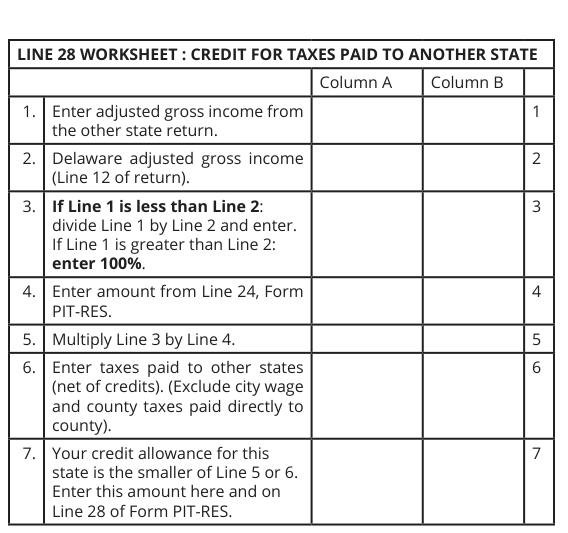
Text version of this table
LINE 28 WORKSHEET : CREDIT FOR TAXES PAID TO ANOTHER STATE Column A Column B 1. Enter adjusted gross income from the other state return. 1 2. Delaware adjusted gross income (Line 12 of return). 2 3. If Line 1 is less than Line 2: divide Line 1 by Line 2 and enter. If Line 1 is greater than Line 2: enter 100%. 3 4. Enter amount from Line 24, Form PIT-RES. 4 5. Multiply Line 3 by Line 4. 5 6. Enter taxes paid to other states (net of credits). (Exclude city wage and county taxes paid directly to county). 6 7. Your credit allowance for this state is the smaller of Line 5 or 6. Enter this amount here and on Line 28 of Form PIT-RES. 7
With regard to any credit claimed for taxes paid to another state, the credit is limited to the smallest of the following:
The Delaware tax liability; a. The tax liability due and paid, after the application of all credits (for example, tax forgiveness credit, earned income credit, poverty level credit), to the other state. The amount due and paid is not the amount on your W-2; or b. The amount computed by multiplying the Delaware tax by a fraction, the numerator of which is your adjusted gross income from sources in the other state and the denominator of which is your Delaware Adjusted Gross Income (Line 12).
NOTE: If you file using filing status 4 - married filing combined separate - enter the credit in the column for the person who actually worked or was taxed by the other state.
NOTE: Taxes paid to a political subdivision of a state cannot be claimed as a credit. The District of Columbia is classified as a "State" for the purpose of this credit and, therefore, taxes paid to the District of Columbia can be claimed as a credit on Line 12.
# Line 29 Volunteer Firefighter Credit
Enter on Line 29 the total of the following credit(s) to which you are entitled:
The law allows a credit of $1,000 against the income tax liability of Delaware residents who are active firefighters, or members of fire company, auxiliaries, or rescue squads. To qualify for the credit, you must be an active volunteer firefighter on call to fight fires on a regular basis, a member of a fire company auxiliary or active member of an organized rescue squad in a Delaware volunteer company. Active status of the members is verified annually by the Division of Revenue with the volunteer fire companies.
You must enter the Fire Company number where you volunteer on Line 29 Spouse Column A and/or Self Column B, to qualify for the credit. Enter the amount of this credit on Line 29, Column A and/or Column B. Only one $1,000 credit may be claimed by each spouse. If you file using Filing
Status 2 (Joint), Do not enter $1,000 in Column A; enter in Column B.
# Line 30 Other Non-Refundable Credits Form PIT-CRS Credits
Taxpayers claiming any of the following credits must complete and attach Form PIT-CRS to their return (Form PIT-CRS is available from the Delaware Division of Revenue or revenue.delaware.gov).
Economic Development Credits are available to certain businesses engaged in a qualified business activity who meet the minimum capital investment and new hiring requirements. Only taxpayers approved by the Division of Revenue may claim these credits.
Green Industry Credits are available for reducing waste release, use of recycled materials, processing of waste materials and collection and distribution of recycled materials. Only those taxpayers whose eligibility is certified by the Delaware Department of Natural Resources and Environmental Control and the Delaware Division of Small Business, Development and Tourism may claim these credits.
Brownfield Tax Credits are available for promoting the rehabilitation of contaminated industrial and commercial sites. Only those taxpayers whose eligibility is certified by the Delaware Department of Natural Resources and Environmental Control may claim these credits.
Research and Development Tax Credit. A business or individual may take an income tax credit for Delaware qualified research and development expenses. A Division of Revenue approval letter must be attached to your Delaware return.
Land and Historic Resource Tax Credit. A business or individual may take an income tax credit for permanent gifts of land or an interest in land to public agencies and qualified private non-profit charitable organizations.
A Division of Revenue approval letter must be attached to your Delaware return.
Historic Preservation Tax Credits are available to Resident Curators and to those persons who work to promote community revitalization and restoration, and the rehabilitation of historic properties. Only those taxpayers whose eligibility is certified by the Delaware State Historic Preservation Office may claim these credits.
Neighborhood Assistance Tax Credit. Certain taxpayers are eligible for an income tax credit for contributing to a neighborhood organization, community development corporation, or community-based development organization; or for providing neighborhood assistance, job training, or education to an impoverished area or for low and moderate-income families. Only those taxpayers whose eligibility is certified by the Delaware State Housing Authority may claim these credits.
Automatic External Defibrillators Tax Credit. Any business that places an automatic external Defibrillator in service at a business location in the State is entitled to a credit equal to $100 per unit.
# Line 31 Child Care Credit
A resident individual is allowed a credit against their individual tax in the amount of fifty percent (50%) of the child and dependent care credit allowable for federal income tax purposes. Use the worksheet provided below to compute the amount of the deduction. The Child Care Credit should not be confused with the Child Tax Credit, which is not an allowable credit on the Delaware return.
In the case of spouses who file a joint federal return, but who elect to file separate or combined separate returns for Delaware, the credit may only be applied against the tax imposed on the spouse with the lower taxable income reported on Line 23.
NOTE: You must attach a copy of federal Form 2441 to your Delaware return.
LINE 31 WORKSHEET - CHILD CARE CREDIT
Enter the total amount from Line 11 of federal Form 2441 (federal form must be attached) and multiply by 50% (.50). x .50 = $ Enter result on Line 31 of your return.
Do not enter an amount in excess of $3,000.
Line 32 Total Non-Refundable Credits
The total of all non-refundable credits (Lines 27a through 31) is limited to the amount of your Delaware tax liability on Line 26.
# Line 34 Earned Income Tax Credit
A Resident individual is allowed a refundable credit of 4.5% of the federal earned income credit or a nonrefundable credit of 20% of the federal earned income credit against his or her individual tax. Complete DE Schedule II (PIT-RSS) to determine the amount of the credit.
In the case of spouses who file a joint federal return, but who elect to file separate or combined separate returns for Delaware, the credit may only be applied against the tax imposed on the spouse with the higher taxable income reported on Line 23.
Check Refundable check box if Refundable EITC amount is entered on PIT-RSS Form Line 16 or check Non-Refundable if Non-Refundable EITC amount is entered on Form PIT-RSS Line 17.
DO NOT complete PIT-RSS Schedule II if you have not taken an Earned Income Credit on your federal return.
PIT-RSS: For each child for whom you claimed the Earned Income Credit on your federal return, provide the following information:
Line 7a: Enter the first name of each child.
Line 7b: Enter the last name of each child.
Line 8: Enter the taxpayer identification number (ID) of each child.
Line 9: Enter the date of birth of each child.
Line 10: Please indicate by checking the appropriate box(es) if the child was under age 24 at the end of 2025, a student, or younger than you (or your spouse, if filing jointly).
Line 11: Check the appropriate box(es) relating to disability.
Line 12: Enter the amount from Form PIT-RES Line 33. If you use filing status 4, combined separate return, enter the PIT-RES Line 33 amount from the same column with the higher taxable income amount from PIT-RES Line 33.
Line 13: Enter the Federal Earned Income Credit from federal Form 1040 or 1040-SR, Line 28.
Line 14: Multiply Line 13 x 0.045
# Line 15: Multiply Line 13 x 0.20
Line 16: REFUNDABLE EARNED INCOME TAX CREDIT - If Line 14 is greater than or equal to Line 12, enter amount from Line 14 here and also on Line 34 of Form PIT-RES and check the Refundable box on Line 34 of Form PIT-RES.
Line 17: NONREFUNDABLE EARNED INCOME TAX CREDIT - If Line 14 is less than Line 12, compare Line 12 to Line 15 and enter the smaller amount here and also on Line 34 of Form PIT-RES and check the Non-Refundable box on Line 34 of Form PIT-RES.
NOTE: The following forms must be attached to your Delaware return if you claim the Earned Income Tax Credit:
- DE Schedule II (Form PIT-RSS)
- Federal Form 1040, Pages 1 and 2
- Federal Form EIC
Failure to attach the above documentation may delay the processing of your return.
Line 35 Delaware Tax Withheld
Enter the Delaware income tax withheld as shown on your W-2 and/or 1099-R Forms in Column A and/or B. DO NOT INCLUDE CITY WAGE TAX
WITHHOLDING, S-CORPORATION PAYMENTS, OR REW-EST CAPITAL
GAINS TAX PAYMENTS. Be sure to include DE Schedule IV (Form PIT-
RSS).
# Line 36 Estimated Tax Payments and Payments with Extensions
Enter on Line 36, Column A and/or B, the total quarterly estimated tax payments for 2025 including any credit carryover from your 2024 return. In order to receive proper credit for fourth quarter estimated tax payments, they must be made by January 16, 2026. Also, enter the amount paid with Form PIT-EST on this line. DO NOT INCLUDE S CORPORATION
PAYMENTS.
If you file a combined separate return (Filing Status 4), you may allocate the estimated tax payments in any manner you wish. All other filing statuses must claim the estimated tax payments under the Taxpayer ID for which the payments were made.
Line 37 S Corporation Payments
Enter on Line 37, Column A and/or B the Delaware estimated tax payment made on your behalf by an S Corporation. Attach a copy of the Delaware
Form SCT-SSR reflecting the payment. Be sure to include DE Schedule
V (Form PIT-RSS).
# Line 38 Refundable Business Credits
Business Finder's Fee Tax Credit. This credit is available to encourage Delaware businesses to bring non-Delaware businesses into the state.
Only those taxpayers whose eligibility is certified by the Delaware Division of Small Business, Development and Tourism may claim this credit.
Organ Donation Tax Credit. A credit is available to incentivize resident taxpayers to donate organs or bone marrow for transplantation. The credit will cover all unreimbursed medical and other expenses related to donation up to a $10,000. Please submit a bank record or receipt for each covered expense along with written acknowledgement of the donation from the relevant medical organization which includes the details of the procedures completed and the date of the procedure.
New Economy Jobs Program Credit. A credit available to qualified employers pursuant to the New Economy Jobs Program whose purpose is to encourage the creation of high wage, knowledge-based jobs in this state. To apply for certification as a qualified employer, submit Form 2080DE (available from the Division of Revenue or at revenue.delaware. gov) with the Secretary of Finance with a copy to the Director of the Delaware Division of Small Business, Development and Tourism.
Research and Development Tax Credit. For credits granted on or after 1/1/2027. A business or individual may take an income tax credit for Delaware qualified research and development expenses. A Division of Revenue approval letter must be attached to your Delaware return.
Any taxpayer claiming refundable credits must complete Form PIT-CRS
(available at revenue.delaware.gov or from the Division of Revenue) and submit it with their Delaware return.
# Line 39 Real Estate Capital Gains Tax Payments Credit
Enter on Line 39, Column A and/or B, the total of all estimated income tax payments at the time of sale of Delaware real estate. If you file combined separate (Filing Status 4), you may allocate these payments in any manner.
All other filing statuses must claim these payments under the Taxpayer ID for which the payments were made.
NOTE: Please submit copies of all Forms REW-EST.
# PAGE 3 OF FORM PIT-RES
Line 40 Total Refundable Credits
Calculate your total refundable credits by adding lines 35 through 39.
If this is an amended return, please proceed to Line 48 on page 4 of Form PIT-RES.
Line 43 Contribution to Special Funds
You and/or your spouse may wish to contribute to any or all of the worthwhile funds listed on the last page of this booklet. You must complete DE Schedule III (PIT-RSS). Enter the amount of your donation on the line provided next to the designated fund(s) of your choice. Enter the total amount donated on Line 43. The minimum amount for a donation is $1.
If you are not due a refund and you wish to make a contribution, you may do so. Include the total amount of your donation with the balance due.
Line 44 Carryover to 2026 Estimated Taxes
If you are using Filing Status 1, 2, 3 or 5, and wish to apply a portion of your overpayment to your 2026 Estimated Taxes, enter on Line 44 the portion of your overpayment (Line 42) to be applied. If you use Filing Status 4, enter on Line 44 the portion of your net overpayment (Line 42, Column A and B, less Line 41, Column A and B) to be applied. NOTE: Any amount entered on Line 44 will reduce the amount of overpayment to be refunded to you.
Line 45 Penalties and Interest Due
You may compute the amount of penalties and interest due or you may leave Line 45 blank and the Division of Revenue will calculate the amount for you and send you a bill. Penalties may be assessed for filing a balance due return late, failure to pay the tax liability due, fraud, negligence, and failure to pay estimated taxes (See Page 4 for a description of penalties and interest).
If you have calculated the underpayment of estimated taxes using
Form PIT-UND and an estimated penalty is due OR if you completed
Part 3, check the "Form PIT-UND Attached" box at the top of your return and submit pages 1 and 2 of the form with your return. Do not submit computer worksheets in lieu of Form PIT-UND. Checking the box without including a Form PIT-UND will delay the processing of your return. If you submit a PIT-UND, it will not be processed unless the box is checked.
Line 46 Net Balance Due
If you are using Filing Status 1, 2, 3 or 5, enter the amount of the net balance due (Line 41 plus Lines 43 and 45) and pay in full. If you are married using Filing Status 4, enter the total balance due (Line 41, Columns A and B, less Line 42, Columns A and B, plus Lines 43 and 45) and pay in full. Make check payable to: DE Division of Revenue.
Please visit our website at www.revenue.delaware.gov, or call to discuss payment difficulties. Our representatives are available 8:00AM to 4:15PM, Monday through Friday to explain the payment options available.
- New Castle County: 1-302-577-8208
- Kent and Sussex County: 1-800-292-7826
- Outside Delaware: 1-302-577-8208
Line 47 Net Refund
If you are using Filing Status 1, 2, 3 or 5, enter the amount of the total refund (Line 42 less amounts on Lines 43, 44, and 45) to be refunded to you. If you are using Filing Status 4, enter the total net refund (Line 42, Column A and B, less Line 41, Column A and B, less amounts on Line 43 and/or Line 44 and Line 45) to be refunded to you. If you do not have a balance due or a refund due, enter "0" on Line 47.
Section E - Direct Deposit Information
# Direct Deposit or Refund
Complete Section E if you want us to directly deposit the amount shown on Line 47, Form PIT-RES into your bank account. Refunds may not be direct deposited to a bank account outside the U.S.
Why Use Direct Deposit?
- You get your refund fast - even faster if you file online.
- Payment is more secure - there is no check to get lost.
- More convenient. No trip to the bank to deposit your check.
Check with your financial institution to make sure your deposit will be accepted and to obtain the correct routing and account numbers.
# Delaware College Investment Plan (529 Plan)
Individuals can deposit their State income tax refund directly into a 529 Plan account. To obtain information on Delaware's Plan or how to contribute go to savingforcollege.com and select the State of Delaware in the US map area. For routing and account number information, please contact the financial institution that administers your 529 Plan.
# Routing Number
The routing number must be nine digits. The first two digits must be 01 through 12 or 21 through 32. Otherwise, the direct deposit will be rejected and a check will be issued instead. On the sample check on page 11, the routing number is 031100000.
Your check may state that it is payable through a bank different from the financial institution at which you have your checking account. If so, do not use the routing number on that check. Instead, contact your financial institution for the correct routing number to enter on this line.
# Type
Please check the type of account: checking or savings.
# Bank Account Number
The account number can be up to 17 characters (both numbers and letters). Include hyphens but omit spaces and special symbols. Enter the number from left to right and leave any unused boxes blank. On the sample check, the account number is 12340818. Be sure not to include the check number.
In order to comply with new federal banking rules, you must declare whether your refund will go to a bank account outside the United States. If the answer is yes, do not enter your account information. We will instead mail your refund by check.
# Sample Check
NOTE: Some financial institutions will not deposit joint refunds into an individual account. The Delaware Division of Revenue is not responsible if a financial institution refuses a direct deposit.
# Deceased Taxpayers
When filing a return for a decedent, write DECD after the decedent's first name on Page 1. If there is a surviving spouse, the surviving spouse information should be entered FIRST under "Your Taxpayer ID and Your Last Name." The deceased person's data should be entered under a "Spouse's Taxpayer ID and Spouse's Last Name".
Decedent example: John and Mary Jones have been married for 30 years and file jointly (Filing Status 2). John Jones passed away on June 30, 2025.
Mary, as the surviving spouse, will enter her data in "Your Taxpayer ID, Your Last Name, First Name and Middle Initial." The data for John, the decedent, will be entered in "Spouse's Taxpayer ID, Spouse's Last Name and Spouse's First Name." DECD will also be written after "John" under "Spouse's First Name".
# Signature
Please review your tax return before you sign it. Complete the return to the bottom of Page 2 to ensure you receive all credits and exclusions. PIT-CFR must be completed if the check of the deceased taxpayer is to be issued to the estate.
# Paid Preparer
Please complete all the fields in the Paid Preparer section. You must also sign the return.
# PIT-RSA Instructions
For additional information regarding deductible expenses, please see the instructions for the federal Schedule A.
# Medical and Dental Expenses
You are permitted to deduct medical and dental expenses paid, after reimbursement, to the extent that they exceed 10% of your adjusted gross income. To calculate the amount that may be deducted, please follow the line-by-line instructions.
Line 1: Enter the total of your medical and dental expenses, after
- you reduce these expenses by any payments from insurance, other resources, or the amount of credit claimed as a organ or marrow donation credit.
Line 2: Enter the amount from federal Form 1040, Line 11.
•
Line 3: Multiply Line 2 by 7.5% (0.075)
•
Line 4: Subtract line 3 from Line 1. If line 3 is greater than Line 1,
- enter zero.
# State and Local Taxes
You are entitled to include certain taxes paid as an itemized deduction for Delaware purposes. You may include either state and local income taxes or sales taxes, but not both. You may also deduct real estate taxes and personal property taxes paid. The amount you can deduct for state and local taxes paid is limited. A cap is currently set in federal law at $40,000 for single, head of household, or joint filers, and $20,000 for married individuals using separate or combined separate filings. Married individuals using separate or combined separate filings may allocate real estate taxes paid between their returns as they deem appropriate. The Tax Cuts and Jobs Act limited itemized deductions for taxes paid. The limitation does not apply to taxes paid or accrued in carrying on a trade or business or activity engaged in the production of income, which should not be included on (PIT-RSA).
Line 5a: Enter any non-Delaware state or local income taxes that are not otherwise claimed as a credit on Form PIT-RES.
DO NOT INCLUDE any Delaware tax paid, whether or not claimed as a credit on Form PIT-RES.
DO NOT INCLUDE the taxes paid that generated the credit you receive for taxes paid to another state on Line 28 of the Form PIT-RES.
Line 5b: Enter any state or local sales taxes paid.
You may deduct income taxes or sales taxes, but not both. Do not enter anything on Line 5b if you have claimed income taxes on Line 5a.
Line 5c: Enter any state and local real estate taxes paid.
Line 5d: Enter any state and local personal property taxes paid.
Line 5e: Add Lines 5a through 5d or enter amount from worksheet.
Line 5f: If line form 1040 or 1040 SR line 11b is equal to or less than $500,000 ($250,000 if married filing separately) and you did not complete federal Form 2555, federal Form 4563, or excluded income from Puerto Rico enter the smaller of Line 5e or $40,000 ($20,000 if married filing a separate return). If line 1 is more than $500,000 ($250,000 if married filing separately) or if you completed federal Form 2555, federal Form 4563, or excluded income from Puerto Rico, complete the State and Local Tax Deduction Worksheet.
Examples below are for filers with federal adjusted gross income of less than $500,000 ($250,000 if married filing separately) or others please see instructions of state and local deduction worksheet Example 1: If you paid $40,000 of real property taxes, $5,000 of local income taxes, and $25,000 of state income taxes from other states that did not result in a credit on line 28, then your deduction on line 5f would be limited to $40,000.
Example 2: If you paid $14,000 of real property taxes, $2,000 of local income taxes, and $10,000 of state income taxes withheld from other states that did not result in a credit on line 28, that were included in line 35 of Form PIT-RES, your deduction on line 5f would be $16,000.
Example 3: If you paid $2,000 of real property taxes, $1,000 of local income taxes, and $5,000 of Pennsylvania state income taxes for which you did not claim a credit on Line 28 of the Form PIT-RES, your deduction on Line 5f would be $8,000.
# Interest You Paid
You are entitled to deduct certain interest paid, subject to the limitations imposed pursuant to federal law.
Line 8a: Enter home mortgage interest and points reported on a federal Form 1098.
Line 8b: Enter home mortgage interest NOT reported on a federal Form 1098.
Line 8c: Enter points not reported on a Form 1098.
Line 8d: This field is Reserved for Future Use.
Line 8e: Add Lines 8a through 8c.
Line 9: Enter investment interest paid. Attach federal Form 4952.
# Gifts to Charity
You may deduct certain gifts to charity, subject to the same limitations imposed by federal law.
Line 11: Enter gifts by cash or check.
Line 12: Enter gifts by other than cash or check. If the value of any gift exceeded $250, please see the instructions for the federal Schedule A.
You must attach federal Form 8283, if you made non-cash contributions in excess of $500.
Line 13: Enter any carryover from a prior year.
Line 14: Add Lines 11 through Line 13.
# Casualty and Theft Losses
You may deduct certain casualty and theft losses, as permitted under federal law. Enter the amount of these losses on Line 15.
# Other Itemized Deductions
You may deduct certain other itemized deductions, as permitted under federal law. Enter the amount of these deductions on Line 16, with an explanation. See the Instructions for federal Schedule A for more information.
# Total Itemized Deductions
Line 17: Add the amounts on Lines 4, 7, 10, 14, 15, and 16. If using filing status 1, 2, 3 or 5, enter this amount on Line 17a. If you are filing status 4, Married Filing Combined Separate, allocate the itemized deductions between the spouses and enter the amount attributable to each spouse on Line 17b.
Enter these amounts on Line 13 of the Form PIT-RES.
Line 18: Check this box if you elect to itemize even though the standard deduction would be greater than your itemized deductions.
# Returns Only
Use Form PIT-RES to correct Form PIT-RES and check the Amended Return checkbox.
# When And Where To File:
File Form PIT-RES Amended only after you have filed your original return.
Generally, Form PIT-RES Amended must be filed within three (3) years after the date the original return was due, or within two (2) years after the date the tax was paid, whichever is later.
A Form PIT-RES Amended based on a net operating loss carry back must be filed within three (3) years after the date the return creating the net operating loss carry back is due. Therefore, even though the return the operating loss is being carried back to is out of statute, if the return creating the operating loss is still in statute, the carry back year becomes
"in statute".
Form PIT-RES Amended should be mailed to:
Delaware Division of Revenue
P.O. Box 8711
Wilmington, Delaware 19899-8711
For Line 57 Net Balance Due mail to:
Delaware Division of Revenue
P.O. Box 508, Wilmington, DE 19899-0508
For Line 58 Net Refund mail to:
Delaware Division of Revenue
P.O. Box 8710
# Who Must File:
If your federal return is changed for any reason, it may affect your Delaware State income tax liability. This would include changes made as a result of an examination of your federal return by the IRS. You are required to report to the Division of Revenue such change within ninety (90) days after the final determination of such change and indicate your agreement with such determination or the grounds of your disagreement. Attach a copy of any federal adjustments to your Delaware amended return.
# What To File:
- Residents file Form PIT-RES, Resident Amended Delaware Personal Income Tax Return.
- Non-Residents file Form PIT-NON, Non-Resident Amended Delaware Personal Income Tax Return.
- Part-Year Residents may choose to file Form PIT-RES or Form PIT-NON.
# Specific Instructions
You can use form PIT-RES if the return you are amending is for a fiscal year and the ending date of the fiscal year is 2025 or later starting on Page 1.
NAME, ADDRESS AND TAXPAYER ID:
If amending a joint or married filing combined separate return, list your names and taxpayer IDs in the same order as shown on the original return. Ensure the taxpayer IDs on your amended return match those on your original return.
If amending to change from a married or filing separate to a joint or married filing combined separate return, and your spouse did not file an original return, enter your name and taxpayer ID first.
FILING STATUS:
Check the appropriate filing status for your amended return. If amending to change your filing status, check your new filing status.
# Line By Line Instruction
Check "Amended Return" checkbox on Page 1 of PIT-RES.
Page 4 Instructions For an Amended PIT-RES only.
Complete the return starting on Line 1 through Line 40, using corrected information, then go to Line 48.
CORRECTING WAGES - If you are correcting wages or other employee compensation, you must attach a copy of all additional or corrected W-2 forms not filed with your original return.
Line 49 Amount Paid on Original Return
Please enter the amount paid with your return as originally filed. This will be no more than the amount in Line 41 of that return. Please include all prior payments from any previously filed return.
Line 51 Refund Received
Enter the amount, if any, refunded from your original return and/or any previously amended return. Use actual amount(s) received.
Estimated Tax Carryover and/or Special Funds
# Line 52
Contributions
Enter the total amount, if any applied to your estimated tax account and/ or contributed to the Special Funds on your original return and/or any previous amended return(s).
Line 54 Balance Due
If Line 33 is greater than Line 53, subtract Line 53 from Line 33.
NOTE: FOR COMBINED SEPARATE RETURNS, ENTER THE AMOUNT, IF
ANY, IN COLUMN A ON LINE 54 AND THE AMOUNT, IF ANY IN COLUMN
B ON LINE 54.
Line 55 Overpayment
If Line 53 is greater than Line 33, subtract Line 33 from Line 53.
NOTE: FOR COMBINED SEPARATE RETURNS, ENTER THE AMOUNT, IF
ANY, IN COLUMN A ON LINE 55 AND THEAMOUNT, IF ANY, IN COLUMN
B ON LINE 55.
Line 56 Carryover to 2026 Estimated Taxes
Enter the portion of your overpayment to be applied to your next year's estimated tax account. DO NOT claim a carryover if the carryover year's return has already been processed. Your overpayment will be refunded to you.
Line 57 Penalties and Interest Due
You may choose to compute the amount of penalties and interest due or you may leave Line 57 blank and the Division of Revenue will calculate the amount for you and send you a bill. If you have a balance due on Line 54, calculate the interest due at a rate of one-half percent (1/2%) per month from the due date of the original return until the time the tax is paid. If you have calculated the Underpayment of Estimated taxes using Form PIT-UND, please check the "Form PIT-UND Attached" box and include the amount here.
Line 58 Net Balance Due
If you use filing status 1, 2, 3 or 5, enter the amount from Line 54 plus amounts from Lines 56 and 57 on Line 58. If you use filing status 4, enter the total balance due, if any (Line 54, Column A and B, less Line 55 Column A and B, plus Lines 56 and 57).
Line 59 Net Refund Due
If you use filing status 1, 2, 3, or 5, enter the amount from Line 55 minus amounts from Lines 56 and 57 on Line 59. If you use filing status 4, enter the total overpayment, if any (Line 55, Column A and B, less Line 54 Column A and B, minus Lines 56 and 57).
# (Resident Schedules)
DE Schedule I - Credit for Income Taxes Paid to
# Another State
You are permitted to receive credit for income taxes paid to more than one state. Column A is reserved for filing status 4 (Reconcile your federal totals to the appropriate individual). Column B is reserved for Taxpayers using filing statuses 1, 2, 3, or 5.
Lines 1 - 5: Enter the 2-character names of the other State(s) and the amount of credit claimed in HIGHEST to LOWEST credit amount order.
Line 6: Enter Total.
# DE Schedule II - Earned Income Tax Credit (EITC)
DO NOT complete PIT-RSS Schedule II if you have not taken an Earned Income Credit on your federal return.
For each child for whom you claimed the Earned Income Credit on your federal return, provide the following information:
Line 7a: Enter the first name of each child.
Line 7b: Enter the last name of each child.
Line 8: Enter the taxpayer identification number (ID) of each child.
Line 9: Enter the date of birth of each child.
Line 10: Please indicate by checking the appropriate box(es) if the child was under age 24 at the end of 2025, a student, or younger than you (or your spouse, if filing jointly).
Line 11: Check the appropriate box(es) relating to disability.
Line 12: Enter the amount from Form PIT-RES Line 33. If you use filing status 4, combined separate return, enter the PIT-RES Line 33 amount from the same column with the higher taxable income amount from PIT-RES Line 33.
Line 13: Enter the Federal Earned Income Credit from federal Form or IRS form 1040 or 1040-SR, Line 27.
Line 14: Multiply Line 13 x 0.045
# Line 15: Multiply Line 13 x 0.20
Line 16: REFUNDABLE EARNED INCOME TAX CREDIT - If Line 14 is greater than or equal to Line 12, enter amount from Line 14 here and on Line 34 of Form PIT-RES and check the refundable box on Line 34 of Form PIT-RES.
Line 17: NONREFUNDABLE EARNED INCOME TAX CREDIT - If Line 14 is less than Line 12, compare Line 12 to Line 15 and enter the smaller amount here and also on Line 34 of Form PIT-RES and check the Non-Refundable box on Line 34 of Form PIT-RES.
# DE Schedule III - Contributions to Special Funds
You and/or your spouse may wish to contribute to any or all the worthwhile funds listed on this schedule.
Line 18: Enter the amount of your donation on the line provided next to each designated fund(s) of your choice. The minimum amount for a donation is $1.
Line 19: Enter the total Contribution amount and on Line 43 of Form PIT-RES.
# DE Schedule IV - W-2 and 1099-R Information
Complete this schedule listing all of your, and if applicable, spouse's forms W-2 and 1099-R showing Delaware Income Tax withheld. Forms W-2 and 1099-R showing income tax withheld must still be attached to the front of your return. Use a separate line on the schedule for each W-2 and 1099-R attached to the return.
Type: Select the appropriate checkbox to identify the type: W-2 or 1099-R
# Employer Name: Enter Name of employer
Employer Taxpayer ID: Enter employer's taxpayer id
State: Enter employer's state
State Wages: Enter total wages received
State Withholding: Enter amount of withholdings in box 17 on W-2 or box 14 on 1099-R Taxpayer or Spouse: Select the appropriate checkbox to identify the W-2 or 1099-R as yours or your spouse's
# DE Schedule V - Delaware S Corporation Payments
Complete this schedule by listing all estimated Delaware tax payments made by an S Corporation on behalf of you or your spouse. Use a separate line for each S Corporation.
NOTE: If any of the schedules above are completed, Form PIT-RSS must be sent in with your Delaware return.
# SPECIAL FUNDS
Delaware's Nongame Wildlife, Endangered Species and Natural • Areas Preservation Fund: Helping Delaware face the challenges of managing and protecting native plants and animals, restoring wildlife habitat, and maintaining the natural beauty of the state. Please give a tax-deductible "Wild Gift" on Line 18A, Form PIT-RSS, Resident Schedule III.
Beau Biden Foundation: The foundation believes that child abuse
- can be prevented through effectively educating adults and children, developing the next generation of child welfare professionals, and strengthening child protection laws around the country. Please help by making a donation on line 18B, Form PIT-RSS, Resident Schedule III.
Please visit our website at www.beaubidenfoundation.org.
Emergency Housing Assistance Fund: The homeless population
- in Delaware continues to increase. Crisis situations such as unemployment, family conflicts, displacement, evictions, fire, or utility failures force people to seek emergency housing. You can help by making a contribution on Line 18C, Form PIT-RSS, Resident Schedule III.
Delaware Breast Cancer Education: Providing outreach, education
- and support services throughout Delaware and the surrounding communities to encourage the early detection and treatment of breast cancer. Your contribution on Line 18D, Form PIT-RSS, Resident Schedule III, will help the nearly 750 women facing breast cancer in Delaware each year.
Organ and Tissue Donation Awareness Trust Fund: One organ
- and tissue donor can save or enhance the lives of 50 people. Make a contribution on Line 18E, Form PIT-RSS, Resident Schedule III, to help increase the number of organ and tissue donors in Delaware. Register as an organ and tissue donor at www.donatelife-de.org.
Delaware Diabetes Education Fund: Administered by the American • Diabetes Association (ADA), our mission is to prevent and cure diabetes, and to improve the lives of those affected by diabetes. For more information, please call 1-800-DIABETES or visit www.diabetes. org. Help 85,000 Delawareans with diabetes by making a contribution on Line 18F, Form PIT-RSS, Resident Schedule III.
Delaware Veterans Home Fund: Show your support by making a
- contribution on Line 18G, Form PIT-RSS, Resident Schedule III. Your tax contribution will assist the Delaware Commission of Veterans Affairs in maintaining a facility that provides much-needed services to our aging veteran population. Please honor our heroes with a Veterans Home contribution. Thank you for your support!
Delaware National Guard And Reserve Emergency Assistance
•
Fund: Supporting members of the Delaware National Guard and members of other Reserve Components (Army, Navy, Air Force, Marine Corps, Coast Guard). Please show your support by making a contribution on Line 18H, Form PIT-RSS, Resident Schedule III.
Delaware Juvenile Diabetes Fund: The leading charitable funder
- and advocate for research on type 1 diabetes, JDRF is associated with major breakthroughs in type 1 diabetes research, such as the artificial pancreas, beta cell regeneration and the treatment of complications.
Your tax-deductible donation to JDRF may be made on Line 18I, Form PIT-RSS, Resident Schedule III.
Delaware Chapter Of The National Multiple Sclerosis Society:
•
Funding programs, services, and financial assistance needed by Delawareans with MS, plus important research into the cause of MS, the development of more effective treatments, and eventually the cure. Please help by making a contribution on Line 18J, Form PIT-RSS, Resident Schedule III.
Delaware Ovarian Cancer Foundation: Our mission is to increase
- awareness and education, to facilitate research for an early detection test, and to support women affected by ovarian cancer. Please show your support by making a contribution on Line 18K, Form PIT-RSS, Resident Schedule III.
- SL24: UnLocke the Light Foundation Fund: Programs dedicated to educating the community and ending the stigma, myths, and barriers surrounding mental health and encouraging productive conversations regarding mental health and wellness. The Foundation provides uninsured and underinsured young people the means to get the critical and ongoing health services they need through the SL24 Mental Health Scholarship program and provides access to trained Peer24 Team Members, Support Groups, and safe spaces like Sean's House and Sean's Rooms. Please show your support by making a contribution on Line 18L, Form PIT-RSS, Resident Schedule III.
White Clay Creek Wild And Scenic River Preservation Fund: Working
- to improve water quality, conserve open space, woodlands, wetlands, and geological features, protect rare native plant and animal species, and aid in the preservation of cultural, historical, and archaeological sites. Please help by making a contribution on Line 18M, Form PIT-RSS, Resident Schedule III.
The Home Of The Brave Foundation, Inc.: Established to furnish
- food, shelter, and counseling to veterans of the Armed Forces of the USA without regard to sex, race, color, or creed and provide positive, supportive assistance to transition out of homelessness. Please help by contributing on Line 18N, Form PIT-RSS, Resident Schedule III. For more information, visit www.homeofthebravefdn.org.
Delaware Veterans Trust Fund: Provides financial assistance to
- eligible veterans, making a difference for veterans who need assistance with reintegration on their return home, those with disabilities awaiting benefits, or those who have met with a financial hardship. Show your support for veterans with a contribution on Line 18P, Form PIT-RSS, Resident Schedule III.
Protecting Delaware's Children Fund: Supports an annual public
- education campaign during Child Abuse Prevention and Awareness Month, to educate the public about the signs of child abuse and the duty to report. Your contribution on Line 18Q, Form PIT-RSS, Resident Schedule III will make certain that the public knows and understands their role in keeping children safe.
Food Bank Of Delaware: Our mission is to provide nutritious foods
- to Delawareans in need and facilitate long-term solutions to the problems of hunger and poverty through community education and advocacy. You can help by making a contribution on Line 18R, Form PIT-RSS, Resident Schedule III.
Delaware Habitat For Humanity: Habitat for Humanity organizations
- in New Castle County, Kent County, and Sussex County bring people together to build homes, communities, and hope. You can help by making a contribution on Line 18S, Form PIT-RSS, Resident Schedule
III. Your contribution will be directed to the Habitat for Humanity in the county in which you live.
B+ Childhood Cancer: The B+ Foundation is helping kids fight cancer
- by providing financial and emotional support to families of children with cancer nationwide. The B+ Foundation also funds critical, cuttingedge childhood cancer research. For more information, please visit our website at www.bepositive.org. You can help by making a contribution on Line 18T, Form PIT-RSS, Resident Schedule III.
Combined Campaign for Justice: The goal of Combined Campaign
- for Justice is to help bridge the justice gap in Delaware and ensure civil legal aid is available to poor and vulnerable people when it matters most. There is a significant justice gap in Delaware—more than eighty percent of the civil legal needs of poor people are going unmet. You can help by making a contribution on Line 18U, Form PIT-RSS, Resident Schedule III.
Source: view the official PDF
The source document contains 2 figures (charts or worksheet graphics) not reproduced in this text version. See the official PDF above.
Nearby sections (25 sections)
- cit-tax-instructions · Instructions for Form CIT-TAX — Corporate Income…
- cmp-est · Form CMP-EST — Composite Estimated Income Tax (2026)
- cmp-ext · Form CMP-EXT — Composite Return Extension of Time to File
- cmp-tax · Form CMP-TAX — Delaware Composite Personal Income Tax Return
- cmp-tax-instructions · Instructions for Form CMP-TAX — Composite…
- de-w4 · Form DE-W4 — Delaware Employee Withholding Allowance Certificate
- pit-est · Form PIT-EST — Estimated Personal Income Tax (2026)
- pit-est-instructions · Instructions for Form PIT-EST — Estimated…
- pit-ext · Form PIT-EXT — Application for Extension of Time to File…
- pit-non · Form PIT-NON — Delaware Non-Resident Personal Income Tax…
- pit-non-instructions · Instructions for Form PIT-NON — Non-Resident…
- pit-res · Form PIT-RES — Delaware Resident Personal Income Tax Return
- pit-res-instructions · Instructions for Form PIT-RES — Resident…
- prt-ext · Form PRT-EXT — Partnership Extension
- prt-psi · Form PRT-PSI — Partner's Share of Income / Schedule K-1…
- prt-rtn · Form PRT-RTN — Delaware Partnership Return
- prt-rtn-instructions · Instructions for Form PRT-RTN — Partnership…
- rtt-tax · Form RTT-TAX — Realty Transfer Tax Return
- rtt-tax-instructions · Instructions for Form RTT-TAX — Realty Transfer…
- sct-ext · Form SCT-EXT — S Corporation Extension of Time to File
- sct-rtn · Form SCT-RTN — Delaware S Corporation Reconciliation and…
- sct-rtn-instructions · Instructions for Form SCT-RTN — S Corporation…
- wth-rec · Form WTH-REC — Annual Reconciliation of Withholding
- wth-tax · Form WTH-TAX — Withholding Tax Return
- wth-tax-instructions · Instructions for Form WTH-TAX — Withholding Tax