Arkansas Department of Finance and Administration Forms & Instructions
Form AR1100CT — Corporation Income Tax Instructions (master booklet)
C Corporation
Income Tax Instructions
# ARKANSAS
Due Date: On or before the 15th day of the 4th month following the close of the tax year, for calendar year filers the due date is April 15th.
# Arkansas Arkansas e file file
Simple Reasons to e-file!
Filing Confirmation Provided
Makes Complex Returns Easy
File Federal & State Forms Together
Secure
Mailing Address:
State of Arkansas
Corporation Income Tax Section
P.O. Box 919
Little Rock, Arkansas 72203-0919
Physical Address:
Corporation Income Tax
1816 W 7th St, Room 2250
Ledbetter Building
Little Rock, AR 72201-1030
# TAX HELP AND FORMS
Internet
You can access the Department of Finance and Administration's website at www.dfa.arkansas.gov.
- Get current and prior year forms and instructions
- Access latest income tax info and archived news
- Get e-file information
You can e-mail questions to: corporate.income@dfa.arkansas.gov Phone General Information … (501) 682-4775 Representatives are available to assist callers at the number above during normal business hours (Monday through Friday from 8:00 a.m. to 5:00 p.m.) with:
- Taxpayer Assistance • Notices Received
- Forms • Amended Returns
- Audit and Examination • Payment Information Other useful phone numbers:
Tax Credits … (501) 682-7106
Withholding Tax … (501) 682-7290
Collections … (501) 682-5000
Revenue Legal Counsel … (501) 682-7030
Individual Income Tax … (501) 682-1100
Sales and Use Tax … (501) 682-7104
Problem Resolution and … (501) 682-7751
Tax Information Office (Offers In Compromise) Internal Revenue Service … (800) 829-1040 Social Security Administration … (800) 772-1213 Forms To obtain a booklet or forms you may:
- Access our website at:
ATAP
Arkansas Taxpayer Access Point (ATAP) allows taxpayers or their representatives to log on to a secure site and manage their account online.
Access ATAP at www.atap.arkansas.gov to:
- Make Tax Payments
- Make Estimated Tax Payments
- Make name and address changes
- View account letters
(Registration is not required to make payments or to check refund status.) Mail Corporation Income Tax Section
P. O. Box 919
Little Rock, AR 72203-0919
Be sure to apply sufficient postage or your return will not be delivered by the U.S. Postal Service.
Walk-In
Representatives are available to assist walk-in taxpayers with corporate income tax questions, but are not available to prepare your return.
No appointment is necessary, but plan to arrive before
4:00 p.m. to allow sufficient time for assistance.
The Corporate Income Tax Office is located at:
1816 W. 7th Street, Room 2250
Ledbetter Building, Little Rock, AR 72201
Office hours are Monday through Friday from 8:00 a.m. to 5:00 p.m. https://www.dfa.arkansas.gov/office/taxes/income-tax-administration/ corporation-income-tax/forms/
- Call: (501) 682-4775
# CONTENTS
Tax Help and Forms … 2
What's New for 2025 … 4
Important Reminders for 2025 … 5-9
Instructions:
Domestic and Foreign Income Tax General Instructions … 10-12 Specific Line Instructions, AR1100CT Return … 13-15 Income from Sources Within and Without the State Instructions … 16-18 Special Industry Apportionment Rules … 19 Allocated Income … 20-21 Financial Institutions … 22 Subchapter S … 23 Exempt Organizations … 24 Tax Tables … 25
# WHAT'S NEW for 2025
NOTE: The following is a brief description of Acts affecting Arkansas Corporation Income Tax and is not intended to replace a careful reading of each Act in its entirety.
On April 16, 2025, Arkansas Gov. Sarah Huckabee Sanders signed Senate Bill 567 into law as Act 719 of 2025, modernizing the state's corporate income tax. This Corporation Income Tax reform legislation will align Arkansas with 34 other states with the adoption of Market-Based Sourcing for Sales of Services and Intangibles, which is based on the location where they are delivered to the customer. It reduces the risk of double taxation and makes the state more competitive for jobs and investments in services and technology by leveling the playing field for instate service providers.
Market-Based Sourcing - adopting market-based sourcing (MBS) to replace the current cost-of-performance
(COP) sourcing methodology.
Apportionable Income - amended the provisions related to business income.
Nexus Threshold - the bill also adopts an economic corporate income tax nexus by establishing a $250,000 receipts threshold for non-resident corporations or partnerships without a physical presence in the state.
Updates to Alternative Apportionment: section 26-51-718 to follow the MTC model for UDITPA section 18 related to alternative apportionment provisions that are expanded/clarified concerning cases where standard methods do not fairly represent a taxpayer's business activity.
Apportionable Income: Replaces business and nonbusiness income definitions with apportionable and nonapportionable income. Apportionable income includes all income that is apportionable under the United States Constitution and is not otherwise allocable under the laws of this state.
Telecommunications 10-Year Option - the bill allows providers of telecommunications services, internet services, and some television services to elect to use the COP sourcing method until Dec. 31, 2035.
The Corporate Income Tax changes in Act 719 of 2025 are effective for tax years beginning on or after January 1, 2026.
Tax rate and other important changes
Act 696 of 2025. Provides an income tax exemption for USDA relief payments from the American Relief Act of 2025.
Act 701 of 2025. Amends the Wood Energy Products and Forest Tax Credit incentive.
Act 719 of 2025. Adopts market-based sourcing for Corporation Income Tax apportionment of multistate services and intangibles and updates other provisions to modernize Arkansas's adoption of the MTC compact.
Act 838 of 2025. Amends the Natural State Opportunity Zone tax incentive.
Act 881 of 2025. Creates an income tax credit incentive for relocation of a Corporate Headquarters to Arkansas.
Act 882 of 2025. Creates an income tax credit incentive for modernization and automation.
# IMPORTANT REMINDERS for 2025
Tax rate and other important changes
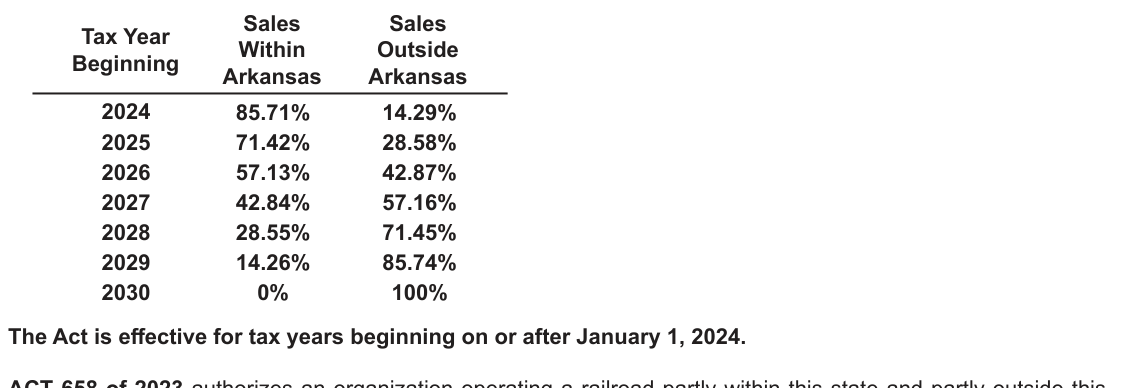
Act 485 of 2023 to enhance economic competitiveness by phasing out the throwback rule amends Arkansas Code Annotated 26-51-716 and 26-5-101, Article IV to provide that sales of tangible personal property are in this state if:
- the property is delivered or shipped to a purchaser within this state regardless of the f.o.b. point or other conditions of the sale; or
- the property is shipped from an office, store, warehouse, factory, or other place of storage in this state and the taxpayer is not taxable in the state of the purchaser in which case the sales shall be sourced as follows:
Sales
# Tax Year
ACT 658 of 2023 authorizes an organization operating a railroad partly within this state and partly outside this state to choose between two options in apportioning its net operating income attributable to this state and provides that any rules adopted by the Department of Finance and Administration that conflict with the act are void. The act is effective for tax years beginning on or after January 1, 2023.
Act 4 of the second Extraordinary Session of 2024 amends Arkansas Code Annotated 26-51-205 to reduce the maximum corporation income tax rate to 4.3% for all taxable income exceeding $11,000 for tax years beginning on or after January 1, 2024. The maximum income tax rate for corporations will remain 5.1% for all taxable income exceeding $25,000 for tax years beginning on or after January 1, 2023.
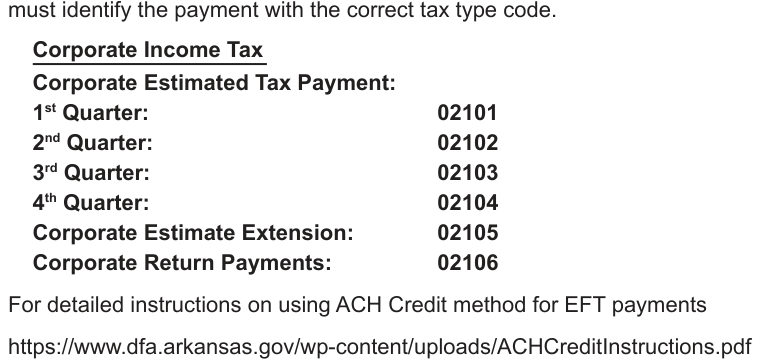
Taxpayers who elect to make their Arkansas tax payments by ACH credit may now also make return payments using the same method. To ensure your EFT (Electronic Funds Transfer) payments are processed correctly, you must identify the payment with the correct tax type code.
# Corporate Income Tax
# Federal Subchapter S Corporations cannot file Arkansas C Returns
Arkansas Code Annotated 26-51-427 allows net operating losses occurring in tax years beginning on or after January 1, 2020 to carryforward for 8 tax years and losses occurring in tax years beginning on or after January 1, 2021 to carryforward 10 years. Net operating losses that occur in tax years beginning before January 1, 2020 carryforward 5 tax years.
Arkansas Code Annotated 26-51-428 was amended to adopt Title 26 U.S.C. Section 179, as in effect on January 1, 2022, for the purpose of computing Arkansas income tax liability for property purchased in tax years beginning on or after January 1, 2022, for tax years beginning on or after January 1, 2024. The adoption of Internal Code Section 179 will result in the Arkansas Section 179 deduction being raised from $25,000 per year to $1,250,000 for tax years beginning in 2022 and for the dollar-for-dollar phaseout being raised from $200,000 to $3,130,000. The lower limits will remain in place for years beginning prior to 2022, including any carryforward of Section 179 that could not be claimed in earlier years. Please refer to the line item instructions for Depreciation and the instructions for Form AR1100REC for further details.
Act 143 of 2021 amends Arkansas Code Annotated 26-51-102 to include a definition for tax practitioner and Arkansas Code Annotated 26-51-806 to require a tax practitioner who files federal income tax returns electronically to also file Arkansas returns electronically and allows DFA to waive the requirement if the requirement would cause an undue hardship on the practitioner.
Act 629 of 2021 amends Arkansas Code Annotated 26-51-807(a) to allow taxpayers an extension to file of one month after the extended due date for a federal income tax return for tax years beginning on or after January 1,
- The one month extended due date does not apply to returns for which a federal extension is not requested and does not extend the original due date. As a reminder all tax payments are due on the original return due date and interest at 10% per annum and failure to pay penalties at 5% per month will be assessed on all taxes unpaid after the original due date which is April 15 for calendar year filers and the 15th day of the fourth month after the end of a tax year that does not end in December.
Multistate Corporations must allocate income from partnerships
Act 482 of 2017 amends ACA 26-51-802(c) to require that Partnership income be determined for state income tax purposes by using an apportionment method. Partners will continue to allocate partnership income. Effective for tax years beginning on and after January 1, 2018.
# Withholding Payments
Form AR1100-WH corresponds with Line 36 on Form AR1100CT for corporations to report withholding tax paid on their behalf by partnerships and will need to be included with Form AR1100CT. Corporations claiming withholding must attach Form AR1100-WH listing each partnership that withheld tax and a copy of Form AR1099PT from each partnership. The partnership must have filed its annual withholding return of Form AR941PT and paid the tax withheld before credit for the withholding will be allowed.
# Withholding Payments as Reported on Form AR941PT
Act 760 of 2017 amends ACA 26-51-919(a)(2), (b)(l)(A)(i), (c)(5)(A) and (d) for the income tax withholding requirements for members or owners of a pass-through entity to require withholding on corporate partners and to allow corporations to participate in composite returns. Effective for tax years beginning on and after January 1, 2018.
Amended Tax Returns
For tax years beginning on or after January 1, 2010, the AR1100CTX Arkansas Amended Return form was removed.
An Arkansas Amended Return will be filed on the Form AR1100CT by checking the appropriate box as filing an Amended Return. Taxpayers should use Form AR1100CTX for tax years 2009 and prior. A copy of the corporation's Federal Amended Return, or IRS audit report, or an explanation for filing the Arkansas Amended Return must be attached to the Form AR1100CT.
# Arkansas Form AR1100CT
To correctly process the Corporation's return it is essential that every applicable line and space on Form AR1100CT and related schedules be typed or printed including tax year, corporation name, address, city, state, zip code, telephone number, (Federal Employer Identification Number) FEIN, date of incorporation, (North American Industry Classification System) NAICS business code used on the federal return, date began business in Arkansas, and filing status (check one box only). If consolidated box 4 is checked, you must also indicate number of entities in Arkansas in the space immediately to the right of Filing Status 4 description.
Consolidated filers must complete a Form AR1100CT (with Schedule A if applicable) for each corporate entity and a separate Form AR1100CT for the consolidated group. DO NOT complete Schedule B - Tax Computation for each subsidiary, only the consolidated group AR1100CT. If Filing Status 4 is checked, do not check any other filing status box. An Arkansas consolidated group with its members having business activity only within Arkansas must check the box for filing Status 4.
To correctly process Corporate Income Tax payments, use the AR1100ESCT for Estimate payments and AR1100CTV for Corporate Income Tax payments. For Composite payments use the AR1000CRES for Estimate payments and AR1000CRV for Composite return tax payments.
# ATAP - Arkansas Taxpayer Access Point
Arkansas Taxpayer Access Point (ATAP) is available for the filing of most Arkansas Corporation Income Tax returns and tax payments. Federal returns and other required schedules must be attached with the ATAP filing or mailed separately to the Corporation Income Tax Section. They may be provided on CD, in PDF, or in paper form. The secure online filing, managing, and payment options of ATAP are available at www.atap.arkansas.gov. Taxpayers and their authorized representatives will be able to view and manage their Corporation Income Tax activity including other tax activity such as Individual Income Tax, Sales Tax, Withholding Tax, and other taxes administered by DFA.
Accountants and attorneys must obtain permission from their clients to access and view their client's accounts.
ATAP is a web-based service that will give taxpayers, or their designated representative, online access to their tax accounts, and offers the following services:
Register a business, file a return online, file a return using XML return upload, change a name, change an address, amend a return, make a payment, store banking information for use during payment submission, view tax period financial information (tax, penalty, interest, credits, balance, etc.), view payments received, view recent account activity, and view correspondence from the department.
If you are currently enrolled with our online systems to either make payments or file a return electronically, you will need to sign up in ATAP to take advantage of the enhanced services. To correctly process payments on ATAP, make sure you are choosing the correct type of payment and applying it to the correct tax period.
The Arkansas Corporation Income Tax Return must be organized as follows:
Other than Filing Status 4 Filers:
- Arkansas Form AR1100CT (Page 1) (Must be signed)
- Arkansas Form AR1100CT Schedule A, (Page 2)
- Arkansas Form AR-718, if subject to special industry and alternative apportionment
- Arkansas Form AR1100ADJ Adustment Schedule
- Arkansas approved extension, if applicable
- Arkansas Reconciliation Schedule, Form AR1100REC
- Business Incentive Tax Credit Certificates (originals), if any, Schedule AR1100BIC, if applicable
- Arkansas Schedule of Check-Off Contributions, Form AR1100CO if applicable
- All other schedules pertaining to the Arkansas return
- Copy of Federal Return with supporting schedules Corporations with Filing Status 2 must complete Schedule A (Apportionment Schedule).
Filing Status 4 Filers:
- Arkansas Form AR1100CT (page 1 and 2) for Group (Must be signed on page 1)
- Arkansas Form AR1100CT for each entity (including parent) within the Group
- Arkansas Form AR-718, if subject to special industry and alternative apportionment
- Arkansas Form AR1100ADJ Adustment Schedule
- Arkansas approved extension, if applicable
- Arkansas Reconciliation Schedule, Form AR1100REC
- Business incentive Tax Credit Certificate (original) if any, Form AR1100BIC, if applicable
- Arkansas Schedule of Check-Off Contributions, Form AR1100CO, if applicable
- All other schedules pertaining to the Arkansas return
- Copy of Federal Return with supporting schedules Corporations with Filing Status 4 (Consolidated Return) must complete a separate AR1100CT and Schedule A, for each member with gross income from sources within Arkansas and consolidate the applicable taxable income on a Consolidated Group AR1100CT and attach a copy of the Federal return. Each member's Arkansas Business Incentive Tax Credit may be combined to reduce the consolidated group's total tax liability without separate entity restrictions, except for the Arkansas Economic Development Credit and ArkPlus Credit. Charitable contribution limits are calculated on a separate corporation basis for consolidated filers.
All percentages used in determining the apportionment factor on Schedule A must be calculated to 6 places to the right of the decimal (example 35.333452%).
# Estimated Tax Requirements
ACA 26-51-911(c)(1) and ACA 26-51-913(a)(2) adopt federal due dates for making declarations of estimated Arkansas income tax. Arkansas taxpayers are required to file an Estimated Declaration when their liability exceeds $1,000. The AR1100ESCT, Estimate Payment Vouchers 1 through 4, and Extension Voucher 5 for tax year 2023 are not included in these instructions. You will find them at our website, www.dfa.arkansas.gov. Filling the forms out online will automatically fill in the taxpayer information and provide the appropriate scan line needed for proper processing.
To make sure payments are processed correctly, please use the correct payment voucher. Use the AR1100ESCT vouchers for Corporation Income tax payments. For Individual Composite payments use the AR1000CRES vouchers.
ACA 26-19-106 provides that a corporation with an estimated quarterly income tax liability equal to or greater than $20,000.00 must pay the estimated quarterly income tax due by electronic funds transfer (Refer to General Instructions). Corporations that underestimate their corporate tax liability must calculate any penalty due as applicable, on Part 2 of Form AR2220, and enter the penalty amount on page 1, Line 45 of Form AR1100CT. Enter the numerical exception from Part 3 in the box on Line 45 if applicable.
Certain corporations are required to remit Arkansas estimated corporation income tax payments through the Electronic Funds Transfer (EFT) method. If they fail to do so, ACA 26-19-107 authorizes the assessment of an EFT penalty equal to five percent (5%) based on the amount of taxes due. Taxpayers who are required to pay by EFT will be notified in writing by the Department. The Form EFT-CT is no longer used to register for EFT payments. You will find current instructions at https://www.dfa.arkansas.gov/excise-tax/sales-and-use-tax/electronic-filingand-payment-options/ or by calling Excise Tax at (501) 682-7105.
# Copy of Federal Return is Required
ACA 26-51-806 (d)(1) requires a completed copy of the corporation's Federal Corporate Income Tax Return, Form 1120, along with all schedules and documents, be attached to the Arkansas "C" Corporation Income Tax Return, Form AR1100CT. The Federal return may be submitted by CD, PDF, TIF format, or attached in paper form. If the Arkansas return is filed on paper and the federal return is more than 500 pages, it must be submitted on CD, thumbdrive, or submitted electronically in ATAP or by e-mail to corporation.income@dfa.arkansas.gov.
# Signatures and Verification
The return must be signed by a corporate officer in the space provided on the bottom of page 1 of Form AR1100CT.
The return of a foreign corporation having an agent in the State may be sworn to by such agent. If receivers, trustees in bankruptcy, or assignees are operating the property or business of the corporation, such receivers, trustees, or assignees shall sign the return for such corporation under certification. The return must be signed in the space provided on the bottom of page 1 of Form AR1100CT. For consolidated returns, only the group Form AR1100CT, must be signed. Refer to General Instructions.
ACA 26-51-804 (b) provides the return must be signed by a corporate officer in the space provided on the bottom of Form AR1100CT.
2025 State of Arkansas
Domestic and Foreign Income Tax General Instructions
# Who Must File
Every corporation organized or registered under the laws of this State, or having income from Arkansas sources as defined in ACA 26-51-205, must file an income tax return. Consolidated returns are permitted under certain conditions. D.I.S.C and F.S.C. Corporations are treated as regular business corporations. Business corporations, D.I.S.C, and F.S.C. Corporations should use Arkansas Form AR1100CT. Small business "S" corporations must use Form AR1100S. A pass-through entity filing as an LLC or Partnership, or a pass-through entity electing to file as a corporation, should check the box on Form AR1100CT.
(Refer to ACA 4-32-1313 or ACA 26-51-802.)
# Consolidated Returns
All corporations that are eligible members of an affiliated group filing a Federal Consolidated corporation income tax return may elect to file an Arkansas Consolidated income tax return. However, only corporations in the affiliated group that have gross income from sources within the State that is subject to Arkansas income tax are eligible to file consolidated income tax returns in Arkansas. An Arkansas consolidated group with its members having business activity only within Arkansas must check the box for Filing Status 4.
In computing Arkansas consolidated taxable income or loss to which the tax rate is applied, the separate net income or loss of each corporation that is entitled to be included in the affiliated group will be included in the consolidated net income or loss to the extent that its net income or loss is separately apportioned or allocated to Arkansas. All corporations in the affiliated group that are eligible to file an Arkansas Consolidated corporation income tax return must consent to, and join in, the filing of the return prior to the last day for filing. The filing of the consolidated return will be considered as consent of each eligible corporation in the affiliated group.
Corporations with Filing Status 4 (Consolidated Return) must complete a separate Form AR1100CT reflecting taxable income before intercompany eliminations and adjustments, and Schedule A, if multistate, for each member with gross income from sources within Arkansas.
Each member's separate net income or loss must be consolidated on a group Form AR1100CT beginning on Line 29. Schedule A should not be completed for the consolidated group, but must be included for signature by a corporate officer.
A complete copy of the Federal return must be attached. A schedule listing each intercompany transaction and adjustment, identifying the entity by FEIN to which it applies must be submitted if this information is not clearly shown on the Federal return.
# Time For Filing
Arkansas adopted a new due date for Corporate
Income tax returns for tax years beginning on or after January 1, 2016. Arkansas Corporate Income Tax Returns are now due the 15th day of the 4th month following the end of the tax year. This includes short tax years. Cooperative Association returns are due on or before the 15th day of the 9th month following the close of the tax year. Exempt organizations are due on the 15th day of the 5th month.
# Extensions of Time for Filing
If you have received an automatic Federal extension (Form 7004), the time for filing your Arkansas Corporation Income Tax Return shall be extended until 30 days after the due date of your federal return. When filing the Arkansas Form AR1100CT, check the box at the top indicating that the Federal Extension Form 7004 and/ or Arkansas Extension Form AR1155 has been filed and file the Arkansas return on or before the extended due date. It is no longer necessary to include a copy of the Federal Form 7004. To request an initial Arkansas extension of 180 days from the original Arkansas return due date or an Arkansas extension of 60 days beyond the automatic federal extension due date, complete and mail Arkansas Form AR1155 by the federal extended due date or, if applicable, the Arkansas extended due date to the Corporation Income Tax Section. If you have an automatic federal extension and do not want to request an additional 60 day Arkansas extension, you do not fill out the Form AR1155. Extensions using Form AR1155 are only available for the filing of original returns. Submit payment with the AR1155 Voucher that is attached to the form only if you are requesting an Arkansas Extension, unless paying by EFT method.
# Amended Returns
For tax years beginning on or after January 1, 2010 the AR1100CTX Arkansas Amended Return form was removed. An Arkansas Amended Return will be filed on the AR1100CT by checking the appropriate box as filing an Amended Return. Taxpayers should use AR1100CTX for tax years 2009 and prior. A copy of the corporation's Federal Amended Return, or IRS audit report, or an explanation for filing the Arkansas Amended Return must be attached to the AR1100CT.
Arkansas amended returns must be filed within three
(3) years from date of filing the original return, or two (2) years from date of payment of tax on the original return, whichever is later, except when required to report the final results of an IRS audit. Refund requests must be filed on the amended return. Attach schedules and an explanation for filing the Arkansas amended return to the AR1100CT.
If multistate, attach amended apportionment schedule.
If consolidated, attach separate company amended AR1100CT with amended apportionment schedule, if applicable. Interest at 10% per annum will be computed on a daily rate of .00027397 from the original return due date to date amended return is filed and the tax is paid.
# Report of Change in Federal Taxable Income
An agreed Revenue Agent's Report (RAR) must be reported on an amended return using the appropriate Form AR1100CT. The RAR must be reported to this State within 180 days after the receipt of the RAR or supplemental report reflecting correct net income of taxpayer. ACA 26-18-306(b)(1-3) states that a refund shall not be paid if the amended return is filed on or after the 181st day following receipt of the notice from the IRS.
Any additional tax and interest must be paid with the amended return or a refund must be requested on an amended return if applicable. Statute of limitations will remain open for three (3) years for assessment of tax if a taxpayer fails to disclose Federal Revenue Agent's Report.
# Period Covered
A taxpayer must calculate their Arkansas income tax liability using the same income year for Arkansas income tax purposes as used for Federal income tax purposes
(ACA 26-51-402). Arkansas Regulation 1.26-51-102(17)(B) states, A fractional part of a year (short tax year) means a period of less than twelve (12) months.
If a short tax year ends on or before the 15th day of the month, then the short tax year shall be deemed to have ended on the last day of the previous month. If a short tax year ends on or after the 16th of the month, then the short tax year shall be deemed to have ended on the last day of the current month.
# Filing Declaration of Estimated Income Tax
Every taxpayer who can expect to owe Arkansas income tax in excess of $1,000 must make a declaration and the timely pay the estimated tax in equal installments.
The declaration shall be filed with the commissioner on or before the 15th day of the 4th month of the tax year of the taxpayer. Taxpayers, whose income from farming for the tax year can reasonably be expected to amount to at least two-thirds (2/3) of the total gross income from all sources for the tax year, may file such declaration and pay the estimated tax on or before the 15th day of the 2nd month after the close of the tax year or the taxpayer may file an income tax return and pay the tax on or before the 15th day of the 4th month after the close of the tax year.
To avoid penalty, all other taxpayers must pay quarterly estimates on or before the 15th day of the 4th month, 6th month, 9th month and 12th month of the tax year. The Form AR1100ESCT, Estimate payment vouchers 1 through 4 and Extension payment voucher 5 are not included in these instructions. Filling out the forms on our website, www.dfa.arkansas.gov, will automatically fill in the taxpayer information and provide the appropriate scan line needed for proper processing.
Corporations may remit estimated and extension corporation income tax payments through ATAP (Refer to www.atap.arkansas.gov for instructions).
If the Director determines that a corporation's estimated quarterly Arkansas income tax liability exceeds $20,000.00, the corporation is required to pay the estimated quarterly income tax payments due by electronic funds transfer (EFT). The EFT must be made no later than the day before each quarterly due date. If the corporation timely pays the estimated quarterly income tax payments by EFT, the corporation is not required to file a quarterly estimated income tax voucher. If a taxpayer is required to submit estimate payments by EFT, a letter will be sent by DFA notifying the taxpayer of the requirement.
# Accounting Methods
A taxpayer must calculate their Arkansas income tax liability using the same accounting method for Arkansas income tax purposes as used for Federal income tax purposes. If a corporation changes its accounting method, attach a copy of any certification or approval received from the Internal Revenue Service authorizing the change of accounting method to the corporation's Arkansas return.(ACA 26-51-401).
# Payment of Taxes
The tax should be paid by attaching to the return a check or money order payable to the order of "Department of Finance & Administration." Enclose proper payment voucher with all remittance checks and write the corporation's FEIN or CIT account ID number and the tax year on the check. Payments with returns may not be made by EFT. Tax due on returns may be paid through ATAP. (Refer to www.atap.arkansas.gov.) To avoid interest and/or penalty the tax must be paid in full by the original return due date, which is the 15th day of the 4th month after the close of the corporation's tax year.
An approved federal and/or state extension, which allows the corporation's return to be filed on or before the approved extended due date, does not extend the time period to pay the tax due in full. Interest and/or penalty will be assessed on any tax due paid after the original return due date as referenced above. Payments with a return should include the AR1100CTV payment voucher for Corporation Income tax payments and the AR1000CRV for Individual Income tax.
# Penalties and Interest
The following penalties shall be imposed:
(ACA 26-18-208)
- Failure to file timely - 5% per month not to exceed 35%.
- Failure to make timely remittance - 5% per month not to exceed 35%.
- Underestimate penalty - 10% of the amount of the underestimate.
- Failure to file return - $50.00.
- Failure to make required EFT payment - 5% of the tax due.
- Incomplete electronic payment -10% of the amount of the draft or $20.00, whichever is greater.
- Failure to Comply - $50.00.
If any part of any deficiency or tax liability is due to negligence or intentional disregard of rules and regulations, a penalty of 10% of the total amount shall be added. Any part of any deficiency determined to be due to fraud shall be subject to a 50% penalty. Interest at the rate of 10% per annum shall be assessed on all tax deficiencies. Interest will be computed using a daily rate of .00027397 from the 15th day of the 4th month after the close of the tax year until the date the tax is paid.
Balance Sheets
The balance sheet submitted with the return should be prepared from the books and should agree therewith. If there are any differences between current year beginning and prior year ending balance sheets, submit a schedule of reconciliation with the return. All corporations engaged in an interstate and intrastate trade or business and reporting to the Surface Transportation Board, or to any national, state, municipal or other public officer, may submit copies of their balance sheet, prescribed by said Board, national, state or municipal authorities, as of the beginning and end of the taxable year.
# General Instructions
Specific Line Instructions for Page 1 of AR1100CT Return
# Type Return
Whether the C Corporation is filing an Initial Return (first time filing), an Amended Return (making changes to an original return), a Final Return (going out of business), or filing as a Cooperative Association, clearly mark the AR1100CT by checking the applicable box at the top of the form.
Income
Line 1 - Gross Sales: Enter the gross sales, less goods returned, and any allowances or discounts from the sale price.
Line 2 - Less Cost of Goods Sold: Enter the cost of goods sold. If the production, purchase, or sale of merchandise is an income producing factor in the trade or business, inventories of merchandise on hand should be taken at the beginning and end of the taxable year, which may be valued at cost or market, whichever is lower.
Fully explain the method used. In case the inventories reported on the return do not agree with those shown on the balance sheet, attach a statement explaining how the difference occurred.
Line 3 - Gross Profit: Enter the gross profit which is obtained by deducting Line 8 from Line 7.
Line 4 - Dividends: Enter taxable dividends only.
Dividends from 80% or greater directly owned subsidiaries are exempt.
Line 5 - Taxable Interest: Enter interest income taxable in Arkansas. Enter amounts received or credited as interest to the corporation during the tax year on bank deposits, C.D.'s, notes, mortgages, corporation bonds, taxable U.S. interest, and all other interest including interest on out-of-state municipal bonds (out-of-state municipal bonds are taxable in Arkansas). Attach schedule to the Arkansas return identifying each U.S. Agency or political subdivision of Arkansas and Schedule AR1100REC to reconcile amounts received that are not included as taxable interest on the Arkansas return.
Line 6 - Gross Rents: Enter all gross rents. Attach detailed schedule showing amounts received if now shown separately on the federal return. The schedule should reconcile Arkansas and federal rents.
Line 7 - Gross Royalties: Enter all gross royalties.
Attach detailed schedule showing amounts received if now shown separately on the federal return. The schedule should reconcile Arkansas and federal royalties.
Line 8 - Capital Gain Net Income: Enter the total net capital gain or loss reported in the tax year in which it is incurred. Attach Schedule D (Form 1120). ACA 26-51-460 adopts Internal Revenue Code Section 1400Z-2 as in effect January 1, 2018 for tax years beginning on or after January 1, 2018 regarding opportunity zones. To claim an exemption for capital gains as a result of the sale of property located in an opportunity zone for Arkansas income tax purposes, the property must be located in an opportunity zone located in Arkansas. Opportunity zone gains for property located in other states are taxable in Arkansas.
Line 9 - Net Gain or (Loss) from Form 4797, Part II,
Line 17: Enter the total net gain or loss. Gains and losses must be adjusted to indicate any difference in Arkansas and federal basis.
Line 10 - Other Income: Enter all other taxable income for which no place is provided on the return. The holder of the ownership interest in a Financial Asset Securitization Investment Trust (FASIT) must list the net income from prohibited transactions on this line. Attach schedule explaining all items included.
Line 11 - Total Income: Enter the net amount of Lines 9 through 14 inclusive.
Deductions
Line 12 - Compensation of Officers: Enter the compensation of all officers, in whatever form paid. Attach a schedule showing amounts paid to officers separately, if not shown separately on the federal return. The schedule should reconcile Arkansas and Federal compensation of officers.
Line 13 - Other Salaries and Wages: Enter the compensation of all employees, in whatever form paid.
Attach a schedule showing amounts paid to employees separately, if not shown separately on the federal return. The schedule should reconcile Arkansas and Federal compensation of employees.
Line 14 - Repairs: Enter the amount of repair costs for business property.
Line 15 - Bad Debts: Enter debts which have been definitely ascertained to be worthless and have been charged off within the year. The Reserve Method for computing and deducting bad debts on receivables may be used only by small banks and thrift institutions.
A debt previously charged off as bad, if subsequently collected, must be reported as income for the year in which collected.
Line 16 - Rent on Business Property: Enter rent paid for business property.
Line 17 - Taxes: Enter taxes paid or accrued during the taxable year. Do not include Arkansas or federal income taxes or taxes assessed against local benefits tending to increase the value of the property assessed. Attach Schedule AR1100REC to the AR1100CT to reconcile federal and Arkansas taxes.
Line 18 - Interest: Enter interest paid on business indebtedness.
Line 19 - Contributions: Enter the Arkansas allowable amount for charitable contributions. Title 26 U.S.C.170 as in effect on January 1, 2019, regarding deductions for charitable contributions, is adopted for the purpose of computing Arkansas income tax liability with the exception of the carryforward period. A five (5) year carryforward period is allowed and is carried over separately from the NOL. No carryback of contributions is allowed. The Arkansas contribution deduction allowable will be calculated using Arkansas taxable income rather than Federal taxable income. The contribution limits are calculated on a separate corporation basis for consolidated filers. (ACA 26-51-419)(a)(1)
Line 20 - Depreciation: Depreciation expense claimed.
ACA 26-51-428 does not adopt the bonus depreciation provisions contained in Internal Revenue Code 168(k).
For Arkansas income tax purposes, Internal Revenue Code Sections 167 and 168 (a) - (j) as in effect on January 1, 2019 is adopted for tax years beginning on or after January 1, 2019.
Internal Revenue Code Section 179 as in effect on January 1, 2022 is adopted for tax years beginning on or after January 1, 2022. For tax years beginning on or after January 1, 2024, the Arkansas Section 179 deduction limit will be $1,220,000 and the dollar-fordollar phaseout will begin at $3,050,000. For tax years beginning on or after January 1, 2011 and beginning before January 1, 2022, the Arkansas Section 179 deduction limit is $25,000 and the phaseout begins at $200,000. Form AR1100REC will need to be completed for any taxpayer filing a corporation income tax return or pass-through entity tax return and claiming a Section 179 deduction. Carryforward of Section 179 deductions from prior years may be used towards the Arkansas Section 179 deduction limitation but may only be claimed if Arkansas depreciation deductions were not claimed in those prior years. If the Arkansas Section 179 deduction is different from the federal Section 179 deduction, a Form 4562 depreciation schedule will need to be completed showing the calculation of the Arkansas depreciation deduction. In addition, Internal Revenue Code Section 179D Energy Efficient Commercial Buildings deduction is not an allowed deduction. Arkansas Legislature has not adopted this IRC code.
Line 21 - Depletion: Enter depletion claimed. Arkansas allows Federal depletion allowances as in effect January 1, 2019. In computing the depletion allowance deduction allowed for oil and gas wells, the depletion deduction shall be controlled by the provisions of IRC Section 613A as in effect on January 1, 2019.
Line 22 - Advertising: Enter amount for business advertising.
Line 23 - Pension, Profit-Sharing, etc., Plans: Enter the deductible amount for employer contributions to pension, profit-sharing, or other plans. (Attach schedule) Line 24 - Employee Benefit Programs: Enter the deductible cost of providing employee benefits as either additional compensation for services rendered or as ordinary and necessary business expenses. (Attach schedule) Line 25 - Other Deductions: Enter other deductions authorized by law. Attach schedule explaining all items included. Internal Revenue Code Section 179D Energy Efficient Commercial Buildings deduction is not an applicable deduction. Arkansas Legislature has not adopted this IRC code.
Line 26 - Total Deductions: Enter the total of Lines 12 through 25 inclusive.
# Note: Expenses of Earning Tax Exempt Income
ACA 26-51-431(c) provides that no deductions shall be allowed for interest on indebtedness incurred or continued to purchase or carry obligations the interest on which is wholly exempt from the taxes imposed by Arkansas law; expenses otherwise allowable as deductions which are related to tax exempt income other than interest; expenses otherwise allowable as deductions which are related to non-business income.
Example a: (interest expense): avg. non-tax assets disallowed avg. total assets X interest expense = expense Example b: (non-business income):
% X non-bus. inc. = disallowed expense
Taxpayer must justify % used and submit schedule.
State may increase % if justification can be made.
Line 27 - Taxable Income Before Net Operating Losses:
Enter the amount from subtracting Line 26 from Line 11.
Line 28 - Net Operating Losses: Enter on Line 28, or Schedule A, Part C, Line 3, net operating losses being claimed, but do not exceed net taxable income on the return. Losses must be carried forward under the following conditions:(Attach AR1100NOL form). If Line 27 is a loss, Line 28 should be zero. Line 28 should not exceed Line 27.
(A) Net operating losses must be carried over to the next succeeding taxable period and annually thereafter for a total period of ten (10) tax periods succeeding the year of such net operating loss or until such net operating loss has been exhausted or absorbed by the taxable income of any succeeding year, whichever is earlier if the loss occurred in a tax year beginning in
- NOL occurring in tax years 1/01/2020 through 12/31/2020 will carryforward 8 tax years; NOL occurring in tax years before 2020 will carryforward 5 years.
(B)For computing the amount of NOL that will be allowed for carryforward purposes, there shall be added to gross income all nontaxable income, not required to be reported as gross income by law, less any related expenses which will otherwise be nondeductible.
Multistate tax filers must follow above procedures and apportion NOL by the apportionment formula for year of loss, applying the Arkansas percentage factor for the year of loss against total apportionable loss for that year. Failure to provide a complete schedule of net operating losses (with the return) may result in disallowance of any NOL claimed.
Carryback of NOL is not allowed. Contributions are not to be added to NOL and carried forward.
Net operating losses of a corporation which merges into another corporation will be allowed under the following conditions:
(1) The acquiring corporation must own at least 80% of the acquired corporation's voting stock, and
(2) Assets of the merged corporation must earn sufficient profits in the post-merger period to absorb the carryover losses claimed by the surviving corporation, see ACA 1.26-51-427(3)(c).
Attach schedules of proof and computations to the return on which any NOL is being carried forward.
Line 29 - Net Taxable Income: Enter the amount of taxable income (Line 27 less Line 28 or Schedule A Line C4 on page 2). (If Amended Return box checked,enter amended net taxable income).
Line 30 - Refund: Enter the amount to be refunded as calculated from Schedule B, Line 12.
Line 31 - Tax Due: Enter the tax due as calculated from Schedule B, Line 13.
# General Instructions
For Taxpayers with Income from Sources Within and Without the State Multistate corporations should complete lines 29-31 of page 1, and all of page 2 of Form AR1100CT.Multistate corporations should not complete lines 1-28 of Form
# AR1100CT.
Unitary Determination of Intangible Income
Interest, dividends (less than 80% directly owned), rents, royalties, gains, and losses from multistate corporations are apportionable to Arkansas if a unitary business relationship exists between the intangible income and the State of Arkansas. Generally, a unitary business relationship will exist when an activity conducted in one state benefits and is benefited by an activity conducted in another state.
Act 822 of 2019 amends Arkansas Code Annotated 26-5-101, Article IV and 26-51-709 through 26-51-718 to provide for a single sales factor to apportion income from within and without Arkansas for tax years beginning on or after January 1, 2021. For tax years beginning on or after January 1, 2021, all taxpayers with income from sources within and without Arkansas must use a single sales factor to apportion income from Arkansas unless the taxpayer is required or approved in advance for the use of an alternative apportionment method.
Industries required to use special industry apportionment methods under the special industry apportionment regulations should apportion income using a single sales factor as modified using the special industry apportionment method in the regulation and exclude the property and payroll factors.
- Construction Contractors by Regulation 1.26-51-718(d)
- Television and Radio Broadcasting by Regulation 2.26-51-718(d)
- Publishing Companies by Regulation 3.26-51-718(d).
- Airlines by Regulation 4.26-51-718(d) - Miles
- Bus Lines and Trucking Companies by Regulation 5.26-51-718(d) - Miles
- Pipelines by Regulation 6.26-51-718(d).
- Railroads by Regulation 2.26-51-204. (3 factors or a single sales factor optional)
- Private Railcar Operators by Regulation 2.26-51-204.
Apportionment Formula
In general, taxpayers with income derived from activities both within and without the State are required to apportion Business Income and allocate the Nonbusiness and Partnership income. For tax years beginning on or after January 1, 2021, all multistate corporations should use the single sales factor only, unless required to use an approved alternative apportionment method.
Financial Institutions must use the single sales factor as outlined in Arkansas Codes Annotated 26-51-1403.
Construction companies, pipelines, private railcar operators, bus lines and trucking companies, airlines, television and radio broadcasting companies, and publishers will use sales factor only as modified in the regulations. Railroads operating within and without the State may use either single sales factor or three-factor double-weighted sales apportionment method beginning tax years effective January 1,
- Requirements for apportionment formulas of the businesses listed in this paragraph (except for financial institutions) are contained in the Arkansas Corporation Income Tax Regulations which may be obtained from
Change of Method
Prior approval Required Before Deviation From the Allocation and Apportionment Method: If the allocation and apportionment provisions as set out above do not fairly represent the extent of the taxpayer's business activity in this State, the taxpayer may petition for, or the Commissioner of Revenue, Department of Finance and Administration may require in respect to all or any part of the taxpayer's business activity, if reasonable:
A) Separate accounting
B) The inclusion of one or more additional factors which will fairly represent the taxpayer's business activity in this State, or
C) The employment of any other method to effectuate an equitable allocation and apportionment of the tax- payer's income.
To "petition for" and approved by DFA shall mean a formal written request submitted and approved prior to the filing of a return.
# Schedule A-Apportionment of Income for Multistate
Corporation
Part A - Income To Apportion
Line 1: Enter federal taxable income before any adjustments, net operating losses, or special deductions from Line 28 of the federal Form 1120. If federal Form 1120 is not filed, use the appropriate line from the federal form that is filed that reflects taxable income before adjustments, net operating loss, and special deductions.
Line 2: Enter any Add Adjustments. Examples Include:
# Arkansas Corporation Income Taxes Deducted,Bonus
Depreciation, Federal Charitable Contributions, and Partnership Loss. (Attach schedule AR1100ADJ) Line 3: Enter any Deduct Adjustments. Examples include: Arkansas Depreciation, Arkansas Charitable Contributions, Partnership Income. (Attach schedule AR1100ADJ)
Line 4: Enter Arkansas Total Apportionable Income.
Line 1 + Total Amount from Line 2 - Total Amount from Line 3 = Line 4, Total Arkansas Apportionable Income.
Note: Lines 2 and 3 are for reporting any adjustments to taxable income that result in differences between Federal and Arkansas tax laws. The examples listed above are not intended as an all-inclusive list of required adjustments.
Part B - Apportionment Factor
Column A is for Amounts in Arkansas; Column B is the Total Everywhere; Column C is the Percentage of Column (A)÷(B). Calculate all percentages to six
(6) places beyond whole percentages. Example 26.123456% Arkansas adopted a single sales factor formula for the apportionment of multistate business income (Act 822 of 2019). As a result, Schedule A reflects single sales factor apportionment. If the corporation is subject to special industry or alternative apportionment, please see instructions for Form AR-718.
Sales/Receipts Factor: The receipts factor is a fraction, the numerator of which is the total sales of the taxpayer in this State during the tax period, and the denominator of which is the total sales of the taxpayer everywhere during the tax period. The method of calculating receipts for purposes of the denominator is the same as the method used in determining receipts for purposes of the numerator. The receipts factor shall include only those receipts which constitute business income and are included in the computation of the apportionable income base for the taxable year. Arkansas requires receipts to be gross receipts instead of net receipts.
Line 1: Sales/Receipt
(a) Enter Destination Shipped from Within Arkansas:
Sale of property that is delivered or shipped by a seller located in Arkansas to a purchaser located in Arkansas.
(b) Enter Destination Shipped from Without Arkansas:
Sale of property that is delivered or shipped to a purchaser located in Arkansas regardless of the f.o.b. point or other conditions of the sale.
# Line 2: Origin Sales From Arkansas
(c) Enter Origin Shipped from Within Arkansas to
Other Non-Taxable Jurisdictions: Sales of property that is shipped from an office, store, warehouse, factory or other place of storage in Arkansas to a taxpayer that is not taxable in the state of the purchaser.
Beginning January 1, 2024, a percentage of sales to which the throwback rule applies as taxable to Arkansas and a percentage as taxable to the destination state, with the amount taxable to the destination state increasing each year as the amount taxable to Arkansas decrease.
The percentages will be as follows:
• 2025: 71.42% to Arkansas.
# Line 3: Other Sales/Receipts
Items such as d. capital & ordinary gains, e. dividends, f. interest, g. rents, h. royalties, and i. services will be reported in the appropriate boxes. For j. other business gross receipts, attach schedule.
Gross receipts from transactions other than sales of tangible personal property are attributed to Arkansas if:
- The income producing activity is performed entirely within Arkansas or, 2) If the income producing activity is performed both inside and outside of Arkansas, the income reportable to Arkansas is determined by calculating the sales factor excluding sales from transactions other than the sale of tangible personal property and applying the resulting percentage to the Arkansas sales factor numerator for gross receipts from transactions other than sales of tangible personal property.
(k) Total Sales/Receipts: (Add Lines 1a through 3j).
Divide Line 3k in Column A by Line 3k in Column B to arrive at the percentage for Line 3k in Column C.
Line 4: Alternative Apportionment Percentage: If the corporation is subject to special industry and alternative apportionment, check the box and enter the percentage from Form AR-718, Line 5, Column C.
Line 5: Enter Percentage Attributable to Arkansas:
Enter the percentage from Line 3k, Column C. If required to complete form AR-718, enter percentage from AR-718, Column C, Line 5.
Part C - Arkansas Taxable Income
# Line 1: Enter Income Apportioned to Arkansas. (Part
A, Line 4) x (Part B, Line 5).
Line 2: Enter Direct Income Allocated to Arkansas:
Include non-business income and partnership income/ loss that are sourced to Arkansas. Arkansas Regulation 1.26-51-802(b) requires corporations to directly allocate partnership Arkansas income or loss to Arkansas rather than including partnership income and apportionment factors in the corporation's apportionment formula.
Multistate corporations with partnership income should deduct all partnership income on Part A, Line 3 (Deduct Adjustments). Partnership losses should be added on
# Part A, Line 2 (Add Adjustments). The corporation's
Arkansas partnership income or loss should then be entered on Part C, Line 2 Add: Direct Income Allocated to Arkansas line. Attach Forms AR K-1 and if claiming withholding, attach Forms AR1099PT.
Line 3: Enter only the amount of Apportioned NOL available or the amount needed to absorb the total of Lines 1 and 2 on Part C. (Attach Form AR1100NOL).
Example: Line C1=$1000 + Line C2=$500
NOL available is $5000; Line C3 will only show $1500
Line 4: Enter Total Income Taxable to Arkansas:
Total of Lines C1 and C2, and subtract C3. (Enter here and on Schedule B, Line 1)
# Schedule B - Tax Computation
Line 1-Net Taxable Income: Enter the net taxable income as reported on page 1, Line 29 or from page 2, Schedule A, C4, as appropriate.
Line 2-Tax from Table: Enter Tax from Table (page 25).
Line 3-Business Incentive Credits: Enter Business Incentive Credits. Attach AR1100BIC and original certificates.
Line 4-Tax Liability: Enter Tax Liability. (If Amended Return box checked, enter amended tax liability.) (Line 2 less Line 3).
Line 5-Estimated Tax Paid: Enter Estimated Tax paid, including estimate carryforward from prior year.
Line 6-Payment with Extension Request: Enter payment made with extension request.
Line 7-Withholding Payment: Enter amount of withholding from a partnership, if applicable, attach Form AR1100-WH and AR1099PT.
Line 8-Amended Return Only: Enter Net tax paid as a positive number on previous return(s) for this tax year. If the net tax return of the previous return(s) resulted in a refund or increased overpayment carried forward, enter the net amounts as a negative number in brackets or parenthesis.
Line 9-Overpayment: Enter Overpayment amount (Add lines 5 through 7, plus or minus line 8, less line 4.).
Line 10-Amount Applied to Next Tax Year: Enter amount applied to next year's estimated tax..
Line 11-Amount Applied to Check Off Contributions:
Enter amount applied to Check Off Contributions; attach
# AR1100CO.
Line 12-Amount to be Refunded: Enter amount to be refunded (Line 9 less Lines 10 and 11).
Line 13-Tax Due: Enter the tax due (Line 4 less lines 5 through 7, plus or minus line 8). Tax Due cannot be less than ZERO.
Line 14-Interest on Tax Due: Enter the interest on tax due.
Line 15-Penalty for Late Filing or Payment: Enter the penalty for late filing or payment amount.
Line 16-Penalty for Underpayment of Estimated Tax:
Enter the penalty for underpayment of Estimated tax, attach AR2220 and enter exception checked in Part 3.
Line 17-Amount Due: Enter the amount due (add Lines 13 through 16).
# Special Industry Apportionment Rules
Arkansas Regulations require taxpayers primarily engaged in certain industries to apportion income using a special industry apportionment method. See below for a brief description of each special industry apportionment method. For a complete description of industries that are required to modify their apportionment factors, see the Corporation Income Tax Regulations at www.dfa.arkansas.gov.
# Construction Contractors
Arkansas Regulation 1.26-51-718(d) modifies the sales factor for all Construction contractors. Gross receipts derived from the performance of a contract are attributable to Arkansas if the construction project is located in Arkansas. If the construction project is located both inside and outside of Arkansas, the gross receipts attributable to Arkansas are based upon the ratio that construction costs for the project in Arkansas incurred during the tax year bear to the total construction costs for the entire project during the tax year. The amount of gross receipts to be included in the sales factor for the current tax year is based on the cost ratio regardless of whether the taxpayer uses the accrual method or the cash method of accounting for receipts and disbursements.
All Construction contractors should not use a property or payroll factor for tax years beginning in 2021 and after.
# Television and Radio Broadcasting
Arkansas Regulation 2.26-51-718(d) modifies the numerator of the sales factor to include all gross receipts of the taxpayer from sources within Arkansas plus a ratable part of film or radio programming revenue including advertising revenue determined by an audience factor. The audience factor is determined based on the ratio that the taxpayer's Arkansas viewing or listening audience bears to its total viewing or listening audience.
Television and radio broadcasters should not use a property or payroll factor for tax years beginning in 2021 and after.
Publishing
Arkansas Regulation 3.26-51-718(d) modifies the sales factor for taxpayers in the business of publishing, selling, licensing, or distribution of books, newspapers, magazines, periodicals, trade journals, or other printed materials that have income from sources both inside and outside of Arkansas. The sales factor is modified to include a "circulation factor". Publishers should not use a property or payroll factor for years beginning in 2021 or after.
Airlines
Arkansas Regulation 4.26-51-718(d) requires airlines to determine Arkansas net taxable income by taking that portion of total operating revenue that the total passenger and freight receipts in Arkansas bear to total receipts from inside and outside Arkansas.
# Bus Lines and Trucking Companies
Arkansas Regulation 5.26-51-718(d) requires a company whose primary business is bus lines or trucking to determine its net income subject to Arkansas income tax by an apportionment formula which is the number of miles operated within Arkansas divided by the total system miles.
Pipelines
Arkansas Regulation 6.26-51-718(d) establishes special rules for taxpayers operating a pipeline for the transportation of oil or gas both inside and outside of Arkansas. The sales factor includes any gas sales and storage sales within Arkansas plus a proportionate part of system revenue earned in Arkansas determined on the basis of total barrel or unit miles within Arkansas to the total barrel or unit miles in the system. Pipelines should not use a property or payroll factor for tax years beginning in 2021 and after.
# Private Railcar Operators
Arkansas Regulation 2.26-51-204 requires taxpayers, other than a railroad, engaged in the business of operating railcars or in the business of furnishing or leasing railcars for the transportation of freight or property whether or not owned by such taxpayer, over any railway lines partly within and partly without the State to determine Arkansas net taxable income by taking that portion of total net operating income that the total miles operating in the State bears to total system miles operated.
# Public Utilities
Arkansas Regulation 3.26-51-204 requires telephone, electric power, and gas distribution companies operating both inside and outside of Arkansas shall allocate and apportion their net income provided under ACA 26-51-701, et seq, ACA 26-51-709 requires income to be apportioned using a single sales factor.
Allocated Income
# Partnership Income
Act 482 of 2017 amends ACA 26-51-802(c) to require partnership income from activites within and without this State that is reflected on a partnership return shall be apportioned to Arkansas under the uniform Division of Income for Tax Purposes Act (ACA 26-51-701 et seq).
Corporations that are partners in a partnership must allocate their share of partnership income as shown on form AR K-1 from the partnership. Partnership Income subject to Arkansas Pass-Through Entity Tax (PET) should be excluded from the Arkansas Individual return.
# Non-Business Income
The following items of income to the extent that they do not constitute business income are to be allocated to this State.
1. Rents & Royalties:
A) Net rents and royalties from real property located in this State.
B) Net rents and royalties from tangible personal property
- If and to the extent that the property is used in this State, or
- In their entirety, if the commercial domicile is in this State and the taxpayer is not organized under the laws of or taxable in the state in which the property is utilized.
The extent of utilization of tangible personal property in a state is determined by multiplying the rents and royalties by a fraction, the numerator of which is the number of days of physical location of the property in the State during the rental or royalty period in the taxable year; and the denominator of which is the number of days of physical location of the property everywhere during all rental or royalty periods in the taxable year.
If the physical location of the property during the rental or royalty period is unknown or unascertainable by the taxpayer, tangible personal property is utilized in the state in which the property is located at the time the rental or royalty payer obtained possession.
2. Gain and Losses:
Gains and losses from sales of assets:
A) Sales of real property located in this State.
B) Sales of tangible personal property.
- The property had a situs in this State at the time of sale, or
- The taxpayer's commercial domicile is in this State, or
- The property has been included in depreciation which has been allocated to this State; in which event gains or losses on such sales shall be allocated on the percentage that is used in the formula for allocating income to this State.
3. Interest and Dividends:
Interest and dividends if the taxpayer's commercial domicile is in this State.
4. Patent and Copyright Royalties:
A) If and to the extent that the patent or copyright is utilized by the taxpayer in this State, or
B) If and to the extent that the patent or copyright is utilized by the taxpayer in a state in which the taxpayer is not taxable and the taxpayer's commercial domicile is in this State.
A copyright is utilized in a state to the extent that printing or other publications originate in the state. If the basis of receipts from copyright royalties does not permit allocation to states or if the accounting procedures do not reflect states of utilization, the copyright is utilized in the state in which the taxpayer's commercial domicile is located.
# Apportionment of Intragroup Intangible Licensing
Transactions:
Regulation 1996-3 clarifies the calculation method for determining the sales factor in apportioning business income received from intragroup intangible licensing transactions. This regulation applies to a corporation that is a passive intangible holding company and receives business income from intragroup intangible licensing transactions with one or more members of the same group. Also, at least one of the other members of the same group from which the business income is received by the taxpayer must be subject to the Arkansas Income Tax Act. The sales factor for intragroup intangible transactions is modified as follows:
- If the licensing agreement states a method of measuring the activity between the licensor and licensee, the numerator of the sales factor is the amount of the sales or receipts received as provided in the licensing agreement.
- If the licensing agreement does not state a method of measuring the activity between the licensor and licensee, the measuring activity will be based on one of the following: a. If the licensee's activity generates sales or receipts, the numerator of the sales factor will be the per- centage of sales in Arkansas compared to the licensee's total sales,or b. If the licensee's activity does not generate sales or receipts, the numerator of the sales factor will be the percentage of units produced or cost of units produced in Arkansas compared to the licensee's total units produced or total cost of units produced, or c. If neither of the above methods accurately represent the licensor's business activity in Arkansas, the licensor may petition for, or the Director may require, another method.
- If the licensing agreement states a method of measuring the activity between the licensor and licensee in addition to a specifically stated dollar amount, the numerator of the sales factor will be the stated measuring activity plus the stated dollar amount attributable to Arkansas.
This Regulation modifies the sales factor for intragroup intangible licensing transactions only. Business income from any other source should be apportioned in accordance with ACA 26-51-709.
If a passive intangible holding company meets the above characteristics and the licensee elects to forego the intragroup intangible licensing transactions deduction, the passive intangible holding company will not be required to report the business income received from intragroup intangible licensing transactions for Arkansas income tax purposes.
The licensee's election to forego the deduction will be binding unless the licensee and the passive intangible holding company submit a written petition to change the election to the Director, and the Director approves the change.
# Financial Institutions
Generally, the receipts factor is a fraction; the numerator is the financial institution's gross receipts in Arkansas during the taxable year, and the denominator is all gross receipts that the financial institution derives from transactions and activities in the regular course of its trade or business.
Interest from loans secured by real property is attributed to Arkansas if the property is located in Arkansas. Interest from loans not secured by real property is attributed to Arkansas if the borrower is located in Arkansas. Interest from credit cards receivables and fees charged to card holders are attributable to Arkansas if the billing address of the card holder is in Arkansas. Net gains from the sale of loans and loan servicing fees are sourced in the same manner as the loan interest. Net gains from the sale of credit card receivables are sourced in the same manner as the interest on credit card receivables.
Interest, dividends, and net gains from investment and trading assets and activities are attributed to Arkansas if such receipts are properly assigned to a regular place of business of the taxpayer within Arkansas.
In general, all state and national banks, savings and loan, building and loan associations, or any other entity operating as financial institutions are to be taxed under existing law. For a complete definition of "financial institution", refer to ACA 26-51-1402.
# Who Must File
- A financial institution having its principal office in this State shall be taxed as a business corporation organized and existing under the laws of this State, or
- A financial institution having its principal office outside this State, but doing business in this State, shall be taxed as a foreign business corporation doing business in this State.
This is not intended to recognize the right of a foreign financial institution to conduct any business in this State except to the extent and under the conditions permitted by any acts or any other now existing applicable laws of this State.
ACA 26-51-702 requires any taxpayer having income from business activity which is taxable both within and without this state, other than activity as a public utility or the rendering of purely personal services by an individual, shall allocate and apportion their net income.
# ACA 26-51-426 adopted Internal Revenue Code Sections
582, 585, and 593 as in effect January 1, 1999, regarding bad debts of financial institutions.
Act 822 of 2019 amends ACA 26-5-101, Article IV, 26-51-709 through 26-51-718, and ACA 26-51-1401 to ACA 26-51-1405 to provide for a single sales factor to apportion income from within and without Arkansas for tax years beginning on or after 01/01/2021.
ACA 26-51-1401 requires that a financial institution whose business activity is taxable both within and without this State to allocate and apportion its net income to this State. All business income which is includable in the apportionable income tax base shall be apportioned to this State by multiplying such income by the taxpayer's receipts factor as described in ACA 26-51-1403.
# Small Business (S) Corporations
For tax years beginning on or after January 1, 2018.
ACA 26-51-409(b)(2) requires corporations that have elected Subchapter S treatment for federal tax purposes must file Subchapter S returns for Arkansas income tax purposes for the same tax year.
- It is treated as a Small Business Corporation with the Internal Revenue Service (IRS).
- It has no more than 100 shareholders. Members of a family (and their estates) are treated as one sharehold- er for this requirement. All other persons are treated as separate shareholders.
- It must be a corporation organized or created under the laws of the United States or a state or territory or it is a similar association taxed as a corporation.
- Its shareholders are individuals, estates and certain trusts described in IRC 1361.
- It has no nonresident alien shareholders.
- It has only one class of stock.
- It is not an ineligible corporation as defined in IRC 1361.
- Banks may elect S Corporation status even though the bank stock is owned by an individual's IRA rather than the individual.
A corporation that is treated as Qualified Subchapter S Subsidiary (QSSS) for federal purposes is not allowed to file a separate Arkansas corporation return. Instead, the federal parent of any QSSS doing business in Arkansas must file an Arkansas return and report the Arkansas activity of the QSSS.
All shareholders are required to file Arkansas Individual income tax returns or be included in a composite return. Please refer to the 2021 Subchapter S tax instructions for details on filing as an S corporation. Act repeals ACA 26-51-413(b).
For tax years beginning after December 31, 2017, it will no longer be necessary to file a separate Subchapter S election for Arkansas. Taxpayers will file a federal S return and an S state return. Federal Subchapter S filers will no longer be able to file an Arkansas C corporation return.
Act 362 of 2021 creates a new Chapter 65 to Arkansas Code Title 26 and creates the Elective Pass-Through Entity Tax for tax years beginning on or after January 1,
- Act 362 allows members holding 50% or more of a pass-through entity to elect to have the pass-through entity pay Arkansas income taxes itself instead of passing the income through to the members to pay income tax on their personal income tax returns or on a composite return. Act 362 also amends ArkansasCode Annotated 26-51-404 to exempt income subject to similar taxes in other states from Arkansas income tax for residents and part-year residents for tax years beginning in 2022 and after. The pass-through entity tax election must be made by the extended due date of the income tax return, but may be made at any time prior by registering for the tax on combined registration forms or by completing Form AR362. Form AR362 and vouchers for estimated payments for the Pass-through Entity Tax should be available in January, 2022. The election to be taxed at the entity level and the exemption from income tax of income subject to similar taxes in other states is not available for 2021.
The annual income tax return of a small business corporation is to be submitted on Arkansas Form AR1100S and should be submitted to:
Department of Finance and
Administration Corporation
Income Tax
P. O. Box 919
Little Rock, AR 72203-0919
Physical address:
1816 West 7th Street Room 2250
Little Rock, AR 72201
Telephone number... (501) 682-4775
Website … www.dfa.arkansas.gov
# Exempt Organizations
ACA 26-51-303 provides exemption from income taxation for certain types of organizations.
The Non-Profit Corporation Act of 1993 sets out filing requirements of the Secretary of State as well as action to be taken for receiving recognition of income tax exempt status by the Arkansas Revenue Division.
Guidelines for filing with the Secretary of State may be obtained by contacting that office at:
Telephone numbers: (501) 682-3409
(888) 233-0325
Website: www.sos.arkansas.gov
Non-Profit corporations, unincorporated groups or associations shall be eligible to receive Arkansas income tax exempt status upon submitting proper documentation and application to:
# Corporation Income Tax Section
P. O. Box 919
Little Rock, AR 72203-0919
Telephone number (501) 682-4775
The following information must be submitted for review in determining income tax exempt status:
A) Organizations with an IRS Ruling letter:
- Copy of IRS Ruling letter.
- Copy of pages 1 and 2 of IRS Form 1023 or 1024.
- Statement declaring Arkansas
Code exemption.
# B) Organizations without an IRS
Ruling letter:
- Arkansas Form AR1023CT.
- Copy of Articles of Incorporaton,
Article of Association,copy of
Trust Indenture or Agreement.
- Copy of Bylaws.
Income derived from investments made by nonprofit organizations which is not for the sole purpose of prviding pension and annuity benefits to members should be reported on Form AR1100CT. Attach a copy of the applicable federal form.
Exemption from income taxation does not apply to Sales Tax exemption. For Sales Tax forms or procedures, please refer to the website at www.dfa.arkansas.gov, or phone (501) 682-1895.
Corporation Income Tax Table
- Find your income from Line 30; Enter tax on Line 31.
# IF YOUR INCOME IS IF YOUR INCOME IS AS BUT MUCH LESS AS THAN 0 100 100 200 200 300
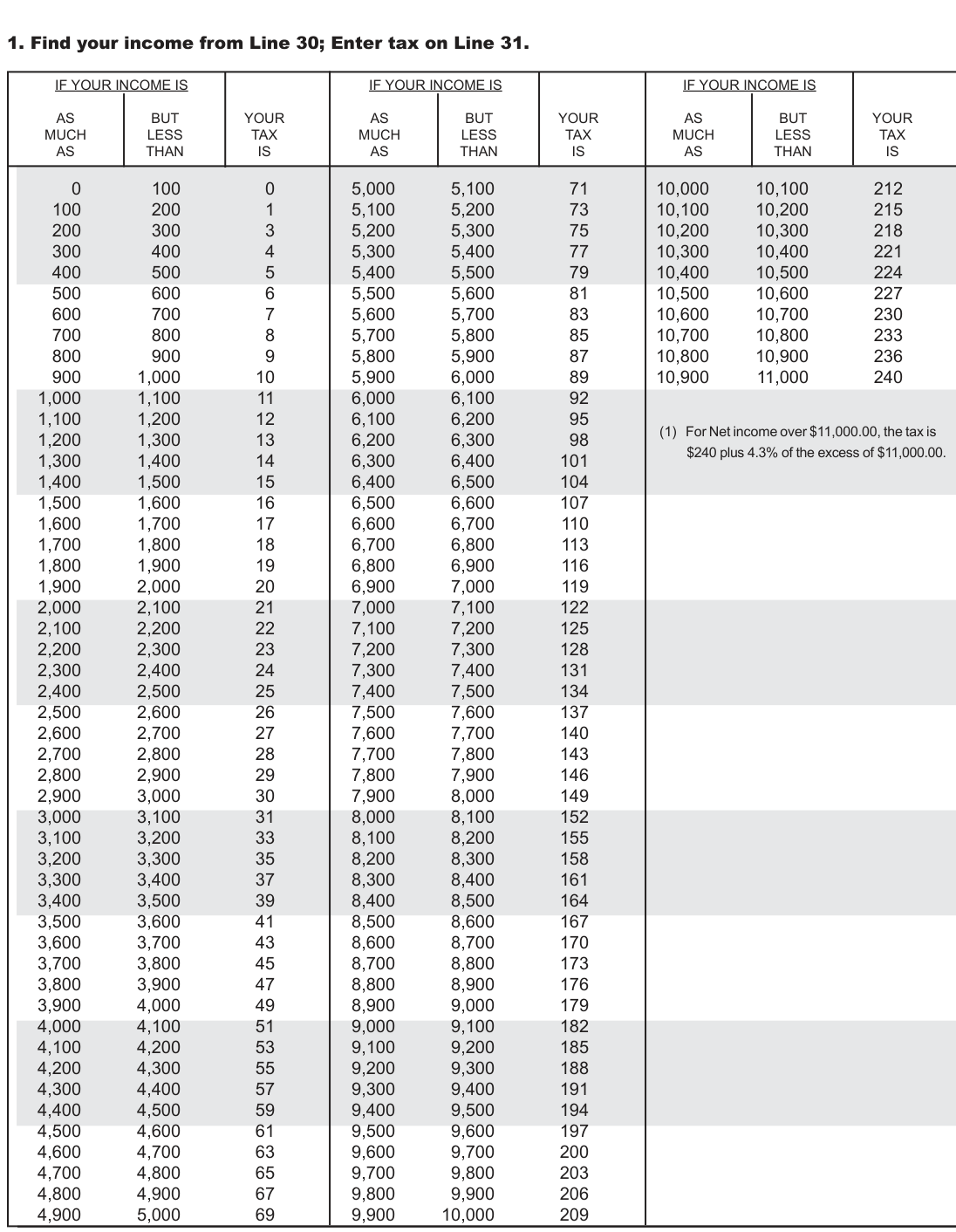
Text version of this table
| in | d your in | come from L | ine 30; En | te | r tax o | n Line 31. | |||||
| IF YOUR INC | OME IS | IF YOUR IN | COME IS | IF YOUR IN | COME IS | ||||||
| AS | BUT Y | OUR | AS | BUT | YOUR | AS | BUT | YOUR | |||
| M | UCH | LESS | TAX | M | UCH | LESS | TAX | MUCH | LESS | TAX | |
| AS | THAN | IS | AS | THAN | IS | AS | THAN | IS | |||
| 0 | 100 | 0 | 5, | 000 | 5,100 | 71 | 10 | ,000 | 10,100 | 212 | |
| 100 | 200 | 1 | 5, | 100 | 5,200 | 73 | 10 | ,100 | 10,200 | 215 | |
| 200 | 300 | 3 | 5, | 200 | 5,300 | 75 | 10 | ,200 | 10,300 | 218 | |
| 300 | 400 | 4 | 5, | 300 | 5,400 | 77 | 10 | ,300 | 10,400 | 221 | |
| 400 | 500 | 5 | 5, | 400 | 5,500 | 79 | 10 | ,400 | 10,500 | 224 | |
| 500 | 600 | 6 | 5, | 500 | 5,600 | 81 | 10 | ,500 | 10,600 | 227 | |
| 600 | 700 | 7 | 5, | 600 | 5,700 | 83 | 10 | ,600 | 10,700 | 230 | |
| 700 | 800 | 8 | 5, | 700 | 5,800 | 85 | 10 | ,700 | 10,800 | 233 | |
| 800 | 900 | 9 | 5, | 800 | 5,900 | 87 | 10 | ,800 | 10,900 | 236 | |
| 900 | 1,000 | 10 | 5, | 900 | 6,000 | 89 | 10 | ,900 | 11,000 | 240 | |
| 1, | 000 | 1,100 | 11 | 6, | 000 | 6,100 | 92 | ||||
| 1, | 100 | 1,200 | 12 | 6, | 100 | 6,200 | 95 | ||||
| (1 | ) For Net inco | me over $11,000.0 | 0, the t | ||||||||
| 1, | 200 | 1,300 | 13 | 6, | 200 | 6,300 | 98 | ||||
| $240 plus 4 | .3% of the excess of | $11,0 | |||||||||
| 1, | 300 | 1,400 | 14 | 6, | 300 | 6,400 | 101 | ||||
| 1, | 400 | 1,500 | 15 | 6, | 400 | 6,500 | 104 | ||||
| 1, | 500 | 1,600 | 16 | 6, | 500 | 6,600 | 107 | ||||
| 1, | 600 | 1,700 | 17 | 6, | 600 | 6,700 | 110 | ||||
| 1, | 700 | 1,800 | 18 | 6, | 700 | 6,800 | 113 | ||||
| 1, | 800 | 1,900 | 19 | 6, | 800 | 6,900 | 116 | ||||
| 1, | 900 | 2,000 | 20 | 6, | 900 | 7,000 | 119 | ||||
| 2, | 000 | 2,100 | 21 | 7, | 000 | 7,100 | 122 | ||||
| 2, | 100 | 2,200 | 22 | 7, | 100 | 7,200 | 125 | ||||
| 2, | 200 | 2,300 | 23 | 7, | 200 | 7,300 | 128 | ||||
| 2, | 300 | 2,400 | 24 | 7, | 300 | 7,400 | 131 | ||||
| 2, | 400 | 2,500 | 25 | 7, | 400 | 7,500 | 134 | ||||
| 2, | 500 | 2,600 | 26 | 7, | 500 | 7,600 | 137 | ||||
| 2, | 600 | 2,700 | 27 | 7, | 600 | 7,700 | 140 | ||||
| 2, | 700 | 2,800 | 28 | 7, | 700 | 7,800 | 143 | ||||
| 2, | 800 | 2,900 | 29 | 7, | 800 | 7,900 | 146 | ||||
| 2, | 900 | 3,000 | 30 | 7, | 900 | 8,000 | 149 | ||||
| 3, | 000 | 3,100 | 31 | 8, | 000 | 8,100 | 152 | ||||
| 3, | 100 | 3,200 | 33 | 8, | 100 | 8,200 | 155 | ||||
| 3, | 200 | 3,300 | 35 | 8, | 200 | 8,300 | 158 | ||||
| 3, | 300 | 3,400 | 37 | 8, | 300 | 8,400 | 161 | ||||
| 3, | 400 | 3,500 | 39 | 8, | 400 | 8,500 | 164 | ||||
| 3, | 500 | 3,600 | 41 | 8, | 500 | 8,600 | 167 | ||||
| 3, | 600 | 3,700 | 43 | 8, | 600 | 8,700 | 170 | ||||
| 3, | 700 | 3,800 | 45 | 8, | 700 | 8,800 | 173 | ||||
| 3, | 800 | 3,900 | 47 | 8, | 800 | 8,900 | 176 | ||||
| 3, | 900 | 4,000 | 49 | 8, | 900 | 9,000 | 179 | ||||
| 4, | 000 | 4,100 | 51 | 9, | 000 | 9,100 | 182 | ||||
| 4, | 100 | 4,200 | 53 | 9, | 100 | 9,200 | 185 | ||||
| 4, | 200 | 4,300 | 55 | 9, | 200 | 9,300 | 188 | ||||
| 4, | 300 | 4,400 | 57 | 9, | 300 | 9,400 | 191 | ||||
| 4, | 400 | 4,500 | 59 | 9, | 400 | 9,500 | 194 | ||||
| 4, | 500 | 4,600 | 61 | 9, | 500 | 9,600 | 197 | ||||
| 4, | 600 | 4,700 | 63 | 9, | 600 | 9,700 | 200 | ||||
| 4, | 700 | 4,800 | 65 | 9, | 700 | 9,800 | 203 | ||||
| 4, | 800 | 4,900 | 67 | 9, | 800 | 9,900 | 206 | ||||
| 4, | 900 | 5,000 | 69 | 9, | 900 | 10,000 | 209 |
Tables and rate charts from the source document
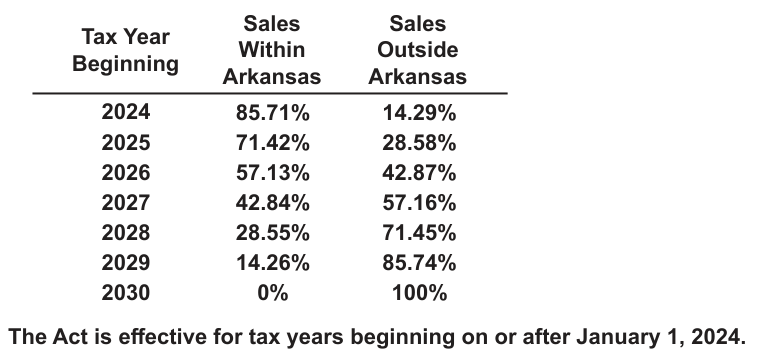
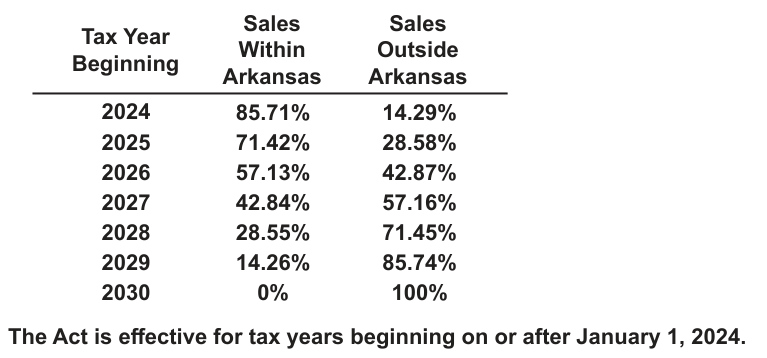
Source: view the official PDF
Nearby sections (16 sections)
- AR1100ADJ_Instructions · Schedule AR1100ADJ — Corporate Adjustments…
- AR1100NOL_Instructions · Schedule AR1100NOL — Corporate Net Operating…
- AR1100PET_Instructions · Form AR1100PET — Pass-Through Entity Tax…
- AR1100REC_Instructions · Form AR1100REC — Corporate Recapture…
- AR2210_Instructions · Form AR2210 — Penalty for Underpayment of…
- AR2220-CT_Instructions · Form AR2220-CT — Underpayment of Estimated Tax…
- AR2220-PET_Instructions · Form AR2220-PET — Underpayment of Estimated…
- AR2220A-PET_Instructions · Form AR2220A-PET — Annualized PET Estimated…
- AR941PT_Instructions · Form AR941PT — Pass-Through Withholding…
- AR_K-1FE_Fiduciary_Instructions · Schedule AR K-1FE — Fiduciary K-1…
- AR_K-1_Partnership_Instructions · Schedule AR K-1 (Partnership) —…
- CompositeTaxReturn_Instructions · Form AR1000CR — Composite Tax Return…
- CorporationIncomeTax_Instructions · Form AR1100CT — Corporation Income…
- FiduciaryTax_Instructions · Form AR1002F/NR — Fiduciary Tax…
- PartnershipTax_Instructions · Form AR1050 — Partnership Tax…
- Whatsnew2025_SalesUse · 2025 Sales & Use Tax Law Changes (TY2025…