REV-413 (I) — Instructions for Estimating PA Personal Income Tax
# Instructions for Estimating PA Personal Income Tax
REV-413 (I) IN 08-24
WHAT'S NEW
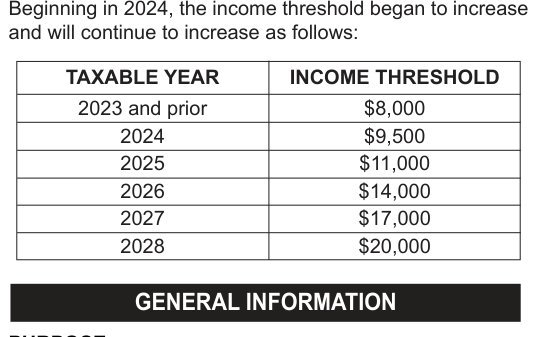
The income threshold for when estimated payments are required to be made is $11,000 for the 2025 tax year.
Beginning in 2024, the income threshold began to increase and will continue to increase as follows:
# TAXABLE YEAR INCOME THRESHOLD
# GENERAL INFORMATION PURPOSE
The REV-413 (I) is used by individual taxpayers for determining if they are required to make estimated tax payments, the amount of their estimated tax liability, the amount of their estimated tax payments, and when the estimated tax payments are due. The REV-413 (I) also provides the instructions for the REV-414 (I), Individuals Worksheet for PA Estimated Tax, and the PA-40 ES (I), Declaration of Estimated Personal Income Tax.
Estimated tax is the method used to pay tax on income not subject to employer withholding that includes, but is not limited to, the following types of income:
- Wages for domestic services;
- Tips received from customers;
- Wages paid to residents who are seamen engaged in interstate or intercoastal trade when PA income tax is not withheld by the employer;
- Wages paid to PA residents who work in the reciprocal states of Indiana, Maryland, New Jersey, Ohio, Virginia, or West Virginia when PA income tax is not withheld by the employer;
- Earnings from self-employment or profits made in a trade, profession, business, or farming by residents or nonresidents regardless of whether the nonresident is a resident of a reciprocal state or not;
- Gains from the sale, exchange, or disposition of property;
- Interest and dividends;
For Individuals Only
- Rents and royalties;
- Gambling and lottery winnings (except PA Lottery noncash winnings); and
- Income derived from estates and trusts.
# FORMS REQUIRED TO MAKE ESTIMATED TAX PAYMENTS
Individual taxpayers required to make estimated tax payments should obtain and complete the REV-414 (I), Individuals Worksheet for PA Estimated Tax, and the PA-40 ES (I), Declaration of Estimated Tax. Instructions for both forms are included within this document. The forms may be obtained from the department's website or by contacting the department's Forms Ordering Service at 1-800-362-2050.
The forms may also be obtained by sending written requests to:
# PA DEPARTMENT OF REVENUE TAX FORMS SERVICE UNIT
1854 BROOKWOOD ST
HARRISBURG PA 17104-2244
CAUTION: Do not mail estimated tax payments to this address. See the "Payment and Mailing Instructions" included in the Instructions for Completing the PA-40 ES (I), Declaration of Estimated Personal Income Tax, for mailing an estimated tax payment to the department.
# WHO MUST MAKE ESTIMATED TAX PAYMENTS
The estimated tax rules apply to:
- Resident and part-year resident individuals; and
- Nonresident individuals (or residents of other countries) that expect to have taxable income from sources within Pennsylvania.
Except for farmers as explained later in these instructions, an individual must make PA estimated tax payments if:
- The individual can reasonably expect to owe at least $338 ($11,000 of income not subject to employer withholding) in tax after subtracting withholding and credits; and
- The individual can reasonably expect withholdings and credits to be less than the smaller of:
- 90 percent of the tax to be shown on the 2025 personal income tax return; or
- 100 percent of the product of multiplying the net PA taxable income shown on the 2024 PA-40 return by 3.07 percent (0.0307). This calculation can only be used by a taxpayer who a filed full-year PA-40 return in 2024.
To determine the estimated tax liability, see the Instructions for Completing the REV-414 (I), Individuals Worksheet for PA Estimated Tax. Use the PA-40 ES (I), Declaration of Estimated Personal Income Tax, to declare and pay the estimated tax for individual taxpayers.
# JOINT DECLARATIONS
A taxpayer and spouse may file a joint return declaration, unless:
- They are separated under a decree of divorce or separate maintenance;
- They have different taxable years;
- One spouse is liable for child support; or
- One spouse is otherwise required by the department to file a separate return. See the PA-40 Instruction Booklet for Married, Filing Separately filing status for details on who must file separate returns.
To avoid problems and delays in processing a PA-40, Personal Income Tax Return, a taxpayer and spouse should file tax returns in the same manner as they made their estimated installment payments. If a taxpayer spouse made joint estimated payments, file a joint return. If a taxpayer and spouse made separate estimated payments, please file separate returns claiming the proper amounts on each return. If a taxpayer and spouse are required to file differently or need to file differently from the way they submitted their estimated payments, complete the REV-459B, Consent to Transfer, Adjust, or Correct PA Estimated Personal Income Tax Account form, to adjust the estimated accounts.
SAFE HARBOR RULES
For individual taxpayers required to make estimated tax payments, the department will not impose the estimated underpayment penalty when:
- The total timely estimated tax payments and credits are at least equal to an amount calculated using the current year's tax rate times the net taxable income on the prior year's PA-40, Personal Income Tax Return (NOTE: This exception does not apply if no return was filed in the prior year or the taxpayer was not a full-year resident of Pennsylvania.); or
- For each installment period, the timely estimated tax payments and credits are at least 90 percent of the actual tax due on the income earned or received for each installment period.
CAUTION: Individuals cannot use the prior year PA-40, Personal Income Tax Return, tax liability as this year's estimated tax to avoid underpayment penalty unless the tax rate for both tax years is the same and the taxpayer was a full-year resident for the prior tax year.
# ESTIMATED TAX PAYMENT AMOUNT
See the Instructions for Completing the REV-414 (I), Individuals Worksheet for PA Estimated Tax, and the Amount of Payment instructions included in the Instructions for Completing the PA-40 ES (I), Declaration of Estimated Personal Income Tax, for determining the amount of an individual's estimated tax payments.
# ESTIMATED TAX PAYMENT DUE DATES
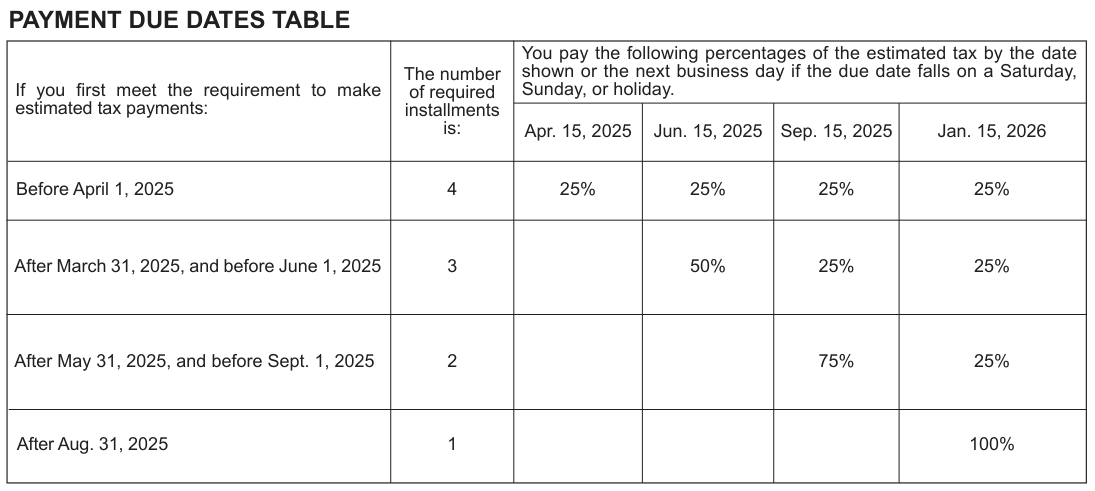
Use the Payment Due Dates Table later in these instructions to determine the due date of each installment.
# FARMERS
If at least two-thirds of a taxpayer's gross income for 2025 will be from farming, a taxpayer may do one of the following:
- Pay all of the estimated tax by Jan. 15, 2026; or
- File a 2025 PA tax return by March 2, 2026, and pay the total tax due. In this case, 2025 estimated tax payments are not required.
# AMENDING ESTIMATED TAX PAYMENTS
An individual that has a change in income or credits during a tax year may be required to elect to change or amend the estimated tax liability and subsequent estimated tax payments. To change or amend the estimated tax liability and subsequent estimated tax payments, use the REV-414 (I), Individuals Worksheet for PA Estimated Tax, to recalculate the estimated tax liability. After completing the recalculation, subtract any estimated tax payments already paid or carryover credits from the previous tax year. Use Line 5 of Section II from the REV-414 (I), the Payment Due Dates Table, and the Amount of Payment instructions included in the Instructions for Completing the PA-40 ES (I), Declaration of Estimated Personal Income Tax, to determine the amount of the subsequent estimated tax payments.
# PENALTY FOR FAILURE TO PAY ESTIMATED TAXES
In some cases, a taxpayer may owe an interest penalty when an estimated tax payment is not made and/or the amount is underpaid. PA law imposes this penalty on each underpayment for the number of days that it remains unpaid, but not beyond the due date for the tax return. PA law imposes the penalty:
- When the individual did not make the estimated tax payments on time and/or in the required amount.
- Even if the individual has an overpayment on the PA-40, Personal Income Tax Return.
Individuals that have $11,000 or more of income not subject to employer withholding for a tax year in which estimated tax payments are due may be subject to the estimated underpayment penalty. The penalty is due for all estimated tax payment periods in which an estimated tax payment is not made, or is underpaid, and no exceptions are met for the periods.
The penalty is due even if the income for (an) earlier payment period(s) is (are) less than an annualized income amount of $11,000. The penalty is due when the income for
# PAYMENT DUE DATES TABLE
Text version of this table
If you first meet the requirement to make estimated tax payments: The number of required installments is: You pay the following percentages of the estimated tax by the date shown or the next business day if the due date falls on a Saturday, Sunday, or holiday. Apr. 15, 2025 Jun. 15, 2025 Sep. 15, 2025 Jan. 15, 2026 Before April 1, 2025 4 25% 25% 25% 25% After March 31, 2025, and before June 1, 2025 3 50% 25% 25% After May 31, 2025, and before Sept. 1, 2025 2 75% 25% After Aug. 31, 2025 1 100%
Individuals, for additional information on how to calculate the estimated underpayment penalty and qualifying for an exception to the underpayment penalty.
NOTE: The department will notify an individual with a preassessment or assessment notice if the individual is subject to the estimated underpayment penalty. Individuals can calculate the correct amount of the penalty on the REV-1630, Underpayment of Estimated Tax by Individuals, if there is a disagreement with the amount of the penalty included on the notice.
INSTRUCTIONS FOR COMPLETING THE
REV-414 (I), INDIVIDUALS WORKSHEET
# FOR PA ESTIMATED TAX SECTION I
2025 PA ESTIMATED TAX PAYMENT WORKSHEET
LINE 1
2025 ESTIMATED INCOME
Enter the expected PA-taxable income for 2025. Do not include the amount of any compensation from which an employer will withhold PA income tax. Using information from prior years' tax returns as a basis as well as information from other sources, add up the expected positive income amounts from each of the classes of income reported on the PA-40, Personal Income Tax Return.
Jan. 15, 2026
Jun. 15, 2025 Sep. 15, 2025
25% 25% 25% 25%
50% 25% 25%
75% 25%
100%
LINE 2
2025 ESTIMATED TAX
Multiply Line 1 by 3.07 percent (0.0307) and enter the result.
LINE 3
ESTIMATED 2025 RESIDENT CREDIT FOR INCOME
# TAX PAID TO OTHER STATES
If income taxes are also expected to be paid in: another state of the United States; the District of Columbia; the Commonwealth of Puerto Rico; or any territory or possession of the United States, enter the amount of the expected resident credit for taxes paid to the other states.
LINE 4
# ESTIMATED PA SCHEDULE OC CREDIT
If a restricted tax credit is expected to be awarded and received in 2025, enter the amount of the expected credit.
Restricted tax credits are those tax credits which must be separately applied for and are awarded to taxpayers or businesses in which they are owners. Generally, a restricted tax credit is received only as a result of ownership in a PA S corporation or partnership, ownership of a sole proprietorship, ownership of a farm, or participation in a special purpose entity.
LINE 5
ESTIMATED 2025 SPECIAL
# TAX FORGIVENESS CREDIT
If the Special Tax Forgiveness Credit is expected to be received in 2025, enter the amount of the expected credit.
LINE 6
# ESTIMATED PA SCHEDULE DC CREDIT
If the Child and Dependent Care Enhancement Tax Credit is expected to be received in 2025, enter the amount of the expected credit.
LINE 7
# TOTAL ESTIMATED CREDITS
Add the amounts on Lines 3 through 6 and enter the result.
LINE 8
TOTAL 2025 ESTIMATED TAX
# NET OF ESTIMATED CREDITS
Subtract Line 7 from Line 2 and enter the result.
LINE 9
Multiply Line 8 by 90 percent (0.90) and enter the result.
LINE 10
# SAFE HARBOR METHOD INCOME
If a full-year PA-40 return was filed in 2024, enter 100 percent of the net PA taxable income from Line 11 of the 2024 PA-40, Personal Income Tax Return. If a return was not filed for 2024 or a part-year resident return was filed, the safe harbor method is not permitted to be used. Enter $0 if not eligible for the safe harbor method and skip Lines 11 through 14.
LINE 11
# SAFE HARBOR METHOD TAX LIABILITY
Multiply the amount on Line 10 by 3.07 percent (0.0307) and enter the result.
LINE 12
EXPECTED 2025 WITHHOLDINGS
Enter the amount of PA tax withholdings expected including any excess withholdings (over 3.07 percent) from employer compensation or withholdings from other sources such as Forms 1099-R or W-2G.
LINE 13
# TOTAL WITHHOLDINGS AND CREDITS
Add Lines 7 and 12.
LINE 14
# SAFE HARBOR METHOD NET ESTIMATED TAX LIABILITY
If Line 13 is less than Line 11, subtract Line 13 from Line 11 and enter the result. If Line 13 is more than Line 11, enter a 0 (zero).
LINE 15
TOTAL 2025 ESTIMATED TAX LIABILITY
Enter the smaller of Line 9 or Line 14.
LINE 16
# NONRESIDENT WITHHOLDING ADJUSTMENT
If nonresident withholding is expected from a PA Schedule NRK-1, Nonresident Schedule of Shareholder/Partner/Beneficiary Pass-Through Income, Loss, and Credits, for a PA S corporation, partnership, estate, or trust or withholding will be included on Forms 1099-MISC or 1099-NEC, enter the amount of nonresident withholding expected from those documents. Otherwise, enter a 0 (zero).
LINE 17
TOTAL 2024 REQUIRED ESTIMATED TAX
Subtract Line 16 from Line 15 and enter the result. If the amount is $338 or greater, this is the amount required to be paid in estimated tax for 2025. If the amount is less than $338, estimated tax payments are not required to be made.
# SECTION II AMENDED INDIVIDUAL PA ESTIMATED TAX SCHEDULE
LINE 1
Enter the amount from Line 17 of the REV-414 (I) Individuals Worksheet for PA Estimated Tax, after recalculating the Total 2025 Required Estimated Tax.
LINE 2
Enter the amount of the previous tax year's overpayment applied to the current year's estimated tax liability.
LINE 3
Enter the total amount of estimated tax payments made to date.
LINE 4
Add Lines 2 and 3 and enter the result.
LINE 5
Subtract Line 4 from Line 1 and enter the result. Refer to the Amending Estimated Tax Payment instructions for additional information.
# SECTION III
2025 RECORD OF ESTIMATED
# TAX PAYMENTS SCHEDULE
Use the chart to record the date and amount of estimated tax payments made along with the amount of any previous year's tax overpayment applied to the current tax year's estimated tax liability.
PAYMENT NUMBER 1
# COLUMN A
For the payment due Apr. 15, 2025, enter the date the estimated tax payment was made. If an estimated tax payment was not required to be made because the overpayment from the previous tax year was equal to or in excess of the estimated tax payment amount required to be made, enter April 15th of the tax year.
# COLUMN B
Enter the amount of the estimated tax payment made. If no estimated tax payment was made because the overpayment from the previous tax year was equal to or in excess of the estimated tax payment amount required to be made, enter a 0 (zero).
# COLUMN C
Enter the amount of any overpayment from the previous tax year applied up to the estimated tax payment amount required to be made for the period based upon the Amount of Payment instructions included in the Instructions for Completing the PA-40 ES (I), Declaration of Estimated Personal Income Tax, later within these instructions.
NOTE: An overpayment amount from the previous tax year in excess of the estimated tax payment amount required to be made for a period will be carried forward to subsequent estimated tax payment periods until there is no remaining balance of the overpayment to be applied.
# COLUMN D
Add the amounts from Column B and Column C and enter the result.
PAYMENT NUMBER 2
# COLUMN A
For the payment due Jun. 15, 2025, enter the date the estimated tax payment was made. If an estimated tax payment was not required to be made because the overpayment from the previous tax year was equal to or in excess of the estimated tax payment amount required to be made for the first and second estimated tax payment periods, enter a dash in the space and a 0 (zero) in Column B.
# COLUMN B
Enter the amount of the estimated tax payment made. If the overpayment from the previous tax year was more than the required estimated tax payment for the first estimated tax payment period but the remaining balance of the overpayment is less than the required estimated tax payment for the second estimated tax payment period, enter the amount of the estimated tax payment actually made.
# COLUMN C
If an estimated tax payment was not required to be made because the overpayment from the previous tax year was equal to or in excess of the estimated tax payment amount required to be made for the first and second estimated tax payment periods, enter a 0 (zero). If the estimated tax payment required to be made for the second estimated tax payment period was more than the remaining balance of the overpayment from the previous tax year after applying an amount to the first estimated tax payment period, enter the remaining balance of the overpayment amount to be applied.
# COLUMN D
Add the amounts from Column B and Column C and enter the result.
PAYMENT NUMBER 3
# COLUMN A
For the payment due Sept. 15, 2025, enter the date the estimated tax payment was made. If an estimated tax payment was not required to be made because the overpayment from the previous tax year was equal to or in excess of the estimated tax payment amount required to be made for the first, second, and third estimated tax payment periods, enter a dash in the space and a 0 (zero) in Column B.
# COLUMN B
Enter the amount of the estimated tax payment made. If the overpayment from the previous tax year was more than the required estimated tax payment for the first and second estimated tax payment periods but the remaining balance of the overpayment is less than the required estimated tax payment for the third estimated tax payment period, enter the amount of the estimated tax payment actually made.
# COLUMN C
If an estimated tax payment was not required to be made because the overpayment from the previous tax year was equal to or in excess of the estimated tax payment amount required to be made for the first, second, and third estimated tax payment periods, enter a 0 (zero). If the estimated tax payment required to be made for the third estimated tax payment period was more than the remaining balance of the overpayment from the previous tax year after applying amounts to the first and second estimated tax payment periods, enter the remaining balance of the overpayment amount to be applied.
# COLUMN D
Add the amounts from Column B and Column C and enter the result.
PAYMENT NUMBER 4
# COLUMN A
For the estimated tax payment Jan. 15, 2026, enter the date the estimated tax payment was made. If an estimated tax payment was not required to be made because the overpayment from the previous tax year was equal to or in excess of the estimated tax payment amount required to be made for the first, second, third, and fourth estimated tax payment periods, enter a dash in the space and a 0 (zero) in Column B.
# COLUMN B
Enter the amount of the estimated tax payment made. If the overpayment from the previous tax year was more than the required estimated tax payment for the first, second, and third estimated tax payment periods but the remaining balance of the overpayment is less than the required estimated tax payment for the fourth estimated tax payment period, enter the amount of the estimated tax payment actually made.
# COLUMN C
If an estimated tax payment was not required to be made because the overpayment from the previous tax year was equal to or in excess of the estimated tax payment amount required to be made for the first, second, third, and fourth estimated tax payment periods, enter a 0 (zero). If the estimated tax payment required to be made for the fourth estimated tax payment period was more than the remaining balance of the overpayment from the previous tax year after applying amounts to the first, second, and third estimated tax payment periods, enter the remaining balance of the overpayment amount to be applied.
# COLUMN D
Add the amounts from Column B and Column C and enter the result.
TOTAL
COLUMN B
Add the amounts in Column B and enter the result.
# COLUMN C
Add the amounts in Column C and enter the result. The result should equal the amount of overpayment applied from the previous tax year.
# COLUMN D
Add the amounts Column D and enter the result. The resulting total should equal or exceed the amount on Line 17 of Section I.
INSTRUCTIONS FOR COMPLETING THE
PA-40 ES (I), DECLARATION OF ESTI-
# MATED PERSONAL INCOME TAX
Individuals filing declarations must use the PA-40 ES (I), Declaration of Estimated Personal Income Tax, to make payments of estimated taxes. Failure to receive forms does not relieve taxpayers from filing and paying the tax.
# DATE FILED
Enter the due date of the estimated tax payment. Use the Payment Due Dates Table earlier in these instructions to determine the due date of the estimated tax payment.
PRIMARY SOCIAL SECURITY NUMBER
Enter the nine-digit Social Security number of the taxpayer.
SPOUSE'S SOCIAL SECURITY NUMBER
If a joint declaration and estimated tax payment is being filed, enter the nine-digit Social Security number of the spouse.
DAYTIME PHONE NUMBER
Enter the taxpayer's daytime phone number.
# LAST NAME
Enter the last name of the primary taxpayer. If filing a joint declaration and estimated tax payment, this is usually the name of the taxpayer that is listed first on the tax return for a Married, Filing Jointly status filed return.
# FIRST NAME
Enter the first name of the primary taxpayer. If filing a joint declaration and estimated tax payment, this is usually the name of the taxpayer that is listed first on the tax return for a Married, Filing Jointly status filed return.
# ADDRESS
Enter the taxpayer's complete street address. If the address has an apartment number, suite, or RR number, enter after the street address. Eliminate all punctuation such as apostrophes, commas, periods, and hyphens.
FISCAL YEAR FILERS ONLY
Enter the beginning and ending dates of the fiscal year only when the PA-40 return is not filed on a calendar-year basis.
# AMOUNT OF PAYMENT
Enter the amount of the estimated tax payment to be made for the payment due date. For most taxpayers, the following method may be used to determine the amount of each estimated tax payment:
- If making four estimated tax payments, multiply the amount on Line 17 of the REV-414 (I), Individuals Worksheet for PA Estimated Tax, by 25 percent and include the result in the "Amount of Payment" space on the PA-40 ES (I), for each of the four estimated tax payment dates.
- If an individual first becomes aware that estimated tax payments were required to be made after the first estimated tax payment date but before the second estimated tax payment date, multiply the amount on Line 17 of the REV-414 (I) by 50 percent and enter the result in the "Amount of Payment" space on the PA-40 ES (I) for the second estimated tax payment. For the last two estimated tax payments, multiply the amount on Line 17 of the REV-414 (I) by 25 percent and enter the result in the "Amount of Payment" space on the PA-40 ES (I).
- If an individual first becomes aware that estimated tax payments were required to be made after the second estimated tax payment date but before the third estimated tax payment date, multiply the amount on Line 17 of the REV-414 (I) by 75 percent and enter the result in the "Amount of Payment" space on the PA-40 ES (I) for the third estimated tax payment. For the remaining estimated tax payment, multiply the amount on Line 17 of the REV-414 (I) by 25 percent and enter the result in the "Amount of Payment" space on the PA-40 ES (I).
- If an individual first becomes aware that estimated tax payments were required to be made after the third estimated tax payment date but before the final estimated tax payment date, enter 100 percent of the amount on Line 17 of the REV-414 (I) in the "Amount of Payment" space on the PA-40 ES (I).
Taxpayers that receive their income unequally throughout the tax year may also pay their estimated tax payments based upon the amount of income received during an estimated tax payment period. To determine the amount of the estimated tax payment using this method:
A. Separately calculate the income received within an estimated tax payment period using the estimated tax payment period as provided in either the first column of the Payment Due Dates Table.
B. Multiply the income amount received by 90 percent.
C. Multiply the result from Step B by 3.07 percent (0.0307).
D. Enter the result from Step C in the "Amount of Payment" space on the PA-40 ES (I).
E. Repeat Steps A through D for each estimated tax payment period.
NOTE: A taxpayer may also elect to pay the entire amount of the estimated tax from Line 35 on the first estimated tax payment due date.
Typically, the amount is based upon Line 17 of the REV-414
(I) divided by four unless a carryover credit amount was applied from the previous tax year or a make-up payment for (a) previous estimated tax payment period(s) must be made.
If a carryover credit exists from the previous tax year, the amount is considered to be applied to the first estimated tax payment amount and period regardless of when the previous tax year's return is filed and/or processed by the department.
Any amounts in excess of the required estimated tax payment for the first estimated payment period are considered to be carried to the subsequent payment period(s) until the carryover amount is completely applied against the amount required for subsequent payment periods. If any carryover amount is less than the required amount for a payment period, the payment amount to be made for the payment period should be the difference between the estimated tax payment amount and the remaining carryover amount.
# DECLARATION OF ESTIMATED TAX OR ESTIMATED WITHHOLDING TAX
Enter the total amount of estimated tax payments to be made from Line 17 of the REV-414 (I) Individuals Worksheet for PA Estimated Tax.
# PAYMENT AND MAILING INSTRUCTIONS
To make the estimated tax payment and mail it to the department, use the following instructions:
- Make the check or money order payable to the "PA Dept. of Revenue";
- Write the last four digits of the primary taxpayer's Social Security number and "2025 estimated tax payment" on the check or money order;
- Do not staple or attach the payment to the PA-40 ES (I),
- Mail the payment and PA-40 ES (I), to the following address:
PA DEPARTMENT OF REVENUE
PO BOX 280403
HARRISBURG PA 17128-0403
- Fill in the record of estimated tax payments in Section III of the REV-414 (I) Individuals Worksheet for PA Estimated Tax
# ELECTRONIC SERVICES
Individuals can remit estimated, extension, and tax due payments through the department's myPATH portal. Visit mypath.pa.gov and select Make a Payment to pay via electronic funds transfer. Payments equal to or greater than $15,000 must be made electronically. Payments not made electronically will be subject to a penalty equal to 3 percent of the payment amount not to exceed $500.
Source: view the official PDF
Nearby sections (16 sections)
- pa-40nrc · PA-40 NRC — Nonresident Consolidated Income Tax Return
- pa-40o · PA-40 Schedule O — Other Deductions
- pa-40sp · PA-40 Schedule SP — Special Tax Forgiveness
- pa-40t · PA-40 Schedule T — Gambling and Lottery Winnings
- pa-40ue · PA-40 Schedule UE — Allowable Employee Business Expenses
- pa-40x · Schedule PA-40 X — Amended PA Personal Income Tax Schedule
- pa-41oi_in · PA-41 Schedule OI Instructions — Other Information…
- rct-101i · RCT-101-I — Inactive PA Corporate Net Income Tax Report
- rct-103in · RCT-103 Instructions — Net Operating Loss Schedule (PA…
- rct-128c_in · RCT-128C Instructions — Report of Change in PA Corporate…
- rev-1200 · REV-1200 — CT-1 PA Corporation Tax Instructions (RCT-101…
- rev-413f · REV-413 (F) — Instructions for Estimating PA Fiduciary…
- rev-413i · REV-413 (I) — Instructions for Estimating PA Personal Income…
- rev-414f · REV-414 (F) — PA Estimated Tax Worksheet (Estates and Trusts)
- rev-414i · REV-414 (I) — PA Estimated Tax Payment Worksheet…
- rev-717 · REV-717 — Retailer's Information Guide (State and Local…