PA-20S/PA-65 — S Corporation/Partnership Information Return
IMPORTANT: FILL IN FORM MUST BE DOWNLOADED ONTO YOUR COMPUTER PRIOR TO COMPLETING
Page 1 of 3(DR) MOD 09-25 (FI)
PA Department of Revenue
PLEASE PRINT. USE BLACK INK.
Fill in the applicable ovals
START Accounting Method
Filing Status:
§ Initial Year
PA-20S PA-65 P-S KOZ Extension Requested
Fiscal Year
FEIN 9 DIGIT - NO DASH NAICS Code Inactive
52/53 Week
C
Short Year
Business Name
Beginning Ending
MM/DD/YY
First Line of Address - Street Address - If Address has Apartment Number, Suite, RR No. - Place on this Line.
Final Return
FEIN/Name/Address
Second Line of Address - PO Box Change
Amended Information
Return
City or Post Office State ZIP Code Country Code Date activity began in PA
(MMDDYYYY)
SUBMIT ALL SUPPORTING SCHEDULES USE BLACK INK If a loss, fill in the oval next to the line
SECTION I. Total Taxable Business Income (Loss) from Operations Everywhere
LOSS
1a l00
1a Taxable Business Income (Loss) from Operations Everywhere … LOSS 1b l00 1b Share of Business Income (Loss) from All Other Entities … LOSS 1c l00 1c Total Income (Loss). Add Lines 1a and 1b … 1d Previously Disallowed CNI Deductions - PA S Corporations only … 1d l00
If a loss, enter "0"
LOSS
1e l00
1e Total Adjusted Business Income (Loss). Subtract Line 1d from Line 1c …
SECTION II. Apportioned/Allocated PA-Taxable
Outside PA PA Source
Business Income (Loss)
LOSS
2a l00
LOSS
2e l00
2 Net Business Income (Loss) …
2 Share of Business Income (Loss) from
LOSS
2b l00
LOSS
2f l00
Other Entities …
If a loss, enter "0" If a loss, enter "0"
2 Previously Disallowed PA Source CNI
Deductions - PA S Corporations only … 2c l00 2g l00 2 Calculate Adjusted/Apportioned Net Business LOSS 2d l00 LOSS 2h l00 Income (Loss) … Outside PA PA Source
SECTION III. Allocated Other PA PIT Income (Loss)
3 Interest Income from PA Schedule A … 3h l00
If a loss, enter "0"
4 Dividend Income from PA Schedule B … 4h l00
If a loss, enter "0"
LOSS LOSS l00 5b l00
5 Net Gain (Loss) from PA Schedule D … 5a
6 Rent/Royalty Net Income (Loss) from
LOSS LOSS l00 6b l00
PA Schedule M, Part II … 6a
7 Estates or Trusts Income from PA Schedule J … 7a l00 7b l00 If a loss, enter "0" If a loss, enter "0"
# LOSS LOSS
8 Gambling and Lottery Winnings (Loss) from PA Schedule T 8a l00 8b l00 LOSS 9b l00 9 Total Other PA PIT Income (Loss) …
# EC OFFICIAL USE ONLY FC RESET FORM TOP OF PAGE NEXT PAGE PRINT
PA-20S/PA-65
Page 2 of 3(DR) MOD 09-25 (FI)
PA Department of Revenue
9 DIGIT - NO DASH
FEIN Business Name
C
SECTION IV. Total PA S Corporation or Partnership Income (Loss)
LOSS
10 Total Income (Loss) per Books and Records … 10 l00 LOSS 11 Total Reportable Income (Loss). Add Lines 1e and 9 or add Lines 2h and 9 … 11 l00 LOSS 12 Total Nontaxable/Nonreportable Income (Loss). Subtract Line 11 from Line 10 … 12 l00
SECTION V. Pass Through Credits - See the PA-20S/PA-65 instructions
If a loss, enter "0"
13a Total Other Credits. Submit PA-20S/PA-65 Schedule OC … 13a l00
If a loss, enter "0"
13b Resident Credit … 13b l00
If a loss, enter "0"
14a PA 2025 Quarterly Tax Withholding Payments/Extension Payment for Nonresident Owners … 14a l00
If a loss, enter "0"
14b Final Payment of Nonresident Withholding Tax … 14b l00 14c Total PA Nonresident Withholding. Add Lines 14a and 14b … 14c l00
If a loss, enter "0"
SECTION VI. Distributions - See the PA-20S/PA-65 instructions - Partnerships Only
If a loss, enter "0"
15 Distributions of Cash, Marketable Securities, and Property … 15 l00
If a loss, enter "0"
16 Guaranteed Payments for Capital or Other Services … 16 l00
If a loss, enter "0"
17 All Other Guaranteed Payments for Services Rendered … 17 l00
If a loss, enter "0"
18 Guaranteed Payments to Retired Partners … 18 l00 Distributions - See the PA-20S/PA-65 instructions - PA S Corporations Only
If a loss, enter "0"
19 Distributions from PA Accumulated Adjustments Account … 19 l00 20 Distributions of Cash, Marketable Securities, and Property … 20 l00
If a loss, enter "0"
SECTION VII. Other Information - See the PA-20S/PA-65 instructions for each line Yes or No During the entity's tax year, did the entity own any interest in another partnership or in any foreign entity that was disregarded as an entity separate from its owner under federal regulations Sections 301.7701-2 and 301.7701-3?
If yes, submit statement … 1
Does the entity have any tax-exempt partners/members/shareholders? If yes, submit statement … 2 Does the entity have any foreign partners/members/shareholders (outside the U.S.)? If yes, submit statement … 3 Was there a distribution of property or a transfer (e.g., by sale or death) of a partner/member interest during the tax year? (Partnership only) If yes, submit statement … 4 Has the federal government changed taxable income as originally reported for any prior period? If yes, indicate period on supplemental statement, and submit final IRS determination paperwork … 5 Does the entity elect to be subject to assessment at the entity level under Act 52 of 2013? … 6 Is this entity involved in a reportable transaction, listed transaction, or registered tax shelter within this return?
If yes, submit statement … 7
Does the entity filing as a partnership have other partnerships as partners? … 8 Has the entity sold any tax credits? If yes, submit statement … 9 Has the entity changed its method of accounting for federal income tax purposes during this tax year? If yes, submit federal Form 3115 … 10 Has the entity elected to pay an entity level tax in another state? If yes, submit a statement listing which state(s). . . 11 PA Apportionment as reported on PA-20S/PA-65 Schedule H-Corp … 12 ●
# RESET FORM NEXT PAGE PRINT
PA-20S/PA-65
Page 3 of 3(DR) MOD 09-25 (FI)
PA Department of Revenue
9 DIGIT - NO DASH
FEIN Business Name
C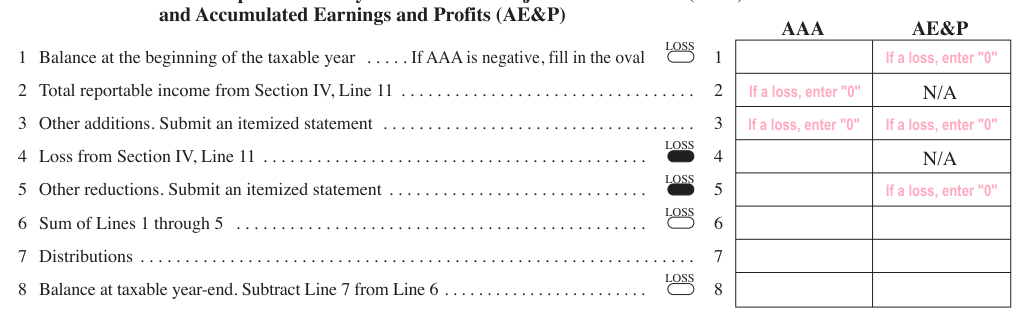
Text version of this table
If a loss, enter "0" I f a l o s s , e n t e r " 0 " N/A If a loss, enter "0" If a loss, enter "0" N/A If a loss, enter "0"
SECTION IX. Ownership in Pass Through Entities
If the entity received income (loss) from an S corporation, partnership, estate or trust, limited liability company, qualified subchapter S subsidiary
(QSSS) or disregarded entity, list below the FEIN, name and address for each entity. If the income (loss) is from a QSSS, enter "yes" in the QSSS box. If the income (loss) is from a disregarded entity other than a QSSS, enter "yes" in the D box. See Instructions for further details.
FEIN QSSS D
9 DIGIT - NO DASH a b c d e f
SECTION X. Signature and Verification
# NAME & ADDRESS
Under penalties of perjury, I declare I have examined this return, including accompanying schedules and statements, and to the best of my knowledge and belief, it is true, correct and complete. Declaration of paid preparer is based on all information of which preparer has any knowledge.
MM/DD/YY
Print/Type name of general partner, principal officer or Signature of general partner, principal officer or Date Daytime phone no. authorized individual authorized individual
Please Sign Your Return after printing.
Paid Preparer's Use Only
Print/Type preparer's name Preparer's signature Date Check if self-employed
Please Sign Your Return after printing.
Firm's name (or yours if self-employed) Daytime phone no.
Firms's address
Preparer's PTIN Firm's FEIN
9 DIGIT - NO DASH
E-File Opt Out
9 DIGIT - NO DASH
# RESET FORM THIS PAGE DOES NOT PRINT
Instructions for Form PA-20S/PA-65
PA S Corporation/Partnership Information Return Form PA-20S/PA-65 IN (DR) MOD 09-25 WHAT'S NEW
PA-20S/PA-65 INFORMATION RETURN
Do not abbreviate or use security features when entering the FEIN field for the return. Entities must use their FEIN as this field remains a required field when filing returns.
This form is an information return and is NOT to be used to request any refunds of tax. Line 14 in Section V is used to list the amount of payments of nonresident withholding made throughout the year along with any payment due with the filing of the return. Figures input on Line 14 should be taken directly from the corresponding lines of Schedule NW.
NOTE: All nonresident withholding MUST be allocated out to the associated nonresident owners on Line 6 of the nonresident owner's Schedule NRK-1. This amount should also match the amount shown as withheld for the nonresident owner in Section II of the Schedule NW.
# SCHEDULE NW
DO NOT report any withholding from 1099 forms as payment on the Schedule NW.
Please use the department's new form, REV-1897, Claim for Refund/Credit by Pass-Through Entity for Incorrect
Withholding.
DO NOT attach the REV-1897 to the PA-20S/PA-65. See the REV-1897 form instructions for filing requirements.
The REV-1897 will not be processed until a PA-20S/PA-65 is filed for the year in question by the entity.
1099-MISC/NEC WITHHOLDING
Pass-through entities are not subject to withholding for business and/or rental income. If a pass-through entity was issued a 1099-MISC/NEC containing Pennsylvania withholding, the entity cannot claim the withholding on its PA-20S/PA-65 form. Instead, the pass-through entity must complete the REV-1897 Claim for Refund/Credit by Pass-Through Entity for Incorrect Withholding, and submit it to the department per the instructions on the form.
Do not enter any 1099-MISC/NEC Pennsylvania withholding on lines 14a, b, or c of the PA-20S/PA-65 form.
The pass-through entity should notify the payer who issued the 1099-MISC/NEC to stop withholding by completing the REV-1832 Nonresident Withholding Exemption Certificate and providing it to the payer.
# HOW TO GET FORMS AND PUBLICATIONS ONLINE
Visit the department's website at revenue.pa.gov to:
● Download Forms and Publications and instructions via the search feature. Current and past year tax forms can be found online;
● Get Assistance and Contact Us for frequently asked questions, help with returns, and other tax questions;
● Search taxing questions online by topic or keyword.
EMAIL
Requests for paper copies of old year forms should be sent to ra-forms@pa.gov.
# WRITTEN REQUESTS
Send written requests for forms to:
# PA DEPARTMENT OF REVENUE TAX FORM SERVICE UNIT
1854 BROOKWOOD ST
HARRISBURG PA 17104-2244
BY PHONE AND IN PERSON
You can order forms and publications by calling the department's automated, 24-hour, toll-free forms ordering message service at 1-800-362-2050.
You can also get most forms and publications at your nearest district office. Please call ahead to verify a district office's address and services or visit revenue.pa.gov for more information. Taxpayer assistance hours are 8:30 a.m. to 5:00 p.m., Monday through Friday, excluding holidays.
# COPIES OF PREVIOUSLY FILED RETURNS
Pennsylvania tax records are confidential and may be released only to the taxpayer or pursuant to a release signed by the taxpayer. Unauthorized disclosure of tax information is a criminal offense.
To receive copies of previously filed tax returns, complete and sign Form REV-467, Authorization for Release of Tax Records, and send it to:
EMAIL ra-rvpa-rvdisclosure@pa.gov
MAIL
ATTN: DISCLOSURE OFFICE
PA DEPARTMENT OF REVENUE
PO BOX 281200
HARRISBURG PA 17128-1200
Please attach the required documentation, which may include Form REV-467, Authorization for Release of Tax Records.
Please see the form instructions for more details. If someone other than the taxpayer is making the request, Form REV-677, Power of Attorney and Declaration of Representative, must be submitted along with a signed REV-467, signed by the taxpayer, authorizing the release of tax documents to a third party. If a power of attorney is provided from the private sector, it will be sent to the Office of Chief Counsel for legal review before the release of any records will occur. If a taxpayer is deceased, sufficient evidence to establish authority to act for the taxpayer's estate must be provided to the department.
Please allow four to six weeks for a request to be processed.
# PRIVACY NOTIFICATION
By law (42 U.S.C. §405(c)(2)(C)(i); 61 Pa. Code §117.16), the department has the authority to use the Social Security number (SSN) to administer the Pennsylvania personal income tax and other Commonwealth of Pennsylvania tax laws.
The department uses the SSN to identify individual taxpayers and verify their incomes. The department also uses the SSN to administer a number of tax-offset and child-support programs that federal and Pennsylvania laws require.
The commonwealth may also use the SSN in exchange-oftax information agreements with governmental authorities.
Except for official purposes, Pennsylvania law prohibits the commonwealth from disclosing information that individuals provide on income tax returns, including the SSN(s).
# GENERAL INFORMATION PURPOSE OF FORM
The PA-20S/PA-65 form is an information return and personal income tax filing requirement used to report the income (losses), deductions, credits, etc., from the operation of foreign or domestic PA S corporations, partnerships or limited liability companies classified as partnerships or S corporations for federal income tax purposes (further referred to as "entity" or "entities").
These entities do not pay tax on their income but "pass through" any profits or losses to their owners (shareholders, partners or members). When preparing the PA-20S/PA-65 PA S Corporation/Partnership Information Return, it is best to start with the completed federal Form 1120S or federal Form 1065 and then proceed to the Pennsylvania schedules.
The information on the PA-20S/PA-65 Information Return has no relevance to C corporations except if a credit from PA-20S/PA-65 Schedule OC has been allocated on the PA Schedule RK-1, Line 9 or NRK-1, Line 7. Otherwise, the only information relevant to a corporate taxpayer is the PA-20S/PA-65 Schedule H-Corp for calculating CNI tax.
IMPORTANT: Pass-through entities that fail to maintain accurate lists of owner/beneficiary names, addresses, and tax identification numbers may subject the general partner, tax matters partner, corporate officer and/or trustee of the partnership, S corporation, trust or estate to responsible party assessments holding them individually liable for tax, penalty, and interest owed by the entity.
# WHO MUST FILE
Every domestic or foreign PA S corporation (72 P.S. § 7330.1), partnership (72 P.S. §7335(c)) or entity formed as a limited liability company that is classified as a partnership or S corporation for federal income tax purposes must file the PA-20S/PA-65 Information Return if any of the following apply:
- During the taxable year, the partnership, PA S corporation or its qualified subchapter S subsidiary earned, received or acquired any gross taxable income (loss) allocable or apportionable to Pennsylvania, regardless of the amount of its income (loss) and whether or not the income was distributed; or
- During the taxable year, the PA S corporation had at least one shareholder that was a Pennsylvania resident individual, estate, trust or disregarded entity owned by a resident individual; or at least one shareholder that was a part-year Pennsylvania resident individual or disregarded entity owned by a part-year resident individual; or
- The partnership, at year-end, had at least one partner that was a Pennsylvania resident individual, estate, trust or disregarded entity owned by a resident individual.
A $250 penalty may be imposed for failure to file the PA-20S/PA-65. In addition, a $250 penalty may be imposed for each missing RK-1, NRK-1 and Schedule H-Corp.
INACTIVE S CORPORATIONS AND PARTNERSHIPS
If the PA S corporation or partnership was inactive during the entire tax reporting period, the entity must still submit the PA-20S/PA-65 Information Return and fill in the Inactive oval. If filing an information return as inactive, the PA S Corporation or partnership must include the PA-20S/PA-65 Partner Member Shareholder Directory and the PA Schedules RK-1 and/or NRK-1.
# CLASSIFYING INCOME
In many instances, Pennsylvania personal income tax law and regulations differ from federal tax laws. This is especially true with regard to federal elections concerning the timing of income and expense items.
Taxpayers should not use federal elections to determine Pennsylvania personal income tax income (loss).
PA S corporations, partnerships and limited liability companies classified as partnerships or S corporations for federal income tax purposes report income (loss) using the Pennsylvania personal income tax rules. Pennsylvania does not adopt federal rules for purposes of personal income taxation.
Accordingly, the determination of reportable amounts in each personal income tax classification may vary significantly from the classifications and amounts as determined for federal income tax purposes.
For Pennsylvania personal income tax purposes, read the rules for classifying income found in the PA Personal Income Tax Guide - Brief Overview and Filing Requirements. The income must be reported on the owner's tax return in the same classification of income as it is reported to them on their PA Schedules RK-1 and/or NRK-1 from the entity.
The entity must maintain sufficient books and records to properly report income (losses), expenses, credits, deductions, and other amounts for Pennsylvania personal income tax purposes. A PA S corporation or partnership that only operates a business, profession or farm must include all activities and transactions to determine Section I or Section II of the PA-20S/PA-65 Information Return, whichever is applicable, regardless of the name of the transaction and regardless of how it reports for federal income tax purposes.
Use PA-20S/PA-65 Schedule M to classify federal income
(loss) for Pennsylvania personal income tax purposes.
Please review the PA-20S/PA-65 Schedule M instructions on the department's website at revenue.pa.gov.
NOTE: Pennsylvania personal income tax law taxes resident partners, shareholders and members (owners) on income from sources within and outside Pennsylvania and taxes nonresident owners on Pennsylvania-source income only.
# PENALTY FOR FAILURE TO WITHHOLD
Pennsylvania law imposes a penalty for failure to remit nonresident withholding on or before the 15th day of the fourth month following the end of the taxable year. The penalty is 5 percent per month or fraction thereof, to a maximum of 50 percent, of the nonresident withholding due.
PENNSYLVANIA S CORPORATION
S STATUS (S ELECTIONS)
Starting with tax years beginning on or after Jan. 1, 2006, all corporations, including those incorporated in a state other than Pennsylvania, with a valid federal subchapter S election are considered Pennsylvania S corporations. Under Act 67 of 2006, all federal subchapter S corporations are Pennsylvania S corporations. Act 67 also includes a provision for federal subchapter S corporations to make an election to not be taxed as a Pennsylvania S corporation. To make this election, the taxpayer is required to file a completed REV-976, Election Not to be Taxed as a Pennsylvania S Corporation on or before the due date, or extended due date, of the report for the first period in which the election is to be in effect.
NOTE: 72 P.S.§7301(n.1) stipulates all federal S corporations filling in Pennsylvania are automatically PA S corporations.
PENNSYLVANIA S CORPORATION
S STATUS REVOCATIONS
An election to not be taxed as a PA S corporation may not be revoked for five years from the date it went into effect.
A revocation received within this five year period will be effective for the first tax period for which the taxpayer is eligible to revoke the election.
Elections that first went into effect in 2020 may be revoked for 2025. To revoke the election the corporation must send a letter signed by shareholders holding more than one-half of the shares of stock of the corporation on the day on which the revocation is made. This letter must contain the name of the corporation, the federal employer identification number
(FEIN) and the effective date of the revocation. If no effective date is provided the revocation will be effective for the first tax period for which the revocation was timely submitted. In the case of a corporation with qualified subchapter S subsidiaries, the letter must include the name and federal employer identification number (FEIN), if applicable, of all qualified subchapter S subsidiaries doing business in Pennsylvania.
Fax or mail the completed form to:
Fax: 717-787-3708
Email: ra-btftregisfax@pa.gov
# ELECTRONIC FILING
FED/STATE ELECTRONIC FILING FOR
S CORPORATIONS AND PARTNERSHIPS
The department will accept original and amended PA S Corporation/Partnership Information Returns (PA-20S/PA-65) including corresponding forms and schedules filed through the Modernized e-File (MeF) platform provided by the IRS (also known as the Fed/State e-File).
IMPORTANT: An amended PA-20S/PA-65 Information Return filed through Fed/State e-File will only be accepted for 2023 tax year returns and forward. You may not file an amended PA-20S/PA-65 Information Return through Fed/State e-File prior to the 2023 tax year return.
# See How To Amend the PA-20S/PA-65 Information Return
Prior to 2023 Tax Year Return.
Fed/State e-File is available through tax preparers or computer software. When you file using Fed/State e-file, the department sends an acknowledgement directly to you, your tax professional or Electronic Return Originator (ERO). Whoever submits the tax return will receive the acknowledgement.
The PA-20S/PA-65 Information Return can be filed through Fed/State e-File through an approved vendor that has tested with and been approved by the department to offer electronic filing in Pennsylvania. Even if a vendor is federally approved they must also be approved by Pennsylvania. As a result, every year vendors must go through a testing process for the department's approval of their software. When the vendors complete the testing process, they will be listed on the department's website.
NOTE: Mandatory e-filing is required for third-party preparers who prepare 11 or more PA-20S/PA-65 returns. The department published a "Method of Filing" notice [43 Pa.B. 5772] for electronic filing requirements in a Pennsylvania Bulletin on the PA Department of Revenue website.
Once subject to this mandate, the preparer must continue to e-file regardless of how many returns are prepared during a calendar year.
Tax filers may direct third party preparers to file returns in a different method than mandated.
# ELECTRONICALLY FILED RETURNS WITH ATTACHMENTS
When the PA-20S/PA-65 S Corporation/Partnership Information Return is filed through the Fed/State e-File, all attachments other than the PA-20S/PA-65 schedules must be sent in PDF format.
Examples of other attachments to an electronically filed PA-20S/PA-65 Information Return may include statements required with the PA-20S/PA-65 Information Return; PA Schedules RK-1 and NRK-1 that a pass through entity receives from another pass through entity; federal Form 3115, Application for Change in Accounting Method; federal Form 7004, Application for Automatic Extension of Time To File Certain Business Income Tax, Information, and Other Returns; and composite returns filed in other states.
The department will consider the tax return incomplete if all required documents are not submitted with an electronically filed return.
IMPORTANT: Do not include the PA-20S/PA-65
Schedules RK-1 and NRK-1 that the entity issues to its owners as a PDF attachment. These schedules are part of the e-File package for the PA-20S/PA-65 Information Return.
# HOW TO PAY ELECTRONICALLY
FED/STATE ELECTRONIC FILING OPTION FOR
# ESTIMATED NONRESIDENT INDIVIDUAL QUARTERLY WITHHOLDING PAYMENTS
The department accepts through the MeF Fed/State program the electronic payment of the quarterly estimated withholding tax for nonresident owners filed with the PA-65ES. The following types of payments can be electronically transferred if filed through Fed/State e-File program:
● Final nonresident individual tax withholding tax payment submitted with the 2025 tax year PA-20S/PA-65 Information Return; and ● 2026 (future) estimated payments for nonresident individual quarterly withholding tax submitted with the 2025 tax year PA-20S/PA-65 Information Return; and ● 2026 PA-65ES Quarterly Estimated Payments for nonresident individuals.
Future estimated nonresident individual tax withholding payments for tax year 2026 will be stored in the system as separate electronic transaction payments until the specified due date.
NOTE: Payments equal to or greater than $15,000 must be made electronically. Payments not made electronically will be subject to a penalty equal to 3% of the payment amount not to exceed $500. Payments can be made on the department's website using myPath at mypath.pa.gov and selecting Make a Payment under the section Payments. Select Pass-through Entity as account type.
# PAYMENT NOT SUBMITTED WITH ELECTRONIC RETURN
If the PA-20S/PA-65 Information Return has been electronically submitted and the nonresident withholding was not sent at the time of electronic submission of the return, then you may send a paper check for the nonresident withholding.
You may send in the PA-20S/PA-65 V Annual Payment Voucher with a check if the entity electronically files the PA-20S/PA-65 Information Return. Submit a check or money order made payable to the PA Dept. of Revenue along with the PA-20S/PA-65 V Annual Payment Voucher.
Print the entity's federal employer identification number
(FEIN) and "2025 PA-20S/PA-65" on the check or money order.
CAUTION: Failure to print the FEIN and "2025 PA-20S/PA-65" on your check will result in a delay of processing.
MAIL THE PAYMENT TO:
PA DEPARTMENT OF REVENUE
PO BOX 280502
HARRISBURG PA 17128-0502
For payment by check with paper tax return, See HOW TO PAY.
HOW TO AMEND THE PA-20S/PA-65
# INFORMATION RETURN
IMPORTANT: There is no statute of limitations to file an amended return when reporting additional income.
Amended returns cannot be filed in response to a
Department of Revenue Assessment. In those cases, an appeal must be filed with the Board of Appeals.
PRIOR TO 2023 TAX YEAR RETURN
If after filing the PA-20S/PA-65 Information Return, the entity discovers that an incorrect PA-20S/PA-65 tax return has been submitted to the department and/or has amended federal Form 1120S or 1065 or if the IRS changed or corrected any items of income, gain or loss previously reported, the entity must submit an amended PA-20S/PA-65 Information Return to the Pennsylvania Department of Revenue.
Prior to the 2023 tax year return, an amended PA S Corporation/Partnership Information Return (PA-20S/PA-65) cannot be filed through Fed/State e-File Program.
When amending a PA-20S/PA-65 Information Return that was originally filed through Fed/State e-File, the entity must:
● Obtain the paper form PA-20S/PA-65 Information Return for the year the entity wants to amend. Do not submit a photocopy of your original PA-20S/PA-65
Information Return;
● Complete the amended return including all schedules by entering the corrected information and submit it with the amended PA-20S/PA-65 Schedules RK-1 and/or NRK-1;
● Clearly mark the "Amended Information Return" oval on PA-20S/PA-65 Information Return and the "Amended Schedule" oval on the Schedules RK-1 and/or NRK-1;
● If applicable, clearly mark the following schedules and the "Amended Schedule" oval on PA Schedules D-I, D-II, D-III, D-IV and/or PA-65 Corp.
● Enter the amended amounts and enclose a statement explaining the reasons an amended return is being filed.
Submit only the forms or schedules supporting the amended amounts;
● Provide a copy of the amended PA-20S/PA-65 Schedules RK-1 and/or NRK-1 to the partners, shareholders or members; and ● Enclose a copy of the amended federal Form 1120S or federal Form 1065. If only amending the PA-20S/PA-65 Information Return, include the original federal Form 1120S or federal Form 1065 filed.
TAX YEAR RETURN 2023 AND FORWARD
For tax years 2023 and forward, the department will accept amended PA-20S/PA-65 Information Returns including corresponding forms and schedules filed through Fed/State e-File.
To file a 2023 or later amended return through Fed/State E-File, you can find the list of approved third party vendors on the Department's website under File my Taxes, Business, Approved Software. Scroll down until you find the appropriate tax year and select a vendor from that list.
WHEN TO AMEND THE PA-20S/PA-65
# INFORMATION RETURN OVER-REPORTED INCOME
If the entity over reported income, failed to claim allowable credits, failed to report allowable deductions, or events transpired that decreased its reportable Pennsylvania-taxable income, including an IRS report of change, the entity must file an amended PA-20S/PA-65 Information Return.
The amended return must be filed within three years of the original due date or payment of tax, whichever is later, of the PA-20S/PA-65 Information Return. The amended PA-20S/PA-65 Schedules RK-1 and/or NRK-1 must show the corrected Pennsylvania-taxable income, so the shareholders or partners can request refunds of Pennsylvania income tax they overpaid. See HOW TO AMEND THE PA-20S/PA-65 INFORMATION RETURN.
In order to request a refund, owners may either file an amended return within three years of the original due date or payment of tax, whichever is later, of their return or file a timely petition for refund with the Pennsylvania Board of Appeals. Refer to the owner's applicable income tax return instructions for more information.
# UNDER-REPORTED INCOME
If the entity under reported income, erroneously claimed credits or deductions to which it was not entitled, or events transpired that increased reportable Pennsylvania-taxable income, including an IRS report of change, the entity must file an amended PA-20S/PA-65 Information Return within 30 days from the determination of such increase. The amended PA-20S/PA-65 Schedules RK-1 and/or NRK-1 must show the corrected Pennsylvania-taxable income so the shareholders or partners can pay the tax due.
The entity and owners must also file an amended Pennsylvania tax return within 30 days of the discovery of the error to report any increase in income for taxes due. See HOW TO AMEND THE PA-20S/PA-65 INFORMATION RETURN.
# WHAT TO FILE PA S CORPORATIONS AND PARTNERSHIPS
Each entity submits with the PA-20S/PA-65 Information Return a complete copy of its federal income tax return including all schedules, statements, federal Schedules K-1, and PA-20S/PA-65 Schedules RK-1 and NRK-1 received from other pass through entities.
With the PA-20S/PA-65 Information Return, the entity must also submit copies of the PA-20S/PA-65 Schedules RK-1 that it provides to resident partners/shareholders (owners) and copies of the PA-20S/PA-65 Schedules NRK-1 that it provides to nonresident owners.
PA S CORPORATIONS AND PARTNERSHIPS AS
OWNERS OF ANOTHER PASS THROUGH ENTITY
If the shareholder, partner, member (owner) of a PA S corporation, partnership, limited liability company or a beneficiary of a trust or estate is classified as a pass through entity, the issuing entity must provide the entity owner with both PA-20S/ PA-65 Schedules RK-1 and NRK-1 showing the entity owner's share of the income (loss) passed through from the issuing entity in the same class in which the issuing entity reported the income to its entity owner.
When the entity owner receives a PA-20S/PA-65 Schedule RK-1 and NRK-1, it has the classified income (loss) amount to complete the PA-20S/PA-65 Information Return, Sections I, II and III. The entity owner is required to file both the PA-20S/PA-65 RK-1 and NRK-1 with their PA-20S/PA-65 Information Return.
Example. When a PA S corporation receives income from a partnership, the PA S corporation must file a copy of the PA Schedule RK-1 and NRK-1 it received from the partnership along with the PA-20S/PA-65 Information Return.
PARTNERSHIPS WITH C CORPORATION PARTNERS
Partnerships or limited liability companies classified as partnerships for federal income tax purposes with operations within Pennsylvania that have corporate partners that have not filed the RCT-101, PA Corporate Net Income Tax Report for the prior or current tax year or whose partners are all C corporations must file the PA-65 Corp, Directory of Corporate Partners.
If the partners are all C corporations, the partnership:
● Must include a complete copy of federal Form 1065 with the PA-65 Corp, Directory of Corporate Partners; PA Schedule H-Corp, Corporate Partner Apportioned Business Income (Loss); PA Schedule CP, Corporate Partner CNI Withholding; and ● Does not file a PA-20S/PA-65 Information Return.
For additional information, please review the instructions for the PA-65 Corp, Directory of Corporate Partners on the department's website.
# LIMITED PARTNERSHIP FILING AS DISREGARDED ENTITY FOR FEDERAL INCOME TAX PURPOSES
If an eligible entity has two members under local law but one of the members of the eligible entity is, for federal income tax purposes, disregarded as an entity separate from the other member of the eligible entity, then the eligible entity cannot be classified as a partnership. The eligible entity is either disregarded as an entity separate from its owner or an association taxable as a corporation.
If the eligible entity is disregarded as an entity separate from its owner and the owner is a partnership, PA S corporation or limited liability company that is classified as a partnership or S corporation for federal income tax purposes, the owner is required to file a PA-20S/PA-65 Information Return, list the eligible entity on Section IX, and include all of the eligible entity's items of income, deduction and credit on the return.
Example. A limited partnership (LP A) is owned by a singlemember limited liability company (SMLLC) and a limited partnership (LP B). The LP B owns 100 percent of the SMLLC which gives LP B 100 percent control of LP A. The LP B is required to file the PA-20S/PA-65 Information Return and report the income of both LP A and the SMLLC. LP B also reports both the SMLLC and LP A in Section IX.
# PA S CORPORATIONS AND PARTNERSHIPS FILING ON BEHALF OF THEIR QUALIFIED ELECTING
# NONRESIDENT INDIVIDUAL OWNERS
PA S corporations, partnerships and limited liability companies classified as partnerships and S corporations for federal income tax purposes may file a composite return (PA-40 NRC, Nonresident Consolidated Income Tax Return) on behalf of their qualified nonresident individual owners who elect to be included in the composite filing.
For additional information, please review the instructions for the PA-40 NRC, Nonresident Consolidated Income Tax Return on the department's website.
INDIVIDUAL OWNERS IN A PA S CORPORATION,
PARTNERSHIP OR LIMITED LIABILITY COMPANY
# CLASSIFIED AS A PARTNERSHIP OR S CORPORATION FOR FEDERAL INCOME TAX PURPOSES
Individual owners of an entity must report on the PA-40, Pennsylvania Income Tax Return, their share of the income (loss), passed through from the entity in the same class in which the partnership or PA S corporation reported the income to its individual owners, as shown on their PA Schedules RK-1 and/or NRK-1.
CLASSIFIED AS A C CORPORATION
A limited liability company that elects to file as a C corporation for federal income tax purposes files as a C corporation for Pennsylvania and is subject to Pennsylvania corporate net income tax, reported on the RCT-101, PA Corporate Net Income Tax Report. A limited liability company that files as a C corporation with the IRS does not file the PA-20S/PA-65 Information Return.
CLASSIFIED AS AN S CORPORATION
A limited liability company that elects to file as an S corporation for federal income tax purposes and has not elected out of PA Subchapter S status for Pennsylvania by filing form REV-976, Election Not To Be Taxed as A Pennsylvania S Corporation, must file as an S corporation for Pennsylvania using the PA-20S/PA-65 Information Return. The members are subject to Pennsylvania personal income tax.
CLASSIFIED AS A PARTNERSHIP
A limited liability company that elects to file as a partnership for federal income tax purposes files as a partnership for Pennsylvania using the PA-20S/PA-65 Information Return. The members are subject to Pennsylvania personal income tax.
CLASSIFIED AS A SINGLE-MEMBER
LIMITED LIABILITY COMPANY
- INCOME REPORTED ON FEDERAL TAX RETURN
OF AN INDIVIDUAL
For personal income tax purposes, a single-member limited liability company owned by an individual or a limited liability company jointly owned by a married couple that is filing as a disregarded entity for federal income tax purposes, does not file a PA-20S/PA-65 Information Return. The income of the limited liability company is reported on PA-40 Schedule C, Profit or Loss from Business or Profession, or PA-40 Schedule E, Rents and Royalty Income (Loss), of the member's PA-40, Pennsylvania Income Tax Return.
- INCOME REPORTED ON FEDERAL TAX RETURN
OF ANOTHER BUSINESS ENTITY
The income of a single-member limited liability company owned by another entity is reported on the tax return of the member as if earned by the member.
If the member is a partnership, PA S corporation or limited liability company that is classified as a partnership or S corporation for federal income tax purposes, it is required to file a PA-20S/PA-65 Information Return. List the single-member limited liability company on Section IX and include all of the single-member's items of income, deduction and credit on the return.
QUALIFIED SUBCHAPTER S SUBSIDIARY AND
ITS PARENT S CORPORATION
Pennsylvania personal income tax law does not treat a qualified subchapter S subsidiary (QSSS) owned by a PA S corporation (parent) as a separate corporation for personal income tax.
Pennsylvania personal income tax law treats all assets, liabilities and items of income, deduction and credit of a QSSS as assets, liabilities and items of income, deduction and credit of the parent PA S corporation for income tax purposes.
The parent PA S corporation must report the assets, liabilities and items of income, deduction and credit of the QSSS on the parent's PA-20S/PA-65 Information Return.
NOTE: Shareholders receive the income distribution from the parent corporation, not from each QSSS.
The following provisions apply only to a qualified subchapter S subsidiary in Pennsylvania:
● A QSSS cannot elect corporation treatment independent of its parent corporation.
If a QSSS and/or parent of a QSSS does not desire to be taxed as a PA S corporation, the parent must file a REV-976, Election Not to be Taxed as a Pennsylvania S Corporation, for itself and all QSSS(s). The parent corporation submits a schedule with the election identifying the name, address and federal employer identification number (FEIN) of each QSSS owned by the corporation and doing business in Pennsylvania.
● The parent corporation is not required to register with the Department of State if its only activity in Pennsylvania is its investment in the QSSS that is registered in Pennsylvania.
The parent is required to file a PA-20S/PA-65 Information Return and list the QSSS(s) on Section IX and include all of the QSSS' items of income, deduction and credit on the return. There is no ownership percentage for the QSSS because it is a division of the parent company.
Since the QSSS is a division of the parent company, the QSSS is not included on the Partner/Member/Shareholder Directory. Only the owners of the parent company are listed on the directory.
The parent PA S corporation may also file the PA-40 Nonresident Consolidated Income Tax Return
(NRC) for its nonresident owners if they meet the parameters. See the PA-40 NRC instructions on the department's website.
ASSEMBLING THE PA-20S/PA-65
PA S CORPORATION/PARTNERSHIP
# INFORMATION RETURN
Assemble the PA-20S/PA-65 Information Return, forms and schedules in the following order:
● Signed original PA-20S/PA-65 Information Return (Pages 1 through 3). Do not mail a photocopy. If all 3 pages are not included in the return packet - the return will be considered incomplete;
● PA Schedule P-S KOZ - attach behind the information return;
● PA-20S/PA-65 Partner/Member/Shareholder Directory;
● PA-20S/PA-65 Schedule D-I, D-II, D-III and D-IV;
● PA-20S/PA-65 Schedule E;
● PA-20A/PA-65 Schedules RK-1 that the entity provides to resident owners;
● PA-20S/PA-65 Schedules NRK-1 that the entity provides to nonresident owners;
● PA-20S/PA-65 Schedule M;
● PA-20S/PA-65 Schedule OC and the required supporting documents for claiming any of the business credits allowed by Pennsylvania law;
● PA-20S/PA-65 Schedule A;
● PA-20S/PA-65 Schedule B;
● PA-20S/PA-65 Schedule H;
● PA-20S/PA-65 Schedule H-Corp;
● PA-20S/PA-65 Schedule NW;
● PA-20S/PA-65 Schedule J;
● PA-20S/PA-65 Schedule T;
● PA-20S/PA-65 Schedule I;
● All other required supporting and supplemental documentation, including a copy of the federal extension.
NOTE: A complete copy of the federal Form 1120S, U.S. Income Tax Return for an S Corporation, or Form 1065, U.S. Return of Partnership Income, including all schedules, statements and federal Schedules K-1 must be included with the entity's PA-20S/PA-65 PA S Corporation/Partnership Information Return.
Assemble documents in the order above.
● Do not staple documents.
● On all additional statements included with the return, please include the entity's name, FEIN, tax year and brief line reference to PA-20S/PA-65 Information Return or PA-20S/PA-65 Schedules.
● The PA-20S/PA-65 Information Return will be considered incomplete if the federal information is not included with the paper return.
IMPORTANT: Do not create a substitute PA-20S/ PA-65 Information Return that has not been approved by the department. A spreadsheet is an unapproved and unacceptable tax form. Unapproved tax forms filed with the department may be rejected and returned to the taxpayer or tax return preparer. This may result in an assessment of interest and penalty.
If filing any tax form other than an official tax form, please review Miscellaneous Tax Bulletin 2008-02 on the department's website.
# ESTIMATED QUARTERLY TAX PAYMENTS FOR RESIDENT OWNERS
Individual resident partners and shareholders (owners) are subject to the estimated quarterly tax provisions under the Pennsylvania Personal Income Tax Act.
Resident owners must file declarations and make quarterly estimated Pennsylvania tax payments if they reasonably expect income, other than compensation on which Pennsylvania tax is withheld, to exceed $11,000.
The individual owners use REV-414 (I), Individuals Worksheet, and REV-413 (I), Instructions for Estimating PA Personal Income Tax (For Individuals Only), to determine the proper amount of estimated tax payments.
# ESTIMATED QUARTERLY WITHHOLDING PAYMENTS FOR NONRESIDENT OWNERS
Under Act 22 of 1991, entities must withhold and pay Pennsylvania personal income tax for nonresident partners and shareholders (owners) that are individuals, estates or trusts.
This withholding tax payment is based on each nonresident owner's expected share of distributable Pennsylvaniasource taxable income.
When there has been a change in an accounting period that requires filing of a short-year return, the tax is calculated on an annualized basis. See SHORT-YEAR RETURN.
The entity must indicate the amount of Pennsylvania personal income tax it withheld for each nonresident on the PA-20S/PA-65 Schedule NRK-1 and provide the PA-20S/ PA-65 Schedule NRK-1 to each nonresident owner.
Use the worksheet included with the PA-20S/PA-65 ES (P/S), Declaration of Estimated Withholding Tax for Partnerships and S Corporations, to determine the proper amount of withholding.
Partnerships or PA S corporations filing a nonresident quarterly withholding tax return should also use PA-20S/PA-65 ES (P/S), Declaration of Estimated Withholding Tax for Partnerships and S Corporations found on the department's website.
The partnership or PA S corporation makes the initial quarterly tax withholding payment and all future quarterly tax withholding payments under the federal employer identification number, name and address of the entity, not the shareholders/owners.
MAIL THE PA-20S/PA-65 ES (P/S) VOUCHER AND
CHECK TO:
PA DEPARTMENT OF REVENUE
PO BOX 280403
HARRISBURG PA 17128-0403
IMPORTANT: An entity cannot withhold Pennsylvania personal income tax on another entity or a Pennsylvania resident individual, and should not withhold Pennsylvania personal income tax on income from intangibles such as interest, dividends or sale of stock. Residents are required to make installment payments of estimated tax if Pennsylvania-taxable income not subject to employer withholding is reasonably expected to exceed $11,000 for the taxable year.
If the entity did not make any or sufficient estimated quarterly withholding tax payments for its nonresident owners, a final payment can be made with the filing of the PA-20S/PA-65 Information Return or PA-40 NRC, Nonresident Consolidated Income Tax Return. Failure to remit withholding payments for all nonresident owners may result in the imposition of interest, penalty and underpayment penalty. See HOW TO PAY for how and where to send the final nonresident withholding tax payment with the PA-20S/PA-65 Information Return.
Please review the instructions on the department's website for the PA-40 NRC, Nonresident Consolidated Income Tax Return, for how and where to send the final nonresident withholding tax payment with the PA-40 NRC, Nonresident Consolidated Income Tax Return.
Be sure to review the electronic option. See FED/STATE
# ELECTRONIC FILING OPTION FOR ESTIMATED NON-
RESIDENT INDIVIDUAL WITHHOLDING PAYMENTS.
OVERPAYMENT/ADJUSTMENT OF WITHHOLDING TAX
# FOR NONRESIDENT OWNERS
The PA-20S/PA-65 PA S Corporation/Partnership Information Return is for information purposes only.
It is not a return where you can indicate a refund or carryforward credit. Payments submitted to this account are for nonresident tax withholding only and are held for transfer to the partner, member or shareholder (owner) as indicated on their individual tax returns. The department will not make the assumption that the entity paid more than was needed.
The entity MUST pass through all of the nonresident tax payments including carry forward credits from the previous year as reported on Section V, Line 14c, Total PA Income Tax Withheld. This amount should agree to the amounts reported on Line 6 of the PA Schedule NRK-1. Nonresident owners can report the Line 6 nonresident tax withheld from their PA Schedule(s) NRK-1, as a tax payment on Page 2, Line 17 of their PA-40, Pennsylvania Income Tax Return, provided they are not eligible to be included in the filing of a PA-40 NRC return.
NOTE: Carry forward credits may include those from the previous year PA-40 Nonresident Consolidated Income Tax Return.
# WHEN TO FILE
File the PA-20S/PA-65 Information Return for the current calendar year or the fiscal year that begins in the current tax year and ends in the next tax year. Use the current tax year return for a tax year of less than 12 months that begins and ends in the current tax year.
The due date for filing 2025 Pennsylvania tax returns will be on or before midnight, April 15, 2026. The U.S. Postal Service postmark date on the envelope is proof of timely filing. If the return cannot be filed by the due date, request an extension of time to file.
For a calendar-year filer, file the current tax year PA-20S/ PA-65 Information Return and PA-20S/PA-65 Schedules RK-1 and NRK-1 on or before April 15, 2026, including an extension date of Sept. 15, 2026.
For a fiscal-year filer, file the current tax year PA-20S/PA-65 Information Return and PA-20S/PA-65 Schedules RK-1 and NRK-1 on or before the 15th day of the fourth month following the close of the fiscal year including an extension date of five months after the original due date. If the due date falls on a Saturday, Sunday or business holiday, the entity must file the PA-20S/PA-65 Information Return no later than midnight on the first business day following the Saturday, Sunday or business holiday. The U.S. Postal Service postmark date on the envelope is proof of timely filing.
If the entity cannot file by the original due date, request an extension of time to file. See EXTENSION OF TIME TO FILE.
If the entity does not file its return by the original due date or extended due date and does not pay the tax due by the original due date, the department imposes interest and penalty for late filing and payment.
# TAX YEARS
Pennsylvania follows the same tax year as federal rules.
# CALENDAR-YEAR ENTITY
An entity that files on a calendar year basis reports all taxable income recognized between Jan. 1 and Dec. 31.
See WHEN TO FILE.
# FISCAL-YEAR ENTITY
A fiscal year is a period of 12 consecutive months without regard to the calendar year. The fiscal year is designated by the calendar year in which it begins. A fiscal-year entity reports all taxable income recognized during the fiscal year.
See WHEN TO FILE.
An entity may use a 52/53 week taxable year if it keeps its books on that basis.
CHANGING FROM A FISCAL-YEAR ENTITY TO
A CALENDAR-YEAR ENTITY
To change from a fiscal-year filer to a calendar-year filer, the entity files a short-year return. See HOW TO FILE A SHORT-YEAR RETURN. The entity then files the next calendar year on or before April 15, 2026, including an extension date of Sept. 15, 2026.
The entity is also required to submit a copy of its federal election Form 1128, Application to Adopt, Change or Retain a Tax Year, with both the short-year return and the calendaryear return.
# SHORT-YEAR RETURN
A short year is an accounting period shorter than one year and not a 52/53 week taxable year.
A short-year return is required for the following reasons:
● Changes in the annual accounting period. For example, the entity changes from a fiscal-year filer to a calendaryear filer; or ● An entity is in existence during only part of the tax year.
For example, if the year is the initial year or final year for all entities.
NOTE: When there has been a change in an accounting period that requires filing of a short-year return, the nonresident withholding tax is calculated on an annualized basis.
# HOW TO FILE A SHORT-YEAR RETURN
If the entity is required to file a short-year return, the entity must use the most recent PA-20S/PA-65 Information Return, schedules and forms on the department's website.
If the tax year on the forms is not the current tax year and/or the tax year for which the entity is filing, then the entity must cross out and write the correct tax year for which it is filing a short-year return.
IMPORTANT: Short-year returns are due on the 15th day of the fourth month following the end of the short period.
If the entity is a calendar-year filer and files a shortyear return, do not fill in the fiscal-year oval. A shortyear return is not a fiscal-year return.
# EXTENSION OF TIME TO FILE
If the entity cannot file the PA-20S/PA-65 Information Return on or before the original return due date, the entity can use REV-276, Application for Automatic Extension of Time to File, to file for a five-month extension. The department accepts REV-276 Application for Automatic Extension of Time to File the PA-20S/PA-65 Information Return through myPath and the MeF Fed/State e-file program. See HOW TO OBTAIN AN EXTENSION OF TIME TO FILE.
The department will not grant an extension for more than five months, except for taxpayers outside the U.S.
IMPORTANT: An extension of time to file does not extend the payment deadline. Pay in full the amount reasonably estimated as the entity's Pennsylvania tax due on or before the original return due date.
# PENALTY FOR FAILURE TO WITHHOLD
Pennsylvania law imposes a penalty for failure to remit nonresident withholding on or before the 15th day of the fourth month following the end of the taxable year. The penalty is 5 percent per month or fraction thereof, to a maximum of 50 percent, of the nonresident withholding due.
# HOW TO OBTAIN AN EXTENSION OF TIME TO FILE
IMPORTANT: An extension of time to file a
PA-20S/PA-65 Information Return does not extend the time for full payment of the nonresident withholding tax, nor does it preclude an assessment of interest and penalty for late payment.
Follow one of these procedures when applying for an extension of time to file:
- If the entity owes nonresident withholding tax with the PA-20S/PA-65 Information Return, the entity may either pay by check with a timely filed REV-276, Application for Automatic Extension of Time to File or submit the application and payment through the myPATH or MeF Fed/State e-file program on or before the original return due date. The return due date is usually April 15 for calendar-year filers and the 15th day of the fourth month following the close of the fiscal year for fiscal-year filers.
- If the entity has an extension of time to file federal Form 1065 or federal Form 1120S and does not owe Pennsylvania nonresident withholding tax on the PA-20S/PA-65 Information Return, the department will automatically grant the entity a five-month extension of time to file the PA-20S/PA-65 Information Return. The entity is not required to submit REV-276 or federal Form 7004 before the original return due date. However, federal Form 7004 must be submitted with the filing of the PA-20S/ PA-65 Information Return.
- If the entity does not have an extension to file federal Form 1065 or federal Form 1120S, request an extension on REV-276, and file it in sufficient time for the department to consider and act upon it prior to the original return due date. The REV-276 can be filed electronically through the myPath or MeF Fed/State program.
CAUTION: The REV-276 can be filed in paper form or electronically. If the entity filed the PA-20S/PA-65 Information Return and did not file the REV-276 but requested an extension for the federal return, federal Form 7004 can be substituted for the REV-276. In such cases, include a copy of the federal Form 7004 with the PA-20S/PA-65 Information Return.
# QUALIFYING FOR THE EXTENSION
When an entity requests an extension of time to file, it does not extend the filing time for its owners. Each owner must individually obtain an extension of time to file the PA-40, Pennsylvania Income Tax Return, PA-41, PA Fiduciary Income Tax Return, or PA-40 NRC, Nonresident Consolidated Income Tax Return.
To get the extra time to file you must:
- Properly estimate the current year nonresident withholding tax liability using the information available to you.
- Enter the tax liability on REV-276.
- File REV-276 by the original due date of the return along with a check or money order for the current year tax liability, or file electronically through the myPath or MeF Fed/State program.
MAIL REV-276 TO:
PA DEPARTMENT OF REVENUE
PO BOX 280504
HARRISBURG PA 17128-0504
NOTE: Payments equal to or greater than $15,000 must be made electronically. Payments not made electronically will be subject to a penalty equal to 3% of the payment amount not to exceed $500. Payments can be made via myPATH. See revenue.pa.gov for more information on making payments through myPATH.
HOW TO FILE THE PA-20S/PA-65 INFORMATION
# RETURN WITH AN EXTENSION
When filing a PA-20S/PA-65 Information Return for which an extension was requested, the entity must:
● Fill in the "Extension Requested" oval at the top of the PA-20S/PA-65 Information Return;
● Submit a copy of federal Form 7004 with the PA-20S/ PA-65 Information Return if the entity did not file REV-276, Application for Automatic Extension of Time to File;
● Submit a statement with the federal confirmation number received if the entity electronically filed a federal extension and did not file REV-276;
● List the extension payment amount on the statement and be sure to include the total nonresident withholding payments on PA-20S/PA-65 Schedule NW, Section I, Line B.
NOTE: Do not submit REV-276, Application for Automatic Extension of Time to File, with the PA-20S/PA-65 Information Return.
# EXTENSION DUE DATES
See WHEN TO FILE.
# WHERE TO FILE
The entity must submit the PA-20S/PA-65 Information Return, the PA-20S/PA-65 supporting schedules and the PA-20S/PA-65 Schedules RK-1 and/or NRK-1, and if applicable, the final withholding payment.
Where the entity should mail the PA-20S/PA-65 Information Return depends whether there is a final withholding payment due. Choose the appropriate mailing address:
WITHOUT PAYMENT:
PA DEPARTMENT OF REVENUE
PO BOX 280509
HARRISBURG PA 17128-0509
WITH PAYMENT:
PA DEPARTMENT OF REVENUE
PO BOX 280502
HARRISBURG PA 17128-0502
See FINAL PAYMENT OF NONRESIDENT WITHHOLDING
TAX for how and where to send the final nonresident withholding tax payment.
# HOW TO PAY ELECTRONIC PAYMENT SERVICES
Individuals can remit estimated, extension and tax due payments through the department's myPATH portal. Visit mypath.pa.gov and select Make a Payment under the section Payments. Select Pass-through Entity as account type. You must select account type - PASS THROUGH.
Payments made equal to or greater than $15,000 must be made electronically. Payments not made electronically will be subject to a penalty equal to 3% of the payment amount not to exceed $500.
# FINAL PAYMENT OF NONRESIDENT WITHHOLDING TAX PAYMENT BY CHECK
You should submit the PA-20S/PA-65 V Annual Payment Voucher (found on the department's website) if the entity electronically files the PA-20S/PA-65 Information Return and submits a check or money order.
Make the check or money order payable to PA Dept. of Revenue. Write the entity's federal employer identification
(FEIN) and 2025 PA-20S/PA-65 on the check or money order. The department will need the entity's FEIN to accurately apply the payment. See WHERE TO FILE.
Mail the check or money order with the return. Note: Do not staple the check or money order to the return.
# ELECTRONIC PAYMENT
See Fed/State Electronic Filing Option For Estimated Nonresident Individual Quarterly Withholding Payments.
NOTE: Payments made equal to or greater than $15,000 must be made electronically. Payments not made electronically will be subject to a penalty equal to 3% of the payment amount not to exceed $500. Payments of nonresident withholding can be made via myPATH. See revenue.pa.gov for more information on making payments through myPATH.
# MAILING ADDRESS FOR FINAL WITHHOLDING PAYMENT
See WHERE TO FILE.
# RECORDKEEPING
An entity must retain all books and records for at least seven years. All amounts reported on the PA-20S/PA-65 Information Return, schedules and forms are subject to verification and audit by the department.
Information that substantiates the calculation of basis for an entity or individual, in any investment (partnership, S corporation, stocks, bonds, real estate, etc.), must be retained indefinitely or for at least seven years after the investment is sold.
Information that substantiates the calculation of basis in an investment shall include but not be limited to broker statements, Pennsylvania and other states' income tax returns, PA-20S/PA-65 Schedules RK-1, closing statements, etc.
COMPLETING PA-20S/PA-65
# INFORMATION RETURN FOREIGN ADDRESS STANDARDS
If the entity is located outside the U.S., it is important to write the foreign address on the PA-20S/PA-65 Information Return, according to U.S. Postal Service standards.
Failure to use these standards may delay processing or correspondence necessary to complete the processing of the return.
To comply with foreign address standards, use the following rules when completing the address portion of the PA-20S/ PA-65 Information Return.
● Eliminate apostrophes, commas, periods and hyphens.
Write the address in all uppercase letters. Addresses should have no more than four lines and must be written in black ink or typewritten. Pencil is unacceptable.
● Write the name of the entity in the spaces provided. Mail may not be addressed to a person in one country "in care of" a person in another country. The address of items sent to general delivery must indicate the addressee's full legal name.
● Write the first and second line of the address on the First Line of Address field in all capital letters.
● Write the state/province if one exists and the foreign postal number (ZIP code equivalent) on the Second Line of Address field separated by a comma. This field is the only field that should contain any punctuation.
● The State and ZIP code spaces should remain blank on the PA-20S/PA-65 Information Return.
● Write the two-character code for the country in the Country Code field. Codes can be found at irs.gov/e-fileproviders/foreign-country-code-listing-formodernized-e-file.
Below are examples of properly completed foreign addresses:
FOREIGN ADDRESS EXAMPLES
BUSINESS NAME: SILVER LAKE PARTNERS
FIRST LINE OF ADDRESS: 2045 ROYAL ROAD
SECOND LINE OF ADDRESS: ENGLAND, WIP 6HQ
CITY OR POST OFFICE: LONDON
STATE:
ZIP:
COUNTRY CODE: UK
OR
BUSINESS NAME: SILVER LAKE PARTNERS
FIRST LINE OF ADDRESS: 1010 CLEAR STREET
SECOND LINE OF ADDRESS: CANADA, K1A OB1
CITY OR POST OFFICE: OTTAWA
STATE:
ZIP:
COUNTRY CODE: CA
If the entity's address does not fit in the available spaces on the PA-20S/PA-65 Information Return using this format, please include a separate statement with the return showing the complete address.
# FILING STATUS
Fill in the oval for a PA S corporation (PA-20S) or partnership (PA-65).
P-S KOZ
Fill in the oval if approved for the Keystone Opportunity Zone and include a PA Schedule P-S KOZ - Keystone Opportunity Zone.
# EXTENSION REQUESTED
Fill in the oval if the entity requested an extension of time to file the PA-20S/PA-65 Information Return. If the entity did not file REV-276, Application for Automatic Extension of Time to File, submit a copy of federal Form 7004, Application for Automatic Extension of Time to File Certain Business Income Tax, Information, and Other Returns with the PA-20S/ PA-65 Information Return. See Extension of Time To File.
# TAX IDENTIFICATION NUMBERS
FEDERAL EMPLOYER IDENTIFICATION NUMBER (FEIN)
Enter the entity's nine-digit federal employer identification number insert new sentence. Do not use security features.
The entire FEIN must be entered or a delay in processing may occur.
NORTH AMERICAN INDUSTRY CLASSIFICATION
SYSTEM (NAICS) CODE
Provide your six-digit federal Business Activity code identified on Page 1 of your federal Form 1120S or 1065.
# INACTIVE OVAL
Fill in the oval if the entity was inactive during the 12-month accounting period. The entity would still be required to file the PA-20S/PA-65 Information Return, including the Partner Member Shareholder Directory and the PA Schedules RK-1 and/or NRK1.
# BUSINESS NAME
Enter the complete name of the entity or business.
# FIRST LINE OF ADDRESS
Enter the street address. If the address has an apartment number, suite or RR number, enter after the street address.
Eliminate all punctuation such as apostrophes, commas, periods and hyphens.
NOTE: If the street address along with the apartment number, suite or RR number does not fit on the first line of address, then enter the street address on the second line of address and the apartment number, suite or RR number on the first line of address, if not an out-of-country address. For an out-of-country address, see FOREIGN ADDRESS EXAMPLES.
# SECOND LINE OF ADDRESS
Enter the post office box, if applicable. If there is no post office box, leave the second line of address blank. Eliminate all punctuation such as apostrophes, commas, periods and hyphens.
For an out-of-country, enter the country and/or foreign postal number. See FOREIGN ADDRESS EXAMPLES.
IMPORTANT: If the address has only a post office box, enter on the first line of address.
CITY, STATE, ZIP CODE AND COUNTRY CODE
Enter the appropriate information in each box. Write the first and second line of address on the First Line of Address.
Write the state/province if one exists and the foreign postal number (ZIP code equivalent) on the Second Line of Address, separated by a comma. Write the city in the space provided. Do not abbreviate. Write the two-character country code for the country in the Country Code field. You can find the appropriate Country Codes at irs.gov/e-fileproviders/foreign-country-code-listing-formodernized-e-file.
FILL IN THE APPLICABLE OVALS
ACCOUNTING METHOD
Indicate the accounting method from the list below and select the applicable letter code. If other, please attach a supplemental statement explaining the method.
A=Accrual
C=Cash
O=Other
Income is calculated under the accounting method on which the entity regularly calculates income in keeping its books.
If the department determines that no method has been regularly used or the method used does not clearly reflect income, the calculation of income shall be made under a method that clearly reflects income in the opinion of the department.
IMPORTANT: If the entity changes its accounting method, it must submit a copy of its federal Form 3115, Application for Change in Accounting Method, with its PA-20S/PA-65 Information Return. The entity also must answer "Yes" to Section VII, Question 10, of the PA-20S/ PA-65.
# INITIAL YEAR
If the entity is in the first year of operations, fill in the oval.
# FISCAL YEAR
A fiscal year is a 12-month accounting period, other than a calendar year, ending on the last day of a particular month, for example July 1 to June 30 of the following year.
The entity must use its federal taxable year for Pennsylvania purposes.
If the entity does not file on a calendar-year basis, fill in the fiscal-year oval. Enter the month, day and year (MMDDYY) when the fiscal year begins and ends.
Do not fill in the fiscal-year oval for a calendar-year filer whose initial year does not begin 01/01/20XX or for a calendar-year filer whose final return does not end 12/31/20XX.
If the entity is a calendar-year filer and files a short-year return, do not fill in the fiscal-year oval.
52/53 WEEK
Fill in the 52/53 week oval if the entity is filing a 52/53 week.
Enter the month day and year (MMDDYY) when the 52/53 week begins and ends.
NOTE: If the entity is a 52/53 week filer, do not complete the fiscal-year oval.
# SHORT YEAR
Fill in the short-year oval if the entity is filing a short-year return. Enter the month, day and year (MMDDYY) when the short year begins and ends.
For more information about short-year returns, refer to Short-Year Return.
# FINAL RETURN
Fill in the oval if the PA S corporation or partnership went out of business during its taxable year.
FEIN/NAME/ADDRESS CHANGE
Fill in the oval if the FEIN, name or address on the PA-20S/ PA-65 Information Return differs from the last filed return.
# AMENDED INFORMATION RETURN
Fill in the oval if amending the PA-20S/PA-65 Information Return. The entity must also provide amended PA-20S/PA-65 Schedules RK-1 and NRK-1 to its owners.
For more information on amended returns, see HOW TO AMEND PA-20S/PA-65 INFORMATION RETURN.
DATE ACTIVITY BEGAN IN PENNSYLVANIA
The entity must include the date activity began in Pennsylvania.
If the entity is only filing the PA-20S/PA-65 Information Return because it has a Pennsylvania resident shareholder or partner and has no Pennsylvania-source income, then the date activity began in Pennsylvania would be the date the shareholder or partner moved to Pennsylvania or the date a partnership or S corporation had a resident partner or shareholder invest in the entity.
NOTE: PA S Corporations Only: If the entity's activity in Pennsylvania began prior to making a federal S corporation election, enter the S election effective date in this field instead of the entity business start date.
# LINE INSTRUCTIONS SECTION I
TOTAL TAXABLE BUSINESS INCOME (LOSS) FROM
# OPERATIONS EVERYWHERE
In Section I, report the entity's income (loss) from all business operations from all sources within and from outside Pennsylvania.
LINE 1a
TAXABLE BUSINESS INCOME (LOSS) FROM
# OPERATIONS EVERYWHERE
Enter the calculation from PA-20S/PA-65 Schedule M, Part II for the total amount of taxable income (loss) from its own separate operation of a business, profession or farm from the books and records of the entity.
This is the entity's total business income (loss) from all of its operations everywhere. Do not include income (loss) received as an owner from other entities providing PA-20S/ PA-65 Schedules RK-1 or federal Schedules K-1 on Line
1a. Report only the income (loss) from an entity's own operations from all locations inside Pennsylvania and outside Pennsylvania. If a negative amount, fill in the "loss" oval.
LINE 1b
SHARE OF BUSINESS INCOME (LOSS) FROM ALL
# OTHER ENTITIES
Enter the share of net profit (loss) that the entity receives as a partner or shareholder (owner). Also complete the PA-20S/ PA-65 Information Return, Section IX on Page 3. If a negative amount, fill in the "loss" oval.
If the entity completing the PA-20S/PA-65 Information Return received a PA-20S/PA-65 Schedule RK-1 from another entity in which it is a shareholder or partner (owner), this PA-20S/ PA-65 Schedule RK-1 already has the classified income (loss) amount for completing PA-20S/PA-65 Information Return.
On Line 1b, enter the business income (loss) received as an owner from all other entities reported on the PA-20S/PA-65 Schedules RK-1, Line 1.
LINE 1c
TOTAL INCOME (LOSS)
Add Line 1a and Line 1b. Include losses when determining Line 1c. If Line 1c is a negative, fill in the "loss" oval.
LINE 1d
PREVIOUSLY DISALLOWED CORPORATE NET
INCOME (CNI) DEDUCTIONS
PA S CORPORATIONS ONLY
Enter the total amount of previously disallowed corporate net income deductions on this line.
The department allows any deduction that it disallowed when the corporation was subject to Pennsylvania corporate net income tax as an additional deduction while the corporation is in a PA S corporation status, except a net loss carry forward deduction.
Pennsylvania limits the additional deduction to the same extent and in the same manner that the additional deduction would have been allowed had the corporation remained subject to Pennsylvania corporate net income tax.
Any previously disallowed Pennsylvania corporate net income deduction shall be separately determined and must be taken against net profits from a business, profession or farm. Resident shareholders are allowed the full amount of any previously disallowed Pennsylvania corporate net income deduction.
Nonresident shareholders are allowed only a previously disallowed Pennsylvania corporate net income deduction to the extent that the deduction would have been considered a deduction against income from sources within Pennsylvania in the year disallowed.
Submit a separate statement for each deduction indicating the basis for each claimed deduction and the year in which the deduction was disallowed. Use the earliest previously disallowed Pennsylvania corporate net income deduction first.
# DISALLOWED ACCELERATED DEPRECIATION ON TAX PREFERENCE ITEMS
Pennsylvania allows accelerated depreciation of tax preference items that were disallowed when the corporation was subject to Pennsylvania corporate net income tax as an additional deduction, to the extent and amount allowed had the corporation remained subject to Pennsylvania corporate net income tax. For further information, refer to the department's regulations in 61 Pa. Code §153.14.
LINE 1e
TOTAL ADJUSTED BUSINESS INCOME (LOSS)
Subtract Line 1d from Line 1c. Include losses when determining Line 1e. If a negative amount, fill in the "loss" oval.
# SECTION II
APPORTIONED/ALLOCATED PA-TAXABLE BUSINESS
INCOME (LOSS)
In Section II, an entity that has business operations within and outside Pennsylvania must allocate or apportion its income (loss), costs, expenses and liabilities.
NOTE: If the entity's operations are entirely within Pennsylvania, the amounts in Section I will be the same as the amounts in Section II, PA Source Column.
Section II, Outside PA Column, will have all zero amounts.
When an entity operates a business that is neither wholly within nor wholly outside Pennsylvania and is required to allocate or apportion its income (loss), it allocates by separate accounting if both of the following conditions are met:
● The business operations within Pennsylvania and the business operations outside Pennsylvania constitute independent profit centers. This means there are no transfers of finished or partly finished goods, raw materials, supplies, services, or operational assets interspersed; each center is free to buy outside; and because of geographical location, no center is in direct competition with another; and ● The entity retains its books so that the amounts of revenues, costs, and expenses attributable to Pennsylvania operations can be properly disclosed.
For more information on the apportionment and allocation of income from a business carried on partly within and partly outside Pennsylvania, refer to 61 Pa. Code §109.5.
If the entity must apportion income, submit a completed PA-20S/PA-65 Schedule H, apportioning income from a business, profession or farm derived from sources both within and outside Pennsylvania. Please review the PA-20S/ PA-65 Schedule H instructions on the department's website.
NOTE: For reporting income (loss) from another entity on Lines 1b, 2b and 2f, the Pennsylvania entity needs both a PA-20S/PA-65 Schedule RK-1 and NRK-1 so it can pass through Pennsylvania-source amounts and amounts from sources outside Pennsylvania to its owners.
If the other entity is not a PA S corporation, partnership or entity formed as a limited liability company that is classified as a partnership or S corporation for federal income tax purposes, a supplemental statement must be provided by the other entity that shows Pennsylvania-source amounts in the same class in which the other entity received the income.
LINE 2a
NET BUSINESS INCOME (LOSS) OUTSIDE
# PA COLUMN
Subtract Line 2e in Section II from Line 1a in Section I. Enter the difference. If a negative amount, fill in the "loss" oval.
SHARE OF BUSINESS INCOME (LOSS) FROM
OTHER ENTITIES
OUTSIDE PA COLUMN
Subtract Line 2f in Section II from Line 1b in Section I. Enter the difference. If a negative amount, fill in the "loss" oval.
If the entity completing the PA-20S/PA-65 Information Return received a PA-20S/PA-65 Schedule RK-1 and/or NRK-1 from another entity in which it is an owner, it already has the classified income (loss) amount for completing the PA-20S/ PA-65 Information Return.
If the entity completing this PA-20S/PA-65 Information Return received a federal Schedule K-1 from another entity, in which it is an owner, it should request a PA-20S/PA-65 Schedule RK-1 and/or NRK-1 from the entity because the federal Schedule K-1 does not classify income for Pennsylvania personal income tax purposes.
LINE 2c
# PREVIOUSLY DISALLOWED PA-SOURCE CORPORATE NET INCOME DEDUCTIONS
OUTSIDE PA COLUMN PA S CORPORATIONS ONLY
Subtract Line 2g in Section II from Line 1d in Section I. Enter the difference.
LINE 2d
CALCULATE ADJUSTED/APPORTIONED
NET BUSINESS INCOME (LOSS)
OUTSIDE PA COLUMN
Add Line 2a and Line 2b and then subtract Line 2c. Enter the difference. Include losses when determining Line 2d. If a negative amount, fill in the "loss" oval.
LINE 2e
NET BUSINESS INCOME (LOSS)
# PA-SOURCE COLUMN
If the entity has operations inside and outside of Pennsylvania, enter the apportioned income (loss) from PA-20S/PA-65 Schedule H, Line 7. If the entity only has operations inside Pennsylvania, enter the allocated income (loss) from its PA-20S/PA-65 Schedule M, Part II, Section VII, Line 1. If a negative amount, fill in the "loss" oval.
LINE 2f
SHARE OF BUSINESS INCOME (LOSS) FROM
OTHER ENTITIES
PA-SOURCE COLUMN
Enter the sum of Line 1 of all the PA-20S/PA-65 Schedules NRK-1 received. If a negative amount, fill in the "loss" oval.
If the entity completing the PA-20S/PA-65 Information Return received a PA-20S/PA-65 Schedule NRK-1 from another entity in which it is an owner, this PA-20S/PA-65 Schedule NRK-1 already has the classified income (loss) amount for completing PA-20S/PA-65 Information Return.
If the entity completing the PA-20S/PA-65 Information Return received a federal Schedule K-1 from another entity in which it is an owner, it should request a PA-20S/PA-65 Schedule RK-1 and/or NRK-1 from the entity because the federal Schedule K-1 does not classify income for Pennsylvania personal income tax purposes.
LINE 2g
# PREVIOUSLY DISALLOWED PA-SOURCE CORPORATE NET INCOME DEDUCTIONS
PA-SOURCE COLUMN PA S CORPORATIONS ONLY
Multiply Line 1d by the applicable apportionment figure(s) from the RCT-101, PA Corporate Net Income Tax Report, for the year(s) in which the deduction was disallowed. The corporation's corporate net income apportionment decimal for the year in which the deduction was disallowed may be used. Enter the result.
LINE 2h
CALCULATE ADJUSTED/APPORTIONED
NET BUSINESS INCOME (LOSS)
# PA-SOURCE COLUMN
Add Line 2e and Line 2f and then subtract Line 2g. Include losses when determining Line 2h. If a negative amount, fill in the "loss" oval.
# SECTION III
ALLOCATED OTHER PA PIT INCOME (LOSS)
In Section III, the entity must allocate all other income (loss) to Pennsylvania source and outside Pennsylvania. If all owners are full-year nonresident individuals, zero amounts must be shown in Section III on Lines 3 and 4.
LINE 3
# INTEREST INCOME FROM PA SCHEDULE A
Enter the amount from PA-20S/PA-65 Schedule A, Line 8. This is the total amount of interest income earned by the entity.
The entity must report on Line 3 any amount it received for the use of its money that it does not include in another income class. Do not report on Line 3 interest from obligations that are statutorily free from Pennsylvania tax.
Include in Line 1a, not Line 3, interest from assets to generate working capital and interest used in operating commercial activities (generally from current assets) LINE 2b when determining net profit (loss). See instructions for PA Schedule M, Part I.
LINE 4
# DIVIDEND INCOME FROM PA SCHEDULE B
Enter the amount from PA-20S/PA-65 Schedule B, Line 9.
Dividend income is any distribution to the entity of cash or property from the accumulated earnings and profits or current earnings and profits of a corporation, association, or business trust.
Include in Line 1a, not Line 4, dividend income from assets to generate working capital and dividend income that the entity used in operating its commercial activities (generally current assets) when determining its net profit (loss). See instructions for PA Schedule M, Part I.
LINE 5
NET GAIN (LOSS) FROM PA SCHEDULE D
# PA-SOURCE COLUMN
A PA-20S/PA-65 Schedule D must be completed for any net gain (loss) income.
These figures represent net gains or net income, less net losses, derived from the sale, exchange or disposition of property including real or personal, whether tangible or intangible.
LINE 5a
NET GAIN (LOSS) FROM PA SCHEDULE D
OUTSIDE PA COLUMN
If the entity disposed of property located outside Pennsylvania, complete PA-20S/PA-65 Schedule D-III and Schedule D-IV. Enter the amount from PA-20S/PA-65 Schedule D-III, Line 14. If a negative amount, fill in the "loss" oval.
LINE 5b
NET GAIN (LOSS) FROM PA SCHEDULE D
# PA-SOURCE COLUMN
If the entity disposed of property located inside Pennsylvania from information on its books and records complete PA-20S/ PA-65 Schedule D-I and Schedule D-II. Enter the amount from PA-20S/PA-65 Schedule D-I, Line 16. If a negative amount, fill in the "loss" oval.
IMPORTANT: Include the sales, exchanges or dispositions of inventories and/or stock-in-trade in determining net business income (loss).
LINE 6
RENT/ROYALTY NET INCOME (LOSS) FROM
# PA SCHEDULE M, PART II NET RENT
Net rents and royalties from real and tangible personal property located in Pennsylvania are allocable to Pennsylvania.
# NET ROYALTIES
Patent, copyright and other intangible royalties are allocable to Pennsylvania to the extent that the payer of such income uses the patent or copyright in Pennsylvania.
A business uses a patent in Pennsylvania to the extent that it employs the patent in the production, fabrication, manufacturing, or other processing in Pennsylvania, or to the extent that it produces a patented product in Pennsylvania.
A business uses a copyright in Pennsylvania to the extent that it prints or otherwise publishes in Pennsylvania.
LINE 6a
RENT/ROYALTY NET INCOME (LOSS) FROM
# PA SCHEDULE M, PART II OUTSIDE PA COLUMN
Complete and submit a PA-20S/PA-65 Schedule E. The PA-20S/PA-65 Schedule E should reflect what is reported on federal Form 8825, Rental Real Estate Income and Expenses of a Partnership or S Corporation.
Complete PA-20S/PA-65 Schedule M, Part II to reflect your Pennsylvania adjustments. From PA-20S/PA-65 Schedule M, Part II, Section VII, enter the difference of Line 2 minus Line 1. If a negative amount, fill in the "loss" oval.
LINE 6b
RENT/ROYALTY NET INCOME (LOSS) FROM
# PA SCHEDULE M, PART II PA-SOURCE COLUMN
Complete and submit a PA-20S/PA-65 Schedule E. PA-20S/ PA-65 Schedule E should reflect what is reported on federal Form 8825, Rental Real Estate Income and Expenses of a Partnership or S Corporation.
Complete PA-20S/PA-65 Schedule M, Part II to reflect your Pennsylvania adjustments. Enter the amount from PA-20S/ PA-65 Schedule M, Part II, Section VII, Line 1. If a negative amount, fill in the "loss" oval.
LINE 7a
# ESTATES OR TRUSTS INCOME FROM PA SCHEDULE J OUTSIDE PA COLUMN
Complete and submit the PA-20S/PA-65 Schedule J. If the entity is a beneficiary of an estate or trust, enter the total figure from the PA-20S/PA-65 Schedule J, Column (d) minus the total figure from PA-20S/PA-65 Schedule J, Column (c).
LINE 7b
# ESTATES OR TRUSTS INCOME FROM PA SCHEDULE J PA-SOURCE COLUMN
Complete and submit PA-20S/PA-65 Schedule J. If the entity is a beneficiary of an estate or trust, enter the total figure from the PA-20S/PA-65 Schedule J, Column (c).
LINE 8
GAMBLING AND LOTTERY WINNINGS (LOSS) FROM
# PA SCHEDULE T
Complete and submit PA-20S/PA-65 Schedule T. The entity must enter any winnings it realizes from gambling or lotteries including cash prizes from the Pennsylvania Lottery. It may not deduct any expenses related to realizing such income.
However, it can offset winnings and losses within this income class. Submit with Schedule T a detailed statement/explanation of any amount reported, including information such as the source of winnings, specific amounts, etc.
LINE 8a
GAMBLING AND LOTTERY WINNINGS (LOSS) FROM
# PA SCHEDULE T OUTSIDE PA COLUMN
Enter the total figure from the PA-20S/PA-65 Schedule T, Column (b) Line 5 minus the total figure from PA-20S/PA-65 Schedule T, Column (a) Line 5. If a negative amount, fill in the "loss" oval.
LINE 8b
GAMBLING AND LOTTERY WINNINGS (LOSS) FROM
# PA SCHEDULE T PA-SOURCE COLUMN
Enter the total figure from the PA-20S/PA-65 Schedule T, Column (a) Line 5. If a negative amount, fill in the "loss" oval.
LINE 9
TOTAL OTHER PA PIT INCOME (LOSS)
# PA-SOURCE COLUMN
If all owners are full-year residents, a combination of Pennsylvania residents and nonresidents; or a part-year resident, then Line 9 equals the sum of Lines 3, 4, 5a, 5b, 6a, 6b, 7a, 7b, 8a and 8b. Include losses.
If all owners are full-year nonresident individuals, then Line 9 equals the sum of Lines 5b, 6b, 7b and 8b. Include losses.
If a negative amount, fill in the "loss" oval.
When determining income (loss) distributable to their owners for each class of income, the entity does not use Line 9 because the income (loss) is reflected in Line 9.
The figure on Line 9 is a sum of total other income used in calculating accumulated adjustments account and the total in Section IV.
# SUMMARY
Below are cross references for resident and nonresident partners and shareholders (owners) for Sections I, II, III from the PA-20S/PA-65 Information Return and the line entries on the PA-20S/PA-65 Schedule(s) RK-1 or NRK-1.
# BUSINESS INCOME
PA-20S/PA-65 Schedule RK-1
Section I, Line 1e RK-1, Line 1
# INTEREST INCOME
PA-20S/PA-65 Schedule RK-1
Section III, Line 3 RK-1, Line 2
# DIVIDEND INCOME
PA-20S/PA-65 Schedule RK-1
Section III, Line 4 RK-1, Line 3
NET GAIN (LOSS) - SCHEDULE D
PA-20S/PA-65 Schedule RK-1
Section III, Line 5a+5b RK-1, Line 4
# RENT, ROYALTY, NET INCOME
PA-20S/PA-65 Schedule RK-1
Section III, Line 6a+6b RK-1, Line 5
# ESTATES OR TRUST INCOME
PA-20S/PA-65 Schedule RK-1
Section III, Line 7a+7b RK-1, Line 6
GAMBLING AND LOTTERY WINNINGS
PA-20S/PA-65 Schedule RK-1
Section III, Line 8a+8b RK-1, Line 7
# BUSINESS INCOME
PA-20S/PA-65 Schedule NRK-1
Section II, Line 2h NRK-1, Line 1
NET GAIN (LOSS) - SCHEDULE D
PA-20S/PA-65 Schedule NRK-1
Section III, Line 5b NRK-1, Line 2
RENT, ROYALTY, NET INCOME (LOSS)
PA-20S/PA-65 Schedule NRK-1
Section III, Line 6b NRK-1, Line 3
# ESTATES OR TRUST INCOME
PA-20S/PA-65 Schedule NRK-1
Section III, Line 7b NRK-1, Line 4
GAMBLING AND LOTTERY WINNINGS
PA-20S/PA-65 Schedule NRK-1
Section III, Line 8b NRK-1, Line 5
# SECTION IV TOTAL PA S CORPORATION OR PARTNERSHIP
INCOME (LOSS)
In Section IV, the entity calculates the difference between its book income (loss) and the income (loss) it reports on the PA-20S/PA-65 Information Return. The amounts reported to Pennsylvania differ from the federal reportable income (loss).
LINE 10
TOTAL INCOME (LOSS) PER BOOKS AND RECORDS
The entity uses book income to arrive at this figure. This figure (book income) would not take into account any federal or Pennsylvania tax adjustments. This figure is not Pennsylvania income after adjustments.
Enter the total entity income (loss) from its underlying Pennsylvania books and records for the taxable year. If a negative amount, fill in the "loss" oval.
Interest and gains that the entity derives from government obligations, exempt from Pennsylvania personal income tax, do not pass through to its owners as taxable.
Conversely, the entity cannot use losses on Pennsylvania personal income tax-exempt obligations to offset taxable income.
In addition, the entity must include such income (loss) on Line 10 as the Pennsylvania-exempt income (loss) affects each owner's basis. Accordingly, the entity passes through to each owner its pro rata share of the Pennsylvania-exempt income (loss).
LINE 11
TOTAL REPORTABLE INCOME (LOSS)
If the entity has only full-year resident individual owners or both full-year resident and nonresident individual owners, add Line 1e and Line 9. If a negative amount, fill in the "loss" oval.
If entity has only full-year nonresident individual owners, add Line 2h and Line 9. If a negative amount, fill in the "loss" oval.
LINE 12
TOTAL NONTAXABLE/NON REPORTABLE INCOME
(LOSS)
This amount represents the difference between book income and Pennsylvania-reportable income (loss). Subtract Line 11 from Line 10 (include losses). If a negative amount, fill in the "loss" oval.
# SECTION V PASS THROUGH CREDITS
In Section V, the entity is required to identify pass through credits that it reports on the PA-20S/PA-65 Information Return.
LINE 13a
# TOTAL OTHER CREDITS
Enter amount from Schedule OC, Line 22. The entity is required to submit the PA-20S/PA-65 Schedule OC detailing all credits.
LINE 13b
# RESIDENT CREDIT
This figure is based on composite returns filed in other states on behalf of the individual owners. It is an individual tax credit that is passed through to owners. Submit a copy of the composite out-of-state returns for all resident credits claimed.
Certain PA S corporations are not taxed as S corporations in other states. Report taxes paid in those other states on PA-20S/PA-65 Schedule OC, Line 21.
The resident credit for taxes paid to other states is now only available as a credit for taxes paid to a state of the U.S., the District of Columbia, the Commonwealth of Puerto Rico or any territory or possession of the U.S. The credit for taxes paid to foreign countries is no longer permitted as a credit against a Pennsylvania personal income tax liability.
LINE 14a
PENNSYLVANIA 2025 QUARTERLY TAX
WITHHOLDING PAYMENTS/EXTENSION PAYMENT
# FOR NONRESIDENT OWNERS
Enter the amount from PA-20S/PA-65 Schedule NW, Section I, Line B. The amount on Line 14a will include a PA-20S/PA-65 Information Return extension payment (if one was made) as listed and reported on PA-20S/PA-65 Schedule NW, Section I, Line B.
IMPORTANT: DO NOT REPORT ANY
1099-MISC/NEC WITHHOLDING OR PAYMENTS
MADE BY ANOTHER ENTITY ON THE PA-20S/PA-65.
SEE REV-1897 FOR INFORMATION RELATED TO
1099-MISC/NEC WITHHOLDING.
LINE 14b
# FINAL PAYMENT OF NONRESIDENT WITHHOLDING TAX
Enter the amount from PA-20S/PA-65 Schedule NW, Section I, Line D. See HOW TO PAY.
IMPORTANT: DO NOT REPORT ANY
1099-MISC/NEC WITHHOLDING ON THE
PA-20S/PA-65. SEE REV-1897 FOR INFORMATION
RELATED TO 1099-MISC/NEC WITHHOLDING. DO NOT
USE SCHEDULE NW TO SUBMIT A PAYMENT; IT IS NOT
A VOUCHER.
LINE 14c
# TOTAL PENNSYLVANIA INCOME TAX WITHHELD
Add Line 14a and Line 14b. Enter the total here.
Line 14c total should match the total amount reported on issued PA Schedule(s) NRK-1 Line 6.
IMPORTANT: DO NOT REPORT ANY
1099-MISC/NEC WITHHOLDING ON THE
PA-20S/PA-65. SEE REV-1897 FOR INFORMATION
RELATED TO 1099-MISC/NEC WITHHOLDING.
INTERNATIONAL ACH TRANSACTIONS
The Federal Office of Foreign Assets Control has imposed additional reporting requirements on all electronic banking transactions that directly involve a financial institution outside of the territorial jurisdiction of the U.S. These transactions are called international ACH transactions (IAT). Presently, the Pennsylvania Department of Revenue does not support IAT debit transactions. Taxpayers who instruct the department to process electronic banking transactions on their behalf are certifying that the transactions do not directly involve a financial institution outside of the territorial jurisdiction of the U.S. at any point in the process.
# SECTION VI DISTRIBUTIONS PARTNERSHIPS ONLY
On Lines 15 through 18, list all distributions and guaranteed payments made to partners during the taxable year.
LINE 15
DISTRIBUTIONS OF CASH, MARKETABLE
SECURITIES, AND PROPERTY
Distributions that the partnership makes that represent cash, marketable securities, and other property that are not guaranteed payments may represent Pennsylvania-taxable income to the extent the distributions exceed the resident partner's outside basis.
NON-LIQUIDATING DISTRIBUTIONS FROM
PARTNERSHIP TO PARTNER
With respect to non-liquidating distributions from a partnership to a resident partner, the partner's adjusted basis in its partnership interest is decreased to the extent of the partnership's Pennsylvania personal income tax adjusted basis in the property distributed to the partner.
In non-liquidating distributions, a resident partner will recognize taxable income to the extent that the partnership's adjusted basis in the property distributed exceeds the resident partner's adjusted basis in its partnership interest. Although not taxable to a nonresident partner, the nonresident partner reduces his or her economic investment by the partnership's adjusted basis in the property distributed.
LIQUIDATING DISTRIBUTIONS FROM
PARTNERSHIP TO PARTNER
With respect to liquidating distributions from a partnership to a resident partner, the partner's adjusted basis in its partnership interest is decreased to the extent of the fair market value of the property distributed to the partner.
In liquidating distributions, a resident partner will recognize taxable gain on PA-40 Schedule D to the extent that the fair market value of the property distributed exceeds the resident partner's adjusted basis in its partnership interest.
LINE 16
# GUARANTEED PAYMENTS FOR CAPITAL OR OTHER SERVICES
Enter the total guaranteed payments for capital or other services made to the partners.
Pennsylvania personal income tax law characterizes such distributions as:
● A withdrawal proportionately from the capital of all partners;
● A gain from the disposition of the recipient's partnership interest and a loss from the disposition of the other partners' partnership interests, to the extent derived from the capital of the other partners; and ● A return of capital by the resident recipients to the extent derived from their own capital. The guaranteed payments that the partnership makes that represent repayments of the partner's own capital are not income for Pennsylvania personal income tax purposes.
IMPORTANT: Pennsylvania personal income tax law does not allow a deduction for guaranteed payments for capital or if services have not been rendered.
LINE 17
# ALL OTHER GUARANTEED PAYMENTS FOR SERVICES RENDERED
Enter the total guaranteed payments to partners to the extent that the partnership makes guaranteed payments for services rendered directly in the production of income for a Pennsylvania income class.
The partnership characterizes guaranteed payments to partners in the following manner:
● To the extent paid for services rendered directly in the production of income from a business, profession, or farm, the guaranteed payments are gross income from that income class; and ● To the extent paid for services rendered directly in the production of rental or royalty income, the guaranteed payments are gross income from that income class.
If guaranteed payments have been deducted in calculating business income, include these payments on Line 17.
LINE 18
# GUARANTEED PAYMENTS TO RETIRED PARTNERS
are not taxable if the exception as stated in IRC §1402(a)(10) is met. Only nontaxable amounts should be reported on Line 18. For further detail, refer to the PA Personal Income Tax Guide -Pass Through Entities.
IMPORTANT: Pennsylvania does not allow a deduction for guaranteed payments for the use of capital, or if services have not been rendered. Each recipient partner reports its classified income (loss) in each class by adding its guaranteed payments to the amounts in their PA-20S/ PA-65 Schedule(s) RK-1 and/or NRK-1, Section IV.
LINE 19
DISTRIBUTIONS FROM PA ACCUMULATED
# ADJUSTMENTS ACCOUNT
Generally, distributions from the Pennsylvania accumulated adjustments account (AAA) are not taxable to the extent of the resident shareholder's basis. The resident shareholder will recognize taxable income to the extent that the Pennsylvania AAA distribution exceeds the shareholder's basis in its stock.
DISTRIBUTIONS FOR PA S CORPORATIONS
On Lines 19 and 20, list all distributions made to shareholders during the taxable year.
A distribution that a PA S corporation makes from its Pennsylvania accumulated earnings and profits before becoming a PA S corporation is dividend income to its resident shareholders. Other distributions can represent a non-taxable return of the resident shareholders' stock basis.
Nontaxable return of basis distribution will reduce each resident shareholder's basis in the stock. If the distribution exceeds the shareholder's basis in the stock the resident shareholder must report a gain from the disposition of property.
If the PA S corporation distributes appreciated property, it must treat the distribution as if it sold the property to the shareholders at fair market value. Such a distribution will produce a gain from the sale of property that the PA S corporation will have to report as net gain (loss) from the sale, exchange or disposition of property.
Although not taxable to a nonresident shareholder, the nonresident shareholder reduces its economic investment by the fair market value of the property distributed.
A nonresident cannot deduct losses in excess of its economic investment in the PA S corporation.
IMPORTANT: When distributions are determined from all income sources and the shareholders are only full-year nonresident individual owners, the Pennsylvania AAA distribution should be multiplied by the PA-20S/PA-65 Schedule H apportionment percentage to prevent premature depletion of the Pennsylvania AAA balance, which may trigger a possible tax event.
LINE 20
DISTRIBUTIONS OF CASH, MARKETABLE
SECURITIES, AND PROPERTY
Distributions by the PA S corporation from its C corporation earnings and profits are Pennsylvania-taxable dividends.
Report such dividends on federal Form 1099-DIV. Do not include on the shareholder's PA-20S/PA-65 Schedule RK-1, Line 3.
Distributions of cash, marketable securities and property (other than dividends) in excess of the shareholder's Pennsylvania AAA are considered a tax-free return of investment to the extent of the resident shareholder's basis in its stock.
The resident shareholder will recognize taxable income to the extent that the fair market value of such distribution exceeds the resident shareholder's basis in its stock.
Although not taxable to a nonresident shareholder, the nonresident shareholder reduces its economic investment by the fair market value of the property distributed.
# SECTION VII OTHER INFORMATION
This section asks a series of questions similar to federal Schedule B. The questions should be answered with a "Yes" or "No." If the entity answered "Yes", supplemental statements must be submitted.
LINE 1
The entity must answer "Yes" to Question 1 if during the tax year:
● It owned an interest in another partnership, foreign (located outside the U.S.) or domestic; or ● It was the tax owner of a foreign entity, located outside the U.S. that was disregarded as an entity separate from its owner under federal Treasury Regulations §301.7701-2 and 301.7701-3. The tax owner of a foreign entity located outside the U.S. that was disregarded as an entity is treated as owning the assets and liabilities of the foreign disregarded entity located outside the U.S. for purposes of U.S. income tax law.
The statement must show each entity's name, federal employer identification number (if any), and the country under whose laws the entity was organized if the entity directly or indirectly owned at least a 10 percent interest in any other foreign (located outside the U.S.) or domestic partnership.
Complete Section IX, on Page 3 if applicable.
LINE 2
The entity must answer "Yes" if there are any tax-exempt partners/ members/shareholders and select tax-exempt as the owner type on the PA-20S/PA-65 Schedule RK-1 and/or NRK-1.
LINE 3
The entity must answer "Yes" and submit a statement indicating entity and foreign location if the partnership, S corporation or limited liability company classified as a partnership or PA S corporation had any owners located outside the U.S. at any time during the tax year.
LINE 4
The entity must answer "Yes" if there was a distribution of property or a transfer (e.g., by sale or death) of a partner/ member interest during the tax year (partnership only). If the entity answered yes, submit a statement indicating the disposing partner, the acquiring partner and the amount paid for the interest.
LINE 5
The entity must answer "Yes" if the federal government changed taxable income as originally reported for any prior tax year for which amended returns have not been filed in Pennsylvania. If the entity answered "Yes", submit a statement indicating tax year and include a copy of the Revenue Agent's Report. If required, the entity must file an amended return within 30 days of the adjustment.
LINE 6
The entity must answer "Yes" if it is electing to be subject to assessment at the entity level. Act 52 of 2013 authorized the assessment of specific partnerships and PA S corporations at the entity level. Certain partnerships and PA S corporations are not automatically subject to assessment at the entity level per the statute. However, the Act provides an option for such partnerships and PA S corporations to elect to be subject to an entity level assessment. See GENERAL INFORMATION, PURPOSE OF FORM on Page 2 for additional information.
LINE 7
The entity must answer "Yes" if it is involved in a reportable transaction, listed transaction, or registered tax shelter within this return.
Federal Form 8886, Reportable Transaction Disclosure Statement, must be submitted with any return on which a deduction, loss, credit or any other tax benefit is claimed or is reported; or any income the partnership reported from an interest in a registration-required tax shelter. If the partnership is required to file this form with the federal return, submit a copy with the partnership's PA-20S/PA-65 Information Return.
A reportable transaction is any transaction as defined in Treasury Regulation 1.6011-4 and includes, but is not limited to:
● A confidential transaction, which is offered to an entity under conditions of confidentiality and for which the entity has paid a minimum fee;
● A transaction with contractual protections, which provides the entity with the right to a full or partial refund of fees if all or part of the intended tax consequences from the transaction are not sustained;
● A loss transaction under IRC §165, which is at least $10 million in anyone year or $20 million in any combination of tax years;
● A listed transaction is a specific reportable transaction, or one that is substantially similar, which has been identified by the IRS to be a tax avoidance transaction.
A registered tax shelter is any investment that must be registered with the Internal Revenue Service under IRC §6111.
LINE 8
The entity must answer "Yes" if the entity filing as a partnership has other partnerships as partners.
LINE 9
The entity must answer "Yes" if tax credits were sold.
If the entity answered "Yes", submit a statement identifying the buyer, the Social Security number or federal employer identification number, the type and amount of credit sold and the sales price.
LINE 10
The entity must answer "Yes" if it changed its method of accounting for federal income tax purposes during this tax year.
Pennsylvania does not allow the four-year spread of the effect in accounting method change under IRC §481. The effect of the change must be recognized entirely in the year of the change.
LINE 11
The entity must answer "Yes" if it has elected to pay entity level tax in another state other than Pennsylvania.
A statement must be submitted listing which states and amounts submitted.
LINE 12
Enter the Pennsylvania-apportionment decimal from PA-20S/ PA-65 Schedule H-Corp used for calculating CNI tax. If using special apportionment, enter that decimal here.
SECTION VIII
PA S CORPORATIONS ONLY
ACCUMULATED ADJUSTMENTS ACCOUNT AND
ACCUMULATED EARNINGS AND PROFITS
The Pennsylvania accumulated adjustments account (AAA) should not equal the federal AAA, because Pennsylvania AAA is based on Pennsylvania tax principles; however, Pennsylvania parallels certain federal calculation rules in arriving at Pennsylvania AAA, such as the following:
● The Pennsylvania AAA is based upon the Pennsylvania personal income tax income (loss) and distributions.
● The PA S corporation's AAA reflects only the income
(loss) and distribution from the inception of the election of PA S corporation status.
● The PA S corporation does not make an adjustment for any income (loss) that is not enumerated in Pennsylvania personal income tax law or any non-deductible Pennsylvania personal income tax expense.
Example. For Pennsylvania personal income tax purposes, tax-exempt income is not added to income subject to Pennsylvania personal income tax.
IMPORTANT: The AE&P column is for former C corporations only. This number can never be negative.
If an entity has been an S corporation from inception, this column will always be zero.
LINE 1
BALANCE AT THE BEGINNING OF THE TAXABLE YEAR
For the corporation's first tax year as a PA S corporation, enter zero. In subsequent years, enter the ending balance from the prior year's account. If a negative amount, fill in the "loss" oval.
NOTE: If an S corporation had no prior earnings in Pennsylvania, the beginning AAA would be zero.
LINE 2
# TOTAL REPORTABLE INCOME FROM SECTION IV,
LINE 11
Enter the total Pennsylvania-reportable income from the PA-20S/PA-65 Information Return, Section IV, Line 11.
Do not enter a loss from Section IV, Line 11 on this line.
LINE 3
OTHER ADDITIONS - SUBMIT AN ITEMIZED STATEMENT
Enter other additions to the Pennsylvania AAA. Do not enter non-taxable income. Submit an itemized statement of the additions reported on this line.
Example. If an S corporation acquired another S corporation, the AAA in the acquired S corporation would be included in this line. The itemized statement must include the name(s) of the S corporation purchased and federal employer identification number(s).
LINE 4
LOSS FROM SECTION IV, LINE 11
Enter the loss from Section IV, Line 11 of the PA-20S/PA-65 Information Return.
LINE 5
OTHER REDUCTIONS - SUBMIT AN ITEMIZED
STATEMENT
Enter other reductions to the Pennsylvania AAA. Do not enter Pennsylvania non-deductible expenses. Submit an itemized statement of the reductions reported on this line.
Example. If an S corporation acquired another S corporation, the negative AAA in the acquired S corporation would be included in this line. The itemized statement must include the name(s) of the S corporation purchased and federal employer identification number(s).
LINE 6
SUM OF LINES 1 THROUGH 5
Enter the sum of Line 1 through Line 5. If a negative amount, fill in the "loss" oval.
LINE 7
# DISTRIBUTIONS
Enter all distributions other than dividend distributions. Dividend distributions are not part of the Pennsylvania AAA.
IMPORTANT: When distributions are determined from all income sources and the shareholders are only full-year nonresident individual owners, the Pennsylvania AAA distribution should be multiplied by the PA-20S/PA-65 Schedule H apportionment percentage to prevent premature depletion of the Pennsylvania AAA balance.
LINE 8
BALANCE AT TAXABLE YEAR-END
Subtract Line 7 from Line 6. Enter the total. If a negative amount, fill in the "loss" oval.
If a PA S corporation reverts to being a corporation subject to corporate net income tax, it may distribute the balance of its Pennsylvania AAA to shareholders as a non-taxable return of capital to the extent of basis. Such distributions, however, will reduce the shareholder's basis in the C corporation.
If the distributions exceed the resident shareholder's basis in the stock of the former PA S corporation, the shareholders must report the distributions as taxable gains on the sale, exchange or disposition of property to the extent of Pennsylvania AAA.
# SECTION IX OWNERSHIP IN PASS THROUGH ENTITIES
If the entity received income (loss) from an S corporation, partnership, estate or trust, limited liability company, any other pass through entity or any other disregarded entity including a qualified subchapter S subsidiary (QSSS), a Single Member LLC (SMLLC), or a partnership described in Revenue Ruling 2004-77, list the FEIN, name and address for each entity.
If the income (loss) is from a qualified subchapter S subsidiary QSSS, enter "yes" in the qualified subchapter S subsidiary QSSS box.
If the income (loss) is from a disregarded entity other than a qualified subchapter S subsidiary (QSSS), enter "yes" in the D box.
The entity filing the PA-20S/PA-65 Information Return would list in Section IX all entities in which it is a shareholder, member, partner or beneficiary. If additional space is needed submit a separate statement.
An S corporation can be a member, partner or beneficiary in a limited liability company, partnership, estate or trust, respectively. An S corporation cannot own another S corporation unless the other corporation is a qualified subchapter S subsidiary.
A partnership can be a member, partner or beneficiary in a limited liability company, partnership, estate or trust, respectively. A partnership cannot be a shareholder in an S corporation.
The entities listed in Section IX may provide a Schedule RK-1 and NRK-1 to the entity filing the PA-20S/PA-65 Information Return. However, a qualified subchapter S subsidiary or a disregarded entity does not issue a PA Schedule K-1.
The entity must report the income from PA Schedules RK-1 and NRK-1 in the same class of income on the PA-20S/ PA-65 Information Return.
The entity reports pass through business income from PA Schedules RK-1 and NRK-1 on the PA-20S/PA-65 Information Return, Sections I and II.
Income from PA-20S/PA-65 Schedule RK-1 less the amount reported on PA-20S/PA-65 Schedule NRK-1 is reported in the Outside PA column and income from PA-20S/PA-65
Schedule NRK-1 is reported in the PA Source column on the PA-20S/PA-65 Information Return.
NOTE: If additional space is needed, submit on a separate statement. Do not submit additional copies of Page 3 from the PA-20S/PA-65 Information Return.
SECTION X
WHO MUST SIGN
PAPER-FILED RETURNS
GENERAL PARTNER, PRINCIPAL OFFICER OR
AUTHORIZED INDIVIDUAL SIGNATURE AND NAME
The PA-20S/PA-65 Information Return must be signed and dated.
The entity has not filed a valid PA-20S/PA-65 Information Return unless it is properly signed. The individual signing the return must be a general partner, principal officer or individual expressly authorized to sign.
The PA S corporation or partnership official signing the return verifies by written declaration, under penalties of perjury, that he or she personally has examined the PA-20S/PA-65 Information Return and its accompanying schedules and to the best of his or her knowledge, PA-20S/PA-65 Information Return is true, correct and complete.
The PA S corporation or partnership official that is responsible for signing the PA-20S/PA-65 Information Return must sign it by hand; signature stamps or labels are not acceptable, and include his or her title, date and daytime phone number.
The responsible official must submit all required schedules with the PA-20S/PA-65 Information Return, including the PA-20S/PA-65 Schedules RK-1 and NRK-1 for each owner, and Schedule H-Corp for each corporate owner.
PREPARER'S SIGNATURE AND NAME
A paid preparer may sign original or amended returns by rubber stamp, mechanical device, or computer software program. Pennsylvania follows federal guidelines for signature requirements for the preparer.
If a partner, shareholder or employee of the entity completes the PA-20S/PA-65 Information Return, the paid preparer's space should remain blank. In addition anyone who prepares the PA-20S/PA-65 Information Return but does not charge the entity should not complete the paid preparer section.
Anyone who prepares a PA-20S/PA-65 Information Return for a fee or incident to the performance of services for which the preparer charges a fee, e.g., an attorney provides legal services for a fee and includes for free, the preparation of the PA-20S/PA-65 Information Return, must complete the required paid preparer information listed below:
● Print or type the paid preparer's name in the space provided.
● Sign the return in the space provided for the paid preparer's signature.
● Fill in the other areas in the "Paid Preparer Use Only" section.
● Print or type the paid preparer's company or corporation name and federal employer identification number, if applicable.
● Print or type the paid preparer's Preparer Tax Identification Number (PTIN). If you are a paid preparer, you must use a PTIN issued by the Internal Revenue Service
(IRS) to identify yourself in the paid preparer section of the tax return.
● Give a copy of the return to the taxpayer.
If someone prepares the return at no charge, the paid preparer's area need not be completed.
# ELECTRONICALLY FILED RETURNS
An electronic return must be signed by a general partner, principal officer or authorized individual.
An electronic return must also be signed by the paid preparer, if applicable.
Two signature options are available:
- PA-8879-P, Pennsylvania e-File Signature Authorization for PA S Corporation/Partnership Information Return (PA-20S/PA-65) - Directory of Corporate Partners (PA-65 Corp); or
- PA-8453-P, PA S Corporation/Partnership Information Return (PA-20S/PA-65) - Directory of Corporate Partners (PA-65 Corp) Tax Declaration for a State e-File Return.
PA-8879-P FORM
The federal self-select PIN option consists of two PINs, one for the taxpayer and one for the practitioner.
In order for the department to accept the federal self-select PIN as a signature, software developers must display a jurat/disclosure statement (similar to the language on the PA-8453-P and meeting the requirements of 72 P.S. §7333 and 61 Pa. Code §121.23) attached as Page 3 to PA-8879-P.
Taxpayers and Electronic Return Originators (ERO) must complete PA-8879-P when using this method and consenting to electronic funds withdrawals.
The department requires the ERO to retain completed PA-8879-P forms for three years after the due dates of the returns or the dates the returns were filed electronically, whichever is later.
NOTE: DO NOT MAIL THESE FORMS TO THE
DEPARTMENT. This is not considered a payment voucher and should be retained by the entity.
PA-8453-P FORM
If a taxpayer elects not to use the federal self-select PIN option or if the state submission is filed as a state stand-alone (no link to an original federal submission), the department requires the ERO to retain completed PA-8453-P forms for three years after date the returns were filed electronically:
NOTE: DO NOT MAIL THESE FORMS TO THE
DEPARTMENT. This is not considered a payment voucher and should be retained by the entity. PA-8453-P must be completed and signed by all appropriate parties before the return is transmitted electronically.
In the event the department selects an electronic return for examination, the ERO may be required to provide the PA-8879-P form and, if appropriate, the PA-8453-P form within five business days of the request. A percentage of these forms will be randomly requested yearly for monitoring compliance.
E-FILE OPT-OUT OVAL
Mandatory e-filing is now required for third party practitioners who prepare 11 or more PA-20S/PA-65 returns. Entities that prefer their preparers to complete a paper return should fill in the opt-out e-filing oval.
RETURN TO PAGE 1
Tables and rate charts from the source document

Text version of this table
| Print/Type preparer’s name | Preparer’s signature P l e a s e S i g n Y o u r R e t u r n a f t e r p r i n t i n g . | Date | Check if self-employed |
|---|---|---|---|
| Firm’s name (or yours if self-employed) | Daytime phone no. | ||
| Firms’s address |
Source: view the official PDF
Nearby sections (15 sections)
- dpo-05 · DPO-05 — Pennsylvania State Tax Due Date Reference Guide (2026…
- pa-1000_inst · PA-1000 Instructions — Property Tax or Rent Rebate Claim…
- pa-20s-pa-65 · PA-20S/PA-65 — S Corporation/Partnership Information…
- pa-20s-pa-65i · PA-20S/PA-65 Schedule I — Amortization of Intangible…
- pa-20s-pa-65nrk-1 · PA-20S/PA-65 Schedule NRK-1 — Nonresident Schedule…
- pa-20s-pa-65rk-1 · PA-20S/PA-65 Schedule RK-1 — Resident Schedule of…
- pa-40_pa-41oc · PA-40/PA-41 Schedule OC — Other Credits
- pa-40a · PA-40 Schedule A — Interest Income
- pa-40b · PA-40 Schedule B — Dividend Income
- pa-40d · PA-40 Schedule D — Sale, Exchange or Disposition of Property
- pa-40e · PA-40 Schedule E — Rents and Royalty Income (Loss)
- pa-40es · PA-40 ES — Declaration of Estimated Personal Income Tax
- pa-40in · PA-40 IN — Pennsylvania Personal Income Tax Return…
- pa-40j · PA-40 Schedule J — Income from Estates or Trusts
- pa-40nrc · PA-40 NRC — Nonresident Consolidated Income Tax Return