New York DTF Form Instructions
Instructions for Form IT-204 — Partnership Return
Department of Taxation and Finance
# Instructional contents
These instructions are for partnerships to complete the following forms:
- IT-204, Partnership Return
- IT-204-IP, New York Partner's Schedule K-1
- IT-204.1, New York Corporate Partners' Schedule K
- IT-204-CP, New York Corporate Partner's Schedule K-1 What's new for 2025?
For a detailed list of what's new, including a summary of tax law changes, visit our website at www.tax.ny.gov (search: 2025).
# Purpose of Form IT-204
Use Form IT-204 to report income, deductions, gains, losses, and credits from the operation of a partnership for calendar year 2025, or other tax year beginning in 2025. All items you report on Form IT-204 or on documents included with it are subject to verification, audit, and revision by the New York State Tax Department.
# Additional forms you must file
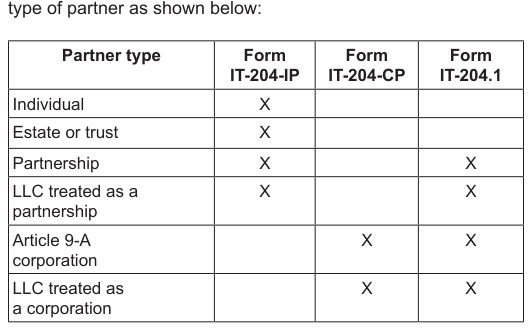
Text version of this table
Partner type Form IT-204-IP Form IT-204-CP Form IT-204.1 Individual X Estate or trust X Partnership X X LLC treated as a partnership X X Article 9-A corporation X X LLC treated as a corporation X X
If you are a partnership with partners that are partnerships or partners that are LLCs treated as partnerships, you must:
- provide each of those partners with both Forms IT-204-IP and IT-204-CP, and;
- file only Form IT-204-IP with your Form IT-204.
# Who must file
Partnerships are not subject to personal income tax. But partnerships must file a return on Form IT-204, regardless of the amount of its income (see Specific instructions) if they have either:
- at least one partner who is an individual, estate, or trust that is a resident of New York State, or
- any income, gain, loss, or deduction from New York State sources.
Otherwise, New York State law does not currently require a partnership to file a return solely because it has a partner that is either a partnership or corporation formed under the laws of New York State, even though the partner may be responsible for filing its own return with New York State.
In addition to the information reported on Forms IT-204-IP and IT-204-CP, the partnership must report to each partner any additional information the partner needs for filing their own return.
# Tiered partnerships (Regulation section 137.6)
If your partnership is a partner in another partnership (a lower-tier partnership), the source and character of the distributive share of each item of your partnership to any partner of your partnership that is attributable to the lower-tier partnership retains the source and character determined at the level of the lower-tier partnership. Any such item that flows through your partnership to such partner does not change the source and character of that item.
Example: Partnership A was a partner in another partnership, B.
A is referred to as the upper-tier partnership while B is referred to as the lower-tier partnership. P was a nonresident individual partner of A.
Partnership A was not engaged in a trade or business in
New York, but partnership B was. Even though partnership A was not carrying on business in New York, it had New York source income from the distributive shares it received from partnership B. The source and character of each item that partnership A received from partnership B retains the source and character determined at the level of partnership B. For instance, if P was a partner of A, and A was a partner of B, nonresident individual partner P would allocate its share of the NY income from B at B's business allocation percentage. Further, if A was engaged in a trade or business in NY, then P would allocate its share of A's income using A's business allocation percentage and P would allocate its share of B's income (which flows to A) at B's business allocation percentage. This allocation method should be reflected on Forms IT-204 and IT-204-IP.
# York source income
If you have no New York source income and are filing a return specifically because you have an Article 22 New York resident partner, complete the entire Form IT-204 with the exception of Section 10. If you have any corporate partners taxable under Article 9-A, or you have any partners that are partnerships or LLCs, you must also complete Form IT-204.1. Submit a Form IT-204-IP for each Article 22 resident partner (you do not have to submit Form IT-204-IP for nonresident partners) and for each partner that is a partnership or LLC. Submit a Form IT-204-CP for each corporate partner that is taxable under Article 9-A.
Submit a statement with your return indicating the following:
- The partnership does not have income from New York sources.
- All other Article 22 partners in the partnership are nonresidents of New York State.
- There is a total of nonresident partners.
If, during an audit, the Tax Department requires copies of Forms IT-204-IP for nonresident partners, we will request this information.
Income from New York State sources
You must include the following in New York source income:
- income attributable to the ownership of any interest in real property located in New York State [see TSB-M-18(1)I,
# Definition of New York Source Income of a Nonresident
Individual Expanded], including all or a portion of the gain or loss from the sale or exchange of an interest in an entity if the entity owns:
− real property in New York State, or
− shares of stock in a cooperative housing corporation where the cooperative units relating to the shares are located in New York, and provided that the sum of the fair market values of the real property, cooperative shares, and related cooperative units equals or exceeds 50% of the fair market value of the assets the entity has owned for at least two years as of the date of the sale or exchange;
- income attributable to tangible personal property located in New York State;
- income attributable to the ownership of any interest in intangible personal property to the extent that it is used in a business, trade, profession, or occupation carried on in New York State;
- income attributable to a business, trade, profession, or occupation carried on in New York State (to determine if the partnership carries on a business, trade, profession, or occupation within New York State, see below);
- any gain from the sale, transfer, or other disposition of shares of stock in a cooperative housing corporation in connection with the grant or transfer of a proprietary leasehold, when the real property comprising the units of such cooperative housing corporation is located in New York State, whether or not connected with a business; and
- any gain you recognized for federal income tax purposes from the sale or transfer of a partnership interest, where the sale or transfer:
− is subject to the provisions of Internal Revenue Code
(IRC) § 1060, and
− occurred on or after April 10, 2017.
Determine the amount of the gain you must include in New York source income consistent with the applicable methods and rules for allocation under Article 22 in the year you sold or transferred the assets. For additional information, see TSB-M-18(2)I, Nonresident Partner's Treatment of Gain or Loss on Certain Sales or Transfers of a Partnership or Membership Interest.
A partnership carries on a business, trade, profession, or occupation within New York State if it:
- maintains or operates an office, shop, store, warehouse, factory, agency, or other place in New York State where its affairs are systematically and regularly carried on, or
- performs a series of acts or transactions in New York State with regularity and continuity for livelihood or profit, as distinguished from isolated or incidental transactions.
# Other forms you may have to file
Form IT-204-LL, Partnership, Limited Liability
Company, and Limited Liability Partnership Filing Fee
# Payment Form
You must file Form IT-204-LL and pay a New York State filing fee if you are:
- a limited liability company (LLC) that is a disregarded entity for federal income tax purposes that has income, gain, loss, or deduction from New York State sources; or
- a domestic or foreign LLC—including limited liability investment company (LLIC), limited liability trust company (LLTC)—or limited liability partnership (LLP) that is required to file a New York State partnership return and that has income, gain, loss, or deduction from New York State sources; or
- a regular partnership that is required to file a New York partnership return that has income, gain, loss, or deduction from New York State sources, and had New York source gross income in the preceding tax year of at least $1 million.
For more information, see Form IT-204-LL-I, Instructions for Form IT-204-LL.
Forms IT-2658, Report of Estimated Tax for
Nonresident Individual Partners and Shareholders, and CT-2658, Report of Estimated Tax for Corporate
Partners
If you have income derived from New York State sources, you must make estimated tax payments on behalf of partners or members who are nonresident individuals or C corporations (any corporation other than a federal S corporation) if you are one of the following:
- a partnership (other than a publicly traded partnership as defined in IRC § 7704); or
- an LLC or LLP that is treated as a partnership for federal income tax purposes For more information, see Form IT-2658-I, Instructions for Form IT-2658 and Form CT-2658-I, Instructions for Form CT-2658. See also Tax Law § 658.
If you underpay the estimated tax, the Tax Department will add a penalty to the estimated tax you are required to pay. For more information, see Form IT-2659-I, Instructions for Form IT-2659.
See also Tax Law § 685.
# Form Y-204, Yonkers Nonresident Partner Allocation
If you do business in Yonkers and have a partner who is a nonresident of Yonkers, you must complete Form Y-204 and show the net earnings from self-employment.
New York City unincorporated business tax
These instructions apply to the New York State partnership return only. They do not apply to the New York City unincorporated business tax administered by the New York City Department of Finance. For information about New York City unincorporated business tax, visit the New York City Department of Finance website at www.nyc.gov/dof and see the instructions for Form NYC-204, Unincorporated Business Tax Return for
Partnerships (including Limited Liability Companies).
Form CT-33-D, Tax on Premiums Paid or Payable to an
# Unauthorized Insurer
If you purchase or renew a taxable insurance contract directly from an insurer not authorized to transact business in New York State under a certificate of authority from the Superintendent of Financial Services, you may be liable for a tax of 3.6% of the premium. For more information, see Form CT-33-D.
# Form IT-225, New York State Modifications
On Form IT-225, report the partnership's addition and subtraction modifications and provide this information to the partners. Each partner must use this information when filing their own New York State income tax return. For more information, see Form IT-225-I, Instructions for Form IT-225.
# When to file
You must file calendar year 2025 returns on or before March 16, 2026. You must file fiscal-year returns on or before the 15th day of the third month after the end of the tax year.
If a partnership is terminated and completely liquidated during its normal tax year, resulting in an accounting period of less than 12 months for federal income tax purposes, the return is due the 15th day of the third month after the end of the accounting period.
Use the same accounting period and method for Form IT-204 as you use for federal Form 1065, U.S. Return of Partnership Income. If you change your partnership's tax year or accounting method for your federal return, do the same on your Form IT-204.
Partnerships using a 52-53 week year
A partnership that reports on the basis of a 52-53 week accounting period for federal income tax purposes may report on the same basis for New York State purposes. If a 52-53 week accounting period begins within seven days from the first day of any calendar month, the tax year is deemed to begin on the first day of that calendar month. If a 52-53 week accounting period ends within seven days from the last day of any calendar month, the tax period will be deemed to end on the last day of the calendar month.
Note: You may also use the 2025 Form IT-204 for a tax year beginning in 2026 if:
- the partnership has a tax year of less than 12 months that begins and ends in 2026; and
- the 2026 Form IT-204 is not available by the time the partnership is required to file its return.
However, the partnership must show its 2026 tax year on the 2025 Form IT-204 and incorporate any tax law changes that are effective for tax years beginning after December 31, 2025.
The current year tax forms are generally available by December 15th of that calendar year. For the current-year's tax forms, visit www.tax.ny.gov (search: forms).
Extension of time to file
If you need an extension of time to file, you may request an automatic extension by the due date of Form IT-204. To apply for an automatic extension of time to file Form IT-204, visit www.tax.ny.gov (search: extension).
Amended return, superseding return, or federal change When you file Form IT-204, you must include the same information you reported on federal Form 1065, including any amended and superseding returns and any amended and superseding federal Schedules K-1. (A superseding return is a return you filed after the originally-filed return and filed within the filing period—including extensions.)
Federal changes
You must file an amended New York State (NYS) partnership return if you have federal changes due to:
- an amended or superseding federal partnership return;
- a federal audit of the federal partnership return:
− that changes any item of income or deduction previously reported to the Internal Revenue Service (IRS) and you elected out of the centralized partnership audit regime.
The amended NYS partnership return must be filed for the reviewed year.
− under the Bipartisan Budget Act of 2015 (BBA) that changes any item of income or deduction previously reported to the IRS unless you make the New York election for alternative payment by the partnership. For information about the New York election for alternative payment by the partnership, visit our website at www.tax.ny.gov (search: BBA). If you do not make this election, file your amended NYS partnership return for the reviewed year.
Note: You must also provide your partners with a statement explaining that the BBA audit is the reason for the amended return.
- the filing of an administrative adjustment request (AAR) with the IRS unless you make the New York election for alternative payment by the partnership. If you do not make this election, file your amended NYS partnership return for the tax year adjusted by the AAR.
You must file your amended NYS partnership return within 90 days:
- of the date you filed the federal amended or superseding partnership return, or
- after the final determination of the change in the case of a federal audit.
If you have federal changes, you must also:
- file an amended return to correct any error on the original state return and to report changes made by the IRS, unless you have made the New York election for alternative payment by the partnership, and
- submit a copy of the federal report of examination changes and a signed statement indicating you concede the federal audit changes. If you do not concede the federal audit changes, include a signed statement explaining why.
Note: To correct any error on the original New York State partnership return, you must file an amended Form IT-204, IT-204-IP or IT-204-CP as applicable, and IT-204.1, whether or not you filed an amended or superseding federal partnership return for that year. Be sure to provide any amended copies of Forms IT-204-IP and IT-204-CP to all applicable partners.
# How to amend Form IT-204
To amend your original Form IT-204 (and Form IT-204.1, if applicable):
- Mark the Amended return box at item C on a blank Form IT-204.
- Correct the appropriate lines and complete any other credit claim form or other form you are amending or are using for the first time and write Amended across the top of that form.
- Correct the appropriate lines with the new information and complete the entire amended Form IT-204 (and Form IT-204.1, if applicable).
- Submit the following with your amended Form IT-204:
- an explanation of the changes;
- any credit claim form or other form that you submitted with your original Form IT-204.
- any other credit claim form or other form you are amending or are using for the first time.
# How to amend Form IT-204-CP or Form IT-204-IP
If there is an error on Form IT-204-IP or IT-204-CP, but you do not need to correct your original filed Form IT-204:
- Mark the Amended return box at item C on amended Form IT-204.
- Complete the entire amended Form IT-204.
- For any Form IT-204-IP or IT-204-CP that you are amending: a. Mark the Amended K-1 box at the top of form, b. Correct the appropriate lines with the new information. c. Complete each form in its entirety.
- Submit only the amended Forms IT-204-IP or IT-204-CP with your amended Form IT-204.
# Penalties
The Tax Department will impose a penalty against the partnership if the partnership is required to file a partnership return and:
- fails to file the return on time, including extensions;
- files a return that fails to show all the information required; or
- fails to file an amended partnership return within 90 days of the date the final federal determination or disallowance is issued or when you file the federal amended partnership return, unless the failure is due to reasonable cause and not due to willful neglect.
The penalty for each month or fraction of a month (for a maximum of five months) that the failure continues is $50 multiplied by the total number of persons who were partners in the partnership during any part of the partnership's tax year for which the return is due. In counting the number of partners for purposes of this penalty, include only individuals and estates or trusts subject to tax under Article 22. Do not include corporations or partnerships.
# E-file information
Using software?
You must e-file if your software allows you to e-file your return, or if you are a tax preparer who is subject to the e-file mandate.
For more information, visit www.tax.ny.gov (search: mandate).
# Where to file
Mail your return to:
STATE PROCESSING CENTER
PO BOX 15198
ALBANY NY 12212-5198
Private delivery services: See Publication 55, Designated Private Delivery Services.
# How to fill in the forms
Follow these guidelines.
- Use black ink only (no red or other color ink or pencils) to print or type all entries.
- Do not use dollar signs, commas, or decimal points when making entries. All necessary punctuation has been printed on the form and amounts are rounded to dollars only.
- Do not make any entry in areas that do not apply to you unless these instructions specifically direct you to do so; treat blank lines as zeros.
- Mark an X to fill in boxes as appropriate. Do not use a check mark. Keep your Xs and numerals inside the boxes. Be careful not to touch any box line.
- For example, if your entry for line 1 is $23,750,500 your money field entry on line 1 should look like this:
- If you need to show a loss, place a minus sign immediately to the left of the loss amount. Do not use [ ] brackets or parentheses. For example, a business loss of $1,024 on line 6 should look like this:
# Specific instructions
Partnerships with New York source income must complete and file the entire Form IT-204. Partnerships must also file specific forms for each partner. See Additional forms you must file.
Partnerships with no New York source income that have resident partners must complete and file Form IT-204, with the exception of Section 10. For more information, see the instructions under Partnerships with resident partners but no New York source income.
Enter all information on Form IT-204 for the calendar year January 1 through December 31, 2025, or for a tax year of the partnership that began in 2025. If filing for a tax year other than a calendar year, enter the month and day the tax year began, and the month, day, and year that it ended at the top of page 1.
# Name and address box
Enter in the spaces at the top of the return the exact legal name, trade name (if any), and address of the partnership. The legal name is the name in which the business owns property or acquires debt. Enter the trade name or d/b/a (doing business as) name if different from the legal name. Also enter the business's employer identification number (EIN), principal business activity, principal product or service, and date the business was started.
# NAICS business code number
Enter the six-digit NAICS business activity code number from Publication 910, NAICS Codes for Principal Business Activity for New York State Tax Purposes, or to locate the code for your business use the link to the North American Industry Classification System on our website (search: naics).
Special conditions for filing your 2025 tax return If the partnership qualifies for one or more of the special conditions below, enter the applicable 2-character codes on the return.
Code A6: Build America Bond (BAB) interest
Enter this code if the partnership included BAB interest in ordinary income. For more information, see TSB-M-10(4)I, Treatment of Interest Income from Build America Bonds, available on our website, and see Form IT-225-I.
Code E3: Out of the country
Enter this code for partnerships that keep their records and books of account outside the United States and Puerto Rico and qualify for an automatic two-month extension of time to file their federal returns. For more information, see When to file.
# Section 1: Partnership information
Item A
Mark an X in the Portfolio investment partnership box if you meet the definition below.
Portfolio investment partnership is defined as a limited partnership which meets the gross income requirement of IRC § 851(b)(2). Income and gains from commodities (not described in IRC § 1221[1]) or from futures, forwards, and options with respect to those commodities are included in income which qualifies to meet the 90% gross income requirement. The commodities must be customarily dealt in on an organized commodity exchange and the transaction must be customarily consummated at that place, as required by IRC § 864(b)(2)(B)(iii). To the extent that the partnership has income and gains from futures, forwards, and options with respect to the commodities, the income and gains must be derived by a partnership which is not a dealer in commodities and is trading for its own account as described in IRC § 864(b)(2)(B)(ii). The term portfolio investment partnership does not include a dealer (within the meaning of IRC § 1236) in stocks or securities.
Item F
Items F1, F2, and F3: Enter the number of partners as applicable.
Include all partners during the tax year, even if they were no longer partners on the last day of the tax year. If you have partners who are partnerships or LLCs that are treated as partnerships for federal purposes, include them on item F1 in the count for Article 22 partners only. Do not include them on item F2 in the count for Article 9-A partners.
Note: Although you must provide the Form IT-204-CP to these partners, only include the Form IT-204-IP for these partners when filing Form IT-204.
Item F4: Add items F1, F2, and F3 and enter the total number of partners on item F4.
Item G
If you have any other New York tax accounts, mark an X in the appropriate boxes on lines 1 and 2 and enter the identification number for each.
Item P
Mark an X in the Yes box if the partnership owes NYS sales and compensating use tax.
A partnership that is registered, or required to be registered, for sales tax purposes, must pay its sales and use taxes on the partnership sales tax return for purchases made by the business.
A partnership operating in New York State that is not registered or required to be registered for sales tax purposes must report its sales and use tax liability by filing Form ST-130, Business Purchaser's Report of Sales and Use Tax. The tax is due within 20 days of the date of the first taxable use in New York State of the tangible personal property or taxable service.
The following are examples of when a business located in NYS that is not registered or required to be registered for sales and use tax purposes must pay tax directly to the Tax Department.
These examples apply when the seller did not collect the NYS tax due from the business.
- The business buys office supplies in New Jersey and brings them back to New York State for use in the business.
- The business orders office equipment through a catalog from a vendor located in Michigan. The equipment is shipped by common carrier to the business in NYS.
- The business sends a fax machine to New Jersey to be repaired. The repaired fax machine is returned by common carrier to the business in NYS.
- The business takes its computer to Pennsylvania to be repaired. The business then picks it up and returns it to its office in New York State. The business owes tax on the cost of the repairs when it brings the computer back to New York
State for use in the business.
- The business purchases and pays sales tax on office equipment and supplies in a locality in New York State with a lower tax rate than the rate in the locality in New York State in which the business is located. When the business brings the equipment and supplies to its office, it will owe tax for the difference between the rate in the locality where the office is located and the rate in the locality where the business purchased the equipment and supplies.
For additional information on when a business must pay sales and compensating use tax directly to the Tax Department, see TB-ST-913, Use Tax for Individuals (including Estates and
Trusts).
Item Q
If you marked Yes on federal Form 1065, Schedule B, indicating the partnership has a financial account in a foreign country, then mark an X in the Yes box.
# Third-party designee
If you want to authorize another individual (third-party designee) to discuss this tax return with the New York State Tax Department, mark an X in the Yes box in the third-party designee area of your return. Also print the designee's name, phone number, email address, and any five-digit number the designee chooses as their personal identification number (PIN).
If you want to authorize the paid preparer who signed your return to discuss the return with the Tax Department, print the preparer's name in the space for the designee's name and enter the preparer's phone number in the space for the designee's phone number. You do not have to provide the other information requested. If you do not want to authorize another person, mark an X in the No box.
If you mark the Yes box, you are authorizing the Tax Department to discuss with the designee any questions related to this return.
You are also authorizing the designee to give and receive confidential taxpayer information relating to:
- this return, including missing information,
- any notices or bills arising from this filing that you share with the designee (they will not be sent to the designee),
- any payments and collection activity arising from this filing, and
- the status of your return or refund.
This authorization will not expire but will only cover matters relating to this return. If you decide to revoke this designee's authority at any time, call us (see Need help?).
You are not authorizing the designee to receive your refund, bind you to anything (including any additional tax liability), or otherwise represent you before the Tax Department. If you want someone to represent you or perform services for you beyond the scope of the third-party designee, you must designate the person using a power of attorney (for example, Form POA-1, Power of Attorney).
# Signatures
A general partner must sign Form IT-204.
Enter your daytime telephone number including the area code.
This entry will enable the Tax Department to correct minor errors or omissions by calling you rather than writing or sending back your return.
Paid preparer's signature
If you pay someone to prepare your return, the paid preparer must also sign it and fill in the other blanks in the paid preparer's area of your return. A person who prepares your return and does not charge you should not fill in the paid preparer's area.
Paid preparer's responsibilities: Under the law, all paid preparers must sign and complete the paid preparer section of the return. Paid preparers may be subject to civil and/or criminal sanctions if they fail to complete this section in full.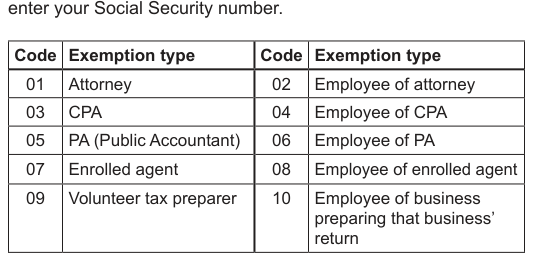
Text version of this table
Code Exemption type Code Exemption type 01 Attorney 02 Employee of attorney 03 CPA 04 Employee of CPA 05 PA (Public Accountant) 06 Employee of PA 07 Enrolled agent 08 Employee of enrolled agent 09 Volunteer tax preparer 10 Employee of business preparing that business’ return
Paid preparer information: For information relating to the Tax Preparer Registration Program, the signing of returns by a paid preparer (anyone you pay to prepare your return), e-file mandate for paid preparers, and other requirements relating to paid preparers, see Publication 58, Information for Income Tax Return Preparers, and our website.
# (loss)
Transfer the amounts you reported on federal Form 1065, page 1, to the corresponding lines on Form IT-204, Section 2.
# Section 3: Cost of goods sold
Transfer the amounts you reported on federal Form 1125-A, Cost of Goods Sold, to the corresponding lines on Form IT-204, Section 3.
# Section 4: Balance sheets per books
Transfer the amounts you reported on federal Form 1065, Schedule L, to the corresponding lines on Form IT-204, Section 4.
Section 5: Reconciliation of income (loss) per books with income (loss) per return Transfer the amounts you reported on federal Form 1065, Schedule M-1, to the corresponding lines on Form IT-204, Section 5. Be sure to write in the Identify boxes, where provided, the types and amounts you are including on that specific line.
If you filed federal Schedule M-3 with federal Form 1065, mark an X in the box and include a copy of the federal Schedule M-3 and any related documents with your Form IT-204. Do not complete Section 5.
Section 6: Analysis of partners' capital accounts Transfer the amounts you reported on federal Form 1065, Schedule M-2, to the corresponding lines on Form IT-204, Section 6. In the Identify boxes, where provided, enter the types and amounts you are including on that specific line.
Section 7: Partners' share of income, deductions, etc.
Transfer the amounts you reported on federal Form 1065, Schedule K to the corresponding lines on Form IT-204, Section 7. In the Identify boxes, where provided, enter the types and amounts you are including on that specific line.
Line 97: Enter the amount from federal Form 1065, Schedule K, line 11.
Line 99: Enter the total amount from federal Form 1065, Schedule K, lines 13a through 13e.
Line 102: Enter the total amount from federal Form 1065, Schedule K, lines 18a through 18c.
Line 105: Enter the total amount from federal Form 1065, Schedule K, lines 20a through 20c.
# Section 8: New York modifications
Lines 108 and 110
To determine the amounts to enter on these lines, complete Form IT-225.
Lines 111 and 113
Use only for modifications that apply to itemized deductions on the individual returns of partners. Exclude any amounts properly reportable on lines 108 and 110. Be sure to enter the corresponding letter and total amount of the addition to or subtraction from itemized deductions.
Lines 111a through 111f: Additions to itemized deductions
If these items were not deducted on your federal return or subtracted on line 110, use lines 111a through 111f to enter the amount of each reportable addition and the corresponding letter on these lines.
A: interest expense on money borrowed to purchase or carry bonds or securities whose interest is subject to New York State income tax but exempt from federal income tax;
B: ordinary and necessary expenses paid or incurred during the tax year in connection with income, or property held to produce income, that is subject to New York State income tax but exempt from federal income tax;
C: amortization of bond premium attributable to the tax year on any bond whose interest income is subject to New York State income tax but exempt from federal income tax Lines 113a through 113f: Subtractions from itemized deductions If these items are not added on line 108, use lines 113a through 113f to enter the amount of each reportable subtraction and the corresponding letter on these lines.
D: state, local, and foreign income taxes (including unincorporated business taxes);
E: interest expense on money borrowed to purchase or carry bonds or securities whose interest is exempt from New York State income tax;
F: ordinary and necessary expenses paid or incurred in connection with income, or property held to produce income, that is exempt from New York State income tax, but only to the extent deducted in computing your federal taxable income;
G: amortization of bond premium attributable to the tax year on any bond whose interest income is exempt from New York State income tax, but only to the extent deducted in computing your federal taxable income.
# Section 9: Other information
# Line 116a
Use the worksheet below to calculate your modified federal and New York source gross income for tax year 2025 for use in filing Form IT-204-LL for tax year 2026.
Column A: Enter the amounts for lines 1 through 13 as instructed.
Column B: Enter the portion of column A (if any) that is derived from or connected to New York State sources.
Note: If the only reason you are filing Form IT-204 is because you have a resident partner, do not complete this line.
Tiered partnerships: Do not include on lines 1 through 13 of the worksheet income from any partnership in which you are a partner. Enter on line 14 the amount that should be shown on line 29a of Form IT-204-IP, New York Partner's Schedule K-1.
1 Enter the amount from federal Form 1065, line 1c … 1 2 Enter the amount from federal Form 1065, Schedule K, line 5 … 2 3 Enter the amount from federal Form 1065, Schedule K, line 6a … 3 4 Enter the amount from federal Form 1065, Schedule K, line 7 … 4 5 Enter any income (not losses) included on federal Form 1065, Schedule K, line 11 … 5 6 Add the gain (not loss) amounts from federal Form 8949, column (h), and the gains (not losses) from federal Form 1065, Schedule D, lines 1a, column (h), 4, 5, 8a, column (h), 11, 12, and 14 … 6 7 Add the gain (not loss) amounts on federal Form 4797, column (g), lines 2 through 6, 10, and 13 through 16 … 7 8 Enter the amount from federal Form 8825, line 20a … 8 9 Enter the income (not loss) from federal Schedule F (Form 1040), line 9 … 9 10 Enter the amount from federal Schedule F (Form 1040), line 1b … 10 11 Enter any income (not losses) included on federal Form 1065, Schedule K, line 3a, not included above … 11 12 Enter any income (not losses) included on federal Form 1065, line 4, from estates and trusts not included above … 12 13 Enter any income (not losses) included on federal Form 1065, line 7, not included above … 13 14 Enter the New York source gross income as reported by your lower tiered partnership from Form IT-204-IP, line 29a … 14 15 Total (add column B, lines 1 through 14); enter the amount here and on Form IT-204, line 116a … 15
Enter 2025 amounts
A - Modified federal gross income
B - New York source gross income
New York source gross income worksheet
Keep this worksheet for your records. You will need it when completing your Form IT-204-LL for 2026.
Lines 116b and 116c
The Metropolitan Commuter Transportation District (MCTD) percentage allocation is calculated separately for the two zones in the district.
To report the percentage allocation:
- for the counties of New York (Manhattan), Bronx, Kings (Brooklyn), Queens, and Richmond (Staten Island) (Zone 1), use line 116b.
- for Rockland, Nassau, Suffolk, Orange, Putnam, Dutchess, and Westchester counties (Zone 2), use line 116c.
# Line 116b: MCTD Zone 1 allocation percentage
If the partnership is doing business only in MCTD Zone 1, enter 100 (100%) on this line.
- If the partnership maintains separate books and records and they reflect the self-employment income in MCTD Zone 1, enter on this line the percentage of net earnings from self-employment allocated to MCTD Zone 1.
- If the partnership carries on business both in and out of MCTD Zone 1 but does not maintain books and records from which the MCTD Zone 1 income can be determined, use the worksheet below to calculate the percentage to enter on this line.
Transfer the amounts in Section 10, Part 2, column A, of Form IT-204, to column A of the worksheet below; and then enter in column B the amounts in MCTD Zone 1.
MCTD Zone 1 allocation percentage worksheet
Items used as factors
1 Real property owned (see line 119 instructions) … 2 Real property rented from others (see line 120 instructions).
3 Tangible personal property owned (see line 121 instructions) … 3a Tangible personal property rented from others
A: Totals in and B: MCTD Zone 1 C: Percent column B out of NYS amounts is of column A (see line 121a instructions) … 3a 4 Property percentage (add lines 1 through 3a;
see line 122 instructions) …
5 Payroll percentage (see line 123 instructions) … 6 Gross income percentage (see line 124 instructions) 4 % 5 % 6 % 7 Total of percentages (add lines 4, 5, and 6, column C) … 7 % 8 MCTD Zone 1 allocation percentage (divide total percentages on line 7 by three or by actual number of percentages if less than three; enter here and on line 116b) …
# Line 116c: MCTD Zone 2 allocation percentage
8 %
If the partnership is doing business only in MCTD Zone 2, enter 100 (100%) on this line.
- If the partnership maintains separate books and records and they reflect the self-employment income in MCTD Zone 2, enter on this line the percentage of net earnings from self-employment allocated to MCTD Zone 2.
- If the partnership carries on business both in and out of MCTD Zone 2 but does not maintain books and records from which the MCTD Zone 2 income can be determined, use the worksheet below to calculate the percentage to enter on this line.
Transfer the amounts in Section 10, Part 2, column A, of Form IT-204, to column A of the worksheet below; and then enter in column B the amounts in MCTD Zone 2.
MCTD Zone 2 allocation percentage worksheet
Items used as factors
1 Real property owned (see line 119 instructions) … 2 Real property rented from others (see line 120 instructions).
3 Tangible personal property owned (see line 121 instructions) … 3a Tangible personal property rented from others
A: Totals in and B: MCTD Zone 2 C: Percent column B out of NYS amounts is of column A (see line 121a instructions) … 3a 4 Property percentage (add lines 1 through 3a;
see line 122 instructions) …
5 Payroll percentage (see line 123 instructions) … 6 Gross income percentage (see line 124 instructions) 4 % 5 % 6 % 7 Total of percentages (add lines 4, 5, and 6, column C) … 7 % 8 MCTD Zone 2 allocation percentage (divide total percentages on line 7 by three or by actual number of percentages if less than three; enter here and on line 116c) … 8 %
Line 116d: Total receipts from the sale of goods by manufacturing Enter the total receipts from the sale of goods produced by manufacturing, processing, assembling, refining, mining, extracting, farming, agriculture, horticulture, floriculture, viticulture, or commercial fishing.
Note: Do not report on this line receipts from the generation and distribution of electricity, the distribution of natural gas, and the production of steam associated with the generation of electricity.
Line 116e: New York adjusted basis of qualified manufacturing property Enter the New York adjusted basis of qualified manufacturing property at the close of the tax year (see
# TSB-M-19(5)C, New York State Adjusted Basis for Qualified
New York Manufacturers). The term qualified manufacturing property means property that:
- has a situs in New York State; and
- is principally used by the partnership in the production of goods by manufacturing, processing, assembling, refining, mining, extracting, farming, agriculture, horticulture, floriculture, viticulture, or commercial fishing.
# Line 117c
If you marked an X in the Yes box, you must list the names and EINs of the entities in the table below this line regardless of the percentage of ownership interest.
# Section 10: New York allocation schedule
If the partnership carries on business both in and out of New York State, complete Part 1. Enter the exact location of each place where the partnership carries on business. Describe each place (for example, branch office, agency, factory), and state whether it is rented or owned by the partnership.
Taxpayers that use books and records method: Attach a summary of New York and Everywhere income schedules for each income source.
If the partnership carries on business both in and out of New York State but does not use the books and records method to determine the New York business income, complete Part 2.
You must still complete Part 2, even though it may not fairly and equitably reflect the income from New York and you use an authorized alternate allocation method. You must include a detailed explanation of the authorized alternate method used to determine the New York income, together with full details of any changes increasing or decreasing the amount of New York income calculated by the authorized alternate method.
Gross rents, for purposes of computing lines 120 and 121a, includes:
- any amount payable for the use or possession of real and tangible personal property, or any part thereof, whether designated as a fixed sum of money or as a percentage of sales, profits, or otherwise;
- any amount payable as additional rent, or in lieu of rent, such as interest, taxes, insurance, repairs, or any other amount required to be paid by the terms of a lease or other arrangement; and
- a proportionate part of the cost of any improvement to real or tangible personal property made by or on behalf of the business that reverts to the owner or lessor upon termination of a lease or other arrangement. However, if a building is erected on leased land by or on behalf of the business, the value of the building is determined in the same manner as if it were owned by the business. The proportionate part of the cost of an improvement (other than a building on leased land) is generally equal to the amount of amortization allowed in computing New York adjusted gross income, whether the lease does or does not include an option for renewal.
Line 119: Real property owned
Determine the average value of the property as follows:
- Add its adjusted basis at the beginning of the tax year to its adjusted basis at the end of the tax year.
- Divide by two.
Column A: Enter the average value of all real property connected with the partnership.
Column B: Enter the average value of all real property connected with the partnership located in New York State.
Line 120: Real property rented from others
Include in this line the value of real property rented to the business (eight times the gross rent payable during the tax year for which the return is filed). For the definition of gross rents, see above.
Line 121: Tangible personal property owned
Column A: Enter the average value (determined in accordance with the instruction for line 119) of all tangible personal property (including any inventory) owned by the business.
Column B: Enter the average value (determined in accordance with the instructions for line 119) of tangible personal property located in New York State.
Line 121a: Tangible personal property rented from others
Enter the value of tangible personal property rented to the business. The value of rented tangible personal property is eight times the gross rents payable for tangible personal property during the tax year for which the return is filed. For the definition of gross rents, see above.
# Line 122: Property percentage
Columns A and B: Add lines 119 through 121a and enter the total for each column on this line.
Column C: To determine the property percentage, divide the column B total by the column A total, round the result to the fourth decimal place, and enter the percentage in this column.
Example: If the total in column A is $15,000 and the total in column B is $10,000, divide $10,000 by $15,000 and enter the result (0.6667) as a percentage (66.67) in column C.
# Line 123: Payroll percentage
Enter all wages, salaries, and other personal service compensation, paid only to employees of the partnership. Do not include payments to independent contractors, independent sales agents, or the like.
Column A: Enter the total of this pay to employees during the tax year for partnership operations carried on both in and out of New York State.
Column B: Enter the amount of that pay for operations carried on in New York State. Operations are considered to be carried on in New York State if the employee works in or travels out of an office or other place of business located in New York State. If in Section 8, line 110, you subtracted an amount based on wages not allowed because of a federal credit under IRC § 280C, report this change here in wages and salaries paid during the year.
Column C: Divide column B by column A. Round the result to the fourth decimal place and enter it as a percentage in this column.
Line 124: Gross income percentage
Column A: Enter the total gross sales made, or charges for services performed, by the employees, agents, agencies, or independent contractors of the partnership in and out of New York State.
Column B: Enter the part of total gross sales or charges that represents sales made or services performed by or through an agency in New York State. This includes sales made or services performed by employees, agents, agencies, or independent contractors situated at, connected with, or sent out from offices of the partnership (or its agencies) located in New York State.
Example: If a salesperson working out of the New York office of the business covers the states of New York, New Jersey, and Pennsylvania, allocate to New York State all sales they made and include those sales in column B. Divide column B by column A. Round the result to the fourth decimal place and enter it as a percentage in column C.
Section 11: Partners' credit information
If the partnership (or a partnership of which it was a partner) is convicted of an offense defined in New York State Penal Law
# Code CF3: Benefit period factor
Farmers' school tax credit
Line 140: To determine the acres of qualified agricultural property to enter on this line, see instructions for item A in Form IT-217-I, Instructions for Form IT-217.
Line 141: Qualified conservation property is acreage that, during the tax year, is enrolled in or participating in a federal environmental conservation acreage reserve program under Title III of the Federal Agricultural Improvement and Reform Act of 1996.
Line 142: To determine the amount of eligible school district property taxes paid to enter on this line, see instructions for item B in Form IT-217-I.
Line 143: To determine the acres of qualified agricultural property converted to nonqualified use to enter on this line, see instructions for item F in Form IT-217-I.
Other flow-through credit bases and information
Lines 144a through 144f: Credit bases
If the partnership contributed to one or more of the following New York Charitable Gifts Trust Fund accounts, enter the amount and code 127:
- Health Charitable Account
- Elementary and Secondary Education Account
If the partnership contributed to one of the following organizations, enter the amount and code 128:
- Health Research Inc.
- State University of New York Impact Foundation
- Research Foundation of the City University of New York If the partnership was a shareholder in a C corporation that has a special gross income from farming election, enter the following information and codes on lines 144a through 144f:
- Enter the entire net income amount provided by the corporation and code 148.
- Enter the principal payment amount paid on farm indebtedness provided by the corporation and code 146.
- Enter the gross income provided by the corporation and code 149.
- Enter the gross income from farming provided by the corporation and code 147.
If the partnership claimed an investment credit for eligible farmers, enter the investment credit base for qualified property and code B12.
If the partnership claimed the economic transformation and facility redevelopment program credit, enter the following codes and amounts from the corresponding lines of Form IT-633.
Code 633: Jobs tax credit component
Code B33: Investment tax credit component
Code C33: Training tax credit component
Code D33: Real property tax credit component
If you opted to pay the New York City pass-through entity tax (NYC PTET) for the tax year, enter the total amount of the NYC PTET liability and code B53.
Part 2: Flow-through credits, addbacks, and recaptures Line 146a: If the partnership has Article 9-A corporate partners, in addition to entering the amount of credit on this line, enter code 212 and the amount of investment credit base (cost or other basis of qualified property purchased excluding R & D property) on lines 144a through 144f.
Line 146b: If the partnership has Article 9-A corporate partners, in addition to entering the amount of credit on this line, enter code 218 and the amount of R & D investment credit base (cost or other basis of qualified property purchased) on lines 144a through 144f.
Line 146c: If the partnership has Article 9-A corporate partners, in addition to entering the amount of credit on this line, enter code B12 and the amount of investment credit property (cost or other basis of eligible farm property purchased excluding R & D property) on lines 144a through 144f.
Lines 147 and 148: See the Lines 147 and 148: Other flow-through credits, addbacks, and recaptures chart below.
Part 3: START-UP NY tax elimination credit information
Line 149: Enter the certificate number from Form DTF-74, Certificate of Eligibility, for the approved START-UP NY business.
Line 150: Enter the tax year of the START-UP NY business tax benefit period (1 through 10) from Form IT-638, START-UP NY Tax Elimination Credit, line D.
Line 151: Enter the area allocation factor from Form IT-638, line 6.
Note: If the partnership is filing multiple Forms IT-638, enter the code and credit information on lines 144g through 144l. The additional codes are as follows:
Code SN1: Certificate number
Code SN2: Year of business tax benefit period
# Code SN3: Area allocation factor
If you opted to pay the pass-through entity tax (PTET) for the tax year, enter the total amount of the PTET liability and code 653.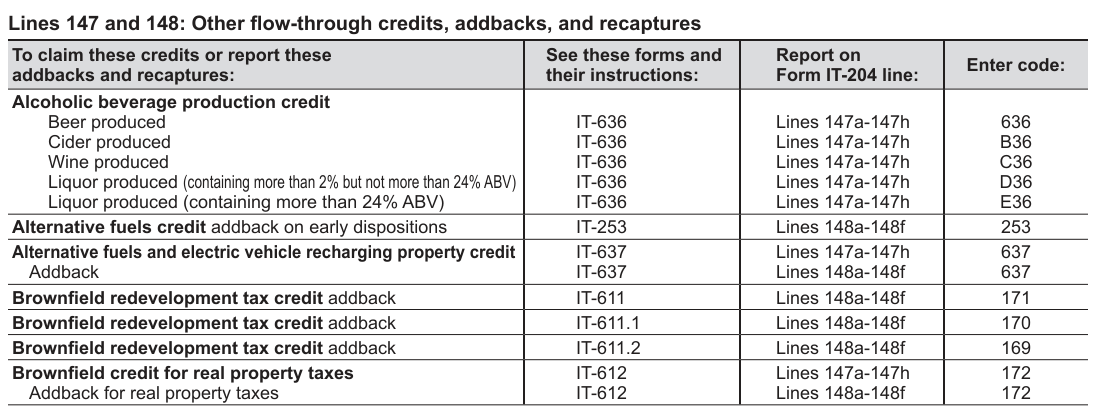
Text version of this table
To claim these credits or report these addbacks and recaptures: See these forms and their instructions: Report on Form IT-204 line: Enter code: Alcoholic beverage production credit Beer produced Cider produced Wine produced Liquor produced (containing more than 2% but not more than 24% ABV) Liquor produced (containing more than 24% ABV) IT-636 IT-636 IT-636 IT-636 IT-636 Lines 147a-147h Lines 147a-147h Lines 147a-147h Lines 147a-147h Lines 147a-147h 636 B36 C36 D36 E36 Alternative fuels credit addback on early dispositions IT-253 Lines 148a-148f 253 Alternative fuels and electric vehicle recharging property credit Addback IT-637 IT-637 Lines 147a-147h Lines 148a-148f 637 637 Brownfield redevelopment tax credit addback IT-611 Lines 148a-148f 171 Brownfield redevelopment tax credit addback IT-611.1 Lines 148a-148f 170 Brownfield redevelopment tax credit addback IT-611.2 Lines 148a-148f 169 Brownfield credit for real property taxes Addback for real property taxes IT-612 IT-612 Lines 147a-147h Lines 148a-148f 172 172
# IT-636 Lines 147a-147h E36
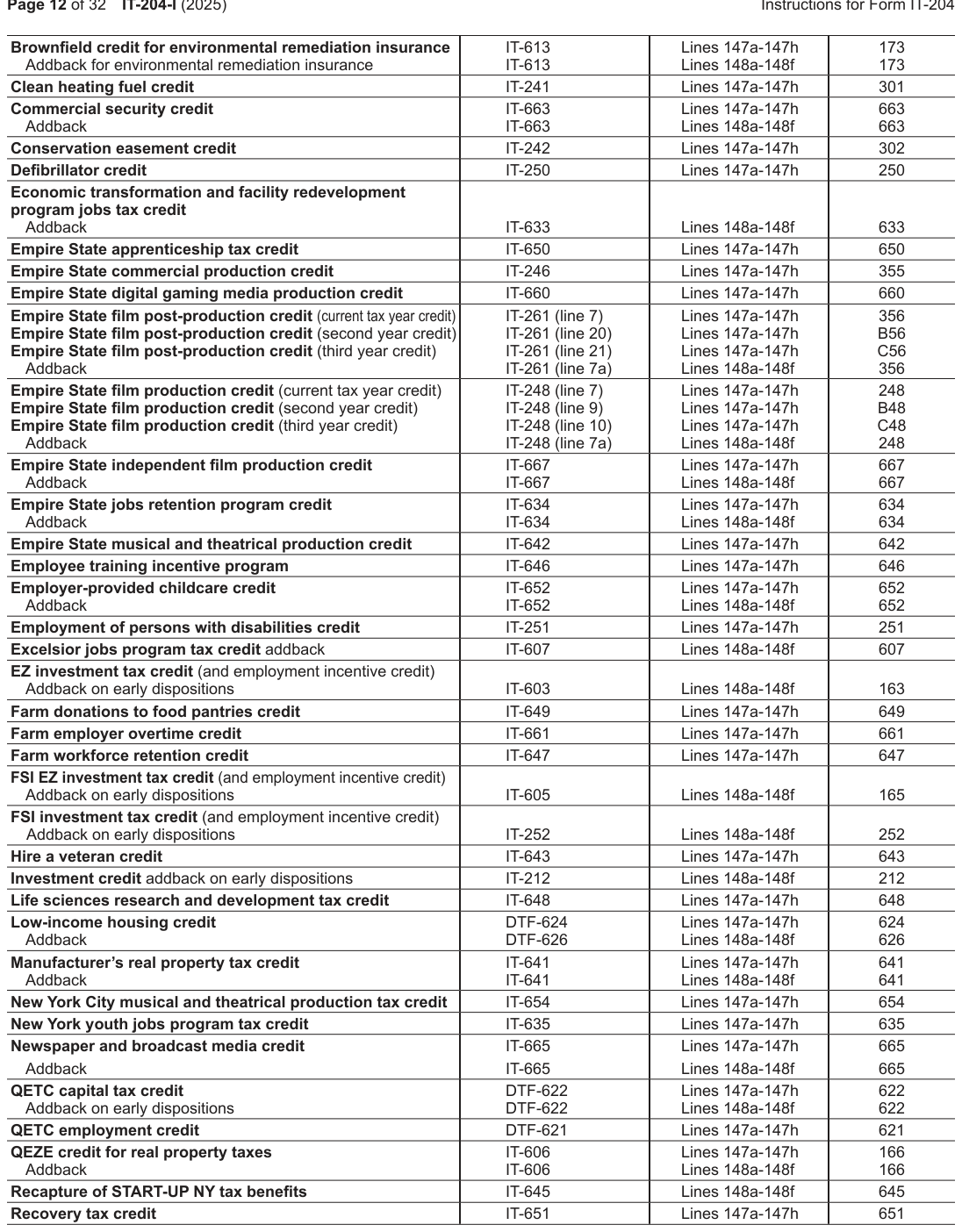
Text version of this table
| Brownfield credit for environmental remediation insurance Addback for environmental remediation insurance | IT-613 IT-613 | Lines 147a-147h Lines 148a-148f | 173 173 |
| Clean heating fuel credit | IT-241 | Lines 147a-147h | 301 |
| Commercial security credit Addback | IT-663 IT-663 | Lines 147a-147h Lines 148a-148f | 663 663 |
| Conservation easement credit | IT-242 | Lines 147a-147h | 302 |
| Defibrillator credit | IT-250 | Lines 147a-147h | 250 |
| Economic transformation and facility redevelopment program jobs tax credit Addback | IT-633 | Lines 148a-148f | 633 |
| Empire State apprenticeship tax credit | IT-650 | Lines 147a-147h | 650 |
| Empire State commercial production credit | IT-246 | Lines 147a-147h | 355 |
| Empire State digital gaming media production credit | IT-660 | Lines 147a-147h | 660 |
| Empire State film post-production credit (current tax year credit) Empire State film post-production credit (second year credit) Empire State film post-production credit (third year credit) Addback | IT-261 (line 7) IT-261 (line 20) IT-261 (line 21) IT-261 (line 7a) | Lines 147a-147h Lines 147a-147h Lines 147a-147h Lines 148a-148f | 356 B56 C56 356 |
| Empire State film production credit (current tax year credit) Empire State film production credit (second year credit) Empire State film production credit (third year credit) Addback | IT-248 (line 7) IT-248 (line 9) IT-248 (line 10) IT-248 (line 7a) | Lines 147a-147h Lines 147a-147h Lines 147a-147h Lines 148a-148f | 248 B48 C48 248 |
| Empire State independent film production credit Addback | IT-667 IT-667 | Lines 147a-147h Lines 148a-148f | 667 667 |
| Empire State jobs retention program credit Addback | IT-634 IT-634 | Lines 147a-147h Lines 148a-148f | 634 634 |
| Empire State musical and theatrical production credit | IT-642 | Lines 147a-147h | 642 |
| Employee training incentive program | IT-646 | Lines 147a-147h | 646 |
| Employer-provided childcare credit Addback | IT-652 IT-652 | Lines 147a-147h Lines 148a-148f | 652 652 |
| Employment of persons with disabilities credit | IT-251 | Lines 147a-147h | 251 |
| Excelsior jobs program tax credit addback | IT-607 | Lines 148a-148f | 607 |
| EZ investment tax credit (and employment incentive credit) Addback on early dispositions | IT-603 | Lines 148a-148f | 163 |
| Farm donations to food pantries credit | IT-649 | Lines 147a-147h | 649 |
| Farm employer overtime credit | IT-661 | Lines 147a-147h | 661 |
| Farm workforce retention credit | IT-647 | Lines 147a-147h | 647 |
| FSI EZ investment tax credit (and employment incentive credit) Addback on early dispositions | IT-605 | Lines 148a-148f | 165 |
| FSI investment tax credit (and employment incentive credit) Addback on early dispositions | IT-252 | Lines 148a-148f | 252 |
| Hire a veteran credit | IT-643 | Lines 147a-147h | 643 |
| Investment credit addback on early dispositions | IT-212 | Lines 148a-148f | 212 |
| Life sciences research and development tax credit | IT-648 | Lines 147a-147h | 648 |
| Low-income housing credit Addback | DTF-624 DTF-626 | Lines 147a-147h Lines 148a-148f | 624 626 |
| Manufacturer’s real property tax credit Addback | IT-641 IT-641 | Lines 147a-147h Lines 148a-148f | 641 641 |
| New York City musical and theatrical production tax credit | IT-654 | Lines 147a-147h | 654 |
| New York youth jobs program tax credit | IT-635 | Lines 147a-147h | 635 |
| Newspaper and broadcast media credit Addback | IT-665 IT-665 | Lines 147a-147h Lines 148a-148f | 665 665 |
| QETC capital tax credit Addback on early dispositions | DTF-622 DTF-622 | Lines 147a-147h Lines 148a-148f | 622 622 |
| QETC employment credit | DTF-621 | Lines 147a-147h | 621 |
| QEZE credit for real property taxes Addback | IT-606 IT-606 | Lines 147a-147h Lines 148a-148f | 166 166 |
| Recapture of START-UP NY tax benefits | IT-645 | Lines 148a-148f | 645 |
| Recovery tax credit | IT-651 | Lines 147a-147h | 651 |
# Lines 147a-147h C48
# Farm donations to food pantries credit
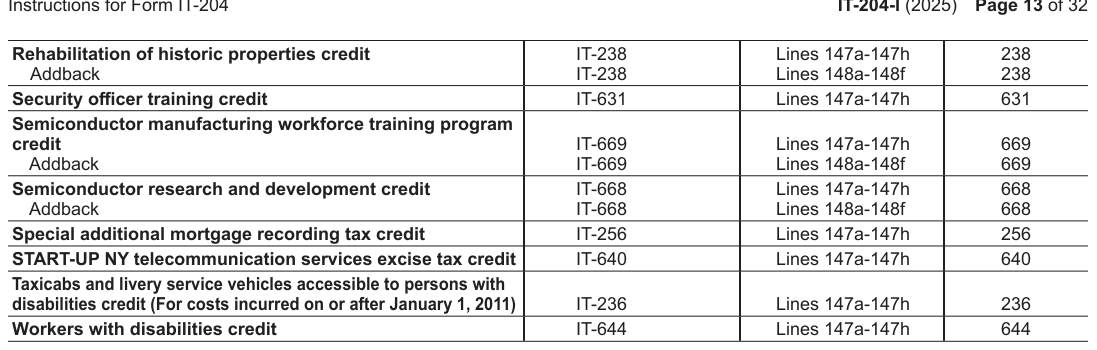
Text version of this table
| IT-238 IT-238 | Lines 147a-147h Lines 148a-148f |
| IT-631 | Lines 147a-147h |
| IT-669 IT-669 | Lines 147a-147h Lines 148a-148f |
| IT-668 IT-668 | Lines 147a-147h Lines 148a-148f |
| IT-256 | Lines 147a-147h |
| IT-640 | Lines 147a-147h |
| IT-236 | Lines 147a-147h |
| IT-644 | Lines 147a-147h |
Page 14 of 32 IT-204-I (2025) Partnership's instructions for Form IT-204-IP Partnership's instructions for Form IT-204-IP New York Partner's Schedule K-1
# General information
Partnerships with New York source income must provide Form IT-204-IP to each Article 22 partner on or before the due date for the partnership return.
Partnerships with no New York source income who are filing a return specifically because they have resident partners must file and provide Form IT-204-IP only for the resident partners. Do not submit Form IT-204-IP for non-resident partners.
However, if a partnership has any partners that are partnerships or LLCs, the partnership must complete and provide both Forms IT-204-IP and IT-204-CP to such partners.
The partnership only submits the Form IT-204-IP (and not the Form IT-204-CP) for such partners with its Form IT-204.
# Partnership responsibilities
The partnership must provide to each partner a statement indicating the partner's distributive share of contributions to one or more of the following New York Charitable Gifts Trust Fund accounts:
- Health Charitable Account; or
- Elementary and Secondary Education Account.
The partnership must provide to each partner a statement indicating the partner's distributive share of income taxes paid to other states, including pass-through entity taxes, on their behalf.
This statement must itemize the amounts paid to each state.
If the partnership meets the qualifications of a non-farm small business, the partnership must provide to each partner a statement that includes the following:
- verification that the partnership qualifies as a non-farm small business; and
- the amount of the qualifying income base attributable to the partnership that is being passed through to that partner. The $1.5 million New York gross receipts limitation is calculated using only receipts directly earned by the partnership. Do not include receipts passed through from any lower-tier partnerships.
If the partnership received a statement from a lower-tier partnership that qualifies as a non-farm small business, the partnership must pass to each of its partners the qualifying statement and that partner's distributive share of the qualifying income base. If passing through qualifying information for more than one partnership, the partnership must provide a separate statement for each lower-tier partnership.
Partnerships that are not an institutional real estate investor (IREI) as described in Tax Law § 208.9(c-4)(2) that own, directly or indirectly, any residential properties consisting of no more than two dwelling units (covered properties) should provide statements to their partners that include:
- the number of covered properties owned,
- the amount of federal depreciation related to covered properties, separately stating any amounts of such depreciation that are included in modifications A-209 or S-213 reported to the partner, and
- the amount of federal interest deductions allowed under IRC § 163 or interest charged to a capital account related to covered properties.
# Farm donations to food pantries credit
If the partnership claimed a credit on Form IT-649, Farm Donations to Food Pantries Credit, the partnership must provide to each partner a statement indicating the partner's distributive share of the amount of qualified donations included in the partnership's charitable contributions amount.
# Specific instructions
Partnership's information
On each Form IT-204-IP, enter the name and EIN of the partnership.
Item C
Enter the business allocation percentage (BAP) of the partnership from Form IT-204, line 126.
If line 126:
- is blank because your BAP is 100% New York State, enter 100 (100%).
- is blank because the partnership's books and records accurately reflect income earned in New York State, leave item C blank.
- does not fairly and equitably reflect the income from New York State and you have included an authorized alternative method of allocation, enter the alternative allocation percentage (see Authorized alternative allocation method below).
Partner's information
On each partner's Form IT-204-IP, enter the partner's name, address, and identifying number (Social Security number or EIN).
Item F
If the partner is a disregarded entity or grantor trust, enter the partner's information as reported on federal Schedule K-1, item E; otherwise leave this line blank.
Item H
Enter the partner's percentages as reported on federal Schedule K-1, item J.
Item I
Enter the partner's share of liabilities as reported on federal Schedule K-1, item K1.
Item J
Enter the partner's capital account analysis as reported on federal Schedule K-1, item L.
Items J2 and J3: Enter the amount of cash and property contributed by that partner to the partnership as included on Form IT-204, Section 6, lines 76 and 77.
Item J5: Enter the amount of withdrawals and distributions of cash to that partner from Form IT-204, Section 6, line 81.
Item J6: Enter the amount of withdrawals and distributions of property made to that partner from Form IT-204, Section 6, line 82.
Partnership's instructions for Form IT-204-IP
Item K
This item does not apply to partners that are partnerships. If completing Form IT-204-IP for a partner that is a partnership, leave item K blank.
Item L
If the partner was included on Form IT-203-GR, Group Return for Nonresident Partners, enter the partnership's special New York State income tax identification number assigned to the group.
Item M
If this partner is a nonresident individual who submitted a Form IT-2658-E, Certificate of Exemption from Partnership or New York S Corporation Estimated Tax Paid on Behalf of Nonresident Individual Partners and Shareholders, that is valid for 2025, mark an X in the Yes box. If the partner is a resident individual partner, another partnership, or an estate or trust, leave this item blank. If you marked an X in the Yes box, do not complete item N or item O.
Item N
Items N1 through N4: Enter the amount of estimated tax paid on behalf of the partner from all Forms IT-2658-NYS, Attachment to Form IT-2658: Report of Estimated Personal Income Tax for
Nonresident Individuals.
Item N: Add items N1 through N4 and enter the total amount paid on item N.
Item O
Items O1 through O4: Enter the total amount of estimated MCTMT paid on behalf of the partner from all Forms IT-2658-MTA, Attachment to Form IT-2658: Report of
Estimated Metropolitan Commuter Transportation Mobility Tax
(MCTMT) for New York Nonresident Individual Partners. If MCTMT payments were made for both Zone 1 and Zone 2, add them together and enter the total paid each quarter for both zones; otherwise, enter the payments made for the applicable zone.
Item O: Add items O1 through O4 and enter the total on item O.
Item P
If you opted to pay the PTET for the tax year, mark an X in the Yes box; if you did not opt to pay the PTET for the tax year, mark an X in the No box.
If you marked Yes, indicate the residency status assigned to this partner for purposes of the PTET only. This may be different from the residency status indicated in item K.
This item does not apply to partners that are partnerships. If completing Form IT-204-IP for a partner that is a partnership, leave item P blank.
Partner's share of income, deductions, etc.
Column B
Transfer the amounts from the individual partner's federal Form 1065, Schedule K-1. If an Identify box is provided in Column A, enter the types and amounts you are including on each specific line.
Lines 17 and 18: Use federal Form 1065, Schedule K-1, line 19 to determine the portion that represents distributions of cash and marketable securities, and distributions of other property, and enter these amounts on line 17 and line 18 of this form respectively.
Column C
In column C, enter the amounts from column B that are derived from or connected with New York State sources. For more information, see Income from New York State sources.
If you are doing business:
- entirely within New York State, enter the amounts from column B in column C.
- both inside and outside New York State, allocate to New York State the federal items of income, gain, loss, and deduction shown on federal Form 1065, Schedule K. Use the BAP (item C), the separate book method (see Books and records below), or an authorized alternative allocation method.
However, do not allocate any items of real property.
Amounts attributable to real property located:
- in New York State are 100% allocable to New York
- outside New York State are not allocable to New York
Books and records
If you do business inside and outside of New York State and maintain books and records that document the New York income of the business, enter in column C the amount of each item derived from New York State sources, as determined from the books of account.
Authorized alternative allocation method
If you are submitting a detailed explanation of an authorized alternative allocation method with Form IT-204, use that method to calculate the amounts in column C.
Calculation of the partner's share of New
# York modifications and credits
You must allocate the partner's share of a modification or credit based on the partner's distributive share for federal income tax purposes of the item related to that modification. Where a partner's distributive share of any such item is not required to be taken into account separately for federal income tax purposes, you must determine the partner's share of such item based on their share for federal income tax purposes of partnership taxable income and loss.
Where a partner's distributive share of an item of partnership income, gain, loss, or deduction is determined for federal income tax purposes by special provision in the partnership agreement with respect to such item, and where the principal purpose of such provision is the avoidance or evasion of tax under this article, you must determine the partner's distributive share of such item, and any related modification or credit, as if the partnership agreement made no special provision with respect to such item.
If the partnership agreement does not provide for the partner's distributive share of income, gain, loss, deduction, or credit, determine the partner's share according to the partner's interest in the partnership.
If a partner's interest changed during the year, determine the distributive share of each partner at the federal level. How the partnership allocates income (or loss) is also determined at the federal level. Allocate income (or loss) to the partner only for the part of the year in which that person was a partner in the partnership.
Partner's share of New York modifications
# Line 20: New York State additions
In column A of lines 20a through 20f, enter the partner's distributive share of the total amount for each addition modification reported on Form IT-225, line 1, column A, and line 5, column A. Be sure to enter the corresponding number of the addition next to the letters EA. If you are reporting more than six addition modifications for the partner, include a separate schedule. Enter in column B, New York State allocated amount, the amount of the partner's modification that relates to income, gain, loss, or deduction derived from or connected with New York State sources (from Form IT-225, line 1, column B, and line 5, column B).
Line 21
On this line, enter the column A total of lines 20a through 20f and from any additional schedules (if more than six addition modifications).
# Line 22: New York State subtractions
In column A on lines 22a through 22f, enter the partner's distributive share of the total amount for each subtraction modification reported on Form IT-225, line 10, column A, and line 14, column A. Be sure to enter the corresponding number of the subtraction next to the letters ES. If you are reporting more than six subtraction modifications for the partner, include a separate schedule. Enter in column B, New York State allocated amount, the amount of the partner's modification that relates to income, gain, loss, or deduction derived from or connected with New York State sources (from Form IT-225, line 10, column B, and line 14, column B).
Line 23
On this line, enter the column A total of lines 22a through 22f and from any additional schedules (if more than six subtraction modifications).
Line 24: Additions to itemized deductions
In the Amount column on lines 24a through 24f, enter the partner's distributive share of the total amount for each addition to itemized deductions reported on Form IT-204, lines 111a through 111f. Be sure to enter the corresponding letter for each addition in the Letter box.
Line 26: Subtractions from itemized deductions
In the Amount column on lines 26a through 26f, enter the partner's distributive share of the total amount for each subtraction from itemized deductions reported on Form IT-204, lines 113a through 113f. Be sure to enter the corresponding letter for each subtraction in the Letter box.
Partner's other information
Line 29a: Partner's share of New York source gross income You must report to each partner their share of your New York source gross income. Enter the partner's distributive share of the New York source gross income you reported on Form IT-204, line 116a.
Line 29b: MCTD Zone 1 allocation percentage
Enter the MCTD Zone 1 allocation percentage of the partnership you reported on Form IT-204, line 116b.
Line 29c: MCTD Zone 2 allocation percentage
Enter the MCTD Zone 2 allocation percentage of the partnership you reported on Form IT-204, line 116c.
Line 29d: Partner's share of receipts from the sale of goods by manufacturing
# Partnership's instructions for Form IT-204-IP
Enter the partner's share of the total receipts from Form IT-204, line 116d. In addition, you must provide your partner with a separate statement that reports any receipts from the generation and distribution of electricity that is not included on this line.
Line 29e: New York adjusted basis of qualified manufacturing property Enter the partner's proportionate part of qualified manufacturing property you reported on Form IT-204, line 116e.
Partner's credit information
Part 1: Flow through credit bases and information
Brownfield redevelopment tax credit
Lines 30, 31, and 32: Enter the partner's distributive share of any amounts from Form IT-611 in column A. Enter the partner's distributive share of any amounts from Form IT-611.1 in column B. Enter the partner's distributive share of any amounts from Form IT-611.2 in column C.
Line 30: Enter the partner's distributive share of the site preparation credit component from Form IT-204, line 127.
Line 31: Enter the partner's distributive share of the tangible property credit component from Form IT-204, line 128.
Line 32: Enter the partner's distributive share of the on-site groundwater remediation credit component from Form IT-204, line 129.
QEZE tax reduction credit
Lines 36, 37, and 38: Enter the QEZE employment increase factor, QEZE zone allocation factor, and QEZE benefit period factor from Form IT-204, lines 133, 134, and 135.
Excelsior jobs program tax credit
Lines 39 through 42a: Enter the partner's distributive share of the excelsior jobs program tax credit from Form IT-204, lines 136 through 139a.
Farmers' school tax credit
Line 43: Enter the partner's distributive share of acres of qualified agricultural property from Form IT-204, line 140.
Line 44: Enter the partner's distributive share of acres of qualified conservation property from Form IT-204, line 141.
Line 45: Enter the partner's distributive share of eligible school district property taxes paid by the partnership from Form IT-204, line 142.
Line 46: Enter the partner's distributive share of acres of qualified agricultural property converted to nonqualified use from Form IT-204, line 143.
Other flow-through credit bases and information
Lines 47a through 47l
If you were a shareholder in a C corporation that has a special gross income from farming election, enter the code and the partner's distributive share of the amount on lines 47a through 47f as reported on Form IT-204, lines 144a through 144f.
# Partnership's instructions for Form IT-204-IP
If you contributed to one or more of the following New York Charitable Gifts Trust Fund accounts, enter the partner's distributive share and code 127:
- Health Charitable Account
- Elementary and Secondary Education Account
If you contributed to one of the following, enter the partner's distributive share and code 128:
- Health Research Inc.
- State University of New York Impact Foundation
- Research Foundation of the City University of New York Enter the following component codes and the partner's distributive share of the amounts on lines 47a through 47f reported on Form IT-204, lines 144a through 144f.
Code 633: Jobs tax credit component
Code B33: Investment tax credit component
Code C33: Training tax credit component
Code D33: Real property tax credit component
If you opted to pay the PTET for the tax year, on lines 47a through 47f, enter the partner's distributive share of the PTET reported on Form IT-204, lines 144a through 144f, and code 653.
If you opted to pay the NYC PTET for the tax year, on lines 47a through 47f, enter the partner's distributive share of the NYC PTET reported on Form IT-204, lines 144a through 144f, and code B53.
If you are filing multiple Forms IT-604, Claim for QEZE Tax Reduction Credit, and/or any Forms IT-638, enter the code and the partner's credit information on lines 47g through 47l reported on Form IT-204, lines 144g through 144l.
Part 2: Flow-through credits, addbacks, and recaptures
Lines 48 through 50a
Enter the partner's distributive share of the:
- long-term care insurance credit from Form IT-204, line 145
- investment credit (including the employment incentive credit and historic barn rehabilitation credit) from Form IT-204, line 146a
- research and development credit: investment credit from Form IT-204, line 146b and,
- investment credit using eligible farmer's rate from Form IT-204, line 146c.
Line 51: For all other credits, you must enter the 3-digit code number identifying each credit and the partner's distributive share of that credit from Form IT-204, lines 147a through 147h.
If you reported a rehabilitation of historic properties credit on Form IT-204, Section 11, Part 2, you must provide to your partners a separate statement indicating all project numbers.
The project number is the National Park Services number that identifies the rehabilitation project. You must provide project numbers for all tax credit amounts passed through to the partnership and for tax credit amounts generated by the partnership.
Line 52: For all other addbacks of credits and recaptures, you must enter the 3-digit code number identifying each addback or recapture and the partner's distributive share of that addback or recapture from Form IT-204, lines 148a through 148f.
Part 3: START-UP NY tax elimination credit information
Lines 53, 54, and 55
Enter on these lines the information from Form IT-204, lines 149, 150, and 151.
You must also provide to your partner a separate statement indicating the name of the sponsoring campus, university, or college; if you are certified by more than one sponsor, list all sponsors on such statement.
Page 18 of 32 IT-204-I (2025) Partnership's instructions for Form IT-204.1
Partnership's instructions for Form IT-204.1
New York Corporate Partners' Schedule K
# General information
You must complete Form IT-204.1 if you are a partnership with any of the following:
- a corporate partner filing Form CT-3, General Business Corporation Franchise Tax Return, or Form CT-3-S, New York S Corporation Franchise Tax Return,
- a corporate partner included in a combined group filing Form CT-3-A, General Business Corporation Combined Franchise Tax Return, or
- a partner that is a partnership or an LLC.
You must report on Form IT-204.1 the aggregate amount of certain partnership items for the partnership as a whole (including amounts from any lower-tier partnerships). You must then report these amounts by distributive share or proportionate part to your corporate partners (or partners that are partnerships or LLCs) on Form IT-204-CP, New York Corporate Partner's Schedule K-1. Submit Form IT-204.1 with your Form IT-204, Partnership Return.
You must separately provide to your corporate partners (or partners that are partnerships or LLCs) your total amount of New York State and total amount of Metropolitan Commuter Transportation District (MCTD) receipts (including total amounts from any lower-tier partnerships) so that a corporate partner (at any level in the tier or chain) can include such amounts when determining if it is subject to the Article 9-A franchise tax and MCTD surcharge.
Note: For a corporate partner that is a New York S corporation, report only lines 34 through 36; Apportionment:
Part 1, line 1; Apportionment: Part 2, lines 1 through 53a; and lines 56 through 77.
# Specific instructions
Note: If you have a partner that is a partnership or an LLC, you must complete all parts of Form IT-204.1 to ensure that all corporate partners in the tier or chain receive the necessary information.
Important: Do not include any IRC § 965 amounts on Form IT-204.1.
Entire net income (ENI) information when the corporate partner's New York tax filing status is a C corporation The amounts reported on lines 1 and 2 represent additions to, or subtractions from, federal taxable income (FTI) that New York C corporations are required to make under Article 9-A.
Line 1: ENI addition modifications
In column A, enter any applicable EA number listed that represents an addition modification to federal taxable income
(FTI) that a New York C corporation partner is required to make under Article 9-A when computing the partner's ENI on the partner's Form CT-3 or CT-3-A. List the amount of each addition in column B and provide the total amount of additions on line 1.
EA-105 Special additional mortgage recording tax: If you deducted special additional mortgage recording tax when you calculated your income, enter the amount deducted that flowed through to your corporate partners, to the extent the special additional mortgage recording tax credit flowed through the partnership to such corporate partners.
EA-106 Special additional mortgage recording tax basis adjustment: See A-106 addition modification instruction in Form IT-225-I.
EA-110 Qualified emerging technology investments
(QETI): See A-110 addition modification instruction in Form IT-225-I.
EA-203 Safe harbor leases: See A-203 addition modification instruction in Form IT-225-I.
EA-204 Safe harbor leases: See A-204 addition modification instruction in Form IT-225-I.
EA-207 Taxes related to the farmers' school tax credit:
Enter the total amount of real property taxes paid on qualified agricultural property that you deducted when you calculated your income that flowed through to your corporate partners to the extent that the tax credit also flowed through to these partners.
EA-208 Sport utility vehicle expense deduction: See A-208 addition modification instruction in Form IT-225-I.
EA-211 Royalty payments made to a related member or members: See A-211 addition modification instruction in Form IT-225-I.
EA-212 Environmental remediation insurance premiums:
See A-212 addition modification instruction in
Form IT-225-I.
EA-216 Manufacturer's real property tax: See A-216 addition modification instruction in Form IT-225-I.
EA-217 START-UP New York excise tax on telecommunication services: See A-217 addition modification instruction in Form IT-225-I.
EA-218 Farm donations to food pantries: Enter the amount of any deduction for charitable contributions allowed under IRC § 170 to the extent such contributions are used as the basis of the calculation of the farm donations to food pantries credit under Tax Law § 210-B(52).
EA-221 Gains invested in a qualified opportunity fund: If you excluded a gain invested in a qualified opportunity fund from federal gross income for the current tax year as a result of IRC § 1400Z-2(a)(1)(A), then enter the amount of the gain that you excluded. Also see ES-218.
EA-504 Interest on federal, state, municipal, and other obligations not included in FTI (only if your corporate partner is not an alien corporation: see EA-508 if your corporate partner is an alien corporation): Enter all interest received or accrued from federal, state, municipal, and other obligations that was exempt from federal income tax. You may deduct from this amount any expenses attributable to that interest but denied deductibility under IRC § 265.
Include a list of items and amounts included on this line.
# Partnership's instructions for Form IT-204.1
EA-505 Certain taxes deducted:
- Include all taxes deducted for federal purposes imposed under Tax Law (§§ 183, 183-a, 184, 184-a), Articles 9-A and 23, and former Article 32. This includes the MTA surcharge. However, do not include New York City taxes.
- Include the amount deducted for taxes paid or accrued to the United States, or any of its possessions, territories, or commonwealths, other U.S. states or their political subdivisions, and the District of Columbia, if the tax or taxes:
− are on or measured by profits or income; or
− include profits or income as a measure of tax, including taxes expressly instead of the foregoing.
EA-506 Federal treaty obligations (only if your corporate partner is an alien corporation): If under any provision of the IRC, your corporate partner is not treated as a domestic corporation as defined in IRC § 7701, enter any of your income that was exempt for federal purposes under any treaty obligation of the United States, but only if this income would be treated as effectively connected, in absence of that exemption, provided that the treaty obligation does not preclude the taxation of such income by a state.
EA-507 Federal depreciation: Enter any federal depreciation amounts (including any disposition adjustments), if applicable, from Forms IT-399, New York State
# Depreciation Schedule, and IT-398, New York State
Depreciation Schedule for IRC § 168(k) Property.
Submit all forms with Form IT-204.
EA-508 Dividend or interest income received, or accrued, by alien corporations (only if your corporate partner is an alien corporation): If under any provision of the IRC, your corporate partner is not treated as a domestic corporation as defined in IRC § 7701, enter any part of any of your income from dividends or interest on any kind of stock, securities, or indebtedness, but only if that income is treated as effectively connected with the conduct of a trade or business in the United States under IRC § 864.
Line 2: ENI subtraction modifications
Enter in column A any applicable ES number listed below that represents a subtraction modification from its FTI that a New York C corporation partner must make under Article 9-A when computing the partner's ENI on such partner's Form CT-3 or Form CT-3-A. List the amount of each subtraction in column B and provide the total amount of subtractions on line 2.
ES-111 Distributions made to a victim of Nazi persecution:
See S-111 subtraction modification instruction in Form IT-225-I.
ES-115 Qualified emerging technologies investments
(QETI): See S-115 subtraction modification instruction in Form IT-225-I.
ES-205 Wage and salary expenses allowed as federal credits but not as federal expenses: See S-205 subtraction modification instruction in Form IT-225-I.
ES-208 Safe harbor leases: See S-208 subtraction modification instruction in Form IT-225-I.
ES-209 Safe harbor leases: See S-209 subtraction modification instruction in Form IT-225-I.
ES-212 Sport utility vehicle expense deduction recapture:
See S-212 subtraction modification instruction in Form IT-225-I.
ES-215 Refund of certain business tax credits: See S-215 subtraction modification instruction in Form IT-225-I.
ES-216 New York State innovation hot spot program:
See S-216 subtraction modification instruction in Form IT-225-I.
ES-218 Gains invested in a qualified opportunity fund: If you included a gain invested in a qualified opportunity fund in federal gross income for the current tax year, then enter the amount of the gain that was added back in a previous tax year per EA-221. Also see EA-221.
ES-220 Deductions related to the production and distribution of adult-use cannabis products:
See S-220 subtraction modification instruction in Form IT-225-I.
ES-501 Taxable refunds or credits of certain taxes: Include the amount of any refund or credit for overpayment of taxes reported in a prior year on federal Form 1065, line 3, 4, or 7, that is now properly included in federal ordinary income and for which no exclusion or deduction was allowed in determining federal ordinary income for any prior year.
ES-504 Receipts from the operation of school buses Enter all receipts from the transportation of pupils, teachers, and others acting in a supervisory capacity to and from school or school activities, minus any deductions allowed in computing federal income that are directly or indirectly attributable to those receipts.
ES-507 Allowable New York depreciation: Enter any allowable New York depreciation (including any disposition adjustments), if applicable, from Forms IT-399 and IT-398. Submit all forms with Form IT-204.
ES-509 Expenses related to federal treaty obligations (only if your corporate partner is an alien corporation): If under any provision of the IRC, your corporate partner is not treated as a domestic corporation as defined in IRC § 7701, enter any of your expenses attributable to income that was exempt for federal purposes due to a federal tax treaty.
# Lines 3 through 7
For a corporate partner, average value is generally calculated quarterly. However, they may use a more frequent basis such as monthly, weekly, or daily. If the partner's usual accounting practice does not permit a quarterly or more frequent computation of the average value of assets, they may use a semiannual or annual computation if no distortion of average value results. While you need only report the actual calculated average values on lines 3 through 6, you must supply to your corporate partners on a separate statement the information they need to calculate the average value under the frequency basis they are utilizing for such lines.
Line 3: Total assets
Enter the value shown on your books in accordance with generally accepted accounting principles (GAAP).
Line 5: Real property and marketable securities at fair market value (FMV) Enter the FMV of real property and marketable securities included on line 4. The FMV of an asset is the price (without deduction of an encumbrance whether or not the partnership is personally liable) at which a willing seller will sell and a willing purchaser will buy. You can generally find the FMV of marketable securities from price quotes in financial newspapers. For determination of FMV of real property, see TSB-M-85(18.1)C, Valuation of Real Property.
Line 6
- Subtract line 4 from line 3.
- Add the result to line 5.
- Enter the total on line 6.
Line 7: Use the same method of averaging used to determine average value of assets on line 3.
# Lines 8 and 9
The amounts to report are attributable to assets reported on line 3, both long and short term. Use the same method of averaging used to determine average value of assets on line 3.
For lines 8 and 9, liabilities directly attributable to an asset are those that were incurred in connection with the acquisition or holding of that asset.
Line 8: Business capital means all assets other than investment capital and stock issued by the partner, less liabilities not deducted from investment capital.
Line 9: Enter the amount from line 13, column G.
Article 9-A
The partner needs these items to file Form CT-3.1, Investment and Other Exempt Income and Investment Capital. For additional information, see that form and its instructions.
# Lines 10 through 15
Per Tax Law § 208.5(a), the term investment capital means investments in stocks that satisfy the definition of a capital asset under IRC § 1221 at all times the partnership owned such stock during the tax year, are held by the partnership for investment for more than one year, the dispositions of which are, or would be, treated by the partnership as generating longterm capital gains or losses under the IRC. Stocks acquired on or after January 1, 2015, at any time after the close of the day on which they are acquired, must have never been held for sale to customers in the regular course of business. The partnership must clearly identify such stocks in its records as stock held for investment in the same manner as required under IRC § 1236(a)(1), for the stock of a dealer in securities to be eligible for capital gain treatment (whether or not the partnership is a dealer of securities subject to IRC § 1236).
Generally, the identification must occur before the close of the day on which the stock was acquired, although floor specialists have seven business days to make the identification.
However, for stock acquired prior to October 1, 2015, that was not subject to IRC § 1236(a), such identification must occur before October 1, 2015 (see TSB-M-15(4)C, Investment
Capital Identification Requirements for Article 9-A Taxpayers.
For stock acquired by non-dealers after October 1, 2015, see TSB-M-15(4.1)C, Additional Investment Capital Identification Periods for Certain Non-dealers for Specified Circumstances that Occur on or After October 1, 2015), to see if additional investment capital identification periods apply. Stock in a Partnership's instructions for Form IT-204.1 corporation that is conducting a unitary business with the partnership is not investment capital and should not be included on lines 10 through 15.
When income or gain from a debt obligation or other security cannot be taxed by New York as a result of U.S. Constitutional principles found in decisions of the U.S. Supreme Court, the debt obligation or other security will be included in investment capital [Tax Law § 208.5(e)].
Note: This rule applies only if the entity is domiciled outside of New York State.
# Parts 1, 2, and 3
If you need more space, submit additional sheets providing the information in the same format as in each part.
Complete Part 1 first, listing all assets owned that generated income being claimed as not taxable by New York under the U.S. Constitution. Part 1 applies only to partnerships domiciled outside of New York State. If you list any asset in Part 1, you cannot list it in Part 2 or Part 3.
In Part 2, list all stocks actually held more than one year that meet the qualifications for investment capital at the partnership level; in Part 3, list all stocks presumed held more than one year, that meet the qualifications for investment capital at the partnership level (see the instructions for Parts 3 and 5).
Column A: For Part 1, provide identifying information, such as stock name, committee on uniform security identification procedures (CUSIP) or CUSIP international numbering system
(CINS) number, and lot number; or issuer and maturity date of bond. For Parts 2 and 3, provide the name, CUSIP or CINS number, and lot number.
Column F: Enter the total average fair market value (FMV) of each item listed in column A. On any date, the FMV of stocks, bonds, and other regularly traded securities is the mean between the highest and lowest selling prices. The average value is generally calculated quarterly if your usual accounting practice permits, but you may use a monthly, weekly, or daily average. If your usual accounting practice does not permit a quarterly or more frequent computation of average FMV, you may use a semiannual or annual computation if no distortion of average FMV results. If the security is not marketable, value it using generally accepted accounting principles (GAAP).
Column G: Enter for each item of investment capital listed in column A the sum of the liabilities directly attributable to it. Use the same method of averaging used to determine the average value of assets in column F. Liabilities directly attributable to an asset are those that were incurred in connection with the acquisition or holding of that asset.
# Parts 3 and 5
Per Tax Law § 208.5(d), if the partnership acquires stock that is a capital asset under IRC § 1221 during the tax year and owns that stock on the last day of the tax year, it will be presumed, solely for purposes of determining whether that stock should be classified as investment capital after it is acquired, that the partnership held that stock for more than one year. However, if the partnership does not in fact own that stock at the time it actually files its original return for the tax year in which it acquired the stock, then the presumption in the preceding sentence shall not apply and you must use the actual period of time during which the partnership owned the stock to determine whether the stock should be classified as investment capital after it is acquired.
If the partnership relies on the presumption in the first sentence of the previous paragraph but does not own the stock for
Partnership's instructions for Form IT-204.1 more than one year, the partnership must, in the immediately succeeding tax year, report to its corporate partners the information in Parts 5 and 6 below.
# Part 5
List all prior year presumed stocks (reported on prior year IT-204.1, Part 3) that did not meet the holding period requirement. In column A, provide the name, CUSIP or CINS number, and lot number and provide the requested additional information in all other columns. If more space is needed, submit additional schedules, providing the information.
# Part 6
Calculate the prior year presumed investment income that your Article 9-A partners must addback at the partner level based on the specific stocks identified in Part 5.
Line 15: Enter the requested information for the stocks identified in Part 5, as previously reported on your prior tax year Form IT-204.1 on line 22.
Items related to investment and other exempt income under Article 9-A All partners required to file Form CT-3.1 need these items when filing their franchise tax returns. For additional information, see that form and its instructions.
Line 16: Gross exempt cross-article dividends
Enter the gross exempt dividend income received from a corporation, conducting a unitary business with the partnership, that is subject to New York State franchise tax under either Article 9 or Article 33, or that would have been taxable under those articles if subject to tax.
Line 17: Gross exempt controlled foreign corporation
(CFC) income
Exempt CFC income means the income required to be included in the partnership's federal total income per IRC § 951(a) received from a corporation that is conducting a unitary business with the partnership.
Important: Do not include any IRC § 965 amounts.
Line 18: Gross exempt unitary corporation dividends
Enter those dividends not otherwise reported on line 16 from a corporation that is conducting a unitary business with the partnership.
Line 19: Gross investment income from investments generating income not taxable by New York State under the U.S. Constitution Enter the income and net gain or loss from a debt obligation or other security that cannot be taxed by New York State as a result of the U.S. Constitutional principles found in decisions of the U.S. Supreme Court. If the result of summing the applicable amounts is a net loss, enter the negative amount using a minus sign. Amounts entered on this line should relate to assets listed in Part 1. This line applies only if the partnership is domiciled outside of New York State.
# Lines 20 through 22
To determine the amounts to enter, see Items related to investment capital under Article 9-A.
Line 20: Enter dividends from investments reported in Items related to investment capital under Article 9-A, Part 2.
Line 21: Enter net capital gains or losses from investments reported in Items related to investment capital under Article 9-A, Part 2. If the result of summing the applicable amounts is a net loss, enter the negative amount using a minus sign.
Line 22: Enter dividends from investments reported in Items related to investment capital under Article 9-A, Part 3.
Items related to interest deductions directly attributable to investment and other exempt income under Article 9-A
# Lines 24 through 31
For information on how to directly attribute interest deductions, see TSB-M-15(8)C, Direct and Indirect Attribution of Interest Deductions for Article 9-A Taxpayers. You must attribute interest deductions whether or not income is earned in a given year.
Items related to subtraction modifications for qualified banks All partners required to file Form CT-3.2, Subtraction Modification for Qualified Banks, need these items when filing their franchise tax returns. For additional information, see that form and its instructions.
Line 32: Qualified residential loan portfolio assets
These assets consist of the assets described in items (i) through
(xii) below, with the application of the rule in item (xiii).
Assets are:
(i) cash, which includes cash and cash equivalents including cash items in the process of collection, deposit with other financial institutions, including corporate credit unions, balances with federal reserve banks and federal home loan banks, federal funds sold, and cash and cash equivalents on hand. Cash does not include any balances serving as collateral for securities lending transactions;
(ii) obligations of the U.S. or of a state or political subdivision thereof, and stock or obligations of a corporation which is an instrumentality or a government sponsored enterprise of the U.S. or of a state or political subdivision thereof;
(iii) loans secured by a deposit or share of a member;
(iv) loans secured by an interest in real property which is (or from the proceeds of the loan, will become) residential real property or real property used primarily for church purposes, and loans made for the improvement of residential real property or real property used primarily for church purposes. For purposes of this item, residential real property includes single or multi-family dwellings, facilities in residential developments dedicated to public use or property used on a nonprofit basis for residents, and mobile homes not used on a transient basis;
(v) property acquired through the liquidation of defaulted loans described in item (iv) above;
(vi) any regular or residual interest in a real estate mortgage investment conduit (REMIC), as such term is defined in IRC § 860D, but only in the proportion which the assets of such REMIC consist of property described in any of the preceding items, except that if 95% or more of the assets of such REMIC are assets described in items (i) through (v), the entire interest in the REMIC shall qualify;
(vii) any mortgage-backed security which represents ownership of a fractional undivided interest in a trust, the assets of which consist primarily of mortgage loans, provided that the real property which serves as security for the loans is (or from the proceeds of the loan, will become) the type of property described in item (iv) and any collateralized mortgage obligation, the security for which consists primarily of mortgage loans that maintain as security the type of property described in item (iv);
(viii) certificates of deposit in, or obligations of, a corporation organized under a state law which specifically authorizes such corporation to insure the deposits or share accounts of member associations;
(ix) loans secured by an interest in educational, health, or welfare institutions or facilities, including structures designed or used primarily for residential purposes for students, residents, and persons under care, employees, or members of the staff of such institutions or facilities;
(x) loans made for the payment of expenses of college or university education or vocational training;
(xi) property used by the partnership in support of business which consists principally of acquiring the savings of the public and investing in loans;
(xii) loans for which the partnership is the creditor and which are wholly secured by loans described in item (iv); and
(xiii) the value of accrued interest receivable and any loss-sharing commitment or other loan guaranty by a governmental agency will be considered part of the basis in the loans to which the accrued interest or loss protection applies.
Your partner needs the asset information above for the purpose of performing a 60% asset test.
At the election of your partner, the 60% can be applied on the basis of the average assets outstanding during the tax year, in lieu of the close of the tax year. Your partner can elect to calculate an average using the assets measured on the first day of the tax year and on the last day of each subsequent quarter, or month, or day during the tax year. Your partner may make this election annually. You must supply to your partner the information the partner needs to perform the test based on the frequency basis your partner has elected.
For purposes of item (iv), if a multi-family structure securing a loan is used in part for nonresidential use purposes, the entire loan is deemed a residential real property loan if the planned residential use exceeds 80% of the property's planned use (measured, at your partner's election, by using square footage or gross rental revenue, and determined as of the time the loan is made).
For purposes of item (iv), loans made to finance the acquisition or development of land shall be deemed to be loans secured by an interest in residential real property if there is a reasonable assurance that the property will become residential real property within a period of three years from the date of acquisition of such land; but this does not apply to any tax year unless, within such three-year period, such land becomes residential real property.
For purposes of determining whether any interest in a REMIC qualifies under item (vi), any regular interest in another REMIC held by such REMIC shall be treated as a loan described in a preceding item under principles similar to the principle of such item (vi), except that if such REMICs are part of a tiered structure, they shall be treated as one REMIC for purposes of such item (vi).
Line 33: Gross interest income from qualifying loans
For purposes of these instructions, a qualifying loan is a loan that meets the following conditions:
(i) the loan is originated by the qualified community bank or small thrift institution or purchased by the qualified community bank or small thrift institution immediately Partnership's instructions for Form IT-204.1 after its origination, in connection with a commitment to purchase made by the bank or thrift institution prior to the loan's origination;
(ii) the loan is a small business loan or a residential mortgage loan, the principal amount of which is $5 million or less, and either the borrower is located in this state as determined under Tax Law § 210-A and the loan is not secured by real property, or the loan is secured by real property located in New York.
A loan that meets the definition of a qualifying loan in a prior tax year (including years beginning prior to January 1, 2015) remains a qualifying loan in tax years during and after which such loan is acquired by another corporation in the partner's combined reporting group under Tax Law § 210-C.
# Apportionment and Metropolitan
Commuter Transportation District (MCTD) information The MCTD includes the counties of New York, Bronx, Kings, Queens, Richmond, Dutchess, Nassau, Orange, Putnam, Rockland, Suffolk, and Westchester. Federal S corporations that have made the election to be a New York State S corporation are not subject to the MTA surcharge and, as a result, do not need you to supply to them MCTD amounts.
Use the instructions below for Apportionment: Part 2 with Form CT-3-I, Instructions for Form CT-3, Part 6.
# Apportionment: Part 1
Enter the MCTD amounts in column A and the New York State amounts in column B.
Average value of real and tangible personal property means the adjusted basis of such property for federal income tax purposes.
The partner may use FMV as the value of its real and tangible personal property.
FMV of real and tangible personal property owned means the price (without deduction of an encumbrance whether or not the partnership is personally liable) at which a willing seller will sell and a willing purchaser will buy.
Partnership's instructions for Form IT-204.1
# Lines 3 through 7
Line 3: Enter the average value based on the method used by your partner (adjusted basis or FMV) of real property you owned.
Do not include real property and related equipment (except inventoriable goods) that are under construction and are not occupied or used by the partnership during construction. Include property or equipment under construction that is partially used in the regular course of business of the partnership only to the extent used.
Line 4: Enter the average value of rented real property. The value of rented real property is generally eight times the gross rent payable during the year covered by this return. Gross rent includes any amount payable as rent or in lieu of rent (such as taxes or repairs), and amortization of leasehold improvements that revert to the lessor at the end of the lease.
Line 6: Enter the average value based on the method used by your partner (adjusted basis or FMV) of tangible personal property you owned, such as machinery, tools, and implements.
Do not include cash, shares of stock, bonds, notes, credits, evidences of an interest in property, or evidences of credit.
Line 7: Enter the average value of tangible personal property you rented. The value of rented tangible personal property is generally eight times the gross rent payable during the year covered by this return.
# Apportionment: Part 2
If you earned any New York State receipts, you must complete column B for Apportionment: Part 2, lines 1 through 53a as applicable. If you earned any MCTD receipts, you must complete column A for such lines following the instructions below.
Apportionment: Part 2, lines 1 through 53a
These lines represent the types of receipts for which your partner must report MCTD, New York State, and Everywhere amounts for apportionment purposes. As a result, you must provide MCTD, New York State, and Everywhere amounts for certain lines. See the specific line instructions below for information regarding when negative amounts should be entered on certain lines.
For those lines reporting your partner's share of your MCTD, New York State, and Everywhere amounts, see Form CT-3-I, Part 6, for specific instructions on how to source the receipts.
When you complete column A, use Form CT-3-I, Part 6 instructions and substitute MCTD for New York State.
For those lines for which you cannot pass on MCTD, New York State, and Everywhere amounts to your partners without special instructions, see the instructions below, including the partnership's instructions for Form IT-204-CP. You may still need to refer to Form CT-3-I, Part 6 instructions for certain information when completing these lines, such as information concerning marked to market financial instruments, types of financial instruments, and sourcing rules.
Note: For all lines, all receipts sourced at the partnership level are sourced using the general apportionment rules as detailed in the Form CT-3-I, Part 6 instructions; the option to source receipts from qualified financial instruments (QFIs) under the 8% fixed percentage method election is available at the corporate partner level only (or at the combined filing level if the corporate partner is included in a combined group filing Form CT-3-A).
Line 3: If the result of summing the gains and losses for a particular column (column A, B, or C) is a net loss, enter the negative amount using a minus sign.
Lines 7 and 7a
For those receipts that you are able to source using either of hierarchy methods 1 or 2, include the MCTD, New York State, and Everywhere amounts for those receipts on line 7. For those receipts that you are able to source using either method 3 or 4, include the MCTD, New York State, and Everywhere amounts of such receipts on line 7a. See Form CT-3-I, Part 6, line 7 for the hierarchy methods.
Line 10: In column C (Everywhere), enter the total amount of your gains and losses from sales of loans secured by real property. If the amount is a loss, enter the negative amount using a minus sign. Also see line 56.
Line 11: Mark an X in the box if you marked to market under IRC §§ 475 or 1256 any loans not secured by real property. If you mark the box, then you must also mark the box on line 12.
Line 12: Mark an X in the box if you marked to market under IRC §§ 475 or 1256 any loans not secured by real property. If you mark the box, then you must also mark the box on line 11.
In column C (Everywhere), enter the total amount of gains and losses from sales of loans not secured by real property. If the amount is a loss, enter the negative amount using a minus sign.
Also see line 57.
Lines 13 through 18
Mark an X in the box next to Section 210-A.5(a)(2)(B) if you marked to market under IRC §§ 475 or 1256 any of the financial instruments described on any of lines 13 through 18.
Line 16: If the result of summing the gains and losses for column C is a net loss, enter the negative amount using a minus sign in such column.
Line 17: In column C (Everywhere), enter 100% of your receipts constituting interest from debt instruments issued by other states and their political subdivisions.
Line 18: In column C (Everywhere), enter 100% of the result of summing your gains and losses from sales of debt instruments issued by other states and their political subdivisions. If the amount is a net loss, enter the negative amount using a minus sign.
Lines 19 through 21
Mark an X in the box next to Section 210-A.5(a)(2)(C) if you marked to market under IRC §§ 475 or 1256 any of the financial instruments described on any of lines 19 through 21.
Line 20: In column C (Everywhere), enter the amount of summing your gains and losses from sales of 1) asset-backed securities, or other securities, issued by government agencies, and 2) sales of asset-backed securities through a registered securities broker or dealer or through a licensed exchange. If the amount is a loss, enter the negative amount using a minus sign.
Line 21: In column C (Everywhere), enter the amount of summing your gains and losses from sales of other asset-backed securities not reported on line 20. If the amount is a loss, enter the negative amount using a minus sign. Also see line 58.
Lines 22 through 24
Mark an X in the box next to Section 210-A.5(a)(2)(D) if you marked to market under IRC §§ 475 or 1256 any of the financial instruments described on any of lines 22 through 24.
Line 23: In column C (Everywhere), enter the total amount of your gains and losses from sales of corporate bonds sold through a registered securities broker or dealer, or through a licensed exchange. If the amount is a loss, enter the negative amount using a minus sign.
Line 24: In column C (Everywhere), enter the total amount of your gains and losses from sales of corporate bonds not sold through a registered securities broker or dealer, or through a licensed exchange. If the amount is a loss, enter the negative amount using a minus sign. Also see line 59.
Line 25: See lines 72 through 77 for the information to report.
Line 26: In column C (Everywhere), enter the result of adding together your interest income and interest expense from federal funds. If the amount is a loss, enter the negative amount using a minus sign.
Lines 27 and 28
Mark an X in the box next to the Tax Law § citation above the line when a financial instrument of the type reportable on that line has been marked to market under IRC §§ 475 or 1256.
Line 27: Subtract from your income from sales of physical commodities the cost to acquire or produce such commodities.
Enter the result in column C. If the amount is a loss, enter the negative using a minus sign. Also see line 60.
Line 28: Marked to market (MTM) net gains are sourced at the corporate partner level. See the instructions for lines 61 through 71, and use lines 61 through 71 to report MTM net gains and losses by type of financial instruments.
Lines 29 through 30f
Mark an X in the box next to Section 210-A.5(a)(2)(H) if you marked to market under IRC §§ 475 or 1256 any other financial instruments that fall under the sourcing rules of Tax Law § 210-A.5(a)(2)(H). Mark an X in the box next to Section 210-A.5(a)(2)(G) if you marked to market under IRC §§ 475 or 1256 any stock that is business capital or any partnership interest in a widely held or publicly traded partnership.
Lines 29 through 30c
You must report business receipts from other financial instruments on a type-by-type basis; source and net such receipts only with receipts from other financial instruments of the same type. If you have interest from; gains or losses from sales of; or other income or losses from; any other financial instruments, do not complete lines 29 through 30c on Form IT-204.1. You must submit a statement with your return providing a breakdown of all such interest, net gains or losses, and net other income or losses by line number (lines 29 through 30c) and by type of other financial instruments. If you have receipts reportable on any of lines 29 through 30c from more than one type of other financial instruments, use an additional such line for each separate type of other financial instruments for which you are reporting receipts. Clearly identify each type of other financial instruments for which you are reporting receipts. Use the specific line instructions below to complete the statement you must submit. You must determine instrument-by-instrument whether other financial instruments are of the same type. For lines 29, 30, and 30b, you must provide amounts for all columns. For lines 30a and 30c, provide amounts for column C (Everywhere) only.
Line 30: Use this line to report sales of other financial instruments of the same type where the purchaser or payor is not a registered securities broker or dealer, or the transaction is not made through a licensed exchange. In column C (Everywhere), enter the amount of summing your gains and losses from all such sales. In column B (New York State), enter the amount of summing your gains and losses from these sales where the purchaser or payor is located in New York State. If the Partnership's instructions for Form IT-204.1 result of summing the gains and losses in a particular column (column A, B, or C) is a net loss, enter the negative amount in the column using a minus sign.
Line 30a: Use this line to report sales of other financial instruments of the same type where the purchaser or payor is a registered securities broker or dealer, or the transaction is made through a licensed exchange. In column C (Everywhere), enter the amount of summing your gains and losses from all such sales. If the result of summing the gains and losses in column C is a loss, enter the negative amount in column C using a minus sign.
Line 30b: Use this line to report other income from other financial instruments of the same type where the payor is not a registered securities broker or dealer, or the transaction is not made through a licensed exchange. In column C (Everywhere), enter the amount of all such other income. In column B (New York State), enter the amount of this income where the payor is located in New York State. If the result of summing the income and losses in a particular column (column A, B, or C) is a loss, enter the negative amount in the column using a minus sign.
Line 30c: Use this line to report other income from other financial instruments of the same type where the payor is a registered securities broker or dealer, or the transaction is made through a licensed exchange. In column C (Everywhere), enter the amount of all such other income. If the result of summing the income and losses in column C is a loss enter the negative amount in column C using a minus sign.
Lines 30d through 30f
Use these lines to report dividends from stock that is business capital, net gains or losses from sales of stock that is business capital, and net gains or losses from sales of partnership interests in widely held or publicly traded partnerships, respectively.
Line 30d: In column C (Everywhere), enter the amount of all such dividend income.
Important: Do not include any IRC § 965 amounts.
Lines 30e and 30f: If the result of summing the applicable gains and losses in column C is a loss, enter the negative amount in the column using a minus sign.
Line 42: If you are a credit card processor, enter in column C 100% of the amount of all other receipts not reported on lines 1 through 41 or 43 through 52.
Line 43: If you provide services to investment companies, enter in column C 100% of the receipts received from investment companies arising from the sale of management, administration, or distribution services to the investment company.
Line 45: Enter in column C 100% of the receipts received from the conduct of a railroad business or a trucking business.
Line 46: Enter in column C 100% of the receipts received from the operation of vessels.
Line 48: Enter in column C 100% of the receipts received from aviation services other than services the receipts from which are reported on line 47.
Line 49: Enter in column C 100% of the receipts received from sales of advertising in newspapers or periodicals.
Line 49a: Enter in column C 100% of the receipts received from sales of advertising on other physical media.
Line 50: Enter in column C 100% of the receipts received from sales of advertising on television or the radio.
Line 51: Enter in column C 100% of the receipts from the sales of advertising via internet.
Partnership's instructions for Form IT-204.1
Line 51a: Enter in column C 100% of the receipts received from sales of advertising or marketing services.
Line 52: Enter in column C 100% of the receipts received from the transportation or transmission of gas through pipes.
Lines 53 and 53a
For those receipts that you are able to source using either of hierarchy methods 1 or 2, include the MCTD, New York State, and Everywhere amounts for those receipts on line 53. For those receipts that you are able to source using either method 3 or 4, include the MCTD, New York State, and Everywhere amounts of the receipts on line 53a. See Form CT-3-I, Part 6, line 55.
# Payroll
Line 54
In column A, enter the wages, salaries, and other compensation of employees (excluding employees having partnership-wide authority or having responsibility for an entire division of the partnership) located within the MCTD. Employees within the MCTD include all employees regularly connected with or working out of an office or other place of business you maintained within the MCTD, no matter where the services of the employees were performed.
In column B, enter the wages, salaries, and other compensation of employees (excluding employees having partnership-wide authority or having responsibility for an entire division of the partnership) located within New York State. Employees within New York State include all employees regularly connected with or working out of an office or other place of business you maintained within New York State, no matter where the employees performed services.
Line 55: See Form CT-3-I, Part 1, Section A, line 6 instructions for how to calculate.
Gross proceeds or receipts from certain sales (for apportionment purposes) Line 56: Enter in column B (New York State) the amount of gross proceeds from sales of loans secured by real property located within the state. Enter in column C (Everywhere) the amount of gross proceeds from sales of loans secured by real property located within and without the state. Determine gross proceeds after deducting any cost incurred to acquire the loans.
If, for either column, the gross proceeds amount is a negative amount, enter the negative amount using a minus sign.
Line 57: Enter in column B (New York State) the amount of gross proceeds from sales of loans not secured by real property to purchasers located within the state. Enter in column C (Everywhere) the amount of gross proceeds from sales of loans not secured by real property to purchasers located within and without the state. Determine gross proceeds after deducting any cost incurred to acquire the loans. If, for either column, the gross proceeds amount is a negative amount, enter the negative amount using a minus sign.
Line 58: Enter in column B (New York State) the amount of gross proceeds from sales of other asset-backed securities to purchasers located within the state. Enter in column C (Everywhere) the amount of gross proceeds from sales of other asset-backed securities to purchasers located within and without the state. Determine gross proceeds after deducting any cost incurred to acquire the securities. If, for either column, the gross proceeds amount is a negative amount, enter the negative amount using a minus sign.
Line 59: Enter in column B (New York State) the amount of gross proceeds from sales of corporate bonds not sold through a registered securities broker or dealer, or through a licensed exchange, that were sold to purchasers located within the state.
Enter in column C (Everywhere) the amount of gross proceeds from sales of corporate bonds not sold through a registered securities broker or dealer, or through a licensed exchange, that were sold to purchasers located within the state and without the state. Determine gross proceeds after deducting any cost incurred to acquire the bonds. If, for either column, the gross proceeds amount is a negative amount, enter the negative amount using a minus sign.
Line 60: Include in column B the amount of your receipts from sales of physical commodities actually delivered to points in New York State. If there was no actual delivery of the commodity, also include in column B your receipts from sales of physical commodities sold to purchasers within New York State. Include in column C the amount of your receipts from sales of physical commodities actually delivered to points both within and without New York State. If there was no actual delivery of the commodity, also include in column C your receipts from sales of physical commodities sold to purchasers both within and without New York State.
Marked to market net gain or loss from deemed sales (for apportionment purposes)
Lines 61 through 71
Use the table below to enter on the appropriate line the marked to market net gain or loss for each type of financial instrument shown in the table. If the amount is a loss, enter the negative amount using a minus sign.
If you have receipts reportable on line 71 from only one type of other financial instruments, enter the MTM net gain or loss from that type of other financial instruments on line 71 and submit a statement identifying such type of other financial instruments.
If you have receipts reportable on line 71 from more than one type of other financial instruments you must leave line 71 blank and submit a statement providing a breakdown of all such MTM gains or losses by type of other financial instruments. You must determine instrument by instrument whether other financial instruments are of the same type. You cannot net MTM gains or losses across different types of other financial instruments.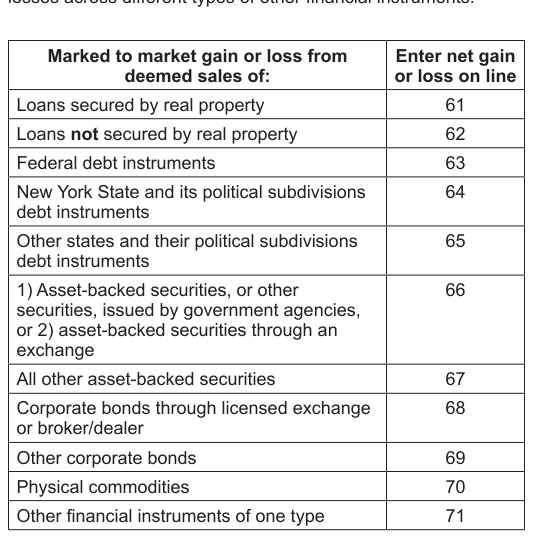
Text version of this table
Marked to market gain or loss from deemed sales of: Enter net gain or loss on line Loans secured by real property 61 Loans not secured by real property 62 Federal debt instruments 63 New York State and its political subdivisions debt instruments 64 Other states and their political subdivisions debt instruments 65 1) Asset-backed securities, or other securities, issued by government agencies, or 2) asset-backed securities through an exchange 66 All other asset-backed securities 67 Corporate bonds through licensed exchange or broker/dealer 68 Other corporate bonds 69 Physical commodities 70 Other financial instruments of one type 71
Page 26 of 32 IT-204-I (2025) Partnership's instructions for Form IT-204-CP Partnership's instructions for Form IT-204-CP New York Corporate Partner's Schedule K-1
# General information
On or before the due date for filing the partnership return, you must provide Form IT-204-CP to each corporate partner filing Form CT-3, CT-3-S, or included in a combined group filing Form CT-3-A, under Article 9-A. You must also provide Form IT-204-CP to each partner that is a partnership or an LLC.
To help partners report on their franchise tax return the items shown on their Form IT-204-CP, you may provide a copy of Form IT-204-CP-I, Partner's Instructions for Form IT-204-CP.
Note: The partnership must provide to each partner a statement indicating the partner's distributive share of contributions to one or more of the following New York Charitable Gifts Trust Fund accounts:
- Health Charitable Account; or
- Elementary and Secondary Education Account.
Note: If the partnership meets the qualifications of a non-farm small business, the partnership must provide to each corporate partner filing Form CT-3-S a statement that includes the following:
- verification that the partnership qualifies as a non-farm small business; and
- the amount of the qualifying income base attributable to the partnership that is being passed through to that partner (the $1.5 million New York gross receipts limitation is calculated using only receipts directly earned by the partnership; do not include receipts passed through from any lower-tier partnerships).
If the partnership received a statement from a lower-tier partnership that qualifies as a non-farm small business, the partnership must pass to each corporate partner filing Form CT-3-S both the qualifying statement and that partner's distributive share of the qualifying income base. If passing through qualifying information for more than one partnership, you must provide a separate statement for each lower-tier partnership.
Partnerships that are not an institutional real estate investor (IREI) as described in Tax Law § 208.9(c-4)(2) that own, directly or indirectly, any residential properties consisting of no more than two dwelling units (covered properties) should provide statements to their partners that include:
- the number of covered properties owned,
- the amount of federal depreciation related to covered properties, separately stating any amounts of such depreciation that are included in modifications A-209 or S-213 reported to the partner, and
- the amount of federal interest deductions allowed under IRC § 163 or interest charged to a capital account related to covered properties.
# Farm donations to food pantries credit
If the partnership claimed a credit on Form IT-649, Farm Donations to Food Pantries Credit, the partnership must provide to each corporate partner filing Form CT-3-S a statement indicating the partner's distributive share of the amount of qualified donations included in the partnership's charitable contributions amount.
# Specific instructions
Partnership's information
On each Form IT-204-CP, enter the tax year of the partnership the partnership is reporting for and the partnership's name and EIN.
Partner's information
On the Form IT-204-CP for each corporate partner, (or partner that is a partnership or an LLC), enter the partner's name, address, and EIN.
Item D
If you have a partner that is a partnership or an LLC, you must provide that partner with both Forms IT-204-CP and IT-204-IP; those partners must provide the information from both forms to their own partners. This will ensure that all Article 22 and Article 9-A partners further up in the partnership tier or chain receive the necessary information.
Item G
Enter the partner's share percentages as reported on federal Schedule K-1, item J.
Item H
Enter the partner's share of liabilities as reported on federal Schedule K-1, item K1.
Item I
Enter the partner's capital account analysis as reported on federal Schedule K-1, item L.
Items I2 and I3: Enter the amount of cash and property contributed by that partner to the partnership as shown on New York State Form IT-204, Section 6, lines 76 and 77.
Item I5: Enter the amount of withdrawals and distributions of cash to that partner, from Form IT-204, Section 6, line 81.
Item I6: Enter the amount of withdrawals and distributions of property made to that partner from Form IT-204, Section 6, line 82.
Item J
If this partner submitted a Form CT-2658-E, Certificate of
Exemption from Partnership Estimated Tax Paid on Behalf of
Corporate Partners, that is valid for 2025, mark an X in the Yes box. If you marked the Yes box, do not complete item K.
Item K
Enter the amount of estimated tax paid on behalf of the partner from all Forms CT-2658 on lines K1 through K4, and the total amount paid on line K. If you need more space to report payments, include a separate sheet showing all relevant prepayment information. Transfer the total shown on the additional sheet to item K.
Partner's distributive share and proportionate part A partner's distributive share of any item of income, gain, loss, deduction, or credit is generally determined by the partnership agreement [see IRC § 704(a)]. If, however, the partnership agreement does not specify the partner's distributive share of
Partnership's instructions for Form IT-204-CP such item, or the allocation of such items to a partner under the partnership agreement does not have substantial economic effect, then you must determine a partner's distributive share of income, gain, loss, deduction, or credit (or item thereof) in accordance with the partner's interest in the partnership, taking into account all of the facts and circumstances. See IRC § 704(b).
A partner's proportionate part of the partnership's assets, liabilities, and activities is generally determined in accordance with the partner's capital interest in the partnership.
Partners that are partnerships or LLCs
If you are completing Form IT-204-CP for a partner that is a partnership or an LLC (see Item D above), you must complete all parts of Form IT-204-CP, including all parts labeled for New York C corporate partners only and all parts labeled for New York S corporate partners only.
Partner's share of entire net income (ENI) information when the corporate partner's
# New York tax filing status is a C corporation
To determine the partner's ENI, the partner must add their distributive share of the ENI modifications to (or subtract it from) their federal taxable income.
ENI addition modifications
Line 1: Enter the partner's distributive share of the addition modifications listed on Form IT-204.1, page 1, line 1. In column A, enter any applicable additions by EA number and list the amount of the distributive share of each addition in column B. Provide the total amount of additions on line 1.
ENI subtraction modifications
Line 2: Enter the partner's distributive share of the subtraction modifications listed on Form IT-204.1, page 1, line 2. In column A, enter any applicable subtractions by ES number and list the amount of the distributive share of each subtraction in column B.
Provide the total amount of subtractions on line 2.
Partner's proportionate part of assets and liabilities (for New York C corporate partners only)
Lines 3 through 9
Enter the partner's proportionate part of your assets and liabilities that you reported on the corresponding lines of Form IT-204.1.
Partner's proportionate part of items related to investment capital under Article 9-A (for
# Parts 1, 2, 3, and 5
For Parts 1, 2, 3, and 5, in rows A through F, and in the row Total from additional sheet(s), enter in columns A through G the information for the partnership as a whole, exactly as you reported it on the corresponding parts and rows of your Form IT-204.1. Submit the copies of the same additional sheets that you submitted with your Form IT-204.1, if any.
Lines 10 through 14: In columns F and G, enter the partner's proportionate part of the totals that you reported on the corresponding lines and columns of Form IT-204.1.
Line 15: Enter the partner's distributive share of the amount from the corresponding line of Form IT-204.1.
Partner's share of items related to investment and other exempt income under Article 9-A (for New York C corporate partners only)
Lines 16 through 22
Enter the partner's distributive share of the amounts from the corresponding lines of Form IT-204.1. If the amount reported on the corresponding line of Form IT-204.1 is a negative amount, report the partner's share of the negative amount using a minus sign. For each of these lines, you must also provide your partner with a statement listing the amount, Name/CUSIP/CINS and lot number of each asset or investment.
Line 19: On the partner's statement, you must provide all applicable identifying information and list income amounts separately from net gain or loss amounts.
Note: For line 19 amounts, when netting at the corporate partner or combined group level on Form CT-3.1, your partner can only net losses against gains; they cannot net losses against any other income amounts, such as interest income.
Partner's share of items related to interest deductions directly attributable to investment and other exempt income under Article 9-A (for New York C corporate partners only) Lines 23 through 31: Enter the partner's distributive share of the deduction amounts from the corresponding lines of Form IT-204.1.
Partner's share and proportionate part of items related to subtraction modification for qualified banks Line 32: Enter the partner's proportionate part of the amount from Form IT-204.1, page 4, line 32.
Lines 33 through 33b: Enter the partner's distributive share of the amount from Form IT-204.1, page 4, lines 33 through 33b.
Partner's share and proportionate part of items related to manufacturing Line 34: Enter the partner's distributive share of the amount from Form IT-204.1, page 4, line 34. In addition, you must provide your partner with a separate statement that reports any receipts from the generation and distribution of electricity that are not included in this line.
Line 35: Enter the partner's proportionate part of the amount from Form IT-204.1, page 4, line 35.
Line 35a: Enter the partner's share of the amount from Form IT-204.1, page 4, line 36.
Partner's share of New York modifications
# (for New York S corporate partners only)
All S corporations must report the following information on Form CT-225 and Form CT-34-SH.
Line 36: New York State additions
In column A on lines 36a through 36f, enter the partner's distributive share of the total amount for each applicable addition modification that you reported on Form IT-225. Each addition modification is designated by the letters EA. Be sure to enter the corresponding number of the addition next to the letters EA.
If you are reporting more than six addition modifications for the partner, include a separate schedule.
Line 37: Enter the column A total of lines 36a through 36f and any additional schedules (if more than six addition modifications) on this line.
Line 38: New York State subtractions
On lines 38a through 38f, enter in column A the partner's distributive share of the total amount for each applicable subtraction modification reported on Form IT-225. Each subtraction modification is designated by the letters ES. Be sure to enter the corresponding number of the subtraction next to the letters ES. If you are reporting more than six subtraction modifications for the partner, include a separate schedule.
Line 39: Enter the column A total of lines 38a through 38f and any additional schedules (if more than six subtraction modifications) on this line.
Line 40: Additions to itemized deductions
In the Amount column on lines 40a through 40f, enter the partner's distributive share of the total amount of each addition modification reported on Form IT-204, lines 111a through 111f.
Be sure to enter the corresponding letter for each addition in the Letter box.
Line 42: Subtractions from itemized deductions
In the Amount column on lines 42a through 42f, enter the partner's distributive share of the total amount of each subtraction modification reported on Form IT-204, lines 113a through 113f. Be sure to enter the corresponding letter for each subtraction in the Letter box.
Partner's share of income, deductions, etc.
Lines 44 through 60: Transfer the amounts from the corporate partner's federal Form 1065, Schedule K-1. However, for line 19 of federal Form 1065, Schedule K-1, determine the portion of line 19 that represents distributions of cash and marketable securities, and distributions of other property, and enter those amounts on Form IT-204-CP, lines 58 and 59, respectively. Be sure to write in the Identify boxes, where provided, the types and amounts you included on each specific line.
Partner's credit information
Part 1: Flow through credit bases and information
Brownfield redevelopment tax credit
Enter the partner's distributive share of any amounts from Form IT-611 in column A, from Form IT-611.1 in column B, from Form IT-611.2 in column C.
Line 61: Enter the partner's distributive share of the site preparation cost from Form IT-204, lines 144a through 144f, code 107.
Line 62: Enter the partner's distributive share of the tangible property cost from Form IT-204, lines 144a through 144f, code 108.
Line 63: Enter the partner's distributive share of the on-site groundwater remediation cost from Form IT-204, lines 144a through 144f, code 109.
QEZE tax reduction credit
Lines 66, 67, and 68: Enter the QEZE employment increase factor, QEZE zone allocation factor, and QEZE benefit period factor from Form IT-204, lines 133, 134, and 135.
Partnership's instructions for Form IT-204-CP
Excelsior jobs program tax credit
Lines 69 through 72a: Enter the partner's distributive share of the excelsior jobs program tax credit from Form IT-204, lines 136 through 139a.
Farmers' school tax credit
Line 73: Enter the partner's distributive share of acres of qualified agricultural property from Form IT-204, line 140.
Line 74: Enter the partner's distributive share of acres of qualified conservation property from Form IT-204, line 141.
Line 75: Enter the partner's distributive share of eligible school district property taxes paid by the partnership from Form IT-204, line 142.
Line 76: Enter the partner's distributive share of acres of qualified agricultural property converted to nonqualified use from Form IT-204, line 143.
Other flow-through credit bases and information
Lines 77a through 77f
Investment tax credit: If you entered code 212 on Form IT-204, lines 144a through 144f, enter code 212 and the partner's proportionate part of the investment tax credit base (excluding R&D property) of such amount, and enter code 218 and the partner's proportionate part of the R&D investment tax credit base.
If you entered code B12 on Form IT-204, lines 144a through 144f, enter code B12 and the partner's proportionate part of the investment credit base that qualifies as eligible farm property.
Economic transformation and facility redevelopment program credit: If you entered any of the following codes on Form IT-204, lines 144a through 144f, enter the corresponding codes and the partner's proportionate part of the economic transformation and facility redevelopment program credit components.
Code 633: Jobs tax credit component
Code B33: Investment tax credit component
Code C33: Training tax credit component
Code D33: Real property tax credit component
Note: If you were a shareholder in a C corporation that has a special gross income from farming election, enter the code and the partner's distributive share of the amount as reported on Form IT-204, lines 144a through 144f.
Lines 77g through 77l
If you are filing multiple Forms IT-604, Claim for QEZE Tax Reduction Credit, and/or Forms IT-638, enter the code and the partner's credit information as reported on Form IT-204, lines 144g through 144l.
Part 2: Flow-through credits, addbacks, and recaptures
Line 78
If you reported a long-term care insurance credit on line 145 of Form IT-204, enter code 249 and the partner's distributive share of that amount.
If you reported an investment credit for eligible farmers on qualified property on line 146c of Form IT-204, enter code C12 and the partner's distributive share of that amount.
Partnership's instructions for Form IT-204-CP
For all other credits, you must enter the 3-digit code number identifying each credit and the partner's distributive share of that credit from Form IT-204, lines 147a through 147h.
If you reported a rehabilitation of historic properties credit on Form IT-204, Section 11, Part 2, you must provide to your partners a separate statement indicating all project numbers.
The project number is the National Park Services number that identifies the rehabilitation project. You must provide project numbers for all such tax credit amounts passed through to the partnership and for tax credit amounts generated by the partnership.
Line 79
For all other addbacks of credits and recaptures, you must enter the 3-digit code number identifying each addback or recapture and the partner's distributive share of that addback or recapture from Form IT-204, lines 148a through 148f.
Part 3: START-UP NY tax elimination credit information
Lines 80, 81, and 82
Enter on these lines the information from Form IT-204, lines 149, 150, and 151.
You must also provide to your partner a separate statement indicating the name of the sponsoring campus, university, or college; if you are certified by more than one sponsor, list all sponsors on such statement.
Partner's share of apportionment and
# District (MCTD) information
New York S corporations are not subject to the MCTD tax surcharge and do not need MCTD amounts.
The MCTD includes the counties of New York, Bronx, Kings, Queens, Richmond, Dutchess, Nassau, Orange, Putnam, Rockland, Suffolk, and Westchester.
When computing property and receipts, eliminate inter-entity rental expenses paid to your corporate partner and receipts from sales to your corporate partner, respectively.
# Lines 3 through 7
Enter the MCTD amounts in column A and the New York State amounts in column B.
Average value of real and tangible personal property means the adjusted basis of such property for federal income tax purposes.
However, the partner may make an election to use FMV as the value of such property.
FMV of real and tangible personal property owned means the price (without deduction of an encumbrance whether or not the partnership is personally liable) at which a willing seller will sell and willing purchaser will buy.
Line 3: Enter, for the method used by your partner (FMV or adjusted basis), the partner's share of the average value of real property you owned. Do not include real property and related equipment (except inventoriable goods) that are under construction and are not occupied or used by the partnership during construction. Include property or equipment under construction that is partially used in the regular course of business of the partnership only to the extent used.
Line 4: Enter the partner's share of the average value of rented real property. The value of rented real property is generally eight times the gross rent payable during the year covered by this return. Gross rent includes any amount payable as rent or instead of rent (such as taxes or repairs), and amortization of lease-hold improvements that revert to the lessor as the end of the lease.
Line 6: Enter, for the method used by your partner (FMV or adjusted basis), the partner's share of the average value of the tangible personal property you owned, such as machinery, tools, and implements. Do not include cash, shares of stock, bonds, notes, credits, evidences of an interest in property, or evidences of credit.
Line 7: Enter the partner's share of the average value of tangible personal property you rented. The value of rented tangible personal property is generally eight times the gross rent payable during the year covered by this return.
# Apportionment: Part 2
Lines 1 through 77
Lines 1 through 77 align with Form IT-204.1, Apportionment:
Part 2, lines 1 through 77. You must provide, when appropriate, on lines 1 through 77, your partner's distributive share or proportionate part of amounts reported on a corresponding line of Form IT-204.1. You must also report such shares in the corresponding columns (MCTD, New York State, or Everywhere), as appropriate.
For receipts sourced by a fraction, the partner must calculate such fractions at the partner level. When computing such fractions, the partner must include both the partner's own amounts and the partner's distributive share or proportionate part of any partnership amounts. The partner must aggregate its own receipts with its distributive share of the partnership's receipts, and source them using the aggregate fraction calculated at the partner level. You must report certain information to your partner by type of other financial instruments or by type of receipt (see netting and sourcing rules under Tax Law § 210-A). Accordingly, for certain receipts, you must supply a separate statement to your partner with the information the partner needs to properly source and net receipts or to calculate, at the partner's level, the fraction the partner will use to source receipts to New York State. For certain receipts, use lines 56 through 77, as instructed below, to provide information to your partners necessary for sourcing.
For those lines that do not have special instructions below, enter the partner's distributive share or proportionate part of the MCTD, New York State, and Everywhere amounts that you entered for the corresponding lines on Form IT-204.1, Apportionment: Part 2.
For the remaining lines in Apportionment: Part 2, follow the specific line instructions below.
Line 3: In its corresponding column, enter the partner's share of the amount entered in each column of Form IT-204.1, Apportionment: Part 2, line 3. If the amount you reported in a particular column for line 3 of Form IT-204.1, Apportionment:
Part 2 is a negative amount, report the partner's share of such negative amount in the corresponding column of this line as a negative amount using a minus sign.
Line 7a: In its corresponding column, enter the partner's share of the amount you entered in each column of Form IT-204.1, Apportionment: Part 2, line 7a. You must supply to your partner a breakdown of the line 7a receipts you are reporting to your partner (on Form IT-204-CP, Apportionment: Part 2) by hierarchy method (3 or 4) and digital product, for each column. See Form CT-3-I, Part 6, line 7.
Line 10: Enter in column C (Everywhere), the partner's share of the amount entered in Form IT-204.1, Apportionment: Part 2, line 10, column C (Everywhere). If the amount reported in column C (Everywhere) for line 10 of Form IT-204.1, Apportionment: Part 2 is a negative amount, report the partner's share of such negative amount in column C (Everywhere) as a negative amount using a minus sign. MCTD and New York State amounts are not reported to your partner for line 10. Also, see line 56.
Line 11: Mark an X in the box if you marked an X in the box on the corresponding line on Form IT-204.1, Apportionment: Part 2.
If you mark the box, then you must also mark the box on line 12.
Line 12: Mark an X in the box if you marked an X in the box on the corresponding line on Form IT-204.1, Apportionment: Part 2.
If you mark the box, then you must also mark the box on line 11.
Enter in column C (Everywhere), the partner's share of the amount entered in Form IT-204.1, Apportionment: Part 2, line 12, column C (Everywhere). If the amount you reported in column C (Everywhere) for line 12 of Form IT-204.1, Apportionment: Part 2 is a negative amount, report the partner's share of such negative amount in column C (Everywhere) as a negative amount using a minus sign. MCTD and New York State amounts are not reported to your partner for line 12. Also, see line 57.
Lines 13 through 18
Mark an X in the box next to Section 210-A.5(a)(2)(B) if you marked an X in such box above the corresponding lines on Form IT-204.1, Apportionment: Part 2. For these lines, do not report MCTD and New York State amounts to your partner.
Line 13: Enter in column C (Everywhere), the partner's share of the amount you entered on Form IT-204.1, Apportionment: Part 2, line 13, column C (Everywhere).
Line 15: Enter in column C (Everywhere), the partner's share of the amount you entered on Form IT-204.1, Apportionment: Part 2, line 15, column C (Everywhere).
Line 16: Enter in column C (Everywhere), the partner's share of the amount you entered on Form IT-204.1, Apportionment:
Part 2, line 16, column C (Everywhere). If the amount reported in column C (Everywhere) for line 16 of Form IT-204.1, Apportionment: Part 2 is a negative amount, report the partner's share of such negative amount in column C (Everywhere) as a negative amount using a minus sign.
Line 17: Enter in column C (Everywhere), the partner's share of the amount you entered on Form IT-204.1, Apportionment: Part 2, line 17, column C (Everywhere).
Line 18: Enter in column C (Everywhere), the partner's share of the amount you entered on Form IT-204.1, Apportionment:
Part 2, line 18, column C (Everywhere). If the amount reported in column C (Everywhere) for line 18 of Form IT-204.1, Apportionment: Part 2 is a negative amount, report the partner's share of such negative amount in column C (Everywhere) as a negative amount using a minus sign.
Lines 19 through 21
Mark an X in the box next to Section 210-A.5(a)(2)(C) if you marked an X in such box above the corresponding lines on Form IT-204.1, Apportionment: Part 2. For these lines, do not report MCTD and New York State amounts to your partner.
Line 19: Enter in column C (Everywhere), the partner's share of the amount you entered on Form IT-204.1, Apportionment: Part 2, line 19, column C (Everywhere).
# Partnership's instructions for Form IT-204-CP
Line 20: Enter in column C (Everywhere), the partner's share of the amount you entered on Form IT-204.1, Apportionment:
Part 2, line 20, column C (Everywhere). If the amount reported in column C (Everywhere) for line 20 of Form IT-204.1, Apportionment: Part 2 is a negative amount, report the partner's share of such negative amount in column C (Everywhere) as a negative amount using a minus sign.
Line 21: Enter in column C (Everywhere), the partner's share of the amount you entered on Form IT-204.1, Apportionment:
Part 2, line 21, column C (Everywhere). If the amount reported in column C (Everywhere) for line 21 of Form IT-204.1, Apportionment: Part 2 is a negative amount, report the partner's share of such negative amount in column C (Everywhere) as a negative amount using a minus sign. Also, see line 58.
Lines 22 through 24
Mark an X in the box next to Section 210-A.5(a)(2)(D) if you marked an X in such box above the corresponding lines on Form IT-204.1, Apportionment: Part 2.
Line 22: In its corresponding column, enter the partner's share of the amount entered in each column of Form IT-204.1, Apportionment: Part 2, line 22.
Line 23: Enter in column C (Everywhere), the partner's share of the amount you entered on Form IT-204.1, Apportionment:
Part 2, line 23, column C (Everywhere). If the amount reported in column C (Everywhere) for line 23 of Form IT-204.1, Apportionment: Part 2 is a negative amount, report the partner's share of such negative amount in column C (Everywhere) as a negative amount using a minus sign. For line 23, do not report MCTD and New York State amounts to your partner.
Line 24: Enter in column C (Everywhere), the partner's share of the amount you entered on Form IT-204.1, Apportionment:
Part 2, line 24, column C (Everywhere). If the amount reported in column C (Everywhere) for line 24 of Form IT-204.1, Apportionment: Part 2 is a negative amount, report the partner's share of such negative amount in column C (Everywhere) as a negative amount using a minus sign. For line 24, do not report MCTD and New York State amounts to your partner. Also, see line 59.
Line 25: For the information you must report to your partner, see lines 72 through 77.
Line 26: Enter in column C (Everywhere), the partner's share of the amount you entered on Form IT-204.1, Apportionment:
Part 2, line 26, column C (Everywhere). If the amount reported in column C (Everywhere) for line 26 of Form IT-204.1, Apportionment: Part 2 is a negative amount, report the partner's share of such negative amount in column C (Everywhere) as a negative amount using a minus sign.
Lines 27 and 28
Mark an X in the box next to the Tax Law section citation above the line if you marked an X in such box above the corresponding line on Form IT-204.1, Apportionment: Part 2.
Line 27: Enter in column C (Everywhere), the partner's share of the amount you entered on Form IT-204.1, Apportionment:
Part 2, line 27, column C (Everywhere). Also, see line 60. If the amount reported in column C (Everywhere) for line 27 of Form IT-204.1, Apportionment: Part 2, is a negative amount, report the partner's share of such negative amount in column C (Everywhere) as a negative amount using a minus sign.
Line 28: For the information you must report to your partner, see lines 61 through 71.
# Partnership's instructions for Form IT-204-CP
Lines 29 through 30f
Mark an X in the box next to Section 210-A.5(a)(2)(H) if you marked an X in such box above the corresponding lines on Form IT-204.1 Apportionment: Part 2. Mark an X in the box next to Section 210-A.5(a)(2)(G) if you marked an X in such box above the corresponding lines on Form IT-204.1 Apportionment:
Part 2.
Lines 29 through 30c: You must report business receipts from other financial instruments on a type-by-type basis; source and net such receipts only with receipts from other financial instruments of the same type. If you have interest from; gains or losses from sales of; or other income or losses from; any other financial instruments, you must submit a statement to provide to your partner a breakdown of the partner's proportionate share of all such interest, net gains or losses, and net other income or losses by line number (lines 29 through 30c) and by type of other financial instruments. If you have receipts reportable on any of lines 29 through 30c from more than one type of other financial instruments, use an additional such line for each separate type of other financial instruments for which you are reporting receipts. Clearly identify each type of other financial instruments for which you are reporting receipts; if you marked an X in the box next to Section 210-A.5(a)(2)(H), you must indicate, for each such type, whether or not you marked to market under IRC §§ 475 or 1256 any other financial instruments of that type. Enter on such statement the partner's share of the amounts you entered on the statement you submitted with Form IT-204.1, Apportionment: Part 2, for lines 29 through 30c. If any amount reported on the statement you submitted with Form IT-204.1, Apportionment: Part 2, for lines 29 through 30c, is a negative amount, report the partner's share of such negative amount as a negative amount using a minus sign.
Line 30d: Enter in column C (Everywhere), the partner's share of the amount you entered on Form IT-204.1, Apportionment:
Part 2, line 30d, column C (Everywhere). If you marked an X in the box next to Section 210-A.5(a)(2)(G) you must submit a statement indicating if you marked to market under IRC §§ 475 or 1256 any stock that is business capital.
Line 30e: Enter in column C (Everywhere), the partner's share of the amount you entered in Form IT-204.1, Apportionment:
Part 2, line 30e, column C (Everywhere). If the amount reported in column C (Everywhere) for line 30e of Form IT-204.1, Apportionment: Part 2 is a negative amount, report the partner's share of such negative amount in column C (Everywhere) as a negative amount using a minus sign. If you marked an X in the box next to Section 210-A.5(a)(2)(G) you must submit a statement indicating if you marked to market under IRC §§ 475 or 1256 any stock that is business capital.
Line 30f: Enter in column C (Everywhere), the partner's share of the amount you entered in Form IT-204.1, Apportionment:
Part 2, line 30f, column C (Everywhere). If the amount reported in column C (Everywhere) for line 30f of Form IT-204.1, Apportionment: Part 2 is a negative amount, report the partner's share of such negative amount in column C (Everywhere) as a negative amount using a minus sign. If you marked an X in the box next to Section 210-A.5(a)(2)(G) you must submit a statement indicating if you marked to market under IRC §§ 475 or 1256 any partnership interest in a widely held or publicly traded partnership.
Line 42: If you are a credit card processor, enter in column C (Everywhere) your partner's share of the amount entered in Form IT-204.1, Apportionment: Part 2, line 42, column C (Everywhere). You must also supply to your partner the partner's proportionate part of the number of New York access points and the partner's proportionate part of the number of U.S. access points, as described in Form CT-3-I, Part 6, line 42.
Line 43: If you provide services to investment companies, enter in column C (Everywhere) your partner's share of the amount entered in Form IT-204.1, Apportionment: Part 2, line 43, column C (Everywhere). You must also supply to your partner the partner's proportionate part of the number of shares in the investment company owned by shareholders located in New York and the number of shares outstanding, that the partner needs to calculate the fraction, as such fraction is described in Form CT-3-I, Part 6, line 43.
Line 45: Enter in column C (Everywhere) your partner's share of the amount entered in Form IT-204.1, Apportionment: Part 2, line 45, column C (Everywhere). You must also supply to your partner the partner's proportionate part of the number of miles in such business within New York State and both within and outside the state, that the partner needs to calculate the fraction, as such fraction is described in Form CT-3-I, Part 6, line 45.
Line 46: Enter in column C (Everywhere) your partner's share of the amount entered in Form IT-204.1, Apportionment: Part 2, line 46, column C (Everywhere). You must also supply to your partner the partner's proportionate part of the aggregate number of working days of the vessels that the partner needs to calculate the fraction, as such fraction is described in Form CT-3-I, Part 6, line 46.
Line 48: Enter in column C (Everywhere) your partner's share of the amount entered in Form IT-204.1, Apportionment: Part 2, line 48, column C (everywhere). You must also supply to your partner the partner's proportionate part of the amounts that the partner needs to complete Worksheet for Part 6, line 48 as such worksheet appears in Form CT-3-I, Part 6.
Line 49: Enter in column C (Everywhere) your partner's share of the amount entered in Form IT-204.1, Apportionment: Part 2, line 49, column C (Everywhere). You must also supply to your partner the partner's proportionate part of the number of newspapers and periodicals delivered to points within New York State and both within and outside the state, that the partner needs to calculate the fraction, as such fraction is described in Form CT-3-I, Part 6, line 49.
Line 49a: Enter in column C (Everywhere) your partner's share of the amount entered in Form IT-204.1, Apportionment:
Part 2, line 49a, column C (Everywhere). You must also supply to your partner the partner's proportionate part of the number of New York State locations of such media and the number of locations both within and outside the state that the partner needs to calculate the fraction, as such fraction is described in Form CT-3-I, Part 6, line 50.
Line 50: Enter in column C (Everywhere) your partner's share of the amount entered in Form IT-204.1, Apportionment: Part 2, line 50, column C (Everywhere). You must also supply to your partner the partner's proportionate part of the number of viewers or listeners within New York State and both within and outside the state that the partner needs to calculate the fraction, as such fraction is described in Form CT-3-I, Part 6, line 51.
Line 51: Enter in column C (Everywhere) your partner's share of the amount entered in Form IT-204.1, Apportionment: Part 2, line 51, column C (Everywhere). You must also supply to your partner the partner's proportionate part of the number of viewers or listeners within New York State and both within and outside the state that the partner needs to calculate the fraction, as such fraction is described in Form CT-3-I, Part 6, line 52.
Line 51a: Enter in column C (Everywhere) your partner's share of the amount entered in Form IT-204.1, Apportionment: Part 2, line 51a, column C (Everywhere). You must also supply to your partner the partner's proportionate part of the number of intended targets of such advertising or marketing in New York State and both within New York State and outside the state that the partner needs to calculate the fraction, as such fraction is described in Form CT-3-I, Part 6, line 53.
Line 52: Enter in column C (Everywhere) your partner's share of the amount entered in Form IT-204.1, Apportionment: Part 2, line 52, column C (Everywhere). You must also supply to your partner the partner's proportionate part of the number of transportation units within New York State and both within and outside the state that the partner needs to calculate the fraction, as such fraction is described in Form CT-3-I, Part 6, line 54.
Line 53a: In its corresponding column, enter the partner's share of the amount you entered in each column of Form IT-204.1, Apportionment: Part 2, line 53a. For each column, you must supply to your partner a breakdown of the line 53a receipts you are reporting to your partner (on Form IT-204-CP, Apportionment: Part 2) by hierarchy method (3 or 4) and type of receipt. See Form CT-3-I, Part 6, line 55, for the hierarchy methods.
Line 54: Enter in columns A (MCTD) and B (New York State), your partner's share of the amounts entered in the corresponding columns of line 54 of Form IT-204.1, Apportionment: Part 2. You do not need Everywhere amounts for this line.
Line 55: Enter your partner's proportionate part of the amount entered in Form IT-204.1, Apportionment: Part 2, line 55.
Lines 61 through 77
Enter your partner's share of the amounts entered in the corresponding lines of Form IT-204.1, Apportionment: Part 2.
Note: For lines 61 through 71, if the amount on the corresponding line of Form IT-204.1 Apportionment: Part 2 is a loss, show the partner's share of such loss using a minus sign.
Line 71: If you have receipts reportable on this line:
- from only one type of other financial instruments, enter the partner's share of the amount you entered on Form IT-204.1, Apportionment: Part 2, line 71, from that type of other financial instruments. You must supply to your partner a statement identifying such type of other financial instruments.
- from more than one type of other financial instruments, leave this line blank and supply to your partner a breakdown of the partner's share of all MTM gains or losses as reported on the statement submitted with Form IT-204.1, Apportionment:
Part 2, line 71, by type of other financial instruments. You cannot net MTM gains or losses across different types of other financial instruments.
Partnership's instructions for Form IT-204-CP
# Privacy notification
New York State Law requires all government agencies that maintain a system of records to provide notification of the legal authority for any request for personal information, the principal purpose(s) for which the information is to be collected, and where it will be maintained. To view this information, visit our website, or, if you do not have Internet access, call and request Publication 54, Privacy Notification. See Need help? for the Web address and telephone number.
# Need help?
Visit our website at www.tax.ny.gov
- get information and manage your taxes online
- check for new online services and features
Telephone assistance
Automated income tax refund status: 518-457-5149 Personal Income Tax Information Center: 518-457-5181 To order forms and publications: 518-457-5431 Dial 7-1-1 for the
Text Telephone (TTY) or TDD equipment users New York Relay Service
Source: view the official PDF
Nearby sections (19 sections)
- ct-225 · Form CT-225 — New York State Modifications (Corporate)
- ct-3 · Instructions for Form CT-3 — General Business Corporation…
- ct-3-a · Instructions for Form CT-3-A — General Business Corporation…
- ct-3-s · Instructions for Form CT-3-S — New York S Corporation…
- ct-3.1 · Instructions for Form CT-3.1 — Investment & Other Exempt…
- ct-34-sh · Instructions for Form CT-34-SH — New York S Corporation…
- it-201 · Instructions for Form IT-201 — Resident Income Tax Return
- it-203 · Instructions for Form IT-203 — Nonresident & Part-Year…
- it-203-gr · Instructions for Form IT-203-GR — Group Return for…
- it-204 · Instructions for Form IT-204 — Partnership Return
- it-204-cp · Instructions for Form IT-204-CP — Corporate Partner's New…
- it-204-ip · Instructions for Form IT-204-IP — Partner's New York K-1…
- it-204-ll · Instructions for Form IT-204-LL — Partnership/LLC/LLP…
- it-205 · Instructions for Form IT-205 — Fiduciary Income Tax Return
- it-225 · Instructions for Form IT-225 — New York State Modifications
- nys-45 · Instructions for Form NYS-45 — Quarterly Combined Withholding,…
- st-100 · Instructions for Form ST-100 — New York State & Local…
- st-101-i · Instructions for Form ST-101 — New York State & Local Annual…
- st-810-i · Instructions for Form ST-810 — New York State & Local…