New York DTF Form Instructions
Instructions for Form IT-204-CP — Corporate Partner's New York K-1
Department of Taxation and Finance
Partner's Instructions for Form IT-204-CP
New York Corporate Partner's Schedule K-1
# General instructions
If you are a partner in a partnership who must file Form CT-3, CT-3-S, or be included in a combined group filing Form CT-3-A, under Article 9-A (a corporate partner), the partnership should send you a completed Form IT-204-CP. Keep Form IT‑204‑CP for your records. Do not file it with your Article 9-A franchise tax return. See Who must file under Article 9-A.
Partnerships and LLCs
If you are a partnership or a limited liability company (LLC) and you received Form IT-204-CP from a partnership that you are a partner in, use that form and these instructions to determine the proper amounts to include on your Form IT-204.1 on an aggregate basis. For more information, see the Partnership's instructions for Form IT-204.1 in Form IT-204-I, Instructions for Form IT-204.
For more information on any Forms IT-204-CP you complete for a partner of your own, see the Partnership's instructions for Form IT-204-CP in Form IT-204-I.
Note: You should also receive a Form IT-204-IP, New York Partner's Schedule K-1, from all partnerships that you are a partner in. You must include the proper amounts from any such Forms IT-204-IP that you receive on the Forms IT-204-IP you complete for your own partners.
New York corporations
Report the partnership items for the partnership tax year that ends within the tax year for which you are filing your franchise tax return. The partnership tax year is entered on the top of page 1 of Form IT-204-CP.
New York C corporations: If you are a New York C corporation, use this form and these instructions to determine the proper amount of partnership income, gain, loss, deduction, and any other partnership items you are required to report on your Article 9-A franchise tax return if you are calculating your tax using the aggregate method, and to determine tax credits you may deduct against the Article 9-A franchise tax.
New York S corporations: If you are a New York S corporation, use this form and these instructions to determine the proper amount of certain partnership items you must pass on to your shareholders under Article 22, and to determine the proper amount of receipts to include in the computation of your fixed dollar minimum tax under Article 9-A.
Errors on your Form IT-204-CP
If you believe the partnership reported inaccurate information on your Form IT-204-CP, notify the partnership. Ask for a corrected Form IT-204-CP from the partnership. Do not change any items on your copy of Form IT-204-CP.
Who must file under Article 9-A
Domestic corporations subject to the franchise tax under
Article 9-A - A domestic corporation (incorporated in New York State) is generally liable for franchise taxes for each fiscal or calendar year, or part thereof, during which it is incorporated until it is formally dissolved with the Department of State (www.dos.ny.gov) unless specifically exempt. When filing its franchise tax return, the corporation must include the proper amount of partnership income, gain, loss, deduction, asset, liability, apportionment item, tax credit, and any other partnership items needed regardless of whether the partnership is doing business, employing capital, owning or leasing property, maintaining an office, or deriving receipts from activity, in New York State.
Foreign corporations subject to the franchise tax under
Article 9-A: A foreign corporation (incorporated outside of New York State) is liable for franchise taxes during the period in which it is doing business, employing capital, owning or leasing property, maintaining an office, or deriving receipts from activity, in New York State regardless of whether it is authorized to do business in New York State, unless specifically exempt.
Foreign corporate limited partner: A foreign corporation is doing business, employing capital, owning or leasing property, maintaining an office, or deriving receipts from activity, in New York State if it is a limited partner of a partnership (other than a portfolio investment partnership) that is doing business, employing capital, owning or leasing property, maintaining an office, or deriving receipts from activity, in New York State, and if it is engaged, directly or indirectly, in the participation or in the domination or control of all or any portion of the business activities or affairs of the partnership.
Foreign corporate general partner: If the partnership marked an X in the Yes box on Partner's share of apportionment and Metropolitan Commuter Transportation District (MCTD) information, Part 1, line 1 (indicating that it did business, employed capital, owned or leased property, maintained an office, or derived receipts from activity, in New York State) and you are a corporate general partner, then you are subject to the franchise tax imposed under Tax Law Article 9-A and must include the proper amount of partnership income, gain, loss, deduction, asset, liability, apportionment item, tax credit, and any other partnership items needed when completing your franchise tax return.
An LLC or limited liability partnership (LLP) that is treated as a partnership for federal income tax purposes is treated as a partnership for New York State tax purposes.
# Computation of tax
An Article 9-A corporate partner computes its tax with respect to its interest in the partnership using either the aggregate method or entity method, whichever applies. (See Election by a foreign corporate limited partner for the exception to these methods.) Aggregate method: Under the aggregate method, a corporate partner is viewed as having an undivided interest in the partnership's assets, liabilities, and items of receipts, income, gain, loss, and deduction. The partner is treated as participating in the partnership's transactions and activities.
Entity method: Under the entity method, a partnership is treated as a separate entity and a corporate partner is treated as owning an interest in the partnership entity. The partner's interest is an intangible asset that is classified as business capital. To the extent a corporate partner's entire net income (ENI) includes its distributive share of partnership items of income, gain, loss, or deduction, those items are treated as business income.
Corporate partners required to file under the aggregate method
A corporate partner receiving a complete Form IT-204-CP must file using the aggregate method. In addition, a corporate partner must file using the aggregate method if the corporate partner has access to the information necessary to compute its tax using the aggregate method. A corporate partner is presumed to have access to the information and therefore is required to file using the aggregate method if it meets one or more of the following conditions:
- it is conducting a unitary business with the partnership;
- it is a general partner of the partnership or is a managing member of an LLC which is treated as a partnership for federal income tax purposes;
- it has a 5% or more interest in the partnership;
- it has reported information from the partnership in a prior tax year using the aggregate method;
- its partnership interest constitutes more than 50% of its total assets;
- its basis in its interest in the partnership determined under Internal Revenue Code (IRC) § 705 on the last day of the partnership year that ends within or with the taxpayer's tax year is more than $5 million; or
- any member of its affiliated group has the information necessary to perform such calculation.
A corporate partner that does not receive a complete Form IT-204-CP may file using the entity method only if it does not meet any of the conditions listed above and does not have access (and will not have access within the time period allowed for filing a return with regard to all extensions of time to file) to the information necessary to compute its tax using the aggregate method and certifies these facts to the commissioner.
Calculation of tax under the aggregate method: Include the taxpayer's distributive share (IRC § 704) of each partnership item of receipts, income, gain, loss, and deduction and the taxpayer's proportionate part of each partnership asset, liability, and partnership activity in the calculation of the taxpayer's business income base, capital base, and the fixed dollar minimum.
For Article 9-A purposes, these items have the same source and character for the partner that the items have for federal income tax purposes.
Election by a foreign corporate limited partner: A foreign corporation that is a limited partner in one or more limited partnerships, that is subject to tax solely as a result of the rule stated under Foreign corporate limited partner and that does not file on a combined basis for Article 9-A purposes, may elect to compute its tax by taking into account only its distributive share of each partnership item of receipts, income, gain, loss, and deduction (including any modifications), and its proportionate part of each asset, liability, and partnership activity of the limited partnership.
If the taxpayer meets the criteria to make the election and does not have access to the information necessary to do the calculation, the taxpayer may treat its distributive share of the partnership's items of income, gain, loss, and deduction as business income and its interest in the partnership as business capital and may allocate that business income and capital entirely to New York State.
You cannot make this election if the limited partnership and corporate group are engaged in a unitary business, wherever conducted.
Corporate group means the corporate limited partner itself or, if it is a member of an affiliated group, the corporate limited partner and all other members of such affiliated group.
Affiliated group has the same meaning as in IRC § 1504 without regard to the exclusions provided for in § 1504(b). However, the term common parent corporation means any person as defined in IRC § 7701(a)(1).
# Specific instructions
Partner's information
Item C
If the General partner or LLC member-manager box is marked, you must use the aggregate method in determining your tax.
Item J
If the No box is marked, but after considering all your individual circumstances, you feel you are not required to pay estimated tax, see Form CT-2658-E-I, Instructions for Form CT-2658-E, to determine if you qualify.
# Item K
If the partnership made estimated tax payments on your behalf, the dates and amounts of the payments are shown in item K. In the payments section of your corporate franchise tax return, include the total amount of the estimated tax as shown on your Form IT-204-CP.
Partner's share of entire net income (ENI) information when the corporate partner's New York filing status is a C corporation When you determine your business income, investment income, and other exempt income, you must take into account your distributive share of each partnership item of income, gain, loss, and deduction that is included in the calculation of ENI.
You may qualify for a reduced rate of tax on your business income base or capital base, or a reduced fixed dollar minimum tax if you are a qualified New York manufacturer or a qualified emerging technology company (QETC).
You must include your distributive share or proportionate part, as applicable, of partnership items when determining if you qualify as one of the above. For the definitions of small business taxpayer, qualified New York manufacturer, and QETC, see Form CT-3-I, Instructions for Form CT-3; or if you are a member of a combined group, see Form CT-3-A-I, Instructions for Form CT-3-A.
Line 1: Total additions
# Include this amount on your Form CT-225, New York State
Modifications, Form CT-225-A, New York State Modifications (for filers of combined franchise tax returns), or Form CT-225-A/B,Group Member's Detail Spreadsheet - New York State Modifications (for filers of combined franchise tax returns), as applicable.
# Line 2: Total subtractions
Include this amount on your Form CT-225, Form CT-225-A, or Form CT-225-A/B, as applicable.
Partner's proportionate part of assets and liabilities
Lines 3 through 9
Your partnership must report to you the information you need to compute the average value of the items reported on lines 3 through 7 using the frequency basis (quarterly or more frequently) that you are utilizing for valuing such items on your Form CT-3, General Business Corporation Franchise Tax Return, or Form CT-3-A, General Business Corporation Combined Franchise Tax Return, Part 4 as applicable.
You must use Lines 8 and 9 to complete Form CT-3.1, Investment and Other Exempt Income and Investment Capital. You must adjust the amount on line 9 to remove the following liabilities directly attributable to those assets/investments reported to you on Parts 1, 2, and 3 that represent stock:
- in corporations that you or your combined group is unitary with,
- in a corporation that is included in a combined return with you pursuant to the commonly owned group election, and
- issued by you.
Such stocks are not investment capital.
When you are completing Form CT-3.1, add the liabilities removed from line 9 to the amount reported to you on line 8.
Adjustments to amounts reported to you on lines 10 through 31 You may not claim investment capital treatment for stock:
- in corporations that you, or your combined group, are unitary with,
- in corporations included in a combined return with you pursuant to the commonly owned group election, and
- issued by you that your partnership may have reported on Parts 1, 2, and 3.
You must treat such stocks as business capital.
Do not claim investment income treatment for any income from such stocks that your partnership may have reported on lines 19 through 22. You must treat such income as business income, unless it meets the definition of other exempt income.
If your partnership reported other exempt income on lines 16 through 18, you may only include such amounts in your total other exempt income if you, or your combined group, are unitary with the corporation that generated such income.
If you, or your combined group, are not unitary with the corporation that generated such income, then you must treat it as business income. If you must reclassify income and capital reported to you by your partnership, then adjust the amounts reported to you on lines 10 through 31 accordingly.
Partner's proportionate part of items related to investment capital under Article 9-A
Lines 10 through 14
Include the amounts on these lines (but see Adjustments to amounts reported to you on lines 10 through 31) on Form CT-3.1, Schedule E, and Schedule F, Part 1, as applicable.
Line 15
Include the amount on this line (but see Adjustments to amounts reported to you on lines 10 through 31) on Form CT-3.1, Schedule F, Part 2, as applicable.
Partner's share of items related to investment and other exempt income under Article 9-A
Lines 16 through 22
Include the amounts on these lines (but see Adjustments to amounts reported to you on lines 10 through 31) on Form CT-3.1, Schedule B, Parts 1 and 2, and Schedule C, Part 1, as applicable.
Note: For line 19 amounts, when netting at the corporate partner or combined group level on Form CT-3.1, you can only net losses against gains. You cannot net losses against any other income amounts, such as interest income.
Partner's share of items related to interest deductions directly attributable to investment and other exempt income under Article 9-A
Lines 23 through 31
Include the amounts on these lines (but see Adjustments to amounts reported to you on lines 10 through 31) on Form CT-3.1, Schedule B, Parts 2, 3, and 4, and Schedule C, Part 3, as applicable.
Partner's share and proportionate part of items related to subtraction modification for qualified banks
Lines 32 through 33b
Include the line 32 amount on Form CT-3.2, Subtraction Modification for Qualified Banks, Schedule C. Include the amounts on lines 33 through 33b on Form CT-3.2, Schedule E.
You may also need to include the amount on line 3 (total assets) on Form CT-3.2, Schedule E.
Partner's share and proportionate part of items related to manufacturing
Lines 34, 35, and 35a
Include the amounts on these lines when determining if you are a qualified New York manufacturer.
Partner's share of New York modifications (for New
York S corporate partners only)
If your partnership meets the qualifications of a non-farm small business, or if it receives information from a lower-tier partnership that qualifies, it must provide you with a statement that includes:
- verification that the partnership qualified as a non-farm small business and
- your distributive share of the amount of the qualifying income base attributable to the partnership.
For more information on reporting that information to your shareholders, see Form CT-34-SH-I, Instructions for Form CT-34-SH.
Lines 36 through 39
Include the addition and subtraction modifications that you must pass through to your shareholders on Form CT-225.
Lines 40 through 43
Include the addition and subtraction modifications that you must pass through to your shareholders on Form CT-34-SH, New York S Corporation Shareholders' Information Schedule.
Partner's share of income, deductions, etc.
You must include the amount of each partnership item of receipt, income, gain, loss, and deduction in the calculation of your business income base (which includes federal taxable income). Each partnership item of receipt, income, gain, loss and deduction has the same source and character for the partner for Article 9-A purposes as such items have for the partner for federal income tax purposes.
When you calculate your federal taxable income on your corporate franchise tax return, include the appropriate amounts listed on lines 44 through 60.
Partner's credit information
The Form IT-204-CP provided to you by your partnership lists your distributive share of any credits, credit components, credit factors, recapture of credits, and other information reported by the partnership during the tax year. You need this information when completing your corporate franchise tax return.
# Part 1: Flow-through credit bases and information
Lines 61, 62, and 63: Brownfield redevelopment tax credit
On lines 61, 62, and 63, enter these amounts on the appropriate lines of the applicable brownfield redevelopment tax credit form.
Amounts in column A are reported on Form CT-611, Claim for Brownfield Redevelopment Tax Credit, for Qualified Sites Accepted into the Brownfield Cleanup Program Prior to June 23, 2008.
Amounts from column B are reported on Form CT-611.1, Claim for Brownfield Redevelopment Tax Credit, for Qualified Sites Accepted into the Brownfield Cleanup Program on or After June 23, 2008, and prior to July 1, 2015.
Amounts from column C are reported on the appropriate line of
Form CT-611.2, Claim for Brownfield Redevelopment Tax Credit, for
Qualified Sites Accepted into the Brownfield Cleanup Program on or
After July 1, 2015.
Lines 66, 67, and 68: QEZE tax reduction credit
Enter the QEZE employment increase factor, QEZE zone allocation factor, and QEZE benefit period factor reported on lines 66, 67, and 68 on the appropriate lines of Form CT-604-CP, Claim for QEZE
Credit for Real Property Taxes and QEZE Tax Reduction Credit for
Corporate Partners.
Line 69 through 72a: Excelsior jobs program tax credit
Include the excelsior jobs program tax credit components reported on lines 69 through 72a on the appropriate lines of Form CT-607, Claim for Excelsior Jobs Program Tax Credit.
Lines 73 through 76: Farmers' school tax credit
Include the acres of qualified agricultural property, acres of qualified conservation property, eligible school district property taxes paid, and acres of qualified property converted to nonqualified use reported on lines 73 through 76 on the appropriate lines of Form CT-47, Claim for Farmers' School Tax Credit.
Other flow-through credit bases and information
Lines 77a through 77f
If the partnership entered code 212, include your proportionate part of the investment tax credit base (excluding R&D property) on Form CT-46, Claim for Investment Tax Credit.
If the partnership entered code 218, include your proportionate part of the R&D investment tax credit base on Form CT-46.
If the partnership entered code B12, include your proportionate part of the eligible farmer's rate investment tax credit base on Form CT-46.
If the partnership is a shareholder of a C corporation that has a special gross income from farming election, information regarding the election is reported on lines 77a through 77f. You will need this information to complete your Form CT-47. Enter the amounts reported on lines 77a through 77f on the appropriate Worksheets A, B, and D in Form CT-47-I, Instructions for Form CT-47.
Code 148: Distributive share of entire net income amount Code 146: Distributive share of principal payments paid on farm indebtedness Code 149: Distributive share of gross income Code 147: Distributive share of gross income from farming If the partnership reported the following codes, enter the amounts on the corresponding lines of Form CT-633.
Code 633: Jobs tax credit component
Code B33: Investment tax credit component
Code C33: Training tax credit component
Code D33: Real property tax credit component
Lines 77g through 77l
If the following codes are reported on lines 77g through 77I, when filing any Forms CT-604-CP, transfer the factors reported on lines 77g through 77I to the appropriate lines of Form CT-604-CP.
Code CF1: Employment increase factor
Code CF2: Zone allocation factor
Code CF3: Benefit period factor
If the following codes are reported on these lines, transfer the information to the appropriate lines on Form CT-638, START-UP NY
Tax Elimination Credit.
Code SN1: Certificate number
Code SN2: Year of business tax benefit period
Code SN3: Area allocation factor
# Part 2: Flow-through credits, addbacks, and recaptures
Lines 78 and 79
For those credits, addback of credits, and recaptures not specifically listed on Form IT-204-CP, the partnership provides you with the code and your distributive share of each of these items. You must complete a separate credit form reporting your distributive share of the credit, credit components, credit factors, and recapture of credit for each credit listed. See the chart at the end of these instructions for a list of the codes for the credits, addback of credits, and recapture amounts entered on lines 78 and 79.
# Part 3: START-UP NY tax elimination credit information
Lines 80, 81, and 82: Include the information from these lines on the appropriate lines of Form CT-638.
Your partnership must supply you with a separate statement indicating the sponsoring campus, university, or college. If there is more than one sponsor, the partnership must list all sponsors on the statement.
Be sure to submit all applicable credit forms with your franchise tax return. For more information on the reporting of credits, see the instructions for the particular credit form you are filing.
Partner's share of apportionment and Metropolitan
Commuter Transportation District (MCTD) information
# Part 1
Line 1: If the partnership marked an X in the Yes box indicating that it did business, employed capital, owned or leased property, maintained an office, or derived receipts from activity, in New York State, then you must file a corporate franchise tax return.
If you are using the aggregate method, then you must include your distributive share of the partnership's receipts within and outside of New York State when calculating your apportionment.
If you are a foreign corporate limited partner that makes the election as described in Election by a foreign corporate limited partner, then use only your distributive share of the partnership's receipts within and outside of New York State when calculating your apportionment.
Line 2: If the partnership marked an X in the Yes box indicating that it did business, employed capital, owned or leased property, maintained an office, or derived receipts from activity, in the MCTD, then you must file Form CT-3-M, General Business Corporation MTA Surcharge Return, and pay a metropolitan transportation business tax (MTA surcharge) on business done in the Metropolitan Transportation Authority region. New York S corporations are not subject to the MCTD tax surcharge.
If you are using the aggregate method, then you must include your distributive share of the partnership's receipts and payroll within both the MCTD and New York State, and your distributive share or proportionate part of the partnership's property within both the MCTD and New York State when calculating your MCTD allocation percentage.
If you are a foreign corporate limited partner that makes the election as described in Election by a foreign corporate limited partner, use only your distributive share of the partnership's receipts and payroll within both the MCTD and New York State, and only your distributive share or proportionate part of the partnership's property within both the MCTD and New York State when calculating your MCTD allocation percentage.
# Property
If you are required to calculate an MCTD allocation percentage, you must include your distributive share or proportionate part of the partnership's real and tangible personal property, owned or rented, within the MCTD and your distributive share or proportionate part of the partnership's real and tangible personal property, owned or rented, within New York State during the applicable partnership year.
Applicable partnership year: any tax year of the partnership ending within or with the tax year of the partner.
Use the adjusted basis used for federal income tax purposes to value real and tangible personal property owned. However, you may make a one-time, revocable election to value real and tangible personal property at fair market value (FMV). You must make this election on or before the due date (or extended due date) for filing your franchise tax return for your first tax year.
Inter-entity rented real or tangible personal property between the partnership and the corporate partner The amount of rented real or tangible personal property reported to you by the partnership does not include your distributive share of the partnership's rental expense for property you rented to the partnership.
If you have leased or rented real or tangible personal property from the partnership, include both your proportionate part of such property and eight times the amount of rental expense that is deemed to have been paid to the other partners for such property.
The amount of rental expense deemed paid to other partners is your total rental expense paid to the partnership less your distributive share of the partnership's rental income from such property.
# Receipts
In calculating a New York State receipts factor for purposes of apportionment, you must include your distributive share of the partnership's business receipts within New York State and your distributive share of the partnership's business receipts within and outside of New York State during the applicable partnership year.
If you are required to calculate an MCTD allocation percentage, you must include your distributive share of the partnership's business receipts within the MCTD and your distributive share of the partnership's business receipts within New York State during the applicable partnership year.
For receipts sourced by a fraction, you must include your distributive share or proportionate part of any partnership amounts when calculating such fractions.
Using the netting and sourcing rules under § 210-A, the partnership must report certain information to you by type of other financial instruments or by type of receipt.
For certain receipts, the partnership must provide, in a separate statement, the information you need to properly source and net receipts or to calculate, at your level, the fraction that you will use to source receipts to New York State.
For certain types of receipts reported in Apportionment, Part 2 your partnership may pass through to you your share of the partnership's amounts of MCTD, New York State, and Everywhere receipts so that you can include such shares in the corresponding columns and lines of Form CT-3, CT-3-S, or CT-3-A.
For the remaining lines in Apportionment, Part 2, follow the special instructions below.
For many lines, columns A (MCTD), B (New York State), or C (Everywhere) are shaded. In certain instances, your partnership must supply you with a statement providing the partnership amounts you need, for example, lines 29 through 30c. In other instances, you do not need partnership amounts for the shaded column(s).
Examples of this are lines where you will, at your level, multiply your Everywhere receipts by 8% to determine your NYS receipts. For these lines you must include your share of the partnership receipts when determining the Everywhere amount to multiply by 8%.
Note: For these 8% lines, the column A (MCTD) amount is 90% of the column B (New York State) amount.
For certain lines, your partnership may report your share amounts as a negative number—shown using a minus (-) sign. On those lines, the partnership must report to you its net amounts (either net gain/loss or net income/expense). You must include the negative amount when determining, at your level, if you have an overall negative amount that must be limited to zero on your Form CT-3, CT-3-S, or CT-3-A. These lines are 3, 10, 12, 16, 18, 20, 21, 23, 24, 26, 27, 30 through 30c, 30e, 30f, and 61 through 71.
For lines 10, 12, 21, and 24, your partnership must report to you your share of the partnership's New York State and Everywhere gross proceeds from the sales being reported on these lines. You must include this share in the numerator and the denominator, as applicable, of your gross proceeds fraction, determined at your level, for each line. Because you are sourcing these lines at your level, the partnership only reports its Everywhere net gain, or loss, on these lines. The partnership reports the gross proceeds amounts on lines 56 through 59. See Form CT-3-I or CT-3-A-I, Part 6 Worksheet A instructions or Form CT-3-S, Part 3, Worksheet A instructions.
For certain types of financial instruments, the partnership has marked an X in a box to inform you that the partnership has marked to market under IRC §§ 475 or 1256 any of the financial instruments within that type. For those types of financial instruments, you must also check the box that appears for that same type of financial instrument on your Form CT-3, CT-3-S, or Form CT-3-A.
If your partnership marked an X in the box above line 29 next to § 210-A.5(a)(2)(H) it must supply you with a statement indicating, for each type of other financial instruments, whether or not the partnership marked to market under IRC §§ 475 or 1256 any other financial instruments of that type. If the partnership marked an X in the box above line 29 next to § 210-A.5(a)(2)(G), your partnership must supply you with a statement indicating if the partnership marked to market under IRC §§ 475 or 1256 any stock that is business capital, and also indicating if the partnership marked to market under IRC §§ 475 or 1256 any partnership interest in a widely held or publicly traded partnership.
For information regarding types of financial instruments, qualified financial instrument (QFI) determination, and the 8% fixed percentage method election, see Form CT-3-I or CT-3-A-I, Part 6, line 8 instructions, or Form CT-3-S-I, Part 3, line 8 instructions.
For lines 42, 43, 45, 46, and 48 through 52, the partnership must supply a separate statement to you. This statement must provide the information you need to calculate, at your level, the fraction you must use to source receipts to New York State. Because you are sourcing these lines at your level, the partnership only reports its Everywhere amount on these lines.
Inter-entity receipts between the partnership and the corporate partner The amount of business receipts reported to you by the partnership does not include your distributive share of the partnership's business receipts from sales to you.
If you have receipts from sales to the partnership, reduce gross receipts from your sales to the partnership by your distributive share of such purchases by the partnership.
Line 7: The partnership is reporting to you MCTD, New York State, and Everywhere amounts sourced using, at the partnership level, either of hierarchy methods 1 or 2 for receipts from the sale, licensing, or granting access to digital products. Include the amounts the partnership reported to you on this line in the corresponding columns on Form CT-3 or CT-3-A, Part 6, line 7; or Form CT-3-S, Part 3, line 7. Also see line 7a.
Line 7a: The partnership is reporting to you MCTD, New York State, and Everywhere amounts sourced using, at the partnership level, either of hierarchy methods 3 or 4 for receipts from the sale, licensing, or granting access to digital products. The partnership must provide you with a statement breaking down this line's receipts by hierarchy method (either 3 or 4) and digital product, for each column. If you do not have any additional digital receipts from the same digital product that you are also sourcing using hierarchy methods 3 or 4, include the amounts the partnership reported to you on this line in the corresponding columns on Form CT-3 or CT-3-A, Part 6, line 7; or Form CT-3-S, Part 3, line 7. However, if you have additional digital receipts from the same digital product that you cannot source using hierarchy methods 1 or 2, you will need only the Everywhere amount. You must recalculate the MCTD and New York State amounts at your level and include them in the corresponding columns on Form CT-3 or CT-3-A, Part 6, line 7; or Form CT-3-S, Part 3, line 7. In such instances, when recalculating the New York State amounts at your level, you must use the apportionment fractions described in hierarchy methods 3 or 4, whichever applies to the particular digital receipt you are sourcing.
When you calculate such apportionment fractions you must include your distributive share of all applicable partnership receipts.
Line 11: The partnership is reporting to you MCTD, New York State, and Everywhere amounts. However, if the financial instruments described on this line are determined to be of a type that are QFIs, and you made the 8% fixed percentage method election on your Form CT-3, CT-3-S, or CT-3-A, you will need only the Everywhere amount.
Lines 17 and 18: The partnership is reporting to you 100% of your distributive share of the partnership's receipts constituting interest from, and net gains from sales of, debt instruments issued by other states and their political subdivisions. If the financial instruments described on these lines are determined to be of a type that are QFIs, and you made the 8% fixed percentage method election on your Form CT-3, CT-3-S, or CT-3-A, include these amounts in the Everywhere column, and include 8% of these amounts in the New York State column, on the corresponding lines on Forms CT-3 or CT-3-A, Part 6, or Form CT-3-S , Part 3. If you did not make the 8% fixed percentage method election on your Form CT-3, CT-3-S, or CT-3-A, or if the financial instruments are not determined to be of a type that are QFIs, you must include 50% of the amounts reported to you on these lines in the Everywhere column, and include 0% of these amounts in the New York State column, on the corresponding lines on Form CT-3 or CT-3-A, Part 6, or Form CT-3-S, Part 3.
Line 22: The partnership is reporting to you MCTD, New York State, and Everywhere amounts. However, if the financial instruments described on this line are determined to be of a type that are QFIs, and you made the 8% fixed percentage method election on your Form CT-3, CT-3-S, or CT-3-A, you will need only the Everywhere amount.
Line 25: Your partnership has reported to you on lines 72 through 77 the amounts you need to complete this line on your Form CT-3, CT-3-S, or CT-3-A.
Line 27: Your partnership has reported on this line your share of the partnership amount of its Everywhere net income from sales of physical commodities. Multiply your overall net income from sales of physical commodities by a fraction that includes in its numerator and the denominator, your share of the partnership's New York State and Everywhere receipts from the partnership's sales of physical commodities. Such shares are reported on line 60.
Line 28: Your partnership has reported to you on lines 61 through 71 the amounts you need to complete this line on your Form CT-3, CT-3-S, or CT-3-A.
Line 29: The partnership must supply you with a statement reporting to you MCTD, New York State, and Everywhere amounts. However, if a type of other financial instruments reported is determined to be QFIs, and you made the 8% fixed percentage method election on your Form CT-3, CT-3-S, or CT-3-A, then you only need the Everywhere amount for such type of other financial instruments.
Lines 30 through 30f: See Form CT-3-I or CT-3-A-I, Part 6, Worksheet B instructions, or Form CT-3-S-I, Part 3, Worksheet B instructions, as well as the specific line instructions below.
Line 30: The partnership must supply you with a statement reporting to you MCTD, New York State, and Everywhere amounts. However, if a type of other financial instruments reported is determined to be QFIs, and you made the 8% fixed percentage method election on your Form CT-3, CT-3-S, or CT-3-A, then you only need the Everywhere amount for such type of other financial instruments.
Line 30b: The partnership must supply you with a statement reporting MCTD, New York State, and Everywhere amounts.
However, if a type of other financial instruments reported is determined to be QFIs, and you made the 8% fixed percentage method election on your Form CT-3, CT-3-S, or CT-3-A, then you will only need the Everywhere amount for such type of other financial instruments.
Line 48: The partnership must supply on a separate statement to you the information you need to compute, at your level, the Worksheet for Part 6, line 48, in Form CT-3-I or CT-3-A-I, or the Worksheet for Part 3, line 48, in Form CT-3-S-I.
Line 53: The partnership is reporting to you MCTD, New York State, and Everywhere amounts sourced using, at the partnership level, either of hierarchy methods 1 or 2 for receipts from other services or activities not specified. Include the amounts the partnership reported to you on this line in the corresponding columns on Form CT-3 or CT-3-A, Part 6, line 55; or Form CT-3-S, Part 3, line 55. Also see line 53a below.
Line 53a: The partnership is reporting to you MCTD, New York State, and Everywhere amounts sourced using, at the partnership level, either of hierarchy methods 3 or 4 for receipts from other services/activities not specified. The partnership must provide you with a statement breaking down this line's receipts by hierarchy method (either 3 or 4) and type of receipt, for each column. If you do not have any additional receipts from other services/activities of the same type that you are also sourcing using hierarchy methods 3 or 4, include the amounts the partnership reported to you on this line in the corresponding columns on Form CT-3 or CT-3-A, Part 6, line 55; or on Form CT-3-S, Part 3, line 55. However, if you have additional receipts from other services/activities of the same type that you cannot source using hierarchy methods 1 or 2, you will need only the Everywhere amount and you must recalculate the MCTD and New York State amounts at your level to be included in the corresponding columns on Form CT-3 or CT-3-A, Part 6, line 55; or on Form CT-3-S, Part 3, line 55. In such instances, when recalculating the New York State amounts at your level, you must use the apportionment fractions described in hierarchy methods 3 or 4, whichever applies to the particular receipts from other services/activities you are sourcing. When calculating such apportionment fractions you must include your distributive share of all applicable partnership receipts.
# Payroll
Line 54: If you are required to calculate an MCTD allocation percentage, you must include your distributive share of the amounts reported on this line. These amounts include:
- the wages, salaries, and other personal service compensation the partnership paid its employees (except employees of the partnership having partnership-wide authority or having responsibility for an entire division of the partnership) within the MCTD; and
- the wages, salaries, and other personal service compensation the partnership paid its employees (except employees of the partnership having partnership-wide authority or having responsibility for an entire division of the partnership) within New York State during the applicable partnership year.
Line 55: Number of employees
A small business corporation may claim certain tax benefits if it meets certain requirements. To determine if you qualify as a small business corporation, you must take into account your proportionate part of the number of employees of the partnership located within New York State, as such part is being reported to you on this line.
# Marked to market net gain or loss from deemed sales
Line 61 through 71: Marked to market: Use the amounts on these lines to calculate marked to market net gains under Section 210-A.5(a)(2)(J), which are reported on Form CT-3 or CT-3-A, Part 6, line 28, or Form CT-3-S, Part 3, line 28, and which are computed as per Form CT-3-I, CT-3-A-I, or CT-3-S-I, Worksheet C - Marked to market (MTM) net gains for line 28.
To calculate marked to market net gains, follow Form CT-3-I or CT-3-A-I, Part 6, line 28 instructions, or Form CT-3-S-I, Part 3, line 28 instructions, including the Worksheet C instructions, as Partner's Credit Information applicable. When calculating, you must include the amounts reported on lines 61 through 71, or on any line 71 statements.
Items related to repurchase agreements and securities borrowing/lending agreements Lines 72 through 77: Repurchase agreements: To calculate the interest income from reverse repurchase and securities borrowing agreements under § 210-A.5(a)(2)(E), the corporate partner must include the amounts reported on lines 72 through 77. See the instructions for the applicable franchise tax return (CT-3 or CT-3-S for corporate partners; CT-3-A for corporate partners that are members of a combined group).
# Lines 78 and 79: Other flow-through credits, addbacks, and recaptures
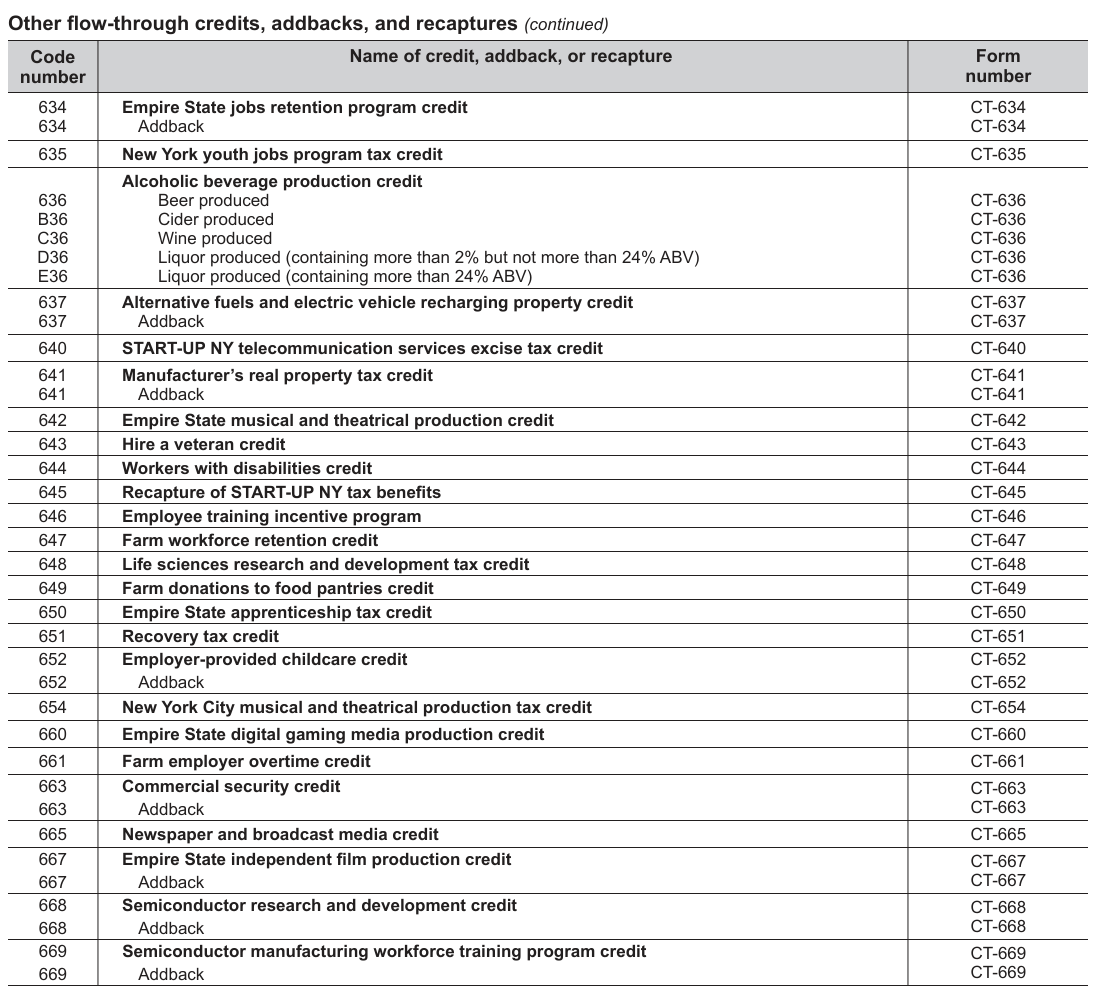
Text version of this table
Code number Name of credit, addback, or recapture Form number 634 634 Empire State jobs retention program credit Addback CT-634 CT-634 635 New York youth jobs program tax credit CT-635 636 B36 C36 D36 E36 Alcoholic beverage production credit Beer produced Cider produced Wine produced Liquor produced (containing more than 2% but not more than 24% ABV) Liquor produced (containing more than 24% ABV) CT-636 CT-636 CT-636 CT-636 CT-636 637 637 Alternative fuels and electric vehicle recharging property credit Addback CT-637 CT-637 640 START-UP NY telecommunication services excise tax credit CT-640 641 641 Manufacturer's real property tax credit CT-641 CT-641 642 Empire State commercial production credit CT-642 643 Hire a veteran credit CT-643 644 Employment of persons with disabilities credit CT-644 645 Recapture of START-UP NY tax benefits CT-645 646 Employee training incentive program CT-646 647 Farm workforce retention credit CT-647 648 Life sciences research and development tax credit CT-648 649 Farm donations to food pantries credit CT-649 650 Empire State apprenticeship tax credit CT-650 651 Recovery tax credit CT-651 652 652 Employer-provided childcare credit Addback CT-652 CT-652 654 New York City musical and theatrical production tax credit CT-654 660 Empire State commercial production credit CT-660 661 Farm employer overtime credit CT-661 663 663 Commercial security credit Addback CT-663 CT-663 665 Newspaper and broadcast media credit CT-665 667 667 Empire State independent film production credit Addback CT-667 CT-667 668 668 Semiconductor research and development credit Addback CT-668 CT-668 669 669 Semiconductor manufacturing workforce training program credit Addback CT-669 CT-669
Form number
Source: view the official PDF
Nearby sections (19 sections)
- ct-225 · Form CT-225 — New York State Modifications (Corporate)
- ct-3 · Instructions for Form CT-3 — General Business Corporation…
- ct-3-a · Instructions for Form CT-3-A — General Business Corporation…
- ct-3-s · Instructions for Form CT-3-S — New York S Corporation…
- ct-3.1 · Instructions for Form CT-3.1 — Investment & Other Exempt…
- ct-34-sh · Instructions for Form CT-34-SH — New York S Corporation…
- it-201 · Instructions for Form IT-201 — Resident Income Tax Return
- it-203 · Instructions for Form IT-203 — Nonresident & Part-Year…
- it-203-gr · Instructions for Form IT-203-GR — Group Return for…
- it-204 · Instructions for Form IT-204 — Partnership Return
- it-204-cp · Instructions for Form IT-204-CP — Corporate Partner's New…
- it-204-ip · Instructions for Form IT-204-IP — Partner's New York K-1…
- it-204-ll · Instructions for Form IT-204-LL — Partnership/LLC/LLP…
- it-205 · Instructions for Form IT-205 — Fiduciary Income Tax Return
- it-225 · Instructions for Form IT-225 — New York State Modifications
- nys-45 · Instructions for Form NYS-45 — Quarterly Combined Withholding,…
- st-100 · Instructions for Form ST-100 — New York State & Local…
- st-101-i · Instructions for Form ST-101 — New York State & Local Annual…
- st-810-i · Instructions for Form ST-810 — New York State & Local…