California Franchise Tax Board Form Instructions
Form 100S Booklet (2024) — S Corporation Tax Booklet (instructions)
TY2024 (archived)
# California
| 100S | |
| California | 2024 |
| Forms & Instructions | S Corporation |
| Tax Booklet | |
| This booklet contains: | |
| Form 100S, California S Corporation | |
| Franchise or Income Tax Return | |
| Members of the Franchise Tax Board | |
| Malia M. Cohen, Chair | For more information regarding e-file, go to |
| Sally J. Lieber, Member | ftb.ca.gov and search for business efile. |
| Joe Stephenshaw, Member |
# This booklet contains:
Form 100S, California S Corporation
# Franchise or Income Tax Return
For more information regarding e-file, go to ftb.ca.gov and search for business efile.
…
…
…
…
…
…
…
…
…
…
…
# Table of Contents
Instructions for Form 100S 3 What's New/Tax Law Changes 3 R&TC Section 41 Reporting Requirements 3 General Information A, Franchise or Income Tax 7 General Information B, Tax Rate and Minimum Franchise Tax 7 Instructions for Schedule K and Schedule K-1 (100S) 22 Form 100S, California S Corporation Franchise or Income Tax Return 29 Credit Chart 35 Schedule K Federal/State Line References 37 Principal Business Activity Codes 38 How to Get California Tax Information 41
# Business e-file
is available for the following returns:
- Form 100, California Corporation Franchise or Income Tax Return, including combined reports
• Form 100S, California S Corporation Franchise or Income Tax Return
- Form 100W, California Corporation Franchise or Income Tax Return -Water's-Edge Filers, including combined reports
- Form 100X, Amended Corporation Franchise or Income Tax Return
- Form 109, California Exempt Organization Business Income Tax Return
- Form 199, California Exempt Organization Annual Information Return
- Form 565, Partnership Return of Income
- Form 568, Limited Liability Company Return of Income For more information, go to ftb.ca.gov and search for business efile.
# California S Corporation Franchise or Income Tax Return
References in these instructions are to the Internal Revenue Code (IRC) as of January 1, 2015, and to the California Revenue and Taxation Code (R&TC).
Differences between California and Federal Law In general, for taxable years beginning on or after January 1, 2015, California law conforms to the Internal Revenue Code (IRC) as of January 1, 2015. However, there are continuing differences between California and federal law. When California conforms to federal tax law changes, we do not always adopt all of the changes made at the federal level. For more information, go to ftb.ca.gov and search for conformity. Additional information can be found in FTB Pub. 1001, Supplemental Guidelines to California Adjustments, the instructions for California Schedule CA (540), California Adjustments - Residents, or Schedule CA (540NR), California Adjustments - Nonresidents or Part-Year Residents, and the Business Entity tax booklets.
The instructions provided with California tax forms are a summary of California tax law and are only intended to aid taxpayers in preparing their state income tax returns. We include information that is most useful to the greatest number of taxpayers in the limited space available. It is not possible to include all requirements of the California Revenue and Taxation Code (R&TC) in the instructions.
Taxpayers should not consider the instructions as authoritative law.
# What' s New/Tax Law Changes
Reporting Requirements - Taxpayers may need to file form FTB 4197, Information on Tax Expenditure Items, with the tax return to report tax expenditure items as part of the Franchise Tax Board's (FTB's) annual reporting requirements under R&TC Section 41. To determine if you have an R&TC Section 41 reporting requirement, see the R&TC Section 41 Reporting Requirements section or get form FTB 4197.
Business Entity Tax Products - The 100S, S Corporation Tax Booklet has been reformatted to include only Form 100S, California S Corporation Franchise or Income Tax Return and related instructions.
Wildfire Relief Payment - For taxable years beginning after December 31, 2019, and before January 1, 2026, the Federal Disaster Tax Relief Act of 2023, allows an exclusion from gross income for any amount received by an individual as a qualified wildfire relief payment.
Generally, California law does not conform.
If any qualified amount was excluded from income for federal purposes and California law provides no similar exclusion, include that amount in income for California purposes.
Wildfire Mitigation Payment - For taxable years beginning on or after January 1, 2024, and before January 1, 2029, California law allows a qualified taxpayer an exclusion from gross income for any amount received as a California qualified wildfire loss mitigation payment through the California Wildfire Mitigation Financial Assistance Program.
For more information, see Specific Line Instructions and R&TC Section 24308.10.
Net Operating Loss Suspension - For taxable years beginning on or after January 1, 2024, and before January 1, 2027, California has suspended the net operating loss (NOL) carryover deduction. Corporations may continue to compute and carryover an NOL during the suspension period. However, corporations with taxable income of less than $1,000,000 or with disaster loss carryovers are not affected by the NOL suspension rules.
The carryover period for suspended losses is extended by:
- Three years for losses incurred in taxable years beginning before January 1, 2024.
- Two years for losses incurred in taxable years beginning on or after January 1, 2024, and before January 1, 2025.
- One year for losses incurred in taxable years beginning on or after January 1, 2025, and before January 1, 2026.
For more information, see R&TC Section 24416.24 and get form FTB 3805Q, Net Operating Loss (NOL) Computation and NOL Disaster Loss Limitations - Corporations.
Credit Limitation - For taxable years beginning on or after January 1, 2024, and before January 1, 2027, there is a $5,000,000 limitation on the application of credits. The total of all credits including the carryover of any credit for the taxable year may not reduce the "tax", by more than $5,000,000. This limitation does not apply to the Low-Income Housing Credit. For taxpayers included in a combined report, the limitation is applied at the group level.
The S Corporation may not elect to receive a refundable credit for credits that are disallowed due to the credit limitation. Credits disallowed due to the limitation may be carried over.
The carryover period for disallowed credit is extended by the number of taxable years the credit was not allowed. For more information, refer to R&TC Sections 23036.4 and 23036.5.
Intangible Drilling and Development
Costs - California law does not allow the deduction for intangible drilling and development costs in the case of oil and gas wells paid or incurred on or after January 1, 2024 (R&TC 24423 has been repealed). For more information, get Schedule B (100S), S Corporation Depreciation and Amortization.
Percentage Depletion - For taxable years beginning on or after January 1, 2024, California law does not allow the calculation of depletion as a percentage of gross income from the property for specified natural resources, including coal, oil shale, oil and gas wells. R&TC Sections 24831.3 and 24831.6 allowing state nonconformity to federal rules for percentage depletion of certain refiner exclusions as well as the temporary suspension of taxable income limit for marginal production have also been repealed.
For more information, see R&TC Section 24831 and get Schedule B (100S).
Enhanced Oil Recovery Credit Repeal - For taxable years beginning on or after January 1, 2024, the Enhanced Oil Recovery Credit has been repealed. Taxpayers may now only claim available carryovers. For more information, get form FTB 3540, Credit Carryover and Recapture Summary.
Postponement of Certain Tax-Related
Deadlines - Beginning on or after June 27, 2024, the Director of Finance shall determine when IRC Section 7508A, related to postponement of certain federal tax-related deadlines, applies for California purposes to a taxpayer affected by a state of emergency declared by the Governor or a federally declared disaster. Impacted taxpayers can request an additional relief period if the state postponement period expires before the federal postponement period by filing form FTB 3872, California Disaster Relief Request for Postponement of Tax Deadlines. For more information, get form FTB 3872 and see R&TC Section 18572.
Conformity - For updates regarding the federal acts, go to ftb.ca.gov and search for conformity.
# Requirements
Taxpayers should file form FTB 4197 with the tax return to report tax expenditure items as part of the FTB's annual reporting requirements under R&TC Section 41. "Tax expenditure" means a credit, deduction, exclusion, exemption, or any other tax benefit provided for by the state. The FTB uses information from form FTB 4197 for reports required by the California Legislature. Taxpayers that have a reporting requirement for any of the following should file form FTB 4197:
- For taxable years beginning on or after January 1, 2024, and before January 1, 2029, qualified taxpayers who benefited from the exclusion from gross income for any amount received as a California qualified wildfire loss mitigation payment through the
# California Wildfire Mitigation Financial
Assistance Program.
- For taxable years beginning on or after January 1, 2020, and before January 1, 2028, qualified taxpayers who benefited from the exclusion from gross income for any qualified amount received in a settlement from Pacific Gas and Electric (PG&E) Company or its subsidiary relating to the 2019 Kincade Fire.
- For taxable years beginning on or after January 1, 2020, and before January 1, 2028, qualified taxpayers who benefited from the exclusion from gross income for any qualified amount received in a settlement from PG&E Company or its subsidiary relating to the 2020 Zogg Fire.
- For taxable years beginning before January 1, 2027, qualified taxpayers who benefited from the exclusion from gross income for any amount received in a settlement from Southern California Edison for claims relating to the 2017 Thomas Fire or the 2018 Woolsey Fire.
- For taxable years beginning before January 1, 2030, a corporation that is a small business solely owned by a deployed member of the United States Armed Forces that meet the requirements to be exempted from the minimum franchise tax.
- For taxable years beginning on January 1, 2022, and before January 1, 2027, taxpayers who benefited from the exclusion of gross income for any amount received as a rebate, voucher, or other financial incentive issued by a public water system, as defined, local government, or state agency for participation in a turf replacement water conservation program.
- For taxable years beginning on or after January 1, 2021, taxpayers who benefited from the exclusion from gross income for the Paycheck Protection Program (PPP) loans forgiveness, other loan forgiveness, the Economic Injury Disaster Loan (EIDL) advance grant, restaurant revitalization grant, or shuttered venue operator grant, and related eligible expense deductions.
- Beginning on or after January 1, 2020, C corporation partners (including corporation filing a combined report) and S corporation partners that received Schedule K-1 from a partnership that is operating a commercial cannabis activity licensed under California Medicinal and
Adult-Use Cannabis Regulation and Safety Act (MAUCRSA).
For more information, get form FTB 4197.
# Important Information
- The FTB offers e-filing for the following entities:
- Corporations filing Form 100S and certain accompanying forms and schedules.
- Corporations filing Form 100X, Amended Corporation Franchise or Income Tax Return.
Check with the software providers to see if they support business e-filing.
- California law requires business entities that file an original or amended tax return that is prepared using tax preparation software to electronically file (e-file) their tax return with the FTB. For more information, go to ftb.ca.gov and search for business efile.
- Corporations can make payments online using Web Pay for Businesses.
Corporations can make an immediate payment or schedule payments up to a year in advance. Go to ftb.ca.gov/pay.
- Corporations can use a Discover,
# MasterCard, Visa, or American Express
Card to pay business taxes. Go to officialpayments.com. ACI Payments, Inc.
(formerly Official Payments) charges a convenience fee for using this service.
- Corporations can make an estimated tax or extension payment using tax preparation software. Check with the software provider to determine if they support Electronic Funds Withdrawal (EFW) for estimated tax or extension payments.
• Elective Tax for Pass-Through Entities
(PTE) and Credit for Owners - For taxable years beginning on or after January 1, 2021, and before January 1, 2026, California law allows an entity taxed as a partnership or an "S" corporation to annually elect to pay an elective tax at a rate of 9.3% based on its qualified net income.
The election shall be made on an original, timely filed return and is irrevocable for the taxable year.
The law allows a credit against the personal income tax to a taxpayer, other than a partnership, that is a partner, shareholder, or member of a qualified entity that elects to pay the elective tax, in an amount equal to 9.3% of the partner's, shareholder's, or member's pro rata share or distributive share and guaranteed payments of qualified net income subject to the election made by the qualified entity. Generally, a disregarded business entity and its partners or members cannot receive the credit, except for a disregarded single member limited liability company (SMLLC) that is owned by an individual, fiduciary, estate, or trust subject to personal income tax. For more information, go to ftb.ca.gov and search for pte elective tax and get the following PTE elective tax forms and instructions:
- Form FTB 3893, Pass-Through Entity
Elective Tax Payment Voucher
- Form FTB 3804, Pass-Through Entity
Elective Tax Calculation
- Form FTB 3804-CR, Pass-Through
# Entity Elective Tax Credit
- Water's-Edge Election and "Doing Business" - For taxable years beginning on or after January 1, 2021, if a unitary corporation that is not incorporated in the United States and not subject to tax under Corporation Tax Law in the year that a valid water's-edge election is made, but subsequently becomes subject to taxation under the Corporation Tax Law solely due to it becoming engaged in business per R&TC Section 23101(b), it will be deemed to have elected with the other members of the unitary combined reporting group.
For more information, see R&TC Section 25113.
- Gross Income Exclusion for Bruce's Beach - Effective September 30, 2021, California law allows an exclusion from gross income for the first time sale in the taxable year in which the land within
# Manhattan State Beach, known as "Peck's
Manhattan Beach Tract Block 5" and commonly referred to as "Bruce's Beach" is sold, transferred, or encumbered. A recipient's gross income does not include the following:
- Any sale, transfer, or encumbrance of Bruce's Beach;
- Any gain, income, or proceeds received that is directly derived from the sale, transfer, or encumbrance of Bruce's Beach.
- For taxable years beginning on or after July 1, 2019, California requires taxpayers to use their federal IRC Section 338 election treatment for certain stock purchases treated as asset acquisitions or deemed election where purchasing corporation acquires asset of target corporation. If an election has not been made by a taxpayer under IRC Section 338, the taxpayer shall not make a separate state election for California.
- Under IRC Section 951A, if the S corporation is a U.S. shareholder of a controlled foreign corporation, the S corporation must include Global Intangible Low-Taxed Income (GILTI) in its income. California does not conform.
- The federal Tax Cuts and Jobs Act (TCJA) signed into law on December 22, 2017, made changes to the IRC. R&TC does not conform to all of the changes. In general, for taxable years beginning on or after January 1, 2019, California conforms to the following TCJA provisions:
- Federal Deposit Insurance Corporation
(FDIC) Premiums.
- Excess employee compensation.
- The TCJA amended IRC Section 1031 limiting the nonrecognition of gain or loss on like-kind exchanges to real property held for productive use or investment. California conforms to this change under the TCJA for exchanges initiated after January 10, 2019.
- For taxable years beginning on or after January 1, 2019, California conforms to certain provisions of the TCJA relating to changes to accounting methods for small businesses.
- If the S corporation was involved in a reportable transaction, including a listed transaction, the S corporation may have a disclosure requirement. Attach federal
Form 8886, Reportable Transaction Disclosure Statement, to the back of the California return along with any other supporting schedules. If this is the first time the reportable transaction is disclosed on the return, send a duplicate copy of federal Form 8886 to the address below:
TAX SHELTER FILING
ABS 389 MS F340
FRANCHISE TAX BOARD
PO BOX 1673
SACRAMENTO CA 95812-9900
The FTB may impose penalties if the S corporation fails to file federal
# Form 8886, Form 8918, Material Advisor
Disclosure Statement, or any other required information. A material advisor is required to provide a reportable transaction number to all taxpayers and material advisors for whom the material advisor acts as a material advisor. For more information, go to ftb.ca.gov and search for disclosure obligation.
- The Internal Revenue Service (IRS) allows corporations with at least $10 million but less than $50 million in total assets at tax year end to file Schedule M-1 (Form 1120-S), Reconciliation of Income (Loss) per Books With Income (Loss) per Return, in place of
Schedule M-3 (Form 1120-S), Net Income
(Loss) Reconciliation for S Corporations With Total Assets of $10 Million or More, Parts II and III. However, Schedule M-3 (Form 1120-S), Part I, is required for these corporations. For California purposes, the S corporation must complete the California Schedule M-1. For more information, see the instructions for
# Schedule M-1, Reconciliation of Income
(Loss) per Books With Income (Loss) per Return, in this booklet.
- R&TC Section 25128.7 requires all business income of an apportioning trade or business, other than an apportioning trade or business under R&TC Section 25128(b), to apportion its business income to California using the single-sales factor formula. For more information, get Schedule R, Apportionment and Allocation of Income, or go to ftb.ca.gov and search for single sales factor.
- R&TC Section 25136 requires all taxpayers to assign sales, other than sales of tangible personal property, using market assignment. For more information, get Schedule R or go to ftb.ca.gov and search for market assignment.
- R&TC Section 25120 was amended to add the definition of gross receipts. For a complete definition of "gross receipts," refer to R&TC Section 25120(f), or go to ftb.ca.gov and search for 25120.
- R&TC Section 25135(b) adopts the Finnigan rule in assigning sales from tangible personal property.
For more information regarding "gross receipts" or "Finnigan rule," get Schedule R or go to ftb.ca.gov and search for corporation law changes.
- Beginning on or after January 1, 2012, a type of corporation called a "benefit corporation" can be formed with the purpose of creating general public benefit, provided certain requirements are met. An existing corporation can become a "benefit corporation," if certain procedures are followed. In addition, a "benefit corporation" can be created through a merger or reorganization, if certain requirements are met. For more information, see the Corporations Code, commencing with Section 14600.
- Beginning on or after January 1, 2012, a type of corporation called a "flexible purpose corporation" could be formed, provided certain requirements were met. An existing corporation could merge or convert into a "flexible purpose corporation," upon completion of certain requirements. A "flexible purpose corporation" must have a special purpose, which may include but is not limited to, charitable and public purpose activities that could be carried out by a nonprofit public benefit corporation.
For more information, see the Corporations Code, commencing with Section 2500.
- Effective January 1, 2015, all references to "flexible purpose corporations" in the Corporations Code are changed to "social purpose corporations," although the requirements are substantially the same as prior law. Any flexible purpose corporation formed before January 1, 2015, may elect to amend its articles of incorporation to change its status to a "social purpose corporation."
If a flexible purpose corporation formed prior to January 1, 2015, does not amend its articles of incorporation to change its status, any reference to "social purpose corporation" in the Corporation Code is deemed a reference to a "flexible purpose corporation." For more information, see the Corporations Code commencing with Section 2500.
- R&TC Section 24343.2 disallows the deduction for payments made to a club that restricts membership or the use of its services or facilities on the basis of ancestry or any characteristic listed or defined in Section 11135 of the Government Code, except for genetic information.
- For taxable years beginning on or after January 1, 2007, interest and dividends from intangible assets held in connection with a treasury function of the taxpayer's unitary business, as well as the gross receipts and any overall net gain from the maturity, redemption, sale, exchange, or other disposition of these assets, are excluded from the sales factor. This exclusion encompasses the use of futures contracts and options contracts to hedge foreign currency fluctuations. See Cal. Code Regs., tit. 18 section 25137(c)(1)(D) for more information. For taxable years beginning on or after January 1, 2011, see R&TC Section 25120(f).
- Group nonresident returns may include:
- Less than two nonresident individuals.
- Nonresident individuals with more than $1 million of California taxable income.
An additional 1% tax will be assessed on nonresident individuals who have California taxable income over $1 million.
Get FTB Pub. 1067, Guidelines for Filing a Group Form 540NR, for more information.
- In general, the water's-edge rules provide for an election out of worldwide combined reporting. By electing water's-edge, a California taxpayer elects into a complex blend of state and federal tax concepts. See General Information T,
# Water's Edge Reporting; refer to R&TC
Sections 25110 and 25113; and get Form 100W, Corporation Tax Booklet -Water's-Edge Filers, for more information.
- A C corporation is taxed on its earnings at regular corporate tax rates and the shareholders are then taxed on these earnings when they are distributed as dividends. For more information, get Form 100, Corporation Tax Booklet.
- S corporations are required to report withholding payments from the S corporation that are allocated to all shareholders, as well as payments withheld on nonresident shareholders.
Report these withholding amounts on
# Schedule K-1 (100S) and Schedule K
(100S), S Corporation Shareholder's Shares of Income, Deductions, Credits, etc.
- Use form FTB 3725, Assets Transferred from Corporation to Insurance Company, to report assets transferred from a parent corporation to an insurance company. Get form FTB 3725 for more information.
- California follows the revised federal instructions (with some exceptions) for reporting the sale, exchange or disposition of an asset for which an IRC Section 179 expense deduction was claimed in prior years by a partnership, limited liability company (LLC), or S corporation.
S corporations should follow the instructions in federal Form 4797, Sales of Business Property, with the exception that the amount of gain on property subject to the IRC Section 179 recapture must be included in the S corporation's taxable income for California purposes.
See General Information FF, Property
Subject To IRC Section 179 Recapture, and Specific Line Instructions for Form 100S, line 4, for more information.
Shareholders should follow federal reporting requirements as detailed in federal Form 1120-S and federal Form 4797 instructions.
- A shareholder's pro-rata share of S corporation income is treated like a partner's distributive share of partnership income. The items of income are characterized as if realized directly from the source from which realized by the corporation, then they are sourced according to the rule for each type of income. Valentino v. Franchise Tax Board
(2001) 87 Cal. App. 4th 1284. Income from California sources is subject to California tax.
- In general, R&TC Section 17024.5 and Section 23051.5 state that federal elections made before a taxpayer becomes a California taxpayer are binding for California tax purposes.
California law conforms to federal law for the following:
- IRC Section 1245(b)(8) relating to amortizable Section 197 intangibles property disposed on or after January 1, 2010.
- The qualification requirements of S corporations and their shareholders.
- Disallowing the deduction for club membership fees and employee remuneration in excess of $1 million.
- Disallowing the deduction for lobbying expenses.
- Tax-exempt organizations may be shareholders in an S corporation.
- Family farm corporations with income over $25 million may defer tax on income that was a result of changes in accounting methods required of these corporations.
For calendar year taxpayers, the suspense account for these deferrals must be recaptured starting with taxable years beginning on or after January 1, 1998. For fiscal year taxpayers, the suspense account must be recaptured starting in taxable years beginning after June 8, 1997, if the fiscal year taxpayer's taxable year ends on or after December 31, 1997.
- For purposes of inventory accounting, an adjustment for shrinkage, based on an estimate, may be made. Taxpayers can voluntarily change their method of accounting if the method currently being used does not utilize estimates of inventory shrinkage and the taxpayer now would like to use that method.
- Required recognition of gain on certain appreciated financial positions in personal property.
- Securities traders and commodities traders are allowed to elect to use the mark-to-market accounting similar to what is currently required for securities dealers. Commodities would include only commodities of a kind that are dealt within the organized commodities exchange. An election to use the mark-to-market method for federal purposes is considered an election for state purposes and a separate election is not allowed.
- Limitation on exception for investment companies under IRC Section 351.
- If an Employee Stock Ownership Plan
(ESOP) is an S corporation shareholder, items of income or loss of the S corporation that pass through to the ESOP are not treated as unrelated business taxable income (UBTI). Previously, such items were treated as UBTI.
- S corporations that establish and maintain ESOPs are not required to give participants the right to demand distributions in the form of employer securities, if the participants have the right to receive such distributions in cash.
- An IRC Section 338 election, relating to stock purchases treated as asset acquisitions, is treated as an election for state purposes. A separate election for state purposes is not allowed.
- Expansion of deduction for certain interest and premiums paid for company-owned life insurance.
- Modification of holding period applicable to dividends received deduction.
- Repeal of special installment sales rule for manufacturers of tangible personal property.
- Payment of estimated tax for closely held real estate investment trusts (REITs) and income and services provided by REIT subsidiaries.
- Reducing the compensation deduction for certain employers from $1 million to $500,000; and making certain parachute payments nondeductible.
California law does not conform to federal law for the following:
- In general, the American Rescue Plan Act
(ARPA) of 2021.
- In general, the Consolidated Appropriations Act (CAA), 2021.
- The TCJA signed into law on December 22, 2017, made changes to the IRC. In general, the R&TC does not conform to the changes.
California taxpayers continue to follow the IRC as of the specified date of January 1, 2015, with modifications. The following is a non-exhaustive list of the TCJA changes:
- The federal modifications to amortization of research and experimental expenditures (IRC Section 174).
- The change in method of accounting treatment of S corporation conversions to C corporations.
- The expanded definition of IRC Section 179 property for certain depreciable tangible personal property related to furnishing lodging and for qualified real property for improvements to nonresidential real property.
- The change to IRC Section 163(j) which limits business interest deduction.
- The modifications to the NOL provisions.
- The deferral and exclusion of capital gains reinvested or invested in qualified opportunity zone funds.
- The exclusion of a patent, invention, model or design, and secret formula or process from the definition of capital asset.
- The federal modifications to depreciation limitations on luxury automobiles (IRC Section 280F).
- IRC Section 951A, relating to GILTI.
- IRC Section 382(n) relating to special rule for certain ownership changes.
- The enhanced IRC Section 179 expensing election.
- The first-year depreciation deduction allowed for new luxury autos or certain passenger automobiles acquired and placed in service in 2010 through 2024.
- The qualified small business stock deferral and gain exclusions under IRC Section 1045 and IRC Section 1202.
- The IRS Notice 2008-83 relating to the treatment of deductions under IRC Section 382(h) following an ownership change.
- IRC Section 168(k) relating to the bonus depreciation deduction for certain assets.
- The decreased holding period for built-in gains.
- The decreased estimated tax payments for certain small businesses.
- The treatment of the loss from the sale or exchange of certain preferred stock (of Fannie Mae or Freddie Mac).
- Exclusion from gross income of certain federal subsidies for prescription drug plans under IRC Section 139A.
- Certain environmental remediation expenditures that would otherwise be chargeable to capital accounts may be expensed and taken as a deduction in the year the expense was paid or incurred.
- Deduction for corporate donation of scientific property and computer technology.
- Decreased capital gains tax rate.
- Certain special tax rules relating to ESOPs will not apply with respect to S corporation stock held by the ESOP. These include rules relating to certain contributions to ESOPs, the deduction for dividends paid on employer securities, and the rollover of gain on the sale of stock to an ESOP.
See IRC Sections 404(a)(9) and 404(k) for more information.
- The treatment of Subpart F income.
The above lists are not intended to be all-inclusive of the federal and state conformities and differences. For more information, refer to the R&TC.
# Records Maintenance Requirements
Any taxpayer filing on a water's-edge or worldwide basis is required to keep and maintain records and make the following available upon request:
- Any records needed to determine the correct treatment of items reported on the worldwide or water's-edge combined report for purposes of determining the income attributable to California.
- Any records needed to determine the treatment of items as nonbusiness or business income.
- Any records needed to determine the apportionment factor.
- Documents and information needed to determine the attribution of income to the U.S. or foreign jurisdictions under Section 482, Sections under Subchapter N of Chapter 1, or other similar provisions of the IRC.
See R&TC Section 19141.6 and the related regulations for more information. An S corporation may be required to authorize an agent, through a Power of Attorney (POA), to act on its behalf in response to requests for information or records pursuant to R&TC Section 19504. For more information, go to ftb.ca.gov/poa.
The penalty for not maintaining the required records is $10,000 for each taxable year for which the failure applies. In addition, if the failure continues for more than 90 days after the FTB notifies the S corporation of the failure, a penalty of $10,000 may be assessed for each additional 30 day period of continued failure.
See General Information M, Penalties, for more information.
# General Information
Form 100S is used if a corporation has elected to be a small business corporation (S corporation).
All federal S corporations subject to California laws must file Form 100S and pay the greater of the minimum franchise tax or the 1.5% income or franchise tax. The tax rate for financial S corporations is 3.5%.
The taxable income of the S corporation is calculated in two different ways for two different purposes. First, it is calculated in the same manner as for C corporations, with certain modifications, for purposes of computing the 1.5% income or franchise tax. Second, it is calculated using federal rules for the pass through of income and deductions, etc. for purposes of pass through to the shareholders.
A corporation that makes a valid election to be treated as an S corporation is not allowed to be included in a combined report of a unitary group, except as provided by R&TC Section 23801(d)(1).
When Completing the Form 100S:
- Use black or blue ink on the tax return sent to the FTB.
- Print name and address (in CAPITAL LETTERS).
- When a domestic S corporation files the first California tax return, the fiscal year beginning date must be the date the S corporation is incorporated.
- Round cents to the nearest whole dollar.
For example, round $50.50 up to $51 or round $25.49 down to $25.
- Send a clean legible copy.
- Enter all types of payments (overpayment from prior year, estimated tax, nonresident tax, etc.) made for the 2024 taxable year on the applicable line.
- When making a payment with a check or money order, enclose but do not staple the payment to the front of the tax return.
- Assemble the corporation return in the following order: Form 100S, Schedule R (if required), supporting schedules, a copy of federal return (if required), and form FTB 5806, Underpayment of Estimated Tax by Corporations, (if required). Do not use staples or other permanent bindings to assemble the tax return.
# A Franchise or Income Tax
Corporation Franchise Tax
Entities subject to the corporation minimum franchise tax include all S corporations that meet any of the following:
- Incorporated or organized in California.
- Qualified or registered to do business in California.
- Doing business in California, whether or not incorporated, organized, qualified, or registered under California law.
The minimum franchise tax must be paid by corporations incorporated in California or qualified or registered under California law whether the S corporation is active, inactive, not doing business, or operates at a loss. See General Information B, Tax Rate and Minimum Franchise Tax, for more information.
The measured franchise tax is imposed on S corporations doing business in California and is measured by the income of the current taxable year for the privilege of doing business in that taxable year.
A taxpayer is "doing business" if it actively engages in any transaction for the purpose of financial or pecuniary gain or profit in California or if any of the following conditions is satisfied:
- The taxpayer is organized or commercially domiciled in California.
- The sales, as defined in R&TC Section 25120(e) or (f), of the taxpayer in California, including sales by the taxpayer's agents and independent contractors, exceed the lesser of $735,019 or 25% of the taxpayer's total sales.
- The real property and tangible personal property of the taxpayer in California exceed the lesser of $73,502 or 25% of the taxpayer's total real property and tangible personal property.
- The amount paid in California by the taxpayer for compensation, as defined in R&TC Section 25120(c), exceeds the lesser of $73,502 or 25% of the total compensation paid by the taxpayer.
In determining the amount of the taxpayer's sales, property, and payroll for doing business purposes, include the taxpayer's pro rata share of amounts from partnerships and S corporations. All S corporations complete Schedule K-1 (100S), Table 2, Item C to report the shareholder's distributive share of property, payroll and sales total within California. For more information, see R&TC Section 23101 or go to ftb.ca.gov and search for doing business.
An S corporation incorporated in California, but not doing business in this state, is not subject to the measured franchise tax. However, careful attention should be given to the term "doing business." It is not necessary that the S corporation conducts business or engages in transactions within the state on a regular basis.
Even an isolated transaction during the taxable year may be enough to cause the S corporation to be "doing business".
Also, when an S corporation is either a general partner of a partnership or a member of an LLC that is "doing business" in California, the S corporation is also considered to be "doing business" in California.
Corporation Income Tax
The corporation income tax is imposed on all S corporations that derive income from sources within California but are not doing business in California.
For purposes of the corporation income tax, the term "corporation" is not limited to incorporated entities, but also includes the following:
- Associations.
- Massachusetts or business trusts.
- REITs.
- Other business entities classified as associations under Cal. Code Regs., tit. 18 sections 23038(b)-1 through 23038(b)-3.
# Franchise Tax
The following tax rates apply to S corporations subject to either the corporation franchise tax or the corporation income tax.
- S corporations …
1.5%
- Financial S corporations … 3.5%
- Built-in gains and excess net passive income … 8.84% See R&TC Section 23186, General
Information J, Built-In Gains, and General
Information S, Excess Net Passive Investment Income, for more information.
# Minimum Franchise Tax
All S corporations subject to the corporation franchise tax and any S corporation doing business in California must file Form 100S and pay at least the minimum franchise tax as required by law. The minimum franchise tax is $800 and must be paid whether the S corporation is active, inactive, operates at a loss, or files a return for a short-period of less than 12 months.
A corporation that incorporated or qualified through the California Secretary of State
(SOS) to do business in California is not subject to the minimum franchise tax for its first taxable year and will compute its tax liability by multiplying its state net income by the appropriate tax rate. The corporation will become subject to minimum franchise tax beginning in its second taxable year.
This does not apply to qualified Subchapter S subsidiaries or corporations that are not qualified by the California SOS, or reorganize solely to avoid payment of the minimum franchise tax.
There is no minimum franchise tax for the following entities:
- Corporations that are not incorporated in California, not qualified under the laws of California, and are not doing business in California even though they derive income from California sources. However, if corporations meet the sale, property, or payroll threshold for "doing business" under R&TC Section 23101(b), corporations may be subject to the minimum franchise tax.
For more information regarding "doing business," see General Information A, Franchise or Income Tax; refer to R&TC Section 23101(b); get FTB Pub. 1050,
# Application and Interpretation of Public
Law 86-272; or FTB Pub. 1060, Guide for Corporations Starting Business in California.
- Corporations that are not incorporated under the laws of California; whose sole activities in California are engaging in convention and trade show activities for seven or fewer days during the taxable year; and do not derive more than $10,000 of gross income reportable to California during the taxable year. These S corporations are not "doing business" in California. For more information, get FTB Pub. 1060.
- Newly formed or qualified corporations filing an initial return.
- Qualified non-profit farm cooperative associations.
- Credit unions.
- Exempt homeowners' associations.
- Exempt political organizations.
- Exempt organizations.
# Deployed Military Exemption
For taxable years beginning on or after January 1, 2020, and before January 1, 2030, a corporation that is a small business solely owned by a deployed member of the United States Armed Forces shall not be subject to the minimum franchise tax if the owner is deployed during the taxable year and the corporation operates at a loss or ceases operation. Corporations exempt from the minimum franchise tax should write "Deployed Military" in black or blue ink in the top margin of the tax return.
For the purposes of this exemption:
(A) "Deployed" means being called to active duty or active service during a period when the United States is engaged in combat or homeland defense. "Deployed" does not include either of the following:
- Temporary duty for the sole purpose of training or processing.
- A permanent change of station.
(B) "Operates at a loss" means negative net income as defined in R&TC Section 24341.
(C) "Small business" means a corporation with two hundred fifty thousand dollars ($250,000) or less of total income from all sources derived from or attributable to California.
Alternative Minimum Tax
S corporations are not subject to the alternative minimum tax.
# C Elections and Terminations
Elections
Corporations that elect federal S corporation status and have a California filing requirement are deemed to have made a California S election effective on the same date as the federal S election.
Terminations
Terminating the taxpayer's federal S election simultaneously terminates its California S election.
If the taxpayer terminates its S corporation status, short-period returns are required for the S corporation short year and the C corporation short year, if applicable.
# Method
The taxable year of the S corporation must not be different from the taxable year used for federal purposes, unless initiated or approved by the FTB (R&TC Section 24632).
A change in accounting method requires consent from the FTB. However, an S corporation that obtains federal approval to change its accounting method, or that is permitted or required by federal law to make a change in its accounting method without prior approval, and does so, is deemed to have the FTB's approval if: (1) the S corporation files a timely Form 100S consistent with the change for the first taxable year the change is effective for federal purposes; and (2) the change is consistent with California law. A copy of federal Form 3115, Application for Change in Accounting Method, and a copy of the federal consent to the change must be attached to Form 100S for the first taxable year the change becomes effective. Get FTB Notice 2024-01 for more information. The FTB may modify requested changes if the adjustments would distort income for California purposes.
California follows the provisions of Revenue Procedure 2016-29, which updates the procedures for a change of accounting method involving previously unclaimed, but allowable depreciation or amortization deductions.
# E When to File
File Form 100S by the 15th day of the 3rd month after the close of the taxable year unless the return is for a short-period as required under R&TC Section 24634. Generally, the due date of a short-period return is the same as the due date of the federal short-period return. See R&TC Section 18601(c) for the due date of the short-period return.
When the due date falls on a weekend or holiday, the deadline to file and pay without penalty is extended to the next business day.
For information on final returns, see General Information O, Dissolution/Withdrawal, and General Information P, Ceasing Business.
If an S corporation converts during its taxable year to an LLC or limited partnership
(LP) under state law, then generally two short-period California returns must be filed (one short-period return for the S corporation and another short-period return for the LLC or LP).
The corporate status and taxable year of the LLC or LP will not terminate and only a single return Form 100S is required if:
- the LLC or LP files a federal election to be classified as an association taxable as an S corporation effective as of the conversion date,
- the conversion otherwise qualifies as a reorganization under IRC Section 368(a)(1)(F), and
- the LLC or LP satisfies the statutory requirements to be an S corporation.
# F Extension of Time to File
If an S corporation cannot file its California tax return by the 15th day of the 3rd month after the close of the taxable year, it may file on or before the 15th day of the 9th month without filing a written request for an extension. Get FTB Notice 2019-07 for more information.
There is no automatic extension period for business entities suspended on or after the original due date.
An automatic extension does not extend the time for payment. The full amount of tax must be paid by the original due date of Form 100S.
If there is an unpaid tax liability on the original due date, complete form FTB 3539, Payment for Automatic Extension for Corporations and Exempt Organizations, and send it with the payment by the original due date of the Form 100S.
When the due date falls on a weekend or holiday, the deadline to file and pay without penalty is extended to the next business day.
If the S corporation must pay its tax liability electronically, all payments must be remitted by Electronic Fund Transfer (EFT), EFW, Web Pay, or credit card to avoid penalties. Do not send form FTB 3539.
# G Electronic Payments
# Electronic Funds Transfer
Corporations or exempt organizations remitting an estimated tax payment or extension payment in excess of $20,000 or having a total tax liability in excess of $80,000 must remit all payments through EFT. Once a corporation meets the threshold, all subsequent payments regardless of amount, tax type, or taxable year must be remitted electronically to avoid the 10% non-compliance penalty. The first payment that would trigger the mandatory EFT requirement does not have to be made electronically. Corporations or exempt organizations required to remit payments electronically may use EFW, Web Pay, or credit card and be considered in compliance with that requirement. The FTB notifies corporations or exempt organizations that are subject to this requirement. Those that do not meet these requirements may participate on a voluntary basis. If the corporation pays electronically, complete the form FTB 3539 worksheet for its records. Do not mail the payment voucher.
For more information, go to ftb.ca.gov and search for eft or call 916.845.4025.
Electronic Funds Withdrawal
S corporations can make an estimated tax or extension payment using tax preparation software. Check with the software provider to determine if they support EFW for estimated tax or extension payments.
Web Pay
Corporations can make payments online using Web Pay for Businesses. Corporations can make an immediate payment or schedule payments up to a year in advance. Go to ftb.ca.gov/pay.
Credit Card
Corporations can use Discover, MasterCard, Visa or American Express Card to pay business taxes. Go to officialpayments.com. ACI Payments, Inc. (formerly Official Payments) charges a convenience fee for using this service. Do not file form FTB 3539.
# H Where to File
Payments
If a tax is due and the corporation is not required to make the payment electronically (by EFT, EFW, Web Pay, or credit card):
- Mail Form 100S with payment to:
FRANCHISE TAX BOARD
PO BOX 942857
SACRAMENTO CA 94257-0501
- e-filed returns: Mail form FTB 3586, Payment Voucher for Corporations and Exempt Organizations e-filed Returns, with payment to:
FRANCHISE TAX BOARD
PO BOX 942857
SACRAMENTO CA 94257-0531
Using black or blue ink, make the check or money order payable to the "Franchise Tax Board." Write the California corporation number and "2024 Form 100S" on the check or money order.
Make all checks or money orders payable in U.S. dollars and drawn against a U.S. financial institution.
Do not attach a copy of the return with the balance due payment if the S corporation already filed/e-filed a return for the same taxable year.
Refunds
- Mail Form 100S requesting a refund to:
FRANCHISE TAX BOARD
PO BOX 942857
SACRAMENTO CA 94257-0500
Return Without Payment or Paid
Electronically
- Mail Form 100S without a payment or paid by EFT, EFW, Web Pay, or credit card to:
FRANCHISE TAX BOARD
PO BOX 942857
SACRAMENTO CA 94257-0500
Private Delivery Services
California law conforms to federal law regarding the use of certain designated private delivery services to meet the "timely mailing as timely filing/paying" rule for tax returns and payments. See the instructions for federal Form 1120-S for a list of designated delivery services. If a private delivery service is used, address the return to:
FRANCHISE TAX BOARD
SACRAMENTO CA 95827
Private delivery services cannot deliver items to PO boxes. If using one of these services to mail any item to the FTB, do not use an FTB PO box.
I Net Income Computation
The computation of net income from trade or business activities generally follows the determination of taxable income as provided in the IRC. However, there are differences that must be taken into account when completing Form 100S. There are two ways to complete Form 100S, the federal reconciliation method or the California computation method.
- Federal Reconciliation Method a. Transfer the information from the federal Form 1120-S, Page 1, to Form 100S, Side 4, Schedule F, Computation of Trade or Business Income, and attach a copy of the federal return with all supporting schedules. b. Enter the amount of federal ordinary income (loss) from trade or business activities before any NOL and special deductions on Form 100S, Side 1, line 1. c. Enter the state adjustments (including any adjustments necessary to report items not included in ordinary trade or business income or loss) on Form 100S, Side 1 and Side 2, line 2 through line 13, to arrive at net income (loss) after state adjustments, Form 100S, Side 2, line 14.
- Schedule F - California Computation Method If the S corporation has no federal filing requirement, or if the S corporation maintains separate records for state purposes, complete Form 100S, Side 4, Schedule F, to determine state ordinary income. If ordinary income is computed under California laws, generally no state adjustments are necessary. Transfer the amount from Schedule F, line 22, to Form 100S, Side 1, line 1. Complete Form 100S, Side 1 and Side 2, line 2 through line 13, only if applicable.
See Specific Line Instructions for more information.
Regardless of the net income computation method used, the S corporation must attach any form, schedule, or supporting document referred to on the return, schedules, or forms filed with the FTB.
Substitution of Federal Schedules
S corporations may not substitute federal schedules for California schedules.
# J Built-In Gains
When a C corporation elects to be an S corporation, certain items of gain or loss recognized in S corporation years are subject to the C corporation 8.84% tax rate instead of the S corporation 1.5% tax rate (financial S corporations add 2%).
Built-In Gains Under Current IRC
Section 1374
For those S corporations that made the initial federal S election after December 31, 1986, certain income items reported by the S corporation are taxed at 8.84% (or the financial C corporation tax rate). This provision applies for a period of ten years following the C corporation's election to become an S corporation. The amount of built-in gain that is taxed at 8.84% (or the financial C corporation tax rate) is the excess of recognized built-in gains over recognized built-in losses, limited by taxable income as determined under IRC Section 1374(d)(2)(A).
The following items are treated as built-in gains subject to this tax:
- Accounts receivable of cash basis taxpayers from C corporation years.
- Long-term contract deferred income from C corporation years.
- Deferred income from installment sales made in C corporation years.
- Recapture of depreciation from C corporation years.
- Income from unreplaced last-in, first-out
(LIFO) inventory from C corporation years.
- Any other income item that is attributable to C corporation years.
These are just a few of the examples. This list is not intended to be all inclusive.
For Apportioning Corporations Only:
All recognized built-in gains and all recognized built-in losses are apportioned and allocated to California according to the current year Schedule R.
# K Estimated Tax
Use Form 100-ES, Corporation Estimated Tax, to figure and pay estimated tax for an S corporation.
Corporations are required to pay the following percentages of the estimated tax liability during the taxable year:
- 30% for the first required installment
- 40% for the second required installment
- No estimated tax payment is required for the third installment
- 30% for the fourth required installment For exceptions and prior year's information, get the instructions for Form 100-ES.
Estimated tax is generally due and payable in four installments as follows:
- The 1st payment is due on the 15th day of the 4th month of the taxable year. This payment may not be less than the minimum franchise tax plus QSub annual tax, if applicable.
- The 2nd, 3rd, and 4th installments are due and payable on the 15th day of the 6th, 9th, and 12th months, respectively, of the taxable year.
If the corporation must pay its tax liability electronically, all estimate payments due must be remitted by EFT, EFW, Web Pay, or credit card to avoid the EFT penalty. See General Information G, Electronic Payments, for more information.
If no amount is due, or if the corporation pays electronically, do not mail Form 100-ES.
# S Corporations
An S corporation is required to pay measured tax instead of minimum tax for the first taxable year if the corporation incorporated or registered through the California SOS. For more information, see General Information B, Tax Rate and Minimum Franchise Tax, or get FTB Pub. 1060.
# M Penalties
# Failure to File a Timely Return
Any corporation that fails to file Form 100S on or before the extended due date is assessed a delinquent filing penalty. The delinquent filing penalty is computed at 5% of the tax due, after allowing for timely payments, for every month that the return is late, up to a maximum of 25%. If the S corporation does not file its return by the extended due date, the automatic extension will not apply and the late filing penalty will be assessed from the original due date of the return. See R&TC Sections 19131 and 23772 for more information.
Unless failure is due to reasonable cause, a penalty will be assessed against the S corporation if it is required to file an S corporation return and one of the following occurs:
- The S corporation fails to file the tax return by the due date, including extensions.
- The S corporation files a return that fails to show all of the information required pursuant to R&TC Section 18601.
The amount of the penalty for each month, or part of a month (for a maximum of 12 months) that the failure continues, is $18 multiplied by the total number of shareholders in the S corporation during any part of the taxable year for which the return is due. See R&TC Section 19172.5 for more information.
# Failure to Pay Total Tax by the Due Date
Any S corporation that fails to pay the total tax shown on Form 100S by the original due date is assessed a penalty. The penalty is 5% of the unpaid tax, plus 0.5% for each month, or part of the month (not to exceed 40 months) the tax remains unpaid. This penalty may not exceed 25% of the unpaid tax. See R&TC Section 19132 for more information.
The FTB may waive the late payment penalty based on reasonable cause. Reasonable cause is presumed when 90% of the tax shown on the return, but not less than minimum franchise tax if applicable, is paid by the original due date of the return. However, the imposition of interest is mandatory.
If an S corporation is subject to both the penalty for failure to file a timely return and the penalty for failure to pay the total tax by the due date, a combination of the two penalties may be assessed, but the total will not exceed 25% of the unpaid tax.
# Underpayment of Estimated Tax
Any S corporation that fails to pay, pays late, or underpays an installment of estimated tax is assessed a penalty. The penalty is a percentage of the underpayment of estimated tax for the period from the date the installment was due until the date it is paid, or until the original due date of the tax return, whichever is earlier. Get form FTB 5806 to determine both the amount of underpayment and the amount of penalty.
The underpayment of estimated tax penalty shall not apply to the extent the underpayment of an installment was created or increased by any provision of law that is chaptered during and operative for the taxable year of the underpayment.
See R&TC Sections 19142, 19144, 19145, 19147 through 19151, and 19161 for more information.
If the S corporation uses Exception B or Exception C on form FTB 5806 to compute or eliminate any of the required installments, form FTB 5806 must be attached to the back of Form 100S (after all schedules and federal return) and the box on Form 100S, Side 2, line 44b should be checked.
# Large Corporate Understatement Penalty
(LCUP)
Corporations are subject to the LCUP for the understatement of tax if that understatement exceeds the greater of:
- $1 million, or
- 20% of the tax shown on an original or amended return filed on or before the original or extended due date of the return for the taxable year.
The amount of the penalty is equal to 20% of the understatement of tax. See R&TC Section 19138 for exceptions to the LCUP. For more information, go to ftb.ca.gov and search for lcup.
# EFT Penalty
If the S corporation must pay its tax liability electronically, all payments must be remitted by EFT, EFW, Web Pay or credit card to avoid the penalty. The penalty is 10% of the amount not paid electronically. See R&TC Section 19011 and General Information G, Electronic Payments, for more information.
Information Reporting Penalties
Federal Forms 5471 and 8975 - U.S. corporations that have an ownership interest (directly or indirectly) in a foreign corporation and were required to file federal Form 5471, Information Return of U.S. Persons With Respect to Certain Foreign Corporations; or federal Form 8975, Country-by-Country
# Report, and accompanying Schedule A
(8975), Tax Jurisdiction and Constituent Entity Information with the federal return, must attach a copy(ies) to the California return.
The penalty for failure to include a copy of federal Form(s) 5471, or federal Form 8975 and accompanying Schedule A (8975), as required, is $1,000 per required form for each year the failure occurs. The penalty will not be assessed if the copy of the information required to be filed with the IRS was not attached to the taxpayer's original return and the taxpayer provides a copy of the form(s) within 90 days of request from the FTB and the taxpayer agrees to attach a copy(ies) of federal Form 5471 or federal Form 8975 and accompanying Schedule A (8975) to all original returns filed for subsequent years. See R&TC Section 19141.2 for more information.
Note: Foreign insurance companies that file as domestic companies are exempt from the requirement of filing federal Form 8975 and accompanying Schedule A (8975).
For additional information, refer to the federal Form 8975 instructions.
Federal Form 5472 - Certain domestic corporations that are 25% or more foreignowned and foreign corporations engaged in a U.S. trade or business must attach a copy(ies) of the federal Form(s) 5472, Information Return of a 25% Foreign-Owned U.S.
Corporation or a Foreign Corporation Engaged in a U.S. Trade or Business, to Form 100S.
The penalty for failing to include a copy of federal Form(s) 5472, as required, is $10,000 per required form for each year the failure occurs. See R&TC Section 19141.5 for more information.
If the S corporation does not file its Form 100S by the due date or extended due date, whichever is later, copy(ies) of federal Form(s) 5472 must still be filed on time or the penalty will be imposed. Attach a cover letter to the copy(ies) indicating the taxpayer's name, California corporation number, and taxable year. Mail to the same address used for returns without payments. See General Information H, Where to File, for more information. When the S corporation files Form 100S, also attach copy(ies) of the federal Form(s) 5472.
# Record Maintenance Penalty
The penalty for failure to maintain certain records is $10,000 for each taxable year for which the failure applies. In addition, if the failure continues for more than 90 days after the FTB notifies the S corporation of the failure, in general, a penalty of $10,000 may be assessed for each additional 30-day period of continued failure. There is no maximum amount of penalty that may be assessed.
See Records Maintenance Requirements on page 6 for a discussion of the records required to be maintained. See R&TC Section 19141.6 and the related regulations for more information.
# Other Penalties
may be imposed for a payment returned for insufficient funds, foreign corporations operating while forfeited or without qualifying to do business in California, and domestic corporations operating while suspended in California. See R&TC Sections 19134 and 19135 for more information.
# N Interest
Interest is due and payable on any tax due if not paid by the original due date of Form 100S.
Interest is also due on some penalties. The automatic extension of time to file Form 100S does not stop interest from accruing. California follows federal rules for the calculation of interest. Get FTB Pub. 1138, Business Entity Refund/Billing Information, for more information.
# O Dissolution/Withdrawal
The S corporation must check the applicable box on Form 100S, Side 1, Question A1, if dissolving, merging, or withdrawing. Enter the date the S corporation filed or will file the documents for dissolution with the California SOS.
The franchise tax for the period in which the S corporation formally dissolves or withdraws is measured by the income of the taxable year in which it ceased doing business in California, unless such income has already been taxed at the rate prescribed for the taxable year of dissolution or withdrawal.
An S corporation that is a successor to a corporation that commenced doing business in California before January 1, 1972, is allowed a credit that may be refunded in the year of dissolution or withdrawal. The amount of the refundable credit is the difference between the minimum franchise tax for the corporation's first full 12 months of doing business and the total tax paid for the same period.
To claim this credit, enter the amount on Form 100S, Side 2, line 34. To the left of line 34, write "Dissolving/ Withdrawing" or include it according to your software's instructions.
The tax return for the final taxable period is due on or before the 15th day of the 3rd full month after the month during which the S corporation withdrew or stops doing business in California.
Corporations are subject to income tax or franchise tax for the final taxable period.
Corporations that file a final franchise tax return must pay at least the minimum franchise tax as specified in R&TC Section 23153.
The minimum franchise tax will not be assessed after the taxable year for which the final tax return is filed, if a corporation meets all of the following requirements:
- The corporation files a timely final franchise tax return for the preceding taxable year, including extension. The corporation must be in good standing to have an extension to file.
- The corporation did not do business in California after the final taxable year.
- The corporation files the appropriate documents for dissolution or surrender with the California SOS within 12 months of the timely filed final franchise tax return.
Get FTB Pub. 1038, Guide to Dissolve, Surrender, or Cancel a California Business Entity, for more information.
To get samples and forms for filing a dissolution, surrender, or merger agreement, go to sos.ca.gov and search for corporation dissolution, or address your request to:
CALIFORNIA SECRETARY OF STATE BUSINESS ENTITIES FILING UNIT PO BOX 944260 SACRAMENTO CA 94244-2600 Telephone: 916.657.5448
# P Ceasing Business
The tax for the final year in which the S corporation does business in California is determined according to or measured by its net income for the taxable year during which the S corporation ceased doing business. In any event, the tax for any taxable year shall not be less than the minimum franchise tax, if applicable. For more information, see R&TC Section 23151.1.
Unreported income on installment obligations, distribution of notes, and distribution of corporate assets (i.e. land, buildings) at a gain must be included in income in the year of cessation. There is no federal law counterpart regarding this issue. For more information, see R&TC Section 24672 and Section 24451.
A domestic or qualified S corporation will remain subject to the minimum franchise tax for each taxable year it is in existence until a certificate of dissolution (and certificate of winding up, if necessary), certificate of withdrawal, or certificate of surrender is filed with the California SOS. See General Information O, Dissolution/Withdrawal, R&TC Sections 23331 through 23333, and R&TC Section 23335 for more information.
# Q Suspension/Forfeiture
If an S corporation does not file Form 100S and/or does not pay any tax, penalty, or interest due, its powers, rights, and privileges may be suspended (in the case of a domestic S corporation) or forfeited (in the case of a foreign S corporation).
S corporations that operate while suspended or forfeited may be subject to a $2,000 penalty per taxable year, which is in addition to any tax, penalties, and interest already accrued. Also, any contracts entered into during suspension or forfeiture are voidable at the request of any party to the contract other than the suspended or forfeited corporation.
Such contracts will remain voidable and unenforceable unless the S corporation applies for relief from contract voidability and the FTB grants relief.
See R&TC Sections 19135, 19719, 23301, 23305.1, and 23305.2 for more information, or go to ftb.ca.gov and search for revivor.
# R Apportionment of Income
S corporations with business income attributable to sources both within and outside of California are required to apportion such income. Use Schedule R to calculate the apportionment percentage. Be sure to answer Question P on Form 100S, Side 3. Attach the Schedule R behind Form 100S and prior to the supporting schedules.
R&TC Section 25128.7 requires all business income of an apportioning trade or business, other than an apportioning business under R&TC Section 25128(b), to apportion its business income using the single-sales factor formula.
R&TC Section 25136 requires all taxpayers to assign sales, other than sales of tangible personal property, using market assignment. For more information, see R&TC Section 25136 and Cal. Code Regs., tit. 18 section 25136-2; Legal Ruling 2022-01, get Schedule R, or go to ftb.ca.gov and search for market assignment.
For more information, see R&TC Sections 25120 through 25136.1.
Combined Reports - A corporation that has made a valid election to be treated as an S corporation is generally not included in a combined report. However, in some cases, the FTB may use combined reporting methods to clearly reflect income of an S corporation. See R&TC Section 23801(d)(1).
# Investment Income
In general, California R&TC Section 23811 conforms to IRC Section 1375. If an S corporation does not have excess net passive investment income for federal purposes, then the S corporation will not have excess net passive investment income for California purposes.
If at the close of the taxable year, an S corporation has undistributed earnings and profits from previous years as a C corporation and has passive investment income that represents more than 25% of total gross receipts, then the S corporation may be subject to tax on the excess net passive investment income at the rate of 8.84% (10.84% in the case of a financial corporation). See R&TC Section 23811 for more information.
If an S corporation has an 80% or greater ownership stake in a C corporation, dividends received from that C corporation are not treated as passive investment income, for purposes of IRC Sections 1362 and 1375, if the dividends are attributable to the earnings and profits of the C corporation derived from the active conduct of a trade or business.
T Water's-Edge Reporting
C corporations filing on a water's-edge basis are required to use Form 100W, California Corporation Franchise or Income Tax Return -Water's-Edge Filers, to file their California tax return. S corporations filing on water's-edge basis use Form 100S to file their California tax return.
Taxpayers may elect to compute income attributable to California on the basis of a water's-edge election. In general, affiliated foreign corporations are excluded from the combined report.
To make the water's-edge election, an S corporation files Form 100-WE, Water's-Edge Election. For the election to be valid for any taxable year, sign and attach Form 100-WE to the original timely filed Form 100S. Attach a copy of the signed Form 100-WE to all subsequent returns filed during the election period.
To be allowed to file on a water's-edge basis, the S corporation must, among other things, do the following:
- File returns on a water's-edge basis for a period of 84 months.
- Agree to business income treatment of dividends received from certain corporations.
- Consent to the taking of certain depositions and the acceptance of subpoenas duces tecum requiring the reasonable production of documents.
Get Form 100W Tax Booklet, for more information.
# U Amended Return
To correct or change a previously filed Form 100S, file the most current Form 100X.
Using an incorrect form may delay processing of the amended return. File Form 100X within six months after the corporation filed an amended federal return or after the final federal determination, if the IRS examined and changed the corporation's federal return.
# V Information Returns
Like-Kind Exchanges
California requires taxpayers who exchange property located in California for like-kind property located outside of California under IRC Section 1031, to file an annual information return with the FTB. For more information, get form FTB 3840, California Like-Kind Exchanges, or go to ftb.ca.gov and search for like kind.
Payments
Every S corporation engaged in a trade or business and making or receiving certain payments in the course of the trade or business is required to file information returns to report the amount of such payments.
Payments that must be reported include, but are not limited to the following:
- Annual payments of $600 or more for compensation for services not subject to withholding, commissions, fees, prizes and awards, payments to independent contractors, rents, royalties, legal services whether or not the payee is incorporated, interest (such as interest charged for late payment), and pensions.
- Annual payments of $10 or more for interest earned and dividends.
- All payment amounts made by a broker or barter exchange.
- All payment amounts for gross proceeds paid to an attorney whether or not the services are performed for the payer.
- Cash payments over $10,000 received in a trade or business.
See instructions for federal Forms 1099 (series), 1098, 5498, and W-2G; federal
Pub. 1220, Specifications for Electronic Filing of Forms 1097, 1098, 1099, 3921, 3922, 5498, and W-2G; and federal Form 8300, Report of Cash Payments Over $10,000 Received in a Trade or Business, for the applicable due dates.
Report payments to the FTB and the IRS using the appropriate federal form. Reports must be made for the calendar year.
Interest on Municipal Bonds
California requires S corporations to report to the FTB interest paid on municipal bonds held by California taxpayers and issued by a state other than California, or a municipality other than a California municipality. Entities paying interest to California residents on these types of bonds are required to report interest payments aggregating $10 or more and paid after January 1, 2024. These information returns will be due by June 1, 2025. For more information, get form FTB 4800 MEO, Federally Tax Exempt Non-California Bond Interest and Interest-Dividend Payments Information Media Transmittal.
IRC Sections 6038 through 6038D
California conforms to the information reporting requirements imposed under IRC Sections 6038 through 6038D.
If the corporation files any of the following federal information returns, a copy of the federal return must be filed with California as well:
- Federal Form 5471
- Federal Form 5472
- Federal Form 926, Return by a U.S.
Transferor of Property to a Foreign Corporation
- Federal Form 8938, Statement of Specified Foreign Financial Assets
- Federal Form 8975*
- Schedule A (8975)*
*Foreign insurance companies that file as domestic companies are exempt from the requirement of filing federal Form 8975 and accompanying Schedule A (8975).
For additional information, refer to federal Form 8975 instructions.
Attach a copy of each federal information return to the California tax return.
If these federal information returns are not provided, penalties may be imposed under R&TC Sections 19141.2 and 19141.5. See General Information M, Penalties for more information.
# W Signatures
Phone Number and Email Address
Include an officer's phone number and email address in case the FTB needs to contact the corporation for information needed to process this return. By providing this information the FTB will be able to process the return or issue the refund faster.
Preparer Tax Identification Numbers (PTIN)
Tax preparers must provide their PTIN on the tax returns they prepare. Preparers who want a PTIN should go to the IRS website at irs.gov and search for ptin.
Paid Preparer Authorization
If the S corporation wants to allow the FTB to discuss its 2024 tax return with the paid preparer who signed it, check the "Yes" box in the signature area of the return. This authorization applies only to the individual whose signature appears in the "Paid Preparer's Use Only" section of the return. It does not apply to the firm, if any, shown in that section.
If the "Yes" box is checked, the S corporation is authorizing the FTB to call the paid preparer to answer any questions that may arise during the processing of the tax return. The S corporation is also authorizing the paid preparer to:
- Give the FTB any information that is missing from the tax return.
- Call the FTB for information about the processing of the tax return or the status of any related refund or payments.
- Respond to certain FTB notices about math errors, offsets, and tax return preparation.
The S corporation is not authorizing the paid preparer to receive any refund check, bind the S corporation to anything (including any additional tax liability), or otherwise represent the S corporation before the FTB.
The authorization will automatically end no later than the due date (without regard to extensions) for filing the S corporation's 2025 tax return. If the S corporation wants to expand the paid preparer's authorization, go to ftb.ca.gov/poa. If the S corporation wants to revoke the authorization before it ends, notify the FTB in writing or call 800.852.5711.
# X Net Operating Loss (NOL)
For taxable years beginning on or after January 1, 2024, and before January 1, 2027, California has suspended the NOL carryover deduction. Corporations may continue to compute and carryover an NOL during the suspension period. However, corporations with taxable income of less than $1,000,000 or with disaster loss carryovers are not affected by the NOL suspension rules.
The carryover period for suspended losses is extended by:
- Three years for losses incurred in taxable years beginning before January 1, 2024.
- Two years for losses incurred in taxable years beginning on or after January 1, 2024, and before January 1, 2025.
- One year for losses incurred in taxable years beginning on or after January 1, 2025, and before January 1, 2026.
# Z Passive Activity Loss
For more information, see R&TC Section 24416.24.
# Limitation
R&TC Sections 24416 through 24416.7, California S corporations generally follow IRC Sections 24416.21 through 24416.24, and Section 469 and the regulations thereunder Section 25108 provide for NOL deductions that allow losses from passive activities to incurred in the conduct of a trade or business. be applied only against income from passive R&TC Sections 24347.5 and 24347.11 through activities. and 24347.13 provide the treatment for California differs from federal law in that rental disaster losses incurred in an area declared real estate activities of taxpayers engaged in by the President of the United States or the a real property business are still treated as a Governor of California as a disaster area. passive activity.
For taxable years beginning on or after California law also differs from federal law January 1, 2014, and before January 1, 2029, in that the passive activity loss rules are taxpayers may deduct a disaster loss sustained applied at both the S corporation level and in any city, county, or city and county in at the shareholder level. The passive activity California that is proclaimed by the Governor loss rules must be applied in determining the to be in a state of emergency. For these net income of the S corporation that will be Governor-only declared disasters, subsequent taxed using the 1.5% tax rate. Subsequent to state legislation is not required to activate the income and deductions passing through the disaster loss provisions. See R&TC to the shareholders, the rules are again Section 24347.14 for more information. applied in determining the net income of the Losses taken into account under the disaster shareholder. Treatment at the shareholder level provisions may not be included in computing is the same as the federal treatment prior to regular NOL deductions.
January 1, 1994.
For more information, get form FTB 3805Q; form FTB 3805Z, Enterprise Zone Deduction and Credit Summary; form FTB 3807, Local Agency Military Base Recovery Area Deduction and Credit Summary; or form FTB 3809, Targeted Tax Area Deduction and Credit Summary.
# Y At-Risk Rules
California S corporations are subject to IRC Section 465 relating to the at-risk rules. For more information, get federal Form 6198, At-Risk Limitations. Losses from passive activities are first subject to the at-risk rules and then to the passive activity rules.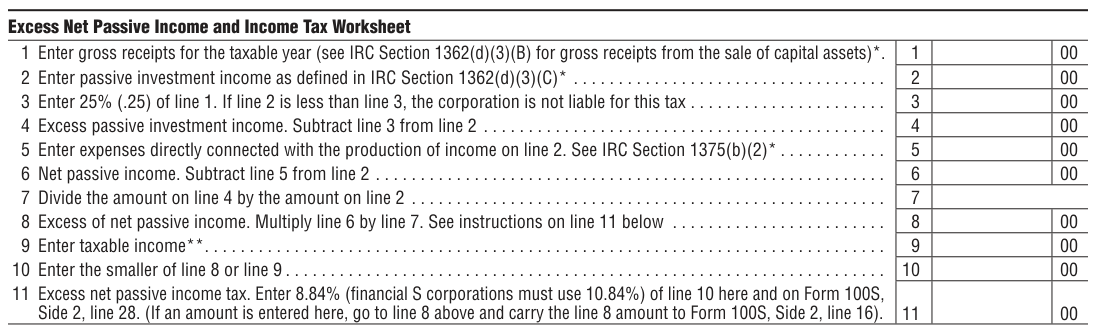
Text version of this table
1 Enter gross receipts for the taxable year (see IRC Section 1362(d)(3)(B) for gross receipts from the sale of capital assets)*. 2 Enter passive investment income as defined in IRC Section 1362(d)(3)(C)* . . . . . . . . . . . . . . . . . . . . . . . . . . . . . . . . . . . 3 Enter 25% (.25) of line 1. If line 2 is less than line 3, the corporation is not liable for this tax . . . . . . . . . . . . . . . . . . . . . . 4 Excess passive investment income. Subtract line 3 from line 2 . . . . . . . . . . . . . . . . . . . . . . . . . . . . . . . . . . . . . . . . . . . . . 5 Enter expenses directly connected with the production of income on line 2. See IRC Section 1375(b)(2)* . . . . . . . . . . . . 6 Net passive income. Subtract line 5 from line 2 . . . . . . . . . . . . . . . . . . . . . . . . . . . . . . . . . . . . . . . . . . . . . . . . . . . . . . . . . 7 Divide the amount on line 4 by the amount on line 2 . . . . . . . . . . . . . . . . . . . . . . . . . . . . . . . . . . . . . . . . . . . . . . . . . . . . . 8 Excess of net passive income. Multiply line 6 by line 7. See instructions on line 11 below . . . . . . . . . . . . . . . . . . . . . . . . 9 Enter taxable income**. . . . . . . . . . . . . . . . . . . . . . . . . . . . . . . . . . . . . . . . . . . . . . . . . . . . . . . . . . . . . . . . . . . . . . . . . . . . 10 Enter the smaller of line 8 or line 9 . . . . . . . . . . . . . . . . . . . . . . . . . . . . . . . . . . . . . . . . . . . . . . . . . . . . . . . . . . . . . . . . . . . 11 Excess net passive income tax. Enter 8.84% (financial S corporations must use 10.84%) of line 10 here and on Form 100S, Side 2, line 28. (If an amount is entered here, go to line 8 above and carry the line 8 amount to Form 100S, Side 2, line 16). 1 00 2 00 3 00 4 00 5 00 6 00 7 8 00 9 00 10 00 11 00
- Income and expenses on line 1, line 2, and line 5 are from total operations for the taxable year. This includes applicable income and expenses from Form 100S, Side 1 and Side 2. See IRC Sections 1362(d)(3)(C) and 1375(b)(4) for exceptions regarding line 2 and line 5.
Taxable income is defined in federal Treas. Regs. Section 1.1374-1A(d). Figure taxable income by completing line 1 through line 17 of Form 100, California Corporation Franchise or Income Tax Return. Clearly mark ''ENPI Taxable Income'' on the Form 100 computation and attach it to Form 100S.
The passive activity loss rules apply to the S corporation as if it were an individual (i.e., losses from passive activities may not be used to offset other income, except for $25,000 in losses from rental real estate). However, when determining whether the S corporation materially participates in the activity, the material participation rules that apply to a "closely held C corporation" should be applied to the S corporation. For more information, see IRC Section 469(h)(4).
S corporations must use form FTB 3801, Passive Activity Loss Limitations, to compute the allowable net loss from passive activities.
# AA Passive Activity Credits
S corporation credits subject to the passive activity credit limitation rules include the following:
- Research Credit
- Low-Income Housing Credit
- Orphan Drug Credit
Get form FTB 3801-CR, Passive Activity Credit Limitations, for more information.
# BB Tax Credits
If a C corporation had unused credit carryovers when it elected S corporation status, the carryovers were reduced to 1/3 and transferred to the S corporation. The remaining 2/3 were disregarded. The allowable carryovers may be used to offset the 1.5% tax on net income in accordance with the respective carryover rules. These C corporation carryovers may not be passed through to shareholders. Get Schedule C (100S), S Corporation Tax Credits, for more information.
S corporations may generate credits from both the Corporation Tax Law and the Personal Income Tax Law. Follow the guidelines below:
- If a credit listed on page 35 is allowed only under the Corporation Tax Law, 1/3 of the credit may be used to offset the S corporation tax or may be carried over, if allowed. The remaining 2/3 must be disregarded and may not be carried over. No part of the credit may be passed through to the shareholders.
- If the credit is allowed only under Personal Income Tax Law, the full credit may be passed through to the shareholders. No part of the credit may be used by the S corporation to offset the S corporation tax or to be carried over.
- If a credit is allowed under both the Corporation Tax Law and Personal Income Tax Law, the S corporation may use 1/3 of the credit to offset the S corporation tax or it may be carried over, if allowed. The remaining 2/3 must be disregarded and may not be carried over. The full amount of the credit, as calculated under the Personal Income Tax Law, may also be passed through to the shareholders.
California Motion Picture & Television
Production Credits
The S corporation may not claim either the original, new, or Program 3.0 California Motion Picture and Television Production Credit. The entire amount of the credit passes through to the shareholder. For more information, get form FTB 3541, California Motion Picture and Television Production Credit.
Credits and credit carryovers may not reduce the minimum franchise tax, the QSub annual tax(es), built-in gains tax, excess net passive income tax, credit recaptures, the increase in tax imposed for the deferral of installment sale income, or an installment of LIFO recapture tax.
# S Subsidiary (QSub)
California has conformed to the sections of the IRC that allow an S corporation to own a
QSub. A QSub is a domestic corporation that is not an ineligible corporation, i.e., it must be eligible to be an S corporation as defined by IRC Section 1361(b)(2). In addition, 100% of the stock of the subsidiary must be held by the S corporation parent and the parent must elect to treat the subsidiary as a QSub. A QSub is not treated as a separate entity and all assets, liabilities, and items of income, deduction, and credit of the QSub are treated as belonging to the parent S corporation. The activities of the QSub are treated as activities of the parent S corporation.
An election made by the parent S corporation under IRC Section 1361(b)(3) to treat the corporation as a QSub for federal purposes is treated as a binding election for California purposes. A separate election is not filed for California.
The federal election is made on federal Form 8869, Qualified Subchapter S Subsidiary Election. California requires that an S corporation parent attach a copy of the Form 8869 for each QSub doing business or qualified to do business in California to the return for the taxable year during which the QSub election was made. California follows the federal transitional relief procedures for perfecting a QSub election.
A QSub is subject to an $800 annual tax which is paid by the S corporation parent. The QSub annual tax is due and payable when the S corporation's first estimated tax payment is due. If the QSub is acquired, or a QSub election is made during the taxable year, the QSub annual tax is due with the S corporation's next estimated tax payment after the date of the QSub election or acquisition. The QSub annual tax is subject to the estimated tax rules and penalties.
An S corporation that owns a QSub does not file a combined return. Instead, the QSub is disregarded, and the activities, assets, liabilities, income, deductions, and credits of the QSub are considered to be the assets, liabilities, income, and credits of the S corporation. If the QSub is not unitary with the S corporation, then it is treated as a separate division and separate computations must be made to compute business income and apportionment factors for the QSub and the S corporation, and to apportion to California the business income of each.
An S corporation parent must complete the Schedule QS, Qualified Subchapter S Subsidiary (QSub) Information, and attach it to the Form 100S for each taxable year in which a QSub election is in effect.
# EE California Use Tax
Use tax has been in effect in California since July 1, 1935. It applies to purchases of property from out-of-state sellers and is similar to sales tax paid on purchases made in California. If the S corporation has not already paid all use tax due to the California
# Department of Tax and Fee Administration
(CDTFA), it may be able to report and pay the use tax due on its state income tax return.
However, S corporations required to hold a California seller's permit or to otherwise register with the CDTFA for sales and use tax purposes may not report use tax on their state income tax return. See the information below and the instructions for line 37 of the income tax return.
In general, S corporations must pay California use tax on purchases of merchandise for use in California, made from out-of-state sellers, for example, by telephone, online, by mail, or in person.
S corporations must pay California use tax on taxable items if:
- The seller does not collect California sales or use tax; and
- The S corporation uses, gifts, stores, or consumes the item in California.
Example: The S corporation purchases a conference table from a company in North Carolina. The company ships the table from North Carolina to the corporation's address in California for the corporation's use, and does not charge California sales or use tax. The S corporation owes use tax on the purchase.
However, not all purchases require the S corporation to pay use tax. For example, the S corporation would include purchases of office equipment, but not exempt purchases of food products or prescription medicine. For more information on nontaxable and exempt purchases, the S corporation may refer to
# Publication 61, Sales and Use Taxes: Tax
Expenditures, on the California Department of Tax and Fee Administration's website at cdtfa.ca.gov.
For more information about California use tax, please refer to the California Department of Tax and Fee Administration's website at cdtfa.ca.gov and type "Find Information About Use Tax" in the search bar.
Complete the Use Tax Worksheet on page 21 to calculate the amount due.
Extensions to File. If the S corporation requests an extension to file the tax return, wait until the S corporation files the return to report the purchases subject to use tax and to make the use tax payment.
Interest, Penalties, and Fees. Failure to timely report and pay use tax due may result in the assessment of interest, penalties, and fees.
Application of Payments. For purchases made during taxable years starting on or after January 1, 2015, payments and credits reported on an income tax return will be applied first to the use tax liability, instead of income tax liabilities, penalties, and interest.
Changes in Use Tax Reported. Do not file an
# Amended S Corporation Franchise or Income
Tax Return (Form 100X) to revise the use tax previously reported. If the S corporation has changes to the amount of use tax previously reported on the original tax return, contact the California Department of Tax and Fee Administration.
For assistance, go to the California Department of Tax and Fee Administration's website at cdtfa.ca.gov, or call their Customer Service Center at 1.800.400.7115 (TTY: 711) (for hearing and speech disabilities). For California income tax information, contact the FTB at ftb.ca.gov.
# Section 179 Recapture
Special rules apply for gains from the sale, exchange or disposition of property for which an IRC Section 179 expense deduction was claimed in a prior year. For federal purposes, the gain is no longer included in income at the entity level. However, it must be included in the taxable income of the S corporation for California purposes.
S corporations should follow the instructions in federal Form 4797 with the exception that the amount of gain on property subject to the IRC Section 179 expense deduction recapture (capital gain and ordinary gain) must be included in the taxable income of the S corporation. To accomplish this, the S corporation will need to complete two sets of Schedule D-1, Sales of Business Property, and Schedule D (100S), S Corporation Capital Gains and Losses and Built-In Gains. The first set of Schedule D-1 and Schedule D (100S) will include the sale or disposition of both IRC Section 179 assets and the sale of non-IRC Section 179 business assets with the amount reported on Form 100S, Side 1, line 4.
The second set of Schedule D-1 and Schedule D (100S) will include the sale or disposition of non-IRC Section 179 business assets only, with the amount reported on the Schedule K and Schedule K-1 (100S).
See Specific Line Instructions for Property Subject to IRC Section 179 Expense Deduction Recapture. Also, see the Schedule D-1 Instructions.
The S corporation should report the gain on property subject to the IRC Section 179 expense deduction recapture passed through to the shareholders on the Schedule K and Schedule K-1 (100S) as supplemental information as instructed on the federal Form 4797.
# (LLCs)
California law authorizes the formation of LLCs and recognizes out-of-state LLCs registered or doing business in California. The taxation of an LLC in California depends upon its classification as a corporation, partnership, or "disregarded entity" for federal tax purposes.
If a LLC elects to be taxed as an S corporation for federal tax purposes, the LLC must file Form 100S, Form 100-ES, form FTB 3539, and/or form FTB 3586 and enter the California corporation number, FEIN, and California SOS file number, if applicable, in the space provided. The FTB will (1) assign an identification number to an LLC that files as a corporation, and (2) notify the LLC with the identification number upon receipt of the first estimated tax payment, first tax payment, or the first tax return. The LLC will be subject to the applicable provisions of the Corporation Tax Law and should be considered a corporation for purposes of all instructions unless otherwise indicated.
If an LLC elects to be taxed as a partnership for federal tax purposes, it must file Form 568, Limited Liability Company Return of Income.
LLCs taxed as partnerships determine their income, deductions, and credits under the Personal Income Tax Law and are subject to an annual tax as well as an annual fee based on total income.
If a Single Member Limited Liability Company (SMLLC) is disregarded for federal tax purposes, get Form 568, Limited Liability Company Tax Booklet, for information regarding SMLLC filing requirements.
A disregarded LLC reports its income, deductions, and credits on the return of its owner. However, an LLC that is disregarded is required to file and pay the annual LLC tax as well as the fee (if applicable) based on total income. Form 568 provides the FTB with information on the sole owner of the LLC, contains the owner's consent to be taxed on the income of the LLC, and provides for the computation of the LLC tax and fee.
# HH Withholding
With certain limited exceptions, payers that are required to withhold and remit backup withholding to the IRS are also required to withhold and remit to the FTB on income sourced to California. If the S corporation (payee) has backup withholding, the S corporation (payee) must contact the FTB to provide a valid taxpayer identification number, before filing the tax return. Failure to provide a valid taxpayer identification number may result in a denial of the backup withholding credit. For more information, go to ftb.ca.gov and search for backup withholding.
R&TC Section 18662 requires buyers to withhold income taxes when purchasing California real property from corporate sellers with no permanent place of business in California immediately after the transfer.
Get FTB Pub. 1016, Real Estate Withholding Guidelines, for more information.
Sellers of California real estate must attach a copy of Form 593, Real Estate Withholding Statement, to their tax return as proof of withholding.
If the corporation needs to verify withholding payments, the corporation may call Withholding Services and Compliance at 916.845.4900 or 888.792.4900.
For transactions that require withholding, a seller of California real estate may elect an alternative to withholding 3 1/3% of the total sales price. The seller may elect an alternative withholding amount based on the maximum tax rate for individuals, corporations, or banks and financial corporations, as applied to the gain on the sale. The seller is required to certify under penalty of perjury the alternative withholding amount to the FTB. For more information, get FTB Pub. 1016.
# Specific Line Instructions
If an LLC elects to be taxed as a corporation, see General Information GG, Limited Liability Companies (LLCs), for more information.
Filing Form 100S without errors will expedite processing. Before mailing Form 100S, make sure entries have been made for the following:
- California corporation number (assigned by the California SOS).
- Federal employer identification number (FEIN).
- California Secretary of State (SOS) file number, if applicable.
- Corporation name (use the true legal name filed with the California SOS) and address (include PMB no., if applicable).
- Use the additional information field for "Owner/Representative/Attention" name, and other supplemental address information only.
- If the corporation has a foreign address, follow the country's practice for entering the city, county, province, state, country, and postal code, as applicable, in the appropriate boxes. Do not abbreviate the country name.
File the 2024 Form 100S for calendar year 2024 or for a fiscal year that begins in 2024.
Enter taxable year beginning and ending dates only if the return is for a short year or a fiscal year. If the S corporation reports its income using a calendar year, leave the date area blank. If a domestic corporation files the first California tax return, the fiscal year beginning date must be the date the corporation is incorporated. If the return is filed for a short period (less than 12 months), write "short year" in black or blue ink in the top margin on Form 100S, Side 1. Convert all foreign monetary amounts to U.S. dollars.
The 2024 Form 100S may also be used if both of the following apply:
- The corporation has a taxable year of less than 12 months that begins and ends in 2025.
- The 2025 Form 100S is not available at the time the corporation is required to file its return. The S corporation must show its 2025 taxable year on the 2024 Form 100S and incorporate any tax law changes that are effective for taxable years beginning after December 31, 2024.
California law is different from federal law.
California taxes S corporations under Chapter 2 (commencing with R&TC Section 23101) or Chapter 3 (commencing with R&TC Section 23501) of the Corporation Tax Law.
# Questions A through U
Answer all applicable questions and attach additional sheets, if necessary. Be sure to answer Questions C through U on Form 100S, Side 3. Read the following instructions when answering:
Question A2 - Check the "Yes" or "No" box to indicate if the S corporation is deferring any income from the disposition of assets. If "Yes," enter the four-digit year in which the assets were disposed (e.g., 2024). If there are multiple years, write "see attached" on the line and attach a schedule listing the years. This question is applicable if the S corporation is deferring any income from a disposition of assets in the current taxable year or prior taxable years.
Question A3 - Check the box for the type(s) of previously deferred income the S corporation is reporting. If there are multiple sources of income, check the box for the appropriate items and attach a schedule listing the income type and year of disposition. If the S corporation is reporting "Other" types of previously deferred income, check the box for "Other" and attach a schedule listing the income type and year of disposition.
This question is applicable if the S corporation is reporting previously deferred income in the current taxable year or prior taxable years.
Question B - Transfer or acquisition of voting stock All S corporations must answer all three questions. The questions provide information regarding changes in control or ownership of legal entities owning or under certain circumstances leasing California real property (R&TC Section 64). (Real Property includes land, buildings, structures, fixtures - see R&TC Section 104 for more information).
If any of the answers are "Yes," a Statement of Change in Control and Ownership of Legal Entities, must be filed with the State of California; failure to do so within 90 days of the event date will result in penalties. The form for this statement is form BOE-100-B, filed with the California State Board of Equalization (BOE). Get this form and information from the BOE website (boe.ca.gov) by searching for
Legal Entity Ownership Program (LEOP).
There may be a change in ownership or control if, during this taxable year, one of the following occurred with respect to this corporation or any of its subsidiaries:
- The percentage of outstanding voting shares transferred to, or owned or controlled by, one person or one legal entity cumulatively exceeded 50%.
- The total outstanding voting shares transferred to or held by one irrevocable trust or trust beneficiary cumulatively exceeded 50%.
- One or more irrevocable proxies cumulatively transferred voting rights to more than 50% of the outstanding voting shares to one person or one entity.
- This corporation, or any of its subsidiaries, cumulatively acquired ownership or control of more than 50% of the outstanding voting shares or other ownership interests in any legal entity.
- As of the end of this taxable year, cumulatively more than 50% of the total outstanding voting shares have been transferred in one or more transactions since an interest in California real property was transferred to the corporation that was excluded from property tax reassessment under R&TC 62(a)(2) which established an original co-owners' interest status.
For purposes of these questions, leased real property is a leasehold interest in taxable real property: (1) leased for a term of 35 years or more (including renewal options), if not leased from a government agency; or (2) leased for any term, if leased from a government agency.
R&TC Section 64(e) requires this information for use in determining whether a change in ownership has occurred under section 64(c) and (d); it is used by the LEOP.
# Question C - Principal business activity
(PBA) code
All S corporations must answer Question C.
Include the six digit PBA code from the Principal Business Activity Codes chart included in this tax booklet. The code should be the number for the specific industry group from which the greatest percentage of California "total receipts" is derived. "Total receipts" means gross receipts plus all other income. The California PBA code number may be different from the federal PBA code number.
If, as its principal business activity, the corporation: (1) purchases raw material;
(2) subcontracts out for labor to make a finished product from the raw materials; and
(3) retains title to the goods, the corporation is considered to be a manufacturer and must enter one of the codes under "Manufacturing."
Also, write in the business activity and principal product or service on the lines provided.
Question E - Does this return include
Qualified Subchapter S Subsidiaries
(QSubs)?
Answer "Yes" if the S corporation owns a
QSub. Refer to the instructions for line 21 and line 32 to report the QSub annual tax. Be sure to complete Schedule QS and attach the schedule to Form 100S when filed.
# Question N - Doing business as (DBA)
S corporations doing business under a name other than that entered on Side 1 of Form 100S must enter the DBA name in Question N. If the S corporation is doing business under multiple DBAs attach a schedule listing all DBAs.
Leave Question N blank if the S corporation is not using a DBA to conduct business.
Question Q - Reportable transaction or listed transaction Federal Form 8886 is required to be attached to any return on which a deduction, loss, credit, or any other tax benefit is claimed or is reported, or any income the S corporation reported from an interest in a reportable transaction. If the S corporation is required to file this form with the federal return, attach a copy to the S corporation's Form 100S.
A material advisor is required to provide a reportable transaction number to all taxpayers and material advisors for whom the material advisor acts as a material advisor.
A Reportable Transaction is any transaction as defined in R&TC Section 18407 and Treas.
Reg. Section 1.6011-4 and includes, but is not limited to the following:
- A Listed Transaction, or a transaction that is substantially similar to a Listed Transaction, which has been identified by the IRS or the FTB as a tax avoidance transaction.
- A Confidential Transaction which is offered to a taxpayer under conditions of confidentiality and for which the taxpayer has paid a minimum fee.
- A transaction with contractual protections which provides the taxpayer with the right to a full or partial refund of fees if all or part of the intended tax consequences from the transaction are not sustained.
- A loss transaction under IRC Section 165 which is at least $10 million in any one year or $20 million in any combination of taxable years. (Those numbers would be reduced to $2 million and $4 million on the
# Form 100S.)
- A transaction of interest is a transaction that is the same as or substantially similar to one of the types of transactions that the IRS has identified by notice, regulation, or other form of published guidance as a transaction of interest (entered into after November 1, 2006).
- A transaction with a significant book-tax difference (entered into prior to August 3, 2007). Beginning January 6, 2006, this transaction was no longer required to be disclosed on Form 8886. See IRS Notice 2006-6.
- A transaction where the taxpayer is claiming a tax credit of greater than $250,000 and held the asset for less than 45 days (entered into prior to August 3, 2007).
Question S - FTB 3544
Check the "Yes" box if form FTB 3544, Assignment of Credit, Side 2, Part B, List of
Assigned Credit Received and/or Claimed by Assignee, is attached to Form 100S.
Question T - Check the applicable box if activities were aggregated for at-risk purposes or grouped for passive activity purposes. Get the instructions for federal Form 1120-S, under Specific Instructions for Item J, for more information.
Question U - Do Not Round Cents to Dollars On line (3), do not round cents to the nearest whole dollar. Enter the amounts with dollars and cents as actually remitted.
# Line 1 through Line 44
Line 1 - Ordinary income (loss) from trade or business S corporations using the federal reconciliation method to figure net income (see General Information I, Net Income Computation) must:
- Transfer the amount from federal Form 1120-S, line 22 to Form 100S, Side 1, line 1 and attach a copy of the federal return and all pertinent supporting schedules; or copy the information from federal Form 1120-S, page 1, onto Form 100S, Side 4, Schedule F and transfer the amount from Schedule F, line 22, to Form 100S, Side 1, line 1.
- Then, complete Form 100S, Side 1 and Side 2, line 2 through line 13, State Adjustments.
S corporations using the California computation to figure ordinary income (see General Information I, Net Income Computation) must transfer the amount from Form 100S, Side 4, Schedule F, line 22, to Side 1, line 1. Complete Form 100S, Side 1 and Side 2, line 2 through line 13, only if applicable.
# Line 2 through Line 13 - State adjustments
To figure net income for California purposes, S corporations using the federal reconciliation method must enter California adjustments to the federal net income on line 2 through line 13. If a specific line for the adjustment is not on Form 100S, enter the adjustment on line 7, Other additions, or line 12, Other deductions, and attach a schedule that explain the adjustment.
Line 2 - Taxes not deductible California law does not permit a deduction for California corporation franchise or income taxes or any other taxes on, according to, or measured by net income or profits. Add these taxes to income on line 2.
Line 3 - Interest on government obligations S corporations subject to the California franchise tax must report interest received on government obligations even though it may be exempt from state or federal individual income tax. This interest must be added to income on line 3. See line 12 instructions for S corporations subject to the California corporation income tax.
Line 4 - Net capital gain
Enter on this line any net capital gain subject to the 1.5% tax rate (3.5% for financial S corporations) shown on Schedule D (100S), Section B, line 10, and any gains subject to the 8.84% tax rate (10.84% for financial S corporations) shown on Schedule D (100S), Section A, line 13.
Property Subject To IRC Section 179 Expense
# Deduction Recapture
If the S corporation has a gain from the sale, exchange or disposition of property for which an IRC Section 179 expense deduction was claimed in a prior year, special rules apply. For federal purposes, the gain is no longer included in income at the entity level.
However, it must be included in the taxable income of the S corporation for California purposes on Form 100S, line 4. See General
# Information FF, Property Subject To IRC
Section 179 Recapture, for more information.
The S corporation should complete two sets of Schedule D-1 and Schedule D (100S).
The first set of Schedule D-1 and Schedule D
(100S) will include the gain or loss from the sale or disposition of IRC Section 179 assets as well as gain or loss from non-IRC Section 179 business assets, and will be reported on the Form 100S. Indicate at the top of this Schedule D-1 and Schedule D
(100S) "IRC Sec. 179 and Business Assets."
When completing Schedule D-1 and Schedule D (100S) for the Form 100S, skip any instructions to report the gain or loss on Schedule K or Schedule K-1 (100S). Transfer the gain amount to Form 100S, Side 1, line 4.
The second set of Schedule D-1 and Schedule D (100S) is to report the gain or loss on non-IRC Section 179 business assets for use on the Schedule K and Schedule K-1 (100S). To accomplish this, the S corporation should complete a Schedule D-1 and Schedule D (100S) with the gain or loss for the non-IRC Section 179 business assets only. The amounts from this Schedule D-1 and Schedule D (100S) will be reported on the Schedule K (100S) and Schedule K-1 (100S).
Indicate at the top of the Schedule D-1 and Schedule D (100S) set "Non-IRC Section 179
Business Assets Only."
Line 5 - Depreciation and amortization Depreciation for S corporations follows the depreciation rules provided under California Personal Income Tax Law. Unlike other corporations, an S corporation is allowed to compute depreciation using the
Modified Accelerated Cost Recovery System (MACRS). Complete Schedule B (100S), for assets subject to depreciation and for assets subject to amortization. Enter the total of Schedule B (100S), Part III, on Form 100S, Side 1, line 5.
# Line 6 - Portfolio income
Enter on this line net portfolio income not included in line 1 but that must be included in the S corporation's net income for computing the 1.5% tax. Include interest, dividends, and royalties. Do not include any passive activity amounts on this line. Instead, include passive activity amounts on line 7 or line 12.
# Line 7 - Other additions
R&TC Section 24425 disallows expenses allocable to income, which is not included in the measure of the franchise tax or income tax.
Add back such deductions on this line.
Also, include on this line other items not added on any other line to arrive at California net income. Attach a schedule that clearly shows how each item was computed and explain the basis for the adjustment.
If a federal contribution deduction was taken in arriving at the amount entered on line 1, include that amount in the computation of line 7. See line 11, Charitable contributions.
Include any income from pass-through entities and passive activities on line 7.
Rental real estate activities owned directly by the S corporation are reported on federal
Form 8825, Rental Real Estate Income and Expenses of a Partnership or an S Corporation.
Shuttered Venue Operator Grant. Under federal law, the CAA, 2021 allows deductions for eligible expenses paid for with grant amounts. California law conforms to this federal provision with modifications. For California purposes, if you are an ineligible entity and deducted eligible expenses for federal purposes, include this amount on line 7.
# Paycheck Protection Program Loans
Forgiveness. Under federal law, the CAA, 2021 allows deductions for eligible expenses paid for with covered loan amounts. California law conforms to this federal provision with modifications. For California purposes, if you are an ineligible entity and deducted eligible expenses for federal purposes, include this amount on line 7.
Also, the ARPA expands PPP eligibility to include "additional covered nonprofit entities" which includes certain Code 501(c) nonprofit organizations and Internet-only news publishers and Internet-only periodical publishers. California law does not conform to this expansion of PPP eligibility. If you met the PPP eligibility requirements and excluded the amount from gross income for federal purposes, include this amount on line 7.
Other Loan Forgiveness. Under federal law, the CAA, 2021 allows deductions for eligible expenses paid for with covered loan amounts.
California law conforms to this federal provision, with modifications. For California purposes, if you are an ineligible entity and deducted eligible expenses for federal purposes, enter the total amount of those expenses deducted on line 7.
# Penalty Assessed by Professional Sports
League. California does not allow a business expense deduction for any fine or penalty paid or incurred by an owner of a professional sports franchise assessed or imposed by the professional sports league that includes that franchise. If the corporation deducted the fine or penalty for federal purposes, include this amount on line 7.
California Ordinary Net Gain or Loss. Before entering the amount from Schedule D-1, line 18, determine whether the gain is subject to built-in gains tax. If the gain is subject to built-in gains tax, enter the amount on Schedule D (100S), Section A, Part III so the built-in gains tax can be computed, and enter the difference between the amount on Schedule D-1, line 18 and the amount subject to built-in gains tax on Form 100S, Side 1, line 7.
Gain on Installment Notes. Generally, when an S corporation sells assets in an installment sale, the S corporation defers the recognition of gain until it receives payments on the installment obligation. If the S corporation distributes the installment obligation to the shareholders in a corporate liquidation, the corporation pays 1.5% tax on the deferred gain in the final year under R&TC Section 24672.
The shareholders continue to defer the gain until they receive payments. If R&TC Section 24672 applies, report the amount of deferred gain on this line.
Line 9 and Line 10 - Dividends deduction
Complete Schedule H (100S), S Corporation Dividend Income Deduction.
# Line 11 - Charitable contributions
The charitable contribution deduction for California corporations is limited to the adjusted basis of the assets being contributed.
The deduction is 10% of California net income, without regard to charitable contributions and special deductions (e.g., the deduction for dividends received). The definition of California net income differs from federal taxable income for computing the charitable contribution deduction.
Per IRC Section 170(d)(2), five-year carryover provisions shall apply for excess charitable contributions.
For taxable years beginning on or after January 1, 2017, and before January 1, 2028, do not include any amounts taken into account for the College Access Tax Credit as a charitable contribution deduction on line 11.
On a separate worksheet, using the Form 100S format, complete Form 100S, Side 1 and Side 2, line 1 through line 14, without regard to line 11. If any federal charitable contribution deduction was taken in arriving at the amount entered on Side 1, line 1, enter that amount as an addition on line 7 of the Form 100S formatted worksheet. Enter the adjusted basis of the assets contributed on line 5 of the following worksheet. Then complete the worksheet to determine the charitable contribution deduction to enter on line 11.
- Net income after state adjustments from Side 2, line 14 … __
- Deduction for dividends received __
- Net income for contribution calculation purposes. … __
Add line 1 and line 2
- Allowable charitable contributions.
Multiply line 3 by 10% (.10) . . . __
- Enter the amount actually contributed … __
- Enter the smaller of line 4 or line 5 here and on Side 2, line 11 __ Get Schedule R to figure the charitable contribution computation for apportioning corporations.
# Line 12 - Other deductions
Include on this line deductions not claimed on any other line. Attach a schedule that clearly shows how each deduction was computed and explain the basis for the deduction.
Include any losses from pass-through entities and passive activities on line 12.
Rental real estate activities owned directly by the S corporation are reported on federal Form 8825. Also, enter any IRC Section 179 expense from Schedule B (100S), Part I, line 5.
For S corporations subject to income (and not franchise) tax, interest received on obligations of the federal government and on obligations of the State of California and its political subdivisions is exempt from income tax. If such interest is reported on line 3, deduct it on line 12.
Wildfire Mitigation Payment. California law allows a qualified taxpayer an exclusion from gross income for any amount received as a California qualified wildfire loss mitigation payment through the California Wildfire Mitigation Financial Assistance Program. If the corporation included any amount as income for federal purposes, deduct the amount on line 12.
Kincade Wildfire Exclusion. California law allows a qualified taxpayer an exclusion from gross income for any qualified amount received in a settlement from PG&E Company or its subsidiary relating to the 2019 Kincade
Fire. If the corporation included any amount as income for federal purposes, deduct the amount on line 12.
Zogg Wildfire Exclusion. California law allows a qualified taxpayer an exclusion from gross income for any qualified amount received in a settlement from PG&E Company or its subsidiary relating to the 2020 Zogg Fire. If the corporation included any amount as income for federal purposes, deduct the amount on line 12.
Thomas and Woolsey Wildfires Exclusion.
California law allows a qualified taxpayer an exclusion from gross income for any amount received in settlement from Southern California Edison for claims relating to the 2017 Thomas Fire or the 2018 Woolsey Fire. If the corporation included any amount as income for federal purposes, deduct the amount on line 12.
Fire Victims Trust Exclusion. California law allows a qualified taxpayer an exclusion from gross income for any amount received from the Fire Victims Trust. If the corporation included any amount as income for federal purposes, deduct the amount on line 12.
# Turf Replacement Water Conservation
Program. California law allows an exclusion from gross income for any amount received as a rebate, voucher, or other financial incentive issued by a public water system, local government, or state agency for participation in a turf replacement water conservation program. If the corporation included any amount as income for federal purposes, deduct the amount on line 12.
Small Business and Nonprofit COVID-19
Supplemental Paid Sick Leave Relief Grant.
California law allows an exclusion from gross income for grant allocations received by a taxpayer pursuant to the California
Small Business and Nonprofit COVID-19
Supplemental Paid Sick Leave Relief Grant Program that is established by Section 12100.975 of the Government Code. If the corporation included any amount qualifying for this exclusion as income for federal purposes, deduct the amount on line 12.
# California Microbusiness COVID-19 Relief
Grant. California law allows an exclusion from gross income for grant allocations received by a taxpayer pursuant to the California Microbusiness COVID-19 Relief Program that is administered by the Office of Small Business Advocate (CalOSBA). Federal law has no similar exclusion. Enter on line 12 the amount of this type of income.
California Venues Grant. California law allows an exclusion from gross income for grant allocations received by a taxpayer pursuant to the California Venues Grant Program that is administered by CalOSBA. Federal law has no similar exclusion. Enter on line 12 the amount of this type of income.
Small Business COVID-19 Relief Grant
Program. California allows an exclusion from gross income for grant allocations received by a taxpayer pursuant to the COVID-19 Relief Grant under Executive Order No. E 20/21-182 and the
# California Small Business COVID-19 Relief Grant
Program established by Section 12100.83 of the Government Code. If the corporation included any amount as income for federal purposes, deduct the amount on line 12.
Financial Incentive for Seismic Improvement.
For taxable years beginning on or after July 1, 2015, California allows an exclusion from gross income for any amount received as a loan forgiveness, grant, credit, rebate, voucher, or other financial incentive issued by the California Residential Mitigation Program or the California Earthquake Authority to assist a residential property owner or occupant with expenses paid, or obligations incurred, for earthquake loss mitigation. If the S corporation included any amount as income for federal purposes, deduct that amount on line 12.
Qualified Opportunity Zone Funds. The TCJA established Opportunity Zones. IRC Sections 1400Z-1 and 1400Z-2 provide a temporary deferral of inclusion of gross income for capital gains reinvested in a qualified opportunity fund, and exclude capital gains from the sale or exchange of an investment in such funds.
California does not conform to the deferral and exclusion of capital gains reinvested or invested in federal opportunity zone funds and has no similar provisions.
If, for California purposes, gains from investment in qualified opportunity zone property had been included in income during previous taxable year, and the corporation recognized the gains for federal tax purposes in the current year, deduct the federal gains amount on line 12.
# Federal Ordinary Net Gain or Loss
Enter any federal ordinary net gain or loss from federal Form 4797.
Line 15 - Net income (loss) for state purposes If all the S corporation income is derived from California sources, transfer the amount from line 14 to line 15.
If only a portion of income is derived from California sources, complete Schedule R before entering any amount on line 15. Transfer the amount from Schedule R, line 35, to this line.
Be sure to answer "Yes" to Question P on Form 100S, Side 3.
If this line is a net loss, complete and attach the 2024 form FTB 3805Q to Form 100S.
# Public Law 86-272
S corporations who meet the protections of Public Law 86-272 are exempt from state taxes based upon, or measured by, net income.
However, they still are subject to the annual minimum franchise tax if they are doing business in, incorporated in, or qualified to transact intrastate business in California.
If S corporations are claiming immunity in California under Public Law 86-272, do not include their net income or loss on line 15 and write "PL 86-272" at the top of Form 100S.
Line 16 - R&TC Section 23802(e) deduction If the S corporation has a tax imposed on excess net passive investment income or built-in gains, a deduction is allowed against the net income taxed at the 1.5% rate. See the
# "Excess Net Passive Income and Income Tax
Worksheet," on page 13 to determine if the S corporation is subject to the tax on excess net passive investment income. If a tax is shown on this worksheet, enter the amount of excess net passive income from line 8 of the worksheet on Form 100S, Side 2, line 16.
For purposes of the built-in gains tax, enter on line 16 the amount from Schedule D (100S), Section A, Part III, line 11.
Line 17, Line 18, and Line 19
The order in which line 17, line 18, and line 19 appear is not meant to imply the order in which any NOL or disaster loss deduction should be taken if more than one type of deduction is available.
Line 17 - Net operating loss (NOL) deduction The NOL carryover deduction is suspended for the 2024, 2025, and 2026 taxable years, if the corporation's taxable income is $1,000,000 or more. The corporation may continue to compute and carryover an NOL during the suspension period. See General Information Section X, Net Operating Loss (NOL), for more information.
The NOL deduction is the amount of the NOL carryover from prior years that may be deducted from income in this taxable year. However, the loss may not reduce the S corporation's current taxable year income below zero.
For more information, get form FTB 3805Q.
If line 15 less line 16 is a positive amount, enter the NOL carryover (but not more than the result of line 15 less line 16) from the S corporation's 2024 form FTB 3805Q, Part III, line 3 on Form 100S, Side 2, line 17.
Attach a copy of the 2024 form FTB 3805Q to Form 100S. If the full amount of the NOL carryover is not deducted this taxable year, complete and attach a 2024 form FTB 3805Q showing the computation of the NOL carryover to future years.
If line 15 less line 16 is a negative amount or $1,000,000 or more, enter 0 on line 17.
- -
Get the 2024 form FTB 3805Q instructions to compute the NOL carryover to future years.
No NOL carryover arising from a year in which an S corporation was a C corporation may be applied against the 1.5% tax.
# See IRC Section 1371(b) (1) and R&TC
Section 23802(d). However, if the corporation terminates its' S election, thus becoming a C corporation, then the prior year NOL carryover may be used to the extent it has not expired.
NOL carryovers arising from a year in which the S corporation was a C corporation may be used in computing the tax on built-in gains.
# Line 18 - EZ, TTA, or LAMBRA NOL carryover deduction
NOL carryover deductions for the EZ, TTA, or LAMBRA are suspended for the 2024, 2025, and 2026 taxable years, if the corporation's taxable income is $1,000,000 or more. For more information, get form FTB 3805Z, form FTB 3807, or form FTB 3809.
An NOL generated by a business that operates (operated) or invests (invested) within a former Enterprise Zone (EZ), Targeted Tax Area (TTA), or Local Agency Military Base Recovery Area (LAMBRA) receives special tax treatment. The loss may not reduce the corporation's current taxable year income below zero.
S corporations can no longer generate/incur any EZ or LAMBRA NOL for taxable years beginning on or after January 1, 2014.
S corporations can claim an EZ or LAMBRA NOL carryover deduction from prior years. Get FTB 3805Z Booklet or FTB 3807 Booklet for more information.
S corporations can no longer generate/incur any TTA NOL for taxable years beginning on or after January 1, 2013. Corporations can claim TTA NOL carryover deduction from prior years.
Get FTB 3809 Booklet for more information.
Compute and enter the former EZ, TTA, or LAMBRA NOL carryover deduction from the corporation's form FTB 3805Z; form FTB 3809; or form FTB 3807 on Form 100S, line 18. Attach a copy of the applicable form to Form 100S.
Line 19 - Disaster loss deduction The disaster loss deduction is not subject to the NOL suspension rules for the 2024, 2025, and 2026 taxable years.
If the S corporation has a disaster loss carryover deduction and there is income in the current taxable year, enter the total amount from the 2024 form FTB 3805Q, Part III, line 2.
The loss may not reduce the current taxable year income below zero. Any excess loss must be carried forward.
If the corporation deducts a 2024 disaster loss, any remaining disaster loss incurred in 2024 (NOL attributable to a qualified disaster loss) must be carried forward. Get form FTB 3805Q for more information.
Line 21 - Tax
S corporations must use a tax rate of 1.5%.
Financial S corporations must use the financial tax rate of 3.5%. The tax on line 21 may not be less than the sum of the minimum franchise tax and QSub annual tax(es), if applicable. See
# General Information B, Tax Rate and Minimum
Franchise Tax.
If the S corporation is the parent of a QSub subject to the annual tax and paid the $800 annual tax on behalf of such QSub, add the total amount of QSub annual tax(es) to the tax on net income or the minimum franchise tax, whichever is applicable, and enter the result on line 21. Complete Schedule QS.
Example 1: Corporation A, an S corporation, is the parent of three QSubs, B, C, and D. QSub B and C are either incorporated or qualified to do business in California. QSub D is not incorporated, doing business, or qualified to do business in California. Corporation A is subject to the minimum franchise tax of $800 and $1,600 of QSub annual tax for QSub B and C.
Example 2: Beta Corporation, an S corporation, is the parent of three QSubs. Only one of the QSubs is qualified and doing business in California. Beta Corporation reports net income for California tax purposes on line 20 of $100,000. Tax on net income is $1,500.
On line 21, Beta Corporation will report tax of $2,300. The $2,300 includes tax on net income of $1,500 plus $800 of QSub annual tax payments for one QSub. Beta Corporation is not required to pay the QSub tax on the two QSubs not doing business in California.
# Line 22 through Line 24 - Tax credits
For taxable years beginning on or after January 1, 2024, and before January 1, 2027, there is a $5,000,000 limitation on the application of credits. The total of all credits including the carryover of any credit for the taxable year may not reduce the "tax", by more than $5,000,000. This limitation does not apply to the Low-Income Housing Credit. For taxpayers included in a combined report, the limitation is applied at the group level.
The S Corporation may not elect to receive a refundable credit for credits that are disallowed due to the credit limitation. Credits disallowed due to the limitation may be carried over.
The carryover period for disallowed credit is extended by the number of taxable years the credit was not allowed. For more information, refer to R&TC Sections 23036.4 and 23036.5.
An eligible assignee can claim assigned credits received this taxable year or carried over from prior years, against its tax liabilities. For more information, get form FTB 3544.
Note: The total amount of specific credit claimed on Form 100S and Schedule C (100S) should include both: (1) the total assigned credit claimed from form FTB 3544, Side 2, Part B, column (j), and (2) the amount of credit claimed that was generated by the assignee.
Credits may be used to reduce the California tax liability; however, credits may not be used to reduce the tax on line 21 to an amount less than the sum of the minimum franchise tax plus the QSub annual tax(es), if applicable. Also, the S corporation is allowed to claim only 1/3 of the total credit generated against the 1.5% franchise tax. See General Information AA, Passive Activity Credits, and BB, Tax Credits.
To figure tax credits, complete and attach the appropriate form for each credit claimed on Form 100S. See page 35 for a list of available credits.
If the S corporation claims a credit carryover for an expired credit, complete form FTB 3540. For EZ, LAMBRA, MEA, or TTA credit carryovers, get form FTB 3805Z, form FTB 3807, form FTB 3808, or form FTB 3809.
Transfer the credit(s) from the respective credit forms to Schedule C (100S) to compute the amount of credit to claim on Form 100S. Then transfer the credit(s) from Schedule C (100S) to Form 100S.
Each credit is identified by a code. To claim one or two credits, enter the credit name, code, and the amount of the credit on line 22 and line 23.
Enter the total of any remaining credits from Schedule C (100S) on line 24. Do not make an entry on line 24 unless line 22 and line 23 are complete.
Attach all credit forms, schedules, and Schedule C (100S) to Form 100S.
# Line 27 - Tax from Schedule D (100S)
S corporations must enter the tax from Schedule D (100S). See General Information J, Built-in Gains, for more information.
Line 28 - Excess net passive income tax If the corporation has always been an S corporation for California purposes or has no federal excess net passive investment income, the excess net passive investment income tax does not apply. See General Information S, Excess Net Passive Investment Income, for more information.
To determine if the S corporation owes this tax, complete line 1 through line 3 and line 9 of the "Excess Net Passive Income and Income Tax Worksheet" on page 13. If line 2 is greater than line 3 and the S corporation has taxable income, it must pay the tax.
Complete a separate schedule using the format of line 1 through line 11 of the worksheet on page 13 to figure the tax. Enter the tax from line 11 of the worksheet on Form 100S, Side 2, line 28. Attach the schedule showing the computation. Reduce each item of passive income passed through to shareholders by its pro-rata share of the tax on line 28.
# See IRC Section 1366(f)(3) and R&TC
Section 23803(b)(2).
R&TC Section 23811(e) provides a deduction for C corporation earnings and profits attributable to California sources for any taxable year by the amount of a consent dividend paid after the close of the taxable year.
The amount of the consent dividend is limited to the difference between the C corporation earnings and profits attributable to California sources and the C corporation earnings and profits for federal purposes.
Line 29 - Pass-through entity elective tax Enter the total amount of elective tax from form FTB 3804, Part I, line 3.
Line 32 - 2024 Estimated tax/Qsub payments Enter the total amount of estimated tax payments made during the 2024 taxable year on line 32. If the S corporation is the parent of a QSub and made payments for the QSub annual tax, include the total amount of QSub annual tax payment made during 2024 on line 32 along with the total estimated tax payments. See General Information DD, Qualified Subchapter S Subsidiary (QSub), for more information. Be sure to complete Schedule QS and attach it to the return.
If the S corporation is a nonconsenting nonresident (NCNR) member of an LLC and tax was paid on the S corporation's behalf by the LLC, include the NCNR members' tax from Schedule K-1 (568), Member's Share of Income, Deductions, Credits, etc., line 15e. If you are including NCNR tax, write "LLC" on the dotted line to the left of the amount on line 32, and attach Schedule K-1 (568) to the California income tax return to claim the tax paid by the LLC on the S corporation's behalf.
Line 33 - 2024 Withholding (Forms 592-B and/or 593) If the corporation was withheld upon by another entity, the corporation can either allocate the entire withholding credit to all its shareholders or claim a portion on line 33 (not to exceed total tax due) and allocate the remaining portion to all its shareholders.
S corporations may not receive a refund of withholding on Form 100S. If the S corporation is claiming any of the withholding credit on the corporate return, attach a copy of Form 592-B,
# Resident and Nonresident Withholding Tax
Statement, and/or Form 593 to the lower part of the front of Form 100S, Side 1. If any of the withholding credit is to be allocated to the shareholders, Form 592, Resident and Nonresident Withholding Statement, must be received by the FTB to allocate the credit to its shareholders. Get the instructions for Form 592 for more information.
Do not include NCNR member's tax from Schedule K-1 (568), line 15e as withholding.
Line 35 - Amounts paid for pass-through entity elective tax Enter any payments made for pass-through entity elective tax for the 2024 taxable year.
This includes electronic payments and payments made with form FTB 3893. This also includes elective tax payments made with the entity's return. The elective tax payment cannot be combined with the entity's other tax payments.
# Line 37 - Use tax
As explained under General Information EE, California use tax applies to purchases of merchandise from out-of-state sellers (for example, purchases made by telephone, online, by mail, or in person) where California sales or use tax was not paid and those items were used in California. For questions on whether a purchase is taxable, go to the California Department of Tax and Fee Administration's website at cdtfa.ca.gov, or call their Customer
# Service Center at 1.800.400.7115 (TTY: 711)
(for hearing and speech disabilities).
Note: The following businesses are required to report purchases subject to use tax directly to the California Department of Tax and Fee Administration, and may not report use tax on their income tax return:
- Businesses that have, or are required to hold, a California seller's permit.
- Businesses that make more than $10,000 in purchases subject to use tax (excluding vehicles, vessels, and aircraft) per calendar year and have not paid use tax on those purchases to a retailer engaged in business in California or to a retailer authorized by the California Department of Tax and Fee Administration to collect the tax.
- Businesses that are otherwise registered or required to be registered with the California Department of Tax and Fee Administration to report use tax.
An S corporation that is not required to report purchases subject to use tax directly to the California Department of Tax and Fee Administration may, with some exceptions, report use tax on its S Corporation Franchise or Income Tax Return. To report use tax on the tax return, complete the Use Tax Worksheet below.
Note: An S corporation may not report use tax on its income tax return for certain types of transactions. These types of purchases are listed in the instructions for completing Worksheet, Line 1.
If the S corporation owes use tax, but does not report it on the income tax return, the S corporation must report and pay the tax to the California Department of Tax and Fee Administration. For more information on how to report use tax directly to the California Department of Tax and Fee Administration, go to their website at cdtfa.ca.gov and type "Find Information About Use Tax" in the search bar.
Failure to timely report and pay the use tax due may result in the assessment of interest, penalties, and fees.
# Use Tax Worksheet
Round all amounts to the nearest whole dollar.
- Enter purchases from out-of-state sellers made without payment of California sales/use tax.
See worksheet instructions below $ … __.00
- Enter the applicable sales and use tax rate. See worksheet instructions … __
- Multiply line 1 by the tax rate on line 2. Enter result here $ __.00
- Enter any sales or use tax paid to another state for purchases included on line 1. See worksheet instructions $ … __.00
- Total Use Tax Due. Subtract line 4 from line 3. Enter the amount here and on Form 100S, line 37. If the amount is less than zero, enter 0 .
- - $ … __.00
# Worksheet, Line 1, Purchases Subject to Use
Tax
Report purchases of items that would have been subject to sales tax if purchased from a California retailer unless the receipt shows that California tax was paid directly to the retailer.
For example, generally, purchases of clothing would be included, but not exempt purchases of food products or prescription medicine. For more information on nontaxable and exempt purchases, visit the California Department of Tax and Fee Administration's website at cdtfa.ca.gov.
- Include handling charges.
- Do not include any other state's sales or use tax paid on the purchases.
- Enter only purchases made during the year that correspond with the tax return the S corporation is filing.
Note: Do not report the following types of purchases on the S corporation's income tax return:
- Vehicles, vessels, and trailers that must be registered with the Department of Motor Vehicles.
- Mobile homes or commercial coaches that must be registered annually as required by the Health and Safety Code.
- Vessels documented with the U.S. Coast Guard.
- Aircraft.
- Rental receipts from leasing machinery, equipment, vehicles, and other tangible personal property to the customers.
- Cigarettes and tobacco products when the purchaser is registered with the California Department of Tax and Fee Administration as a cigarette and/or tobacco products consumer.
# Worksheet, Line 2, Sales and Use Tax Rate
Enter the sales and use tax rate applicable to the place in California where the property is used, stored, or otherwise consumed. If the S corporation does not know the applicable city or county sales and use tax rate, please go to the California Department of Tax and Fee Administration's website at cdtfa.ca.gov and type "City and County Sales and Use Tax Rates" in the search bar. You may also call their Customer Service Center at 1.800.400.7115 (TTY: 711) (for hearing and speech disabilities).
Worksheet, Line 4, Credit for Tax Paid to
# Another State
This is a credit for tax paid to other states on purchases reported on Line 1. The S corporation can claim a credit up to the amount of tax that would have been due if the purchase had been made in California. For example, if the S corporation paid $8.00 sales tax to another state for a purchase, and would have paid $6.00 in California, the S corporation can only claim a credit of $6.00 for that purchase.
Line 40 and Line 41 - Franchise or income tax due or overpayment In addition to any amount entered on line 40 or line 41, tax due and overpayment, also include any amounts required to be included from Side 3, Schedule J, Add-On Taxes and Recapture of Tax Credits. See Schedule J instructions for more information.
Line 42 - Amount to be credited to 2025 estimated tax If the corporation chooses to have the overpayment credited to next taxable year's estimated tax payment, the corporation cannot later request that the overpayment be applied to the prior year to offset any tax due.
Line 43 - Refund
# Direct Deposit of Refund (DDR)
Direct deposit is fast, safe, and convenient.
To have the refund directly deposited into the S corporation's bank account, enter the account information on Form 100S, Side 2, lines 43a, 43b, and 43c. Be sure to fill in all the information. Do not attach a voided check or deposit slip.
Caution: Check with your financial institution to make sure your deposit will be accepted and to get the correct routing and account numbers. The FTB is not responsible for a lost refund due to incorrect account information.
To cancel the DDR, call the FTB at 916.845.0353. The FTB is not responsible when a financial institution rejects a direct deposit. If the FTB, the bank, or financial institution rejects the direct deposit due to an error in the routing number or account number, the FTB will issue a paper check.
Line 44 - Penalties and interest Enter on line 44a the amount of any penalties and interest due. Complete and attach form FTB 5806, to the back of Form 100S (after all schedules and federal return) only if Exception B or Exception C of form FTB 5806 is used to compute or eliminate the penalty.
Be sure to check the box on line 44b. For more information, see General Information M, Penalties, and General Information N, Interest.
# Schedules
Schedule F - Computation of
# Trade or Business Income
See General Information I, Net Income Computation, for information on net income computation methods.
Line 1a- Gross Receipts
"Gross receipts" means the gross amounts realized (the sum of money and the fair market value of other property or services received) on:
- The sale or exchange of property,
- The performance of services, or
- The use of property or capital (including rents, royalties, interest, and dividends) in a transaction that produces business income, in which the income, gain, or loss is recognized (or would be recognized if the transaction were in the United States) under the IRC.
Amounts realized on the sale or exchange of property shall not be reduced by the cost of goods sold or the basis of property sold. For a complete definition of "gross receipts," refer to R&TC Section 25120(f).
Line 1a through Line 6 - Income Complete line 1a through line 6 to figure the income or loss from trade or business activity. Do not report any rental activity or portfolio income or loss on these lines.
Rental activity and portfolio income or loss are reported on Form 100S, Side 1, line 7 or Side 2, line 12; Form 100S, Side 6, Schedule K; and Schedule K-1 (100S). Rental real estate activities are also reported on federal Form 8825. Attach a copy of federal Form 8825 to Form 100S.
Line 7 - Compensation of officers If the S corporation's total receipts are $150,000 or more, complete and attach a schedule showing the compensation of officers. On the schedule, list all of the following:
- Name of officer.
- Social security number of officer.
- Percentage of time devoted to the business.
- Percentage of stock owned.
- Amount of compensation.
- The calculation of compensation of officers deducted (total compensation of officers, minus compensation of officers claimed in the cost of goods sold schedule and elsewhere on the return.) Line 8 - Salaries and wages Gain from the exercise of California Qualified Stock Options issued and exercised after 1996 and before 2002, can be excluded from gross income if the individual's earned income is $40,000 or less. The exclusion from gross income is subject to the alternative minimum tax and the S corporation is not allowed a deduction for the compensation excluded from the employee's gross income. For more information, see R&TC Section 24602.
Line 20 - Other deductions
Do not include the dividend deduction on this line. Instead enter the dividend deduction on Form 100S, Side 2, line 9 or line 10.
Schedule J - Add-On Taxes and
# Recapture of Tax Credits
Complete Schedule J on Form 100S, Side 3, if the S corporation has credit amounts to recapture or is required to include installment payments of "add-on" taxes for the following:
- Last-in, first-out (LIFO) recapture resulting from an S corporation election.
- Interest computed under the look-back method for completed long-term contracts.
- Interest on tax attributable to installment sales of certain property or use of the installment method for non-dealer installment obligations.
- IRC Section 197(f)(9)(B)(ii) election to recognize gain on the disposition of an IRC Section 197 intangible.
Revise the tax due or overpayment on Form 100S, Side 2, line 40 or line 41, as appropriate, by the amount from Schedule J, line 6.
LIFO Recapture Tax
If the S corporation computed the LIFO recapture tax in the final year as a C corporation, include on Schedule J, line 1, any LIFO installment due this taxable year.
Long-Term Contracts
If the S corporation must compute interest under the look-back method for completed long-term contracts, complete and attach form FTB 3834, Interest Computation Under the Look-Back Method for Completed Long-Term Contracts, and include the amount of interest the S corporation owes or the amount of interest to be credited or refunded to the S corporation on Schedule J, line 2. Attach form FTB 3834 to Form 100S. If interest is to be credited or refunded, enter as a negative amount.
Interest on Tax Attributable to Payments
Received on Installment Sales of Certain
Timeshares and Residential Lots
If the S corporation elected to pay interest on the amount of tax attributable to payments received on installment obligations arising from the disposition of certain timeshares and residential lots under IRC Section 453(l)(3), it must include the interest due on Schedule J, line 3a. For the applicable interest rates, get FTB Pub. 1138. Attach a schedule showing the computation.
Interest on Tax Deferred Under the
Installment Method for Certain Nondealer
Installment Obligations
If an obligation arising from the disposition of property to which IRC Section 453A(c) applies is outstanding at the close of the taxable year, the corporation must include the interest due under IRC Section 453A on Schedule J, line 3b.
Attach a schedule showing the computation.
For the applicable interest rates, get FTB Pub. 1138.
IRC Section 197(f)(9)(B)(ii) Election
Complete Schedule J, line 4 if the corporation elected to pay tax on the gain from the sale of an intangible under the related person exception to the anti-churning rules.
Credit Recaptures
Complete Schedule J, line 5, if the S corporation completed the credit recapture portion for any of the following forms:
- FTB 3835, State Historic Rehabilitation Tax Credit
- FTB 3531, California Competes Tax Credit -Enter only the recaptured amount used. Get the instructions for form FTB 3531, Part III, Credit Recapture, for more information.
- FTB 3554, New Employment Credit Also, complete Schedule J, line 5, if the S corporation is subject to recapture for any of the following credits:
- Environmental Tax Credit
- Farmworker Housing Credit
Get the instructions for form FTB 3540, Part II, for more information.
# Schedule K-1 (100S)
Shareholders' Share of Income, Deductions,
Credits, etc.
Purpose of Schedules
Schedule K is a summary schedule of all the shareholders' shares of the S corporation's income, deductions, credits, etc.
Schedule K-1 (100S) shows each shareholder's separate share of pass-through items and adjusted basis. Use federal Schedule K and Schedule K-1 (Form 1120-S) as a basis for preparing California Schedule K and Schedule K-1 (100S).
Amounts on Schedule K-1 (100S) may not add up to amounts reflected on Form 100S, because Form 100S calculates tax at the S corporation level while Schedule K-1 (100S) amounts are calculated using different rules.
Attach one copy of each Schedule K-1 (100S) to the Form 100S filed with the FTB. Keep one copy of each Schedule K-1 (100S) for the S corporation's records, and give each shareholder a copy of Schedule K-1 (100S) on or before the due date of Form 100S.
Be sure to give each shareholder a copy of either the Shareholder's Instructions for Schedule K-1 (100S) or specific instructions for each item reported on the shareholder's Schedule K-1 (100S).
Substitute Forms
The S corporation needs approval from the FTB to use a substitute Schedule K-1 (100S). The substitute schedule must include the Shareholder's Instructions for Schedule K-1 (100S) or other prepared specific instructions. For more information and access to form FTB 1096, Agreement to Comply with FTB Pub. 1098 Annual Requirements and Specification; or FTB Pub. 1098, Annual Requirements and Specifications for the Development and Use of Substitute, Scannable, and Reproduced Tax Forms, email the FTB's Substitute Forms Program at:
SubstituteForms@ftb.ca.gov.
Paycheck Protection Program Loans
Forgiveness
Under federal law, the CAA, 2021 allows deductions for eligible expenses paid for with covered loan amounts. California law conforms to this federal provision with modifications.
For California purposes, if you are an ineligible entity and deducted eligible expenses for federal purposes, enter that amount on the applicable line(s) as a column (c) adjustment.
Also, the ARPA expands PPP eligibility to include "additional covered nonprofit entities" which includes certain Code 501(c) nonprofit organizations and Internet-only news publishers and Internet-only periodical publishers. California law does not conform to this expansion of PPP eligibility. If you met the PPP eligibility requirements and excluded the amount from gross income for federal purposes, enter that amount on the applicable line(s) as a column (c) adjustment.
Other Loan Forgiveness
Under federal law, the CAA, 2021 allows deductions for eligible expenses paid for with covered loan amounts. California law conforms to this federal provision, with modifications.
For California purposes, if you are an ineligible entity and deducted eligible expenses for federal purposes, enter the total amount of those expenses deducted on the applicable line(s) as a column (c) adjustment.
Shuttered Venue Operator Grant
Under federal law, the CAA, 2021 allows deductions for eligible expenses paid for with grant amounts. California law conforms to this federal provision, with modifications. For California purposes, if you are an ineligible entity and deducted eligible expenses for federal purposes, enter the total amount of those expenses deducted on the applicable line(s) as a column (c) adjustment.
Special Reporting for R&TC Section 41
If the S corporation conducted a commercial cannabis activity licensed under the California MAUCRSA, or received flow-through income from another pass-through entity in that business, attach a schedule to the Schedule K-1 (100S) showing the breakdown of the following information:
- The shareholder's share of total deductions related to the cannabis business, including deductions from Ordinary Income.
- The shareholder's share of total credits related to the cannabis business.
Get form FTB 4197 for more information.
Special Reporting Requirements for Passive
Activities
If items of income (loss), deduction, or credit from more than one activity are reported on Schedule K-1 (100S), the S corporation must attach a statement to Schedule K-1 (100S) for each activity that is a passive activity to the shareholder. Rental activities are passive activities to all shareholders. Trade or business activities are passive activities to shareholders who do not materially participate in the activity.
The attachment must include all the information explained in the instructions for federal Schedule K-1 (Form 1120-S).
# Specific Line Instructions
When completing the California Schedule K and Schedule K-1 (100S), refer to the Schedule K Federal/State Line References chart on page 37 included in this tax booklet, that shows the specific line references between the federal and state schedules.
Schedule K Only
In column (b), enter the amounts from federal Schedule K. In column (c), enter the adjustments resulting from differences between California and federal law (not adjustments relating to California source income). In column (d), enter the worldwide income computed under California law.
Item A through Item H (Schedule K-1 (100S) only) To ensure correct processing of Schedule K-1 (100S), answer all items that are appropriate.
Item A, B, and C - Get the instructions for federal Form 1120-S, under Specific Instructions for Schedule K-1, Part II, Item G, H, and I, for more information.
# Income
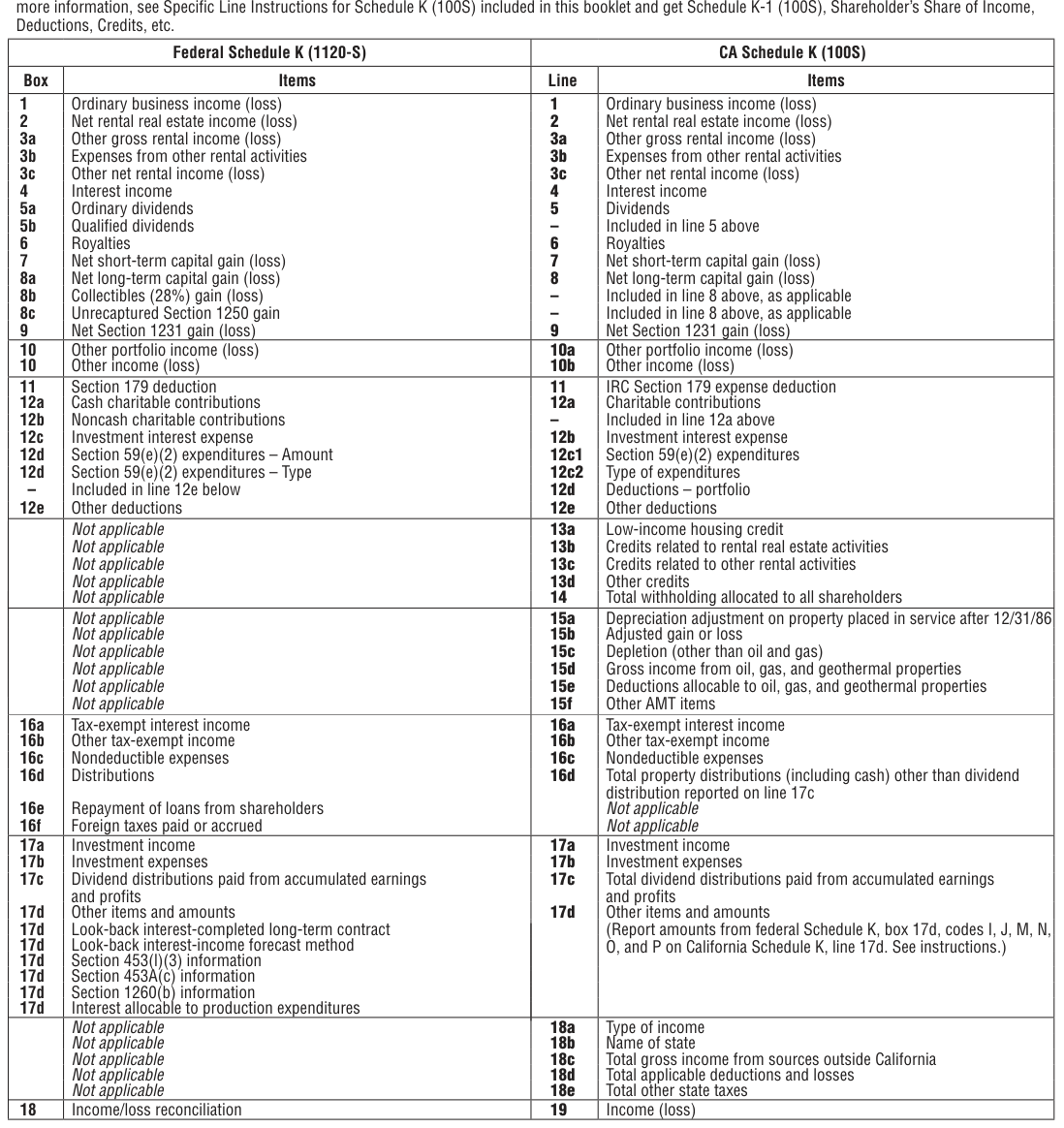
Text version of this table
Federal Schedule K (1120-S) CA Schedule K (100S) Box Items Line Items 1 2 3a 3b 3c 4 5a 5b 6 7 8a 8b 8c 9 Ordinary business income (loss) Net rental real estate income (loss) Other gross rental income (loss) Expenses from other rental activities Other net rental income (loss) Interest income Ordinary dividends Qualified dividends Royalties Net short-term capital gain (loss) Net long-term capital gain (loss) Collectibles (28%) gain (loss) Unrecaptured Section 1250 gain Net Section 1231 gain (loss) 1 2 3a 3b 3c 4 5 – 6 7 8 – – 9 Ordinary business income (loss) Net rental real estate income (loss) Other gross rental income (loss) Expenses from other rental activities Other net rental income (loss) Interest income Dividends Included in line 5 above Royalties Net short-term capital gain (loss) Net long-term capital gain (loss) Included in line 8 above, as applicable Included in line 8 above, as applicable Net Section 1231 gain (loss) 10 10 Other portfolio income (loss) Other income (loss) 10a 10b Other portfolio income (loss) Other income (loss) 11 12a 12b 12c 12d 12d – 12e Section 179 deduction Cash charitable contributions Noncash charitable contributions Investment interest expense Section 59(e)(2) expenditures – Amount Section 59(e)(2) expenditures – Type Included in line 12e below Other deductions 11 12a – 12b 12c1 12c2 12d 12e IRC Section 179 expense deduction Charitable contributions Included in line 12a above Investment interest expense Section 59(e)(2) expenditures Type of expenditures Deductions – portfolio Other deductions Not applicable Not applicable Not applicable Not applicable Not applicable 13a 13b 13c 13d 14 Low-income housing credit Credits related to rental real estate activities Credits related to other rental activities Other credits Total withholding allocated to all shareholders Not applicable Not applicable Not applicable Not applicable Not applicable Not applicable 15a 15b 15c 15d 15e 15f Depreciation adjustment on property placed in service after 12/31/86 Adjusted gain or loss Depletion (other than oil and gas) Gross income from oil, gas, and geothermal properties Deductions allocable to oil, gas, and geothermal properties Other AMT items 16a 16b 16c 16d 16e 16f Tax-exempt interest income Other tax-exempt income Nondeductible expenses Distributions Repayment of loans from shareholders Foreign taxes paid or accrued 16a 16b 16c 16d Tax-exempt interest income Other tax-exempt income Nondeductible expenses Total property distributions (including cash) other than dividend distribution reported on line 17c Not applicable Not applicable 17a 17b 17c 17d 17d 17d 17d 17d 17d 17d Investment income Investment expenses Dividend distributions paid from accumulated earnings and profits Other items and amounts Look-back interest-completed long-term contract Look-back interest-income forecast method Section 453(l)(3) information Section 453A(c) information Section 1260(b) information Interest allocable to production expenditures 17a 17b 17c 17d Investment income Investment expenses Total dividend distributions paid from accumulated earnings and profits Other items and amounts (Report amounts from federal Schedule K, box 17d, codes I, J, M, N, O, and P on California Schedule K, line 17d. See instructions.) Not applicable Not applicable Not applicable Not applicable Not applicable 18a 18b 18c 18d 18e Type of income Name of state Total gross income from sources outside California Total applicable deductions and losses Total other state taxes 18 Income/loss reconciliation 19 Portfolio income (loss)
Enter only taxable interest, dividend, and royalty income that is portfolio income.
Line 7 and Line 8 - Net capital gain (loss) Enter on line 7 and line 8 the amount of capital gains and losses that is portfolio income (loss). If any of the income (loss) is not portfolio income (loss), include it on line 10b.
S corporations should report any net long-term capital gains on California Schedule K and Schedule K-1 (100S), line 8.
Qualified Opportunity Zone Funds.
The TCJA established Opportunity Zones.
IRC Sections 1400Z-1 and 1400Z-2 provide a temporary deferral of inclusion of gross income for capital gains reinvested in a qualified opportunity fund, and exclude capital gains from the sale or exchange of an investment in such funds. California does not conform to the deferral and exclusion of capital gains reinvested or invested in federal opportunity zone funds and has no similar provisions.
If, for California purposes, gains from investment in qualified opportunity zone property had been included in income during previous taxable year, do not include the gain in the current year income.
# Line 9 - Net IRC Section 1231 gain (loss)
The amount for line 9 comes from Schedule D-1. Do not include specially allocated ordinary gains and losses or net gains or losses from involuntary conversions due to casualties or thefts on this line. Instead, report these gains or losses on line 10b.
If the S corporation has more than one activity and the amount on line 9 is a passive activity amount to the shareholder, attach a statement to Schedule K-1 (100S) to identify which activity the IRC Section 1231 gain (loss) relates.
Line 10a - Other portfolio income (loss) Enter any other portfolio income (loss) not entered on lines 4, 5, 6, 7, and 8.
# Line 10b - Other income (loss)
Enter any other item of income or loss not included on line 1 through line 8, line 9 and line 10a, such as:
- Wagering gains and losses. See IRC Section 165(d).
- Recovery of tax benefit items. See IRC Section 111.
- Any gain or loss where the S corporation was a trader or dealer in IRC Section 1256 contracts or property related to such contracts. See IRC Section 1256(f).
- Net gain (loss) from involuntary conversions due to casualty or theft.
- Loss(es) from qualified low-income housing projects for shareholders that are qualified investors.
IRC Section 951A income. California does not conform to IRC Section 951A. If, for federal purposes, the S corporation included global intangible low-taxed income (GILTI) on federal Schedules K and K-1, enter that amount in column (c).
Wildfire Mitigation Payment. California law allows a qualified taxpayer an exclusion from gross income for any amount received as a California qualified wildfire loss mitigation payment through the California Wildfire Mitigation Financial Assistance Program. If any amount was included for federal purposes, exclude that amount for California purposes on Schedules K and K-1 (100S), line 10b, column (c).
Kincade Wildfire Exclusion. California law allows a qualified taxpayer an exclusion from gross income for any qualified amount received in a settlement from PG&E Company or its subsidiary relating to the 2019 Kincade
Fire. If any amount was included for federal purposes, exclude that amount for California purposes on Schedules K and K-1 (100S), line 10b, column (c).
Zogg Wildfire Exclusion. California law allows a qualified taxpayer an exclusion from gross income for any qualified amount received in a settlement from PG&E Company or its subsidiary relating to the 2020 Zogg Fire. If any amount was included for federal purposes, exclude that amount for California purposes on Schedules K and K-1 (100S), line 10b, column (c).
Thomas and Woolsey Wildfires Exclusion.
California law allows a qualified taxpayer an exclusion from gross income for any amount received in settlement from Southern California Edison for claims relating to the 2017 Thomas Fire or the 2018 Woolsey Fire. If any amount was included for federal purposes, exclude that amount for California purposes on Schedules K and K-1 (100S), line 10b, column (c).
Fire Victims Trust Exclusion. California law allows a qualified taxpayer an exclusion from gross income for any amount received from the Fire Victims Trust. If any amount was included for federal purposes, exclude that amount for California purposes on Schedules K and K-1 (100S), line 10b, column (c).
# Turf Replacement Water Conservation
Program. California law allows an exclusion from gross income for any amount received as a rebate, voucher, or other financial incentive issued by a public water system, local government, or state agency for participation in a turf replacement water conservation program. If any amount was included for federal purposes, exclude that amount for California purposes on Schedules K and K-1 (100S), line 10b, column (c).
Small Business and Nonprofit COVID-19
Supplemental Paid Sick Leave Relief
Grant. California law allows an exclusion from gross income for grant allocations received by a taxpayer pursuant to the
California Small Business and Nonprofit
# COVID-19 Supplemental Paid Sick Leave
Relief Grant Program that is established by Section 12100.975 of the Government Code.
If you included an amount qualifying for this exclusion as income for federal purposes, exclude that amount for California purposes on Schedules K and K-1 (100S), line 10b, column (c).
# California Microbusiness COVID-19 Relief
Grant. California law allows an exclusion from gross income for grant allocations received by a taxpayer pursuant to the California Microbusiness COVID-19 Relief Program that is administered by CalOSBA. Federal law has no similar exclusion. Enter the amount of this type of income on Schedules K and K-1 (100S), line 10b, column (c).
California Venues Grant. California law allows an exclusion from gross income for grant allocations received by a taxpayer pursuant to the California Venues Grant Program that is administered by CalOSBA. Federal law has no similar exclusion. Enter the amount of this type of income on Schedules K and K-1 (100S), line 10b, column (c).
Small Business COVID-19 Relief Grant
Program. California allows an exclusion from gross income for grant allocations received by a taxpayer pursuant to the COVID-19
Relief Grant under Executive Order No. E
20/21-182 and the California Small Business COVID-19 Relief Grant Program established by Section 12100.83 of the Government Code.
If the corporation included any amount as income for federal purposes, enter that amount on Schedules K and K-1 (100S), line 10b, column (c).
# Deductions
Line 11 - IRC Section 179 expense deduction The amount of expense deduction for recovery property that can be claimed from all sources will vary depending on the type of property and the year of designation. For more information, see IRC Section 179 and R&TC Section 17201.
Line 12a - Charitable contributions Enter the total amount of charitable contributions made by the S corporation during its taxable year on Schedule K and each shareholder's distributive share on Schedule K-1 (100S). On an attachment to each schedule, separately show the dollar amount and type of contributions.
A resident shareholder is allowed a deduction for charitable contributions to a qualified organization as provided in IRC Section 170.
Do not include any amounts taken into account for the College Access Tax Credit as a charitable contribution on line 12a.
Line 12b - Investment interest expense Complete this line whether or not a shareholder is subject to the investment interest rules.
Include on this line interest paid or accrued to purchase or carry property held for investment.
Property held for investment includes property that produces portfolio income (interest, dividends, annuities, royalties, etc.). Therefore, interest expense allocable to portfolio income should be reported on Schedules K and K-1 (100S), line 12b rather than line 12e.
Investment interest does not include interest expense allocable to a passive activity. A passive activity is a rental activity or a trade or business activity in which the shareholder does not materially participate.
Property held for investment includes a shareholder's interest in a trade or business activity that is not a passive activity to the shareholder and in which the shareholder does not materially participate. An example would be a shareholder's working interest in oil and gas property (i.e., the shareholder's interest is not limited) if the shareholder does not materially participate in the oil and gas activity.
The amount on line 12b will be reflected (after applying the investment interest expense limitations) by individual shareholders on their Schedule CA (540 or 540NR), California Adjustments.
For more information, get form FTB 3526, Investment Interest Expense Deduction.
Line 12c1 - IRC Section 59(e)(2) expenditures (Schedule K-1 (100S) only) Enter the same amount in column (e) as entered in column (d). Refer to the instructions for federal Schedules K and K-1 (1120-S).
Line 12d - Deductions-portfolio Enter on this line the deductions allocable to portfolio income (loss) other than interest expenses. Generally, these deductions are IRC Section 212 expenses and are subject to IRC Section 212 limitations at the shareholder level.
However, interest expense related to portfolio income (loss) is generally investment interest expense and is reported on line 12b.
Line 12e - Other deductions
Include on this line deductions not claimed on any other line. Attach a schedule that clearly shows how each deduction was computed and explain the basis for the deduction.
Financial Incentive for Seismic Improvement.
For taxable years beginning on or after July 1, 2015, California allows an exclusion from gross income for any amount received as a loan forgiveness, grant, credit, rebate, voucher, or other financial incentive issued by the California Residential Mitigation Program or the California Earthquake Authority to assist a residential property owner or occupant with expenses paid, or obligations incurred, for earthquake loss mitigation. If for federal purposes, the S corporation included any amount as income on federal Schedule K and K-1, enter that amount in column (c).
Penalty Assessed by Professional Sports
League. California does not allow a business expense deduction for any fine or penalty paid or incurred by an owner of a professional sports franchise assessed or imposed by the professional sports league that includes that franchise. If for federal purposes, the corporation deducted the fine or penalty on the federal Schedule K and K-1, enter that amount in column (c) as an adjustment because for state purposes, the deduction is not allowed.
# Credits
Line 13a - Low-income housing credit R&TC Section 23610.5 provides that a credit may be claimed by owners of residential rental projects providing low-income housing. The credit is generally effective for buildings placed in service after 1986. If the shareholders are eligible to claim the low-income housing credit, attach a copy of form FTB 3521 Low-Income Housing Credit to Form 100S and to each shareholder's Schedule K-1 (100S), for more information.
Line 13b - Credits related to rental real estate activities Report any information that the shareholder needs to figure credits related to a rental real estate activity other than the low-income housing credit that is included on line 13a. Attach to each shareholder's Schedule K-1 (100S) a schedule showing the amount to be reported and the form on which the amount should be reported.
Line 13c - Credits related to other rental activities Use this line to report information that the shareholder needs to figure credits related to a rental activity other than a rental real estate activity. Attach to each shareholder's Schedule K-1 (100S) a schedule showing the amount to be reported and the form on which the amount should be reported.
Line 13d - Other credits
Enter on an attached schedule each shareholder's allocable share of any credit or credit information reported on Schedule C (100S) that is related to a trade or business activity.
The following are examples of credits that may apply to each shareholder:
- EZ Hiring Credit (get form FTB 3805Z).
- LAMBRA Hiring Credit (get form FTB 3807).
- Manufacturing Enhancement Area (MEA) Hiring Credit (get form FTB 3808)
- TTA Hiring Credit (get form FTB 3809).
- Research Credit (get form FTB 3523).
Pass-Through Entity (PTE) Elective Tax
Credit - The PTE Elective Tax Credit is not a pass-through item, but should still be reported on Schedule K-1 (100S), line 13d and attached schedule.
For a complete list of credits, refer to the Credit Chart.
Line 14 - Withholding on payments to the
S corporation allocated to all shareholders
(Schedule K)
If withholding from payments made to the S corporation are made by another entity, payments withheld on you by this S corporation, or backup withholding, they are allocated to the shareholders by their stock ownership.
Get FTB Pub. 1017, Resident and Nonresident Withholding Guidelines, for more information.
Line 14 - Total withholding (Schedule K-1 (100S)) Line 14 includes withholding from payments made to the S corporation allocated to all shareholders based on their stock ownership and payments withheld on nonresident shareholders. The S corporation must provide each shareholder (including California residents) with a completed Form 592-B.
Shareholders must attach Form 592-B to the front of their California tax return to claim the withholding credit. The Schedule K-1 (100S) is not used for claiming the withholding credit.
# Items
Line 15a through Line 15f
Enter the items of income and deductions that enter into each shareholder's computation of AMT items. A shareholder with AMT items may be required to file Schedule P (540, 540NR, or 541), Alternative Minimum Tax and Credit Limitations.
Get the instructions for federal Schedules K and K-1 (Form 1120-S), Alternative Minimum Tax (AMT) Items, line 15a through line 15f, for more information.
# Basis
Line 16a, Line 16b and Line 16c
Refer to the instructions for federal Schedules K and K-1 (Form 1120-S) for more information.
Line 16d - Total property distributions including cash (Schedule K only) Enter total distributions made to shareholders other than dividends reported on Schedule K, line 17c. Noncash distributions of appreciated property are valued at fair market value. Refer to the instructions for federal Form 1120-S for the ordering rules on distributions.
Line 16d - Total property distributions including cash (Schedule K-1 (100S) only) Report the distribution amount for each shareholder for distributions other than dividends reported on Schedule K-1 (100S), line 17c. Noncash distributions of appreciated property are valued at fair market value. Refer to the instructions for federal Form 1120-S for the ordering rules on distributions.
Line 16e - Repayment of loans from shareholders (Schedule K-1 (100S) only) Report the amount of loan repayments the S corporation has made to each shareholder who has loaned the S corporation money.
# Other Information
Line 17a and Line 17b - Investment income and investment expenses Complete these lines whether or not a shareholder is subject to the investment interest rules.
Enter on line 17a only the investment income included on Schedules K and K-1 (100S), line 4, line 5, line 6, and line 10a. Enter on line 17b only the investment expense included on Schedules K and K-1 (100S), line 12d.
If there are items of investment income or expense included in the amounts that are required to be passed through separately to the shareholder on Schedule K-1 (100S), such as net short-term capital gain or loss, net long-term gain or loss and other portfolio gains or losses, give each shareholder a schedule identifying these amounts. See the instructions for federal Form 1120-S for more information on portfolio income.
Investment income includes gross income from property held for investment, gain attributable to the disposition of property held for investment, and other amounts that are gross portfolio income. Investment income and investment expenses do not include any income or expenses from a passive activity.
Property subject to a net lease is not treated as investment property because it is subject to the passive loss rules. Do not reduce investment income by losses from passive activities.
Investment expenses are deductible expenses (other than interest) directly connected with the production of investment income.
Get form FTB 3526 for more information.
Line 17c - Total dividend distributions
(Schedule K only)
Report the distribution amount made out of prior C corporation years accumulated earnings and profits (E&P). The S corporation should issue a federal Form 1099-DIV, Dividends and Distributions, to each of the shareholders reporting their proportionate distribution amounts.
Line 17c - Total taxable dividend distributions (Schedule K-1 (100S) only) Report the distribution amount for each shareholder that was paid out of prior C corporation years accumulated E&P.
Each shareholder should receive a federal Form 1099-DIV reporting the proportionate distribution amount shown on Schedule K-1 (100S), line 17c.
Line 17d - Other items and amounts
(Schedule K only)
The S corporation may need to report supplemental information separately to each shareholder that is not specifically requested on the Schedule K-1 (100S).
If the S corporation has supplemental information not included in lines 1 through 17b and lines 18a-e, write "See attached" on Line 17d, column (b) and column (d) and provide a schedule with details.
Attach the schedule to the Schedule K showing the computation of those items that must be reported separately to shareholders including any credit recapture reported to shareholders on Schedule K-1 (100S), line 17d.
Shareholders may need to obtain the amount of their proportionate interest of aggregate gross receipts, less returns and allowances, from the S corporation. Alternative minimum taxable income shall not include income, adjustments, and items of tax preference related to any trade or business of a qualified taxpayer who has gross receipts, less returns and allowances, during the taxable year of less than $1 million from all trades or businesses. The S corporation can provide the shareholder's proportionate interest of aggregate gross receipts on Schedule K-1 (100S), line 17d.
For purposes of R&TC Section 17062(b)(4), "gross receipts" means the sum of gross receipts from the production of business income (within the meaning of subdivisions (a) and (c) of R&TC Section 25120) and the gross receipts from the production of nonbusiness income (within the meaning of subdivision
(d) of R&TC Section 25120). For taxable years beginning on or after January 1, 2011, R&TC Section 25120 was amended to add the definition of gross receipts. For a complete definition of "gross receipts," refer to R&TC Section 25120(f), or go to ftb.ca.gov and search for 25120. "Proportionate interest" includes an interest in a pass-through entity.
See R&TC Section 17062, the instructions for federal Schedule K (Form 1120-S), line 17d, and the instructions for Schedule K-1 (100S) for more information.
The gain or loss on property subject to the IRC Section 179 expense deduction recapture should be reported on the Schedule K and Schedule K-1 (100S) as supplemental information as instructed on the federal Form 4797.
The S corporation must provide all of the following information with respect to a disposition of business property if an IRC Section 179 expense deduction was claimed in prior years:
- Description of the property.
- Date the property was acquired and placed in service.
- Date of the sale or other disposition of the property.
- The gross sales price or amount realized.
- The cost or other basis plus the expense of sale (reduced as explained in the instructions for federal Form 4797, line 21).
- The depreciation allowed or allowable, determined as described in the instructions for federal Form 4797, line 22, but excluding the IRC Section 179 expense deduction.
- The IRC Section 179 expense deduction (if any) passed through for the property and the S corporation's taxable year(s) in which the amount was passed through.
- If the disposition is due to a casualty or theft, a statement indicating so, and any additional information needed by the shareholder.
- If the sale was an installment sale made during the S corporation's taxable year, any information the shareholder needs to complete federal Form 6252, Installment Sale Income. The S corporation also must separately report the shareholder's share of all payments received for the property in the following taxable years. (Installment payments received for sales made in prior taxable years should be reported in the same manner used in the prior taxable years). See instructions for federal Form 6252 for more information.
Line 17d - Other information
# (Schedule K-1 (100S) only)
Supplemental Information
The S corporation will provide supplemental information required to be reported to each shareholder on this line. Write "See attached" on Line 17d, column (b) and column (d) and provide a schedule with details.
The gain or loss on property subject to the IRC Section 179 expense deduction recapture should be reported on the Schedule K and Schedule K-1 (100S) as other information as instructed on the federal Form 4797.
The S corporation must provide all of the following information with respect to a disposition of business property if an IRC Section 179 expense deduction was claimed in prior years:
- Date the property was acquired and placed in service.
- Date of the sale or other disposition of the property.
- The shareholder's share of the gross sales price or amount realized.
- The shareholder's share of the cost or other basis plus the expense of sale (reduced as explained in the instructions for federal Form 4797, line 21).
- The shareholder's share of the depreciation allowed or allowable, determined as described in the instructions for federal Form 4797, line 22, but excluding the IRC Section 179 expense deduction.
- The shareholder's share of the IRC Section 179 expense deduction (if any) passed through for the property and the S corporation's taxable year(s) in which the amount was passed through.
- If the disposition is due to a casualty or theft, a statement indicating so, and any additional information needed by the shareholder.
- If the sale was an installment sale made during the S corporation's taxable year, any information the shareholder needs to complete federal Form 6252. The S corporation also must separately report the shareholder's share of all payments received for the property in the following taxable years. (Installment payments received for sales made in prior taxable years should be reported in the same manner used in the prior taxable years.) See instructions for federal Form 6252 for details.
The S corporation should provide an amount showing each shareholder's proportionate interest in the S corporation's aggregate gross receipts, less returns and allowances, on Schedule K-1 (100S), line 17d. See the instructions for Schedule K, line 17d.
Report the credit recapture amount on Schedule K-1(100S), line 17d if the S corporation completed the credit recapture portion of the following forms:
- FTB 3835, State Historic Rehabilitation Tax Credit
- FTB 3531, California Competes Tax Credit -Enter only the recaptured amount used. Get the instructions for form FTB 3531, Part III, Credit Recapture, for more information.
- FTB 3554, New Employment Credit Also, report the credit recapture amount on line 17d if the corporation is subject to recapture of the following:
- Environmental Tax Credit
- Farmworker Housing Credit
Get the instructions for form FTB 3540, Part II, for more information.
Attach a statement showing each of the following:
- Each shareholder's share of business income apportioned to an EZ, LAMBRA, MEA, or TTA.
- Each shareholder's pro-rata share of business capital gain or loss included in 1 above.
# Other State Taxes
Line 18a through Line 18e
Subject to certain conditions, shareholders may claim a credit against their individual tax for net income taxes paid by the S corporation to another state that either taxes the corporation as an S corporation or does not recognize S corporation status. For purposes of this credit, net income taxes include the shareholder's share of taxes on, according to, or measured by income. Enter the name of the other state(s), the income reported to the other state(s), and the amount of tax paid. Attach a copy of the return filed with the other state(s).
Residents are taxable on all their pro-rata share of income and generally receive a credit for taxes paid to other states.
Nonresidents must use the amounts shown in Schedule K-1 (100S), column (e). See R&TC Sections 18001, 18002, 18006 and
Cal. Code Regs., tit. 18 section 18001-1 for more information.
Line 19 and Line 20 (Schedule K-1 (100S) only) The applicable box will be checked if the corporation has more than one activity for at-risk or passive activity purposes. Get the instructions for federal Form 1120-S, under Specific Instructions (Schedules K and K-1), for Line 18 and Line 19, for more information.
# (Schedule K-1 (100S) only)
Table 1 - Enter the shareholder's pro-rata share of nonbusiness income from intangibles.
Because the source of this income must be determined at the shareholder level, do not enter income in this category in column (e).
If the income (loss) for an income item is a mixture of income (loss) in different subclasses (for example, short and long-term capital gain), attach a supplemental schedule providing a breakdown of income in each subclass.
Nonbusiness income is all income other than business income as defined under Table 2.
Table 2 - The S corporation will complete Schedule K-1(100S), Table 2, Items A - C.
In Item A, enter the shareholder's pro-rata share of the S corporation's business income.
The shareholder will then add that income to its own business income and apportion the combined business income.
Business income is defined by Cal. Code Regs., tit. 18 section 25120(a) as income arising in the regular course of the taxpayer's trade or business. Business income includes income from tangible and intangible property if the acquisition, management, and disposition of the property constitutes integral parts of the taxpayer's regular trade or business.
In Item B, enter the shareholder's pro-rata share of nonbusiness income from real and tangible property that is located in California.
Because this income has a California source, this income should also be included on the appropriate line in column (e).
In Item C, enter the shareholder's pro-rata share of the S corporation's payroll, property, and sales factors. The S corporation will complete Schedule K-1(100S), Table 2, Item C to report the shareholder's distributive share of property, payroll and sales total within California.
The shareholders will use Schedule K-1(100S), Table 2, Item C to determine if they meet threshold amounts of California property, payroll, and sales. For more information on the doing business test, see General Information A, Franchise or Income Tax.
Schedule L - Balance Sheet
If the S corporation's total receipts (see top of page 67 for the definition of total receipts) for the taxable year and total assets at the end of the taxable year are less than $250,000, the S corporation is not required to complete Schedule L and Schedule M-1. However, this information must be available in the future upon request.
Schedule M-1 - Reconciliation of Income (Loss) per Books
# With Income (Loss) per Return
Schedule M-1 is used to reconcile the difference between book and tax accounting for an income or expense item. If the S corporation's total receipts for the taxable year and total assets at the end of the taxable year are less than $250,000, the S corporation is not required to complete Schedule L and Schedule M-1. However, this information must be available in the future upon request.
To reconcile the S corporation's income (loss) per books with the income (loss) per the California return, adjustments consistent with California income and franchise tax law must be made to the book income and expenses to compute the California income (loss) on Schedule M-1, line 8. These adjustments will convert book income to the total California income (loss) reflected on line 19, column (d) of Schedule K.
S Corporation With Total Assets of At Least
$10 Million or More but Less Than $50
Million. The IRS allows corporations with at least $10 million but less than $50 million in total assets at tax year end to file Schedule M-1 (Form 1120-S) in place of Schedule M-3 (Form 1120-S), Parts II and III. However, Schedule M-3 (Form 1120-S), Part I, is required for these corporations. For California purposes, the S corporation must complete the California Schedule M-1, and attach either of the following:
- A copy of the federal Schedule M-3 (Form 1120-S) and related attachments to the Form 100S.
- A complete copy of the federal return.
The FTB will accept the federal Schedule M-3 (Form 1120-S) in a spreadsheet format if more convenient.
Schedule M-2 - CA
# Earnings
The computation of the California Accumulated
# Adjustments Account (AAA) and Other
Adjustments Account (OAA) is similar to the federal computation applying California amounts. Get the instructions for federal Form 1120-S and IRC Section 1368 for more information.
Column (a) - The AAA is an account of the S corporation that generally reflects the accumulated undistributed net income of the corporation for the corporation's post-1986 years. S corporations with accumulated E&P from C corporation years must maintain the AAA to determine the tax effect of distributions during S corporation years and the post-termination transition period.
An S corporation without accumulated E&P does not need to maintain the AAA in order to determine the tax effect of distributions. However, if an S corporation without accumulated E&P engages in certain transactions to which IRC Section 381(a) applies, such as a merger into an S corporation with accumulated E&P, the S corporation must be able to calculate its AAA at the time of the merger for purposes of determining the tax effect of post-merger distributions. Therefore, it is recommended that all S corporations maintain the AAA.
At the end of the taxable year, the AAA is determined by taking into account all items of income, loss, and deductions for the taxable year (including nondeductible losses and expenses that are not capitalized but excluding certain exempt income and state taxes attributable to C corporation years). After the year-end income and expense adjustments are made, the account is reduced by distributions made during the taxable year. The AAA should be reduced by the California built-in gains tax amount and the minimum franchise tax.
The amount on Form 100S, Side 1, line 2, should be included as an other addition on Schedule M-2, line 3, and as an other reduction on Schedule M-2, line 5. Also, include any other adjustments to arrive at California income.
The AAA may have a negative balance at year-end as a result of losses or deductions from the S corporation.
Column (b) - The other adjustments account is adjusted for tax-exempt income (and related expenses) of the S corporation. After adjusting for tax-exempt income, the account is reduced for any distributions made during the year.
Column (c) - Other retained earnings include appropriated and unappropriated retained earnings accumulated in prior years when the S corporation was a C corporation. Line 1, column (c) for the first S corporation return will be the sum of the ending balances of appropriated and unappropriated retained earnings for the previous year.
Distributions
Generally, property distributions (including cash) are applied in the following order to reduce accounts of the S corporation that are used to compute the tax effect of distributions made by the S corporation to its shareholders:
- Reduce the AAA determined without regard to any net negative adjustment for the taxable year (but not below zero).
If distributions during the taxable year exceed the AAA at the close of the taxable year determined without regard to any net negative adjustment for the taxable year, the AAA is allocated pro-rata to each distribution made during the taxable year.
See IRC Section 1368(c). The term "net negative adjustment" means the excess, if any, of the reductions in the AAA for the taxable year (other than distributions) over the increases in the AAA for the taxable year.
- Reduce accumulated E&P. Generally, the S corporation has accumulated E&P only if it has not distributed E&P accumulated in prior years when the S corporation was a C corporation, IRC Section 1361(a)(2), or when the S corporation merged with another corporation that has C corporation accumulated E&P. The only adjustments that can be made to the accumulated E&P of an S corporation are both of the following: a. Reductions for dividend distributions. b. Adjustments for redemptions, liquidations, reorganizations, etc.
- Reduce the OAA.
- Reduce any remaining shareholders' equity account.
Shareholders' previously taxed income (PTI) on federal Form 1120-S, Schedule M-2, column (c) - California S corporations will never have undistributed PTI. The federal code section that created PTI was removed from the IRC before California incorporated the federal S corporation provisions into the R&TC.
Elections Relating to the Order of
Distributions
The corporation may modify the ordering rules by making one or more of the following elections:
- Election to distribute accumulated E&P first.
If the corporation has accumulated E&P and wants to distribute E&P before making distributions from the AAA, it may elect to do so with the consent of all its affected shareholders - IRC Section 1368(e)(3)(B).
This election is irrevocable and applies only for the taxable year for which it is made. For more information regarding this election, see "Statement Regarding Elections".
- Election to make a deemed dividend. If the corporation wants to distribute all or part of its C corporation accumulated E&P through a deemed dividend, it may elect to do so with the consent of all its affected shareholders - IRC Section 1368(e)(3)(B).
Under this section, the corporation will be treated as also having made the election to distribute E&P first. The amount of the deemed dividend cannot exceed the accumulated E&P at the end of the taxable year reduced by any actual distributions of accumulated E&P made during the taxable year. A deemed dividend is treated as if it were a pro-rata distribution of money to the shareholders, received by the shareholders, and immediately contributed back to the corporation all on the last day of the taxable year. This election is irrevocable and applies only for the taxable year for which it is made.
# Statement Regarding Elections
To make any elections relating to the order of distribution, the corporation must attach a statement to a timely filed original Form 100S or amended Form 100S for the year in which the election is made. The corporation must identify the election it is making and state that each shareholder consents to the election.
A corporate officer must sign the statement under penalties of perjury on behalf of the corporation. The statement of election to make a deemed dividend must include the amount of the deemed dividend distributed to each shareholder.
When making either of the elections, the corporation must prepare copies of federal Form 1099-DIV for shareholders to report this dividend as taxable income.
The corporation may file the election for California purposes only. It is not necessary for the corporation to have the same election for federal purposes in order to make a California election. However, regardless of whether or not the corporation makes the same election on the federal return, the corporation must attach a separate election statement to the California return.
# C Corporation E&P
If the S corporation was a C corporation in a prior year(s) and has C corporation E&P at the end of the taxable year enter that amount on line 10. For this purpose, C corporation E&P means the remaining balance of E&P of any S corporation for any taxable year when it was not an S corporation. If the S corporation has C corporation E&P, it may be liable for excess net passive income tax and the distributions to shareholders may have different tax consequences for federal and California purposes. See instructions for Form 100S, Side 2, line 27 and line 28, for details on these taxes.
# California S Corporation
TAXABLE YEAR FORM
2024 100S
# Franchise or Income Tax Return
RP
For calendar year 2024 or fiscal year beginning and ending .
(mm/dd/yyyy)
(m m / d d / y y y y) (mm/dd/yyyy) (m m / d d / y y y y) Corporation name California corporation number FEIN Additional information. See instructions. California Secretary of State file number Street address (suite/room no.) PMB no.
City (if the corporation has a foreign address, see instructions.) State ZIP code Foreign country name Foreign province/state/county Foreign postal code
Schedule Q Questions (continued on Side 3)
- □ □ □ □ □
# A 1. FINAL RETURN?
Dissolved Surrendered (withdrawn) Merged/Reorganized IRC Section 338 sale QSub election … • Enter date (mm/dd/yyyy) … • □ □
- Is the S corporation deferring any income from the disposition of assets? Yes No … • If "Yes" enter the year of disposition (yyyy)
- □ • □ • □ • □
- Is the S corporation reporting previously deferred income from: Installment sale IRC §1031 IRC §1033 Other B 1. During this taxable year, did this corporation or any of its subsidiaries acquire control or majority ownership (more than a 50% interest) in another legal entity?
If yes, did the acquired entity(ies) own California real property (i.e., land, buildings), lease such property for a term of 35 . . . ● □ □ Yes No years or more, or lease such property from a government agency for any term? If yes to both questions, answer yes
- During this taxable year, did another person or legal entity acquire control or majority ownership (more than a 50% interest) of this corporation or any of its subsidiaries?
If yes, did the acquired entity(ies) own California real property (i.e., land, buildings), lease such property for a term of 35 years or more, or lease such property from a government agency for any term?
… ● □ □
# Yes No
If yes to both questions, answer yes
- Has California real property (i.e., land, buildings) transferred to the corporation that was excluded from property tax reassessment under Revenue and Taxation Code Section 62(a)(2)?
If yes, during this taxable year, has more than 50% of the voting stock of this corporation cumulatively transferred in one … ● □ □ Yes No or more transactions and it was not reported on a previous year's tax return? If yes to both questions, answer yes (Yes requires filing of BOE-100-B statement, penalties may apply - see instructions.) 1 Ordinary income (loss) from trade or business activities from Schedule F (Form 100S, Side 4), line 22 or federal Form 1120-S, line 22. If Schedule F (Form 100S, Side 4) was not completed, attach federal 1 00 Form 1120-S, page 1, and supporting schedules … ● 2 00 2 Foreign or domestic tax based on income or profits and California franchise or income tax deducted … ●
# State Adjustments
3 00
3 Interest on government obligations … ● 4 00 4 Net capital gain from Schedule D (100S), Section A & Section B. Attach Schedule D (100S). See instructions . . . ● 5 00 5 Depreciation and amortization adjustments. Attach Schedule B (100S) … ● 6 00 6 Portfolio income … ● 7 00 7 Other additions. Attach schedule(s) … ● 8 Total. Add line 1 through line 7 … ● 8 00 3611243 Form 100S 2024 Side 1
State Adjustments (cont.)
9 Dividends received deduction. Attach Schedule H (100S) … ● 9 00
# 10 Water's-edge dividend deduction. Attach Schedule H (100S)
… ● 10 00
… ● 11 00
11 Charitable contributions. See instructions … ● 12 00 12 Other deductions. Attach schedule(s) … ● 13 00 13 Total. Add line 9 through line 12 14 Net income (loss) after state adjustments. Subtract line 13 from Side 1, line 8 … ● 14 00 15 Net income (loss) for state purposes. Use Schedule R if apportioning or allocating income … ● 15 00 16 R&TC Section 23802(e) deduction. See instructions … ● 16 00
# CA Net Income
17 Net operating loss (NOL) deduction. See instructions … ● 17 00 18 EZ, TTA, or LAMBRA NOL carryover deduction. See instructions … ● 18 00 19 Disaster loss deduction. See instructions … ● 19 00 20 Net income for tax purposes. Combine line 16 through line 19. Subtract the result from line 15 … ● 20 00 … ● 21 00 21 Tax. _ % x line 20 (at least minimum franchise tax, if applicable). See instructions 22 Credit name code ● amount … ▶ 22 00 23 Credit name _ code amount … ▶ 23 00 ● 24 To claim more than two credits, see instructions … ● 24 00 25 Add line 22 through line 24. Attach Schedule C (100S) … ● 25 00
Taxes
26 Balance. Subtract line 25 from line 21 (not less than minimum franchise tax plus QSub annual tax(es), if applicable) ● 26 00 … ● 27 00 27 Tax from Schedule D (100S). Attach Schedule D (100S). See instructions 28 Excess net passive income tax. See instructions … ● 28 00 29 Pass-through entity elective tax. See instructions … ● 29 00 30 Total tax. Add line 26 through line 29 … ● 30 00 31 Overpayment from prior year allowed as a credit … ● 31 00 Payments 32 2024 Estimated tax/QSub payments. See instructions … ● 32 00 33 2024 Withholding (Forms 592-B and/or 593). See instructions … ● 33 34 Amount paid with extension of time to file tax return … ● 34 00 35 Amounts paid for pass-through entity elective tax … ● 35 00 36 Total payments. Add line 31 through line 35 … ● 36 00 37 Use tax. This is not a total line. See instructions … ● 37 00 38 Payments balance. If line 36 is more than line 37, subtract line 37 from line 36 … ● 38 00 39 Use tax balance. If line 37 is more than line 36, subtract line 36 from line 37 … ● 39 40 Franchise or income tax due. If line 30 is more than line 38, subtract line 38 from line 30 … ● 40 00
# Refund or Amount Due
41 Overpayment. If line 38 is more than line 30, subtract line 30 from line 38 … ● 41 00 42 Amount of line 41 to be credited to 2025 estimated tax … ● 42 00 43 Refund. Subtract line 42 from line 41 … ● 43 00 See instructions to have the refund directly deposited.
•
Checking
•
Savings
- • •
# 43a. Routing number 43b. Type 43c. Account number
… •
44 a Penalties and interest 44a 00 □ • Check if estimate penalty computed using Exception B or C on form FTB 5806. See instructions. b 45 Total amount due. Add line 39, line 40, line 42, and line 44a. Then, subtract line 41 from the result … 45 00 Side 2 Form 100S 2024 3612243
# Schedule Q Questions (continued from Side 1)
… •
C Principal business activity code. Do not leave blank
Business activity Product or service … ● □ □ D Is this S corporation filing on a water's-edge basis pursuant to R&TC Sections 25110 and 25113 for the current taxable year? Yes No … ● □
E Does this tax return include Qualified Subchapter S Subsidiaries?
•
F Date incorporated (mm/dd/yyyy) Where: State □
# Yes No
Country
… •__
G Maximum number of shareholders in the S corporation at any time during the year. Do not leave blank … • H Date business began in California or date income was first derived from California sources (mm/dd/yyyy) Was the S corporation an inactive business both within and outside of California during the taxable year?
I
… • □
□
Yes No
… • □
J Is the S corporation under audit by the IRS or has it been audited in a prior year? □
Yes No
… •
K Effective date of federal S election (mm/dd/yyyy) … •
# L Accounting method
M Location of principal accounting records □ □ □
(1) Cash (2) Accrual (3) Other
… • __
N "Doing business as'' (DBA) name. See instructions O Have all required information returns (e.g., federal Forms 1099, 8300, and state Forms 592, 592-B etc.) been filed with the … □
Franchise Tax Board?
□ □
# N/A Yes No
… •□
□
P Is this S corporation apportioning or allocating income to California using Schedule R? Yes No . . •□ □ Q Has the S corporation included a reportable transaction or listed transaction within this return? See instructions for definitions If "Yes," complete and attach federal Form 8886, for each transaction.
Yes No
… •□
R Did this S corporation file the federal Schedule M-3 (Form 1120-S)?
□
Yes No
… •□
□
S Is form FTB 3544, Side 2, Part B, List of Assigned Credit Received and/or Claimed by Assignee, attached to the return?
□
(1)
…
Yes No
Aggregated activities for IRC Section 465 at-risk purposes T Check if corporation:
□
(2)
Grouped activities for IRC Section 469 passive activity purposes … •□ □
# Yes No
U (1) Has this business entity previously filed an unclaimed property Holder Remit Report with the State Controller's Office?
- __
◾ _ _
(3) Amount last remitted
(2) If "Yes," when was the last report filed? (mm/dd/yyyy)
Schedule J Add-On Taxes and Recapture of Tax Credits. See instructions 1 LIFO recapture due to S corporation election (IRC Section 1363(d) deferral $ $ .
1 00 )
__ … ●
2 00
2 Interest computed under the look-back method for completed long-term contracts (attach form FTB 3834) . . . ● … ● 3a 00 3 Interest on tax attributable to installment a) Sales of certain timeshares and residential lots … ● 3b 00 b) Method for nondealer installment obligations 4 00 … ●
# 4 IRC Section 197(f)(9)(B)(ii) election
5 00
__ … ●
5 Credit recapture name
6 Combine line 1 through line 5. Revise the amount on Side 2, line 40 or line 41, whichever applies, by this amount. Write "Schedule J'' to the left of line 40 or line 41 … ● 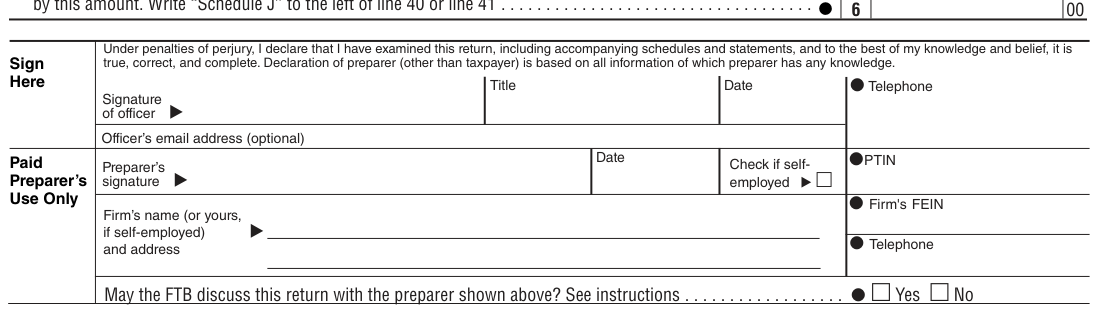
Text version of this table
Sign Here Under penalties of perjury, I declare that I have examined this return, including accompanying schedules and statements, and to the best of my knowledge and belief, it is true, correct, and complete. Declaration of preparer (other than taxpayer) is based on all information of which preparer has any knowledge. • Title Date Telephone Signature of officer ▶ Officer’s email address (optional) Officer's email address (optional) Paid Preparer’s Use Only Preparer's signature Date Check if self- employed ▶ □ • PTIN Firm’s name (or yours, if self-employed) ▶ and address • Firm's FEIN • Telephone May the FTB discuss this return with the preparer shown above? See instructions . . . . . . . . . . . . . . . . . . • □ Yes □ No
# Yes No
Side 3
Schedule F Computation of Trade or Business Income. See instructions.
1 a) Gross receipts or sales ● 1c 00 b) Less returns and allowances
2 Cost of goods sold from Schedule V, line 8 c) Balance
__ …
● 2 00
…
3 Gross profit. Subtract line 2 from line 1c 3 00 …
# Income
4 Net gain (loss). Attach schedule 4 00 … 5 Other income (loss). Attach schedule ● 5 00 … 6 Total income (loss). Combine line 3 through line 5 ● 6 00 … 7 00 … 7 Compensation of officers. Attach schedule. See instructions ● 8 00 … 8 Salaries and wages 9 Repairs and maintenance 9 00 … 10 00 … 10 Bad debts ● 11 00 … 11 Rents 12 Taxes 12 00 … 13 00 … 13 Interest 14 a) Depreciation ● 14c 00 b) Less depreciation reported elsewhere
# Deductions
__ c) Balance
__ …
15 00
…
15 Depletion
16 Advertising
16 00
…
● 17 00
…
17 Pension, profit-sharing plans, etc 18 Employee benefit programs ● 18 00 … b) Deductible amount 19b 00
19 a) Total travel and entertainment … ● 20 00 … 20 Other deductions. Attach schedule 21 Total deductions. Add line 7 through line 20 ● 21 00 … ● 22 Ordinary income (loss) from trade or business. Subtract line 21 from line 6. Enter here and on Side 1, line 1 … 22 00
The corporation may not be required to complete Schedule L and Schedule M-1. See Schedule L and Schedule M-1 instructions for reporting requirements.
Schedule L Balance Sheet Beginning of taxable year End of taxable year (a)
Assets
1 Cash
…
2 a Trade notes and accounts receivable.
…
( b Less allowance for bad debts … 3 Inventories … 4 Federal and state government obligations … 5 Other current assets. Attach schedule(s) … 6 Loans to shareholders. Attach schedule(s) … 7 Mortgage and real estate loans … 8 Other investments. Attach schedule(s) … 9 a Buildings and other fixed depreciable assets … ( b Less accumulated depreciation … 10 a Depletable assets … ( b Less accumulated depletion … 11 Land (net of any amortization) … 12 a Intangible assets (amortizable only) … ( b Less accumulated amortization … 13 Other assets. Attach schedule(s) … 14 Total assets … Liabilities and shareholders' equity 15 Accounts payable … 16 Mortgages, notes, bonds payable in less than 1 year 17 Other current liabilities. Attach schedule(s) … 18 Loans from shareholders. Attach schedule(s) … 19 Mortgages, notes, bonds payable in 1 year or more .
20 Other liabilities. Attach schedule(s) … 21 Capital stock … 22 Paid-in or capital surplus … 23 Retained earnings … 24 Adjustments. Attach schedule(s) … 25 Less cost of treasury stock … 26 Total liabilities and shareholders' equity … Side 4 Form 100S 2024
(b) (c) ) (
● ) (
● ) (
● ) (
●
●
●
●
●
●
●
( )
●
(d)
● )
●
●
●
● ) ● )
● )
●
●
●
●
●
●
●
( )
●
Schedule M-1 Reconciliation of Income (Loss) per Books With Income (Loss) per Return.
If the S corporation completed federal Schedule M-3 (Form 1120-S). See instructions.
… 5 Income recorded on books this year not 1 Net income per books 2 Income included on Schedule K, line 1 through line 10b, not recorded on books this year
(itemize)
__ ●
3 Expenses recorded on books this year not included on Schedule K, line 1 through included on Schedule K, line 1 through line 10b (itemize) a Tax-exempt interest $
__ b Other $
_ c Total. Add line 5a and line 5b … ● 6 Deductions included on Schedule K, line 1 line 12e (itemize) a Depreciation … $ b State taxes … $ c Travel and entertainment $ . . . d Other $ … _ e Total. Add line 3a through line 3d … ● through line 12e, not charged against book income this year (itemize) a Depreciation $
_ b State tax refunds $ _ c Other $ d Total. Add line 6a through line 6c … ● … 7 Total. Add line 5c and line 6d 4 Total. Add line 1 through line 3e … 8 Income (loss) (Schedule K, line 19, col. d).
Subtract line 7 from line 4
… ●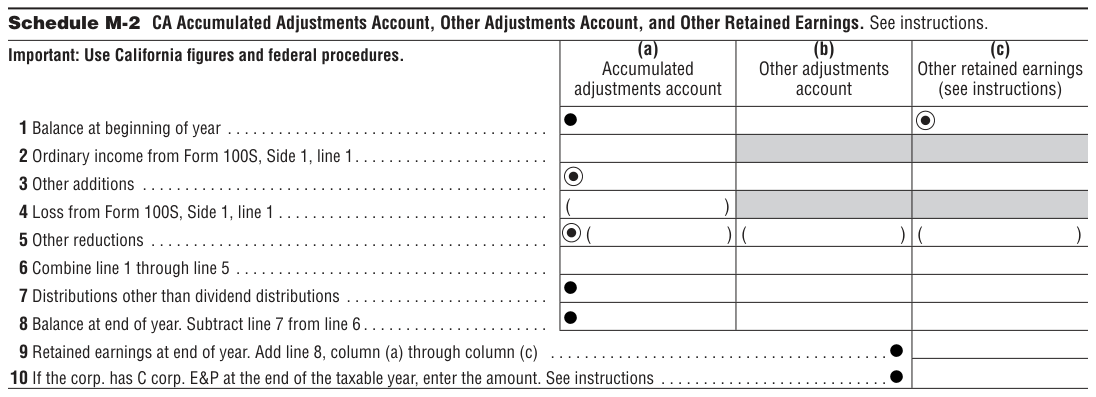
Text version of this table
(a) (b) Important: Use California figures and federal procedures. Accumulated Other adjustments adjustments account account ● 1 Balance at beginning of year . . . . . . . . . . . . . . . . . . . . . . . . . . . . . . . . . . . . . . 2 Ordinary income from Form 100S, Side 1, line 1 . . . . . . . . . . . . . . . . . . . . . . . 3 Other additions . . . . . . . . . . . . . . . . . . . . . . . . . . . . . . . . . . . . . . . . . . . . . . . . 4 Loss from Form 100S, Side 1, line 1 . . . . . . . . . . . . . . . . . . . . . . . . . . . . . . . . ( ) 5 Other reductions . . . . . . . . . . . . . . . . . . . . . . . . . . . . . . . . . . . . . . . . . . . . . . . ( ) ( ) 6 Combine line 1 through line 5 . . . . . . . . . . . . . . . . . . . . . . . . . . . . . . . . . . . . . ● 7 Distributions other than dividend distributions . . . . . . . . . . . . . . . . . . . . . . . . 8 Balance at end of year. Subtract line 7 from line 6 . . . . . . . . . . . . . . . . . . . . . . ● 9 Retained earnings at end of year. Add line 8, column (a) through column (c) . . . . . . . . . . . . . . . . . . . . . . . . . . . . . . . . . . . . . . . . ● 10 If the corp. has C corp. E&P at the end of the taxable year, enter the amount. See instructions . . . . . . . . . . . . . . . . . . . . . . . . . . . ● (a) Accumulated adjustments account (b) Other adjustments account (c) Other retained earnings (see instructions) ● ( ) ( ) ( ) ( ) ● ● 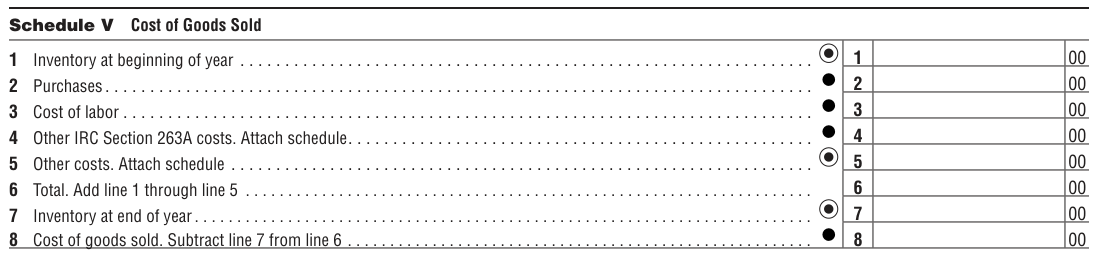
Text version of this table
1 Inventory at beginning of year . . . . . . . . . . . . . . . . . . . . . . . . . . . . . . . . . . . . . . . . . . . . . . . . . . . . . . . . . . . . . . . . 2 Purchases . . . . . . . . . . . . . . . . . . . . . . . . . . . . . . . . . . . . . . . . . . . . . . . . . . . . . . . . . . . . . . . . . . . . . . . . . . . . . . . ● 3 Cost of labor . . . . . . . . . . . . . . . . . . . . . . . . . . . . . . . . . . . . . . . . . . . . . . . . . . . . . . . . . . . . . . . . . . . . . . . . . . . . . ● 4 Other IRC Section 263A costs. Attach schedule . . . . . . . . . . . . . . . . . . . . . . . . . . . . . . . . . . . . . . . . . . . . . . . . . . . . ● 5 Other costs. Attach schedule . . . . . . . . . . . . . . . . . . . . . . . . . . . . . . . . . . . . . . . . . . . . . . . . . . . . . . . . . . . . . . . . . 6 Total. Add line 1 through line 5 . . . . . . . . . . . . . . . . . . . . . . . . . . . . . . . . . . . . . . . . . . . . . . . . . . . . . . . . . . . . . . . . . . . 7 Inventory at end of year . . . . . . . . . . . . . . . . . . . . . . . . . . . . . . . . . . . . . . . . . . . . . . . . . . . . . . . . . . . . . . . . . . . . . . . . . 8 Cost of goods sold. Subtract line 7 from line 6 . . . . . . . . . . . . . . . . . . . . . . . . . . . . . . . . . . . . . . . . . . . . . . . . . . . . . . . ● 1 00 2 00 3 00 4 00 5 00 6 00 7 00 8 00
…
… □ □
Was there any change in determining quantities, costs, or valuations between opening and closing inventory? Yes No … ▶ If "Yes,'' attach an explanation. Enter California seller's permit number, if any … Method of inventory valuation … • □ Check if the LIFO inventory method was adopted this taxable year for any goods. If checked, attach federal Form 970 … • If the LIFO inventory method was used for this taxable year, enter the amount of closing inventory computed under LIFO
Side 5
Schedule K S Corporation Shareholder's Shares of Income, Deductions, Credits, etc.
(a) (b) (c) (d)
Total amounts using
Pro-rata share items Amount from California federal K (112O-S) Adjustment California law 1 Ordinary business income (loss) … 1 ● 2 Net rental real estate income (loss). Attach federal Form 8825 … 2 ● 3 a Other gross rental income (loss) … 3a b Expenses from other rental activities. Attach schedule … 3b Income (Loss) c Other net rental income (loss). Subtract line 3b from line 3a … 3c ● 4 Interest income … 4 ● 5 Dividends. See instructions … 5 ● 6 Royalties … 6 ● 7 Net short-term capital gain (loss). Attach Schedule D (100S) … 7 ● 8 Net long-term capital gain (loss). Attach Schedule D (100S) … 8 ● 9 Net IRC Section 1231 gain (loss) … 9 ●
# Income
Other
(Loss) 10 a Other portfolio income (loss). Attach schedule … 10a ● b Other income (loss). Attach schedule … 10b ● 11 IRC Section 179 expense deduction. Attach Schedule B (100S) . … 11 12 a Charitable contributions … 12a ● Deductions b Investment interest expense … 12b ● c 1 IRC Section 59(e)(2) expenditures … 12c1 2 Type of expenditures __ 12c2 d Deductions-portfolio. Attach schedule … 12d ● e Other deductions. Attach schedule … 12e 13 a Low-income housing credit. See instructions … 13a ● b Credits related to rental real estate activities. Attach schedule … 13b ● Credits c Credits related to other rental activities. See instructions. Attach schedule . . 13c ● d Other credits. Attach schedule … 13d ● 14 Total withholding allocated to all shareholders … 14 Alternative Minimum 15 a Depreciation adjustment on property placed in service after 12/31/86 … 15a Tax (AMT) Items b Adjusted gain or loss. See instructions … 15b c Depletion (other than oil and gas) … 15c d Gross income from oil, gas, and geothermal properties … 15d e Deductions allocable to oil, gas, and geothermal properties … 15e f Other AMT items … 15f
Shareholder Basis
16 a Tax-exempt interest income … 16a Items Affecting b Other tax-exempt income … 16b ● c Nondeductible expenses … 16c d Total property distributions (including cash) other than dividends distribution reported on line 17c … 16d ● 17 a Investment income. See instructions … 17a Information b Investment expenses. See instructions … 17b Other c Total dividend distributions paid from accumulated earnings and profits . . . 17c ● d Other items and amounts not included in lines 1 - 17b and lines 18a-e that are required to be reported separately to shareholders. Attach schedule 17d ● 18 a Type of income 18a State Taxes b Name of state 18b Other c Total gross income from sources outside California. Attach schedule … 18c d Total applicable deductions and losses. Attach schedule … 18d □ □ e Total other state taxes. Check one: Paid Accrued . . … 18e ● 19 Income (loss) (required only if Schedule M-1 must be completed). ciliation -
Recon
Combine line 1, line 2, and line 3c through line 10b. From the result, subtract the sum of lines 11, 12a, 12b, 12c1, 12d and 12e … 19 ● Side 6 Form 100S 2024 3616243
# Credit Chart
Credit Chart - Continued
Repealed Credits with Carryover or Recapture Provisions: The expiration dates for the credits listed below have passed. However, these credits had carryover or recapture provisions. The corporation may claim these credits if there is a carryover available from prior years. Get form FTB 3540, to figure the credit carryover to future years. For EZ, LAMBRA, MEA, or TTA carryovers, get form FTB 3805Z, form FTB 3807, form FTB 3808, or form FTB 3809.
Agricultural Products … 175
Commercial Solar Electric System … 196 Commercial Solar Energy … 181 Contribution of Computer Software … 202 Donated Fresh Fruits or Vegetables … Employer Childcare Contribution … 190 Employer Childcare Program … 189 Employer Ridesharing - Large employer … 191 Employer Ridesharing - Small employer … 192 Employer Ridesharing - Transit passes … 193 Energy Conservation … 182 Enhanced Oil Recovery … 203 Orphan Drug … 185 Enterprise Zone Hiring … 176 Enterprise Zone Sales or Use Tax Recycling Equipment … 174 … 176 Ridesharing … 171 Environmental Tax … 218 Salmon & Steelhead Trout Habitat Farmworker Housing - Construction … 207 Restoration … 200 Local Agency Military Base Recovery Area Hiring … 198 Solar Energy … 180 Local Agency Military Base Recovery Solar Pump … 179 Area Sales or Use Tax … 198 Targeted Tax Area Hiring … 210 Low-Emission Vehicles … 160 Targeted Tax Area Sales or Use Tax … 210 Main Street Small Business Tax … 240 Technology Property Contributions … 201 Main Street Small Business Tax II … 241 Manufacturing Enhancement Area Hiring … 211
# Schedule K Federal/State Line References
The following chart cross-references the line items on the federal Schedule K (1120-S) to the appropriate line items on the California Schedule K (100S). For more information, see Specific Line Instructions for Schedule K (100S) included in this booklet and get Schedule K-1 (100S), Shareholder's Share of Income, Deductions, Credits, etc.
Federal Schedule K (1120-S)
Box Items
1 Ordinary business income (loss) 2 Net rental real estate income (loss) 3a Other gross rental income (loss) 3b Expenses from other rental activities 3c Other net rental income (loss) 4 Interest income 5a Ordinary dividends 5b Qualified dividends 6 Royalties 7 Net short-term capital gain (loss) 8a Net long-term capital gain (loss) 8b Collectibles (28%) gain (loss) 8c Unrecaptured Section 1250 gain 9 Net Section 1231 gain (loss) 10 Other portfolio income (loss) 10 Other income (loss) 11 Section 179 deduction 12a Cash charitable contributions 12b Noncash charitable contributions 12c Investment interest expense 12d Section 59(e)(2) expenditures - Amount 12d Section 59(e)(2) expenditures - Type
- Included in line 12e below 12e Other deductions
# Items
# Principal Business Activity Codes
This list of principal business activities and their associated codes is designed to classify a business by the type of activity in which it is engaged to facilitate the
Code
Code
315210 Cut & Sew Apparel Contractors 332810 Coating, Engraving, Heat
# Treating, & Allied Activities
315250 Cut & Sew Apparel Mfg (except Contractors) 332900 Other Fabricated Metal administration of the California Revenue and Taxation Code. These principal business activity codes are based on the North American Industry Classification System.
Using the list of activities and codes below, determine from which activity the company derives the largest percentage of its ''total receipts.'' Total receipts is
Product Mfg
315990 Apparel Accessories & Other
Apparel Mfg
Machinery Manufacturing
Leather and Allied Product 333100 Agriculture, Construction, &
# Manufacturing Mining Machinery Mfg
316110 Leather & Hide Tanning & 333200 Industrial Machinery Mfg defined as the sum of gross receipts or sales (Form 100S, Side 4, Schedule F, line 1a) Finishing 333310 Commercial & Service Industry plus all other income (Form 100S, Side 4, Schedule F, lines 4 and 5). If the company 316210 Footwear Mfg (including rubber Machinery Mfg purchases raw materials and supplies them to a subcontractor to produce the finished product, but retains title to the product, the company is considered a manufacturer and must use one of the manufacturing codes (311110-339900).
Once the principal business activity is determined, entries must be made on Form 100S, Question C. For the business activity code number, enter the six-digit code selected from the list below. On the next line enter a brief description of the company's business activity. Finally, enter a description of the principal product or service of the company on the next line.
Agriculture, Forestry, Fishing, Construction and Hunting
Code
Code Construction of Buildings 236110 Residential Building
Crop Production
Construction
111100 Oilseed & Grain Farming 236200 Nonresidential Building 111210 Vegetable & Melon Farming
Construction
(including potatoes & yams)
Heavy and Civil Engineering
111300 Fruit & Tree Nut Farming
Construction
111400 Greenhouse, Nursery, & 237100 Utility System Construction
Floriculture Production
237210 Land Subdivision
111900 Other Crop Farming (including tobacco, cotton, sugarcane, 237310 Highway, Street, & Bridge hay, peanut, sugar beet, & all Construction other crop farming) 237990 Other Heavy & Civil
Engineering Construction
Animal Production
112111 Beef Cattle Ranching & Specialty Trade Contractors Farming 238100 Foundation, Structure, & 112112 Cattle Feedlots & plastics) 333410 Ventilation, Heating, Air-316990 Other Leather & Allied Product Conditioning, & Commercial
Mfg Refrigeration Equipment Mfg 333510 Metalworking Machinery Mfg
Wood Product Manufacturing
333610 Engine, Turbine & Power 321110 Sawmills & Wood Preservation
Transmission Equipment Mfg
321210 Veneer, Plywood, & Engineered 333900 Other General Purpose
Wood Product Mfg
Machinery Mfg
321900 Other Wood Product Mfg
Computer and Electronic Product
Paper Manufacturing
Manufacturing
322100 Pulp, Paper, & Paperboard Mills 334110 Computer & Peripheral 322200 Converted Paper Product Mfg
Equipment Mfg
Printing and Related Support 334200 Communications Equipment
Activities Mfg
323100 Printing & Related Support 334310 Audio & Video Equipment Mfg
Activities
334410 Semiconductor & Other
Electronic Component Mfg
Petroleum and Coal Products
Manufacturing 334500 Navigational, Measuring, Electromedical, & Control 324110 Petroleum Refineries (including
Instruments Mfg integrated)
334610 Manufacturing & Reproducing 324120 Asphalt Paving, Roofing, &
Magnetic & Optical Media
Saturated Materials Mfg
324190 Other Petroleum & Coal Electrical Equipment, Appliance, and
Products Mfg Component Manufacturing 335100 Electric Lighting Equipment
Chemical Manufacturing
Mfg
325100 Basic Chemical Mfg
335200 Household Appliance Mfg 325200 Resin, Synthetic Rubber, & 335310 Electrical Equipment Mfg
Artificial & Synthetic Fibers & Filaments Mfg 335900 Other Electrical Equipment &
Component Mfg
325300 Pesticide, Fertilizer, & Other
Agricultural Chemical Mfg
Transportation Equipment
325410 Pharmaceutical & Medicine
# Building Exterior Contractors Manufacturing
Mfg
(including framing carpentry, 112120 Dairy Cattle & Milk Production masonry, glass, roofing, & 112210 Hog & Pig Farming siding) 112300 Poultry & Egg Production 238210 Electrical Contractors 112400 Sheep & Goat Farming 238220 Plumbing, Heating, & Air-112510 Aquaculture (including shellfish
Conditioning Contractors
& finfish farms & hatcheries) 238290 Other Building Equipment 112900 Other Animal Production Contractors
Forestry and Logging
336100 Motor Vehicle Mfg
325500 Paint, Coating, & Adhesive Mfg 336210 Motor Vehicle Body & Trailer 325600 Soap, Cleaning Compound, & Mfg
Toilet Preparation Mfg
336300 Motor Vehicle Parts Mfg 325900 Other Chemical Product & 336410 Aerospace Product & Parts
# Preparation Mfg
Mfg
Plastics and Rubber Products 336510 Railroad Rolling Stock Mfg Manufacturing 336610 Ship & Boat Building 238300 Building Finishing Contractors 113110 Timber Tract Operations 326100 Plastics Product Mfg 336990 Other Transportation (including drywall, insulation, 113210 Forest Nurseries & Gathering 326200 Rubber Product Mfg Equipment Mfg painting, wallcovering, flooring, of Forest Products tile, & finish carpentry) 113310 Logging 238900 Other Specialty Trade Contractors (including site
Fishing, Hunting and Trapping preparation) 114110 Fishing 114210 Hunting & Trapping
Manufacturing
Support Activities for Agriculture and
Food Manufacturing
Forestry
311110 Animal Food Mfg
115110 Support Activities for Crop 311200 Grain & Oilseed Milling Production (including cotton
Nonmetallic Mineral Product Furniture and Related Product
# Manufacturing
337000 Furniture & Related Product 327100 Clay Product & Refractory Mfg
Manufacturing
327210 Glass & Glass Product Mfg 327300 Cement & Concrete Product Miscellaneous Manufacturing Mfg 339110 Medical Equipment & Supplies 327400 Lime & Gypsum Product Mfg Mfg 327900 Other Nonmetallic Mineral 339900 Other Miscellaneous
Product Mfg Manufacturing
Primary Metal Manufacturing
Sugar & Confectionery Product ginning, soil preparation, Mfg planting, & cultivating)
Wholesale Trade
331110 Iron & Steel Mills & Ferroalloy Mfg
Fruit & Vegetable Preserving & 115210 Support Activities for Animal
Specialty Food Mfg
Production (including farriers) 311500 Dairy Product Mfg 115310 Support Activities for Forestry 311610 Animal Slaughtering and
Mining Processing
Merchant Wholesalers, Durable Goods
331200 Steel Product Mfg from 423100 Motor Vehicle & Motor Vehicle
Purchased Steel Parts & Supplies 331310 Alumina & Aluminum 423200 Furniture & Home Furnishings
Production & Processing
423300 Lumber & Other Construction 331400 Nonferrous Metal (except
Seafood Product Preparation & 211120 Crude Petroleum Extraction Packaging 211130 Natural Gas Extraction Materials
Aluminum) Production &
423400 Professional & Commercial Processing
Bakeries, Tortilla & Dry Pasta 212110 Coal Mining Mfg 212200 Metal Ore Mining 311900 Other Food Mfg (including 212310 Stone Mining & Quarrying coffee, tea, flavorings, & 212320 Sand, Gravel, Clay, & Ceramic seasonings)
& Refractory Minerals Mining &
Beverage and Tobacco Product
Quarrying
Manufacturing
212390 Other Nonmetallic Mineral 312110 Soft Drink & Ice Mfg
Mining & Quarrying
312120 Breweries
213110 Support Activities for Mining 312130 Wineries
Utilities
312140 Distilleries
221100 Electric Power Generation, 312200 Tobacco Manufacturing
Transmission & Distribution
Equipment & Supplies
331500 Foundries
423500 Metal & Mineral (except Petroleum)
Fabricated Metal Product
Manufacturing 423600 Household Appliances and
Electrical & Electronic Goods 332110 Forging & Stamping 423700 Hardware, Plumbing, & Heating 332210 Cutlery & Handtool Mfg
Equipment & Supplies
332300 Architectural & Structural 423800 Machinery, Equipment, &
Metals Mfg
Supplies
332400 Boiler, Tank, & Shipping 423910 Sporting & Recreational Goods
Container Mfg
& Supplies
332510 Hardware Mfg
423920 Toy & Hobby Goods & Supplies 332610 Spring & Wire Product Mfg 423930 Recyclable Materials 332700 Machine Shops; Turned
Textile Mills and Textile Product Mills
221210 Natural Gas Distribution 313000 Textile Mills 221300 Water, Sewage & Other 314000 Textile Product Mills -Systems
Apparel Manufacturing
221500 Combination Gas & Electric 315100 Apparel Knitting Mills 423940 Jewelry, Watch, Precious
Product; & Screw, Nut, & Bolt
Stone, & Precious Metals
Mfg
423990 Other Miscellaneous Durable
Goods
Gasoline Stations & Fuel Dealers
# Merchant Wholesalers, Nondurable
Goods 457100 Gasoline Stations (including convenience stores with gas) 424100 Paper & Paper Products
Code
Code
Support Activities for Transportation 523160 Commodity Contracts
Intermediation
488100 Support Activities for Air Transportation 523210 Securities & Commodity Exchanges 457210 Fuel Dealers (including Heating 424210 Drugs & Druggists' Sundries
Oil & Liquefied Petroleum)
424300 Apparel, Piece Goods, & Notions
# Clothing and Accessories Retailers
424400 Grocery & Related Products 458110 Clothing and Clothing 424500 Farm Product Raw Materials Accessories Retailers 424600 Chemical & Allied Products 458210 Shoe Retailers 424700 Petroleum & Petroleum 458310 Jewelry Retailers Products 458320 Luggage & Leather Goods 424800 Beer, Wine, & Distilled Alcoholic Retailers Beverages
Sporting, Hobby, Book, Musical
424910 Farm Supplies
# Instrument and Miscellaneous
424920 Book, Periodical, &
Retailers
-
Newspapers
459110 Sporting Goods Retailers 424930 Flower, Nursery Stock, & 488210 Support Activities for Rail Transportation 523900 Other Financial Investment Activities (including portfolio 488300 Support Activities for Water management & investment Transportation advice) 488410 Motor Vehicle Towing
Insurance Carriers and Related
488490 Other Support Activities for
Activities
Road Transportation
524110 Direct Life, Health, & Medical 488510 Freight Transportation
Insurance Carriers
Arrangement
524120 Direct Insurance & (except Life, 488990 Other Support Activities for
Health, & Medical) Carriers
Transportation
524210 Insurance Agencies &
Couriers and Messengers
Brokerages
492110 Couriers & Express Delivery 524290 Other Insurance Related
Services
459120 Hobby, Toy, & Game Retailers
Florists' Supplies
Activities (including third-party 492210 Local Messengers & Local 459130 Sewing, Needlework, & Piece 424940 Tobacco Products & Electronic
Goods Retailers
Cigarettes administration of insurance & Delivery pension funds)
Warehousing and Storage
459140 Musical Instrument & Supplies 424950 Paint, Varnish, & Supplies
Retailers
424990 Other Miscellaneous
Funds, Trusts, and Other Financial
493100 Warehousing & Storage (except Vehicles lessors of miniwarehouses & 459210 Book Retailers & News Dealers
Nondurable Goods
(including newsstands)
Wholesale Trade Agents and Brokers 459310 Florists 425120 Wholesale Trade Agents & 459410 Office Supplies & Stationery
Brokers Retailers
459420 Gift, Novelty, & Souvenir
Retail Trade
Retailers
459510 Used Merchandise Retailers
Motor Vehicle and Parts Dealers
459910 Pet & Pet Supplies Retailers 441110 New Car Dealers 459920 Art Dealers 441120 Used Car Dealers 525100 Insurance & Employee Benefit self-storage units) Funds 525910 Open-End Investment Funds
Information
(Form 1120-RIC)
Motion Picture and Sound Recording
525920 Trusts, Estates, & Agency
Industries
Accounts
512100 Motion Picture & Video 525990 Other Financial Vehicles Industries (except video rental) (including mortgage REITs & 512200 Sound Recording Industries closed-end investment funds)
"Offices of Bank Holding
# Publishing Industries
459930 Manufactured (Mobile) Home 441210 Recreational Vehicle Dealers Dealers 441222 Boat Dealers 459990 All Other Miscellaneous 441227 Motorcycle, ATV, and All Other Retailers (including tobacco, Motor Vehicle Dealers candle, & trophy retailers) 441300 Automotive Parts, Accessories,
Nonstore Retailers
# & Tire Retailers
Nonstore retailers sell all types of Building Material and Garden merchandise using such methods Equipment and Supplies Dealers as Internet, mail-order catalogs, 444110 Home Centers interactive television, or direct sales.
444120 Paint & Wallpaper Retailers These types of Retailers should select 444140 Hardware Retailers the PBA associated with their primary 444180 Other Building Material Dealers line of products sold. For example, establishments primarily selling 444200 Lawn & Garden Equipment & Companies" and "Offices of 513110 Newspaper Publishers
Other Holding Companies" are 513120 Periodical Publishers located under Management 513130 Book Publishers of Companies (Holding 513140 Directory & Mailing List
Companies)
Publishers
Real Estate and Rental and
513190 Other Publishers
513210 Software Publishers Leasing
Broadcasting, Content Providers, and
Real Estate
Telecommunications
531110 Lessors of Residential 516100 Radio & Television
Buildings & Dwellings
Broadcasting Stations
(including equity REITs)
516210 Media Streaming, Social 531120 Lessors of Nonresidential
Networks, & Other Content
Buildings (except prescription and non-prescription drugs, Supplies Retailers Providers Miniwarehouses) (including select PBA code 456110 Pharmacies &
Food and Beverage Retailers
Drug Retailers.
445110 Supermarkets & Other Grocery Retailers (except Convenience)
Transportation and
445131 Convenience Retailers
Warehousing
445132 Vending Machine Operators
# Air, Rail, and Water Transportation
445230 Fruit & Vegetable Retailers 481000 Air Transportation 445240 Meat Retailers 482110 Rail Transportation 445250 Fish & Seafood Retailers 483000 Water Transportation 445291 Baked Goods Retailers 445292 Confectionery & Nut Retailers Truck Transportation 445298 All Other Specialty Food 517000 Telecommunications (including equity REITs)
Wired, Wireless, Satellite, Cable 531130 Lessors of Miniwarehouses & & Other Program Distribution, Self-Storage Units (including
Resellers, Agents, Other equity REITs)
Telecommunications, & Internet 531190 Lessors of Other Real Estate
Service Providers)
Property (including equity
Data Processing, Web Search Portals, REITs)
& Other Information Services
531210 Offices of Real Estate Agents & 518210 Computing Infrastructure Brokers Providers, Data Processing, 531310 Real Estate Property Managers
Web Hosting & Related
531320 Offices of Real Estate Appraisers
Services
General Freight Trucking, Local
Retailers
531390 Other Activities Related to Real 519200 Web Search Portals, Libraries, 484120 General Freight Trucking, Long-445320 Beer, Wine, & Liquor Retailers distance 484200 Specialized Freight Trucking
Furniture and Home Furnishings
Retailers
Transit and Ground Passenger
449110 Furniture Retailers Transportation 449121 Floor Covering Retailers 485110 Urban Transit Systems 449122 Window Treatment Retailers 485210 Interurban & Rural Bus 449129 All Other Home Furnishings Transportation
Retailers
Estate
Archives, & Other Info. Services
Rental and Leasing Services
Finance and Insurance 532100 Automotive Equipment Rental
& Leasing
Depository Credit Intermediation
532210 Consumer Electronics & 522110 Commercial Banking
Appliances Rental
522130 Credit Unions
532281 Formal Wear & Costume Rental 522180 Savings Institutions & 532282 Video Tape & Disc Rental
Other Depository Credit
485310 Taxi and Ridesharing Services 485320 Limousine Service
Electronics and Appliance Retailers
485410 School & Employee Bus 449210 Electronics & Appliance
Transportation
Retailers (including Computers) 485510 Charter Bus Industry
General Merchandise Retailers
485990 Other Transit & Ground 455110 Department Stores
Passenger Transportation
455210 Warehouse Clubs,
Pipeline Transportation
Supercenters, & Other General Merch. Retailers 486000 Pipeline Transportation
Health and Personal Care Retailers Scenic & Sightseeing Transportation 456110 Pharmacies & Drug Retailers 487000 Scenic & Sightseeing
Transportation
456120 Cosmetics, Beauty Supplies, &
Perfume Retailers
456130 Optical Goods Retailers 456190 Other Health & Personal Care
Retailers
532283 Home Health Equipment Rental
Intermediation
532284 Recreational Goods Rental
# Nondepository Credit Intermediation
532289 All Other Consumer Goods 522210 Credit Card Issuing Rental 522220 Sales Financing 532310 General Rental Centers 522291 Consumer Lending 532400 Commercial & Industrial 522292 Real Estate Credit (including Machinery & Equipment Rental mortgage bankers & & Leasing originators)
Lessors of Nonfinancial Intangible
522299 Intl, Secondary Market, &
Assets (except copyrighted works)
Other Nondepos. Credit
533110 Lessors of Nonfinancial
Intermediation
Intangible Assets (except
Activities Related to Credit copyrighted works)
Intermediation
Professional, Scientific, and
522300 Activities Related to Credit Intermediation (including loan Technical Services brokers, check clearing, & Legal Services money transmitting) 541110 Offices of Lawyers
Securities, Commodity Contracts,
541190 Other Legal Services and Other Financial Investments and
Related Activities
523150 Investment Banking &
Securities Intermediation
Form 100S Booklet 2024 Page 39
Code Code
Accounting, Tax Preparation, 561500 Travel Arrangement &
Bookkeeping, and Payroll Services Reservation Services 541211 Offices of Certified Public 561600 Investigation & Security
Accountants Services
541213 Tax Preparation Services
Code
Code
Food Services and Drinking Places
# Other Ambulatory Health Care
Services 722300 Special Food Services (including food service 621900 Other Ambulatory Health Care contractors & caterers) Services (including ambulance 722410 Drinking Places (Alcoholic services & blood & organ 561710 Exterminating & Pest Control
Services
541214 Payroll Services
561720 Janitorial Services
541219 Other Accounting Services 561730 Landscaping Services
Architectural, Engineering, and
Beverages) banks)
722511 Full Service Restaurants
Hospitals
722513 Limited Service Restaurants 622000 Hospitals 722514 Cafeterias, Grill Buffets, and
Carpet & Upholstery Cleaning
Related Services
Services
541310 Architectural Services
Nursing and Residential Care
Buffets
Facilities
722515 Snack and Non-alcoholic 561790 Other Services to Buildings & 541320 Landscape Architecture Dwellings
Services
561900 Other Support Services 541330 Engineering Services 623000 Nursing & Residential Care
Beverage Bars
Facilities
Other Services
Social Assistance
(including packaging & labeling 541340 Drafting Services 624100 Individual & Family Services services, & convention & trade 541350 Building Inspection Services show organizers) 541360 Geophysical Surveying &
Repair and Maintenance
624200 Community Food & Housing, 811110 Automotive Mechanical
& Emergency & Other Relief
Waste Management and Remediation
Mapping Services
Services
541370 Surveying & Mapping (except 562000 Waste Management &
Geophysical) Services
Remediation Services
541380 Testing Laboratories & Services
Educational Services
Specialized Design Services
611000 Educational Services
541400 Specialized Design Services
& Electrical Repair &
Services
Maintenance
624310 Vocational Rehabilitation 811120 Automotive Body, Paint, Interior,
Services
# & Glass Repair
624410 Childcare Services
811190 Other Automotive Repair & Maintenance (including oil Arts, Entertainment, and change & lubrication shops & Recreation car washes) (including schools, colleges, & (including interior, industrial, universities) graphic, & fashion design)
Computer Systems Design and
Health Care and Social
Related Services
Assistance
541511 Custom Computer Programming Services
Offices of Physicians and Dentists
541512 Computer Systems Design 811210 Electronic & Precision Performing Arts, Spectator Sports, Equipment Repair & and Related Industries Maintenance 711100 Performing Arts Companies 811310 Commercial & Industrial 711210 Spectator Sports (including Machinery & Equipment sports clubs & racetracks) (except Automotive & 711300 Promoters of Performing Arts, Offices of Physicians (except Services mental health specialists) 541513 Computer Facilities
Electronic) Repair &
Sports, & Similar Events
Maintenance
711410 Agents & Managers for Artists, Offices of Physicians, Mental
Management Services Health Specialists 541519 Other Computer Related 621210 Offices of Dentists
Services
811410 Home & Garden Equipment
Athletes, Entertainers, & Other
& Appliance Repair &
Public Figures
-
Maintenance
711510 Independent Artists, Writers, & 811420 Reupholstery & Furniture
Offices of Other Health Practitioners
Other Professional, Scientific, and
621310 Offices of Chiropractors
Technical Services
621320 Offices of Optometrists 541600 Management, Scientific, & 621330 Offices of Mental Health
Technical Consulting Services
Practitioners (except
541700 Scientific Research & Physicians)
Development Services
621340 Offices of Physical,
541800 Advertising, Public Relations, &
Occupational & Speech
Related Services
Therapists, & Audiologists
541910 Marketing Research & Public 621391 Offices of Podiatrists
Opinion Polling
621399 Offices of All Other
541920 Photographic Services
Miscellaneous Health
541930 Translation & Interpretation Practitioners
Services
Outpatient Care Centers
541940 Veterinary Services
621410 Family Planning Centers 541990 All Other Professional, 621420 Outpatient Mental Health &
Scientific, & Technical Services
Substance Abuse Centers
621491 HMO Medical Centers
Management of Companies
621492 Kidney Dialysis Centers
(Holding Companies)
621493 Freestanding Ambulatory 551111 Offices of Bank Holding Performers Repair Museums, Historical Sites, and Similar 811430 Footwear & Leather Goods
Institutions Repair
712100 Museums, Historical Sites, & 811490 Other Personal & Household
Similar Institutions Goods Repair & Maintenance
Amusement, Gambling, and Personal and Laundry Services
Recreation Industries
812111 Barber Shops
713100 Amusement Parks & Arcades 812112 Beauty Salons 713200 Gambling Industries 812113 Nail Salons 713900 Other Amusement & 812190 Other Personal Care Services
Recreation Industries (including (including diet & weight golf courses, skiing facilities, reducing centers) marinas, fitness centers, & 812210 Funeral Homes & Funeral bowling centers)
Services
812220 Cemeteries & Crematories
Accommodation and Food
812310 Coin-Operated Laundries &
Services
Drycleaners
Accommodation 812320 Drycleaning & Laundry Services (except Coin-721110 Hotels (except Casino Hotels) & Operated) Motels
Surgical & Emergency Centers Companies 621498 All Other Outpatient Care 551112 Offices of Other Holding Centers Companies 812330 Linen & Uniform Supply 721120 Casino Hotels 812910 Pet Care (except Veterinary) 721191 Bed & Breakfast Inns
Services
721199 All Other Traveler
Medical and Diagnostic Laboratories
621510 Medical & Diagnostic
Administrative and Support
Laboratories and Waste Management and
Home Health Care Services
Remediation Services
621610 Home Health Care Services
# Administrative and Support Services
561110 Office Administrative Services 561210 Facilities Support Services 561300 Employment Services 561410 Document Preparation Services 561420 Telephone Call Centers 561430 Business Service Centers (including private mail centers & copy shops) 561440 Collection Agencies 561450 Credit Bureaus 561490 Other Business Support Services (including repossession services, court reporting, & stenotype services) 812920 Photofinishing -
Accommodation
812930 Parking Lots & Garages 721210 RV (Recreational Vehicle) Parks & Recreational Camps 812990 All Other Personal Services 721310 Rooming & Boarding Houses Religious, Grantmaking, Civic, Dormitories, & Workers' Camps
Professional, and Similar
Organizations
813000 Religious, Grantmaking, Civic, Professional, & Similar Organizations (including condominium and homeowners associations)
Other
999000 Unclassified Establishments (Unable to classify)
# Where To Get Tax Forms and Publications
By Internet - You can download, view, and print California tax forms, instructions, publications, FTB Notices, and FTB Legal Rulings at ftb.ca.gov.
By phone - You can order current year California tax forms from 6 a.m. to 10 p.m. weekdays, 6 a.m. to 4:30 p.m. Saturdays, except holidays.
Refer to the list in the right column and find the code for the form you want to order. Call 800.338.0505 and follow the recorded instructions.
Allow two weeks to receive your order. If you live outside California, allow three weeks to receive your order.
By mail - Write to:
TAX FORMS REQUEST UNIT MS D120 FRANCHISE TAX BOARD PO BOX 307 RANCHO CORDOVA CA 95741-0307
# Letters
If you write to us, be sure to include your California corporation number or federal employer identification number, your daytime and evening telephone numbers, and a copy of the notice with your letter. Send your letter to:
FRANCHISE TAX BOARD
PO BOX 942857
SACRAMENTO CA 94257-0500
We will respond to your letter within ten weeks. In some cases, we may need to call you for additional information. Do not attach correspondence to your tax return unless the correspondence relates to an item on the return.
# General Phone Service
Telephone assistance is available year-round from 8 a.m. until 5 p.m.
Monday through Friday, except holidays. Hours subject to change.
Telephone: 800.852.5711 from within the United States 916.845.6500 from outside the United States
# California
Relay
Service: 711 or 800.735.2929 for persons with hearing or speaking limitations IRS: 800.829.4933 call the IRS for federal tax questions
Asistencia En Español
Asistencia telefónica está disponible durante todo el año desde las 8 a.m. hasta las 5 p.m. de lunes a viernes, excepto días feriados. Las horas están sujetas a cambios.
Teléfono: 800.852.5711 dentro de los Estados Unidos 916.845.6500 fuera de los Estados Unidos Servicio de Retransmisión de California: 711 o 800.735.2929 para personas con limitaciones auditivas o del habla IRS: 800.829.4933 para preguntas sobre impuestos federales
# California Tax Forms and Publications
817 California Corporation Tax Booklet: Form 100, California Corporation Franchise or Income Tax Return 816 California S Corporation Tax Booklet: Form 100S, California S Corporation Franchise or Income Tax Return 814 Form 109, California Exempt Organization Business Income Tax Booklet 818 Form 100-ES, Corporation Estimated Tax 815 Form 199, California Exempt Organization Annual Information Return and Instructions 802 FTB 3500, Exemption Application 831 FTB 3500A, Submission of Exemption Request 943 FTB 4058, California Taxpayers' Bill of Rights - Information for Taxpayers 948 FTB 1131 EN-SP, Franchise Tax Board Privacy Notice on Collection - Aviso de Privacidad del Franchise Tax Board sobre la Recaudacion
# Your Rights As A Taxpayer
The FTB's goals include making certain that your rights are protected so that you have the highest confidence in the integrity, efficiency, and fairness of our state tax system. For more information, get FTB 4058, California Taxpayers' Bill of Rights - Information for Taxpayers.
See "Where To Get Tax Forms and Publications," on this page.
# Collection
Our privacy notice can be found in annual tax booklets or online. Go to ftb.ca.gov/privacy to learn about our privacy policy statement, or go to ftb.ca.gov/forms and search for 1131 to locate FTB 1131 EN-SP, Franchise Tax Board Privacy Notice on Collection - Aviso de Privacidad del Franchise Tax Board sobre la Recaudación. To request this notice by mail, call 800.338.0505 and enter form code 948 when instructed.
Form 100S Booklet 2024 Page 41
- Automated Phone Service
Use our automated phone service to get recorded answers to many of your questions about California taxes and to order current year California business entity tax forms and publications. This service is available in English and Spanish to callers with touch-tone telephones. Have paper and pencil ready to take notes.
Telephone: 800.338.0505 from within the United States 916.845.6500 from outside the United States
# To Order Forms
See "Where to Get Tax Forms and Publications" on the previous page.
# To Get Information
You can hear recorded answers to Frequently Asked Questions 24 hours a day, 7 days a week. Call our automated phone service at the number listed above. Select "Business Entity Information," then select "Frequently Asked Questions." Enter the 3-digit code, listed below, when prompted.
Code Filing Assistance
715 If my actual tax is less than the minimum franchise tax, what figure do I put on the Tax line on Form 100 or Form 100W?
717 What are the tax rates for corporations?
718 How do I get an extension of time to file?
722 When does my corporation have to file a short-period return?
734 Is my corporation subject to franchise tax or income tax?
Code S Corporations
704 Is an S corporation subject to the minimum franchise tax?
705 Are S corporations required to make estimated payments?
706 What forms do S corporations file?
707 The tax for my S corporation is less than the minimum franchise tax. What figure do I put on the Tax line on Form 100S?
Code
Code
Code
Code
Code
Code
# (Keep This Booklet For Future Use)
Exempt Organizations
How do I get tax-exempt status?
Does an exempt organization have to file Form 199?
I have exempt status. Do I need to file Form 100 or Form 109 in addition to Form 199?
Minimum Tax and Estimate Tax
What is the minimum franchise tax?
My corporation is not doing business; does it have to pay the minimum franchise tax?
Billings and Miscellaneous Notices
How do I file a protest against a Notice of Proposed Assessment?
I received a bill for $250. What is this for?
Corporate Dissolution
How do I dissolve my corporation?
Limited Liability Companies (LLCs)
How do I organize or register an LLC?
What tax forms do I use to file as an LLC?
When is the annual tax payment due?
Miscellaneous
Who do I need to contact to start a business?
I need a state Employer ID number for my business. Who do I contact?
How do I incorporate?
Where do I send my payment?
Recycled
Recycled
Recyclable
Recyclable
Source: view the official PDF
Nearby sections (20 sections)
- 100-2025 · Form 100 (2025) — California Corporation Franchise or Income…
- 100 · Form 100 (2024) — California Corporation Franchise or Income Tax…
- 100-booklet-2025 · Form 100 Booklet (2025) — Corporation Tax Booklet…
- 100-booklet · Form 100 Booklet (2024) — Corporation Tax Booklet…
- 100s-2025 · Form 100S (2025) — California S Corporation Franchise or…
- 100s · Form 100S (2024) — California S Corporation Franchise or Income…
- 100s-booklet-2025 · Form 100S Booklet (2025) — S Corporation Tax…
- 100s-booklet · Form 100S Booklet (2024) — S Corporation Tax Booklet…
- 100w-2025 · Form 100W (2025) — California Corporation Franchise or…
- 100w · Form 100W (2024) — California Corporation Franchise or Income…
- 199-2025 · Form 199 (2025) — California Exempt Organization Annual…
- 199 · Form 199 (2024) — California Exempt Organization Annual…
- 3514-2025 · Form FTB 3514 (2025) — California Earned Income Tax Credit
- 3514 · Form FTB 3514 (2024) — California Earned Income Tax Credit
- 3522-2025 · Form FTB 3522 (2025) — LLC Tax Voucher
- 3522 · Form FTB 3522 (2024) — LLC Tax Voucher
- 3804-2025 · Form FTB 3804 (2025) — Pass-Through Entity Elective Tax…
- 3804 · Form FTB 3804 (2024) — Pass-Through Entity Elective Tax…
- 3804-cr-2025 · Form FTB 3804-CR (2025) — Pass-Through Entity Elective…
- 3804-cr · Form FTB 3804-CR (2024) — Pass-Through Entity Elective Tax…